Introduction
Students of English literature know the exact cause of novelist George Eliot's indignation. It was the performance of Henry George Lewes and Charles Mathews’ play A Chain of Events,Footnote 1 a melodrama fully in line with the genre's crave for sensational, spectacular effects to please the eye of an insatiable public cutting across socio-economic and cultural stratifications.Footnote 2 True to the spirit of the sub-category of ‘nautical’ melodramas,Footnote 3 Act ii of Lewes and Mathews’ play culminated in the shipwreck whose realistic stage-representation George Eliot deplores. The authors' instructions read:
The Scene represents the open Sea in the midst of a Hurricane. A large dismasted Vessel tossed on the tempest is seen rolling heavily among the billows. Four or five only of the crew are left on the wreck, and are clinging to the spars and broken mast. At intervals between the roar of the ocean and the peals of thunder, broken sentences are caught from those on board … A terrific peal of Thunder is heard – the lightning runs along the sky, and the vessel goes down bodily, amidst a shriek from those on board. The waves wash over her, and nothing is seen but the open sea. In a few seconds two men are visible buffeting with the waves, and Gaspard crawls on to a small rock on the foreground.
We are not nearly as fortunate with respect to the second of the extracts quoted above, Horace's injunctions against the horrible and the miraculous as legitimate tragic spectacle: ‘scenes of revolting violence (like Medea murdering her children) or sights which transgress the laws of nature (like Cadmus turning into a snake) should not be shown on the stage’.Footnote 4 The gaps in our knowledge of both the scripted drama of the late Republican/early Augustan period and Horace's literary sources are such that we can neither tell which particular tragedies (if any at all) he may have had in mind nor pinpoint securely the dramaturgical trends (if any) he may have wished to deprecate in lines 182–8 of his Letter to the Pisones (Ars poetica). We consequently take comfort in the thought that, like so much else in the epistle, lines 182–8 derive their special hue from Peripatetic literary criticism, with no point of contact with the realities of staged spectacle in first-century BCE Rome. In fact, the near-total absence of attestations of publicly staged performances of new tragedies in the early Augustan period,Footnote 5 combined with Horace's use of Peripatetic and later Hellenistic doctrine as his ‘theoretical grid’Footnote 6 in the Ars, have been instrumental in deflecting readings of important sections of the epistle away from the contemporary Augustan literary scene and towards the area of literary and aesthetic theory.Footnote 7 ‘The literary scene … is not the topic here … it is the theory that he takes as his material’, wrote Russell in a milestone publication of the early 1970s.Footnote 8 A rare example of scholarly understanding of the Ars as interacting programmatically with the actual Roman literary scene we find in Wiseman (Reference Wiseman1988). Focusing on the contentious passage of the Ars regarding the history and composition of satyr plays (220–50), Wiseman argues that satyr drama, whether in ‘pure’ or contaminated form, was a live genre in Augustan Rome, so much so that ‘we need not resist the natural assumption that Horace's advice to young Piso was practical, and concerned with the writing of plays for real stage performance’.Footnote 9 More recently, Bartsch reads the Ars as ‘the main backdrop’ against which Persius (especially in Satires 1 and 5) ‘chooses to carve out his own programmatic path’:Footnote 10 Horace is taken to condemn the ‘literal staging’ of the consumption of human flesh, foreground ‘onstage cannibalism as an example of bad tragic practices’Footnote 11 and, in general, ‘offer guidance to composers of the high genres of epic and tragedy’ by means of ‘instructions for propriety in poetic composition’.Footnote 12 Lone voices aside, however, Horace's ‘preoccupation with drama as a literary benchmark’ is read consistently as more of a debt to ‘scholarly convention and to the tastes of his addressee than to contemporary reality’.Footnote 13 Rudd (Reference Rudd, Kenney and Clausen1983) 84 is still an accurate reflection of prevailing scholarly opinion:
… the long section on drama was included partly for its intrinsic interest, partly because drama held a dominant position in the most important Greek criticism, viz. that of Aristotle and his successors …
Yet, the undercurrent similarity between Horace's and Eliot's reaction to the privileging of ‘showing’ over ‘telling’ cannot be brushed aside. It brings sharply into focus the (for us) uncomfortable possibility that towards the lower end of the performance spectrum Victorian London and early imperial Rome shared stage-idioms speaking to the audience's pulse by mastering ‘an aesthetic of astonishment’Footnote 14 alongside an exhibitionist style of visual and moral excess. In nineteenth-century England no theatrical entertainment was more deeply embedded in Victorian culture and more sweepingly popular than melodrama, the genre which, systematically and, as it were, constitutionally, placed the highest premium on a pictorial over a narrative style of description and turned the transparent visibility of pathos and violence, terror and horror, into the backbone and overarching principle of its dramatic structure. In late first-century BCE Rome theatre-goers witnessed not only the performance of Varius’ Thyestes (29 BCE), hailed by Quintilian as equal to the best Greek tragedies (Inst. 10.1.98), but also the rise of the most spectacular kind of stage entertainment with a dramatic plot that ever took shape in the ancient world, namely pantomime dancing.Footnote 15 An expression-filled dance form predicated on the mute delineation of character and passion, pantomime enthralled by means of an affective vocabulary of steps and gestures: ‘speaking through the entrancing quiver of the palm’ (Anth. Pal. 9.505, 17), a silent, solo, usually male and masked dancer carried the full burden of theatrical communication by impersonating successively a series of mythological characters to the accompaniment of instrumental music and sung narrative in the form of a libretto (fabula saltica).
The case for ancient pantomime deserving a place in the line of ancestry of Western melodrama is beyond the scope of the present piece. Suffice to state that at the heart of both genres was an unashamedly corporeal dramaturgy which consciously downplayed the semiotics of articulate speech in favour of a ‘narrative aesthetics of embodiment’Footnote 16 reliant on the physical, corporeal coding and externalisation of all passion; the voyeuristic lingering on human bodies caught in the grip of the most harrowing emotions, and the absolute centrality of gesture as an indicator of ‘inner’ life and nature. I will, however, pose the question that emanates directly from the broader cultural comparison thus far attempted. If the excesses of Victorian melodrama drew upon them many an intellectual's critical eye, is it possible that, quite apart from being steeped in the Peripatetic critical tradition, Horace's instructions too had a very real, urgent point of reference in his contemporary Rome? Could it be the case that the deeper, invisible source of Horace's indignation lay in the subliterary aesthetic of lowly, ‘body genres’,Footnote 17 primarily (though not exclusively) the emergent, fashionable genre of pantomime dancing? How seriously have we considered the possibility that a pantomime-inflected theatrical aesthetics thriving on a blatant disregard of classical propriety had actually become a rage in the capital, a sweeping trend which, in the eyes of a detached or level-headed critic, had the potential to infect, if left unchecked, the purity of tragic composition?Footnote 18 Could pantomime's gradual ascendancy to the top of Rome's show-business culture have anything to do with Horace's stipulations on what to exclude from tragedy's ‘on-stage’ space, the area within the audience's full field of vision where the corporeal, material dimension of all dramatic action unfolds?Footnote 19
Pantomime is only conspicuous by its absence in scholarship on the Ars poetica, insofar as its increasing prominence in the theatrical scene of Horace's contemporary Rome is never recognised in a way that has a bearing on Horace's own literary output. To the best of my knowledge, Niall Rudd remains the only voice to have ruffled the outermost edges of received wisdom by raising, in passing, the possibility that, as far as Horace's ‘intentions’ are concerned, ‘we may believe that he was hoping to revive the old theatrical traditions in opposition to the increasingly popular mimes and pantomimes’.Footnote 20 There is no reason why our acknowledgement of a subliterary strand as a powerful player in the field of first-century BCE cultural production should have an impact on our reading of the epistle in its entirety. Even so, I would still like to suggest (sections i–iii) that, by positing pantomime's ‘melodramatic’ mode of exhibitionist excess as one of the ‘missing links’Footnote 21 in the landscape against which Horace composed his letter, we could gain significant insights into the literary polemics informing the stubborn lines 182–8. I will conclude (section iv) by positioning the pantomime genre's and Horace's diametrically different aesthetic choices within the ever-shifting battleground between the values associated with visual and verbal codes of theatrical production in the post-classical world. Overall this article purports to argue that our fixation on the absence of contemporary Roman tragedy and the concomitant downplaying of contemporary points of reference in the Ars have blinded us to crucial nodes of intersection between the epistle and its cultural milieu – a partial view that has become impoverishing and detrimental. The Ars is, after all, fully embedded socially and culturally by means of its named addressees, the Pisones (Ars P. 6). Seeking to understand how it interacts with and participates in the poetic discourses of the late first century BCE should be just as urgent an aim as elucidating its links to Hellenistic literary criticism. Furthermore, important pieces in the jigsaw that is the literature of the late first century BCE should be sought not only within the literary tradition itself but, most intriguingly, within the powerful aesthetic currents migrating from the domains of the subliterary into elite literary culture. Just as the aggressive ascendency of melodrama in the West may be at the root of the way Romantic critics such as Coleridge and Lamb wrote about Shakespeare,Footnote 22 pantomime's early success may have coloured (albeit to a different extent and in very different ways) a wide variety of Latin literary narratives. Being insufficiently ‘marked’ with the explicitness of open reference that would ‘flip’ them into ‘prominence’,Footnote 23 the scar-marks such cultural exchanges left on the texts themselves are barely visible to us today. Moreover, as the subliterary has seldom been considered part of that ‘matrix of possibilities’Footnote 24 preapproved by scholarly tradition as relevant to the reading of Augustan literature, classicists have naturally tended to not see it there, never having expected to encounter it in the first place.Footnote 25 It is nevertheless important to acknowledge that promiscuous interbreeding between the ‘high’ and the ‘low’ was very much a part of the broader cultural background informing the aesthetic judgement and firing the imagination of Augustan poets. Pantomime dancing in particular ought to be considered an irreducible element of that background – whether elite authors chose to keep it at arm's length, defining themselves self-consciously against its principles and its genetic blueprint, or preferred to co-optFootnote 26 its sizzling, flamboyant idioms in their own art, pantomime (and the subliterary in general) must be acknowledged at long last as a vitally central intertext with which Augustan writers interacted.
I. From tragedy to pantomime: the great shift in theatrical decorum
To suggest beyond reasonable doubt that pantomime was a cultural intertext potentially relevant to the Ars, the issue of chronology must be addressed first. Although the theory of pantomime's sudden, unheralded irruption into Roman life in the year 23 or 22 BCE has been discredited,Footnote 27 the ancient writers responsible for the perpetuation of that particular narrative of originsFootnote 28 have captured a milestone moment in the genre's remarkably protracted period of evolution in both the East and West of the Mediterranean.Footnote 29 Understanding pantomime's development as a slow and gradual process, Lycinus, the fictitious defender of the genre in Lucian's On the Dance, highlights the period of Augustus as that of a decisive turn in the genre's quest for kallos, beauty (Salt. 34). It was then that Pylades from Cilicia and Bathyllus from Alexandria embarked on an extraordinary artistic venture, changing forever the nature of the dance experience in the capital as a result. Rather than constitute pantomime's birthday in absolute terms, the games for Marcellus given under the auspices of Augustus in 23 BCE must have marked the official ‘launch’ of pantomime as a self-contained, flamboyant genre with the potential for explosive mass appeal.
If the Letter to the Pisones was composed around 10 BCE,Footnote 30 Horace would have had ample time to witness pantomime's rise to the centre of the Augustan entertainment industry from 23/22 BCE. But even if it does belong to the late 20s, there is good reason to believe that pantomime would still have been very much a vibrant presence in the poet's world. Livy's famous digression into the origins of theatrical performances (ludi scaenici)Footnote 31 claims that the Etruscan ludiones summoned to Rome in 365/364 BCE performed sine carmine ullo, sine imitandorum carminum actu, ‘without any song, without expressing the content of song through gestures’ (Liv. 7.2.4). Since, however, the notion of imitating a carmen is ‘a particularly apt description of the nature of the pantomime dance, in which the artist interprets in gesture and movement a literary text’,Footnote 32 Livy's double negative construction can be taken to betray his anxiety to drive a wedge between a decorous dancing of old and degenerate dance practices in fashion in his own day. If such a reading – which dovetails with Livy's understanding of contemporary theatre as having reached a fever pitch of insania harmful to public moralsFootnote 33 – is correct, the implication could be that ‘pantomime dancing, or some form of imitative dance, was prevalent on the Roman stage well before 22 BC’.Footnote 34 In fact, we may be able to go further back. For even before the emergence of pantomime as a distinct theatrical genre, disparate scraps of evidence point to the conclusion that some form of mimetic dancing on mythological/dramatic themes may have been a feature of Roman performances from the early first century BCE.Footnote 35
With chronological compatibility between the Ars and pantomime established, attention must now turn to the lowly genre's ‘upmarket’ pedigree: from its earliest manifestations, pantomime was consistently perceived as the offspring and generic offshoot of classical tragedy itself.Footnote 36 Bearing in mind this uncontroversial line of filiation between tragedy and pantomime is crucially important. In combination with the fact that myth, the subject matter of the tragic genre, was also pantomime's lifeblood,Footnote 37 tragic ancestry can function as a compass able to guide us through the absence of written literary matter.Footnote 38 For in the light of this deep abiding continuity, not only is the perceived free flow of mythological matter between the saltatio of a pantomimus and the actio of a tragoedus easier to understand,Footnote 39 but direct comparisons can be made between fabulae salticae and tragic plays on the same themes, especially as we are lucky enough to be able to pair tragedy and pantomime on several occasions.Footnote 40 Was pantomime then the genre most heavily responsible for turning tragedy's conventional way of linking performance space and dramatic action on its head, the offence against tragic decorum which lies at the centre of Horace's preoccupations in Ars P. 182–8?
It would seem that, whereas in ‘Aristotelian’ style tragedy it was the ‘offstage’ space, away from the audience's direct eyesight, that featured as the locus of intense, violent or even unnatural physical action, in pantomime drama such action was invited to invade the performance's ‘onstage’ space,Footnote 41 committing thus the kind of crime in tragic staging and composition that Horace deplores. This much can be safely inferred from a story in Lucian's little dialogue On the Dance, a priceless narrative (Salt. 83–4) on the unfortunate performance of a star dancer dancing ‘Ajax going mad immediately after his defeat’ and plunging the entire audience into madness by means of an overjealous identification with his part.Footnote 42 Replete with a choreography of frenzied leaps and bounds across the Trojan plain,Footnote 43 the consummate dancing of ‘Ajax's madness’Footnote 44 would have been the highlight of the show, not even stopping short of the violence perpetrated against the Trojan flocks (Salt. 83). In Sophocles’ Ajax, on the other hand, the eponymous hero's madness would have been fleshed out in the audience's imagination only, as his delusional behaviour was mediated by the narrative of those who either saw it themselves (Aj. 61–4, 235–44, 296–304) or heard about it, either in the form of rumour (141–50) or by means of an eyewitness's report (29–31). An inversion of tragic decorum is also palpable in the so-called ‘Barcelona Alcestis’, a late (fourth-century CE?) short poem (124 lines) in Latin hexameters on the death of Alcestis, possibly composed as a pantomime libretto or at the very least indicative of ‘the type of poetry that an ancient pantomime dancer would have found suitable to realize in his art form’.Footnote 45 While Euripides allows us to ‘see’ a large part of Alcestis’ final moments through what Horace would call ‘the eloquence of an eyewitness’, the libretto poet dispenses of the ‘messenger’ function by having Alcestis herself mime and dance her own life's end coram populo, in the audience's full view,Footnote 46 until the chill of death takes hold of her body cell by cell and silences her voice for good.Footnote 47 We can easily imagine this final scene as a ‘pictorial’ moment, Alcestis’ rigid limbs held in abeyance in a culminating tableau, rhetorical description having given way to pictorial expressiveness. Not only is death onstage not excised; it is carefully underscored by means of a frozen composition which, ‘like an illustrative painting’, gives ‘a visual summary of the emotional situation’, as Peter Brooks (Reference Brooks1995) 48 writes on the signifying practices of Victorian melodrama, equally wedded to a dramaturgy of pathos concentrated in sensational tableaux. Similar comparisons are also possible on the basis of material relevant to Horace's own time. For Heracles’ madness and kin-killing (the subject of an astoundingly vivid messenger speech in Eur. HF 922–1015) were danced onstage by Pylades, the celebrity dancer of Augustan Rome, whose idea of a realistic representation of mental disturbance extended to the shooting of arrows at real-life spectators, not even sparing the emperor himself.Footnote 48 Had Augustan librettists followed a version close to that of Euripides’ play,Footnote 49 actions such as mounting a fictitious chariot (HF 947–8), striking imaginary horses with an (imaginary?) whip (949), eating an insubstantial banquet (956–7), wrestling in unreal games and proclaiming oneself victor over no opponent in front of imagined crowds (959–62) or even attacking non-existent walls (953–5) would have provided ample opportunities for dazzling displays of solo dancing. Not surprisingly, Lucian, Salt. 41 includes in the pantomimic repertoire ‘Heracles together with all his labours and the slaughter of his children’ (cf. Lib. Or. 64.70).
Although gradual and protracted over several centuries, then, the passage from classical tragedy to imperial pantomime was almost certainly marked by a seismic shift in notions of aesthetic sensibility and theatrical decorum.Footnote 50 The space and the action which tragic convention allows audiences to glimpse only at a second (or sometimes third) remove through the eyes and perceptual filters of choruses or other dramatis personae (primarily messengers) pantomime freely opens up to the spectator's physical eyesight.Footnote 51 Nothing warrants absolute confidence, but it does seem that in Augustan Rome pantomime was precisely the kind of spectacle where Horace (or Horace's contemporaries) could have seen enacted, in the audience's full view, what he vociferously decries: the murder of Medea's children, Atreus’ human sacrifice, Procne becoming a bird, Cadmus becoming a snake.Footnote 52 Granted that no specific evidence contemporary with the Ars poetica exists to testify that these were indeed stories danced in the genre's early history. Conversely, however, there is equally no reason to believe that they would not have been among an Augustan dancer's favourite pickings,Footnote 53 given the extensive opportunity for sensationalism and pathos they afford. In any case, the broader mythical clusters hosting the particular scenes of horror mentioned by Horace as unsuitable for public viewing were prime pantomimic repertoire until late antiquity.Footnote 54
In one form or another then, it seems that the conventions of lowbrow entertainmentFootnote 55 provided in abundance the kind of theatrical business to which Horace's theoretical principles would rather deny legitimate existence on the Roman stage. Although Horace's own thoughts are irrecoverable, the possibility that his prohibitions in Ars P. 182–8 were, at least in part, a specific, targeted reaction to what he may have considered as vulgar contemporary practices cannot be rejected out of hand.Footnote 56 Equally untenable would be any dogmatic assertion that the mental processing of Horace's lines on Medea and Atreus, Cadmus and Procne by late first-century BCE readers could not have been mediated by the stage experience of pantomime dancing. It is simply impossible to overestimate the enormity of pantomime's pulling power across socio-cultural stratifications in the life of Augustan Rome. The highest and the lowest, emperor and knight, plebeian and senator alike feasted avidly on its aesthetic fare, a cultural commodity that circulated freely not only on the stage and the triclinia of the rich but on the banks of the Tiber, where its most successful ditties, the i-tune hits of the day, were picked up by (professional?) dancing girls and the plebs (Ov. Fast. 3.535–8).
II. Pantomime in Horace's field of vision?
Circumscribing a range of possibilities is altogether different from establishing the parameters of historical truth. But, while the question whether Horace did or did not have pantomime and its insidious influence in mind when casting his vote of disapproval on the theatricalisation of the marvellous and the abhorrent cannot be decided with anything approaching even a semblance of certainty, we do have a sufficient number of explicit ‘markers’Footnote 57 left on Horace's work itself to document the proposition that pantomime was indeed a firm, recurrent presence in the poet's field of cultural vision. On this matter at least we find ourselves on safe ground, for Horace's verse betrays an easy familiarity with his contemporary dance scene.
In Sat. 1.5 (datable to 38/37 BCE) he casually reports how one scurra begged another to ‘dance “the shepherd Cyclops”’ (pastorem saltaret uti Cyclopa rogabat, 63), employing already the trope whereby the verb saltare, one of the technical words for dancing, governs an internal accusative, which is the syntax characteristic of references to fully fledged pantomimes in both Greek and Latin sources until deep into late antiquity.Footnote 58 For Garton this is ‘theatre language which borders very close upon, if it does not directly refer to, pantomime’.Footnote 59 In Sat. 2.6.72 the merits and demerits of the archimimus Footnote 60 Lepos’ dance (nec male necne Lepos saltet) is the implied subject of trivial dinner gossip, the normal fare of high-society parties, while the sixth of Horace's Roman Odes plays upon the typical association of polished female dancing with sexual licence (Carm. 3.6.21–4).
The most interesting Horatian reference to dance by far comes in the Letter to Florus (19 BCE), where he draws an implicit parallel between poet and mimetic dancer, both of whom must reach such a high level of artistic skill that, although in reality they put themselves through painful effort, they manage to convey an impression of ease and playfulness – in other words, they manage to conceal their art.Footnote 61 Thus, the good (bonus) poet, courageous enough to censor his own writings (cf. Sat. 1.10.72–3),
will give the impression of being at play while (in reality) torturing himself, like someone dancing now the role of a satyr now that of the rustic Cyclops.
Porphyrio's scholion torquebitur et fatigabitur ut pantomimus (‘he will twist and tire himself like a pantomime dancer’, ad loc.)Footnote 63 implies a reading of Horace's line as a clear nod in the direction of danced spectacles.Footnote 64 In the light of Plutarch's reference to Bathyllus’ dance as imitative of bucolic love tales, it is not impossible that Horace would have had in mind the pastoral and satyric element that defined the jolly character of Bathyllus’ branch of pantomime dancing,Footnote 65 ‘involving the imitation of Echo or some Pan or Satyr revelling with Eros’ (Ἠχοῦς ἤ τινος Πανὸς ἢ Σατύρου σὺν Ἔρωτι κωμάζοντος ὑπόρχημά τι διατιθεμένην).Footnote 66 Persius, for one, while imitating Horace's line, seems to understand Horace's verse as referring to Bathyllus’ ‘signature’ form of dance: ‘you could not dance the Satyr of Bathyllus as far as the first three steps’ (nec … tris tantum ad numeros Satyrum moueare Bathylli, 5.122–3; trans. Braund Reference Braund2004). Moreover, in the light of our further knowledge that the legendary Bathyllus himself was the ‘grand passion’ of Horace's own patron, the star-struck Maecenas,Footnote 67 the assumption of pantomime ‘interference’ in the lines of the Ars under discussion becomes eminently plausible. Camouflaged and understated, the subliminal reference to pantomime-inspired idioms may well have been one of the earliest illustrations of the volcanic impact Pylades’ and Bathyllus’ dance reforms had not only on Rome's contemporary art scene but also on contemporary literary minds.
Finally, special attention deserves the end of Horace's ‘Lalage’ ode, homing in on an effeminate youth indistinguishable from maidens in the midst of dancing:
(Gyges) whom if you were to place in a group of dancing girls, discerning guests would be wondrously deceived by the blurring of distinction by means of his flowing hair and sexually indeterminate looks.Footnote 68
Nisbet and Hubbard rightly detect in Horace's verses an allusion to the ‘Achilles on Scyros’ myth,Footnote 69 to which the poet refers explicitly in Carm. 1.8.13–16, when comparing the effeminised Sybaris to ‘the son of marine Thetis’ hiding in female garb before going to Troy. But, quite apart from being a hit with visual artists, mythographers and poets in the Hellenistic period and beyond,Footnote 70 Achilles’ transvestism among the daughters of King Lycomedes at Scyros was a beloved pantomime topic until late antiquity,Footnote 71 ideal for showcasing self-referentially the dancer's gender-bending versatility: whether incarnating ‘Achilles playing at being a virgin girl’ (τὸν Ἀχιλλέα … παρθένον ὑποκρινόμενον) or Achilles ‘the man in Troy’ (τὸν ἐν Τροίᾳ), terrifying in the wielding of his ashen spear, bringer of death and destruction (Lib. Or. 64.68), the dancer was required to persuade his viewers not that he ‘imitates’ (μιμεῖται) but that ‘he is by nature’ (πέφυκε) the very object of his imitation (Choricius, Or. 21.1 Foerster-Richsteig).
Might Horace's particular way of ‘zooming in’ on the puer delicatus Gyges have been inspired by the notoriously ‘look alike’ feminine appearance of the professional saltator? It is the pantomime par excellence who, ‘moulding his pliant flank to suit either sex’ (aptans lentum sexum ad utrumque latus),Footnote 72 creates a perfect illusion of the female form – so perfect that onlookers, fascinated, cannot but succumb to the pleasurable deception. In Columella's words,
attonitique miramur gestus effeminatorum, quod a natura sexum uiris denegatum muliebri motu mentiantur decipiantque oculos spectantium.
As if struck by thunder, we are lost in admiration of the gestures of effeminate males, the reason being that with their womanish motion they feign the sex denied to men by nature and (thus) deceive the eyes of the viewers. (Columella, Rust. 1, Pref. 15)Footnote 73
Moreover, it is, again, the pantomime par excellence who, ambivalently gendered and modifying ‘his sex by means of his art’ (Cyprian, Ep. 2.2), offers the audience an unrivalled variety of erotic titillation,Footnote 74 much like Gyges, whose ‘very sexual indeterminacy (ambiguo uultu) … renders him … sexually available’.Footnote 75 Statius, who tried his hand at least once at composing a fabula saltica (Juv. 7.86–7), draws attention precisely to the disguised Achilles’ elision of gender difference, successful enough to trick bystanders: ‘escaping notice by a fine dividing line, his indeterminate sex deceives those looking on’ (fallitque tuentes | ambiguus tenuique latens discrimine sexus, Achil. 1.336–7).Footnote 76 Whether ‘Statius has “recognized” and appropriated a veiled reference to Achillean myth in Horace’, as Hinds astutely suggests,Footnote 77 is impossible to ascertain. But it is equally impossible to rule out the likelihood that an ‘Achilles at Scyros’ pantomime, built around the story of a transvestite ballerino ‘concealed under the image of false sex’ (occultum falsi sub imagine sexus, Stat. Achil.1.560) in the midst of choruses of Scyrian maidens, left an indelible imprint on Horace's imagination.Footnote 78
Vital clues, then, for a contextualised reading of lines 182–8 of Horace's Ars poetica have been overlooked, lying, as they do, outside the ‘textual’, literary tradition, the usual ‘catchment area’ for research into a poetic work. Yet, as I hope to have shown thus far, not only had Horace taken notice of the new sensation that was the dance of the Augustan pantomime masters but the genre itself was, in objective terms, the culprit par excellence, responsible for upsetting the ‘Aristotelian’ balance between ‘seen’ and ‘unseen’ action on the stageFootnote 79 by means of its overt theatricalisation of the marvellous and the abhorrent residing in mythic plots. With its consistent validation of vision over hearing, the ocular, spectacular idiom of the subliterary was cut from the same aesthetic cloth as the theatrical fashion Horace despised. One crucial question, however, remains unanswered and will be properly addressed in the following section.
III. Why would Horace bother with the cultural subaltern?
Despite the fact that poets of the standing of Statius and Lucan are said to have composed fabulas salticas,Footnote 80 it is highly unlikely that the poetics of pantomime libretti per se would have entered the realm of Horace's preoccupations.Footnote 81 Until very late antiquity fabulae salticae had a bad reputation as works of paltry literary value. Sidonius Apollinaris (Ep. 8.9.5) in the late fifth century CE refers to pantomime songs (presumably contained in the libretto) as ‘bad poetry’ (male dictata), only managing to sound acceptable by means of the pantomime chorus’ nice singing (bono cantu). Similarly Libanius, in the fourth century CE and in a treatise in defence of the genre, has no qualms admitting that the songs sung in pantomime cannot boast the literary quality of Sappho or Anacreon (Or. 64.87).Footnote 82 Closer to Horace's own time, Seneca the Elder pours contempt on the (for us) shadowy figure of Abronius Silo's son: by composing fabulas for the dancers (pantomimis), he ‘not only wasted but also defiled’ (non tantum deseruit sed polluit) a ‘great talent’ (ingenium grande, Suas. 2.19).Footnote 83 Whether Horace shared such a disparaging view and looked down upon ephemeral ‘literature’ destined to vanish at the close of the show is impossible to gauge.Footnote 84 But no matter how fervently he gunned for the acceptance of novelty in poetic language and composition,Footnote 85 one may legitimately assume that, qua literary products, pantomime libretti themselves would have been moving far below Horace's cultural antennae to have had anything to do with the concerns over real dramatic poetry expressed in the Ars.
Assuming that this is so, and if I am right to detect pantomime's performative coding in the cultural weave of lines 182–8, how can we explain Horace's dive into the ‘slums of theatricality’Footnote 86 while thinking about literary poetics in the Ars? This particular question becomes potentially more complex when we consider (a) that the number of professional dramatists had been dwindling already in the decades after Accius’ death (c. 90 BCE) and (b) that Horace himself not only never tried his hand in tragic composition but, as Lowrie reminds us, even ‘spent a certain amount of poetic capital disavowing the genre along with epic and history (e.g. Odes 1.6, 2.1, Epistles 2.1) because of its association with the high style and along with it uncomfortable political themes’.Footnote 87
Nevertheless, Horace's way of relegating transgressive idiolects in tragic composition/staging beyond the furthest limits of generic legitimacy is perfectly in line with the innumerable acts of cultural mapping and exercises in cultural self-fashioning taking place at all levels and in all corners of the elite experience, in both the Greek and Latin speaking side of the Mediterranean. It was in such exercises par excellence that lowbrow expressive idioms came to ‘serve as a foil, a negative reference point’, in relation to which ‘high class aesthetics’ could define itself through a series of ‘successive negations’.Footnote 88 Pronouncements of taste in particular express themselves through ‘the refusal of other tastes’,Footnote 89 and authoritative views on what constitutes wholesome, liberal entertainment are best expressed in a negative fashion. To borrow from Aelius Aristides’ language of cultural differentiation, for example, a netherland of illiberal tastes and low-class entertainers is the necessary cultural foil for the philosopher's and the orator's declamatory art to rise to the top:
καὶ γὰρ αὖ κἀκεῖνο, οὐ τὸν αὐτὸν τρόπον, οἶμαι, τῷ τε ῥήτορι καὶ φιλοσόφῳ καὶ πᾶσι δὴ τοῖς ἐπὶ τῆς ἐλευθερίου παιδείας προσήκει τέρπειν τοὺς ὄχλους καὶ τοῖς ἀνδραποδώδεσι τούτοις ὀρχησταῖς, μίμοις, θαυματοποοῖς.
And this other thing as well, it is not fitting, I think, for the orator and the philosopher and all those involved in liberal education to please the masses in the same way that these servile fellows do, the pantomimes and mimes and jugglers. (Or. 34.55)
Similarly, instead of instructing the Piso boys uniquely in the manner of ‘you must do X’, where X carries a positive, normative value, Horace splices the positive (Ars P. 183–4) with the negative route of ‘do not do Y’ (Ars P. 185–7), spelling out what he rejects before exorcising it outrightly: incredulus odi (188). Just as Quintilian demarcates oratorical legitimacy in the first century CE by posting the unruly, effeminised bodies of the actor and the dancer at its outermost edges,Footnote 90 Horace circumscribes tragic decorum by disengaging it from the wayward practices of lowbrow theatrical attractions.Footnote 91 If we were to decode the passage of the Ars contextually, along the lines suggested in this article, its message would read: don't compose your tragedy as if you were a pantomime librettist or as if you were sketching out a mime plot; generic boundaries must be in place at all times and everyone must scrupulously adhere to them. By using the performative languages of the subaltern as a convenient ‘margin of mess’,Footnote 92 Horace anchors tragedy where his Aristotelian/Peripatetic principles dictate it should be placed: in the sphere of the verbal, occupying a space of articulate language and sophisticated storytelling. In this respect then, Ars P. 182–8 has preserved a distant echo of some of the fiercest battles in the ancient performance world, waged between traditional, literary drama, ‘the agonistic arts’ (Lucian, Salt. 2) of Tragedy and Comedy, versus an undifferentiated torrent of newer or derivative dramatic forms and quasi-theatrical attractions.
Shoring up tragic decorum against popular performance practices need not have been a purely academic exercise on Horace's part.Footnote 93 In the first place, there was indeed in his contemporary Rome an army of specialised and increasingly professional performers of high visibility against whom any poet yearning for a mass audience and popular recognition would have had to be measured.Footnote 94 It is not without reason that Horace's own unwillingness to court the plebs (e.g. Epist. 1.19.37; Sat. 1.4.71–4, 1.10.73) or recite (recitare) lightweight matter (nugas) in crowded theatres (spissis theatris, Epist. 1.19.41–2; cf. Sat.1.4.73–4) is pitted against the vulgar promotional tactics of celebrity singer Hermogenes Tigellius, the ‘Prince’ of Republican Rome.Footnote 95 Secondly, the paucity of new drama in the late Republic must not obscure from view the vibrant culture of theatrical revivals of early Roman plays, a tradition well established from the age of Cicero onwardsFootnote 96 and even attested by Horace himself in his Epistle to Augustus: ‘these are the poets mighty Rome packs the narrow theatre to see’ (hos arto stipata theatro | spectat Roma potens).Footnote 97 Vintage plays were adapted to suit the demands of a different age and audience – by all accounts the overwhelming preference was for ‘impressive staging, stunning effects, violent utterances and actions, magnificent costumes and elaborate stage properties over meaningful dialogue’.Footnote 98 Not surprisingly, the trend was resented by intellectuals from Cicero to Horace, the latter complaining of cavalry and infantry, chariots, carriages and ships, captive kings and lavish spoils paraded on the stage (Epist. 2.1.189–93).Footnote 99 Why are tragic revivals significant in the context of the present inquiry? Assuming that revivals of plays such as Accius’ Atreus and Tereus or Ennius’ Thyestes and Medea continued (even at a reduced frequency) well into Horace's generation, it is entirely possible that they were, in part, the source of that elusive contemporary ‘motive’ and ‘cue’ for grief that we consider absent from the Ars. For if tragic performances had already in Cicero's time ‘taken on the trappings’ of subliterary shows such as lush triumphs and processions,Footnote 100 why wouldn't they have taken on, by Horace's time, the trappings of the most popular of new sensations, the aesthetics of mime and pantomime dancing? Although copious ink has been spilt on such revivals as the barometers of political temperature in the late Republic, scholarship has failed to appreciate them equally as ‘hybrid’ constructions,Footnote 101 speaking the elite language of the dramatist's verse while having also incorporated the ‘accent’ and the ‘style’ of a hodgepodge of other, ‘parvenu-languages’Footnote 102 belonging to the broader space of entertainment culture. It was there, this article contends, on such an increasingly ‘bilingual’ cultural terrain, that Tragedy, in the form of adaptations, could potentially indulge in meretricious courting of subliterary traditions, plunging the genre deep into uncharted territory and certainly beyond the realm of what would have been envisaged as ‘appropriate’ and ‘fitting’. It is moreover far from inconceivable that Horace's aesthetic sensibilities clashed repeatedly with fashions imported from the ‘lowlands’ of the theatrical landscape precisely in the course of explosively visual stagings of revived Roman ‘classics’. The numerous days per year devoted to theatre by the end of the Republic must have provided ample opportunity not only for voyeuristic dwelling on cannibal-style mealsFootnote 103 but also for overwhelming emotional intensity sparked off by visual highlights such as onstage death and transformation.Footnote 104 And, while a generic purist like Horace might not have felt outraged watching a pantomime’s Medea dance out her infanticide coram populo, he would certainly have been offended by a tragic Medea's resorting to ‘showing’ as opposed to ‘telling’ in the course of a reconfigured Roman classic. What would have been at stake in such a context is not the subliterary per se but the perceived degradation of gender-specific proprieties in the midst of high culture's deplorable effort to keep up with it – or, even worse, to supersede it.
IV. From ‘virtual’ to ‘physical’ seeing
Before bringing the piece to a close I would like to complete the picture by taking a more detailed look at the cultural shift to which the polemical verses of the Ars respond, namely the displacement of ‘horror’ and ‘marvel’ from the realm of the ‘heard’ to the realm of the ‘seen’,Footnote 105 the physically enacted, the performer's ‘corporeal’ and ‘gestural’ space. For this was nothing short of a landslide change in audience sensibilities and theatrical decorum, with far-reaching repercussions that cut deep in both compositional and performative practices. Qualities such as enargeia (vividness), which were inextricably interwoven with artfully composed logos in the realm of traditional drama,Footnote 106 became the property of the performer's staged body in the colourful idioms of subliterary performance genres. Thus, whereas it is the vividness of Euripides’ lexis which enables the audience to ‘see’ what the poet has imagined, such as the invisible Furies (Long. Subl. 15.2), on the popular stage of pantomime dancing the burden of giving shape to the ineffable and inexpressible, the absent, the gruesome or the magical falls solely on the saltator’s exceptionally expressive body: ‘he will compel you to see Troy falling here and now and Priam cut down before your very eyes’ (cogetque uidere | praesentem Troiam Priamumque ante ora cadentem), enthuses Manilius (Astron. 5.484–5)Footnote 107 on the career of the man born under the sign of Cepheus and destined for the stage boards. This is not to say that in the corporeal dramaturgy of mime and pantomime no demands were ever made on the spectator's ‘eye of the mind’. On the contrary, as pantomime's highly sensational subject matter eschews the possibility of truly realistic presentation (how can one, literally, become a snake?), the artist has no choice other than ask spectators to, as it were, ‘piece out’ visual ‘imperfections’ with their ‘thoughts’.Footnote 108 But, although the audience's collusion is still necessary, the appeal to their ‘imaginary forces’Footnote 109 is made by means of the visual as opposed to the verbal, the spectacle's opsis rather than the poet's logos.
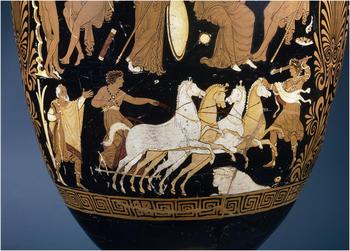
It cannot be stressed strongly enough that the ‘melodramatic’ excess with its shameless indulging of the ocular deplored in the Ars would not have been a state of affairs reached overnight. The precise pathways taken in the tortuous journey from the older to the newer are now irrecoverable, yet some faint traces of intermediary stops may have been preserved in the figurative arts. It is the splendid South Italian pottery of the fourth century BCE in particular which seems to have captured somewhere midway the trajectory from tragedy's style of implicit evocation to pantomime's mode of actual presentation. An artefact such as the Apulian vase attributed to the Darius Painter and dated in the 340s BCE, for example (Fig. 1),Footnote 110 displays side by side both the act of narrating a scene of violent death (cf. Horace's ‘eloquence of an eyewitness’) and that same narrative's ultimate effect, the emerging picture which, far from remaining a mental image only, becomes literal enough for the beholder's bodily eye to absorb and relish (the pantomime mode).Footnote 111 As if defying the a-temporality of the iconographic medium, Hippolytus’ gruesome death, the subject of a virtuosic rhēsis in Euripides’ play (Hipp. 1173–1254), unfolds on the lower iconographic register where the gesticulating figure of a ‘little old man’ seems to be pointing (pantomime's constitutive concept of deixis/ostentatio)Footnote 112 to a youth struggling to keep control of his chariot while a bull is seen emerging from beneath the horses’ front hooves. If Richard Green's reading of this category of South Italian vases is correct, the figure of the ‘little Old Man’ in the ‘Hippolytus’ volute krater as well as in some fifty-three similar funerary vessels is the iconographic pointer to the theatrical convention of the tragic messenger/actor,Footnote 113 usually the most talented member of an acting troupe.Footnote 114 His tonal and gestural register would have been able to conjure up most graphically the kind of scene unlikely to be performed in the flesh onstage, from the misadventure of a body mauled by dogs, mangled by bacchants or trampled upon by horse-hooves to rape and perverted, unnatural love to magical metamorphosis. As if offering a visual explanation of literary/rhetorical tropes and concepts such as ecphrasis and phantasia, the vase exhibits both stages involved in successful description or fertile visualisation: gripped by emotion, the gesturing figure (on the left) seems to see what he describes (stage 1) and puts it visually (on the right) before his audience's eyes (stage 2) – an audience which happens to coincide with the viewer(s) of the artefact itself. As if providing a visual translation of Longinus’ well-known passage on eidolopoeia or phantasia, the painter illustrates a situation where, under the influence of ‘enthusiasm’ (enthousiasmos) and ‘strong emotion’ (pathos), the speaker thinks he sees (βλέπειν) what he describes and puts it before his audience's eyes (ὑπ᾽ ὄψιν) (Longinus, Subl. 15.1).
Volute krater, Apulian (Greek), Puglia, Ruvo. © The Trustees of the British Museum.

A few centuries down the line from the Hippolytus vase, the construction of similarly arresting visual tableaux seems to have been canonised in the aesthetics of extreme spectacularity embedded in the pantomime mode. By Horace's time suicide, child-killing and child-eating, becoming animal or rock or tree (with their attendant somatic transformations) are the expected fare, a fabula’s climactic point, haunting or disgusting to the extent that the performer's body (as opposed to the poet's verse) is suffused with the prized pictorial qualities of clarity (saphēneia) and vividness (enargeia).Footnote 115 By the beginning of the first century CE the very thing that Horace had shunned and relegated beyond the pale of acceptability with respect to tragic decorum Ovid wholeheartedly embraced.Footnote 116 Very much like Dickens, who took enthusiastically as his narrative model ‘the custom of the stage’ obtaining ‘in all good murderous melodramas’,Footnote 117 Ovid co-opted the exuberant physicality of pantomime's live bodies in his Metamorphoses, creating a profound symbiosis between dance and literary expression, gestural poetry and the poetry of words.Footnote 118 It is here in the Metamorphoses that ‘[t]he prohibition to represent coram populo – that is, on stage – the transformation of Cadmus into a serpent (AP 187) is violated with gusto’.Footnote 119
Yet even the Metamorphoses, wherein the fully fledged visuality of pantomime's gestural narratives is palpable, falls short of the last literary mutation of classical Athenian tragedy's ‘hidden’, offstage space, namely its outright, unashamed, triumphant flipping-into-prominence that takes place in the highly sophisticated pages of the Elder Philostratus’ Imagines. As Elsner has shown, in a thematic group of ‘tragic’ ecphraseis which lead the reader back, self-consciously, to masterpieces of the Athenian tragic stage, Philostratus’
specific, and of course ironic, strategy is the persistent choice to make a picture from the tragic climax of a play that happens – in the dynamics of Greek tragedy – not to be performed on stage but recited to the audience via a messenger speech. Philostratean ecphrasis thus genuflects (especially) to Euripidean ecphrasis (in so far as Euripides’ messenger speeches bring to mind descriptively events, including objects, not seen directly on stage), while simultaneously surpassing Euripides’ failure to enact the deaths of Pentheus, Hippolytus, or the children of Heracles by offering a painting that fills the absence.Footnote 120
Where tragedy (with Horace's retrospective approbation) ‘fails’ to generate physical vision, pantomime, Ovid and Philostratus triumphantly ‘succeed’. More specifically in the case of Cadmus’ metamorphosis, whose live unfolding on the stage the Ars poetica deplores, Philostratus’ ecphrasis readily ‘fulfils in painted actuality what Euripides could only report as dramatic speech rather than show as performative action’:Footnote 121
Harmonia and Cadmus are here … they are already in the process of becoming (ἤδη … γίνονται) snakes from the thighs up, and scales are already (ἤδη) upon them. Gone are their feet, gone their hips, and the change of form is creeping upwards. (Imag. 1.18.4).
It is far from my intention to inquire whether Philostratus’ ecphrastic narratives are pantomime-inflected (though I would be greatly surprised if they were not). No less than my flash back to the fourth century BCE, my recourse to Philostratus hopes to place Horace's and pantomime's diametrically opposed aesthetic preferences within the long cross-cultural struggle between the visible and the discursive.Footnote 122 As Mitchell has taught us,
The dialectic of word and image seems to be a constant in the fabric of signs that a culture weaves around itself. What varies is the precise nature of the weave, the relation of warp and woof. The history of culture is in part the story of a protracted struggle for dominance between pictorial and linguistic signs, each claiming for itself certain proprietary rights on a ‘nature’ to which only it has access.Footnote 123
A veritable gulf separates the ‘indirect’ or ‘virtual’ seeingFootnote 124 offered to the spectator of classical Athenian tragedy and idolised in Aristotelian/Peripatetic aesthetics from the ‘physical’ seeing of post-classical expressive idioms. Unless we acknowledge the seismic order of the ‘turn’,Footnote 125 we run the risk of underestimating how large it may have loomed in Horace's thought.Footnote 126 If, on the other hand, we are minded to look harder for the shadowy imprint of the subliterary on our elite texts, we may be able to obtain a much richer spectrum of possible yet otherwise unsuspected readings as a result. The effort is, this paper has argued, entirely worthwhile, especially if it contributes to, as Peter Wiseman has put it,Footnote 127 ‘discourag[ing] dogmatism about what could or could not be shown on a Roman stage’.Footnote 128