1 Introduction
Given a subset
$\mathcal {F}\subset \mathrm {Homeo}(\mathbb {S}^1 )$
 , we study the random dynamical system (RDS) associated with
$\mathcal {F}$
 and the action on the circle of the semigroup
$G_{\mathcal {F}}$
 generated by
$\mathcal {F}$
 . While the action of the group generated by
$\mathcal {F}$
 has been extensively studied, the semigroup action considered here requires a different approach; see, for instance, [Reference AntonovAnt84, Reference Deroin, Kleptsyn and NavasDKN07, Reference NavasNav11]. Throughout this paper, we assume that there is no Borel probability measure that is invariant under all maps in
$\mathcal {F}$
 . In particular, there is no finite
$\mathcal {F}$
 -invariant set. Since all measures considered here are Borel probability measures, we simply call them measures. By [Reference MalicetMal17, Proposition 4.8], there exists an integer d, depending only on
$\mathcal {F}$
 , such that every RDS associated with
$\mathcal {F}$
 has exactly d ergodic stationary measures. The supports of these measures are pairwise disjoint and coincide with the minimal invariant sets. For brevity, we use the term minimal invariant set to mean a non-empty closed
$\mathcal {F}$
 -invariant subset of
$\mathbb {S}^1$
 that is minimal with respect to inclusion. Recall that a subset
$K\subset \mathbb {S}^1$
 is
$\mathcal {F}$
 -invariant if
$f(K)\subset K$
 for every
$f\in \mathcal {F}$
 .
A stationary measure for an RDS reflects the long-term distribution of the orbits under the random system and captures the notion of probabilistic equilibrium. By compactness of
$\mathbb {S}^1$
 and continuity of the maps in the RDS, for any initial point
$x \in \mathbb {S}^1$
 , the finite-time averages of the iterates of the transfer operator applied to
$\delta _x$
 converge weakly to a stationary measure, denoted by
$m_x$
 (see [Reference FurstenbergFur63]). We describe the stationary measures that arise in this way for some
$x\in \mathbb {S}^1$
 . By the classical Birkhoff ergodic theorem, each ergodic stationary measure is obtained as such a limit for at least one orbit. The continuity of the map
$x\mapsto m_x$
 was already established in [Reference MalicetMal17]. The results of this paper describe finer properties of this map. To do this, we use the topological structure of
$\mathbb {S}^1$
 and show the existence of finite families of closed intervals such that the union over any of these families is
$\mathcal {F}$
 -invariant. This was previously established in the case where
$\mathcal {F}$
 is a finite subset of the group
$\mathrm {Homeo}^+(\mathbb {S}^1)$
 of orientation-preserving homeomorphisms, see [Reference Kleptsyn, Kudryashov and OkunevKKO18, Theorem 1.2]. In our more general context, we have the following result.
Theorem 1. Let
$\mathcal {F}\subset \mathrm {Homeo}(\mathbb {S}^1 )$
 be a subset for which there is no
$\mathcal {F}$
 -invariant measure on
$\mathbb {S}^1$
 and let
$K_1,\ldots ,K_d$
 be the minimal invariant sets. Assume that
$d\geq 2$
 . Then, there exist pairwise disjoint interval-domains
$L_1,\ldots ,L_d$
 for
$\mathcal {F}$
 such that:
-
• $\partial L_i\subset K_i\subset L_i$
 for every
$i\in \{1,\ldots ,d\}$
; and
-
• the action of $G_{\mathcal {F}}$
on each connected component of
$L_i$
is proximal.


Here, borrowing the terminology from [Reference Kleptsyn, Kudryashov and OkunevKKO18], we say that a proper non-empty subset
$L\subset \mathbb {S}^1$
 is an interval-domain for
$\mathcal {F}$
 if it is an
$\mathcal {F}$
 -invariant closed subset with finitely many connected components. We shall also use the notion of proximality, introduced by Furstenberg [Reference FurstenbergFur67]: the action of
$G_{\mathcal {F}}$
 on a subset
$A\subset \mathbb {S}^1$
 is proximal if any two points of A can be brought arbitrarily close by a suitable sequence of elements of
$G_{\mathcal {F}}$
 . See also item (e) of Theorem 5 for the precise definition of proximality in our context. Moreover, the interval-domains
$L_i$
 given by Theorem 1 are minimal with respect to inclusion among the interval-domains L for
$\mathcal {F}$
 satisfying
$ \partial L\subset K_i\subset L. $
 In particular, they are uniquely determined by the minimal invariant sets
$K_i$
 .
Now, to state the rest of our results, let us introduce some probabilistic concepts involved. For
$\mathcal {F}\subset \mathrm {Homeo}(\mathbb {S}^1 )$
 , an RDS associated with
$\mathcal {F}$
 is given by a probability measure
$\nu $
 on
$\mathrm {Homeo}(\mathbb {S}^1 )$
 such that the support of
$\nu $
 is exactly
$\mathcal {F}$
 . To be more specific, we say that
$(\mathcal {F},\nu )$
 is an RDS. The corresponding product probability space
$(\mathcal {F}^{\mathbb {N}}, \nu ^{\mathbb {N}})$
 is invariant and ergodic under the shift map
$\sigma $
 . Define the random walk
${\omega \mapsto (f^n_\omega )}$
 on the semigroup
$G_{\mathcal {F}}$
 generated by
$\mathcal {F}$
 as follows:

with the implicit notation
$\omega = (f_n)_{n \in \mathbb {N}}\in \mathcal {F}^{\mathbb {N}}$
 . We use the notation
$f^0_{\omega }=\mathrm {id}_{\mathbb {S}^1}$
 . Consider the skew-shift map

on
$\mathcal {F}^{\mathbb {N}} \times \mathbb {S}^1$
 . A probability measure
$\mu $
 on
$\mathbb {S}^1$
 is called stationary if the product measure
$\nu ^{\mathbb {N}}\otimes \mu $
 is T-invariant. When
$\nu ^{\mathbb {N}}\otimes \mu $
 is T-ergodic, we say that
$\mu $
 is an ergodic stationary measure for
$(\mathcal {F}, \nu )$
 .
As we discuss in §4, by [Reference FurstenbergFur63, Reference MalicetMal17], for an RDS
$(\mathcal {F},\nu )$
 of circle homeomorphisms without finite orbits, we have that for every x, the sequence

converges in the weak-
$*$
 topology to a probability measure
$m_x$
 on
$\mathbb {S}^1$
 , which is stationary for
$(\mathcal {F},\nu )$
 . Moreover, the map
$x\mapsto m_x$
 is continuous on
$\mathbb {S}^1$
 .
Theorem 2. Let
$(\mathcal {F},\nu )$
 be an RDS of circle homeomorphisms without finite orbits. Let d denote the number of ergodic stationary measures
$\mu _1,\ldots , \mu _{ d }$
 . For
$x\in \mathbb {S}^1$
 , consider the limit measure
$m_x$
 on
$\mathbb {S}^1$
 in the weak-
$*$
 topology of the sequence in (1). Also, consider the continuous maps
$u_1,\ldots ,u_d\colon \mathbb {S}^1\to [0,1]$
 such that

Then, for every
$x\in \mathbb {S}^1$
 ,

and for every
$i\in \{1,\ldots ,d\}$
 ,

Moreover, for every
$i\in \{1,\ldots ,d\}$
 :
-
(i) both sets $\{u_i=0\}$
and
$\{u_i=1\}$
are invariant by all
$f\in \mathcal {F}$
and can be written as a finite union of closed intervals; -
(ii) on every connected subset of $\{0<u_i<1\}$
, the function
$u_i$
is monotone, with respect to the orientation of
$\mathbb {S}^1$
; and -
(iii) if $u_i|_I\equiv C$
for some connected subset
$I\subset \mathbb {S}^1$
and
$C\in [0,1]$
, then for every
$f\in \mathcal {F}$
, there exists
$c_f\in [0,1]$
such that
$u_i|_{f(I)}\equiv c_f$
.


As a consequence of item (i), every measure
$m_x$
 is a convex combination of at most two ergodic stationary measures. In particular, if
$d>2$
 , then not every stationary measure is of the form
$m_x$
 for some
$x\in \mathbb {S}^1$
 .
For
$\mathcal {F}\subset \mathrm {Homeo}(\mathbb {S}^1 )$
 , consider
$\mathcal {F}^{-}= \{f^{-1}\colon f\in \mathcal {F}\}$
 . Also, consider
$\nu ^{-}$
 , the probability measure supported on
$\mathcal {F}^{-}$
 naturally induced by
$\nu $
 . We refer to
$(\mathcal {F}^{-},\nu ^{-})$
 as the inverse RDS of
$(\mathcal {F},\nu )$
 . The following theorem is proved in §7.
Theorem 3. Let
$(\mathcal {F},\nu )$
 be an RDS of circle homeomorphisms without finite orbits and consider its respective inverse RDS
$(\mathcal {F}^{-},\nu ^{-})$
 . Let
$d_+$
 and
$d_-$
 be the numbers of ergodic stationary measures associated with
$(\mathcal {F},\nu )$
 and
$(\mathcal {F}^{-},\nu ^{-})$
 , respectively. Then,

Moreover, if
$\mathcal {F}\subset \mathrm {Homeo}^+(\mathbb {S}^1 )$
 , then
$d_+=d_-$
 .
The bound in Theorem 3 is sharp: in Example 1, we exhibit an RDS for which the numbers of ergodic stationary measures of the RDS and of its inverse RDS differ by one.
Since
$\mathcal {F}$
 has a finite invariant set if and only if
$\mathcal {F}^-$
 has a finite invariant set, and since the number of ergodic stationary measures coincides with the number of minimal invariant sets in the present setting, we obtain the following topological consequence.
Corollary 1. Let
$\mathcal {F}\subset \mathrm {Homeo}(\mathbb {S}^1 )$
 and
$\mathcal {F}^{-}= \{f^{-1}\colon f\in \mathcal {F}\}$
 . Assume that there is no finite set invariant under each map in
$\mathcal {F}$
 simultaneously. Let
$d_+$
 and
$d_-$
 be the numbers of
$\mathcal {F}$
 -minimal sets and
$\mathcal {F}^-$
 -minimal sets, respectively. Then,

Moreover, if
$\mathcal {F}\subset \mathrm {Homeo}^+(\mathbb {S}^1 )$
 , then
$d_+=d_-$
 .
The paper is organized as follows. We begin, in §3, by discussing the topological properties of the minimal sets of the semigroup
$G_{\mathcal {F}}$
 . In §4, we prove part of Theorem 2, which can be compared with Theorem 4. In §5, we present results that are used to complete the proof of Theorem 2. We also introduce the notions of neighbors and paths in §5. In §6, we discuss the notion of proximality and construct non-trivial intervals on which the action is proximal. A proof of Theorem 1 is given in §6. Finally, in §7, we study the inverse RDS and prove Theorem 3.
2 Basic notation
Throughout the paper, the circle
$\mathbb {S}^1$
 is endowed with its counterclockwise orientation. We denote by
$\mathcal {R} \subset (\mathbb {S}^1)^3$
 the canonical ternary cyclic order induced by this orientation: for pairwise distinct points
$a,b,c\in \mathbb {S}^1$
 , we write
$[a,b,c]\in \mathcal {R} $
 if, starting from a and moving counterclockwise along
$\mathbb {S}^1$
 , one meets b before c.
For
$n\geq 3$
 , we endow the set
$\{1,\ldots ,n\}$
 with its natural cyclic order: for pairwise distinct indices
$i,j,k\in \{1,\ldots ,n\}$
 , we write
$[i,j,k]_{\mathrm {cyc}}$
 if, starting from i and moving in the order

one meets j before k.
An ordered n-tuple
$(x_1,\ldots ,x_n)\in (\mathbb {S}^1)^n$
 is said to be circularly ordered if the points
$x_1,\ldots ,x_n$
 are pairwise distinct and the map

preserves the cyclic order, that is,

for every triple of pairwise distinct indices
$i,j,k\in \{1,\ldots ,n\}$
 . Equivalently, the points appear in the order
$x_1\to x_2\to \cdots \to x_n\to x_1$
 as the circle is traversed counterclockwise.
We extend the same terminology to finite families of subsets of the circle. Let
$n\geq 3$
 . An ordered n-tuple
$(A_1,\ldots ,A_n)$
 of pairwise disjoint subsets of
$\mathbb {S}^1$
 is called circularly ordered if, for every choice of points
$x_i\in A_i$
 ,
$i=1,\ldots ,n$
 , the tuple
$(x_1,\ldots ,x_n)$
 is circularly ordered.
Given two distinct points
$a,b\in \mathbb {S}^1$
 , the open interval, or open arc, from a to b is

The corresponding closed interval is

and we use the convention
$[a,a]=\{a\}$
 .
If
$a\neq b$
 , the interval
$[a,b]$
 carries the natural order induced by cutting the circle at a. Namely, for two distinct points
$x,y\in [a,b]$
 , we write
$x<_{[a,b]}y$
 if either
$x=a$
 or
$[a,x,y]\in \mathcal {R} $
 . We also write
$x\leq _{[a,b]}y$
 if
$x=y$
 or
$x<_{[a,b]}y$
 . When the interval is clear from the context, we simply write
$x<y$
 and
$x\leq y$
 . The same convention will be used on open intervals: if
$x,y\in (a,b)$
 , then
$x<y$
 whenever
$ [a,x,y]\in \mathcal {R} .$

Finally, let
$I\subset \mathbb {S}^1$
 be an interval of the form
$[a,b]$
 or
$(a,b)$
 , with
$a\neq b$
 , endowed with the order defined above. A map
$f\in \mathrm {Homeo}(\mathbb {S}^1 )$
 is said to be monotone increasing on I if
$x<y$
 implies
$f(x)\leq f(y)$
 for all
$x,y\in I$
 . Similarly, f is said to be monotone decreasing on I if
$x<y$
 implies
$f(y)\leq f(x)$
 for all
$x,y\in I$
 . We say that f is monotone on I if it is either monotone increasing or monotone decreasing on I.
3 Minimal invariant sets
The results in this section are purely topological and rely on the order structure of the circle. Let
$\mathcal {F}\subset \mathrm {Homeo}(\mathbb {S}^1 )$
 and let
$\mathcal {K}_{\mathcal {F}}$
 be the collection of
$\mathcal {F}$
 -minimal invariant sets.
For
$x\in \mathbb {S}^1$
 , its
$\mathcal {F}$
 -orbit is defined as

where
$G_{\mathcal {F}}$
 denotes the semigroup generated by
$\mathcal {F}$
 .
The main result of this section is the following.
Proposition 1. Assume that
$\mathcal {F}\subset \mathrm {Homeo}(\mathbb {S}^1 )$
 and that the collection
$\mathcal {K}_{\mathcal {F}}$
 of
$\mathcal {F}$
 -minimal invariant sets is finite. Then, for every
$x\in \mathbb {S}^1$
 , there exist
$K_1,K_2\in \mathcal {K}_{\mathcal {F}}$
 , not necessarily distinct, such that

Remark 1. In Proposition 1, we assume that there are finitely many minimal invariant sets, as this is the case needed in the following. However, this assumption can be dropped. Indeed, the existence of finite
$\mathcal {F}$
 -orbits provides enough order structure to control the minimal invariant sets that may be met by the closure of a given orbit: such an orbit can accumulate only on the minimal invariant sets adjacent to it in the circular order. Therefore, the conclusion of Proposition 1 remains valid without assuming that the number of minimal invariant sets is finite.
We now prove Proposition 1 in the finite case by describing the interval-domains determined by the minimal invariant sets.
Assume from now on that
$\mathcal {K}_{\mathcal {F}}=\{K_1,\ldots ,K_d\}$
 is finite. If
$d=1$
 , we set
$D_K=\mathbb {S}^1$
 for the unique element
$K\in \mathcal {K}_{\mathcal {F}}$
 . If
$d>1$
 , then, for each
$K\in \mathcal {K}_{\mathcal {F}}$
 , we define the K-admissible interval-domain
$D_K$
 as the union of all closed intervals
$[a,b]\subset \mathbb {S}^1$
 such that

In particular,
$K\subset D_K$
 .
Before proving Proposition 1, let us establish some topological results.
Lemma 1. Assume that
$\mathcal {F}\subset \mathrm {Homeo}(\mathbb {S}^1 )$
 and that
$\mathcal {K}_{\mathcal {F}}$
 is a finite family. Then, for every
$K\in \mathcal {K}_{\mathcal {F}}$
 , its domain
$D_K$
 is a finite union of closed intervals.
Proof. The case
$d=1$
 is immediate. Assume
$d>1$
 , fix
$K\in \mathcal K_{\mathcal F}$
 , and set

Since the minimal invariant sets are pairwise disjoint and compact,

By definition,
$\mathbb {S}^1\setminus D_K$
 is the union of the components
$I$
 of
$\mathbb {S}^1\setminus K$
 that meet
$K^{*}$
 . Each such component has length at least
$\delta $
 . Hence, since these components are pairwise disjoint and
$\mathbb {S}^1$
 has finite length, there are only finitely many of them. Therefore,
$D_K$
 is a finite union of closed intervals.
For each
$K\in \mathcal {K}_{\mathcal {F}}$
 , let
$\ell _K\in \mathbb {N}$
 be the number of connected components of
$D_K$
 . We write

where the intervals are indexed according to the circular order in such a way that

with the convention that
$x_{K,\ell _K+1}=x_{K,1}$
 .
Lemma 2. Assume that
$\mathcal {F}\subset \mathrm {Homeo}(\mathbb {S}^1 )$
 and
$\mathcal {K}_{\mathcal {F}}$
 is finite. Then, for all
$K\in \mathcal {K}_{\mathcal {F}}$
 ,
${j\in \{1,\ldots ,\ell _K\}}$
 , and
$f\in \mathcal {F}$
 , there is
$k_j,r_j\in \{1,\ldots ,\ell _K\}$
 such that
$f(I_{K,j})\subset I_{K,k_j}$
 and
$f(I_{K,r_j})\subset I_{K,j}$
 .
Proof. Consider
$f\in \mathcal {F}$
 and
$K\in \mathcal {K}_{\mathcal {F}}$
 . Since
$K\subset D_K$
 , by the
$\mathcal {F}$
 -invariance of K,

for all
$j=1,\ldots ,\ell _K$
 . If
$\ell _K=1$
 , the conclusion is immediate with
$k_1=r_1=1$
 .
Assume
$\ell _K>1$
 . For
$j=1,\ldots ,\ell _K$
 , there exist
$k_j^-,k_j^+\in \{1,\ldots ,\ell _K\}$
 such that
$f(x_{K,j})\in I_{K,k_j^-}$
 and
$f(y_{K,j})\in I_{K,k_j^+}$
 . By definition, for all

with
$b\neq y_{K,j}$
 ,
$a\neq x_{K,j}$
 , we have that both intervals
$[a,x_{K,j}]$
 and
$[y_{K,j},b]$
 intersect
$\bigcup _{K'\in \mathcal {K}_{\mathcal {F}}\backslash \{K\}}K$
 . Indeed, for some
$i=1,\ldots ,\ell _K$
 , we have
$[y_{K,i},x_{K,j}]\subset [a,x_{K,j}]$
 and
$[y_{K,j},x_{K,i}]\subset [y_{K,j},b]$
 . By
$\mathcal {F}$
 -invariance, the intervals
$f([a,x_{K,j}])$
 and
$f([y_{K,j},b])$
 also intersect
$\bigcup _{K'\in \mathcal {K}_{\mathcal {F}}\setminus \{K\}}K'$
 . In particular, for all
$I\in \{I_{K,j}\}_{j=1}^{\ell _K}$
 ,
$f([a,x_{K,j}])\not \subset I$
 and
$f([y_{K,j},b])\not \subset I$
 . Therefore, for all
$i,j\in \{1,\ldots ,\ell _K\}$
 ,
$i\neq j$
 ,

and so,

So, we must necessarily have equality
$k_j^-=k_j^+$
 for all
$j=1,\ldots ,\ell _K$
 . Thus, for each j, the image
$f(I_{K,j})$
 is contained in some component
$I_{K,k_j}$
 . Since the map
$j\mapsto k_j$
 is a permutation of
$\{1,\ldots ,\ell _K\}$
 , for every j, there exists
$r_j$
 such that
$k_{r_j}=j$
 . Hence,
$f(I_{K,r_j})\subset I_{K,j}$
 .
Lemma 3. Assume that
$\mathcal {F}\subset \mathrm {Homeo}(\mathbb {S}^1 ) $
 and
$\mathcal {K}_{\mathcal {F}}$
 is finite. Let
$K_1,K_2\in \mathcal {K}_{\mathcal {F}}$
 . Let
$y_1\in K_1$
 and
$x_2\in K_2$
 be such that
$(y_1,x_2)\cap K=\emptyset $
 for all
$K\in \mathcal {K}_{\mathcal {F}}$
 . Then, for every
$f\in \mathcal {F}$
 and
$K\in \mathcal {K}_{\mathcal {F}}\backslash \{K_1,K_2\}$
 , we have
$f([y_1,x_2])\cap K=\emptyset $
 .
Proof. Consider
$K_1,K_2\in \mathcal {K}_{\mathcal {F}}$
 ,
$y_1\in K_1$
 , and
$x_2\in K_2$
 be such that
$(y_1,x_2)\cap K=\emptyset $
 for all
$K\in \mathcal {K}_{\mathcal {F}}$
 . Let us proceed by contradiction. Given
$f\in \mathcal {F}$
 , if
$f([y_1,x_2])\cap K\neq \emptyset $
 for some
$K\in \mathcal {K}_{\mathcal {F}}\backslash \{K_1,K_2\}$
 , then there exists a connected component I of
$D_K$
 (that is,
${I\in \{I_{K,j}\}_{j=1}^{\ell _K}}$
 ) such that
$I\subset f([y_1,x_2])$
 . By Lemma 2, there exists
$J\in \{I_{K,j}\}_{j=1}^{\ell _K}$
 such that
$f(J)\subset I\subset f([y_1,x_2])$
 . Since f is a homeomorphism,
$J\subset [y_1,x_2]$
 . Hence,
$(y_1,x_2)\cap K\neq \emptyset $
 , which contradicts the hypotheses. The lemma is proven.
Finally, we are ready to prove Proposition 1.
Proof of Proposition 1.
Let
$x\in \mathbb {S}^1$
 . If
$x\in K$
 , for some
$K\in \mathcal {K}_{\mathcal {F}}$
 , it is clear that for all
$\omega \in \mathcal {F}^{\mathbb {N}}$
 ,
$f_{\omega }^n(x)\in K$
 for all
$n\in \mathbb {N}$
 . Hence, the proposition follows by taking
${K_1=K_2=K}$
 . If
$x\notin \bigcup _{K\in \mathcal {K}_{\mathcal {F}}} K$
 , there exist
$K_1$
 ,
$K_2\in \mathcal {K}_{\mathcal {F}}$
 and
$y_1\in K_1$
 ,
$x_2\in K_2$
 , such that
${(y_1,x)\cap K=(x,x_2)\cap K=\emptyset }$
 for all
$K\in \mathcal {K}_{\mathcal {F}}$
 . By Lemma 3, we get that for all
${f\in \mathcal {F}}$
 ,
$f(y_1,x_2)\cap K=\emptyset $
 for all
$K\in \mathcal {K}_{\mathcal {F}}\backslash \{K_{1},K_{2}\}$
 . Therefore, the cluster set of the sequence
$(f_\omega ^n(x))_{n\in \mathbb {N}}$
 does not intersect any
$K\in \mathcal {K}_{\mathcal {F}}\backslash \{K_{1},K_{2}\}$
 . The proposition is proven.
4 Weight maps
Throughout this section,
$(\mathcal {F},\nu )$
 is an RDS of circle homeomorphisms without finite orbits. Let
$K_1,\ldots , K_{ d }$
 be the corresponding topological supports of the ergodic stationary measures
$\mu _1,\ldots ,\mu _d$
 . In our context,
$\mathcal {K}_{\mathcal {F}}=\{K_1,\ldots , K_{ d }\}$
 is the collection of the closed
$\mathcal {F}$
 -minimal invariant sets.
The random process
$(X_n)_{n\geq 0}$
 defined by

with
$\omega =(f_n)_{n\in \mathbb {N}}\in \mathcal {F}^{\mathbb {N}}$
 and
$X_0$
 being a random variable taking values in
$\mathbb {S}^1$
 , is a Markov chain on the probability space
$(\mathcal {F}^{\mathbb {N}},\nu ^{\mathbb {N}})$
 with state space
$\mathbb {S}^1$
 . By compactness of
$\mathbb {S}^1$
 , we can apply [Reference FurstenbergFur63, Lemma 2.5] to conclude that, for every
$x\in \mathbb {S}^1$
 , every weak-
$*$
 cluster point of the sequence of probability measures in (1) is a stationary probability measure for the RDS. In particular, when
$d=1$
 , for each
$x\in \mathbb {S}^1$
 , the sequence in (1) converges to the unique stationary measure in the weak-
$*$
 topology.
Define the weight maps
$u_i:\mathbb {S}^1\to [0,1]$
 ,
$1\leq i \leq d $
 , by

where for a set
$A\subset \mathbb {S}^1$
 ,
$\mathrm {cl}(A)$
 denotes the set of cluster values of A. By invariance of the sets in
$\mathcal {K}_{\mathcal {F}}$
 , we have
$u_i = \delta _{i,j}$
 on
$K_j$
 . By [Reference MalicetMal17, Proposition 4.9], for every
$x\in \mathbb {S}^1$
 ,

and

where
$f_\omega ^0(x)=x$
 . Moreover, for every
$x\in \mathbb {S}^1$
 , the sequence in (1) converges in the weak-
$*$
 topology to the probability measure
$m_x$
 appearing in Theorem 2.
The weight maps also satisfy the following invariance property:

Lemma 4. Let
$(\mathcal {F},\nu )$
 be an RDS of circle homeomorphisms without finite orbits. Let d be the number of ergodic stationary measures and consider the weight maps
$u_i$
 ,
$i=1,\ldots ,d$
 as in (2). Then, for all
$i\in \{1,\ldots ,d\}$
 , the sets

are
$\mathcal {F}$
 -invariant.
Proof. Let us show the
$\mathcal {F}$
 -invariance of
$\{u_i=1\}$
 . For
$\{u_i=0\}$
 , the proof is analogous. We need to prove that for all
$f\in \mathcal {F}$
 ,

In fact, using (4), for x such that
$u_i(x)=1$
 , we get

Since
$0\leq u_i\leq 1$
 , we get
$u_i(f(x))=1$
 for
$\nu $
 -almost every
$f\in \mathcal {F}$
 . Using the continuity of
$u_i$
 and the fact that the support of
$\nu $
 is exactly
$\mathcal {F}$
 , we get
$u_i(f(x))=1$
 for all
$f\in \mathcal {F}$
 and so (5) holds.
Let us establish a first result using what we discussed in §3.
Proposition 2. Let
$(\mathcal {F},\nu )$
 be an RDS of circle homeomorphisms without finite orbits. Let d be the number of ergodic stationary measures. Let
$\mathcal {K}_{\mathcal {F}}=\{K_1,\ldots , K_{ d }\}$
 be the collection of the closed
$\mathcal {F}$
 -minimal invariant sets. Consider
$u_i$
 as in (2) for
${i=1,\ldots ,d}$
 . Then, for every
$x\in \mathbb {S}^1$
 , there exist
$i_1,i_2\in \{1,\ldots ,d\}$
 ,
$x_1\in K_{i_1}$
 ,
$x_2\in K_{i_2}$
 , such that
${x\in [x_1,x_2]}$
 , and for all
$j\in \{1,\ldots ,d\}\backslash \{i_1,i_2\}$
 , we have
$u_j(x)=0$
 and
${[x_1,x_2]\cap K_j=\emptyset }$
 .
Proof. When
$d=1$
 , the result is evident by taking
$i_1=i_2=1$
 for all
$x\in \mathbb {S}^1$
 because
$u_1\equiv 1$
 . Now, consider
$d\geq 2$
 . Since the collection
$\mathcal {K}_{\mathcal {F}}=\{K_1,\ldots , K_{ d }\}$
 of the closed
$\mathcal {F}$
 -minimal invariant sets is a finite set, we can apply Proposition 1 to get that for every
$x\in \mathbb {S}^1$
 , there exist
$i_1,i_2\in \{1,\ldots ,d\}$
 such that for all
$\omega \in \mathcal {F}^{\mathbb {N}}$
 , the cluster set of the sequence
$(f_\omega ^n(x))_{n\in \mathbb {N}}$
 does not intersect any element of
$\mathcal {K}_{\mathcal {F}}\backslash \{K_{i_1},K_{i_2}\}$
 . In particular, we can find
$x_1\in K_{i_1}$
 ,
$x_2\in K_{i_2}$
 , such that
$x\in [x_1,x_2]$
 and
$[x_1,x_2]\cap K_j=\emptyset $
 for all
$j\in \{1,\ldots ,d\}\backslash \{i_1,i_2\}$
 . By (3), using the definition of the maps
$u_i$
 , we get that
$u_{i_1}(x)+u_{i_2}(x)=1$
 (case
$i_1\neq i_2$
 ) or
$u_{i_1}(x)=1$
 (case
$i_1= i_2$
 ). Hence,
$u_j(x)=0$
 for all
${j\in \{1,\ldots ,d\}\backslash \{i_1,i_2\}}$
 .
The main result of this section establishes more precisely the properties of the collections of closed intervals mentioned in Theorem 2. Beyond this, we show that if i and j are neighbors (see §5 for a definition), then the functions
$u_i$
 and
$u_j$
 are monotone on any interval contained in
$\{u_i>0\}\cap \{u_j>0\}$
 .
Before stating the next theorem, let us fix some notation. For each
$i\in \{1,\ldots ,d\}$
 , we denote by
$D_i$
 the
$K_i$
 -admissible interval-domain defined in §3. Thus,
$D_i$
 is the maximal subset of
$\mathbb S^1$
 that can be written as a union of closed intervals with endpoints in
$K_i$
 and is disjoint from
$K_j$
 for every
$j\neq i$
 .
We shall also use the following consequence of the definition of the weight maps:

Indeed,
$K_i\subset D_i$
 by the definition of
$D_i$
 , whereas the inclusion
$D_i\subset \{u_i=1\}$
 follows from Lemma 2 and the equality in (3).
Theorem 4. Let
$(\mathcal F,\nu )$
 be an RDS of circle homeomorphisms without finite orbits. Let d be the number of ergodic stationary measures and let
$K_1,\ldots ,K_d$
 be the corresponding topological supports of these measures. For
$i=1,\ldots ,d$
 , let
$u_i$
 be the weight map defined in (2).
Then, for every
$i\in \{1,\ldots ,d\}$
 , we have the following.
-
(a) The set $ \{u_i=1\} $
has finitely many connected components. -
(b) If I is a connected component of $\{u_i=1\}$
and
$f\in \mathcal F$
, then
$f(I)$
is contained in a connected component of
$\{u_i=1\}$
. -
(c) If I and J are two distinct connected components of $\{u_i=1\}$
, and if
$x\in I$
,
$y\in J$
, then both connected intervals
$[x,y]$
and
$[y,x]$
in
$\mathbb S^1$
intersect
$ \bigcup _{j\neq i}K_j. $


Moreover, assume that
$d\geq 2$
 . Let
$i,j\in \{1,\ldots ,d\}$
 ,
$i\neq j$
 . Let I be a connected component of
$\{u_i=1\}$
 and let J be a connected component of
$\{u_j=1\}$
 . Suppose that there exist
$y_i\in I\cap K_i$
 and
$x_j\in J\cap K_j$
 such that

Then,
$u_i$
 is monotone decreasing on
$[y_i,x_j]$
 and
$u_j$
 is monotone increasing on
$[y_i,x_j]$
 .
Remark 2. Note that
$(y_i,x_j)\subset \{u_i>0\}\cap \{u_j>0\}$
 . Moreover, the set
$\{u_i>0\}\,\cap \, \{u_j>0\}$
 is a finite union of open intervals with an extremal point in
$\{u_i=1\}$
 and the other extremal point in
$\{u_j=1\}$
 .
Proof of Theorem 4.
When
$d=1$
 , the result is immediate, since
$ \{u_1=1\}=\mathbb {S}^1. $
 Thus, assume that
$d\geq 2$
 .
Fix
$i\in \{1,\ldots ,d\}$
 . Recall that
$u_i:\mathbb {S}^1\to [0,1]$
 is continuous. Hence, the proof that
$ \{u_i=1\} $
 is a finite union of closed intervals is analogous to the proof of Lemma 1. This proves item (a).
To prove item (b), we use the
$\mathcal {F}$
 -invariance of
$\{u_i=1\}$
 established in Lemma 4. The conclusion then follows by arguing analogously to the proof of Lemma 2.
Finally, item (c) follows from Lemma 3 and the fact that every connected component of
$\{u_i=1\}$
 intersects
$K_i$
 .
To prove the second part of Theorem 4, consider
$i,j\in \{1,\ldots ,d\}$
 ,
$i\neq j$
 and
${I=[x_i,y_i]\subset \{u_i=1\}}$
 ,
$J=[x_j,y_j]\subset \{u_j=1\}$
 such that

By Proposition 2, for
$x\in [y_i,x_j]$
 , we have
$u_i(x)+u_j(x)=1$
 . Let us show that
$u_i$
 is a monotone decreasing function on
$[y_i,x_j]$
 . Note that for
$f\in \mathcal {F}$
 , there exist
${I(f)=[x_i(f),y_i(f)]\subset \{u_i=1\}}$
 ,
$J(f)=[x_j(f),y_j(f)]\subset \{u_j=1\}$
 such that
${f(I)\subset I(f)}$
 ,
$f(J)\subset J(f)$
 , and

The last fact will depend on whether f preserves orientation or not. Therefore, for
${x\in [y_i,x_j]}$
 and
$\omega \in \mathcal {F}^{\mathbb {N}} $
 such that
$\mathrm {cl}((f_\omega ^n(x))_{n \geq 0})=K_i$
 , we get that for all
$y\in [y_i,x]$
 , we also have
$\mathrm {cl}((f_\omega ^n(y))_{n \geq 0})=K_i$
 . Hence,

for every
$x\in [y_i,x_j]$
 and
$y\in [y_i,x]$
 . Consequently, for
$x,y\in [y_i,x_j]$
 ,
$( y_i,x,y,x_j)$
 is circularly ordered, we have that

This implies the desired conclusion. The monotonicity of
$u_j$
 is an immediate consequence of
$u_i+u_j=1$
 on
$[y_i,x_j]$
 .
Let us prove item (iii) in Theorem 2 as a corollary of Theorem 4.
Corollary 2. Let
$(\mathcal {F},\nu )$
 be an RDS of circle homeomorphisms without finite orbits. Let d be the number of ergodic stationary measures. Consider
$u_i$
 as in (2) for
$i=1,\ldots ,d$
 . If
$u_i|_I\equiv C$
 for some interval
$I\subset \mathbb {S}^1$
 and
$C\in [0,1]$
 , then for every
$f\in \mathcal {F}$
 , there exists
$c_f\in [0,1]$
 such that
$u_i|_{f(I)}\equiv c_f$
 .
Proof. Consider
$i\in \{1,\ldots ,d\}$
 and
$I=[a,b]$
 such that
$u_i|_I\equiv C$
 for some
$C\in [0,1]$
 . By Lemma 4, when
$C\in \{0,1\}$
 , it is enough to consider
$c_f=C$
 for all
$f\in \mathcal {F}$
 .
Assume
$C\in (0,1)$
 . Since
$C<1$
 ,
$I\cap K_j=\emptyset $
 for all
$j\in \{1,\ldots ,d\}$
 . Take
$i_1,i_2\in \{1,\ldots ,d\}$
 ,
$i_1\neq i_2$
 ,
$x_1\in K_{i_1}$
 ,
$x_2\in K_{i_2}$
 such that
$I\subset [x_1,x_2]$
 , and for all
$j\in \{1,\ldots ,d\}$
 ,

Since
$C>0$
 , either
$i_1=i$
 or
$i_2=i$
 . Consider
$c_1,c_2>0$
 such that
$c_1+c_2=1$
 ,
${u_{i_1}|_I=c_1}$
 , and
$u_{i_2}|_I=c_2$
 . By the invariance of the weight maps in (4), we get for
$x,y\in I$
 ,
$x\leq y$
 ,

By the continuity of the maps in
$\mathcal {F}$
 and the argument leading to (6), for all
$f\in \mathcal {F}$
 , we have

By (7) and (8), we get that for
$\nu $
 -almost every
$f\in \mathcal {F}$
 ,

that is,
$u_{i_1}(f(x))=u_{i_1}(f(y))$
 . By the continuity of
$u_{i_1}$
 and the fact that
$\nu $
 is supported on
$\mathcal {F}$
 , we conclude
$u_{i_1}(f(x))=u_{i_1}(f(y))$
 for all
$f\in \mathcal {F}$
 . Since x and y are arbitrary in I, we get
$u_{i_1}|_{f(I)}=c_{1,f}$
 for some
$c_{1,f}\in [0,1]$
 . Analogously, we can show that for all
$f\in \mathcal {F}$
 , we have
$u_{i_2}|_{f(I)}=c_{2,f}=1-c_{1,f}$
 . To conclude this demonstration, it only remains to consider
$c_f=c_{k,f}$
 for all
$f\in \mathcal {F}$
 and
$k\in \{1,2\}$
 such that
$i=i_k$
 .
We say that a finite set
$P=\{x_0,x_1,\ldots ,x_{n_P}\}$
 ,
$n_P\geq 2$
 is a partition of
$\mathbb {S}^1$
 if
${x_{n_P}=x_0}$
 ,
$x_i\neq x_{i+1}$
 , and P appears in the order
$x_1 \to x_2 \to \cdots \to x_{n_P}$
 when traversing the circle
$\mathbb {S}^1$
 counterclockwise. In particular, when
$n_P\geq 2$
 , we have that
$( x_1,\ldots ,x_{n_P})$
 and
$( x_0, x_1,\ldots ,x_{n_P-1})$
 are circularly ordered. When
$n_P=2$
 , P is a set of the form
$\{a,b,a\}$
 with
$a\neq b$
 . Let
$\mathcal {P}$
 denote the set of partitions P of
$\mathbb {S}^1$
 .
The total variation of a real-valued function
$\varphi :\mathbb {S}^1\to \mathbb {R}$
 , defined on
$\mathbb {S}^1$
 , is the quantity

A function
$\varphi :\mathbb {S}^1\to \mathbb {R}$
 is said to be of bounded variation (BV function) on
$\mathbb {S}^1$
 if its total variation is finite.
From Theorem 4, we can conclude the bounded variation of the weight maps using their continuity.
Corollary 3. Let
$(\mathcal {F},\nu )$
 be an RDS of circle homeomorphisms without finite orbits. Let d be the number of ergodic stationary measures. Then, for
$i=1,\ldots ,d$
 , the map
$u_i$
 defined by (2) has bounded variation.
Proof. If
$d=1$
 , the corollary follows easily because
$u_1$
 is constant, implying that
${V(u_1)=0}$
 . Assume
$d\geq 2$
 and take
$i\in \{1,\ldots ,d\}$
 . By Theorem 4, we can find a circularly ordered tuple
$( a_0,a_1,\ldots ,a_m)$
 , with
$m=4k-1$
 for some
$k\in \mathbb {N}$
 such that for
${j=1,\ldots ,k}$
 :
-
• $u_i=1$
on
$[a_{4j-4},a_{4j-3}]$
; -
• $u_i$
is monotone decreasing on
$[a_{4j-3},a_{4j-2}]$
; -
• $u_i=0$
on
$[a_{4j-2},a_{4j-1}]$
; and -
• $u_i$
is monotone increasing on
$[a_{4j-1},a_{4j}]$
, where
$a_{4k}=a_0$
.


Therefore, for any
$P\in \mathcal {P}$
 , the sum

can be separated into
$m+1=4k$
 sums with half of them being 0 and the other half (corresponding to the monotonicity intervals of
$u_i$
 ) being telescopic sums. Thus, using
$0\leq u_i\leq 1$
 ,

Since k does not depend on the partition P, we can conclude the bounded variation of
$u_i$
 .
5 Neighbors
Throughout this section, we use the notation introduced in §4. For
$i,j\in \{1,\ldots ,d\}$
 , we say that i and j are neighbors if
$\{u_i>0\}\cap \{u_j>0\}\neq \emptyset $
 . See Lemma 6 for a non-trivial upper bound on the number of neighbors for i. Define

as the set of pairs
$(i,j)$
 such that i and j are neighbors. That is,
$(i,j)\in \mathcal {E}$
 if and only if there is
$x\in \mathbb {S}^1$
 such that
$u_i(x)>0$
 and
$u_j(x)>0$
 .
Define
$\mathcal {S}_{\nu }$
 as the collection of stationary measures that are weak-
$*$
 limits of the sequence (1) for some
$x\in \mathbb {S}^1$
 .
Using the topological facts shown in §3, let us prove the following results, which immediately imply the first part of Theorem 2.
Lemma 5. Let
$(\mathcal {F},\nu )$
 be an RDS of circle homeomorphisms without finite orbits. Let d be the number of ergodic stationary measures
$\mu _1,\ldots , \mu _{ d }$
 . Then,

Proof. Let
$K_i=\operatorname {supp}(\mu _i)$
 ,
$i=1,\ldots ,d$
 . We first prove the inclusion

Take
$x\in \mathbb {S}^1$
 . By [Reference MalicetMal17, Proposition 4.11], the sequence in (1) converges in the weak-
$*$
 topology to
$ m_x=\sum _{i=1}^d u_i(x)\mu _i. $
 Since for every
$n\geq 0$
 , the support of the n-step transition measure starting from x is contained in
$\mathcal O_{\mathcal {F}}(x)$
 , we must have

If
$u_i(x)>0$
 , then
$K_i\subset \operatorname {supp}(m_x)$
 . Consequently,
$ K_i\subset \overline {\mathcal O_{\mathcal {F}}(x)}. $
 Thus, every minimal set
$K_i$
 with positive weight
$u_i(x)$
 intersects
$\overline {\mathcal O_{\mathcal {F}}(x)}$
 . By Proposition 1, the set
$\overline {\mathcal O_{\mathcal {F}}(x)}$
 can intersect at most two minimal sets. Therefore, at most two coefficients in the convex decomposition of
$m_x$
 are non-zero. It follows that, for each
$x\in \mathbb {S}^1$
 ,

for some
$t\in [0,1]$
 and some pair
$(i,j)\in \mathcal {E}$
 . Hence,

Since, by definition, every element of
$\mathcal {S}_{\nu }$
 is of the form
$m_x$
 for some
$x\in \mathbb {S}^1$
 , we obtain the inclusion in (10).
We now prove the reverse inclusion. Let
$(i,j)\in \mathcal {E}$
 . If
$i=j$
 , by the Birkhoff ergodic theorem, we have
$\mu _i\in \mathcal {S}_{\nu }$
 . Let us assume
$i\neq j$
 .
By the definition of
$\mathcal {E}$
 , there exists a point
$x\in \mathbb {S}^1$
 such that
$ \overline {\mathcal O_{\mathcal {F}}(x)} $
 intersects both
$K_i$
 and
$K_j$
 . Moreover, by Proposition 1, there is no
$l\in \{1,\ldots ,d\}\backslash \{i,j\}$
 such that
$ \overline {\mathcal O_{\mathcal {F}}(x)} $
 intersects
$K_l$
 . Take
$x_i\in K_i$
 and
$x_j\in K_j$
 such that
$x\in (x_i,x_j)$
 and
$(x_i,x_j)\cap K=\emptyset $
 for
$K\in \{K_1,\ldots ,K_d\}\backslash \{K_i,K_j\}$
 . By the continuity of the weight maps, we must have for all
$t\in [0,1]$
 ,

Combining both inclusions, we obtain the desired equality.
Now, for
$i\in \{1,\ldots ,d\}$
 , consider

If
$d=1$
 , it is clear that
$V_1=\emptyset $
 . Let us establish the following property of the sets
$V_i$
 ,
$i=1,\ldots ,d$
 , which will be key to completing the second inequality in Theorem 2.
Lemma 6. Let
$(\mathcal {F},\nu )$
 be an RDS of circle homeomorphisms without finite orbits. Let d be the number of ergodic stationary measures. Let
$\mathcal {K}_{\mathcal {F}}=\{K_1,\ldots , K_{ d }\}$
 be the collection of the closed
$\mathcal {F}$
 -minimal invariant sets. Consider
$u_i$
 as in (2) for
$i=1,\ldots ,d$
 . If
$d\geq 2$
 , then for all
$i=1,\ldots ,d$
 ,

where
$V_i$
 is as in (11). Moreover,

Proof of (12).
Assume
$d\geq 2$
 . For
$i=1,\ldots ,d$
 , let
$\mathcal A_i$
 be the collection of connected components of
$D_{K_i}$
 . Fix
$i=1,\ldots ,d$
 . Note that there exists
$j\neq i$
 such that

From the continuity of the weight maps, we can conclude that
$j\in V_i$
 . Hence,
$\# V_i\geq 1$
 .
Now, let us show that
$\# V_i\leq 2$
 . Take
$j\in V_i$
 and consider
$I'=[a_i',b_i']\in \mathcal {A}_i$
 and
${J'=[a_j',b_j']\in \mathcal {A}_j}$
 such that:
-
• $(b_i',a_j')\cap A=\emptyset $
for all
$A\in \bigcup _{k}\mathcal {A}_k$
; or -
• $(b_j',a_i')\cap A=\emptyset $
for all
$A\in \bigcup _{k}\mathcal {A}_k$
.


In any case, by item (c) of Theorem 4, we have that for every
$I=[a_i,b_i]\in \mathcal {A}_i$
 , there exists
$f\in \mathcal {F}$
 and
$J=[a_j,b_j]\in \mathcal {A}_j$
 such that
$f(I')\subset I$
 and
$f(J')\subset J$
 . From Lemma 3, we get:
-
• $(b_i,a_j)\cap A=\emptyset $
for all
$A\in \bigcup _{k}\mathcal {A}_k$
; or -
• $(b_j,a_i)\cap A=\emptyset $
for all
$A\in \bigcup _{k}\mathcal {A}_k$
.


We have just shown that for all
$j\in V_i$
 and
$I=[a_i,b_i]\in \mathcal {A}_i$
 , there exists
${J=[a_j,b_j]\in \mathcal {A}_j}$
 such that the two items above are satisfied. Using the topological structure of
$\mathbb {S}^1$
 , we conclude that
$\# V_i\leq 2$
 since each interval
$I\in \mathcal {A}_i$
 has only two intervals in
$\bigcup _{k\neq i}\mathcal {A}_k$
 as neighbors.
To prove (13), let us first introduce the notion of
$\mathcal {F}$
 -paths over the index set
$\{1,\ldots ,d\}$
 . According to the conclusions in Theorem 4, we have a finite family of intervals on the circle, say
$I_1,\ldots ,I_k$
 , such that for each
$\ell =1,\ldots ,k$
 , there exists
$r(\ell )\in \{1,\ldots ,d\}$
 for which
$u_{r(\ell )}=1$
 on
$I_\ell $
 . Assume that the enumeration of these intervals is counterclockwise. Then, two different indices i and j are neighbors if, for some
$\ell $
 , we have
$r(\ell )=i$
 and also,
$r(\ell -1)=j$
 or
$r(\ell +1)=j$
 . With these concepts in mind, we define an
$\mathcal {F}$
 -path as any finite sequence on
$\{1,\ldots ,d\}$
 of the form
$[r(\ell ),\ldots ,r(\ell +n)]$
 , where
$n\geq 0$
 ,
${\ell \in \{1,\ldots ,k\}}$
 , and
$r(k+m)=r(m)$
 , for
$m\in \mathbb {N}$
 . Let us formalize the definition of
$\mathcal {F}$
 -paths.
For
$n\in \mathbb {N}$
 and
$i_1,\ldots ,i_n\in \{1,\ldots ,d\}$
 , we say that
$[i_1,\ldots ,i_n]$
 is an
$\mathcal {F}$
 -path if for all
$k=1,\ldots ,n-1$
 :
-
• $i_k\neq i_{k+1}$
; and -
• there exist $I_k=[a_k,b_k]\in \mathcal {A}_{i_k}$
and
$I_{k+1}=[a_{k+1},b_{k+1}]\in \mathcal {A}_{i_{k+1}}$
such that the interval
$(b_k,a_{k+1})$
does not intersect any
$I\in \bigcup _i \mathcal {A}_i$
.


Let us make some observations about
$\mathcal {F}$
 -paths.
Remark 3. Each
$\mathcal {F}$
 -path with length greater than
$\#(\bigcup _i\mathcal {A}_i)$
 passes through all the indices in
$\{1,\ldots ,d\}$
 . Also, note that i and j are neighbors if and only if
$[i,j]$
 or
$[j,i]$
 is an
$\mathcal {F}$
 -path. Further, if
$d=1$
 , the unique
$\mathcal {F}$
 -path is
$[1]$
 and if
$d=2$
 , the
$\mathcal {F}$
 -paths are as follows:
$[i_1,i_2,i_1,\ldots ,i_1,i_2,i_1]$
 or
$[i_1,i_2,i_1,\ldots ,i_2,i_1,i_2]$
 .
Lemma 7. Let
$(\mathcal {F},\nu )$
 be an RDS of circle homeomorphisms without finite orbits. Let d be the number of ergodic stationary measures. Then, for every
$i,j,k,a,b,c\in \{1,\ldots ,d\}$
 , with
$i\neq j$
 ,
$j\neq k$
 , and
$k\neq i$
 , at least one of the triples
$[a,i,a]$
 ,
$[b,j,b]$
 , or
$[c,k,c]$
 is not an
$\mathcal {F}$
 -path.
Proof. Assume
$d\geq 3$
 . For
$d<3$
 , the conclusion is clear. We argue by contradiction. Take
$i,j,k,a,b,c\in \{1,\ldots ,d\}$
 , with
$i\neq j$
 ,
$j\neq k$
 , and
$k\neq i$
 , such that
$[a,i,a]$
 ,
$[b,j,b]$
 , and
$[c,k,c]$
 are
$\mathcal {F}$
 -paths, that is,
$\#V_i=\#V_j=\#V_k=1$
 . Using (12), we can conclude that
${\#V_a=2}$
 . In fact, if
$\#V_a=1$
 , then
$[i,a,i,a,i]$
 is an
$\mathcal {F}$
 -path and, in particular, for any
$n\in \mathbb {N}$
 , any n-tuple of the form
$[i,a,i,a,\ldots ,i]$
 is an
$\mathcal {F}$
 -path, which is not possible by Remark 3 and the fact
$d\geq 3$
 . Analogously, we have
$\#V_a=\#V_b=\#V_c=2$
 . Using the circle structure, we get that for
$n\in \mathbb {N}$
 and any two
$\mathcal {F}$
 -paths
$[i_1,\ldots ,i_n]$
 and
$[j_1,\ldots ,j_n]$
 with
$i_1=j_n=a$
 and
$i_n=j_1=b$
 , we have
$i_m=j_{n-m+1}$
 for
$m=1,\ldots ,n$
 . Further, we have
$i_m=k$
 for some
$m=1,\ldots ,n$
 . Since we must conclude the same for
$\mathcal {F}$
 -paths starting at a (or b) and ending at c, we can conclude that
$a=b$
 . However, this contradicts that
$i\neq j$
 , since
$\#V_a=2$
 . Therefore, at least one of the triples
$[a,i,a]$
 ,
$[b,j,b]$
 , or
$[c,k,c]$
 is not an
$\mathcal {F}$
 -path.
Proof of (13) in Lemma 6.
Since
$\#V_i=1$
 implies that
$[j,i,j]$
 is an
$\mathcal {F}$
 -path for some
$j\neq i$
 , we can apply Lemma 7 to get (13).
We already have proven Theorem 2, as shown below.
6 Proximal action
An important concept in the study of RDSs is proximality. Introduced by Furstenberg in his seminal paper [Reference FurstenbergFur67], it has since been employed by many researchers in the field. Proximality measures the degree of similarity between two orbits in a dynamical system. Specifically, two points are proximal if their images can be brought arbitrarily close along a suitable sequence of iterates or semigroup elements. See item (e) of Theorem 5 for further details.
Let us state the main result of this section, which further illustrates the usefulness of the collections of intervals defined in Theorem 2.
Theorem 5. Let
$(\mathcal F,\nu )$
 be an RDS of circle homeomorphisms without finite orbits. Assume the number of ergodic stationary measures is
$d>1$
 . Let
$K_1,\ldots ,K_d$
 be their corresponding topological supports. For
$i=1,\ldots ,d$
 , let
$u_i$
 be the weight map defined in (2) and let
$\mathcal A_i$
 be the collection of connected components of
$\{u_i=1\}$
 .
Then, for every
$i\in \{1,\ldots ,d\}$
 , there exists a finite collection
$\mathcal B_i$
 of pairwise disjoint closed intervals such that:
-
(a) either $\#\mathcal B_i=\#\mathcal A_i$
or
$\#\mathcal B_i=2\#\mathcal A_i$
; -
(b) we have the inclusions
$$ \begin{align*} K_i \subset \bigcup_{B\in\mathcal B_i} B \subset \bigcup_{A\in\mathcal A_i} A=\{u_i=1\}; \end{align*} $$
-
(c) every $A\in \mathcal A_i$
contains either one or two intervals of
$\mathcal B_i$
; -
(d) for every $B_1,B_2\in \mathcal B_i$
, there exists
$f\in \mathcal F$
such that
$f(B_1)\subset B_2$
; -
(e) the semigroup $G_{\mathcal {F}}$
generated by
$\mathcal {F}$
acts proximally on each
$I\in \mathcal {B}_i$
, that is, for every
$x,y\in I$
, there exists a sequence
$(g_n)_{n\in \mathbb {N}}$
in
$G_{\mathcal {F}}$
such that $$ \begin{align*} \lim_{n\to\infty}\mathrm{dist}(g_n(x),g_n(y))=0. \end{align*} $$


Theorem 5 may be viewed as a probabilistic version of Theorem 1. Indeed, if for each minimal set
$K_i$
 , we consider its domain
$D_{K_i}$
 , defined in §3, instead of the set
$\{u_i=1\}$
 , then the same argument gives the corresponding topological statement.
Remark 4. Consider an RDS
$(\mathcal {F},\nu )$
 as in Theorem 5. Since
$d>1$
 and there are no finite orbits, there is no probability measure invariant under all elements of
$G_{\mathcal {F}}$
 . Applying [Reference MalicetMal17, Proposition 4.18] and using the finiteness of the collection
$\mathcal {B}_i$
 , we can conclude that the action of
$G_{\mathcal {F}}$
 is synchronizing on each interval
$I\in \mathcal {B}_i$
 , that is, for every
$x,y\in I$
 and
$\nu ^{\mathbb {N}}$
 -almost every sequence
$\omega \in \mathcal {F}^{\mathbb {N}}$
 , we have

Corollary 4. Assume that
$(\mathcal {F},\nu )$
 is an RDS without finite orbits, with
${\mathcal {F}\kern1.3pt{\subset}\kern1.3pt \mathrm {Homeo}^+(\mathbb {S}^1)}$
 . Also, assume that the number d of ergodic stationary measures is greater than 1. For
$i\in \{1,\ldots ,d\}$
 , consider the finite collection of disjoint closed intervals
$\mathcal {A}_i$
 as in Theorem 5. Then, the semigroup
$G_{\mathcal {F}}$
 generated by
$\mathcal {F}$
 acts proximally on each
$I\in \mathcal {A}_i$
 .
In the proof of Theorem 5, it becomes apparent that the primary elements used are the topological properties of the collections
$\mathcal {A}_i$
 . Specifically, for a fixed
$i\in \{1,\ldots ,d\}$
 , we employ the
$\mathcal {F}$
 -invariance properties obtained in Theorem 4. Furthermore, we use the fact that almost every random orbit starting from an extremal point of any interval within
$\mathcal {A}_i$
 converges to the minimal
$K_i$
 . Consequently, in the case
$d=1$
 , when the closed minimal set K is contained within a finite union of non-trivial closed intervals, we can follow the same approach as in the proof of Theorem 5 to establish the subsequent result.
Corollary 5. Let
$(\mathcal {F},\nu )$
 be an RDS of circle homeomorphisms without finite orbits. Let the number d be the number of ergodic stationary measures and assume
$d=1$
 . Let
$K\subset \mathbb {S}^1$
 be the closed minimal set. If there exists a finite collection
$\mathcal {A}$
 of closed intervals such that
$\bigcup _{I\in \mathcal {A}}I\subsetneq \mathbb {S}^1$
 and for any
$I,J\in \mathcal {A}$
 and any
$f\in \mathcal {F}$
 , there exist
$I',J'\in \mathcal {A}$
 such that
$f(I)\subset I'$
 and
$f(J')\subset J$
 , then,
$K\subset \bigcup _{I\in \mathcal {A}}I$
 and there exists a finite collection of disjoint closed intervals
$\mathcal {B}$
 such that:
-
(a) $\# \mathcal {B}=\# \mathcal {A}$
or
$\#\mathcal {B}=2\#\mathcal {A}$
; -
(b) $K\subset \bigcup _{I\in \mathcal {B}} I\subset \bigcup _{I\in \mathcal {A}} I$
; -
(c) each interval in $\mathcal {A}$
contains either one or two intervals in
$\mathcal {B}$
; -
(d) for all $I,J\in \mathcal {B}$
, there exists
$f\in \mathcal {F}$
such that
$f(I)\subset J$
; -
(e) the semigroup $G_{\mathcal {F}}$
generated by
$\mathcal {F}$
acts proximally on each
$I\in \mathcal {B}$
.


Before showing Theorem 5, let us establish some useful results. In what follows, as
$x,y\in [a,b]$
 ,
$x\neq y$
 , we write
$x<y$
 whenever
$(a,x,y,b)$
 is circularly ordered.
Lemma 8. Assume that
$(\mathcal {F},\nu )$
 is an RDS with
$\mathcal {F}\subset \mathrm {Homeo}(\mathbb {S}^1 ) $
 without finite orbits. Let the number d be the number of ergodic stationary measures and assume
$d\geq 2$
 . Let
$G_{\mathcal {F}}$
 be the semigroup generated by
$\mathcal {F}$
 . Fix
$i\in \{1,\ldots ,d\}$
 . Let
$\mathcal {A}_i$
 be as in Theorem 4. Given
${I=[a,b]\in \mathcal {A}_i}$
 , let
$S_I\subset G_{\mathcal {F}}$
 denote the semigroup of the maps f in
$G_{\mathcal {F}}$
 such that
${f(I)\subset I}$
 . Let
$S_I^+\subset S_I$
 be the semigroup of orientation-preserving maps in
$S_I$
 . Set

and

Then either:
-
(i) $\hat a\geq \hat b$
and
$G_{\mathcal {F}}$
acts proximally on
$[a,b]$
; or -
(ii) $\hat a<\hat b$
and
$G_{\mathcal {F}}$
acts proximally on
$[a,\hat a]$
and
$[\hat b,b]$
. In this case, we also have
${\hat a,\hat b\in K_i}$
and
$(\hat a ,\hat b)\cap K_i=\emptyset $
.


In case (ii), for each
$f\in S_I$
 , we have either:
-
(iii) f preserves orientation, $f([a,\hat a])\subset [a,\hat a]$
, and
$f([\hat b, b])\subset [\hat b, b]$
; or -
(iv) f does not preserve orientation, $f([a,\hat a])\subset [\hat b, b]$
, and
$f([\hat b, b])\subset [a,\hat a]$
.




Proof. Using that
$S_I^+$
 is a semigroup, we get that for
$g\in S_I^+$
 ,

that is,
$g(\hat a)\leq \hat a$
 . Analogously, for
$g\in S_I^+$
 , we get
$g(\hat b)\geq \hat b$
 .
Case
$\hat a>\hat b$
 . In this case, it is easy to show the proximal action of
$G_{\mathcal {F}}$
 on I. In fact, take
$g\in S_I^+$
 such that
$\hat b<g(a)\leq g(b)\leq b$
 . Then, consider a sequence
$(g_n)_{n\in \mathbb {N}}$
 in
$ S_I^+$
 such that
$g_n(b) $
 converges to
$\hat b$
 as
$n\to \infty $
 . Hence, for every
$x\in I$
 ,
$\hat b\leq g_n(\hat b)\leq g_n(g(a))\leq g_n(g(x))\leq g_n(g(b))\leq g_n(b)$
 and so the sequence
$(g_n(g(x)))_{n\in \mathbb {N}}$
 converges to
$\hat b$
 so that the sequence
$(g_n\circ g)_{n\in \mathbb {N}}$
 in
$S_I^+\subset G_{\mathcal {F}}$
 degenerates the interval I to
$\{\hat b\}$
 , which implies what is desired.
Case
$\hat a=\hat b$
 . For all
$g\in S_I^+$
 , we get

that is,
$c=\hat a=\hat b\in [a,b]$
 is a fixed point of every map in
$S_I^+$
 . Now, let us show that for any
$\varepsilon>0$
 , there exists
$g\in S_I^+$
 such that
$g([a,b])\subset (c-\varepsilon ,c+\varepsilon )$
 . By definition of supremum and infimum, given
$\varepsilon>0$
 , there exist
$f\in S_I^+$
 and a sequence
$(f_n)_{n\in \mathbb {N}}$
 such that

and

By continuity,

By definition of c, it is clear that
$c\leq f_n(b)\leq b$
 for all
$n\in \mathbb {N}$
 so that for N large enough, we have

Consequently,
$g([a,b])\subset (c-\varepsilon ,c+\varepsilon )$
 for
$g=f\circ f_N$
 . Using the arbitrariness of
$\varepsilon $
 , we can conclude that the semigroup
$S_I^+$
 (and so
$G_{\mathcal {F}}$
 ) acts proximally on
$I=[a,b]$
 .
Case
$\hat a<\hat b$
 . By definition of
$\hat a$
 and
$\hat b$
 , it is clear that
$S_I^+$
 acts proximally on
$[a,\hat a]$
 and
$[\hat b,b]$
 . Since
$S_I^+\subset S_I\subset G_{\mathcal {F}}$
 , we have that
$G_{\mathcal {F}}$
 acts proximally on
$[a,\hat a]$
 and
$[\hat b,b]$
 . Now, let us show that
$f( a),f( b)\in [a,\hat a]\cup [\hat b,b]$
 for all
$f\in S_I$
 . Take
$f\in S_I$
 and note
${f^2\in S_I^+}$
 . If f is not orientation-preserving, then
$f(a)>\hat b$
 , because

implies

which is a contradiction to the definition of
$\hat b$
 . Analogously,
$f(b)<\hat a$
 . Therefore, for
${f\in S_I}$
 ,

whenever f preserves orientation, or

whenever f does not preserve orientation. Using Theorem 4, for
$f\in G_{\mathcal {F}}$
 such that
${f(a)\in [a,b]}$
 , we conclude that
$f\in S_I$
 . Since
$u_i(a)=1$
 , for any
$x\in K_i$
 , we can find
$f\in G_{\mathcal {F}}$
 such that
$f(a)$
 is arbitrarily close to x. Hence, we must have
$(\hat a,\hat b)\cap K_i=\emptyset $
 .
Moreover,
$\hat a,\hat b\in K_i$
 . Let us show that
$\hat a\in K_i$
 ; the proof of
$\hat b\in K_i$
 is analogous. Use the finiteness of the collection
$\mathcal {A}_i$
 , the definition of the weight map
$u_i$
 , and that
${u_i(a)=u_i(b)=1}$
 to conclude
$K_i\cap [a,\hat a]\neq \emptyset $
 . Hence, if
$\hat a\notin K_i$
 , then take
${x\in [a,\hat a)\cap K_i}$
 such that
$(x,\hat a)\cap K_i=\emptyset $
 . Now, by
$\mathcal {F}$
 -invariance of
$K_i$
 , for all
$f\in S_I^{+}$
 ,
$f(x)\in K_i$
 and
$f(a)\leq f(x)\leq \hat a$
 . However, by definition of x,
$f(x)\leq x$
 so that
$f(a)\leq x<\hat a$
 for all
$f\in S_I^+$
 , which contradicts the definition of
$\hat a.$

The lemma is proven.
Remark 5. Case (ii) in Lemma 8 can occur only when there exists a map in
$S_I$
 that does not preserve orientation.
Proof of Theorem 5.
Consider
$i\in \{1,\ldots ,d\}$
 and
$\mathcal {A}_i=\{I_1,\ldots ,I_m\}$
 as in Theorem 4. Given
$I_j=[a_j,b_j]\in \mathcal {A}_i$
 , consider
$A_j=[a_j,\hat a_j]$
 and
$B_j=[\hat b_j,b_j]$
 , where
$\hat a_j$
 and
$\hat b_j$
 are defined analogously to
$\hat a$
 and
$\hat b$
 in Lemma 8 taking
$a=a_j$
 and
$b=b_j$
 . In the case
$\hat a_j\geq \hat b_j$
 , set
$\mathcal {B}_{i,j}=\{I_j\}$
 . In the case
$\hat a_j<\hat b_j$
 , set
$\mathcal {B}_{i,j}=\{A_j,B_j\}$
 . Consider

By definition of
$\mathcal {B}_i$
 , item (c) holds. Items (b) and (e) are consequences of items (i) and (ii) of Lemma 8. Item (d) is a consequence from item (b) of Theorem 4 and items (iii), (iv) of Lemma 8.
To see item (a), it is enough to show that
$\# \mathcal {B}_{i,j}=\# \mathcal {B}_{i,k}$
 for all
$j,k\in \{1,\ldots ,m\}$
 . Assume that there exist
$j,k$
 such that
$\# \mathcal {B}_{i,j}=2$
 and
$\# \mathcal {B}_{i,k}=1$
 . Since
$\# \mathcal {B}_{i,j}=2$
 , we have
$\hat a_j<\hat b_j$
 . Set
$\delta =\mathrm {dist}(\hat a_j, \hat b_j)>0$
 . Fix
$x\in [a_j,\hat a_j]\subset [a_j,b_j]$
 and
$y\in [\hat b_j,b_j]\subset [a_j,b_j]$
 . By item (iv) of Lemma 8, we get
$\mathrm {dist}(g(x),g(y))\geq \delta>0$
 for all g preserving
$I_j$
 . By item (b) of Theorem 4, there exists
$f\in G_{\mathcal {F}}$
 such that
$f(I_j)\subset I_k$
 . From the proximal action of
$G_{\mathcal {F}}$
 on
$I_k$
 , we can find a sequence
$(g_n)_{n\in \mathbb {N}}$
 in
$G_{\mathcal {F}}$
 such that

Without loss of generality, let us assume that the sequences
$(g_n(f(x)))_{n\in \mathbb {N}}$
 and
$(g_n(f(y)))_{n\in \mathbb {N}}$
 converge to a point
$z\in I_r$
 for some
$r\in \{1,\ldots ,m\}$
 . Take
$h\in \mathcal {F}$
 such that
$h(I_r)\subset I_j$
 . Consider
$V_z=h^{-1}(h(z)-\varepsilon ,h(z)+\varepsilon )$
 for some
$\varepsilon \in (0,\delta /4)$
 . Take N such that
$g_N(f(x)),g_N(f(y))\in V_z$
 . Hence,
$g=h\circ g_N\circ f$
 preserves
$I_j$
 . Further,
$g(x),g(y)\in (h(z)-\varepsilon ,h(z)+\varepsilon )$
 , which is a contradiction because
$\mathrm {dist}(g(x), g(y))>\delta >2\varepsilon $
 . Therefore, there is no
$i,j$
 such that
$\# \mathcal {B}_{i,j}\neq \# \mathcal {B}_{i,k}$
 , which implies the desired.
Proof of Corollary 4.
Following the notation in the proof of Theorem 5, by Remark 5, for all i and j, we get that
$\mathcal {B}_{i,j}=\{I_j\}$
 . Therefore, for all
$i=1,\ldots ,d$
 , we have
$\mathcal {B}_i=\mathcal {A}_i$
 . Applying Theorem 5, we conclude the desired.
Proof of Theorem 1.
For each i, write

We repeat the proof of Theorem 5, replacing the set
$\{u_i=1\}$
 by the domain
$D_i$
 . This gives a finite collection
$\widehat {\mathcal B}_i$
 of pairwise disjoint closed intervals with the same properties as the collection
$\mathcal B_i$
 in Theorem 5. In particular,

Moreover, the intervals in
$\widehat {\mathcal B}_i$
 are mapped into each other by elements of
$\mathcal F$
 , and the semigroup
$G_{\mathcal F}$
 acts proximally on each of them.
We now define

Then,
$L_i$
 is a finite union of pairwise disjoint closed intervals, contains
$K_i$
 , is contained in
$D_i$
 , and satisfies all the required properties. This proves the theorem.
7 The inverse RDS
Assume that
$(\mathcal {F},\nu )$
 is an RDS with
$\mathcal {F}\subset \mathrm {Homeo}(\mathbb {S}^1 ) $
 . Consider the inverse RDS
$(\mathcal {F}^{-},\nu ^{-})$
 associated with
$(\mathcal {F},\nu )$
 , that is,

and

Also, we assume there is no finite orbit for
$\mathcal {F} $
 . Hence, no finite orbit exists for
$\mathcal {F}^{-}$
 .
Let us begin the discussion on the number of stationary measures of
$(\mathcal {F},\nu )$
 and
$(\mathcal {F}^{-},\nu ^{-})$
 with an example illustrating that such quantities do not necessarily coincide.
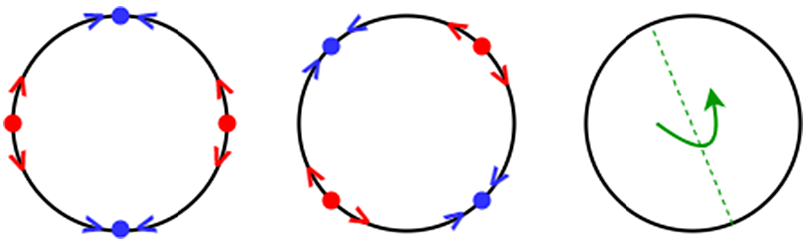
Example 1. Consider
$\mathcal {F}=\{f_1,f_2,f_3\}\subset \mathrm {Homeo}(\mathbb {S}^1 ) $
 , where the maps
$f_i$
 are defined as follows:
-
• $f_1$
is a orientation-preserving homeomorphism with only 4 fixed points
$0$
,
$1/4$
,
$1/2$
, and
$3/4$
, where
$0$
and
$1/2$
are attracting points, and
$1/4$
and
$3/4$
are repelling points; -
• $f_2$
is a orientation-preserving homeomorphism with only 4 fixed points
$1/8$
,
$3/8$
,
$5/8$
, and
$7/8$
, where
$3/8$
and
$7/8$
are attracting points, and
$1/8$
and
$5/8$
are repelling points; -
• $f_3$
is a reflection map on the line that passes through the points
$7/16$
and
$15/16$
. So,
$f_3$
is an isometry fixing only
$7/16$
and
$15/16$
. Further,
$f_3(0)=7/8$
,
$f_3(1/4)=5/8$
,
$f_3(1/2)=3/8$
, and
$f_3(3/4)=1/8$
(see Figure 1).Figure 1Dynamics on the circle of the functions $f_1$
,
$f_2$
and
$f_3$
in Example 1.


We consider
$\mathbb {S}^1=[0,1)$
 . Since each point fixed by
$f_1$
 is different from any point fixed by
$f_2$
 , there is no probability measure m on
$\mathbb {S}^1$
 such that
$f_{\ast }m=m$
 for all
$f\in \mathcal {F}$
 (and so for all
$f\in \mathcal {F}^-$
 ). Note that
$f_i([3/4,1/8])\subset [3/4,1/8]$
 and
$f_i([1/4,5/8])\subset [1/4,5,8]$
 for all
$i=1,2,3$
 . Therefore, it is not difficult to conclude that there are exactly
$d_+=2$
 minimal invariant sets for
$\mathcal {F}$
 . However, using the dynamics of the maps in
$\mathcal {F}$
 , we have that
$\mathcal {F}^-=\{f_1^{-1},f_2^{-1},f_3^{-1}\}$
 has a unique minimal set contained in
$[1/2,7/8]\cup [0,3/8]$
 . Let
$d_-=1$
 . Then, for any probability measure
$\nu $
 supported in
$\mathcal {F}$
 (that is, with
$\nu (\{f_i\})>0$
 for
$i=1,2,3$
 ), the number of ergodic stationary measures for
$(\mathcal {F},\nu )$
 is
$d_+=2$
 . However, if we consider
$\nu ^-$
 by
$\nu ^-(\{f_i^{-1}\})=\nu (\{f_i\})$
 , we have that the number of ergodic stationary measures for
$(\mathcal {F}^{-},\nu ^{-})$
 is
$d_-=1$
 .
Let
$d_+$
 and
$d_-$
 denote the number of ergodic stationary measures for
$(\mathcal {F},\nu )$
 and
$(\mathcal {F}^-,\nu ^-)$
 , respectively. First, let us establish some preliminary results.
Lemma 9. Let
$(\mathcal {F},\nu )$
 be an RDS of circle homeomorphisms without finite orbits. Let
$(\mathcal {F}^{-},\nu ^{-})$
 be the inverse RDS. Let
$d_+$
 and
$d_-$
 be the numbers of ergodic stationary measures associated with
$(\mathcal {F},\nu )$
 and
$(\mathcal {F}^{-},\nu ^{-})$
 , respectively. If
$d_+=n+2$
 , then
${d_-\geq n+1}$
 .
Before proving Lemma 9, let us introduce some useful sets. For
$i,j\in \{1,\ldots ,d_+\}$
 ,
${i\neq j}$
 , let
$C_{i,j}$
 be the set of closed intervals I with one of its extremal points in
$\bigcup _{J\in \mathcal {A}_i}J$
 and the other extremal point in
$\bigcup _{J\in \mathcal {A}_j}J$
 such that the interior of I does not intersect
$\bigcup _{J\in \bigcup _k\mathcal {A}_k}J$
 . Note that
$C_{i,j}=C_{j,i}$
 and that it is a finite set. Furthermore,
$C_{i,j}\neq \emptyset $
 whenever i and j are neighbors.
Remark 6. By item (b) in Theorem 4, for all
$I,J\in C_{i,j}$
 , there exists
$f\in \mathcal {F}$
 such that
$f^{-1}(I)\subset J$
 (or
$I\subset f(J)$
 ). In other words, the
$\mathcal {F}$
 -invariance of the sets
$\mathcal {A}_i$
 implies the
$\mathcal {F}^{-1}$
 -invariance of the sets
$C_{i,j}$
 . Hence,

for all
$f\in G_{\mathcal {F}}$
 . Then, for each
$(i,j)\in \mathcal {E}$
 ,
$i\neq j$
 , there exists a closed
$\mathcal {F}^-$
 -minimal set
${F\subset C_{i,j}}$
 .
Proof of Lemma 9.
Assume
$d_+=n+2$
 . By Lemma 6, then

Hence, there are n distinct points
$i_1,\ldots ,i_n,$
 in
$\{1,\ldots ,d_+\}$
 such that
$V_{i_k}=2$
 for
${k=1,\ldots ,n}$
 . Since
$d_+=n+2>n$
 , we have that any n-cycle is not an
$\mathcal {F}$
 -path. (An n-cycle is a path of the form
$[j_0,j_1,\ldots ,j_n]$
 with
$j_0=j_n$
 and
$j_k\neq j_{\ell }$
 for
${k,\ell =1,\ldots ,n}$
 and
$\ell \neq k$
 .) Therefore, we can find
$i_{n+1},j_1,\ldots ,j_n,j_{n+1}\in \{1,\ldots ,d_+\}$
 with
$(i_1,j_1),\ldots ,(i_{n+1},j_{n+1})\in \mathcal {E}$
 such that for
$k\neq \ell $
 ,

For
$k=1,\ldots ,n+1$
 , consider the set
$C_{i_k,j_k}$
 as defined above Remark 6. Let
$C_k=C_{i_k,j_k}$
 . Note that for
$k\neq \ell $
 ,
$C_k\neq C_\ell $
 and so

By Remark 6, for
$k=1,\ldots ,n+1$
 , there exists a closed
$\mathcal {F}^-$
 -minimal set
$F_k\subset C_k$
 . Therefore, there exist at least
$n+1$
 closed
$\mathcal {F}^-$
 -minimal sets and so
$d_-\geq n+1$
 .
Lemma 10. Let
$(\mathcal {F},\nu )$
 be an RDS of circle homeomorphisms without finite orbits. Let
$(\mathcal {F}^{-},\nu ^{-})$
 be the inverse RDS. Let
$d_+$
 and
$d_-$
 be the numbers of ergodic stationary measures associated with
$(\mathcal {F},\nu )$
 and
$(\mathcal {F}^{-},\nu ^{-})$
 , respectively. If
$\mathcal {F}\subset \mathrm {Homeo}^+(\mathbb {S}^1 )$
 , then
$d_-\geq d_+$
 .
Let us introduce a variation of the sets
$C_{i,j}$
 . Now we will respect the order of the indices. For
$i,j\in \{1,\ldots ,d_+\}$
 ,
$i\neq j$
 , let
$C_{[i,j]}$
 be the set of closed intervals
$I=[a,b]$
 with
$a\in \bigcup _{J\in \mathcal {A}_i}J$
 and
$b\in \bigcup _{J\in \mathcal {A}_j}J$
 such that
$(a,b)$
 has no points of
$\bigcup _{J\in \bigcup _k\mathcal {A}_k}J$
 . Note that
$C_{[i,j]}\neq C_{[j,i]}$
 (provided that one of the two is non-empty) and
$C_{[i,j]}$
 is a finite set. Further,
$C_{[i,j]}\neq \emptyset $
 whenever
$[i,j]$
 is an
$\mathcal {F}$
 -path. By item (b) in Theorem 4,

for all
$f\in G_{\mathcal {F}}\subset \mathrm {Homeo}^{+}(\mathbb {S}^1 )$
 . Hence, for each
$\mathcal {F}$
 -path
$[i,j]$
 , there exists a closed
$\mathcal {F}^-$
 -minimal set
$F\subset C_{[i,j]}$
 .
Proof of Lemma 10.
If
$d_+=1$
 , it is clear that
$d_-\geq d_+$
 . Assume
$d_+\geq 2$
 . For all
${i=1,\ldots ,d_+}$
 , take
$j_i\in \{1,\ldots ,d_+\}\backslash \{i\} $
 such that
$[i,j_i]$
 is an
$\mathcal {F}$
 -path and so
$(i,j_i)\in \mathcal {E}$
 . As we discussed above, we have for each
$\mathcal {F}$
 -path
$[i,j_i]$
 (that is,
$(i,j_i)\in \mathcal {E}$
 ), there exists a closed
$\mathcal {F}^-$
 -minimal set
$F_i\subset C_{[i,j_i]}$
 . Hence, there exist at least
$d_+$
 closed
$\mathcal {F}^-$
 -minimal sets and so
$d_-\geq d_+$
 .
Now we are ready to prove Theorem 3.
Proof of Theorem 3.
By Lemma 9,
$d_-\geq d_+-1$
 . Using that
$(\mathcal {F}^-)^-=\mathcal {F}$
 , we also get
${d_+\geq d_--1}$
 . Consequently,
$d_++1\geq d_-\geq d_+-1$
 and, hence,
$|d_+-d_-|\leq 1$
 .
Now, assume
$\mathcal {F}\subset \mathrm {Homeo}^+(\mathbb {S}^1 )$
 . Since
$(\mathcal {F}^-)^-=\mathcal {F}$
 , by Lemma 10,
$d_-\geq d_+$
 and
${d_+\geq d_-}$
 . Therefore,
$d_-=d_+$
 .
Acknowledgements
This study was financed by grant 2022/10341-9 from the São Paulo Research Foundation (FAPESP) and by the Center of Excellence ‘Dynamics, Mathematical Analysis and Artificial Intelligence’ at Nicolaus Copernicus University in Toruń.