


1. Introduction
A classical result by Lickorish and Wallace [Reference Lickorish10, Reference Wallace18] states that every closed, oriented, connected 3-manifold
 $M$
arises as Dehn surgery along a link
 $L$
in
 $S^3$
. That is,
 $M$
can be obtained by removing an open tubular neighbourhood
 $\nu L$
of
 $L$
from
 $S^3$
and gluing back to each torus boundary component of
 $S^3 \setminus \nu L$
a solid torus by an orientation-preserving diffeomorphism of its boundary. Our motivation in this note stems from the following type of question.
Question 1.
Let
 $\mathcal{L}$
be a set of links in
 $S^3$
. Can each closed, oriented, connected 3-manifold be obtained by Dehn surgery along a link
 $L \in \mathcal{L}$
?
Considering the first homology of a 3-manifold obtained by Dehn surgery directly implies that the number of components of links in
 $\mathcal{L}$
is unbounded if
 $\mathcal{L}$
gives a positive answer to Question1. Question1 was answered affirmatively for the following sets of links:
-
1. Links that are fibred, by [Reference Stallings17; Theorem 3],
-
2. Links that are quasipositive, by [Reference Rudolph16; Proposition 4],
-
3. Links that are alternating and hyperbolic, by [Reference Adams1; p. 126],
-
4. Chainmail links, by [Reference Polyak13]; see also [Reference Agol2; Theorem 2.2],
-
5. Generalised
 $L$
-space links, by [Reference Agol2; Corollary 4.3].Footnote
1

In contrast to these results, not every closed, oriented, connected 3-manifold can be obtained by Dehn surgery along a torus link since Dehn surgeries along torus links are never hyperbolic [Reference Kadokami and Shimozawa9, Reference Moser12]. Moreover, the answer to Question1 is negative for the set of Montesinos links by [Reference Ichihara and Jong8] and thus also for pretzel links. Question1 also has a negative answer for two-bridge links since these have at most two components.
In this short note, we show the following.
Theorem 2.
Every closed, oriented, connected 3-manifold
 $M$
can be obtained by Dehn surgery along a braid positive link
 $L$
in
 $S^3$
. Moreover,
 $L$
can be chosen to have at most
 $s(M) + 1$
many components.
Here, we denote by
 $s(M)$
the surgery number of
 $M$
, which is the minimal number of components of any link in
 $S^3$
needed to describe
 $M$
as Dehn surgery along that link; see, for example, [Reference Auckly5]. Moreover, recall that a link is called braid positive if it arises as the closure of a positive braid, that is, it is a braid represented by a finite product of the Artin generators of the braid group [Reference Artin4] (see Section 3).
Braid positive links are fibred [Reference Stallings17], positive and strongly quasipositive, so we can also add, for example, the set of positive, fibred links or the set of strongly quasipositive, fibred links to the above list.
Conventions. All 3-manifolds are assumed to be smooth and oriented and are considered up to orientation-preserving diffeomorphism. For us, a link in a 3-manifold
 $M$
is a smooth, closed 1-dimensional submanifold of
 $M$
. Surgery coefficients (see Section 2) are measured with respect to the Seifert framing.
2. Surgery diagrams and Rolfsen twists
The two main ingredients in the proof of Theorem2 are the so-called Rolfsen twist [Reference Rolfsen15] and Garside’s theory of braids [Reference Garside7]. To make this note self-contained, we will explain Rolfsen twists in this section and a direct consequence of Garside’s work needed in our proof in Section 3. Readers who are already familiar with these concepts can skip ahead to Section 4 for the proof of Theorem2.
First, let us briefly review the basics of Dehn surgery. For more details, the reader is referred, for example, to [Reference Rolfsen14]. Let
 $L = L_1 \cup \ldots \cup L_m$
be a link in
 $S^3$
of
 $m$
components. The boundary of
 $S^3 \setminus \nu L$
is orientation-preservingly diffeomorphic to a disjoint union of
 $m$
tori
 $\bigcup _{j=1}^m S^1 \times S^1$
. The diffeomorphism type of the 3-manifold obtained by Dehn surgery along
 $L$
, that is, by gluing
 $m$
solid tori
 $\bigcup _{j=1}^m S^1 \times D^2$
to
 $S^3 \setminus \nu L$
, is determined by the image of
 $\bigcup _{j=1}^m \{1\} \times \partial D^2$
under an orientation-preserving diffeomorphism
 \begin{equation*}\bigcup _{j=1}^m \partial (S^1 \times D^2 )\longrightarrow S^3 \setminus \nu L.\end{equation*}
Given a meridian
 $\mu _j$
and a Seifert longitude
 $\lambda _j$
of the link component
 $L_j$
, the image curves in
 $\partial (\overline {\nu L_j})$
can be expressed as
 $p_j \mu _j + q_j \lambda _j$
for coprime integers
 $p_j, q_j$
for every
 $j \in \{1, \ldots , m\}$
. The quotient
 \begin{equation*}p_j/q_j \in \mathbb{Q} \cup \{\infty \}\end{equation*}
is called the surgery coefficient of the link component
 $L_j$
. By the above discussion, the diffeomorphism type of the 3-manifold obtained by Dehn surgery on the link
 $L$
is determined by a diagram of
 $L$
where each component
 $L_j$
of
 $L$
is labelled by
 $p_j/q_j$
. We call
 $L$
together with the labellings
 $p_j/q_j$
,
 $i\in \{1,\ldots ,m\}$
, a surgery diagram.
Let us remark that a link component
 $L_j$
with surgery coefficient
 $\infty =1/0$
means that we identify the meridian of the attached solid torus with the meridian of
 $L_j$
. The corresponding surgery simply glues in a solid torus in exactly the same way as the removed tubular neighbourhood of
 $L_j$
. Therefore, a component with surgery coefficient
 $\infty =1/0$
can be removed from a surgery diagram without changing the diffeomorphism type of the surgered manifold.
Let us now turn to Rolfsen twists. To that end, let
 $L= L_1 \cup \ldots \cup L_m$
be a surgery diagram with an unknotted component, say
 $L_1$
, with surgery coefficient
 $p_1/q_1$
. For any integer
 $N\in \mathbb{Z}$
, an
 $N$
-fold Rolfsen twist along
 $L_1$
creates out of
 $L$
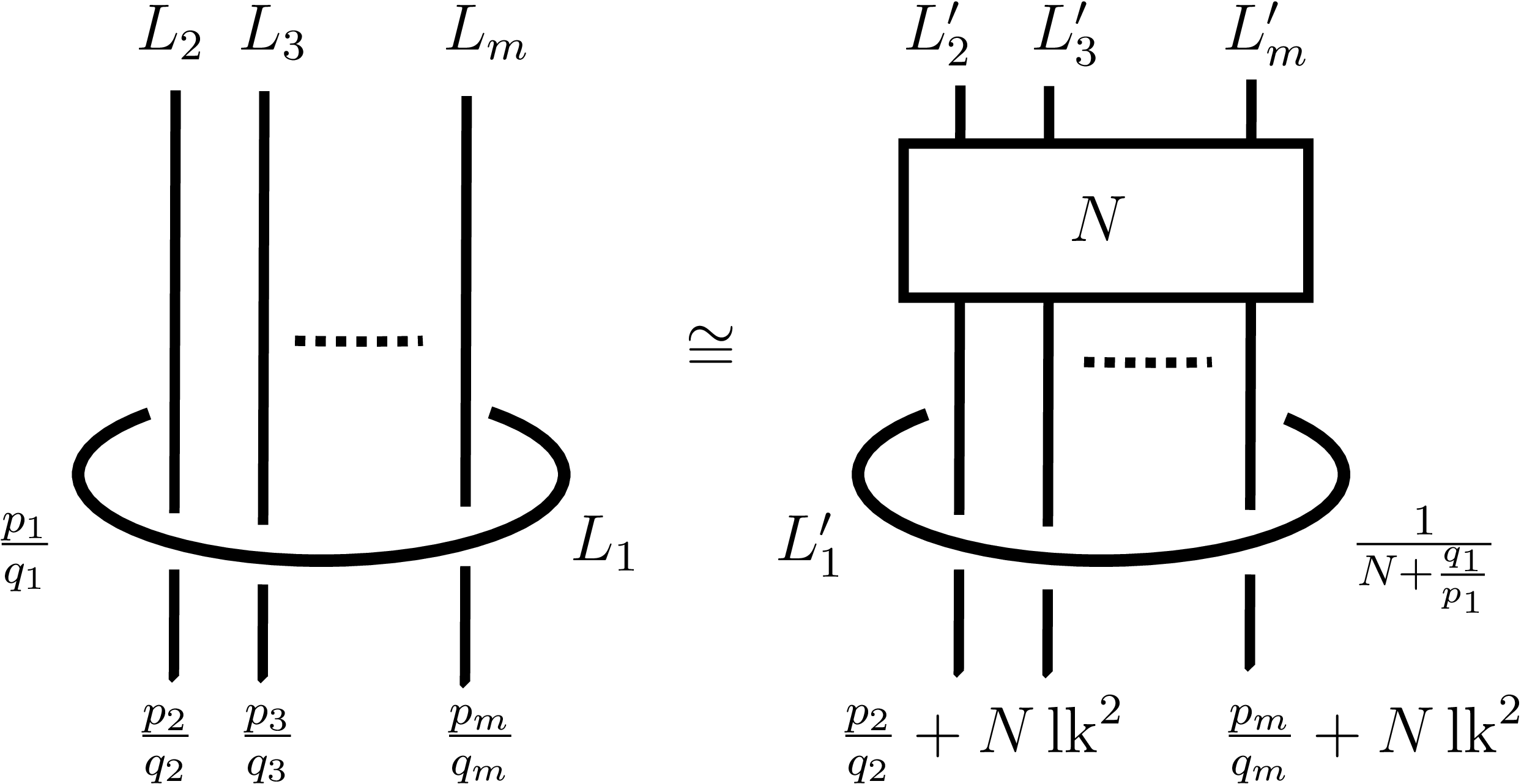
a new surgery diagram
 $L'$
as follows:
-
• We cut the exterior of
$L_1$
, which is a solid torus, along a Seifert disk of
$L_1$
and re-glue it with an
$N$
-fold twist (where
$N=1$
corresponds to one right-handed full twist) to get a new link
$L'= L'_1 \cup \ldots \cup L'_m$
(the components of which are in natural bijection with the components of
$L$
), -
• the surgery coefficient of
$L'_1$
is
$\frac {1}{N+\frac {q_1}{p_1}}$
and the surgery coefficients of the other components
$L'_j$
are given by
$\frac {p_j}{q_j}+N\operatorname {lk}(L_j,L_1)^2$
, where
$\operatorname {lk}$
denotes the linking number for a choice of orientation of
$L$
.


We refer to Figure 1 for a visualisation.
Lemma 3 (Rolfsen twist [Reference Rolfsen15]). If
 $L$
and
 $L'$
are two surgery diagrams that differ by a Rolfsen twist, then the 3-manifolds obtained by Dehn surgery along
 $L$
and
 $L'$
, respectively, are orientation-preservingly diffeomorphic.
Proof.
The process of cutting the exterior of
 $L_1$
along a Seifert disk of
 $L_1$
and re-glueing it with an
 $N$
-fold twist describes a diffeomorphism of the exterior of
 $L$
to the exterior of
 $L'$
. It is straightforward to check that this diffeomorphism acts on the boundary tori as
 \begin{align*} \mu _1 &\longmapsto \mu '_1+N\lambda '_1\\[5pt] \lambda _1 &\longmapsto \lambda '_1\\[5pt] \mu _j &\longmapsto \mu '_j\\[5pt] \lambda _j &\longmapsto N\operatorname {lk}(L_j,L_1)^2\mu '_j+\lambda '_j \end{align*}
and thus the surgery coefficients transform as claimed.
3. Garside theory
The second key ingredient in our proof of Theorem2 is Garside’s theory of braids [Reference Garside7]. A braid on
 $k$
strands is a collection of
 $k$
disjoint, properly embedded arcs in the cylinder
 $[0,1]\times D^2$
that run monotonically in the
 $[0,1]$
-direction from
 $k$
fixed points in
 $\{0\} \times D^2$
to
 $\{1\} \times D^2$
. Braids up to ambient isotopy of
 $[0,1]\times D^2$
fixing
 $\{0,1\} \times D^2$
pointwise form a group called the braid group
 $B_k$
. The group operation is defined by stacking braids. Closing a braid by identifying
 $\{0\} \times D^2$
and
 $\{1\} \times D^2$
, connecting the endpoints of the arcs and identifying the resulting solid torus with the tubular neighbourhood of an unknot in
 $S^3$
produces an oriented link in
 $S^3$
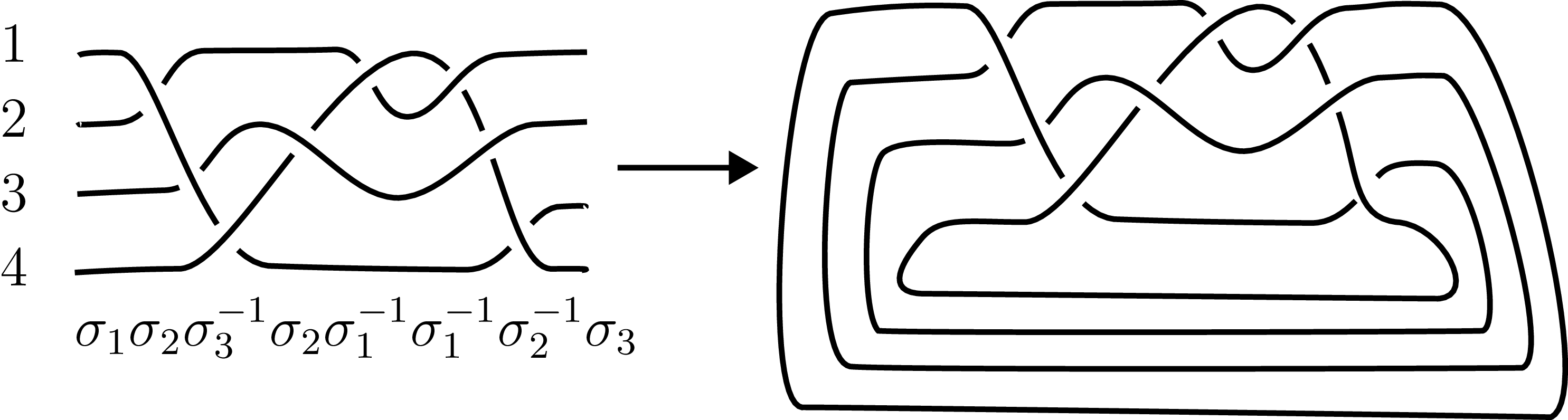
; see Figure 2.Footnote
2
By Alexander’s theorem, every link arises in this way [Reference Alexander3]. We refer to [Reference Birman and Brendle6] for more details on braids and their closures.
An
 $N$
-fold Rolfsen twist.

A braid (left) and its closure (right).

The braid group
 $B_k$
is generated by the Artin generators [Reference Artin4] denoted
 $\sigma _1, \ldots , \sigma _{n-1}$
, where
 $\sigma _i$
corresponds to a positive half-twist exchanging two neighbouring strands with indices
 $i$
and
 $i+1$
; see Figure 2. A braid on
 $k$
strands is positive if it can be represented by a word in
 $B_k$
that is a product of positive powers of the Artin generators. The closure of a positive braid is called a braid positive link. We denote by
 \begin{equation*}T_k=(\sigma _1 \ldots \sigma _{k-1})^{k}\end{equation*}
a full twist in
 $B_k$
; see, for example, Figure 3. The following lemma is a direct corollary from Garside’s work [Reference Garside7].Footnote
3
For completeness and to keep our arguments purely geometric, we present a proof.
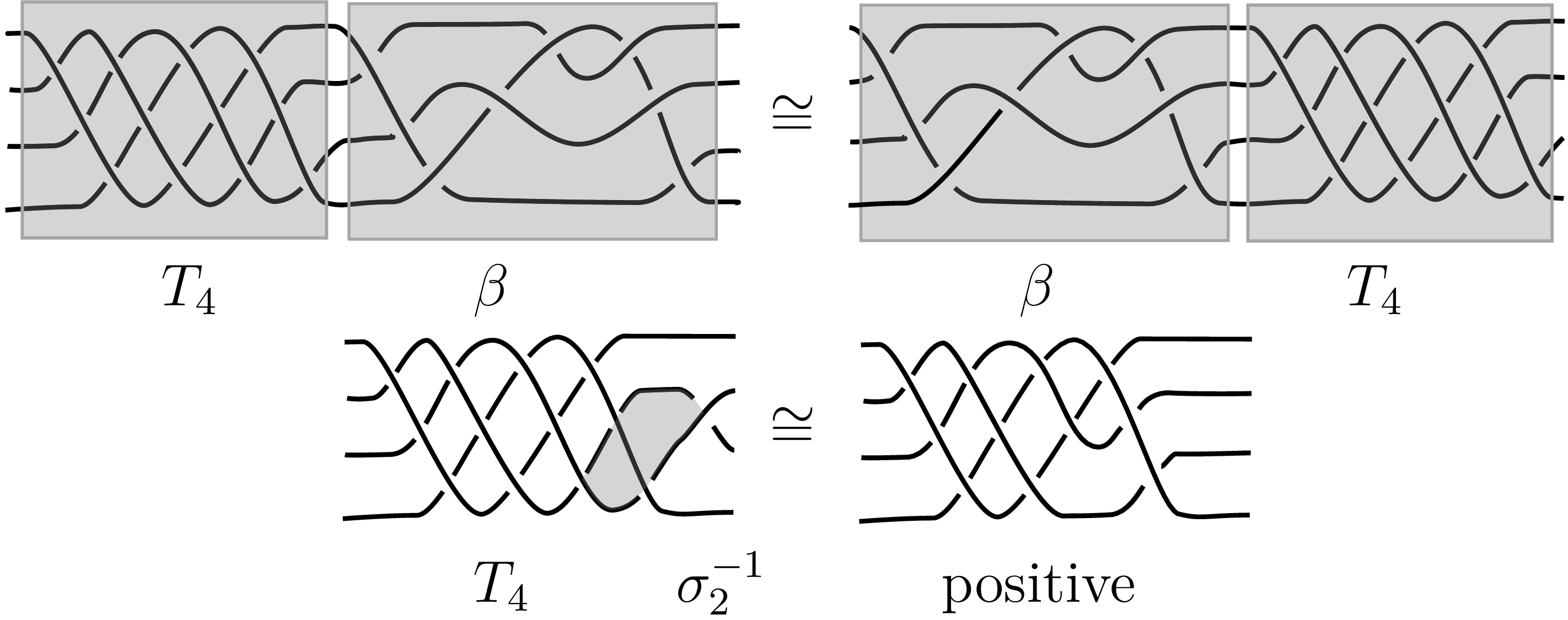
The first row shows that a full twist
 $T_k$
commutes with any other braid
 $\beta$
on
 $k$
strands. The second row visualises that a full twist
 $T_k$
followed by a negative Artin generator
 $\sigma _i^{-1}$
yields a positive braid.

Lemma 4 ([Reference Garside7]). For each braid
 $\beta$
on
 $k$
strands, there is an integer
 $N \geq 0$
such that
 $T_k^{N} \beta$
is a positive braid on
 $k$
strands. More concretely, we can choose
 $N$
to be the number of negative Artin generators in a braid word representative of
 $\beta$
.
Proof.
We start with two simple observations. First, the full twist
 $T_k$
in
 $B_k$
commutes with any other element
 $\beta$
of
 $B_k$
, that is,
 $T_k\beta =\beta T_k$
. See Figure 3 for an illustration. Second, for any Artin generator
 $\sigma _i$
, the braid
 $T_k\sigma _i^{-1}$
is positive; see Figure 3 again.
If
 $\beta$
is a positive braid, we can set
 $N = 0$
. Otherwise, we write
 $\beta$
as a word in the Artin generators and distinguish two cases. In the first case, the first letter of
 $\beta$
is a positive generator, say
 $\beta =\sigma _i\beta '$
. Using the above observations, we can then write
 $T_k^N\beta =\sigma _iT_k^N\beta '$
. In the second case, if the first letter of
 $\beta$
is a negative Artin generator, say
 $\beta =\sigma _i^{-1}\beta '$
, then we write
 \begin{equation*} T_k^N\beta = T_k^{N-1} T_k\sigma _i^{-1}\beta ' = T_k^{N-1} p \beta ' = p T_k^{N-1} \beta ', \end{equation*}
where
 $p$
is a positive braid. The claim follows using an induction on the length of the braid word
 $\beta$
.
4. Braid positive surgery diagrams
In this section, we finally prove Theorem2.
Proof of Theorem
2. Given a closed, oriented, connected 3-manifold
 $M$
, let
 $L$
be a link whose number of components realises
 $s(M)$
. We can represent
 $L$
as the closure of a braid
 $\beta$
on, say,
 $k$
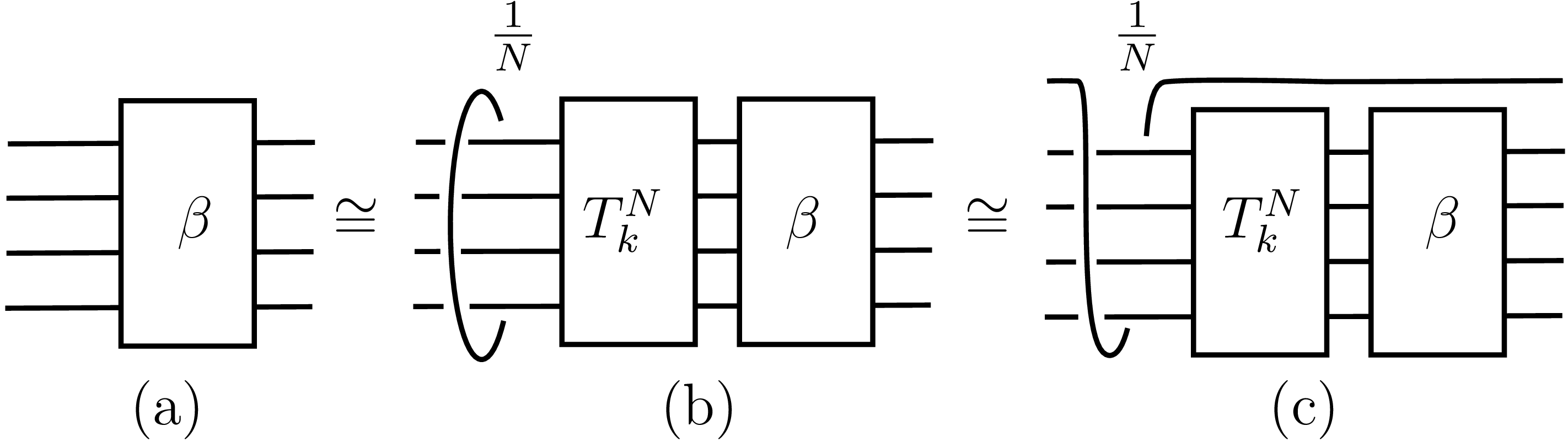
strands. Figure 4(a) represents a braid diagram
 $\beta$
of
 $L$
. Inserting a new component with surgery coefficient
 $\infty =1/0$
and performing an
 $N$
-fold Rolfsen twist, we obtain the diagram shown in Figure 4(b). Figure 4(c) shows the result of an isotopy of the new link diagram performed on the new component. The link
 $L^\prime$
in Figure 4(c) arises as the closure of a braid
 $\beta ^\prime$
. Note that
 $\beta ^\prime$
is a positive braid whenever the braid
 $\alpha := T_k^{N} \beta$
on
 $k$
strands is a positive braid. The theorem thus follows from Lemma4, choosing
 $N$
sufficiently large.
Transforming a braid into a positive braid by a single surgery.

Remark 5.
Note that Rudolph’s proof for quasipositive links [Reference Rudolph16], in very brief, inserts a new unknotted component for each negative band generator in a band presentation of a braid representing
 $L$
, so it increases both the braid index and the number of components of
 $L$
potentially much more than the procedure described in our above proof. Moreover, his method does not immediately carry over to obtain braid positive links.
Acknowledgements
This project started at the conference on Trisections and related topics, October 2025, CIRM, Marseille, and was finished at the workshop on Knotted surfaces in four-manifolds, December 2025, University of Regensburg. We thank Stefan Friedl for helpful comments on a first draft.
Funding information
M.K. is supported by a Ramón y Cajal grant (RYC2023-043251-I) and PID2024-157173NB-I00 funded by MCIN/AEI/10.13039/501100011033, by ESF+, and by FEDER, EU; and by a VII Plan Propio de Investigación y Transferencia (SOL2025-36103) of the University of Seville. P.T. acknowledges support by the Swiss National Science Foundation Postdoc. Mobility fellowship 230329, and she would like to thank the Max Planck Institute for Mathematics in Bonn and the University of Glasgow for their hospitality and support.
Conflicts of interest
The authors declare no conflicts of interest.