1 Introduction
A knot in the
$3$
 -sphere
$S^3$
 is called an L-space knot if it admits a positive Dehn surgery yielding an L-space. A typical example is a (positive) torus knot. In this paper, we focus on the braid index of L-space knots. Knots with braid index two are torus knots. It is known that L-space knots with braid index three are either torus knots or braid positive twisted torus knots [Reference Lee and Vafaee15]. (Here, a knot that is the closure of a positive braid is said to be braid positive.) Also, L-space knots with braid index less than four have tunnel number one.
In the SnapPy census [Reference Anderson1, Reference Baker and Kegel2, Reference Dunfield8, Reference Dunfield9], there are 632 L-space knots, and there are only three known strongly invertible hyperbolic L-space knots with braid index four and tunnel number two; t09284, t10496 and o9_34409 [Reference Anderson1]. This observation leads to the following question.
Question 1.1 [Reference Anderson1, Question 10].
What are the L-space knots of braid index four with tunnel number greater than one?
In a previous paper [Reference Baker and Teragatio4], we gave an infinite family of asymmetric hyperbolic L-space knots with braid index four. We can verify that these knots have tunnel number two. (It is not hard to give an unknotting tunnel system consisting of two arcs. Then, the asymmetry excludes the possibility of tunnel number one, because a tunnel number one knot is strongly invertible [Reference Morimoto17, Lemma 5].)
The purpose of this paper is to give the first infinite family of strongly invertible hyperbolic L-space knots with braid index four and tunnel number two.
Theorem 1.2. There are infinitely many strongly invertible, hyperbolic L-space knots with braid index four and tunnel number two.
For an integer
$n\ge 0$
 , let
$K_n$
 be the closure of the positive
$4$
 -braid

where an integer i denotes the standard braid generator
$\sigma _i$
 in the braid group
$B_4$
 of four strands. Since it is the closure of a positive braid, it is fibred [Reference Stallings24, Theorem 2] and it has genus
$3n+3$
 . Hence,
$K_m\ne K_n$
 if
$m\ne n$
 . Note that
$K_0$
 is the torus knot
$T(3,4)$
 and
$K_1$
 is the
$(2,9)$
 -cable of
$T(2,3)$
 . Also,
$K_2$
 ,
$K_3$
 and
$K_4$
 are s682, t10496 and o9_34409, respectively, in the census.
Theorem 1.2 immediately follows from the following theorem.
Theorem 1.3. Let
$K_n$
 be the knots defined above. Then,
$K_n$
 has the following properties.
-
(1) $K_n$
 is a strongly invertible L-space knot.
-
(2) If $n\ge 1$
, then
$K_n$
has braid index four. -
(3) If $n\ge 2$
, then
$K_n$
is hyperbolic. -
(4) If $n\ge 3$
, then
$K_n$
has tunnel number two.


We have two other candidates of infinite families which generalize t09284. They are the closures of
$4$
 -braids

When
$m=3$
 or
$n=1$
 , each gives t09284. However, we could not prove that these knots have tunnel number two.
2 L-space knots
In this section, we prove that our knot
$K_n$
 is a strongly invertible L-space knot. Let
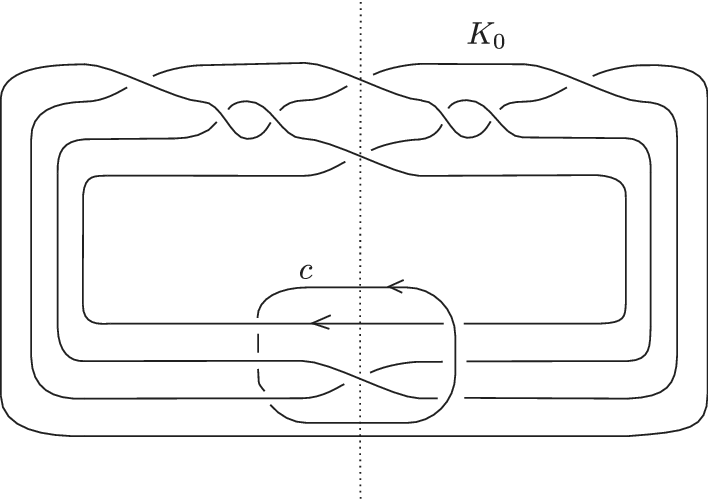
$K_0\cup c$
 be the link shown in Figure 1. By performing
$(-1/n)$
 -surgery along c,
$K_0$
 will be changed into
$K_n$
 .
The link
$K_0\cup c$
 . By performing
$(-1/n)$
 -surgery along c,
$K_0$
 will be changed into
$K_n$
 . This diagram also shows a strongly invertible position of the link.

Figure 1 Long description
A line drawing of a mathematical link.
* At the top right is the label K sub 0, referring to the primary large knot structure.
* The primary structure consists of three parallel horizontal strands that twist around each other in two distinct crossing regions at the top left and top right. These strands then loop around to form a large rectangular frame.
* A vertical dotted line bisects the entire diagram, representing an axis of symmetry for the strongly invertible position.
* In the lower center, a smaller rectangular loop labeled c encloses three horizontal strands.
* The loop c has an arrow indicating a counter-clockwise orientation.
* Inside the loop c, the two horizontal strands perform a single twist crossing before exiting the loop.
* The overall structure is composed of continuous black lines on a white background, with breaks in the lines to indicate over-and-under crossings.
Lemma 2.1. For any
$n\ge 0$
 ,
$K_n$
 is strongly invertible.
Proof. Figure 1 shows a strongly invertible position of the link
$K_0\cup c$
 . The dotted line is the axis of the involution. Performing
$(-1/n)$
 -surgery on c changes
$K_0$
 into
$K_n$
 . This observation confirms that
$K_n$
 is strongly invertible for any
$n\ge 0$
 .
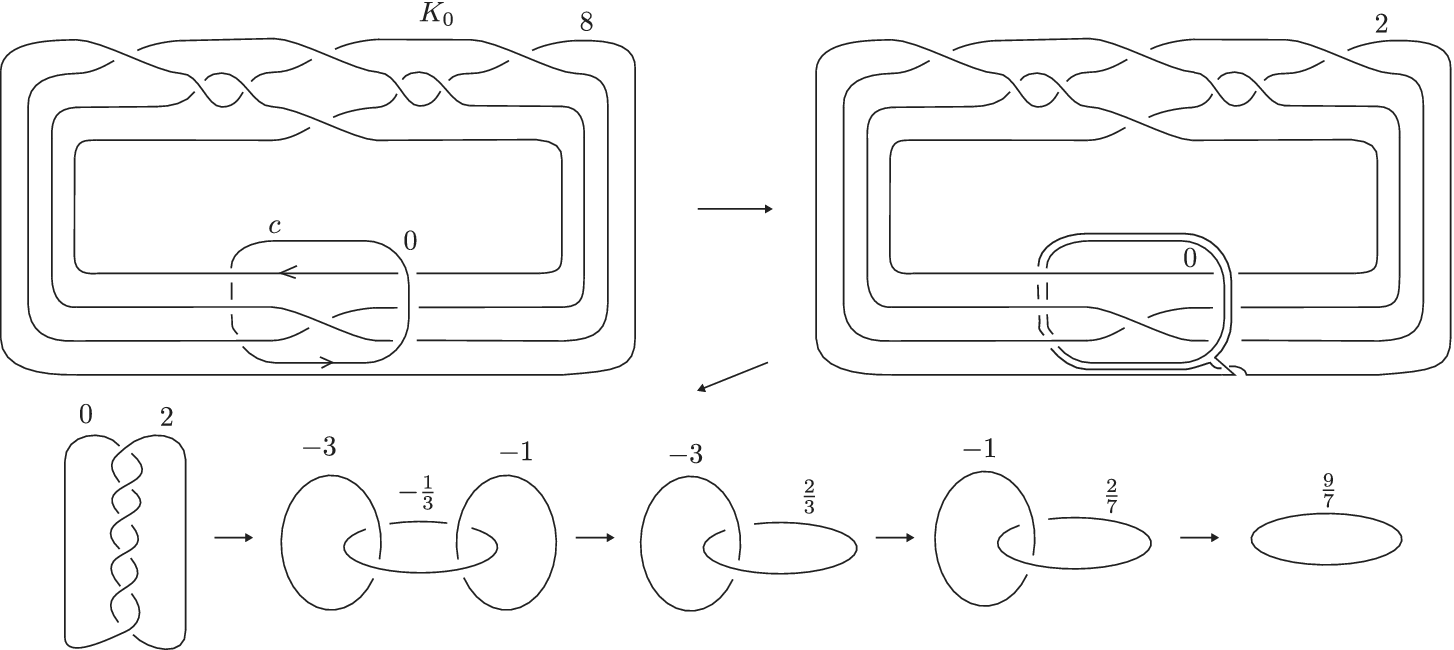
Lemma 2.2. For the link
$K_0\cup c$
 ,
$(8,0)$
 -surgery yields a lens space
$L(9,7)$
 .
Proof. This is confirmed by Kirby–Rolfsen calculus. See Figure 2.
Kirby–Rolfsen calculus for
$(8,0)$
 -surgery on
$K_0\cup c$
 . The result is a lens space
$L(9,7)$
 .

Figure 2 Long description
The diagram consists of two large panels at the top and a sequence of five smaller diagrams at the bottom.
* Top-Left Panel: A complex knot labeled K sub 0 with an integer coefficient 8. Inside the knot is a smaller loop labeled c with a coefficient 0 and directional arrows.
* Top-Right Panel: An arrow points from the first panel to this modified version where the coefficient 8 has changed to 2. Perform a handle slide of the knot K over the inner loop c.
* Bottom Row Sequence: An arrow points from the top-right panel down to the start of the bottom row.
1. The first diagram is a vertical twisted knot with coefficients 0 and 2.
2. An arrow points to a link of two circles with coefficients minus 3 and minus 1, connected by a horizontal segment labeled minus 1 over 3.
3. An arrow points to a two-component link with coefficients minus 3 and 2 over 3.
4. An arrow points to a two-component link with coefficients minus 1 and 2 over 7.
5. A final arrow points to a single oval with the fraction 9 over 7, representing the final lens space L(9,7).
Lemma 2.3 [Reference Baker and Motegi3, Theorem 1.13 and Lemma 6.1], [Reference Baker and Teragatio4, Lemma 2.1].
Let
$K\cup c$
 be a link of an L-space knot K and an unknot c with linking number
$w=\mathrm {lk}(K,c)>1$
 . Let
$K_n$
 be the image of K after
$(-1/n)$
 -surgery on c for integers n. If there exists a slope
$r\ge 2g(K)-1$
 such that
$(r,0)$
 -surgery on
$K\cup c$
 is an L-space, then
$K_n$
 is an L-space knot for all integers
$n\ge 0$
 .
Lemma 2.4. For each
$n\ge 0$
 ,
$K_n$
 is an L-space knot.


3 Tunnel number
In this section, we prove that
$K_n$
 has tunnel number two if
$n\ge 3$
 . We need a lemma using the Montesinos trick [Reference Montesinos-Amilibia16].
Lemma 3.1. If
$n\ge 3$
 , then
$(9n+9)$
 -surgery on
$K_n$
 yields a graph manifold M which is the union of two Seifert fibred spaces over the disk with two exceptional fibres of indices
$(3,3)$
 and
$(2,n-1)$
 , respectively. In addition, the graph manifold M has Heegaard genus at least three.
Proof. For the link
$K_0\cup c$
 given in Figure 1, consider
$(9,-1/n)$
 -surgery. Performing n-twists on c shows that it represents
$(9n+9)$
 -surgery on
$K_n$
 .
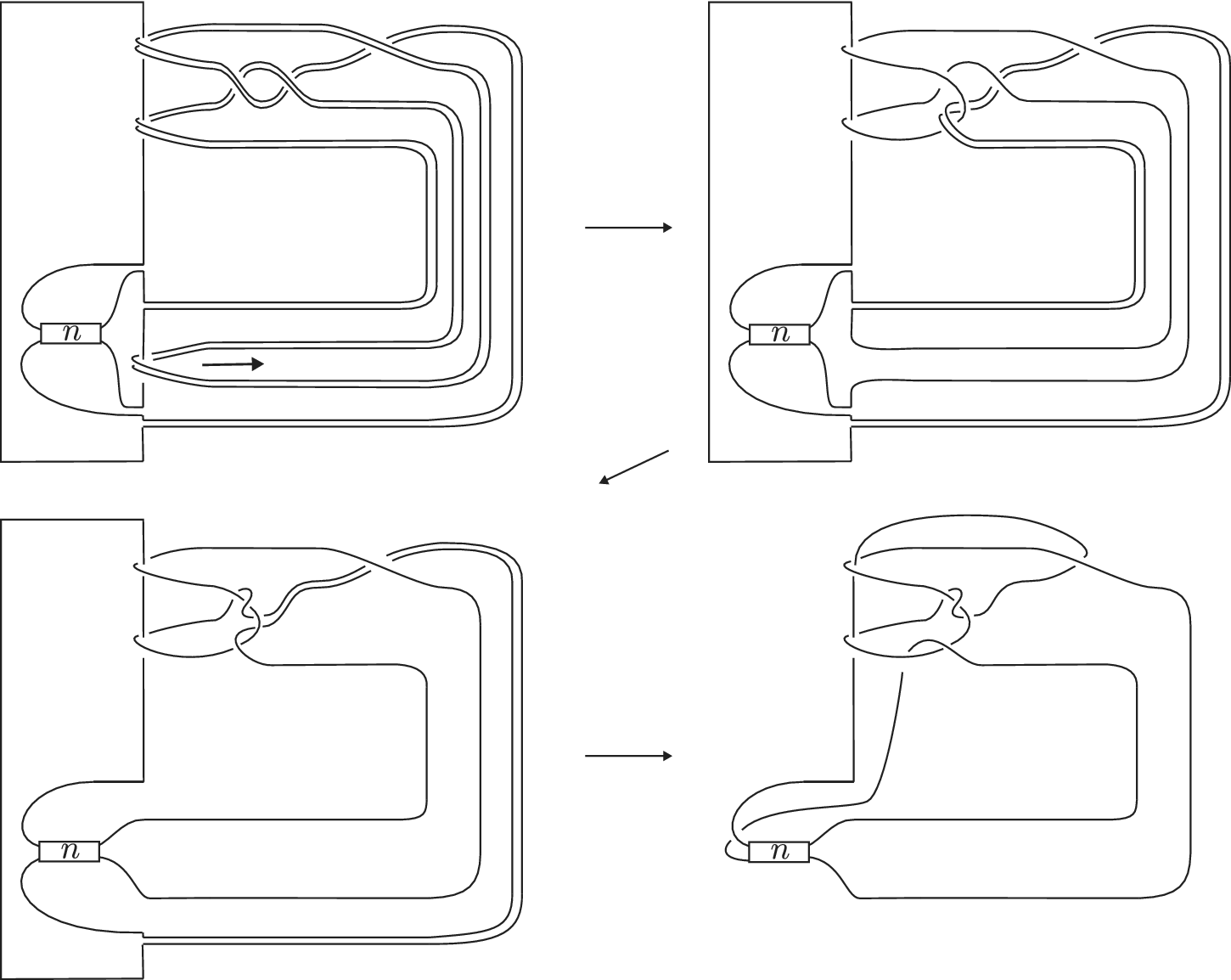
Take the quotient under the involution along the axis depicted there. Then, we have a diagram as shown in Figure 3 (top left) after the tangle replacements. (Since
$K_0$
 has writhe
$9$
 in the diagram of Figure 1, the tangle surgery for the quotient of
$K_0$
 is done by the
$0$
 -tangle.)
The diagram after the tangle replacements (top left) and its deformation. The box with integer n contains right handed horizontal n half twists.

Figure 3 Long description
The diagram consists of four panels arranged in a Z-shaped sequence connected by arrows.
1. Top-left panel: A complex knot diagram features a large vertical rectangular block on the left. From this block, multiple strands emerge. At the top, strands form a series of crossings. At the bottom, a small horizontal box labeled with the variable n contains right-handed horizontal n half twists. A small arrow points right along one of the lower strands.
2. Top-right panel: Following a horizontal arrow, the diagram shows a slight deformation of the top crossings. The strands are pulled tighter, and the relationship between the upper loops and the lower n-twist box remains connected via the large rectangular boundary.
3. Bottom-left panel: Following a diagonal arrow pointing down and left, the diagram simplifies. The number of parallel strands is reduced, and the top crossing is shown as a single intertwined knot. The n-twist box remains at the bottom-left.
4. Bottom-right panel: Following a final horizontal arrow, the diagram shows the most simplified state. The strands have been deformed such that the upper knot is more isolated, and the connection to the n-twist box is streamlined into a single continuous loop structure that wraps back toward the left boundary.
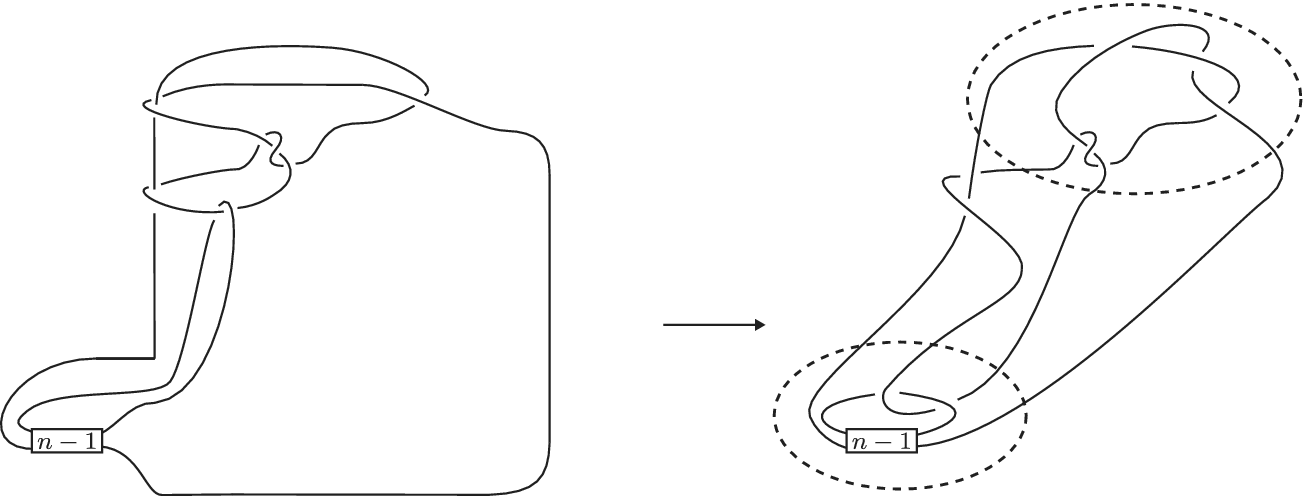
After a series of deformations in Figures 3 and 4, the resulting link (right in Figure 4) consists of two Montesinos tangles
$[-1/3,1/3]$
 and
$[-1/2,-1/(n-1)]$
 . By taking the double branched cover, which gives M, we have the first conclusion.
Further deformation. The resulting link (right) consists of two Montesinos tangles
$[-1/3,1/3]$
 and
$[-1/(n-1), -1/2]$
 .

Figure 4 Long description
The diagram consists of two panels separated by a right-pointing arrow.
Left panel: A single continuous knot diagram. At the top, there is a horizontal loop with several crossings. A vertical strand descends from the left side of this loop, leading to a smaller horizontal loop at the bottom left. This bottom loop contains a rectangular box labeled n minus 1.
Right panel: The knot has been deformed into two distinct regions highlighted by dashed elliptical boundaries.
- The upper dashed ellipse contains a complex tangle of overlapping loops and crossings, representing the first Montesinos tangle.
- The lower dashed ellipse contains a simpler loop structure that includes the rectangular box labeled n minus 1, representing the second Montesinos tangle.
- Strands connect the upper and lower tangles to form a closed link system.
To confirm that this graph manifold M has Heegaard genus at least three, we follow the argument in [Reference Anderson1, Section 2.3], which is based on the classification by Kobayashi [Reference Kobayashi12] of closed orientable
$3$
 -manifolds with Heegaard genus two that contain an essential torus. It claims that if a graph manifold obtained from gluing two Seifert fibred manifolds along an incompressible boundary torus has Heegaard genus two and contains a unique essential torus, then the regular fibres of the two pieces on the common torus intersect just once.
First, the cases where
$n=3$
 and
$4$
 are treated in [Reference Anderson1, Section 2.3.2]. Thus, we assume
$n\ge 5$
 . We remark that each piece of M admits a unique Seifert fibration. (In fact, this holds when
$n\ge 4$
 .) From Figure 4, we see that the regular fibres of the two pieces on the common torus intersect twice (see the proof of [Reference Burde, Zieschang and Heusener7, Proposition 12.28]). This implies that M has Heegaard genus at least three.
Lemma 3.2. If
$n\ge 3$
 , then
$K_n$
 has tunnel number two.
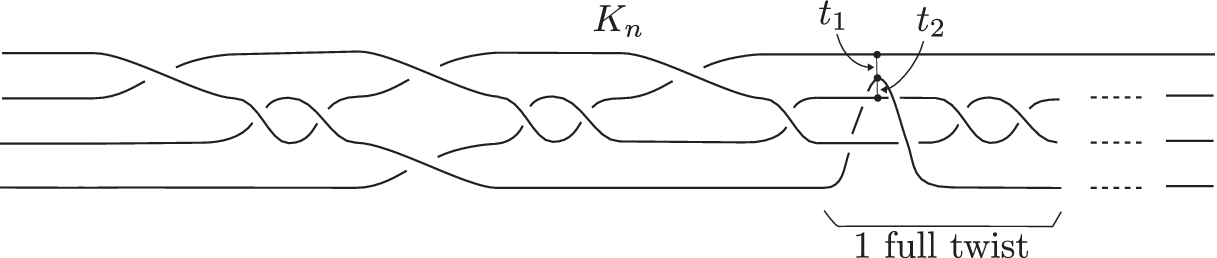
Proof. First, the two arcs
$t_1$
 and
$t_2$
 , as shown in Figure 5, give an unknotting tunnel system for
$K_n$
 . It is straightforward to verify that the exterior of the neighbourhood of
$K_n\cup t_1\cup t_2$
 is a handlebody of genus three. Hence,
$K_n$
 has tunnel number at most two.
An unknotting tunnel system
$\{t_1,t_2\}$
 for
$K_n$
 .

Figure 5 Long description
A line drawing depicts a horizontal braid consisting of four parallel strands that undergo a series of repeating crossings.
* The entire structure is labeled K sub n at the top center.
* Moving from left to right, the strands weave over and under each other in three distinct repeating blocks.
* Towards the right side, a vertical segment connects two strands. This segment contains two points labeled t sub 1 and t sub 2.
* Arrows point to these specific points: t sub 1 is the upper point on the vertical segment, and t sub 2 is the lower point.
* Below this specific section, a bracket spans one braid cycle and is labeled 1 full twist.
* To the far right, the strands transition into horizontal dashed lines, indicating the remaining full twists.
If
$K_n$
 has tunnel number one, then any resulting manifold by Dehn surgery on
$K_n$
 has Heegaard genus at most two. This is impossible by Lemma 3.1. Hence,
$K_n$
 has tunnel number two.
Remark 3.3. It is well known that a torus knot has tunnel number one, so is
$K_0$
 . For
$K_2$
 , which is s682, it is not hard to see that it admits an unknotting tunnel. In fact,
$t_1$
 , shown in Figure 5, gives the unknotting tunnel for
$K_2$
 . However,
$K_1$
 , the
$(2,9)$
 -cable of
$T(2,3)$
 , has tunnel number two [Reference Bleiler5, Reference Morimoto and Sakuma18].
4 Hyperbolicity and braid index
In this section, we prove that
$K_n$
 is hyperbolic when
$n\ge 2$
 . First, we calculate the Alexander polynomial
$\Delta _{K_n}(t)$
 of
$K_n$
 .
Lemma 4.1. Let
$n\ge 1$
 . Then, the Alexander polynomial
$\Delta _{K_n}(t)$
 of
$K_n$
 is

Proof. We start from the link
$K_0\cup c$
 used in Section 2. The orientation of each component is shown in Figure 1. The multivariable Alexander polynomial
$\Delta _{K_0\cup c}(x,y)$
 is

(We used Kodama’s knot [Reference Kodama13] for the calculation.)
By performing
$(-1/n)$
 -surgery on c, the link
$K_0\cup c$
 is changed into the new link
$K_n\cup c_n$
 , where
$c_n$
 is the unknot. We set
$c=c_0$
 . Clearly, two links
$K_0\cup c$
 and
$K_n\cup c_n$
 have homeomorphic exteriors. Then, the induced isomorphism of the homeomorphism on their homology groups relates the Alexander polynomials of these two links [Reference Fox10, Reference Morton20].
Let
$\mu _{K_n}$
 and
$\lambda _{K_n}$
 (respectively
$\mu _{c_n}$
 and
$\lambda _{c_n}$
 ) be the oriented meridian and longitude of
$K_n$
 (respectively
$c_n$
 ). Then,
$\mu _{K_n}=\mu _{K_0}$
 ,
$\mu _{c_n}=\mu _{c}-n\lambda _{c}$
 and
$\lambda _{c}=3\mu _{K_0}$
 . These give
$\mu _{c}=\mu _{c_n}+3n\mu _{K_n}$
 .
Hence,
$ \Delta _{K_n\cup c_n}(x,y)=\Delta _{K_0\cup c}(x,yx^{3n}). $
 Since
$\mathrm {lk}(K_n,c_n)=\mathrm {lk}(K_0,c)=3$
 , the Torres condition [Reference Torres25] implies

Thus,

Here,

and

Therefore,

as desired.
Recall the formal semigroup
$\mathcal {S}$
 of an L-space knot K [Reference Wang26]. It is a set of nonnegative integers defined from the formal power series expansion

Lemma 4.2. Let
$n\ge 2$
 . The formal semigroup of
$K_n$
 is

In particular,
$\mathcal {S}$
 is not a semigroup if
$n\ge 2$
 .
Proof. The first conclusion immediately follows from Lemma 4.1. If
$n\ge 2$
 , then
${4\in \mathcal {S}}$
 , but
$8\not \in \mathcal {S}$
 . Hence,
$\mathcal {S}$
 is not closed under addition.
We remark that
$\mathcal {S}=\{0,4,6,8,9,10\}\cup \{12,13,\ldots \}$
 when
$n=1$
 . This is closed under addition (see [Reference Borodzik and Livingston6, Example 1.10] and [Reference Wang26, Theorem 1.4]).
Lemma 4.3. If
$n\ge 2$
 , then
$K_n$
 is hyperbolic.
Proof. By Lemma 4.2, the formal semigroup
$\mathcal {S}$
 of
$K_n$
 is not a semigroup. Hence,
$K_n$
 is not a torus knot, since the formal semigroup of a torus knot is a genuine semigroup [Reference Borodzik and Livingston6, Example 1.10].
Suppose that
$K_n$
 is a satellite knot for a contradiction. First, by Lemma 2.4,
$K_n$
 is prime because an L-space knot is prime [Reference Krcatovich14, Theorem 1.2]. Since
$K_n$
 is the closure of a
$4$
 -braid, it has bridge index at most four. Hence, the companion is a
$2$
 -bridge knot and the pattern has wrapping number two by [Reference Schubert23].
In addition, the companion is an L-space knot and the pattern is braided [Reference Baker and Motegi3, Theorems 1.17 and 7.2]. This implies that the companion is a
$2$
 -bridge torus knot [Reference Ozsváth and Szabó21, Theorem 1.5] and the pattern is
$2$
 -cabled. Then,
$K_n$
 is an iterated torus L-space knot, so its formal semigroup is closed under addition [Reference Wang26, Theorem 1.4]. This contradicts Lemma 4.2. Hence,
$K_n$
 is hyperbolic.
Lemma 4.4. If
$n\ge 1$
 , then
$K_n$
 has braid index four.
Proof. We know that
$K_1$
 is the
$(2,9)$
 -cable of the trefoil, so it has bridge index four. Thus,
$K_1$
 has braid index four.
Next, consider
$K_2$
 , which is s682. The Morton–Franks–Williams inequality [Reference Franks and Williams11, Reference Morton19] gives a lower bound on the braid index in terms of its HOMFLY-PT polynomial. For the
$P(v,z)$
 version of the HOMFLY-PT polynomial, let
$d_+$
 and
$d_-$
 be the max and min degrees of v. Then,
$(d_+-d_-)/2+1$
 gives the lower bound for the braid index. For
$K_2$
 ,
$d_+=24$
 and
$d_-=18$
 by SageMath [22]. This shows that
$K_2$
 has braid index four.
Assume
$n\ge 3$
 . If
$K_n$
 has braid index at most three, then it has tunnel number one as mentioned in Section 1. By Lemma 3.2,
$K_n$
 has tunnel number two. Hence, it has braid index four.
Acknowledgement
The author would like to thank the referee for their careful reading.