




No CrossRef data available.
Egyptian Mathematical Texts and Their Contexts
Published online by Cambridge University Press: 01 September 2003
Abstract
Argument
The extant sources for ancient Egyptian mathematics are extremely limited. It is therefore necessary to read the few sources carefully and use additional information from further Egyptian sources in order to achieve the most detailed picture possible. Traditional approaches to Egyptian mathematics have provided only a superficial account of mathematical practices and almost no information about the role of mathematics within Egyptian culture. To enlarge our knowledge it is crucial to use a different methodological approach in the analysis of ancient mathematical techniques. In addition, it is indispensable to contextualize the mathematical problems with sources that are not specifically mathematical per se. In this article I discuss several possibilities for these additional sources, such as administrative texts, reliefs found in tombs, and other archaeological evidence. I exemplify the use of these sources with two problems from the Moscow mathematical papyrus.
Information
- Type
- Articles
- Information
- Copyright
- 2003 Cambridge University Press
I. Introduction
Twenty-five years ago, an article by Sabetai Unguru, “On the Need to Rewrite the History of Greek mathematics,” appeared in the Archive for History of Exact Sciences (Unguru 1975). In this article, now regarded as a classic in the field, the author pointed out the dangers and pitfalls of applying modern mathematical symbolisms and terminology in the historiography of ancient mathematics.1
Unguru expanded his argument further in Unguru 1979; Unguru and Rowe 1981 and 1982; and most recently in Unguru and Fried 2001.
In this article I will briefly describe traditional approaches to Egyptian mathematics and indicate their shortcomings. Then I will outline a new methodology for analyzing Egyptian mathematical problem texts. However, merely using a new formal interpretation of the texts is not enough. In addition, it is essential to consider the context of the mathematical problems. In contrast to the famous Greek mathematical texts that represent a deductive system of abstract mathematical theorems, Egyptian mathematical problem texts (our major source for Egyptian mathematics) are embedded in daily-life practices. In the main part of this article I argue that the use of our knowledge of this context is indispensable for the analysis of Egyptian mathematical texts, and I provide two concrete examples from the Moscow mathematical papyrus. The conclusions combine results obtained through these new approaches and summarize briefly the role of mathematics within the Egyptian culture as represented by the mathematical texts and their contexts.
1. Traditional Historiography of Egyptian Mathematics
The study of ancient Egyptian mathematics started with the discovery of the Rhind mathematical papyrus at the end of the nineteenth century (Eisenlohr [1877] 1972). While literature on Egyptian mathematics has never ceased to be produced since then, for some time most scholars only repeated and discussed what had been written before. The reason for this stagnation is twofold: first, the available primary sources2
In order of their publication (if edited several times, all editions are listed): pRhind (BM 10057 and 58): Eisenlohr, 1877; Peet, 1923a; Chace/Bull/Manning, 1927/29; Robins/Shute, 1987. Lahun mathematical fragments: Griffith, 1898. pBerlin 6619: Schack-Schackenburg, 1900 and 1902. Cairo wooden boards (CG 25367 and 25368): Daressy, 1901 and Peet, 1923b. pMoscow (E4676): Struve, 1930. Mathematical leatherroll (BM 10250): Glanville, 1927. Ostracon Senmut 153: Hayes, 1942. Ostracon Turin 57170: López, 1980.
The lack of new texts has led scholars to include administrative texts involving calculations in their presentations of Egyptian “mathematics texts” (e.g. Gillings 1972, 218–231, or Claggett 1999, 261–279). While it is certainly true that those sources can be useful for enlarging our knowledge on Egyptian mathematics, it must be kept in mind that they are not mathematical texts. As has been pointed out recently by Eleanor Robson in her work on Babylonian mathematics, there is a distinction between texts that reflect mathematical knowledge and texts that have been written about mathematics (Robson 1999, 7). Mathematical texts are simply texts that have been written to teach or learn mathematics. In the extant Egyptian texts, two kinds of mathematical texts can be differentiated: problem texts and table texts. Table texts are collections of mathematical data structured in the form of tables that are used in solving mathematical problems. The extant Egyptian mathematical texts include tables used in fraction reckoning and tables for conversions of measures. Problem texts state a mathematical problem and then indicate the solution of that problem by step-by-step instructions, each step usually consisting of one arithmetic operation. They can be characterized generally as suggested by Jim Ritter, as numeric, rhetorical, and algorithmic (Ritter 1989, 43–49). Numeric denotes the quality of always using concrete numbers. The texts are rhetorical in the sense that all operations are formulated without the use of symbolism, and they can be named algorithmic, since the solution is given as a sequence of instructions. The algorithmic trait of Egyptian (and also Babylonian)3
For Mesopotamian mathematics most explicitly Knuth 1972 (cf. also Knuth 1976). This has been largely ignored, presumably because Donald Knuth was a computing expert and had neither a background in history of mathematics nor in Assyriology. I would like to thank Eleanor Robson for this information.
2. New Approaches
A close examination of the individual problem texts reveals a common structure. First, an introduction announces 1.2 of the problem, names the data, and indicates the entity that is sought. This is followed by a series of instructions. These propose a sequence of arithmetical operations which, if carried out, will lead to the solution of the given problem. This part of the problem is grammatically marked by the use of imperatives (in the instructions) and the use of the verb form

(in the instructions and intermediate results). The function of this verb form can best be described as expressing a necessary sequence which results from the previously stated conditions (cf. Malaise and Winand 1999, 388–389 and Allen 2000, 304–306). As for announcing the result of a previously mentioned mathematical operation, the
expresses “mathematical facts” – if you add 2 and 2, the result will necessarily be 4. The use of the
in the instructions themselves can be interpreted as underlining their algorithmic aspect – given the stated mathematical problem, if a solution is to be found, it is necessarily those mathematical operations that have to be executed.
Some ten years ago, Jim Ritter proposed the utility of taking the algorithmic structure seriously (cf. Ritter 1989 [English translation Ritter 1995] and Ritter 1998). This approach enables a modern reader, at least to a certain degree, to walk in the shoes of those who created and worked with the sources. By applying this approach to the complete corpus of Egyptian problem texts, I have disclosed links between problems and have discerned substructures and refinements in the texts.4
A detailed account of my algorithmic analysis can be found in Imhausen 2003. A shorter description of the method is given in Imhausen 2002.
Having acknowledged this important formal feature, the actual content of the problem texts must not be neglected. Today we know of around one hundred problems from the extant problem texts, most of which are found in the Rhind and Moscow papyri. These problems cover a variety of topics that are often situated in daily life, as for example problems 39 and 40 from the Rhind papyrus in which rations are to be calculated, and problems 41 to 46 from the same papyrus which deal with the calculation of granary volumes. A large group of problems, found in both the Rhind and the Moscow papyri, deal with calculations related to baking and brewing. This situation renders the “context” extremely significant to Egyptian problem texts.
This significance is evident on different levels. The translation of an Egyptian text, vital for a correct interpretation, often requires more than the knowledge of Egyptian grammar. The technical vocabulary is different from our own, therefore the knowledge of practical procedures may provide clues to concepts expressed in source texts. Moreover, due to the fragility of papyrus, relatively few papyri from pharaonic Egypt are still extant today (Parkinson and Quirke 1995, 51). All those papyri that ended up in the inhabited area neighboring the Nile are lost. The only survivors are some scattered examples that – by some chance – happened to be in the desert. In many cases this condition has been fulfilled in the circumstances of a burial which gave the advantage to texts that were supposedly useful for the afterlife of the deceased. The mathematical texts were obviously not favored by this selection (Ritter 2000, 115). It is therefore necessary to read other Egyptian texts, in order to fill lacunae in one type of document by information gained from another genre.
Furthermore, the context of the mathematical texts is indispensable for their deeper understanding and necessary to appreciate the role of mathematics within the Egyptian culture. The collections of mathematical problems known as mathematical texts most probably served as school textbooks in the education of scribes. They inform us therefore, not only about mathematical techniques but also about part of the professional life of an Egyptian employed in administration.
II. Egyptian Mathematical Texts and Their Contexts
The term “contextualization” has become very well appreciated in the history of mathematics. The range of contextual studies is large; for this reason, it may be reasonable to say which kind of “context” I refer to, and why. The following two sections will present an outline of the different contexts available for the study of Egyptian mathematics and the ways these contexts can be used to understand Egyptian mathematical texts. The third section will illustrate this with two examples of Egyptian problems.
1. Various possibilities of “context”
One of the characteristic features of Egyptian mathematical texts is their close relation to daily life: of the hundred or so problems, over half of them have a background in everyday life.5
An overview of the individual problems and their classification can be found in the introduction of Imhausen 2003. Out of 101 problems, 40 teach mathematical techniques; 58 have a practical background and 3 are too fragmentary to be assigned to either group.
Information about these practical procedures can be gained from several sources. The most important among them are the so-called administrative or economic documents. They result from the actual work of scribes – work that scribes had been trained for with mathematical texts, among others. Moreover, they show the actual use of techniques that are taught in the mathematical texts. With this material we can greatly increase our understanding of the role of mathematics in the education of a scribe. Examples of these sources are the so-called ration texts. The Egyptian organization of work relied on a ration system. Quantities of bread and beer, the basic food items, were given as wages to the workers. The ration texts – in which at least sometimes mathematical techniques can be traced (cf. Guillemot 1992) – prove the importance of this kind of problem in the education of a scribe.
In addition to these very concrete examples, another type of background information is given by literary compositions referring to the profession of a scribe. For example, the Satire of the Trades compares the profession of a scribe to a range of other professions.6
An English translation can be found in Lichtheim 1976, 168–175.
The most recent translation (German) and commentary can be found in Fischer-Elfert 1986, 118–157.
Both of these literary compositions refer briefly to mathematics as part of the scribal profession. The Satire of the Trades includes sections on taxes that have to be paid (usually with great difficulty) by the different workers; the scribe in contrast, is referred to as the one who records the taxes of the others.8
“Only the scribe, it is he who calculates the taxes of all of them. You shall remember it” (pLansing 5,7; my translation). The hieratic text can be found in British Museum 1923, pl. 15–30.
- calculating the number of bricks needed to build a ramp,
- calculating the number of persons needed to move an obelisk,
- calculating the number of persons to erect a colossal statue,
- calculating the rations of a military group of given size.
The mathematical problems that are stated in pAnastasi I have been analyzed by several scholars (see Fischer-Elfert 1986, 118–157 with further bibliographical references). Due to the fact that they don’t contain all the necessary data to solve the sketched mathematical exercises, a variety of interpretations is possible. Their function in this text is obvious though: they come from a then-well-known body of scribal mathematical tasks so that the mention of the problem type alone was sufficient to recall in every Egyptian reader the group of problems referred to.
When using literary compositions to establish a “social setting” in which the scribes calculated and employed their mathematical training, it must not be forgotten that they are literary texts, written to entertain their readers and therefore not necessarily to be taken at face value.
The textual information is supplemented by evidence from paintings and reliefs in tombs as well as by archaeological finds. From the Old Kingdom on, scribes are depicted in tomb decorations. They are shown in scenes of accounting and measuring of all kinds.
In those cases where the mathematical problems are situated in the background of handicraft activities, these scenes of daily life provide an illustration of the underlying processes. Again, however, these illustrations cannot always be taken at face value, but have to be evaluated against evidence provided by archaeological findings (cf. Samuel 2000, 538). Taking into account the various possibilities of sources available from the above listed contexts, a modern reader can fill in some of the blanks caused by the fragmentary textual evidence of the mathematical texts.
2. Using the context to understand a mathematical problem
The consideration of the context can contribute to the understanding of Egyptian mathematical problem texts in several ways. The first stage in dealing with ancient sources is their translation, which is often far from trivial. Apart from the fact that the manuscripts sometimes are in a deplorable state, some reduced to tiny fragments, the concepts expressed in them may be very different from those we use today. A responsible translation has not only to ensure that the ancient concept is not lost, but has to observe at the same time that the translation itself is understandable to a modern reader. That this task is not easily achieved can be seen by the (often huge) philological commentaries added to translations.
The translation of ancient mathematical texts is no exception. Most Egyptian mathematical terminology was taken from “everyday” Egyptian. In addition, many of the problems have a practical setting. In these examples, a number of expressions and formulas have been directly adopted from the corresponding background. Knowing the “context,” namely the administrational, economic, and handicraft practices of pharaonic Egypt is therefore a basic necessity for gaining access to the sources themselves and for enabling a translation of mathematical texts. As will be shown in one of the examples below, the mathematical interpretation of a problem is dependant on the understanding of the source text and its correct translation.
Besides this bare necessity, however, there are further reasons to consider the cultural background of the mathematical texts: A deeper understanding of a text can only be gained if it is taken into consideration that the creation of texts happens within specific conditions to fulfill a distinct intention. In the case of the Egyptian problem texts, this intention is rather obvious: teaching mathematics. As indicated previously, the preserved mathematical texts tell us even more. They show a large number of problems referring to a practical background. This reflects not only the group of persons the texts were intended to teach, the so-called scribes, but also the kind of mathematical techniques these scribes needed to learn for their profession.
Furthermore, the “practical character” of the Egyptian mathematical texts becomes understandable. The “applied” problems are not mathematical problems with an accidental practical setting. They are the actual training for handling the mathematics that an Egyptian scribe was confronted with in his daily work. Pivotal for our understanding of the significance of a mathematical problem in Egyptian mathematics – as it is displayed in the mathematical texts – is therefore its importance with regard to the actual work of the scribes.
3. Individual Examples
The following two examples illustrate the importance of considering the context. In the first case administrative documents and tomb representations provide the means to achieve an accurate translation of the problem text. The second case shows the understanding of the significance of a group of mathematical problems through the use of information from tomb representations.
The texts are given here in my hieroglyphic transcription. In addition, I have indicated references to the original hieratic texts. In several instances the translation makes use of Egyptian words. This indicates that the Egyptian term either does not have an equivalent English translation or that the specific meaning of the term is still open to discussion.
The Egyptian fraction notation used unit fractions only, with the sole exception of the fraction two-thirds (noted as
in translations). They are written in the hieratic texts by the number that represents the denominator with a dot (to indicate the fraction) above it. This dot is conventionally rendered in translations as a horizontal line over the number, e.g.
is written as
.
3.1 The problem of a cobbler (pMoscow, no. 23)
Figure 1 shows the hieroglyphic transcription of problem 23 from the Moscow mathematical papyrus9
The hieratic text can be found in Struve 1930, col. XLII.

Fig. 1. pMoscow, problem 23, hieroglyphic transcription and Struve’s translation
Struve understood the text as a problem dealing with the wage of a cobbler who is normally paid twice within ten days and who does, in this problem, overtime-work for which the pay is to be calculated.
It turns out however, that this interpretation is incorrect in several aspects. The first objections against this interpretation were introduced in 1931 by the Egyptologist Thomas Eric Peet:
S.’s interpretation of this exceedingly difficult problem is unconvincing for several reasons. In the first place, the words mk
pw n hrw in the last line cannot mean “It is
days” but only “It is
in a day.” Secondly he introduces into the calculation a figure
(relation of the ordinary working-day to the extraordinary) which is not in the data. Thirdly one of the data, 10, is, on his theory, entirely unnecessary to the problem. Fourthly, the Egyptian for “a day which is long,” i.e. “a long day” is not hrw jw. f r wrr, which if it meant anything at all, would be definitely future.11
Here Peet has not read the German text correctly which is indeed written in future tense (“der groß sein wird”).
In order to meet these objections, it is necessary to consider the background of the problem. The title of the problem indicates an administrative context. The Egyptian term used to denote the quantity that is to be calculated is “

w.” This was understood by Struve as “Arbeiten” (produce). However, the term
w, which is derived from the verb
“to work,” is also used as a technical term in a number of administrative documents. From the references to
w in these texts it has been possible to grasp its meaning:
w indicates the product of a working process, but includes also the obligation to deliver a fixed quantity of this product within a certain period of time.
12It must be stressed that the term and the underlying concept of
w is not restricted to craftsmen, there are also references to the
w of a scribe and in one inscription gold, silver, and copper – which are generally used to denote the exchange value – are indicated as
w of traders.
I would like to thank Eleanor Robson for suggesting this translation to me, and also for referring me to the respective Mesopotamian (Old Babylonian) problems, e.g. IM 53961 (cf. Robson 1999, 94–96).
w suggests that the calculation refers to the amount of the cobbler’s product which must be submitted in a fixed period of time.
The handicraft context of this problem is named in its setting: it is the work of a cobbler. We have access to this context through artifacts from settlement sites as well as depictions of handicraft processes in tombs.
14The tomb depictions of craftsmen have been analyzed in Drenkhahn 1976. For leather manufacture, cf. also Hasanien 1997. These interpretations have to be read carefully, cf. now van Driel-Murray 2000, which contradicts several of the statements made in Hasanien 1997.

).
15Leather manufacture scenes from the Middle Kingdom can be found in Newberry 1894, pl. IV (tomb 15) and Newberry 1893, pl. XI (tomb 2). On production of sandals, see van Driel-Murray 2000, 312–316.
The term

which Struve took as a term for a payment made to the cobbler is significant in regard to this context. This term can be found in at least one inscription

that accompanies the depiction of the manufacturing of sandals in an Old Kingdom tomb (fig. 2).

Fig. 2. Leather working in the tomb of My line drawing. A photo of the scene can be found in Capart 1907, pl. 33.
In this depiction one of three cobblers is working on something lying in front of him. This inscription indicates therefore that DbA is used to denote the final part of the process of manufacturing sandals, after the leather has been cut. Thus, in the text of problem 23, DbA probably refers to part of the manufacturing process, and not to a payment made for the work.17
This was already suggested (without further explanation) by Peet 1931, 158. Peet translates DbA tentatively as “to decorate.”
These lexical considerations lead to another interpretation of this problem that fits in well with the calculations found in the text:
1. Method of calculating the work rate (
w) of a cobbler:
2. If it is said to you “the work rate (
w) of a cobbler”:
if he cuts,
3. it is 10 per day; if he finishes, it is 5 per day.
4/5. If he cuts and finishes, how many will it be per day?
Then you calculate the parts of this 10 together with this 5.
6. Then the sum results as 3. Then you divide 10 by this.
Then 3$\bar{3}$ times result.
7 Behold, it is 3$\bar{3}$ per day.
What has been found by you is correct.
The title of the problem (ln. 1) provides the information that the work-rate (
w) of a cobbler is calculated. The following lines (ln. 2–3) state that the cobbler has to cut leather for ten pairs of sandals as his work-rate per day – if he only cuts the leather; and that he has to finish five pairs per day if the leather has already been cut. The next two lines (ln. 4–5) tell us what is looked for, namely the amount of his contribution (work-rate), given the condition that the cobbler does both parts of the sandal production, cutting and finishing the shoe. The following instructions given to solve the problem (ln.4–6) suit this interpretation. The solution basically uses the fact that the contribution of the cobbler, if he only cuts leather, is twice the contribution if he finishes the sandals. If he has to cut ten pairs as his daily work-rate and he has to finish five, it will take three days work to amount to ten pairs of sandals. What was wanted was the number of sandals per day if he does both. This is obtained by dividing 10 by 3, which results in
pairs of sandals. The problem concludes with the notice “gmj = k nfr” “What has been found by you is correct.”
The previous criticism of Struve’s interpretation of this problem should not be taken as an attempt to demonstrate his incompetence. It rather shows the importance of considering the underlying procedures – and at the time of Struve’s edition much less was known of these – and it demonstrates the problems every modern reader has to face in dealing with this kind of source.
3.2 The Bread and Beer Problems
Within the Egyptian mathematical problem texts, the so-called bread-and-beer problems hold a significant position due to their frequency.18
Nine problems in the Rhind papyrus (problems 69–78) and eleven problems in the Moscow papyrus (problems 5, 8, 9, 12, 13, 15, 16, 20, 21, 22, and 24) belong to this group.
Figure 3 shows the hieroglyphic text as well as my translation of pMoscow, no. 16.19
The readings given here differ from the readings given by Struve in several places. An explanation for the readings given here can be found in Imhausen 1999.
Unlike the previous problem, the heading of this problem uses red ink. Within the Moscow papyrus, only the first 16 problems each use red ink to indicate the heading of a new problem.
- (beer vessels of) psw 2,
- “ of for dates,”

- (emmer, measured as) .
The entity that is sought in this problem is not explicitly stated, but the data mentioned in this introduction are already sufficient to indicate the problem. The introduction is followed by the second part of the problem, namely the procedure of its solution.

Fig. 3. pMoscow, problem 16 (Red ink in the source text is rendered as underlined in the hieroglyphic text and as bold print in the translation).
As usual, the text contains a series of instructions for arithmetical operations, followed by the individual results. These are sometimes supplemented by further explanations: “Then you calculate the need of these beer-vessels of psw 2. Then it results as

. Then you calculate it times 2. Then 1 results. Then you divide 1 by
. Then
results. Then you calculate
of 1. Then
result.” The end of the text states that the result of the last step solved the problem, followed by a note that this solution is correct: “Then you tell him: Look: It is these. What has been found by you is correct.”
This example shows again very clearly the difficulties a modern reader encounters when reading an ancient text. Although all of the individual arithmetical steps can be followed easily, the sense of the problem remains obscure. The title of the problem states that beer shall be calculated, but the final result is given as
. This is a quantity; however, it is certainly not a quantity of beer:
is the standard Egyptian measure for grain volumes, approximately 4.8 liters. Beer, by contrast, is usually counted by vessels (as is in fact indicated in the text of this problem). The translation includes, besides
, the Egyptian words psw and

which have to be explained. Finally, two factors are indicated, namely
and
. Several calculations are executed with the final result of
which is identified as the correct solution.
Again, in order to understand what is going on, information about the problem’s practical background is needed. “Understanding” not only refers to the individual calculations, but also to the problem’s relevance within Egyptian mathematics. To understand the problem, the following questions have to be answered:
- What are the meanings of psw and ?
- What does
of for dates imply?
- What is the relevance of the factor ?
- What has been calculated in the end?
To answer these questions, a basic knowledge of baking and brewing in ancient Egypt is needed.
Egyptian grain and the Egyptian production of bread and beer
Two kinds of grain, barley and emmer (a variety of wheat), are proven to have been used in ancient Egypt. Both were used in the production of bread and beer. Besides these, another cereal called
is mentioned in the Egyptian texts. Its exact meaning has not yet been established (cf. Faltings 1995 and Posener-Krièger 1977), but it is most probably a grain product used for beer brewing, presumably some sort of malt.
The production of bread and beer in Egypt can be traced by archaeological artifacts as well as by representations on tomb walls decorated with scenes from daily life (cf. Faltings 1998 and Samuel 2000).21
The most detailed tomb scenes found are during the Old Kingdom. This is a period prior to the mathematical texts that are dated to the Middle Kingdom. During the Middle Kingdom models representing the scenes from daily life become more prominent (see for example the models of bakers and brewers from the tomb of Meketre in Roehrig 2002, 11–12). These are mostly less detailed than the Old Kingdom tomb scenes. However, they show no significant change in the representation of baking and brewing, therefore the Old Kingdom scenes are used for further explications. A Middle Kingdom scene of baking and brewing can be found in the tomb of Intefiqer (cf. Davies and Gardiner 1920, pl. 8 and 11).
There is a certain variety in details depicted in these scenes. Not every depiction shows the same sequence of steps. Some of them are represented only in a few instances. The following description is based on the work of Dina Faltings, who examined the available material from the Old Kingdom (Faltings 1998). Fig. 4 shows the scenes of baking and brewing from the tomb of Nianchchnum and Chnumhotep.

Fig. 4. Scenes of baking and brewing in the tomb of Nianchchnum and ChnumhotepMy line drawing. A photo of the scene can be found in Moussa and Altenmüller 1977, Tafel 23.
The scenes start with the depiction of workers taking grain out of the granary and handing it to the bakers. An official notes the amounts that are given to them (1st register). The production of bread starts with purifying and grinding the grain (2nd register). The flour is then made into dough (2nd register) which is distributed into pre-heated bread moulds and is then baked (3rd register). The 4th register shows the preparations of another type of bread. The preparation of the beer starts from bread that is mixed with dates and water in a large bin (5th register). The dates serve to fortify the taste as well as to bring yeast to the mixture for fermentation. The yeast organisms are found on the skins of the dates. Before further processing, the mixture is probably left alone for fermentation. This is followed by the procedure of straining the mixture. The beer is finally poured into vessels (5th register). The last scenes of the representations show the delivery of produced goods. A scribe is shown measuring the delivered quantities (6th register).
A connection between the production of bread and beer and the mathematical bread and beer problems can be traced by means of the terminology that is used. The representations of baking and brewing show the distribution of grain and the delivery of bread and beer. To be able to control the production, the distributed grain must have a specific equivalent in bread and beer, that is, a certain quantity of bread and beer of a known quality. It must be possible therefore to calculate how many loaves of bread can be baked with a given amount of grain. The entities and formulations used to describe this are found in the bread and beer problems of the mathematical texts.
The most important terminus technicus herein is the Egyptian word psw. The psw denotes how many bread loaves or vessels of beer are prepared from one
of grain.
23This relies on constant sizes of bread or vessels for beer. It should not be assumed that constant vessel or loaf sizes were in use all over Egypt, although regional standards are perfectly possible. Proof of this has been established in at least one case (cf. Bárta 1996). Average sizes of bread moulds can be found in Faltings 1998.

The higher the psw of bread or beer, the lower is its actual content of grain. In the problems of the Moscow papyrus the psw of bread is constantly 20 (20 bread loaves were made from 1
of grain). The psw of beer varies between 2 and 6.
With this additional information, the mention of psw in problem 16 of the Moscow papyrus becomes understandable, as well as the first calculation (XXXI.5), in which the amount of grain needed per vessel is determined. If the psw is said to be 2, the amount of grain needed for one vessel of beer is
(its inverse).
The role of
and dates in the problem, as well as the introduction of emmer and the following calculations, are still unclear. At this point, it is helpful to consider another document from the context of the bread and beer problems. pBerlin 10.078 was written in the same period as the Moscow papyrus. Anthony Spalinger has established that this document contains the information that different types of grain are valued in standard proportions (Spalinger 1988). According to Spalinger, this can be rendered as follows:

Each line of the table notes how many
of the grain noted on top of each respective column equals one
of the grain noted at the beginning of the line. For example, line two gives the information that 1
of emmer equals respectively
of barley, 1
of emmer,
of dates or 4
of
. These value proportions are found in the Moscow papyrus as well, where barley is used as a kind of reference grain, as can be seen from problem 20. In this problem, a number of bread loaves made of emmer of a known psw are given, and the value of these bread loaves as an amount of barley is calculated.
As a consequence, the quantities of barley mentioned in the problems of the Moscow papyrus have two possible meanings. Either they denote a quantity used for the actual baking/brewing, or they represent the value of (another) quantity of a different type of grain that is used for baking or brewing.
Taking this further information into account, the factor
mentioned in the text of our problem is understandable. It denotes the proportion of value between emmer and barley. This also indicates that the amount of grain (emmer) calculated is the value of the product. The respective calculations are found in our problem in column XXXI, line7: the inverse of the given factor
is determined, since – as we will see later – an amount of barley must be transferred into the equivalent amount of emmer.
The last missing piece in our understanding is the meaning of the formula of
for dates. As indicated above,
is a cereal, probably malt.
and dates are used in the production of beer. Within the problems relating to the production of bread and beer of the Moscow papyrus there are two possible formulas that mention
and dates:


The first formula, which has been translated above as “
of
for dates,” is used in problems, no. 5, 8, 9, 13, 16, 22, and 24; the second one which can be translated as “
like dates” only in problem 12.
The occurrence of one of these formulas in the mathematical problems usually implies that amounts of grain are multiplied by a certain factor. The exact meaning of these formulas has been discussed since 1930, a discussion that I will not repeat here.
24The relevant literature in order of its appearance is: Struve 1930, 59–79 and 90–92; Gardiner 1947, 226*; Nims 1958; Reineke 1964, 189–190; Spalinger 1988.
of
for dates” could not yet be interpreted in a way that explains the calculations that usually follow it in the problem texts.
A close examination of the problems in which either of the two phrases are employed makes it evident that they mention the ingredients. The mention of
and dates therefore indicates that they are used for brewing. Furthermore, they include relative quantitative statements of the amount of
and dates. The explanation of those formulas must not only explain the factors that appear within them (namely 3:4 and 1:1) but also the respective factors that appear after their appearance in the mathematical problems.
The second formula, “
like dates” turns out to be easier to explain (cf. Spalinger 1988).
25Spalinger’s interpretation of the other formula, however, uses only some of the available problem texts and needs serious emendations of the source texts. The problems not taken into account in his interpretation show that the explanation given by him cannot be correct.
and dates. While both ingredients determine the value of the resulting product, it is only the amount of
that is considered for the respective psw-value.
From this explanation follow a number of premises that can be used to explain the formula in our problem:
- the calculated entity designates the value of the named products,
- the psw-value mentioned in the problem does not change; the amount of grain used for brewing is determined by the psw-value indicated at the beginning,26
Spalinger assumes a change of the psw. From problem 12 it follows, however, that the psw is independent of further quality announcements.
- the psw refers only to the grain (), dates are not concerned.
- the calculation of the value includes all the ingredients, grain and dates; the value is given (if not indicated otherwise) as an amount of barley.
After these preliminary observations, problem 9 from the Moscow papyrus can be used to determine the meaning of the “
of
for dates”-formula. This text includes the formula and its text is very detailed. It indicates that beer that is said to be “
of
for dates” has twice the value of beer made of barley alone. The value is calculated from the psw (indication of grain quantity used for brewing), the kind of grain (
), and the amount of dates. The result, given as an amount of grain (barley), denotes only the value. Since the amount and kind of grain are known, the factor 2, which is named in the problem text, can be used to determine the amount of dates. The total value of the mixture used for brewing consists of the value of the
, and the value of the dates. The psw indicates the amount of grain used for brewing. The text of some of the problems indicated that the value of the beer named
“of
for dates” is twice of that made of barley alone. Since the psw is given, the value can be calculated as well.
The value of
, as an amount of barley, is deducible from the amount of
and the factor to calculate an amount of
as an amount of barley given in the table of grain values. Thereby the value of
can be calculated. The only thing remaining to be determined is the part of dates.
With the entities known, the value of the dates can be expressed in relation to the amount of grain (
) used for brewing. This results in the relation 3:4. One possible explanation for the factor
(= 3:4) in the formula is therefore the statement of the relation of the amount of grain to the value of the dates.
With these explications, the text of problem 16 can be followed: The title “Method of calculating beer-vessels of psw 2” indicates the type of problem and already names one of the data (psw = 2). Then the data are introduced: “If you are told beer-vessels of psw 2,
of
for dates exchanged as emmer, measured as
.” Beer of psw 2 is named as the starting point. Then it is indicated that it should be the more expensive beer, characterized as “
of
for dates.” The value of this beer has to be expressed as a quantity of emmer. Therefore the factor to convert grain from emmer to barley is given.
This introduction is followed by the algorithm to solve the problem: “Then you calculate the need of these beer-vessels of psw 2. Then it results as
.” The definition of the psw is used to calculate the amount of grain needed to brew each vessel. Then the superior quality is brought into play: “Then you calculate it times 2. Then 1 results.” For the reasons stated above, the amount of grain is doubled. This is then converted into the equivalent amount of emmer: “Then you divide 1 by
. Then results. Then you calculate
of 1. Then
result.” Since the conversion is barley into emmer, the inverse of the given factor has to be calculated first. It results as
. This is used to convert the calculated amount of barley into emmer. This is the solution of the problem: “Then you tell him: Behold: It is these. What has been found by you is correct.”
III. Conclusions
It is now 25 years since Unguru published his article challenging historians of mathematics to rewrite the history of Greek mathematics. His article demonstrating fundamental pitfalls in the former traditional historiography of Greek mathematics is just as meaningful for historians of Egyptian mathematics. Those pitfalls are the major reason for the recent stagnation of the field. To get out of this dead-end, I have proposed a new approach to analyzing the sources (Imhausen 2002 and Imhausen 2003). Taking the algorithmic feature of the texts into account, this approach is appropriate to the internal structure of the extant mathematical texts. The inclusion of the context that Egyptian mathematical texts have been recognized to be deeply linked with, ensures first of all the correct interpretation of the actual source. Furthermore, if more than just a superficial account of “mathematical content” is to be achieved, the embedding of the texts into their background enables us to gain a deeper understanding of the use of mathematics in ancient Egypt and its role in society. Mathematical texts, as well as the reference to mathematics in Egyptian literature prove that mathematical training was an important element of the education of a scribe. The group of “scribes” undoubtedly consisted of persons from a range of social positions. The largest part of these (which is the group referred to in literary texts as “the scribes”) were probably the ones doing basic daily accounting. It is from this group of persons that we find documents displaying mathematical techniques, namely economic and administrative documents, which allow us to follow mathematical practices in ancient Egypt.
References
Allen, James P.2000. Middle Egyptian. An Introduction to the Language and Culture of Hieroglyphs. Cambridge: Cambridge University Press.
Bárta, Miroslav. 1996. “Several Remarks on Beer Jars Found at Abusir.” Cahiers de la Céramique Égyptienne 4:127–131.Google Scholar
British Museum. 1923. Hieratic Papyri in the British Museum. Vol. 2. London: British Museum.
Capart, Jean. 1907. Une rue de tombeaux a Saqqarah. Bruxelles: Vromant.
Chace, Arnold B.with Ludlow Bull, Henry P. Manning, and Raymond C. Archibald. 1927/1929. The Rhind Mathematical Papyrus: British Museum 10057 and 10058 (2 Bde.). Oberlin (Ohio): Mathematical Association of America.
Clagett, Marshall. 1999. Ancient Egyptian Science. Volume III: Ancient Egyptian Mathematics. Philadelphia: American Philosophical Society.
Daressy, Georges. 1901. Catalogue général des antiquités égyptiennes du Musée du Caire: Nos 25001–25385: Ostraca. Kairo: Institut fran¸ais d’archéologie orientale du Caire.
Davies, N. de Garisand Alan H. Gardiner. 1920. The Tomb of Antefoker, Vizier of Sesostris I, and of his Wife, Senet (No. 60)(Theban Tomb Series 2). London: Egypt Exploration Society.
Drenkhahn, Rosemarie. 1976. Die Handwerker und ihre Tätigkeiten im Alten Ägypten(Ägyptologische Abhandlungen 31). Wiesbaden: Otto Harrassowitz.
van Driel-Murray, Carol. 2000. “Leatherwork and Skin Products.” In Ancient Egyptian Materials and Technology, edited by Paul T. Nicholson and Ian Shaw299–319. Cambridge: Cambridge University Press.
Eisenlohr, August. [1877] 1972. Ein mathematisches Handbuch der alten Ägypter. Leipzig: Hinrichs(reprint Walluf bei Wiesbaden: Dr. Martin Sändig oHG).
Faltings, Dina. 1995. “ und zwt – zwei ungeklärte Begriffe der Getreidewirtschaft im AR.” Göttinger Miszellen 148:35–44.Google Scholar
Faltings, Dina. 1998. Die Keramik der Lebensmittelproduktion im Alten Reich. Ikonographie und Archäologie eines Gebrauchsartikels(Studien zur Archäologie und Geschichte Altägyptens). Heidelberg: Heidelberger Orientverlag
Fischer-Elfert, Hans Werner. 1986. Die satirische Streitschrift des Papyrus Anastasi: Übersetzung und Kommentar(Ägyptologische Abhandlungen 44). Wiesbaden: Otto Harrassowitz.
Gardiner, Alan H.1947. Ancient Egyptian Onomastica. London: Oxford University Press.
Gillings, Richard. 1972. Mathematics in the Time of the Pharaohs. Cambridge, Mass.: MIT Press.
Glanville, Stephen R. K.1927. “The Mathematical Leather Roll in the British Museum.” Journal of Egyptian Archaeology 13:232–239.Google Scholar
Griffith, Francis L.1898. Hieratic Papyri from Kahun and Gurob. London: Quaritch.
Guillemot, Michel. 1992. “Les notations et les pratiques opératoires permettent-elles de parler de ‘fractions égyptiennes’?” In Histoire de fractions, fractions d’histoire, edited by Paul BenoitKarine Chemlaand Jim Ritter53–69. Basel, Boston, Berlin: Birkhäuser
Hasanien, Azza Farouk. 1997. “Leather Manufacture in Ancient Egypt.” Göttinger Miszellen 161:75–85.Google Scholar
Hayes, William C.1942. Ostraca and Name Stones from the Tomb of Sen-Mut (No. 71) at Thebes. New York: Metropolitan Museum of Art.
Imhausen, Annette. 1999. “Aufgabe 16 des mathematischen Papyrus Moskau – Rechenfehler oder Ligatur?” Göttinger Miszellen 168:45–48.Google Scholar
Imhausen, Annette. 2002. “The Algorithmic Structure of the Egyptian Mathematical Problem Texts.” In Under One Sky. Astronomy and Mathematics in the Ancient Near Eastedited by John Steele and Annette Imhausen147–166. Proceedings of the Conference held in the British Museum, London, June 25–27, 2001 (AOAT 297). Münster: Ugarit Verlag.
Imhausen, Annette. 2003. Ägyptische Algorithmen. Eine Untersuchung zu den mittelägyptischen mathematischen Aufgabentexten(Ägyptologische Abhandlungen 65). Wiesbaden: Otto Harrassowitz.
Knuth, Donald E.1972. “Ancient Babylonian Algorithms.” Communications for the Association of Computing Machinery 15:671–677.Google Scholar
Knuth, Donald E.1976. “Errata: Ancient Babylonian Algorithms.” Communications for the Association of Computing Machinery 19:108.Google Scholar
Lichtheim, Miriam. 1976. Ancient Egyptian Literature. Volume II: The New Kingdom. Berkeley, Los Angeles, London: University of California Press.
López, Jesus. 1980. Ostraca Ieratici. N. 57093–57319: Catalogo del Museo Egizio di Torino, Serie Seconda – Collezioni, Vol. III, Fasciolo 2. Milano: Istituto Editoriale Cisalpino-LaGoliardica.
Malaise, Michel and Jean Winand.1999. Grammaire raisonnée de l’égyptien classique (Ægyptiaca Leodiensia 6). Liège: Centre Informatique de Philosophie et Lettres.
Moussa, Ahmed M./Altenmüller, Hartwig. 1977. Das Grab des Nianchchnum und Chnumhotep (Archäologische Veröffentlichungen 21). Mainz: Philipp von Zabern.
Neugebauer, Otto. 1929. Über vorgriechische Mathematik (Hamburger Mathematische Einzelschriften 8. Heft/1929). Leipzig: B.G. Teubner.
Neugebauer, Otto. 1934. Vorlesungen über Geschichte der antiken mathematischen Wissenschaften. Erster Band: Vorgriechische Mathematik. Berlin: Julius Springer.
Newberry, Percy E.1893. Beni Hasan: Part I (Archaeological Survey of Egypt 1). London: Egypt Exploration Fund.
Newberry, Percy E.1894a. Beni Hasan: Part II (Archaeological Survey of Egypt 2). London: Egypt Exploration Fund.
Nims, Charles F.1958. “The Bread and Beer Problems of the Moscow Mathematical Papyrus.” Journal of Egyptian Archaeology 44:56–65.Google Scholar
Parkinson, Richard and Stephen Quirke. 1995. Papyrus. London: British Museum.
Parkinson, Richard. 1998. The Tale of Sinuhe and Other Ancient Egyptian Poems, 1940–1640 BC. Oxford: Oxford University Press.
Peet, Thomas E.1923a. The Rhind Mathematical Papyrus, British Museum 10057 and 10058. Introduction, Transcription, Translation and Commentary. London: cHodder & Stoughton Limited(reprint: Nendeln (Liechtenstein): Kraus Reprint 1970).
Peet, Thomas E.1923b. “Arithmetic in the Middle Kingdom.” Journal of Egyptian Archaeology 9:91–95.Google Scholar
Peet, Thomas E.1931. “Notices of Recent Publications: Mathematischer Papyrus des Staatlichen Museums der Schönen Künste in Moskau. Von W.W. Struve. (Quellen u. Studien zur Geschichte der Mathematik; Abteilung A: Quellen, Band I.) Berlin 1930.” Journal of Egyptian Archaeology 17:154–160.Google Scholar
Reineke, Walter Friedrich. 1964. “Die mathematischen Texte der Alten Ägypter.” Ph.D. diss., Berlin.
Ritter, James. 1989. “Chacun sa vérité: les mathématiques en Égypte et en Mésopotamie.” In Éléments d’histoire des sciences, edited by Michel Serres, 39–61. Paris: Bordas.
Ritter, James. 1995. “Measure for Measure: Mathematics in Egypt and Mesopotamia.” In A History of Scientific Thought. Elements of a History of Science, edited by Michel Serres44–72. Oxford and Cambridge, Mass.: Blackwell.
Ritter, James. 1998. Reading Strasbourg 368: A Thrice-Told Tale(Preprint Max-Planck-Institut für Wissenschaftsgeschichte 103). Berlin: Max-Planck-Institut für Wissenschaftsgeschichte.
Ritter, James. 2000. “Egyptian Mathematics.” In Mathematics Across Cultures. The History of Non-Western Mathematics, edited by Helaine Selin115–136. Dordrecht/Boston/London: Kluwer.
Robins, Gay and Charles. Shute. 1987. The Rhind Mathematical Papyrus. An Ancient Egyptian Text. London: British Museum.
Robson, Eleanor. 1995. “Review: Karen Rhea Nemet-Nejat, Cuneiform Mathematical Texts as a Reflection of Everyday Life in Mesopotamia, New Haven 1993.” Bibliotheca Orientalis 52:424–432.Google Scholar
Robson, Eleanor. 1999. Mesopotamian Mathematics, 2100 – 1600 BC. Technical Constants in Bureaucracy and Education. Oxford: Clarendon Press.
Roehrig, Catharine H.2002. Life Along the Nile. Three Egyptians of Ancient Thebes. (Reprint of the Metropolitan Museum of Art Bulletin, Summer 2002). New York: Metropolitan Museum of Art.
Samuel, Delwen. 2000. “Brewing and Baking.” In Ancient Egyptian Materials and Technology, edited by Paul T. Nicholson and Ian Shaw537–576. Cambridge: Cambridge University Press.
Schack-Schackenburg, Hans. 1900. “Der Berliner Papyrus 6619 (mit 1 Tafel).” Zeitschrift für Ägyptische Sprache und Altertumskunde 38:135–140.Google Scholar
Schack-Schackenburg, Hans. 1902. “Das kleinere Fragment des Berliner Papyrus 6619.” Zeitschrift für Ägyptische Sprache und Altertumskunde 40:65–66.Google Scholar
Spalinger, Anthony. 1988. “Dates in Ancient Egypt.” Studien zur Altägyptischen Kultur 15:255–276.Google Scholar
Struve, Wasili W.1930. Mathematischer Papyrus des staatlichen Museums der schönen Künste in Moskau. Edited by Otto NeugebauerJulius Stenzel and Otto Toeplitz. Quellen und Studien zur Geschichte der Mathematik Astronomie und Physik Abteilung A: Quellen, Berlin: Julius Springer.
Unguru, Sabetai. 1975. “On the Need to Rewrite the History of Greek Mathematics.” Archive for History of Exact Sciences 15:67–114.Google Scholar
Unguru, Sabetai. 1979. “History of Ancient Mathematics: Some Reflections on the State of the Art.” Isis 70:555–565.Google Scholar
Unguru, Sabetai and David E. Rowe. 1981. “Does the Quadratic Equation have Greek Roots? A Study of ‘Geometric Algebra,’ ‘Application of Areas,’ and Related Problems (Part 1).” Libertas Mathematica 1:1–49.Google Scholar
Unguru, Sabetai and David E. Rowe. 1982. “Does the Quadratic Equation have Greek Roots? A Study of ‘Geometric Algebra,’ ‘Application of Areas,’ and Related Problems (Part 2).” Libertas Mathematica 2:1–62.Google Scholar
Unguru, Sabetai and Michael Fried. 2001. Apollonius of Perga’s Conica: Text, Context, Subtext. Leiden, Boston: Brill.
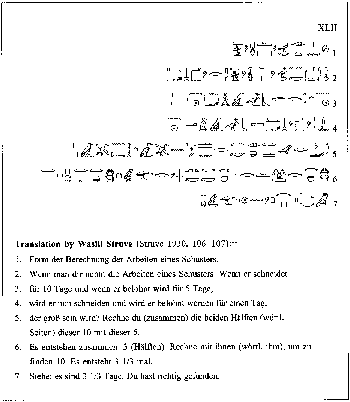
Fig. 1. pMoscow, problem 23, hieroglyphic transcription and Struve’s translation
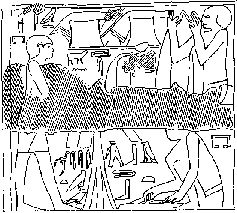
Fig. 2. Leather working in the tomb of My line drawing. A photo of the scene can be found in Capart 1907, pl. 33.
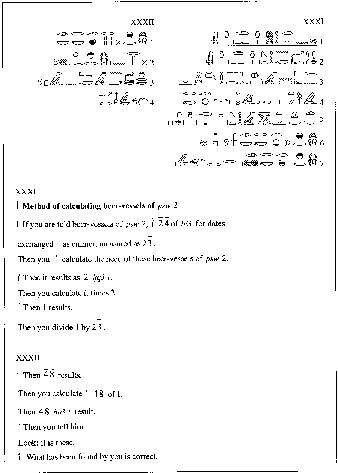
Fig. 3. pMoscow, problem 16 (Red ink in the source text is rendered as underlined in the hieroglyphic text and as bold print in the translation).
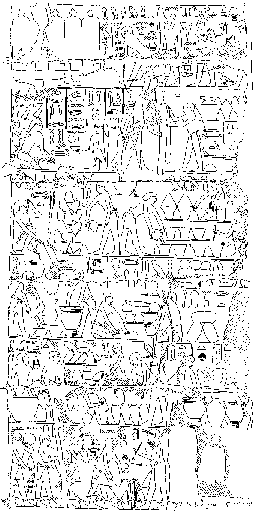
Fig. 4. Scenes of baking and brewing in the tomb of Nianchchnum and ChnumhotepMy line drawing. A photo of the scene can be found in Moussa and Altenmüller 1977, Tafel 23.
 You have
Access
- 6
- Cited by