1. INSIGHT AND INSIGHTFULNESS
On 3 July 2012, Yitang Zhang, a 50-year-old maths lecturer, was taking a stroll in the back yard of a friend's house in Colorado before leaving for a concert. He had been working tirelessly for years on one of the most elusive problems in pure mathematics, the twin prime conjecture, one of the holy grails of pure mathematics. The twin prime conjecture says that there are infinitely many prime numbers, p, such that p + 2 is also a prime number – i.e., such as (3, 5), (5, 7), etc. Leading experts in analytic number theory have been attempting to prove this since the middle of the 19th century, but with no success. In fact, by 2012, no one had even proven that there is any number such that there are an infinite number of primes which differ by only that number (this later conjecture is called the bounded gaps conjecture). And what's more is that no one had any obvious leads as to how to make headway, though it was clear to all that if anyone could provide a proof for the bounded gaps conjecture, this would be an enormous breakthrough towards proving the twin prime conjecture.
When Zhang was taking that walk in his friend's backyard in the summer of 2012, he had made, to that point, no substantial contribution to mathematics and was virtually unknown by experts working in the field. He'd not even published a paper since 2001, and had for a long time struggled to find any academic employment. But, as Zhang later told a reporter, that evening in July 2012 a solution to the bounded gaps conjecture suddenly came to him, and he immediately realised that it would work. He wrote up the proof and sent it to the most prestigious journal in the field, Annals of Mathematics Footnote 1 and the publication of his proof left the experts shocked; it was praised as one of the greatest and most surprising breakthroughs in number theory, described as astounding by number theorist Daniel Goldson in an interview with Quanta magazine, and further as one of those problems you weren't sure people would ever be able to solve.Footnote 2
So what exactly happened to Yitang Zhang in his friend's back yard? And why did it happen to him? Let's begin with the what and then move to the why. One mundane way to describe the situation is that what Zhang did was to form a belief – viz., a belief about the bounded gaps conjecture – which was both true and important. While this description is literally accurate, it fails (rather badly) to capture an important epistemic dimension of Zhang's moment of clarity. After all, like most mathematicians working in number theory, Zhang already believed the conjecture was true – he believed this years before his discovery. Most number theorists believed it as well.
In an interview with the New Yorker following the publication of his proof, Zhang spoke more of the remarkable experience he had that evening. He admitted that he wasn't consciously trying to solve the bounded gap conjecture at the moment the solution struck him. Rather, what he was actually doing in his friend's back yard was smoking a cigarette and watching for deer, hoping he might spot one in the woods past a fence, and then he suddenly realised there was a way to prove the bounded gaps conjecture. He said in that interview, of the experience he had: it's hard to say what it is … Something very special … I knew [immediately] that, even though there were many details to fill in, we should have a proof. Then I went back to the house.Footnote 3
There is plenty to say about Zhang's epistemic achievement, though let's focus on what took place on 3 July. While Zhang worked remarkably hard in the years leading up to his discovery, we can imagine others working similarly hard, but who – after staring at the deer in the yard – (or, after staring at whatever the leading number theorists were staring at that evening) were struck by no thought of any importance. Zhang in that circumstance surely had a remarkable insight. But what is an insight?
First, a disambiguation. Consider a parallel to assertion. In one sense, an assertion is a speech act; in another sense, an assertion is what is issued by the speech act of asserting. As assertion admits of a speech act/object distinction,Footnote 4 likewise, insight admits of a cognitive act/object distinction. In its most general and abstract sense, an act or episode of insight is a token episode in which one grasps of something X, its relatedness to something else, F, where F can be another object, property, etc. Call this, for short, grasping under a relational mode. Insight, in the second (object) sense, is what such a cognitive episode issues, the deliverance of an act of grasping of something its relatedness to something else.Footnote 5
Working with this very generic account of an episode of insight (which I'll continue to refine), we might expect that what such an episode issues – insight in the object sense – is best understood as a true belief that (for instance) some X is F. In Zhang's case, this would translate to: believing not simply that the bounded gaps conjecture is correct (something he already believed), but rather believing that a certain proof for the bounded gaps conjecture is correct. But this cannot be entirely right, either.
To appreciate why, consider a helpful example from Stephen Grimm (Reference Grimm2012), involving grasping, of a necessary truth, its necessity, in a way that is required to know the necessary truth a priori. As Grimm observes, I might believe on someone's (say, a school teacher's) testimony that a certain truth is a necessary truth. Provided I lack any defeaters, I thus plausibly know on your say so that something is a necessary truth, and yet, as Grimm (Reference Grimm2012) writes, it's possible even though I now have knowledge of a necessary truth, I nonetheless fail to see or grasp or in some way appreciate its necessity.Footnote 6 If that's the case, I fail to know the necessary truth a priori. In order to do that I need to grasp, of the proposition, its necessity.Footnote 7 Compare now with insight: just as knowing a priori that something is a necessary truth involves a grasping of the proposition its necessity, similarly, grasping of something, its relatedness to something else, isn't going to be secured simply by having a belief that something is related to something else in a particular way. Such a belief can be acquired (e.g., testimonially) without the kind of grasping that's essential to insight.Footnote 8
Here is a further very general point about insight: though Zhang's insight was profound, important, original, etc., insights as such, needn't be. Often times, I might have an entirely typical episode of insight when simply ruling out a relevant alternative under unremarkable circumstances. Consider, as Jonathan Schaffer (Reference Schaffer2001) has argued, that in order to properly count as ruling out a relevant alternative (i.e., whether the milk in the fridge has been consumed) in an epistemically satisfactory way, I must not merely believe or even know of the relevant alternative that it is false.Footnote 9 I must do something further: I must come to regard it as false while also appreciating the alternative as relevant, and without this appreciation, the alternative remains live even if my belief that the relevant alternative is false persists.
Let's move now from insight to insightfulness. Individuals can be more or less insightful. When they are, this will surely have something to do with their dispositions to insightful episodes (episodes with the features described), the episodes which issue insights. But here some care is needed. Insightfulness, at least as a term of epistemic praise – viz., as an intellectual virtue – isn't simply a matter of having many insights.
After all, we aren't likely to regard an individual as especially insightful if her cognitive history includes a well-above average number of insights (relative to the mean) provided the insights themselves are ones which are on the whole utterly shrugworthy:Footnote 10 unimportant, superficial and/or which fail to point beyond mundane common knowledge.Footnote 11
I want to suggest now four dimensions along which an individual can be plausibly evaluated as more insightful, with references to features of that individual's insights conceived as the deliverances of the individual's grasping under a relational mode.Footnote 12 These four dimensions involve depth, non-triviality, originality, and frequency. These points won't be uncontroversial, so I want to briefly defend them before moving on to connect insight with intellectual virtue in more sophistication and, ultimately, with feeling.
Firstly, depth. An insight is deep to the extent that what is grasped under a relational mode is (in the context of discovery) unexpectedly so related, viz., as when two areas of physics are brought together in a surprising way.Footnote 13 A paradigmatic example here is James Maxwell Clerk's late 19th century discovery of electromagnetic force, when previously electricity and magnetism were regarded to be two entirely separate kinds of force. Leonhard Euler's famous identity, ei π + 1 = 0, which connects five fundamental mathematical constants, is also a classic example of a deep insight, and one that is often referred to as a paragon of mathematical beauty.Footnote 14 We are inclined to regard an individual as more insightful, the deeper her insights.
Another dimension relevant to insightfulness is non-triviality. Even deep insights can be trivial. Take, for example, spurious correlations. One who reads papers daily might suddenly grasp that there is an utterly unexpected strong correlation (over 95% from 1999–2009) between railway train death collisions and barrels of US crude oil imports from NorwayFootnote 15 , a relationship previously unappreciated. Like Maxwell's discovery of electromagnetic force, one's discovery of this spurious correlation has the trappings of depth. Surely though an individual whose insights are nearly exclusively about spurious correlationsFootnote 16 (or about unexpected relationships between various patterns of blades of grass) will not be regarded as equally insightful as another individual whose insights are equally deep but also important, or meaningful.Footnote 17
Thirdly, and probably most controversially, originality matters; specifically, the originality of the deliverances of one's episodes of insight is a dimension that – at least, if our patterns of attributing insightfulness are a guide – relevant to the insightfulness of the individual. If (as a contingent matter of fact) many other individuals have had the same insights as you, this seems to negatively affect our willingness to attribute insightfulness. A corollary of this point is that at least one feature (originality) relevant to our judgments of insightfulness is relative; it is a dimension of insightfulness which doesn't have an absolute measure.Footnote 18
Fourthly, frequency. An individual who has many episodes of insight is (defeasibly) more insightful than one with fewer. This claim is compatible with an assessment that an individual A who, has very few insights, is comparatively more insightful than another, B, who has more, provided A's insights are evaluated more highly than B's on the other three dimensions. The point about frequency is just that, all else equal, more insights make one more insightful – in the mundane sense that more generous acts makes one more generous.
2. WHAT MAKES INSIGHTFULNESS AN INTELLECTUAL VIRTUE? A DILEMMA
The previous section articulated several key marks of insightfulness, as a function of the kinds of insights issued by an individual's episodes of insight. This section explores what makes insightfulness, as a character trait, an intellectual virtue, and in doing so, raises a kind of dilemma.
One very natural approach to vindicating insightfulness as an intellectual virtue will be to follow virtue responsibilism and offer a motivationalist account of insightfulness as an intellectual virtue (e.g., Montmarquet Reference Montmarquet1993; Battaly Reference Battaly2008).Footnote 19 On this account, insightfulness is an intellectual virtue not because of the epistemic value of the insights issued by insightful people, but because of the epistemic value of the characteristic motivation of insightful people. Compare here with openmindendeness: Heather Battaly remarks: ‘What makes open-mindedness, so construed, an intellectual virtue? What makes it an intellectual, rather than a moral, virtue is its motivational component. Even though it need not track the truth, it is characterized by a motivation for truth.’Footnote 20
Even if motivationalist accounts are plausible in the case of some intellectual character virtues, in the case of insight, however, motivationalist accounts seem to get the wrong result across a range of cases where insightfulness appears to be intellectually virtuous in the presence of intellectually vicious motivationFootnote 21 . To appreciate this point, just imagine two versions of a case, both of which the agent in question has little care for the truth, for responsible inquiry, lacks curiosity, is intellectually dishonest, etc. Now, in the first version of this case, suppose that over the course of a lifetime, this individual fails to generate any original insights, whereas, in the second version of the case, the individual (holding fixed the vicious motivations) has a range of insights which are original, deep, etc. Two key points: firstly, intuitively, despite whatever vices the individual in the second case has, she also appears to possess one kind of intellectual virtue which the agent in the former case lacksFootnote 22 . Even more, it's hard to see how the agent in the second case's vicious motivation actual detracts in any from the epistemic goodness of her insightfulness. If this is right, though, then to the extent that insightfulness is an intellectual virtue, this isn't going to be accounted for from within the motivationalist modelFootnote 23 .
A rival paradigm for accounting for what makes a trait an intellectual virtue is virtue reliabilism (Sosa Reference Sosa1991, Reference Sosa2009, Reference Sosa2011; Greco Reference Greco1999, Reference Greco, DePaul and Zagzebski2003, Reference Greco2010a, Reference Greco2012), according to which what accounts for why a given trait is an intellectual virtue is its propensity to deliver true beliefs and avoid error. On this model, to the extent that insightfulness is an intellectual virtue, it will be in virtue of insightfulness's reliability in issuing true beliefs.
This view also quickly runs into a jam. Take as a starting point Mark Alfano's (Reference Alfano2012: 246) remark that ‘If someone has an original insight even once a week, that might qualify her as insightful’. This seems about right. Consider Elon Musk, who has invented PayPal, Tesla Motors, SpaceX, and holds many patents. Musk might very well have an original insight per week, and even if he has several false positives which he scraps each week,Footnote 24 this intuitively doesn't seem to undermine our willingness to regard him as (very) insightful nonetheless. Put another way: on the supposition that Musk has an original insight each week, that very plausibly suffices for his being virtuously insightful, the point intimated by Alfano's observation; we needn't (for instance) inquire further about his track record. This latter point is however at tension with the virtue reliabilist account of what makes a trait an intellectual virtue; the virtue reliabilist fails to account for why insightfulness, qua intellectual virtue, shouldn't be approached through the lens of a batting average.
3. INSIGHT PROBLEM SOLVING, FEELING, AND VIRTUE
A tempting knee-jerk conclusion to draw is that if insightfulness can't be accounted for as an intellectual virtue on either a motivationalist or reliabilist model – that is, with reference to characteristic motivation or propensity to issue true beliefs – then it's simply not a bona fide intellectual virtue. This would be far too quick. In this section and the next, I want to show how insightfulness can be vindicated as an intellectual virtue, in a way that draws from both virtue epistemology as well as empirical psychology.
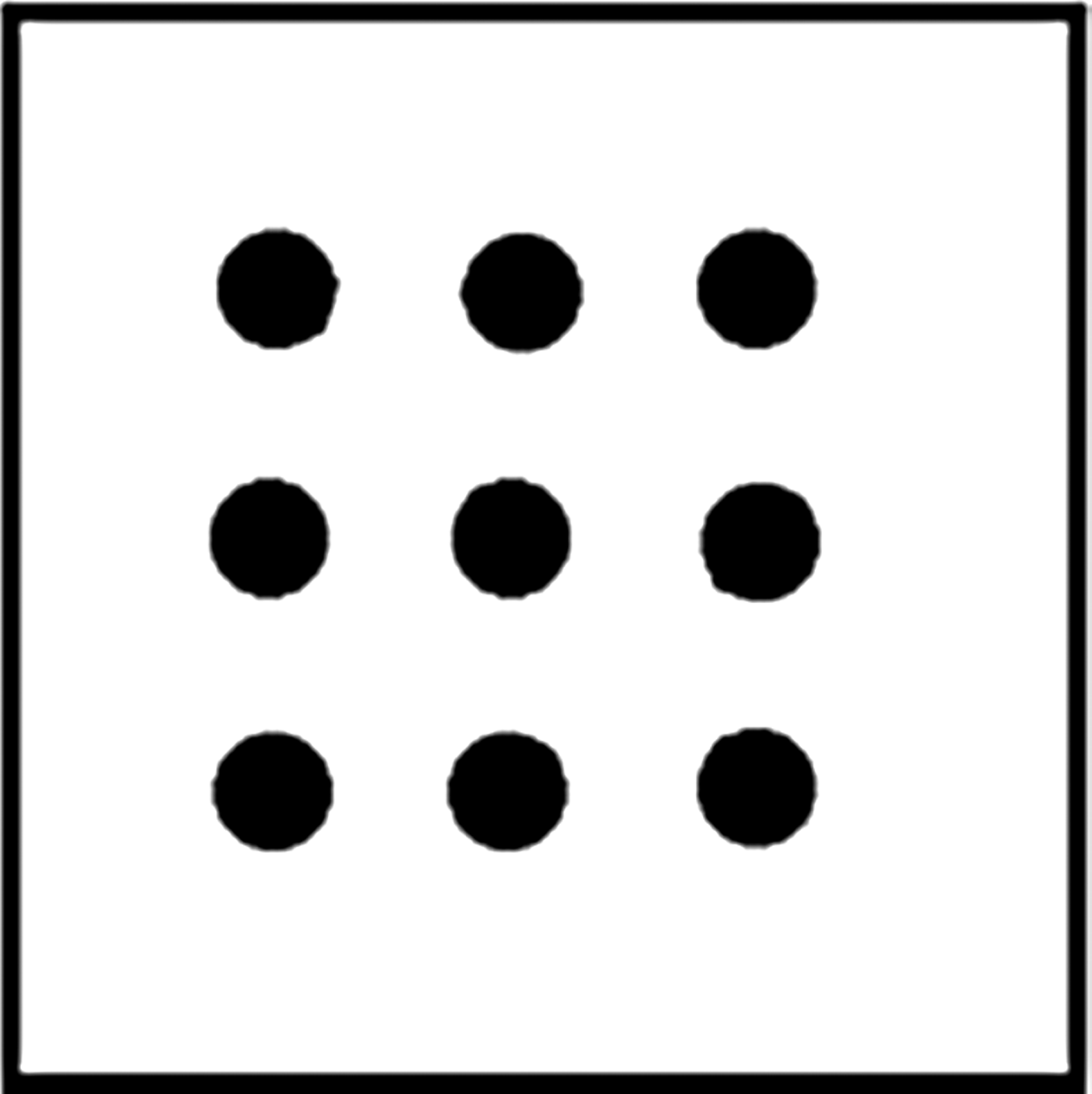
To this end, it will be helpful to begin by reviewing some empirical work on insight problem solving in psychology. Consider the following classic insight problem: the nine-dot problem (e.g., Chronicle et al. Reference Chronicle, Ormerod and MacGregor2001; Kershaw and Ohlsson Reference Kershaw and Ohlsson2004), according to which one is instructed to connect all nine of the dots below, using just four straight lines, but without lifting one's pencil/pen from the paper. (Try this, though don't look yet at the solution below.)Footnote 25 .
The nine-dot problem.

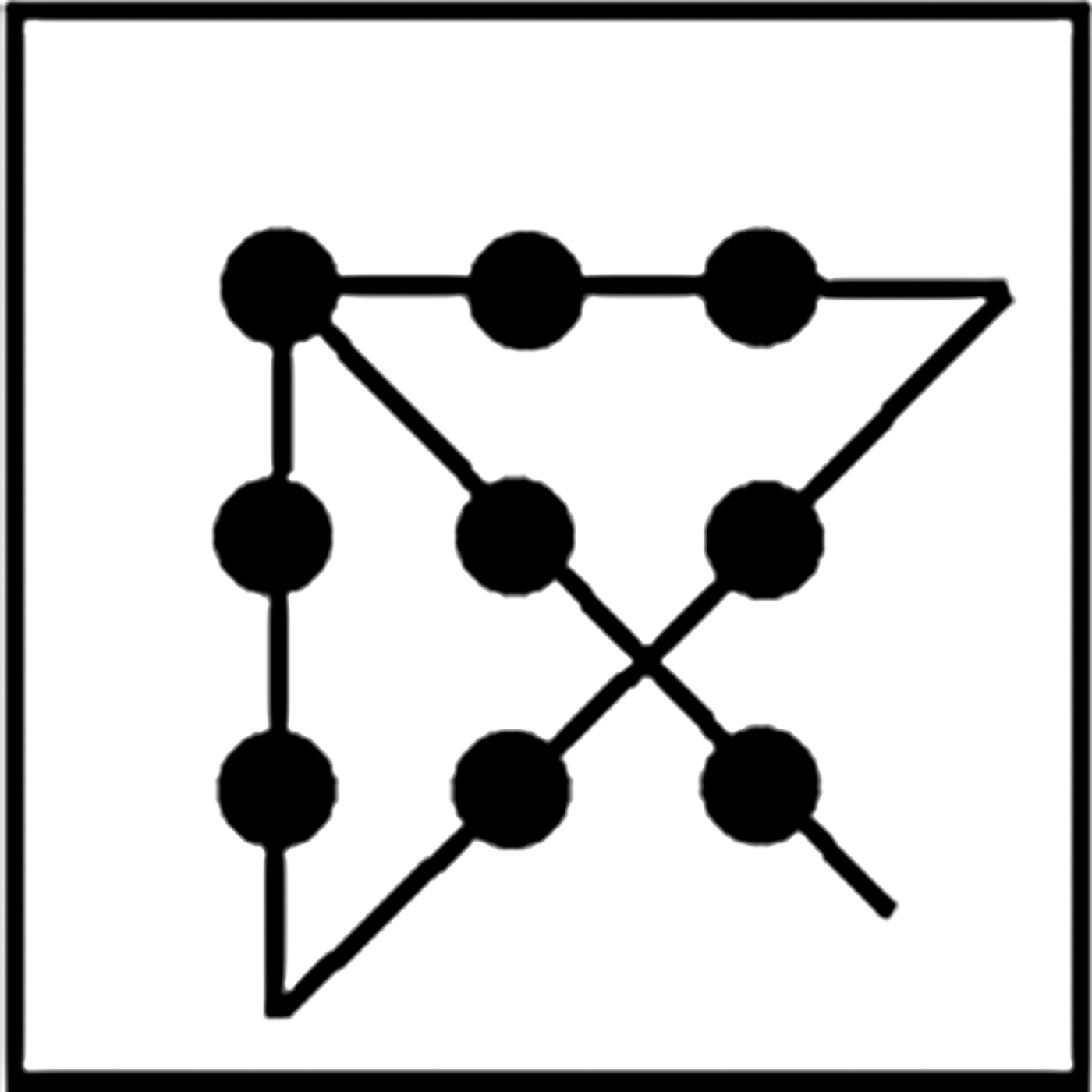
There is a certain phenomenology common to the discovery of solutions to insight tasks such as the one above (e.g., Metcalfe and Wiebe Reference Metcalfe and Wiebe1987; Sternberg and Davidson Reference Sternberg and Davidson1995). For instance, once the participant realises that the lines can go beyond the square that is formed by the nine dots, there is with this (and the discovery of other insight problem solutions) a kind of aha experience.
Solution.

One aspect distinctive of episodes of insight is that the aha experience is not gradual, but sudden. For instance, in a study by Metcalfe and Wiebe (Reference Metcalfe and Wiebe1987), participants completed classic insight problems along with non-insight problems (i.e., such as problems where one must simply apply an algebra rule). In each case, participants recorded patterns-of-warmth ratings, which reflect the subjects' feelings of approaching a solution. Patterns-of-warmth ratings differed significantly in the case of insight versus non-insight tasks. As they found algebra problems and non-insight problems showed a more incremental pattern over the course of solving than did insight problems … the phenomenology of insight-problem solution was characterized by a sudden, unforeseen flash of illumination.Footnote 26
Secondly, a key feature of the psychology of insight is termed incubation, where a break in attention to the task at hand can effectively facilitate the solution process (e.g., Dodds et al. Reference Dodds, Ward and Smith2003; Hélie and Sun Reference Hélie and Sun2010), though the mechanisms by which this occurs are debated.Footnote 27 In a study by Eliaz Segal (Reference Segal2004), insight tasks were completed more effectively by individuals who took a break after reaching a self-reported impasse than did those who did not.
Thirdly, there is some neuroscientific evidence that the kind of aha experiences associated with participants attaining solutions to insight tasks correspond with different neural states in the case of insight versus non-insight tasks. As Jung-Beeman et al. (Reference Jung-Beeman, Bowden, Haberman, Frymiare, Arambel-Liu, Greenblatt, Reber and Kounios2004) note, the right anterior temporal area is associated with making connections across distantly related information during comprehension; and, further, FMRIs in their 2004 study revealed increased neural activity in the right hemisphere anterior superior temporal gyrus in the case of individuals gaining solutions to insight relative to non-insight tasks (Jung-Beeman et al. Reference Jung-Beeman, Bowden, Haberman, Frymiare, Arambel-Liu, Greenblatt, Reber and Kounios2004).
These empirical features of insight solutions, as reported in cases of classic insight problems in psychology, suggest a picture on which (i) episodes of insight are typically (ii) preceded by incubation; (iii) are characterised by a distinctive phenomenology (i.e., feelings of approaching an answer which differ from non-insight cases) and neurophysiology (relative to non-insight solutions); and that the distinctive phenomenology or aha experience is both (iv) sudden and (v) unforeseen.
Note firstly, that this picture aligns well with the account offered by Yitang Zhang of his own experience. Zhang's incubation period (when his attention was diverted from the bounded gaps conjecture and focused on the deer in the yard) was suddenly interrupted by a realisation that he described as immediate and something special.
I want to now (perhaps unsurprisingly) suggest that a satisfactory account of what makes insightfulness an intellectual virtue should make some essential reference to how is that what is distinctive of episodes of insight – i.e., namely, the kinds of eurekaFootnote 28 moments which typically are preceded by incubation – are connected in some way to our epistemic ends or goals. But, in order to make this argument, however, I shall present an objection to the strategy just outlined; the account of insightfulness as a virtue I want to defend emerges as a response to the anticipated objection.
The objection to accounting for what makes insightfulness an intellectual virtue, in terms of how the psychology of insight is connected to some epistemic end (i.e., truth) is that such an account will face what we can call (for lack of a better term) the bunny problem. Consider that rabbits' hare-trigger instinct to flee from danger – an instinct which often saves their lives when predators are near – is nonetheless very unreliable at detecting danger, even when working normally in an environment suited to its function.Footnote 29 Their danger detectors generate mostly (around 90%) false positives, which is why when a bunny's sense of danger is triggered, this is nearly always in the absence of genuine danger. Of course, having an over-primed disposition to flee is evolutionarily advantageous for bunnies, and this is so even though the sense of danger detector is woefully unreliable at distinguishing genuine danger from false danger.Footnote 30 In short, the bunny's sense of danger doesn't discriminate danger from non-danger.
Unfortunately for us, though, the key psychological features associated with insight are triggered in cases of correct insights (i.e., where one's grasping under a relational mode is apt, and generates some epistemically valuable cognitive contact with reality) but also in cases of incorrect insights (i.e., where one sees an unexpected connection, rendering a body of information or task intelligible, but which is not accurate), as when we pre-emptively celebrate an insight (i.e., Aha, it's the butler … wait, never mind)Footnote 31 . This is why, as Stephen Grimm (Reference Grimm, Bernecker and Pritchard2010) notes, from the inside, genuine (factive) understanding feels indistinguishable from what he calls subjective understanding which is merely a grasp of how specific propositions interlink, and which does not depend on their truth but rather on their forming a coherent or intelligible picture.Footnote 32 Coherent pictures of course, can depart dramatically with how things actually stand and thus be of scant epistemic value.
4. INSIGHTFULNESS AS A VIRTUE, REDUX
Compare Yitang Zhang with British Mathematician Andrew Wiles, who believed, in 1993, that he'd proven Fermat's Last Theorem, which states that no positive integers a, b, and c can satisfy the equation an + bn = cn for any integer n such that n > 2. This is harder than it looks;Footnote 33 no one had proven it in the more than 350 years since it was first proposed, though many had tried.
Wiles' announcement in 1993 followed an insight he described as beautiful … ‘I was electrified. I knew that moment the course of my life was changing’.Footnote 34 But Wiles had overlooked a gap in his proof. After his series of lectures in Cambridge, he began receiving e-mails from a reviewer, Princeton's Nick Katz, with questions about the details of the proof. Most of Katz's questions, Wiles could answer, but one of the questions revealed what he appreciated as a serious problem.Footnote 35 By 1994, Wiles was on the brink of giving up, when he was finally able to patch the gap, and prove Fermat's Last Theorem successfully, in 1995.
Wiles' remarkable felt experience in 1993, which he took to be beautiful, was in an important respect defective, a kind of botched grasping (even if a highly skilled botched grasping).Footnote 36 In order to give a plausible account of what makes insightfulness an intellectual virtue in terms of how the psychological features of insight are connected to some epistemic end (i.e., truth, understanding, etc.) it is necessary to discriminate between the kinds of eureka feelings which typically follow incubation in cases of correct insight (i.e., Zhang's in 2012 and Wiles' in 1994) from the subjectively indistinguishable eureka feelings which follow incubation in cases of mistaken insights (i.e. Wiles in 1993).
I want to now suggest how such an account of insightfulness as an intellectual virtue might do exactly this. The model I want to suggest connects virtue and feeling in two different directions: from preparation and incubation to feeling, and from feeling to judgment or verification. The model I suggest draws from the basic four stage model of creative problem solving as originally introduced in Graham Wallas' (Reference Wallas1926) seminal text in the philosophy of creativity The Art of Thought. On Wallas' view, the feeling of illumination is (in the case of creative problem solving) best appreciated as the third step in a four-step creative process anteceded by (i) preparation and (ii) incubation and followed by what Wallas calls (iv) verification. What I want to suggest, in a nutshell (which I will flesh out), is that the virtuously insightful individual is skilled at bringing about (even if not directly or intentionally) eureka/illumination experiences specifically by excelling in the anteceding stages of preparation and incubation, and further, is skilled in a very specific way which I'll explain, at moving from these felt experiences to judgment or verification, where the aim of the final stage is truth (or more broadly, understanding). For ease of reference, call the first stage the cultivation stage of virtuous insight and the second the management stage of virtuous insight.
4.1 Cultivation stage of virtuous insight
An initial worry is that despite what Zhang did in the previous stages, it was a matter of fortune that he had the insight he did when staring at the deer, thinking of something else entirely, and not even at that moment trying to solve any problem. The underlying intuition here is that it was in a straightforward sense out of his control that he had the illuminating experience he did. And if it's out of his control, then it can't be explained by any virtue of Zhang's at the preparation and incubation stage, but rather, by luck.Footnote 37 Or so this line of worry goes.
Here, an analogy from the literature on unreliable achievements will be helpful. Consider, for example, artistic achievements. To borrow an example I've advanced in previous workFootnote 38 , an artist for instance might produce her signature pottery by using methods that very often produce cracked and broken failures. In order to produce a new and successful work, she may, in ordinary circumstances instance, have to make several attempts. It may be that ordinarily, her ways of making pottery are unsafe. Nevertheless, we would not, for this reason, hesitate to say that her successful works are, in many cases, artistic achievements and in doing so credit her success in the main to her ability. A similar intuition holds in the case of athletic achievements. As John Greco (Reference Grimm2012) remarks:
[…] different abilities require different degrees of reliability. Thus Kobe Bryant is a great free-throw shooter because he is successful around 85% of the time. Jeter is a great hitter because he is successful around 30% of the time (Reference Grimm2012: 17).
Even if the artist's successful pot and Jeter's hit are unsafe – viz., they don't occur in most nearby worlds where we hold fixed the initial conditions – we nonetheless credit the success to the ability, even if it is not an ability to intentionally bring about the outcome at will more often than not.
To the extent that the successful potter and Derek Jeter's respective successes are due to their abilities, it is because, in light of their dispositions, they do much better than the mean in attaining success. For instance, it is because of Jeter's practice and form that he hits above the mean, even though he can't directly bring about it that he gets a hit. Likewise, I want to suggest, even though it was beyond Zhang's control to bring about his being struck with the eureka experience he had, his being so struck is in an important respect creditable to his skills at the anteceding preparation and incubation stages, and that this point holds more generally.
Firstly, regarding the incubation stage. While Browne and Cruse (Reference Browne and Cruse1988) have reported some effect of choosing relaxing (over other forms of) activity during incubation, several other studies have suggested that activity choice during incubation makes little difference (e.g., Olton and Johnson Reference Olton and Johnson1976; Dodds et al. Reference Dodds, Ward and Smith2003).
Preparation, however, is different. Skill at the preparation stage can, in one obvious sense, come as a result of manifesting one's other task-relevant intellectual virtues, i.e., by being intellectually tenacious, intellectually courageous, intellectually openminded, etc. in ways that bear on the problem task.Footnote 39 This should not be surprising, and is clearly the case in our pet examples of Zhang, and also Wiles, each of whom worked tirelessly prior to their breakthroughs.Footnote 40 However, there are also more fine-grained features at the preparation stage which generate a higher likelihood of success relative to the mean. For example, results reported by Silveira (Reference Silveira1972) have shown a positive correlation between the timing of one's interruption in insight tasks. In Silveira's experiment, she had experimental participants work on a chain-link insight task, and the participants were interrupted either 3 or 13 minutes after starting. Then, following a 30 minute incubation period, the subjects returned to the task to work, for either 32 or 22 minutes, whereas control subjects worked continuously for 35 minutes. Silveira found that whereas those interrupted 3 minutes in did only slightly better than control subjects, those interrupted 13 minutes in did significantly better than in the control case. As Dodd et al. (Reference Dodds, Ward and Smith2003: 7) noted, a conclusion to be drawn here is that incubation effects may be more apparent when the person solving the problem has had more time to become fixated prior to taking a break from the problem. Of course, individuals can be better or worse at facilitating these conditions, and part of what makes an individual perform better relative to the mean is her resilience, focus and commitment to the task, traits an individual can be responsible for cultivating.
Putting this all together: while the illuminating experience of being struck with a eureka moment is not typically brought about by deliberate direct control – these are things which we say happen to one, seemingly out of the blue – they are not a matter of luck, but rather, can be properly attributed to an insightful individual's virtues in light of how the insightful individual performs better than the mean in the (to use Wallas' model) preparation and incubation stages anteceding the moment of insight.Footnote 41
4.2. Management stage of virtuous insight
§4.1 outlined how the virtuously insightful individual can, by excelling in the anteceding stages of preparation and incubation, perform better than the mean in generating the eureka experience, despite such an experience being out of the individual's direct performative control.
But of course, as was noted at the end of §3, the eureka experience is but the third of four stages of the Wallas model of creative problem solving. And, as I suggested the move from the third stage to the fourth stage – i.e., judgment or endorsement – can be done more or less skilfully. Recall again here, the bunny problem, where a rabbit's hare-trigger instinct is needed to avoid danger, it is woefully unreliable; the hare-trigger response to perceived threat is a poor predictor (approximately 10%) of danger. And the point about the subjective indistinguishability between eureka experiences which accompany accurate versus botched grasping reveal a similar kind of problem of us: like the bunny, the feeling in cases of botched grasping is indistinguishable from the feeling of apt grasping.
In this section, I want to propose an account of how the virtuously insightful individual can be appreciated as skilled at moving from these felt experiences that follow preparation and incubation to judgment or verification (i.e., the fourth stage), where the aim of this stage is truth (or more broadly, understanding).
The first step here will be to consider more carefully the epistemic structure of the connection between the third and fourth stages, that is between the eureka feeling, and the ensuing judgment or endorsement of the content issued by the grasping. Here, it will be helpful to draw from one established and increasingly popular model within which this kind of transition can be sharpened.
According to the perceptual model of emotional experience (e.g., Roberts Reference Roberts1988; Elgin Reference Elgin1999; Johnston Reference Johnston2001; Prinz Reference Prinz2004) emotional experience constitutes reason or evidence for evaluative judgement in a similar way to the way in which perceptual experience constitutes reason or evidence for empirical judgement.Footnote 42 One class of evaluative judgments are epistemic evaluations. And so one way to think about the epistemic significance of the kinds of eureka feelings associated with insight are, within this model, specifically, as reasons or evidence for epistemic evaluations. On this view, the transition from stage three to four (i.e., from feeling to judgment) is a transition from feeling as evidence for an epistemic evaluation – an endorsement – of the insight.
Thinking about the transition from stage three to four within this model makes evident the place for the virtuously insightful individual to exercise skill. Just as, in the perceptual case, an individual can afford too much or too little epistemic weight to one's perceptions in forming empirical judgments,Footnote 43 so likewise, an individual can afford too much or too little epistemic weight to one's emotional experiences (at the eureka stage) in epistemically evaluating the insight. For example, the virtuously insightful individual, upon having the eureka experience, has fewer false negatives relative to the mean, in that the virtuously insightful individual does not ignore the kind of felt connections between information when these are epistemically valuable (i.e., of the sort that are likely to lead to true belief or understanding). Likewise, the virtuously insightful individual is appropriately cautious in moving from emotional experience to endorsement.
To give an example of the exercise of such caution, consider the following case, where cognitive biases are at play. Take, for example, belief bias (i.e., Klauer et al. Reference Klauer, Musch and Naumer2000) according to which individuals tend to give disproportionate positive evaluations of the logical strength of arguments the more believable their conclusions are judged to be. Many insights are graspings which depend on appreciation of argument cogency; naturally, one potential cause of botched grasping (i.e., a eureka experience which does not generate apt insight) is belief bias. The virtuously insightful individual is more attuned than most in her sensitivity to the kinds of biases she might be afflicted with which could defeat the evidential weight of the eureka experience. The virtuously insightful individual accordingly is best understood as occupying a kind of Aristotelian mean between affording too little or too much evidential weight to the kind of felt experience at stage 3, in her transition from the insight to endorsement. Put another way: the virtuously insightful individual is better than the mean at issuing safe endorsements, conditioned upon her felt experiences of insight.
5. CONCLUDING REMARKS
Aha experiences happen to some more than others – as if out of the blue – but virtuously insightful individuals are better than others at cultivating the right precursors to these episodes, and importantly, at moving in a responsible way from these felt experiences to endorsed insights. In this paper I hope to have shown how both the psychology of problem solving as well as the resources of virtue epistemology, paired together, offer some explanation for why this is so.Footnote 44