


Highlights
-
• CYP2C19 loss-of-function variants were present in 41.9% of clopidogrel-treated Canadian patients with stroke, indicating a high prevalence of reduced clopidogrel efficacy.
-
• Pharmacogenetic testing prompted a change in antiplatelet therapy in 71.8% of affected patients.
-
• Home-based genetic testing is feasible and supports personalized antiplatelet selection for secondary stroke prevention.
Introduction
Stroke is a leading cause of disability, dementia and death. Clopidogrel is widely prescribed for secondary stroke prevention in patients with ischemic strokes of non-cardioembolic origin. Although there is no clear definition of “clopidogrel resistance,” 4% to 30% of patients receiving clopidogrel do not have an adequate platelet antiaggregatory effect.Reference Nguyen, Diodati and Pharand1 Clopidogrel is a prodrug that requires the hepatic cytochrome P450 system to convert it to its active metabolite.Reference Hulot2 Several studies have demonstrated a link between CYP2C19 loss-of-function alleles (CYP2C19*2 and CYP2C19*3) and lower levels of the active metabolite of clopidogrel and reduced platelet inhibition in healthy patients.Reference Hulot2,Reference Mega, Close and Wiviott3 CYP2C19 alleles and their associated clopidogrel metabolism status are outlined in Table 1.
CYP2C19 alleles and associated clopidogrel metabolism

Table 1. Long description
A table with two columns and six rows. The first column is labeled ‘CYP2C19 genotype’ and the second column is labeled ‘Clopidogrel metabolism’. Row 1: CYP2C19 genotype, *1/*1; Clopidogrel metabolism, Normal. Row 2: CYP2C19 genotype, *1/*2, *1/*3, *2/*17, *3/*17; Clopidogrel metabolism, Intermediate. Row 3: CYP2C19 genotype, *2/*2, *2/*3, *3/*3; Clopidogrel metabolism, Poor. Row 4: CYP2C19 genotype, *1/*17; Clopidogrel metabolism, Rapid. Row 5: CYP2C19 genotype, *17/*17; Clopidogrel metabolism, Ultrarapid.
A systematic review and meta-analysis of 15 studies involving 4762 patients found that carriers of CYP2C19 loss-of-function alleles were at a higher risk of stroke and combined vascular events compared to non-carriers among patients with ischemic stroke or transient ischemic attack (TIA) treated with clopidogrel.Reference Pan, Chen and Xu4 However, the existing literature on CYP2C19 polymorphisms in patients with ischemic stroke or TIA has mainly focused on Asian populations.Reference Pan, Chen and Xu4
This study aimed to evaluate the prevalence of CYP2C19 loss-of-function variants among clopidogrel-treated stroke patients in a Canadian outpatient setting and assess their potential impact on patient management.
Methods
Study design and participants
This prospective observational cohort study was conducted at an outpatient regional stroke prevention clinic in Toronto, Canada, from September 1, 2020, to June 30, 2022. We searched the clinic database for all patients receiving clopidogrel for secondary stroke prevention after an ischemic stroke or TIA who were seen in the clinic at least once within the two preceding years. From this list, we generated a random sample of patients to be invited to participate in the study. The original planned sample size was 165 patients. We mailed invitation letters to the patients with an informed consent form. The Research Ethics Board of Sunnybrook Health Sciences Centre approved this study. Written informed consent was obtained from all participants.
Outcomes
The primary outcome was the estimated prevalence of intermediate or poor metabolizers of clopidogrel among the study cohort. The secondary outcomes included the estimated prevalence of the CYP2C19*17 gain-of-function allele and the estimated proportion of participants whose antiplatelet regimen was modified based on pharmacogenetic testing results.
Pharmacogenetic testing
Participants underwent pharmacogenetic testing using a self-administered cheek swab to determine their CYP2C19 genotype. The testing platform used by DNALabs Canada is based on mass spectrometry, called the Agena MassArray. This is a highly sensitive platform with a high level of accuracy and reproducibility – the vendor’s validation claims for the platform include call rates of >99%, with >99.7% accuracy. Prior to launch, DNALabs Canada performed a rigorous validation process for their specific panel, which included the analysis of 44 samples through multiple runs. This included samples with known genotypes as well as samples analyzed by multiple labs to ensure that testing is accurate and reproducible. Results showed that 100% of the expected genotype calls were confirmed during the validation runs. As per US Clinical Laboratory Improvement Amendments (CLIA) requirements, control samples are included with every batch of samples run to ensure that the test continues to perform as expected. The testing is performed at an accredited molecular laboratory approved under the Clinical Laboratory Improvement Advisory Committee (CLIAC), which is managed by the Centers for Disease Control and Prevention (CDC), in partnership with the Centers for Medicare and Medicaid Services (CMS) and the US FDA. Additional accreditations include the College of American Pathologists (CAP), the California Department of Public Health (CDPH) and the State of New York Department of Health (DOH).
Data collection and analysis
Participant demographic and clinical data, including self-reported ethnicity, prior stroke history, bleeding events and medication adjustments, were collected via chart abstraction. The impact of CYP2C19 genotype results on decisions regarding antiplatelet therapy was also collected. Descriptive statistics were used to summarize the findings.
Results
A total of 739 patients met the inclusion criteria. Of the 200 randomly selected patients approached in 2 phases of 100 each, 98 were enrolled between September 1, 2020, and June 30, 2022, corresponding to a response rate of 49% (Figure 1). Four participants were excluded because their final diagnosis was not stroke or TIA, and one did not complete pharmacogenetic testing, leaving 93 participants in the final analysis. The baseline demographic and clinical characteristics of the study cohort are shown in Table 2.
Study enrollment flowchart.

Baseline demographics stratified by metabolizer status

Table 2. Long description
A table comparing baseline demographics by metabolizer status. The table has 13 rows and 6 columns. The columns are labeled Total (N = 93), Normal (N = 25), Intermediate (N = 31), Poor (N = 8), Rapid (N = 20), and Ultrarapid (N = 9). The rows are labeled with various characteristics such as Age, Female, Ethnicity, Hypertension, Dyslipidemia, Diabetes, Chronic kidney disease, Obstructive sleep apnea, Myocardial infarction, Smoking, and Antiplatelet therapy at study enrollment. Each row provides specific data points for each metabolizer status category. For example, the Age row shows mean ages and standard deviations for each group. The Female row shows the percentage of females in each group. The Ethnicity row lists percentages for different ethnic groups within each metabolizer status. The table also includes percentages for various health conditions and smoking statuses. The Antiplatelet therapy at study enrollment row shows the percentages of patients using Clopidogrel and Clopidogrel + aspirin.
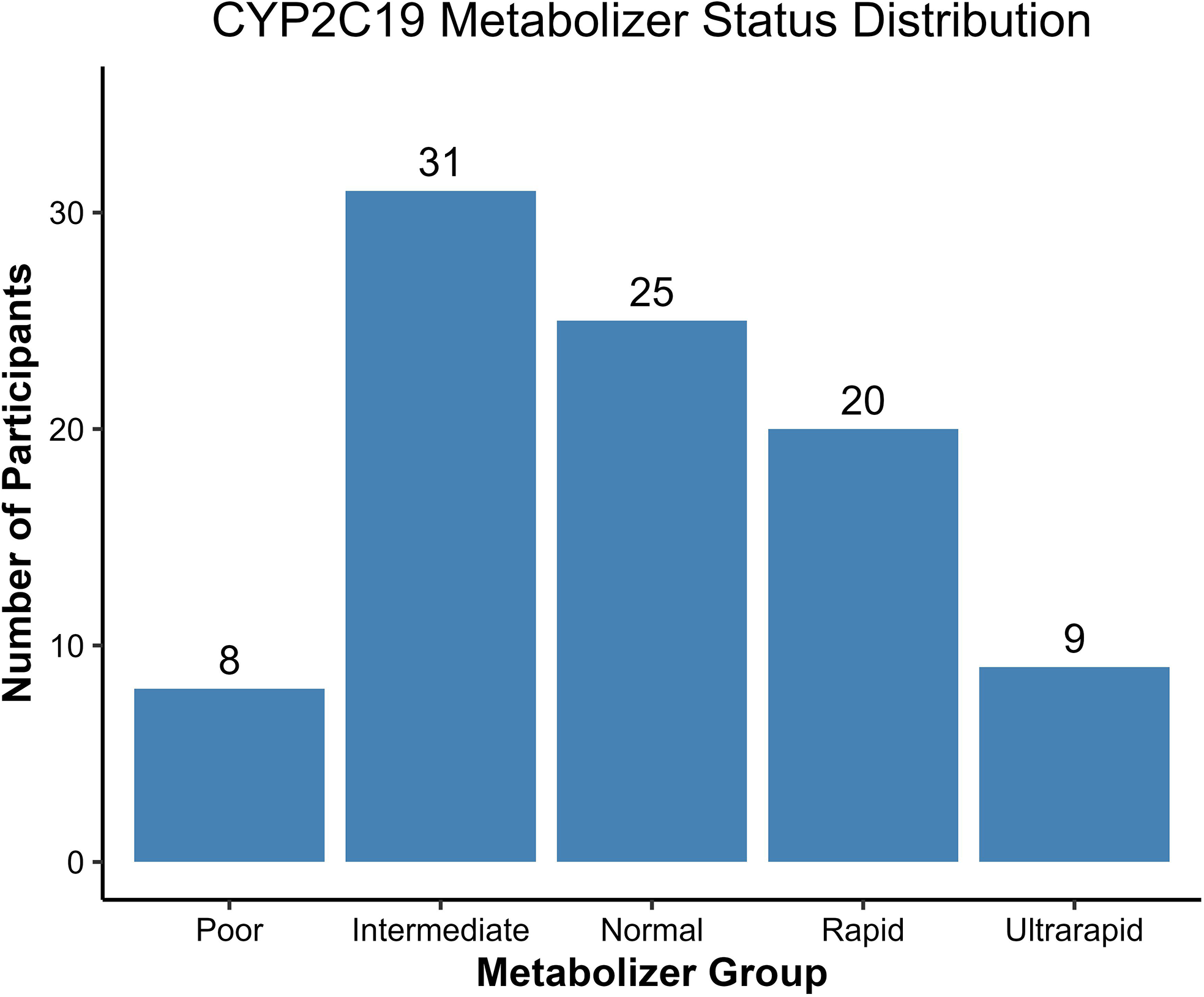
Among the 93 participants tested, 31 (33.3%) were identified as intermediate metabolizers, 8 (8.6%) as poor metabolizers, 25 (26.9%) as normal metabolizers, 20 (21.5%) as rapid metabolizers and 9 (9.7%) as ultrarapid metabolizers. In total, 39 participants (41.9%) were intermediate or poor metabolizers (Figure 2). The majority of participants self-identified as Caucasian (n = 65, 69.9%), followed by Asian (n = 16, 17.2%), with smaller numbers identifying as Latino or Hispanic (n = 4, 4.3%), Middle Eastern (n = 4, 4.3%), Black or African American (n = 1, 1.1%) and other/unknown (n = 3, 3.2%). The majority (62.5%) of Asian participants were classified as intermediate (50%) or poor metabolizers (12.5%).
CYP2C19 metabolizer status.

Antiplatelet therapy was changed in 28 of 39 (71.8%) participants with intermediate/poor metabolizer status. Antiplatelet therapy was changed in all eight (100.0%) participants with poor metabolizer status. Two of these participants were switched to ticagrelor, and the remainder were switched to aspirin.
There were five participants with a history of bleeding events (e.g., frequent nosebleeds, excessive bruising and gastrointestinal bleed) while receiving clopidogrel. Four of them (80%) were classified as rapid metabolizers.
Discussion
This study examined the outcomes of home-based pharmacogenetic testing among randomly selected stroke clinic outpatients who had been prescribed clopidogrel for secondary stroke prevention after an ischemic stroke or TIA. The pharmacogenetic testing showed that a large proportion of patients carried CYP2C19 loss-of-function variants: 39 out of 93 (41.9%) participants were classified as intermediate or poor metabolizers. As a result of the testing, treating physicians changed the antiplatelet therapy in over 70% of patients identified as intermediate or poor metabolizers. When exploring why some patients with intermediate metabolizer status did not switch therapies, the two main reasons were patient preference and provider preference, particularly due to long-term stability on clopidogrel. Additionally, 80% of patients who experienced a documented bleeding event – most of which were minor – were rapid metabolizers, suggesting a possible link between increased clopidogrel metabolism and bleeding risk. Although our study was not powered to evaluate bleeding outcomes, this suggests a potential avenue for future investigation and more individualized antiplatelet selection.
In a secondary analysis of the CHANCE trial based in China, 1726 of 2933 patients (58.8%) were carriers of CYP2C19 loss-of-function alleles. Among those patients, the combination of clopidogrel and aspirin did not reduce the risk of new stroke compared with aspirin alone.Reference Wang, Zhao and Lin5 Growing evidence supports a genotype-guided treatment approach (i.e., using CYP2C19 status to choose the appropriate antiplatelet therapy). The CHANCE-2 trial found that this strategy significantly reduced the risk of early recurrent stroke (23% relative risk reduction within 3 months).Reference Wang, Meng and Wang6 Recently, the prospective multicenter PLATELET trial demonstrated that ischemic stroke patients carrying CYP2C19 loss-of-function alleles experienced higher rates of recurrent cardiovascular events while treated with clopidogrel compared with non-carriers, further supporting the clinical relevance of CYP2C19-guided antiplatelet therapy selection.Reference Jung, Song and Kim7 In the cardiac population, the TAILOR-PCI trial studied 5302 patients who underwent a percutaneous coronary intervention.Reference Pereira, Farkouh and So8 Participants were randomly assigned to a genotype-guided treatment group (CYP2C19 LOF carriers were prescribed ticagrelor; non-carriers were prescribed clopidogrel) or a standard care group (prescribed clopidogrel without testing). There was a 34% reduction in the primary outcome (a composite of cardiovascular death, myocardial infarction, stroke, stent thrombosis or severe recurrent ischemia at 1 year) in the genotype-guided treatment group compared with the standard treatment group. Although this result did not reach statistical significance (the trial was underpowered), the trend suggests a potential benefit. The Clinical Pharmacogenetics Implementation Consortium (CPIC) provided recommendations for CYP2C19 genotype test results in patients receiving clopidogrel for the treatment of acute coronary syndromes (ACS) and/or undergoing percutaneous coronary intervention (PCI).Reference Scott, Sangkuhl and Stein9 They recommended considering an alternative antiplatelet medication in those who are intermediate or poor metabolizers of clopidogrel. Despite the FDA boxed warning and the existing research on this gene–drug interaction affecting cardiovascular and cerebrovascular outcomes in Asian groups, current stroke practice guidelines do not include recommendations for such genetic testing. Although prior literature has largely focused on Han Chinese and other Asian populations, our findings demonstrate a high prevalence of CYP2C19 loss-of-function variants across a diverse Canadian cohort. These findings suggest that genotype-guided antiplatelet strategies may have broader applicability irrespective of self-reported ethnicity, and this may be an area for future guideline development. Although evidence supports the impact of these loss-of-function alleles, their prevalence and impact across a broader, more diverse population remain unclear.
The main limitation of our study is that it was conducted at a single center with a relatively small sample size, which may affect the generalizability of the results. The study was not designed or powered to evaluate recurrent ischemic events or long-term comparative clinical outcomes according to metabolizer status.
This study has implications for research and practice. Future studies are needed to evaluate the clinical effectiveness and cost-effectiveness of this type of genotype-guided therapy on stroke recurrence. In the meantime, clinicians should be aware of the availability of home-based genetic testing platforms. They may consider offering such testing for post-stroke patients who are often prescribed lifelong antiplatelet monotherapy with clopidogrel.
In conclusion, this prospective cohort of stroke patients prescribed clopidogrel showed a high prevalence of CYP2C19 intermediate and poor metabolizers, leading to changes in antiplatelet therapy in more than half of those affected. These findings support the feasibility and rationale for integrating CYP2C19 pharmacogenetic testing into stroke care.
Author contributions
All authors listed have made a substantial, direct and intellectual contribution to this work and have approved the final manuscript for publication. P.R., M.B., A.G. and D.G. contributed to the conceptualization, funding acquisition, data analysis and drafting of the manuscript. L.D., H.X., J.H., R.S., A.S., A.Y., H.P., A.L. and H.K. contributed to patient enrollment, data curation, data analysis and writing – reviewing and editing.
Funding statement
This study was funded by a peer-reviewed grant from Ontario Genomics (Industry Challenge 2020 Program: Healthy Lives, Healthy Economy, Healthy Planet Through Genomics) and in-kind support from DNALabs Canada Inc.
Competing interests
Mark I. Boulos – No relevant COIs. Outside of the submitted work, Dr. Boulos is PI of the NUANCE-ICAD trial, which was funded by a peer-reviewed grant from the Heart & Stroke Foundation of Canada. Dr. Boulos is also PI of the PRECISE STROKE study funded by a peer-reviewed operating grant from the McLaughlin Centre, University of Toronto. Dr. Mark Boulos reports peer-reviewed funding from the Canadian Institutes of Health Research, Heart and Stroke Foundation of Canada, CanStroke Recovery Trials network, Restless Legs Syndrome Foundation, Alternative Funding Plan from the Academic Health Sciences Centres of Ontario, the Temerty Centre for AI Research and Education in Medicine (T-CAIREM) and the Toronto Dementia Research Alliance. He also reports consulting fees and honoraria from Takeda, Axsome, Sentrex, Jazz Pharmaceuticals, Paladin Labs, Eisai, Techspert, Precision AQ and Lundbeck; and receipt of sleep equipment or research support from Zoll Itamar, Braebon Medical Corporation, CGX, The Mahaffy Family Research Fund and Green Mountain. Dr. Boulos also reports unrestricted educational grants from Takeda, Axsome, Jazz Pharmaceuticals and Paladin Labs.
Richard H. Swartz – Dr. Rick H. Swartz reports institutional research funding from the Ontario Brain Institute, the Canadian Institutes of Health Research and the US National Institutes of Health. He has served on an advisory board for Hoffmann-La Roche. He holds the Bastable-Potts Chair in Stroke Research at Sunnybrook Research Institute and the University of Toronto and reports stock ownership in FollowMD Inc. He reports no other conflicts of interest relevant to this manuscript.
Aaron Goldman is a co-founder and shareholder of DNA Labs Canada Inc., which markets the pharmacogenetics test used in the study. Funds from the supporting grant were used to cover the cost of the pharmacogenetic testing carried out as part of this study.
David J. Gladstone – Dr. Gladstone received support from the Department of Medicine at Sunnybrook Health Sciences Centre, the F.W. Thompson Family Chair in Stroke Prevention at Sunnybrook Health Sciences Centre and a Clinician Scientist Award from the University of Toronto Department of Medicine. Dr. Gladstone is PI of the STROKE75+ trial supported by the Sunnybrook Foundation and a peer-reviewed operating grant from the AFP Innovation Fund paid to his institution and in-kind supply of study drug from Daiichi Sankyo. Dr. Gladstone is co-investigator of the PRECISE-STROKE study funded by a peer-reviewed operating grant from the McLaughlin Centre, University of Toronto, and the NUANCE-ICAD trial, funded by a peer-reviewed grant from the Heart and Stroke Foundation of Ontario, and was a site PI for OCEANIC-Stroke, OCEANIC-AF and ENRICH-AF trials (all grants and site fees paid to his institution; no personal fees).
The remaining authors declared no potential conflicts of interest with respect to the research, authorship and/or publication of this article.



 Open access


Target article
High Yield of Pharmacogenetic Testing for Clopidogrel Resistance in a Canadian Outpatient Stroke Population
Related commentaries (1)
Reviewer Comment on Rajendram et al. “High Yield of Pharmacogenetic Testing for Clopidogrel Resistance in a Canadian Outpatient Stroke Population”