






No CrossRef data available.
When instrumental inference hides behind seemingly arbitrary conventions
Published online by Cambridge University Press: 10 November 2022
Abstract
We review recent evidence that game rules, rules of etiquette, and supernatural beliefs, that the authors see as “ritualistic” conventions, are in fact shaped by instrumental inference. In line with such examples, we contend that cultural practices that may appear, from the outside, to be devoid of instrumental utility, could in fact be selectively acquired and preserved because of their perceived utility.
Information
- Type
- Open Peer Commentary
- Information
- Copyright
- Copyright © The Author(s), 2022. Published by Cambridge University Press
Footnotes
*
Contributed equally to this paper.
References
André, J.-B., Baumard, N., & Boyer, P. (2020). The mystery of symbolic culture: What fitness costs? What fitness benefits? 18. https://osf.io/kdh7t/download?format=pdfCrossRefGoogle Scholar
Baumard, N. (2016). The origins of fairness: How evolution explains our moral nature. Oxford University Press.Google Scholar
Boyer, P. (2018). Minds make societies: How cognition explains the world humans create. Yale University Press.Google Scholar
Boyer, P. (2020). Why divination?: Evolved psychology and strategic interaction in the production of truth. Current Anthropology, 61(1), 100–123. https://doi.org/10.1086/706879CrossRefGoogle Scholar
Dubourg, E., & Baumard, N. (2022). Why and how did narrative fictions evolve? Fictions as entertainment technologies. Frontiers in Psychology, 13, 786770. https://doi.org/10.3389/fpsyg.2022.786770CrossRefGoogle ScholarPubMed
Fitouchi, L., & Singh, M. (2022). Supernatural punishment beliefs as manipulated explanations of misfortune. Current Opinion in Psychology, 44(4), 252–257. https://doi.org/10.31234/osf.io/vejacCrossRefGoogle Scholar
Hill-Haas, S. V., Dawson, B., Impellizzeri, F. M., & Coutts, A. J. (2011). Physiology of small-sided games training in football. Sports Medicine, 41(3), 199–220. https://doi.org/10.2165/11539740-000000000-00000CrossRefGoogle ScholarPubMed
Hong, Z., & Henrich, J. (2021). The cultural evolution of epistemic practices: The case of divination. Human Nature, 32(3), 622–651. https://doi.org/10.1007/s12110-021-09408-6CrossRefGoogle ScholarPubMed
Hong, Z., Slingerland, E., & Henrich, J. (2022). Magic and empiricism in early Chinese rainmaking – A cultural evolutionary analysis. Current Anthropology, Forthcoming. https://doi.org/10.31234/osf.io/n54hpGoogle Scholar
Lombardo, M. P. (2012). On the evolution of sport. Evolutionary Psychology, 10(1), 147470491201000. https://doi.org/10.1177/147470491201000101CrossRefGoogle ScholarPubMed
Nichols, S. (2002). On the genealogy of norms: A case for the role of emotion in cultural evolution. Philosophy of Science, 69(2), 234–255. https://doi.org/10.1086/341051CrossRefGoogle Scholar
Royzman, E. B., Leeman, R. F., & Baron, J. (2009). Unsentimental ethics: Towards a content-specific account of the moral–conventional distinction. Cognition, 112(1), 159–174. https://doi.org/10.1016/j.cognition.2009.04.004CrossRefGoogle ScholarPubMed
Schmidt, M., & Tomasello, M. (2012). Young children enforce social norms. Current Directions in Psychological Science, 21, 232–236. https://doi.org/10.1177/0963721412448659CrossRefGoogle Scholar
Singh, M. (2018). The cultural evolution of shamanism. Behavioral and Brain Sciences, 41, e66. https://doi.org/10.1017/S0140525X17001893CrossRefGoogle ScholarPubMed
Singh, M. (2020). Subjective selection and the evolution of complex culture. 21.CrossRefGoogle Scholar
Singh, M. (2021). Magic, explanations, and evil: On the origins and design of witches and sorcerers. Current Anthropology, 62, 2–29. https://doi.org/10.31235/osf.io/pbwc7CrossRefGoogle Scholar
You, J. (2017). Influence of rules change on football. Advances in Social Science, Education and Humanities Research, 159. https://doi.org/10.2991/jahp-17.2017.7Google Scholar
Zhao, Y. (2021). Downtrends in offside offenses among “The Big Five” European football leagues. Frontiers in Psychology, 12, 719270. https://doi.org/10.3389/fpsyg.2021.719270CrossRefGoogle Scholar
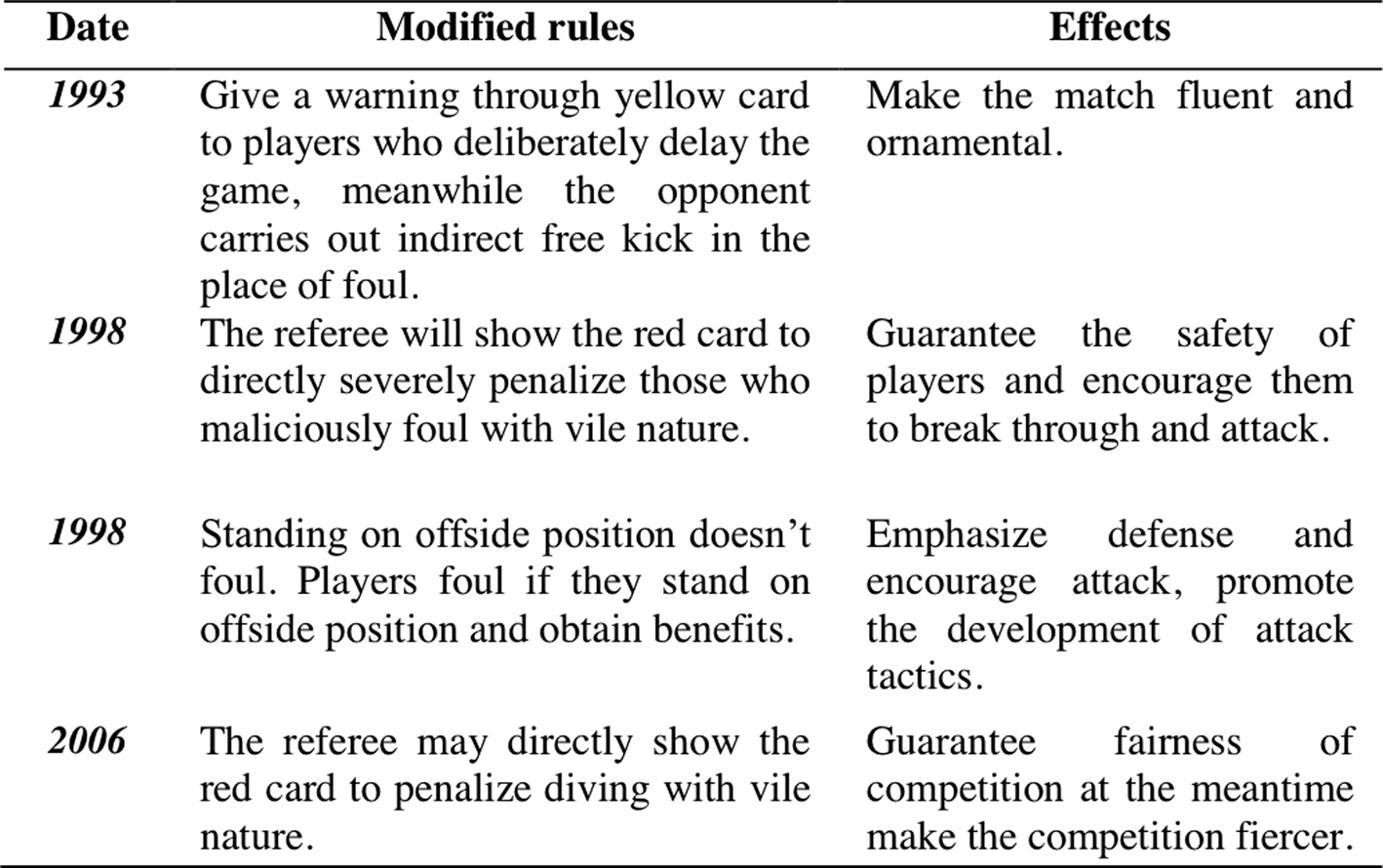
Figure 1 Instrumental effects justifying rules modified by the international football federation (from You, 2017).
A correction has been issued for this article:
Target article
Related commentaries (25)
Can bifocal stance theory explain children's selectivity in active information transmission?
Cultural evolution is not independent of linguistic evolution and social aspects of language use
Implications of instrumental and ritual stances for traditionalism–threat responsivity relationships
Non-instrumental actions can communicate roles and relationships, not just rituals
Psychological closeness and concrete construal may underlie high-fidelity social emulation
Representational exchange in social learning: Blurring the lines between the ritual and instrumental
Revisiting an extant framework: Concerns about culture and task generalization
The authors propose a plausible case for the idea that detail-focused copying fulfills an affiliative function, and underlies the cultural evolution of apparently arbitrary conventions. In their own terms, the actions behind “social etiquette, clothing fashions, tea ceremonies, and even the rules of childhood games” are “simply copied without question” because “their purposes remain mysterious” (target article, sect. 2, para. 6). While we do not deny this possibility, we suspect that the cultural evolution of many seemingly arbitrary conventions may be, despite appearances, mostly driven by instrumental inference at the cognitive level. We argue that many conventions which, from the outside, may appear devoid of instrumental utility, and “slavishly” learned simply because it's the “done” way to behave, are in fact selectively acquired and preserved, by the people involved, because of perceived instrumental benefits (see also André, Baumard, & Boyer, Reference André, Baumard and Boyer2020; Singh, Reference Singh2020). While demonstrating this on each instance of apparently arbitrary convention would require a whole research program, we here illustrate this point on the following examples – game rules, social etiquette, and religious rituals.
1. Sport and game rules
Sport and game rules are widely deemed typical examples of arbitrary conventions (Schmidt & Tomasello, Reference Schmidt and Tomasello2012). The authors similarly argue that competitive sports (e.g., football), despite being oriented toward some instrumental outcomes (e.g., playing a ball into the opposing teams' net), are constrained by slavishly copied, causally opaque conventions (e.g., the prohibition to use one's hands to do so). We argue, however, that people adopt an instrumental stance toward these conventional rules themselves, designing and selectively retaining them to satisfy the goals they pursue by playing or watching sports and games – such as being entertained and signaling one's skills (Lombardo, Reference Lombardo2012; see Dubourg & Baumard [Reference Dubourg and Baumard2022] for another example of entertainment technology).
This is manifested by the fact that sport and game rules are transformed, under people's impulse, in a direction that increasingly satisfies those goals. Sport federations have adapted their rules throughout history to maximize players' and spectators' enjoyment, and the possibility for players' to signal their physical skills. The “offside rule,” for instance, has been explicitly designed and retained because it prevents players from “goal-hanging,” thereby making the game harder to play and funnier to watch (Zhao, Reference Zhao2021; see Fig. 1 for other examples). Even at a more micro-level, non-professionals who play street football spontaneously adapt the official rules of football to the context (e.g., the pitch dimensions). For instance, they commonly remove goalkeepers and reduce the number of players, to make the game funnier and more physically challenging (Hill-Haas, Dawson, Impellizzeri, & Coutts, Reference Hill-Haas, Dawson, Impellizzeri and Coutts2011). In other words, we doubt that people would slavishly copy rules that would make a sport boring and hard to use to signal or train their physical skills. Taking back the authors' example, we propose that people who (copy people who) use their feet and not their hands, do it because it makes the game funnier and allows better display of gross motor skills.
Instrumental effects justifying rules modified by the international football federation (from You, Reference You2017).
2. Social etiquette
As the authors note, rules of etiquette also appear as purely arbitrary conventions, compliance to which is motivated solely by a “need to belong.” Yet closer examination again suggests that their cultural design and preservation also obeys non-arbitrary, instrumental criteria. In a famous study, Nichols (Reference Nichols2002) showed that, of the table manners promoted in etiquette manuals of the European Renaissance (see Elias, Reference Elias1939), those that prohibited behaviors eliciting disgust (e.g., spitting) were more likely to have been culturally preserved to the point of being still part of contemporary social etiquette. Rules that didn't elicit disgust, by contrast, were more likely to go culturally extinct, presumably precisely because they appeared to people as more arbitrary (Nichols, Reference Nichols2002). If social etiquette was culturally preserved because of slavish, affiliative copying, etiquette rules should have been preserved whatever their content. Rather, what seems to have happened is that, despite their apparent arbitrariness, etiquette rules have stabilized because people perceive them (not necessarily consciously) as satisfying some intuitive goal, such as not imposing on others the unpleasant experience of being disgusted while eating (Baumard, Reference Baumard2016; Royzman, Leeman, & Baron, Reference Royzman, Leeman and Baron2009).
3. Supernatural rituals
The authors also argue that magico-religious rituals, despite being oriented toward some instrumental goal (i.e., warding off misfortune), are socially learned through the ritual stance because of their “causal irresolvability.” Yet a growing body of research suggests that the social learning of such cultural traits is mostly driven by instrumental inference. For example, Hong and Henrich (Reference Hong and Henrich2021) present abundant historical and ethnographic evidence that people adopt (or not) divination practices primarily based on their evaluation of whether the latter “works” (or not) for revealing accurate information. People, moreover, “carefully discriminate among diviners according to perceived skill, ability, or success … in pretty much the same way as [they do for] any other artisans whose abilities can be evaluated by other community members” (Hong & Henrich, Reference Hong and Henrich2021, pp. 625–626). Hong, Slingerland, and Henrich (Reference Hong, Slingerland and Henrich2022) similarly review historical evidence that, despite the apparent “exoticity” of rain-making rituals to modern people, early Chinese mostly adopted a “problem-solving,” instrumental mindset toward rain-making methods, willingly abandoning – rather than slavishly copying – methods that seemed ineffective in making rain fall (see also Boyer, Reference Boyer2020; Fitouchi & Singh, Reference Fitouchi and Singh2022; Singh, Reference Singh2021, Reference Singh2018; for other examples).
4. Conclusion
To be clear, we do not deny that the ritual stance may, in the end, underlie the social learning and preservation of some arbitrary cultural practices. We also understand that, according to the authors, the ritual and the instrumental stances often coexist and alternate during social learning, in a “bifocal spectacle.” Our point is simply the following: The fact that many conventions which initially appear as “ritually” acquired are in fact, on closer inspection, substantially shaped by instrumental inference, suggests that this may be the case for many other apparently arbitrary conventions – from weddings (see e.g., Boyer, Reference Boyer2018) to codes of conducts to initiation and puberty rites. If this is the case, the ritual stance should not be put on the same level of importance as the “instrumental stance” as a cognitive foundation of cultural evolution. As things stand, we doubt that the “ritual” part of human social learning is large enough, and causally powerful enough in driving cultural evolutionary dynamics, to justify a “bi-focal” theory of cultural evolution.
Financial support
This study was supported by FrontCog ANR-17-EURE-0017.
Conflict of interest
None.