










1 Introduction
A sequence of integer numbers
 $\{u_n\}$
is a linear recurrence sequence of order l if it is defined by the recurrence relation
 $$ \begin{align} u_{n+l}= a_1u_{n+l-1}+ a_2u_{n+l-2}+ \cdots + a_lu_{n}, \quad (n \in \mathbb{N}), \end{align} $$
where the coefficients
 $a_1, \ldots , a_l$
are complex numbers and l is minimal. It is well known that we can write
 $$ \begin{align*} u_n = \sum_{i=1}^{m} P_i(n) \alpha_i^n, \end{align*} $$
where
 $\alpha _i$
are the roots of the characteristic polynomial P of
 $\{u_n\}$
and the coefficients of polynomials
 $P_i$
belong to
 $K:= \mathbb {Q}(\alpha _1, \ldots , \alpha _m)$
and d is the degree of the number field K over
 $\mathbb {Q}$
. One says that such a sequence is nondegenerate if none of the ratios
 ${\alpha _i/\alpha _j\, (i \neq j)}$
is a root of unity. Let
 $\alpha _1$
be a dominant root of P. We denote by s the cardinality of the set containing all the prime ideals above
 $\alpha _i$
and all the Archimedean places over K. Here, we are interested in the study of the exponential Diophantine equation
 $u_n=0$
. Since any linear recurrence sequence can be decomposed as the interleaving of nondegenerate sequences, we study the previous equation only for the nondegenerate sequences. This problem was first studied by Skolem, Mahler and Lech, who used p-adic analysis to prove that this equation has finitely many solutions. Their proof is ineffective in the sense that it does not allow one to bound the number of solutions. Van der Poorten and Schlickewei [Reference Schlickewei and Van der Poorten12] gave an upper bound for the number of solutions depending only on
 $d, l$
and s. This result was extended by Schlickewei and Schmidt [Reference Schlickewei and Schmidt11, Theorem 2.1], who provided an upper bound depending only on d and l, and by Schmidt [Reference Schmidt14], who provided an upper bound depending only on l.
We now turn to a more general question concerning the rate of growth of the recurrence. It is not difficult to see there is an effectively computable constant C such that, for all
 $n \geq 1, \vert u_n \vert < C n^a \vert \alpha _1 \vert ^n,$
where
 $\alpha _1$
is a dominant root of the characteristic polynomial of the sequence
 $\{u_n\}$
with a, the maximum multiplicity of the roots
 $\alpha _i$
. In 1977, Loxton and Van der Poorten [Reference Loxton and Van Poorten8] conjectured that any nondegenerate LRS (linear recurrence sequence) has, essentially, a maximal possible growth rate, that is, for any
 $\epsilon>0$
, there is an effectively computable constant
 $C(\epsilon )$
such that if
 $ \vert u_n \vert < (\max _i\{ \vert \alpha _i \vert \})^{n(1-\epsilon )}$
, then
 $n<C(\epsilon )$
. Using results of Schmidt [Reference Schmidt14] and Evertse [Reference Evertse4], a complete noneffective (qualitative) proof of this conjecture was given by Fuchs and Heintze [Reference Fuchs and Heintze6] and, independently, by Karimov et al. [Reference Karimov, Kelmendi, Nieuwveld, Ouaknine and Worrell7].
This question about the rate of growth of LRS is connected to the Positivity and Ultimate Positivity Problems (in theoretical computer science). In fact, Ouaknine and Worrell [Reference Ouaknine and Worrell10] have proven that for a simple linear recurrence sequence, the Ultimate Positivity Problem is decidable for all orders. Their algorithm arises from model theory and the qualitative version of the Loxton–Van der Poorten conjecture above. The noneffectiveness of this result makes that algorithm nonconstructive in the sense that, for a given linear recurrence sequence
 $\{u_n\}$
, the procedure does not produce a threshold N such that
 $u_n \geq 0$
for all
 $n \geq N$
. This is why the positivity problem for simple linear recurrence sequences is still open.
In this article, we make progress in that direction by giving an explicit upper bound for the number of solutions.
Let
 $\{u_n\}$
be the nondegenerate linear recurrence sequence of integers of order
 $l \geq 1$
defined by the Recurrence Relation (1-1) with Binet’s formula given by
 $$ \begin{align*} u_n = \sum_{i=1}^{m} P_i(n) \alpha_i^n, \end{align*} $$
where
 $\alpha _i$
are the roots of the characteristic polynomial P of
 $\{u_n\}$
with multiplicity at most a; the coefficients
 $a_{ij}$
of the polynomials
 $P_i$
belong to
 $K:= \mathbb {Q}(\alpha _1, \ldots , \alpha _m)$
and d is the degree of the number field K over
 $\mathbb {Q}$
. Assume
 $\alpha _1$
is a dominant root of P and
 $\vert \alpha _1 \vert>1$
. We denote by S the set containing all the prime ideals above
 $\alpha _i$
, and all the Archimedean places over K and by s its cardinality. Let
 $n_{ij}$
be the smallest positive integer such that
 $n_{ij}a_{ij} \in \mathcal {O}_K$
and we denote by
 $\rho := \mathrm {lcm}(n_{ij})$
. Put
 $$ \begin{align} A':= \min_{\sigma, i, j} \{ 1, \vert \sigma(\rho a_{ij})\vert, \sigma(a_{ij}) \neq 0 \}, \quad A := \max_{\sigma, i,j} \{ 1, \vert \sigma(\rho a_{ij})\vert \}, \end{align} $$
where the minimum and the maximum are taken respectively over all elements of
 $\mathrm {Gal}(K/ \mathbb {Q})$
and coefficients of
 $\rho P_i$
. Let
 $\Delta _K$
be the discriminant of K. For
 $x \in \mathbb {R}^{*}$
, we define the functions
 $g(x)=2^{34}\cdot 2^{11l}s^2l^{12}x^{-5}$
and
 $$ \begin{align*} \tau(x) = \max \bigg\{ \dfrac{20a^lA^l}{ A'} , \dfrac{-\log(A')}{\epsilon \log(\vert \alpha_1 \vert)}, \dfrac{11mA + e^{g(x)}\log(l!)\log(2d\vert \Delta_K \vert)}{x\log \vert \alpha_1 \vert} \bigg\}. \end{align*} $$
Notice that
 $\rho =1$
is equivalent to all the coefficients of the polynomials
 $P_i$
being algebraic integers. Hence, our main result can be stated as the following theorem.
Theorem 1.1. For each
 $0<\epsilon < 1/ 12,$
the number of solutions of the inequality
 $$ \begin{align} \vert u_n \vert < \vert \alpha_1 \vert ^{n(1-\epsilon)} \end{align} $$
does not exceed:
-
•
 $ \tau (\epsilon / 2d) + 2\cdot s^2 ( d^2l^{7} 2^{4l+19} \epsilon ^{-2})^{ls+l} \exp ( (7l^a)^{8l^a})$
if
$\rho =1$
; and
-
•
$ ({2\epsilon ^{-1} \log \rho }/{\log \vert \alpha _1 \vert }) + \tau (\epsilon / 4d) + 2\cdot s^2 ( d^2 l^{7} 2^{4l+21} \epsilon ^{-2})^{ls+l} \exp ( (7l^a)^{8l^a})$
if
$\rho \neq 1.$


The following result owing to Schmidt [Reference Schmidt14] plays a crucial role in the proof of Theorem 1.1.
Lemma 1.2. Suppose that
 $\{u_n\}_{n \in \mathbb {Z}}$
is a nondegenerate linear recurrence sequence of complex numbers, whose characteristic polynomial has k distinct roots of multiplicity at most a. Then, the number of solutions
 $n \in Z$
of the equation
 $u_n=0$
can be bounded above by
 $$ \begin{align*}c(k, a) = \exp((7k^a)^{8k^a}).\end{align*} $$
Remark 1.3. An effective upper bound for the number of solutions of Inequality (1-3) can be obtained by ‘carefully’ combining a variant of the main theorem in [Reference Evertse5] and Lemma 1.2. However, our Theorem 1.1 provides a better upper bound.
If the characteristic polynomial of
 $\{u_n\}_n$
has just one root, that is,
 $m=1$
, then Inequality (1-3) becomes
 $$ \begin{align*} \vert P_1(n)\alpha_1^n \vert < ( \vert \alpha_1 \vert )^{n(1-\epsilon)}, \end{align*} $$
which implies
 $ \vert P_1(n)\alpha _1^{n\epsilon } \vert < 1$
. If
 $n> ({2(aA+1)}/{A'}),$
where A and
 $A'$
are defined in (1-2), then one gets
 $\vert P_i(n) \vert> A'$
. So
 $A' \vert \alpha _1^{n\epsilon } \vert < 1$
. Hence, we conclude that any nonnegative integer solution n of the inequality (1-3) satisfies the relation
 $$ \begin{align*}n < \max \bigg( \dfrac{2(aA+1)}{A'} , \dfrac{-\log(A')}{\epsilon \log(\vert \alpha_1 \vert)} \bigg).\end{align*} $$
In the remainder of the article, we assume
 $m>1$
. Let
 $M_{K}$
be the collection of places over K. For
 $v \in M_K$
,
 $x \in K$
, we define
 $\vert x \vert _v$
as follows:
-
•
$\vert x \vert _v = \vert \sigma (x) \vert ^{1/d}$
if v corresponds to the embedding
$\sigma : K \rightarrow \mathbb {R}$
; -
•
$\vert x \vert _v = \vert \sigma (x) \vert ^{2/d}$
if v corresponds to the embedding
$\sigma : K \rightarrow \mathbb {C}$
; -
•
$\vert x \vert _v = (N_{K/\mathbb {Q}}(\mathcal {P}))^{-\mathrm {ord}_{\mathcal {P}}(x)/d}$
if v corresponds to the prime ideal
$\mathcal {P}$
of
$\mathcal {O}_K$
and
$\mathrm {ord}_{\mathcal {P}}(x)$
to the exponent of
$\mathcal {P}$
in the decomposition of the ideal generated by x.


With this norm, we have the product formula
 $$ \begin{align*} \prod_{ v \in M_K}^{} \vert x \vert_v =1 \quad \mbox{for } x \in K.\end{align*} $$
For
 $X=(x_1, \ldots , x_m) \in K^m$
,
 $X \neq 0$
and
 $\vert X \vert _v = \max ( \vert x_1\vert _v, \ldots , \vert x_m \vert _v )$
, we define the height of X as
 $$ \begin{align*}H(X)= \prod_{ v \in M_K}^{} \vert X \vert_v .\end{align*} $$
Note that
 $H(X)$
depends only on X and not on the choice of the number field K (see [Reference Bombieri and Gubler1, Lemma 1.5.2]). Let K be the splitting field of the characteristic polynomial of
 $\{u_n\}$
and S be the set containing all the prime ideals above
 $\alpha _i$
and all the Archimedean places over K, and s be its cardinality. The ring of S-integers and its set of units are respectively defined as
 $$ \begin{align*}\mathcal{O}_S= \{x \in K: \vert x \vert_v \leq 1 \; \mbox{for all } v\notin S\}\end{align*} $$
and
 $$ \begin{align*}\mathcal{O}_S^*= \{x \in K: \vert x \vert_v = 1 \; \mbox{for all } v\notin S\}.\end{align*} $$
We denote by
 $\mathrm {id}$
the embedding over K corresponding to the identity and for
 $v \in M_K$
, we define the quantity
 $s(v)$
by
 $$ \begin{align*} s(v) = \begin{cases} \dfrac{1}{d} & \mbox{if } v \mbox{ is } \mbox{real }\mbox{infinite}, \\[6pt] \dfrac{2}{d} & \mbox{if } v \mbox{ is } \mbox{complex } \mbox{infinite},\\[6pt] 0 & \mbox{if } v \mbox{ is } \mbox{finite}, \end{cases} \end{align*} $$
where d is the degree of K over
 $\mathbb {Q}$
. By the definition of
 $s(v)$
, we get
 $$ \begin{align} \sum_{v \in M_K}^{} s(v) = 1. \end{align} $$
For
 $v \in S \setminus \{\mathrm {id}\}$
, we define m linear forms
 $l_{1v}, \ldots , l_{mv}$
with m variables
 $x:=(x_1, \ldots , x_m)$
over K as
 $l_{iv}(x)=x_i$
. For
 $v=\mathrm {id},$
we define
 $l_{1v} (x) = x_1+\cdots + x_m$
and
 $l_{iv}(x)=x_i$
for
 $i=2,\ldots , m.$
Notice that to prove Theorem 1.1, it suffices to show only the first part (that is, the case
 $\rho =1$
, meaning all the coefficients of the polynomials
 $P_i$
are algebraic integers) since the second part follows easily from the first one. Indeed, assume
 $\rho \neq 1$
and fix
 $\epsilon>0$
. It is clear that all the solutions of Inequality (1-3) are solutions of the inequality
 $$ \begin{align*}\vert \rho u_n \vert < \dfrac{\rho}{\vert \alpha_1 \vert ^{n\epsilon / 2} }\vert \alpha_1 \vert ^{n(1-\epsilon/2)}.\end{align*} $$
If
 $\rho> \vert \alpha _1 \vert ^{n\epsilon / 2}$
, then we obtain
 $$ \begin{align*}n< \dfrac{2\epsilon^{-1} \log \rho}{\log \vert \alpha_1 \vert}.\end{align*} $$
Otherwise, one obtains
 $\vert \rho u_n \vert < (\vert \alpha _1 \vert )^{n(1-\epsilon /2)}$
. Since the coefficients of the polynomials
 $\rho P_i$
in Binet’s formula for the nondegenerate sequence
 $v_n := \rho u_n $
are all algebraic integers, the desired result follows by applying the first case of Theorem 1.1 with
 $\epsilon / 2$
instead of
 $\epsilon $
.
Thus, in the rest of the paper, we assume
 $\rho = 1$
, meaning that all the coefficients of the polynomials
 $P_i$
are algebraic integers. Put
 $$ \begin{align*}\mathcal{N} := \{(P_1(n)\alpha_1^n, \ldots, P_m(n)\alpha_m^n), n \in \mathbb{N}\}\end{align*} $$
and
 $X_n = ( P_1(n)\alpha _1^n, \ldots , P_m(n)\alpha _m^n)$
. Our main result is a consequence of the following theorem.
Theorem 1.4. For each
 $0<\epsilon < 1/ 12$
, the set of
 $X_n \in \mathcal {N} $
with
 $n> \tau (\epsilon )$
that are solutions of the inequality
 $$ \begin{align} \prod_{ v \in S}^{} \prod_{i=1}^{m} \vert l_{iv}(X_n)\vert_v < \vert \alpha_1 \vert ^{-n\epsilon} \end{align} $$
is contained in at most
 $$ \begin{align*}2 \cdot s^2 ( m^{7} 2^{4m+17} \epsilon ^{-2})^{ms+m}\end{align*} $$
proper subspaces in
 $K^m$
.
2 Deduction of Theorem 1.1 from Theorem 1.4
Fix
 $\epsilon>0.$
Let n be a solution of the inequality (1-3) with
 $n> \tau (\epsilon / 2d)$
and
 $X_n \in \mathcal {N}$
. For
 $v \in S$
,
 $$ \begin{align} \vert P_i(n)\vert_v \leq ((d_i+1)n^{d_i})^{s(v)}A^{s(v)} \leq (an^{a})^{s(v)}A^{s(v)}, \end{align} $$
where a is the maximum multiplicity of the roots of the characteristic polynomial of
 $\{u_n\}$
;
 $d_i$
the degree of
 $P_i$
and A is defined in (1-2). By using the relation (2-1), (1-4), the product formula and the fact that
 $\alpha _i \in \mathcal {O}_S^*$
,
 $$ \begin{align} \prod_{ v \in S}^{} \prod_{i=1}^{m} \vert P_i(n) \alpha_i^n\vert_v \leq (an^{a}A)^{m}. \end{align} $$
Hence,
 $$ \begin{align*} { \prod_{ v \in S}^{} \prod_{i=1}^{m} \vert l_{iv}(X_n)\vert_v } &= \dfrac{\vert u_n \vert_{\mathrm{id}}}{ \vert P_1(n)\alpha_1^n \vert_{\mathrm{id}}} \cdot { \prod_{ v \in S}^{} \prod_{i=1}^{m} \vert P_i(n) \alpha_i^n \vert_v } \\ &\leq \dfrac{ (an^{a}A)^{l}}{ \vert P_1(n)\alpha_1^n\vert_{id}} \cdot \vert \alpha_1 \vert^{ns(id)(1-\epsilon)}\\ &\leq n^{l^2} \cdot \vert \alpha_1 \vert^{-n\epsilon /d}\\ &\leq \vert \alpha_1 \vert^{-n\epsilon /2d}, \end{align*} $$
where for the first inequality, we use Relation (2-2), the fact that n is a solution of Inequality (1-3) and
 $m\leq l$
, and for the last one, [Reference Luca and Noubissie9, Lemma 2.4] and the fact that
 ${n> \tau (\epsilon / 2d)}$
. So
 $X_n$
is a solution of Inequality (1-5) (replacing
 $\epsilon $
by
 $\epsilon /2d$
). Applying Theorem 1.4 and the fact that
 $X_n \in \mathcal {N}$
, we deduce that there are at most
 $$ \begin{align*}2\cdot s^2 ( d^2l^{7} 2^{4l+19} \epsilon ^{-2})^{ls+l}\end{align*} $$
exponential Diophantine equations of the shape
 $$ \begin{align} \sum_{i \in I}^{} c_iP_i(n)\alpha_i^{n}=0 \end{align} $$
with
 $c_i$
non-zero elements of
 $ K$
and
 $I \subseteq \{1, 2, \ldots , m\}$
such that for all solutions
 $X_n$
of Inequality (1-5), n is a solution of at least one of them. From Lemma 2, each Diophantine equation given by the relation (2-3) has at most
 $ \exp ( (7l^a)^{8l^a})$
solutions with
 $n \in \mathbb {Z}$
. Hence, we conclude that the cardinality of the set of solutions n of the inequality (1-3) with
 $n> \tau (\epsilon / 2d)$
does not exceed
 $$ \begin{align*} 2\cdot s^2 ( d^2l^{7} 2^{4l+19} \epsilon ^{-2})^{ls+l} \exp ( (7l^a)^{8l^a}),\end{align*} $$
which gives us the desired result.
3 Preliminaries
Before starting the proof of Theorem 1.4, we need some notation and facts about exterior algebra, inequalities related to heights, and results from the geometry of numbers over number fields.
Let V be a vector space over the splitting field K of the characteristic polynomial P of
 $\{u_n\}$
of dimension m (number of distinct roots of P), with canonical basis
 ${e_i\ (i=1, \ldots , m)}$
. For
 $1 \leq p \leq m$
, we equip the exterior power
 $\wedge ^p V$
with the standard basis
 $$ \begin{align*}e_{i_1} \wedge e_{i_2} \wedge \cdots \wedge e_{i_p} \quad \mbox{with } i_1<i_2<\cdots < i_p. \end{align*} $$
Put
 $ N= \binom {m}{p}$
. Let
 $\sigma _1, \ldots , \sigma _N$
be the subsets of
 $\{1, \ldots , m\}$
given by
 $$ \begin{align*}\sigma_1=\{1, \ldots, p\}, \sigma_2=\{1, \ldots, p-1, p+1 \}, \ldots, \end{align*} $$
and
 $$ \begin{align*} \sigma_{N-1}=\{m-p, m-p+2, \ldots, n\}, \quad \sigma_N=\{m-p+1, \ldots, m\}\end{align*} $$
ordered lexicographically. For the vectors
 $x_t=(x_{t1}, \ldots , x_{tm}) \in K^m$
,
 $1 \leq t \leq m,$
we define
 $$ \begin{align*} \Delta_{\sigma_i}=\Delta_i(x_1, \ldots, x_p) = \begin{vmatrix} x_{1,i_1} & x_{1,i_2} & \cdots & x_{1,i_p} \\ x_{2,i_1} & x_{2,i_2} & \cdots & x_{2,i_p} \\ \vdots & \vdots & \ddots & \vdots\\ x_{p,i_1} & x_{p,i_2} & \cdots & x_{p,i_p} \\ \end{vmatrix}, \end{align*} $$
where
 $\sigma _i=\{i_1, \ldots , i_p\}$
and also
 $$ \begin{align*}x_{1} \wedge x_{2} \wedge \cdots \wedge x_{p} = (\Delta_{\sigma_1}, \Delta_{\sigma_2}, \ldots, \Delta_{\sigma_N}).\end{align*} $$
Note that
 $x_{1} \wedge x_{2} \wedge \cdots \wedge x_{p} =0$
if and only if
 $\{x_1, x_2, \ldots , x_p\}$
is linearly dependent (see, for example, [Reference Schmidt13, Lemma 6B, Ch. IV]). For
 $x=(x_1, x_2, \ldots , x_m)$
, we define
 $x^* = (x_m, - x_{m-1}, \ldots , (-1)^{m-1}x_1)$
and extend the standard scalar product
 $x\cdot y = { \sum _{i=1}^{m} x_iy_i },$
where
 $x, y \in K^m$
, to
 $\wedge ^p V$
, using the Laplace identity,
 $$ \begin{align} (x_{1} \wedge x_{2} \wedge \cdots \wedge x_{p}) \cdot (y_{1} \wedge y_{2} \wedge \cdots \wedge y_{p}) = \mathrm{ det}(x_i\cdot y_j)_{i,j=1,\ldots, p} \end{align} $$
and the Laplace extension
 $$ \begin{align} x_1\cdot (x_{2} \wedge x_{3} \wedge \cdots \wedge x_{m})^* = \mathrm{det}(x_1,\ldots , x_m) \quad \mbox{with } x_1,\ldots, x_m \in K^m. \end{align} $$
A similar notation is used with regards to linear forms. If
 $l(X) = a \cdot X = \sum _{i=1}^{m} a_iX_i, $
where
 $a=(a_1, \ldots , a_m)$
, we put
 $l^*(X)= a^*\cdot X.$
Further, for linear forms
 $l_t(X)= a^{(t)}\cdot X$
, with
 $1 \leq t \leq p,$
in m variables, we define the linear forms in N variables by
 $$ \begin{align*}(l_{1} \wedge l_{2} \wedge \cdots \wedge l_{p})(x)= (l_{1} \wedge l_{2} \wedge \cdots \wedge l_{p})\cdot x.\end{align*} $$
Let
 $\{a_1, \ldots , a_m\}$
and
 $\{b_1, \ldots , b_m\}$
be two bases of
 $K^m$
. Then
 $\{A_1, \ldots , A_N\}$
and
 $\{B_1, \ldots , B_N\}$
with
 $A_i= a_{i_1} \wedge a_{i_2} \wedge \cdots \wedge a_{i_{m-p}}$
and
 $B_i= b_{i_1} \wedge b_{i_2} \wedge \cdots \wedge b_{i_{m-p}}$
are two bases of
 $K^N$
.
The following lemma, established in [Reference Edixhoven and Evertse3, Lemma 3.3.1, Ch. IV], is used at several places in this paper.
Lemma 3.1. Let
 $k \in \{1, \ldots , m\}$
. If
 $\{a_1, \ldots , a_m\}$
and
 $\{b_1, \ldots , b_m\}$
are two bases of
 $K^m$
, then
 $\{a_1, \ldots , a_k\}$
and
 $\{b_1, \ldots , b_k\}$
generate the same vector space if and only if
 $\{A_1, \ldots , A_{N-1}\}$
and
 $\{B_1, \ldots , B_{N-1}\}$
generate the same vector space with
 $N= \binom {m}{k} $
.
This lemma implies the existence of an injective map
 $f_k$
from the collection of k-dimensional subspaces of
 $K^m$
to the collection of
 $(N-1)$
-dimensional subspaces of
 $K^N$
such that if V has basis
 $\{a_1, \ldots , a_k\}$
and
 $a_{k+1}, \ldots, a_n$
are any vectors such that
 $\{a_1, \ldots , a_n\}$
is a basis of
 $K^m,$
then
 $\{A_1, \ldots , A_{N-1}\}$
is a basis of
 $f_k(V)$
.
Lemma 3.2. Let
 $v \in M_K$
. The following inequalities hold:
 $$ \begin{align} \vert x\cdot y \vert_v \leq m^{s(v)} \vert x \vert_v \cdot \vert y \vert_v \quad \mbox{for } x, y \in K^m \end{align} $$
and
 $$ \begin{align} \vert x_{1} \wedge x_{2} \wedge \cdots \wedge x_{k} \vert_v \leq (k!)^{s(v)} \vert x_1 \vert_v \cdots \vert x_k \vert_v \quad \mbox{for } x_1, \ldots, x_k \in K^m, k \leq m. \end{align} $$
If
 $x_1, \ldots , x_m$
are linearly independent vectors in
 $K^m,$
then also
 $$ \begin{align} \vert \mathrm{det}(x_1,\ldots , x_m) \vert_v \leq (m!)^{s(v)} \vert x_1 \vert_v \cdots \vert x_m \vert_v \end{align} $$
and
 $$ \begin{align} H(x_1 \wedge x_{2} \wedge \cdots \wedge x_{k} ) \leq k! \cdot H(x_1)\cdot H(x_2) \cdots H( x_k). \end{align} $$
Proof. Let
 $x, y$
be two elements of
 $K^m$
. By the above definition of the scalar product on the vector space
 $K^m$
, we infer that
 $$ \begin{align*}\vert x\cdot y \vert_v = \bigg| \sum_{i=1}^{m} x_iy_i \bigg|_v \leq m^{s(v)} \vert x \vert_v \cdot \vert y \vert_v,\end{align*} $$
where for the inequality, we use the fact that
 $\vert \cdot \vert _v^{1/s(v)}$
is the usual absolute value when v is an infinite place over K and the strong triangle inequality property of
 $\vert \cdot \vert _v$
, whereas v is a finite place over K. Therefore, the relation (3-3) holds. By the above definition of the exterior power over the vector space
 $K^m,$
 $$ \begin{align*}x_{1} \wedge x_{2} \wedge \cdots \wedge x_{k} = (\Delta_{\sigma_1}, \Delta_{\sigma_2}, \ldots, \Delta_{\sigma_N}),\end{align*} $$
with
 $N=\binom {m}{k}$
and
 $$ \begin{align*} \Delta_{\sigma_i}=\Delta_i(x_1, \ldots, x_k) = \begin{vmatrix} x_{1,i_1} & x_{1,i_2} & \cdots & x_{1,i_k} \\ x_{2,i_1} & x_{2,i_2} & \cdots & x_{2,i_k} \\ \vdots & \vdots & \ddots & \vdots\\ x_{k,i_1} & x_{k,i_2} & \cdots & x_{k,i_k} \\ \end{vmatrix}, \end{align*} $$
where
 $\sigma _i=\{i_1< \cdots < i_k\}$
. From the Leibniz formula for the determinant
 $\Delta _{\sigma _i}$
, it follows that
 $$ \begin{align*}\vert \Delta_{\sigma_i} \vert_v \leq (k!)^{s(v)} \vert x_1 \vert_v \cdots \vert x_k \vert_v\end{align*} $$
for all
 $i \in \{1, \ldots , N\}.$
So
 $$ \begin{align*}\vert x_{1} \wedge x_{2} \wedge \cdots \wedge x_{k} \vert_v \leq (k!)^{s(v)} \vert x_1 \vert_v \cdots \vert x_k \vert_v.\end{align*} $$
If
 $x_1, \ldots , x_m$
are linearly independent vectors in
 $K^m,$
then
 $$ \begin{align*}\vert \mathrm{det}(x_1,\ldots , x_m) \vert_v = \vert x_{1} \wedge x_{2} \wedge \cdots \wedge x_{m} \vert_v\end{align*} $$
and so the relation (3-5) follows immediately from (3-4). By taking the product over all the places of
 $M_K$
on the relation (3-4) and using the definition of the height function
 $H(\cdot )$
, we obtain the relation (3-6).
Lemma 3.3. Let
 $v \in M_K$
, H be positive real numbers and
 $x_1, \ldots , x_p$
linearly independent vectors in
 $K^m,$
with
 $H(x_i) \leq H$
for
 $i=1, \ldots , p.$
Then,
 $$ \begin{align} \frac{H^{-p}}{p!} \leq \dfrac{\vert x_{1} \wedge x_{2} \wedge \cdots \wedge x_{p} \vert_v} {\vert x_1 \vert_v \cdots \vert x_p\vert_v } \leq (p!)^{s(v)}. \end{align} $$
In particular, if
 $p=m,$
then
 $$ \begin{align} \frac{H^{-m}}{m!} \leq \dfrac{\vert \mathrm{det}(x_1,\ldots , x_m) \vert_v } {\vert x_1 \vert_v \cdots \vert x_m \vert_v } \leq (m!)^{s(v)}. \end{align} $$
Proof. We prove this result by using the same argument as in the proof of [Reference Evertse5, Lemma 2]. Since
 $x_1, \ldots , x_p$
are linearly independent vectors, it follows from [Reference Schmidt13, Lemma 6B, Ch. IV] that
 $x_1 {\kern-1pt}\wedge{\kern-1pt} x_{2} {\kern-1pt}\wedge{\kern-1pt} \cdots {\kern-1pt}\wedge{\kern-1pt} x_{p} {\kern-1pt}\neq{\kern-1pt} 0$
; therefore,
 $H(x_1 {\kern-1pt}\wedge{\kern-1pt} x_{2} {\kern-1pt}\wedge{\kern-1pt} \cdots {\kern-1pt}\wedge{\kern-1pt} x_{p}) {\kern-1pt}\geq{\kern-1pt} 1$
. Hence,
 $$ \begin{align*} \dfrac{\vert x_{1} \wedge x_{2} \wedge \cdots \wedge x_{p} \vert_v} {\vert x_1 \vert_v \cdots \vert x_p\vert_v } &= \dfrac{ ({ \prod_{w \in M_K \setminus \{v\}}^{}\vert x_{1} \wedge x_{2} \wedge \cdots \wedge x_{p} \vert_v} )^{-1} \cdot H( x_1 \wedge x_{2} \wedge \cdots \wedge x_{p} ) } {\vert x_1 \vert_v \cdots \vert x_p\vert_v } \\ &\geq { \prod_{w \in M_K \setminus \{v\} }^{} (p!)^{-s(w)}} \cdot { \prod_{w \in M_K }^{} ( \vert x_1 \vert_w \cdots \vert x_p\vert_w)^{-1} } \\ &\geq (p!)^{-1} H(x_1)^{-1} \cdots H(x_p)^{-1} \\ &\geq \dfrac{H^{-p}}{p!}, \end{align*} $$
where, for the first inequality, we use Relation (3-4) of Lemma 3.2, the second inequality follows from the fact that
 $$ \begin{align*}\sum_{w \in M_K}^{} s(w) = 1,\end{align*} $$
whereas the last inequality holds because
 $H(x_i) \leq H$
for
 $i=1, \ldots , p.$
So we proved the first inequality of Relation (3-7). The second inequality follows immediately from Relation (3-4). Therefore, the proof of the relation (3-7) is complete. By the definition above of the exterior power of the vector space
 $K^m,$
 $$ \begin{align*}\vert \mathrm{det}(x_1,\ldots , x_m) \vert_v = \vert x_{1} \wedge x_{2} \wedge \cdots \wedge x_{m} \vert_v.\end{align*} $$
Hence, the relation (3-8) follows from the relation (3-7), which completes the proof of our lemma.
We now define
 $\mathrm {rank}(x_1, \ldots , x_r)$
, the maximum number of vectors in
 $M = \{x_1, \ldots , x_r\}$
that are linearly independent over
 $K^m$
. We need the following lemma, which is a slight modification of [Reference Evertse5, Lemma 3].
Lemma 3.4. Let H be a positive real number,
 $a_1, \ldots , a_r \in \overline {\mathbb {Q}}^m $
with
 $H(a_i) \leq H$
for
 $i=1, \ldots , r$
and
 $x\in K^m$
be nonzero such that
 $$ \begin{align*} a_i \cdot x = 0 \quad \mbox{for } i=\{1, \ldots, r\}. \end{align*} $$
Suppose that
 $\mathrm {rank}(a_1, \ldots , a_r) \leq m-1.$
Then, there exists
 $y \in K^m$
that only depends on
 $a_i$
such that
 $y \neq 0, a_i \cdot y =0$
for
 $i=1, \ldots , r$
and
 $H(y) \leq (m-1)! H^{m-1}$
.
Here, we provide the result of Bombieri and Vaaler about a generalisation of Minkowski’s result on geometry of numbers to an Adele ring of a number field (see [Reference Bombieri and Gubler1, Appendix C] for more details). Throughout this section, K is the splitting field of the characteristic polynomial of
 $\{u_n\}$
, and S the set of places consisting of all Archimedean places and prime ideals above
 $\alpha _1, \ldots , \alpha _m.$
Let
 $\mathcal {O}_v$
be a local ring
 ${\{x \in K_v: \vert x \vert _v \leq 1\}.}$
A set
 $C_v$
of
 $K_v^m$
(with respect to the v-adic topology) is called a symmetric convex body in
 $K_v^m$
if it satisfies the following conditions:
-
•
$0$
is an interior point of
$C_v$
and
$C_v$
compact; -
• if
$x \in C_v$
and
$\alpha \in K_v, \vert \alpha \vert _v=1$
, then
$\alpha x \in C_v;$
-
• if
$v\mid \infty $
and
$ x, y \in C_v$
, then
$\lambda x + (1-\lambda ) y \in C_v$
for all
$\lambda \in \mathbb {R}, 0\leq \lambda \leq 1;$
otherwise if
$ x, y \in C_v$
, then
$x + y \in C_v.$


The ring of K-Adele
 $V_K$
is the set of infinite tuples
 $(x_v, v\in M_K)$
with
 $x_v \in K_v$
and
 $\vert x_v \vert _v \leq 1$
for all but finitely many v, endowed with component-wise addition and multiplication. The set
 $V_K^m$
may be identified with a set of infinite tuples of vectors
 $(x_v)$
with
 $x_v \in K_v^m$
for all
 $v \in M_K$
and
 $x_v \in \mathcal {O}_v^m$
for all but finitely many v. By the diagonal embedding, we mean the map
 $$ \begin{align*}\psi: K^m \rightarrow V_K^m : x \mapsto (x_v),\end{align*} $$
with
 $x_v = x$
for
 $v \in M_K.$
A convex body in
 $V_K^m$
is a Cartesian product
 $$ \begin{align*}C = \prod_{v \in M_K} C_v = \{(x_v) \in V_K^m : x_v \in C_v \mbox{ for all } v \in M_K\},\end{align*} $$
where for every
 $v \in M_K, C_v$
is a symmetric convex body in
 $V_K$
and
 $C_v = \mathcal {O}_v^m$
for all but finitely many
 $v \in M_K.$
For
 $\lambda \in \mathbb {R},$
we define
 $$ \begin{align*}\lambda C := \prod_{v \mid \infty}^{} \lambda C_v \times \prod_{v \nmid \infty}^{} C_v .\end{align*} $$
The i th successive minima
 $\lambda _i := \lambda _i (C)$
is defined by
 $$ \begin{align*}\lambda_i := \min \{\lambda \in \mathbb{R}_{>0} : \psi^{-1} (\lambda C) \mbox{ contains } i \mbox{ linearly } \mbox{independent points}\}.\end{align*} $$
This minimum exists (see [Reference Bombieri and Gubler1, Appendix C]). We recall that we use the volume with respect to the following measure. If
 $v \nmid \infty ,$
then
 $K_v$
is a commutative locally compact set so that the Haar measure exists and it is unique up to a constant. Further, we consider the measure
 $\beta _v$
on
 $K_v$
defined by
 $\beta _v (\Omega ) = \vert \Delta _{K_v } \vert _p^{1/2} \mu _v (\Omega ), $
with
 $\mu _v$
defined in [Reference Bombieri and Gubler1, Example C.1.3] and
 $\Omega $
a
 $\mu _v$
-measurable set of
 $K_v$
. If
 $v \mid \infty $
and is real, then
 $K_v = \mathbb {R}$
and we take
 $\beta _v$
to be the usual Lebesgue measure on
 $\mathbb {R.}$
If v is complex infinite, then
 $K_v = \mathbb {C} $
and we take
 $\beta _v$
to be two times Lebesgue measure on the complex plane. The corresponding product measure on
 $K_v^m$
is denoted
 $\beta _v^m.$
If
 $\rho $
is a linear transformation of
 $K_v^m$
into itself, then
 $$ \begin{align*} \beta_v^m (\rho D) = \vert \mathrm{det}(\rho) \vert_v^d \beta_v^m(D) \end{align*} $$
for any
 $\beta _v^m$
-measurable set D of
 $K_v^m$
(see [Reference Evertse5, page 239]). Now, let
 $\beta = \prod _{v}\beta _v$
be the product measure on
 $V_K$
and
 $\beta ^m$
the n-fold product measure on
 $V_K^m.$
Bombieri and Vaaler [Reference Bombieri and Vaaler2, Theorems 3 and 6] proved the following generalisation of Minkowski’s theorem (see also [Reference Evertse5, Lemma 6]).
Lemma 3.5. Let
 $\Delta _K$
be the discriminant of K and
 $r_2$
the number of complex infinite places of K. Further, let C be a symmetric convex body in
 $V_K^m$
and
 $\lambda _1, \ldots , \lambda _m$
its successive minima. Then,
 $$ \begin{align*}\bigg( \dfrac{\pi^mm!}{2}\bigg)^{r_2/d} \dfrac{2^m}{m!} \vert \Delta_K \vert^{-m/2d} \leq \lambda_1 \cdots \lambda_m \cdot \beta^m(C)^{1/d} \leq 2^m.\end{align*} $$
By a tuple
 $(N, \overline {\gamma }, \mathcal {L}, Q)$
we mean a collection satisfying:
-
•
$Q>1;N \geq 2; \; \overline {\gamma }= (\gamma _{iv}, v \in S, i=1, \ldots , N);$
-
•
$\mathcal {L}$
is a system of linear forms
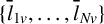
$\mathcal {L} = \{\overline {l}_{iv}: v \in S, i=1, \ldots , N\}$
in N variables such that
$ \{\overline {l}_{1v}, \ldots , \overline {l}_{Nv} \} $
is linearly independent for each
$v \in S$
.



We define the set
 $$ \begin{align*}\Pi (N, \overline{\gamma}, \mathcal{L}, Q) := \{ y \in \mathcal{O}_S^N: \vert \overline{l}_{iv}(y) \vert_v \leq Q^{\gamma_{iv}} \mbox{ for } v \in S, i=1, \ldots, N\}\end{align*} $$
and
 $$ \begin{align*}V(N, \overline{\gamma}, \mathcal{L}, Q) := \text{the } K\text{-vector space generated by } \Pi (N, \overline{\gamma}, \mathcal{L}, Q).\end{align*} $$
Notice that the map
 $f_k$
is defined previously. We deduce our Theorem 1.4 from the two following results.
Theorem 3.6. Let
 $0 < \epsilon < 1/ 12,$
and
 $X_n \in \mathcal {N}$
with
 $n> \tau (\epsilon )$
be a solution of Inequality (1-5) such that
 $l_{iv}(X_n) \neq 0$
for
 $v \in S, i=1, \ldots , m.$
There are a proper linear subspace W of
 $K^m$
and a tuple
 $ (N, \overline {\gamma }, \mathcal {L}, Q)$
with
 $N= \binom {m}{k}$
, where
 $k = \mathrm { dim}_K W,$
such that the three conditions below are satisfied:
 $$ \begin{align} X_n \in W, \quad f_k(W) = V(N, \overline{\gamma}, \mathcal{L}, Q), \quad \mathrm{dim}_K (V(N, \overline{\gamma}, \mathcal{L}, Q))= N-1; \end{align} $$
 $$ \begin{align} \overline{\gamma}= (\gamma_{iv}, v \in S, i=1, \ldots, N) \quad \text{with } \gamma_{iv} \leq s(v) \text{ and } \sum_{v \in S}^{} \sum_{i=1}^{N} \gamma_{iv} \leq -\frac{\epsilon}{9m^3}; \end{align} $$
 $$ \begin{align} Q \geq (\vert \alpha_1 \vert)^{3mn}, \end{align} $$
and such that
 $(N, \overline {\gamma }, \mathcal {L}) \in \mathcal {C},$
where
 $\mathcal {C}$
is a fixed set independent of
 $X_n$
of cardinality at most
 $C':= (64em^42^m \epsilon ^{-1})^{ms+m}.$
The next result gives us an effective upper bound for the number of vector spaces
 $V(N, \overline {\gamma }, \mathcal {L}, Q)$
when Q is large enough.
Theorem 3.7. Fix a tuple
 $(N, \overline {\gamma }, \mathcal {L}) $
as in Theorem 3.6. Then there exists a collection of
 $(N-1)$
-dimensional linear subspaces of
 $K^N$
of cardinality at most
 $$ \begin{align*} C" = 2^{11m+34}s^2 \epsilon^{-4} m^{12}\end{align*} $$
such that for every Q with
 $$ \begin{align} \mathrm{dim}_K (V(N, \overline{\gamma}, \mathcal{L}, Q))= N-1; \quad Q> ( 9m!)^{e^{2C"}}, \end{align} $$
the vector spaces
 $V(N, \overline {\gamma }, \mathcal {L}, Q)$
belong to this collection.
By combining Lemma 3.1 and Theorems 3.6 and 3.7, we easily deduce Theorem 1.4. Indeed, we notice that Lemma 3.1 implies the map
 $f_k$
from the collection of k-dimensional subspaces of
 $K^m$
to the collection of
 $(N-1)$
-dimensional subspaces of
 $K^N$
such that, for any k-dimensional subspace V of basis
 $\{a_1, \ldots , a_k\}$
and any vectors
 $a_{k+1}, \ldots, a_n$
such that
 $\{a_1, \ldots , a_n\}$
is a basis of
 $K^m,$
then
 $f_k(V)$
is the subspace generated by
 $\{A_1, \ldots , A_{N-1}\}$
, with
 $N =\binom {m}{m-k}$
with
 $A_i= a_{i_1} \wedge a_{i_2} \wedge \cdots \wedge a_{i_{m-k}}$
is injective. Let
 $0 < \epsilon < 1/ 12$
and
 $X_n \in \mathcal {N}$
with
 $n> \tau (\epsilon )$
solutions of Inequality (1-5) such that
 $l_{iv}(X_n) \neq 0$
for
 $v \in S, i=1, \ldots , m.$
Since
 $n> \tau (\epsilon )$
, we deduce
 $$ \begin{align*}\vert \alpha_1 \vert ^{3mn} \geq ( 9m!)^{e^{2C"}} \quad \mbox{with } C" = 2^{11m+34}s^2 \epsilon^{-4} m^{12}. \end{align*} $$
It follows from Theorem 3.6 that a proper subspace W of
 $K^m$
and a tuple
 $(N, \overline {\gamma }, \mathcal {L})$
independent of n such that
 $$ \begin{align*}X_n \in W, \quad f_k(W) = V(N, \overline{\gamma}, \mathcal{L}, Q), \quad \mathrm{dim}_K (V(N, \overline{\gamma}, \mathcal{L}, Q))= N-1, \quad Q \geq ( 9m!)^{e^{2C"}}\end{align*} $$
exist. The cardinality of the collection of such tuples
 $(N, \overline {\gamma }, \mathcal {L})$
does not exceed
 $C':= (64em^42^m \epsilon ^{-1})^{ms+m}.$
For each tuple
 $(N, \overline {\gamma }, \mathcal {L})$
, we deduce from Theorem 3.7 that the collection of vector spaces
 $V(N, \overline {\gamma }, \mathcal {L}, Q)$
satisfying the properties
 $$ \begin{align*} \mathrm{dim}_K (V(N, \overline{\gamma}, \mathcal{L}, Q))= N-1 \quad Q\geq ( 9m!)^{e^{2C"}}\end{align*} $$
does not exceed
 $C"$
. Since
 $f_k$
is injective, we obtain the set of proper subspaces W of
 $K^m$
for which
 $X_n \in W$
does not exceed
 $$ \begin{align*}C'C" = (64em^42^m \epsilon^{-1})^{ms+m} \cdot 2^{11m+34}s^2 \epsilon^{-4} m^{12} \leq s^2 ( m^{7} 2^{4m+17} \epsilon ^{-2})^{ms+m}.\end{align*} $$
By adding the collection of
 $ms$
proper subspaces associated to the collection
 $\{l_{iv}, v\in S, i=1,\ldots , m\},$
we conclude that the set of
 $X_n \in \mathcal {N}$
with
 $n> \tau (\epsilon )$
solutions of Inequality (1-5) is contained in at most
 $$ \begin{align*}ms + s^2 ( m^{7} 2^{4m+17} \epsilon ^{-2})^{ms+m} \leq 2\cdot s^2 ( m^{7} 2^{4m+17} \epsilon ^{-2})^{ms+m}\end{align*} $$
proper subspaces in
 $K^m.$
4 Proof of Theorem 3.6
We prove this result using the same machinery as in the proof of [Reference Evertse5, Theorem B], with the difference that the norm of vectors in
 $K^m$
that we are working with is not the Euclidean norm that Evertse considered in his paper. Let
 $0 < \epsilon < 1/ 12$
and
 $X_n \in \mathcal {N}$
with
 $n> \tau (\epsilon )$
solutions of Inequality (1-5) such that
 $l_{iv}(X_n) \neq 0$
for
 $v \in S, i=1, \ldots , m.$
Fixing
 $v \in S$
, we define
 $\mathcal {O}_v =\{x \in K_v: \vert x \vert _v \leq 1\}$
and the v-adic approximation domain
 $\Pi _v(n)$
of
 $X_n$
to be the paralellepiped in
 $K_v^m$
given by
 $$ \begin{align*}\Pi_v(n)= \{ y \in K_v^m : \vert l_{iv}(y) \vert_v \leq \vert l_{iv}(X_n) \vert_v \mbox{ for } i=1, \ldots, m\}.\end{align*} $$
This is a compact convex body of
 $K_v^m$
. The approximate domain is defined in
 $V_K^m$
by
 $$ \begin{align*} \Pi (n) &= \prod_{v \in S}^{} \Pi_v(n) \times \prod_{v \notin S}^{} \mathcal{O}_v^m\\ &= \{ y_v \in V_K^m : \vert l_{iv}(y_v) \vert_v \leq \vert l_{iv}(X_n) \vert_v \mbox{ for } v \in S \mbox{ and } \vert y_v \vert_v \leq 1 \mbox{ for } v \notin S \}. \end{align*} $$
We denote by
 $\lambda _1(n), \ldots , \lambda _m(n)$
the successive minima of
 $\Pi (n)$
;
 $$ \begin{align*} R_v(n) = \bigg(\prod_{i=1}^{m} \vert l_{iv}(X_n)\vert_v \bigg)^{-1} \quad \mbox{and}\quad R(n)= \prod_{v \in S}^{} R_v(n).\end{align*} $$
Lemma 4.1. Let
 $v\in M_K$
and
 $D_{K_v}$
be the discriminant over
 $K_v$
. When v is a finite place over K, we denote by
 $ p$
the rational prime above v.
-
(1) If
$v\notin S,$
then
$\beta _v^m(n) := \beta _v^m(\Pi _v(n)) = \beta _v^m(\mathcal {O}_v^m) = \vert D_{K_v} \vert _p^{m/2}$
. -
(2) If
$v\in S$
is not Archimedean, then
$\beta _v^m(n) = \vert D_{K_v} \vert _p^{m/2} \cdot R_v(n)^{-d}$
. -
(3) If
$K_v = \mathbb {R}$
, then
$\beta _v^m(n) = 2^m \cdot R_v(n)^{-d}$
. -
(4) If
$K_v = \mathbb {C}$
, then
$\beta _v^m(n) = (2\pi )^m \cdot R_v(n)^{-d}$
. -
(5) We also have
$$ \begin{align*}\dfrac{1}{m!} R(n) \leq \lambda_1(n) \cdots \lambda_m(n) \leq \Delta_K^{m/2d} R(n).\end{align*} $$


Proof. It is easy to see that, for
 $v \in S,$
 $$ \begin{align*}\Pi_v(n)= \rho \mathcal{O}_v^m \quad \mbox{with } \rho = \begin{pmatrix} l_{1v}(X_n) & l_{2v}(X_n)\cdot \{0,-1\} & \cdots & l_{mv}(X_n) \cdot \{0,-1\} \\ 0 & l_{2v}(X_n) & \cdots & 0 \\ \vdots & \vdots & \ddots & \vdots\\ 0 & 0 & \cdots & l_{mv}(X_n) \\ \end{pmatrix},\end{align*} $$
where
 $l_{iv}(X_n)\cdot \{0,-1\} = -l_{iv}(X_n)$
if
 $v = \mathrm {id}$
and
 $0$
otherwise. Hence, the first four statements follow from the definition of
 $\beta _v$
and the fact that
 $$ \begin{align*}\beta_v^m(n)= \beta_v^m (\rho \mathcal{O}_v^m) = \vert \mathrm{det}(\rho) \vert_v^d \beta_v^m(\mathcal{O}_v^m).\end{align*} $$
From [Reference Bombieri and Gubler1, B.1.20 and B.1.21, page 606]),
 $$ \begin{align*}\vert \Delta_K \vert_p = \prod_{v\mid p}^{} \vert \Delta_{K_v} \vert_p. \end{align*} $$
Together with the product formula,
 $$ \begin{align} \vert \Delta_K \vert^{-1} = \prod_{p}\prod_{v\mid p}^{} \vert \Delta_{K_v} \vert_p. \end{align} $$
By the definition of
 $\beta ^m,$
 $$ \begin{align*} \beta^m(n) &=2^{mr_1} \cdot (2\pi)^{mr_2} { \prod_{p}\prod_{v\mid p}^{} \vert \Delta_{K_v} \vert_p^{m/2}} \cdot \bigg(\prod_{v \in S}^{} R_v(n)\bigg)^{-d}\\ &= 2^{mr_1} \cdot (2\pi)^{mr_2} \vert \Delta_{K} \vert^{-m/2} \cdot R(n)^{-d},\end{align*} $$
where, for the last equality, we use Relation (4-1) and
 $r_1, r_2$
correspond respectively to the numbers of real and complex places. Together with Lemma 3.5,
 $$ \begin{align*} \lambda_1(n) \cdots \lambda_m(n) &\leq 2^{m} \beta^m(n)^{-1/d} \\ &\leq 2^{m} \cdot 2^{-mr_1/d} (2\pi)^{-mr_2/d} \vert \Delta_{K} \vert^{m/2d} \cdot R(n)\\ &\leq \bigg(\dfrac{2}{\pi}\bigg)^{mr_2/d} \vert \Delta_{K} \vert^{m/2d} \cdot R(n)\\ &\leq \vert \Delta_{K} \vert^{m/2d} \cdot R(n), \end{align*} $$
and
 $$ \begin{align*} \lambda_1(n) \cdots \lambda_m(n) &\geq \bigg(\dfrac{\pi^mm!}{2}\bigg)^{r_2/d} \dfrac{2^m}{m!} \cdot 2^{-mr_1/d} (2\pi)^{-mr_2/d} \cdot R(n)\\ &\geq \bigg(\dfrac{m!}{2}\bigg)^{r_2/d} \dfrac{(2^m)^{r_2/d}}{m!} \cdot R(n)\\ &\geq \dfrac{R(n)}{m!}. \end{align*} $$
Hence, the proof is completed.
We also need the following lemma.
Lemma 4.2. Let
 $\lambda>0.$
For each
 $y \in \psi ^{-1} (\lambda \Pi (n))$
:
-
•
$ \vert y \vert _v \leq ( m^2(m-1)! R(n)^{{11}/{10\epsilon }}\lambda )^{s(v)} $
for
$v \in S;$
-
•
$\lambda _1(n) \geq m^{-2}(m-1)!^{-1} R(n)^{{-11}/{10\epsilon }}. $


Proof. Let
 $y \in \psi ^{-1} (\lambda \Pi (n))$
. Fix
 $v \in S$
and set
 $\Delta _v = \mathrm {det} (l_{1v}, \ldots , l_{mv})$
. Clearly,
 $\Delta _v =1.$
Let
 $a_j$
be the vector
 $(l_{1v} \wedge \cdots \wedge l_{j-1v} \wedge l_{j+1v} \wedge \cdots \wedge l_{mv})^*$
. The fact that
 $\{a_1, \ldots , a_m\}$
is a basis of
 $K^m$
implies
 $$ \begin{align} y = \sum_{j=1}^{m} \Delta_v^{-1} l_{jv}(y) a_j = \sum_{j=1}^{m} l_{jv}(y) a_j. \end{align} $$
Using the fact
 $n> \tau (\epsilon ),$
one gets
 $\vert X_n \vert _v \leq (\vert \alpha _1 \vert )^{11ns(v)/10}.$
Namely, if v is a finite place over K, then
 $\vert X_n \vert _v \leq 1$
, as all the coordinates
 $P_i(n)\alpha _i^n$
of
 $X_n$
are algebraic integers, so we are done. Otherwise, by using the fact that
 $\vert \cdot \vert _v^{1/s(v)}$
is the usual absolute value,
 $$ \begin{align*} \vert X_n\vert_v &= \vert (P_i(n)\alpha_1^n, \ldots, P_m(n)\alpha_m^n) \vert_v \\ &\leq \max_i \vert (P_i(n)\alpha_i^n \vert_v \\ &\leq \bigg(\dfrac{(a+1)A n^a}{\vert \alpha_1 \vert ^{n/10}}\bigg)^{s(v)} \cdot (\vert \alpha_1 \vert )^{11ns(v)/10} \\ &\leq (\vert \alpha_1 \vert )^{11ns(v)/10}, \end{align*} $$
where, for the second inequality, we use the triangle inequality for the absolute value and the definition of A in (1-2), while for the last inequality, we use the fact that
 $n> \tau (\epsilon ).$
Therefore,
 $$ \begin{align} \vert l_{jv} (y) \vert_v &\leq \lambda^{s(v)} \vert l_{jv}(X_n) \vert_v \nonumber\\ &\leq ( \lambda m (\vert \alpha_1 \vert)^{11n/10} )^{s(v)}\nonumber\\ &\leq ( \lambda m (R(n))^{11 / (10\epsilon)} )^{s(v)}. \end{align} $$
By Relation (3-4),
 $$ \begin{align*}\vert a_j \vert_v = \vert l_{1v} \wedge \cdots \wedge l_{j-1v} \wedge l_{j+1v} \wedge \cdots \wedge l_{mv} \vert_v \leq (m-1)!^{s(v)}\!.\end{align*} $$
Together with (4-2) and (4-3),
 $$ \begin{align*} \vert y \vert_v &\leq m^{s(v)} \max_j \{\vert l_{jv} (y) a_j \vert_v\}\\ &\leq ( \lambda m^2 (m-1)! (R(n))^{11 / (10\epsilon)} )^{s(v)}. \end{align*} $$
Hence, the proof of the first statement is completed. Let
 $y \in \psi ^{-1} (\lambda _1(n) \Pi (n))$
with
 $y \neq 0.$
Then,
 $\vert y \vert _v \leq 1$
for
 $v \notin S$
and since
 $H(y) \geq 1$
, it follows that
 $$ \begin{align*}1 \leq H(y) \leq \prod_{v \in S}^{} \vert y \vert_v \leq m^2 (m-1)! \lambda_1(n)(R(n))^{11/(10 \epsilon)},\end{align*} $$
which implies the second statement of the lemma.
The following lemma is a particular case of one due to Evertse [Reference Evertse5, Lemma 15].
Lemma 4.3. Let
 $ b_1, \ldots , b_m$
be linearly independent vectors in
 $K^m$
. For each infinite place v on K, let
 $ \mu _{1v}, \ldots , \mu _{mv}$
be real numbers with
 $$ \begin{align*}0< \mu_{1v} \leq \mu_{2v} \leq \cdots \leq \mu_{mv}.\end{align*} $$
Suppose
 $\vert l_{iv} (b_j)\vert _v \leq \mu _{jv}$
for
 $1 \leq i,j \leq m, v \mid \infty .$
Then there are permutations
 $k_v$
of
 $\{1, \ldots , m\}$
for each infinite place v on K and vectors
 $$ \begin{align*}v_1=b_1, \quad v_i = \sum_{j=1}^{i-1} \epsilon_{ij} v_j + b_i \quad \mbox{with } \epsilon_{ij} \in \mathcal{O}_K\end{align*} $$
such that
 $$ \begin{align*}\vert l_{k_v(i), v} (v_j)\vert_v \leq (2d\vert \Delta_K\vert^{1/2})^{s(v) (i+j)} \min \{\mu_{iv}, \mu_{jv}\} \quad \mbox{for } 1 \leq i,j \leq m, v \mid \infty .\end{align*} $$
Choose linearly independent vectors
 $g_1, \ldots , g_m$
with
 $g_j \in \psi ^{-1} (\lambda _j \Pi (n))$
for any
 $j=1, \ldots , m.$
By Lemma 4.2, we have
 $g_j \in \mathcal {O}_K$
and
 $$ \begin{align*} \begin{cases} \vert l_{iv} (g_j)\vert_v \leq \lambda_j^{s(v)}\vert l_{iv} (X_n)\vert_v& \mbox{for } v \mid \infty,\\ \vert l_{iv} (g_j)\vert_v \leq \vert l_{iv} (X_n)\vert_v& \mbox{for } v\in S v \nmid \infty. \end{cases} \end{align*} $$
By applying Lemma 4.3 with the vectors
 $g_1, \ldots , g_m$
and the linear forms
 $l_{iv}(X_n)^{-1}l_{iv}$
(
 $v \mid \infty , i=1, \ldots , m$
), and the real numbers
 $\mu _{jv} = \lambda _j^{s(v)} (v \mid \infty , j=1, \ldots , m) $
, we infer that there are vectors
 $ v_1, \ldots , v_m$
with
 $$ \begin{align*} v_1=g_1, \quad v_i = \sum_{j=1}^{i-1} \epsilon_{ij} v_j + g_i \quad \mbox{with } \epsilon_{ij} \in \mathcal{O}_K \end{align*} $$
and permutations
 $k_v$
of
 $\{1, \ldots , m\}$
for
 $v \mid \infty $
such that
 $$ \begin{align*} \vert l_{k_v(i), v} (v_j)\vert_v \leq ( (2d\vert \Delta_K\vert^{1/2})^{2m} \lambda_{\min \{i, j\}})^{s(v)}\vert l_{k_v(i),v}(X_n) \vert_v \quad \mbox{for } 1 \leq i,j \leq m, v \mid \infty. \end{align*} $$
Fix
 $v \in S$
,
 $v \nmid \infty $
. Since
 $\epsilon _{ij} \in \mathcal {O}_K$
and
 $g_{j} \in \mathcal {O}_K^m,$
 $$ \begin{align*}v_j \in \mathcal{O}_K^m, \quad \vert l_{i v} (v_j)\vert_v \leq \vert l_{iv}(X_n) \vert_v.\end{align*} $$
Hence, we have proven the following lemma.
Lemma 4.4. There are linearly independent vectors
 $v_1, \ldots , v_m \in \mathcal {O}_K^m$
and permutations
 $k_v$
of
 $\{1, \ldots , m\}$
for
 $v \mid \infty $
all depending of
 $X_n$
, with the following properties:
-
• for
$j=1, \ldots , m$
, the vectors
$v_1, \ldots , v_j$
belong in the K-vector space generated by
$ \psi ^{-1} (\lambda _j(n) \Pi (n));$
-
• we also have
$$ \begin{align*} \begin{cases} \vert l_{k_v(i),v} (v_j)\vert_v \leq ( (2d\vert \Delta_K\vert^{1/2})^{2m} \lambda_{\min \{i, j\}}(n))^{s(v)}\vert l_{k_v(i),v}(X_n) \vert_v & \mbox{for } v\mid \infty \\ \vert l_{iv} (v_j)\vert_v \leq \vert l_{iv}(X_n) \vert_v & \mbox{for } v\in S, v \nmid \infty. \end{cases} \end{align*} $$


In the next lemma, we make a first step towards the proof of Theorem 1.4.
Lemma 4.5. There is a set
 $\Gamma $
of cardinality
 $$ \begin{align*}\vert \Gamma \vert \leq (m!)^{-s} (64em^42^m \epsilon^{-1})^{ms+m}\end{align*} $$
consisting of the tuples of real numbers
 $$ \begin{align*}(c;d) = (c_{iv} :v \in S, i=1, \ldots, m; d_i:i=1, \ldots, m)\end{align*} $$
with:
-
•
$c_{iv} \leq ({12s(v)}/{10\epsilon })$
for
$v \in S, i=1, \ldots , m;$
-
•
$d_1 \leq 0, {-12}/{10\epsilon } \leq d_1 \leq \cdots \leq d_m$


such that for every solution
 $X_n$
of Inequality (1-5), with
 $n> \tau (\epsilon )$
and
 $l_{iv}(X_n) \neq 0$
for
 $v \in S, i=1, \ldots , m$
, there is a tuple
 $(c;d) \in \Gamma $
with
 $$ \begin{align*}R(n)^{c_{iv} - \{1/s c(m)\}} < \vert l_{iv}(X_n) \vert_v \leq R(n)^{c_{iv} } \end{align*} $$
and
 $$ \begin{align*}R(n)^{d_{i} } \leq \lambda_i(n) \leq R(n)^{d_{i}+\{1/c(m)\}} \end{align*} $$
for
 $v \in S, i=1, \ldots , m$
with
 $c(m) = 4m^32^m.$
Proof. Put
 $u_{iv} := \vert l_{iv}(X_n) \vert _v ( R(n)^{{-12}/{10\epsilon }})^{s(v)}$
for
 $v \in S, i=1, \ldots , m.$
Since
 $\vert X_n \vert _v \leq (\vert \alpha _1 \vert )^{11ns(v)/10}$
, it follows that
 $$ \begin{align*}u_{iv} \leq \vert X_n \vert_v (m R(n)^{{-12}/{10\epsilon}})^{s(v)} \leq (m R(n)^{{-1}/{10\epsilon}})^{s(v)} \leq 1,\end{align*} $$
where for the second inequality, we use the fact that
 $X_n$
is a solution of Inequality (1-5) and for the last inequality,
 $n>\tau (\epsilon )$
. However,
 $$ \begin{align*} \prod_{v \in S}^{} \prod_{i=1}^{m} u_{iv} &= \bigg( \prod_{v \in S}^{} \prod_{i=1}^{m} \vert l_{iv}(X_n) \vert_v \bigg) R(n)^{{-12m}/{10\epsilon}} \\ &\geq ( R(n) )^{{-2m}/{\epsilon}}. \end{align*} $$
By applying [Reference Evertse5, Lemma 9] with
 $\theta = 0.5\epsilon c(m)^{-1}$
, there is a set
 $\Gamma _1$
of nonnegative reals
 $\beta = (\beta _{iv}, v \in S, i=1, \ldots , m)$
of cardinality
 $$ \begin{align*}\vert \Gamma_1 \vert \leq (2e +2ec(m)\epsilon^{-1})^{ms}\end{align*} $$
such that for some
 $\beta \in \Gamma _1,$
 $$ \begin{align*} R(n)^{c_{iv} - \{1/s c(m)\}} < \vert l_{iv}(X_n) \vert_v \leq R(n)^{c_{iv}}, \end{align*} $$
with
 $$ \begin{align*}c_{iv} = \dfrac{12}{10 \epsilon} s(v) - \dfrac{2m}{\epsilon} \beta_{iv} \quad \mbox{for } v \in S, i=1, \ldots, m. \end{align*} $$
Therefore,
 $c_{iv} \leq ({12}/{10\epsilon }) s(v)$
. Finally,
 $c= (c_{iv},v \in S, i=1, \ldots , m)$
depends only on
 ${\gamma \in \Gamma _1;}$
hence, for c, we have at most
 $\vert \Gamma _1 \vert $
possibilities.
We define the numbers
 $v_{j}(n) := R(n)^{{-12}/{10\epsilon }} \lambda _j(n)^{-1}$
for
 $v \in S, i=1, \ldots , m.$
By Lemma 4.2, we have
 $\lambda _1(n) \geq m^{-2}(m-1)!^{-1} R(n)^{{-11}/{10\epsilon }}$
. Together with
 $n> \tau (\epsilon )$
,
 $$ \begin{align*}1 \geq v_1(n) \geq v_2(n) \geq \cdots \geq v_m(n).\end{align*} $$
Then, it follows from Lemma 4.1 that
 $$ \begin{align*}v_1(n)\cdots v_m(n) = \dfrac{R(n)^{{-12m}/{10\epsilon}}}{\lambda_1(n)\cdots \lambda_m(n)} \geq R(n)^{{-2m}/{\epsilon}}.\end{align*} $$
By applying [Reference Evertse5, Lemma 9] with
 $\theta = 0.5\epsilon c(m)^{-1}$
, there is a set
 $\Gamma _2$
of m-tuples of nonnegative reals
 $\delta = (\delta _{i}, i=1, \ldots , m)$
independent of
 $X_n$
of cardinality
 $$ \begin{align*}\vert \Gamma_2 \vert \leq (2e +2ec(m)\epsilon^{-1})^{m}\end{align*} $$
such that for some
 $\delta \in \Gamma _2,$
 $$ \begin{align} R(n)^{{-2m}/{\epsilon} (\delta_{j} + {\epsilon}/{2m c(m)})} < v_j(n) \leq R(n)^{-2m \delta_j / \epsilon}, \end{align} $$
and the relation (4-4) remains valid after replacing
 $\delta _1, \ldots , \delta _m$
by
 $$ \begin{align*}\delta_1^{\prime} = \min\{\delta_1, \ldots, \delta_m\}, \quad \delta_2^{\prime} = \min\{\delta_2, \ldots, \delta_m\}, \ldots, \delta_m^{\prime} = \delta_m.\end{align*} $$
Putting
 $$ \begin{align*}d_j = \dfrac{-12}{10\epsilon} + \dfrac{2m \delta_j^{\prime}}{\epsilon} \quad \mbox{for } j=1, \ldots, m,\end{align*} $$
finally,
 $$ \begin{align*}R(n)^{d_{i} } \leq \lambda_i(n) \leq R(n)^{d_{i}+\{1/c(m)\}}; \end{align*} $$
therefore,
 $d=(d_1, \ldots , d_m)$
depends only on
 $\Gamma _2$
. From the definition
 $d_i$
, we have the desired inequality. Since
 $X_n \in \psi ^{-1} (\Pi (n))$
, it follows by definition of first successive minima, we have
 $\lambda _1(n) \leq 1$
; therefore,
 $d_1 \leq 0$
. For such a tuple d, we have at most
 $\vert \Gamma _2 \vert $
possibilities. It follows that the number of possibilities for
 $(c;d)$
is at most
 $$ \begin{align*} \vert \Gamma_1 \vert \vert \Gamma_2\vert &\leq (2e +2ec(m)\epsilon^{-1})^{ms+m}\\ &\leq (16e^2m^32^m\epsilon^{-1})^{ms+m}\\ &\leq (m!)^{-s} (64em^42^m\epsilon^{-1})^{ms+m}, \end{align*} $$
where we use Stirling’s approximation to get the last inequality.
Let
 $X_n$
be a solution of Inequality (1-5) with
 $n> \tau (\epsilon )$
and
 $(c;d)$
the corresponding tuple from Lemma 4.5. For any finite place
 $v \in S$
, choose
 $k_v$
to be an identity map from
 $\{1, \ldots , m\}$
to
 $\{1, \ldots , m\}$
. We define
 $$ \begin{align*}l_{iv}^{\prime}(X) = l_{k_v(i),v}(X) \quad \mbox{for } v \in S, i=1, \ldots, m\end{align*} $$
and the numbers
 $$ \begin{align*}e_{iv} = c_{k_v(i),v} \quad \mbox{for } v \in S, i=1, \ldots, m.\end{align*} $$
We have constructed a tuple
 $$ \begin{align*}\mathcal{T} = (l_{iv}^{\prime}: v \in S, i=1, \ldots, m; e_{iv}: v\in S, i=1, \ldots, m; d_i: i=1, \ldots, m).\end{align*} $$
By Lemma 4.5,
 $$ \begin{align} R(n)^{e_{iv} - \{1/s c(m)\}} < \vert l_{iv}^{\prime}(X_n) \vert_v \leq R(n)^{e_{iv} } \end{align} $$
and
 $$ \begin{align} R(n)^{d_{i} } \leq \lambda_i(n) \leq R(n)^{d_{i}+\{1/c(m)\}} \end{align} $$
for
 $v \in S, i=1, \ldots , m.$
Lemma 4.6.
 $\mathcal {T}$
belongs to a set independent of
 $X_n$
of cardinality at most
 $$ \begin{align*} C' = (64em^42^m \epsilon^{-1})^{ms+m}, \end{align*} $$
and we also have:
-
•
$e_{iv} \leq ({12s(v)}/{10\epsilon })$
for
$v \in S, i=1, \ldots , m;$
-
•
${ \sum _{v \in S}^{} \sum _{i=1}^{m} e_{iv}} \leq -1 + (4m^22^m)^{-1} $
; -
•
$1 - (3m^22^m)^{-1} \leq { \sum _{i=1}^{m} d_i} \leq 1 + (3m^22^m)^{-1}$
.


Proof. For infinite places
 $v \in S$
, the linear forms
 $l_{iv}^{\prime }$
are uniquely determined by the permutation of
 $\{1, \ldots , m\}$
from Lemma 4.3. Therefore,
 $\mathcal {T}$
is uniquely determined by
 $k_v (v \mid \infty )$
and
 $(c;d)$
. It follows that for
 $\mathcal {T}$
, we have at most
 $$ \begin{align*}(m!)^{r_1+r_2}(m!)^{-s}(64em^42^m\epsilon^{-1})^{ms+m} \leq C'\end{align*} $$
possibilities. The second point follows from the definition of
 $\mathcal {T}$
. Namely, from Lemma 4.5,
 $$ \begin{align*}e_{iv} \leq \dfrac{12s(v)}{10\epsilon} \quad \mbox{for } v \in S, i=1, \ldots, m.\end{align*} $$
Moreover,
 $$ \begin{align*}R_v(n)^{-1} = \prod_{i=1}^{m}\vert l_{iv}(X_n) \vert_v \geq R(n)^{{ \sum_{i=1}^{m} e_{iv} }-{m}/{c(m)s}}\end{align*} $$
for
 $v \in S.$
Hence,
 $$ \begin{align*}R(n)^{-1} = \prod_{v \in S}^{}R_v(n)^{-1} \geq R(n)^{{ \sum_{i,v}^{} e_{iv}} -{m}/{c(m)}},\end{align*} $$
which gives us the desired result. By (4-6) and Lemma 4.1,
 $$ \begin{align*}R(n)^{d_1+\cdots + d_m} \leq \lambda_1(n) \cdots \lambda_m(n) < \Delta_K^{m/2d} R(n) \leq R(n)^{1 + {1}/{3m^22^m}},\end{align*} $$
where for the last inequality, we use the fact
 $n> \tau (\epsilon )$
. Moreover,
 $$ \begin{align*}R(n)^{d_1+\cdots + d_m} \geq \lambda_1(n) \cdots \lambda_m(n) R(n)^{- {1}/{4m^22^m}}> R(n)^{1 - {1}/{3m^22^m}},\end{align*} $$
where for the last inequality, we also use that
 $n> \tau (\epsilon )$
. Combining the two relations above completes the proof of the lemma.
Now, we consider the vectors
 $v_1, \ldots , v_m$
from Lemma 4.5. We recall that
 $l_{iv}^{\prime } = l_{k_v(i),v}$
for infinite places v and
 $l_{iv}^{\prime } = l_{iv}$
if v is a finite place in S. Lemma 4.3, (4-5) and (4-6) thus yield that
 $$ \begin{align} \vert l_{iv}^{\prime}(v_j) \vert_v \leq ( (2d\vert \Delta_K\vert^{1/2})^{2m} )^{s(v)} R(n)^{e_{iv} + s(v) ( d_{\min(i,j)} +1/c(m)} ). \end{align} $$
Let t be the largest integer such that
 $\lambda _t \leq 1$
and V, the K-vector space generated by
 $\psi ^{-1}(\lambda _t \Pi (n))$
. We have
 $X_n \in V$
since
 $\lambda _{t+1}> 1$
and, moreover,
 $\{v_1, \ldots , v_t\}$
is a basis of V. We also have
 $R(n)^{d_t} \leq \lambda _t \leq 1$
, which implies
 $d_t \leq 0.$
Hence, it follows that
 $X_n$
lies in the K-vector space generated by
 $v_1, \ldots , v_r,$
where r is the largest integer such that
 $d_r \leq 0.$
Next, we construct a tuple
 $(N, \overline {\gamma }, \mathcal {L})$
depending only on
 $\mathcal {T}$
. Since the number of possibilities for
 $\mathcal {T}$
is at most
 $C'$
, it follows that the number of such tuples is at most
 $$ \begin{align*} (64em^42^m\epsilon^{-1})^{ms+m}.\end{align*} $$
Let
 $(l_{iv}^{\prime }; e_{iv}; d_i) \in \mathcal {T}$
. There is an integer k with
 $$ \begin{align} 1\leq k \leq m-1, \quad d_{k+1}>0, \quad d_{k+1} -d_k \geq \frac{1}{m^2}. \end{align} $$
Namely, let r be the largest integer such that
 $d_r \leq 0$
. By taking k as the smallest index of the set
 $\{d_r, d_{r+1}, \ldots , d_m\}$
such that
 $d_{k+1} -d_k$
is maximal, we obtain the relation (4-8) as follows. By Lemma 4.5, it is immediate that
 $$ \begin{align} d_m \geq \frac{1}{m}- \dfrac{1}{3m^32^m}. \end{align} $$
Therefore,
 $$ \begin{align*} d_{k+1}-d_k \geq \frac{1}{m-r}(d_m-d_r) \geq \frac{1}{m-r} \bigg( \frac{1}{m}- \dfrac{1}{3m^32^m} \bigg) \geq \frac{1}{m^2}, \end{align*} $$
where for the second inequality, we use (4-9). Put
 $N= \binom {m}{k}$
. As before, let
 $\sigma _1, \ldots , \sigma _N$
be the sequence of subsets of
 $\{1, \ldots , m\}$
of cardinality
 $m-k$
, ordered lexicographically. We define the set of linear forms
 $\mathcal {L} =\{ \overline {l}_{iv} : v \in S, i=1, \ldots , N \}$
with
 $$ \begin{align*} \overline{l}_{iv} := \alpha_{iv} l_{i_1v}^{\prime} \wedge \cdots \wedge l_{i_{m-k}v}^{\prime} \quad \mbox{for } v \in S, i=1, \ldots,N \end{align*} $$
such that
 $\vert \overline {l}_{iv} \vert _v =1.$
We also define
 $$ \begin{align*} \overline{e}_{iv} = e_{i_1v} + \cdots + e_{i_{m-k}v}, \quad \overline{d}_{i} = d_{i_1} + \cdots + d_{i_{m-k}}\end{align*} $$
and the tuple
 $\overline {\gamma } = (\gamma _{iv}, v \in S, i=1, \ldots , N)$
with
 $$ \begin{align*}\gamma_{iv} = \dfrac{\epsilon}{3m} \bigg\{ \dfrac{1}{c(m) s} + \overline{e}_{iv} + s(v) \bigg( \overline{d}_{i} + \dfrac{m}{c(m)} \bigg) \bigg\} \quad \mbox{for } v \mid \infty, i=1, \ldots,N-1 \end{align*} $$
and
 $$ \begin{align*}\gamma_{Nv} = \dfrac{\epsilon}{3m} \bigg\{ \dfrac{1}{c(m) s} + \overline{e}_{Nv} + s(v) \bigg( \overline{d}_{N-1} + \dfrac{m}{c(m)} \bigg) \bigg\} \quad \mbox{for } v \mid \infty \end{align*} $$
and
 $$ \begin{align*}\gamma_{iv} = \dfrac{\epsilon}{3m} \bigg\{ \min \bigg( 0, \dfrac{1}{c(m) s} + \overline{e}_{iv} \bigg) \bigg\} \quad \mbox{for } v \nmid \infty, i=1, \ldots,N, \end{align*} $$
where
 $c(m) = 4m^32^m.$
Lemma 4.7. We have
 $\gamma _{iv} \leq s(v)$
for
 $v \in S, i=1, \ldots , N$
and
 $$ \begin{align*}\sum_{v \in S}^{} \sum_{i=1}^{m} \gamma_{iv} \leq -\frac{\epsilon}{9m^3}.\end{align*} $$
Proof. For any finite place
 $v \in S$
, we have
 $\gamma _{iv} \leq 0 \leq s(v).$
Let v be an infinite place over K. By Lemma 4.6, it follows that
 $$ \begin{align*} \overline{e}_{iv} = e_{i_1v} + \cdots + e_{i_{m-k}v} \leq (m-k) \dfrac{12s(v)}{10\epsilon} \leq \dfrac{12ms(v)}{10\epsilon}\end{align*} $$
and
 $$ \begin{align*} \overline{d}_{i} = d_{i_1} + \cdots + d_{i_{m-k}} \leq d_{1} + \cdots + d_{m} -kd_1 \leq 1+ \dfrac{1}{3m^22^m} + \dfrac{12m}{10\epsilon}.\end{align*} $$
By inserting these relations in the expression of
 $\gamma _{iv}$
,
 $$ \begin{align*} \gamma_{iv} &\leq \dfrac{\epsilon}{3m} \bigg\{ \dfrac{2+m}{c(m) } + \dfrac{24m}{10\epsilon} + 1+ \dfrac{1}{3m^22^m} \bigg\}s(v) \\ &\leq \dfrac{\epsilon}{3} \{ 3\epsilon + 2.5 \} s(v)\\ &\leq s(v), \end{align*} $$
where we use the fact that
 $\epsilon < 1/ 12.$
We know that
 $\overline {d}_N- \overline {d}_{N-1} = d_{k+1} - d_k,$
so we obtain
 $$ \begin{align*} { \sum_{v \in S}^{} \sum_{i=1}^{N} \gamma_{iv}} &\leq \dfrac{\epsilon}{3m} \bigg\{ { \sum_{v \in S}^{} \sum_{i=1}^{N} \bigg( \dfrac{1}{c(m)s } + \overline{e}_{iv} + s(v)\bigg( \overline{d}_{i} + \dfrac{m}{c(m)} \bigg) \bigg)} -(\overline{d}_N- \overline{d}_{N-1} ) \bigg\}\\ &\leq \dfrac{\epsilon}{3m} \bigg\{ \dfrac{N}{c(m)} + { \sum_{v \in S}^{} \sum_{i=1}^{N} \overline{e}_{iv} + \sum_{i=1}^{N} \overline{d}_{i} }+ \dfrac{Nm}{c(m)} -(d_{k+1}- d_{k} ) \bigg\}\\ &\leq \dfrac{\epsilon}{3m} \bigg\{ \dfrac{(m+1)2^m}{4m^32^m} + \dfrac{7\cdot 2^{m-1}}{12m^32^m} - \dfrac{1}{m^2} \bigg\}\\ &\leq -\dfrac{ \epsilon}{9m^3}, \end{align*} $$
where, for the third inequality, we have applied Lemma 4.6 and the equality
 $$ \begin{align*} \sum_{v \in S}^{} \sum_{i=1}^{N} \overline{e}_{iv}= \binom{m-1}{m-k-1} \sum_{v \in S}^{} \sum_{i=1}^{N}e_{iv} \quad \mbox{and} \quad \sum_{i=1}^{N} \overline{d}_{i} = \binom{m-1}{m-k-1} \sum_{i=1}^{N} d_i.\end{align*} $$
Hence, the proof is complete.
Put
 $Q = ( R(n)^{1/ \epsilon } )^{3m}$
. We have proved
 $(N, \overline {\gamma }, \mathcal {L}, Q)$
satisfies the relations (3-10) and (3-11) of Theorem 3.6. Hence, we complete the proof of that result by showing there is a vector space W for which (3-9) holds.
Lemma 4.8. Let
 $v_1, \ldots , v_m$
be linearly independent vectors from Lemma 4.4 and W the K-vector space generated by
 $\{v_1, \ldots , v_k\}$
. Then,
 $$ \begin{align*}\mathrm{dim}_K W = k, \quad X_n \in W, \quad f_k(W) = V(N, \overline{\gamma}, \mathcal{L}, Q).\end{align*} $$
Proof. It is clear that
 $\mathrm {dim}_K W = k$
. We have proved previously that
 $X_n \in V$
, where V is the vector space generated by
 $\{v_1, v_2, \ldots , v_r\}$
with r the largest integer such that
 $d_r \leq 0$
. By the construction of the integer k above, it is immediate that
 $k \geq r$
, which implies
 $X_n \in W$
. We now define the vector
 $$ \begin{align*} \widehat{v}_i := \widehat{v}_{\sigma_i}= v_{i_1} \wedge \cdots \wedge v_{i_{m-k}} \quad \mbox{where } \sigma_i = \{i_1, \ldots, i_{m-k}.\} \end{align*} $$
By definition,
 $f_k(W)$
has basis
 $\{\widehat {v}_1, \ldots , \widehat {v}_{N-1}\}.$
Furthermore,
 $f_k(W)$
is the K- vector space generated by
 $\Pi := \Pi (N, \overline {\gamma }, \mathcal {L}, Q)$
. Namely, we first show that
 $\widehat {v}_1, \ldots , \widehat {v}_{N-1} \in \Pi $
and that any vector
 $\widehat {v}_0 \in \Pi $
is linearly dependent on
 $\widehat {v}_1, \ldots , \widehat {v}_{N-1}$
. This gives us what we want. Take
 $v \in S$
and
 $i,j \in \{1, \ldots , N\}$
. Suppose
 $\sigma _i, \sigma _j$
given as above. By the Laplace rule,
 $$ \begin{align*} \vert \overline{l}_{iv}(\widehat{v}_j) \vert_v = \vert \alpha_{iv} \vert_v \vert \mathrm{det} (l_{pv}^{\prime}(v_q))_{p\in \sigma_i, q \in \sigma_j}\vert_v .\end{align*} $$
From the definition of
 $\overline {l}_{iv}$
and Lemma 3.3 (apply with
 $H=1$
), Relation (3-7), we have
 $\vert \alpha _{iv} \vert _v = \vert l_{i_1v}^{\prime } \wedge \cdots \wedge l_{i_{m-k}v}^{\prime } \vert _v^{-1} \leq m!$
and by taking the maximum over all permutations
 $\kappa $
of
 $\sigma _j$
, one gets from (4-7) and Leibniz’s formula for the determinant that
 $$ \begin{align*} \vert \overline{l}_{iv}(\widehat{v}_j) \vert_v \leq m!(m!)^{s(v)} \max_{\kappa} \prod_{t=1}^{m-k} (2d \Delta_K^{1/2})^{2ms(v)} R(n)^{ e_{i_tv} + s(v) ( d_{\min(i_t, \kappa (j_t))} + {1}/{c(m)} )}.\end{align*} $$
This expression thus yields that
 $$ \begin{align*} \vert \overline{l}_{iv}(\widehat{v}_j) \vert_v \leq m! (m! (2d \Delta_K^{1/2})^{2m(m-k)})^{s(v)} R(n)^{ \overline{e}_{iv} + s(v) ( d_0 + {m}/{c(m)} )},\end{align*} $$
where
 $$ \begin{align*}d_0 = \max_{\kappa} \sum_{i=1}^{m-k} d_{\min(i_t, \kappa(j_t))} \leq \min\{\overline{d}_i, \overline{d}_j\}.\end{align*} $$
Using the fact that
 $n> \tau (\epsilon )$
,
 $$ \begin{align*}(m!^2 (2d \Delta_K^{1/2})^{2m(m-1)}) \leq \vert \alpha_1 \vert^{{n\epsilon}/{sc(m)}} \leq R(n)^{{1}/{sc(m)}}.\end{align*} $$
Hence,
 $$ \begin{align} \vert \overline{l}_{iv}(\widehat{v}_j) \vert_v \leq R(n)^{\{ {1}/{c(m) s} + \overline{e}_{iv} + s(v) ( \overline{d}_{\min(i,j)} + {m}/{c(m)} ) \}} \end{align} $$
for
 $v \in S; (i,j) \in \{1, \ldots , N\} \times \{1, \ldots , N-1\}.$
Together with the fact that
 $Q = ( R(n)^{1/ \epsilon } )^{3m}$
and the definition of
 $\gamma _{iv}$
, we deduce that for infinite place v and
 $i=1, \ldots , N; j=1, \ldots, N-1,$
one gets
 $$ \begin{align*} \vert \overline{l}_{iv}(\widehat{v}_j) \vert_v \leq Q^{\gamma_{iv}}.\end{align*} $$
We know that
 $v_1, \ldots , v_m \in \mathcal {O}_K^m$
and so
 $\widehat {v}_j \in \mathcal {O}_K^N.$
For every finite place v and
 ${j= 1, \ldots , N-1,}$
one deduces from Lemma 3.2, Relation (3-3) that
 $$ \begin{align*}\vert \overline{l}_{iv}(\widehat{v}_j) \vert_v \leq \vert \overline{l}_{iv} \vert_v \vert \widehat{v}_{j} \vert_v \leq 1.\end{align*} $$
Together with (4-10),
 $$ \begin{align*}\vert \overline{l}_{iv}(\widehat{v}_j) \vert_v \leq R(n)^{\min \{ 0, {1}/{c(m) s} + \overline{e}_{Nv} \}} \leq Q^{\gamma_{iv}}.\end{align*} $$
Therefore,
 $\widehat {v}_1, \ldots , \widehat {v}_{N-1} \in \Pi .$
Take
 $\widehat {v}_0 \in \Pi .$
We show that
 $\widehat {v}_0$
is linearly dependent of
 $\widehat {v}_1, \ldots , \widehat {v}_{N-1}$
. Fix
 $v \in S.$
Then,
 $$ \begin{align} \mathrm{det} ( \widehat{v}_0, \ldots, \widehat{v}_{N-1}) = \mathrm{det} ( \overline{l}_{1v}, \ldots, \overline{l}_{Nv})^{-1} \mathrm{det} (\overline{l}_{iv}(\widehat{v}_j))_{i,j}. \end{align} $$
Put
 $f_v = \mathrm {det} (\overline {l}_{iv}(\widehat {v}_j))_{i,j}.$
By the relations (3-4), (3-6) and (3-8),
 $$ \begin{align} \vert \mathrm{det} ( \overline{l}_{1v}, \ldots, \overline{l}_{Nv})^{-1} \vert_v \leq N!(m-1)!^N(m-1)!^{Ns(v)}. \end{align} $$
Since
 $v_0, \ldots , v_{N-1} \in \Pi $
, it follows that
 $$ \begin{align} \vert f_v \vert_v &\leq (N!)^{s(v)} \max_{\kappa} \vert \overline{l}_{1v}(\widehat{v}_{\kappa(0)}) \cdots \overline{l}_{Nv}(\widehat{v}_{\kappa(N-1)}) \vert_v\nonumber\\ &\leq ( N!)^{s(v)} \cdot Q^{\gamma_{1v} + \cdots + \gamma_{Nv}}. \end{align} $$
By combining (4-11), (4-12) and (4-13),
 $$ \begin{align*} \vert \mathrm{det} ( \widehat{v}_0, \ldots, \widehat{v}_{N-1}) \vert_v \leq N!(m-1)!^{N(1+s(v))} ( N!)^{s(v)} \cdot Q^{\gamma_{1v} + \cdots + \gamma_{Nv}}.\end{align*} $$
By taking the product over
 $v \in S$
and using Lemma 3.5,
 $$ \begin{align*} \prod_{v \in S}^{} \vert \mathrm{det} ( \widehat{v}_0, \ldots, \widehat{v}_{N-1}) \vert_v &\leq (N! (m!))^{N})^{(s+1)} \cdot Q^{{ \sum_{i,v} \gamma_{iv}}}\\ &\leq ((2^m)! (m!))^{2^m})^{(s+1)} \cdot Q^{-{\epsilon}/{9m^3}}\\ &< 1, \end{align*} $$
where for the last inequality, we use the relation (3-11) and the fact that
 $n> \tau (\epsilon )$
. Since
 $ \widehat {v}_j \in \mathcal {O}_S^N$
for
 $j=0, \ldots , N-1,$
 $ \mathrm {det} ( \widehat {v}_0, \ldots , \widehat {v}_{N-1}) $
is an S-integer. By the product formula, we deduce that
 $$ \begin{align*} \mathrm{det} ( \widehat{v}_0, \ldots, \widehat{v}_{N-1}) = 0,\end{align*} $$
and hence the proof is completed.
5 Proof of Theorem 3.7
Let
 $l, N$
be the integers
 $\geq 2$
. For
 $h=1, \ldots , l$
denote by
 $x_h$
the block of N variables
 $(x_{h1}, \ldots , x_{hN})$
and
 $\overline {\mathbb {Q}}[x_1, \ldots , x_l]$
, the ring of polynomials in the
 $lN$
variables
 $x_{11}, \ldots , x_{lN}$
with coefficients from
 $\overline {\mathbb {Q}}$
. We use i to denote a tuple of nonnegative integers
 $i_{hj} : h=1, \ldots , l; j=1, \ldots , N.$
For such a tuple i, we define the partial derivative of
 $F \in \overline {\mathbb {Q}}[x_1, \ldots , x_l]$
by
 $$ \begin{align*}F_{\textbf{i}} = \prod_{h=1}^{l} \prod_{j=1}^{N} \bigg( \frac{1}{i_{hj}!} \frac{ \partial^ {i_{hj}} }{\partial x_{hj}^ {i_{hj}} }F \bigg). \end{align*} $$
Let
 $d:= (d_1, \ldots , d_l)$
be a tuple of positive integers and for a tuple i as above, put
 $$ \begin{align*}( \textbf{i} /d ) = \sum_{h=1}^{l} \frac{1}{d_h} \{ i_{h1} + \cdots + i_{hN} \}.\end{align*} $$
Assume
 $F \neq 0$
. Then, the index of F at x with respect to d, denoted by
 $\mathrm {Ind}_{x,d}(F)$
is defined as the largest number
 $\sigma $
such that
 $F_{\textbf {i}} (x) =0$
for all
 $\textbf {i}$
with
 $( \textbf {i} /d ) \leq \sigma .$
It is well known (see for example, [Reference Schmidt13, Lemma 4A, Ch. VI]) that
 $$ \begin{align*}\mathrm{Ind}_{x,d}(FG) = \mathrm{Ind}_{x,d}(F) + \mathrm{Ind}_{x,d}(G) \quad \mbox{for } F, G \in \overline{\mathbb{Q}}[X_1, \ldots, X_l].\end{align*} $$
We say that F is homogeneous of degree
 $d_h$
in
 $x_h$
for
 $h=1, \ldots , l$
if F is a linear combination of monomials
 $$ \begin{align*} \prod_{h=1}^{l} \prod_{j=1}^{N} X_{hj}^{i_{hj}} \quad \mbox{with } \sum_{j=1}^{l} i_{hj} = d_h, h=1, \ldots, l.\end{align*} $$
Let
 $\Gamma (d)$
be the set of homogeneous polynomials of degree
 $d_h$
in
 $x_h$
for
 $h=1, \ldots , l$
with coefficients in
 $\mathbb {Z}$
whose
 $\mathrm {\gcd }$
is
 $1$
. We define the height
 $H(F) := H(a_F)$
, where
 $a_F$
is the vector of coefficients of F. Let L be a number field, v a place on L and
 $F \in L[x_1, \ldots , x_l]$
. Put
 $\vert F \vert _v = \vert a_F \vert _v$
and
 $$ \begin{align*}H(F) = \prod_{v \in M_L}^{} \vert F \vert_v.\end{align*} $$
From the inequality
 $\binom {a}{b} \leq 2^{a}$
with
 $a \geq b$
integers, it is easy to see that
 $$ \begin{align} \vert F_{\textbf{i}} \vert_v \leq 2^{(d_1+ \cdots + d_l)s(v)}\vert F\vert_v. \end{align} $$
By taking the product over all places,
 $$ \begin{align*} H( F_{\textbf{i}}) \leq 2^{(d_1+ \cdots + d_l)}H(F). \end{align*} $$
The height of an
 $(N-1)$
-dimensional linear subspace of
 $L^N$
defined by
 $$ \begin{align*}V = \{x \in L^N: a_1x_1 + \cdots + a_Nx_N = 0\},\end{align*} $$
with
 $a= (a_1, \ldots , a_N) \in L^N \setminus \{0\}$
, is given by
 $H(V) = H(a)$
.
We need the next lemma, which is a generalisation of Roth’s lemma owing to Evertse [Reference Evertse5, Lemma 24] and based on Schmidt’s result [Reference Schmidt13, Theorem 10B, Ch. VI].
Lemma 5.1. Let
 $d=(d_1, \ldots , d_l)$
be a tuple of positive integers and
 $ 0< \theta \leq 1$
. Suppose that
 $$ \begin{align*}\dfrac{d_h}{d_{h+1}} \geq \dfrac{2l^2}{\theta} \quad \mbox{with } h=1, \ldots, l-1. \end{align*} $$
Further, let F be a nonzero polynomial in
 $\Gamma (d)$
and
 $V_1, \ldots , V_l$
be
 ${(N-1)}$
-dimensional linear subspaces of
 $L^N$
with
 $$ \begin{align*}H(V_h)^{d_h} \geq \{ e^{d_1 + \cdots + d_l}H(F)\}^{(N-1) (3l^2 / \theta)^l} \quad \mbox{with } h=1, \ldots, l.\end{align*} $$
Then, there is
 $x_h \in V_h$
for
 $h=1, \ldots , l$
such that for
 $x=(x_1, \ldots , x_l)$
, we have
 $\mathrm { Ind}_{x,d}(F) < l\theta. $
Let V be a
 $(N-1)$
-dimensional linear subspace of
 $L^N$
. A grid of size A in V is a set
 $$ \begin{align*}\Gamma = \{g_1x_1 + \cdots + g_{N-1}x_{N-1}; x_i \in \mathbb{Z}; \vert x_i \vert \leq A\},\end{align*} $$
where
 $\{g_1, \ldots , g_{N-1}\}$
is a basis of
 $V.$
The following lemma is proven in [Reference Evertse5] (see Lemma 26) using Schmidt’s argument in the proof of [Reference Schmidt13, Lemmas 8A and 8B, Ch. VI].
Lemma 5.2. Let
 $d=(d_1, \ldots , d_l),F, V_1, \ldots , V_l, \theta $
be defined as in Lemma 5.1 and satisfy the condition of Lemma 5.1. For
 $h=1, \ldots , l$
, let
 $\Gamma _h$
be any grid in
 $V_h$
of size
 $N / \theta .$
Then, there are
 $x_1 \in \Gamma _1, \ldots , x_l \in \Gamma _l$
such that for
 $x=(x_1, \ldots , x_l)$
, we have
 $\mathrm {Ind}_{x,d}(F) < 2l\theta .$
In what follows, we fix
 $(N, \overline {\gamma }, \mathcal {L})$
as defined in the proof of Theorem 3.6 meaning that
 $N=\binom {m}{t}$
with some integer t and m is the number of distinct roots of the characteristic polynomial P of
 $\{u_n\}$
. Here, K is the splitting field of P and S is the set containing all the prime ideals above
 $\alpha _i$
, and all the Archimedean places over K and s is its cardinality,
 $ \overline {\gamma }=(\gamma _{iv}:v \in S; i=1,\ldots N)$
with
 $\gamma _{iv} \leq s(v)$
, by setting
 $\delta = {\epsilon }/{9m^3}$
,
 $$ \begin{align*}\sum_{i,v}^{} \gamma_{iv} \leq - \delta \quad \mbox{and} \quad \mathcal{L} =\{\overline{l}_{iv} :v \in S; i=1,\ldots N \}\end{align*} $$
with
 $\vert \overline {l}_{iv} \vert _v =1$
. We keep fixed
 $\Pi (Q), V(Q)$
for
 $\Pi (N, \overline {\gamma }, \mathcal {L},Q), V(N, \overline {\gamma }, \mathcal {L},Q)$
, respectively. We assume that Q satisfies Relation (3-12). The next auxiliary result gives the relation between Q and the height
 $H(V(Q))$
of
 $V(Q)$
.
Lemma 5.3. There is an
 $(N-1)$
-dimensional linear subspace of
 $K^N$
with the following property. For every Q, with (3-12),
 $$ \begin{align*}V(Q) = V \quad \mbox{or} \quad H(V(Q)) \geq Q^{{\delta}/{3s}},\end{align*} $$
where V is a fixed
 $(N-1)$
-dimensional linear subspace of
 $K^N.$
Proof. Fix Q as in the relation (3-12). The first expression in Relation (3-12) implies there are linearly independent vectors
 $g_1, \ldots , g_{N-1} \in \Pi (Q).$
Now put
 $g^* = (g_1 \wedge \cdots \wedge g_{N-1})^*,$
where
 $x^*$
is defined previously. It is clear from (3-2) that
 $$ \begin{align*}V(Q) = \{ x \in K^N: g^* \cdot x =0\}.\end{align*} $$
Define the linear forms
 $$ \begin{align*}l_{kv}^* = (\overline{l}_{1v} \wedge \cdots \wedge \overline{l}_{k-1v} \wedge \overline{l}_{k+1v} \wedge \cdots \wedge \overline{l}_{Nv})^*\end{align*} $$
and put
 $$ \begin{align*}D_{kv} = l_{kv}^* (g^*) \quad \mbox{for } v \in S; i=1,\ldots N.\end{align*} $$
By Laplace Identity (3-1),
 $$ \begin{align*}D_{kv} = \mathrm{det}(\overline{l}_{iv}(g_j)_{i\neq k,j})\end{align*} $$
and using the fact that
 $g_1, \ldots , g_{N-1} \in \Pi (Q)$
, one deduces
 $\vert l_{iv}(g_j) \vert _v \leq Q^{\gamma _{iv}}$
for
 $v \in S, i=1, \ldots , N; j=1, \ldots , N-1.$
Therefore, it follows from the Leibniz formula for the determinant that
 $$ \begin{align*} \vert D_{kv} \vert_v \leq (N-1)!^{s(v)} Q^{\gamma_{1v} + \cdots +\gamma_{Nv}- \gamma_{kv}}. \end{align*} $$
Suppose, for the moment, there is a tuple
 $(i_v, v \in S)$
with
 $i_v \in \{1, \ldots , N\}$
such that
 $$ \begin{align} D_{i_v,v} \neq 0 \end{align} $$
and
 $$ \begin{align} \sum_{v}^{} \gamma_{i_v,v} \geq - \frac{\delta}{2}. \end{align} $$
Then,
 $$ \begin{align} \prod_{v \in S}^{} \vert D_{i_v,v} \vert_v \leq (N-1)! Q^{-\delta /2}. \end{align} $$
Fix
 $v \in S$
and
 $k:=i_v$
. The product formula applied to
 $D_{kv}$
and the relation (3-3) give
 $$ \begin{align*} 1 &= \prod_{w \in M_K}^{} \vert D_{kv} \vert_w\\ &\leq \vert D_{kv} \vert_v \bigg( \prod_{w \neq v}^{} N^{s(w)} \vert l_{kv}^* \vert_w \vert g^* \vert_w \bigg) \\[4pt] &\leq \dfrac{ \vert D_{kv} \vert_v }{ N^{s(v)} \vert l_{kv}^* \vert_v \vert g^* \vert_v} \bigg( \prod_{w \in M_K}^{} N^{s(w)} \vert l_{kv}^* \vert_w \vert g^* \vert_w \bigg)\\ &\leq \dfrac{ \vert D_{kv} \vert_v }{ N^{s(v)-1} \vert l_{kv}^* \vert_v \vert g^* \vert_v} H (l_{kv}^*) H( g^* ). \end{align*} $$
This implies
 $$ \begin{align*}\vert D_{kv} \vert_v \geq N^{s(v)-1} \vert l_{kv}^* \vert_v \vert g^* \vert_v H (l_{kv}^*)^{-1} H( g^* )^{-1}.\end{align*} $$
Together with Lemma 3.3 (Relation (3-7) with
 $H=m!$
),
 $$ \begin{align*}\vert l_{kv}^* \vert_v \geq \frac{(m!)^{1-N}}{(N-1)!}\quad \mbox{and} \quad H (l_{kv}^*) \leq (N-1)! (m!)^{N-1}.\end{align*} $$
Hence,
 $$ \begin{align*} \prod_{v \in S}^{} \vert D_{kv} \vert_v \geq N(m!)^{-2s(N-1)} (N)!^{-2s} H(V(Q))^{-s} \cdot \prod_{v \in S}^{} \vert g^* \vert_v .\end{align*} $$
By combining this with (5-4),
 $$ \begin{align*}H(V(Q))^{s} \geq N(m!)^{-2s(N-1)} (N)!^{-2s-1} Q^{\delta /2} \geq Q^{\delta /3},\end{align*} $$
where, for the last inequality, we use the fact that
 $N=\binom {m}{t} \leq 2^m$
and
 $$ \begin{align*}Q^{-\delta /6} < (9m!)^{-{\delta e^{2C"}}/{6}} < N(m!)^{-2s(N-1)} (N)!^{-1}\end{align*} $$
with
 $C"$
defined as in Theorem 3.7. Now, assume there is no tuple
 $(i_v, v \in S)$
with
 ${i_v \in \{1, \ldots , N\}}$
satisfying (5-2) and (5-3). We show there is a fixed
 $(N-1)$
-dimensional linear subspace V of
 $K^N,$
independent of Q such that
 $V(Q) = V.$
Fix
 $v \in S$
. Put
 $$ \begin{align*}I_v = \{i \in \{1, \ldots, N \} :D_{iv} \neq 0\}.\end{align*} $$
We have
 $$ \begin{align*} l_{kv}^*(g^*) = 0 \quad \mbox{for } v \in S, k \in \{1, \ldots, N\} \setminus I_v. \end{align*} $$
If
 $I_v = \{1, \ldots , N\}$
for each
 $v \in S$
, take
 $h=(1, 0, \ldots , 0)$
and we define
 $$ \begin{align*}V := \{x \in K^N: x \cdot h =0\}.\end{align*} $$
Otherwise, by the relation (3-6) and the definition of
 $\overline {l}_{iv}$
in the proof of Theorem 3.6,
 $$ \begin{align*}H(l_{kv}^*) \leq (N-1)! (m!)^{N-1} \quad \mbox{for } v \in S, i = 1, \ldots, N.\end{align*} $$
Since the rank of the set of such
 $l_{kv}^*$
is less than
 $N-1$
(by the definition of
 $g^*$
), it follows from Lemma 3.4 (with
 $H= (N-1)! (m!)^{N-1}$
) that there exists a nonzero vector
 $h \in K^N$
such that
 $$ \begin{align} l_{kv}^*(h) = 0 \quad \mbox{for } v \in S, i \in \{1, \ldots, N\}\setminus I_v \end{align} $$
with
 $$ \begin{align*}H(h) \leq (N-1)!^{N} (m!)^{(N-1)^2}.\end{align*} $$
Therefore,
 $$ \begin{align*}V := \{x \in K^N: x \cdot h =0\}.\end{align*} $$
We now want to show that
 $V(Q) =V.$
Since
 $V(Q)$
is the vector space generated by
 $\Pi (Q)$
, and
 $V(Q)$
and V have dimension
 $N-1$
, it suffices to show that
 $\Pi (Q) \subset V.$
Let
 ${x \in \Pi (Q)}$
, we prove that
 $x\cdot h = 0$
. Put
 $\Delta _v = \mathrm { det}(\overline {l}_{1v}, \ldots , \overline {l}_{Nv}).$
Using the fact that
 $\{\overline {l}_{1v}, \ldots , \overline {l}_{Nv}\}$
is a basis of
 $K^N$
,
 $$ \begin{align*}x \cdot h = \Delta_v^{-1} \sum_{i=1}^{N} \overline{l}_{iv}(x) l_{iv}^*(h).\end{align*} $$
In view of the relation (5-5),
 $$ \begin{align*}x \cdot h = \Delta_v^{-1} \sum_{i\in I_v}^{} \overline{l}_{iv}(x) l_{iv}^*(h).\end{align*} $$
From Lemma 3.4 (the relation (3-8) with
 $H=m!$
),
 $$ \begin{align*} \vert \Delta_v\vert_v^{-1} \leq N!(m!)^N \quad \mbox{for } v \in S. \end{align*} $$
Further, by applying the relations (3-3) and (3-4),
 $$ \begin{align} \vert l_{iv}^*(h) \vert_v \leq \vert \overline{l}_{1v} \wedge \cdots \wedge \overline{l}_{i-1v} \wedge \overline{l}_{i+1v} \wedge \cdots \wedge \overline{l}_{Nv} \vert_v \cdot \vert h \vert_v \leq ( N!(m!)^{N-1})^{s(v)} \vert h \vert_v. \end{align} $$
If there exists
 $v \in S$
such that
 $I_v = \emptyset $
then, using the above equality and (5-5), one deduces
 $x \cdots h =0$
; therefore, the desired result follows. Otherwise, for
 $v \in S,$
choose
 $j_v \in I_v$
such that
 $\gamma _{j_v,v} = \max _{i \in I_v} \gamma _{iv}$
. Since
 $x \in \Pi (Q)$
, it follows that
 $$ \begin{align*}\vert \overline{l}_{iv}(x) \vert_v \leq Q^{\gamma_{j_v,v}} \quad \mbox{for } v \in S, i \in I_v.\end{align*} $$
Combining this inequality with (5-5) and (5-6),
 $$ \begin{align} \vert x\cdot h \vert_v &= \vert \Delta_v\vert_v^{-1} \bigg| { \sum_{i\in I_v}^{} \overline{l}_{iv}(x) l_{iv}^*(h)} \bigg|_v \nonumber\\ &\leq N!(m!)^N \cdot N^{s(v)} \cdot ( N!(m!)^{N-1})^{s(v)} \vert h \vert_v Q^{\gamma_{j_v,v}}. \end{align} $$
Further,
 $j_v \in I_v$
for
 $v \in S,$
the tuple
 $(j_v, v\in S)$
satisfies (5-2), so by assumption, it does not satisfy (5-3). Together with (5-7) and the product formula, if
 $\vert x\cdot h \vert _v \neq 0,$
then
 $$ \begin{align*} 1 &= \prod_{v \in S} \vert x \cdot h \vert_v \cdot \prod_{v \notin S} \vert x \cdot h \vert_v \\ &\leq (m!)^{Ns} \cdot N!^s N \cdot ( N!(m!)^{N-1}) Q^{-\delta / 2} H(h)\\ &\leq (m!)^{Ns + (N-1)^2 +(N-1)} \cdot (N!)^{N+s+1} Q^{-\delta / 2}, \end{align*} $$
which contradicts the fact that
 $Q> (9m!)^{e^{2C"}}$
by using the fact that
 $N \leq 2^m$
.
We need the following gap principle.
Lemma 5.4. Let
 $a, b$
be reals with
 $b>a>(9m!)^{e^{2C"}}.$
There is a collection of
 $(N-1)$
-dimensional linear subspaces of
 $K^N$
of cardinality at most
 $$ \begin{align*}C(a,b) = 1 + 4 \delta^{-1} \log \left( \dfrac{\log b}{\log a} \right)\end{align*} $$
such that for every Q satisfying (3-12) and
 $a \leq Q \leq b,$
the vector space
 $V(Q)$
belongs to this collection.
Proof. The proof is similar to [Reference Evertse5, Lemma 28] so it is left to the reader.
Let us consider
 $F \in \Gamma (d)$
. For each
 $v \in S,$
 $$ \begin{align*}U_{hiv} = \overline{l}_{iv}(x_h) \quad h=1, \ldots, l; i=1, \ldots, N\end{align*} $$
and
 $$ \begin{align*}F_{\textbf{i}} = \sum_{\textbf{j}}^{} C(\textbf{i},\textbf{j},v) U_{11v}^{j_{11}} \cdots U_{lNv}^{j_{lN}},\end{align*} $$
where the sum is taken over tuples
 $\textbf {j}$
with
 $$ \begin{align*}\sum_{k=1}^{N} j_{hk} = d_h - \sum_{k=1}^{N} i_{hk} \quad \mbox{for } h=1, \ldots l.\end{align*} $$
Lemma 5.5. Let
 $\theta $
be real with
 $\theta < 1/N$
. Assume
 $l> 4\theta ^{-2} \log (2Ns)$
and
 $d=(d_1, \ldots , d_l)$
for any l-tuple of positive integers. Then, there is a polynomial
 $F \in \Gamma (d)$
with the following properties:
-
•
$H(F) \leq (8^Nm!)^{d_1 + \cdots + d_l};$
-
• for all tuples
$v \in S$
and all
$\textbf {i} ,\textbf {j} $
with
$( \textbf {i} /d ) \leq 2l\theta $
,
$$ \begin{align*} C(\textbf{i}, \textbf{j},v) \neq 0 \quad \mbox{implies } \max_{k} \bigg| \sum_{h=1}^{l} \frac{j_{hk}}{d_h} - \frac{l}{N} \bigg| < 3lN \theta;\end{align*} $$
-
• for all tuples
$\textbf {i}$
,
$$ \begin{align*}\prod_{v \in S}^{} \max_{\textbf{j}} \vert C(\textbf{i}, \textbf{j}, v)\vert_v \leq ( 2 \cdot 16^N m! N!^{s+1})^{ d_1 + \cdots + d_l}.\end{align*} $$


Proof. By definition of
 $\overline {l}_{iv}$
, its coefficients are rational numbers. Let t be the maximal number of pairwise nonproportional linear forms among
 $\overline {l}_{iv} (v \in S i=1, \ldots , N).$
Then,
 $t \leq Ns$
and we have
 $l> 4\theta ^{-2} \log (2t)$
. This is precisely the condition of [Reference Schmidt13, Theorem 6A, Ch. VI]. Then, there exists a polynomial
 $F \in \Gamma (d)$
whose coefficients have
 $\mathrm {\gcd }$
 $1.$
For
 $v \in S$
infinite, we have
 $\vert \overline {l}_{iv} \vert _v \leq m!.$
Together with [Reference Schmidt13, Theorem 6A, Ch. VI], the first point of our lemma is proven and by the polynomial theorem [Reference Schmidt13, Theorem 7A, Ch. VI], we have our second point. Fix
 $v \in S$
. Since the coefficients of F have
 $\mathrm {gcd}\ 1$
, it follows that
 $$ \begin{align*} \vert F \vert_v = H(F)^{s(v)} \leq (8^N m!)^{s(v) (d_1 + \cdots + d_l)}.\end{align*} $$
Together with (5-1),
 $$ \begin{align} \vert F_{\textbf{i}} \vert_v \leq (2\cdot8^N m!)^{s(v) (d_1 + \cdots + d_l)}. \end{align} $$
Fix
 $v \in S$
and consider the matrix
 $A_v = (\overline {l}_{1v}, \ldots , \overline {l}_{Nv})$
. By Cramer’s rule,
 $$ \begin{align} x_{hi} = \sum_{k=1}^{N} \eta_{ik} U_{hkv} \quad \mbox{for } h=1, \ldots, l; i=1, \ldots, N, \end{align} $$
where
 $\eta _{ik} = \pm \Delta _{ik} \Delta _{v}^{-1},$
with
 $\Delta _{ik}$
the determinant of the matrix obtained by removing the i th row and k th column of
 $A_v$
and
 $\Delta _v = \mathrm {det}(A_v)$
. Using the Leibniz formula for the determinant and the fact that
 $\vert \overline {l}_{iv} \vert _v =1$
, we obtain
 $\vert \Delta _{ij} \vert _v \leq (N-1)!^{s(v)}$
for
 $i,j = 1, \ldots , N.$
Together with (3-8) and the fact that the coordinates of
 $\overline {l}_{iv}$
are
 $0$
or
 $1$
,
 $$ \begin{align*} \vert \eta_{ij} \vert_v \leq (N-1)!^{s(v)} \cdot N!. \end{align*} $$
Write
 $$ \begin{align*}F_{\textbf{i}}(x_1, \ldots, x_n) = \sum_{\textbf{j}}^{} P(\textbf{i}, \textbf{j})x_{11}^{j_{11}} \cdots x_{lN}^{j_{lN}},\end{align*} $$
where
 $x_i=(x_{i1}, \ldots , x_{iN})$
. By inserting (5-9),
 $$ \begin{align*}F_{\textbf{i}}(x_1, \ldots, x_n) = \sum_{\textbf{j}}^{} P(\textbf{i}, \textbf{j}) \prod_{h=1}^{l} \prod_{k=1}^{N} \bigg( \sum_{j=1}^{N} \eta_{kj} U_{hjv} \bigg)^{j_{hk}}.\end{align*} $$
Put
 $$ \begin{align*} \vert F_{\textbf{i}} \vert_v = \max_{\textbf{j}} \vert P(\textbf{i}, \textbf{j}) \vert_v.\end{align*} $$
We finally obtain
 $$ \begin{align*}F_{\textbf{i}}(x_1, \ldots, x_l) = \sum_{\textbf{p}}^{} C(\textbf{i} ,\textbf{p} ,v) U_{11v}^{p_{11}} \cdots U_{lNv}^{p_{lN}},\end{align*} $$
where, for v infinite places over K,
 $\vert \cdot \vert _v^{1/s(v)}$
is the usual absolute value and so
 $$ \begin{align*} \vert C(\textbf{i}, \textbf{p},v) \vert_v^{{1}/{s(v)}} &\leq \bigg| { \sum_{\textbf{j}}^{} P(\textbf{i}, \textbf{j}) \prod_{h=1}^{l} \prod_{k=1}^{N} \bigg( \sum_{j=1}^{N} \eta_{kj} \bigg)^{j_{hk}} } \bigg|_v^{{1}/{s(v)}}\\ &\leq { \sum_{\textbf{j}}^{} \vert F_{\textbf{i}} \vert_v^{{1}/{s(v)}} \bigg| \prod_{h=1}^{l} \prod_{k=1}^{N} \bigg( \sum_{j=1}^{N} \eta_{kj} \bigg)^{j_{hk}} } \bigg| _v^{{1}/{s(v)}} \\ &\leq { \sum_{\textbf{j}}^{} \vert F_{\textbf{i}} \vert_v^{{1}/{s(v)}} \prod_{h=1}^{l} \prod_{k=1}^{N} (N! N!^{{1}/{s(v)}} )^{j_{hk}}}. \end{align*} $$
Together with (5-8),
 $$ \begin{align*}\vert C(\textbf{i},\textbf{p},v) \vert_v \leq ( 2 \cdot 16^N m! ) ^{s(v) (d_1 + \cdots + d_l)} ( N!^{s(v)} (N!) )^{d_1 + \cdots + d_l}\end{align*} $$
for any
 $v \in S$
. By taking the product over
 $v \in S$
, finally,
 $$ \begin{align*} \prod_{v \in S}^{} \max_{\textbf{p}} \vert C(\textbf{i}, \textbf{p}, v)\vert_v &\leq ( 2 \cdot 16^N m! ) ^{ d_1 + \cdots + d_l} ( N!^{s+1} )^{d_1 + \cdots + d_l} \\&\leq ( 2 \cdot 16^N m!N!^{s+1})^{ d_1 + \cdots + d_l}.\\[-3pc] \end{align*} $$
Now, we present the last step of the proof of Theorem 3.7. Let
 $(N, \overline {\gamma }, \mathcal {L})$
be as constructed in the proof of Theorem 3.6 meaning that
 $N=\binom {m}{t}$
with some integer t and m is the number of distinct roots of the characteristic polynomial of
 $\{u_n\}$
and
 $ \overline {\gamma }=(\gamma _{iv}: v \in S; i=1,\ldots N)$
with
 $\gamma _{iv} \leq s(v)$
. By setting
 $\delta = {\epsilon }/{9m^3}$
,
 $$ \begin{align*}\sum_{i,v}^{} \gamma_{iv} \leq - \delta \quad \mbox{and} \quad \mathcal{L} =\{\overline{l}_{iv} :v \in S; i=1,\ldots N \}\end{align*} $$
with
 $\vert \overline {l}_{iv} \vert _v =1$
. Put
 $\theta = \delta / (30N^3)$
and we recall that
 $C" = 2^{11m+34}s^2 \epsilon ^{-4} m^{12}$
. Let l be the smallest integer such that
 $l> 4 \theta ^{-2} \log (2Ns)$
. So
 $l < 5 \theta ^{-2} \log (2Ns)$
. We assume that the number of subspaces
 $V(Q)$
satisfying (3-12) has cardinality
 $> C"$
and derive a contradiction from that. By denoting
 $\lfloor \cdot \rfloor $
as the floor function, this number of subspaces is more than
 $$ \begin{align*} 2+ (l-1)t \quad \mbox{with } t= 2 + \lfloor 4 \delta^{-1} \log(4l^2 \theta^{-1}) \rfloor \end{align*} $$
since, using the fact that
 $N<2^m$
and
 $l< 5 \theta ^{-2} \log (2Ns)$
, we get
 $2+ (l-1)t < C"$
. By Lemma 5.3, there are real
 $Q_1^{\prime }, \ldots , Q_{1+(l-1)t}^{\prime }$
satisfying the relation (3-12) and
 $$ \begin{align*} Q_1^{\prime} < Q_2^{\prime} < \cdots < Q_{1+(l-1)t}^{\prime} \end{align*} $$
such that the spaces
 $V(Q_1^{\prime }), \ldots , V(Q_{1+(l-1)t}^{\prime })$
are all distinct and different from V; therefore,
 $$ \begin{align} H(V(Q_i^{\prime})) \geq Q_i^{\prime {\delta}/{3s}} \quad \mbox{for } i=1, \ldots, 1+t(l-1). \end{align} $$
We set
 $$ \begin{align*} Q_1 =Q_1^{\prime}, \quad Q_2=Q_{1+t}^{\prime}, \ldots, Q_l = Q_{1+t(l-1)}^{\prime} \end{align*} $$
and
 $$ \begin{align*} V_h = V(Q_h) \quad \mbox{for } h= 1, \ldots, l. \end{align*} $$
There are t different spaces
 $V(Q)$
with
 $Q_h \leq Q \leq Q_{h+1}$
. By applying Lemma 5.4 with
 $a=Q_{h+1}$
and
 $b=Q_h$
,
 $$ \begin{align*} Q_{h+1} \geq Q_{h}^{4l^2 \theta^{-1}} \quad \mbox{for } h= 1, \ldots, l-1. \end{align*} $$
We define
 $$ \begin{align*} d_1 = 1 + \bigg\lfloor \frac{\log Q_l}{\theta \log Q_1} \bigg\rfloor. \end{align*} $$
Let us define
 $d_h$
as an integer satisfying the relation
 $$ \begin{align*} d_1\log Q_1 \leq d_h \log Q_h <(1+ \theta) d_1 \log Q_1 \quad \mbox{for } h= 2, \ldots, l. \end{align*} $$
Furthermore, we may take
 $$ \begin{align*} d_h = 1 + \bigg\lfloor \frac{d_1 \log Q_1}{ \log Q_h} \bigg\rfloor \quad \mbox{for } h= 2, \ldots, l.\end{align*} $$
In what follows, we denote by F the polynomial obtained from Lemma 5.5. In view of the definition of
 $d_h$
,
 $$ \begin{align*}\dfrac{d_h}{d_{h+1}} = \dfrac{d_h \log Q_h}{d_{h+1} \log Q_{h+1}} \cdot \dfrac{\log Q_{h+1}}{\log Q_h} \geq \dfrac{2l^2}{\theta}.\end{align*} $$
From (5-10),
 $$ \begin{align*}H(V(Q_h))^{d_h} \geq Q_h^{{d_h \delta}/{3s}}> Q_1^{{d_1 \delta}/{3s}}.\end{align*} $$
However,
 $d_1 + \cdots + d_l \leq ld_1$
and by Lemma 5.5,
 $$ \begin{align*} \{ e^{d_1 + \cdots + d_l}H(F)\}^{(N-1) (3l^2 / \theta)^l} &\leq ( e^{ld_1}(8^Nm!)^{ld_1} ) ^{(N-1) (3l^2 / \theta)^l} \\ &\leq ( e8^Nm! ) ^{ld_1(N-1) (3l^2 / \theta)^l} \\ &\leq ( 9m! ) ^{ld_1N^2 (3l^2 / \theta)^l} \\ &< Q_1^{{d_1 \delta}/{3s}}, \end{align*} $$
where for the last inequality, we use the fact that
 $l< 5 \theta ^{-2} \log (2Ns)$
and
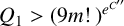 $Q_1> (9m!)^{e^{C"}}$
. Therefore,
 $$ \begin{align*}H(V_h)^{d_h} \geq \{ e^{d_1 + \cdots + d_l}H(F)\}^{(N-1) (3l^2 / \theta)^l}\end{align*} $$
and so
 $l, N, \theta , d_1, \ldots , d_l, F, V_1, \ldots , V_l$
satisfy the conditions of Lemma 5.1. For
 ${h = 1, \ldots , l,}$
choose a linearly independent set of vectors
 $$ \begin{align*}\{g_{h1}, \ldots, g_{hN-1}\}\end{align*} $$
from
 $\Pi (Q_h)$
and let
 $\Gamma _h$
be the grid of size
 $N\theta ^{-1},$
given by
 $$ \begin{align*}\Gamma_h = \{g_{h1}u_1 + \cdots + g_{hN-1}u_{N-1}, u_i \in \mathbb{Z}; \vert u_i \vert \leq N\theta^{-1}\}.\end{align*} $$
By Lemma 5.2, there are
 $x_1 \in \Gamma _1, \ldots , x_l \in \Gamma _l$
such that for
 $x=(x_1, \ldots , x_l)$
, we have
 $\mathrm {Ind}_{x,d}(F) < 2l\theta $
and so
 $$ \begin{align*} f:= F_{\textbf{i}}(x_1, \ldots, x_l) \neq 0 \end{align*} $$
for some
 $\textbf {i} = (i_{11}, \ldots , i_{lN})$
with
 $(\textbf {i}/d)= \mathrm {Ind}_{x,d}(F).$
Since
 $g_{hj} \in \Pi (Q_h)$
, it follows that
 $x_h \in \mathcal {O}_S^N$
for
 $h=1, \ldots , N.$
Further, the fact that
 $ F_{\textbf {i}}$
has coefficients in
 $\mathbb {Z}$
, combined with the product formula yields
 $\prod _{v \in S}^{} \vert f \vert _v \geq 1.$
Now, we show that
 $\prod _{v \in S}^{} \vert f \vert _v < 1.$
Fix
 $v \in S.$
Put
 $u_{hiv} = \overline {l}_{iv}(x_h)$
for
 $h=1, \ldots , l; i=1, \ldots , N.$
Since
 $x_h \in \Gamma _h$
is of size
 $N \theta ^{-1}$
,
 $$ \begin{align} \vert u_{hiv} \vert_v \leq (N^2 \theta^{-1})^{s(v)} Q_h^{\gamma_{iv}} \quad \mbox{for } h=1, \ldots, l; i=1, \ldots, N. \end{align} $$
From Lemma 5.5, we may write
 $$ \begin{align} f = \sum_{\textbf{j}}^{} C(\textbf{i},\textbf{j},v) u_{11v}^{p_{11}} \cdots u_{lNv}^{j_{lN}} \end{align} $$
with
 $$ \begin{align} \max_{k} \bigg| \sum_{h=1}^{l} \frac{j_{hk}}{d_h} - \frac{l}{N} \bigg| < 3lN \theta \quad \mbox{for } C(\textbf{i},\textbf{j},v) \neq 0. \end{align} $$
The number of possibilities of
 $\textbf {j}$
is at most
 $(2^N)^{(d_1 + \cdots + d_l)}$
and we know that
 $d_1 + \cdots + d_l \leq ld_1.$
Thus,
 $$ \begin{align*} \vert f \vert_v &\leq (2^N)^{s(v) (d_1 + \cdots + d_l)} \cdot \max_{\textbf{j}} \vert C(\textbf{i},\textbf{j},v) \vert_v \vert u_{11v}\vert_v^{j_{11}} \cdots \vert u_{lNv}\vert_v^{j_{lN}} \\ &\leq (2^NN^2\theta^{-1})^{s(v) (d_1 + \cdots + d_l)} \max_{\textbf{j}} \vert C(\textbf{i},\textbf{j},v) \vert_v Q_1^{{ \sum_{k}^{} \gamma_{kv} j_{1k}}} \cdots Q_l^{{ \sum_{k}^{} \gamma_{kv}j_{lk}}}, \end{align*} $$
where for the last inequality, we use (5-11). However,
 $$ \begin{align*} &\sum_{h, k} \gamma_{kv} \dfrac{j_{hk}}{d_h} \cdot \dfrac{d_h \log Q_h}{d_1 \log Q_1}\\ &\quad\leq { \sum_{k=1}^{N} [ (\gamma_{kv}-s(v)) + s(v)] \sum_{h=1}^{l} \dfrac{j_{hk}}{d_h} \cdot \dfrac{d_h \log Q_h}{d_1 \log Q_1} }\\ &\quad\leq (1+\theta) \bigg( { \sum_{k=1}^{N} l\gamma_{kv} \bigg( \dfrac{1}{N} - 3N\theta \bigg) + s(v)(3lN^2 \theta - l) + s(v)(l+3lN^2\theta)} \bigg) \\ &\quad\leq l (1+\theta) \bigg(6N^2\theta s(v)+ \bigg(\dfrac{1}{N} - 3N\theta \bigg) { \sum_{k=1}^{N} \gamma_{kv}} \bigg). \end{align*} $$
From the equality
 $$ \begin{align*} Q_h^{{ \sum_{k}^{} \gamma_{kv} j_{hk}}} = Q_1^{({\log Q_h}/{\log Q_1}) { \sum_{k}^{} \gamma_{kv} j_{hk}}} \end{align*} $$
together with (5-12) and (5-13), it follows that
 $$ \begin{align*} \prod_{v \in S}^{} \vert f \vert_v &\leq (2^NN^2\theta^{-1})^{(ld_1)} { \prod_{v \in S} \max_{\textbf{j}} \vert C(i,\textbf{j},v) \vert_v} \cdot Q_1^{ld_1(1+\theta) (6N^2\theta + ({1}/{N} - 3N\theta ) { \sum_{k,v}^{} \gamma_{kv}} )} \\ &\leq (2^{5N+1}N^2\theta^{-1} m! (N!)^{s+1})^{ld_1} \cdot Q_1^ {1.25 ld_1 ( ({\delta^2}/{10N^2})+ ({\delta}/{5N}) - ({\delta}/{N}) )}\\ &\leq (2^{5N+1}N^2\theta^{-1} m! (N!)^{s+1})^{ld_1} \cdot Q_1^ {-3ld_1\delta/5N}\\ &\leq ( 2^{5N+1}N^2\theta^{-1} m! (N!)^{s+1} \cdot Q_1^{- 3\delta/5N} ) ^ {ld_1}\\ &< 1, \end{align*} $$
where for the last inequality, we use the fact that
 $N \leq 2^m$
and
 $Q_1> (9m!)^{e^{2C"}}, \theta = \delta / 30N^3$
and
 ${ \sum _{k,v}^{} \gamma _{kv} \leq - \delta } $
, with
 $\delta = \epsilon /9m^3$
and
 $C" = 2^{11m+34}s^2 \epsilon ^{-4} m^{12}$
. Hence, the proof of Theorem 3.7 is complete.



