


1 Introduction
In his proof of his strengthening of property
 $(T)$
for
 $SL(3,\mathbb {R})$
, Lafforgue used the fact that
 $SO(2)$
-invariant matrix coefficients of unitary representations of
 $SO(3)$
are
 $\frac {1}{2}$
-Hölder continuous outside of some singular points [Reference LafforgueLaf08].
In [Reference DumasDum24a, Reference DumasDum24b], we obtained generalizations of this regularity result for many Lie groups. Given a Lie group G, the aim is to find some compact subgroup K and the largest value of
 $\alpha>0$
such that all K-bi-invariant - and even K-finite - matrix coefficients of unitary representations of G are of class
 $C^\alpha $
.
As explained in [Reference DumasDum24b], a nice context to answer such questions is to assume that
 $(G,K)$
is a Gelfand pair. In that case, obtaining regularity results for K-bi-invariant coefficients reduces to the boundedness of a specific family in Hölder spaces, the family of spherical functions (see Section 2.2).
If M is a Riemannian symmetric space, we can associate a natural Gelfand pair
 $(G,K)$
such that
 $M=G/K$
, which we call a symmetric Gelfand pair (see Section 3.1). If M is simply connected, then M splits as a direct product
 $M=M_+\times M_-\times M_0$
where
 $M_+$
is of compact type (positive curvature),
 $M_-$
is of non-compact type (negative curvature) and
 $M_0$
is a Euclidean space (zero curvature).
Spaces of non-compact type correspond to quotient spaces
 $G/K$
where G is a semisimple Lie group with finite center and K a maximal compact subgroup. The regularity of their coefficients was studied in [Reference DumasDum24a]. Such a space is always simply connected. If U is a compact real form of G, then
 $U/K$
is a symmetric space of compact type, which we call the compact dual of
 $G/K$
. The symmetric pairs
 $(U,K)$
with U compact semisimple were studied in [Reference DumasDum24b] and the results were improved in [Reference DumasDum24a].
The purpose of this note is to study the flat case. As pointed out in [Reference DumasDum24b, Lemma 2.9], in compact and non-compact type there is essentially one connected symmetric Gelfand pair, which represents M. This is far from being true in the Euclidean case. Indeed, consider
 $M=\mathbb {R}^n$
. The group of displacement
 $G(M)$
is
 $\mathbb {R}^n$
itself, and the natural Gelfand pair is
 $(\mathbb {R}^n,\{0\})$
. Then, the spherical functions are just
 $x\mapsto e^{2i\pi \langle x,y\rangle }$
for
 $y\in \mathbb {R}^n$
, which are not bounded in any Hölder space. On the other hand, the group of all automorphisms (of symmetric spaces) of M is
 ${G=\mathbb {R}^n\rtimes GL_n(\mathbb {R})}$
, the group of affine map. For any compact subgroup K of
 $GL_n(\mathbb {R})$
, we obtain a symmetric Gelfand pair
 $(\mathbb {R}^n\rtimes K,K)$
. If, for example,
 $K=SO(n)$
, the group G is called the Euclidean motion group, and the spherical functions of G can be expressed in terms of Bessel functions [Reference VilenkinVil68, Chapter XI]. Thus, the behavior is very different in that case.
We will focus on pairs arising from Cartan motion groups. Let G be a semisimple Lie group with finite center, then there is a Cartan decomposition
 $\mathfrak {g}=\mathfrak {k}\oplus \mathfrak {p},$
where
 $\mathfrak {k}$
is the Lie algebra of a maximal compact subgroup K. Then, K acts on
 $\mathfrak {p}$
, seen as a vector space, by the adjoint representation. Let
 $H=\mathfrak {p}\rtimes K$
. Then,
 $(H,K)$
is a symmetric Gelfand pair and
 $H/K$
is a Euclidean symmetric space. Note that we can thus obtain three natural Gelfand pairs related to G:
 $(G,K)$
is a pair of non-compact type,
 $(U,K)$
is a pair of compact type for U compact real form, and
 $(H,K)$
a flat pair.
Our goal in this article is to find the optimal value
 $(r,\delta )\in \mathbb {N}\times [0,1]$
such that any K-finite matrix coefficient of H belongs to the Hölder space
 $C^{(r,\delta )}(H_r)$
(see Section 2.1 for the precise definition of these Hölder spaces). Here,
 $H_r$
is the dense open subset of regular points of G (see Section 3.3 for the definition).
If
 $\mathfrak {a}$
is a maximal abelian subspace of
 $\mathfrak {p}$
, we can consider the associated root system
 $\Sigma \subset \mathfrak {a}^*$
and a choice of positive roots
 $\Sigma ^+$
(see Section 3.2 for more details, in particular for the definitions of those objects). For
 $\lambda \in \mathfrak {a}^*$
, define
 $$ \begin{align*}n(\lambda)=\sum_{\begin{subarray}{c} \alpha\in \Sigma^+\\ \langle \alpha,\lambda\rangle\neq 0 \end{subarray}} m(\alpha)\end{align*} $$
and set
 $$ \begin{align*} \kappa(G)=\underset{\lambda \in \mathfrak{a}^*\setminus \{0\}}{\inf} \frac{n(\lambda)}{2}.\end{align*} $$
The values of
 $\kappa $
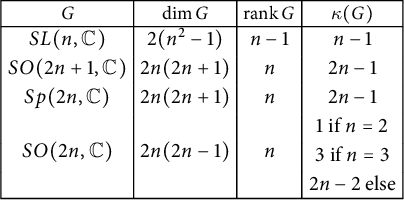
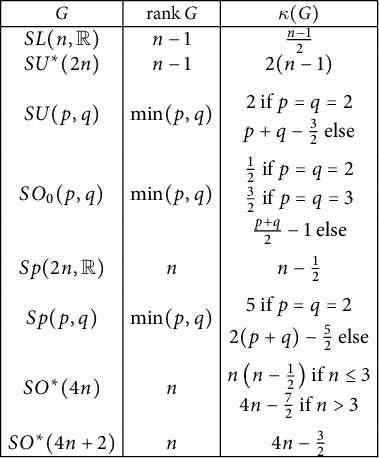
were computed for Lie groups in [Reference DumasDum24a, Appendix A, Tables 1 and 2] (see also Section 3.2, where we reproduce the tables for classical simple Lie groups). For example, in the case of the special linear group,
 $\kappa (SL_n(\mathbb {R}))=\frac {n-1}{2}$
. We also point out that when G has rank
 $1$
, the formula takes the simpler form
 $$ \begin{align*}\kappa(G)=\frac{\dim G/K -1}{2}=\frac{\dim \mathfrak{p}-1}{2}.\end{align*} $$
Our main result is the following.
Theorem A Let G be a connected semisimple Lie group with finite center and
 ${H=\mathfrak {p}\rtimes K}$
its Cartan motion group. Let
 $r=\lfloor \kappa (G)\rfloor $
and
 $\delta =\kappa (G)-r$
. Then, any K-finite matrix coefficient of a unitary representation of H is in
 $C^{(r,\delta )}(H_r)$
. Furthermore, this result is optimal in the sense that for any
 $\delta '>\delta $
, there exists a K-finite (even K-bi-invariant) coefficient, which is not in
 $C^{(r,\delta ')}(H_r)$
.
Comparing with [Reference DumasDum24a, Theorems A and B], the regularity obtained for H on
 $H_r$
is exactly the regularity that was previously obtained for the semisimple group G, and the regularity that was obtained for its compact real form U (only on a small open subset). Thus, all three Gelfand pairs arising from G exhibit a similar behavior in terms of the regularity of their K-finite coefficients.
We first explain how to reduce this question to understanding spherical functions of a Gelfand pair. In Section 2.2, we show that spherical functions dictate the behavior of all K-bi-invariants. In Section 2.3, we prove that this is enough to understand all K-finite coefficients. Such a result was already proved in [Reference DumasDum24b, Section 5] and [Reference DumasDum24a, Section 3.2] in special cases (namely compact and non-compact type). Here, we give a general proof under some assumptions on the existence of a
 $KAK$
decomposition. Section 3 is devoted to preliminaries on Cartan motion groups and their harmonic analysis. We also prove some results on
 $KAK$
decomposition in this context (Section 3.3). Finally, we prove Theorem A in Section 4. To do so, we proceed in a similar manner to [Reference DumasDum24a]. Indeed, spherical functions are expressed as an oscillatory integral, thus we may understand their asymptotics through the stationary phase approximation. The phase functions appearing in these integrals were studied in [Reference Duistermaat, Kolk and VaradarajanDKV83].
2 Reduction to harmonic analysis on a Gelfand pair
2.1 Hölder spaces
Definition 2.1 Let
 $(X,d)$
be a metric space and U open subset of X,
 $(E,\Vert .\Vert )$
a normed vector space,
 $\alpha \in ]0,1]$
. A function
 $f:U\to E$
is
 $\alpha $
-Hölder if for any compact subset K of U, there is
 $C_K>0$
such that
 $\forall x,y\in K$
,
 $\Vert f(x)-f(y)\Vert \leq C_Kd(x,y)^\alpha $
.
If X is also a normed vector space and
 $r\in \mathbb {N}$
, we say that the map f belongs to
 $C^{(r,\alpha )}(U,E)$
if
 $f\in C^r(U,E)$
and the r-th differential
 $D^rf$
is
 $\alpha $
-Hölder as a map from U to the vector space of multilinear r-forms. We extend to
 $\alpha =0$
by
 $C^{(r,0)}(U,E)=C^r(U,E)$
.
For K, a compact subset of U and
 $f\in C^{(r,\alpha )}(U,E)$
, define
 $$ \begin{align*}\Vert f\Vert_{C^{(r,\alpha)}(K,E)}=\max \left\{\underset{k\leq r}{\max}\, \underset{x\in K}{\sup}\Vert D^kf(x)\Vert,\underset{x,y\in K,x\neq y}{\sup}\frac{\Vert D^rf(x)-D^rf(y)\Vert}{d(x,y)^\alpha}\right\}.\end{align*} $$
The family of semi-norms
 $\Vert .\Vert _{C^{(r,\alpha )}(K,E)}$
for K a compact subset of U makes the space
 $C^{(r,\alpha )}(U,E)$
into a Fréchet space.
Finally, if
 $(X,d)$
is a Riemannian manifold, we say that
 $f\in C^{(r,\alpha )}(U,E)$
if for any chart
 $(\varphi ,V)$
of U,
 $f\circ \varphi ^{-1}\in C^{(r,\alpha )}(\varphi (V),E)$
.
Remark 2.1 If U is locally compact, a function
 $f:U\to E$
is
 $\alpha $
-Hölder if and only if for any
 $x\in U$
, there exists a neighborhood
 $U_x$
of x and a constant
 $C_x>0$
such that for any
 $y,z\in U_x$
,
 $\Vert f(y)-f(z)\Vert \leq C_xd(y,z)^\alpha $
.
We will denote
 $C^{(r,\alpha )}(U,\mathbb {C})$
by
 $C^{(r,\alpha )}(U)$
.
The following lemma will be useful throughout the article and can be found in [Reference DumasDum24b, Lemma 2.1]
Lemma 2.2 Let
 $(X,d)$
and
 $(Y,d')$
be two Riemannian manifolds and
 $U,V$
open subsets of
 $X,Y$
, respectively. Let
 $\alpha>0$
and
 $r\in \mathbb {N}$
. Let
 $\varphi :U\to V$
be a function of class
 $C^{\infty }$
. Then,
 $\varphi _*:f\mapsto f\circ \varphi $
maps
 $C^{(r,\alpha )}(V)$
to
 $C^{(r,\alpha )}(U)$
and is continuous.
2.2 Gelfand pairs
Definition 2.2 Let G be a locally compact topological group with a left Haar measure
 $dg$
and K a compact subgroup with normalized Haar measure
 $dk$
. The pair
 $(G,K)$
is a Gelfand pair if the algebra of continuous K-bi-invariant functions on G with compact support is commutative for the convolution.
A spherical function of
 $(G,K)$
is a continuous K-bi-invariant nonzero function on G such that for all
 $x,y\in G$
,
 $$ \begin{align*}\int_K \varphi(xky)\,dk=\varphi(x)\varphi(y).\end{align*} $$
A standard result (see [Reference van DijkvD09, Corollary 6.3.3]) gives a link between spherical functions of
 $(G,K)$
and unitary representations of G.
Proposition 2.3 If
 $(G,K)$
is a Gelfand pair, then for any irreducible unitary representation
 $\pi $
of G on a Hilbert space
 $\mathcal {H}$
, the subspace
 $\mathcal {H}^K$
of K-invariant vectors is of dimension at most
 $1$
.
The positive-definite spherical functions of G are exactly the matrix coefficients
 ${g\mapsto \langle \pi (g)v,v\rangle }$
with
 $\pi $
an irreducible unitary representation of G and v a K-invariant unit vector.
If G is compact, any spherical function is positive-definite.
More details on Gelfand pairs can be found in [Reference van DijkvD09, Chapters 5–7].
Given a Gelfand pair
 $(G,K)$
, it is natural to study spherical functions in order to get results on K-bi-invariant matrix coefficients of unitary representations. Indeed, any matrix coefficient of a unitary representation decomposes into an integral of spherical functions - an infinite sum if G is compact. Then studying the boundedness of positive-definite spherical functions in some Hölder spaces is enough to obtain regularity for all K-bi-invariant matrix coefficients of unitary representations. More precisely, the optimal regularity of such coefficients is exactly the optimal uniform regularity of spherical functions. The proof of the following two lemmas can be found in [Reference DumasDum24b, Section 2.2].
Lemma 2.4 Let
 $(G,K)$
be a Gelfand pair with G second countable. Let
 $\varphi $
be a K-bi-invariant matrix coefficient of a unitary representation
 $\pi $
on an Hilbert space
 $\mathcal {H}$
. Then, there exists a standard Borel space X and a
 $\sigma $
-finite measure
 $\mu $
on X such that
 $$ \begin{align*}\varphi=\int_X c_x\varphi_x d\mu(x)\end{align*} $$
where
 $\varphi _x$
is a positive-definite spherical function of
 $(G,K)$
for any
 $x\in X$
and
 ${c\in L^1(X,\mu )}$
.
Lemma 2.5 Let
 $(G,K)$
be a Gelfand pair with G a Lie group endowed with a Riemannian metric d and U any open subset of G. Let
 $(\varphi _\lambda )_{\lambda \in \Lambda }$
be the the family of positive-definite spherical functions of
 $(G,K)$
. Then,
 $(\varphi _\lambda )_{\lambda \in \Lambda }$
is bounded in
 $C^{(r,\delta )}(U)$
if and only if any K-bi-invariant matrix coefficient of a unitary representation of G is in
 $C^{(r,\delta )}(U)$
.
2.3 From K-bi-invariant to K-finite coefficients
Let G be a Lie group and K a compact subgroup of G.
Definition 2.3 Let
 $\pi $
be a unitary representation of G on
 $\mathcal {H}$
and
 $(\rho ,V)$
a representation of K. We say that
 $\xi \in \mathcal {H}$
is
-
• K-finite if
 $\operatorname {\mathrm {span}}(\pi (K)\xi )$
is finite dimensional,
-
• of K-type V if
$\operatorname {\mathrm {span}}(\pi (K)\xi )\simeq V$
as a representation of K.


Note that this definition of K-type V is not standard.
The aim of this subsection is to prove that a regularity result on the space of all K-bi-invariant coefficients of G imply that the same regularity holds for all K-finite coefficients of G. This was done in [Reference DumasDum24b, Section 5] for compact symmetric pairs, and then extended in [Reference DumasDum24a, Section 3.2] in the non-compact case. We here give a unified proof that holds under some mild assumptions on the pair
 $(G,K)$
.
The first step is a lemma, which first appeared in [Reference de Laat, Mimura and de la SalledLMdlS16, Lemma 2.2] and was extended in [Reference DumasDum24a, Lemma 3.6]. Let
 $U=K\times K$
. Let
 $(\rho ,E)$
be a finite-dimensional unitary representation of U. For
 $g\in G$
, let
 $U_g$
be the stabilizer of g under the action of U by left-right multiplication, that is,
 $$ \begin{align*}U_g=\{(k_1,k_2)\in U\vert\ k_1gk_2^{-1}=g\}.\end{align*} $$
Let
 $E_g=E^{U_g}$
be the subspace of vectors fixed by
 $U_g$
, and
 $P_g:E\to E_g$
the orthogonal projection.
Lemma 2.6 For any
 $g_0\in G$
, there exists a smooth function
 $\psi :G\to B(E)$
such that
-
(1)
$\forall u\in U,g\in G$
,
$\psi (u.g)=\psi (g)\circ \rho (u)^{-1}$
, -
(2)
$\forall v_1,v_2\in E$
,
$g\mapsto \langle \psi (g)v_1,v_2\rangle $
is a matrix coefficient of a unitary representation of G, -
(3)
$\psi (g_0)=P_{g_0}$
.


With this lemma in hand, we can now prove regularity for K-invariant coefficients. However, although Lemma 2.6 holds without assumption, we need to assume that the pair
 $(G,K)$
has some sort of a
 $KAK$
decomposition to carry on - in the spirit of the well-known
 $KAK$
decomposition of semisimple Lie groups.
Definition 2.4 Let G be a Lie group and K a compact subgroup of G. Let
 $G_r$
be an open subset of G which is invariant by multiplication on the left and right by elements of K. We say that
 $(G_r,K)$
has a well-behaved
 $KAK$
decomposition if there exists a submanifold
 $A_r$
of G and a subgroup M of K such that:
-
• for any
$g\in G_r$
, there exists a unique
$a(g)\in A_r$
such that
$g\in Ka(g)K$
; -
• the map
$a:G_r\to A_r$
is smooth; -
• the stabilizer of
$a\in A_r$
under the left-right multiplication action of K is
${\Delta (M)=\{(k,k) \vert \ k\in M \}}$
and thus independent of a; -
• for any
$x\in G_r$
, there exists a neighborhood
$O_x$
and a choice of
$g\mapsto k_i(g)$
defined on
$O_x$
,
$i=1,2$
such that
$k_i$
is smooth and for any
$g\in O_x$
,
$g=k_1(g)a(g)k_2(g)^{-1}.$


The existence of a
 $KAK$
decomposition of a semisimple Lie group is well-known, and it is proven in [Reference DumasDum24a, Proposition 3.3] that it is well-behaved on a specific dense open subset. A similar result holds for compact semisimple Lie groups [Reference DumasDum24b, Proposition 5.8] and we will show this for Cartan motion groups in Section 3.3.
Let
 $\pi $
be a unitary representation of G on
 $\mathcal {H}$
and
 $\xi ,\eta \in \mathcal {H}$
of K-type
 $V,W$
, respectively, for
 $V,W$
irreducible representations of K. Denote
 $V_\xi =\operatorname {\mathrm {span}}(\pi (K)\xi )$
. Then, there is an isomorphism
 $i_\xi :V\to V_\xi \subset \mathcal {H}$
, denote
 $\xi _0=i_\xi ^{-1}(\xi )$
. Similarly, define
 $V_\eta $
,
 $i_\eta $
, and
 $\eta _0$
. Then, the map

is
 $K\times K$
equivariant.
For the associated matrix coefficient, we have
 $$ \begin{align*}\varphi(g)=\langle\pi(g)\xi,\eta\rangle=\langle f(\pi(g))\xi_0,\eta_0\rangle.\end{align*} $$
Now denote
 $(\rho ,E)$
the irreducible representation of
 $U=K\times K$
on
 $V^*\otimes W$
. The U-equivariance of f means that for any
 $(k,k')\in U$
and
 $A\in B(\mathcal {H})$
, we have
 $$ \begin{align}f(\pi(k)A\pi(k')^{-1})=\rho(k,k')(f(A)).\end{align} $$
Furthermore, there are
 $v_1,\ldots ,v_n\in E$
and
 $\xi _1,\ldots ,\xi _n,\eta _1,\ldots ,\eta _n\in \mathcal {H}$
such that
 $$ \begin{align}f(A)=\sum_{i=1}^n \langle A\xi_i,\eta_i\rangle v_i.\end{align} $$
Proposition 2.7 Let
 $G_r$
be an open subset of G such that
 $(G_r,K)$
has a well-behaved
 $KAK$
-decomposition. Assume that any K-bi-invariant matrix coefficient
 $\varphi $
of a unitary representation of G is in
 $C^{(r,\delta )}(G_r)$
, then the map
 $f\circ \pi $
is in
 $C^{(r,\delta )}(G_r,E)$
.
Proof Let
 $g_0\in G_r$
and
 $\psi $
given by Lemma 2.6 for the representation
 $(\rho ,E)$
. Let
 . By (2.2) and
 $(1)$
of Lemma 2.6, we have

so  is a K-bi-invariant map.
Let
 $(e_1,\ldots ,e_d)$
be an orthonormal basis of E, by
 $(2)$
of Lemma 2.6, there are
 $(\pi _{ij},\mathcal {H}_{ij})$
unitary representations of G and
 $a_{ij},b_{ij}\in \mathcal {H}_{ij}$
such that
 $$ \begin{align*}\langle\psi(g)v_i,e_j\rangle=\langle\pi_{ij}(g)a_{ij},b_{ij}\rangle\end{align*} $$
so
 $\psi (g)v_i=\sum _{j=1}^d \langle \pi _{ij}(g)a_{ij},b_{ij}\rangle e_j$
and finally with (2.3),

Hence,  is a sum of K-bi-invariant matrix coefficients of unitary representations of G, so by the hypothesis,
 .
Since
 $(G_r,K)$
has a well-behaved
 $KAK$
decomposition, consider
 $A_r,M$
from Definition 2.4. Then, for any
 $a\in A_r$
,
 $U_a=\Delta (M)$
. Thus,
 $E_a=E_0$
is independent of
 ${a\in A_r}$
. If
 $g=(k_1,k_2).a=k_1ak_2^{-1}$
, we have
 $(k,k')\in U_g$
if and only if
 $(k_1^{-1}kk_1,k_2^{-1}k'k_2)\in \Delta (M)$
and so
 $E_g=\rho (k_1,k_2)E_0$
.
Let
 $g_0=k_0a_0k_0^{'-1}$
and
 $E_1=E_{g_0}$
. Since
 $\psi (g_0)=P_{g_0}$
, there is an orthonormal basis adapted to
 $E_1$
such that
 $$ \begin{align*}\psi(g_0)=\begin{pmatrix}\operatorname{\mathrm{Id}}&0\\0&0\end{pmatrix}.\end{align*} $$
Furthermore, since
 $\psi $
is smooth, there is
 $A_{g_0}$
neighborhood of
 $g_0$
such that
 $$ \begin{align*}\psi(g)=\begin{pmatrix}A(g)&*\\ *&*\end{pmatrix}\end{align*} $$
with
 $g\mapsto A(g)$
smooth,
 $A(g)$
invertible for any
 $g\in A_{g_0}$
. Up to restricting
 $A_{g_0}$
, by assumption on
 $(G_r,K)$
, we have
 $g=k_1(g)a(g)k_2(g)^{-1}$
with
 $k_1,k_2$
smooth on
 $A_{g_0}$
.
By (2.4), for any
 $g\in A_{g_0}$
, we have

But then,
 $f(\pi (k_0a(g)k_0^{'-1}))\in E_{k_0a(g)k_0^{'-1}}=\rho (k_0,k_0')E_0=E_1$
. Set
 $$ \begin{align*}\Phi(g)=\rho(k_1(g)k_0^{-1},k_2(g)k_0^{'-1})\begin{pmatrix} A(k_0a(g)k_0^{'-1})^{-1} & 0\\0&0 \end{pmatrix}.\end{align*} $$
It is a smooth map on
 $A_{g_0}$
because A is smooth invertible,
 $k_1,k_2$
are smooth, and
 $\rho $
is a finite-dimensional representation of U thus smooth. Since
 $f(\pi (k_0a(g)k_0^{'-1}))\in E_1$
, we have

Now let
 $B:B(V)\times V\to V$
be the bilinear map sending
 $(u,v)$
to
 $u(v)$
. We showed that on
 $A_{g_0}$
,
 . Since
 $\Phi $
is smooth on
 $A_{g_0}$
and
 , we get by Leibniz’s formula that
 $f\circ g\in C^{(r,\delta )}(A_{g_0},E)$
.
So for any
 $g_0\in G_r$
, there exists a neighborhood
 $A_{g_0}$
such that
 $$ \begin{align*}f\circ \pi \in C^{(r,\delta)}(A_{g_0},E).\end{align*} $$
Thus,
 $f\circ \pi \in C^{(r,\delta )}(G_r,E)$
.
Theorem 2.8 Let G be a Lie group,
 $G_r$
be an open subset of G, and K a compact subgroup of G such that
 $(G_r,K)$
has a well-behaved
 $KAK$
-decomposition. The optimal regularity of K-bi-invariant matrix coefficient of unitary representations of G on
 $G_r$
is equal to the optimal regularity of K-finite matrix coefficients of unitary representations of G on
 $G_r$
.
Proof One inequality is trivial since K-bi-invariant coefficients are K-finite.
For the other inequality, let
 $(r,\delta )$
such that any K-bi-invariant matrix coefficient of unitary representations G is in
 $C^{(r,\delta )}(G_r)$
. Let
 $\varphi :g\mapsto \langle \pi (g)\xi ,\eta \rangle $
be a K-finite matrix coefficient of a unitary representation.
If
 $\xi ,\eta $
are of K-type
 $V,W$
, respectively, with
 $V,W$
irreducible representations of K, we showed that
 $\varphi (g)=\langle \pi (g)\xi ,\eta \rangle =\langle f(\pi (g))\xi _0,\eta _0\rangle $
and in Proposition 2.7 that
 $f\circ \pi \in C^{(r,\delta )}(G_r)$
, thus
 $\varphi \in C^{(r,\delta )}(G_r)$
.
For the general case, if
 $\xi ,\eta $
are K-finite,
 $V_\xi ,V_\eta $
are finite-dimensional representations of K, so they decompose into a finite number of irreducible representations. Thus,
 $\varphi $
is a finite sum of matrix coefficients of the previous case, so
 ${\varphi \in C^{(r,\delta )}(G_r)}$
.
3 Cartan motion groups
3.1 Flat symmetric spaces and Gelfand pairs
Definition 3.1 A symmetric space is a smooth manifold M together with a smooth map
 $\mu :M\times M\to M$
, denoted
 $\mu (x,y)=x\cdot y$
, which verifies the following properties:
-
(1)
$\forall x\in M$
,
$x\cdot x=x$
; -
(2)
$\forall x,y\in M$
,
$x\cdot (x\cdot y)= y$
; -
(3)
$\forall x,y,z\in M$
,
$x\cdot (y\cdot z)=(x\cdot y)\cdot (x\cdot z)$
; -
(4)
$\forall x\in M$
, there is a neighborhood
$U\subset M$
of x such that if
$y\in U$
,
${x\cdot y=y \Rightarrow x=y}$
.


Let G be a connected Lie group,
 $\sigma $
an involutive automorphism of G, and
 $G^\sigma $
the subgroup of fixed points of
 $\sigma $
. If K is a subgroup of G such that
 $(G^\sigma )_0\subset K\subset G^\sigma $
, then the quotient space
 $M=G/K$
carries a natural structure of a symmetric space with
 $xK\cdot yK=x\sigma (x)^{-1}\sigma (y)K$
[Reference LoosLoo69a]. When K is compact,
 $(G,K)$
is a Gelfand pair, which we call a symmetric Gelfand pair, and M is Riemannian.
Conversely, given a Riemannian symmetric space M and
 $o\in M$
, there exists a canonical connected Lie group
 $G(M)$
called the group of displacements of M, which is a subgroup of the group
 $\mathrm {Aut}(M)$
of all automorphisms of the symmetric space of M. Let
 $K(M)$
be the isotropy group of o which is compact, then
 $(G(M),K(M))$
is a symmetric pair and
 $M\simeq G(M)/K(M)$
as a symmetric space.
If M is a simply connected symmetric space, there are
 $M_0,M_c,M_{nc}$
, respectively, Euclidean, of compact type and of non-compact type, such that
 $M=M_0\times M_c\times M_{nc}$
. We say that M is semisimple if
 $G(M)$
is a semisimple Lie group.
The following lemma can be found in [Reference DumasDum24b, Lemma 2.9].
Lemma 3.1 Let
 $(G,K)$
be a symmetric pair and
 $M=G/K$
the associated symmetric space. If M is semisimple, then there is a bijection between spherical functions of
 $(G,K)$
and spherical functions of
 $(G(M),K(M))$
, such that the image of
 $\varphi $
induces the same function as
 $\varphi $
on M.
This lemma essentially means that when M is semisimple, the behavior of spherical functions (and thus, the regularity of K-bi-invariant matrix coefficients of G) does not depend on the choice of a symmetric pair representing M.
When M is of compact or non-compact type, then M is semisimple. The associated pairs were studied in [Reference DumasDum24a, Reference DumasDum24b]. On the other hand, for a Euclidean symmetric space, there is a variety of pairs representing the space that exhibit different behaviors.
Let
 $n\in \mathbb {N}$
, and consider
 $M=\mathbb {R}^n$
. Then
 $G(M)=\mathbb {R}^n$
and
 $\operatorname {\mathrm {Aut}}(M)=\mathbb {R}^n \rtimes GL_n(\mathbb {R})$
. Let K be a compact subgroup of
 $GL_n(\mathbb {R})$
and
 $H=\mathbb {R}^n \rtimes K$
, then
 $(H,K)$
is a symmetric Gelfand pair (with the involution
 $\sigma (x,g)=(-x,g)$
for any
 $(x,g)\in H$
). Clearly, when K is the trivial group, there exist coefficients of unitary representations of
 $\mathbb {R}^n$
that are continuous, but not Hölder continuous (for any exponent). However, it is interesting to ask what happens when K is nontrivial.
3.2 Cartan motion groups
Let G be a connected real semisimple Lie group with finite center and
 $\mathfrak {g}$
its Lie algebra. Let
 $\theta $
be a Cartan involution of
 $\mathfrak {g}$
and
 $\mathfrak {g}=\mathfrak {k}\oplus \mathfrak {p}$
be the decomposition of
 $\mathfrak {g}$
in
 $\pm 1$
-eigenspaces of
 $\theta $
. Then
 $K=\exp \mathfrak {k}$
is a maximal compact subgroup of G. The subspace
 $\mathfrak {p}$
is stable by
 $\operatorname {\mathrm {Ad}}(k)$
for each
 $k\in K$
, thus we can define the semi-direct product
 $H=\mathfrak {p}\rtimes K$
, called the Cartan motion group associated with G. As explained in Section 3.1,
 $(H,K)$
is a symmetric Gelfand pair and
 $H/K$
is isomorphic to the Euclidean symmetric space
 $\mathfrak {p}$
.
Consider
 $\mathfrak {a}$
a maximal abelian subspace of
 $\mathfrak {p}$
. Let
 $\ell =\operatorname {\mathrm {rank}} G=\dim \mathfrak {a}$
. For
 $\alpha \in \mathfrak {a}^*$
, define
 $\mathfrak {g}_\alpha =\{X\in \mathfrak {g}\vert \forall H\in \mathfrak {a}, [H,X]=\alpha (H)X\}$
the root space associated with
 $\alpha $
. Let
 $m(\alpha )=\dim (\mathfrak {g}_\alpha )$
and
 $\Sigma =\{\alpha \neq 0 \vert m(\alpha )\geq 1\}$
be the set of roots. We say that
 $\Sigma $
is the restricted root system of G. Let
 $\mathfrak {m}=\mathfrak {g}_0\cap \mathfrak {k}$
. Then, the Lie algebra of G decomposes as
 $$ \begin{align*}\mathfrak{g}=\mathfrak{m}\oplus \mathfrak{a}\oplus \bigoplus_{\alpha\in \Sigma} \mathfrak{g}_\alpha.\end{align*} $$
The Killing form of
 $\mathfrak {g}$
induces an inner product on
 $\mathfrak {a}$
, denoted
 $\langle \cdot ,\cdot \rangle $
. Then, for
 ${\lambda \in \mathfrak {a}^*}$
, there is a unique
 $H_\lambda \in \mathfrak {a}$
such that for any
 $H\in \mathfrak {a}$
,
 $\lambda (H)=\langle H_\lambda ,H\rangle $
. We use the isomorphism
 $\lambda \mapsto H_\lambda $
to define an inner product on
 $\mathfrak {a}^*$
by
 $$ \begin{align*}\langle \lambda,\mu\rangle=\langle H_\lambda,H_\mu\rangle.\end{align*} $$
Let W be the Weyl group of the root system
 $\Sigma $
, which is the subgroup of
 $O(\mathfrak {a}^*)$
generated by the reflections
 $s_\alpha :x\mapsto x-\frac {2\langle x,\alpha \rangle }{\langle \alpha ,\alpha \rangle }\alpha $
. The group W also acts on
 $\mathfrak {a}$
by
 $wH_{\lambda }=H_{w\lambda }$
and is isomorphic to
 $N_K(\mathfrak {a})/Z_K(\mathfrak {a})$
[Reference KnappKna02, Theorem 6.57]. By [Reference VaradarajanVar13, Theorem 4.3.24], this action can be extended to automorphisms of the Lie algebra
 $\mathfrak {g}$
. In particular, we get that
 $\mathfrak {g}^{w\alpha }=w(\mathfrak {g}^\alpha )$
and so
 $m(w\alpha )=m(\alpha )$
. The hyperplanes
 ${\{\alpha (H)=0\}}$
divide
 $\mathfrak {a}$
into
 $\vert W\vert $
connected components. We choose one, which we denote
 $\mathfrak {a}^+$
and call the positive Weyl chamber, and we define the positive roots
 $\Sigma ^+=\{\alpha \in \Sigma \vert \forall H\in \mathfrak {a}^+,\alpha (H)>0\}$
. Then
 $\Sigma =\Sigma ^+ \cup (-\Sigma ^+)$
. We say that
 $\alpha \in \Sigma ^+$
is simple if it cannot be decomposed as
 $\alpha =\beta +\gamma $
with
 $\beta ,\gamma \in \Sigma ^+$
. Let
 $\Delta $
be the set of simple roots. Then
 $\Delta $
is a basis of
 $\mathfrak {a}^*$
, and we can write
 $\Delta =\{\alpha _1,\ldots ,\alpha _\ell \}$
. Given
 $\alpha \in \Sigma ^+$
,
 $\alpha =\sum _{i=1}^\ell n_i(\alpha )\alpha $
with
 $n_i(\alpha )\in \mathbb {N}$
. Furthermore, the group W is generated by the reflections
 $\{s_\alpha \}_{\alpha \in \Delta }$
[Reference BourbakiBou07, Chapter VI, Theorem 2]. For any
 $\alpha \in \Delta $
, the reflection
 $s_\alpha $
permutes the positive roots that are not proportional to
 $\alpha $
[Reference BourbakiBou07, Chapter VI, Proposition 17].
For
 $\lambda \in \mathfrak {a}^*$
, define
 $$ \begin{align}n(\lambda)=\sum_{\begin{subarray}{c} \alpha\in \Sigma^+\\ \langle \alpha,\lambda\rangle\neq 0 \end{subarray}} m(\alpha)\end{align} $$
and set
 $$ \begin{align} \kappa(G)=\underset{\lambda \in \mathfrak{a}^*\setminus \{0\}}{\inf} \frac{n(\lambda)}{2}=\frac{1}{2}\underset{1\leq i \leq \ell}{\min}\underset{\begin{subarray}{c} \alpha\in \Sigma^+\\n_i(\alpha)\geq 1 \end{subarray}}{\sum} m(\alpha).\end{align} $$
The values of
 $\kappa $
can be found in [Reference DumasDum24a, Appendix A]. The values of
 $\kappa $
when G is a classical simple Lie group are reproduced here in Tables 1 and 2. It is also proven in [Reference DumasDum24a] that
 $\kappa (G)$
is the optimal regularity of K-finite matrix coefficients of G.
Values of
 $\kappa (G)$
for complex simple Lie groups.

Values of
 $\kappa (G)$
for real simple Lie groups.

Proposition 3.2 [Reference GindikinGin67]
The positive-definite spherical functions of
 $(H,K)$
are
 $$ \begin{align*}\varphi_\lambda:X\mapsto \int_K e^{i\lambda(\operatorname{\mathrm{Ad}}(k)X)}dk\end{align*} $$
for
 $\lambda \in \mathfrak {a}^*$
.
The Killing form induces a scalar product
 $\langle \cdot ,\cdot \rangle $
on
 $\mathfrak {p}$
and its subspace
 $\mathfrak {a}$
. Then for
 $\lambda \in \mathfrak {a}^*$
, there exists
 $H_\lambda \in \mathfrak {a}$
such that
 $\lambda (X)=\langle X,H_\lambda \rangle $
. Furthermore, for any
 $k\in K$
, we have
 $$ \begin{align*}\langle \operatorname{\mathrm{Ad}}(k)X,Y\rangle=\langle X,\operatorname{\mathrm{Ad}}(k^{-1})Y\rangle.\end{align*} $$
Since K is compact, we may use the change of variable
 $k\leftrightarrow k^{-1}$
to obtain the following expression for the spherical functions:
 $$ \begin{align} \varphi_\lambda(X) = \int_K e^{i\langle X,\operatorname{\mathrm{Ad}}(k)H_\lambda\rangle }dk. \end{align} $$
Remark 3.3 When
 $G=SO_0(n,1)$
,
 $K=SO(n)$
acts on
 $\mathfrak {p}\simeq \mathbb {R}^n$
by its usual action. Thus, the Cartan motion group associated with G is the Euclidean motion group. In this case, the spherical functions are Bessel functions [Reference VilenkinVil68, Chapter XI].
The integral formula in Proposition 3.2 is a generalization of the integral formula for Bessel functions.
3.3 KAK decomposition
In this section, we prove the existence of a well-behaved
 $KAK$
decomposition for Cartan motion groups, to apply results from Section 2.3.
The following proposition is a consequence of well-known results in the theory of semisimple Lie groups, which are essentially the ingredients used for the
 $KAK$
decomposition at the level of the semisimple group G itself.
Proposition 3.4 Let
 $g\in H=\mathfrak {p}\rtimes K$
. Then there exists a unique
 $a\in \overline {\mathfrak {a}^+}$
and such that
 $g\in K(a,\operatorname {\mathrm {Id}})K$
. Furthermore, if
 $k_1,k_2$
are such that
 $$ \begin{align*}g=(0,k_1)(a,\operatorname{\mathrm{Id}})(0,k_2^{-1})\end{align*} $$
and if
 $a\in \mathfrak {a}^+$
then
 $k_1$
is unique up to multiplication on the right by an element of
 ${M=Z_K(\mathfrak {a})}$
.
Proof Let
 $g=(x,k)$
. Since
 $(0,k_1)(a,\operatorname {\mathrm {Id}})(0,k_2^{-1})=(\operatorname {\mathrm {Ad}}(k_1)(a),k_1k_2^{-1})$
, it suffices to show that for any
 $x\in \mathfrak {p}$
, there exists a unique
 $a\in \overline {\mathfrak {a}^+}$
such that
 $x\in \operatorname {\mathrm {Ad}}(K)a$
.
Existence. Since all maximal abelian subspaces of
 $\mathfrak {p}$
are conjugated under K, we have
 $\mathfrak {p}=\bigcup \operatorname {\mathrm {Ad}}(k)\mathfrak {a}$
[Reference KnappKna02, Theorem 6.51]. Thus, there exist
 $a_0\in \mathfrak {a}$
and
 $k_0\in K$
such that
 $x=\operatorname {\mathrm {Ad}}(k_0)a_0$
. Then, by the theory of root systems, there exists
 $a\in \overline {\mathfrak {a}^+}$
the closure of the positive Weyl chamber and
 $w\in W$
such that
 $w.a=a_0$
[Reference HallHal03, Proposition 8.29]. Since
 $W=N_K(\mathfrak {a})/Z_K(\mathfrak {a})$
, w is represented by
 $k_w\in K$
and
 $x=\operatorname {\mathrm {Ad}}(k_0k_w)a$
.
Uniqueness. Assume that
 $x=\operatorname {\mathrm {Ad}}(k)a=\operatorname {\mathrm {Ad}}(k')a'$
for
 $k,k'\in K$
and
 $a,a'\in \overline {\mathfrak {a}^+}$
. Then
 $a,a'$
are conjugated under K thus by [Reference KnappKna02, Lemma 7.38],
 $a,a'$
are conjugated under
 $N_K(\mathfrak {a})$
. So there is
 $w\in W$
such that
 $w.a=a'$
, hence by [Reference HallHal03, Proposition 8.25],
 $a=a'$
.
Finally, the element k such that
 $x=\operatorname {\mathrm {Ad}}(k)a$
is unique up to multiplication on the right by an element of
 $Z_K(a)$
. When
 $a\in \mathfrak {a}^+$
,
 $Z_K(a)=M=Z_K(\mathfrak {a})$
.
By Proposition 3.4, we may define
 $P:H\to \overline {\mathfrak {a}^+}$
such that
 $P(g)$
is the only element of
 $\mathfrak {a}^+$
such that
 $g\in K(P(g),\operatorname {\mathrm {Id}})K$
. Set
 $$ \begin{align*}H_r=\{g\in H \vert \ P(g)\in \mathfrak{a}^+\},\end{align*} $$
this is a dense open subset of H that we call the set of regular points of H. We now want to study the regularity of the decomposition.
Lemma 3.5 The map

is a submersion.
Proof If
 $k\in K$
, denote
 $L_k$
and
 $R_k$
the translations by k on the left and right, respectively. Let
 $m:G\times K\to K$
be the multiplication map, its differential at
 $(a,b)$
is

We can identify
 $T_kK$
with
 $\mathfrak {k}$
by the isomorphism
 $T_eL_k$
. Under this identification, we have
 $\forall g,h\in K$
,
 $T_hL_g=\operatorname {\mathrm {Id}}$
and
 $T_hR_g=\operatorname {\mathrm {Ad}}(g^{-1})$
, so that the tangent map becomes
 $T_{(a,b)}m(X_a,X_b)=\operatorname {\mathrm {Ad}}(b^{-1})(X_a)+X_b$
. Thus, by the chain rule, we have

We know that
 $\operatorname {\mathrm {Ad}}(k)$
is an isomorphism of
 $\mathfrak {p}$
. Thus, the map
 $T_{(k_1,k_2,H)}q$
is surjective if and only if

is surjective. For
 $\alpha \in \Sigma ^+$
, let
 $\mathfrak {k}^\alpha =\mathfrak {k}\cap (\mathfrak {g}^\alpha \oplus \mathfrak {g}^{-\alpha })$
and
 $\mathfrak {p}^\alpha =\mathfrak {p}\cap (\mathfrak {g}^\alpha \oplus \mathfrak {g}^{-\alpha })$
. From [Reference LoosLoo69b, Chapter VI, Proposition 1.4], we get
 $$ \begin{align*}\mathfrak{k}=\mathfrak{m}\oplus \bigoplus_{\alpha\in \Sigma^+} \mathfrak{k}^\alpha=\mathfrak{m}\oplus \mathfrak{l},\end{align*} $$
 $$ \begin{align*}\mathfrak{p}=\mathfrak{a}\oplus \bigoplus_{\alpha\in \Sigma^+} \mathfrak{p}^\alpha=\mathfrak{a}\oplus \mathfrak{b}.\end{align*} $$
We also get that for
 $\alpha \in \Sigma ^+$
, there exists
 $Z_{\alpha ,1},\ldots ,Z_{\alpha ,m(\alpha )}$
basis of
 $\mathfrak {g^\alpha }$
, such that setting
 $Z_{\alpha ,i}^{+}=Z_{\alpha ,i}+\theta (Z_{\alpha ,i})$
and
 $Z_{\alpha ,i}^-=Z_{\alpha ,i}-\theta (Z_{\alpha ,i})$
,
 $\{Z_{\alpha ,i}^{+}\}$
is a basis of
 $\mathfrak {k}_\alpha $
and
 $\{Z_{\alpha ,i}^{-}\}$
is a basis of
 $\mathfrak {p}_\alpha $
. Clearly,
 $\mathfrak {a}\subset \operatorname {\mathrm {Im}} u$
. Furthermore, for
 $\alpha \in \Sigma ^+,1\leq i\leq m(\alpha )$
,
 $$ \begin{align*} u(Z_{\alpha,i}^+,0)&=[Z_{\alpha,i}^+,a]\\ &=[Z_{\alpha,i},a]+[\theta Z_{\alpha,i},a]\\ &=[Z_{\alpha,i},a]+\theta [Z_{\alpha,i},-a]\\ &=-\alpha(a)Z_{\alpha,i}+\alpha(a)\theta Z_{\alpha,i}\\ &=-\alpha(a)Z_{\alpha,i}^-. \end{align*} $$
Since
 $a\in \mathfrak {a}^+$
,
 $\alpha (a)\neq 0$
for all
 $\alpha \in \Sigma ^+$
, thus
 $Z_{\alpha ,i}\in \operatorname {\mathrm {Im}} u$
and u is surjective.
Proposition 3.6 The map
 $P:H_r\to \mathfrak {a}^+$
is smooth on
 $H_r$
. Furthermore, for each
 $g\in H_r$
, there exists a neighborhood
 $U_g$
of g in
 $H_r$
and a choice of
 $g\mapsto k_i(g)$
such that
 $k_i$
is smooth on
 $U_g$
,
 $i=1,2$
and for any
 $g\in U_g$
,
 $$ \begin{align*}g=(0,k_1(g))(P(g),\operatorname{\mathrm{Id}})(0,k_2(g)^{-1}).\end{align*} $$
In particular, Propositions 3.4 and 3.6 imply that
 $(H_r,K)$
has a well-behaved
 $KAK$
decomposition in the sense of Definition 2.4.
Proof Let
 $\Delta (M)=\{(m,m)\vert m\in M\}$
denote the diagonal subgroup of
 $K\times K$
. By Lemma 3.4, the map

is a well-defined smooth bijection between manifolds of the same dimension. Let
 $p:K\times K\to (K\times K)/\Delta (M)$
be the projection. It is a surjective submersion. Let q be the submersion defined in Lemma 3.5, we have
 . Thus, for any
 $(x,a)\in (K\times K)/\Delta (M)\times \mathfrak {a}^+$
, we have
 surjective. But it is a linear map between vector spaces of the same dimension, so it is invertible. Thus, by the local inversion theorem and since
 is bijective,
 is a smooth diffeomorphism.
Let
 $(x,P):G_r\to (K\times K)/\Delta (M)\times \mathfrak {a}^+$
be a smooth inverse. We get that P is a smooth map. From [Reference LeeLee03, Proposition 4.26], since p is a submersion, any
 $(k_1,k_2)\in K\times K$
is in the image of a smooth local section of p. Let
 $g\in H_r$
, since p is surjective,
 $x(g)=p(k_1,k_2)$
. There exists a neighborhood V of
 $x(g)$
and a smooth section
 ${s=(s_1,s_2):V\mapsto K\times K}$
such that
 $s(x(g))=(k_1,k_2)$
. Let
 $U=x^{-1}(V)$
be a neighborhood of g, then
 $k_i=s_i\circ x$
is smooth on U and
 $g=(0,k_1(g))(P(g),\operatorname {\mathrm {Id}})(0,k_2(g)^{-1})$
.
4 Boundedness of spherical functions
Theorem 4.1 Let G be a connected semisimple Lie group with finite center and
 ${H=\mathfrak {p}\rtimes K}$
its Cartan motion group. Let
 $r=\lfloor \kappa (G)\rfloor $
and
 $\delta =\kappa (G)-r$
. Then, the family of positive-definite spherical functions of
 $(H,K)$
is bounded in
 $C^{(r,\delta )}(H_r)$
.
Proof Up to composition with the smooth map P, it suffices to consider the group variable in
 $\mathfrak {a}^+$
. Let
 $\lambda \in \mathfrak {a}^*$
,
 $a\in \mathfrak {a}$
, and
 $t\in \mathbb {R}$
. Let D be the differential operator with respect to the variable a. Denote
 $$ \begin{align*}f(\lambda,a,k,t)=e^{it\langle a,\operatorname{\mathrm{Ad}}(k)H_\lambda\rangle}\in C^\infty(\mathfrak{a}^* \times \mathfrak{a}^+\times K\times \mathbb{R}).\end{align*} $$
Then by induction on s, there is a polynomial
 $P\in C^\infty (\mathfrak {a}^* \times \mathfrak {a}^+\times K\times \mathfrak {a}^s)[t]$
of degree s such that for any
 $X\in \mathfrak {a}^s$
,
 $$ \begin{align*}D^sf(\lambda,a,k,t)(X)=P(t)(\lambda,a,k,X)e^{it\langle a,\operatorname{\mathrm{Ad}}(k)H_\lambda\rangle}.\end{align*} $$
For
 $0\leq j \leq s$
, let
 $g_j(\lambda ,a,X)\in C^\infty (K)$
be defined by
 $$ \begin{align}g_j=\left.\frac{1}{j!} \frac{d^j}{dt^j}\left( (D^sf)e^{-it\langle a,\operatorname{\mathrm{Ad}}(k)H_\lambda\rangle} \right)\right\vert{}_{t=0}.\end{align} $$
Then we have
 $$ \begin{align}D^s\varphi_{t\lambda}(a)(X)=\sum_{j=0}^s t^j \int_K e^{it\langle a,\operatorname{\mathrm{Ad}}(k)H_\lambda\rangle}g_j(\lambda,a,X)(k)dk.\end{align} $$
We want to apply the method of stationary phase to understand the asymptotics of these integrals as
 $t\to \infty $
. Let
 $f_{a,\lambda }:k\mapsto \langle a,\operatorname {\mathrm {Ad}}(k)H_\lambda \rangle $
be the phase function. By [Reference Duistermaat, Kolk and VaradarajanDKV83, Proposition 1.2], the critical set of
 $f_{a,\lambda }$
is
 $\mathcal {C}_\lambda =\bigcup _{w\in W} k_wK_\lambda $
, where
 ${K_\lambda =Z_K(\lambda )}$
and
 $k_w$
is a representative of
 $w\in W$
(since
 $M=Z_K(\mathfrak {a})\subset K_\lambda $
this does not depend on the choice of
 $k_w$
). By [Reference Duistermaat, Kolk and VaradarajanDKV83, Proposition 1.4], the Hessian of
 $f_{a,\lambda }$
at
 $k_wm$
,
 $m\in K_\lambda $
, is diagonal in the basis adapted to the orthogonal decomposition of
 $\mathfrak {p}=\mathfrak {m}\oplus \bigoplus \mathfrak {p}_\alpha $
, where
 $\mathfrak {p}_\alpha =\mathfrak {p}\cap \left (\mathfrak {g}_\alpha \oplus \mathfrak {g}_{-\alpha }\right )$
, with eigenvalues
 $-\alpha (H_\lambda )(w\alpha )(a)$
in each
 $\mathfrak {p}_\alpha $
.
We now proceed as in [Reference Duistermaat, Kolk and VaradarajanDKV83, Proposition 9.2]. Let S be the unit sphere in
 $\mathfrak {a}^*$
and L a compact subset of
 $\mathfrak {a}^+$
. Fix
 $\lambda _0\in S,a_0\in L$
. Let
 $k_0\in \mathcal {C}_{\lambda _0}$
, we can find a chart

around
 $k_0$
such that
 $\psi (k_0)=(0,0)$
and
 $\mathcal {C}_\lambda $
is given in these local coordinate by
 $\{y=0\}$
. Treat
 $f_{a,\lambda }(k)$
as a function of y with parameters
 $a,\lambda ,x$
. Then, f has a unique nondegenarate critical point
 $y=0$
at
 $(a,\lambda ,x)=(a_0,\lambda _0,0)$
. Thus, by [Reference HörmanderHör83, Theorem 7.7.6], there exists a neighborhood
 $U_{a_0}\times U_{\lambda _0}\times U_0$
of
 $(a_0,\lambda _0,0)$
and a continuous seminorm
 $\nu $
on
 $C^\infty (K)$
, such that for any
 $a\in U_{a_0}$
,
 $\lambda \in U_{\lambda _0}$
,
 $x\in U_0$
,
 $g\in C^\infty (K)$
, and
 $t\geq 1$
,
 $$ \begin{align} \left\vert \int_V e^{itf_{a,\lambda}(\psi^{-1}(x,y))}g(\psi^{-1}(x,y))dy \right\vert \leq \nu(g)t^{-n(\lambda_0)/2}\leq \nu(g)t^{-\kappa(G)}. \end{align} $$
By compactness, we may cover
 $L\times S$
by a finite number of open subset
 $U_{a_0}\times U_{L_0}$
so up to changing the seminorm and
 $U_0$
, we may assume (4.3) holds for any
 $a\in L,\lambda \in S$
. Similarly, by compactness, we can cover K by a finite number of open subset of the form
 $U_0\times V$
. Using a smooth partition of unity and summing estimates in (4.3), we obtain a seminorm
 $\nu $
such that for any
 $a\in L$
,
 $\lambda \in S$
,
 $g\in C^\infty (K)$
and
 $t\geq 1$
,
 $$ \begin{align} \left\vert \int_K e^{itf_{a,\lambda}(k)}g(k)dk \right\vert \leq \nu(g)t^{-\kappa(G)}. \end{align} $$
Now if
 $a\in L,\lambda \in S$
and
 $t\leq 1$
, then by (4.2) we get that
 $$ \begin{align} \Vert D^s\varphi_{t\lambda}(a)\Vert \leq \underset{a\in L,\lambda\in S,k\in K\Vert X_i\Vert=1}{\sup} \sum \vert g_j(\lambda,a,X)(k)\vert \leq C_{L,s}, \end{align} $$
where
 $C_{L,s}>0$
depends only on the compact L and the order of differentiation.
On the other hand, for
 $t\geq 1$
, combining (4.2) and (4.4), we obtain
 $$ \begin{align} \begin{aligned} \Vert D^s\varphi_{t\lambda}(a)\Vert & = \underset{\Vert X_i\Vert=1}{\sup} \vert D^s\varphi_{t\lambda}(a)(X)\vert \\ & \leq \underset{\Vert X_i\Vert=1}{\sup}\sum_{j=0}^s t^j \left\vert\int_K e^{itf_{a,\lambda}(k)} g_j(\lambda,a,X)(k)dk\right\vert \\ & \leq \sum_{j=0}^s t^j\underset{\begin{subarray}{c} \Vert X_i\Vert=1\\ a\in L,\lambda\in S \end{subarray}}{\sup}\nu(g_j(\xi,\eta,Y,X))t^{-\kappa(G)}\\ & \leq D_{L,s}t^{s-\kappa(G)}, \end{aligned} \end{align} $$
where
 $D_{L,s}>0$
depends again only on the compact L and the order of differentiation.
Thus, combining (4.5) and (4.6), for any
 $\lambda \in \mathfrak {a}^*$
,
 $a\in L$
,
 $s\leq r$
,
 $$ \begin{align}\Vert D^s\varphi_{\lambda}(a)\Vert \leq \max(C_{L,s},D_{L,s})=M_{L,s}.\end{align} $$
Thus, the differentials of the family of spherical functions are bounded independently on
 $\lambda $
up to order r. If
 $r=\kappa (G)$
, the proof is complete.
Otherwise,
 $\kappa (G)-r=\frac {1}{2}$
. Then, using (4.6) for
 $s=r$
and
 $s=r+1$
, we show that for any
 $x,y\in L$
,
 $\xi \in S$
,
 $\eta \in C$
,
 $t\geq 1$
, we have on the one hand
 $$ \begin{align}\Vert D^r \varphi_{t\lambda}(x)-D^r\varphi_{t\lambda}(y)\Vert \leq \Vert D^r \varphi_{t\lambda}(x)\Vert+\Vert D^r\varphi_{t\lambda}(y)\Vert\leq 2D_{L,r}t^{-1/2}\end{align} $$
and on the other hand, we get by the mean value theorem that
 $$ \begin{align} \Vert D^r \varphi_{t\lambda}(x)-D^r\varphi_{t\lambda}(y)\Vert \leq \left(\underset{a\in L}{\sup}\Vert {D^{r+1}}\varphi_{t\lambda}(a)\Vert\right)\Vert x-y\Vert \leq D_{L,r+1}t^{1/2}\Vert x-y\Vert.\end{align} $$
Thus, combining (4.8) and (4.9) yields
 $$ \begin{align}\Vert D^r \varphi_{t\lambda}(x)-D^r\varphi_{t\lambda}(y)\Vert \leq \left(2D_{L,r}D_{L,r+1}\right)^{1/2}\Vert x-y\Vert^{1/2}.\end{align} $$
Hence, setting
 $M_L=\max \left (\left (2D_{L,r}D_{L,r+1}\right )^{1/2},C_{L,r+1}(\operatorname {\mathrm {diam}} L)^{1/2}\right )$
, we have that for any
 $\lambda \in \mathfrak {a}^*$
,
 $x,y\in L$
,
 $$ \begin{align}\Vert D^r \varphi_{\lambda}(x)-D^r\varphi_\lambda(y)\Vert \leq M_L \Vert x-y\Vert^{\kappa(G)-r}\end{align} $$
We will now show that this result is optimal. We will use the following lemma [Reference DumasDum24a, Lemma 4.5] which essentially states that families of exponential maps are not bounded in Hölder spaces.
Lemma 4.2 Let E be a finite-dimensional real vector space, U an open subset of E such that
 $0\in \overline {U}$
. Let
 $u_1,\ldots ,u_n\in E^*$
distinct and nonzero, and
 $f_1,\ldots ,f_n:E\to \mathbb {C}$
continuous functions such that for any
 $U'$
open subset of U, there is
 $x\in U'$
such that
 $\sum \vert f_j(x)\vert \neq 0$
. Then there exists
 $C>0$
,
 $d>0$
,
 $x\in U$
, and an open set V with
 $0\in \overline {V}$
such that for all
 $y=x+h,h\in V$
,
 $m\in \mathbb {N}$
and
 $N\geq \frac {d}{\Vert h\Vert }$
,
 $$ \begin{align*}\frac{1}{N}\sum_{t=m}^{m+N-1} \left\vert \sum_{j=1}^n f_j(x)e^{itu_j(x)}-f_j(y)e^{itu_{j}(y)} \right\vert{}^2 \geq C.\end{align*} $$
To prove optimality, we will show that a particular subfamily of the whole family of positive-definite spherical functions is already unbounded in the Hölder spaces of higher order.
Theorem 4.3 Let G be a connected semisimple Lie group with finite center and
 ${H=\mathfrak {p}\rtimes K}$
its Cartan motion group. Let
 $r=\lfloor \kappa (G)\rfloor $
and
 $\delta =\kappa (G)-r$
. For any
 ${\delta '>\delta }$
, the family of positive definite spherical functions of
 $(H,K)$
is not bounded in
 $C^{(r,\delta ')}(H_r)$
.
Proof Fix
 $\lambda \in \mathfrak {a}^*$
such that
 $n(\lambda )=2\kappa (G)$
, and such that
 $\langle \alpha ,\lambda \rangle \geq 0$
for any
 $\alpha \in \Sigma ^+$
. It suffices to show that the family
 $\left (\varphi _{t\lambda }\right )_{t\in \mathbb {R}}$
is not bounded in
 $C^{(r,\delta ')}(\mathfrak {a}^+)$
. As in the proof of Theorem 4.1, let
 $f_{a,\lambda }:k\mapsto \langle a,\operatorname {\mathrm {Ad}}(k)H_\lambda \rangle $
be the phase function. Since
 $f_{a,\lambda }$
is right
 $K_\lambda $
-invariant, we may see the integral on the quotient manifold
 $K/K_\lambda $
. More precisely, let
 $d(k_\lambda )$
be the image of the Haar measure on K under the quotient map
 $K\to K/K_\lambda $
, then for all
 $t\geq 1$
,
 $$ \begin{align*}\varphi_{t\lambda}(a)=\int_{K/K_\lambda} e^{itf_{a,\lambda}(k)}d(kK_\lambda).\end{align*} $$
This will simplify the proof, as the critical set of
 $f_{a,\lambda }$
is thus
 $\mathcal {C}=\bigcup _{w\in W}k_wK_\lambda $
a finite set in
 $K/K_\lambda $
. As in (4.2), for any
 $a\in \mathfrak {a}$
,
 $t\geq 1$
,
 $X\in \mathfrak {a}^r$
,
 $$ \begin{align} D^r\varphi_{t\lambda}(a)(X)=\sum_{j=0}^r t^j \int_{K/K_\lambda} e^{itf_{a,\lambda(k)}} g_j(a,X)(k)d(kK_\lambda). \end{align} $$
Let
 $I_j(a,X,t)=\int _K e^{itf_{a,\lambda }}(k) g_j(a,X)(k)d(kK_\lambda )$
. Let
 $W_\lambda $
denote the stabilizer of
 $\lambda $
under the action of the Weyl group W. Let also
 $$ \begin{align*}\Sigma^+(\lambda)=\{\alpha \in \Sigma^+ \vert \langle \alpha,\lambda\rangle\neq 0\}\end{align*} $$
and
 $$ \begin{align*}\sigma_w=-\underset{\alpha\in \Sigma^+(\lambda)\neq 0}{\sum} m(\alpha)\operatorname{sgn}(\langle\alpha,\lambda\rangle)(w\alpha)(Y).\end{align*} $$
Let
 $d_0k$
denote the Riemannian measure on K induced by the bi-invariant metric defined by the Killing form on
 $\mathfrak {k}$
. Let
 $d_0(kK_\mu )$
be the volume measure on
 $K/K_\mu $
associated with the (invariant) Riemannian metric induced by the restriction of the inner product
 $-\langle \cdot ,\cdot \rangle $
on
 $\mathfrak {k}$
. Denote
 $\operatorname {Vol}(K/K_\mu )=\int _{K/K_\mu } d_0(K/K_\mu )$
. By the uniqueness of the invariant measure on
 $K/K_\mu $
, we have
 $d(kK_\mu )=\frac {1}{\operatorname {Vol}(K/K_\mu )}d_0(kK_\mu )$
. For
 $w\in W$
,
 $g\in C^\infty (K/K_\lambda )$
,
 $a\in \mathfrak {a}^+$
, set
 $$ \begin{align} c_{w,a}(g)=e^{i\frac{\pi}{4}\sigma_w} \prod_{\alpha\in \Sigma^{+}(\lambda)}\left\vert\frac{\langle \alpha,\lambda \rangle}{4\pi}\left(w\alpha\right)(a)\right\vert{}^{-\frac{m(\alpha)}{2}} \frac{1}{\operatorname{Vol}(K/K_\lambda)}g(k_wK_\lambda). \end{align} $$
Then, by the stationary phase approximation (see [Reference HörmanderHör83, Theorem 7.7.6] and [Reference DumasDum24a, Theorem 5.5]), for any
 $a\in \mathfrak {a}^+$
, there is a neighborhood
 $U_a$
of a in
 $\mathfrak {a}^+$
and
 $D(a)>0$
such that for any
 $0\leq j\leq r$
,
 $t\geq 1$
,
 $a'\in U_a$
and X with
 $\Vert X_i\Vert =1$
for all i,
 $$ \begin{align} \left\vert I_j(a',X,t) - \sum_{W/W_\lambda} e^{it(w\lambda)(a')}t^{-\kappa(G)}c_{w,a'}(g_j(a',X))\right\vert \leq D(a)t^{-{\kappa(G)}-1}. \end{align} $$
We use the fact that
 $g_j$
is smooth in all variables, hence bounded on compact sets, and that the bound is uniform in the parameter
 $a'$
of the phase function.
The end of the proof relies on Lemma 4.2 and is similar to [Reference DumasDum24a, Theorem 4.4].
Combining (4.12) with (4.14) for
 $0\leq j< r$
, for any a there is a neighborhood
 $V_a$
of a and a constant
 $C(a)$
such that for any
 $t\geq 1$
,
 $a'\in V_a$
and X with
 $\Vert X_i\Vert =1$
,
 $$ \begin{align} \left\vert D^r\varphi_{t\lambda}(a')(X)-t^r I_r(a',X,t) \right\vert \leq C(a)t^{-1}. \end{align} $$
For X fixed with
 $\Vert X_i\Vert =1$
, let
 $S_t(x)=\sum _{W/W_\lambda } e^{it(w\lambda )(x)}c_{w,x}(g_r(x,X))$
. Combining (4.15) and (4.14), if
 $t\geq 1$
, and
 $x,y\in U_a\cap V_a$
,
 $$ \begin{align}\begin{aligned} t^{-\delta}\vert S_t(x)-S_t(y)\vert & \leq t^r\vert t^{-\kappa(G)}S_t(x)-I_r(x,X,t)\vert + t^r\vert I_r(x,X,t)-I_r(y,X,t)\vert \\ &\phantom{\leq}+ t^r\vert I_r(y,X,t)-t^{-\kappa(G)}S_t(y)\vert \\ & \leq 2D(a)t^{-\delta-1}+\vert t^rI_r(x,H,t)-D^r\varphi_{t\lambda}(x)(X) \vert \\ &\phantom{\leq} + \vert D^r\varphi_{t\lambda}(x)(X)-D^r\varphi_{t\lambda}(y)(X) \vert\\ &\phantom{\leq}+\vert D^r\varphi_{t\lambda}(y)(X)-t^rI_r(y,X,t) \vert\\ &\leq 2D(a)t^{-\delta-1}+2C(a)t^{-1} + \vert D^r\varphi_{t\lambda}(x)(X)-D^r\varphi_{t\lambda}(y)(X) \vert\\ & \leq \Vert D^r\varphi_{t\lambda}(x)-D^r\varphi_{t\lambda}(y) \Vert + 2(C(a)+D(a))t^{-1}. \end{aligned}\end{align} $$
Now the functions
 $c_{w,x}(g_r(x,X))$
are all zero at x if and only if
 $g_r(x,X)(k_wK_\lambda )=0$
for all
 $w\in W$
. But
 $$ \begin{align*}g_r(x,X)(kK_\lambda)=\prod_{i=1}^r \langle X_i,\operatorname{\mathrm{Ad}}(k)H_\lambda\rangle.\end{align*} $$
Thus, given any open subset of
 $\mathfrak {a}^+$
, we can choose
 $x,X$
such that
 $g_r(x,X)(e)\neq 0$
. Therefore, the hypotheses of Lemma 4.2 hold for the family of functions
 $f_w:x\mapsto c_{w,x}(g_r(x,X))$
, for
 $U=\mathfrak {a}^+$
. Let
 $C,d,x,V$
be given by Lemma 4.2,
 $W_x=x+V$
such that for any
 $y\in W_x$
,
 $m\in \mathbb {N}$
,
 $N\geq \frac {d}{\Vert x-y\Vert }$
,
 $$ \begin{align} \sum_{t=m}^{m+N-1} \vert S_t(x)-S_t(y)\vert^2 \geq CN. \end{align} $$
From now on, we choose
 $a=x$
given above. Let
 $M=4(C(x)+D(x))^2$
, we get from (4.16) that for any
 $t\geq 1$
,
 $y\in U_x\cap V_x\cap W_x$
,
 $$ \begin{align} \frac{t^{-2\delta}}{2}\vert S_t(x)-S_t(y)\vert^2 \leq \Vert D^r\varphi_{t\lambda}(x)-D^r\varphi_{t\lambda}(y) \Vert^2+ Mt^{-2}. \end{align} $$
Assume now that the family of positive definite spherical functions of
 $(H,K)$
is bounded in
 $C^{(r,\delta ')}(\mathfrak {a}^+)$
for
 $\delta '> \delta $
. In particular, up to reducing
 $U_x\cap V_x\cap W_x$
to a bounded subset of diameter L if necessary, there is
 $D>0$
such that for any
 $y\in U_x\cap V_x\cap W_x$
and
 $t\geq 1$
,
 $$ \begin{align} \Vert D^r\varphi_{t\lambda}(x)-D^r\varphi_{t\lambda}(y) \Vert \leq D\Vert x-y\Vert^{\delta'}. \end{align} $$
For y fixed, set
 $m,N$
such that
 $$ \begin{align}\frac{1}{\Vert x-y\Vert^{\delta'}}\leq m\leq \frac{1}{\Vert x-y\Vert^{\delta'}}+1\end{align} $$
and
 $$ \begin{align}\frac{d}{\Vert x-y\Vert}\leq N\leq \frac{d}{\Vert x-y\Vert}+1.\end{align} $$
Combining (4.17), (4.18), and (4.19) gives
 $$ \begin{align} \begin{aligned}\frac{CN}{2(m+N)^{2\delta}}&\leq\sum_{t=m}^{m+N-1} \frac{t^{-2\delta}}{2} \vert S_t(x)-S_t(y)\vert^2 \\&\leq \sum_{t=m}^{m+N-1} \left(\Vert D^r\varphi_{t\lambda}(x)-D^r\varphi_{t\lambda}(y) \Vert^2+ Mt^{-2}\right)\\ &\leq ND^2\Vert x-y\Vert ^{2\delta'}+\frac{MN}{m^2}.\end{aligned} \end{align} $$
Thus
 $$ \begin{align} \frac{C}{2(m+N)^{2\delta}} \leq D^2\Vert x-y\Vert ^{2\delta'}+\frac{M}{m^2} \leq (D^2+M)\Vert x-y\Vert^{2\delta'} \end{align} $$
by (4.20). But by (4.20) and (4.21), we have
 $$ \begin{align} m+N\leq \frac{d}{\Vert x-y\Vert}+1+\frac{1}{\Vert x-y\Vert^{\delta'}}+1 & \leq \frac{1}{\Vert x-y\Vert}\left(d+2\Vert x-y\Vert +\Vert x-y\Vert^{1-\delta'}\right) \nonumber\\ & \leq \frac{1}{\Vert x-y\Vert}\left(d+2L+L^{1-\delta'}\right). \end{align} $$
Hence, (4.23) becomes
 $$ \begin{align} \frac{C}{2(d+2L+L^{1-\delta'})^{2\delta}}\Vert x-y\Vert^{2\delta}\leq (D^2+M)\Vert x-y\Vert^{2\delta'}. \end{align} $$
Since (4.25) holds for any
 $y\in U_x\cap V_x\cap W_x$
with the constant involved independent from y and
 $\delta '>\delta $
, we get a contradiction as y goes to x (which is possible because
 $0\in \overline {V}$
hence
 $x\in \overline {U_x\cap V_x\cap W_x}$
).
Finally, we can prove the main theorem as a consequence of these results.
Theorem 4.4 Let G be a connected semisimple Lie group with finite center and
 ${H=\mathfrak {p}\rtimes K}$
its Cartan motion group. Let
 $r=\lfloor \kappa (G)\rfloor $
and
 $\delta =\kappa (G)-r$
. Then, any K-finite matrix coefficient of a unitary representation of H is in
 $C^{(r,\delta )}(H_r)$
. Furthermore, this result is optimal in the sense that for any
 $\delta '>\delta $
, there exists a K-finite (even K-bi-invariant) coefficient, which is not in
 $C^{(r,\delta ')}(H_r)$
.
Proof By Propositions 3.4 and 3.6,
 $(H_r,K)$
has a well-behaved
 $KAK$
decomposition. Thus, by Theorem 2.8, it suffices to consider K-bi-invariant matrix coefficients. The result is then an immediate consequence of Lemma 2.5 and Theorems 4.1 and 4.3.
Remark 4.5 Given any compact Lie group and any orthogonal representation
 ${\pi :K\to O(V)}$
on a finite dimensional real vector space V, we can form the semi-direct product
 $H=V\rtimes K$
. In general, there is no reason for H to be the Cartan motion group of a semisimple Lie group. However,
 $(H,K)$
remains a Gelfand pair, so we may ask if we can find the optimal regularity of K-finite matrix coefficients of unitary representations of H. By Mackey’s theory [Reference MackeyMac49], we can still find the irreducible representations of H with a nonzero K-invariant vector and thus compute the positive definite spherical functions. Indeed, K acts on
 $\hat {V}$
the space of characters of V. Given some
 $\chi _\lambda :x\mapsto e^{i\langle \lambda ,x\rangle }\in \hat {V}$
, let
 $K_\lambda =\operatorname {\mathrm {Stab}}(\chi _\lambda )=\operatorname {\mathrm {Stab}} (\lambda )$
and
 $H_\lambda =V\rtimes K_\lambda $
. Then, for any
 $(\rho ,V_\rho )\in \hat {K}_\lambda $
irreducible representation of
 $K_\lambda $
, we may consider the induced representation
 $\mathrm {Ind}_{H_\lambda }^H (\chi _\lambda \otimes \rho )$
acting on
 $L^2(H/H_\lambda ;V_\rho )$
. Mackey’s result is that those representations are irreducible, and that they exhaust the irreducible representations of H. It is not difficult to see that the induced representation has a K-invariant vector if and only if
 $\chi _\lambda \otimes \rho $
has a
 $K_\lambda $
-invariant vector, thus by irreducibility of
 $\rho $
, if and only if
 $\rho $
is the trivial representation. In that case, the one-dimensional space of invariant vectors is the space of constant functions. Thus, the spherical function associated with
 $\mathrm {Ind}_{H_\lambda }^H (\chi _\lambda \otimes 1)$
can be expressed by
 $$ \begin{align*}\varphi_\lambda(v)=\int_K e^{i\langle \lambda,\pi(k)v\rangle}dk\end{align*} $$
with
 $\lambda \in V$
, and
 $\varphi _\lambda =\varphi _{\lambda '}$
if
 $\lambda ,\lambda '$
are in the same K-orbit. So the spherical functions are still oscillatory integrals. However, the lack of semisimple structure makes it difficult to understand the orbits and the critical points of the phase functions.
The simplest case to consider is
 $K=SO(3)$
and
 $\pi $
irreducible. In the case of Cartan motion groups, the representation on
 $\mathfrak {p}$
is irreducible if and only if the ambient semisimple Lie group G is simple. By the classification of simple Lie groups, we see that the only irreducible representations of
 $SO(3)$
, which appear in Cartan motion groups of semisimple Lie groups are the three-dimensional and the five-dimensional representations. Thus, the first case outside the world of Cartan motion groups to consider seems to be the seven-dimensional representation of
 $SO(3)$
on the space
 $V_3$
of harmonic homogeneous polynomials of degree
 $3$
in three variables with real coefficients. In this specific case, we may be able to make the necessary computations without the additional semisimple structure.
Acknowledgments
I am grateful to Alexandre Afgoustidis and Jean-Louis Clerc who pointed out the question of Cartan motion groups to me. I would like to thank my Ph.D. advisor Mikael de la Salle for his involvement.