


Severe violent behavior is almost always the product of transactions between predisposing individual differences (dispositional or socialized) and precipitating situational influences (see, e.g., Anderson & Huesmann, Reference Anderson, Huesmann, Hogg and Cooper2003; Guerra & Huesmann, Reference Guerra and Huesmann2004; Huesmann, Reference Huesmann, Geen and Donnerstein1998). Exposure to violence is one important experience that contributes to predisposing a person to behave more violently in the long run and to precipitating violent behavior in the short run (Huesmann, Eron, & Dubow, Reference Huesmann, Eron and Dubow2003; Huesmann & Kirwil, Reference Huesmann, Kirwil, Flannery, Vazsonyi and Waldman2007). The short-term precipitating effects seem to be due mostly to priming, mimicry, and excitation transfer (Bushman & Huesmann, Reference Bushman and Huesmann2006). The long-term socializing effects include the observational learning of cognitions supporting aggression (aggressive scripts, beliefs, and hostile world schemas; Huesmann & Kirwil, Reference Huesmann, Kirwil, Flannery, Vazsonyi and Waldman2007) as well as long-term changes in emotional reactions to violence (Boxer & Sloan-Power, Reference Boxer and Sloan-Power2013). Consistent with a developmental psychopathology framework (see Cicchetti & Rogosh, Reference Cicchetti and Rogosh1996), a broad literature indicates that the observation of violence exhibits multifinality, with both short- and long-term effects on internalizing problems (e.g., posttraumatic stress) as well as externalizing behavior problems (e.g., aggression).
Numerous empirical studies have demonstrated a link between exposure to interpersonal violence in the media or in the community and the long-term development of habitual aggression (e.g., Anderson et al., Reference Anderson, Berkowitz, Donnerstein, Huesmann, Johnson, Linz and Wartella2003; Guerra, Huesmann, & Spindler, Reference Guerra, Huesmann and Spindler2003; Huesmann, Moise-Titus, Podolski, & Eron, Reference Huesmann, Moise-Titus, Podolski and Eron2003; Lynch & Cicchetti, Reference Lynch and Cicchetti1998; Schwartz & Proctor, Reference Schwartz and Proctor2000). Fewer studies have examined the link between exposure to ethnic–political violence and immediate aggression by those who were exposed (e.g., Barber, Reference Barber2008; Dubow et al., Reference Dubow, Boxer, Huesmann, Shikaki, Landau, Gvirsman and Ginges2010; Kithakye, Morris, Terranova, & Myers, Reference Kithakye, Morris, Terranova and Myers2010; Qouta, Punamäki, & El-Sarraj, Reference Qouta, Punamäki and El-Sarraj2008), and only a handful of studies have examined the relation between exposure to ethnic–political violence and aggression years later (Boxer et al., Reference Boxer, Huesmann, Dubow, Landau, Gvirsman, Shikaki and Ginges2013; Merrilees et al., Reference Merrilees, Cairns, Taylor, Goeke-Morey, Shirlow and Cummings2013; Taylor, Merrilees, Goeke-Morey, Shirlow, & Cummings, Reference Taylor, Merrilees, Goeke-Morey, Shirlow and Cummings2014). The current 3-year prospective longitudinal study examines exactly this longitudinal relation among Israeli and Palestinian youth, with a focus on the social–cognitive and emotional mediators that produce the relation.
Previous analyses of these data found that children's exposure to political violence had both a direct influence on aggression against peers and an indirect effect by increasing the child's exposure to school, community, and family violence (Boxer et al., Reference Boxer, Huesmann, Dubow, Landau, Gvirsman, Shikaki and Ginges2013). Previous analyses also showed that greater exposure to political violence in the media was longitudinally related to higher levels of aggression at peers independently of exposure to violence in other contexts (Dvir Gvirsman et al., Reference Dvir Gvirsman, Huesmann, Dubow, Landau, Shikaki and Boxer2014). In this paper, we elaborate on the psychological processes that account for this relation over time between exposure to political violence and subsequent aggression against peers.
The Social–Cognitive–Ecological Model for Understanding the Relation Between Exposure to Violence and Aggression
Our hypotheses about mediating effects are derived from our social–cognitive–ecological model (Dubow, Huesmann, & Boxer, Reference Dubow, Huesmann and Boxer2009). This transactional developmental model is based on more generalized social learning and social information-processing models that have emerged over the past 30 years to explain how characteristic ways of solving social problems develop in children (e.g., Anderson & Huesmann, Reference Anderson, Huesmann, Hogg and Cooper2003; Bandura, Reference Bandura1977; Berkowitz, Reference Berkowitz1993; Crick & Dodge, Reference Crick and Dodge1994; Guerra & Huesmann, Reference Guerra and Huesmann2004; Huesmann, Reference Huesmann1988, Reference Huesmann, Geen and Donnerstein1998; Huesmann & Kirwil, Reference Huesmann, Kirwil, Flannery, Vazsonyi and Waldman2007). Social–cognitive information processing styles are shaped through interactions between individual predispositions (e.g., temperament and intelligence) and socializing contexts. Because the child is part of a nested environmental–contextual structure, we draw on elements of Bronfenbrenner's (Reference Bronfenbrenner1979) ecological view of child development in which habitual behavioral styles are shaped across multiple contexts (Boxer et al., Reference Boxer, Huesmann, Dubow, Landau, Gvirsman, Shikaki and Ginges2013). We also draw on Sameroff's (Reference Sameroff2009) and Lynch and Cicchetti's (Reference Lynch and Cicchetti1998) ideas that behavior is influenced transactionally in adjacent ecological spheres. Finally, our model draws on social-identity theory (Tajfel & Turner, Reference Tajfel, Turner, Worchel and Austin1986) in emphasizing the importance of how identification with the perpetrators and victims of the violence as members of one's in-group or an out-group moderates the effects of exposure to violence (Huesmann, Dubow, Boxer, Souweidane, & Ginges, Reference Huesmann, Dubow, Boxer, Souweidane and Ginges2012; Niwa et al., Reference Niwa, Boxer, Dubow, Huesmann, Landau, Shikaki and Gvirsman2016).
We move beyond the ideas in these prior theories to emphasize observational learning as the primary process of acquiring aggression-promoting social cognitions that are then strengthened by conditioning. By observing behavior and experiencing the consequences of behavior over time, the child gradually acquires a set of cognitive scripts for guiding social behavior (Abelson, Reference Abelson1981; Huesmann, Reference Huesmann, Geen and Donnerstein1998), world schemas to assist in making attributions about others, normative beliefs to evaluate social scripts, and emotional–behavioral skills for managing internal arousal. Children exposed to violence across contexts are likely to develop a general schema that the world is a hostile place, a schema that will make them prone to hostile–attributional bias (Crick & Dodge, Reference Crick and Dodge1994; Dodge et al., Reference Dodge, Malone, Lansford, Sorbring, Skinner, Tapanya and Pastorelliin press). They are also likely to acquire a relatively large repertoire of aggressive cognitive scripts (Huesmann, Reference Huesmann, Geen and Donnerstein1998). The more they identify with perpetrators or victims of the violence they observe, the more salient it will seem, the more distorted their perceptions may be (Huesmann et al., Reference Huesmann, Dubow, Boxer, Souweidane and Ginges2012), and the more likely they are to encode the scripts they observe. Cognitive rehearsal through fantasizing about aggression increases the accessibility of the encoded script (Huesmann, Reference Huesmann, Geen and Donnerstein1998; Huesmann & Eron, Reference Huesmann, Eron, Lefkowitz and Walder1984; Musher-Eizenman et al., Reference Musher-Eizenman, Boxer, Danner, Dubow, Goldstein and Heretick2004), and situational conflicts promote the retrieval of aggressive scripts. Once retrieved, those scripts must be evaluated; particularly important at this step are normative beliefs about aggression that the child has incorporated into his/her self-schema. Normative beliefs inhibit or disinhibit aggressive responding, as they involve judgments about whether aggression is generally “right” or “wrong” (Huesmann, Reference Huesmann, Geen and Donnerstein1998; Huesmann & Guerra, Reference Huesmann and Guerra1997). Normative beliefs are seen as response filters that are acquired over time through repeated observations of violence across contexts (Guerra et al., Reference Guerra, Huesmann and Spindler2003).
Our social–cognitive–ecological model also draws on longstanding theory regarding the expression of aggression in order to posit that persistent exposure to violence leads to emotional distress, which leads to more aggressive behaviors. The idea that frustrating or aversive situations lead to negative affect, which in turn can lead to a fight or flight tendency, was explicated by Berkowitz (Reference Berkowitz1989, Reference Berkowitz1993, Reference Berkowitz2000). He argued that emotions, thoughts, and behaviors are linked together in one associative network. Consequently, when one feels bad, one tends to act bad (Berkowitz, Reference Berkowitz1993, p. 69). Observing violence is likely to make most people experience negative affect. If the associative connections from negative affect activate aggressive scripts, one is more likely to behave reactively aggressively and to cognitively label the bad feeling as “anger.” If the negative affect activates “flee” scripts, one is more likely to run away and to label the bad feeling as anxiety. Individual differences make some youth more susceptible to fear reactions and internalizing problems and some more susceptible to anger reactions and externalizing problems. Eventually the emotional distress that exposure to violence generates may dissipate as the exposed youth becomes habituated or “desensitized.” While this may make internalizing problems less likely, it may increase externalizing problems, as one feels less negative affect when thinking about aggressing (Huesmann & Kirwil, Reference Huesmann, Kirwil, Flannery, Vazsonyi and Waldman2007; Krahé et al., Reference Krahé, Möller, Huesmann, Kirwil, Felber and Berger2011).
Application of this model to exposure to ethnic–political violence
In our research, we conceptualize ethnic–political conflict and violence as conflict and violence that is “sanctioned by different influential political and social bodies based on a history of conflict between ethnic or religious groups” (Dubow et al., Reference Dubow, Huesmann and Boxer2009, Reference Dubow, Boxer, Huesmann, Shikaki, Landau, Gvirsman and Ginges2010). This definition is similar to the construct of “religio-political aggression” in which the key in-group/out-group distinction is religious in nature (see Atran, Reference Atran2003; Stern, Reference Stern2003).
We suggest that the psychological effects on youth of observing or experiencing ethnic–political violence are similar to the effects of observing or experiencing violence in other contexts (e.g., family, school, neighborhood, or media), but heightened, because the violence is often directed against or committed by people with whom the youth identifies. This is particularly true in the case of the Israeli–Palestinian conflict. Since the beginning of the second Intifada in September 2000 through November 2014, over 8,800 people have been killed as a consequence of ethnic–political violence in this part of the world (B'Tselem: Israeli Information Center for Human Rights in the Occupied Territories, 2014). More exposure to violence, no matter at whom it is directed, should lead to schema that the world is a mean place and hostile attributional bias, adoption of normative beliefs more approving of aggression, encoding of more aggressive social scripts for solving disputes, and more emotion dysregulation; these in turn should lead to more aggression against peers. Some evidence of such effects exists in macro-ecological and cross-sectional studies. For example, Landau (Reference Landau1988, Reference Landau1997) found that based on results of large-scale surveys to Israelis, emotional reactions (e.g., worry and dissatisfaction) to economic, security, and political issues were associated with higher societal rates of robbery and homicide, and Victoroff et al. (Reference Victoroff, Qouta, Adelman, Celinska, Stern, Wilcox and Sapolsky2010) found that Gazan youth who had a family member injured or killed during the second Intifada reported higher levels of anxiety, depression, and/or aggression. In addition, in a prior study of exposure to Israeli–Palestinian violence in the media, we found that youth who identify more with the portrayed people have their beliefs influenced more by what they see and even interpret what they see differently (Huesmann et al., Reference Huesmann, Dubow, Boxer, Souweidane and Ginges2012). These results support our hypotheses that social cognitions and emotion dysregulation mediate the effects of exposure to ethnic–political violence on aggression. However, these important processes have not been examined until now with a longitudinal study.
The Present Study
Data for the present study were collected from 600 Palestinian and 901 Israeli children, equally distributed across three age cohorts (ages 8, 11, and 14), who were interviewed once a year for 3 consecutive years. We hypothesize that the youth who are more exposed to inter ethnic violence in the early years of our study will behave more aggressively toward their peers (of the same ethnic group) in later years. We hypothesize that this relation will be mediated by changes in normative beliefs to be more accepting of aggression, increased rehearsal of aggressive scripts by fantasizing about aggression, and dysregulated emotional reactions to violence.
Method
Sample
Palestinian and Israeli children (N = 1,501 at Wave 1) in three age cohorts (ages 8, 11, and 14) and their parents completed three waves of interviews at 1-year intervals between 2008 and 2010. The Israeli sample included approximately half Israeli Jews and half Israeli Arabs.
Palestinian sample
The Palestinian sample at Wave 1 included 600 children: 200 8-year-olds (101 girls, 99 boys), 200 11-year-olds (100 girls, 100 boys), and 200 14-year-olds (100 girls, 100 boys) and one of their parents (98% were mothers). Residential areas were sampled proportionally to achieve a representative sample of the general population (64% West Bank, 36% Gaza Strip; see Boxer et al., Reference Boxer, Huesmann, Dubow, Landau, Gvirsman, Shikaki and Ginges2013; Dubow et al., Reference Dubow, Boxer, Huesmann, Shikaki, Landau, Gvirsman and Ginges2010, for details on the sampling procedure); 10% of families initially approached declined to participate. Staff from the Palestinian Center for Policy and Survey Research conducted the sampling and interviews.
Almost 100% (599/600) of the parents reported their religion as Muslim, and 99% were married. One-third of the parents reported having at least a high school degree. Parents reported that on average there were 4.89 (SD = 1.86) children in the home. These statistics are representative of the general population of Palestinians (Palestinian Central Bureau of Statistics, 2008).
At Wave 2, 590 Palestinian children and their parents were reinterviewed (resampling rate = 98%), and at Wave 3, 572 were reinterviewed (resampling rate = 95%). Analysis of t tests of Wave 1 study variables revealed that by Wave 3, parents of nonresampled children rated their children as lower in aggression at Wave 1, but attrition was unrelated to Wave 1 parents’ average education, exposure to political conflict/violence, child self-reported aggression, aggressive fantasy, normative beliefs supporting aggression, emotional distress, or child gender or age.
Israeli sample
The Israeli sample included 901 children. The Israeli Arab group consisted of 450 children: 150 8-year-olds (66 girls, 84 boys), 149 11-year-olds (69 girls, 80 boys), and 151 14-year-olds (79 girls, 72 boys) and one of their parents (68% were mothers). The Israeli Jewish group consisted of 451 children: 151 8-year-olds (79 girls, 72 boys), 150 11-year-olds (73 girls, 77 boys), and 150 14-year-olds (94 girls, 56 boys) and one of their parents (87% were mothers).
Because the level of conflict and violence is relatively low in the major population centers of Israel, we oversampled high-conflict areas. Families were sampled by random phone calls, random door-to-door cluster sampling based on neighborhoods, and nonprobability sampling using interviewee recommendations for families who fit the sample criteria (see Landau et al., Reference Landau, Gvirsman, Huesmann, Dubow, Boxer, Ginges, Shikaki and Österman2010, for the detailed sampling procedure). Interviews were scheduled for those who agreed to participate (55% in the Jewish sample and 65% in the Arab sample). Staff from the Machshov Survey Research Institute conducted the sampling and interviews.
Among the Israeli Jewish sample, 91% of the parents were married, and over 80% had graduated from high school. Parents reported that on average, there were 3.59 (SD = 1.83) children in the home. Among the Israeli Arab sample, 92% of the parents were married and 55%–60% did not graduate from high school. Parents reported that on average, there were 3.17 (SD = 1.39) children in the home.
In Wave 2, 386 Israeli Arab children and their parents were reinterviewed (86%), and at Wave 3, 385 were reinterviewed (86%). Attrition by Wave 3 was associated with higher exposure to political conflict/violence, higher child aggression scores, higher levels of aggressive fantasy, and higher levels of emotional distress. Attrition was unrelated to parents’ average education levels or normative beliefs supporting aggression, or child gender or age.
In Wave 2, the resampling rate was only 68% among Israeli Jews (n = 305), and in Wave 3 it was 63% (n = 282). This attrition was mostly due to “refusals,” resulting from what parents viewed as insufficient monetary reimbursement (due to significant exchange rate changes, the amount of money offered was significantly less in Waves 2 and 3). For Israeli Jews, t tests of Time 1 study variables revealed that attrition by Wave 3 was associated with lower levels of average parental education, lower levels of normative beliefs supporting aggression, lower levels of emotional distress, and lower levels of self-rated severe physical aggression at Wave 1, but was not associated with exposure to political conflict/violence, self- or parent-reported general aggression, or child gender or age.
Consent and interview procedures
The research protocol was approved by the institutional review boards of the University of Michigan and the Hebrew University of Jerusalem. One parent and one child in each family participated. Written parent consent and child assent were obtained. The family was compensated at the region's equivalent rate of $25 for the 1-hr interview. The interviews were conducted in the families’ homes.
Measures
All measures were presented in appropriate native languages by region/ethnicity. Original English measures were translated and backtranslated for accuracy by native-speaking research teams. All measures described below were presented with no variation among data collection waves.
Demographic information
Parents reported on standard demographic characteristics (e.g., child age and child gender). As an index of socioeconomic status, parent education was coded as 1 = illiterate to 10 = doctorate or law degree.
Exposure to ethnic–political conflict and violence
Parents of children in the 8-year-old cohort reported on their children's exposure to political conflict and violence in each wave, whereas children in the 11- and 14-year-old cohorts provided self-reports of their exposure.Footnote 1 The index of exposure to political conflict and violence includes 24 items adapted from Slone, Lobel, and Gilat (Reference Slone, Lobel and Gilat1999). The events represent the following domains of political conflict and violence:
-
1. loss of, or injury to, a friend or family member (five events), for example, “Has a friend or acquaintance of yours been injured as a result of political or military violence?”;
-
2. nonviolent events (6 events), for example, “How often have you spent a prolonged period of time in a security shelter or under curfew?”;
-
3. self or significant others participated in political demonstrations (three events), for example, “How often have you known someone who was involved in a violent political demonstration?”;
-
4. witnessed actual violence (four events), for example, “How often have you seen right in front of you [members of your ethnic group] being held hostage, tortured, or abused by [members of the other ethnic group]?”; and
-
5. witnessed media portrayals of violence (six events), for example, “How often have you seen video clips or photographs of injured or martyred [members of your ethnic group] on stretchers or the ground because of an attack by [members of the other ethnic group]?”
Respondents indicated the extent to which the child experienced the specific event in the past year along a 4-point scale (0 = never to 3 = many times). The score on the index is the average of responses to the 24 events. The events often occur independently of each other, so we prefer to call the score an index of exposure rather than a scale. Nevertheless, the events intercorrelate enough that the coefficient α of the index was over 0.80 in all ethnic groups, age cohorts, and in both genders.
Aggressive behavior
We assessed the child's aggression using three well-validated measures at Wave 1 and at Wave 3 and then computed a factor-weighted, structurally invariant overall aggression score for each participant (described in the Results section). The reliability of each measure was invariant across gender, age, and ethnic group.
Severe physical aggression
Children were administered the four-item (α = 0.62 at Wave 1, 0.64 at Wave 3) Severe Physical Aggression Scale (Huesmann, Eron, et al., Reference Huesmann, Eron and Dubow2003; Lefkowitz, Eron, Walder, & Huesmann, Reference Lefkowitz, Eron, Walder and Huesmann1977). Respondents indicated how often in the last year they had engaged in each behavior along a 4-point scale (0 = never to 3 = 5 or more times). The scale score is the mean of the four items (e.g., “How often have you punched or beaten someone?” “How often have you choked someone?”).
General aggressive behavior
Children responded to a modified, 10-item (α = 0.80 at Wave 1, α = 0.81 at Wave 3) version of the Peer Nomination of Aggression Inventory (Huesmann, Eron, et al., Reference Huesmann, Eron and Dubow2003), based on the original peer-rated index (Eron, Walder, & Lefkowitz, Reference Eron, Walder and Lefkowitz1971; Huesmann & Eron, Reference Huesmann and Eron1986; Huesmann, Eron, et al., Reference Huesmann, Eron and Dubow2003). Children provided ratings on a 4-point scale ranging from 0 (never) to 3 (almost always) on items measuring verbal aggression (e.g., “How often do you say mean things?”), physical aggression (e.g., “How often do you push or shove other people/kids?”), indirect aggression (e.g., “How often do you make up stories and lies to get others into trouble?”), and acquisitive aggression (e.g., “How often do you take others’ things without asking?”). The scale score is the mean of the 10 item scores.
Parent report of aggressive behavior
Parents reported on their children's aggressive behavior via the 20-item aggression subscale of the Child Behavior Checklist (Achenbach & Edelbrock, Reference Achenbach and Edelbrock1983; α = 0.91 at Wave 1, α = 0.92 at Wave 3). Parents rated the extent to which children displayed each behavior during the 6 months prior to assessment (e.g., “argues a lot,” “threatens people,” or “gets in many fights”) on a 3-point scale (0 = not true, 1 = somewhat or sometimes true, 2 = very true or often true). The scale score is the mean of the 20 item scores.
It should be noted that aggressive behavior by our participants can only be directed against other youth in their own in-group. The children (with rare exceptions) have no contact or opportunities to aggress against youth from other ethnic groups.
Hypothesized mediators of the relation between exposure to political conflict/violence and aggression
Each of the three hypothesized mediators was assessed at Wave 1 (to control for its association with initial exposure to political conflict/violence and aggression), and at Wave 2 (to test mediation). The reliability of the measures was invariant across genders, cohorts, and ethnic groups.
Aggressive fantasy
Mental rehearsal of aggressive scripts was measured using the four-item aggressive fantasy scale from the Child Fantasy Inventory (Rosenfeld, Huesmann, Eron, & Torney-Purta, Reference Rosenfeld, Huesmann, Eron and Torney-Purta1982; α = 0.69 at Wave 1, 0.72 at Wave 2). A sample item is “Do you sometimes have daydreams about hitting or hurting somebody that you don't like?” Children responded to each item along a 4-point scale (0 = never to 3 = often). The scale score is the average of the responses to the items. The scale has been validated for youth and adults in numerous social classes, cultures, and languages (e.g., Hebrew, Finish, and Polish; Guerra et al., Reference Guerra, Huesmann and Spindler2003; Huesmann & Eron, Reference Huesmann and Eron1986; Huesmann, Eron, et al., Reference Huesmann, Moise-Titus, Podolski and Eron2003).
Normative beliefs about aggression
To assess children's normative beliefs supporting aggression, we constructed a 15-item scale assessing a youth's beliefs about how appropriate it is to aggress against certain people. We began with 8 items that Huesmann and Guerra (Reference Huesmann and Guerra1997) had shown to be reliable (a = 0.94) and valid. Children rate the appropriateness of using physically and verbally aggressive acts independent of provocation (e.g., “In general, it is wrong to hit other children?” and “Is it OK for kids your age to insult other kids?”). These 8 items have been validated for ages 6 to adult as a measure of approval of aggression at peers in numerous social classes, cultures, and languages (e.g., Hebrew, Finish, and Polish; Guerra et al., Reference Guerra, Huesmann and Spindler2003; Huesmann & Eron, Reference Huesmann and Eron1986; Huesmann, Eron, et al., Reference Huesmann, Moise-Titus, Podolski and Eron2003). We then constructed a parallel set of 7 items assessing approval of aggressive acts that specifically target out-group political enemies. Sample items include “In general, is it OK for [members of your group—Palestinians, Israeli Jews, Israeli Arabs] to … curse at … harm … threaten to kill … throw stones at … [members of the out-group]?” For Palestinians, the out-group was identified as Israelis; for Israeli Jews, the out-group was identified as Palestinians; and for Israeli Arabs, the out-group was identified as Israeli Jews. For all 15 items, children responded along a 4-point scale (1 = It's really wrong; 2 = It's sort of wrong; 3 = It's sort of OK; 4 = It's really OK). For the 15-item scale, α = 0.85 at Wave 1 and α = 0.86 at Wave 2.
Emotional distress
We used the five-item emotional symptom index of the Strengths and Difficulties Questionnaire (Goodman, Reference Goodman1997) reported by a parent about his or her child (α = 0.68 for Wave 1, 0.66 for Wave 2). Respondents were asked to indicate how true (0 = not true, 1 = somewhat true, 2 = certainly true) each statement is for the target child during the past 6 months. Sample statements include “get a lot of headaches, stomach-aches or sickness,” “worry a lot,” and “nervous in new situations, easily lose confidence.” The Strengths and Difficulties Questionnaire has been validated in numerous cultures and languages (including Arabic, in studies of Palestinian children; Thabet, Abed, & Vostanis, Reference Thabet, Abed and Vostanis2002; Thabet, Tischler, & Vostanis, Reference Thabet, Tischler and Vostanis2004).
Results
The composite measure of aggressive behavior
To combine the three well-validated measures of aggression into one overall composite measure, we followed a procedure we have used before (Huesmann, Reference Huesmann and Eron1984; Huesmann, Moise-Titus, et al., Reference Huesmann, Eron and Dubow2003) and developed a structural equation measurement model combining the three measures in each of the three waves. Each of the within-wave models fit the data well (χ2 = 4.1–6.4, p > .70, df = 9, comparative fit index [CFI] = 1, root mean square error of approximation [RMSEA] = 0) and was adequately invariant across gender, age, and ethnic group. A combined wave model was also found to be adequately invariant across waves.Footnote 2 The factor score coefficients that the model yielded were 0.176 for the parents’ reports on the Child Behavior Checklist (aggression subscale), 0.176 for self-reports on the general aggression scale, and 0.473 for self-reports on the serious physical aggression scale. Consequently, scores on the factor-weighted composite aggression scale could range from 0 if a participant displayed no aggression on any scale to 2.3.
Mean differences between subgroups
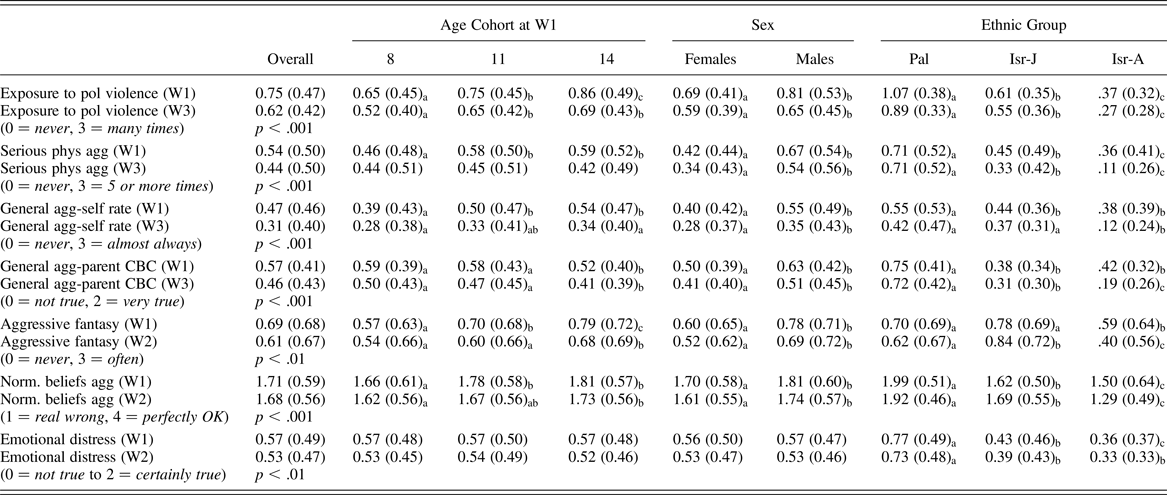
Table 1 shows the means and standard deviations for exposure to ethnic–political conflict/violence), composite aggression and individual aggression scales, and the hypothesized mediator variables (aggressive normative beliefs, aggressive fantasy, and emotional distress) by ethnic subgroup, age cohort, and gender, over the key waves (Wave 1 and 3 for the predictor and outcome variables, and Waves 1 and 2 for the hypothesized mediator variables). The effects of ethnic subgroup, cohort, sex, and time on each of these means were tested with a set of three-way repeated measures analyses of variance.
Descriptive statistics of the means (standard deviations) for study variables by age, sex, and ethnic group
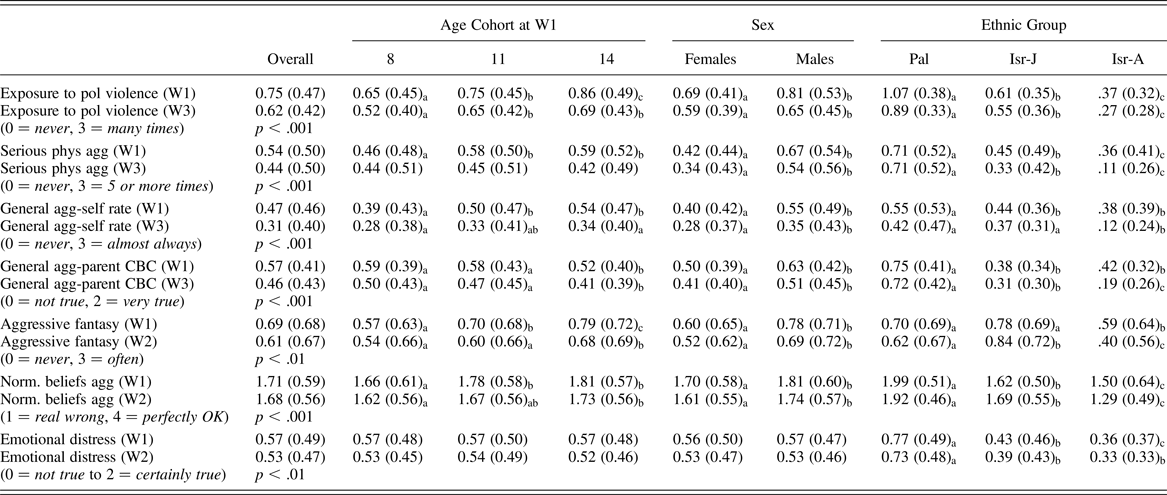
Note: A three-way (Age × Sex × Ethnic Group) repeated measures analysis of variance was computed for each variable; across analyses, Ns = 1238–1278. The p values are shown for differences between waves in the overall mean score. Within each wave, post hoc multiple comparison (least significant differences) tests were computed between means of subgroups defined by age cohort, sex, and ethnic group. Within a comparison, means with different subscripts are significantly different at p < .05. W1–W3, Waves 1–3.
As reported previously (Boxer et al., Reference Boxer, Huesmann, Dubow, Landau, Gvirsman, Shikaki and Ginges2013) and shown in Table 1, Palestinian children experienced the highest levels of exposure to political conflict/violence and were most aggressive, while Israeli Jewish youth were exposed to more violence and were more aggressive than Israeli Arab youth. Males were consistently exposed to more ethnic–political conflict/violence and were more aggressive than females, and older children were exposed to more violence and were more aggressive than younger children. In addition, Palestinian children reported the highest levels of normative beliefs supporting aggression and the highest levels of emotional distress. However, Israeli Jews reported the highest levels of aggressive fantasy. Males scored no differently from females on emotional distress, but higher on aggressive fantasy and normative beliefs. Similarly, older children scored no differently than younger children on emotional distress, but higher on aggressive fantasy and normative beliefs supporting aggression.
Despite the higher scores for older children on exposure, aggression, and the mediating variables, all these variables decreased over time during the study. This finding that scores increased with age but decreased with time could indicate an artifactual “retesting” effect that lowers scores (see Babbie, Reference Babbie1992; Campbell & Stanley, Reference Campbell and Stanley1963, on retesting effects), or the findings could be related to real changes in the children's environment over time (i.e., lower levels of ethnic–political conflict/violence at later times). The design of the study does not enable us to determine which explanation is more plausible, but Israeli and Palestinian casualties appear to have decreased slightly since 2006 (Jewish Virtual Library, 2014), although there has been much debate over the accuracy of casualty statistics.
Correlations among key variables
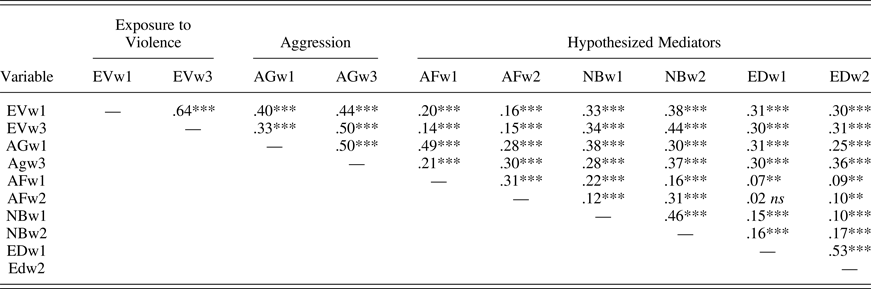
Table 2 shows the correlations among these key variables. For these and all subsequent analyses, all scale scores (but not the index of exposure to ethnic/political violence) are log transformed to reduce the effects of extreme scores. Aggression and exposure to ethnic–political conflict/violence intercorrelate significantly, when measured both concurrently and longitudinally. In addition, every hypothesized mediator variable measured in Waves 1 and 2 correlates significantly with aggression and exposure to ethnic–political conflict/violence measured in Waves 1 and 3.
Correlations between exposure to ethnic–political conflict/violence, aggression, and the hypothesized mediators
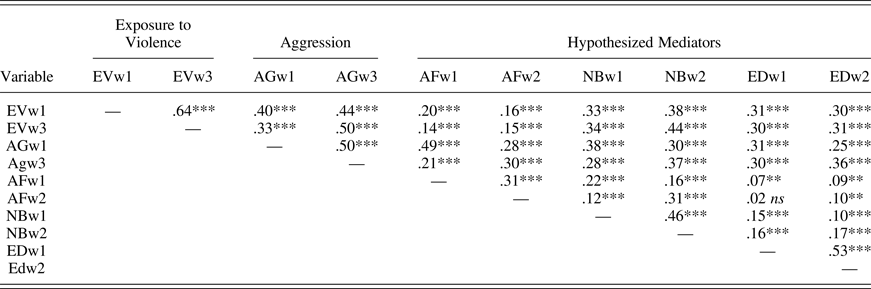
Note: All scales were log transformed (excluding Exposure index). EVw1, Exposure to political conflict/violence Wave 1; EVw3, exposure to political conflict/violence Wave 3; AGw1, aggression Wave 1; AFw1, aggressive fantasy Wave 1; AFw2, aggressive fantasy Wave 2; NBw1, normative beliefs Wave 1; NBw2, normative beliefs Wave 2; EDw1, emotional distress Wave 1; EDw2, emotional distress Wave 2.
**p < .01. ***p < .001.
Cross-lagged relations between exposure to ethnic–political violence and aggression
Our theory is that exposure to ethnic–political conflict/violence stimulates aggression at peers over time by increasing the observers’ social cognitions and emotional reactions that support aggression. The obtained positive correlation between these variables is consistent with this theory. However, the correlation could be an artifact of a third variable or in principle could be due to more aggressive youth exposing themselves to more ethnic–political violence. To test the relative plausibility of these alternative explanations, we conducted a cross-lagged path analysis in which aggression and exposure to ethnic–political conflict/violence in Wave 3 were predicted from aggression and exposure to ethnic–political conflict/violence in Wave 1 while controlling for gender and family socioeconomic status. We conducted the analysis by estimating the parameters of the structural equation model shown in Figure 1 with the AMOS program using full Information maximum likelihood estimation to handle missing observations.
A cross-lagged path model showing the standardized path coefficients for relating exposure to ethnic–political violence and overall aggressive behavior in Wave 1 to the same measures 2 years later in Wave 3 controlling for participant's gender and family socioeconomic status. The parameters are estimated for the sample of 1,501 participants using full information maximum likelihood. Estimating the model with ethnic group as a subgroup moderator resulted in a worse fitting model (Akaike information criterion = 164.68) as did estimating the model with age as a subgroup moderator (Akaike information criterion = 162.58). The cross-lagged standardized regression coefficient for predicting aggression at Wave 3 from exposure to violence at Wave 1 is significantly greater than the coefficient for predicting exposure to violence at Wave 3 from aggression at Wave 1, χ2 (1) = 6.14, p < .014.

The final model shown in Figure 1 fits the data well, χ2 (1) = 0.76, p = .38, CFI = 1, RMSEA = 0.00, Akaike information criterion (AIC) = 52.76. Before arriving at the final model, we tested the model without the main effect for gender for invariance across genders and found that introducing gender as a moderator with a two-group model made the model fit worse (AIC = 80 vs. AIC = 40).Footnote 3 Then we added the significant main effect of gender and retested for invariance across age cohorts and ethnic subgroups with multigroup models. The fit of the models with either grouping was much worse than the combined group model shown in Figure 1 (AICs = 162.58 and 164.68 compared to 52.76 for the combined group model), so we accept the parameter estimates in Figure 1 as the best estimates.
The standardized path from exposure to political conflict/violence in Wave 1 to aggression in Wave 3 is highly significant (0.25, p < .001). It indicates that, while controlling for initial aggression, gender, and family socioeconomic status, a youth who scores 1 SD higher on exposure to violence in Wave 1 can be expected to score 0.25 SD higher on aggression in Wave 3. At the same time, youth who are more aggressive during Wave 1 are somewhat more likely (0.07, p < .01) to be exposed to violence in Wave 3. However, this 0.07 effect is significantly smaller, χ2 (1) = 6.14, p < .014, than the 0.25 effect of prior exposure to violence on later aggression. We conclude that the larger factor in contributing to the correlation between exposure to violence and aggression is the aggression-stimulating effect of exposure to violence.
Tests of the mediating roles of social cognitions and emotional distress in the longitudinal relation between exposure to ethnic–political conflict/violence and aggression
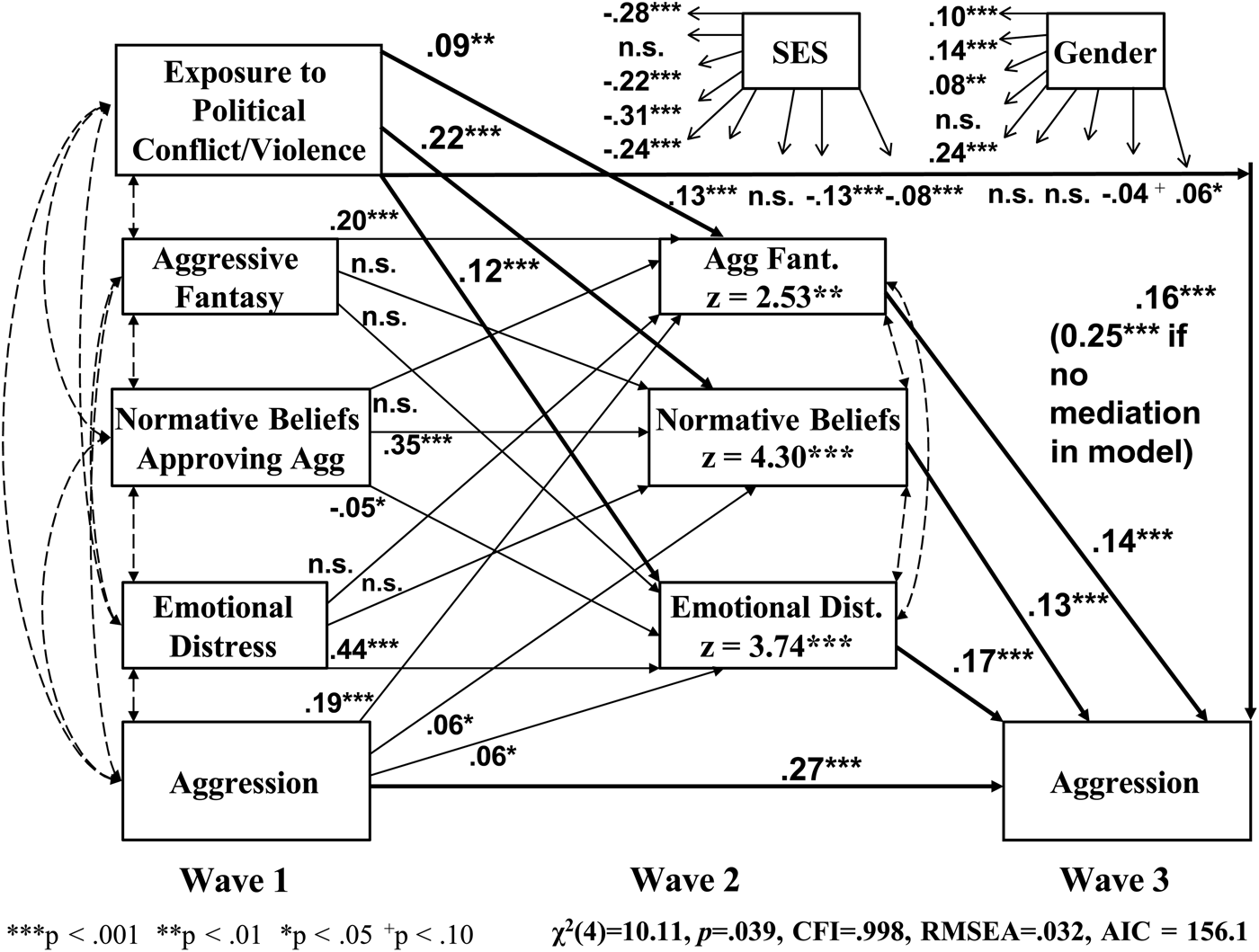
We estimated the parameters of the structural equation model shown in Figure 2 in which aggression at Wave 3 is directly influenced by three hypothesized mediating variables assessed in Wave 2 as well as directly from aggression and exposure to ethnic–political conflict/violence in Wave 1. The mediating variables assessed at Wave 2 are in turn influenced by aggression and exposure to ethnic–political violence in Wave 1 and by their own values in Wave 1. With this model, we test the extent to which the effect of exposure to ethnic–political conflict/violence in Wave 1 on aggression in Wave 3 is mediated by aggressive fantasy (rehearsal of aggressive scripts), normative beliefs approving of aggression, and emotional distress in Wave 2. Again, we estimated the parameters of the model using full Information maximum likelihood estimation (AMOS program, Version 18).
A three-wave mediation model showing the standardized path coefficients for relating exposure to ethnic–political violence and overall aggressive behavior in Wave 1 to three hypothesized mediating variables assessed in Wave 2 and from them to aggressive behavior in Wave 3 controlling for participant's gender, family socioeconomic status, and the Wave 1 values of the hypothesized mediators. The parameters are estimated for the sample of 1,501 participants using full information maximum likelihood. Estimating the model with ethnic group as a subgroup moderator resulted in a worse fitting model (Akaike information criterion = 459.1) as did estimating the model with age as a subgroup moderator (Akaike information criterion = 459.2). The three mediated paths are all significant according to the displayed Sobel test for mediation and according to a bootstrapping analysis that also showed mediation by normative beliefs was stronger than mediation by aggressive fantasizing.

The resulting final model with the parameter estimates is shown in Figure 2. The model fits the observed data well (χ2 = 10.1, df = 4, p = .04, CFI = 0.998, RMSEA = 0.032, AIC = 156.1). Again, using multigroup models, we tested the model for invariance across gender (with no main effect of gender), and across age cohort and ethnic subgroup. Including gender as a moderator instead of a main effect resulted in a worse fit (AIC = 260.2), and including cohort or ethnic group as a moderator also resulted in a worse fit (AICs = 460.86 and 458.41, respectively). Consequently, we accept the model and estimates shown in Figure 2 as the best fitting model.
This model implies that the effect of exposure to ethnic–political conflict/violence on the participants’ aggression at in-group peers is partially mediated by fantasizing about aggressive scripts, by normative beliefs approving of aggression, and by the emotional distress that the exposure stimulates. Figure 2 shows that the mediated paths from exposure to violence in Wave 1 to aggression in Wave 3 through these three constructs are significant (using Sobel tests).
We also tested the simultaneous significance of the multiple mediation paths with bootstrapping analyses in AMOS following the approach of Macho and Ledermann (Reference Macho and Ledermann2011). Because bootstrapping analyses cannot be done with missing values in the data set, the data set was transformed into one with no missing values by using SPSS's expectation maximization imputation algorithm. The bootstrapping analysis indicated that all three mediation paths were significant at the p < .001 level; the mediation path through normative beliefs was significantly stronger that the mediation path through aggressive fantasy, but the other pairwise comparisons were not significant.
Discussion
Exposure to ethnic–political conflict/violence: The social–cognitive–ecological model
Our study extends support for the social–cognitive–ecological model for the effects of political violence, and illuminates key psychological processes linking exposure to violence transactionally over time to aggressive behavior. In particular, our analyses highlight the mediating roles of aggressive fantasy, normative beliefs about aggression, and emotional dysregulation in response to exposure to violence. Our results demonstrate that habitual exposure to ethnic–political violence increases the risk of a youth's subsequent aggression against in-group peers, and that all three hypothesized mediators do mediate this longitudinal effect.
In this study, we expanded the construct of normative beliefs about aggression to integrate beliefs about the appropriateness of aggression toward out-group as well as toward in-group members. Our rationale was that being exposed to violence even by an out-group directed toward one's in-group would increase normative acceptance of aggression against anyone because of the generality of observational learning. The expanded normative beliefs measure mediated the effects of exposure on aggression toward in-group peers as we expected. This result is consistent with Punamäki's (Reference Punamäki and Barber2009) argument that children exposed to persistent political violence “have to develop specific cognitive, emotional, and physiological responses to adapt and mentally survive… . however, if excessive and distorted, these originally adaptive mechanisms may constitute a risk for development” (p. 64). She continued, “Risk for aggressive behavior is also great if children generalize perceptions of humans as malevolent toward their own people and even family members” (p. 66).
Our findings also underscore the role of emotional processes in accounting for the effects of exposure to ethnic–political violence on aggressive behavior. Emotional undercontrol or dysregulation is a clear risk factor in the development of aggressive behavior (Boxer & Sloan-Power, Reference Boxer and Sloan-Power2013; Calkins & Keane, Reference Calkins and Keane2009). Following Berkowitz's (Reference Berkowitz2000) views on the role of negative affectivity in promoting aggressive behavior, we found that increased emotional distress accounted in part for the relation between ethnic–political violence exposure and aggressive behavior. However, other perspectives and process models suggest a different effect: specifically, theory and research on callous–unemotional traits (e.g., Frick & White, Reference Frick and White2008), pathologic adaptation to violence (Ng-Mak, Salzinger, Feldman, & Stueve, Reference Ng-Mak, Salzinger, Feldman and Stueve2004), and desensitization and emotional habituation to violence (Carnagey, Anderson, & Bushman, Reference Carnagey, Anderson and Bushman2007; Krahèet al., Reference Krahé, Möller, Huesmann, Kirwil, Felber and Berger2011) imply that emotional underreactivity is a substrate of aggressive responding. This is not necessarily at odds with the emotional distress perspective or the results in our study. Exposure to violence may produce emotional distress that is aversive at the same time as the observer is being desensitized to it and experiencing less negative emotional arousal as one thinks about it. Given the multifinality of exposure to violence, which has been linked to a wide variety of problem outcomes, it will be important for future work to consider the sensitizing as well as desensitizing potential of persistent exposure. This is particularly important for expanding this work into the domain of resilience, as some research has suggested that desensitization to violence might be adapative or protective in certain contexts (Boxer, Sloan-Power, Mercado, & Schappell, Reference Boxer, Sloan-Power, Mercado and Schappell2012).
Our focus on mediators of the relation between exposure to ethnic–political violence and aggression also provides important results to inform the design of intervention programs for children exposed to war and terrorism (Peltonen & Punamäki, Reference Peltonen and Punamäki2010). Specifically, our findings lend empirical support for including social–cognitive and emotional components in interventions for youth oriented toward peace education and reconciliation. Punamäki (Reference Punamäki and Barber2009) described some goals of such projects as, “aim[ed] at enhancing cognitive processing that allows more realistic and comprehensive observations of other people and behavior that are based on real feedback from the environment rather than war-salient rigid and hostile schemata and negative memories. Interventions with war traumatized children focus on teaching children to recognize accurately their own and others’ emotional states and the physiological markers of fear and arousal. Such interventions enhance flexible and integrative interpretations and provide a repertoire of responses to traumatic experiences” (p. 75). Going further, our findings support the potential benefits of extant theory-driven interventions that modify aggression-supporting social cognitions (e.g., Metropolitan Area Child Study Research Group, 2007) or aggression-related arousal and emotion regulation (Larson & Lochman, Reference Larson and Lochman2010) for translational application with youth exposed to ethnic–political violence.
Limitations and implications
It is important to note a few limitations of the current study. First, our data on exposure to violence were based on child self-report or parent report. Future studies should incorporate other indicators of violence exposure, perhaps through supplementing self-reports with historical accounts of violent conflict utilized by Cummings, Merrilees, et al. (Reference Cummings, Merrilees, Schermerhorn, Goecke-Morey, Shirlow and Cairns2010) and Cummings, Schermerhorn, et al. (Reference Cummings, Schermerhorn, Merrilees, Goeke-Morey, Shirlow and Cairns2010). Second, Barber (Reference Barber2009) has stressed the need to broaden the focus of research on exposure to political violence to include an examination of the remarkable resilience of exposed youth and the protective factors that promote this resilience. In a related examination of the relation between exposure to ethnic/political violence and posttraumatic stress symptoms with the current sample, we (Dubow et al., Reference Huesmann, Dubow, Boxer, Souweidane and Ginges2012) found that the child's self-esteem and the parent's good mental health increased the resiliency of the exposed youth. Whether similar child and family constructs would moderate the effects of exposure to violence on aggression needs to be explored. Third, it should be emphasized that our indicators of aggressive behavior presumably tap in-group aggression exclusively (e.g., aggression by Israeli Jewish children directed toward Israeli Jewish peers). However, given other work suggesting that exposure to ethnic–political violence and related forms of interethnic conflict appear to amplify negative attitudes and hostile intentions toward ethnic out-groups (see Huesmann et al., Reference Huesmann, Dubow, Boxer, Souweidane and Ginges2012; Niwa et al., Reference Niwa, Boxer, Dubow, Huesmann, Landau, Shikaki and Gvirsman2016), future studies could examine whether our theorized model also holds for aggression targeted at ethnic out-groups.
Despite these limitations, the present study makes a unique contribution to the relatively small but growing literature on the deleterious effects of exposure to persistent ethnic–political violence on children.




Target article
Children's exposure to violent political conflict stimulates aggression at peers by increasing emotional distress, aggressive script rehearsal, and normative beliefs favoring aggression
Related commentaries (1)
Commentary on Huesmann et al.