


1 Introduction
For an affine Kac–Moody algebra  $\mathfrak{g}$, let
 $U_{q}^{\prime }(\mathfrak{g})$ be the corresponding quantum affine algebra. Since the category
 $\mathscr{C}_{\mathfrak{g}}$ of finite-dimensional integrable representations over
 $U_{q}^{\prime }(\mathfrak{g})$ has a rich structure including rigidity, it has been intensively studied in various fields of mathematics and physics (see for example [Reference Akasaka and KashiwaraAK97, Reference Chari and PressleyCP94, Reference Frenkel and ReshetikhinFR99, Reference Ginzburg and VasserotGV93, Reference Kazhdan and SoibelmanKS95, Reference NakajimaNak01]). In particular, the representation theory for
 $\mathscr{C}_{\widehat{\mathfrak{s}\mathfrak{l}}_{2}}$ is well understood: every simple module in
 $\mathscr{C}_{\widehat{\mathfrak{s}\mathfrak{l}}_{2}}$ is isomorphic to a tensor product
 $S_{1}\otimes S_{2}\otimes \cdots \otimes S_{r}$ of simple modules, called Kirillov–Reshetikhin modules, satisfying that
 $S_{i}$ and
 $S_{j}$are in general position [Reference Chari and PressleyCP91]. A simple object
 $S$ of a monoidal category is said to be real if
 $S\otimes S$ is simple, and to be prime if there exists no non-trivial factorization
 $S\simeq S_{1}\otimes S_{2}$. Since Kirillov–Reshetikhin modules over
 $U_{q}^{\prime }(\widehat{\mathfrak{s}\mathfrak{l}}_{2})$ are prime and real, every simple module in
 $\mathscr{C}_{\widehat{\mathfrak{s}\mathfrak{l}}_{2}}$ is real and can be expressed as a tensor monomial of prime real simple modules. However, these phenomena cannot be expected for general
 $\mathfrak{g}$. In fact, there exist
 $\mathfrak{g}$ such that
 $\mathscr{C}_{\mathfrak{g}}$ contains non-real simple modules [Reference LeclercLec03].
The cluster algebras were introduced by Fomin and Zelevinsky in [Reference Fomin and ZelevinskyFZ02] for studying the upper global bases of quantum groups and total positivity [Reference KashiwaraKas90, Reference LusztigLus90] in the viewpoint of combinatorics. Since their introduction, numerous connections and applications have been discovered in diverse fields of mathematics including representation theory, tropical geometry, integrable system and Poisson geometry (see [Reference Buan and MarshBM06, Reference Fock and GoncharovFG06, Reference Fomin and ZelevinskyFZ03, Reference Fomin and ReadingFR05, Reference Gekhtman, Shapiro and VainshteinGSV03]).
The representation theory of quantum affine algebras and the cluster algebras are connected by the notion of monoidal categorification, introduced by Hernandez and Leclerc in [Reference Hernandez and LeclercHL10]. A monoidal category  ${\mathcal{C}}$ is called a monoidal categorification of a cluster algebra
 $\mathscr{A}$ if it satisfies:
(a) the Grothendieck ring
 $K({\mathcal{C}})$ of ${\mathcal{C}}$ is isomorphic to $\mathscr{A}$; and
(b) each cluster monomial of
$\mathscr{A}$ corresponds to a real simple object in ${\mathcal{C}}$, under the isomorphism.


(This definition is weaker than the original one.) Note that, by the Laurent phenomenon of  $\mathscr{A}$ [Reference Fomin and ZelevinskyFZ02], the Laurent positivity (proved by [Reference Lee and SchifflerLS15] in a general setting) follows immediately, if
 ${\mathcal{C}}$ is a monoidal categorification of
 $\mathscr{A}$.
The notion of a monoidal categorification is extended in [Reference Kang, Kashiwara, Kim and OhKKKO18] to quantum cluster algebras, a  $q$-analogue of cluster algebras, which were introduced by Berenstein and Zelevinsky in [Reference Berenstein and ZelevinskyBZ05]. Unlike cluster algebras, cluster variables are not commutative but
 $q$-commutative, where the
 $q$-commutation relation is controlled by a skew-symmetric matrix
 $L$. In [Reference Geiß, Leclerc and SchröerGLS13a], Geiß, Leclerc and Schröer showed that the quantum unipotent coordinate algebra
 $A_{q}(\mathfrak{n}(w))$, associated with a symmetric quantum group
 $U_{q}(\mathsf{g})$ and its Weyl group element
 $w$, has a skew-symmetric quantum cluster algebra structure (see [Reference Goodearl and YakimovGY16] for the non-symmetric case). Using the quiver Hecke algebras
 $R$ introduced by Khovanov and Lauda [Reference Khovanov and LaudaKL09, Reference Khovanov and LaudaKL11] and Rouquier [Reference RouquierRou08, Reference RouquierRou12] independently, the authors in [Reference Kang, Kashiwara, Kim and OhKKKO18] introduced certain monoidal subcategory
 ${\mathcal{C}}_{w}$ of the category
 $R\text{-}\text{gmod}$ of finite-dimensional graded modules over
 $R$ and proved that
 ${\mathcal{C}}_{w}$ gives a monoidal categorification for
 $A_{q}(\mathfrak{n}(w))$ in the following sense:

Here  $\unicode[STIX]{x1D6EC}(V,W)$ denotes the degree of the
 $R$-matrix
 $\mathbf{r}_{V,W}$, constructed in [Reference Kang, Kashiwara and KimKKK18], which is a distinguished homomorphism from
 $V\circ W$ to
 $W\circ V$, where
 $V\circ W$ denotes the convolution product of
 $V$ and
 $W$ (see [Reference Kang, Kashiwara, Kim and OhKKKO18] for notations). Note that the condition (iii) in (
) is not easy to check since it is concerned with infinitely many mutations. In the first part of [Reference Kang, Kashiwara, Kim and OhKKKO18], it was proved that the conditions (ii) and (iii) in (
1.1) are a consequence of the following condition:
(ii’) there exists an admissible monoidal seed
$\mathscr{S}=(\{{V_{i}\}}_{i\in K},\widetilde{B})$ in ${\mathcal{C}}_{w}$ such that $[\mathscr{S}]:=(\{q^{m_{i}}[V_{i}]\}_{i\in K},(-\unicode[STIX]{x1D6EC}(V_{i},V_{j}))_{i,j\in K},\widetilde{B})$ is a quantum seed of $A_{q^{1/2}}(\mathfrak{n}(w))$ for some $m_{i}\in {\textstyle \frac{1}{2}}\mathbb{Z}$ (see Definition 6.3).





Here, the admissibility means that the monoidal seed admits the first step mutations. Thus, (ii $^{\prime }$) implies that, to achieve a monoidal categorification, it suffices to check the existence of such
 $M_{k}^{\prime }$ only at the first mutation in each direction
 $k$.
On the whole flow of [Reference Kang, Kashiwara, Kim and OhKKKO18], the integer-valued invariants  $\unicode[STIX]{x1D6EC}(V,W)$,
 $\widetilde{\unicode[STIX]{x1D6EC}}(V,W)$ and
 $\mathfrak{d}(V,W)$, arising from the
 $\mathbb{Z}$-grading structure of
 $R$ and defined in [Reference Kang, Kashiwara and KimKKK18, Reference Kang, Kashiwara, Kim and OhKKKO18], provide important information in the representation theory of quiver Hecke algebra
 $R$. To name a few: (i)
 $\unicode[STIX]{x1D6EC}$ provides information about whether the restriction of
 $R$-matrix
 $\mathbf{r}_{V,W}$ to
 $V^{\prime }\circ W^{\prime }$ vanishes or not for subquotients
 $V^{\prime }$ and
 $W^{\prime }$ of
 $V$ and
 $W$ respectively; (ii)
 $\unicode[STIX]{x1D6EC}$ indicates the head and socle in the constituent of
 $V\circ W$; (iii)
 $\widetilde{\unicode[STIX]{x1D6EC}}(V,W):={\textstyle \frac{1}{2}}(\unicode[STIX]{x1D6EC}(V,W)+(\operatorname{wt}(V),\operatorname{wt}(W)))$ measures the degree shifts of
 $V\circ W$ from the self-duality; (iv) the non-negative integer
 $\mathfrak{d}(V,W):={\textstyle \frac{1}{2}}(\unicode[STIX]{x1D6EC}(V,W)+\unicode[STIX]{x1D6EC}(W,V))$ tells whether
 $V\circ W$ is simple or not, corresponding to
 $\mathfrak{d}(V,W)=0$ or
 $\mathfrak{d}(V,W)>0$, under suitable assumptions on
 $V$ and
 $W$. However, in general, computing those values are quite difficult, and the second half of [Reference Kang, Kashiwara, Kim and OhKKKO18] is devoted to investigating several properties of those invariants.
After the success in the quiver Hecke algebras setting, it is natural to ask a criterion for monoidal categorification for subcategories of  $\mathscr{C}_{\mathfrak{g}}$. There are monoidal subcategories
 $\mathscr{C}_{N}$
 $(N\in \mathbb{Z}_{{\geqslant}1})$,
 $\mathscr{C}_{\mathfrak{g}}^{-}$ and
 $\mathscr{C}_{\mathfrak{g}}^{0}$ of
 $\mathscr{C}_{\mathfrak{g}}$, introduced by Hernandez and Leclerc in [Reference Hernandez and LeclercHL10, Reference Hernandez and LeclercHL16] (see also [Reference Kashiwara, Kim, Oh and ParkKKOP19b] for
 $\mathscr{C}_{\mathfrak{g}}^{0}$), whose Grothendieck rings
 $K({\mathcal{C}})$ have cluster algebra structures, and which are conjectured to be monoidal categorifications of
 $K({\mathcal{C}})$. The conjecture for
 $\mathscr{C}_{\mathfrak{g}}^{0}$ of affine types
 $A_{n}^{(t)}$
 $(t=1,2)$ and
 $B_{n}^{(1)}$ is proved in [Reference Kashiwara, Kim, Oh and ParkKKOP19b] indirectly by using generalized quantum Schur–Weyl duality constructed in [Reference Kang, Kashiwara and KimKKK18, Reference Kang, Kashiwara, Kim and OhKKKO15b, Reference Kashiwara, Kim and OhKKO19], and for
 $\mathscr{C}_{1}$ and
 $\mathscr{C}_{N}$
 $(N\in \mathbb{Z}_{{\geqslant}1})$ of untwisted affine types
 $ADE$ are proved in [Reference Hernandez and LeclercHL10, Reference Hernandez and LeclercHL13, Reference NakajimaNak11] and [Reference QinQin17] respectively, by approaches different from [Reference Kashiwara, Kim, Oh and ParkKKOP19b]. However, by the lack of
 $\mathbb{Z}$-grading structure on
 $U_{q}^{\prime }(\mathfrak{g})$, one can not apply the framework in [Reference Kang, Kashiwara, Kim and OhKKKO18] to those categories for monoidal categorifications directly (see also [Reference Cautis and WilliamsCW19, §4]).
The aim of this paper is to give a criterion for a monoidal subcategory  ${\mathcal{C}}$ of
 $\mathscr{C}_{\mathfrak{g}}$ to become a monoidal categorification of
 $K({\mathcal{C}})$. We first introduce new invariants, denoted also by
 $\unicode[STIX]{x1D6EC}(M,N)$,
 $\widetilde{\unicode[STIX]{x1D6EC}}(M,N)$,
 $\unicode[STIX]{x1D6EC}^{\infty }(M,N)$ and
 $\mathfrak{d}(M,N)$, for a pair of modules
 $M$ and
 $N$ in
 $\mathscr{C}_{\mathfrak{g}}$, by analyzing
 $R$-matrices associated to
 $M\otimes N_{z}$.
We say that the universal  $R$-matrix
 $$\begin{eqnarray}R_{M,N_{z}}^{\text{univ}}:\mathbf{k}((z))\otimes _{\boldsymbol{ k}[z^{\pm 1}]}(M\otimes N_{z})\rightarrow \mathbf{k}((z))\otimes _{\mathbf{k}[z^{\pm 1}]}(N_{z}\otimes M)\end{eqnarray}$$
is rationally renormalizable if there exists  $c_{M,N}(z)\in \mathbf{k}((z))^{\times }$ such that
 $R_{M,N_{z}}^{\text{ren}}:=c_{M,N}(z)R_{M,N_{z}}^{\text{univ}}$ sends
 $M\,\otimes \,N_{z}$ to
 $N_{z}\,\otimes \,M$. In such a case, we can normalize
 $c_{M,N}(z)\in \mathbf{k}((z))^{\times }$ (up to multiplication by an element of
 $\mathbf{k}[z^{\pm 1}]^{\times }$) such that
 $R_{M,N_{z}}^{\text{ren}}|_{z=x}:M\otimes N_{x}\rightarrow N_{x}\otimes M$ does not vanish at any
 $x\in \mathbf{k}^{\times }$. We call
 $c_{M,N}(z)$ the renormalizing coefficient of
 $M$ and
 $N$. We define
 $\widetilde{\unicode[STIX]{x1D6EC}}(M,N)$ as the order of zero of
 $c_{M,N}(z)$ at
 $z=1$. We then define
 $\unicode[STIX]{x1D6EC}(M,N)$,
 $\unicode[STIX]{x1D6EC}^{\infty }(M,N)$ and
 $\mathfrak{d}(M,N)$ similarly to
 $\widetilde{\unicode[STIX]{x1D6EC}}(M,N)$ (see Definition 3.6 for new invariants). Note that
 $\unicode[STIX]{x1D6EC}^{\infty }(M,N)=2\widetilde{\unicode[STIX]{x1D6EC}}(M,N)-\unicode[STIX]{x1D6EC}(M,N)$ can be understood as a quantum affine analogue of
 $(\operatorname{wt}(V),\operatorname{wt}(W))$.
When  $M$ and
 $N$ are simple modules in
 $\mathscr{C}_{\mathfrak{g}}$,
 $c_{M,N}(z)$ is the ratio
 $d_{M,N}(z)$ to
 $a_{M,N}(z)$, where
 $d_{M,N}(z)$ (respectively
 $a_{M,N}(z)$) denotes the denominator (respectively universal coefficient) of the normalized
 $R$-matrix
 $R_{M,N_{z}}^{\text{norm}}(z)$ of
 $M$ and
 $N$, computed in [Reference Akasaka and KashiwaraAK97, Reference Date and OkadoDO94, Reference Kang, Kashiwara and KimKKK15, Reference OhOh15, Reference Oh and ScrimshawOS19] for fundamental representations. Thus
 $\mathfrak{d}(M,N)$ can be interpreted as the degree of zero of
 $d_{M,N}(z)d_{N,M}(z^{-1})$ at
 $z=1$ with the results in [Reference Akasaka and KashiwaraAK97] (see § 2.2).
We next investigate several properties of the new invariants by using  $R$-matrices and their coefficients, and prove that they play the same role in the representation theory for quantum affine algebras as the ones for quiver Hecke algebras do. Furthermore, new invariants provide more information arising from taking duals in
 $\mathscr{C}_{\mathfrak{g}}$, which cannot be obtained in the quiver Hecke algebra setting (see Remark 3.21). For instances, we have that:
∙
$\unicode[STIX]{x1D6EC}(M,N)$ and $\unicode[STIX]{x1D6EC}^{\infty }(M,N)$ can be expressed in terms of $\mathfrak{d}(M,\mathscr{D}^{k}N)$ for $k\in \mathbb{Z}$;∙
$\unicode[STIX]{x1D6EC}^{\infty }(M,N)=\unicode[STIX]{x1D6EC}^{\infty }(N,M)=-\unicode[STIX]{x1D6EC}^{\infty }(M^{\ast },N)=-\unicode[STIX]{x1D6EC}^{\infty }(\text{}^{\ast }\!M,N)$;∙
$\unicode[STIX]{x1D6EC}^{\infty }(M,N)=-\unicode[STIX]{x1D6EC}(M,\mathscr{D}^{2n}N)=\unicode[STIX]{x1D6EC}(M,\mathscr{D}^{-2n}N)$ for $n\gg 0$;∙
$\unicode[STIX]{x1D6EC}(M,N)\,=\,\unicode[STIX]{x1D6EC}(N^{\ast },M)\,=\,\unicode[STIX]{x1D6EC}(N,\text{}^{\ast }\!M)$ and hence $\mathfrak{d}(M,N)\,=\,{\textstyle \frac{1}{2}}(\unicode[STIX]{x1D6EC}(M,N)+\unicode[STIX]{x1D6EC}(N,M))\,=\,{\textstyle \frac{1}{2}}(\unicode[STIX]{x1D6EC}(M,N)+\unicode[STIX]{x1D6EC}(M^{\ast },N))$,







where  $N^{\ast }$ (respectively
 $^{\ast }N$ and
 $\mathscr{D}^{k}N$) denotes the left (respectively right and
 $k$th left) dual of
 $N$ (see § 3).
With the new invariants at hand, we introduce the following notions: (a) a  $\unicode[STIX]{x039B}$-seed
 ${\mathcal{S}}_{\unicode[STIX]{x039B}}$, a triple
 ${\mathcal{S}}_{\unicode[STIX]{x039B}}=(\{{X_{i}\}}_{i\in K},L,\widetilde{B})$ consisting of a cluster
 $\{{X_{i}\}}_{i\in K}$, a skew-symmetric
 $K\times K$-matrix
 $L$ and a
 $K\times K^{\text{ex}}$-matrix
 $\widetilde{B}=(b_{jk})$ such that
 $(L\widetilde{B})_{ij}=2\unicode[STIX]{x1D6FF}_{ij}$; and (b) a cluster algebra associated to
 ${\mathcal{S}}_{\unicode[STIX]{x039B}}$. Here the mutation rule for the pair
 $(L,\widetilde{B})$ associated to
 ${\mathcal{S}}_{\unicode[STIX]{x039B}}$ is the same as the ones for quantum cluster algebras.
Finally, we introduce the notion of a  $\unicode[STIX]{x039B}$-admissible monoidal seed in a monoidal subcategory
 ${\mathcal{C}}$ of
 $\mathscr{C}_{\mathfrak{g}}$ by using the new invariants as follows. A monoidal seed
 $\mathscr{S}=(\{{M_{i}\}}_{i\in K},\widetilde{B})$ is said to be
 $\unicode[STIX]{x039B}$-admissible if it satisfies:
(a)
$(\unicode[STIX]{x1D6EC}^{\mathscr{S}}\widetilde{B})_{jk}=-2\unicode[STIX]{x1D6FF}_{jk}$ where $\unicode[STIX]{x1D6EC}^{\mathscr{S}}:=(\unicode[STIX]{x1D6EC}(M_{i},M_{j}))_{i,j\in K}$;(b) for each
$k\in K^{\text{ex}}$, there exists a real simple module $M_{k}^{\prime }$ in ${\mathcal{C}}$, corresponding to the mutated cluster variable $X_{k}^{\prime }$, satisfying $\mathfrak{d}(M_{j},M_{k}^{\prime })=\unicode[STIX]{x1D6FF}_{jk}$ and the short exact sequence $$\begin{eqnarray}0\rightarrow \bigotimes _{b_{ik}>0}M_{i}^{\otimes b_{ik}}\rightarrow M_{k}\otimes M_{k}^{\prime }\rightarrow \bigotimes _{b_{ik}<0}M_{i}^{\otimes (-b_{ik})}\rightarrow 0.\end{eqnarray}$$






By employing the framework of [Reference Kang, Kashiwara, Kim and OhKKKO18, §7] with new invariants and notions, we prove the main result of this paper.
Main Theorem (Theorem 6.10). For a monoidal seed  $\mathscr{S}=(\{{M_{i}\}}_{i\in K},\widetilde{B})$ in a monoidal subcategory
 ${\mathcal{C}}$ of
 $\mathscr{C}_{\mathfrak{g}}$, assume the following conditions.
∙ The Grothendieck ring
$K({\mathcal{C}})$ of ${\mathcal{C}}$ is isomorphic to the cluster algebra $\mathscr{A}$ associated to the initial seed $[\mathscr{S}]:=(\{[M_{i}]\}_{i\in K},\widetilde{B})$.∙ The monoidal seed
$\mathscr{S}$ is $\unicode[STIX]{x039B}$-admissible.





Then the category  ${\mathcal{C}}$ is a monoidal categorification of the cluster algebra
 $\mathscr{A}$.
As consequences, we can obtain the following applications (Corollary 6.11).
(i) For
$k\in K^{\text{ex}}$ and the $k$th cluster variable module $\widetilde{M}_{k}$ of a monoidal seed $\widetilde{\mathscr{S}}$ obtained by successive mutations from the initial monoidal seed $\mathscr{S}$, we have $\mathfrak{d}(\widetilde{M}_{k},\widetilde{M}_{k}^{\prime })=1$.(ii) Any monoidal cluster
$\{{\widetilde{M}_{i}\}}_{i\in K}$ is a maximal real commuting family in ${\mathcal{C}}$ (see Definition 6.8).


In the forthcoming paper, we will apply the main theorem to certain monoidal subcategories  ${\mathcal{C}}$ of
 $\mathscr{C}_{\mathfrak{g}}$ for providing monoidal categorifications.
This paper is organized as follows. We give the necessary background on quantum affine algebras, their representations, and  $R$-matrices, their related coefficients in § 2. In §§ 3 and 4, we introduce new invariants for pairs of
 $U_{q}^{\prime }(\mathfrak{g})$-modules by using
 $R$-matrices and investigate their properties. Especially, we will show the similarities of new invariants with the ones for quiver Hecke algebras in § 4. In § 5, we briefly recall the definition of cluster algebras with the consideration on
 $\unicode[STIX]{x039B}$-seeds. In § 6, we prove our main result with newly introduced invariants and notions.
2 Preliminaries
(i) For a statement
$P$, $\unicode[STIX]{x1D6FF}(P)$ is $1$ or $0$ according to whether $P$ is true or not.(ii) For a field
$\mathbf{k}$, $a\in \mathbf{k}$ and $f(z)\in \mathbf{k}(z)$, we denote by $\text{zero}_{z=a}f(z)$ the order of zero of $f(z)$ at $z=a$. In particular, $\text{zero}_{z=a}f(z)=-k$ for $k\in \mathbb{Z}_{{\geqslant}1}$ implies that $f(z)$ has a pole of order $k$ at $z=a$.





2.1 Quantum affine algebras
Let ( $\mathsf{A}$,
 $\mathsf{P}$,
 $\unicode[STIX]{x1D6F1}$,
 $\mathsf{P}^{\vee }$,
 $\unicode[STIX]{x1D6F1}^{\vee }$) be an affine Cartan datum. It consists of an affine Cartan matrix
 $\mathsf{A}=(a_{ij})_{i,j\in I}$ with a finite index set
 $I$, a free abelian group
 $\mathsf{P}$ of rank
 $|I|+1$, called the weight lattice, a set
 $\unicode[STIX]{x1D6F1}=\{\unicode[STIX]{x1D6FC}_{i}\in \mathsf{P}\mid i\in I\}$ of linearly independent elements called simple roots, the group
 $\mathsf{P}^{\vee }:=\operatorname{Hom}_{\mathbb{Z}}(\mathsf{P},\mathbb{Z})$ called the coweight lattice, and a set
 $\unicode[STIX]{x1D6F1}^{\vee }=\{h_{i}\mid i\in I\}\subset \mathsf{P}^{\vee }$ of simple coroots. Note that the pairing
 $\langle ~,~\rangle$ between
 $\mathsf{P}^{\vee }$ and
 $\mathsf{P}$ satisfies
 $\langle h_{i},\unicode[STIX]{x1D6FC}_{j}\rangle =a_{ij}$ for all
 $i,j\in I$, and for each
 $i\in I$, there exists
 $\unicode[STIX]{x1D6EC}_{i}\in \mathsf{P}$ such that
 $\langle h_{j},\unicode[STIX]{x1D6EC}_{i}\rangle =\unicode[STIX]{x1D6FF}_{ij}$ for all
 $j\in I$. We choose such elements
 $\unicode[STIX]{x1D6EC}_{i}$ and call them the fundamental weights. The free abelian group
 $\mathsf{Q}:=\bigoplus _{i\in I}\mathbb{Z}\unicode[STIX]{x1D6FC}_{i}\subset \mathsf{P}$ is called the root lattice. Set
 $\mathsf{Q}_{+}=\sum _{i\in I}\mathbb{Z}_{{\geqslant}0}\unicode[STIX]{x1D6FC}_{i}\subset \mathsf{Q}$. Similarly we set
 $\mathsf{Q}^{\vee }:=\bigoplus _{i\in I}\mathbb{Z}h_{i}\subset \mathsf{P}^{\vee }$ and
 $\mathsf{Q}_{+}^{\vee }:=\sum _{i\in I}\mathbb{Z}_{{\geqslant}0}h_{i}$.
We choose the imaginary root  $\unicode[STIX]{x03B4}=\sum _{i\in I}\mathsf{a}_{i}\unicode[STIX]{x1D6FC}_{i}\in \mathsf{Q}_{+}$ and the center
 $c=\sum _{i\in I}\mathsf{c}_{i}h_{i}\in \mathsf{Q}_{+}^{\vee }$ such that
 $\{\unicode[STIX]{x1D706}\in \mathsf{P}\mid \langle h_{i},\unicode[STIX]{x1D706}\rangle =0\text{ for every }i\in I\}=\mathbb{Z}\unicode[STIX]{x03B4}$ and
 $\{h\in \mathsf{P}^{\vee }\mid \langle h,\unicode[STIX]{x1D6FC}_{i}\rangle =0\text{ for every }i\in I\}=\mathbb{Z}c$ (see [Reference KacKac90, ch. 4]). We set
 $\mathsf{P}_{\text{cl}}:=\mathsf{P}/(\mathsf{P}\cap \mathbb{Q}\unicode[STIX]{x03B4})\simeq \operatorname{Hom}(\mathsf{Q}^{\vee },\mathbb{Z})$ and call it the classical weight lattice. We choose
 $\unicode[STIX]{x1D70C}\in \mathsf{P}$ (respectively
 $\unicode[STIX]{x1D70C}^{\vee }\in \mathsf{P}^{\vee }$) such that
 $\langle h_{i},\unicode[STIX]{x1D70C}\rangle =1$ (respectively
 $\langle \unicode[STIX]{x1D70C}^{\vee },\unicode[STIX]{x1D6FC}_{i}\rangle =1$) for all
 $i\in I$.
Set  $\mathfrak{h}:=\mathbb{Q}\otimes _{\mathbb{Z}}\mathsf{P}^{\vee }$. Then there exists a symmetric bilinear form
 $(~,~)$ on
 $\mathfrak{h}^{\ast }$ satisfying
 $$\begin{eqnarray}\langle h_{i},\unicode[STIX]{x1D706}\rangle ={\displaystyle \frac{2(\unicode[STIX]{x1D6FC}_{i},\unicode[STIX]{x1D706})}{(\unicode[STIX]{x1D6FC}_{i},\unicode[STIX]{x1D6FC}_{i})}}\quad \text{for any }i\in I\text{ and }\unicode[STIX]{x1D706}\in \mathfrak{h}^{\ast }.\end{eqnarray}$$
We normalize the bilinear form  $(~,~)$ by
 $$\begin{eqnarray}\displaystyle \langle c,\unicode[STIX]{x1D706}\rangle =(\unicode[STIX]{x03B4},\unicode[STIX]{x1D706})\quad \text{for any }\unicode[STIX]{x1D706}\in \mathfrak{h}^{\ast }. & & \displaystyle\end{eqnarray}$$
We denote by  $\mathfrak{g}$ the affine Kac–Moody algebra associated with
 $(\mathsf{A},\mathsf{P},\unicode[STIX]{x1D6F1},\mathsf{P}^{\vee },\unicode[STIX]{x1D6F1}^{\vee })$ and by
 $\mathsf{W}:=\langle r_{i}\mid i\in I\rangle \subset \text{GL}(\mathfrak{h}^{\ast })$ the Weyl group of
 $\mathfrak{g}$, where
 $r_{i}(\unicode[STIX]{x1D706}):=\unicode[STIX]{x1D706}-\langle h_{i},\unicode[STIX]{x1D706}\rangle \unicode[STIX]{x1D6FC}_{i}$ for
 $\unicode[STIX]{x1D706}\in \mathfrak{h}^{\ast }$. We will use the standard convention in [Reference KacKac90] to choose
 $0\in I$ except
 $A_{2n}^{(2)}$-case, in which case we take the longest simple root as
 $\unicode[STIX]{x1D6FC}_{0}$. In particular, we have always
 $\mathsf{a}_{0}=1$, while
 $\mathsf{c}_{0}=2$ or
 $1$ according to whether
 $\mathfrak{g}=A_{2n}^{(2)}$ or not.
We define  $\mathfrak{g}_{0}$ to be the subalgebra of
 $\mathfrak{g}$ generated by the Chevalley generators
 $e_{i}$,
 $f_{i}$ and
 $h_{i}$ for
 $i\in I_{0}:=I\setminus \{0\}$ and
 $\mathsf{W}_{0}$ to be the subgroup of
 $\mathsf{W}$ generated by
 $r_{i}$ for
 $i\in I_{0}$. Note that
 $\mathfrak{g}_{0}$ is a finite-dimensional simple Lie algebra and
 $\mathsf{W}_{0}$ contains the longest element
 $w_{0}$.
Let  $q$ be an indeterminate and
 $\mathbf{k}$ be the algebraic closure of the subfield
 $\mathbb{C}(q)$ in the algebraically closed field
 $\widehat{\mathbf{k}}:=\bigcup _{m>0}\mathbb{C}((q^{1/m}))$. When we deal with quantum affine algebras, we regard
 $\mathbf{k}$ as the base field.
For  $m,n\in \mathbb{Z}_{{\geqslant}0}$ and
 $i\in I$, we define
 $q_{i}=q^{(\unicode[STIX]{x1D6FC}_{i},\unicode[STIX]{x1D6FC}_{i})/2}$ and
 $$\begin{eqnarray}[n]_{i}=\frac{q_{i}^{n}-q_{i}^{-n}}{q_{i}-q_{i}^{-1}},\quad [n]_{i}!=\mathop{\prod }_{k=1}^{n}[k]_{i},\quad \left[\begin{array}{@{}c@{}}m\\ n\\ \end{array}\right]_{i}=\frac{[m]_{i}!}{[m-n]_{i}![n]_{i}!}.\end{eqnarray}$$
Definition 2.2. The quantum affine algebra  $U_{q}(\mathfrak{g})$ associated with an affine Cartan datum
 $(\mathsf{A},\mathsf{P},\unicode[STIX]{x1D6F1},\mathsf{P}^{\vee },\unicode[STIX]{x1D6F1}^{\vee })$ is the associative algebra over
 $\mathbf{k}$ with
 $1$ generated by
 $e_{i},f_{i}$
 $(i\in I)$ and
 $q^{h}$
 $(h\in \unicode[STIX]{x1D6FE}\;\mathsf{P}^{\vee })$ satisfying the following relations:
(i)
$q^{0}=1,q^{h}q^{h^{\prime }}=q^{h+h^{\prime }}$ for $h,h^{\prime }\in \unicode[STIX]{x1D6FE}\;\mathsf{P}^{\vee }$;(ii)
$q^{h}e_{i}q^{-h}=q^{\langle h,\unicode[STIX]{x1D6FC}_{i}\rangle }e_{i}$, $q^{h}f_{i}q^{-h}=q^{-\langle h,\unicode[STIX]{x1D6FC}_{i}\rangle }f_{i}$ for $h\in \unicode[STIX]{x1D6FE}^{-1}\mathsf{P}^{\vee },i\in I$;(iii)
$e_{i}f_{j}-f_{j}e_{i}=\unicode[STIX]{x1D6FF}_{ij}((K_{i}-K_{i}^{-1})/(q_{i}-q_{i}^{-1}))$, where $K_{i}=q_{i}^{h_{i}}$;(iv)
$\sum _{k=0}^{1-a_{ij}}(-1)^{k}e_{i}^{(1-a_{ij}-k)}e_{j}e_{i}^{(k)}=\sum _{k=0}^{1-a_{ij}}(-1)^{k}f_{i}^{(1-a_{ij}-k)}f_{j}f_{i}^{(k)}=0$ for $i\neq j$,









where  $e_{i}^{(k)}=e_{i}^{k}/[k]_{i}!$ and
 $f_{i}^{(k)}=f_{i}^{k}/[k]_{i}!$.
Let us denote by  $U_{q}^{+}(\mathfrak{g})$ (respectively
 $U_{q}^{-}(\mathfrak{g})$) the subalgebra of
 $U_{q}(\mathfrak{g})$ generated by
 $e_{i}$ (respectively
 $f_{i}$) for
 $i\in I$. We denote by
 $U_{q}^{\prime }(\mathfrak{g})$ the subalgebra of
 $U_{q}(\mathfrak{g})$ generated by
 $e_{i},f_{i},K_{i}^{\pm 1}$
 $(i\in I)$ and we call it also the quantum affine algebra. Throughout this paper, we mainly deal with
 $U_{q}^{\prime }(\mathfrak{g})$.
We use the coproduct  $\unicode[STIX]{x1D6E5}$ of
 $U_{q}^{\prime }(\mathfrak{g})$ given by
 $$\begin{eqnarray}\unicode[STIX]{x1D6E5}(q^{h})=q^{h}\otimes q^{h},\quad \unicode[STIX]{x1D6E5}(e_{i})=e_{i}\otimes K_{i}^{-1}+1\otimes e_{i},\quad \unicode[STIX]{x1D6E5}(f_{i})=f_{i}\otimes 1+K_{i}\otimes f_{i}.\end{eqnarray}$$
Let us denote by  $\bar{~}$ the bar involution of
 $U_{q}^{\prime }(\mathfrak{g})$ defined as follows:
 $$\begin{eqnarray}q^{1/m}\rightarrow q^{-1/m},\quad e_{i}\mapsto e_{i},\quad f_{i}\mapsto f_{i},\quad K_{i}\mapsto K_{i}^{-1}.\end{eqnarray}$$
We denote by  $\mathscr{C}_{\mathfrak{g}}$ the category of finite-dimensional integrable
 $U_{q}^{\prime }(\mathfrak{g})$-modules; i.e., finite-dimensional modules
 $M$ with a weight decomposition
 $$\begin{eqnarray}M=\bigoplus _{\unicode[STIX]{x1D706}\in \mathsf{P}_{\text{cl}}}M_{\unicode[STIX]{x1D706}}\quad \text{where }M_{\unicode[STIX]{x1D706}}=\{u\in M\mid K_{i}u=q_{i}^{\langle h_{i},\unicode[STIX]{x1D706}\rangle }u\}.\end{eqnarray}$$
Note that  $\mathscr{C}_{\mathfrak{g}}$ is a monoidal category with the coproduct in (2.2). It is known that the Grothendieck ring
 $K(\mathscr{C}_{\mathfrak{g}})$ is a commutative ring. A simple module
 $M$ in
 $\mathscr{C}_{\mathfrak{g}}$ contains a non-zero vector
 $u$ of weight
 $\unicode[STIX]{x1D706}\in \mathsf{P}_{\text{cl}}$ such that: (i)
 $\langle h_{i},\unicode[STIX]{x1D706}\rangle \geqslant 0$ for all
 $i\in I_{0}$; (ii) all the weights of
 $M$ are contained in
 $\unicode[STIX]{x1D706}-\sum _{i\in I_{0}}\mathbb{Z}_{{\geqslant}0}\text{cl}(\unicode[STIX]{x1D6FC}_{i})$, where
 $\text{cl}:\mathsf{P}\rightarrow \mathsf{P}_{\text{cl}}$ denotes the canonical projection. Such a
 $\unicode[STIX]{x1D706}$ is unique and
 $u$ is unique up to a constant multiple. We call
 $\unicode[STIX]{x1D706}$ the dominant extremal weight of
 $M$ and
 $u$ a dominant extremal weight vector of
 $M$.
For an integrable  $U_{q}^{\prime }(\mathfrak{g})$-module
 $M$, the affinization
 $M_{z}$ of
 $M$ is the
 $U_{q}(\mathfrak{g})$-module
 $$\begin{eqnarray}M_{z}=\bigoplus _{\unicode[STIX]{x1D706}\in \mathsf{P}}(M_{z})_{\unicode[STIX]{x1D706}}\quad \text{with }(M_{z})_{\unicode[STIX]{x1D706}}=M_{\text{cl}(\unicode[STIX]{x1D706})}.\end{eqnarray}$$
Here the actions  $e_{i}$ and
 $f_{i}$ are defined in a way that they commute with the canonical projection
 $\text{cl}:M_{z}\rightarrow M$.
We denote by  $z_{M}:M_{z}\rightarrow M_{z}$ the
 $U_{q}^{\prime }(\mathfrak{g})$-module automorphism of weight
 $\unicode[STIX]{x03B4}$ defined by
 $(M_{z})_{\unicode[STIX]{x1D706}}\overset{{\sim}}{\longrightarrow }(M_{z})_{\unicode[STIX]{x1D706}+\unicode[STIX]{x03B4}}$. For
 $x\in \mathbf{k}^{\times }$, we define
 $$\begin{eqnarray}M_{x}:=M_{z}/(z_{M}-x)M_{z}.\end{eqnarray}$$
We call  $x$ a spectral parameter. Note that, for a module
 $M$ in
 $\mathscr{C}_{\mathfrak{g}}$ and
 $x\in \mathbf{k}^{\times }$,
 $M_{x}$ is also contained in
 $\mathscr{C}_{\mathfrak{g}}$. The functor
 $T_{x}$ defined by
 $T_{x}(M)=M_{x}$ is an endofunctor of
 $\mathscr{C}_{\mathfrak{g}}$ which commutes with tensor products.
Let us take a section  of
 $\text{cl}:\mathsf{P}\rightarrow \mathsf{P}_{\text{cl}}$ such that
 $\unicode[STIX]{x1D704}\text{cl}(\unicode[STIX]{x1D6FC}_{i})=\unicode[STIX]{x1D6FC}_{i}$ for all
 $i\in I_{0}$. For
 $u\in M_{\unicode[STIX]{x1D706}}$ (
 $\unicode[STIX]{x1D706}\in P_{\text{cl}}$) and an indeterminate
 $z$, let us denote by
 $u_{z}\in (M_{z})_{\unicode[STIX]{x1D704}(\unicode[STIX]{x1D706})}$ the element such that
 $\text{cl}(u_{z})=u$. With this notation, we have
 $$\begin{eqnarray}e_{i}(u_{z})=z^{\unicode[STIX]{x1D6FF}_{i,0}}(e_{i}u)_{z},\quad f_{i}(u_{z})=z^{-\unicode[STIX]{x1D6FF}_{i,0}}(f_{i}u)_{z},\quad K_{i}(u_{z})=(K_{i}u)_{z}.\end{eqnarray}$$
Then we have  $M_{z}\simeq \mathbf{k}[z^{\pm 1}]\otimes M$, and the automorphism
 $z_{M}$ on
 $M_{z}$ corresponds to the multiplication of
 $z$ on
 $\mathbf{k}[z^{\pm 1}]\otimes M$. Thus
 $u_{z}$ is the element
 $1\otimes u\in \mathbf{k}[z^{\pm 1}]\otimes M$ for
 $u\in M$. We also use
 $M_{z_{M}}$ instead of
 $M_{z}$ to emphasize
 $z$ as the automorphism on
 $M_{z}$ of weight
 $\unicode[STIX]{x03B4}$.
For each  $i\in I_{0}$, we set
 $$\begin{eqnarray}\unicode[STIX]{x1D71B}_{i}:=\text{gcd}(\mathsf{c}_{0},\mathsf{c}_{i})^{-1}\text{cl}(\mathsf{c}_{0}\unicode[STIX]{x1D6EC}_{i}-\mathsf{c}_{i}\unicode[STIX]{x1D6EC}_{0})\in \mathsf{P}_{\text{cl}}.\end{eqnarray}$$
Then  $\mathsf{P}_{\text{cl}}^{0}:=\{\unicode[STIX]{x1D706}\in \mathsf{P}_{\text{cl}}\mid \langle c,\unicode[STIX]{x1D706}\rangle =0\}$ is equal to
 $\bigoplus _{i\in I_{0}}\mathbb{Z}\unicode[STIX]{x1D71B}_{i}$. Moreover, for any
 $i\in I_{0}$, there exists a unique simple module
 $V(\unicode[STIX]{x1D71B}_{i})$ in
 $\mathscr{C}_{\mathfrak{g}}$ satisfying certain conditions (see [Reference KashiwaraKas02, §5.2]), which is called the fundamental module of weight
 $\unicode[STIX]{x1D71B}_{i}$. The dominant extremal weight of
 $V(\unicode[STIX]{x1D71B}_{i})$ is
 $\unicode[STIX]{x1D71B}_{i}$.
For a  $U_{q}^{\prime }(\mathfrak{g})$-module
 $M$, we denote by
 $\overline{M}=\{\bar{u}\mid u\in M\}$ the
 $U_{q}^{\prime }(\mathfrak{g})$-module defined by
 $x\bar{u}:=\overline{\overline{x}u}$ for
 $x\in U_{q}^{\prime }(\mathfrak{g})$. Then we have
 $$\begin{eqnarray}\overline{M_{a}}\simeq (\overline{M})_{\,\overline{a}},\quad \overline{M\otimes N}\simeq \overline{N}\otimes \overline{M}.\end{eqnarray}$$
Note that  $V(\unicode[STIX]{x1D71B}_{i})$ is bar-invariant; i.e.,
 $\overline{V(\unicode[STIX]{x1D71B}_{i})}\simeq V(\unicode[STIX]{x1D71B}_{i})$ (see [Reference Akasaka and KashiwaraAK97, Appendix A]).
Remark 2.3 [Reference Akasaka and KashiwaraAK97, §1.3].
Let  $m_{i}$ be a positive integer such that
 $$\begin{eqnarray}\mathsf{W}\unicode[STIX]{x1D70B}_{i}\cap (\unicode[STIX]{x1D70B}_{i}+\mathbb{Z}\unicode[STIX]{x03B4})=\unicode[STIX]{x1D70B}_{i}+\mathbb{Z}m_{i}\unicode[STIX]{x03B4},\end{eqnarray}$$
where  $\unicode[STIX]{x1D70B}_{i}$ is an element of
 $\mathsf{P}$ such that
 $\text{cl}(\unicode[STIX]{x1D70B}_{i})=\unicode[STIX]{x1D71B}_{i}$. We have
 $m_{i}=(\unicode[STIX]{x1D6FC}_{i},\unicode[STIX]{x1D6FC}_{i})/2$ in the case when
 $\mathfrak{g}$ is the dual of an untwisted affine algebra, and
 $m_{i}=1$ otherwise. Then, for
 $x,y\in \mathbf{k}^{\times }$, we have
 $$\begin{eqnarray}V(\unicode[STIX]{x1D71B}_{i})_{x}\simeq V(\unicode[STIX]{x1D71B}_{i})_{y}\quad \text{if and only if }x^{m_{i}}=y^{m_{i}}.\end{eqnarray}$$
For a module  $M$ in
 $\mathscr{C}_{\mathfrak{g}}$, let us denote the right and the left dual of
 $M$ by
 $\text{}^{\ast }\!M$ and
 $M^{\ast }$, respectively. That is, we have isomorphisms
 $$\begin{eqnarray}\displaystyle & \displaystyle \operatorname{Hom}_{U_{q}^{\prime }(\mathfrak{g})}(M\otimes X,Y)\simeq \operatorname{Hom}_{U_{q}^{\prime }(\mathfrak{g})}(X,\text{}^{\ast }\!M\otimes Y),\quad \!\!\operatorname{Hom}_{U_{q}^{\prime }(\mathfrak{g})}(X\otimes \text{}^{\ast }\!M,Y)\simeq \operatorname{Hom}_{U_{q}^{\prime }(\mathfrak{g})}(X,Y\otimes M), & \displaystyle \nonumber\\ \displaystyle & \displaystyle \operatorname{Hom}_{U_{q}^{\prime }(\mathfrak{g})}(M^{\ast }\otimes X,Y)\simeq \operatorname{Hom}_{U_{q}^{\prime }(\mathfrak{g})}(X,M\otimes Y),\quad \!\!\operatorname{Hom}_{U_{q}^{\prime }(\mathfrak{g})}(X\otimes M,Y)\simeq \operatorname{Hom}_{U_{q}^{\prime }(\mathfrak{g})}(X,Y\otimes M^{\ast }), & \displaystyle \nonumber\end{eqnarray}$$
which are functorial in  $U_{q}^{\prime }(\mathfrak{g})$-modules
 $X$ and
 $Y$.
Hence, we have the evaluation morphisms
 $$\begin{eqnarray}M\otimes \text{}^{\ast }\!M\rightarrow \mathbf{1},\quad M^{\ast }\otimes M\rightarrow \mathbf{1}\end{eqnarray}$$
and the co-evaluation morphisms
 $$\begin{eqnarray}\mathbf{1}\rightarrow \text{}^{\ast }\!M\otimes M,\quad \mathbf{1}\rightarrow M\otimes M^{\ast }.\end{eqnarray}$$
Note the following (see [Reference Akasaka and KashiwaraAK97, Appendix A]).
(i) For any module
$M$ in $\mathscr{C}_{\mathfrak{g}}$, we have $$\begin{eqnarray}M^{\ast \ast }\simeq M_{q^{-2(\unicode[STIX]{x03B4},\unicode[STIX]{x1D70C})}}\quad \text{and}\quad \text{}^{\ast \ast }\!M\simeq M_{q^{2(\unicode[STIX]{x03B4},\unicode[STIX]{x1D70C})}}.\end{eqnarray}$$(ii) The duals of
$V(\unicode[STIX]{x1D71B}_{i})_{x}$$(x\in \mathbf{k}^{\times })$ satisfy (2.4)where$$\begin{eqnarray}(V(\unicode[STIX]{x1D71B}_{i})_{x})^{\ast }\simeq V(\unicode[STIX]{x1D71B}_{i^{\ast }})_{(p^{\ast })^{-1}x},\quad \text{}^{\ast }(V(\unicode[STIX]{x1D71B}_{i})_{x})\simeq V(\unicode[STIX]{x1D71B}_{i^{\ast }})_{p^{\ast }x},\end{eqnarray}$$$p^{\ast }:=(-1)^{\langle \unicode[STIX]{x1D70C}^{\vee },\unicode[STIX]{x03B4}\rangle }q^{\langle c,\unicode[STIX]{x1D70C}\rangle }$ and $i^{\ast }\in I_{0}$ is defined by $\unicode[STIX]{x1D6FC}_{i^{\ast }}=-w_{0}\,\unicode[STIX]{x1D6FC}_{i}$.





We say that a  $U_{q}^{\prime }(\mathfrak{g})$-module
 $M$ is good if it has a bar involution, a crystal basis with simple crystal graph, and a global basis (see [Reference KashiwaraKas02] for the precise definition). It is known that the fundamental representations are good modules.
Definition 2.4. We say that a  $U_{q}^{\prime }(\mathfrak{g})$ module
 $M$ is quasi-good if
 $$\begin{eqnarray}M\simeq V_{c}\end{eqnarray}$$
for some good module  $V$ and
 $c\in \mathbf{k}^{\times }$.
Note that every quasi-good module is a simple  $U_{q}^{\prime }(\mathfrak{g})$-module. Moreover the tensor product
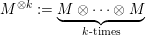 $M^{\otimes k}:=\underbrace{M\otimes \cdots \otimes M}_{k\text{-times}}$ for a quasi-good module
 $M$ and
 $k\in \mathbb{Z}_{{\geqslant}1}$ is again quasi-good.
For simple modules  $M$ and
 $N$ in
 $\mathscr{C}_{\mathfrak{g}}$, we say that
 $M$ and
 $N$commute or
 $M$ commutes with
 $N$ if
 $M\otimes N\simeq N\otimes M$. We say that
 $M$ and
 $N$strongly commute or
 $M$strongly commutes with
 $N$ if
 $M\otimes N$ is simple. When simple modules
 $M$ and
 $N$ strongly commute, they commute. Note that
 $M\otimes N$ is simple if and only if
 $N\otimes M$ is simple, since
 $K(\mathscr{C}_{\mathfrak{g}})$ is a commutative ring.
Also, when the simple modules  $M_{t}$
 $(1\leqslant t\leqslant m)$ strongly commute with each other, it is proved in [Reference HernandezHer10] that
 $$\begin{eqnarray}M_{1}\otimes \cdots \otimes M_{m}\simeq M_{\unicode[STIX]{x1D70E}(1)}\otimes \cdots \otimes M_{\unicode[STIX]{x1D70E}(m)}\text{ is simple}\end{eqnarray}$$
for every element  $\unicode[STIX]{x1D70E}$ in the symmetric group
 $\mathfrak{S}_{m}$ on
 $m$-letters. We say that a simple module
 $L$ in
 $\mathscr{C}_{\mathfrak{g}}$ is real if
 $L$ strongly commutes with itself, i.e., if
 $L\otimes L$ is simple. Note that quasi-good modules are real.
2.2 $R$-matrices, universal and renormalizing coefficients

In this subsection, we review the notion of  $R$-matrices on
 $U_{q}^{\prime }(\mathfrak{g})$-modules and their coefficients by following mainly [Reference KashiwaraKas02, § 8] and [Reference Akasaka and KashiwaraAK97, Appendices A and B]. Let us choose the universal
 $R$-matrix in the following way. Take a basis
 $\{{P_{\unicode[STIX]{x1D708}}\}}_{\unicode[STIX]{x1D708}}$ of
 $U_{q}^{+}(\mathfrak{g})$ and a basis
 $\{{Q_{\unicode[STIX]{x1D708}}\}}_{\unicode[STIX]{x1D708}}$ of
 $U_{q}^{-}(\mathfrak{g})$ dual to each other with respect to a suitable coupling between
 $U_{q}^{+}(\mathfrak{g})$ and
 $U_{q}^{-}(\mathfrak{g})$. Then for
 $U_{q}^{\prime }(\mathfrak{g})$-modules
 $M$ and
 $N$ define
 $$\begin{eqnarray}R_{M,N}^{\text{univ}}(u\otimes v)=q^{(\operatorname{wt}(u),\operatorname{wt}(v))}\mathop{\sum }_{\unicode[STIX]{x1D708}}P_{\unicode[STIX]{x1D708}}v\otimes Q_{\unicode[STIX]{x1D708}}u,\end{eqnarray}$$
so that  $R_{M,N}^{\text{univ}}$ gives a
 $U_{q}^{\prime }(\mathfrak{g})$-linear homomorphism from
 $M\otimes N$ to
 $N\otimes M$ provided that the infinite sum has a meaning.
For modules  $M$ and
 $N$ in
 $\mathscr{C}_{\mathfrak{g}}$, it is known that
 $R_{M,N_{z}}^{\text{univ}}$ converges in the
 $z$-adic topology. Hence, it induces a morphism of
 $\mathbf{k}((z))\otimes U_{q}^{\prime }(\mathfrak{g})$-modules
 $$\begin{eqnarray}R_{M,N_{z}}^{\text{univ}}:\mathbf{k}((z))\otimes _{\boldsymbol{ k}[z^{\pm 1}]}(M\otimes N_{z})\longrightarrow \mathbf{k}((z))\otimes _{\mathbf{k}[z^{\pm 1}]}(N_{z}\otimes M).\end{eqnarray}$$
Moreover,  $R_{M,N_{z}}^{\text{univ}}$ is an isomorphism.
It is known that  $R^{\text{univ}}$ satisfies the following properties: the following diagram commutes

for  $L$,
 $M$,
 $N$ in
 $\mathscr{C}_{\mathfrak{g}}$.
Let  $M$ and
 $N$ be non-zero modules in
 $\mathscr{C}_{\mathfrak{g}}$. If there exists
 $a(z)\in \mathbf{k}((z))$ such that
 $$\begin{eqnarray}a(z)R_{M,N_{z}}^{\text{univ}}(M\otimes N_{z})\subset N_{z}\otimes M,\end{eqnarray}$$
then we say that  $R_{M,N_{z}}^{\text{univ}}$ is rationally renormalizable. In this case, we can choose
 $c_{M,N}(z)\in \mathbf{k}((z))^{\times }$ as
 $a(z)$ such that, for any
 $x\in \mathbf{k}^{\times }$, the specialization of
 $R_{M,N_{z}}^{\text{ren}}:=c_{M,N}(z)R_{M,N_{z}}^{\text{univ}}:M\otimes N_{z}\rightarrow N_{z}\otimes M$ at
 $z=x$
 $$\begin{eqnarray}R_{M,N_{z}}^{\text{ren}}|_{z=x}:M\otimes N_{x}\rightarrow N_{x}\otimes M\end{eqnarray}$$
does not vanish. Such  $R_{M,N_{z}}^{\text{ren}}$ and
 $c_{M,N}(z)$ are unique up to multiplication by an element of
 $\mathbf{k}[z^{\pm 1}]^{\times }=\bigsqcup _{\,n\in \mathbb{Z}}\mathbf{k}^{\times }z^{n}$. We call
 $c_{M,N}(z)$ the renormalizing coefficient.
We write
 $$\begin{eqnarray}\mathbf{r}_{M,N}:=R_{M,N_{z}}^{\text{ren}}|_{z=1}:M\otimes N\rightarrow N\otimes M,\end{eqnarray}$$
and call it  $R$-matrix. The
 $R$-matrix
 $\mathbf{r}_{M,N}$ is well defined up to a constant multiple when
 $R_{M,N_{z}}^{\text{univ}}$ is rationally renormalizable. By the definition,
 $\mathbf{r}_{M,N}$ never vanishes.
Now assume that  $M$ and
 $N$ are simple
 $U_{q}^{\prime }(\mathfrak{g})$-modules in
 $\mathscr{C}_{\mathfrak{g}}$. Then
 $\mathbf{k}(z)\otimes _{\mathbf{k}[z^{\pm 1}]}(M\otimes N_{z})$ is a simple
 $\mathbf{k}(z)\otimes U_{q}^{\prime }(\mathfrak{g})$-module [Reference KashiwaraKas02, Proposition 9.5].
Furthermore, we have the following. Let  $u$ and
 $v$ be dominant extremal weight vectors of
 $M$ and
 $N$, respectively. Then there exists
 $a_{M,N}(z)\in \mathbf{k}[[z]]^{\times }$ such that
 $$\begin{eqnarray}R_{M,N_{z}}^{\text{univ}}(u\otimes v_{z})=a_{M,N}(z)(v_{z}\otimes u).\end{eqnarray}$$
Then  $R_{M,N_{z}}^{\text{norm}}:=a_{M,N}(z)^{-1}R_{M,N_{z}}^{\text{univ}}|_{\;\boldsymbol{ k}(z)\otimes _{\mathbf{k}[z^{\pm 1}]}(M\otimes N_{z})}$ induces a unique
 $\mathbf{k}(z)\otimes U_{q}^{\prime }(\mathfrak{g})$-module isomorphism

satisfying
 $$\begin{eqnarray}R_{M,N_{z}}^{\text{norm}}(u\otimes v_{z})=v_{z}\otimes u.\end{eqnarray}$$
We call  $a_{M,N}(z)$ the universal coefficient of
 $M$ and
 $N$, and
 $R_{M,N_{z}}^{\text{norm}}$ the normalized
 $R$-matrix.
Similarly there exists a unique  $\mathbf{k}(z)\otimes U_{q}^{\prime }(\mathfrak{g})$-module isomorphism

satisfying
 $$\begin{eqnarray}R_{M,N}^{\text{norm}}(u_{z}\otimes v)=v\otimes u_{z}.\end{eqnarray}$$
Note that  $R_{M_{z},N}^{\text{norm}}=T_{z}\circ R_{M,N_{w}}^{\text{norm}}$ with
 $w=1/z$. Here, for
 $x\in \mathbf{k}(z)$, the functor
 $T_{x}$ is the endofunctor of the category of
 $\mathbf{k}(z)\otimes U_{q}^{\prime }(\mathfrak{g})$-modules
 $L$ given by
 $T_{x}(L)=L_{x}$.
Let  $d_{M,N}(z)\in \mathbf{k}[z]$ be a monic polynomial of the smallest degree such that the image of
 $d_{M,N}(z)R_{M,N_{z}}^{\text{norm}}(M\otimes N_{z})$ is contained in
 $N_{z}\otimes M$. We call
 $d_{M,N}(z)$ the denominator of
 $R_{M,N_{z}}^{\text{norm}}$. Then we have
 $$\begin{eqnarray}R_{M,N_{z}}^{\text{ren}}=d_{M,N}(z)R_{M,N_{z}}^{\text{norm}}:M\otimes N_{z}\longrightarrow N_{z}\otimes M\end{eqnarray}$$
up to multiplication by an element of  $\mathbf{k}[z^{\pm 1}]^{\times }$.
Hence, the universal  $R$-matrix
 $R_{M,N_{z}}^{\text{univ}}$ is rationally renormalizable and we have
 $$\begin{eqnarray}R_{M,N_{z}}^{\text{ren}}=a_{M,N}(z)^{-1}d_{M,N}(z)R_{M,N_{z}}^{\text{univ}}\quad \text{and}\quad c_{M,N}(z)={\displaystyle \frac{d_{M,N}(z)}{a_{M,N}(z)}}\end{eqnarray}$$
up to multiplication by an element of  $\mathbf{k}[z^{\pm 1}]^{\times }$ (see [Reference Kang, Kashiwara and KimKKK18, Example 2.3] and [Reference Date and OkadoDO94] for instances of
 $R$-matrices).
Since  $\mathbf{k}(z)\otimes _{\mathbf{k}[z^{\pm 1}]}(M\otimes N_{z})$ is a simple
 $\mathbf{k}(z)\otimes U_{q}^{\prime }(\mathfrak{g})$-module [Reference KashiwaraKas02, Proposition 9.5], we have
 $$\begin{eqnarray}\displaystyle & & \displaystyle \operatorname{Hom}_{\mathbf{k}[z^{\pm 1}]\otimes U_{q}^{\prime }(\mathfrak{g})}(M\otimes N_{z},N_{z}\otimes M)=\mathbf{k}[z^{\pm 1}]R_{M,N_{z}}^{\text{ren}}.\end{eqnarray}$$
Similarly there exists a  $\mathbf{k}[z^{\pm 1}]\otimes U_{q}^{\prime }(\mathfrak{g})$-linear homomorphism
 $R_{M_{z},N}^{\text{ren}}:M_{z}\otimes N\rightarrow N\otimes M_{z}$ such that
 $$\begin{eqnarray}\displaystyle \operatorname{Hom}_{\mathbf{k}[z^{\pm 1}]\otimes U_{q}^{\prime }(\mathfrak{g})}(M_{z}\otimes N,N\otimes M_{z})=\mathbf{k}[z^{\pm 1}]R_{M_{z},N}^{\text{ren}}. & & \displaystyle\end{eqnarray}$$
The homomorphism  $R_{M_{z},N}^{\text{ren}}$ is unique up to multiplication by an element of
 $\mathbf{k}[z^{\pm 1}]^{\times }$. We have
 $$\begin{eqnarray}\displaystyle R_{M_{z},N}^{\text{ren}}=d_{M,N}(z^{-1})\;R_{M_{z},N}^{\text{norm}}\hspace{0.6em}{\rm mod}\hspace{0.2em}\mathbf{k}[z^{\pm 1}]^{\times }. & & \displaystyle\end{eqnarray}$$
In particular, we have
 $$\begin{eqnarray}\displaystyle R_{N_{z},M}^{\text{ren}}\circ R_{M,N_{z}}^{\text{ren}}=d_{M,N}(z)d_{N,M}(z^{-1})\operatorname{id}_{M\otimes N_{z}}\hspace{0.6em}{\rm mod}\hspace{0.2em}\mathbf{k}[z^{\pm 1}]^{\times }. & & \displaystyle\end{eqnarray}$$
Theorem 2.5 ([Reference Akasaka and KashiwaraAK97, Reference ChariCha10, Reference KashiwaraKas02, Reference Kang, Kashiwara, Kim and OhKKKO15a]; see also [Reference Kang, Kashiwara and KimKKK18, Theorem 2.2]).
(i) For good modules
$M$ and $N$, the zeroes of $d_{M,N}(z)$ belong to $\mathbb{C}[[q^{1/m}]]q^{1/m}$ for some $m\in \mathbb{Z}_{{>}0}$.(ii) For simple modules
$M$ and $N$ such that one of them is real, $M_{x}$ and $N_{y}$ strongly commute to each other if and only if $d_{M,N}(z)d_{N,M}(1/z)$ does not vanish at $z=y/x$.(iii) Let
$M_{k}$ be a good module with a dominant extremal vector $u_{k}$ of weight $\unicode[STIX]{x1D706}_{k}$, and $a_{k}\in \mathbf{k}^{\times }$ for $k=1,\ldots ,t$. Assume that $a_{j}/a_{i}$ is not a zero of $d_{M_{i},M_{j}}(z)$ for any $1\leqslant i<j\leqslant t$. Then the following statements hold. (a)
$(M_{1})_{a_{1}}\otimes \cdots \otimes (M_{t})_{a_{t}}$ is generated by $u_{1}\otimes \cdots \otimes u_{t}$.(b) The head of
$(M_{1})_{a_{1}}\otimes \cdots \otimes (M_{t})_{a_{t}}$ is simple.(c) Any non-zero submodule of
$(M_{t})_{a_{t}}\otimes \cdots \otimes (M_{1})_{a_{1}}$ contains the vector $u_{t}\otimes \cdots \otimes u_{1}$.(d) The socle of
$(M_{t})_{a_{t}}\otimes \cdots \otimes (M_{1})_{a_{1}}$ is simple.(e) Let
$\mathbf{r}_{}:(M_{1})_{a_{1}}\otimes \cdots \otimes (M_{t})_{a_{t}}\rightarrow (M_{t})_{a_{t}}\otimes \cdots \otimes (M_{1})_{a_{1}}$ be the specialization of $R_{M_{1},\ldots ,M_{t}}^{\text{norm}}:=\prod _{1\leqslant j<k\leqslant t}R_{M_{j},\,M_{k}}^{\text{norm}}$ at $z_{k}=a_{k}$. Then the image of $\mathbf{r}_{}$ is simple and it coincides with the head of $(M_{1})_{a_{1}}\otimes \cdots \otimes (M_{t})_{a_{t}}$ and also with the socle of $(M_{t})_{a_{t}}\otimes \cdots \otimes (M_{1})_{a_{1}}$.
(iv) For a simple integrable
$U_{q}^{\prime }(\mathfrak{g})$-module $M$, there exists a finite sequence (2.14)which satisfies the following condition: for any$$\begin{eqnarray}((i_{1},a_{1}),\ldots ,(i_{t},a_{t}))\in I_{0}\times \mathbf{k}^{\times }\end{eqnarray}$$$\unicode[STIX]{x1D70E}\in \mathfrak{S}_{t}$ such that $$\begin{eqnarray}d_{V(\unicode[STIX]{x1D71B}_{i_{\unicode[STIX]{x1D70E}(k)}}),V(\unicode[STIX]{x1D71B}_{i_{\unicode[STIX]{x1D70E}(k^{\prime })}})}(a_{\unicode[STIX]{x1D70E}(k^{\prime })}/a_{\unicode[STIX]{x1D70E}(k)})\not =0\quad \text{for }1\leqslant k<k^{\prime }\leqslant t,\end{eqnarray}$$$M$ is isomorphic to the head of $V(\unicode[STIX]{x1D71B}_{i_{\unicode[STIX]{x1D70E}(1)}})_{a_{\unicode[STIX]{x1D70E}(1)}}\otimes \cdots \otimes V(\unicode[STIX]{x1D71B}_{i_{\unicode[STIX]{x1D70E}(t)}})_{a_{\unicode[STIX]{x1D70E}(t)}}$.Moreover, such a sequence
$((i_{1},a_{1}),\ldots ,(i_{t},a_{t}))$ is unique up to permutation. In particular, $M$ has the dominant extremal weight $\sum _{k=1}^{t}\unicode[STIX]{x1D71B}_{i_{k}}$.























From the above theorem, for each simple module  $M$ in
 $\mathscr{C}_{\mathfrak{g}}$, we can associate a multiset of pairs
 $\{(i_{k},a_{k})\in I_{0}\times \mathbf{k}^{\times }\}_{1\leqslant k\leqslant t}$ satisfying the conditions in Theorem 2.5(iv). We call
 $\{(i_{k},a_{k})\in I_{0}\times \mathbf{k}^{\times }\}_{1\leqslant k\leqslant t}$ of
 $M$the multipair associated to
 $M$, and write
 $$\begin{eqnarray}M=S((i_{1},a_{1}),\ldots ,(i_{t},a_{t})).\end{eqnarray}$$
Proposition 2.6. Let  $M$ and
 $N$ be non-zero modules in
 $\mathscr{C}_{\mathfrak{g}}$, and
 $a\in \mathbf{k}^{\times }$ such that
 $R_{M,N_{z}}^{\text{univ}}$ is rationally renormalizable. Then we have
 $$\begin{eqnarray}\displaystyle c_{M,N}(z) & = & \displaystyle c_{M^{\ast },N^{\ast }}(z)=c_{\text{}^{\ast }\!M,\text{}^{\ast }\!N}(z),\nonumber\\ \displaystyle c_{M_{a},N}(z) & = & \displaystyle c_{M,N}(a^{-1}z),\quad c_{M,N_{a}}(z)=c_{M,N}(az).\nonumber\end{eqnarray}$$
Proof. The first assertion follows from  $(R_{M,N_{z}}^{\text{univ}})^{\ast }=R_{M^{\ast },N_{z}^{\ast }}^{\text{univ}}$: that is,

commutes [Reference Frenkel and ReshetikhinFR92]. The second follows from the first and the others are trivial. ◻
Proposition 2.7 [Reference Akasaka and KashiwaraAK97, (A14), (A15), Proposition A.1, Lemma C.15].
Let  $M$ and
 $N$ be simple modules in
 $\mathscr{C}_{\mathfrak{g}}$.
(i) We have
(2.15)$$\begin{eqnarray}\displaystyle a_{M,N}(z) & = & \displaystyle a_{M^{\ast },\,N^{\ast }}(z)=a_{\text{}^{\ast }\!M,\,\text{}^{\ast }\!N}(z),\nonumber\\ \displaystyle d_{M,N}(z) & = & \displaystyle d_{M^{\ast },\,N^{\ast }}(z)=d_{\text{}^{\ast }\!M,\,\text{}^{\ast }\!N}(z),\nonumber\\ \displaystyle a_{M,N}(z) & = & \displaystyle a_{M_{x},\,N_{x}}(z),\quad d_{M,N}(z)=d_{M_{x},\,N_{x}}(z)\quad \text{for any }x\in \mathbf{k}^{\times }.\end{eqnarray}$$(ii) We have
$a_{M,N}(z)a_{\text{}^{\ast }\!M,N}(z)\equiv d_{M,N}(z)/d_{N,\text{}^{\ast }\!M}(z^{-1})~\text{mod}~\mathbf{k}[z^{\pm 1}]^{\times }$.


We set
 $$\begin{eqnarray}\unicode[STIX]{x1D711}(z):=\mathop{\prod }_{s=0}^{\infty }(1-\widetilde{p}^{\,s}z)\in \mathbf{k}[[z]]\subset \widehat{\mathbf{k}}[[z]].\end{eqnarray}$$
Here  $\widetilde{p}:=p^{\ast \,2}=q^{2\langle c,\unicode[STIX]{x1D70C}\rangle }=q^{2\sum _{i\in I}\mathsf{c}_{i}}$. We have
 $$\begin{eqnarray}\unicode[STIX]{x1D711}(z)=\mathop{\sum }_{m=0}^{\infty }(-1)^{m}{\displaystyle \frac{\widetilde{p}^{\,m(m-1)/2}}{\mathop{\prod }_{k=1}^{m}(1-\widetilde{p}^{\,k})}}z^{m}.\end{eqnarray}$$
For  $i,j\in I_{0}$, set
 $$\begin{eqnarray}\displaystyle a_{i,j}(z) & := & \displaystyle a_{V(\unicode[STIX]{x1D71B}_{i}),V(\unicode[STIX]{x1D71B}_{j})}(z),\nonumber\\ \displaystyle d_{i,j}(z) & := & \displaystyle d_{V(\unicode[STIX]{x1D71B}_{i}),V(\unicode[STIX]{x1D71B}_{j})}(z).\end{eqnarray}$$
Then the universal coefficient  $a_{i,j}(z)$ is obtained as follows (see [Reference Akasaka and KashiwaraAK97, Appendix A]):
 $$\begin{eqnarray}a_{i,j}(z)\equiv {\displaystyle \frac{\mathop{\prod }_{\unicode[STIX]{x1D707}}\unicode[STIX]{x1D711}(p^{\ast }y_{\unicode[STIX]{x1D707}}z)\unicode[STIX]{x1D711}(p^{\ast }\overline{y_{\unicode[STIX]{x1D707}}}z)}{\mathop{\prod }_{\unicode[STIX]{x1D708}}\unicode[STIX]{x1D711}(x_{\unicode[STIX]{x1D708}}z)\unicode[STIX]{x1D711}(p^{\ast 2}\overline{x_{\unicode[STIX]{x1D708}}}z)}}\quad \text{mod}~\mathbf{k}[z^{\pm 1}]^{\times },\end{eqnarray}$$
where
 $$\begin{eqnarray}d_{i,j}(z)=\mathop{\prod }_{\unicode[STIX]{x1D708}}(z-x_{\unicode[STIX]{x1D708}})\quad \text{and}\quad d_{i^{\ast },\,j}(z)=\mathop{\prod }_{\unicode[STIX]{x1D707}}(z-y_{\unicode[STIX]{x1D707}}).\end{eqnarray}$$
Example 2.8. For the fundamental representations  $V(\unicode[STIX]{x1D71B}_{i})$ over
 $$\begin{eqnarray}U_{q}^{\prime }(A_{n-1}^{(1)})\quad (i\in I_{0}=\{1,\ldots ,n-1\}),\end{eqnarray}$$
the denominators  $d_{i,j}(z):=d_{V(\unicode[STIX]{x1D71B}_{i}),V(\unicode[STIX]{x1D71B}_{j})}(z)$ and the universal coefficients of
 $a_{i,j}(z):=a_{V(\unicode[STIX]{x1D71B}_{i}),V(\unicode[STIX]{x1D71B}_{j})}(z)$ are given as follows:
 $$\begin{eqnarray}\displaystyle d_{i,j}(z)=\mathop{\prod }_{s=1}^{\min (i,j,n-i,n-j)}(z-(-q)^{2s+|i-j|})\quad \text{and}\quad a_{i,j}(z)\equiv {\displaystyle \frac{[\,|i-j|\,]\,[2n-|i-j|\,]}{[i+j]\,[2n-i-j]}}\quad \text{mod}~\mathbf{k}[z^{\pm 1}]^{\times }, & & \displaystyle \nonumber\end{eqnarray}$$
where  $[a]:=\unicode[STIX]{x1D711}((-q)^{a}z)$. Note that
 $p^{\ast }=(-q)^{n}$ in this case.
Remark 2.9. The denominators of the normalized  $R$-matrices
 $d_{i,j}(z)$ and hence the universal coefficients
 $a_{i,j}(z)$ were calculated in [Reference Akasaka and KashiwaraAK97, Reference Date and OkadoDO94, Reference Kang, Kashiwara and KimKKK15, Reference OhOh15] for the classical affine types and in [Reference Oh and ScrimshawOS19] for the exceptional affine types (see also [Reference Frenkel and HernandezFH15, Reference FujitaFuj18, Reference Kang, Kashiwara, Misra, Miwa, Nakashima and NakayashikiKKMM+92, Reference Kashiwara, Misra, Okado and YamadaKMOY07, Reference YamaneYam98]).
Lemma 2.10 [Reference Kang, Kashiwara, Kim and OhKKKO15a, Lemma 3.10].
Let  $M_{k}$ be a module in
 $\mathscr{C}_{\mathfrak{g}}$
 $(k=1,2,3)$. Let
 $X$ be a
 $U_{q}^{\prime }(\mathfrak{g})$-submodule of
 $M_{1}\otimes M_{2}$ and
 $Y$ a
 $U_{q}^{\prime }(\mathfrak{g})$-submodule of
 $M_{2}\otimes M_{3}$ such that
 $X\otimes M_{3}\subset M_{1}\otimes Y$ as submodules of
 $M_{1}\otimes M_{2}\otimes M_{3}$. Then there exists a
 $U_{q}^{\prime }(\mathfrak{g})$-submodule
 $N$ of
 $M_{2}$ such that
 $X\subset M_{1}\otimes N$ and
 $N\otimes M_{3}\subset Y$.
Proposition 2.11 [Reference Kang, Kashiwara, Kim and OhKKKO15a, Corollary 3.11].
(i) Let
$M_{k}$ be a module in $\mathscr{C}_{\mathfrak{g}}$$(k=1,2,3)$, and let $\unicode[STIX]{x1D711}_{1}:L\rightarrow M_{2}\otimes M_{3}$ and $\unicode[STIX]{x1D711}_{2}:M_{1}\otimes M_{2}\rightarrow L^{\prime }$ be non-zero morphisms. Assume further that $M_{2}$ is a simple module. Then the compositiondoes not vanish.(ii) Let
$M$, $N_{1}$ and $N_{2}$ be non-zero modules in $\mathscr{C}_{\mathfrak{g}}$, and assume that $R_{N_{k},M_{z}}^{\text{univ}}$ is rationally renormalizable for $k=1,2$. Then $R_{N_{1}\otimes N_{2},M_{z}}^{\text{univ}}$ is rationally renormalizable, and we have If we assume further that$$\begin{eqnarray}{\displaystyle \frac{c_{N_{1},M}(z)c_{N_{2},M}(z)}{c_{N_{1}\otimes N_{2},M}(z)}}\in \mathbf{k}[z^{\pm 1}].\end{eqnarray}$$$M$ is simple, then we have and the following diagram commutes up to a constant multiple.$$\begin{eqnarray}c_{N_{1}\otimes N_{2},M}(z)\equiv c_{N_{2},M}(z)c_{N_{1},M}(z)\hspace{0.6em}{\rm mod}\hspace{0.2em}\mathbf{k}[z^{\pm 1}]^{\times }\end{eqnarray}$$(2.19)(iii) Let
$M$, $N_{1}$ and $N_{2}$ be non-zero modules in $\mathscr{C}_{\mathfrak{g}}$, and assume that $R_{M,\,(N_{k})_{z}}^{\text{univ}}$ is rationally renormalizable for $k=1,2$. Then $R_{M,\,(N_{1}\otimes N_{2})_{z}}^{\text{univ}}$ is rationally renormalizable, and we have If we assume further that$$\begin{eqnarray}{\displaystyle \frac{c_{M,N_{1}}(z)c_{M,N_{2}}(z)}{c_{M,N_{1}\otimes N_{2}}(z)}}\in \mathbf{k}[z^{\pm 1}].\end{eqnarray}$$$M$ is simple, then we have and the following diagram commutes up to a constant multiple.$$\begin{eqnarray}c_{N_{1}\otimes N_{2},M}(z)\equiv c_{N_{2},M}(z)c_{N_{1},M}(z)\hspace{0.6em}{\rm mod}\hspace{0.2em}\mathbf{k}[z^{\pm 1}]^{\times }\end{eqnarray}$$(2.20)






Proof. Part (i) and the commutativity of (2.19) are nothing but [Reference Kang, Kashiwara, Kim and OhKKKO15a, Corollary 3.11]. Since

commutes, the diagram

commutes. Hence  $R_{N_{1}\otimes N_{2},M_{z}}^{\text{univ}}$ is rationally renormalizable, and we have
 $c_{N_{1},M}(z)c_{N_{2},M}(z)\in \mathbf{k}[z^{\pm 1}]c_{N_{1}\otimes N_{2},M}(z)$.
If  $M$ is simple, then (i) implies that
 $c_{N_{2},M}(z)c_{N_{1},M}(z)R_{N_{1}\otimes N_{2},~M_{z}}^{\text{univ}}$ never vanishes at any
 $z=a\in \mathbf{k}^{\times }$. Hence
 $c_{N_{2},M}(z)c_{N_{1},M}(z)R_{N_{1}\otimes N_{2},~M_{z}}^{\text{univ}}\equiv R_{N_{1}\otimes N_{2},~M_{z}}^{\text{ren}}~\text{mod}~\mathbf{k}[z^{\pm 1}]^{\times }$, which implies
 $c_{N_{1}\otimes N_{2},M}(z)\equiv c_{N_{2},M}(z)c_{N_{1},M}(z)~\text{mod}~\mathbf{k}[z^{\pm 1}]^{\times }$.
The proof of (iii) is similar. ◻
Proposition 2.12. Let  $M$ and
 $N$ be modules in
 $\mathscr{C}_{\mathfrak{g}}$, and let
 $M^{\prime }$ and
 $N^{\prime }$ be a non-zero subquotient of
 $M$ and
 $N$, respectively. Assume that
 $R_{M,N_{z}}^{\text{univ}}$ is rationally renormalizable. Then
 $R_{M^{\prime },N_{z}^{\prime }}^{\text{univ}}$ is rationally renormalizable, and
 $c_{M,N}(z)/c_{M^{\prime }.N^{\prime }}(z)\in \mathbf{k}[z^{\pm 1}]$.
Proof. We shall show that  $R_{M^{\prime },N_{z}}^{\text{univ}}$ is rationally renormalizable and
 $c_{M,N}(z)/c_{M^{\prime }.N}(z)\in \mathbf{k}[z^{\pm 1}]$ for a non-zero quotient
 $M^{\prime }$ of
 $M$. We have a commutative diagram

which induces the following.

Hence  $R_{M^{\prime },N_{z}}^{\text{univ}}$ is rationally renormalizable and
 $c_{M,N}(z)\in c_{M^{\prime }.N}(z)\mathbf{k}[z^{\pm 1}]$.
Similarly  $R_{M^{\prime },N_{z}}^{\text{univ}}$ is rationally renormalizable and
 $c_{M,N}(z)/c_{M^{\prime }.N}(z)\in \mathbf{k}[z^{\pm 1}]$ for any non-zero submodule of
 $M^{\prime }$ of
 $M$, and hence for any non-zero subquotient of
 $M^{\prime }$ of
 $M$.
We can argue similarly for non-zero subquotients  $N^{\prime }$ of
 $N$.◻
Theorem 2.13 [Reference Kang, Kashiwara, Kim and OhKKKO15a].
Let  $M$ and
 $N$ be simple modules in
 $\mathscr{C}_{\mathfrak{g}}$ and assume that one of them is real. Then we have that:
(i)
$\operatorname{Hom}(M\otimes N,N\otimes M)=\mathbf{k}\,\mathbf{r}_{M,N}$;(ii)
$M\otimes N$ and $N\otimes M$ have simple socles and simple heads;(iii) moreover,
$\text{Im}(\mathbf{r}_{M,N})$ is isomorphic to the head of $M\otimes N$ and the socle of $N\otimes M$;(iv)
$M\otimes N$ is simple whenever its head and its socle are isomorphic to each other.



Note that (i) is not proved in [Reference Kang, Kashiwara, Kim and OhKKKO15a] but it can be proved similarly to the quiver Hecke algebra case given in [Reference Kang, Kashiwara, Kim and OhKKKO18, Theorem 2.11].
For modules  $M$ and
 $N$ in
 $\mathscr{C}_{\mathfrak{g}}$, we denote by
 $M\,\,\unicode[STIX]{x1D6FB}\,\,N$ and
 $M\,\,\unicode[STIX]{x1D6E5}\,\,N$ the head and the socle of
 $M\otimes N$, respectively.
3 New invariants for pairs of modules
In this section, we introduce new invariants for pairs of  $U_{q}^{\prime }(\mathfrak{g})$-modules by using
 $R$-matrices and investigate their properties. These invariants have similar properties to those in the quiver Hecke algebra case.
Recall that
 $$\begin{eqnarray}\widetilde{p}:=p^{\ast 2}=q^{2\langle c,\unicode[STIX]{x1D70C}\rangle }\quad \text{and}\quad \unicode[STIX]{x1D711}(z)=\mathop{\prod }_{s\in \mathbb{Z}_{{\geqslant}0}}(1-\widetilde{p}^{\,s}z)\in \mathbf{k}[[z]].\end{eqnarray}$$
We set
 $$\begin{eqnarray}\widetilde{p}^{\,S}:=\{\widetilde{p}^{\,k}\mid k\in S\}\quad \text{for a subset }S\text{ of }\mathbb{Z}.\end{eqnarray}$$
Definition 3.1. We define the subset  ${\mathcal{G}}$ of
 $\mathbf{k}((z))^{\times }$ as follows:
 $$\begin{eqnarray}\displaystyle {\mathcal{G}}:=\bigg\{cz^{m}\mathop{\prod }_{a\in \mathbf{k}^{\times }}\unicode[STIX]{x1D711}(az)^{\unicode[STIX]{x1D702}_{a}}\,\bigg|\,\begin{array}{@{}c@{}}c\in \mathbf{k}^{\times },m\in \mathbb{Z},\\ \unicode[STIX]{x1D702}_{a}\in \mathbb{Z}\text{ vanishes except finitely many }a\end{array}\bigg\}. & & \displaystyle\end{eqnarray}$$
Note that  ${\mathcal{G}}$ forms a group with respect to the multiplication. We have
 $\mathbf{k}(z)^{\times }\subset {\mathcal{G}}$. Note also that for
 $f(z)=cz^{m}\prod _{a\in \mathbf{k}^{\times }}\unicode[STIX]{x1D711}(az)^{\unicode[STIX]{x1D702}_{a}}$,
 $\{{\unicode[STIX]{x1D702}_{a}\}}_{a\in \mathbf{k}^{\times }}$ is determined by
 $f(z)$ since
 $$\begin{eqnarray}\displaystyle {\displaystyle \frac{f(z)}{f(\widetilde{p}z)}}=(\widetilde{p}\,)^{-m}\mathop{\prod }_{a\in \mathbf{k}^{\times }}(1-az)^{\unicode[STIX]{x1D702}_{a}}. & & \displaystyle \nonumber\end{eqnarray}$$
Proposition 3.2. Let  $M$ and
 $N$ be modules in
 $\mathscr{C}_{\mathfrak{g}}$. If
 $R_{M,N_{z}}^{\text{univ}}$ is rationally renormalizable, then the renormalizing coefficient
 $c_{M,N}(z)$ belongs to
 ${\mathcal{G}}$.
Proof. Let us take a simple submodule  $M^{\prime }$ of
 $M$ and a simple submodule
 $N^{\prime }$ of
 $N$. Then, Proposition 2.12 implies that
 $c_{M,N}(z)/c_{M^{\prime }N^{\prime }}(z)\in \mathbf{k}(z)^{\times }\subset {\mathcal{G}}$. Hence the assertion follows from the following lemma.◻
Lemma 3.3. For simple modules  $M$ and
 $N$ in
 $\mathscr{C}_{\mathfrak{g}}$, the universal coefficient
 $a_{M,N}(z)$ as well as the renormalizing coefficient
 $c_{M,N}(z)$ is contained in
 ${\mathcal{G}}$.
Proof. Let us write  $M=S((i_{1},a_{1}),\ldots ,(i_{t},a_{t}))$ and
 $N=S((j_{1},b_{1}),\ldots ,(j_{t^{\prime }},b_{t^{\prime }}))$. When
 $t+t^{\prime }=2$,
 $a_{M,N}(z)$ is nothing but
 $a_{i,j}(b_{1}/a_{1}z)$ in (2.18), and our assertion holds. Then the induction on
 $t+t^{\prime }$ proceeds by Propositions 2.11 and 2.12.◻
For each subset  $S$ of
 $\mathbb{Z}$, we can construct a group homomorphism from
 ${\mathcal{G}}$ to the additive group
 $\mathbb{Z}$ by associating the sum of exponents
 $\unicode[STIX]{x1D702}_{a}$ such that
 $a\in \widetilde{p}^{\,S}$. For instance, by taking
 $S$ as
 $\mathbb{Z}$ or
 $\mathbb{Z}_{{\leqslant}0}$, we define the group homomorphisms
 $$\begin{eqnarray}\displaystyle \widetilde{\text{De}}\text{g}:{\mathcal{G}}\rightarrow \mathbb{Z}\quad \text{and}\quad \text{Deg}^{\infty }:{\mathcal{G}}\rightarrow \mathbb{Z}, & & \displaystyle \nonumber\end{eqnarray}$$
by
 $$\begin{eqnarray}\widetilde{\text{De}}\text{g}(f(z))=\mathop{\sum }_{a\in \widetilde{p}^{\,\mathbb{Z}_{{\leqslant}0}}}\unicode[STIX]{x1D702}_{a}\quad \text{and}\quad \text{Deg}^{\infty }(f(z))=\mathop{\sum }_{a\in \widetilde{p}^{\,\mathbb{Z}}}\unicode[STIX]{x1D702}_{a},\end{eqnarray}$$
for  $f(z)=cz^{m}\prod \unicode[STIX]{x1D711}(az)^{\unicode[STIX]{x1D702}_{a}}\in {\mathcal{G}}$. As their linear combination, we introduce the group homomorphism
 $$\begin{eqnarray}\displaystyle \text{Deg}:{\mathcal{G}}\rightarrow \mathbb{Z}\quad \text{by }\text{Deg}=2\widetilde{\text{De}}\text{g}-\text{Deg}^{\infty }, & & \displaystyle \nonumber\end{eqnarray}$$
namely,
 $$\begin{eqnarray}\displaystyle \text{Deg}(f(z))=\mathop{\sum }_{a\in \widetilde{p}^{\,\mathbb{Z}_{{\leqslant}0}}}\unicode[STIX]{x1D702}_{a}-\mathop{\sum }_{a\in \widetilde{p}^{\,\mathbb{Z}_{{>}0}}}\unicode[STIX]{x1D702}_{a}. & & \displaystyle\end{eqnarray}$$
Lemma 3.4. Let  $f(z)\in {\mathcal{G}}$.
(i) If
$f(z)\in \mathbf{k}(z)$, then we have $$\begin{eqnarray}\widetilde{\text{De}}\text{g}(f(z))=\text{zero}_{z=1}f(z),\quad \text{Deg}^{\infty }(f(z))=0,\quad \text{and}\quad \text{Deg}(f(z))=2\text{zero}_{z=1}f(z).\end{eqnarray}$$(ii) If
$g(z),\;h(z)\in {\mathcal{G}}$ satisfy $g(z)/h(z)\in \mathbf{k}[z^{\pm 1}]$, then $\text{Deg}(h(z))\leqslant \text{Deg}(g(z))$.(iii) We have
$\text{Deg}^{\infty }f(z)=-\text{Deg}(f(\widetilde{p}^{\,n}z))=\text{Deg}(f(\widetilde{p}^{\,-n}z))$ for $n\gg 0$.(iv) If
$\text{Deg}^{\infty }(f(cz))=0$ for any $c\in \mathbf{k}^{\times }$, then $f(z)\in \mathbf{k}(z)$.









Proof. We may assume  $f(z)=\prod _{a\in \mathbf{k}^{\times }}\unicode[STIX]{x1D711}(az)^{\unicode[STIX]{x1D702}_{a}}$.
(i) For  $a\not \in \widetilde{p}^{\,\mathbb{Z}}$, it is obvious. For
 $a\in \widetilde{p}^{\,\mathbb{Z}}$, we have
 $$\begin{eqnarray}\displaystyle \widetilde{\text{De}}\text{g}(1-az) & = & \displaystyle \widetilde{\text{De}}\text{g}(\unicode[STIX]{x1D711}(az)/\unicode[STIX]{x1D711}(\widetilde{p}az))\nonumber\\ \displaystyle & = & \displaystyle \unicode[STIX]{x1D6FF}(a\in \widetilde{p}^{\,\mathbb{Z}\leqslant 0})-\unicode[STIX]{x1D6FF}(\widetilde{p}a\in \widetilde{p}^{\,\mathbb{Z}\leqslant 0})=\unicode[STIX]{x1D6FF}(a=1)=\text{zero}_{z=1}(1-az)\nonumber\end{eqnarray}$$
and
 $$\begin{eqnarray}\text{Deg}^{\infty }(1-az)=\text{Deg}^{\infty }(\unicode[STIX]{x1D711}(az)/\unicode[STIX]{x1D711}(\widetilde{p}az))=1-1=0.\end{eqnarray}$$
(ii) This follows from (i).
(iii) We have
 $$\begin{eqnarray}\text{Deg}(f(\widetilde{p}^{\,n}z))=\mathop{\sum }_{a\widetilde{p}^{\,n}\in \widetilde{p}^{\,\mathbb{Z}\leqslant 0}}\unicode[STIX]{x1D702}_{a}-\mathop{\sum }_{a\widetilde{p}^{\,n}\in \widetilde{p}^{\,\mathbb{Z}>0}}\unicode[STIX]{x1D702}_{a}.\end{eqnarray}$$
Hence we have  $\text{Deg}(f(\widetilde{p}^{\,n}z))=-\sum _{a\in \widetilde{p}^{\,\mathbb{Z}}}\unicode[STIX]{x1D702}_{a}$ if
 $n\gg 0$ and
 $\text{Deg}(f(\widetilde{p}^{\,n}z))=\sum _{a\in \widetilde{p}^{\,\mathbb{Z}}}\unicode[STIX]{x1D702}_{a}$ if
 $n\ll 0$.
(iv) By the assumption, we can easily see that  $f(z)$ is a product of functions of the form
 $\unicode[STIX]{x1D711}(az)/\unicode[STIX]{x1D711}(\widetilde{p}^{\,m}az)$ (
 $a\in \mathbf{k}^{\times }$,
 $m\in \mathbb{Z}$). Then the result follows from
 $\unicode[STIX]{x1D711}(az)/\unicode[STIX]{x1D711}(\widetilde{p}^{\,m}az)\in \mathbf{k}(z)$.◻
Remark 3.5. Any  $f(z)\in {\mathcal{G}}$ extends to a meromorphic function on
 $$\begin{eqnarray}\{(z,q^{1/\ell })\in \mathbb{C}\times \mathbb{C};|q^{1/\ell }|<\unicode[STIX]{x1D700}\}\end{eqnarray}$$
for some  $\ell \in \mathbb{Z}_{{>}0}$ and
 $\unicode[STIX]{x1D700}>0$. Hence
 $\text{zero}_{z=\widetilde{p}^{\,k}}f(z)$, the order of zero of
 $f(z)$ at
 $z=\widetilde{p}^{\,k}$, makes sense for any
 $k\in \mathbb{Z}$. Then one has
 $\widetilde{\text{De}}\text{g}(f(z))=\text{zero}_{z=1}f(z)$.
Using the homomorphisms  $\text{Deg}$,
 $\widetilde{\text{De}}\text{g}$ and
 $\text{Deg}^{\infty }$, we define the new invariants for a pair of modules
 $M$,
 $N$ in
 $\mathscr{C}_{\mathfrak{g}}$ such that
 $R_{M,N_{z}}^{\text{univ}}$ is rationally renormalizable.
Definition 3.6. For non-zero modules  $M$ and
 $N$ in
 $\mathscr{C}_{\mathfrak{g}}$ such that
 $R_{M,N_{z}}^{\text{univ}}$ is rationally renormalizable, we define the integers
 $\unicode[STIX]{x1D6EC}(M,N)$,
 $\widetilde{\unicode[STIX]{x1D6EC}}(M,N)$ and
 $\unicode[STIX]{x1D6EC}^{\infty }(M,N)$ as follows:
 $$\begin{eqnarray}\unicode[STIX]{x1D6EC}(M,N)=\text{Deg}(c_{M,N}(z)),\quad \widetilde{\unicode[STIX]{x1D6EC}}(M,N)=\widetilde{\text{De}}\text{g}(c_{M,N}(z)),\quad \unicode[STIX]{x1D6EC}^{\infty }(M,N)=\text{Deg}^{\infty }(c_{M,N}(z)).\end{eqnarray}$$
Hence, we have
 $$\begin{eqnarray}\displaystyle \widetilde{\unicode[STIX]{x1D6EC}}(M,N)={\textstyle \frac{1}{2}}(\unicode[STIX]{x1D6EC}(M,N)+\unicode[STIX]{x1D6EC}^{\infty }(M,N)). & & \displaystyle\end{eqnarray}$$
Lemma 3.7. For any simple modules  $M$,
 $N$ in
 $\mathscr{C}_{\mathfrak{g}}$ and
 $x\in \mathbf{k}^{\times }$, we have
 $$\begin{eqnarray}\displaystyle \unicode[STIX]{x1D6EC}(M,N) & = & \displaystyle \unicode[STIX]{x1D6EC}(M^{\ast },N^{\ast })=\unicode[STIX]{x1D6EC}(\text{}^{\ast }\!M,\text{}^{\ast }\!N)=\unicode[STIX]{x1D6EC}(M_{x},N_{x}),\nonumber\\ \displaystyle \widetilde{\unicode[STIX]{x1D6EC}}(M,N) & = & \displaystyle \widetilde{\unicode[STIX]{x1D6EC}}(M^{\ast },N^{\ast })=\widetilde{\unicode[STIX]{x1D6EC}}(\text{}^{\ast }\!M,\text{}^{\ast }\!N)=\widetilde{\unicode[STIX]{x1D6EC}}(M_{x},N_{x}),\nonumber\\ \displaystyle \unicode[STIX]{x1D6EC}^{\infty }(M,N) & = & \displaystyle \unicode[STIX]{x1D6EC}^{\infty }(M^{\ast },N^{\ast })=\unicode[STIX]{x1D6EC}^{\infty }(\text{}^{\ast }\!M,\text{}^{\ast }\!N)=\unicode[STIX]{x1D6EC}^{\infty }(M_{x},N_{x}).\nonumber\end{eqnarray}$$
Proof. These assertions follow from Proposition 2.6. ◻
Lemma 3.8. Let  $M$ and
 $N$ be non-zero modules in
 $\mathscr{C}_{\mathfrak{g}}$.
(i) If
$M$ and $N$ are simple, then we have $\unicode[STIX]{x1D6EC}^{\infty }(M,N)=\text{Deg}^{\infty }(c_{M,N}(z))=-\text{Deg}^{\infty }(a_{M,N}(z))$.(ii) If
$R_{M,N_{z}}^{\text{univ}}$ is rationally renormalizable, then $$\begin{eqnarray}\unicode[STIX]{x1D6EC}^{\infty }(M,N)=-\unicode[STIX]{x1D6EC}(M,N_{\widetilde{p}^{\,n}})=\unicode[STIX]{x1D6EC}(M,N_{\widetilde{p}^{\,-n}})\quad \text{for }n\gg 0.\end{eqnarray}$$





Proof. (i) This follows from  $a_{M,N}(z)c_{M,N}(z)\in \mathbf{k}(z)$ and Lemma 3.4(ii).
(ii) This follows from  $c_{M,N_{\widetilde{p}^{\,n}}}(z)=c_{M,N}(\widetilde{p}^{\,n}z)$ and Lemma 3.4(iii).◻
Proposition 3.9. Let  $M$ and
 $N$ be modules in
 $\mathscr{C}_{\mathfrak{g}}$, and let
 $M^{\prime }$ and
 $N^{\prime }$ be a non-zero subquotient of
 $M$ and
 $N$, respectively. Assume that
 $R_{M,N_{z}}^{\text{univ}}$ is rationally renormalizable. Then
 $R_{M^{\prime },N_{z}^{\prime }}^{\text{univ}}$ is rationally renormalizable, and
 $$\begin{eqnarray}\unicode[STIX]{x1D6EC}(M^{\prime },N^{\prime })\leqslant \unicode[STIX]{x1D6EC}(M,N)\quad \text{and}\quad \unicode[STIX]{x1D6EC}^{\infty }(M^{\prime },N^{\prime })=\unicode[STIX]{x1D6EC}^{\infty }(M,N).\end{eqnarray}$$
Lemma 3.10. Let  $M$,
 $N$ and
 $L$ be non-zero modules in
 $\mathscr{C}_{\mathfrak{g}}$.
(i) If
$R_{M_{,}\,L_{z}}^{\text{univ}}$ and $R_{N,\,L_{z}}^{\text{univ}}$ are rationally renormalizable, then $R_{M\otimes N_{,}\,L_{z}}^{\text{univ}}$ is rationally renormalizable and If we assume further that$$\begin{eqnarray}\unicode[STIX]{x1D6EC}(M\otimes N,L)\leqslant \unicode[STIX]{x1D6EC}(M,L)+\unicode[STIX]{x1D6EC}(N,L)\quad \text{and}\quad \unicode[STIX]{x1D6EC}^{\infty }(M\otimes N,L)=\unicode[STIX]{x1D6EC}^{\infty }(M,L)+\unicode[STIX]{x1D6EC}^{\infty }(N,L).\end{eqnarray}$$$L$ is simple, then the equality holds instead of the inequality.(ii) If
$R_{L_{,}M_{z}}^{\text{univ}}$ and $R_{L,N_{z}}^{\text{univ}}$ are rationally renormalizable, then $R_{L,\;(M\otimes N)_{z}}^{\text{univ}}$ is rationally renormalizable and If we assume further that$$\begin{eqnarray}\unicode[STIX]{x1D6EC}(L,M\otimes N)\leqslant \unicode[STIX]{x1D6EC}(L,M)+\unicode[STIX]{x1D6EC}(L,N)\quad \text{and}\quad \unicode[STIX]{x1D6EC}^{\infty }(L,M\otimes N)=\unicode[STIX]{x1D6EC}^{\infty }(L,M)+\unicode[STIX]{x1D6EC}^{\infty }(L,N).\end{eqnarray}$$$L$ is simple, then the equality holds instead of the inequality.


Proof. These assertions follow from Proposition 2.11. ◻
Proposition 3.11. Let  $M$,
 $N$ and
 $L$ be non-zero modules in
 $\mathscr{C}_{\mathfrak{g}}$, and let
 $S$ be a non-zero subquotient of
 $M\otimes N$.
(i) Assume that
$R_{M,L_{z}}^{\text{univ}}$ and $R_{N,L_{z}}^{\text{univ}}$ are rationally renormalizable. Then $R_{S,L_{z}}^{\text{univ}}$ is rationally renormalizable and $$\begin{eqnarray}\unicode[STIX]{x1D6EC}(S,L)\leqslant \unicode[STIX]{x1D6EC}(M,L)+\unicode[STIX]{x1D6EC}(N,L)\quad \text{and}\quad \unicode[STIX]{x1D6EC}^{\infty }(S,L)=\unicode[STIX]{x1D6EC}^{\infty }(M,L)+\unicode[STIX]{x1D6EC}^{\infty }(N,L).\end{eqnarray}$$(ii) Assume that
$R_{L,M_{z}}^{\text{univ}}$ and $R_{L,N_{z}}^{\text{univ}}$ are rationally renormalizable. Then $R_{L,S_{z}}^{\text{univ}}$ is rationally renormalizable and $$\begin{eqnarray}\unicode[STIX]{x1D6EC}(L,S)\leqslant \unicode[STIX]{x1D6EC}(L,M)+\unicode[STIX]{x1D6EC}(L,N)\quad \text{and}\quad \unicode[STIX]{x1D6EC}^{\infty }(L,S)=\unicode[STIX]{x1D6EC}^{\infty }(L,M)+\unicode[STIX]{x1D6EC}^{\infty }(L,N).\end{eqnarray}$$


Corollary 3.12. For simple modules
 $$\begin{eqnarray}M=S((i_{1},a_{1}),\ldots ,(i_{\ell },a_{\ell }))\quad \text{and}\quad N=S((j_{1},b_{1}),\ldots ,(j_{\ell ^{\prime }},b_{\ell ^{\prime }}))\quad \text{in }\mathscr{C}_{\mathfrak{g}},\end{eqnarray}$$
we have
 $$\begin{eqnarray}\unicode[STIX]{x1D6EC}^{\infty }(M,N)=\mathop{\sum }_{1\leqslant \unicode[STIX]{x1D708}\leqslant \ell ,\,1\leqslant \unicode[STIX]{x1D707}\leqslant \ell ^{\prime }}\unicode[STIX]{x1D6EC}^{\infty }(V(\unicode[STIX]{x1D71B}_{i_{\unicode[STIX]{x1D708}}})_{a_{\unicode[STIX]{x1D708}}},V(\unicode[STIX]{x1D71B}_{j_{\unicode[STIX]{x1D707}}})_{b_{\unicode[STIX]{x1D707}}}).\end{eqnarray}$$
Example 3.13. Take  $L=M=V(\unicode[STIX]{x1D71B}_{1})_{(-q)^{-2}}$ and
 $N=V(\unicode[STIX]{x1D71B}_{1})$ over
 $U_{q}^{\prime }(A_{2}^{(1)})$ where
 $p^{\ast }=(-q)^{3}$ and
 $\widetilde{p}=q^{6}$. Then we have
 $$\begin{eqnarray}c_{M,L}(z)={\displaystyle \frac{[2][-2]}{[0][6]}},\quad c_{N,L}(z)={\displaystyle \frac{[0][-4]}{[-2][4]}}\quad \text{and hence }c_{M,L}(z)c_{N,L}(z)={\displaystyle \frac{[2][-4]}{[6][4]}}.\end{eqnarray}$$
On the other hand, we have  $M\,\unicode[STIX]{x1D6FB}\,N=V(\unicode[STIX]{x1D71B}_{2})_{(-q)^{-1}}$ and
 $$\begin{eqnarray}c_{M\,\unicode[STIX]{x1D6FB}\,N,L}(z)={\displaystyle \frac{[2][-4]}{[0][4]}}.\end{eqnarray}$$
Thus we have
 $$\begin{eqnarray}\widetilde{\unicode[STIX]{x1D6EC}}(M,L)+\widetilde{\unicode[STIX]{x1D6EC}}(N,L)=(-1)+1=0,\quad \widetilde{\unicode[STIX]{x1D6EC}}(M\,\unicode[STIX]{x1D6FB}\,N,L)=-1\end{eqnarray}$$
and hence
 $$\begin{eqnarray}\unicode[STIX]{x1D6EC}(M,L)+\unicode[STIX]{x1D6EC}(N,L)-\unicode[STIX]{x1D6EC}(M\,\unicode[STIX]{x1D6FB}\,N,L)=2\quad \text{and}\quad c_{M\,\unicode[STIX]{x1D6FB}\,N,L}(z)\times (1-z)=c_{M,L}(z)c_{N,L}(z).\end{eqnarray}$$
Definition 3.14 (see Corollary 3.19).
For simple modules  $M$ and
 $N$ in
 $\mathscr{C}_{\mathfrak{g}}$, we define
 $\mathfrak{d}(M,N)$ by
 $$\begin{eqnarray}\mathfrak{d}(M,N)={\textstyle \frac{1}{2}}(\unicode[STIX]{x1D6EC}(M,N)+\unicode[STIX]{x1D6EC}(M^{\ast },N)).\end{eqnarray}$$
Now we will prove that  $\mathfrak{d}(M,N)$ is non-negative integer. In order to do that, we need some preparation.
Lemma 3.15. For simple modules  $M$ and
 $N$ in
 $\mathscr{C}_{\mathfrak{g}}$, we have
 $$\begin{eqnarray}c_{M,N}(z)c_{M^{\ast },N}(z)\equiv d_{M,N}(z)d_{N,M}(z^{-1})\end{eqnarray}$$
and
 $$\begin{eqnarray}{\displaystyle \frac{c_{M,N}(z)}{c_{M,N}(\widetilde{p}z)}}\equiv {\displaystyle \frac{d_{M,N}(z)d_{N,M}(z^{-1})}{d_{M^{\ast },N}(z)d_{N,M^{\ast }}(z^{-1})}}\end{eqnarray}$$
up to multiplication by an element of  $\mathbf{k}[z^{\pm 1}]^{\times }$.
Proof. By Proposition 2.7(ii), we have
 $$\begin{eqnarray}a_{M^{\ast },N}(z)a_{M,N}(z)\equiv {\displaystyle \frac{d_{M^{\ast },N}(z)}{d_{N,M}(z^{-1})}}\quad \text{mod}~\mathbf{k}[z^{\pm 1}]^{\times }.\end{eqnarray}$$
Recall that  $c_{M,N}(z)=d_{M,N}(z)/a_{M,N}(z)$. Then we have
 $$\begin{eqnarray}\displaystyle c_{M,N}(z)c_{M^{\ast },N}(z) & = & \displaystyle {\displaystyle \frac{d_{M,N}(z)}{a_{M,N}(z)}}\times {\displaystyle \frac{d_{M^{\ast },N}(z)}{a_{M^{\ast },N}(z)}}\nonumber\\ \displaystyle & \equiv & \displaystyle d_{M,N}(z)\times d_{M^{\ast },N}(z)\times {\displaystyle \frac{d_{N,M}(z^{-1})}{d_{M^{\ast },N}(z)}}\nonumber\\ \displaystyle & \equiv & \displaystyle d_{M,N}(z)\times d_{N,M}(z^{-1})\quad \text{mod}~\mathbf{k}[z^{\pm 1}]^{\times }.\nonumber\end{eqnarray}$$
Thus we have
 $$\begin{eqnarray}{\displaystyle \frac{c_{M,N}(z)}{c_{M,N}(\widetilde{p}z)}}={\displaystyle \frac{c_{M,N}(z)c_{M^{\ast },N}(z)}{c_{M^{\ast },N}(z)c_{M^{\ast \ast },N}(z)}}\equiv {\displaystyle \frac{d_{M,N}(z)d_{N,M}(z^{-1})}{d_{M^{\ast },N}(z)d_{N,M^{\ast }}(z^{-1})}}\quad \text{mod}~\mathbf{k}[z^{\pm 1}]^{\times }.\Box\end{eqnarray}$$
Proposition 3.16. For simple modules  $M$ and
 $N$ in
 $\mathscr{C}_{\mathfrak{g}}$, we have
 $$\begin{eqnarray}\displaystyle \mathfrak{d}(M,N)=\text{zero}_{z=1}(d_{M,N}(z)d_{N,M}(z^{-1})). & & \displaystyle\end{eqnarray}$$
In particular,
 $$\begin{eqnarray}\mathfrak{d}(M,N)\in \mathbb{Z}_{{\geqslant}0},\end{eqnarray}$$
and
 $$\begin{eqnarray}\mathfrak{d}(M,N)=\mathfrak{d}(N,M).\end{eqnarray}$$
Proof. By the preceding lemma,
 $$\begin{eqnarray}\displaystyle 2\mathfrak{d}(M,N) & = & \displaystyle \text{Deg}(c_{M,N}(z)c_{M^{\ast },N}(z))=\text{Deg}(d_{M,N}(z)d_{N,M}(z^{-1}))\nonumber\\ \displaystyle & = & \displaystyle 2\text{zero}_{z=1}(d_{M,N}(z)d_{N,M}(z^{-1})).\nonumber\end{eqnarray}$$
Here the last equality follows from Lemma 3.4(ii). The other assertions follow from (3.4). ◻
Corollary 3.17. Let  $M$ and
 $N$ be simple modules in
 $\mathscr{C}_{\mathfrak{g}}$. Assume that one of them is real. Then
 $M$ and
 $N$ strongly commute if and only if
 $\mathfrak{d}(M,N)=0$.
For  $k\in \mathbb{Z}$ and a module
 $M$ in
 $\mathscr{C}_{\mathfrak{g}}$, we define

Proposition 3.18. For simples  $M$ and
 $N$ in
 $\mathscr{C}_{\mathfrak{g}}$, we have
 $$\begin{eqnarray}\unicode[STIX]{x1D6EC}(M,N)=\unicode[STIX]{x1D6EC}(N^{\ast },M)=\unicode[STIX]{x1D6EC}(N,\text{}^{\ast }\!M).\end{eqnarray}$$
Proof. We shall prove  $\unicode[STIX]{x1D6EC}(M,N)=\unicode[STIX]{x1D6EC}(N^{\ast },M)$. The other equality follows from Lemma 3.7.
By (3.5), we have
 $$\begin{eqnarray}\displaystyle & & \displaystyle \unicode[STIX]{x1D6EC}(M,N)+\unicode[STIX]{x1D6EC}(M^{\ast },N)=\unicode[STIX]{x1D6EC}(N,M)+\unicode[STIX]{x1D6EC}(N^{\ast },M)\nonumber\\ \displaystyle & & \displaystyle \;\Longleftrightarrow \;\unicode[STIX]{x1D6EC}(M,N)-\unicode[STIX]{x1D6EC}(N^{\ast },M)=\unicode[STIX]{x1D6EC}(N,M)-\unicode[STIX]{x1D6EC}(M^{\ast },N).\nonumber\end{eqnarray}$$
Set
 $$\begin{eqnarray}K(M,N):=\unicode[STIX]{x1D6EC}(M,N)-\unicode[STIX]{x1D6EC}(N^{\ast },M).\end{eqnarray}$$
Then we have  $K(M,N)=K(N,M)$ and
 $$\begin{eqnarray}K(M^{\ast },N)=\unicode[STIX]{x1D6EC}(M^{\ast },N)-\unicode[STIX]{x1D6EC}(N^{\ast },M^{\ast })\underset{(\star )}{=}\unicode[STIX]{x1D6EC}(M^{\ast },N)-\unicode[STIX]{x1D6EC}(N,M)=-K(N,M)=-K(M,N),\end{eqnarray}$$
where ( $\star$) follows from Lemma 3.7. Hence we have
 $$\begin{eqnarray}K(M,N)=K(\mathscr{D}^{2n}(M),N)\quad \text{for any }n\in \mathbb{Z}.\end{eqnarray}$$
Note that, for  $n\gg 0$, we have
 $$\begin{eqnarray}\displaystyle \unicode[STIX]{x1D6EC}(\mathscr{D}^{2n}(M),N) & = & \displaystyle \unicode[STIX]{x1D6EC}(M_{\widetilde{p}^{\,n}},N)=\unicode[STIX]{x1D6EC}(M,N_{\widetilde{p}^{\,-n}})=\left\{\begin{array}{@{}ll@{}}\unicode[STIX]{x1D6EC}^{\infty }(M,N) & \text{if }n\gg 0,\\ -\unicode[STIX]{x1D6EC}^{\infty }(M,N) & \text{if }n\ll 0,\end{array}\right.\end{eqnarray}$$
 $$\begin{eqnarray}\displaystyle \unicode[STIX]{x1D6EC}(N^{\ast },\mathscr{D}^{2n}(M)) & = & \displaystyle \unicode[STIX]{x1D6EC}(N^{\ast },M_{\widetilde{p}^{\,n}})=\left\{\begin{array}{@{}ll@{}}-\unicode[STIX]{x1D6EC}^{\infty }(N^{\ast },M) & \text{if }n\gg 0,\\ \unicode[STIX]{x1D6EC}^{\infty }(N^{\ast },M) & \text{if }n\ll 0.\end{array}\right.\end{eqnarray}$$
 $n\gg 0$, we have
 $K(\mathscr{D}^{2n}(M),N)=-K(\mathscr{D}^{-2n}(M),N)$, which implies
 $K(M,N)=-K(M,N)$. Finally, we conclude that
 $$\begin{eqnarray}K(M,N)=0.\Box\end{eqnarray}$$
Corollary 3.19. For any simple modules  $M$ and
 $N$ in
 $\mathscr{C}_{\mathfrak{g}}$, we have
 $$\begin{eqnarray}\mathfrak{d}(M,N)={\textstyle \frac{1}{2}}(\unicode[STIX]{x1D6EC}(M,N)+\unicode[STIX]{x1D6EC}(N,M)).\end{eqnarray}$$
Corollary 3.20. For any real simple  $M$ in
 $\mathscr{C}_{\mathfrak{g}}$, we have
 $$\begin{eqnarray}\unicode[STIX]{x1D6EC}(M,M)=0.\end{eqnarray}$$
Proof. By Corollaries 3.17, 3.19 and the assumption that  $M$ is real simple, we have
 $$\begin{eqnarray}0=2\mathfrak{d}(M,M)=\unicode[STIX]{x1D6EC}(M,M)+\unicode[STIX]{x1D6EC}(M,M),\end{eqnarray}$$
which implies our assertion. ◻
Remark 3.21. The formula in Proposition 3.18 holds also for objects in the rigid monoidal category  $\widetilde{{\mathcal{C}}}_{w}$ (see [Reference Kashiwara, Kim, Oh and ParkKKOP19a]). Indeed, we have

and hence their generators  $R_{N^{\ast },M_{z}}^{\text{norm}}$ and
 $R_{M_{z},N}^{\text{norm}}$ have the same homogeneous degree.
Proposition 3.22. For simple modules  $M$ and
 $N$ in
 $\mathscr{C}_{\mathfrak{g}}$, we have:
(i)
$\unicode[STIX]{x1D6EC}(M,N)=\sum _{k\in \mathbb{Z}}(-1)^{k+\unicode[STIX]{x1D6FF}(k<0)}\mathfrak{d}(M,\mathscr{D}^{k}N)$;(ii)
$\unicode[STIX]{x1D6EC}^{\infty }(M,N)=\sum _{k\in \mathbb{Z}}(-1)^{k}\mathfrak{d}(M,\mathscr{D}^{k}N)$.


Proof. Write  $c_{M,N}(z)\equiv \prod \unicode[STIX]{x1D711}(az)^{\unicode[STIX]{x1D702}_{a}}~\text{mod}~\mathbf{k}[z^{\pm 1}]^{\times }$. Then we have
 $$\begin{eqnarray}{\displaystyle \frac{c_{M,N}(z)}{c_{M,N}(\widetilde{p}z)}}\equiv \prod (1-az)^{\unicode[STIX]{x1D702}_{a}}.\end{eqnarray}$$
and hence
 $$\begin{eqnarray}\displaystyle \unicode[STIX]{x1D702}_{\widetilde{p}^{\,k}} & = & \displaystyle \text{zero}_{z=\widetilde{p}^{\,-k}}\biggl({\displaystyle \frac{c_{M,N}(z)}{c_{M,N}(\widetilde{p}z)}}\biggr)=\text{zero}_{z=1}\biggl({\displaystyle \frac{c_{M,N}(\widetilde{p}^{\,-k}z)}{c_{M,N}(\widetilde{p}^{\,-k+1}z)}}\biggr)\nonumber\\ \displaystyle & \underset{(\star )}{=} & \displaystyle \mathfrak{d}(M,N_{\widetilde{p}^{\,-k}})-\mathfrak{d}(M^{\ast },N_{\widetilde{p}^{\,-k}})\nonumber\\ \displaystyle & = & \displaystyle \mathfrak{d}(M,\mathscr{D}^{-2k}N)-\mathfrak{d}(M,\mathscr{D}^{-2k+1}N).\nonumber\end{eqnarray}$$
Here  $(\star )$ follows from Lemma 3.15 and Proposition 3.16.
Thus we have
 $$\begin{eqnarray}\displaystyle \unicode[STIX]{x1D6EC}(M,N) & = & \displaystyle \mathop{\sum }_{k\in \mathbb{Z}}(-1)^{\unicode[STIX]{x1D6FF}(k<0)}\unicode[STIX]{x1D702}_{\widetilde{p}^{\,k}}\nonumber\\ \displaystyle & = & \displaystyle \mathop{\sum }_{k\in \mathbb{Z}}(-1)^{\unicode[STIX]{x1D6FF}(k<0)}(\mathfrak{d}(M,\mathscr{D}^{2k}N)-\mathfrak{d}(M^{\ast },\mathscr{D}^{2k}N))\nonumber\\ \displaystyle & = & \displaystyle \mathop{\sum }_{k\in \mathbb{Z}}(-1)^{\unicode[STIX]{x1D6FF}(k<0)}(\mathfrak{d}(M,\mathscr{D}^{2k}N)-\mathfrak{d}(M,\mathscr{D}^{2k+1}N))\nonumber\\ \displaystyle & = & \displaystyle \mathop{\sum }_{k\in \mathbb{Z}}(-1)^{k+\unicode[STIX]{x1D6FF}(k<0)}\mathfrak{d}(M,\mathscr{D}^{k}N),\nonumber\end{eqnarray}$$
which imply the first assertion. Similarly, we have
 $$\begin{eqnarray}\displaystyle \unicode[STIX]{x1D6EC}^{\infty }(M,N)=\mathop{\sum }_{k\in \mathbb{Z}}(\mathfrak{d}(M,\mathscr{D}^{-2k}N)-\mathfrak{d}(M,\mathscr{D}^{-2k+1}N))=\mathop{\sum }_{k\in \mathbb{Z}}(-1)^{k}\mathfrak{d}(M,\mathscr{D}^{k}N).\Box & & \displaystyle \nonumber\end{eqnarray}$$
The following corollary is a direct consequence of Proposition 3.22 and (3.5).
Corollary 3.23. For simple modules  $M$ and
 $N$ in
 $\mathscr{C}_{\mathfrak{g}}$, we have:
(1)
$\unicode[STIX]{x1D6EC}^{\infty }(M,N)=\unicode[STIX]{x1D6EC}^{\infty }(N,M)$;(2)
$\unicode[STIX]{x1D6EC}^{\infty }(M,N)=-\unicode[STIX]{x1D6EC}^{\infty }(M^{\ast },N)=-\unicode[STIX]{x1D6EC}^{\infty }(\text{}^{\ast }\!M,N)$.


Proof. Sine  $\mathfrak{d}(M,N)=\mathfrak{d}(\mathscr{D}^{k}M,\mathscr{D}^{k}N)$, we have
 $$\begin{eqnarray}\displaystyle \unicode[STIX]{x1D6EC}^{\infty }(M,N) & = & \displaystyle \mathop{\sum }_{k\in \mathbb{Z}}(-1)^{k}\mathfrak{d}(M,\mathscr{D}^{k}N)=\mathop{\sum }_{k\in \mathbb{Z}}(-1)^{k}\mathfrak{d}(\mathscr{D}^{k}M,N)\nonumber\\ \displaystyle & = & \displaystyle \mathop{\sum }_{k\in \mathbb{Z}}(-1)^{k}\mathfrak{d}(N,\mathscr{D}^{k}M)=\unicode[STIX]{x1D6EC}^{\infty }(N,M).\nonumber\end{eqnarray}$$
Hence the first assertion follows. The second assertion follows similarly. ◻
4 Further properties of the invariants
We start this section with the following proposition, which can be understood as a quantum affine analogue of [Reference Kang, Kashiwara, Kim and OhKKKO18, Proposition 3.2.8].
Proposition 4.1. Let  $N_{1}$,
 $N_{2}$ and
 $M$ be non-zero modules in
 $\mathscr{C}_{\mathfrak{g}}$ and let
 $f:N_{1}\rightarrow N_{2}$ be a morphism. We assume that
 $R_{N_{k},M_{z}}^{\text{univ}}$ is rationally renormalizable for
 $k=1,2$.
(i) If
$f$ does not vanish, then $c_{N_{1},M}(z)/c_{N_{2},M}(z)\in \mathbf{k}(z)$ and $$\begin{eqnarray}\unicode[STIX]{x1D6EC}(N_{1},M)-\unicode[STIX]{x1D6EC}(N_{2},M)=2\text{zero}_{z=1}\biggl({\displaystyle \frac{c_{N_{1},M}(z)}{c_{N_{2},M}(z)}}\biggr).\end{eqnarray}$$(ii) If
$\unicode[STIX]{x1D6EC}(M,N_{1})=\unicode[STIX]{x1D6EC}(M,N_{2})$, then the following diagram is commutative. (iii) If
$\unicode[STIX]{x1D6EC}(N_{1},M)>\unicode[STIX]{x1D6EC}(N_{2},M)$, then the compositionvanishes.(iv) If
$\unicode[STIX]{x1D6EC}(N_{1},M)<\unicode[STIX]{x1D6EC}(N_{2},M)$, then the compositionvanishes.









Although we do not write them, similar statements hold for  $c_{M,N_{k}}(z)$ and
 $M\otimes N_{k}$.
Proof. Without loss of generality, we may assume that  $f$ is non-zero.
(i) Proposition 2.12 implies that  $c_{N_{1},M}(z)/c_{N_{2},M}(z)\in \mathbf{k}(z)$. Hence we have by Lemma 3.4 that
 $$\begin{eqnarray}2\text{zero}_{z=1}\biggl({\displaystyle \frac{c_{N_{1},M}(z)}{c_{N_{2},M}(z)}}\biggr)=\text{Deg}\biggl({\displaystyle \frac{c_{N_{1},M}(z)}{c_{N_{2},M}(z)}}\biggr)=\unicode[STIX]{x1D6EC}(N_{1},M)-\unicode[STIX]{x1D6EC}(N_{2},M).\end{eqnarray}$$
Set  $t=\text{zero}_{z=1}(c_{N_{1},M}(z)/c_{N_{2},M}(z))$. Then we can write
 $g(z)c_{N_{1},M}(z)=h(z)(z-1)^{t}c_{N_{2},M}(z)$ for some
 $t\in \mathbb{Z}$ and
 $g(z),h(z)\in \mathbf{k}[z]$ which do not vanish at
 $z=1$.
If  $t\geqslant 0$, then we have the following commutative diagram.

(ii) Since  $t=0$, by specializing
 $z=1$ in the above diagram, we obtain the commutativity of (4.1).
(iii) Since  $t>0$, the homomorphism
 $h(z)(z-1)^{t}R_{N_{2},M_{z}}^{\text{ren}}$ vanishes at
 $z=1$. Hence we have
 $$\begin{eqnarray}(M\otimes f)\circ \mathbf{r}_{N_{1},M}=(z-1)^{t}R_{N_{2},M_{z}}^{\text{ren}}|_{z=1}\circ (f\otimes M)=0,\end{eqnarray}$$
as desired.
(iv) Since  $t<0$, we have the following commutative diagram.

Since  $g(z)(z-1)^{-t}R_{N_{1},M_{z}}^{\text{ren}}$ vanishes at
 $z=1$, we obtain the desired result.◻
From the above proposition, we can show that the new invariants share similar properties with the one for quiver Hecke algebras studied in [Reference Kang, Kashiwara, Kim and OhKKKO18, §3.2]. We will collect such properties. Since the proofs are similar, we sometimes omit the proofs.
Proposition 4.2. Let  $L$,
 $M$ and
 $N$ be simple modules. Then we have
 $$\begin{eqnarray}\mathfrak{d}(S,L)\leqslant \mathfrak{d}(M,L)+\mathfrak{d}(N,L)\end{eqnarray}$$
for any simple subquotient  $S$ of
 $M\otimes N$. Moreover, when
 $L$ is real, the following conditions are equivalent.
(a)
$L$ strongly commutes with $M$ and $N$.(b) Any simple subquotient
$S$ of $M\otimes N$ commutes with $L$ and satisfies $$\begin{eqnarray}\unicode[STIX]{x1D6EC}(S,L)=\unicode[STIX]{x1D6EC}(M,L)+\unicode[STIX]{x1D6EC}(N,L).\end{eqnarray}$$(c) Any simple subquotient
$S$ of $M\otimes N$ commutes with $L$ and satisfies $$\begin{eqnarray}\unicode[STIX]{x1D6EC}(L,S)=\unicode[STIX]{x1D6EC}(L,M)+\unicode[STIX]{x1D6EC}(L,N).\end{eqnarray}$$


Lemma 4.3. Let  $L$,
 $M$ and
 $N$ be simple modules in
 $\mathscr{C}_{\mathfrak{g}}$, and assume that
 $L$ is real.
(i) If
$L$ strongly commutes with $N$, then the diagramcommutes and$$\begin{eqnarray}\unicode[STIX]{x1D6EC}(M\,\unicode[STIX]{x1D6FB}\,N,L)=\unicode[STIX]{x1D6EC}(M,L)+\unicode[STIX]{x1D6EC}(N,L).\end{eqnarray}$$(ii) If
$L$ strongly commutes with $M$, then the diagramcommutes and$$\begin{eqnarray}\unicode[STIX]{x1D6EC}(L,M\,\unicode[STIX]{x1D6FB}\,N)=\unicode[STIX]{x1D6EC}(L,M)+\unicode[STIX]{x1D6EC}(L,N).\end{eqnarray}$$


Corollary 4.4. Let  $L$,
 $M$
 $N$ be non-zero modules in
 $\mathscr{C}_{\mathfrak{g}}$. Assume that
 $L$ is real. Then we have the following.
(i) If
$L^{\ast }$ and $M$ strongly commute, then $$\begin{eqnarray}\unicode[STIX]{x1D6EC}(M\,\unicode[STIX]{x1D6FB}\,N,L)=\unicode[STIX]{x1D6EC}(M,L)+\unicode[STIX]{x1D6EC}(N,L).\end{eqnarray}$$(ii) If
$L$ and $N^{\ast }$ strongly commute, then $$\begin{eqnarray}\unicode[STIX]{x1D6EC}(L,M\,\unicode[STIX]{x1D6FB}\,N)=\unicode[STIX]{x1D6EC}(L,M)+\unicode[STIX]{x1D6EC}(L,N).\end{eqnarray}$$


Proof. (i) We have
 $$\begin{eqnarray}\displaystyle \unicode[STIX]{x1D6EC}(M\,\unicode[STIX]{x1D6FB}\,N,L)\underset{(\ast )}{=}\unicode[STIX]{x1D6EC}(L^{\ast },M\,\unicode[STIX]{x1D6FB}\,N)\underset{(\ast \ast )}{=}\unicode[STIX]{x1D6EC}(L^{\ast },M)+\unicode[STIX]{x1D6EC}(L^{\ast },N)=\unicode[STIX]{x1D6EC}(M,L)+\unicode[STIX]{x1D6EC}(N,L), & & \displaystyle \nonumber\end{eqnarray}$$
where  $(\ast )$ follows from Proposition 3.18 and
 $(\ast \ast )$ from Lemma 4.3. The proof of (ii) is similar.
 $$\begin{eqnarray}\unicode[STIX]{x1D6EC}(L,M\,\unicode[STIX]{x1D6FB}\,N)=\unicode[STIX]{x1D6EC}(M\,\unicode[STIX]{x1D6FB}\,N,\text{}^{\ast }\!L)=\unicode[STIX]{x1D6EC}(M,\text{}^{\ast }\!L)+\unicode[STIX]{x1D6EC}(N,\text{}^{\ast }\!L)=\unicode[STIX]{x1D6EC}(L,M)+\unicode[STIX]{x1D6EC}(L,N).\Box\end{eqnarray}$$
Proposition 4.5. Let  $M$ and
 $N$ be non-zero modules in
 $\mathscr{C}_{\mathfrak{g}}$ and assume that
 $M$ is real.
(i) Assume that
$N$ has a simple socle, $R_{N,M}^{\text{univ}}$ is rationally renormalizable and the diagramcommutes up to a non-zero constant multiple. Then$M\,\unicode[STIX]{x1D6E5}\,\operatorname{soc}(N)$ is isomorphic to the socle of $M\otimes N$. In particular, $M\otimes N$ has a simple socle.(ii) Assume that
$N$ has a simple head, $R_{M,N}^{\text{univ}}$ is rationally renormalizable and the diagramcommutes up to a non-zero constant multiple. Then$M\,\unicode[STIX]{x1D6FB}\,\operatorname{hd}(N)$ is equal to the simple head of $M\otimes N$.


Proof. Let  $S$ be an arbitrary simple submodule of
 $M\otimes N$. Then we have the following commutative diagram

for some  $f(z)\in \mathbf{k}(z)$ which is regular and does not vanish at
 $z=1$ and
 $m\in \mathbb{Z}_{{\geqslant}0}$. By specializing at
 $z=1$, we have a commutative diagram (up to a constant multiple).

Here, we use the fact that  $\mathbf{r}_{M\otimes N,M}=(\mathbf{r}_{M,M}\otimes N)\circ (M\otimes \mathbf{r}_{N,M})$ and
 $\mathbf{r}_{M,M}$ is equal to
 $\text{id}_{M\otimes M}$ up to a non-zero constant multiple, because
 $M$ is real.
It follows that  $S\otimes M\subset M\otimes (\mathbf{r}_{N,M})^{-1}(S)$. Hence there exists a submodule
 $K$ of
 $N$ such that
 $S\subset M\otimes K$ and
 $K\otimes M\subset (\mathbf{r}_{N,M})^{-1}(S)$ by Lemma 2.10. Hence
 $K\not =0$ and
 $\operatorname{soc}(N)\subset K$ by the assumption. Hence
 $\mathbf{r}_{N,M}(\operatorname{soc}(N)\otimes M)\subset \mathbf{r}_{N,M}(K\otimes M)\subset S$. Since
 $\mathbf{r}_{N,M}(\operatorname{soc}(N)\otimes M)$ is non-zero by the assumption, we have
 $\mathbf{r}_{N,M}(\operatorname{soc}(N)\otimes M)=S$. Thus we obtain the desired result for the first assertion.
The second assertion can be proved similarly. ◻
Proposition 4.6. Let  $L$,
 $M$ and
 $N$ be simple modules. We assume that
 $L$ is real and one of
 $M$ and
 $N$ is real.
(i) If
$\unicode[STIX]{x1D6EC}(L,M\,\unicode[STIX]{x1D6FB}\,N)=\unicode[STIX]{x1D6EC}(L,M)+\unicode[STIX]{x1D6EC}(L,N)$, then $L\otimes M\otimes N$ has a simple head and $N\otimes M\otimes L$ has a simple socle.(ii) If
$\unicode[STIX]{x1D6EC}(M\,\unicode[STIX]{x1D6FB}\,N,L)=\unicode[STIX]{x1D6EC}(M,L)+\unicode[STIX]{x1D6EC}(N,L)$, then $M\otimes N\otimes L$ has a simple head and $L\otimes N\otimes M$ has a simple socle.(iii) If
$\mathfrak{d}(L,M\,\unicode[STIX]{x1D6FB}\,N)=\mathfrak{d}(L,M)+\mathfrak{d}(L,N)$, then $L\otimes M\otimes N$ and $M\otimes N\otimes L$ have simple heads, and $N\otimes M\otimes L$ and $L\otimes N\otimes M$ have simple socles.









Proposition 4.7. Let  $M$ and
 $N$ be simple modules. Assume that one of them is real and
 $\mathfrak{d}(M,N)=1$. Then we have an exact sequence
 $$\begin{eqnarray}0\rightarrow M\,\unicode[STIX]{x1D6E5}\,N\rightarrow M\otimes N\rightarrow M\,\unicode[STIX]{x1D6FB}\,N\rightarrow 0.\end{eqnarray}$$
In particular,  $M\otimes N$ has length
 $2$.
Proof. By Theorem 2.13, Proposition 3.16 and (2.13), we can apply the same argument in the proof of [Reference Kashiwara and OhKO19, Lemma 7.3]. ◻
Definition 4.8. For simple modules  $M$ and
 $M^{\prime }$ in
 $\mathscr{C}_{\mathfrak{g}}$, we say that they are simply linked if
 $\mathfrak{d}(M,M^{\prime })=1$.
Proposition 4.9. Let  $X,Y,M$ and
 $N$ be simple modules in
 $\mathscr{C}_{\mathfrak{g}}$. Assume that there is an exact sequence
 $$\begin{eqnarray}0\rightarrow X\rightarrow M\otimes N\rightarrow Y\rightarrow 0,\end{eqnarray}$$
and  $X\otimes N$ and
 $Y\otimes N$ are simple.
(i) If
$X\otimes N\not \simeq Y\otimes N$, then $N$ is a real simple module.(ii) If
$M$ is real, then $N$ is a real simple module.



Lemma 4.10. Let  $\{{M_{i}\}}_{1\leqslant i\leqslant n}$ and
 $\{{N_{i}\}}_{1\leqslant i\leqslant n}$ be a pair of commuting families of real simple modules in
 $\mathscr{C}_{\mathfrak{g}}$. We assume that:
(a)
$\{M_{i}\,\unicode[STIX]{x1D6FB}\,{N_{i}\}}_{1\leqslant i\leqslant n}$ is a commuting family of real simple modules;(b)
$M_{i}\,\unicode[STIX]{x1D6FB}\,N_{i}$ commutes with $N_{j}$ for any $1\leqslant i,j\leqslant n$.



Then we have
 $$\begin{eqnarray}\biggl(\bigotimes _{1\leqslant i\leqslant n}M_{i}\biggr)\,\unicode[STIX]{x1D6FB}\,\biggl(\bigotimes _{1\leqslant j\leqslant n}N_{j}\biggr)\simeq \bigotimes _{1\leqslant i\leqslant n}(M_{i}\,\unicode[STIX]{x1D6FB}\,N_{i}).\end{eqnarray}$$
Theorem 4.11. Let  $M$ and
 $N$ be simple modules. We assume that
 $M$ is real. Then we have the equalities in the Grothendieck group
 $K(\mathscr{C}_{\mathfrak{g}})$:
(i)
$[M\otimes N]=[M\,\unicode[STIX]{x1D6FB}\,N]+\sum _{k}[S_{k}]$ with simple modules $S_{k}$ such that $\unicode[STIX]{x1D6EC}(M,S_{k})<\unicode[STIX]{x1D6EC}(M,M\,\unicode[STIX]{x1D6FB}\,N)=\unicode[STIX]{x1D6EC}(M,N)$;(ii)
$[M\otimes N]=[M\,\unicode[STIX]{x1D6E5}\,N]+\sum _{k}[S_{k}]$ with simple modules $S_{k}$ such that $\unicode[STIX]{x1D6EC}(S_{k},M)<\unicode[STIX]{x1D6EC}(M\,\unicode[STIX]{x1D6E5}\,N,M)=\unicode[STIX]{x1D6EC}(N,M)$;(iii)
$[N\otimes M]=[N\,\unicode[STIX]{x1D6FB}\,,M]+\sum _{k}[S_{k}]$ with simple modules $S_{k}$ such that $\unicode[STIX]{x1D6EC}(S_{k},M)<\unicode[STIX]{x1D6EC}(N\,\unicode[STIX]{x1D6FB}\,M,M)=\unicode[STIX]{x1D6EC}(N,M)$;(iv)
$[N\otimes M]=[N\,\unicode[STIX]{x1D6E5}\,M]+\sum _{k}[S_{k}]$ with simple modules $S_{k}$ such that $\unicode[STIX]{x1D6EC}(M,S_{k})<\unicode[STIX]{x1D6EC}(M,N\,\unicode[STIX]{x1D6E5}\,M)=\unicode[STIX]{x1D6EC}(M,N)$.












In particular,  $M\,\unicode[STIX]{x1D6FB}\,N$ as well as
 $M\,\unicode[STIX]{x1D6E5}\,N$ appears only once in the Jordan–Hölder series of
 $M\otimes N$ in
 $\mathscr{C}_{\mathfrak{g}}$.
Proof. We shall prove only statement (iii). The other statements are proved similarly. First remark that  $\unicode[STIX]{x1D6EC}(N\,\unicode[STIX]{x1D6FB}\,M,M)=\unicode[STIX]{x1D6EC}(N,M)+\unicode[STIX]{x1D6EC}(M,M)=\unicode[STIX]{x1D6EC}(N,M)$ by Lemma 4.3 and Corollary 3.20.
Let
 $$\begin{eqnarray}N\otimes M=K_{0}\supset K_{1}\supset \cdots \supset K_{\ell }\supset K_{\ell +1}=0\end{eqnarray}$$
be a Jordan–Hölder series of  $N\otimes M$. Then we have
 $K_{0}/K_{1}\simeq N\,\unicode[STIX]{x1D6FB}\,M$. Let us consider the renormalized R-matrix
 $R_{N\otimes M,M_{z}}^{\text{ren}}=(R_{N,M_{z}}^{\text{ren}}\otimes M)\circ (N\otimes R_{M,M_{z}}^{\text{ren}})$

Then  $R_{N\otimes M,M_{z}}^{\text{ren}}$ sends
 $K_{k}\otimes M_{z}$ to
 $M_{z}\otimes K_{k}$ for any
 $k$. By evaluating the above diagram at
 $z=1$, we obtain the following.

Since  $\operatorname{Im}(\mathbf{r}_{N,M}:N\otimes M\rightarrow M\otimes N)\simeq (N\otimes M)/K_{1}$, we have
 $\mathbf{r}_{M,N}(K_{1})=0$. Hence,
 $R_{N\otimes M,M_{z}}^{\text{ren}}$ sends
 $K_{1}\otimes M_{z}$ to
 $(M_{z}\otimes K_{1})\cap (z-1)(M_{z}\otimes (N\otimes M))=(z-1)(M_{z}\otimes K_{1})$. Thus
 $(z-1)^{-1}R_{N\otimes M,M_{z}}^{\text{ren}}|_{K_{1}\otimes M_{z}}$ is well defined. Hence, we have
 $$\begin{eqnarray}\unicode[STIX]{x1D6EC}(K_{1},M)\leqslant \unicode[STIX]{x1D6EC}(N\otimes M,M)-1=\unicode[STIX]{x1D6EC}(N,M)-1.\end{eqnarray}$$
Hence we have  $\unicode[STIX]{x1D6EC}(K_{k}/K_{k+1},M)\leqslant \unicode[STIX]{x1D6EC}(K_{1},M)<\unicode[STIX]{x1D6EC}(N,M)$ for
 $k\geqslant 1$ by Proposition 3.9.◻
Corollary 4.12. Let  $M$ and
 $N$ be simple modules in
 $\mathscr{C}_{\mathfrak{g}}$. We assume that one of them is real and
 $M\otimes N$ is not simple. We write
 $$\begin{eqnarray}[M\otimes N]=[M\,\unicode[STIX]{x1D6FB}\,N]+[M\,\unicode[STIX]{x1D6E5}\,N]+\mathop{\sum }_{k}[S_{k}]\end{eqnarray}$$
with simple modules  $S_{k}$ in the Grothendieck ring
 $K(\mathscr{C}_{\mathfrak{g}})$. Then we have the following.
(i) If
$M$ is real, then we have $\unicode[STIX]{x1D6EC}(M,M\,\unicode[STIX]{x1D6E5}\,N)<\unicode[STIX]{x1D6EC}(M,N)$, $\unicode[STIX]{x1D6EC}(M\,\unicode[STIX]{x1D6FB}\,N,M)<\unicode[STIX]{x1D6EC}(N,M)$ and $\unicode[STIX]{x1D6EC}(M,S_{k})<\unicode[STIX]{x1D6EC}(M,N)$, $\unicode[STIX]{x1D6EC}(S_{k},M)<\unicode[STIX]{x1D6EC}(N,M)$.(ii) If
$N$ is real, then we have $\unicode[STIX]{x1D6EC}(N,M\,\unicode[STIX]{x1D6FB}\,N)<\unicode[STIX]{x1D6EC}(N,M)$, $\unicode[STIX]{x1D6EC}(M\,\unicode[STIX]{x1D6E5}\,N,N)<\unicode[STIX]{x1D6EC}(M,N)$ and $\unicode[STIX]{x1D6EC}(N,S_{k})<\unicode[STIX]{x1D6EC}(N,M)$, $\unicode[STIX]{x1D6EC}(S_{k},N)<\unicode[STIX]{x1D6EC}(M,N)$.










The following theorem is a  $U_{q}^{\prime }(\mathfrak{g})$-analogue of [Reference Kashiwara and KimKK19, Theorem 4.1].
Theorem 4.13. Let  $X$ be a simple module and
 $M$ a real simple module in
 $\mathscr{C}_{\mathfrak{g}}$. If
 $[X]=[M]\unicode[STIX]{x1D719}$ for some
 $\unicode[STIX]{x1D719}$ in
 $K(\mathscr{C}_{\mathfrak{g}})$, then
 $X\simeq M\otimes Y$ for some simple module
 $Y$ in
 $\mathscr{C}_{\mathfrak{g}}$ which strongly commutes with
 $M$.
Proof. We may assume that
 $$\begin{eqnarray}\unicode[STIX]{x1D719}=\mathop{\sum }_{i\in K}[Y_{i}]-\mathop{\sum }_{j\in K^{\prime }}[Z_{j}],\end{eqnarray}$$
where  $Y_{i}$ and
 $Z_{j}$ are simple modules in
 $\mathscr{C}_{\mathfrak{g}}$ and there is no pair
 $(i,j)\in K\times K^{\prime }$ such that
 $Y_{i}\simeq Z_{j}$. It follows that
 $$\begin{eqnarray}[X]+\mathop{\sum }_{j\in K^{\prime }}[M\otimes Z_{j}]=\mathop{\sum }_{i\in K}[M\otimes Y_{i}]\quad \text{and}\quad [X]+\mathop{\sum }_{j\in K^{\prime }}[Z_{j}\otimes M]=\mathop{\sum }_{i\in K}[Y_{i}\otimes M]\end{eqnarray}$$
in  $K(\mathscr{C}_{\mathfrak{g}})$. Take
 $i_{0}$ such that
 $\unicode[STIX]{x1D6EC}(M,Y_{i_{0}})=\max \{\unicode[STIX]{x1D6EC}(M,Y_{i})\mid i\in K\}$. For any
 $j\in K^{\prime }$, the head
 $M\,\unicode[STIX]{x1D6FB}\,Z_{j}$ appears as a subquotient of some
 $M\otimes Y_{i}$. Since
 $M\,\unicode[STIX]{x1D6FB}\,Z_{j}\not \simeq M\,\unicode[STIX]{x1D6FB}\,Y_{i}$, we have
 $$\begin{eqnarray}\unicode[STIX]{x1D6EC}(M,Z_{j})=\unicode[STIX]{x1D6EC}(M,M\,\unicode[STIX]{x1D6FB}\,Z_{j})<\unicode[STIX]{x1D6EC}(M,M\,\unicode[STIX]{x1D6FB}\,Y_{i})=\unicode[STIX]{x1D6EC}(M,Y_{i})\leqslant \unicode[STIX]{x1D6EC}(M,Y_{i_{0}}).\end{eqnarray}$$
Since any simple subquotient  $S$ of
 $M\otimes Z_{j}$ satisfies
 $$\begin{eqnarray}\unicode[STIX]{x1D6EC}(M,S)\leqslant \unicode[STIX]{x1D6EC}(M,Z_{j})<\unicode[STIX]{x1D6EC}(M,Y_{i_{0}})=\unicode[STIX]{x1D6EC}(M,M\,\unicode[STIX]{x1D6FB}\,Y_{i_{0}}),\end{eqnarray}$$
we conclude that  $M\,\unicode[STIX]{x1D6FB}\,Y_{i_{0}}$ does not appear in
 $M\otimes Z_{j}$ for any
 $j\in K^{\prime }$. Hence
 $$\begin{eqnarray}X\simeq M\,\unicode[STIX]{x1D6FB}\,Y_{i_{0}}.\end{eqnarray}$$
In particular, we have
 $$\begin{eqnarray}\unicode[STIX]{x1D6EC}(M,Y_{i})\leqslant \unicode[STIX]{x1D6EC}(M,Y_{i_{0}})=\unicode[STIX]{x1D6EC}(M,M\,\unicode[STIX]{x1D6FB}\,Y_{i_{0}})=\unicode[STIX]{x1D6EC}(M,X)\quad \text{for any }i\in K.\end{eqnarray}$$
Take  $i_{1}$ such that
 $\unicode[STIX]{x1D6EC}(Y_{i_{1}},M)=\max \{\unicode[STIX]{x1D6EC}(Y_{i},M)\mid i\in K\}$. For any
 $j\in K^{\prime }$, the head
 $Z_{j}\,\unicode[STIX]{x1D6FB}\,M$ appears as a subquotient of some
 $Y_{i}\otimes M$. Since
 $Z_{j}\,\unicode[STIX]{x1D6FB}\,M\not \simeq Y_{i}\,\unicode[STIX]{x1D6FB}\,M$, we have
 $$\begin{eqnarray}\unicode[STIX]{x1D6EC}(Z_{j},M)=\unicode[STIX]{x1D6EC}(Z_{j}\,\unicode[STIX]{x1D6FB}\,M,M)<\unicode[STIX]{x1D6EC}(Y_{i}\,\unicode[STIX]{x1D6FB}\,M,M)=\unicode[STIX]{x1D6EC}(M,Y_{i})\leqslant \unicode[STIX]{x1D6EC}(Y_{i_{1}},M).\end{eqnarray}$$
Thus, by the same reasoning as above, we have
 $$\begin{eqnarray}X\simeq Y_{i_{1}}\,\unicode[STIX]{x1D6FB}\,M\simeq M\,\unicode[STIX]{x1D6E5}\,Y_{i_{1}}.\end{eqnarray}$$
In particular, we have
 $$\begin{eqnarray}\unicode[STIX]{x1D6EC}(Y_{i_{0}},M)\leqslant \unicode[STIX]{x1D6EC}(Y_{i_{1}},M)=\unicode[STIX]{x1D6EC}(Y_{i_{1}}\,\unicode[STIX]{x1D6FB}\,M,M)=\unicode[STIX]{x1D6EC}(X,M)=\unicode[STIX]{x1D6EC}(M\,\unicode[STIX]{x1D6FB}\,Y_{i_{0}},M).\end{eqnarray}$$
Hence, if  $M$ and
 $Y_{i_{0}}$ do not strongly commute, the inequality
 $\unicode[STIX]{x1D6EC}(Y_{i_{0}},M)\leqslant \unicode[STIX]{x1D6EC}(M\,\unicode[STIX]{x1D6FB}\,Y_{i_{0}},M)$ contradicts Corollary 4.12(i). Thus
 $M$ and
 $Y_{i_{0}}$ strongly commute and hence
 $X\simeq \text{M}\otimes Y_{i_{0}}$.◻
Definition 4.14 (Cf. [Reference Kashiwara and KimKK19, Definition 2.5]).
A sequence  $(L_{1},\ldots ,L_{r})$ of real simple modules in
 $\mathscr{C}_{\mathfrak{g}}$ is called a normal sequence if the composition of the
 $R$-matrices
 $$\begin{eqnarray}\displaystyle \mathbf{r}_{L_{1},\ldots ,L_{r}} & := & \displaystyle \mathop{\prod }_{1\leqslant i<k\leqslant r}\mathbf{r}_{L_{i},L_{k}}\nonumber\\ \displaystyle & = & \displaystyle (\mathbf{r}_{L_{r-1},L_{r}})\circ \cdots \circ (\mathbf{r}_{L_{2},L_{r}}\circ \cdots \circ \mathbf{r}_{L_{2},L_{3}})\circ (\mathbf{r}_{L_{1},L_{r}}\circ \cdots \circ \mathbf{r}_{L_{1},L_{2}})\nonumber\\ \displaystyle & & \displaystyle :L_{1}\otimes \cdots \otimes L_{r}\longrightarrow L_{r}\otimes \cdots \otimes L_{1}\nonumber\end{eqnarray}$$
does not vanish.
The following two lemmas can be proved by the same arguments in [Reference Kashiwara and KimKK19, §2.3] with  $\unicode[STIX]{x1D6EC}$.
Lemma 4.15. If  $(L_{1},\ldots ,L_{r})$ is a normal sequence of real simple modules in
 $\mathscr{C}_{\mathfrak{g}}$, then the image of
 $\mathbf{r}_{L_{1},\ldots ,L_{r}}$ is simple and coincides with the head of
 $L_{1}\circ \cdots \circ L_{r}$ and also with the socle of
 $L_{r}\circ \cdots \circ L_{1}$,
Lemma 4.16. Let  $(L_{1},\ldots ,L_{r})$ be a sequence of real simple modules in
 $\mathscr{C}_{\mathfrak{g}}$. Then the following three conditions are equivalent:
(a)
$(L_{1},\ldots ,L_{r})$ is a normal sequence;(b)
$(L_{2},\ldots ,L_{r})$ is a normal sequence and $$\begin{eqnarray}\unicode[STIX]{x1D6EC}(L_{1},\operatorname{hd}(L_{2}\otimes \cdots \otimes L_{r}))=\mathop{\sum }_{2\leqslant j\leqslant r}\unicode[STIX]{x1D6EC}(L_{1},L_{j});\end{eqnarray}$$(c)
$(L_{1},\ldots ,L_{r-1})$ is a normal sequence and $$\begin{eqnarray}\unicode[STIX]{x1D6EC}(\operatorname{hd}(L_{1}\otimes \cdots \otimes L_{r-1}),L_{r})=\mathop{\sum }_{1\leqslant j\leqslant r-1}\unicode[STIX]{x1D6EC}(L_{j},L_{r}).\end{eqnarray}$$


Lemma 4.17. For real simple modules  $L$,
 $M$ and
 $N$ in
 $\mathscr{C}_{\mathfrak{g}}$,
 $(L,M,N)$ is a normal sequence if either
 $L$ and
 $M$ strongly commute or
 $L$ and
 $N^{\ast }$ strongly commute.
Corollary 4.18. For real simple modules  $L$,
 $M$ and
 $N$ in
 $\mathscr{C}_{\mathfrak{g}}$,
 $(L^{\ast },M,N)$ is a normal sequence if and only if
 $(M,N,L)$ is a normal sequence.
Proof. Proposition 3.18 implies that
 $$\begin{eqnarray}\unicode[STIX]{x1D6EC}(L^{\ast },M)+\unicode[STIX]{x1D6EC}(L^{\ast },N)-\unicode[STIX]{x1D6EC}(L^{\ast },M\,\unicode[STIX]{x1D6FB}\,N)=\unicode[STIX]{x1D6EC}(M,L)+\unicode[STIX]{x1D6EC}(N,L)-\unicode[STIX]{x1D6EC}(M\,\unicode[STIX]{x1D6FB}\,N.L).\end{eqnarray}$$
Then our assertion follows from Lemma 4.16 since  $(M,N)$ is a normal sequence.◻
5 Cluster algebras
In this section, we briefly recall the definition of cluster algebra with little modifications. For more detail, we refer the reader to [Reference Berenstein and ZelevinskyBZ05, Reference Fomin and ZelevinskyFZ02]. Fix a countable index set  $K=K^{\text{ex}}\sqcup K^{\text{fr}}$ which decomposes into subset
 $K^{\text{ex}}$ of exchangeable indices and a subset
 $K^{\text{fr}}$ of frozen indices.
Let  $\widetilde{B}=(b_{ij})_{(i,j)\in K\times K^{\text{ex}}}$ be an integer-valued matrix such that the following hold.

We extend the definition of  $b_{ij}$ for
 $(i,j)\in K\times K$ by
 $$\begin{eqnarray}b_{ij}=-b_{ji}\quad \text{if }i\in K^{\text{ex}}\text{ and }j\in K\quad \text{and}\quad b_{ij}=0\text{ for }i,j\in K^{\text{fr}},\end{eqnarray}$$
so that  $(b_{ij})_{i,j\in K}$ is skew-symmetric.
To the matrix  $\widetilde{B}$, we associate the quiver
 $\mathfrak{Q}_{\widetilde{B}}$ such that the set of vertices is
 $K$ and the number of arrows from
 $i\in K$ to
 $j\in K$ is
 $\max (0,b_{ij})$. Then,
 $\mathfrak{Q}_{\widetilde{B}}$ satisfies the following.

Conversely, for a given quiver satisfying (5.2), we can associate a matrix  $\widetilde{B}$ by
 $$\begin{eqnarray}b_{ij}:=(\text{the number of arrows from }i\text{ to }j)-(\text{the number of arrows from }j\text{ to }i).\end{eqnarray}$$
Then  $\widetilde{B}$ satisfies (5.1).
Let  $L=(\unicode[STIX]{x1D706}_{ij})_{i,j\in K}$ be a skew-symmetric integer-valued
 $K\times K$-matrix. We say that
 $L$ is compatible with
 $\widetilde{B}$ with a positive integer
 $d\in \mathbb{Z}_{{\geqslant}1}$, if
 $$\begin{eqnarray}\mathop{\sum }_{k\in K}\unicode[STIX]{x1D706}_{ik}b_{kj}=\unicode[STIX]{x1D6FF}_{i,j}d\quad \text{for each }i\in K\text{ and }j\in K^{\text{ex}}.\end{eqnarray}$$
Let  $\{X_{i}\}$ be the set of mutually commuting indeterminates.
Definition 5.1. For a commutative ring  $A$, we say that a triple
 ${\mathcal{S}}_{\unicode[STIX]{x039B}}=(\{{x_{i}\}}_{i\in K},L,\widetilde{B})$ is a
 $\unicode[STIX]{x039B}$-seed in
 $A$ if we have the following.
(a) There exists an injective algebra homomorphism
$\mathbb{Z}[X_{i}]_{i\in K}$ into $A$ such that $X_{i}\mapsto x_{i}$.(b) The pair
$(L,\widetilde{B})$ is a compatible pair with respect to $d\in \mathbb{Z}_{{\geqslant}1}$. In this paper, we always assume that $d=2$.


For a  $\unicode[STIX]{x039B}$-seed
 ${\mathcal{S}}_{\unicode[STIX]{x039B}}=(\{{x_{i}\}}_{i\in K},L,\widetilde{B})$, we call the set
 $\{{x_{i}\}}_{i\in K}$ the cluster of
 ${\mathcal{S}}_{\unicode[STIX]{x039B}}$ and its elements the cluster variables. An element of the form
 $x^{\mathbf{a}}(\mathbf{a}\in \mathbb{Z}_{{\geqslant}0}^{\oplus K})$ is called a cluster monomial, where
 $$\begin{eqnarray}x^{\mathbf{c}}:=\mathop{\prod }_{k\in K}x_{i_{k}}^{c_{i_{k}}}\quad \text{for }\mathbf{c}=(c_{i})_{i\in K}\in \mathbb{Z}^{\oplus K}.\end{eqnarray}$$
Let  ${\mathcal{S}}_{\unicode[STIX]{x039B}}=(\{{x_{i}\}}_{i\in K},L,\widetilde{B})$ be a
 $\unicode[STIX]{x039B}$-seed in a field
 $\mathfrak{K}$ of characteristic
 $0$. For each
 $k\in K^{\text{ex}}$, we define:

where  $\mathbf{a}^{\prime }:=(a_{i}^{\prime })_{i\in K}$ and
 $\mathbf{a}^{\prime \prime }:=(a_{i}^{\prime \prime })_{i\in K}\in \mathbb{Z}^{\oplus K}$ are defined as
 $$\begin{eqnarray}a_{i}^{\prime }=\left\{\begin{array}{@{}ll@{}}-1\quad & \text{if}~i=k,\\ \max (0,b_{ik})\quad & \text{if}~i\neq k,\end{array}\right.\quad a_{i}^{\prime \prime }=\left\{\begin{array}{@{}ll@{}}-1\quad & \text{if}~i=k,\\ \max (0,-b_{ik})\quad & \text{if}~i\neq k.\end{array}\right.\end{eqnarray}$$
Then the triple
 $$\begin{eqnarray}\unicode[STIX]{x1D707}_{k}({\mathcal{S}}_{\unicode[STIX]{x039B}}):=(\{\unicode[STIX]{x1D707}_{k}{(x)_{i}\}}_{k\in K},\unicode[STIX]{x1D707}_{k}(L),\unicode[STIX]{x1D707}_{k}(\widetilde{B}))\end{eqnarray}$$
becomes a new  $\unicode[STIX]{x039B}$-seed in
 $\mathfrak{K}$ and we call it the mutation of
 ${\mathcal{S}}_{\unicode[STIX]{x039B}}$ at
 $k$.
The cluster algebra  $\mathscr{A}({\mathcal{S}}_{\unicode[STIX]{x039B}})$associated to the
 $\unicode[STIX]{x039B}$-seed
 ${\mathcal{S}}_{\unicode[STIX]{x039B}}$ is the
 $\mathbb{Z}$ -subalgebra of the field
 $\mathfrak{K}$ generated by all the cluster variables in the
 $\unicode[STIX]{x039B}$-seeds obtained from
 ${\mathcal{S}}_{\unicode[STIX]{x039B}}$ by all possible successive mutations.
A cluster algebra structure associated to a  $\unicode[STIX]{x039B}$-seed
 ${\mathcal{S}}_{\unicode[STIX]{x039B}}$ on a
 $\mathbb{Z}$-algebra
 $A$ is a family
 $\mathscr{F}$ of
 $\unicode[STIX]{x039B}$-seeds in
 $A$ such that we have the following.
(a) For any
$\unicode[STIX]{x039B}$-seed ${\mathcal{S}}_{\unicode[STIX]{x039B}}$ in $\mathscr{F}$, the cluster algebra $\mathscr{A}({\mathcal{S}}_{\unicode[STIX]{x039B}})$ is isomorphic to $A$.(b) Any mutation of a
$\unicode[STIX]{x039B}$-seed in $\mathscr{F}$ is in $\mathscr{F}$.(c) For any pair
${\mathcal{S}}_{\unicode[STIX]{x039B}}$, ${\mathcal{S}}_{\unicode[STIX]{x039B}}^{\prime }$ of $\unicode[STIX]{x039B}$-seeds in $\mathscr{F}$, ${\mathcal{S}}_{\unicode[STIX]{x039B}}^{\prime }$ can be obtained from ${\mathcal{S}}_{\unicode[STIX]{x039B}}$ by a finite sequence of mutations.


Note that the definition of cluster algebra associated to a  $\unicode[STIX]{x039B}$-seed is designed for the Grothendieck ring
 $K(\mathscr{C}_{\mathfrak{g}})$ of
 $\mathscr{C}_{\mathfrak{g}}$ and can be understood as an intermediate one between a cluster algebra and a quantum cluster algebra. When we ignore
 $L$ in each
 $\unicode[STIX]{x039B}$-seed
 ${\mathcal{S}}_{\unicode[STIX]{x039B}}$, we recover the definition of cluster algebra.
6 Monoidal categorification
In this section, we construct a  $U_{q}^{\prime }(\mathfrak{g})$-analogue of [Reference Kang, Kashiwara, Kim and OhKKKO18, §7]. From now on,
 ${\mathcal{C}}$is a full subcategory of
 $\mathscr{C}_{\mathfrak{g}}$stable under taking tensor products, subquotients and extensions. Note that
 $K({\mathcal{C}})$ has a
 $\mathbb{Z}$-basis consisting of the isomorphism classes of simple modules.
Definition 6.1. A monoidal seed in  ${\mathcal{C}}$ is a pair
 $\mathscr{S}=(\{{M_{i}\}}_{i\in K},\widetilde{B})$ consisting of a strongly commuting family
 $\{{M_{i}\}}_{i\in K}$ of real simple modules in
 ${\mathcal{C}}$ and an integer-valued
 $K\times K^{\text{ex}}$-matrix
 $\widetilde{B}=(b_{ij})_{(i,j)\in K\times K^{\text{ex}}}$ satisfying the conditions in (5.1).
For  $i\in K$, we call
 $M_{i}$ the
 $i$th cluster variable module of
 $\mathscr{S}$.
For a monoidal seed  $\mathscr{S}=(\{{M_{i}\}}_{i\in K},\widetilde{B})$, let
 $\unicode[STIX]{x1D6EC}^{\mathscr{S}}=(\unicode[STIX]{x1D6EC}_{ij}^{\mathscr{S}})_{i,j\in K}$ be the skew-symmetric matrix given by
 $\unicode[STIX]{x1D6EC}_{ij}^{\mathscr{S}}=\unicode[STIX]{x1D6EC}(M_{i},M_{j})$.
Definition 6.2. For  $k\in K^{\text{ex}}$, we say that a monoidal seed
 $\mathscr{S}=({\{M_{i}\}}_{i\in K},\widetilde{B})$admits a mutation in direction
 $k$ if there exists a simple object
 $M_{k}^{\prime }\in {\mathcal{C}}$ such that we have the following.
(a) There exist exact sequences in
${\mathcal{C}}$(b) The pair
$\unicode[STIX]{x1D707}_{k}(\mathscr{S}):=(\{{M_{i}\}}_{i\neq k}\cup \{M_{k}^{\prime }\},\unicode[STIX]{x1D707}_{k}(\widetilde{B}))$ is a monoidal seed in ${\mathcal{C}}$.




Condition (b) is equivalent to saying that  $M_{k}^{\prime }$ is real and strongly commuting with
 $M_{i}$ for any
 $i\in K\setminus \{k\}$.
Definition 6.3. A monoidal seed  $\mathscr{S}=(\{{M_{i}\}}_{i\in K},\widetilde{B})$ is called admissible if, for each
 $k\in K^{\text{ex}}$, there exists a simple object
 $M_{k}^{\prime }$ of
 ${\mathcal{C}}$ such that there is an exact sequence in
 ${\mathcal{C}}$
 $$\begin{eqnarray}0\rightarrow \bigotimes _{b_{ik}>0}M_{i}^{\otimes b_{ik}}\rightarrow M_{k}\otimes M_{k}^{\prime }\rightarrow \bigotimes _{b_{ik}<0}M_{i}^{\otimes (-b_{ik})}\rightarrow 0,\end{eqnarray}$$
and  $M_{k}^{\prime }$ commutes with
 $M_{i}$ for any
 $i\neq k$.
Note that  $M_{k}^{\prime }$ is uniquely determined by
 $k$ and
 $\mathscr{S}$. Indeed, it follows from
 $M_{k}\,\unicode[STIX]{x1D6FB}\,M_{k}^{\prime }\simeq \bigotimes _{b_{ik}<0}M_{i}^{\otimes (-b_{ik})}$ and [Reference Kang, Kashiwara, Kim and OhKKKO15a, Corollary 3.7].
It is evident that a monoidal seed which admits a mutation at all  $k\in K^{\text{ex}}$ is admissible. Indeed, the converse is true.
Proposition 6.4. Let  $\mathscr{S}=(\{{M_{i}\}}_{i\in K},\widetilde{B})$ be an admissible monoidal seed in
 ${\mathcal{C}}$ and
 $k\in K^{\text{ex}}$, Let
 $M_{k}^{\prime }$ be as in Definition 6.3. Then we have the following properties.
(i) The monoidal seed
$\mathscr{S}$ admits a mutation in direction $k$. In particular, $M_{k}^{\prime }$ is a real simple object.(ii) For any
$j\in K$, we have $(\unicode[STIX]{x1D6EC}^{\mathscr{S}}\;\widetilde{B})_{jk}=-2\unicode[STIX]{x1D6FF}_{jk}\mathfrak{d}(M_{k},M_{k}^{\prime })$.(iii) For any
$j\in K$, we have (6.2)$$\begin{eqnarray}\displaystyle \unicode[STIX]{x1D6EC}(M_{j},M_{k}^{\prime }) & = & \displaystyle -\unicode[STIX]{x1D6EC}(M_{j},M_{k})-\mathop{\sum }_{b_{ik}<0}\unicode[STIX]{x1D6EC}(M_{j},M_{i})b_{ik},\end{eqnarray}$$(6.3)$$\begin{eqnarray}\displaystyle \unicode[STIX]{x1D6EC}(M_{k}^{\prime },M_{j}) & = & \displaystyle -\unicode[STIX]{x1D6EC}(M_{k},M_{j})+\mathop{\sum }_{b_{ik}>0}\unicode[STIX]{x1D6EC}(M_{i},M_{j})b_{ik}.\end{eqnarray}$$





Proof. (i) The reality of  $M_{k}^{\prime }$ follows from the exact sequence (6.1) by applying Proposition 4.9(ii) to the case
 $$\begin{eqnarray}M=M_{k},\quad N=M_{k}^{\prime },\quad X=\bigotimes _{b_{ik}>0}M_{i}^{\otimes b_{ik}}\quad \text{and}\quad Y=\bigotimes _{b_{ik}<0}M_{i}^{\otimes (-b_{ik})}.\end{eqnarray}$$
Note that  $N\otimes M$ has the same length as the one of
 $M\otimes N$, that is
 $2$. Since
 $N\,\unicode[STIX]{x1D6E5}\,M\simeq M\,\unicode[STIX]{x1D6FB}\,N\simeq Y$ and
 $N\,\unicode[STIX]{x1D6FB}\,M\simeq M\,\unicode[STIX]{x1D6E5}\,N\simeq X$, we have an exact sequence
 $0\rightarrow Y\rightarrow N\otimes M\rightarrow X\rightarrow 0$.
Property (iii) follows from
 $$\begin{eqnarray}\displaystyle \unicode[STIX]{x1D6EC}(M_{j},M_{k})+\unicode[STIX]{x1D6EC}(M_{j},M_{k}^{\prime }) & = & \displaystyle \unicode[STIX]{x1D6EC}(M_{j},M_{k}\,\unicode[STIX]{x1D6FB}\,M_{k}^{\prime })=\unicode[STIX]{x1D6EC}\biggl(M_{j},\bigotimes _{b_{ik}<0}M_{i}^{\otimes (-b_{ik})}\biggr)\nonumber\\ \displaystyle & = & \displaystyle \mathop{\sum }_{b_{ik}<0}\unicode[STIX]{x1D6EC}(M_{j},M_{i})(-b_{ik})\nonumber\end{eqnarray}$$
and
 $$\begin{eqnarray}\displaystyle \unicode[STIX]{x1D6EC}(M_{k},M_{j})+\unicode[STIX]{x1D6EC}(M_{k}^{\prime },M_{j}) & = & \displaystyle \unicode[STIX]{x1D6EC}(M_{k}^{\prime }\,\unicode[STIX]{x1D6FB}\,M_{k},M_{j})=\unicode[STIX]{x1D6EC}\biggl(\underset{b_{ik}>0}{\bigotimes }M_{i}^{\otimes b_{ik}},M_{j}\biggr)\nonumber\\ \displaystyle & = & \displaystyle \mathop{\sum }_{b_{ik}>0}\unicode[STIX]{x1D6EC}(M_{i},M_{j})b_{ik}.\nonumber\end{eqnarray}$$
Property (ii) follows from property (iii) as follows:
 $$\begin{eqnarray}\displaystyle 2\unicode[STIX]{x1D6FF}_{jk}\mathfrak{d}(M_{k},M_{k}^{\prime }) & = & \displaystyle 2\mathfrak{d}(M_{j},M_{k}^{\prime })=\unicode[STIX]{x1D6EC}(M_{j},M_{k}^{\prime })+\unicode[STIX]{x1D6EC}(M_{k}^{\prime },M_{j})\nonumber\\ \displaystyle & = & \displaystyle -\unicode[STIX]{x1D6EC}(M_{j},M_{k})-\unicode[STIX]{x1D6EC}(M_{k},M_{j})-\mathop{\sum }_{b_{ik}<0}\unicode[STIX]{x1D6EC}(M_{j},M_{i})b_{ik}+\mathop{\sum }_{b_{ik}>0}\unicode[STIX]{x1D6EC}(M_{i},M_{j})b_{ik}\nonumber\\ \displaystyle & = & \displaystyle -2\mathfrak{d}(M_{j},M_{k})-\mathop{\sum }_{b_{ik}<0}\unicode[STIX]{x1D6EC}(M_{j},M_{i})b_{ik}-\mathop{\sum }_{b_{ik}>0}\unicode[STIX]{x1D6EC}(M_{j},M_{i})b_{ik}\nonumber\\ \displaystyle & = & \displaystyle -\mathop{\sum }_{i\in K}\unicode[STIX]{x1D6EC}(M_{j},M_{i})b_{ik}.\Box \nonumber\end{eqnarray}$$
Definition 6.5. We say that a monoidal seed  $\mathscr{S}=(\{{M_{i}\}}_{i\in K},\widetilde{B})$ is
 $\unicode[STIX]{x039B}$-admissible if
 $\mathscr{S}$ is an admissible monoidal seed and
 $(-\unicode[STIX]{x1D6EC}^{\mathscr{S}},\widetilde{B})$ is compatible with 2; i.e.,
 $$\begin{eqnarray}(\unicode[STIX]{x1D6EC}^{\mathscr{S}}\widetilde{B})_{jk}=-2\unicode[STIX]{x1D6FF}_{jk}\quad \text{for }(j,k)\in K\times K^{\text{ex}}.\end{eqnarray}$$
Note that the compatibility condition is equivalent to saying that  $\mathfrak{d}(M_{k},M_{k}^{\prime })=1$ for any
 $k\in K^{\text{ex}}$.
For a monoidal seed  $\mathscr{S}=(\{{M_{i}\}}_{i\in K},\widetilde{B})$ in
 ${\mathcal{C}}$, we define the triple
 $[\mathscr{S}]_{\unicode[STIX]{x039B}}$ in
 $K({\mathcal{C}})$ by
 $$\begin{eqnarray}[\mathscr{S}]_{\unicode[STIX]{x039B}}:=(\{[M_{i}]\}_{i\in K},-\unicode[STIX]{x1D6EC}^{\mathscr{S}},\widetilde{B}).\end{eqnarray}$$
If  $\mathscr{S}$ is a
 $\unicode[STIX]{x039B}$-admissible monoidal seed, then
 $[\mathscr{S}]_{\unicode[STIX]{x039B}}$ is a
 $\unicode[STIX]{x039B}$-seed.
The following lemma immediately follows from Proposition 6.4.
Lemma 6.6. Let  $\mathscr{S}=(\{{M_{i}\}}_{i\in K},\widetilde{B})$ be a
 $\unicode[STIX]{x039B}$-admissible monoidal seed, and
 $k\in K^{\text{ex}}$. Then we have
 $$\begin{eqnarray}\unicode[STIX]{x1D707}_{k}([\mathscr{S}\,]_{\unicode[STIX]{x039B}})=[\,\unicode[STIX]{x1D707}_{k}(\mathscr{S})\,]_{\unicode[STIX]{x039B}}.\end{eqnarray}$$
In particular,  $(-\unicode[STIX]{x1D6EC}^{\unicode[STIX]{x1D707}_{k}(\mathscr{S})},\unicode[STIX]{x1D707}_{k}(\widetilde{B}))$ is compatible with
 $2$.
Definition 6.7. A category  ${\mathcal{C}}$ is called a
 $\unicode[STIX]{x039B}$-monoidal categorification of a cluster algebra
 $A$ if:
(1) the Grothendieck ring
$K({\mathcal{C}})$ is isomorphic to $A$;(2) there exists a monoidal seed
$\mathscr{S}=(\{{M_{i}\}}_{i\in K},\widetilde{B})$ in ${\mathcal{C}}$ such that is the initial$$\begin{eqnarray}[\mathscr{S}]_{\unicode[STIX]{x039B}}:=(\{[M_{i}]\}_{i\in K},-\unicode[STIX]{x1D6EC}^{\mathscr{S}},\widetilde{B})\end{eqnarray}$$$\unicode[STIX]{x039B}$-seed of $A$ and $\mathscr{S}$ admits successive mutations in all possible directions.





Definition 6.8. A family of real simple modules  $\{{M_{i}\}}_{i\in K}$ in
 ${\mathcal{C}}$ is called a maximal real commuting family in
 ${\mathcal{C}}$ if it satisfies both the following.
(a) The modules
$\{{M_{i}\}}_{i\in K}$ are mutually strongly commuting.(b) If a simple module
$X$ strongly commutes with all the $M_{i}$, then $X$ is isomorphic to $\bigotimes _{i\in K}M^{\otimes a_{i}}$ for some $\mathbf{a}\in \mathbb{Z}_{{\geqslant}0}^{\oplus K}$.


The following theorem can be proved similarly to its quiver Hecke algebra version [Reference Kashiwara and KimKK19, Theorem 2.4].
Theorem 6.9. If  $\mathscr{S}=(\{{M_{i}\}}_{i\in K},\widetilde{B})$ is a monoidal seed of
 ${\mathcal{C}}$ and induces a
 $\unicode[STIX]{x039B}$-seed of
 $A$, then
 $\{{M_{i}\}}_{i\in K}$ is a maximal real commuting family in
 ${\mathcal{C}}$.
After the introduction of new invariants for pairs of modules in  $\mathscr{C}_{\mathfrak{g}}$, the following theorem can be proved similarly to the one in [Reference Kang, Kashiwara, Kim and OhKKKO18, Theorem 7.1.3] with a small modification. Since it is one of the principal results of this paper, we repeat its proof.
Theorem 6.10. Let  $\mathscr{S}=(\{{M_{i}\}}_{i\in K},\widetilde{B})$ be a
 $\unicode[STIX]{x039B}$-admissible monoidal seed in
 ${\mathcal{C}}$, and set
 $$\begin{eqnarray}[\mathscr{S}]_{\unicode[STIX]{x039B}}:=(\{[M_{i}]\}_{i\in K},-\unicode[STIX]{x1D6EC}^{\mathscr{S}},\widetilde{B}).\end{eqnarray}$$
We assume that
 $$\begin{eqnarray}\text{the algebra }K({\mathcal{C}})\text{ is isomorphic to }\mathscr{A}([\mathscr{S}]_{\unicode[STIX]{x039B}}).\end{eqnarray}$$
Then, for each  $x\in K^{\text{ex}}$, the monoidal seed
 $\unicode[STIX]{x1D707}_{x}(\mathscr{S})$ is
 $\unicode[STIX]{x039B}$-admissible in
 ${\mathcal{C}}$.
Proof. Set  $N_{i}:=\unicode[STIX]{x1D707}_{x}(M)_{i}$ and
 $b_{ij}^{\prime }:=\unicode[STIX]{x1D707}_{x}(\widetilde{B})_{ij}$ for
 $i\in K$ and
 $j\in K^{\text{ex}}$, i.e.,
 $$\begin{eqnarray}\unicode[STIX]{x1D707}_{x}(\mathscr{S})=(\{{N_{i}\}}_{i\in K},(b_{i,j}^{\prime })_{(i,j)\in K\times K^{\text{ex}}}).\end{eqnarray}$$
By Definition 6.3, it is enough to show that, for any  $y\in K^{\text{ex}}$, there exists a simple module
 $M_{y}^{\prime \prime }\in {\mathcal{C}}$ such that there is a short exact sequence

and
 $$\begin{eqnarray}\mathfrak{d}(N_{i},M_{y}^{\prime \prime })=0\quad \text{for }i\neq y.\end{eqnarray}$$
If  $x=y$, then
 $b_{iy}^{\prime }=-b_{ix}$ and hence
 $M_{y}^{\prime \prime }=M_{x}$ satisfies the desired condition.
Assume that  $x\not =y$ and
 $b_{xy}=0$. Then
 $b_{iy}^{\prime }=b_{iy}$ for any
 $i$ and
 $N_{i}=M_{i}$ for any
 $i\not =x$. Hence
 $M_{y}^{\prime \prime }=\unicode[STIX]{x1D707}_{y}(M)_{y}$ satisfies the desired condition.
We will show the assertion in the case  $b_{xy}>0$. We omit the proof of the case
 $b_{xy}<0$ because it can be shown in a similar way.
Recall that we have
 $$\begin{eqnarray}b_{iy}^{\prime }=\left\{\begin{array}{@{}ll@{}}b_{iy}+b_{ix}b_{xy}\quad & \text{if }b_{ix}>0,\\ b_{iy}\quad & \text{if }b_{ix}\leqslant 0\end{array}\right.\end{eqnarray}$$
for  $i\in K$ different from
 $x$ and
 $y$.
Set
 $$\begin{eqnarray}\displaystyle M_{x}^{\prime } & := & \displaystyle \unicode[STIX]{x1D707}_{x}(M)_{x},\quad M_{y}^{\prime }:=\unicode[STIX]{x1D707}_{y}(M)_{y},\nonumber\\ \displaystyle C & := & \displaystyle \underset{b_{ix}>0}{\bigotimes }M_{i}^{\otimes b_{ix}},\quad S:=\bigotimes _{b_{ix}<0,~i\neq y}M_{i}^{\otimes -b_{ix}},\nonumber\\ \displaystyle P & := & \displaystyle \underset{b_{iy}>0,i\neq x}{\bigotimes }M_{i}^{\otimes b_{iy}},\quad Q:=\underset{b_{iy}^{\prime }<0,~i\neq x}{\bigotimes }M_{i}^{\otimes -b_{iy}^{\prime }},\nonumber\\ \displaystyle A & := & \displaystyle \underset{b_{iy}^{\prime }\leqslant 0,~b_{ix}>0}{\bigotimes }M_{i}^{\otimes b_{ix}b_{xy}}\otimes \underset{\substack{ b_{iy}<0,\;b_{iy}^{\prime }>0,\;b_{ix}>0}}{\bigotimes }M_{i}^{\otimes -b_{iy}}\nonumber\\ \displaystyle & \simeq & \displaystyle \underset{\substack{ b_{iy}<0,\;b_{ix}>0}}{\bigotimes }M_{i}^{\otimes \min (b_{ix}b_{xy},-b_{iy})},\nonumber\\ \displaystyle B & := & \displaystyle \underset{b_{iy}\geqslant 0,~b_{ix}>0}{\bigotimes }M_{i}^{\otimes b_{ix}b_{xy}}\otimes \underset{\substack{ b_{iy}^{\prime }>0,\;b_{iy}<0,\;b_{ix}>0}}{\bigotimes }M_{i}^{\otimes b_{iy}^{\prime }}.\nonumber\end{eqnarray}$$
Set
 $$\begin{eqnarray}\displaystyle L:=(M_{x}^{\prime })^{\otimes b_{xy}},\quad V:=M_{x}^{\otimes b_{xy}} & & \displaystyle \nonumber\end{eqnarray}$$
and
 $$\begin{eqnarray}\displaystyle X:=\bigotimes _{b_{iy}>0}M_{i}^{\otimes b_{iy}}\simeq M_{x}^{\otimes b_{xy}}\otimes P=V\otimes P,\quad Y:=\bigotimes _{b_{iy}<0}M_{i}^{\otimes -b_{iy}}\simeq Q\otimes A. & & \displaystyle \nonumber\end{eqnarray}$$
Then (6.5) reads as

Note that we have
 $$\begin{eqnarray}\displaystyle 0 & \rightarrow & \displaystyle C\rightarrow M_{x}\otimes M_{x}^{\prime }\rightarrow M_{y}^{\otimes b_{xy}}\otimes S\rightarrow 0,\end{eqnarray}$$
 $$\begin{eqnarray}\displaystyle 0 & \rightarrow & \displaystyle X\rightarrow M_{y}\otimes M_{y}^{\prime }\rightarrow Y\rightarrow 0.\end{eqnarray}$$
Taking the tensor products of  $L=(M_{x}^{\prime })^{\otimes b_{xy}}$ and (6.9), we obtain

Since  $L$ commutes with
 $M_{y}$, we have
 $$\begin{eqnarray}\displaystyle \unicode[STIX]{x1D6EC}(L,Y) & = & \displaystyle \unicode[STIX]{x1D6EC}(L,M_{y}\,\unicode[STIX]{x1D6FB}\,M_{y}^{\prime })\nonumber\\ \displaystyle & = & \displaystyle \unicode[STIX]{x1D6EC}(L,M_{y})+\unicode[STIX]{x1D6EC}(L,M_{y}^{\prime })=\unicode[STIX]{x1D6EC}(L,M_{y}\otimes M_{y}^{\prime }).\nonumber\end{eqnarray}$$
On the other hand, we have
 $$\begin{eqnarray}\displaystyle \unicode[STIX]{x1D6EC}(M_{x}^{\prime },X)-\unicode[STIX]{x1D6EC}(M_{x}^{\prime },Y) & = & \displaystyle \unicode[STIX]{x1D6EC}\biggl(M_{x}^{\prime },\bigotimes _{b_{iy}>0}M_{i}^{\otimes b_{iy}}\biggr)-\unicode[STIX]{x1D6EC}\biggl(M_{x}^{\prime },\bigotimes _{b_{iy}<0}M_{i}^{\otimes -b_{iy}}\biggr)\nonumber\\ \displaystyle & = & \displaystyle \mathop{\sum }_{b_{iy}>0}\unicode[STIX]{x1D6EC}(M_{x}^{\prime },M_{i})b_{iy}-\mathop{\sum }_{b_{iy}<0}\unicode[STIX]{x1D6EC}(M_{x}^{\prime },M_{i})(-b_{iy})\nonumber\\ \displaystyle & = & \displaystyle \mathop{\sum }_{i\in K}\unicode[STIX]{x1D6EC}(M_{x}^{\prime },M_{i})b_{iy}=\mathop{\sum }_{i\neq x}\unicode[STIX]{x1D6EC}(M_{x}^{\prime },M_{i})b_{iy}+\unicode[STIX]{x1D6EC}(M_{x}^{\prime },M_{x})b_{xy}\nonumber\\ \displaystyle & = & \displaystyle \mathop{\sum }_{i\neq x}\unicode[STIX]{x1D6EC}(M_{x}^{\prime },M_{i})(b_{iy}^{\prime }-\unicode[STIX]{x1D6FF}(b_{ix}>0)b_{ix}b_{xy})+\unicode[STIX]{x1D6EC}(M_{x}^{\prime },M_{x})b_{xy}\nonumber\\ \displaystyle & = & \displaystyle \mathop{\sum }_{i\neq x}\unicode[STIX]{x1D6EC}(M_{x}^{\prime },M_{i})b_{iy}^{\prime }-\mathop{\sum }_{b_{ix}>0}\unicode[STIX]{x1D6EC}(M_{x}^{\prime },M_{i})b_{ix}b_{xy}+\unicode[STIX]{x1D6EC}(M_{x}^{\prime },M_{x})b_{xy}\nonumber\\ \displaystyle & \underset{(\star )}{=} & \displaystyle 0-\unicode[STIX]{x1D6EC}\biggl(M_{x}^{\prime },\bigotimes _{b_{ix}>0}M_{i}^{\otimes b_{ix}}\biggr)b_{xy}+\unicode[STIX]{x1D6EC}(M_{x}^{\prime },M_{x})b_{xy}\nonumber\\ \displaystyle & = & \displaystyle \biggl(-\unicode[STIX]{x1D6EC}(M_{x}^{\prime },\bigotimes _{b_{ix}>0}M_{i}^{\otimes b_{ix}})+\unicode[STIX]{x1D6EC}(M_{x}^{\prime },M_{x})\biggr)b_{xy}\nonumber\\ \displaystyle & = & \displaystyle (-\unicode[STIX]{x1D6EC}(M_{x}^{\prime },M_{x}^{\prime }\,\unicode[STIX]{x1D6FB}\,M_{x})+\unicode[STIX]{x1D6EC}(M_{x}^{\prime },M_{x}))b_{xy}\nonumber\\ \displaystyle & = & \displaystyle (-\unicode[STIX]{x1D6EC}(M_{x}^{\prime },M_{x}^{\prime })-\unicode[STIX]{x1D6EC}(M_{x}^{\prime },M_{x})+\unicode[STIX]{x1D6EC}(M_{x}^{\prime },M_{x}))b_{xy}=0.\nonumber\end{eqnarray}$$
Note that we have used the compatibility of  $(\unicode[STIX]{x1D6EC}(\unicode[STIX]{x1D707}_{x}(M)_{i},\unicode[STIX]{x1D707}(M)_{j}))_{i,j}$ and
 $\unicode[STIX]{x1D707}_{x}(B)$ when we derive the equality (
 $\star$).
Since  $L=(M_{x}^{\prime })^{\otimes b_{xy}}$, the equality
 $\unicode[STIX]{x1D6EC}(M_{x}^{\prime },X)=\unicode[STIX]{x1D6EC}(M_{x}^{\prime },Y)$ implies
 $$\begin{eqnarray}\unicode[STIX]{x1D6EC}(L,X)=\unicode[STIX]{x1D6EC}(L,Y)=\unicode[STIX]{x1D6EC}(L,M_{y}\otimes M_{y}^{\prime }).\end{eqnarray}$$
Hence the following diagram is commutative by Proposition 4.1(ii).

Note that since  $L=(M_{x}^{\prime })^{\otimes b_{xy}}$ commutes with
 $Q$ and
 $A$,
 $\mathbf{r}_{L,Y}$ is an isomorphism. Hence we have
 $$\begin{eqnarray}\operatorname{Im}(\mathbf{r}_{L,Y})\simeq L\otimes Y.\end{eqnarray}$$
Therefore we obtain an exact sequence

On the other hand,  $\mathbf{r}_{L,M_{y}\otimes M_{y}^{\prime }}$ decomposes by Proposition 2.11 as follows.

Since  $L=(M_{x}^{\prime })^{\otimes b_{xy}}$ commutes with
 $M_{y}$, the homomorphisms
 $\mathbf{r}_{L,M_{y}}\otimes M_{y}^{\prime }$ is an isomorphism and hence we have
 $$\begin{eqnarray}\displaystyle \text{Im}(\mathbf{r}_{L,M_{y}\otimes M_{y}^{\prime }})\simeq M_{y}\otimes (L\,\unicode[STIX]{x1D6FB}\,M_{y}^{\prime }). & & \displaystyle \nonumber\end{eqnarray}$$
Similarly,  $\mathbf{r}_{L,X}$ decomposes as follows.

Since  $L$ commutes with
 $P$, the homomorphism
 $V\otimes \mathbf{r}_{L,P}$ is an isomorphism and hence we have
 $$\begin{eqnarray}\displaystyle \text{Im}(\mathbf{r}_{L,X})\simeq (L\,\unicode[STIX]{x1D6FB}\,V)\otimes P\simeq ((M_{x}^{\prime })^{\otimes b_{xy}}\,\unicode[STIX]{x1D6FB}\,M_{x}^{\otimes b_{xy}})\otimes P. & & \displaystyle \nonumber\end{eqnarray}$$
On the other hand, Lemma 4.10 implies that
 $$\begin{eqnarray}\displaystyle (M_{x}^{\prime })^{\otimes b_{xy}}\,\unicode[STIX]{x1D6FB}\,M_{x}^{\otimes b_{xy}}\simeq (M_{x}^{\prime }\,\unicode[STIX]{x1D6FB}\,M_{x})^{\otimes b_{xy}}\simeq C^{\otimes b_{xy}}\simeq B\otimes A, & & \displaystyle \nonumber\end{eqnarray}$$
and hence we obtain
 $$\begin{eqnarray}\displaystyle \text{Im}(\mathbf{r}_{L,X})\simeq (B\otimes P)\otimes A. & & \displaystyle \nonumber\end{eqnarray}$$
Thus the exact sequence (6.10) becomes the exact sequence in  ${\mathcal{C}}$:

Thus we obtain the identity in  $K(\mathscr{C}_{\mathfrak{g}})$:
 $$\begin{eqnarray}\displaystyle [M_{y}]\,[L\,\unicode[STIX]{x1D6FB}\,M_{y}^{\prime }]=([B\otimes P]+[L\otimes Q])[A]. & & \displaystyle \nonumber\end{eqnarray}$$
On the other hand, the hypothesis (6.4) implies that there exists  $\unicode[STIX]{x1D719}\in K({\mathcal{C}})$ corresponding to
 $\unicode[STIX]{x1D707}_{y}\unicode[STIX]{x1D707}_{x}([M])$ so that it satisfies
 $$\begin{eqnarray}\displaystyle [M_{y}]\unicode[STIX]{x1D719}=[B\otimes P]+[L\otimes Q]. & & \displaystyle\end{eqnarray}$$
Hence, in  $K({\mathcal{C}})$, we have
 $$\begin{eqnarray}\displaystyle [M_{y}]\unicode[STIX]{x1D719}[A]=([B\otimes P]+[L\otimes Q])[A]=[M_{y}][L\otimes M_{y}^{\prime }]. & & \displaystyle \nonumber\end{eqnarray}$$
Since  $K({\mathcal{C}})$ is an integral domain, we conclude that
 $$\begin{eqnarray}\displaystyle \unicode[STIX]{x1D719}[A]=[L\,\unicode[STIX]{x1D6FB}\,M_{y}^{\prime }]. & & \displaystyle \nonumber\end{eqnarray}$$
By Theorem 4.13, there exists a simple module  $M_{y}^{\prime \prime }$ such that
 $\unicode[STIX]{x1D719}=[M_{y}^{\prime \prime }]$, since
 $A$ is real simple.
Now (6.12) implies
 $$\begin{eqnarray}[M_{y}\otimes M_{y}^{\prime \prime }]=[B\otimes P]+[L\otimes Q].\end{eqnarray}$$
Hence there exists an exact sequence
 $$\begin{eqnarray}0\longrightarrow W\longrightarrow M_{y}\otimes M_{y}^{\prime \prime }\longrightarrow Z\longrightarrow 0,\end{eqnarray}$$
where  $W=B\otimes P$ and
 $Z=L\otimes Q$ or
 $W=L\otimes Q$ and
 $Z=B\otimes P$.
Since  $\unicode[STIX]{x1D6EC}(M_{y},L\otimes Q)-\unicode[STIX]{x1D6EC}(M_{y},B\otimes P)=-\!\sum _{b_{iy}^{\prime }}\unicode[STIX]{x1D6EC}(M_{y},M_{i})b_{iy}^{\prime }=2\mathfrak{d}(M_{y},M_{y}^{\prime \prime })>0$, we have
 $$\begin{eqnarray}0\longrightarrow B\otimes P\longrightarrow M_{y}\otimes M_{y}^{\prime \prime }\longrightarrow L\otimes Q\longrightarrow 0,\end{eqnarray}$$
by Corollary 4.12.
Now it remains to prove that:
(a)
$M_{y}^{\prime \prime }$ strongly commutes with $M_{i}$$(i\neq x,y)$ and $M_{x}^{\prime }$;(b)
$M_{y}^{\prime \prime }$ is real simple.


Take  $M$ as one of
 $M_{i}$
 $(i\neq x,y)$ and
 $M_{x}^{\prime }$. Then
 $M_{y}^{\prime \prime }\otimes M$ is of length less than or equal to
 $2$, since
 $M_{y}\otimes M_{y}^{\prime \prime }\otimes M$ is of length 2:
 $$\begin{eqnarray}0\longrightarrow H\otimes M\longrightarrow M_{y}\otimes M_{y}^{\prime \prime }\otimes M\longrightarrow G\otimes M\longrightarrow 0,\end{eqnarray}$$
where  $H:=B\otimes Q\simeq \bigotimes _{b_{iy}^{\prime }>0}M_{i}^{\otimes b_{iy}^{\prime }}$ and
 $G:=L\otimes Q$.
Assume that  $M_{y}^{\prime \prime }\otimes M$ is of length
 $2$:
 $$\begin{eqnarray}0\longrightarrow U\longrightarrow M_{y}^{\prime \prime }\otimes M\longrightarrow V\longrightarrow 0.\end{eqnarray}$$
By taking tensor  $M_{y}\otimes$ to (6.13), we have
 $$\begin{eqnarray}[M_{y}][U]=[H][M].\end{eqnarray}$$
Note that  $[H\otimes M]=[\bigotimes _{b_{iy}^{\prime }>0}M_{i}^{\otimes b_{iy}^{\prime }}][M]$. Since
 $K({\mathcal{C}})$ has a cluster algebra structure, the cluster variables
 $[M_{y}]$ and
 $[M]$ are prime [Reference Geiß, Leclerc and SchröerGLS13b]. However,
 $[M_{y}]$ does not divide either
 $[H]$ nor
 $[M]$ which contradicts
 $[M_{y}][U]=[H][M]$. Thus we obtain (a).
By (a),  $M_{y}^{\prime \prime }$ strongly commute with
 $L\otimes Q$ and
 $B\otimes P$, and hence
 $M_{y}^{\prime \prime }$ is real simple by Proposition 4.9. It completes the proof of Theorem 6.9.◻
Corollary 6.11. Let  $\mathscr{S}=({\{M_{i}\}}_{i\in K},\widetilde{B})$ be a
 $\unicode[STIX]{x039B}$-admissible monoidal seed in
 ${\mathcal{C}}$. Under the assumption (6.4),
 ${\mathcal{C}}$ is a
 $\unicode[STIX]{x039B}$-monoidal categorification of the cluster algebra
 $\mathscr{A}([\mathscr{S}]_{\unicode[STIX]{x039B}})$. Furthermore, the following statements hold.
(i) The monoidal seed
$\mathscr{S}=(\{{M_{i}\}}_{i\in K},\widetilde{B})$ admits successive mutations in all directions.(ii) Any cluster monomial in
$K({\mathcal{C}})$ is the isomorphism class of a real simple object in ${\mathcal{C}}$.(iii) Any cluster monomial in
$K({\mathcal{C}})$ is a Laurent polynomial of the initial cluster variables with coefficient in $\mathbb{Z}_{{\geqslant}0}$.(iv) For
$k\in K^{\text{ex}}$ and the $k$th cluster variable module $\widetilde{M}_{k}$ of a monoidal seed $\widetilde{\mathscr{S}}$ obtained by successive mutations from the initial monoidal seed $\mathscr{S}$, we have Here$$\begin{eqnarray}\mathfrak{d}(\widetilde{M}_{k},\widetilde{M}_{k}^{\prime })=1.\end{eqnarray}$$$\widetilde{M}_{k}^{\prime }$ is the $k$th cluster variable module of $\unicode[STIX]{x1D707}_{k}(\widetilde{\mathscr{S}})$.(v) Any monoidal cluster
$\{{\widetilde{M}_{i}\}}_{i\in K}$ is a maximal real commuting family.



Remark 6.12. In [Reference Kashiwara, Kim and OhKKO19, Reference Kashiwara, Kim, Oh and ParkKKOP19b], we constructed several examples of monoidal subcategories  ${\mathcal{C}}$ of
 $\mathscr{C}_{\mathfrak{g}}$ such that
 ${\mathcal{C}}$ is a
 $\unicode[STIX]{x039B}$-monoidal categorification of
 $K({\mathcal{C}})$. In those papers, we employed the method of generalized Schur–Weyl duality functors. Namely, we constructed a monoidal functor
 ${\mathcal{F}}:{\mathcal{C}}_{\text{QHA}}\rightarrow {\mathcal{C}}$ such that:
(a)
${\mathcal{C}}_{\text{QHA}}$ is a certain monoidal category related with a quiver Hecke algebra;(b)
${\mathcal{C}}_{\text{QHA}}$ is a monoidal categorification of the cluster algebra $K({\mathcal{C}}_{\text{QHA}})$;(c)
${\mathcal{F}}$ induces an isomorphism $K({\mathcal{C}}_{\text{QHA}})\xrightarrow[{}]{{\sim}}K({\mathcal{C}})$.



Further examples of monoidal categorifications obtained from Theorem 6.10 will be given in a forthcoming paper.


