Introduction
The rather strange discussion in Simplicius, In cael. 655.9–656.5 concerns the claim by Aristotle that regular pyramids can completely fill space, and makes an attempt to justify this claim. In his translation of Simplicius’ On Aristotle On the heavens 3.7–4.6, in which this argument is found, Ian Mueller presents two appendices.Footnote 1 The first of these explains his interpretation of the passage cited;Footnote 2 the second, based partly on a classic study by Dirk Struik,Footnote 3 gives a historical survey of other interpretations of Aristotle's claim, presenting contributions from Ibn al-Salah (d. ca 1150) to Biancani (‘Blancanus’, 1566–1624), who finally demolished Aristotle's claim. In the present work there is some agreement with Mueller's interpretation of the Simplicius citation, but a sharp disagreement on one critical point. Myrto Hatzimichali has reported the outline of an alternative analysis of this passage,Footnote 4 and this alternative is expanded here.
Aristotle and Plato
In the passage concerned, Simplicius is discussing Aristotle’s arguments (Cael. 3.8, 306b3–9), and remarks on them which he has found in earlier commentators. Aristotle is attacking Plato's analysis of the structure of matter in the Timaeus (Ti. 53a–61c), and this part of his attack focuses on Plato's suggestion that the elements fill space completely (Ti. 58a7). Aristotle begins his discussion in two dimensions, and makes the perfectly valid point that there are only three (regular) polygons which can be used to fill two-dimensional space:Footnote 5 the equilateral triangle, the square and the regular hexagon (Cael. 3.8, 306b3–6). However, he then goes on to state, erroneously, that in three dimensions there are two regular solids, the cube and the ‘pyramid’, which can fill space (Cael. 3.8, 306b6–7). Since he then immediately attacks Plato, who uses the regular tetrahedron for fire, Aristotle can only have intended this meaning for the word ‘pyramid’.Footnote 6 It will become apparent, however, that a later writer has been much more flexible in using this word.
In reality the only regular solid which can fill space completely is the cube, but Aristotle's error was only brought to light in Europe in the early seventeenth century by Guiseppe Biancani.Footnote 7 Half a millennium earlier Ibn-al-Salah had made the same point, but this did not come to European attention until the twentieth century.Footnote 8 Other authors may also have had their suspicions, and a probable example is noted below, but presumably it took some courage to oppose the great authority of Aristotle.
Simplicius, Potamo and Alexander
In his extensive comments on Aristotle's ‘Sixth Objection’ against the attribution of specific shapes to the elements, Simplicius (in Cael. 650.18–657.1)Footnote 9 is summarising the work of earlier commentators. Alexander of Aphrodisias and Potamo (as cited by Alexander) are mentioned specifically. It is often assumed that when Simplicius refers to Alexander in this text, he is quoting directly from Alexander's lost commentary on the De caelo. However, in his review of Andrea Rescigno's compilation of fragments from Alexander's work,Footnote 10 Andrea Falcon warns that
… Simplicius does not simply copy from Alexander's commentary. Rather, he makes a conscious effort to insert Alexander's exegesis in the fabric of his own commentary. This entails disassembling and reassembling the original text as appropriate.Footnote 11
This comment summarises an analysis, by Resigno, of a part of Simplicius’ text where there is independent evidence for Alexander's wording. In what follows below, further evidence in support of this view of Simplicius’ extensive editing will be presented.
Simplicius begins by putting numbers on to the bald statements by Aristotle. When the planar equilateral figures, namely triangles, squares and hexagons, meet at a point, there are respectively six, four and three which can fit around the point, and there are no other possibilities. He continues to the solid figures mentioned by Aristotle, cubes and pyamids, and claims that
… καὶ πυραμίδες μὲν δώδεκα συμπληροῦσι, κύβοι δὲ ὀκτώ. (650.28)
… and twelve pyramids fill the space (around a point), and so do eight cubes.
As an introduction to what will follow in his text, this is quite extraordinary.Footnote 12 After his analysis of the uncontentious two-dimensional figures, Simplicius will present a ‘proof’ that eight pyramids, not twelve, fill the three-dimensional space around a point. Here it seems that Simplicius may have lost track of his own editing, and has left in a reference to some material (from Alexander?) which he did not incorporate into his own work. The mention of eight cubes is also strange. In his analysis, Simplicius will mainly be discussing four cubes rather than eight.Footnote 13 The eight do appear, but in such a way that suggests another slip in editing (see below).
Following this introduction, Simplicius gives an extended account of some simple proofs for the numbers of regular polygons which can complete the two-dimensional space around a point (in Cael. 652.9–655.8). He begins with arithmetic arguments, supporting the numbers he has just given for each of the three polygons. This is followed by a diagrammatic method to obtain the same result, which Alexander ascribes to Potamo. He describes diagrams for each of Aristotle's regular polygons.Footnote 14 Simplicius then reports an alternative diagrammatic approach, this time directly from Alexander, though only the case of the hexagon is given, followed by Alexander's demonstration that Aristotle's three examples are the only possible ones.
Alexander's hexagon proof begins as follows:
ἐὰν γὰρ ἑξάγωνον ἀναγράψωμεν τὸ ΑΒΓΔΕΖ, καὶ ἀπὸ τῆς ΓΔ πλευρᾶς ὅμοιον ἑξάγωνον ἀναγράψωμεν τῷ προτέρῳ τὸ ΓΔΗΘΙΚ, ἡ ὑπὸ τῶν ΒΓΚ περιεχομένη γωνία γίνεται καὶ αὑτὴ τεσσάρων τρίτων, οὗ καὶ αἱ τῶν περὶ τὸ Γ σημεῖον ἀναγεγραμμένων δύο ἑξαγώνων. (654.14–17)
If we draw a hexagon ABCDEF and on the side CD we draw a hexagon CDGHIK similar to it, the angle contained by BCK is itself four thirds (of a right angle), as are the angles about the point C of the two hexagons already drawn.Footnote 15
There is an apparently trivial point here, which may be of relevance for what follows. The proof begins by setting two hexagons together, joined by a common side, the line CD (ΓΔ). It then shows that another hexagon can fit in the remaining angular space at point C. Simplicius does not directly report any proof from Alexander for the square, but a little later, at 655.11–12 and 14–15, he gives what appear to be references back to such a proof:
ἐξεπλήρου δὲ τὸν τόπον ἐν τοῖς ἐπιπέδοις τὸ τετράγωνον⋅ … ἀπὸ τῶν τεσσάρων τετραγώνων τῶν πρὸς ἑνὶ σημείῳ συνεστηκότων …
The square filled up the space in terms of plane figures … from the four squares that converge on one point …
Since Alexander's next contribution is the proof that no other regular polygon can fill the two-dimensional space at a point, this hexagon proof is probably part of a discussion of all three polygons mentioned by Aristotle. Again we have evidence to suggest editing by Simplicius, who might have cut out these Alexander diagrams because they appear to duplicate the Potamo diagrams.Footnote 16 Alexander's proof for the square could have worked in a similar way to the hexagon proof, by placing two squares in contact along a common side CD, and then proceeding to the trivial result that the remaining angle at C is the sum of two right angles, so that two more squares can be added at C, which would be the one point (ἑνὶ σημείῳ) referred to at 655.15. This two-dimensional section concludes with Alexander's demonstration that there are only three possibilities for regular polygons. Then, with no obvious break, Simplicius proceeds to a discussion of objects in three-dimensional space. This block (in Cael. 655.9–27), discussed in the next section, has no specific attribution. Since it follows on directly from Alexander's two-dimensional analysis, it would seem likely that Simplicius is still reporting the text of Alexander here. This is the position taken by Heiberg, who has inverted commas running from the beginning of Alexander's hexagon discussion at 654.14 to the end of the three-dimensional part at 655.27.
However, immediately after this discussion of the three-dimensional solids, there is an ambiguous reference to Potamo:
ταῦτα καὶ περὶ τῶν στερεῶν ἱστορεῖται τοῦ Ποτάμωνος ἐνστάσεις, οἶμαι, τινὰς ἔχοντα. (655.28–9)
Mueller translates this as: ‘This is what Potamon says about solids, as reported (by Alexander). I think it raises certain objections.’ Accordingly, he assigns the entire block of text about the solids (in Cael. 655.9–27) to Potamo, and reinforces this by adding an introductory heading of his own at the beginning of the block: <Concerning the solid figures, Potamon says>.Footnote 17 Hatzimichali's analysis is much more cautious. She discusses two possible meanings for this reference to Potamo. The first version, ‘These views of Potamo's are reported also about solids, but there are, I think, some difficulties’ is consistent with Mueller's translation, and his assignment of the preceding block of text to Potamo. However, on the basis of a textual variant (ἔχοντος instead of ἔχοντα, found in two manuscripts), an alternative is possible: ‘These views are reported about solids too, though Potamo, I believe, had some objections.’
This alternative reading suggests that the ideas being presented in that block were the views of one or more unnnamed earlier authors, with which Potamo may have disagreed, but which Alexander had summarised in his discussion.Footnote 18 This would support Heiberg's grouping of both the hexagon proof and the text concerned with solids as a single quotation from Alexander.
In what follows, more evidence in favour of the Heiberg grouping will be presented.
Cubes, divided cubes and pyramids
In analysing the three-dimensional section (in Cael. 655.9–27), I use the translation by Hatzimichali (Reference Hatzimichali2011) 157. I have broken this text into smaller blocks, in order to try to work through what may be going on. It begins:
ἐπὶ δὲ τῶν στερεῶν, ὅτι μὲν ὁ κύβος ἐκπληροῖ τὸν τόπον, τί δεῖ καὶ λέγειν; ἐὰν γάρ τις κατὰ τὰς πλευρὰς παραβάλλῃ τέσσαρας κύβους, ἐκπληρώσει τὸν τόπον. ἄλλως τε, ὃν ἔχει λόγον ἐν ἐπιπέδοις τὸ τετράγωνον, τοῦτον ἔχει τὸν λόγον ἐν στερεοῖς ὁ κύβος⋅ ἐξεπλήρου δὲ τὸν τόπον ἐν τοῖς ἐπιπέδοις τὸ τετράγωνον⋅ καὶ ὁ κύβος ἄρα ἐν τοῖς στερεοῖς πληρώσει τὸν τόπον. ὄψει δὲ ἐναργῶς, ἐὰν ἀπὸ τῶν τεσσάρων τετραγώνων τῶν πρὸς ἑνὶ σημείῳ συνεστηκότων κύβους ἀναστήσῃς βάσεις ἔχοντας τὰ τετράγωνα⋅ ἀντὶ γὰρ τοῦ σημείου ἐκείνου γενήσεται ἡ ἐπὶ τὸ σημεῖον κάθετος ἀγομένη εὐθεῖα, πρὸς ἣν συνάψουσιν ἀλλήλοις οἱ τέσσαρες κύβοι τὸν στερεὸν τόπον συμπληροῦντες. (655.9–18)
As far as solids are concerned, the fact that the cube fills the space does not even need discussing. For if we place four cubes together joining along their sides we will fill up the space. Moreover, as the cube is to solids, the square is to surfaces; and the square filled up the space in terms of plane figures;Footnote 19 therefore, the cube will also complete the space as far as solids are concerned. You can see this vividly if you set up cubes from the four squares that converge on one point with these squares as their bases. Instead of this point, the straight line perpendicular to the surface and running through this point will be where the four cubes converge to fill up the three-dimensional space.
This first block works at a fairly low level, and argues for an analogy between the situation in three dimensions and the two-dimensional case. The analogy does work for this case of cubes/squares, but unfortunately it does not for regular tetrahedra/equilateral triangles, and this leads to a serious error later on. Mueller treats the final sentence in the citation above, which begins ὄψει δὲ ἐναργῶς (‘You can see this vividly …’), as though it is intended as a proof of the space-filling by cubes,Footnote 20 but it has already been claimed that this filling is intuitively obvious (‘does not even need discussing’). It is ineffective as a proof, as Mueller demonstrates with a diagram, his Figure 4.Footnote 21 This shows four cubes stacked together, with their common edge. He has another diagram (his Figure 5), showing a set of eight cubes meeting at a common corner, which, as he says, illustrates the argument which should have been presented if the intention were to demonstrate space-filling around a point. However, this second diagram does not relate to what the Simplicius text actually says here. It does illustrate another version of this argument, given by Themistius, which probably also derives from Alexander (see below).
Perhaps a more likely interpretation of ὄψει δὲ ἐναργῶς is that the author does not intend to present a demonstration that cubes can fill space, since he has already stated that this is self-evident. Rather than proving the obvious, he is using this construction to argue for the validity of the analogy between squares and cubes, which he has just introduced, and will later generalise (wrongly) to the triangle /tetrahedron case.
It is noteworthy that the text here concentrates on the filling of space around a line (‘the straight line perpendicular to the surface’),Footnote 22 when the emphasis in the two-dimensional section was on filling around a point. It may be relevant here that Alexander's discussion of the two-dimensional hexagon case began with two hexagons sharing a common line CD. If the part of the text dealing with three dimensions is also due to Alexander, as Heiberg's grouping suggests, there may be a common theme here, and this suggestion is developed below. The ‘principle’ that the three-dimensional case can be argued from the two-dimensional case returns later on in the text.
So far, as in the preceding two-dimensional analyses (in Cael. 651.3–655.8), the discussion reported by Simplicius is leisurely. It is particularly noticeable that although the cube ‘does not even need discussing’ (Hatzimichali) or ‘what need is there even to say …’ (Mueller), some ten lines of text are used to discuss it. Strong emphasis has been given to the (misleading) analogy between the fitting together of the squares and of the four cubes. However, immediately after this section, when we come to the pyramid, there is a change of pace. Suddenly the argument becomes very compressed, and the core discussion occupies less than 1/3 of the space devoted to the cube:
ὅτι δὲ καὶ ἡ πυραμίς, δῆλον⋅ οὐδὲν γὰρ ἄλλο ἐστὶν ἡ πυραμὶς ἢ κύβου γωνία⋅ ἐπεὶ οὖν αἱ τοῦ κύβου γωνίαι ἀνεπλήρουν τὸν τόπον, καὶ ἡ πυραμὶς ἀναπληρώσει⋅ (655.18–20)
That the pyramid is such a shape too is obvious: for the pyramid is nothing other than the corner (angular part) of a cube. Since, then, the corners of the cube completed the space the pyramid will do so too.
To make sense of this argument, and of the subsequent text, Euclid is a useful guide, and the relevant Definitions are summarised in the Appendix to this article (pp. 25–6), together with some extension of the discussion here. This citation from Simplicius works by combining Definitions 11 (‘A solid angle is that which is contained by more than two plane angles which are not in the same plane and are constructed to one point’) and 12 (‘A pyramid is a solid figure, contained by planes, which is constructed from one plane to one point’). The expression οὐδὲν γὰρ ἄλλο ἐστὶν ἡ πυραμὶς … (‘the pyramid is nothing other than…’) may appear rather off-hand, but the point is clear enough: if a plane intersects with a cube, dividing off a corner, a pyramid (tetrahedron) of some sort will result. However, there are very many possible pyramids included in Definition 12 which cannot be described as κύβου γωνία (‘the corner of a cube’), and this flags up a warning that something odd may be going on; the apparent casualness might be an attempt to conceal something, and this description of the ‘pyramid’ as ‘the corner of a cube’ needs further examination.
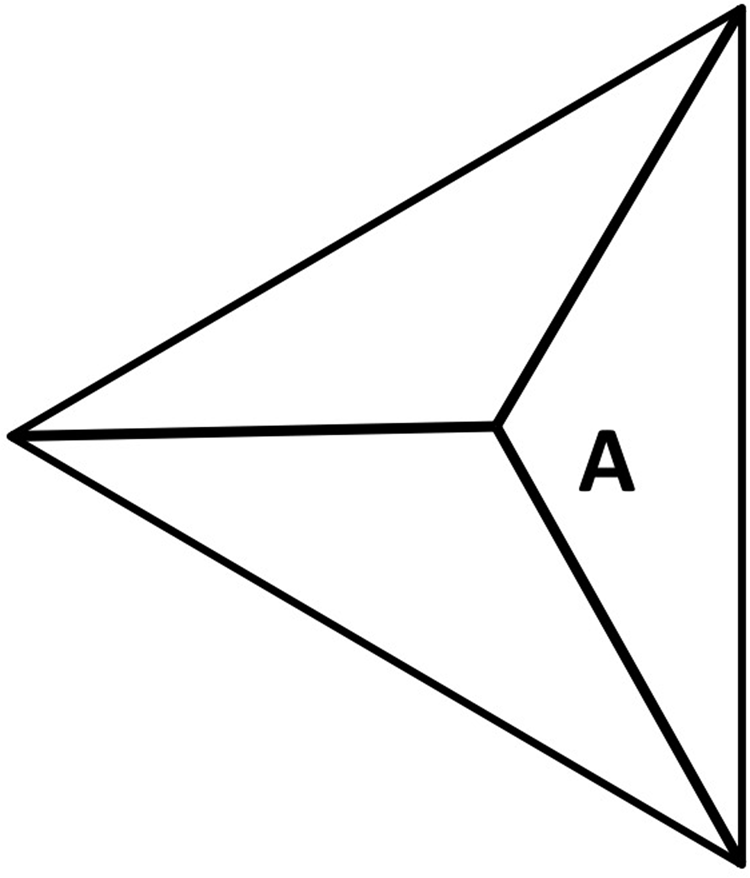
Figure 1 shows Plato's (and Aristotle's) regular tetrahedron (ἡ πυραμίς) in projection, essentially looking down on it from above.Footnote 23 Point A is an apex, pointing towards the viewer, and the equilateral triangle is the outline of the base. If such a regular tetrahedron is turned over, so that A now becomes one of the points defining a new base, the form of the diagram will be unchanged, since all four sides are identical, a fact which is partly concealed in the projection.
A regular tetrahedron (‘pyramid’), drawn in projection (essentially as if seen from above). Point A is an apex, closer to the viewer than the equilateral triangular base behind.

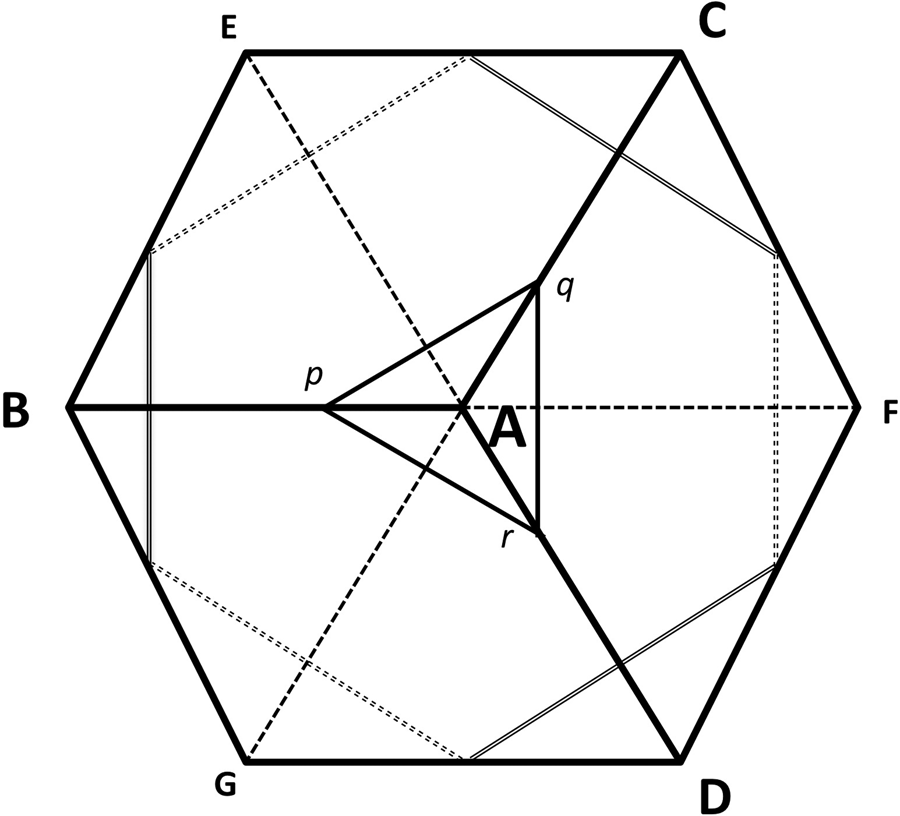
Figure 2 shows a similar projection of a cube, seen along the line joining a pair of opposite corners. This view picks out one of the three-fold symmetries of the cube. The centre of the diagram, point A, is the corner of the cube nearest to the viewer. Points B, C and D are the next-nearest corners; these define an equilateral triangle (not shown) and a plane. Behind this plane, further from the viewer, are the three corners E, F and G; those edges which run from these three to the eighth corner will be hidden by the body of the cube, and are shown as dashed lines. The size of the letters on the figure decreases with increasing distance from the viewer. If a plane, perpendicular to the axis between A and the opposite corner,Footnote 24 intersects the cube at the points p, q and r, it will generate a true pyramid Apqr, in accordance with Euclid's Definition 12, with an equilateral triangle as a base; ABCD is a similar pyramid. In the projection of Figure 2 these pyramids look remarkably like versions of Figure 1, but this is an accident of the projection. Pyramids Apqr or ABCD are much flatter than the regular tetrahedron required for Aristotle's attack on Plato. Each has a base of one equilateral triangle, but the remaining three sides are right-angled isosceles triangles meeting at the apex, whereas the regular tetrahedron has angles of 60° at the apex. These pyramids are much less symmetrical than Plato's equilateral, regular pyramid. For example, if they are rotated so that a different apex is closest to the viewer, the outlines will change to right-angled isosceles triangles, rather than remaining the same, as with the regular tetrahedron in Figure 1. Such pyramids have no relevance to Plato's conception, which requires the symmetry of a regular solid.Footnote 25 However, by referring to ‘ἡ πυραμὶς’ (the pyramid), the text is quite clearly implying that this cut-off cube corner is a regular pyramid. Rescigno seems to assume that this ‘confusion’ of two sorts of pyramid is a straightforward mistake,Footnote 26 but, as discussed below, this is very unlikely.
A cube, drawn in projection. Point A is a corner, closest to the viewer, and the direction of view is along the line between A and the opposite corner. Corners B, C and D are the next closest after A; E, F and G are further away. (Smaller letters are further from the viewer.) The remaining corner, furthest from the viewer, is hidden behind A. Other features of this figure are described in the text.

The next, somewhat obscure, statement in the text reads: ἄλλως τε ὁ κύβος αὐτὸς ἐκ δυοῖν πυραμίδων συμπεπλήρωται (‘in any case the cube itself is completed from two pyramids’, 655.20–1). There is an apparently simple interpretation of this statement, which was outlined very briefly by Struik,Footnote 27 and has been elaborated by Mueller.Footnote 28 This supposes that the author of the above argument was thinking of the two pyramids here as ABCD, closest to the viewer in Figure 2, and the opposite pyramid, furthest from the viewer, with base EFG (the triangle sides have not been drawn in, to avoid unnecessary clutter on the figure). This interpretation supposes that the two pyramids alone complete the cube (‘in any case the cube itself is completed from two pyramids’), but such an interpretation presents severe difficulties.
It is clear from Figure 2 that a large slice of the cube, defined by the trigonal antiprism BCDGEF, is left out. It is not even necessary to use this particular projection to see the qualitative point. Any sketch of a cube with these two pyramids drawn in shows a large gap between them. Using only information from Euclid, it is easy to demonstrate that the volume of one of these pyramids is only 1/6 of that of the cube. Thus anyone at the time could have shown that the missing slice has a volume 2/3 of that of the cube, so the cube is very far from being completed by these two pyramids. As can be seen from Figure 2, the two pyramids are rotated against each other, so they could not possibly recombine as a cube. If they were brought together, with an appropriate rotation, a trigonal bipyramid with only five corners would result, instead of the eight corners of the original cube.
Any ancient author intending to make a contribution in this area would have to have read and understood Plato's descriptions of the regular solids in the Timaeus.These constructions require a considerable effort of three-dimensional imagination to follow them. It is therefore very difficult to imagine that anyone who had passed this test of mental gymnastics could make such clumsy mistakes as to suppose that these two pyramids could complete a cube, or that they are regular pyramids. As a final point, within Plato's scheme (Ti. 55b–c) for construction of a cube, these two pyramids only incorporate twelve of the necessary twenty-four elemental triangles, so this apparently simple suggestion is untenable, and we need to look for an alternative interpretation of the statement in Simplicius.
It should be clear from Figure 2 that there is no way in which a cube can be divided into two equal parts which are true pyramids, still less regular tetrahedra. The general slice pqr can be taken at any position down to the plane defined by B, C and D, to generate a pyramid which accords exactly with Euclid's Definition 12. However, if the slicing is taken at a slightly lower plane than this, the resulting ‘pyramid’ will have three of its corners clipped. Nevertheless, if we are to follow the argument further, we will have to accept this approximate description, while noting that we have now moved even further away from Aristotle's regular tetrahedron.
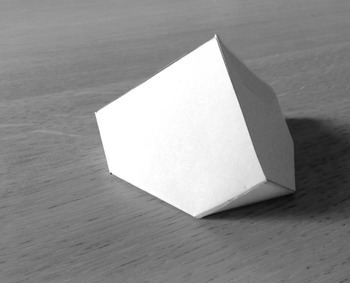
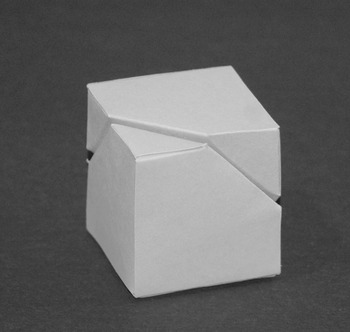
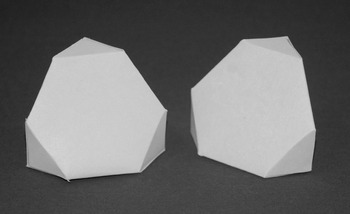
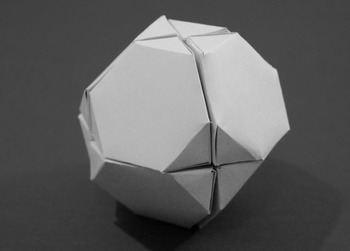
Such a corner-clipped ‘pyramid’ has seven sides, including the base, which at first is an irregular hexagon, with alternating long and short sides. However, as the slicing plane is lowered further below BCD,Footnote 29 the lengths of these sides of the hexagon approach each other. At a position halfway between planes BCD and EFG, the lengths become equal, the hexagons are regular, and the cube is now sliced into the two equal parts (‘pyramids’) indicated in Figure 2. The part closer to the observer includes points A, B, C and D, while points E, F and G belong to the one which is further away. These equal parts touch each other across the plane of the hexagon shown as a double line in Figure 2 (the portions with dashed lines will be hidden behind the closer ‘pyramid’). A paper model of one of these truncated pyramids, set on the hexagon base, is shown in Figure 3, where the apex corresponds to A in Figure 2. A model of the cube, divided into the two equal ‘pyramids’, is shown in Figure 4, and these two halves are shown separately in Figure 5, where the hexagon faces are clearly visible.

A cardboard model of a cube, divided along the double lines of Figure 2, illustrating the argument in Simplicius’ text that ‘the cube itself is completed from two pyramids’. (This image was kindly provided by Mr Laszlo Bardos.)


Figures 2–5 demonstrate that the claim that ὁ κύβος αὐτὸς ἐκ δυοῖν πυραμίδων συμπεπλήρωται (‘the cube is completed by two pyramids’) does make geometrical sense, but only if we can accept these seven-sided objects as pyramids. While they are clearly derived from pyramids, probably the best that can be said about them is that they are reasonable approximations to true pyramids,Footnote 30 but that does not seem to have discouraged the author of this proposal.
This argument about the division of the cube could only have come from someone who was very comfortable with thinking in three dimensions. The compression of the argument, which takes considerable effort to follow through, might be intentional, as a way of distracting the attention of the reader from the basic logical flaw that these pyramids are far from the sort needed in Aristotle's attack: not only are they not regular tetrahedra, but they are also truncated. The next argument is even more subtle, and again requires considerable three-dimensional imagination to follow:
ἐὰν ἄρα ὀκτὼ πυραμίδες συντεθῶσι τὰς κορυφὰς ἔχουσαι πρὸς τῷ κέντρῳ τῆς σφαίρας, ἐκπληρώσουσι τὸν τόπον (655.21–3)
if then eight pyramids are put together with their peaks towards the centre of a sphere, they will fill the space.
Here, for the first time in Simplicius’ text (apart perhaps from the unintentional mention of eight cubes in his introduction), we get a fully three-dimensional description of the space around a point, which is directly analogous to the two-dimensional analysis presented earlier. After slicing a cube into two equal parts, ‘pyramids’, what happens when we assemble a set of eight such objects around one point, now filling all the space around it? The relevance of the sphere may not be immediately obvious, but a few pages before this Simplicius had discussed another quotation from Aristotle, on the shapes which result from slicing a sphere into eight (equal) parts.Footnote 31 Here he suggests, following Alexander, that Aristotle means slicing the sphere by three mutually perpendicular planes intersecting at the centre, and thereby generating ‘pyramidish’ (πυραμοειδῶν) parts. An attentive reader of Simplicius would certainly make a connection, since the geometry at the centre of the sphere, where the eight parts meet each other, is precisely the same as that defined by the eight ‘pyramids’ joining at a point.Footnote 32 Furthermore, the eight hexagon bases of the ‘pyramids’, when assembled into this unit, are all tangential to a sphere, in much the same way as the faces of any of the truly regular solids, and all the vertices of this solid lie on the slightly larger circumscribing sphere. A model of the assembly of the eight units together is shown in Figure 6, and it can be seen that the ideal shape is not very far from spherical.
A model showing eight ‘pyramids’ assembled with adjoining apices, and generating a truncated octahedron. (This image was kindly provided by Mr Laszlo Bardos.)

This ideal shape, generated by the union of the eight ‘pyramids’, is the Archimedean semi-regular truncated octahedron, which was a known form ever since the Hellenistic period. Perhaps accidentally, with this construction the space-filling argument has been raised to a new level, as will be discussed in the final section below.
After this highly condensed account of quite difficult concepts in three-dimensional geometry, the text returns to argument by analogy with the two-dimensional case:
ἔτι ὃν λόγον ἔχει τὸ τρίγωνον ἐν τοῖς ἐπιπέδοις, τοῦτον ἔχει τὸν λόγον ἐν τοῖς στερεοῖς ἡ πυραμίς⋅ τὸ δὲ τρίγωνον ἐν ἐπιπέδοις ἐκπληροῖ τὸν τόπον⋅ καὶ ἡ πυραμὶς ἄρα ἐν στερεοῖς. (655.23–5)
Moreover, as the pyramid is to solids, the triangle is to surfaces; and the triangle completed the space in terms of plane figures; therefore, the pyramid (will do the same) as far as solids are concerned.
To those readers who may have been somewhat dazzled or confused by the rather spectacular and highly compressed geometrical argument above, this return to an analogy, which has been ‘justified’ previously, could be a reassurance. It would probably reinforce a conviction that even if they have not followed everything, the argument must be correct, because this analogy worked for cubes. Nevertheless, once again something is being concealed here. The Alexander/Potamo two-dimensional arguments only make sense for the regular polygons, so if the analogy beween two and three dimensions had any validity, it could only work for regular bodies, which have only one sort of side. It makes no sense for bodies with differing sides. So, even if the analogy were valid, it could only work for regular pyramids of the type seen in Figure 1, and could not for any of the ‘pyramids’ defined in Figure 2. This discussion/justification began with a logical slide, from Aristotle's regular pyramids to the non-regular ones of Figure 2, but at this point we have slid back to regular pyramids.
After this dubious reassurance, which requires regular pyramids, there is more discussion of the structure made up with eight ‘pyramids’, so now the argument has slipped yet again, back to irregular pyramids. Perhaps to help readers visualise this eight-pyramid structure, there is a strange reference to ‘wedges’:
καὶ δι’ αὐτῆς, φησί, τῆς αἰσθήσεως φανερόν. εἰ γάρ τις πυραμίδας συνθείη ὀκτὼ τὰς κορυφὰς αὐτῶν εἰς ἀλλήλας νευούσας ποιῶν ὡς σφῆνας, οὐκ ἀπολείψει κενὸν τόπον. (655.25– 7)
This is also obvious, he says, from the evidence of the senses themselves. For if someone were to put together eight pyramids with their peaks pointing towards each other making them like wedges, there will be no empty space left.
The ‘he says’Footnote 33 (φησί) may be significant: no one other than Alexander has been mentioned since the introduction to Alexander's hexagon discussion. Thus, attribution of this argument to Potamo makes sense only if Simplicius has been very careless in writing that part of the text, and so we are more likely to be dealing with Simplicius’ report from Alexander.
This might appear to be a repetition of the argument above (‘if then eight pyramids …’). However, the earlier version was concentrating on the invisible point at which the eight pyramids meet. Now, attention is focused on the appearance (‘evidence of the senses’) of the assembled set of eight pyramids, as seen from the outside. The significance of the wedges is not completely clear, but a possible meaning is that the apices come together much as the edges of a pair of wedges do if they are hammered into the same place together, as in splitting a recalcitrant log. In Figure 6, because of the difficulties in making completely accurate models, gaps appear at the joins, which may make this ‘wedge’ idea more plausible; thus, the term might have been inspired by the use of similar models during the development of this argument.
After the passage on three-dimensional bodies, which concludes with the reference to Potamo at 655.28–9, Simplicius cites Alexander again, but he finds a problem:
ὁ δὲ Ἀλέξανδρος “οὐδὲν δὲ ἄλλο, φησίν, ἢ τὸ ἐπὶ τῶν ἐπιπέδων γινόμενον τοῦτο καὶ ἐπὶ τῶν στερεῶν γίνεται κατὰ τὰς τρεῖς διαστάσεις ὁμοίως ὡς ἐπ’ ἐκείνων κατὰ τὴν μίαν.” καὶ τοῦτο αἰνίγματί μοι μᾶλλον ἐοικέναι δοκεῖ⋅ πῶς γὰρ τῶν ἐπιπέδων κατὰ γραμμὴν συνταττομένων (αὕτη γάρ, ὡς ἔοικεν, ἐστιν ἡ μία διάστασις) τὰ στερεὰ κατὰ τὰς τρεῖς συνταχθήσεται, εἴπερ κατὰ τὰ ἐπίπεδα ἀλλήλοις συνήρμοσται; (655.29–33)
And Alexander says: ‘It is nothing other than what we saw in the case of plane figures, and it applies in the same way for solids in three dimensions as it did for plane figures in one dimension.’ And this seems to me more like a riddle; for how is it possible, while planes are joined together along a line (for this, as it seems, is the one dimension), that solids may be joined across three dimensions, since they fit together by attaching (only) surfaces?
At the start of the section that falls inside Heiberg's inverted commas (654.14–655.31), a perfectly valid argument for the hexagon was presented, derived from Alexander. This began by connecting two of these along a common side, the (one-dimensional) line CD (above, p. 4). One possible interpretation of the final comment from Alexander, which Simplicius finds puzzling, is that the description of the four cubes fitting together also concentrated on their joining along a line, the shared common edge. Within this framework, there is a contact along one dimension for three-dimensional solids, and also for the plane figures. In this formulation it could be said that the two cases of space-filling, in three dimensions and in two, do have a similarity. This, however, is not the immediate sense of the text reported by Simplicius, as can be seen in the translation above (Mueller has similar wording). A possible reason for the discrepancy could be that the text to which Simplicius is objecting has suffered some corruption in transmission. Perhaps a definite article has been interpolated at the end of Simplicius’ citation,Footnote 34 so that it should read: τὸ ἐπὶ τῶν ἐπιπέδων γινόμενον τοῦτο καὶ ἐπὶ τῶν στερεῶν γίνεται κατὰ τὰς τρεῖς διαστάσεις ὁμοίως ὡς ἐπ’ ἐκείνων, κατὰ μίαν (instead of κατὰ τὴν μίαν), to be translated as: ‘what happens in the case of plane figures applies also to solids in three dimensions in the same way as it did to those, along one dimension’. The alternative to such a revision is that, as Simplicius is hinting here, Alexander has made a serious, almost laughable mistake. For someone ranked by later writers as ὁ ἐξηγητής (the Commentator), this seems very unlikely.
Alexander seems to have thought that this common line was a significant part of his misleading argument from analogy. I note below another version of this idea of linking edge-sharing cubes along a line, this time with eight cubes, which is reported by Themistius, and probably also derives from Alexander. It is possible that Alexander has introduced this idea of space-filling by the three-dimensional solids around a line because he has seen that packing objects in space without leaving any gaps is a difficult problem,Footnote 35 and this, together with his argument by analogy with the two-dimensional situation, is his attempt to deal with that problem.
Mueller's interpretation of the divided cube and pyramids
As noted above, Mueller assigns the section 655.9–27 to Potamo, and he also interprets the argument of this text very differently. He notes that the phrase ‘angle of a cube’ does suggest a pyramid of the general type Apqr in Figure 2. However, he rejects this, essentially on the grounds that the argument cannot work, as we have seen above, because this is not Plato's regular pyramid. He seems to believe that Potamo is making a genuine but misguided attempt to prove Aristotle's claim, and that he could not have intended this meaning because it is so obviously wrong.Footnote 36
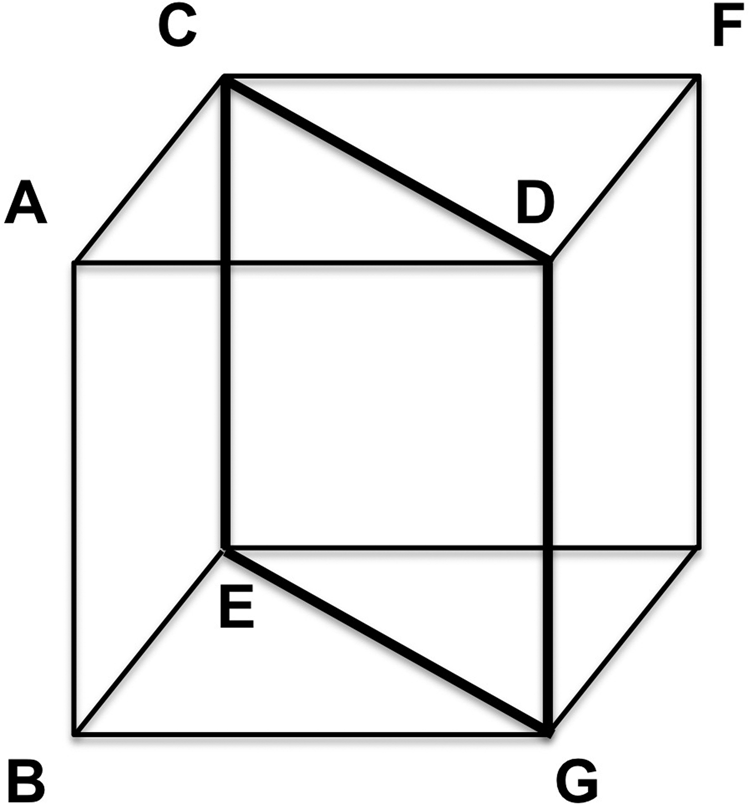
Mueller is forced by his position into an interpretation which moves even further away from Plato's regular tetrahedron than the seven-sided ‘pyramid’ described above. He proposes that Potamo means that the cube be divided into two equal halves, not as above, by a plane parallel to pqr, but by a plane connecting a parallel pair of opposite face diagonals.Footnote 37 On the model of Figure 2, if one takes the parallel cube face diagonals CD and EG, one such dividing plane could be that running through these two lines. Figure 7 shows the same cube, divided in this way, but in a more conventional orientation than in Figure 2. The problem with this division is that it does not generate a pair of pyramids, but, as Mueller admits, a pair of prisms instead. This is discussed further in the Appendix (below) in the light of Definitions 12 and 13 in Book 11 of Euclid's Elements, where it is shown that there are serious difficulties with such an interpretation. It seems extremely unlikely that Simplicius, Alexander or Potamo could have accepted, let alone proposed, that Mueller's decomposition of a cube into two prisms was actually generating two pyramids. We might also note that Euclid 12.7 describes the decomposition of a prism into three pyramids; a confusion of pyramids and prisms is just not feasible.
A cube, divided according to Mueller's interpretation. The heavy lines indicate the plane which passes through through the cube face diagonals CD and EG. The labels for the corners are the same as those used in Figure 2.

Mueller may have been relying too much on the word ‘wedges’. His prisms do indeed have a shape which is somewhat wedge-like, even if far too blunt to be of any use. However, this word only comes at the end of the ‘Potamo’ argument, and there it is only a simile for the method of assembly, not a description of the bodies themselves. Also, there are problems with his interpretation given the mention of a sphere at 655.22. In his Appendix 1, Mueller has a diagram showing eight of his ‘pyramids’ (prisms) assembled, with the ridges (the edges along the 90° angle) joining along a common line.Footnote 38 This creates a square prism where the height is √2 x the base side; this prism is the central core of his diagram.
However, it is very difficult to make any sense of the mention of a sphere in relation to this compound object. It is particularly difficult to know what the reference to apexes pointing towards the centre of a sphere could mean for these eight prisms. There is a single point which is common to all eight triangular prisms assembled in his diagram,Footnote 39 but there is no reason to call these particular positions in the prisms ‘apexes’. A sphere could be drawn through the corners of this compound square-based prism, but so could an ellipsoid, which would better represent the lower symmetry of the rectangular prism. There is no particular connection to a sphere, as there is with the Archimedean truncated octahedron.Footnote 40 For all the reasons given above, but particularly because Mueller's argument flies in the face of two important Euclidean Definitions, his interpretation has to be rejected.
Themistius
In the second volume of his very detailed study of the fragments of Alexander's In caelo which can be recovered from later sources, Rescigno includes the text from Simplicius discussed above (653.9–656.5) as fragment 216a.Footnote 41 In connection with this, he cites a passage from the Latin version of Themistius’ paraphrase of De caelo (fr. 216b) which he also assigns to Alexander.Footnote 42 It is important to note that the original text of this work of Themistius is lost, and that the Latin version is the end of a complex series of translations.Footnote 43 The Latin version is a translation from Hebrew, and all versions prior to this Hebrew text have been lost. In the cascade of translations, considerable corruption has occurred. Landauer carefully edited the early printed version of the Latin text, offering possible corrections at some of the more obviously corrupted points, and published this together with a version of the Hebrew text based on the two manuscripts available to him.Footnote 44
Recently a new edition of the Hebrew text has been prepared by Coda, with an English translation.Footnote 45 This is based on a larger set of manuscripts than that available to Landauer, and is almost certainly the most reliable source for the Themistius text. However, at least within this particular fragment, the Hebrew and Latin versions are very similar. The corruptions noted seem to have entered at an earlier stage in the series of translations.
Allowing for these corruptions, the beginning of Rescigno's fragment 216b has some remarkable similarities to Simplicius’ description of four cubes set over four squares. However, there are two major differences from the account given by Simplicius (fr. 216a). Themistius, unlike Simplicius, begins with the statement that the purpose here is to demonstrate that the space around a point contains eight solid right angles. Also, after the four cubes have been set up over the squares, this version continues with an extension to the other side of the squares, where a second set of four cubes is constructed.Footnote 46 Again the common line, which now is running along the common edges of eight cubes, is emphasised. This version of the cube argument, found in Themistius, provides a possible explanation for the odd feature in Simplicius’ text noted earlier, where in the initial discussion of the ‘pyramid’ there is a reference to the meeting of cubes at their corners: ‘since, then, the corners of the cube completed the space, the pyramid will do so too’ (655.19–20). We have already seen that Simplicius had probably omitted a part of Alexander's text dealing with the four squares, and apparently he has done the same here, with the eight cubes.
After Themistius has established the fact that the angles of eight cubes completely fill the space around a point, he attempts to develop a similar argument about pyramids. Unfortunately, at the change-over between cubes and pyramids, the text becomes almost unintelligible. However, in what follows, it is at least clear that the pyramids discussed are true regular tetrahedra, not the seven-sided objects in Simplicius’ text. This argument for tetrahedra describes six equilateral (i.e. regular) pyramids assembled together, with their bases on a common plane, so that these triangular bases fill the two-dimensional space around their common point, as did the four squares. Another six pyramids are then added on the opposite side of this plane, in a manner analogous to the second set of four cubes. Themistius deduces from this analogy, wrongly, that twelve regular pyramids fill three-dimensional space, and attempts to confirm this conclusion with the outline of an argument about calculating solid angles, which was taken up later and expanded by Averroes.Footnote 47 Unfortunately, the basis for this calculation is also wrong.Footnote 48 Both the calculation, and the idea that twelve pyramids fill space, were later criticised by Peter of Auvergne as we shall see below.
Simplicius began his discussion with a statement that twelve pyramids fill space at 650.27, but failed to explain this statement, which in any case is inconsistent with his main passage discussed above (655.9–656.5). Since he frequently cites Alexander, the most likely source for this idea of twelve pyramids is Alexander's In caelo. This is consistent with Rescigno's assignment of the Themistius fragment 216b, in which this appears, to Alexander.
Peter of Auvergne
After the death of Thomas Aquinas, his unfinished commentary on Aristotle's De caelo was completed by Peter of Auvergne; this completion includes Peter's comments on the ‘Sixth Objection’, which appear in chapter 12. In his second Appendix, Mueller includes some remarks about this work, and claims that Peter is using the same approach as his, so that Peter also supposes the ‘pyramids’ concerned to be prisms: ‘When he turns to the pyramid, Peter first brings in the rectangular prism of Potamon's argument as a kind of (quaedam) pyramid, and shows that such a figure fills the space around a point.’Footnote 49
If it were true that a major medieval scholar,Footnote 50 probably as steeped in Euclid as were Potamo, Alexander and Simplicius, had made such a proposal, this might provide some support for Mueller's analysis. However, I can find no evidence to favour such an interpretation of Peter's text. The reference is probably to the sentence which begins pyramis autem quaedam est, quae habet unum angulum solidum rectum (‘there is a particular pyramid which has one solid right angle’).Footnote 51 Peter has read Simplicius; he makes several references to that text. However, rather than following this presentation, he sets up his own analysis, which is substantially different. In the earlier part of this chapter of his work, Peter has referred to pyramids on several occasions, but always in the context of the pyramid as fire, in accordance with the text of the Timaeus.Footnote 52 Thus, in his text so far, Peter has always used the word ‘pyramid’ in reference to a regular pyramid. It is therefore entirely reasonable that when he comes to discuss a different sort of pyramid, one with one solid right angle, he should draw attention to this difference between the two. The word quaedam need be no more than a marker to distinguish this sort of pyramid from the regular one which he has discussed earlier. The sentence goes on to emphasise that these two sorts of pyramids are very different:
pyramis autem quaedam est, quae habet unum angulum solidum rectum; alia autem quae habet aequilateri valent omnes quatuor aequales, et unusquisque minor est recto.
There is a particular pyramid, which has one solid right angle; the other (sort) has four equal (solid angles), and each and every one is less than a right (solid angle).
With his use of slightly different language, Peter is emphasising the symmetry difference between these two sorts of pyramids, discussed above in connection with Figures 1 and 2. Since he specifies unum angulum solidum rectum, he cannot be thinking of Mueller's prism, which has two solid right angles.
It is clearly implied by Peter that an argument which works for pyramids with one solid right angle will not apply to Plato's regular pyramid, which as he emphasises cannot have a solid right angle. This is of course precisely the flaw in the ‘Potamo’ argument presented by Simplicius, though Peter does not spell that out; perhaps he thought that it was too obvious to mention. Nevertheless, the fact that he spends so much time on what would be the wrong sort of pyramid for Aristotle's claim does suggest that he thinks that there is a serious problem with the argument presented by Simplicius.
Peter's approach to the three-dimensional bodies has more in common with the Themistius account of cubes described above than with that in Simplicius. Whereas the latter has four cubes meeting along a line, Peter begins with a qualitative description of the three-dimensional space around a point. He then provides the critical condition for this angular space to be filled, that it is aequale octo angulis cubicis rectis (‘equal to eight cubic right angles’).Footnote 53 However, unlike Themistius (Alexander), Peter does not mention the common edges of the cubes, or the line which runs through these edges. He continues with the general point that the requirement for solid figures to fill space is that, when meeting, their solid angles add up to this total (omnis autem figura solida, cujus anguli aliquot valent octo angulos cubicos, replet locum corporaliter, ‘therefore every solid shape, whose angles add up to the same as eight cubic angles, fills three-dimensional space’).
Following on from this generalisation, he produces the obvious specific example, a description of a set of eight cubes coming together at a point. The reference to the quaedam pyramid comes immediately after this. Peter introduces this as a separate example of space-filling. It is very noticeable that he does not derive his pyramid by dividing a cube, still less by the symmetric division of a cube as presented by Simplicius; he simply introduces this quaedam pyramid as another example of a solid which will fill the (angular) space. Peter therefore has no reason to refer to Mueller's half-cube prism/pyramid; his pyramid is clearly of the type Apqr in Figure 2. Peter completes his argument for this sort of pyramid by pointing out that when eight of them are assembled together they will fill space around a point just as eight cubes do. He comments that in this respect the cube and (this) pyramid are essentially the same (et hoc modo verum est dicere quod pyramis non est aliud quam cubus, ‘and in this way it is true to say that the pyramid is not different from the cube’), but this is as close as he comes to the argument in Simplicius.
Nowhere does Peter give any indication that he is attempting to ‘justify’ Aristotle, as Alexander or his sources seem to have been driven to do. Rather, he is summarising earlier arguments about the supposed space-filling by pyramids. Earlier in this chapter, when introducing the Aristotelian claim that both cube and pyramid fill space, he uses the academically detached, but presumably ironic comment, ut declarabitur:
in corporibus autem sunt duae tantum, scilicet pyramis et cubus, ut declarabitur.
Among [solid] bodies there are two, the pyramid and the cube, as will be shown.
In fact, he is going to show the opposite of what Aristotle had argued for. After discussing the filling of space by the cube, he shows how the special (quaedam) right-angled pyramid can fill space, but, as noted above, he emphasises at the beginning that this is not the regular pyramid. He then proceeds to show what is wrong in the attempts to prove the space-filling argument for the truly regular pyramid. He leaves it to the reader to draw the obvious conclusion that the right-angled pyramid is in no way related to Aristotle's claim, so the ‘proof’ reported in Simplicius is completely fallacious. He is more directly critical of Averroes’ arguments (derived from Alexander via Themistius) for the truly regular pyramid: regarding the claim that twelve regular tetrahedra fill space when meeting at a point, Peter says simply that this does not work, and he knows because he has tried it, presumably with models.Footnote 54 The basis of the second argument in Averroes, which attempts to determine a solid angle by summing the plane angles which contain it, is dismissed as non est intelligibile.
Although Peter does not specifically say that Aristotle is wrong, this is very clearly implied, both when he comments on the twelve regular pyramids, and in his very obvious pointer to the error in the argument reported by Simplicius. Later Blancanus claimed that no Latin author had questioned Aristotle on this point,Footnote 55 and, as far as Peter is concerned, this is technically correct, but he comes very close to doing so. If Blancanus had read Peter carefully, this text might well have been the spur which impelled him to investigate further for himself.
Modern aspects of the construction described by Simplicius, and of the packing of regular tetrahedra
Simplicius, using material from Alexander, has demonstrated that the space around a point can be completely filled by his half-cube ‘pyramids’, which appears to support Aristotle. However, Aristotle's attack on Plato concerned the whole of space, not just that around a point, so it is possible that in his two-dimensional argument Aristotle was thinking in terms of tiling, complete filling of space with a repeating pattern. At least for the square there would have been many visible examples of this available on floors and walls. Unfortunately, in three dimensions the equivalent of the tiling problem is much more complex, and a full analysis had to wait for two millennia, when Evgraf Fedorov showed that there are only five parallel-sided bodies which can ‘tile’ three-dimensional space.Footnote 56 One of these five is Aristotle's cube. However, another is the Archimedean truncated octahedron whose construction from divided cubes has been presented in Simplicius’ argument (above, pp. 13–14 and Figure 6). So, probably accidentally, this construction has arrived at a true filling of space. Slightly later than Fedorov, Kelvin independently came up with the same truncated octahedron as an important way to divide up space with a repeating pattern,Footnote 57 and during the twentieth century this three-dimensional patterning, using the truncated octahedron, became an important tool for solid-state physics.Footnote 58
As a final note, there has recently been a remarkable burst of interest in the question of just how well space can be filled by regular tetrahedra, studied partly by extended computation, but also by direct experiment. According to Elisabeth Chen, the maximum amount of space which can be filled in this way is a little over 85 per cent of the total.Footnote 59
Conclusions
In the part of Simplicius’ In caelo that has been examined here, the discussion of the packing of pyramids in space, there is a clear attempt to project the impression that we are dealing with Plato's regular pyramids. The principal argument is from analogy, which works for cubes but not for tetrahedra, but there is also some remarkable geometrical analysis, of the division of a cube and of the reassembly of half-cubes, giving another significant shape. Despite the compression of the argument, it makes good geometrical sense. However, this follows on after a three-card trick with the word pyramis, and the pyramids for which the proof does apply are very different from Plato's pyramid, as Peter of Auvergne emphasises. The compressed nature of this description of quite difficult geometry may be a deliberate attempt to draw the reader's attention away from the fatal flaw in the early part of the argument.
Simplicius presents his argument as if it had been taken directly from Alexander, but he has clearly carried out much editorial pruning. When we compare this account with the corresponding section in Themistius, it emerges that a discussion about eight cubes, presumably Alexander's original, has been reduced to one about only four, and by the elimination of some introductory material the argument has morphed from an analysis of angular space around a point into support for the false analogy between two- and three-dimensional figures. There appear to have been two separate arguments about pyramids in Alexander's text,Footnote 60 one of which, for eight pyramids, Simplicius has used; the other, for twelve, appears in Themistius, though Simplicius has left us a strong indication that he is aware of this other possibility in the rather dramatic mistake in his introduction.
It is quite possible that Simplicius saw that the two pyramid arguments in Alexander are incompatible, and picked the eight-pyramid version as the best one to support Aristotle. It is noticeable that the eight-pyramid argument makes no attempt to use the idea of solids joining along a line, which Alexander emphasises in the other version. This is consistent with the suggestion referred to in n. 18 above, that the argument comes from an earlier unknown author, rather than from Potamo. Simplicius seems to have attempted, not alogether successfully, to edit out traces of Alexander's twelve-pyramid version. Precisely what is happening in his chosen eight-pyramid version is unclear, though Mueller seems to believe that something like wish-fulfilment, a desire to get the ‘right’ answer, has led to an honest mistake. However, it is very difficult to imagine that the argument is a simple error of this sort. Anyone capable of working out the equal division of the cube and the assembly of the eight half-cubes could not have been under any illusion that the pyramids being discussed were the same as the regular tetrahedron used by Plato and by Aristotle. Thus, at least in modern terms, the whole passage looks like an attempt to deceive. The only likely reason for this would be a strong desire to maintain the Aristotelian structure, perhaps driven by a feeling that this would unravel if a single statement were false. Simplicius may have been editing what he found in Alexander's text into what seemed to him to be a coherent and self-consistent defence of Aristotle.
While such a deliberate fabrication seems reprehensible, there is at least one parallel episode in our own times. A senior English judge, hearing an appeal in which police misconduct in a case was alleged (later confirmed), wrote, among other comments, that ‘it is better that some innocent men remain in jail than that the integrity of the English judicial system be impugned’.Footnote 61 In such a context, offering a false proof in the hope of holding up a philosophical system may seem a relatively minor matter.
Appendix: Euclid
The main text makes occasional reference to Definitions from Euclid's Elements, and the relevant ones are collected here. Euclid was the dominating background geometrical text for Simplicius, and for the sources he is quoting in the passge discussed in this article. It can safely be assumed that all of them were intimately familiar with this work. Definitions 11 and 12 of book 11 are particularly relevant to the first part of Simplicius’ argument about pyramids. Definition 11 devotes some time to ‘solid angle’ (στερεὰ γωνία), and the second of the two versions given is the more relevant here:
ἄλλως⋅ στερεὰ γωνία ἐστὶν ἡ ὑπὸ πλειόνων ἢ δύο γωνιῶν ἐπιπέδων περιεχομένη μὴ οὐσῶν ἐν τῷ αὐτῷ ἐπιπέδῳ πρὸς ἑνὶ σημείῳ συνισταμένων.
Otherwise: a solid angle is that which is contained by more than two plane angles which are not in the same plane and are constructed to one point.
This includes the corner of a cube, as well as the corners of other solids. The next Definition, no. 12, reads:
πυραμίς ἐστι σχῆμα στερεὸν ἐπιπέδοις περιεχόμενον ἀπὸ ἑνὸς ἐπιπέδου πρὸς ἑνὶ σημείῳ συνεστώς.
A pyramid is a solid figure, contained by planes, which is constructed from one plane to one point.
In essence Definition 12 adds another plane, the ‘one plane’, to the solid angle of Definition 11. This new plane intersects those containing the solid angle, generating a pyramid, and, in the case of a cube's solid angle, a four-sided pyramid will be generated. This seems to be the basis of the statement that ‘the pyramid is nothing other than the corner of a cube’, cited in the main text (above, p. 7), though this conveniently ignores square pyramids, pentagonal pyramids etc.
Mueller's interpretation claims that the pyramids in Simplicius’ text, specified by the above Definition 12, can instead be taken as prisms. Euclid defines a prism in Definition 13 as follows: ‘a prism is a solid figure contained by planes, two of which, namely those which are opposite, are equal, similar and parallel, while the rest are parallelograms’. Heath comments that the pyramid Definition (12) is ‘by no means too clear’.Footnote 62 However, the lack of clarity could not allow any confusion between these two bodies. In particular, Definition 12 requires a single unique point for a pyramid, what we call ‘the apex’, so on this ground alone the prism shape favoured by Mueller would have to be rejected; there is no unique point on a prism.
Definition 13, on the prism, is more rigorous, but is quite general as well, so it also includes cases where the sides are not rectangular. However, for the special case where the sides are rectangular, this Definition is an exact description of the shape CDGEBA used by Mueller (see Fig. 7).