



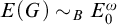



















1 Introduction
In recent years, a theory has been developed abundantly in descriptive set theory: using Borel reducibility to investigate the complexity of equivalence relations. Equivalence relations from different branches of mathematics have been systematically studied, and a large number of results on Borel reducibility or non-reducibility have been found. Polish groups are important tools in the study of equivalence relations. The orbit equivalence relations generated by the continuous (or Borel) group actions of Polish groups G on Polish spaces X (denoted by
 $E_G^X$
) account for most of the various equivalence relations concerned by various branches of classical mathematics.
We let E be a Borel equivalence relation on a Polish space X. We say that E is smooth if E is Borel reducible to the equality relation of some Polish space; and say that E is countable if every E-class is countable. We call E essentially countable if there is a countable Borel equivalence relation F such that E is Borel reducible to F. Feldman–Moore Theorem [Reference Gao14, Theorem 7.1.4] asserts that, for every countable Borel equivalence relation E on a Polish space X, there is a countable group
 $\Gamma $
and a Borel action of
 $\Gamma $
on X such that
 $E=E^X_\Gamma $
.
A very prevalent phenomenon is that the structural properties of a Polish group G can affect the Borel complexity of the orbit equivalence relations
 $E_G^X$
. For instances, Solecki [Reference Solecki28] proved that a Polish group G is compact if and only if
 $E_G^X$
is smooth for any Polish G-space X; Kechris [Reference Kechris22] proved that if G is a locally compact Polish group, then
 $E_G^X$
is essentially countable for any Polish G-space X; Gao and Jackson [Reference Gao and Jackson15] proved that if G is a countable discrete abelian group, then
 $E_G^X$
is Borel reducible to
 $E_0$
for any Polish G-space X; Hjorth’s turbulence theory [Reference Hjorth17] asserts that orbit equivalence relations induced by turbulent actions are not Borel reducible to
 $E_{S_\infty }^X$
for any Polish
 $S_\infty $
-space X; the orbit equivalence relation generated by a continuous action of a CLI Polish group on a Polish space X is pinned, which implies that any non-pinned Borel equivalence relation is not Borel reducible to
 $E_G^X$
(see [Reference Kanovei21, Section 17]). Naturally, we ask the following problem.
Problem 1. Can we characterize structures and properties of Polish groups through the study of equivalence relations?
Theoretically, this should be possible: for each kind of Polish groups, studying the properties of all/part of their orbit equivalence relations will inevitably reflect the properties of this kind of Polish groups. However, systematic research needs to find a specific orbit equivalence relation that can well reflect the properties of a given Polish group.
Given a countable discrete group
 $\Gamma $
. There is a canonical continuous shift action of
 $\Gamma $
on
 $\{0,1\}^\Gamma $
given by
 $(gp)(h)=p(g^{-1}h)$
for
 $p\in \{0,1\}^\Gamma $
and
 $g,h\in \Gamma $
. The free part of the action is the set
 $$ \begin{align*}(2)^\Gamma=\{p\in\{0,1\}^\Gamma:gp\neq p\mbox{ for all } 1_\Gamma\neq g\in \Gamma\}.\end{align*} $$
We let
 $E_\Gamma $
be the corresponding orbit equivalence relation on
 $(2)^\Gamma $
. Indeed, the Borel complexity of the relation
 $E_\Gamma $
can reflect the properties of the group
 $\Gamma $
. For instance, if
 $E_\Gamma $
is Borel reducible to
 $E_0$
, then
 $\Gamma $
is amenable, i.e., there is a left-invariant finitely additive probability measure
 $\mu $
on
 $\Gamma $
(cf. [Reference Gao14, Section 7.4]). For a special case of
 $\Gamma $
, Thomas proved that
 $E_\Gamma $
is Borel reducible to
 $E_\Lambda $
if and only if
 $\Gamma $
embeds into
 $\Lambda $
(cf. [Reference Thomas29, Corollary 3.8]). So in this special case, we can think that the equivalence relation
 $E_\Gamma $
captures the algebraic structure of
 $\Gamma $
very well.
The main purpose of this article is to attempt to provide a possible answer to Problem 1 for general Polish groups.
Given a Polish group G, we define an equivalence relation
 $E(G)$
on
 $G^\omega $
as: for
 $x,y\in G^\omega $
,
 $$ \begin{align*}xE(G)y\iff\lim_nx(n)y(n)^{-1}\mbox{ converges in }G.\end{align*} $$
We say that
 $E(G)$
is the equivalence relation induced by G. Indeed,
 $E(G)$
is the orbit equivalence relation induced by the action of left multiplication of
 $c(G)$
on
 $G^\omega $
, where
 $c(G)$
is the Polish group consisting of all convergent sequences in G.
For all Polish groups G, equivalence relations
 $E(G)$
are
 ${\mathbf \Pi }^0_3$
.
The study of equivalence relations induced by Polish groups can distinguish Polish groups very well. For instance, we can compare them with some benchmark equivalence relations:
 $E_0,E_0^\omega $
and
 $=^+$
(the definitions of these benchmark equivalence relations are left for the next section).
Theorem 1.1. Let G be a Polish group, then we have:
-
(1) G is a discrete countable group containing at least two elements iff
 $E(G)\sim _BE_0$
;
-
(2) if G is TSI uncountable non-Archimedean, then
$E(G)\sim _BE_0^\omega $
; -
(3) G is non-Archimedean iff
$E(G)\le _B=^+$
.


Recently, the authors [Reference Ding and Zheng10] use the Borel complexity of
 $E(G)$
to characterize TSI non-Archimedean Polish groups.
Theorem [Reference Ding and Zheng10, Theorem 1.3].
Let G be a Polish group. Then the following are equivalent:
-
(1) G is TSI non-Archimedean;
-
(2)
$E(G)\leq _B E_0^\omega $
; -
(3)
$E(G)\leq _B {\mathbb {R}}^\omega /c_0$
.


In particular,
 $E(G)\sim _B E_0^\omega $
iff G is TSI uncountable non-Archimedean.
Many notions about Borel reductions can be applied in the research on equivalence relations induced by Polish groups. For instance, using the notion of right embedability introduced by Lupini and Panagiotopoulos [Reference Lupini and Panagiotopoulos25], we get the following.
Theorem 1.2. Let G be a non-CLI Polish group and H a CLI Polish group. Then
 $E(G)\not \le _BE_H^Y$
for any Polish H-space Y.
In particular, since
 $c(H)$
is also CLI, we have
 $E(G)\not \le _B E(H)$
.
Similarly, using the notion of turbulence introduced by Hjorth [Reference Hjorth17] and
 $c_0$
-equality introduced by Farah [Reference Farah13], we get the following.
Theorem 1.3. Let G and H be two Polish groups. If H is non-Archimedean but G is not, then
 $E(G)\not \le _BE_H^Y$
for any Polish H-space Y.
In particular, since
 $c(H)$
is also non-Archimedean, we have
 $E(G)\not \le _B E(H)$
.
Recently, similar result concerning TSI Polish groups is obtained by the authors [Reference Ding and Zheng10].
Theorem [Reference Ding and Zheng10, Theorem 1.2].
Let
 $G,H$
be two Polish groups. If H is TSI but G is not, then
 $E(G)\not \le _BE(H)$
.
More attractive results appear in the study of CLI Polish groups. Using the notion of
 $\alpha $
-unbalanced relations introduced by Allison and Panagiotopoulos [Reference Allison and Panagiotopoulos1], we define the notion of
 $\alpha $
-l.m.-unbalanced Polish groups for
 $\alpha <\omega _1$
in Section 5.1 (“l.m.” stands for left multiplication.) and obtain the following.
Theorem 1.4. Let
 $G,H$
be Polish groups,
 $0<\alpha <\omega _1$
. If G is
 $\alpha $
-l.m.-unbalanced but H is not, then
 $E(G)\not \le _B E(H)$
.
We will also present examples of
 $\alpha $
-l.m.-unbalanced groups. Recall that a topological group G is said to be distal if
 $1_G\notin \overline {\{ghg^{-1}:g\in G\}}$
for all
 $h\ne 1_G\in G$
. It is known that all TSI Polish groups and all nilpotent Polish groups are distal (c.f. [Reference Rosenblatt27]).
Theorem 1.5. Let G be a Polish group.
-
(1) If G is not distal, then G is
$1$
-l.m.-unbalanced. In particular, if G is locally compact, then G is not distal iff it is
$1$
-l.m.-unbalanced. -
(2) If G is locally compact, then G is not
$2$
-l.m.-unbalanced. -
(3) Let
$\Lambda $
be an infinite countable discrete group, and
$\alpha <\omega _1$
. Then G is
$\alpha $
-l.m.-unbalanced iff the wreath product
$\Lambda \wr G$
is
$(\alpha +1)$
-l.m.-unbalanced.


Therefore, we can find a sequence
 $(G_n)$
of CLI Polish groups such that
 $$ \begin{align*}E(G_0)<_B\cdots<_BE(G_n)<_BE(G_{n+1})<_B\dots.\end{align*} $$
Unfortunately, we have not found any
 $\omega $
-l.m.-unbalanced CLI Polish group so far, though we know that
 $S_\infty $
is
 $\alpha $
-l.m.-unbalanced for any ordinal
 $\alpha $
.
The most refined result appears in the study of TSI Polish groups. Applying the tool of additive reduction and ultrafilter limit, the existence of Borel reduction is transformed into the existence of a well-behaved continuous mapping between Polish groups.
Let G be a Polish group. We define equivalence relation
 $E_*(G)$
on
 $G^\omega $
as:
 $$ \begin{align*}xE_*(G)y\iff\lim_nx(0)x(1)\dots x(n)y(n)^{-1}\dots y(1)^{-1}y(0)^{-1}\mbox{ converges}\end{align*} $$
for
 $x,y\in G^\omega $
. It is clear that
 $E(G)\sim _BE_*(G)$
(cf. [Reference Ding and Zheng9, Proposition 2.2]). It turns out that, for TSI Polish groups,
 $E_*(G)$
is a more convenient research object than
 $E(G)$
.
Theorem 1.6 (Pre-rigid Theorem).
Let
 $G,H$
be two TSI Polish groups. Suppose G is connected, H is locally compact and the interval
 $[0,1]$
embeds in H. Then
 $E(G)\le _BE(H)$
iff there exists a continuous map
 $S:G\to H$
with
 $S(1_G)=1_H$
such that, for
 $x,y\in G^\omega $
, if
 $\lim _nd_G(x(n),y(n))=0$
, then
 $$ \begin{align*}xE_*(G)y\iff S^\omega(x)E_*(H)S^\omega(y),\end{align*} $$
where the map
 $S^\omega :X^\omega \to Y^\omega $
is defined as: for
 $x\in X^\omega $
and
 $n\in \omega $
,
 $$ \begin{align*}S^\omega(x)(n)=S(x(n)).\end{align*} $$
To illustrate the strength of this theorem, we recall some notions. For any Polish group G, let
 $G_0$
be the connected component of the identity element
 $1_G$
, which is a closed normal subgroup of G. It is known that, if G is locally compact TSI, then
 $G_0$
is the product of a compact connected Polish group and a group
 ${\mathbb {R}}^n$
. Now we apply Pre-rigid Theorem on Lie groups as follows.
Theorem 1.7. Let G and H be two separable TSI Lie groups. If
 $E(G)\le _BE(H)$
, then there exists a continuous locally injective map
 $S:G_0\to H_0$
.
In particular, if
 $G_0,H_0$
are abelian, then S is a group homomorphism.
As a corollary, we have
 $\dim (G)\le \dim (H)$
. Furthermore, if
 $\dim (G)=\dim (H)$
and
 $G_0$
is compact, then
 $H_0$
is also compact and
 $G_0$
is a covering space of
 $H_0$
, and hence the corresponding Lie algebras of
 $G_0$
and
 $H_0$
are isomorphic. In particular, we obtain a complete answer for abelian connected Lie groups. Recall that
 ${\mathbb {T}}$
is the multiplicative group of all complex numbers with modulus
 $1$
.
Theorem 1.8. Let
 $c_0,e_0,c_1,e_1\in {\mathbb {N}}$
, then
 $E({\mathbb {R}}^{c_0}\times {\mathbb {T}}^{e_0})\le _BE({\mathbb {R}}^{c_1}\times {\mathbb {T}}^{e_1})$
iff
 $e_0\le e_1$
and
 $c_0+e_0\le c_1+e_1$
.
Recently, the aforementioned results have been vigorously generalized by the authors [Reference Ding and Zheng10]. A completely metrizable topological group G is called a pro-Lie group if every open neighborhood of
 $1_G$
contains a normal subgroup N such that
 $G/N$
is a Lie group (cf. [Reference Hofmann and Morris18, Definition 1]). By [Reference Hofmann, Morris and Stroppel20, Theorem 3.6], every locally compact TSI Polish group is a pro-Lie group. The following is a Rigid Theorem concerning locally compact connected TSI Polish groups and TSI pro-Lie groups.
Theorem [Reference Ding and Zheng10, Theorem 6.9].
Let G be a locally compact connected TSI Polish group, H a TSI pro-Lie Polish group. Then
 $E(G)\leq _B E(H)$
iff there exists a continuous homomorphism
 $S:G\rightarrow H$
such that
 $\ker (S)$
is non-Archimedean.
We also get a few results for disconnected Lie groups. Let
 $\mathrm {Inn}_G(G_0)$
be the group of all
 $\iota _u:G_0\to G_0$
with
 $\iota _u(g)=ugu^{-1}$
for
 $u\in G$
.
Theorem 1.9. Let G be a separable TSI Lie group with
 $G_0={\mathbb {R}}$
. Define
 $\iota _{\mathbb {R}}:{\mathbb {R}}\to {\mathbb {R}}$
as
 $\iota _{\mathbb {R}}(t)=-t$
. Then we have:
-
(1)
$E(G)\sim _BE({\mathbb {R}})\iff \mathrm {Inn}_G(G_0)=\{\mathrm {id}_{\mathbb {R}}\}$
; -
(2)
$E(G)\sim _BE({\mathbb {Z}}_2\ltimes {\mathbb {R}})\iff \mathrm {Inn}_G(G_0)=\{\mathrm {id}_{\mathbb {R}},\iota _{\mathbb {R}}\}$
.


Similar results of
 $G_0={\mathbb {T}}$
in place of
 ${\mathbb {R}}$
are also valid.
In the end, the groups
 ${\mathbb {T}}_p$
of p-adic solenoids for all
 $p\ge 2$
are considered. Let
 $N(p)$
be the set of all prime divisors of p.
Theorem 1.10. Let
 $p,q\ge 2$
be natural numbers, then we have:
-
(1)
$E({\mathbb {T}}_p)\le _BE({\mathbb {T}}_q)\iff N(p)\supseteq N(q)$
; -
(2)
$E({\mathbb {R}})<_BE({\mathbb {T}}_p)<_BE({\mathbb {T}})$
.


The authors also generalized the above theorem to P-adic solenoids, where P is a sequence of natural numbers
 $\ge 2$
(see [Reference Ding and Zheng9, Theorem 3.2]). Moreover, the Borel reducibility among
 $E(G)$
’s between
 $E({\mathbb {R}})$
and
 $E({\mathbb {T}})$
are extremely complicated that the partial ordered set
 $P(\omega )/\mathrm {Fin}$
embeds into them (see [Reference Ding and Zheng9, Theorem 3.6]).
This article is organized as follows. In Section 2, we recall some notions in descriptive set theory and Polish groups. In Section 3, we define the equivalence relations induced by Polish groups, and prove Theorem 1.1 and some basic facts. In Section 4, we prove Theorems 1.2 and 1.3. In Section 5, we define the notion of
 $\alpha $
-l.m.-unbalanced groups and prove Theorems 1.4 and 1.5. In Section 6, we present many results on TSI Polish groups and prove Theorems 1.6–1.10. Finally, in Section 7, we give some further open questions and additional remarks.
2 Preliminaries
We say that a topological space is Polish if it is separable and admits a compatible complete metric. Let
 $X,Y$
be two Polish spaces, E and F equivalence relations on X and Y, respectively. We say that a map
 $\theta :X\to Y$
is a Borel reduction of E to F if
 $\theta $
is Borel and for
 $x,y\in X$
,
 $$ \begin{align*}xEy\iff\theta(x)F\theta(y).\end{align*} $$
If such a Borel reduction exists, we say that E is Borel reducible to F, denoted by
 $E\le _BF$
. We also denote by
 $E\sim _BF$
for
 $E\le _BF$
and
 $F\le _BE$
; and denote by
 $E<_BF$
for
 $E\le _BF$
but
 $F\not \le _BE$
. For more details on Borel reducibility and descriptive set theory, we refer to [Reference Gao14, Reference Kanovei21, Reference Kechris23].
The identity element of a group G is denoted by
 $1_G$
. We say that a topological group is a Polish group if its underlying topology is Polish. Given a Polish group G and a Polish space X, an action of G on X, denoted by
 $G\curvearrowright X$
, is a map
 $a:G\times X\to X$
satisfying that
 $a(1_G,x)=x$
and
 $a(gh,x)=a(g,a(h,x))$
for
 $g,h\in G$
and
 $x\in X$
. The pair
 $(X,a)$
is called a Polish (Borel) G-space if a is a continuous (Borel) map. Throughout this article, we write
 $gx$
in place of
 $a(g,x)$
for the sake of brevity. For each
 $x\in X$
, the G-orbit of x, denoted by
 $[x]$
or
 $Gx$
, is the set
 $\{gx:g\in G\}$
. A subset A of X is G-invariant if
 $Gx\subseteq A$
for each
 $x\in A$
. The orbit equivalence relation, denoted by
 $E_G^X$
, is defined as
 $$ \begin{align*}xE_G^Xy\iff[x]=[y]\iff\exists g\in G\,(gx=y).\end{align*} $$
Becker and Kechris proved that, for any Borel G-space
 $(X,a)$
, there is a Polish topology
 $\tau $
on X such that
 $\tau $
generates the Borel structure of X and
 $(X,a)$
is a Polish G-space (cf. [Reference Gao14, Theorem 4.4.6]). This implies that
 $E^X_G=E^{(X,\tau )}_G$
. Therefore, the concepts of Borel G-space and Polish G-space are equivalent under the perspective of Borel reducibility.
Note that any discrete countable group is Polish. The infinite permutation group
 $S_\infty $
is the group of all permutations of
 $\omega $
equipped with the pointwise convergence topology. A Polish group G is non-Archimedean if it has a neighborhood base of
 $1_G$
consisting of open subgroups. Becker and Kechris proved that a Polish group is non-Archimedean iff it is topologically isomorphic to a closed subgroup of
 $S_\infty $
(cf. [Reference Becker and Kechris4, Theorem 1.5.1] or [Reference Gao14, Theorem 2.4.1]). A metric d on a group G is left-invariant if
 $d(gh,gk)=d(h,k)$
for all
 $g,h,k\in G$
. Similarly, we can define right-invariant metric. We say that d is two-sided invariant if it is both left and right-invariant. A compatible two-sided invariant metric on a Polish group is necessarily complete (cf. [Reference Becker and Kechris4, Corollary 1.2.2]). We say that a Polish group G is CLI if it admits a left-invariant compatible complete metric, and that G is TSI if it admits a two-sided invariant compatible metric.
Now we recall some benchmark equivalence relations in the research of Borel reducibility. The equivalence relation
 $E_0$
on
 $2^\omega $
is defined as
 $$ \begin{align*}xE_0y\iff\exists m\,\forall n>m\,(x(n)=y(n)).\end{align*} $$
If E is an equivalence relation on a Polish space X, then we define equivalence relations
 $E^\omega $
and
 $E^+$
on
 $X^\omega $
as
 $$ \begin{align*}xE^\omega y\iff\forall n\,(x(n)Ey(n)),\end{align*} $$
 $$ \begin{align*}xE^+y\iff\forall n\,\exists m\,(x(n)Ey(m))\wedge\forall m\,\exists n\,(x(n)Ey(m)). \end{align*} $$
We pay special attention to
 $E_0^\omega $
and
 $\mathrm {id}(\omega ^\omega )^+$
(denoted by
 $=^+$
for brevity).
Let G and
 $\Lambda $
be two groups, and
 $\phi $
a homomorphism from
 $\Lambda $
to
 $\mathrm {Aut}(G)$
, the group of automorphisms on G. Recall that the semi product
 $\Lambda \ltimes _\phi G$
is the set
 $\Lambda \times G$
equipped with group operation as: for
 $(\lambda _1,g_1),(\lambda _2,g_2)\in \Lambda \times G$
,
 $$ \begin{align*}(\lambda_1,g_1)(\lambda_2,g_2)=(\lambda_1\lambda_2,g_1\phi(\lambda_1)(g_2)).\end{align*} $$
Note that, if G is a Polish group,
 $\Lambda $
is a countable discrete group, and
 $\phi (\lambda )$
is a continuous automorphism on G for each
 $\lambda $
, then
 $\Lambda \ltimes _\phi G$
equipped with the product topology on
 $\Lambda \times G$
is also a Polish group and G is topologically isomorphic to the open normal subgroup
 $\{1_\Lambda \}\times G$
. We also recall that the wreath product
 $\Lambda \wr G$
is the set
 $\Lambda \times G^\Lambda $
equipped with group operation as: for
 $(\lambda _1,\chi _1),(\lambda _2,\chi _2)\in \Lambda \times G^\Lambda $
,
 $$ \begin{align*}(\lambda_1,\chi_1)(\lambda_2,\chi_2)=(\lambda_1\lambda_2,\chi)\end{align*} $$
with
 $\chi (\lambda )=\chi _1(\lambda )\chi _2(\lambda _1^{-1}\lambda )$
for
 $\lambda \in \Lambda $
. If
 $\Lambda $
is countable and G is Polish,
 $\Lambda \wr G$
equipped the product topology of
 $\Lambda \times G^\Lambda $
is also a Polish group.
Given two sets
 $X,Y$
and a map
 $f:X\to Y$
, we define a map
 $f^\omega :X^\omega \to Y^\omega $
as: for
 $x\in X^\omega $
and
 $n\in \omega $
,
 $$ \begin{align*}f^\omega(x)(n)=f(x(n)).\end{align*} $$
3 Equivalence relations induced by Polish groups
Definition 3.1. Let G be a Polish group. We define an equivalence relation
 $E(G)$
on
 $G^\omega $
as
 $$ \begin{align*}xE(G)y\iff\lim_nx(n)y(n)^{-1}\mbox{ converges in }G\end{align*} $$
for
 $x,y\in G^\omega $
. We say that
 $E(G)$
is the equivalence relation induced by G. Moreover, we define a subgroup of
 $G^\omega $
as
 $$ \begin{align*}c(G)=\{x\in G^\omega:\lim_nx(n)\mbox{ converges in }G\}.\end{align*} $$
Then we have
 $$ \begin{align*}xE(G)y\iff xy^{-1}\in c(G)\iff c(G)x=c(G)y.\end{align*} $$
It is easy to see that
 $E(G)$
is a
 ${\mathbf \Pi }^0_3$
equivalence relation on
 $G^\omega $
.
Let d be a compatible metric on G. We define the supremum metric as
 $d_u(x,y)=\sup \{d(x(n),y(n)):n\in \omega \}$
for
 $x,y\in G^\omega $
. For any sequence
 $(x_k)$
in
 $G^\omega $
and any
 $x\in G^\omega $
, we use
 $x_k\rightrightarrows x$
to denote
 $d_u(x_k,x)\to 0$
, i.e.,
 $(x_k)$
converges to x uniformly (respect to
 $d_u$
).
Theorem 3.2. Let G be a Polish group, d a complete compatible metric on G, and let
 $d_u$
be the supremum metric on
 $c(G)$
. Then
 $(c(G),d_u)$
is also a Polish group.
Furthermore, let
 $d'$
be any compatible metric on G and
 $d_u'$
the supremum metric of
 $d'$
, then
 $(c(G),d_u)$
and
 $(c(G),d_u')$
have the same topology.
Proof. (1) First, we prove that
 $d_u$
is a Polish metric on
 $c(G)$
. Let
 $(\gamma _m)$
be a
 $d_u$
-Cauchy sequence in
 $c(G)$
, and let
 $g_m=\lim _n\gamma _m(n)$
. Then for each
 $n\in \omega $
,
 $(\gamma _m(n))$
is a d-Cauchy sequence. So there exists an
 $x\in G^\omega $
such that
 $\lim _m\gamma _m(n)=x(n)$
for each
 $n\in \omega $
. It is clear that
 $(g_m)$
is also a d-Cauchy sequence, so
 $g_m\to g$
for some
 $g\in G$
. From the property of uniform convergence, we have
 $$ \begin{align*}\lim_nx(n)=\lim_n\lim_m\gamma_m(n)=\lim_m\lim_n\gamma_m(n)=\lim_mg_m=g.\end{align*} $$
So
 $x\in c(G)$
, and hence
 $d_u$
is complete.
(2) Secondly, we prove that
 $(c(G),d_u)$
is a topological group. Let
 $\gamma ,\eta \in c(G)$
and let
 $(\gamma _m),(\eta _m)$
be two sequences in
 $c(G)$
. Put
 $g=\lim _n\gamma (n)$
,
 $h=\lim _n\eta (n)$
,
 $g_m=\lim _n\gamma _m(n)$
, and
 $h_m=\lim _n\eta _m(n)$
for each
 $m\in \omega $
. Now suppose
 $d_u(\gamma _m,\gamma )\to 0$
and
 $d_u(\eta _m,\eta )\to 0$
. We only need to show that
 $d_u(\gamma _m\eta _m^{-1},\gamma \eta ^{-1})\to 0$
.
For any
 $\varepsilon>0$
, there exists a
 $\delta _1>0$
such that, for any
 $g',h'\in G$
, if
 $d(g',g)<\delta _1$
and
 $d(h',h)<\delta _1$
, then we have
 $d(g'(h')^{-1},gh^{-1})<\varepsilon /2$
. For this
 $\delta _1>0$
, there exists an
 $N_1\in \omega $
such that, for
 $n>N_1$
, we have
 $d(\gamma (n),g)<\delta _1/2$
and
 $d(\eta (n),h)<\delta _1/2$
. It follows that
 $d(\gamma (n)\eta (n)^{-1},gh^{-1})<\varepsilon /2$
. There also exists an
 $M_1\in \omega $
such that, for
 $m>M_1$
, we have
 $d_u(\gamma _m,\gamma )<\delta _1/2$
and
 $d_u(\eta _m,\eta )<\delta _1/2$
. So
 $$ \begin{align*}d(\gamma_m(n),g)\le d(\gamma_m(n),\gamma(n))+d(\gamma(n),g)\le d_u(\gamma_m,\gamma)+d(\gamma(n),g)<\delta_1,\end{align*} $$
and also
 $d(\eta _m(n),h)<\delta _1$
. It follows that
 $d(\gamma _m(n)\eta _m(n)^{-1},gh^{-1})<\varepsilon /2$
. Then we have
 $$ \begin{align*}d(\gamma_m(n)\eta_m(n)^{-1},\gamma(n)\eta(n)^{-1})<\varepsilon\quad(\forall m>M_1,\forall n>N_1).\end{align*} $$
For this
 $\varepsilon>0$
, there exists a
 $\delta _2>0$
such that, for any
 $g',h'\in G$
and any
 $n\le N_1$
, if
 $d(g',\gamma (n))<\delta _2$
and
 $d(h',\eta (n))<\delta _2$
, then
 $d(g'(h')^{-1},\gamma (n)\eta (n)^{-1})<\varepsilon $
. Then there exists an
 $M_2\in \omega $
such that
 $d_u(\gamma _m,\gamma )<\delta _2$
and
 $d_u(\eta _m,\eta )<\delta _2$
for
 $m>M_2$
. Thus we have
 $$ \begin{align*}d(\gamma_m(n)\eta_m(n)^{-1},\gamma(n)\eta(n)^{-1})<\varepsilon\quad(\forall m>M_2,\forall n\le N_1).\end{align*} $$
Therefore,
 $d_u(\gamma _m\eta _m^{-1},\gamma \eta ^{-1})\le \varepsilon $
for all
 $m>\max \{M_1,M_2\}$
. It follows that
 $d_u(\gamma _m\eta _m^{-1},\gamma \eta ^{-1})\to 0$
.
It is trivial that
 $(c(G),d_u)$
is separable, so it is a Polish group.
(3) Let
 $d'$
be a compatible metric on G and
 $d^{\prime }_u$
the supremum metric (respect to
 $d'$
) on
 $c(G)$
. Let
 $\gamma \in c(G)$
and let
 $(\gamma _m)$
be a sequence in
 $c(G)$
, we only need to show that:
 $d_u(\gamma _m,\gamma )\to 0$
iff
 $d^{\prime }_u(\gamma _m,\gamma )\to 0$
. Let
 $\lim _n\gamma (n)=g$
and
 $\lim _n\gamma _m(n)=g_m$
for each
 $m\in \omega $
. Suppose
 $d_u(\gamma _m,\gamma )\to 0$
. Following similar arguments in the proof of
 $d_u(\gamma _m\eta _m^{-1},\gamma \eta ^{-1})\to 0$
in (2), we can prove that
 $d^{\prime }_u(\gamma _m,\gamma )\to 0$
. And vice versa.
Therefore,
 $E(G)$
is the orbit equivalence relation induced by
 $c(G)\curvearrowright G^\omega $
, the action of left multiplication of
 $c(G)$
on
 $G^\omega $
.
Proposition 3.3. Let G be a Polish group. If G is CLI (TSI, or non-Archimedean), so is
 $c(G)$
.
Proof. If G is CLI, let d be a left-invariant compatible complete metric on G. Then it is trivial to check that the supremum metric
 $d_u$
is also a left-invariant compatible complete metric on
 $c(G)$
, so
 $c(G)$
is CLI too.
If G is TSI, the same arguments show that
 $c(G)$
is TSI.
If G is non-Archimedean, let
 $(G_n)$
be a sequence of open subgroups of G which forms a neighborhood base of
 $1_G$
, and let d be a compatible metric on G and
 $d_u$
the supremum metric on
 $c(G)$
. Find an
 $\varepsilon _n>0$
such that
 $$ \begin{align*}\{g\in G:d(g,1_G)<\varepsilon_n\}\subseteq G_n.\end{align*} $$
Let
 $V_n=\{\gamma \in c(G):d_u(\gamma ,1_{c(G)})<\varepsilon _n\}$
. Then for any
 $\eta \in G_n^\omega \cap c(G)$
, we have
 $$ \begin{align*}\eta\in\eta V_n\subseteq G_n^\omega\cap c(G).\end{align*} $$
So
 $G_n^\omega \cap c(G)$
is an open subgroup of
 $c(G)$
. It is clear that
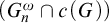 $(G_n^\omega \cap c(G))$
is a neighborhood base of
 $1_{c(G)}$
, so
 $c(G)$
is non-Archimedean.
Proposition 3.4. Let
 $G,H$
be two Polish groups. If G is topologically isomorphic to a closed subgroup of H, then
 $E(G)\le _BE(H)$
.
Proof. It follows from the definitions of
 $E(G)$
and
 $E(H)$
.
Theorem 3.5.
-
(1) Let G be a discrete countable group containing at least two elements, then
$E(G)\sim _BE_0$
. -
(2) Let G be an uncountable Polish group, then
$E_0^\omega \le _BE(G)$
. -
(3) Let G be a TSI non-Archimedean uncountable Polish group, then
$E(G)\sim _BE_0^\omega $
. -
(4) Let G be a non-Archimedean Polish group, then
$E(G)\le _B=^+$
. -
(5)
$E(S_\infty )\sim _B =^+$
.


Proof. (1) Let G be a discrete countable group containing at least two elements. For
 $x,y\in G^\omega $
, we have
 $$ \begin{align*}xE(G)y\iff xy^{-1}\in c(G)\iff\exists m\,\exists g\in G\,\forall n>m\,(x(n)y(n)^{-1}=g).\end{align*} $$
For all
 $m\in \omega $
, we define
 $$ \begin{align*}\begin{array}{ll}xF_my & \iff\exists g\in G\,\forall n>m\,(x(n)y(n)^{-1}=g)\\ & \iff\forall n>m\,(x(n)y(n)^{-1}=x(n+1)y(n+1)^{-1}).\end{array}\end{align*} $$
Thus each
 $F_m$
is a closed equivalence relation on
 $G^\omega $
, and hence is smooth (cf. [Reference Gao14, Proposition 5.4.7]). Note that
 $E(G)=\bigcup _mF_m$
and
 $F_m\subseteq F_{m+1}$
for each
 $m\in \omega $
. So
 $E(G)$
is hypersmooth (cf. [Reference Gao14, Definition 8.1.1]). It is clear that each orbit of
 $E(G)$
is countable. By Dougherty–Jackson–Kechris’ theorem (cf. [Reference Gao14, Theorem 8.1.5]), we have
 $E(G)\le _BE_0$
.
Fix a
 $g_0\in G$
with
 $g_0\ne 1_G$
. For
 $a\in 2^\omega $
, we define
 $\theta (a)\in G^\omega $
as
 $$ \begin{align*}\theta(a)(n)=\left\{\begin{array}{ll}g_0, & n=2k,a(k)=1,\\ 1_G, &\mbox{otherwise.}\end{array}\right.\end{align*} $$
Then
 $\theta $
witnesses that
 $E_0\le _BE(G)$
. Therefore, we have
 $E(G)\sim _BE_0$
.
(2) Let G be uncountable, then we can find a sequence
 $(g_i)$
in G such that
 $\lim _i g_i=1_G$
with all
 $g_i\ne 1_G$
for
 $i\in \omega $
. Fix a bijection
 $\langle \cdot ,\cdot \rangle $
from
 $\omega \times \omega $
to
 $\omega $
. For
 $\alpha \in (2^\omega )^\omega $
, we define
 $\vartheta (\alpha )\in G^\omega $
as
 $$ \begin{align*}\vartheta(\alpha)(\langle i,j\rangle)=\left\{\begin{array}{ll}g_i, & j=2k,\alpha(i)(k)=1,\\ 1_G, &\mbox{otherwise.}\end{array}\right.\end{align*} $$
Then
 $\vartheta $
witnesses that
 $E_0^\omega \le _BE(G)$
.
(3) Let G be TSI non-Archimedean uncountable. By (2), we only need to show
 $E(G)\le _BE_0^\omega $
. From [Reference Gao and Xuan16, Theorem 1.1], G is isomorphic to a closed subgroup of a product
 $\prod _k\Gamma _k$
, where each
 $\Gamma _k$
is a discrete countable group. So, by Proposition 3.4, it suffices to prove
 $E(\prod _k\Gamma _k)\le _BE_0^\omega $
. For
 $x,y\in (\prod _k\Gamma _k)^\omega $
, we have
 $$ \begin{align*}\begin{array}{ll}xE(\prod_k\Gamma_k)y &\iff xy^{-1}\in c(\prod_k\Gamma_k)\\ &\iff\forall k\,(x(\cdot)(k)y(\cdot)(k)^{-1}\in c(\Gamma_k))\\ &\iff\forall k\,(x(\cdot)(k)E(\Gamma_k)y(\cdot)(k)).\end{array}\end{align*} $$
Then
 $E(\prod _k\Gamma _k)\le _BE_0^\omega $
follows from (1).
(4) From [Reference Gao14, Theorem 2.4.1] and Proposition 3.4, it suffices to prove
 $E(S_\infty )\le _B=^+$
. For
 $x,y\in (S_\infty )^\omega $
, we have
 $$ \begin{align*}\begin{array}{ll}xE(S_\infty)y &\iff xy^{-1}\in c(S_\infty)\\ &\iff\exists g\in S_\infty\,\forall k\,\exists m\,\forall n>m\,((x(n)y(n)^{-1})(k)=g(k))\\ &\iff\exists g\in S_\infty\,\forall k\,\exists m\,\forall n>m\,(x(n)^{-1}(g(k))=y(n)^{-1}(k)).\end{array}\end{align*} $$
We define
 $\theta '(x)\in (\omega ^\omega )^\omega $
as
 $\theta '(x)(k)(n)=x(n)^{-1}(k)$
for
 $n,k\in \omega $
. Then
 $$ \begin{align*}xE(S_\infty)y\iff\exists g\in S_\infty\,\forall k\,(\theta'(x)(g(k))E_0\theta'(y)(k)).\end{align*} $$
By [Reference Gao14, Exercise 8.3.4], this implies that
 $E(S_\infty )\le _BE_0^+$
. It is well known that
 $E_0^+\le _B=^+$
(cf. [Reference Gao14, Theorem 7.4.10 and Exercise 8.3.3]), so we have
 $E(S_\infty )\le _B=^+$
.
(5) By [Reference Gao14, Lemma 10.3.4] and (4), we only need to show that
 $=^+\upharpoonright Y\le _BE(S_\infty )$
, where
 $Y=\{\alpha \in (2^\omega )^\omega :\forall n,m\,(n\ne m\Rightarrow \alpha (n)\ne \alpha (m))\}$
. Let
 $(p_i)$
be the strictly increasing enumeration of all prime numbers. Define a map
 $\varphi :Y\rightarrow (\omega ^\omega )^\omega $
with
 $$ \begin{align*}\varphi(\alpha)(n)(k)=\left\{\begin{array}{ll} p_0^{\alpha(n)(0)}\dots p_k^{\alpha(n)(k)}, & k\ge n,\\ 0, &\mbox{otherwise},\end{array}\right.\end{align*} $$
for
 $\alpha \in Y$
and
 $n,k\in \omega $
. It is clear that
 $$ \begin{align*}\varphi(\alpha)(n)E_0\varphi(\beta)(m)\iff\alpha(n)=\beta(m).\end{align*} $$
Define a map
 $\rho :(\omega ^\omega )^\omega \rightarrow (\omega ^\omega )^\omega $
by induction on n as
 $$ \begin{align*}\rho(x)(k)(n)=\left\{\begin{array}{ll} x(n)(k), & x(n)(k)\notin\{\rho(x)(k)(i):i<n\},\\ \min{\omega\setminus\{\rho(x)(k)(i):i<n\}}, &\mbox{otherwise},\end{array}\right.\end{align*} $$
for
 $x\in (\omega ^\omega )^\omega $
and
 $n,k\in \omega $
. Note that
 $\varphi (\alpha )(n)(k)=0$
for all
 $n>k$
, so
 $\rho (\varphi (\alpha ))(k)\in S_\infty $
for all
 $\alpha \in Y$
and
 $k\in \omega $
. Furthermore, for any
 $n\in \omega $
,
 $\alpha (0),\dots ,\alpha (n)$
are pairwise distinct elements in
 $2^\omega $
, so for large enough k, we have that
 $\varphi (\alpha )(0)(k),\dots ,\varphi (\alpha )(n)(k)$
are pairwise distinct natural numbers. It follows that
 $$ \begin{align*}\forall n\,\forall^\infty k\,(\rho(\varphi(\alpha))(k)(n)=\varphi(\alpha)(n)(k)).\end{align*} $$
Now we define a map
 $\vartheta ':Y\rightarrow (S_\infty )^\omega $
as
 $$ \begin{align*}\vartheta'(\alpha)(k)=\rho(\varphi(\alpha))(k)^{-1}\in S_\infty\end{align*} $$
for
 $x\in Y$
and
 $k\in \omega $
. Then for any
 $\alpha ,\beta \in Y$
, we have
 $$ \begin{align*}\begin{aligned} &\vartheta'(\alpha)E(S_\infty)\vartheta'(\beta)\\ \iff &\exists g\in S_\infty\,\forall n\,\forall^\infty k\,((\rho(\varphi(\alpha))(k)^{-1}\rho(\varphi(\beta))(k))(n)=g(n))\\ \iff &\exists g\in S_\infty\,\forall n\,\forall^\infty k\,(\rho(\varphi(\alpha))(k)(g(n))=\rho(\varphi(\beta))(k)(n))\\ \iff &\exists g\in S_\infty\,\forall n\,\forall^\infty k\,(\varphi(\alpha)(g(n))(k)=\varphi(\beta)(n)(k))\\ \iff &\exists g\in S_\infty\,\forall n\,(\varphi(\alpha)(g(n))E_0\varphi(\beta)(n))\\ \iff &\exists g\in S_\infty\,\forall n\,(\alpha(g(n))=\beta(n))\\ \iff &\alpha=^+\beta. \end{aligned} \end{align*} $$
Thus
 $=^+\upharpoonright Y\le _B E(S_\infty )$
. So
 $E(S_\infty )\sim _B=^+$
.
Furthermore, the authors [Reference Ding and Zheng10] get the following stronger result.
Theorem 3.6 [Reference Ding and Zheng10, Theorem 1.3].
Let G be a Polish group. Then the following are equivalent:
-
(1) G is TSI non-Archimedean;
-
(2)
$E(G)\leq _B E_0^\omega $
; -
(3)
$E(G)\leq _B {\mathbb {R}}^\omega /c_0$
.


In particular,
 $E(G)\sim _B E_0^\omega $
iff G is TSI uncountable non-Archimedean.
Corollary 3.7. Let
 $\Lambda $
be a discrete countable group, G a Polish group containing an element
 $h_0$
with
 $1_G\notin \overline {\{gh_0g^{-1}:g\in G\}}$
. Then
 $E(G\times \Lambda )\sim _BE(G)$
.
Proof. Proposition 3.4 gives
 $E(G)\le _BE(G\times \Lambda )$
. It is trivial that
 $E(G\times \Lambda )\sim _BE(G)\times E(\Lambda )$
. By Theorem 3.5(1),
 $E(\Lambda )\le _BE_0$
, so we only need to show that
 $E(G)\times E_0\le _BE(G)$
. For
 $x\in G^\omega $
and
 $a\in 2^\omega $
, define
 $\theta (x,a)\in G^\omega $
as
 $$ \begin{align*}\theta(x,a)(n)=\left\{\begin{array}{ll}x(k)h_0, & n=2k,a(k)=1,\\ x(k), & n=2k,a(k)=0\mbox{ or }n=2k+1.\end{array}\right.\end{align*} $$
It is trivial to check that
 $\theta $
is a Borel reduction of
 $E(G)\times E_0$
to
 $E(G)$
.
4 Non-CLI Polish groups and non non-Archimedean Polish groups
4.1 Non-CLI Polish groups
Lupini and Panagiotopoulos introduced a notion of right embedability for proving that an orbit equivalence relation is not Borel reducible to any
 $E_H^Y$
, where H is a CLI Polish group.
Definition 4.1 (Becker [Reference Becker3], Lupini–Panagiotopoulos [Reference Lupini and Panagiotopoulos25]).
Let G be a Polish group,
 $(g_n)$
a sequence in G. We say that
 $(g_n)$
is left Cauchy if
 $\lim _{m,n}g_m^{-1}g_n=1_G$
, and say that
 $(g_n)$
is right Cauchy if
 $\lim _{m,n}g_mg_n^{-1}=1_G$
.
Let X be a Polish G-space and
 $x,y\in X$
. We say that x is left embeddable into y, denoted by
 $x\stackrel {l}{\to }y$
, if there exists a left Cauchy sequence
 $(g_n)$
in G such that
 $g_nx\to y$
, and say that x is right embeddable into y, denoted by
 $x\stackrel {r}{\to }y$
, if there exists a right Cauchy sequence
 $(h_n)$
in G such that
 $h_ny\to x$
.
Clearly,
 $(g_n)$
is right Cauchy iff
 $(g_n^{-1})$
is left Cauchy. Let d be a left-invariant compatible metric on G,
 $(g_n)$
a sequence in G. It is worth noting that
 $(g_n)$
is left Cauchy iff it is d-Cauchy. It was proved by Becker that the relation of left embeddability is a preorder, and is invariant (cf. [Reference Becker3]). Similar arguments show that the relation of right embeddability is a preorder, and is invariant too. So we can write
 $[x]\stackrel {l}{\to }[y]$
and
 $[x]\stackrel {r}{\to }[y]$
in place of
 $x\stackrel {l}{\to }y$
and
 $x\stackrel {r}{\to }y,$
respectively.
Theorem 4.2. Let X be a Polish G-space and
 $x,y\in X$
. Then
 $x\stackrel {l}{\to }y$
implies
 $x\stackrel {r}{\to }y$
.
Proof. Suppose
 $x\stackrel {l}{\to }y$
. Then there exists a left Cauchy sequence
 $(g_n)$
in G such that
 $g_nx\to y$
. Let d be a compatible metric on G and
 $\rho $
a compatible metric on X.
By the continuity of the action of G on X, for any
 $k\in \omega $
, there exists a
 $\delta>0$
such that, for any
 $g\in G$
, if
 $d(g,1_G)<\delta $
, then
 $\rho (gx,x)<2^{-(k+1)}$
. Since
 $(g_n)$
is left Cauchy, for this
 $\delta>0$
, there exists an
 $m_k\in \omega $
such that, for any
 $n>m_k$
, we have
 $d(g_{m_k}^{-1}g_n,1_G)<\delta $
, and hence
 $\rho (g_{m_k}^{-1}g_nx,x)<2^{-(k+1)}$
. By
 $g_nx\to y$
, we have
 $g_{m_k}^{-1}g_nx\to g_{m_k}^{-1}y$
. There exists an
 $n>m_k$
such that
 $\rho (g_{m_k}^{-1}g_nx,g_{m_k}^{-1}y)<2^{-(k+1)}$
. So we have
 $\rho (g_{m_k}^{-1}y,x)<2^{-k}$
. Without loss of generality, we can assume that
 $(m_k)$
is strictly increasing. Let
 $h_k=g_{m_k}^{-1}$
for each k. Then
 $(h_k)$
witnesses that
 $x\stackrel {r}{\to }y$
.
Suppose that X is a Polish G-space, and
 $x,y\in X$
. Lupini and Panagiotopoulos defined a Becker-embedding game
 $Emb(x,y)$
(see [Reference Lupini and Panagiotopoulos25, Definition 2.2]). We say that x is Becker embeddable into y and write
 $x\preceq _B y$
if Player II has a winning strategy for the game Emb(
 $x,y$
). They showed the notion of Becker-embeddability is actually equivalent to the notion of right embedability, i.e.,
 $x\preceq _B y$
iff
 $x\stackrel {r}{\to }y$
[Reference Lupini and Panagiotopoulos25, Lemma 2.4].
Theorem 4.3. Let G be a non-CLI Polish group and H a CLI Polish group. Then for any Polish H-space Y, we have
 $E(G)\not \le _BE_H^Y$
.
Proof. Let d be a left-invariant compatible metric on G, and let
 $d_u$
be the supremum metric on
 $c(G)$
. Since G is not CLI, d is not complete. So there exists a d-Cauchy sequence
 $(g_n)$
in G such that
 $(g_n)$
diverges. For
 $m\in \omega $
, we define
 $\gamma _m\in c(G)$
as
 $$ \begin{align*}\gamma_m(n)=\left\{\begin{array}{ll}g_n, & n<m,\\ g_m, & n\ge m.\end{array}\right.\end{align*} $$
For
 $m<k$
, we have
 $d_u(\gamma _m^{-1}\gamma _k,1_{c(G)})=\max \{d(g_m,g_n):m\le n\le k\}$
. So
 $(\gamma _m)$
is left Cauchy, and hence
 $(\gamma _m^{-1})$
is right Cauchy.
We define
 $z\in G^\omega $
as
 $z(n)=g_n$
for each
 $n\in \omega $
. Then
 $z\notin c(G)$
. We claim that for any
 $c(G)$
-invariant dense
 $G_\delta $
subset C of
 $G^\omega $
there exist
 $x,y\in C$
with different orbits such that
 $x\preceq _B y$
. Then by [Reference Lupini and Panagiotopoulos25, Theorem 2.9] we have
 $E(G)\not \le _BE_H^Y$
.
Fix a
 $c(G)$
-invariant dense
 $G_\delta $
subset C of
 $G^\omega $
. Since
 $z^{-1}C$
is also dense
 $G_\delta $
,
 $C\cap z^{-1}C\ne \emptyset $
. Let
 $x\in C\cap z^{-1}C$
and
 $y=zx$
, then
 $x,y\in C$
and
 $[x]\ne [y]$
. Note that
 $\gamma _m^{-1}y\to z^{-1}y=x$
, so
 $x\stackrel {r}{\to } y$
. Thus
 $x\preceq _B y$
.
Corollary 4.4. Let H be a CLI Polish group, then
 $E(S_\infty )\not \le _BE(H)$
.
Proof. It well known that
 $S_\infty $
is not CLI (cf. [Reference Gao14, Example 2.2.7]). And by Proposition 3.3,
 $c(H)$
is CLI.
4.2 Non non-Archimedean Polish groups
Hjorth founded the theory of turbulence for proving that an orbit equivalence relation is not Borel reducible to
 $E_{S_\infty }^Y$
for any Polish
 $S_\infty $
-space Y. We omit the definition of turbulent actions since it is very complicated and is not used in this article, one can find it in [Reference Gao14, Section 10].
Definition 4.5 (Farah [Reference Farah13, Definition 3.1]).
If
 $(X_n,d_n),\,n\in \omega $
is a sequence of finite metric spaces, let
 $D=D(\langle X_n,d_n\rangle )$
be the equivalence relation on
 $\prod _nX_n$
defined as
 $$ \begin{align*}xDy\iff\lim_nd_n(x(n),y(n))=0.\end{align*} $$
The equivalence relations of this form are called
 $c_0$
-equalities.
By [Reference Farah13, Lemma 3.4], every
 $c_0$
-equality is an orbit equivalence relation induced by a continuous Polish group action on
 $\prod _nX_n$
.
For a finite metric space
 $(X,d)$
and
 $\varepsilon \in {\mathbb {R}}_+$
, we define
 $$ \begin{align*}\delta(\varepsilon,X)=\min\{\delta:\exists x_0,x_1,\dots,x_n\,(d(x_0,x_n)\ge\varepsilon\wedge\forall i<n\,(d(x_i,x_{i+1})<\delta))\}.\end{align*} $$
Lemma 4.6. Let G be a Polish group. If G is not non-Archimedean, then there exists a turbulent
 $c_0$
-equality D such that
 $D\le _BE(G)$
.
Proof. Let d be a left-invariant compatible metric on G. Since G is not non-Archimedean, there exists an
 $\varepsilon _0>0$
such that no open subgroup of G is contained in
 $V=\{g\in G:d(1_G,g)<\varepsilon _0\}$
. For each
 $n\in \omega $
, we define
 $V_n=\{g\in G:d(1_G,g)<2^{-n}\}$
. Then
 $V_n^{-1}=V_n$
and
 $G_n=\bigcup _mV_n^m$
is an open subgroup of G. Thus
 $G_n\not \subseteq V$
for each
 $n\in \omega $
, and hence there is an integer
 $m_n>0$
such that
 $V_n^{m_n}\not \subseteq V$
. So we can find
 $1_G=g_{n,0},g_{n,1},\dots ,g_{n,m_n}\in G$
such that
 $g_{n,i}^{-1}g_{n,i+1}\in V_n$
for each
 $i<m_n$
and
 $g_{n,m_n}\notin V$
.
Let
 $X_n=\{g_{n,i}:0\le i\le m_n\}$
for each
 $n\in \omega $
. Then
 $(X_n,d)$
is a finite metric space. We define
 $\theta :\prod _nX_n\to G^\omega $
as, for
 $x\in \prod _nX_n$
and each
 $k\in \omega $
,
 $$ \begin{align*}\theta(x)(k)=\left\{\begin{array}{ll}x(n)^{-1}, & k=2n,\\ 1_G, & k=2n+1.\end{array}\right.\end{align*} $$
It is trivial to check that
 $\theta $
is a Borel reduction of
 $D(X_n,d)$
to
 $E(G)$
.
Note that
 $\delta (\varepsilon _0,X_n)\le 2^{-n}\to 0$
as
 $n\to \infty $
. By [Reference Farah13, Theorem 3.7(a)], there exists a turbulent
 $c_0$
-equality D such that
 $D\le _BD(X_n,d)\le _BE(G)$
.
Hjorth proved that orbit equivalence relations from turbulent actions are not Borel reducible to any
 $S_\infty $
orbit equivalence relation (see [Reference Gao14, Corollary 10.4.3]). Using this result, we can prove the following theorem.
Theorem 4.7. Let G and H be two Polish groups. If H is non-Archimedean but G is not, then
 $E(G)\not \le _BE_H^Y$
for any Polish H-space Y.
In particular, we have
 $E(G)\not \le _BE(S_\infty )$
.
Proof. Since H is topologically isomorphic to a closed subgroup of
 $S_\infty $
, by [Reference Gao14, Theorem 3.5.2], we only need to consider the case of
 $H=S_\infty $
.
Then the result follows from the preceding lemma.
By Proposition 3.3,
 $c(S_\infty )$
is non-Archimedean, so
 $E(G)\not \le _BE(S_\infty )$
.
Corollary 4.8. Let G be a Polish group, then
 $E(G)\le _B=^+$
iff G is non-Archimedean.
Proof. It follows from Theorem 3.5(4) and the preceding theorem.
5 Non-TSI Polish groups and
$\alpha $
-unbalanced relations

5.1 Unbalanced relations
Definition 5.1 (Allison–Panagiotopoulos [Reference Allison and Panagiotopoulos1, Definition 1.1]).
Let X be a Polish G-space and let
 $x,y\in X$
. We write
 $x\leftrightsquigarrow y$
provided that, for any open
 $V\ni 1_G$
and open set U of X with
 $U\cap ([x]\cup [y])\ne \emptyset $
, there exist
 $g^x,g^y\in G$
with
 $g^xx,g^yy\in U$
, so that
 $$ \begin{align*}g^yy\in\overline{V(g^xx)}\mbox{ and }g^xx\in\overline{V(g^yy)}.\end{align*} $$
It is clear that
 $\leftrightsquigarrow $
is symmetric, and for any
 $g,h\in G$
, we have that
 $x\leftrightsquigarrow y\iff gx\leftrightsquigarrow hy$
. So we can write
 $[x]\leftrightsquigarrow [y]$
whenever
 $x\leftrightsquigarrow y$
.
Lemma 5.2. Let G be a Polish group and
 $c(G)\curvearrowright G^\omega $
the action of left multiplication. For
 $x,y\in G^\omega $
we have
 $$ \begin{align*}x\leftrightsquigarrow y\iff\exists(\gamma_m),(\eta_m)\in c(G)^\omega\,(\gamma_mxy^{-1}\eta_m\rightrightarrows 1_{G^\omega}).\end{align*} $$
Proof. Let d be a compatible metric on G and
 $d_u$
the supremum metric on
 $G^\omega $
. Note that
 $1_{c(G)}(n)=1_{G^\omega }(n)=1_G$
for each
 $n\in \omega $
. Let
 $V_m=\{\gamma \in c(G):d_u(\gamma ,1_{c(G)})<2^{-m}\}$
for
 $m\in \omega $
. Then
 $(V_m)$
is a neighborhood basis of
 $1_{c(G)}$
. Note that
 $V_m$
is dense in
 $\{x\in G^\omega :d_u(x,1_{G^\omega })<2^{-m}\}$
under the topology of
 $G^\omega $
. For
 $x,y\in G^\omega $
, we have
 $x\in \overline {V_my}\iff xy^{-1}\in \overline {V_m}$
, so
 $$ \begin{align*}d_u(xy^{-1},1_{G^\omega})<2^{-m}\Rightarrow x\in\overline{V_my}\Rightarrow d_u(xy^{-1},1_{G^\omega})\le 2^{-m}.\end{align*} $$
(
 $\Rightarrow $
). Let
 $x\leftrightsquigarrow y$
. Then for each
 $m\in \omega $
, there exist
 $\gamma ^x_m,\gamma ^y_m\in c(G)$
such that
 $\gamma ^x_mx\in \overline {V_m(\gamma ^y_my)}$
. So
 $d_u(\gamma ^x_mxy^{-1}(\gamma ^y_m)^{-1},1_{G^\omega })\le 2^{-m}$
. Let
 $\gamma _m=\gamma ^x_m$
and
 $\eta _m=(\gamma ^y_m)^{-1}$
, then
 $\gamma _mxy^{-1}\eta _m\rightrightarrows 1_{G^\omega }$
.
(
 $\Leftarrow $
). Let
 $(\gamma _m),(\eta _m)\in c(G)^\omega $
with
 $\gamma _mxy^{-1}\eta _m\rightrightarrows 1_{G^\omega }$
. It is easy to check that
 $\eta _m^{-1}yx^{-1}\gamma _m^{-1}\rightrightarrows 1_{G^\omega }$
. For any open
 $V\ni 1_{c(G)}$
and open set U of
 $G^\omega $
with
 $U\cap ([x]\cup [y])\ne \emptyset $
, there exists
 $k\in \omega $
with
 $V_k\subseteq V$
. Without loss of generality, we may assume that
 $U\cap [x]\ne \emptyset $
and
 $U=U_0\times \cdots \times U_l\times G^\omega $
with
 $U_0,\dots ,U_l$
open in G. So there exists
 $\gamma \in c(G)$
with
 $\gamma x\in U$
, i.e.,
 $\gamma (n)x(n)\in U_n$
for each
 $n\le l$
.
Fix a large enough m such that
 $$ \begin{align*}d_u(\gamma_mxy^{-1}\eta_m,1_{G^\omega})<2^{-k},\quad d_u(\eta_m^{-1}yx^{-1}\gamma_m^{-1},1_{G^\omega})<2^{-k}.\end{align*} $$
Now we define
 $$ \begin{align*}\gamma^x(n)=\left\{\begin{array}{ll}\gamma(n), & n\le l,\\ \gamma_m(n), & n>l,\end{array}\right. \quad\gamma^y(n)=\left\{\begin{array}{ll}\gamma(n)x(n)y(n)^{-1}, & n\le l,\\ \eta_m(n)^{-1}, & n>l.\end{array}\right.\end{align*} $$
Then we have
 $\gamma ^x,\gamma ^y\in c(G)$
and
 $\gamma ^xx,\gamma ^yy\in U$
. Note that
 $$ \begin{align*}\gamma^x(n)x(n)y(n)^{-1}(\gamma^y(n))^{-1}=\left\{\begin{array}{ll}1_G, & n\le l,\\ \gamma_m(n)x(n)y(n)^{-1}\eta_m(n), & n>l.\end{array}\right.\end{align*} $$
It is easy to see that
 $$ \begin{align*}d_u(\gamma^xxy^{-1}(\gamma^y)^{-1},1_{G^\omega})\le d_u(\gamma_mxy^{-1}\eta_m,1_{G^\omega})<2^{-k},\end{align*} $$
 $$ \begin{align*}d_u(\gamma^yyx^{-1}(\gamma^x)^{-1},1_{G^\omega})\le d_u(\eta_m^{-1}yx^{-1}\gamma_m^{-1},1_{G^\omega})<2^{-k}.\end{align*} $$
It gives that
 $\gamma ^xx\in \overline {V_k(\gamma ^yy)}\subseteq \overline {V(\gamma ^yy)}$
and
 $\gamma ^yy\in \overline {V_k(\gamma ^xx)}\subseteq \overline {V(\gamma ^xx)}$
. Thus we have
 $x\leftrightsquigarrow y$
.
Definition 5.3. Let G be a Polish group and
 $c(G)\curvearrowright G^\omega $
the action of left multiplication. We say that G is l.m.-unbalanced if there exist
 $x,y\in G^\omega $
such that
 $x\leftrightsquigarrow y$
and
 $[x]\ne [y]$
, where l.m. stands for left multiplication.
Theorem 5.4. Any TSI Polish group is not l.m.-unbalanced.
Proof. Let G be a Polish group and
 $c(G)\curvearrowright G^\omega $
the action of left multiplication. Assume that
 $x\leftrightsquigarrow y$
for some
 $x,y\in G^\omega $
. From Lemma 5.2, there exist
 $(\gamma _m),(\eta _m)\in c(G)^\omega $
with
 $\gamma _mxy^{-1}\eta _m\rightrightarrows 1_{G^\omega }$
. Let d be a two-sided invariant compatible metric on G and
 $d_u$
the supremum metric on
 $G^\omega $
. Then
 $d_u$
is also two-sided invariant, so
 $$ \begin{align*}d_u(\eta_m\gamma_mxy^{-1},1_{G^\omega})=d_u(\gamma_mxy^{-1}\eta_m,1_{G^\omega})\to 0,\end{align*} $$
thus we have
 $\eta _m\gamma _mxy^{-1}\rightrightarrows 1_{G^\omega }$
. It follows that
 $\eta _m\gamma _m\rightrightarrows yx^{-1}$
. Since
 $c(G)$
is closed under uniform convergence,
 $yx^{-1}\in c(G)$
. So
 $[x]=[y]$
.
As an application of the notion of l.m.-unbalanced groups, we present the following theorem. Since it is a special case of Theorem 5.15, we omit the proof at this moment.
Theorem 5.5. Let
 $G,H$
be Polish groups. If G is l.m.-unbalanced but H is not, then
 $E(G)\not \le _BE(H)$
.
Corollary 5.6. Let G be a Polish group. If G is l.m.-unbalanced, then
 $E_0^\omega <_BE(G)$
.
5.2
$\alpha $
-unbalanced relations

Definition 5.7 (Allison–Panagiotopoulos [Reference Allison and Panagiotopoulos1, Definition 7.1]).
Let X be a Polish G-space, V an open neighborhood of
 $1_G$
, and let
 $\alpha <\omega _1$
. We define
 $\leftrightsquigarrow _V^\alpha $
by induction. We say:
-
(1)
$x\leftrightsquigarrow _V^0y$
, if
$y\in \overline {Vx}$
and
$x\in \overline {Vy}$
; -
(2)
$x\leftrightsquigarrow _V^\alpha y$
for
$\alpha>0$
, if for any open neighborhood
$W\ni 1_G$
and any open neighborhood
$U\subseteq X$
of x or y, there exist
$g^x,g^y\in V$
with
$g^xx,g^yy\in U$
, so that
$g^xx\leftrightsquigarrow _W^\beta g^yy$
for all
$\beta <\alpha $
.


Remark 5.8. This definition appeared in an old version of [Reference Allison and Panagiotopoulos1]. It is slightly different with which in new version of [Reference Allison and Panagiotopoulos1] that the requirement of U has been modified to
 $U\cap ([x]\cup [y])\ne \emptyset $
. It should be noted that the definitions of these two versions are not equivalent for
 $V\ne G$
or
 $\alpha>1$
.
It is trivial that, if
 $x\leftrightsquigarrow _V^\alpha y$
, then we have
 $x\leftrightsquigarrow _V^{\alpha '} y$
for
 $0<\alpha '\le \alpha $
. Note that
 $g^xx\in U\cap Vx$
for any open neighborhood U of y, so
 $U\cap Vx\ne \emptyset $
, and hence
 $y\in \overline {Vx}$
. Similarly,
 $x\in \overline {Vy}$
. Therefore,
 $x\leftrightsquigarrow _V^\alpha y$
implies
 $x\leftrightsquigarrow _V^0 y$
too.
Lemma 5.9. Let V and
 $V'$
be two open neighborhoods of
 $1_G$
and
 $g,h\in G$
with
 $(gVg^{-1}\cup gVh^{-1}\cup hVh^{-1}\cup hVg^{-1})\subseteq V'$
, and let
 $\alpha <\omega _1$
,
 $x,y\in X$
. If
 $x\leftrightsquigarrow _V^\alpha y$
, then
 $gx\leftrightsquigarrow _{V'}^\alpha hy$
. In particular, we have
 $gx\leftrightsquigarrow _{gVg^{-1}}^\alpha gy$
.
Proof. We prove by induction on
 $\alpha $
. If
 $\alpha =0$
, since
 $x\leftrightsquigarrow _V^0y$
means
 $x\in \overline {Vy}$
and
 $y\in \overline {Vx}$
, we have
 $gx\in \overline {gVy}=\overline {(gVh^{-1})(hy)}\subseteq \overline {V'(hy)}$
and
 $hy\in \overline {hVx}=\overline {(hVg^{-1})(gx)}\subseteq \overline {V'(gx)}$
, so
 $gx\leftrightsquigarrow _{V'}^0hy$
.
Assume that the result holds for all
 $\beta <\alpha $
. If
 $x\leftrightsquigarrow _V^\alpha y$
, then for any open
 $W\ni 1_G$
and any open set
 $U\subseteq X$
such that U contains
 $gx$
or
 $hy$
. Without loss of generality, suppose
 $gx\in U$
, i.e.,
 $x\in g^{-1}U$
. Then there exist
 $g^x,g^y\in V$
with
 $g^xx,g^yy\in g^{-1}U$
, so that
 $g^xx\leftrightsquigarrow _{g^{-1}Wg}^\beta g^yy$
for all
 $\beta <\alpha $
. By the inductive hypothesis,
 $(gg^xg^{-1})(gx)=gg^xx\leftrightsquigarrow _W^\beta gg^yy=(gg^yh^{-1})(hy)$
for all
 $\beta <\alpha $
. It is trivial to check that
 $gg^xg^{-1}$
and
 $gg^yh^{-1}$
witnesses that
 $gx\leftrightsquigarrow _{V'}^\alpha hy$
.
Lemma 5.10. For all
 $\alpha <\omega _1$
, the relation
 $\leftrightsquigarrow _G^\alpha $
is G-invariant. Moreover,
 $x\leftrightsquigarrow y$
iff
 $x\leftrightsquigarrow _G^1y$
for
 $x,y\in X$
.
Proof. For any
 $x,y\in X$
and
 $g,h\in G$
, by Lemma 5.9,
 $x\leftrightsquigarrow _G^\alpha y$
implies
 $gx\leftrightsquigarrow _G^\alpha hy$
. So
 $\leftrightsquigarrow _G^\alpha $
is G-invariant.
By their definitions, it is trivial that
 $x\leftrightsquigarrow y$
implies
 $x\leftrightsquigarrow _G^1y$
.
On the other hand, if
 $x\leftrightsquigarrow _G^1y$
, we will show
 $x\leftrightsquigarrow y$
. For any open
 $V\ni 1_G$
and any open set
 $U\subseteq X$
with
 $U\cap ([x]\cup [y])\ne \emptyset $
, without loss of generality, we can assume that
 $U\cap [x]\ne \emptyset $
. There exists
 $g\in G$
with
 $gx\in U$
, i.e.,
 $x\in g^{-1}U$
. So there are
 $g^x,g^y\in G$
such that
 $g^xx,g^yy\in g^{-1}U$
,
 $g^xx\in \overline {(g^{-1}Vg)g^yy}$
, and
 $g^yy\in \overline {(g^{-1}Vg)g^xx}$
. Then
 $gg^x$
and
 $gg^y$
witness that
 $x\leftrightsquigarrow y$
.
Lemma 5.11. Let
 $0<\alpha <\omega _1$
, V an open neighborhood of
 $1_G$
. If
 $x\leftrightsquigarrow _V^\alpha y$
, then for any open set
 $W\ni 1_G$
and any open set U of X such that U contains x or y, there exist nonempty open sets
 $V^x,V^y\subseteq V$
such that, whenever
 $g^x\in V^x$
and
 $g^y\in V^y$
, we have
 $g^xx,g^yy\in U$
and
 $g^xx\leftrightsquigarrow _W^\beta g^yy$
for all
 $\beta <\alpha $
.
Proof. Given an open set
 $W\ni 1_G$
and an open set U of X with
 $x\in U$
or
 $y\in U$
. We can find an open
 $W_0\ni 1_G$
with
 $W_0^{-1}=W_0$
and
 $W_0^3\subseteq W$
. Then there exist
 $h^x,h^y\in V$
such that
 $h^xx,h^yy\in U$
and
 $h^xx\leftrightsquigarrow _{W_0}^\beta h^yy$
for all
 $\beta <\alpha $
. We can find an open
 $V_0\ni 1_G$
such that
 $(V_0h^xx\cup V_0h^yy)\subseteq U$
. By Lemma 5.9,
 $w^xh^xx\leftrightsquigarrow _W^\beta w^yh^yy$
holds for all
 $w^x,w^y\in W_0$
. Then we can put
 $V^x=W_0h^x\cap V_0h^x\cap V$
and
 $V^y=W_0h^y\cap V_0h^y\cap V$
as desired.
Theorem 5.12. Let
 $G,H$
be two Polish groups, X a Polish G-space, and Y a Polish H-space, and let
 $f:X\to Y$
be a Baire measurable homomorphism, i.e.,
 $xE_G^Xy$
implies
 $f(x)E_H^Yf(y)$
for any
 $x,y\in X$
. Then there exists a dense
 $G_\delta $
subset
 $C\subseteq X$
such that
 $x\leftrightsquigarrow _G^\alpha y$
implies
 $f(x)\leftrightsquigarrow _H^\alpha f(y)$
for any
 $x,y\in C$
and
 $0<\alpha <\omega _1$
.
Proof. Let C be the dense
 $G_\delta $
subset of X in [Reference Lupini and Panagiotopoulos25, Lemma 2.5].
Claim. Let
 $0<\alpha <\omega _1$
,
 $x_0,y_0\in C$
, and let
 $V\ni 1_G$
open in G,
 $W\ni 1_H$
open in H, and U open in X with
 $x_0,y_0\in U$
. Suppose:
-
(1)
$\forall x\in (U\cap C)\,\forall ^*g\in V\,(f(gx)\in Wf(x))$
; -
(2)
$x_0\leftrightsquigarrow _V^\alpha y_0$
.


Then we have
 $f(x_0)\leftrightsquigarrow _W^\alpha f(y_0)$
.
Proof of Claim.
By [Reference Lupini and Panagiotopoulos25, Lemma 2.5], the following conditions hold:
-
(i)
$f\upharpoonright C$
is continuous; -
(ii)
$\forall x\in C\,\forall ^*g\in G\,(gx\in C)$
; -
(iii) for any open
$W'\ni 1_H$
, there exist an open set
$V'\ni 1_G$
and an open neighborhood
$U'$
of
$x_0$
such that
$$ \begin{align*}\forall x\in(U'\cap C)\,\forall^*g\in V'\,(f(gx)\in W'f(x)).\end{align*} $$


Let
 $W'\ni 1_H$
be any open subset of H. Then we find two open sets
 $V'\ni 1_G$
and
 $U'\ni x_0$
satisfying (iii). Given any open set
 $O\subseteq Y$
with
 $f(x_0)\in O$
or
 $f(y_0)\in O$
, without loss of generality, we can assume that
 $f(x_0)\in O$
. Since f is continuous on C and
 $x_0\in U'\cap C$
, by shrinking, we can assume that
 $f(U'\cap C)\subseteq O$
. Since
 $x_0\leftrightsquigarrow _V^\alpha y_0$
, by Lemma 5.11, we have
 $$ \begin{align*}\exists^*g^x\in V\,\exists^*g^y\in V\,(g^xx_0,g^yy_0\in U'\wedge\forall\beta<\alpha\,(g^xx_0\leftrightsquigarrow_{V'}^\beta g^yy_0)).\end{align*} $$
Moveover, since
 $x_0,y_0\in U\cap C$
, by (1) and (ii), we can find
 $g^x,g^y\in V$
such that
 $g^xx_0,g^yy_0\in (U'\cap C)$
,
 $g^xx_0\leftrightsquigarrow _{V'}^\beta g^yy_0~(\forall \beta <\alpha )$
,
 $f(g^xx_0)\in Wf(x_0)$
and
 $f(g^yy_0)\in Wf(y_0)$
. Thus there exist
 $h^x,h^y\in W$
so that
 $f(g^xx_0)=h^xf(x_0)$
and
 $f(g^yy_0)=h^yf(y_0)$
.
Now we prove
 $f(x_0)\leftrightsquigarrow _W^\alpha f(y_0)$
by induction on
 $\alpha $
. Since
 $g^xx_0,g^yy_0\in (U'\cap C)$
, we have
 $h^xf(x_0),h^yf(y_0)\in O$
. Thus we only need to show that
 $h^xf(x_0)\leftrightsquigarrow _{W'}^\beta h^yf(y_0)$
for
 $\beta <\alpha $
.
For any open neighborhood N of
 $h^xf(x_0)=f(g^xx_0)$
, we have
 $g^xx_0\in f^{-1}(N)$
. By the continuity of
 $f\upharpoonright C$
, there is an open set
 $V_0\ni 1_G$
such that
 $(V_0g^xx_0\cap C)\subseteq f^{-1}(N)$
. Since
 $g^yy_0\in (U'\cap C)$
, we can find
 $v\in V_0\cap V'$
such that
 $vg^yy_0\in C$
and
 $f(vg^yy_0)\in W'f(g^yy_0)=W'h^yf(y_0)$
. So
 $N\cap (W'h^yf(y_0))\ne \emptyset $
. It follows that
 $h^xf(x_0)\in \overline {W'h^yf(y_0)}$
. Similarly, we have
 $h^yf(y_0)\in \overline {W'h^xf(x_0)}$
. Therefore,
 $h^xf(x_0)\leftrightsquigarrow _{W'}^0 h^yf(y_0)$
.
If
 $\alpha =1$
, we have already proved
 $f(x_0)\leftrightsquigarrow _W^1 f(y_0)$
.
If
 $\alpha>1$
, then for all
 $0<\beta <\alpha $
, by inductive hypothesis,
 $g^xx_0\leftrightsquigarrow _{V'}^\beta g^yy_0$
implies
 $h^xf(x_0)=f(g^xx_0)\leftrightsquigarrow _{W'}^\beta f(g^yy_0)=h^yf(y_0)$
. This completes the proof.
Put
 $V=G,W=H$
, and
 $U=X$
, then the proceeding Claim gives that,
 $x\leftrightsquigarrow _G^\alpha y$
implies
 $f(x)\leftrightsquigarrow _H^\alpha f(y)$
for
 $x,y\in C$
and
 $0<\alpha <\omega _1$
.
Now we return to
 $E(G)$
and the left multiplication action
 $c(G)\curvearrowright G^\omega $
.
Lemma 5.13. Let G be a Polish group,
 $V\subseteq c(G)$
an open neighborhood of
 $1_{c(G)}$
,
 $\alpha <\omega _1$
, and
 $x,y,z\in G^\omega $
. If
 $x\leftrightsquigarrow _V^\alpha y$
, then
 $xz\leftrightsquigarrow _V^\alpha yz$
.
Proof. We prove by induction on
 $\alpha $
.
If
 $\alpha =0$
, then we have
 $x\in \overline {Vy}$
and
 $y\in \overline {Vx}$
. So
 $xz\in \overline {Vyz}$
and
 $yz\in \overline {Vxz}$
, i.e.,
 $xz\leftrightsquigarrow _V^0 yz$
.
If
 $\alpha>0$
, then for any open
 $W\ni 1_{c(G)}$
and any open
 $U\subseteq G^\omega $
with
 $xz\in U$
or
 $yz\in U$
, we have
 $x\in Uz^{-1}$
or
 $y\in Uz^{-1}$
, so there exist
 $g^x,g^y\in V$
such that
 $g^xx,g^yy\in Uz^{-1}$
and
 $g^xx\leftrightsquigarrow _W^\beta g^yy$
for
 $\beta <\alpha $
. Then we have
 $g^xxz,g^yyz\in U$
, and by induction hypothesis,
 $g^xxz\leftrightsquigarrow _W^\beta g^yyz$
for
 $\beta <\alpha $
. Therefore,
 $xz\leftrightsquigarrow _V^\alpha yz$
.
Definition 5.14. Let G be a Polish group,
 $0<\alpha <\omega _1$
. We say that G is
 $\alpha $
-l.m.-unbalanced if there exist
 $x,y\in G^\omega $
such that
 $x\leftrightsquigarrow _{c(G)}^\alpha y$
and
 $[x]\ne [y]$
, or equivalently, there exists
 $z\in G^\omega \setminus c(G)$
such that
 $z\leftrightsquigarrow _{c(G)}^\alpha 1_{G^\omega }$
.
It is clear that G is
 $0$
-l.m.-unbalanced if G contains at least two elements. And Lemma 5.10 gives that G is l.m.-unbalanced iff it is
 $1$
-l.m.-unbalanced.
Theorem 5.15. Let
 $G,H$
be Polish groups,
 $0<\alpha <\omega _1$
. If G is
 $\alpha $
-l.m.-unbalanced but H is not, then
 $E(G)\not \le _B E(H)$
.
Proof. Assume for contradiction that there is a Borel reduction
 $\theta $
of
 $E(G)$
to
 $E(H)$
. From Theorem 5.12, there is a comeager set
 $C\subseteq G^\omega $
such that for any
 $x,y\in C$
, if
 $x\leftrightsquigarrow _{c(G)}^\alpha y$
, then
 $\theta (x)\leftrightsquigarrow _{c(H)}^\alpha \theta (y)$
. Since G is
 $\alpha $
-l.m.-unbalanced, there exists
 $z\in G^\omega \setminus c(G)$
such that
 $z\leftrightsquigarrow _{c(G)}^\alpha 1_{G^\omega }$
. Since
 $C\cap zC\ne \emptyset $
, we can find an
 $x\in (C\cap zC)$
and put
 $x=zy$
. Then
 $x,y\in C$
and
 $xy^{-1}=z\not \in c(G)$
, so
 $[x]\ne [y]$
. By Lemma 5.13,
 $x\leftrightsquigarrow _{c(G)}^\alpha y$
. It follows that
 $\theta (x)\leftrightsquigarrow _{c(H)}^\alpha \theta (y)$
and
 $[\theta (x)]\ne [\theta (y)]$
, contradicting that H is not
 $\alpha $
-l.m.-unbalanced.
5.3 Examples of
$\alpha $
-l.m.-unbalanced groups

Let G be a topological group, recall that G is said to be distal provided that
 $1_G\notin \overline {\{ghg^{-1}:g\in G\}}$
for all
 $h\ne 1_G\in G$
(cf. [Reference Rosenblatt27]). It is trivial that all TSI Polish groups are distal. Moveover, if H is a closed normal nilpotent subgroup of G and
 $G/H$
is compact, then G is distal (cf. [Reference Rosenblatt27, Section 3. Proposition]). In particular, all nilpotent topological groups are distal.
Theorem 5.16. Let G be a Polish group. If G is not distal, then G is l.m.-unbalanced.
Proof. Since G is not distal, there exist
 $h\ne 1_G$
in G and a sequence
 $(g_m)$
in G with
 $g_mhg_m^{-1}\to 1_G$
. For each
 $m,n\in \omega $
, let
 $\gamma _m(n)=g_m$
and
 $\eta _m(n)=g_m^{-1}$
. Then
 $\gamma _m,\eta _m\in c(G)$
. We define
 $z\in G^\omega $
as
 $$ \begin{align*}z(n)=\left\{\begin{array}{ll}1_G, & n=2k,\\ h, & n=2k+1.\end{array}\right.\end{align*} $$
It is clear that
 $\gamma _mz\eta _m\rightrightarrows 1_{G^\omega }$
. From Lemma 5.2, for any
 $x,y\in G^\omega $
, if
 $xy^{-1}=z$
, we have
 $x\leftrightsquigarrow y$
. But it is trivial that
 $[x]\ne [y]$
.
Theorem 5.17. Let G be a locally compact Polish group. Then G is not distal iff it is l.m.-unbalanced.
Proof. From Theorem 5.16, we only need to prove that if G is l.m.-unbalanced then it is not distal.
Let
 $x,y\in G^\omega $
with
 $x\leftrightsquigarrow y$
but
 $[x]\ne [y]$
. By Lemma 5.2, there exist two sequences
 $(\gamma _m),(\eta _m)$
in
 $c(G)$
such that
 $\gamma _mxy^{-1}\eta _m\rightrightarrows 1_{G^\omega }$
. Since
 $\gamma _m,\eta _m\in c(G)$
for each m, we can find
 $g_m,v_m\in G$
such that
 $g_m=\lim _n\gamma _m(n)$
and
 $v_m=\lim _n\eta _m(n)$
.
Let
 $B\subseteq G$
be an open neighborhood of
 $1_G$
with
 $\overline {B}$
compact. There is a large enough
 $k\in \omega $
such that
 $\gamma _k(n)x(n)y(n)^{-1}\eta _k(n)\in B\subseteq \overline {B}$
for all
 $n\in \omega $
. Thus there exist a
 $p\in \overline {B}$
and a strictly increasing natural numbers
 $n_0<n_1<\cdots $
such that
 $\lim _i\gamma _k(n_i)x(n_i)y(n_i)^{-1}\eta _k(n_i)=p$
. By
 $[x]\ne [y]$
, we have
 $xy^{-1}\notin c(G)$
, thus
 $\gamma _kxy^{-1}\eta _k\notin c(G)$
. So there exist a
 $q\in \overline {B}$
with
 $q\ne p$
and another strictly increasing natural numbers
 $l_0<l_1<\cdots $
such that
 $\lim _i\gamma _k(l_i)x(l_i)y(l_i)^{-1}\eta _k(l_i)=q$
. Therefore, we have
 $$ \begin{align*}\lim_ix(n_i)y(n_i)^{-1}=g_k^{-1}pv_k^{-1},\quad\lim_ix(l_i)y(l_i)^{-1}=g_k^{-1}qv_k^{-1}.\end{align*} $$
By the property of uniformly convergence of
 $\gamma _mxy^{-1}\eta _m\rightrightarrows 1_{G^\omega }$
, we have
 $$ \begin{align*}\begin{array}{ll}\lim_mg_mg_k^{-1}pv_k^{-1}v_m &\!\!\! =\lim_m\lim_i\gamma_m(n_i)x(n_i)y(n_i)^{-1}\eta_m(n_i)\\ &\!\!\!=\lim_i\lim_m\gamma_m(n_i)x(n_i)y(n_i)^{-1}\eta_m(n_i)\\ &\!\!\!=\lim_i1_G=1_G.\end{array}\end{align*} $$
Similarly, we have
 $\lim _mg_mg_k^{-1}qv_k^{-1}v_m=1_G$
. In the end, we set
 $h=g_k^{-1}pq^{-1}g_k\ne 1_G$
. It follows that
 $$ \begin{align*}\lim_mg_mhg_m^{-1}=\lim_m(g_mg_k^{-1}pv_k^{-1}v_m)(g_mg_k^{-1}qv_k^{-1}v_m)^{-1}=1_G.\end{align*} $$
So G is not distal.
Corollary 5.18. Let
 $G,H$
be two Polish groups. If G is not distal, and H is TSI, or locally compact and distal, then
 $E(G)\not \le _BE(H)$
.
Example 5.19. Let G be the group of all
 $2\times 2$
real upper triangular matrices whose determinant
 $=1$
, equipped with the usual topology. Then
 $h=\left (\begin {array}{cc}1 & 1\\ 0 & 1\end {array}\right )$
and
 $g_m=\left (\begin {array}{cc}1/m & 0\\ 0 & m\end {array}\right )$
witness that G is not distal.
Example 5.20. Let
 $\Lambda $
be an infinite countable discrete group, G a Polish group containing at least two elements, then the wreath product
 $\Lambda \wr G$
is not distal. To see this, fix an
 $a\in G$
with
 $a\ne 1_G$
. We define
 $\chi :\Lambda \to G$
as
 $\chi (\lambda )=\left \{\begin {array}{ll}a, & \lambda =1_\Lambda ,\\ 1_G, & \lambda \ne 1_\Lambda .\end {array}\right .$
and let
 $\Lambda =\{\lambda _m:m\in \omega \}$
. Then
 $h=(1_\Lambda ,\chi )$
and
 $g_m=(\lambda _m,1_{G^\Lambda })$
witness that
 $\Lambda \wr G$
is not distal.
Theorem 5.21. Let G be a locally compact Polish group. Then G is not
 $2$
-l.m.-unbalanced.
Proof. Let d be a compatible metric on G and
 $d_u$
the supremum metric on
 $G^\omega $
. Since G is locally compact, we can find an
 $r>0$
with
 $\overline {B(1_G,r)}$
is compact. Let
 $V=\{\gamma \in c(G):d_u(1_{c(G)},\gamma )<r\}$
.
Assume for contradiction that there exist
 $x,y\in G^\omega $
with
 $x\leftrightsquigarrow _{c(G)}^2 y$
but
 $[x]\ne [y]$
, then there exist
 $g^x,g^y\in c(G)$
such that
 $g^xx\leftrightsquigarrow _V^1g^yy$
. Following the arguments of
 $\Rightarrow $
part in the proof of Lemma 5.2, we can find two sequences
 $(\gamma _m)$
and
 $(\eta _m)$
in V such that
 $\gamma _mg^xxy^{-1}(g^y)^{-1}\eta _m\rightrightarrows 1_{G^\omega }$
. Let
 $g_m=\lim _n\gamma _m(n)$
. Following the arguments in the proof of Theorem 5.17, there exists
 $h\ne 1_G$
such that
 $g_mhg_m^{-1}\to 1_G$
.
Since
 $\gamma _m\in V$
, we have
 $g_m\in \overline {B(1_G,r)}$
. There exists a subsequence of
 $(g_m)$
converging to some
 $g\in G$
, so
 $ghg^{-1}=1_G$
, i.e.,
 $h=1_G$
. A contradiction!
For
 $c(G)\curvearrowright G^\omega $
, Lemma 5.2 can simplify arguments concerning
 $\leftrightsquigarrow $
. Following the same spirit, we define a notion
 $\leftrightarrow _V^\alpha $
to simplify arguments concerning
 $\leftrightsquigarrow _V^\alpha $
.
Definition 5.22. Let X be a Polish G-space, V an open neighborhood of
 $1_G$
, and let
 $\alpha <\omega _1$
. We define
 $\leftrightarrow _V^\alpha $
by induction. We say:
-
(1)
$x\leftrightarrow _V^0y$
, if
$y\in \overline {Vx}$
and
$x\in \overline {Vy}$
; -
(2)
$x\leftrightarrow _V^\alpha y$
for
$\alpha>0$
, if for any open
$W\ni 1_G$
, there exist
$g^x,g^y\in V$
such that
$g^xx\leftrightarrow _W^\beta g^yy$
for all
$\beta <\alpha $
.


From their definitions, it is trivial to see that
 $x\leftrightsquigarrow _V^\alpha y$
implies
 $x\leftrightarrow _V^\alpha y$
. Moreover, if
 $x\leftrightarrow _V^\alpha y$
, then we have
 $x\leftrightarrow _V^{\alpha '} y$
for
 $0<\alpha '\le \alpha $
, but
 $x\leftrightarrow _V^0 y$
may fail.
Lemma 5.23. Let G be a Polish group,
 $c(G)\curvearrowright G^\omega $
the left multiplication action. Then
 $x\leftrightarrow _{c(G)}^\alpha y$
implies
 $x\leftrightsquigarrow _{c(G)}^\alpha y$
for all
 $x,y\in G^\omega $
and
 $\alpha <\omega _1$
.
Proof. Let
 $d\leq 1$
be a compatible metric on G and
 $d_u$
the supremum metric on
 $G^\omega $
. For
 $\varepsilon>0$
, we define
 $V_\varepsilon =\{\gamma \in c(G):d_u(1_{c(G)},\gamma )<\varepsilon \}$
.
Let
 $x,y,x',y'\in G^\omega $
,
 $m\in \omega $
, and
 $\alpha <\omega _1$
. If
-
(1)
$x\leftrightarrow _{V_\varepsilon }^\alpha y$
, -
(2)
$x(n)=x'(n),y(n)=y'(n)$
for
$n\ge m$
, and -
(3)
$x'(y')^{-1},y'(x')^{-1}\in \overline {V_{\varepsilon /2}}$
,


then we claim that
 $x'\leftrightsquigarrow _{V_\varepsilon }^\alpha y'$
.
To see this, we prove by induction on
 $\alpha $
. It is trivial that (3) implies
 $x'\leftrightsquigarrow _{V_\varepsilon }^0 y'$
. For any
 $\delta>0$
and any open
 $U\subseteq G^\omega $
with
 $x'\in U$
or
 $y'\in U$
, without loss of generality, we can assume that
 $x'\in U$
, and
 $U=U_0\times \cdots \times U_l\times G^\omega $
with
 $l\ge m$
and
 $U_0,\dots ,U_l$
open in G. By
 $x\leftrightarrow _{V_\varepsilon }^\alpha y$
, there exist
 $\gamma ^x,\gamma ^y\in V_{\varepsilon }$
such that
 $\gamma ^xx\leftrightarrow _{V_{\delta /2}}^\beta \gamma ^yy$
for
 $\beta <\alpha $
. We put
 $$ \begin{align*}(\gamma^x)'(n)=\left\{\begin{array}{ll}1_G, & n\le l,\\ \gamma^x(n), & n>l,\end{array}\right. \quad(\gamma^y)'(n)=\left\{\begin{array}{ll}x'(n)y'(n)^{-1}, & n\le l,\\ \gamma^y(n), & n>l.\end{array}\right.\end{align*} $$
Then we have
 $(\gamma ^x)',(\gamma ^y)'\in V_\varepsilon $
and
 $(\gamma ^x)'x',(\gamma ^y)'y'\in U$
. Note that
 $\gamma ^xx\leftrightarrow _{V_{\delta /2}}^0\gamma ^yy$
gives
 $\gamma ^xx(\gamma ^yy)^{-1},\gamma ^yy(\gamma ^xx)^{-1}\in \overline {V_{\delta /2}}$
. Since
 $$ \begin{align*}(\gamma^x)'(n)x'(n)((\gamma^y)'(n)y'(n))^{-1}=\left\{\begin{array}{ll}1_G , & n\le l,\\ \gamma^x(n)x(n)(\gamma^y(n)y(n))^{-1}, & n>l,\end{array}\right.\end{align*} $$
we have
 $(\gamma ^x)'x'((\gamma ^y)'y')^{-1}\in \overline {V_{\delta /2}}$
. Similarly,
 $(\gamma ^y)'y'((\gamma ^x)'x')^{-1}\in \overline {V_{\delta /2}}$
. Since
 $\gamma ^xx\leftrightarrow _{V_{\delta /2}}^\beta \gamma ^yy$
implies
 $\gamma ^xx\leftrightarrow _{V_\delta }^\beta \gamma ^yy$
for
 $\beta <\alpha $
. By the induction hypothesis,
 $(\gamma ^x)'x'\leftrightsquigarrow _{V_\delta }^\beta (\gamma ^y)'y'$
for
 $\beta <\alpha $
. Thus
 $(\gamma ^x)'$
and
 $(\gamma ^y)'$
witness that
 $x'\leftrightsquigarrow _{V_\varepsilon }^\alpha y'$
.
In the end, by setting
 $V_{\varepsilon /2}=c(G)$
, it follows that
 $x\leftrightarrow _{c(G)}^\alpha y$
implies
 $x\leftrightsquigarrow _{c(G)}^\alpha y$
.
Given two sets
 $X,Y$
and a map
 $f:X\to Y$
, recall that the map
 $f^\omega :X^\omega \to Y^\omega $
is defined as:
 $f^\omega (x)(n)=f(x(n))$
for
 $x\in X^\omega $
and
 $n\in \omega $
.
Lemma 5.24. Let
 $G,H$
be two Polish groups,
 $\phi :G\to H$
a continuous homomorphism. Then for any
 $x,y\in G^\omega $
,
 $\alpha <\omega _1$
, open neighborhood
 $W\subseteq c(H)$
of
 $1_{c(H)}$
, and any open neighborhood
 $V\subseteq c(G)$
of
 $1_{c(G)}$
with
 $\phi ^\omega (V)\subseteq W$
, we have
 $x\leftrightarrow _V^\alpha y$
implies
 $\phi ^\omega (x)\leftrightarrow _W^\alpha \phi ^\omega (y)$
.
Proof. Let d be a compatible metric on G, and let
 $d_u$
be the supremum metric on
 $G^\omega $
. By the continuity of
 $\phi $
, we can see that
 $\phi ^\omega :G^\omega \to H^\omega $
is continuous, and
 $\phi ^\omega \upharpoonright c(G)$
is also continuous from
 $c(G)$
to
 $c(H)$
.
We prove by induction on
 $\alpha $
. If
 $\alpha =0$
, note that
 $x\leftrightarrow _V^0 y$
iff
 $xy^{-1},yx^{-1}\in \overline V$
. It follows from the continuity of
 $\phi ^\omega $
that
 $\phi ^\omega (x)\phi ^\omega (y)^{-1}=\phi ^\omega (xy^{-1})\in \overline W$
and
 $\phi ^\omega (y)\phi ^\omega (x)^{-1}=\phi ^\omega (yx^{-1})\in \overline W$
, and hence
 $\phi ^\omega (x)\in \overline {W\phi ^\omega (y)}$
and
 $\phi ^\omega (y)\in \overline {W\phi ^\omega (x)}$
, i.e.,
 $\phi ^\omega (x)\leftrightarrow _W^0\phi ^\omega (y)$
.
For
 $\alpha>0$
, we let
 $W'\subseteq c(H)$
be an open neighborhood of
 $1_{c(H)}$
. By the continuity of
 $\phi ^\omega \upharpoonright c(G)$
, we can find an open neighborhood
 $V'$
of
 $1_{c(G)}$
such that
 $\phi ^\omega (V')\subseteq W'$
. Note that
 $x\leftrightarrow _V^\alpha y$
, so there exist
 $\gamma ^x,\gamma ^y\in V$
such that
 $\gamma ^xx\leftrightarrow _{V'}^\beta \gamma ^yy$
for
 $\beta <\alpha $
. By induction hypothesis, we have
 $\phi ^\omega (\gamma ^x)\phi ^\omega (x)=\phi ^\omega (\gamma ^xx)\leftrightarrow _{W'}^\beta \phi ^\omega (\gamma ^yy)=\phi ^\omega (\gamma ^y)\phi ^\omega (y)$
. Therefore,
 $\phi ^\omega (\gamma ^x)$
and
 $\phi ^\omega (\gamma ^y)$
witness that
 $\phi ^\omega (x)\leftrightarrow _W^\alpha \phi ^\omega (y)$
.
Theorem 5.25. Let G be a Polish group,
 $\Lambda $
an infinite countable discrete group, and
 $\alpha <\omega _1$
. Then G is
 $\alpha $
-l.m.-unbalanced iff
 $\Lambda \wr G$
is
 $(\alpha +1)$
-l.m.-unbalanced.
Proof. Let
 $\rho $
be a compatible metric on
 $\Lambda \wr G$
,
 $\rho _u$
the supremum metric on
 $(\Lambda \wr G)^\omega $
. For any
 $\varepsilon>0$
, we define
 $$ \begin{align*}V_\varepsilon=\{\gamma\in c(\Lambda\wr G):\rho_u(1_{c(\Lambda\wr G)},\gamma)<\varepsilon\}.\end{align*} $$
(
 $\Rightarrow $
). Suppose G is
 $\alpha $
-l.m.-unbalanced. Then there exists an
 $a\in G^\omega \setminus c(G)$
such that
 $a\leftrightsquigarrow _{c(G)}^\alpha 1_{G^\omega }$
, and hence
 $a\leftrightarrow _{c(G)}^\alpha 1_{G^\omega }$
. For any
 $n\in \omega $
, let
 $$ \begin{align*}\chi_n(\lambda)=\left\{\begin{array}{ll}a(n), & \lambda=1_\Lambda,\\ 1_G, & \lambda\ne 1_\Lambda.\end{array}\right.\end{align*} $$
We define
 $z\in (\Lambda \wr G)^\omega $
as
 $z(n)=(1_\Lambda ,\chi _n)$
for
 $n\in \omega $
. It is trivial that
 $z\notin c(\Lambda \wr G)$
. To see that
 $\Lambda \wr G$
is
 $(\alpha +1)$
-l.m.-unbalanced, by Lemma 5.23, we only need to show that
 $z\leftrightarrow _{c(\Lambda \wr G)}^{\alpha +1}1_{(\Lambda \wr G)^\omega }$
.
Note that the underlying topology of
 $\Lambda \wr G$
is the product topology on
 $\Lambda \times G^\Lambda $
. Thus for any given
 $\varepsilon>0$
, there exists a
 $\lambda _0\in \Lambda $
such that, for any
 $\chi \in G^\Lambda $
, if
 $\chi (\lambda )=1_G$
for all
 $\lambda \ne \lambda _0$
, then
 $\rho (1_{\Lambda \wr G},(1_\Lambda ,\chi ))<\varepsilon /2$
. Define
 $$ \begin{align*}H=\{(1_\Lambda,\chi)\in\Lambda\wr G:\forall\lambda\in\Lambda\,(\lambda\ne\lambda_0\Rightarrow\chi(\lambda)=1_G)\}.\end{align*} $$
It is clear that H is a closed subgroup of
 $\lambda \wr G$
. Because
 $\rho _u(1_{(\Lambda \wr G)^\omega },x)\le \varepsilon /2<\varepsilon $
for all
 $x\in H^\omega $
, we have
 $$ \begin{align*}c(H)=(c(\Lambda\wr G)\cap H^\omega)\subseteq V_\varepsilon.\end{align*} $$
We define
 $f:G\to H$
as: for
 $g\in G$
,
 $f(g)=(1_\Lambda ,\chi ^g)$
with
 $$ \begin{align*}\chi^g(\lambda)=\left\{\begin{array}{ll}g, & \lambda=\lambda_0,\\ 1_G, & \lambda\ne\lambda_0.\end{array}\right.\end{align*} $$
It is easy to see that f is a topological isomorphism from G to H, and hence a continuous homomorphism from G to
 $\Lambda \wr G$
. Note that
 $f^\omega (c(G))\subseteq c(H)\subseteq V_\varepsilon $
. Then Lemma 5.24 gives
 $f^\omega (a)\leftrightarrow _{V_\varepsilon }^\alpha 1_{(\Lambda \wr G)^\omega }$
.
In
 $\Lambda \wr G$
, for
 $n\in \omega $
, we have
 $$ \begin{align*}(\lambda_0,1_{G^\Lambda})z(n)(\lambda_0,1_{G^\Lambda})^{-1}=(1_\Lambda,\chi^{a(n)})=f(a(n)).\end{align*} $$
Define
 $\gamma _0\in c(\Lambda \wr G)$
as
 $\gamma _0(n)=(\lambda _0,1_{G^\Lambda })$
for
 $n\in \omega $
, then
 $\gamma _0z\gamma _0^{-1}=f^\omega (a)$
. It follows that
 $\gamma _0z=f^\omega (a)\gamma _0\leftrightarrow _{V_\varepsilon }^\alpha \gamma _0$
. From Definition 5.22, we can see that
 $\gamma _0z\leftrightarrow _{V_\varepsilon }^\beta \gamma _0$
for
 $0<\beta \le \alpha $
. To prove for
 $\beta =0$
, because
 $f^\omega (a),f^\omega (a)^{-1}\in H^\omega $
, we have
 $\rho _u(1_{(\Lambda \wr G)^\omega },f^\omega (a))<\varepsilon $
and
 $\rho _u(1_{(\Lambda \wr G)^\omega },f^\omega (a)^{-1})<\varepsilon $
. So
 $f^\omega (a),f^\omega (a)^{-1}\in \overline {V_\varepsilon }$
, then we have
 $f^\omega (a)\gamma _0\in \overline {V_\varepsilon \gamma _0}$
and
 $\gamma _0\in \overline {V_\varepsilon f^\omega (a)\gamma _0}$
, and hence
 $\gamma _0z=f^\omega (a)\gamma _0\leftrightarrow _{V_\varepsilon }^0\gamma _0$
. It follows that
 $z\leftrightarrow _{c(\Lambda \wr G)}^{\alpha +1}1_{(\Lambda \wr G)^\omega }$
.
(
 $\Leftarrow $
). On the other hand, suppose
 $\Lambda \wr G$
is
 $(\alpha +1)$
-l.m.-unbalanced. Then there exists
 $z\in (\Lambda \wr G)^\omega \setminus c(\Lambda \wr G)$
such that
 $z\leftrightarrow _{c(\Lambda \wr G)}^{\alpha +1}1_{(\Lambda \wr G)^\omega }$
. Thus for any
 $\varepsilon>0$
, there exist
 $\gamma _\varepsilon ^z,\gamma _\varepsilon \in c(\Lambda \wr G)$
such that
 $\gamma _\varepsilon ^zz\leftrightarrow _{V_\varepsilon }^\alpha \gamma _\varepsilon $
and
 $\gamma _\varepsilon ^zz\leftrightarrow _{V_\varepsilon }^0\gamma _\varepsilon $
. Then we have
 $\gamma _\varepsilon ^zz\gamma _\varepsilon ^{-1}\leftrightarrow _{V_\varepsilon }^\alpha 1_{(\Lambda \wr G)^\omega }$
and
 $\gamma _\varepsilon ^zz\gamma _\varepsilon ^{-1}\in \overline {V_\varepsilon }$
.
Fix a small enough
 $\varepsilon _0>0$
such that, for any
 $\gamma \in \overline {V_{\varepsilon _0}}$
and any
 $n\in \omega $
,
 $\gamma (n)=(1_\Lambda ,\chi )$
for some
 $\chi \in G^\Lambda $
, i.e.,
 $\overline {V_{\varepsilon _0}}$
is a subset of the subgroup
 $(\{1_\Lambda \}\times G^\Lambda )^\omega $
of
 $(\Lambda \wr G)^\omega $
. So we can write
 $\gamma _{\varepsilon _0}^z(n)z(n)\gamma _{\varepsilon _0}(n)^{-1}=(1_\Lambda ,\xi _n)$
with
 $\xi _n\in G^\Lambda $
for each
 $n\in \omega $
. Note that
 $\gamma _{\varepsilon _0}^zz\gamma _{\varepsilon _0}^{-1}\notin c(\Lambda \wr G)$
, we can find a
 $\lambda _0\in \Lambda $
such that
 $\lim _n\xi _n(\lambda _0)$
diverges.
Now we define
 $\pi :(\{1_\Lambda \}\times G^\Lambda )\to G$
as
 $\pi (1_\Lambda ,\chi )=\chi (\lambda _0)$
for
 $\chi \in G^\Lambda $
. It is clear that
 $\pi $
is a continuous homomorphism. Note that
 $\gamma _{\varepsilon _0}^zz\gamma _{\varepsilon _0}^{-1}\in \overline {V_{\varepsilon _0}}\subseteq (\{1_\Lambda \}\times G^\Lambda )^\omega $
. Then
 $\pi ((\gamma _{\varepsilon _0}^zz\gamma _{\varepsilon _0}^{-1})(n))=\xi _n(\lambda _0)$
for all
 $n\in \omega $
, so
 $\pi ^\omega (\gamma _{\varepsilon _0}^zz\gamma _{\varepsilon _0}^{-1})\notin c(G)$
. By the continuity of
 $\pi :(\{1_\Lambda \}\times G^\Lambda )\to G$
, we have
 $\pi ^\omega (c(\{1_\Lambda \}\times G^\Lambda ))\subseteq c(G)$
, and hence
 $\pi ^\omega (V_{\varepsilon _0})\subseteq c(G)$
. Then Lemma 5.24 gives
 $\pi ^\omega (\gamma _{\varepsilon _0}^zz\gamma _{\varepsilon _0}^{-1})\leftrightarrow _{c(G)}^\alpha 1_{G^\omega }$
. Therefore, G is
 $\alpha $
-l.m.-unbalanced.
Corollary 5.26. Let G be a Polish group,
 $\Lambda $
an infinite countable discrete group, and
 $\alpha <\omega _1$
. If G is
 $\alpha $
-l.m.-unbalanced but not
 $(\alpha +1)$
-l.m.-unbalanced, then
 $E(G)<_BE(\Lambda \wr G)$
.
Proof. It is trivial that G is topologically isomorphic to a closed subgroup of
 $\Lambda \wr G$
, so
 $E(G)\le _BE(\Lambda \wr G)$
. It follows from Theorems 5.15 and 5.25 that
 $E(\Lambda \wr G)\not \le _BE(G)$
.
Let
 $G_0$
be a TSI Polish group containing at least two elements, and let
 $\Lambda $
be an infinite countable discrete group. We define
 $G_{n+1}=\Lambda \wr G_n$
for
 $n<\omega $
. Then
 $G_n$
is n-l.m.-unbalanced but not
 $(n+1)$
-l.m.-unbalanced. Therefore,
 $$ \begin{align*}E(G_0)<_B\cdots<_BE(G_n)<_BE(G_{n+1})<_B\dots.\end{align*} $$
From [Reference Gao14, Theorem 2.2.11], all these
 $G_n$
are CLI. So far, we have not found any example of
 $\omega $
-l.m.-unbalanced CLI Polish group.
On the other hand, if G is a non-CLI Polish group, let
 $z\in G^\omega $
and
 $(\gamma _m)\in c(G)^\omega $
be which defined in the proof of Theorem 4.3. We can inductively prove that, for any
 $V\ni 1_{c(G)}$
, there exists m large enough, such that
 $\gamma _m^{-1}z\leftrightarrow _V^\alpha 1_{G^\omega }$
. So
 $z\leftrightarrow _{c(G)}^\alpha 1_{G^\omega }$
, and hence G is
 $\alpha $
-l.m.-unbalanced for all ordinal
 $\alpha $
(even if
 $\alpha \ge \omega _1$
).
6 On TSI Polish groups
Definition 6.1. Let G be a Polish group. We define equivalence relation
 $E_*(G)$
on
 $G^\omega $
as: for
 $x,y\in G^\omega $
,
 $$ \begin{align*}xE_*(G)y\iff\lim_nx(0)x(1)\dots x(n)y(n)^{-1}\dots y(1)^{-1}y(0)^{-1}\mbox{ converges}.\end{align*} $$
It is clear that
 $E(G)\sim _BE_*(G)$
(cf. [Reference Ding and Zheng9, Proposition 2.2]).
In this section, we focus on TSI Polish groups. It turns out that, for TSI Polish groups,
 $E_*(G)$
is a more convenient research object than
 $E(G)$
.
Lemma 6.2. Let G be a TSI Polish group, d a complete compatible two-sided invariant metric on G.
-
(1) For
$g_0,\dots ,g_n,h_0,\dots ,h_n\in G$
, we have
$$ \begin{align*}d(g_0\dots g_n,h_0\dots h_n)=d(g_0\dots g_nh_n^{-1}\dots h_0^{-1},1_G)\le\sum_{k=0}^nd(g_k,h_k).\end{align*} $$
-
(2) For
$x,y\in G^\omega $
, we have
$$ \begin{align*}xE_*(G)y\iff\lim_n\sup_{n\le m}d(x(n)\dots x(m),y(n)\dots y(m))=0.\end{align*} $$
-
(3) For
$x,y\in G^\omega $
, if
$xE_*(G)y$
, then
$\lim _nd(x(n),y(n))=0$
.


Proof. (1) Since d is two-sided invariant, we have
 $$ \begin{align*}\begin{array}{l@{\;}l}d(g_0g_1,h_0h_1)&=d(g_0g_1h_1^{-1}h_0^{-1},1_G)=d(g_1h_1^{-1},g_0^{-1}h_0)\\ & \le d(g_1h_1^{-1},1_G)+d(1_G,g_0^{-1}h_0)=d(g_0,h_0)+d(g_1,h_1).\end{array}\end{align*} $$
Then we can easily complete the proof of (1) by induction on n.
(2) By Cauchy criterion,
 $\lim _nx(0)x(1)\dots x(n)y(n)^{-1}\dots y(1)^{-1}y(0)^{-1}$
converges iff for any
 $\varepsilon>0$
, there exists
 $N\in \omega $
such that, for
 $m>n>N$
, we have
 $$ \begin{align*}\begin{array}{l@{\;}l}\varepsilon &>d(x(0)\dots x(n)y(n)^{-1}\dots y(0)^{-1},x(0)\dots x(m)y(m)^{-1}\dots y(0)^{-1})\\ &=d(1_G,x(n+1)\dots x(m)y(m)^{-1}\dots y(n+1)^{-1})\\ &=d(x(n+1)\dots x(m),y(n+1)\dots y(m)).\end{array}\end{align*} $$
It follows that
 $$ \begin{align*}xE_*y\iff\lim_n\sup_{n\le m}d(x(n)\dots x(m),y(n)\dots y(m))=0.\end{align*} $$
(3) It is an easy corollary of (2).
For the sake of brevity, we write
 $$ \begin{align*}d(x,y)|_{[n,m+1)}=d(x,y)|_{[n,m]}=d(x(n)\dots x(m),y(n)\dots y(m)).\end{align*} $$
6.1 Borel reducibility
For any given metric space
 $(M,d)$
, recall that
 $E(M;0)$
is an equivalence relation on
 $M^\omega $
(cf. [Reference Ding7, Definition 3.2]) defined as
 $$ \begin{align*}xE(M;0)y\iff\lim_nd(x(n),y(n))=0\end{align*} $$
for
 $x,y\in M^\omega $
. If G is a Polish group, then
 $E(G;0)$
is independent of the choice of left-invariant compatible metric d on G, since
 $d(x(n),y(n))\to 0$
iff
 $x(n)^{-1}y(n)\to 1_G$
.
Lemma 6.3. Let G be a TSI Polish group, then we have
 $$ \begin{align*}E(G)\times E(G;0)\le_BE(G).\end{align*} $$
Proof. We define
 $\theta :G^\omega \times G^\omega \to G^\omega $
as
 $$ \begin{align*}\theta(x,x')(n)=\left\{\begin{array}{ll}x(k), & n=2k,\\ x(k)x'(k), & n=2k+1.\end{array}\right.\end{align*} $$
Then
 $\theta $
witnesses that
 $E(G)\times E(G;0)\le _BE(G)$
.
Lemma 6.4. Let
 $G,H,K$
be three TSI Polish groups. Suppose
 $\psi :G\to H$
and
 $\varphi :H\to K$
are continuous homomorphisms with
 $\varphi (\psi (G))=K$
such that
 $\ker (\varphi \circ \psi )$
is non-Archimedean. Then
 $E(G)\le _BE(H)\times E(G;0)$
.
Proof. By [Reference Gao14, Corollary 2.3.4],
 $K\cong G/\ker (\varphi \circ \psi )$
. Without loss of generality we may assume that
 $K=G/\ker (\varphi \circ \psi )$
. Let
 $\phi =\varphi \circ \psi $
. Then
 $\phi :G\to G/\ker (\varphi \circ \psi )$
is a continuous surjective homomorphism. Let
 $d_G,d_H$
be two-sided invariant complete compatible metrics on G and
 $H,$
respectively. Let
 $$ \begin{align*}\begin{array}{l@{\;}l}d_\phi(\phi(g),\phi(g'))&=\inf\{d_G(hg,h'g'):h,h'\in\ker(\varphi\circ\psi)\}\\ &=\inf\{d_G(hg,g'):h\in\ker(\varphi\circ\psi)\}.\end{array}\end{align*} $$
Then
 $d_\phi $
is a two-sided invariant complete compatible metric on
 $G/\ker (\varphi \circ \psi )$
(c.f. [Reference Gao14, Exercise 2.2.7]). It is clear that
 $d_\phi (\phi (g),\phi (g'))\le d_G(g,g')$
for
 $g,g'\in G$
.
We only need to prove that
 $E_*(G)\le _BE_*(H)\times E(G;0)$
. Define
 $\vartheta :G^\omega \to H^\omega \times G^\omega $
as, for
 $x\in G^\omega $
and
 $n\in \omega $
,
 $$ \begin{align*}\vartheta(x)(n)=(\psi(x(n)),x(n)).\end{align*} $$
For
 $x,y\in G^\omega $
, if
 $xE_*(G)y$
, then
 $\lim _k\sup _{k\le m}d_G(x,y)|_{[k,m]}=0$
. So
 $\lim _nd_G(x(n),y(n))=0$
. Since
 $d_G,d_H$
are two-sided invariant and
 $\psi $
is a continuous homomorphism, we have
 $$ \begin{align*}\lim_k\sup_{k\le m}d_H(\psi(x(\cdot)),\psi(y(\cdot)))|_{[k,m]}=0.\end{align*} $$
Thus we have
 $(\vartheta (x),\vartheta (y))\in E_*(H)\times E(G;0)$
.
On the other hand, if
 $(\vartheta (x),\vartheta (y))\in E_*(H)\times E(G;0)$
, then we have
 $\lim _nd_G(x(n),y(n))=0$
, and there exists
 $h_0\in H$
such that
 $$ \begin{align*}\begin{array}{l@{\;}l}& \lim_n\psi(x(0)\dots x(n)y(n)^{-1}\dots y(0)^{-1})\\ =&\lim_n\psi(x(0))\dots\psi(x(n))\psi(y(n))^{-1}\dots\psi(y(0))^{-1}\\ =&h_0.\end{array}\end{align*} $$
From
 $\varphi (h_0)\in K=\varphi (\psi (G))=\phi (G)$
, there exists
 $g_0\in G$
with
 $\varphi (h_0)=\phi (g_0)$
. By continuity of
 $\varphi $
and
 $\phi =\varphi \circ \psi $
, we have
 $$ \begin{align*}\lim_n\phi(x(0)\dots x(n)y(n)^{-1}\dots y(0)^{-1})=\varphi(h_0)=\phi(g_0).\end{align*} $$
Since
 $\ker (\varphi \circ \psi )$
is non-Archimedean, there exists a sequence of open subgroups
 $(M_l)$
of
 $\ker (\varphi \circ \psi )$
which forms a neighborhood base of
 $1_G$
in
 $\ker (\varphi \circ \psi )$
. For any
 $\varepsilon>0$
, there exist
 $l\in \omega $
and
 $0<\varepsilon '<\varepsilon $
such that
 $$ \begin{align*}\{h\in\ker(\varphi\circ\psi):d_G(1_G,h)<3\varepsilon'\}\subseteq M_l\subseteq\{h\in\ker(\varphi\circ\psi):d_G(1_G,h)<\varepsilon\}.\end{align*} $$
Then there is an
 $N\in \omega $
such that
 $$ \begin{align*}d_G(x(n),y(n))<\varepsilon',\end{align*} $$
 $$ \begin{align*}d_\phi(\phi(x(0)\dots x(n)y(n)^{-1}\dots y(0)^{-1}),\phi(g_0))<\varepsilon'\end{align*} $$
for
 $n>N$
. By the definition of
 $d_\phi $
, there exist
 $h_n\in \ker (\varphi \circ \psi )$
for each
 $n>N$
such that
 $$ \begin{align*}d_G(x(0)\dots x(n)y(n)^{-1}\dots y(0)^{-1},h_ng_0)<\varepsilon'.\end{align*} $$
Note that
 $$ \begin{align*}\begin{array}{l@{\;}l}& d_G(x(0)\dots x(n)x(n+1)y(n+1)^{-1}y(n)^{-1}\dots y(0)^{-1},\\ &\quad\quad x(0)\dots x(n)y(n)^{-1}\dots y(0)^{-1})\\ =& d_G(x(n+1),y(n+1))<\varepsilon'.\end{array}\end{align*} $$
Then
 $d_G(1_G,h_n^{-1}h_{n+1})=d_G(h_ng_0,h_{n+1}g_0)<3\varepsilon '$
. So
 $h_n^{-1}h_{n+1}\in M_l$
. It follows that
 $h_n^{-1}h_m$
is in the open subgroup
 $M_l$
for
 $m\ge n>N$
. Thus
 $d_G(h_n,h_m)<\varepsilon $
, and hence
 $$ \begin{align*}\begin{array}{l@{\;}l}& d_G(x(0)\dots x(n)y(n)^{-1}\dots y(0)^{-1},x(0)\dots x(m)y(m)^{-1}\dots y(0)^{-1})\\ <& 2\varepsilon'+d_G(h_ng_0,h_mg_0)<3\varepsilon.\end{array}\end{align*} $$
This gives
 $xE_*(G)y$
.
Therefore,
 $\vartheta $
witnesses that
 $E_*(G)\le _BE_*(H)\times E(G;0)$
.
Theorem 6.5. Let
 $G,H,K$
be three TSI Polish groups. Suppose
 $\psi :G\to H$
and
 $\varphi :H\to K$
are continuous homomorphisms with
 $\varphi (\psi (G))=K$
such that
 $\ker (\varphi \circ \psi )$
is non-Archimedean. If the interval
 $[0,1]$
embeds into H, then
 $E(G)\le _BE(H)$
.
Proof. By [Reference Ding7, Theorem 3.4(ii)], we have
 $E(G;0)\le _BE([0,1];0)$
.
Let
 $f:[0,1]\to H$
be an embedding. By the uniformly continuity of f and
 $f^{-1}:f([0,1])\to [0,1]$
, it is trivial that
 $E([0,1];0)\sim _BE(f([0,1]);0)\le _BE(H;0)$
.

Lemma 6.6. Let
 $G,H$
be two TSI Polish groups,
 $G_c$
and
 $H_c$
open normal subgroups of G and
 $H,$
respectively, and let
 $T_G$
meets each coset of
 $G_c$
at exact one point. Let
 $\phi :G_c\to H_c$
be a topological group isomorphism, and
 $\theta :G\to H$
such that, for
 $u,v\in T_G$
and
 $g\in G_c$
,
-
(1)
$\phi (ugu^{-1})=\theta (u)\phi (g)\theta (u)^{-1}$
; -
(2)
$\theta (ug)=\theta (u)\phi (g)$
; -
(3) if
$u\ne v$
, then
$\theta (u)H_c\ne \theta (v)H_c$
.


Then
 $\theta ^\omega $
is a continuous reduction of
 $E_*(G)$
to
 $E_*(H)$
.
Proof. From (2), it is trivial to see that
 $\theta :G\to H$
is continuous, so
 $\theta ^\omega $
is also continuous. we only need to check that
 $\theta ^\omega $
is a reduction.
Let
 $x,y\in G^\omega $
. We write, for brevity,
 $x(n)=u_ng_n$
and
 $y(n)=v_nh_n$
such that
 $u_n,v_n\in T_G$
and
 $g_n,h_n\in G_c$
for each n. Let
 $d_G$
and
 $d_H$
be two-sided invariant complete compatible metrics on G and
 $H,$
respectively.
If
 $xE_*(G)y$
, then we have
 $\lim _k\sup _{k\le m}d_G(x,y)|_{[k,m]}=0$
. In particular, we have
 $\lim _nd_G(x(n),y(n))=0$
. Since
 $G_c$
is open, there exists an
 $N\in \omega $
such that, for
 $n>N$
,
 $x(n)$
and
 $y(n)$
are in the same coset of
 $G_c$
, i.e.,
 $u_n=v_n$
. Now let
 $m\ge k>N$
, we have
 $$ \begin{align*}\begin{array}{c@{\;}l}& x(k)x(k+1)\dots x(m)\\ =& u_kg_ku_{k+1}g_{k+1}\dots u_mg_m\\ =&(u_kg_ku_k^{-1})(u_ku_{k+1}g_{k+1}u_{k+1}^{-1}u_k^{-1})\dots(u_k\dots u_mg_mu_m^{-1}\dots u_k^{-1})u_k\dots u_m\\ \stackrel{\mathrm{Def}}{=}& g_k'g_{k+1}'\dots g_m'u_k\dots u_m,\end{array}\end{align*} $$
 $$ \begin{align*}\begin{array}{c@{\;}l}& y(k)y(k+1)\dots y(m)\\ =& u_kh_ku_{k+1}h_{k+1}\dots u_mh_m\\ =&(u_kh_ku_k^{-1})(u_ku_{k+1}h_{k+1}u_{k+1}^{-1}u_k^{-1})\dots(u_k\dots u_mh_mu_m^{-1}\dots u_k^{-1})u_k\dots u_m\\ \stackrel{\mathrm{Def}}{=}& h_k'h_{k+1}'\dots h_m'u_k\dots u_m.\end{array}\end{align*} $$
Note that
 $$ \begin{align*}\phi(g_k')&=\phi(u_kg_ku_k^{-1})=\theta(u_k)\phi(g_k)\theta(u_k)^{-1},\\\phi(g_{k+1}')&=\phi(u_ku_{k+1}g_{k+1}u_{k+1}^{-1}u_k^{-1})\\ &=\theta(u_k)\phi(u_{k+1}g_{k+1}u_{k+1}^{-1})\theta(u_k^{-1})\\ &=\theta(u_k)\theta(u_{k+1})\phi(g_{k+1})\theta(u_{k+1})^{-1}\theta(u_k)^{-1},\\\phi(g_m')&=\phi(u_k\dots u_mg_mu_m^{-1}\dots u_k^{-1})\\ &=\theta(u_k)\phi(u_{k+1}\dots u_mg_mu_m^{-1}\dots u_{k+1}^{-1})\theta(u_k^{-1})\\ &=\dots\\ &=\theta(u_k)\dots\theta(u_m)\phi(g_m)\theta(u_m)^{-1}\dots\theta(u_k)^{-1}.\end{align*} $$
Therefore, we have
 $$ \begin{align*}\begin{array}{c@{\;}l}& \theta(x(k))\theta(x(k+1))\dots\theta(x(m))\\ =&\theta(u_k)\phi(g_k)\theta(u_{k+1})\phi(g_{k+1})\dots\theta(u_m)\phi(g_m)\\ =&\phi(g_k')\phi(g_{k+1}')\dots\phi(g_m')\theta(u_k)\dots\theta(u_m).\end{array}\end{align*} $$
Similarly, we have
 $$ \begin{align*}\begin{array}{c@{\;}l}& \theta(y(k))\theta(y(k+1))\dots\theta(y(m))\\ =&\theta(u_k)\phi(h_k)\theta(u_{k+1})\phi(h_{k+1})\dots\theta(u_m)\phi(h_m)\\ =&\phi(h_k')\phi(h_{k+1}')\dots\phi(h_m')\theta(u_k)\dots\theta(u_m).\end{array}\end{align*} $$
It follows that from
 $\lim _k\sup _{k\le m}d_G(x,y)|_{[k,m]}=0$
that
 $$ \begin{align*}d_G(g_k'\dots g_m',h_k'\dots h_m')=d_G(x(k)\dots x(m),y(k)\dots y(m))\to 0.\end{align*} $$
Since
 $\phi $
is a topological group isomorphism, we have
 $$ \begin{align*}d_H(\theta^\omega(x),\theta^\omega(y))|_{[k,m]}=d_H(\phi(g_k')\dots\phi(g_m'),\phi(h_k')\dots\phi(h_m'))\to 0.\end{align*} $$
And hence
 $\theta ^\omega (x)E_*(H)\theta ^\omega (y)$
.
On the other hand, if
 $\theta ^\omega (x)E_*(H)\theta ^\omega (y)$
, we have
 $\lim _nd_H(\theta (x(n)),\theta (y(n)))=0$
. By
 $\theta (x(n))=\theta (u_n)\phi (g_n)$
and
 $\theta (y(n))=\theta (v_n)\phi (h_n)$
, we have
 $\theta (u_n)H_c=\theta (v_n)H_c$
, i.e.,
 $u_n=v_n$
, for n large enough. Then the similar arguments give
 $xE_*(G)y$
.
For
 $u\in G$
, define a topological group automorphism
 $\iota _u:G_c\to G_c$
as
 $\iota _u(g)=ugu^{-1}$
. We define
 $$ \begin{align*}\mathrm{Inn}_G(G_c)=\{\iota_u:u\in G\}.\end{align*} $$
Theorem 6.7. Let
 $G,H$
be two TSI Polish groups containing at least two elements,
 $G_c$
and
 $H_c$
open normal subgroups of G and H, respectively. If there exists a topological group isomorphism
 $\phi :G_c\to H_c$
such that
 $\phi \mathrm {Inn}_G(G_c)\phi ^{-1}\subseteq \mathrm {Inn}_H(H_c)$
, then
 $E_*(G)\le _BE_*(H)$
.
Proof. Corollary 3.7 gives
 $E_*(H\times {\mathbb {Z}})\sim _BE_*(H)$
, so we only need to show that
 $E_*(G)\le _BE_*(H\times {\mathbb {Z}})$
. Define a topological group isomorphism
 $\phi _0$
from
 $G_c$
to the open normal subgroup
 $H_c\times \{0\}$
of
 $H\times {\mathbb {Z}}$
as
 $\phi _0(g)=(\phi (g),0)$
for
 $g\in G_c$
.
Fix a
 $T_G\subseteq G$
such that
 $T_G$
meats each coset of
 $G_c$
at exact one point. For each
 $u\in T_G$
, since
 $\phi \iota _u\phi ^{-1}\in \mathrm {Inn}_H(H_c)$
, there exists some
 $w\in H$
such that
 $\phi \iota _u\phi ^{-1}=\iota _w$
. Thus
 $\phi _0\iota _u\phi _0^{-1}=\iota _{(w,n)}$
for all
 $n\in {\mathbb {Z}}$
. Therefore, we can find
 $\theta :T_G\to (H\times {\mathbb {Z}})$
such that, for
 $u,v\in T_G$
,
-
(i)
$\phi _0\iota _u\phi _0^{-1}=\iota _{\theta (u)}$
; -
(ii) if
$u\ne v$
, then
$\theta (u)(H_c\times \{0\})\ne \theta (v)(H_c\times \{0\})$
.


Then we can extend
 $\theta $
to a map
 $G\to H$
satisfying clauses (1)–(3) in the proceeding lemma.
6.2 Borel irreducibility
Definition 6.8 (Farah [Reference Farah13]).
-
(1) A map
$\psi :\prod _nX_n\to \prod _nX_n'$
is additive if there exist
$0=l_0<l_1<\cdots <l_j<\cdots $
and maps
$T_j:X_j\to \prod _{n\in [l_j,l_{j+1})}X_n'$
such that, for
$x\in \prod _nX_n$
,
$$ \begin{align*}\psi(x)=T_0(x(0))^\smallfrown T_1(x(1))^\smallfrown T_2(x(2))^\smallfrown\dots.\end{align*} $$
-
(2) Let E and F be equivalence relations on
$\prod _nX_n$
and
$\prod _nX_n'$
, respectively, we say that E is additive reducible to F, denoted by
$E\le _A F$
, if there exists an additive reduction of E to F.


Let E be an equivalence relation on
 $\prod _nX_n$
, and let
 $I\subseteq \omega $
be infinite. Fix an element
 $w\in \prod _{n\notin I}X_n$
. For
 $x\in \prod _{n\in I}X_n$
, define
 $x\oplus w\in \prod _nX_n$
as:
 $(x\oplus w)(n)=x(n)$
for
 $n\in I$
and
 $(x\oplus w)(n)=w(n)$
for
 $n\notin I$
. We define
 $E|_I^w$
on
 $\prod _{n\in I}X_n$
as: for
 $x,y\in \prod _{n\in I}X_n$
,
 $$ \begin{align*}xE|_I^wy\iff(x\oplus w)E(y\oplus w).\end{align*} $$
Let
 $(F_n)$
be a sequence of finite sets. A special equivalence relation
 $E_0(\prod _nF_n)$
defined as: for
 $x,y\in \prod _nF_n$
,
 $$ \begin{align*}xE_0(\prod_nF_n)y\iff\exists m\,\forall n>m\,(x(n)=y(n)).\end{align*} $$
The following lemma converts a Borel reduction to an additive reduction. This turns out to be a powerful tool to prove Borel irreducibility.
Lemma 6.9. Suppose G is a TSI Polish group. Let
 $(F_n)$
be a sequence of finite sets, E a Borel equivalence relation on
 $\prod _nF_n$
with
 $E_0(\prod _nF_n)\subseteq E$
. If
 $E\le _BE_*(G)$
, then there exist an infinite
 $I\subseteq \omega $
and a
 $w\in \prod _{n\notin I}F_n$
such that
 $E|_I^w\le _AE_*(G)$
.
Proof. The following proof is a modification of the proof of [Reference Dougherty and Hjorth12, Theorem 2.2], claims (i)–(iii). We omit some similar arguments.
Assume that
 $\theta $
is a Borel reduction of E to
 $E_*(G)$
. Let d be a two-sided invariant complete compatible metric on G. Following claims (i), (ii), and the arguments after Claim (ii) in the proof of [Reference Dougherty and Hjorth12, Theorem 2.2], we construct two sequences of natural numbers
 $0=n_0<n_1<n_2<\cdots $
and
 $0=l_0<l_1<l_2<\cdots $
, a sequence
 $(s_j)$
with
 $s_j\in \prod _{n_j<n<n_{j+1}}F_n$
for each
 $j\in \omega $
. Put
 $I=\{n_j:j\in \omega \}$
, and put
 $w=\bigcup _js_j\in \prod _{n\notin I}F_n$
. Our construction confirms that, for any
 $x,y\in \prod _{n\in I}F_n$
, we have:
-
(a) if
$x(n)=y(n)$
for
$n>n_j$
, then for
$l_{j+1}\le k\le m$
,
$$ \begin{align*}d(\theta(x\oplus w),\theta(y\oplus w))|_{[k,m]}<2^{-j};\end{align*} $$
-
(b) if
$x(n)=y(n)$
for
$n\le n_j$
, then for
$k\le m<l_{j+1}$
,
$$ \begin{align*}d(\theta(x\oplus w),\theta(y\oplus w))|_{[k,m]}<2^{-j}.\end{align*} $$


For each
 $n\in I$
, fix an
 $a_n^\#\in F_n$
. Define
 $p_j:F_{n_j}\to \prod _{n\in I}F_n$
for each
 $j\in \omega $
as
 $p_j(a)(n)=\left \{\begin {array}{ll}a, & n=n_j,\\ a_n^\#, & n\ne n_j\end {array}\right .$
for
 $a\in F_{n_j}$
and
 $n\in \omega $
. Then we define
 $T_{n_j}:F_{n_j}\to G^{l_{j+1}-l_j}$
as: for
 $a\in F_{n_j}$
and
 $i<l_{j+1}-l_j$
,
 $$ \begin{align*}T_{n_j}(a)(i)=\theta(p_j(a)\oplus w)(l_j+i).\end{align*} $$
The additive mapping
 $\psi :\prod _{n\in I}F_n\to G^\omega $
is defined as: for
 $x\in \prod _{n\in I}F_n$
,
 $$ \begin{align*}\psi(x)=T_{n_0}(x(n_0))^\smallfrown T_{n_1}(x(n_1))^\smallfrown T_{n_2}(x(n_2))^\smallfrown\dots.\end{align*} $$
Now we will show that
 $\psi $
is a reduction of
 $E|_I^w$
to
 $E_*(G)$
.
For any
 $x\in \prod _{n\in I}F_n$
and
 $j\in \omega $
, define
 $e_j(x),e^{\prime }_j(x)\in \prod _{n\in I}F_n$
as
 $$ \begin{align*}e_j(x)(n)=\left\{\begin{array}{l@{\;}l}x(n), & n=n_j,\\ a_n^\#, & n\ne n_j,\end{array}\right.\quad e^{\prime}_j(x)(n)=\left\{\begin{array}{l@{\;}l}x(n), & n\le n_j,\\ a_n^\#, & n>n_j.\end{array}\right.\end{align*} $$
Applying (a) for
 $l_j\le k\le m$
, we have
 $$ \begin{align*}d(\theta(e_j(x)\oplus w),\theta(e^{\prime}_j(x)\oplus w))|_{[k,m]}<2^{-(j-1)}\end{align*} $$
and applying (b) for
 $k\le m<l_{j+1}$
, we have
 $$ \begin{align*}d(\theta(x\oplus w)),\theta(e^{\prime}_j(x)\oplus w))|_{[k,m]}<2^{-j}.\end{align*} $$
Claim.
 $\theta (x\oplus w)E_*(G)\psi (x)$
.
Proof of Claim.
Since d is complete and two-sided invariant, by Cauchy criterion, we only need to show that
 $$ \begin{align*}\lim_k\sup_{k\le m}d(\theta(x\oplus w),\psi(x))|_{[k,m]}\to 0.\end{align*} $$
For any
 $k\le m$
, there exists
 $j\le j'$
with
 $l_j\le k<l_{j+1}$
and
 $l_{j'}\le m<l_{j'+1}$
. If
 $j=j'$
, note that
 $p_j(x(n_j))=e_j(x)$
, so we have
 $$ \begin{align*}\psi(x)\upharpoonright[l_j,l_{j+1})=\theta(e_j(x)\oplus w)\upharpoonright[l_j,l_{j+1}),\end{align*} $$
and hence
 $$ \begin{align*}\begin{array}{l@{\;}l}& d(\theta(x\oplus w),\psi(x))|_{[k,m]}\\ \le & d(\theta(x\oplus w),\theta(e^{\prime}_j(x)\oplus w))|_{[k,m]}+d(\theta(e^{\prime}_j(x)\oplus w),\theta(e_j(x)\oplus w))|_{[k,m]}\\ <& 2^{-j}+2^{-(j-1)}=3\cdot 2^{-j};\end{array}\end{align*} $$
otherwise,
 $j<j'$
, we have
 $$ \begin{align*}\begin{array}{l@{\;}l}& d(\theta(x\oplus w),\psi(x))|_{[k,m]}\\ \le &d(\theta(x\oplus w),\psi(x))|_{[k,l_{j+1})}+\sum_{i=j+1}^{j'-1}d(\theta(x\oplus w),\psi(x))|_{[l_i,l_{i+1})}\\ &+d(\theta(x\oplus w),\psi(x))|_{[l_{j'},m]}\\ < & 3\cdot\sum_{i=j}^{j'}2^{-i}<3\cdot 2^{-(j-1)}.\end{array}\end{align*} $$
This gives
 $\theta (x\oplus w)E_*(G)\psi (x)$
.
In the end, for
 $x,y\in \prod _{n\in I}F_n$
,
 $xE|_I^wy$
means
 $(x\oplus w)E(y\oplus w)$
, so
 $$ \begin{align*}xE|_I^wy\iff\theta(x\oplus w)E_*(G)\theta(y\oplus w)\iff\psi(x)E_*(G)\psi(y).\end{align*} $$
This competes the proof.
Let
 $G,H$
be two TSI Polish groups, and let
 $d_G$
and
 $d_H$
be complete compatible two-sided invariant metrics on G and
 $H,$
respectively. Assume that
 $\theta $
is a Borel reduction of
 $E_*(G)$
to
 $E_*(H)$
. Let
 $(F_n)$
be a sequence of finite subsets of G such that:
-
(i)
$1_G\in F_n=F_n^{-1}$
, -
(ii)
$F_{n-1}^{3n+2}\subseteq F_n$
, and -
(iii)
$\bigcup _nF_n$
is dense in G.


Let E be the restriction of
 $E_*(G)$
on
 $\prod _nF_n$
. There exist an infinite
 $I\subseteq \omega $
and a
 $w\in \prod _{n\notin I}F_n$
such that
 $E|_I^w\le _AE_*(H)$
. So there are natural numbers
 $0=n_0<n_1<n_2<\cdots $
with
 $I=\{n_j:j\in \omega \}$
,
 $0=l_0<l_1<l_2<\cdots $
,
 $T_{n_j}:F_{n_j}\to H^{l_{j+1}-l_j}$
, and
 $\psi :\prod _{n\in I}F_n\to H^\omega $
with
 $$ \begin{align*}\psi(x)=T_{n_0}(x(n_0))^\smallfrown T_{n_1}(x(n_1))^\smallfrown T_{n_2}(x(n_2))^\smallfrown\dots,\end{align*} $$
such that
 $\psi $
is an additive reduction of
 $E|_I^w$
to
 $E_*(H)$
.
For
 $s=(h_0,\dots ,h_{l-1})$
and
 $t=(h^{\prime }_0,\dots ,h^{\prime }_{l-1})$
in
 $H^l$
, let
 $$ \begin{align*}d_H^\infty(s,t)=\max_{0\le k\le m<l}d_H(h_k\dots h_m,h^{\prime}_k\dots h^{\prime}_m).\end{align*} $$
Lemma 6.10. For any
 $q\in \omega $
, there exists a
 $\delta _q>0$
such that
 $$ \begin{align*}\forall^\infty n\in I\,\forall g,g'\in F_n\,(d_G(g,g')<\delta_q\Rightarrow d_H^\infty(T_n(g),T_n(g'))<2^{-q}).\end{align*} $$
Proof. If not, then there exist an
 $\varepsilon _0>0$
, a strictly increasing sequence
 $(j_p)$
, and
 $g_p,g^{\prime }_p\in F_{n_{j_p}}$
for each p, such that
 $$ \begin{align*}d_G(g_p,g^{\prime}_p)<2^{-p},\quad d_H^\infty(T_{n_{j_p}}(g_p),T_{n_{j_p}}(g^{\prime}_p))\ge\varepsilon_0.\end{align*} $$
For each
 $n\in I$
, put
 $$ \begin{align*}x(n)=\left\{\begin{array}{ll}g_p, & n=n_{j_p},\\ 1_G, & \mbox{otherwise},\end{array}\right.\quad y(n)=\left\{\begin{array}{ll}g^{\prime}_p, & n=n_{j_p},\\ 1_G, & \mbox{otherwise}.\end{array}\right.\end{align*} $$
Then for any
 $k\le m$
, letting
 $n_{j_p}\le k<n_{j_{p+1}}$
, we have
 $$ \begin{align*}\begin{array}{l@{\;}l}& d_G(x\oplus w,y\oplus w)|_{[k,m]}\\ \le &\sum_{k\le n\le m}d_G((x\oplus w)(n),(y\oplus w)(n))\\ \le &\sum_{r\ge p}d_G(g_r,g^{\prime}_r)<\sum_{r\ge p}2^{-r}=2^{-(p-1)}.\end{array}\end{align*} $$
It follows that
 $(x\oplus w)E_*(G)(y\oplus w)$
. But for any
 $p\in \omega $
,
 $$ \begin{align*}\max_{l_{j_p}\le k\le m<l_{j_{p+1}}}d_H(\psi(x),\psi(y))|_{[k,m]} =d_H^\infty(T_{n_{j_p}}(g_p),T_{n_{j_p}}(g^{\prime}_p))\ge\varepsilon_0.\end{align*} $$
So
 $(\psi (x),\psi (y))\notin E_*(H)$
, contradicting that
 $\psi $
is a reduction.
In the rest of this section, we assume that H is locally compact.
Then there exists a
 $q_c\in \omega $
such that the closure of
 $W_c=\{h\in H:d_H(1_H,h)<2^{-q_c}\}$
is compact. Note that
 $W_c=W_c^{-1}$
and
 $hW_ch^{-1}=W_c$
for all
 $h\in H$
. Define
 $H_c=\bigcup _mW_c^m$
. Then
 $H_c$
is an open normal subgroup of H. Let
 $V_c=\{g\in G:d_G(1_G,g)<\delta _{q_c}\}$
and
 $G_c=\bigcup _mV_c^m$
. Note that
 $V_c=V_c^{-1}$
and
 $gV_cg^{-1}=V_c$
for all
 $g\in G$
. So
 $G_c$
is an open normal subgroup of G.
For
 $j>0$
, we define
 $$ \begin{align*}u_{n_j}=w(n_{j-1}+1)\dots w(n_j-1),\end{align*} $$
and
 $u_{n_0}=u_0=1_G$
. For any
 $g\in \bigcup _nF_n$
, if
 $g\in F_n$
for some
 $n<n_j$
, we have
 $u_{n_j}^{-1}g\in F_{n_j-1}^{n_j}\subseteq F_{n_j}$
. We define
 $$ \begin{align*}S_{n_j}(g)=T_{n_j}(u_{n_j}^{-1}g)(0)\dots T_{n_j}(u_{n_j}^{-1}g)(l_{j+1}-l_j-1).\end{align*} $$
Note that
 $d_G(u_{n_j}^{-1}g,u_{n_j}^{-1}g')=d_G(g,g')$
. From the preceding lemma, we have
 $$ \begin{align*}\forall q\,\forall^\infty j\,\forall g,g'\in F_{n_j}\,(d_G(g,g')<\delta_q\Rightarrow d_H(S_{n_j}(g),S_{n_j}(g'))<2^{-q}).\end{align*} $$
Fix a coset C of
 $G_c$
, note that C is open, we can fix a
 $v\in C\cap \bigcup _nF_n$
. For
 $g\in G_c\cap \bigcup _nF_n$
, there exists an
 $m>0$
such that
 $g\in V_c^m$
. So we can find
 $1_G=g_0',g_1',\ldots ,g_m'=g\in G_c$
such that
 $(g_i')^{-1}g_{i+1}'\in V_c$
. Put
 $g_0=g_0'$
and
 $g_m=g_m'$
. For
 $1\le i<m$
, we can also find
 $g_i$
in some small enough neighborhood of
 $g_i'$
such that
 $g_i\in G_c\cap \bigcup _nF_n$
and
 $g_i^{-1}g_{i+1}\in V_c$
. Then
 $d_G(g_i,g_{i+1})=d_G(1_G,g_ig_{i+1}^{-1})<\delta _{q_c}$
for
 $i<m$
. Moveover,
 $d_G(v^{-j}g_iv^{j+1},v^{-j}g_{i+1}v^{j+1})=d_G(g_i,g_{i+1})<\delta _{q_c}$
for all
 $j\in \omega $
. For j large enough, we have
 $v,g_i\in F_{n_j-1}$
, and hence
 $v^{-j}g_iv^{j+1}\in F_{n_j-1}^{2j+2}\subseteq F_{n_j}$
. So, for
 $i<m$
,
 $$ \begin{align*}d_H(S_{n_j}(v^{-j}g_i v^{j+1}),S_{n_j}(v^{-j}g_{i+1}v^{j+1}))<2^{-q_c}.\end{align*} $$
Thus
 $S_{n_j}(v^{-j}g v^{j+1})S_{n_j}(v)^{-1}\in W_c^m\subseteq \overline {W_c^m}$
. We define
 $$ \begin{align*}S^C_{n_j}(g)=S_{n_0}(v)\dots S_{n_{j-1}}(v)S_{n_j}(v^{-j}gv^{j+1})S_{n_j}(v)^{-1}S_{n_{j-1}}(v)^{-1}\dots S_{n_0}(v)^{-1}.\end{align*} $$
Then
 $S^C_{n_j}(g)\in W_c^m\subseteq \overline {W_c^m}$
and
 $S^C_{n_j}(1_G)=1_H$
. Fix an ultrafilter
 $\mathfrak A$
on
 $\omega $
such that
 $\mathfrak A$
does not contain any finite set. Note that
 $\overline {W_c^m}=\overline W_c^m$
is compact. We now define
 $$ \begin{align*}S^C(g)=\lim_{j\in\mathfrak A}S^C_{n_j}(g)\in\overline{W_c^m}.\end{align*} $$
For the definition and the existence of the ultrafilter limit
 $\lim _{j\in \mathfrak A}$
, one can see [Reference Chang and Jerome Keisler5, Section 1.5]. Since
 $\overline {W_c^m}\subseteq W_c^{m+1}\subseteq H_c$
for each
 $m\in \omega $
, we have
 $S^C(g)\in H_c$
. Note that
 $$ \begin{align*}\forall q\,\forall g,g'\in G_c\cap\bigcup_nF_n\,(d_G(g,g')<\delta_q\Rightarrow d_H(S^C(g),S^C(g'))\le 2^{-q}).\end{align*} $$
So
 $S^C$
is uniformly continuous on
 $G_c\cap \bigcup _nF_n$
. Therefore, we can extend
 $S^C$
to a uniformly continuous map from
 $G_c$
to
 $H_c$
, which is still denoted as
 $S^C$
for brevity.
It is worth noting that
 $S^C(1_G)=1_H$
.
For
 $x\in G_c^\omega $
, recall that
 $(S^C)^\omega (x)\in H_c^\omega $
is defined as
 $$ \begin{align*}(S^C)^\omega(x)(p)=S^C(x(p))\quad(\forall p\in\omega).\end{align*} $$
Lemma 6.11. For
 $x,y\in G_c^\omega $
, if
 $\lim _pd_G(x(p),y(p))=0$
, then
 $$ \begin{align*}xE_*(G)y\iff (S^C)^\omega(x)E_*(H)(S^C)^\omega(y).\end{align*} $$
Proof. For each
 $p\in \omega $
, we can find
 $g_p,g^{\prime }_p\in G_c\cap \bigcup _nF_n$
such that
 $$ \begin{align*}d_G(g_p,x(p))<2^{-p},\quad d_G(g^{\prime}_p,y(p))<2^{-p},\end{align*} $$
 $$ \begin{align*}d_H(S^C(g_p),S^C(x(p)))<2^{-p},\quad d_H(S^C(g^{\prime}_p),S^C(y(p)))<2^{-p}.\end{align*} $$
We can find a large enough
 $j(p)\in \omega $
for
 $p\in \omega $
such that:
-
(0)
$j(0)<j(1)<j(2)<\cdots $
; -
(1)
$v\in F_n$
for some
$n<n_{j(0)}$
; -
(2)
$g_p,g^{\prime }_p\in F_n$
for some
$n<n_{j(p)}$
; -
(3) for brevity, we write
$n(p)=n_{j(p)}$
, then
$$ \begin{align*}d_H(S^C(g_p),S^C_{n(p)}(g_p))<2^{-p},\quad d_H(S^C(g^{\prime}_p),S^C_{n(p)}(g^{\prime}_p))<2^{-p}.\end{align*} $$


For
 $n\in I$
, we define
 $$ \begin{align*}\hat x(n)=\left\{\begin{array}{ll}u_{n(p)}^{-1}v^{-j(p)}g_pv^{j(p)+1}, & n=n(p),\\ u_n^{-1}v, & \mbox{otherwise,}\end{array}\right.\end{align*} $$
 $$ \begin{align*}\hat y(n)=\left\{\begin{array}{ll}u_{n(p)}^{-1}v^{-j(p)}g^{\prime}_pv^{j(p)+1}, & n=n(p),\\ u_n^{-1}v, & \mbox{otherwise.}\end{array}\right.\end{align*} $$
Note that
 $\hat x(n),\hat y(n)\in F_{n-1}^{3n+2}\subseteq F_n$
for each
 $n\in I$
.
Then for
 $k\le m$
, if
 $n(q-1)<k\leq m\leq n(q)$
, we have
 $$ \begin{align*} \begin{array}{l@{\;}l} & d_G(\hat x\oplus w,\hat{y}\oplus w)|_{[k,m]}\\ \leq & d_G(u_{n(q)}^{-1}v^{-j(q)}g_qv^{j(q)+1},u_{n(q)}^{-1}v^{-j(q)}g^{\prime}_qv^{j(q)+1})\\ =& d_G(g_q,g_q')\to 0\quad(q\to\infty). \end{array}\end{align*} $$
If
 $n(q-1)<k\le n(q)$
and
 $n(r)\le m<n(r+1)~(q\leq r)$
, we have
 $$ \begin{align*}\begin{array}{l@{\;}l} & d_G(\hat x\oplus w,\hat y\oplus w)|_{[k,m]}\\ =& d_G(u_{n(q)}^{-1}v^{-j(q)}g_q\dots g_{r}v^{j(r)+1},u_{n(q)}^{-1}v^{-j(q)}g^{\prime}_q\dots g^{\prime}_{r}v^{j(r)+1})\\ =& d_G(g_q\dots g_{r},g^{\prime}_q\dots g^{\prime}_{r}).\end{array}\end{align*} $$
Thus we have
 $$ \begin{align*}\begin{array}{l@{\;}l} & \left|d_G(\hat x\oplus w,\hat y\oplus w)|_{[k,m]}-d_G(x,y)|_{[q,r]}\right|\\ =& \left|d_G(g_q\dots g_r,g^{\prime}_q\dots g^{\prime}_r)-d_G(x(q)\dots x(r),y(q)\dots y(r))\right|\\ \le & d_G(g_q\dots g_r,x(q)\dots x(r))+d_G(g^{\prime}_q\dots g^{\prime}_r,y(q)\dots y(r))\\ \le & \sum_{q\le p\le r}(d_G(g_p,x(p))+d_G(g^{\prime}_p,y(p)))\\ < & 2\cdot\sum_{q\le p}2^{-p}=2^{-(q-2)}\to 0\quad(q\to\infty).\end{array}\end{align*} $$
This implies that
 $$ \begin{align*}xE_*(G)y\iff(\hat x\oplus w)E_*(G)(\hat y\oplus w).\end{align*} $$
Since
 $\psi $
is an additive reduction, we have
 $$ \begin{align*}(\hat x\oplus w)E_*(G)(\hat y\oplus w)\iff\hat xE|_I^w\hat y\iff\psi(\hat x)E_*(H)\psi(\hat y).\end{align*} $$
On the other hand, for
 $k\le m$
, if
 $l_j\le k<l_{j+1}$
and
 $l_{s}\le m<l_{s+1}$
, then
 $j\le s$
, so there exist q and r such that
 $n(q)\le n_j<n(q+1)$
and
 $n(r)<n_{s}\le n(r+1)$
. Then
 $$ \begin{align*}\begin{array}{l@{\;}l} & d_H(\psi(\hat x),\psi(\hat y))|_{[k,m]}\\ \le & d_H(\psi(\hat x),\psi(\hat y))|_{[k,l_{j+1})}+d_H(\psi(\hat x),\psi(\hat y))|_{[l_{j+1},l_{s})}+d_H(\psi(\hat x),\psi(\hat y))|_{[l_{s},m]}.\end{array}\end{align*} $$
Note that
 $$ \begin{align*}d_H(\psi(\hat x),\psi(\hat y))|_{[k,l_{j+1})}\le d_H^\infty(T_{n_j}(\hat x(n_j)),T_{n_j}(\hat y(n_j))).\end{align*} $$
If
 $n_j\ne n(q)$
, then
 $\hat x(n_j)=\hat y(n_j)$
; if
 $n_j=n(q)$
, since
 $$ \begin{align*}\begin{array}{l@{\;}l}d_G(\hat x(n(q)),\hat y(n(q))) & =d_G(g_q,g^{\prime}_q)\\ &\le d_G(x(q),y(q))+2^{-q}+2^{-q}\to 0\quad(q\to\infty),\end{array}\end{align*} $$
we have
 $$ \begin{align*}d_H^\infty(T_{n(q)}(\hat x(n(q))),T_{n(q)}(\hat y(n(q))))\to 0\quad(q\to\infty).\end{align*} $$
Therefore,
 $d_H(\psi (\hat x),\psi (\hat y))|_{[k,l_{j+1})}\to 0$
as
 $k\to \infty $
.
Similarly, we also have
 $d_H(\psi (\hat x),\psi (\hat y))|_{[l_{s},m]}\to 0$
as
 $m\to \infty $
.
In the end, we have
 $$ \begin{align*}\psi(\hat x)(l_{j+1})\dots\psi(\hat x)(l_{s}-1)=S_{n_{j+1}}(u_{n_{j+1}}\hat x(n_{j+1}))\dots S_{n_{s-1}}(u_{n_{s-1}}\hat x(n_{s-1})).\end{align*} $$
For
 $n_i\in I$
with
 $j+1\le i\le s-1$
, if
 $n_i=n(p)$
for some
 $q+1\le p\le r$
, then
 $$ \begin{align*}S_{n_i}(u_{n_i}\hat x(n_i))=S_{n_{i-1}}(v)^{-1}\dots S_{n_0}(v)^{-1}S^C_{n(p)}(g_p)S_{n_0}(v)\dots S_{n_i}(v);\end{align*} $$
and if
 $n_i\ne n(p)$
for all
 $q+1\le p\le r$
, then
 $$ \begin{align*}S_{n_i}(u_{n_i}\hat x(n_i))=S_{n_i}(v).\end{align*} $$
This gives that
 $$ \begin{align*}\begin{array}{l@{\;}l}& \psi(\hat x)(l_{j+1})\dots\psi(\hat x)(l_{s}-1)\\ =& S_{n_j}(v)^{-1}\dots S_{n_0}(v)^{-1}S^C_{n(q+1)}(g_{q+1})\dots S^C_{n(r)}(g_r)S_{n_0}(v)\dots S_{n_{s-1}}(v).\end{array}\end{align*} $$
Similarly, we have
 $$ \begin{align*}\begin{array}{l@{\;}l}& \psi(\hat y)(l_{j+1})\dots\psi(\hat y)(l_{s}-1)\\ =& S_{n_j}(v)^{-1}\dots S_{n_0}(v)^{-1}S^C_{n(q+1)}(g^{\prime}_{q+1})\dots S^C_{n(r)}(g^{\prime}_r)S_{n_0}(v)\dots S_{n_{s-1}}(v).\end{array}\end{align*} $$
Thus we have
 $$ \begin{align*}\begin{array}{l@{\;}l} &d_H(\psi(\hat x),\psi(\hat y))|_{[l_{j+1},l_{s})}\\ =& d_H(S^C_{n(q+1)}(g_{q+1})\dots S^C_{n(r)}(g_r),S^C_{n(q+1)}(g^{\prime}_{q+1})\dots S^C_{n(r)}(g^{\prime}_r)).\end{array}\end{align*} $$
Note that
 $$ \begin{align*}\begin{array}{l@{\;}l} & d_H(S^C_{n(q+1)}(g_{q+1})\dots S^C_{n(r)}(g_r),S^C(x(q+1))\dots S^C(x(r)))\\ \le & \sum_{q+1\le p\le r}d_H(S^C_{n(p)}(g_p),S^C(x(p)))\\ \le & \sum_{q+1\le p\le r}(d_H(S^C_{n(p)}(g_p),S^C(g_p))+d_H(S^C(g_p),S^C(x(p))))\\ < & 2\cdot\sum_{q+1\le p\le r}2^{-p}<2^{-(q-1)}\to 0\quad(q\to\infty).\end{array}\end{align*} $$
Similarly, we also have
 $$ \begin{align*}d_H(S^C_{n(q+1)}(g^{\prime}_{q+1})\dots S^C_{n(r)}(g^{\prime}_r),S^C(y(q+1))\dots S^C(y(r)))\to 0\quad(q\to\infty).\end{align*} $$
To sum up, we have
 $$ \begin{align*}\begin{array}{l@{\;}l}&\lim_kd_H(\psi(\hat x),\psi(\hat y))|_{[k,m]}=0\\ \iff &\lim_jd_H(\psi(\hat x),\psi(\hat y))|_{[l_{j+1},l_{s})}=0\\ \iff &\lim_qd_H((S^C)^\omega(x),(S^C)^\omega(y))|_{[q+1,r]}=0.\end{array}\end{align*} $$
It follows that
 $$ \begin{align*}\psi(\hat x)E_*(H)\psi(\hat y)\iff (S^C)^\omega(x)E_*(H)(S^C)^\omega(y),\end{align*} $$
and hence
 $xE_*(G)y\iff (S^C)^\omega (x)E_*(H)(S^C)^\omega (y)$
.
Recall that a topological group G is said to have no small subgroups if there exists an open set
 $U\ni 1_G$
such that
 $\{1_G\}$
is the only subgroup of G contained in U (cf. [Reference Hofmann and Morris18, Definition 2.16]).
Lemma 6.12. Suppose G has no small subgroups. Then there is a
 $D>0$
such that, for all
 $1_G\ne h\in G_c$
, if
 $d_G(1_G,h)\le D$
, then
 $$ \begin{align*}\inf_{g\in G_c}d_H(S^C(g),S^C(hg))>0.\end{align*} $$
In particular, for
 $g,g'\in G_c$
, if
 $0<d_G(g,g')\le D$
, then
 $S^C(g)\ne S^C(g')$
.
Proof. If not, there exists a sequence
 $(h_q)$
in
 $G_c$
such that
 $h_q\ne 1_G$
and
 $\inf _{g\in G_c}d_H(S^C(g),S^C(h_qg))=0$
for each
 $q\in \omega $
, and
 $\lim _qd_G(1_G,h_q)=0$
.
Since G has no small subgroups, there exists some
 $D_0>0$
such that, for each
 $q\in \omega $
, we can find an
 $m_q>0$
such that
 $d_G(1_G,h_q^{m_q})\ge D_0$
. And for
 $i<m_q$
, we can find an element
 $g_{q,i}\in G_c$
such that
 $$ \begin{align*}d_H(S^C(g_{q,i}),S^C(h_qg_{q,i}))<2^{-(q+i+3)}.\end{align*} $$
Let
 $M_{-1}=0$
and
 $M_q=m_0+\cdots m_q$
for
 $q\in \omega $
.
Now for
 $p\in \omega $
, define
 $$ \begin{align*}x(p)=\left\{\begin{array}{ll}g_{q,i}, & p=2(M_{q-1}+i),i<m_q,\\ g_{q,i}^{-1}, & p=2(M_{q-1}+i)+1,i<m_q,\end{array}\right.\end{align*} $$
 $$ \begin{align*}y(p)=\left\{\begin{array}{ll}h_qg_{q,i}, & p=2(M_{q-1}+i),i<m_q,\\ g_{q,i}^{-1}, & p=2(M_{q-1}+i)+1,i<m_q.\end{array}\right.\end{align*} $$
By
 $\lim _qd_G(1_G,h_q)=0$
, we have
 $\lim _pd_G(x(p),y(p))=0$
, then it follows from Lemma 6.11 that
 $$ \begin{align*}xE_*(G)y\iff (S^C)^\omega(x)E_*(H)(S^C)^\omega(y).\end{align*} $$
Note that
 $d_G(x,y)|_{[2M_{q-1},2M_q)}=d_G(1_G,h_q^{m_q})\ge D_0$
, so
 $xE_*(G)y$
fails.
On the other hand, for
 $k\le k'$
, if
 $2M_{r-1}\le k<2M_r$
and
 $2M_{r'-1}\le k'<2M_{r'}$
, then
 $$ \begin{align*}\begin{array}{l@{\;}l}& d_H((S^C)^\omega(x),(S^C)^\omega(y))|_{[k,k']}\\ &\le\sum_{p=2M_{r-1}}^{2M_{r'}-1}d_H(S^C(x(p)),S^C(y(p)))\\ &=\sum_{q=r-1}^{r'-1}\sum_{i=0}^{m_q-1}d_H(S^C(g_{q,i}),S^C(h_qg_{q,i}))\\ &<\sum_{q=r-1}^{r'-1}\sum_{i=0}^{m_q-1}2^{-(q+i+3)}<\sum_{q=r-1}^{r'-1}2^{-(q+2)}<2^{-r}.\end{array}\end{align*} $$
This gives
 $(S^C)^\omega (x)E_*(H)(S^C)^\omega (y)$
. A contradiction!
We conclude this section by the following theorem.
Theorem 6.13 (Pre-rigid Theorem).
Let
 $G,H$
be two TSI Polish groups such that H is locally compact. If
 $E(G)\le _BE(H)$
, then there exists an open normal subgroups
 $G_c$
of G and a continuous map
 $S:G_c\to H$
with
 $S(1_G)=1_H$
such that, for
 $x,y\in G_c^\omega $
, if
 $\lim _nd_G(x(n),y(n))=0$
, then
 $$ \begin{align*}xE_*(G_c)y\iff S^\omega(x)E_*(H)S^\omega(y).\end{align*} $$
In particular, if
 $G=G_c$
and the interval
 $[0,1]$
embeds in H, then the converse is also true.
Proof. Suppose
 $E(G)\le _BE(H)$
, then Lemma 6.11 gives the desired results.
Conversely, if
 $G=G_c$
, from such an
 $S:G\to H$
we can define a continuous map
 $\theta :G^\omega \to H^\omega \times G^\omega $
as: for
 $x\in G^\omega $
and
 $n\in \omega $
,
 $$ \begin{align*}\theta(x(n))=(S(x(n)),x(n)).\end{align*} $$
It is clear that S is a Borel reduction of
 $E_*(G)$
to
 $E_*(H)\times E(G;0)$
. Since the interval
 $[0,1]$
embeds in H, following the arguments in the proof of Theorem 6.5, we can see that
 $E(G)\le _BE(H)$
.
Under the assumption in Pre-rigid Theorem, the existence of Borel reduction is transformed into the existence of a well-behaved continuous mapping between topological groups.
6.3 Applications on Lie groups
A Lie group is a group which is also a smooth manifold such that the group operations are smooth functions. A Lie group is Polish iff it is separable iff it has only countably many connected components. Let G be a Lie group, we denote by
 $G_0$
the connected component of
 $1_G$
, then
 $G_0$
is an open normal subgroup of G. For more details on Lie groups, we refer to [Reference Knapp24, Reference Varadarajan30].
Theorem 6.14. Let G and H be two separable TSI Lie groups. If
 $E(G)\le _BE(H)$
, then there exists a continuous locally injective map
 $S:G_0\to H_0$
.
Proof. If
 $E(G)\le _BE(H)$
, then
 $E_*(G)\le _BE_*(H)$
. The open normal subgroup
 $G_c$
of G defined in the arguments before Lemma 6.11 is clopen, so
 $G_c$
contains the connected component
 $G_0$
. By continuity of S, we have
 $S(G_0)\subseteq H_0$
. Let
 $S^C$
be which appeared in Lemma 6.12. Note that any Lie group is locally compact and has no small subgroups (cf. [Reference Hofmann and Morris18, Proposition 2.17]). So the restriction of
 $S^C$
on
 $G_0$
is the desired continuous locally injective map.
Let
 $f:\tilde X\to X$
be a continuous surjection between two topological spaces. We say that f is a covering map provided that, for any
 $x\in X$
, there exists an open
 $V\ni x$
such that
 $f^{-1}(V)$
is the disjoint union of open subsets of
 $\tilde X$
each of which is mapped homeomorphically onto V under f. Then
 $\tilde X$
is said to be a covering space of X.
Theorem 6.15. Let G and H be two separable TSI Lie groups with
 $E(G)\le _BE(H)$
. Then we have:
-
(1)
$\dim (G)\le \dim (H)$
; -
(2) if
$\dim (G)=\dim (H)\ge 2$
and
$G_0$
is compact, then
$H_0$
is also compact and
$G_0$
is a covering space of
$H_0$
.


Proof. Clause (1) follows from Theorem 6.14 trivially.
If
 $\dim (G)=\dim (H)\ge 2$
and
 $G_0$
is compact, by Theorem 6.14, there exists a continuous locally injective map
 $S:G_0\to H_0$
. It follows from [Reference Meisters and Olech26, Lemma 1] that S is an open map, so
 $S(G_0)$
is an open subset of
 $H_0$
. Since
 $G_0$
is compact, we have
 $S(G_0)$
is closed, and hence clopen in
 $H_0$
. So
 $S(G_0)=H_0$
, thus
 $H_0$
is compact. Moreover, since S is an open continuous locally injective map, it is a locally homeomorphism. Then by [Reference Charatonik and Pellicer Covarrubias6, Proposition 1], S is a covering map.
Clause (2) is also valid for
 $\dim (G)=\dim (H)=1$
. We will show it later as a special case of that
 $G_0$
and
 $H_0$
are abelian.
Remark 6.16. Lemma 5.8 of [Reference Ding8] concerning finite-dimensional Banach spaces is a special case of the preceding theorem. Indeed, it was this lemma from [Reference Ding8] that served as the inspiration for our definition of the equivalence relations induced by Polish groups.
It is well known that all abelian Polish groups and compact Polish groups are TSI (cf. [Reference Gao14, Exercise 2.1.5]). On the other hand, a connected locally compact Polish group is TSI iff it is the product of a compact Polish group and a group
 ${\mathbb {R}}^n$
(cf. [Reference Gao14, Exercise 2.1.4] and [Reference Dixmier11, Theorem 16.4.6]). Let G be a connected TSI Lie group. Since any closed subgroup of a Lie group is also a Lie group (cf. [Reference Arvanitoyeorgos2, Theorem 1.4]), we can write
 $G={\mathbb {R}}^n\times G_K$
, where
 $G_K$
is a compact connected Lie group.
Now we focus on the case that
 $G_0$
and
 $H_0$
are abelian. It is well known that every connected abelian Lie group is of the form
 $\mathbb {R}^c\times \mathbb T^e$
(cf. [Reference Arvanitoyeorgos2, Proposition 1.12]). We can write
 $$ \begin{align*}G_0={\mathbb{R}}^{c_0}\times{\mathbb{T}}^{e_0},\quad H_0={\mathbb{R}}^{c_1}\times{\mathbb{T}}^{e_1}.\end{align*} $$
Suppose
 $E(G)\le _BE(H)$
, we will show that
 $S^C:G_0\to H_0$
is a group homomorphism for each coset C of
 $G_0$
. Note that
 ${\mathbb {T}}=\{\exp (\mathrm {i} t):t\in {\mathbb {R}}\}$
.
Given
 $g_0,g_1\in G_0$
and fix their expressions as
 $$ \begin{align*}g_0=(\tau_0^0,\dots,\tau_0^{c_0-1},\exp(\mathrm{i}\tau_0^{c_0}),\dots,\exp(\mathrm{i}\tau_0^{c_0+e_0-1})),\end{align*} $$
 $$ \begin{align*}g_1=(\tau_1^0,\dots,\tau_1^{c_0-1},\exp(\mathrm{i}\tau_1^{c_0}),\dots,\exp(\mathrm{i}\tau_1^{c_0+e_0-1})).\end{align*} $$
For
 $t\in [0,1]$
, define
 $g(t)\in G_0$
such that
 $$ \begin{align*}\mathrm{proj}_i(g(t))=\left\{\begin{array}{ll}\tau_0^i+t(\tau_1^i-\tau_0^i), & 0\le i<c_0,\\ \exp(\mathrm{i}(\tau_0^i+t(\tau_1^i-\tau_0^i))), & c_0\le i<c_0+e_0.\end{array}\right.\end{align*} $$
Then
 $g(0)=g_0$
and
 $g(1)=g_1$
.
Fix an
 $i_0<c_1+e_1$
. If
 $i_0<c_1$
, we define
 $F_{i_0}:[0,1]\to {\mathbb {R}}$
as
 $F_{i_0}(t)=\mathrm {proj}_{i_0}(S^C(g(t)))$
. Note that
 $[0,1]$
is simply connected. If
 $c_1\le i_0<c_1+e_1$
, by [Reference Hofmann and Morris19, Definition A2.6], we can also find a continuous function
 $F_{i_0}:[0,1]\to {\mathbb {R}}$
such that
 $\exp (\mathrm {i} F_{i_0}(t))=\mathrm {proj}_{i_0}(S^C(g(t)))$
.
Lemma 6.17.
 $F_{i_0}(t)=F_{i_0}(0)+t(F_{i_0}(1)-F_{i_0}(0))$
for
 $t\in [0,1]$
.
Proof. Define
 $f:[0,1]\to {\mathbb {R}}$
as
 $f(t)=F_{i_0}(t)-F_{i_0}(0)-t(F_{i_0}(1)-F_{i_0}(0))$
. Note that f is continuous and
 $f(0)=f(1)=0$
. We only need to prove that
 $f(t)=0$
for all
 $t\in (0,1)$
.
If not, there exists
 $t_0\in (0,1)$
such that
 $f(t_0)\ne 0$
. Without loss of generality, assume that
 $f(t_0)>0$
. Let
 $$ \begin{align*}\xi=\inf\{t\le t_0:f(t)\ge f(t_0)\},\quad \zeta=\sup\{t\ge t_0:f(t)\ge f(t_0)\}.\end{align*} $$
By the continuity, we have
 $f(\xi )=f(\zeta )=f(t_0)$
. Again by the continuity, we can find
 $0<\xi _0<\xi _1<\xi _2<\cdots <\xi $
such that
 $f(\xi _l)=\frac {l+1}{l+2}f(t_0)$
for each
 $l\in \omega $
. Let
 $\xi '=\lim _l\xi _l$
, then
 $\xi '\le \xi $
and
 $f(\xi ')=\lim _lf(\xi _l)=f(t_0)$
. By the definition of
 $\xi $
, we have
 $\xi =\xi '$
. There exists
 $L\in \omega $
such that
 $\xi -\xi _L<1-\zeta $
. Thus we can find
 $1>\zeta _0>\zeta _1>\zeta _2>\cdots >\zeta $
such that, for
 $l\ge L$
, we have
 $$ \begin{align*}\xi-\xi_l>\zeta_l-\zeta>\xi-\xi_{l+1}.\end{align*} $$
This gives
 $\zeta =\lim _l\zeta _l$
.
For
 $p\in \omega $
, we set
 $$ \begin{align*}x(p)=\left\{\begin{array}{ll}g(\xi), & p=2l,\\ g(\zeta), & p=2l+1,\end{array}\right.\quad y(p)=\left\{\begin{array}{ll}g(\xi_l), & p=2l,\\ g(\zeta_l), & p=2l+1.\end{array}\right.\end{align*} $$
It is clear that
 $\lim _pd_G(x(p),y(p))=0$
, so Lemma 6.11 gives
 $$ \begin{align*}xE_*(G)y\iff (S^C)^\omega(x)E_*(H)(S^C)^\omega(y).\end{align*} $$
From the alternating series test, the following series
 $$ \begin{align*}(\xi-\xi_0)+(\zeta-\zeta_0)+\cdots+(\xi-\xi_l)+(\zeta-\zeta_l)+\cdots\end{align*} $$
is convergent. We also note that
 $$ \begin{align*}\mathrm{proj}_i(g(\xi)g(\xi_l)^{-1})= \left\{\begin{array}{ll}(\xi-\xi_l)(\tau_1^i-\tau_0^i), & 0\le i<c_0,\\ \exp(\mathrm{i}(\xi-\xi_l)(\tau_1^i-\tau_0^i)), & c_0\le i<c_0+e_0,\end{array}\right.\end{align*} $$
 $$ \begin{align*}\mathrm{proj}_i(g(\zeta)g(\zeta_l)^{-1})= \left\{\begin{array}{ll}(\zeta-\zeta_l)(\tau_1^i-\tau_0^i), & 0\le i<c_0,\\ \exp(\mathrm{i}(\zeta-\zeta_l)(\tau_1^i-\tau_0^i)), & c_0\le i<c_0+e_0.\end{array}\right.\end{align*} $$
It follows that, for all
 $i<c_0+e_0$
, the following are convergent:
 $$ \begin{align*}\sum_p\mathrm{proj}_i(x(p)y(p)^{-1})=\sum_l\mathrm{proj}_i(g(\xi)g(\zeta)g(\xi_l)^{-1}g(\zeta_l)^{-1})\quad(0\le i<c_0),\end{align*} $$
 $$ \begin{align*}\prod_p\mathrm{proj}_i(x(p)y(p)^{-1})=\prod_l\mathrm{proj}_i(g(\xi)g(\zeta)g(\xi_l)^{-1}g(\zeta_l)^{-1})\quad(c_0\le i<c_0+e_0).\end{align*} $$
So we have
 $xE_*(G)y$
.
On the other hand, we have
 $$ \begin{align*}\sum_l(f(\xi)-f(\xi_l)+f(\zeta)-f(\zeta_l))\ge\sum_l(f(\xi)-f(\xi_l))=\sum_l\frac{f(t_0)}{l+2}=\infty.\end{align*} $$
Since
 $$ \begin{align*}\begin{array}{l@{\;}l}& F_{i_0}(\xi)-F_{i_0}(\xi_l)+F_{i_0}(\zeta)-F_{i_0}(\zeta_l)\\ =&(f(\xi)-f(\xi_l)+f(\zeta)-f(\zeta_l))+(\xi-\xi_l+\zeta-\zeta_l)(F_{i_0}(1)-F_{i_0}(0)),\end{array}\end{align*} $$
and
 $\sum _l(\xi -\xi _l+\zeta -\zeta _l)$
converges, we have
 $$ \begin{align*}\sum_l(F_{i_0}(\xi)-F_{i_0}(\xi_l)+F_{i_0}(\zeta)-F_{i_0}(\zeta_l))=\infty.\end{align*} $$
If
 $i_0<c_1$
, we have
 $$ \begin{align*}\sum_l\mathrm{proj}_{i_0}(S^C(g(\xi))S^C(g(\xi_l))^{-1}S^C(g(\zeta))S^C(g(\zeta_l))^{-1})=\infty;\end{align*} $$
if
 $c_1\le i_0<c_1+e_1$
, since
 $(F_{i_0}(\xi )-F_{i_0}(\xi _l)+F_{i_0}(\zeta )-F_{i_0}(\zeta _l))\to 0$
,
 $$ \begin{align*} & \prod_l\mathrm{proj}_{i_0}(S^C(g(\xi))S^C(g(\xi_l))^{-1}S^C(g(\zeta))S^C(g(\zeta_l))^{-1})\\ =& \prod_l\exp(\mathrm{i}(F_{i_0}(\xi)-F_{i_0}(\xi_l)+F_{i_0}(\zeta)-F_{i_0}(\zeta_l)))\mbox{ diverges}.\end{align*} $$
Therefore,
 $\prod _pS^C(x(p))S^C(y(p))^{-1}$
diverges. In other words, we have
 $(S^C)^\omega (x)E_*(H)(S^C)^\omega (y)$
fails. A contradiction!
Lemma 6.18.
 $S^C:G_0\to H_0$
is a group homomorphism.
Proof. For any
 $i_0<c_1+e_1$
, Lemma 6.17 gives
 $F_{i_0}(1/2)=F_{i_0}(0)+(F_{i_0}(1)-F_{i_0}(0))/2$
, i.e.,
 $F_{i_0}(0)+F_{i_0}(1)=2F_{i_0}(1/2)$
. It follows that
 $$ \begin{align*}S^C(g(0))S^C(g(1))=S^C(g(1/2))^2.\end{align*} $$
For
 $t\in [0,1]$
, define
 $g^*(t)\in G_0$
as
 $$ \begin{align*}\mathrm{proj}_i(g^*(t))=\left\{\begin{array}{ll}t(\tau_0^i+\tau_1^i), & 0\le i<c_0,\\ \exp(\mathrm{i}(t(\tau_0^i+\tau_1^i))), & c_0\le i<c_0+e_0.\end{array}\right.\end{align*} $$
Similarly, we have
 $$ \begin{align*}S^C(g^*(0))S^C(g^*(1))=S^C(g^*(1/2))^2.\end{align*} $$
From the definition of
 $S^C$
, we have
 $S^C(1_G)=1_H$
. Note that
 $g(0)=g_0$
and
 $g(1)=g_1$
, also note that
 $g^*(0)=1_G,g^*(1)=g_0g_1$
, and
 $g^*(1/2)=g(1/2)$
. So we have
 $$ \begin{align*}S^C(g_0g_1)=S^C(g^*(1))=S^C(g^*(1/2))^2=S^C(g(1/2))^2=S^C(g_0)S^C(g_1).\end{align*} $$
Therefore,
 $S^C$
is a group homomorphism.
Theorem 6.19.
 $E({\mathbb {R}}^{c_0}\times {\mathbb {T}}^{e_0})\le _BE({\mathbb {R}}^{c_1}\times {\mathbb {T}}^{e_1})$
iff
 $e_0\le e_1$
and
 $c_0+e_0\le c_1+e_1$
.
Proof. The
 $(\Leftarrow )$
part follows form Theorem 6.5 and Proposition 3.4.
Now suppose
 $E({\mathbb {R}}^{c_0}\times {\mathbb {T}}^{e_0})\le _BE({\mathbb {R}}^{c_1}\times {\mathbb {T}}^{e_1})$
. Theorem 6.15 gives
 $c_0+e_0\le c_1+e_1$
. Since
 $E({\mathbb {T}}^{e_0})\le _BE({\mathbb {R}}^{c_0}\times {\mathbb {T}}^{e_0})\le _BE({\mathbb {R}}^{c_1}\times {\mathbb {T}}^{e_1})$
, by Theorem 6.14 and Lemma 6.18, there exists a continuous locally injective homomorphism
 $S:{\mathbb {T}}^{e_0}\to {\mathbb {R}}^{c_1}\times {\mathbb {T}}^{e_1}$
. Then there are continuous homomorphisms
 $R:{\mathbb {T}}^{e_0}\to {\mathbb {R}}^{c_1}$
and
 $T:{\mathbb {T}}^{e_0}\to {\mathbb {T}}^{e_1}$
such that
 $S(g)=(R(g),T(g))$
for
 $g\in {\mathbb {T}}^{e_0}$
. It is trivial to see that
 $R(g)=0$
for all
 $g\in {\mathbb {T}}^{e_0}$
. So T should be locally injective, and hence
 $e_0\le e_1$
.
Generalizing the results above, the authors [Reference Ding and Zheng10] proved a Rigid Theorem concerning TSI Lie groups as following.
Theorem [Reference Ding and Zheng10, Theorem 1.8].
Let
 $G,H$
be two separable TSI Lie groups such that G is connected. Then
 $E(G)\leq _B E(H)$
iff there exists a continuous locally injective homomorphism
 $S:G\rightarrow H$
.
Next we provide an example of a disconnected Lie group. Let
 ${\mathbb {Z}}_2=\{0,1\}$
and denote by
 ${\mathbb {Z}}_2\ltimes {\mathbb {R}}$
the semi product
 ${\mathbb {Z}}_2\ltimes _\phi {\mathbb {R}}$
with
 $\phi (0)=\mathrm {id_{\mathbb {R}}}$
and
 $\phi (1)(t)=-t$
for
 $t\in {\mathbb {R}}$
. Then we have
 $(1,0)(0,t)(1,0)=(0,-t)$
for
 $t\in {\mathbb {R}}$
. In the following, we write
 $v=(1,0)$
for brevity. Note that
 $v^{-1}=v$
and
 $v(0,t)v^{-1}=(0,-t)$
.
Lemma 6.20.
 $E({\mathbb {Z}}_2\ltimes {\mathbb {R}})\not \le _BE({\mathbb {T}})$
.
Proof. We use notions defined in the arguments before Lemma 6.11. We can assume
 $v\in F_0$
. In order to write succinctly, we identify
 $\{0\}\times {\mathbb {R}}$
with
 ${\mathbb {R}}$
.
Assume for contradiction that
 $E({\mathbb {Z}}_2\ltimes {\mathbb {R}})\le _BE({\mathbb {T}})$
. Let
 $G={\mathbb {Z}}_2\ltimes {\mathbb {R}}$
and
 $H={\mathbb {T}}$
. Since
 ${\mathbb {T}}$
is compact, we can put
 $H_c=W_c={\mathbb {T}}$
. Then we can put
 $G_c=V_c$
to be either
 ${\mathbb {R}}$
or G.
First, for
 $G_c={\mathbb {R}}$
, there are two cosets
 ${\mathbb {R}}$
and
 ${\mathbb {R}} v$
. By Lemma 6.18,
 $S^{\mathbb {R}},S^{{\mathbb {R}} v}:{\mathbb {R}}\to {\mathbb {T}}$
are continuous locally injective homomorphisms. Thus there exist
 $a,b\in {\mathbb {R}}\setminus \{0\}$
such that, for
 $t\in {\mathbb {R}}$
,
 $$ \begin{align*}S^{\mathbb{R}}((0,t))=\exp(\mathrm{i} at),\quad S^{{\mathbb{R}} v}((0,t))=\exp(\mathrm{i} bt).\end{align*} $$
Secondly, for
 $G_c=G$
, there is only one coset G. Since
 $H={\mathbb {T}}$
is abelian and
 $v^2=1_G$
, we have
 $$ \begin{align*}S^{{\mathbb{R}} v}_{n_{2j}}(g)=S_{n_{2j}}(gv)S_{n_{2j}}(v)^{-1},\quad S^G_{n_{2j}}(h)=S_{n_{2j}}(h)S_{n_{2j}}(1_G)^{-1}\end{align*} $$
for
 $g=(0,t)\in {\mathbb {R}}\cap F_{n_{2j}-2},~v\in F_{n_{2j}-2}$
and any
 $h\in F_{n_{2j}-1}$
, so
 $$ \begin{align*}S^{{\mathbb{R}} v}_{n_{2j}}((0,t))=S_{n_{2j}}((0,t)v)S_{n_{2j}}(v)^{-1}=S^G_{n_{2j}}((0,t)v)S^G_{n_{2j}}(v)^{-1}.\end{align*} $$
Assume that the ultrafilter
 $\frak A\ni \{2j:j\in \omega \}$
, then we have
 $$ \begin{align*}S^{{\mathbb{R}} v}((0,t))=S^G((0,t)v)S^G(v)^{-1}.\end{align*} $$
So
 $S^G((0,t)v)=\exp (\mathrm {i} bt)S^G(v)$
for
 $t\in {\mathbb {R}}$
.
Now define
 $x,y\in G^\omega $
as
 $x(p)=v$
and
 $y(p)=(0,\frac {1}{p+1})v$
for
 $p\in \omega $
. Then we have
 $\lim _pd_G(x(p),y(p))=0$
, and hence by Lemma 6.11,
 $$ \begin{align*}xE_*(G)y\iff (S^G)^\omega(x)E_*(H)(S^G)^\omega(y).\end{align*} $$
For
 $p\in \omega $
, we have
 $x(0)\dots x(p)=v^{p+1}$
and
 $$ \begin{align*}\begin{array}{l@{\;}l}y(0)\dots y(p)&=(0,1)v\dots(0,\frac{1}{p+1})v\\ &=(0,1)(v(0,\frac{1}{2})v^{-1})\dots(v^p(0,\frac{1}{p+1})v^{-p})v^{p+1}\\ &=(0,1+\frac{-1}{2}\cdots+\frac{(-1)^p}{p+1})v^{p+1}.\end{array}\end{align*} $$
Since
 $\sum _p\frac {(-1)^p}{p+1}$
converges, we have
 $xE_*(G)y$
.
On the other hand, we have
 $S^G(x(0))\dots S^G(x(p))=S^G(v)^{p+1}$
and
 $$ \begin{align*}\begin{array}{l@{\;}l}S^G(y(0))\dots S^G(y(p))&=\exp(\mathrm{i} b)S^G(v)\dots\exp(\frac{\mathrm{i} b}{p+1})S^G(v)\\ &=\exp(\mathrm{i} b)\exp(\frac{\mathrm{i} b}{2})\dots\exp(\frac{\mathrm{i} b}{p+1})S^G(v)^{p+1}.\end{array}\end{align*} $$
Since
 $\sum _p\frac {1}{p+1}=\infty $
and
 $\frac {1}{p+1}\to 0$
, we have
 $\prod _p\exp (\frac {\mathrm {i} b}{p+1})$
diverges, and hence
 $(S^G)^\omega (x)E_*(H)(S^G)^\omega (y)$
fails. A contradiction!
We also denote by
 ${\mathbb {Z}}_2\ltimes {\mathbb {T}}$
the semi product
 ${\mathbb {Z}}_2\ltimes _\phi {\mathbb {T}}$
with
 $\phi (0)=\mathrm { id_{\mathbb {T}}}$
and
 $\phi (1)(\exp (\mathrm {i} t))=\exp (-\mathrm {i} t)$
for
 $t\in [0,2\pi )$
.
Corollary 6.21.
-
(1)
$E({\mathbb {T}})$
and
$E({\mathbb {Z}}_2\ltimes {\mathbb {R}})$
are Borel incomparable; -
(2)
$E({\mathbb {R}})<_BE({\mathbb {T}})<_BE({\mathbb {Z}}_2\ltimes {\mathbb {T}})$
; -
(3)
$E({\mathbb {R}})<_BE({\mathbb {Z}}_2\ltimes {\mathbb {R}})<_BE({\mathbb {Z}}_2\ltimes {\mathbb {T}})$
.


Proof. Clause (1) follows from Lemmas 6.18 and 6.20. By Proposition 3.4 and Theorem 6.5, we have
 $E({\mathbb {R}})\le _BE({\mathbb {T}})\le _BE({\mathbb {Z}}_2\ltimes {\mathbb {T}})$
and
 $E({\mathbb {R}})\le _BE({\mathbb {Z}}_2\ltimes {\mathbb {R}})\le _BE({\mathbb {Z}}_2\ltimes {\mathbb {T}})$
. Then (2) and (3) follow from (1).
Corollary 6.22. Let G be a separable TSI Lie group with
 $G_0={\mathbb {R}}$
. Define
 $\iota _{\mathbb {R}}:{\mathbb {R}}\to {\mathbb {R}}$
as
 $\iota _{\mathbb {R}}(t)=-t$
. Then we have:
-
(1)
$E(G)\sim _BE({\mathbb {R}})\iff \mathrm {Inn}_G(G_0)=\{\mathrm {id}_{\mathbb {R}}\}$
; -
(2)
$E(G)\sim _BE({\mathbb {Z}}_2\ltimes {\mathbb {R}})\iff \mathrm {Inn}_G(G_0)=\{\mathrm {id}_{\mathbb {R}},\iota _{\mathbb {R}}\}$
.


Proof. Suppose that there are
 $u\in G$
and
 $b\in {\mathbb {R}}$
with
 $b\ne \pm 1$
such that
 $utu^{-1}=bt$
for all
 $t\in {\mathbb {R}}=G_0$
. Without loss of generality, we can assume that
 $|b|<1$
. Then
 $u^ntu^{-n}=b^nt\to 0$
, contradicting that G is TSI. So
 $\mathrm { Inn}_G(G_0)\subseteq \{\mathrm {id}_{\mathbb {R}},\iota _{\mathbb {R}}\}$
.
By Theorem 6.7 and
 $E({\mathbb {Z}}_2\ltimes {\mathbb {R}})\not \le _BE({\mathbb {R}})$
, we complete the proof.
By similar arguments, we can prove the following corollary.
Corollary 6.23. Let G be a separable TSI Lie group with
 $G_0={\mathbb {T}}$
. Define
 $\iota _{\mathbb {T}}:{\mathbb {T}}\to {\mathbb {T}}$
as
 $\iota _{\mathbb {T}}(\exp (\mathrm {i} t))=\exp (-\mathrm {i} t)$
. Then we have:
-
(1)
$E(G)\sim _BE({\mathbb {T}})\iff \mathrm {Inn}_G(G_0)=\{\mathrm {id}_{\mathbb {T}}\}$
; -
(2)
$E(G)\sim _BE({\mathbb {Z}}_2\ltimes {\mathbb {T}})\iff \mathrm {Inn}_G(G_0)=\{\mathrm {id}_{\mathbb {T}},\iota _{\mathbb {T}}\}$
.


6.4 Applications on p-adic solenoids
Let
 $p\ge 2$
be a natural number. Recall that the p-adic solenoid
 ${\mathbb {T}}_p$
is the closed subgroup of
 ${\mathbb {T}}^\omega $
as follows:
 $$ \begin{align*}{\mathbb{T}}_p=\{(g_l)\in{\mathbb{T}}^\omega:\forall l\,(g_l=g_{l+1}^p)\}.\end{align*} $$
Then
 ${\mathbb {T}}_p$
is a compact connected abelian Polish group, but not arcwise connected. The arc component of
 $1_{{\mathbb {T}}_p}$
in
 ${\mathbb {T}}_p$
is
 $$ \begin{align*}R_p=\{(\exp(\mathrm{i} t/p^l)):t\in{\mathbb{R}}\}\end{align*} $$
(cf. [Reference Hofmann and Morris19, Exercise E1.11(iv)]). For more on p-adic solenoids, we refer to [Reference Hofmann and Morris19].
Given
 $p\ge 2$
, let
 $N(p)$
be the set of all prime divisors of p.
Theorem 6.24. Let
 $p,q\ge 2$
be natural numbers, then we have:
-
(1)
$E({\mathbb {T}}_p)\le _BE({\mathbb {T}}_q)\iff N(p)\supseteq N(q)$
; -
(2)
$E({\mathbb {R}})<_BE({\mathbb {T}}_p)<_BE({\mathbb {T}})$
.


Proof. For
 $p\ge 2$
, let
 $\phi _p:{\mathbb {T}}_p\to {\mathbb {T}}$
as
 $\phi _p((g_l))=g_0$
for
 $(g_l)\in {\mathbb {T}}_p$
. Then
 $\phi _p$
is a closed continuous surjective group homomorphism, so
 ${\mathbb {T}}\cong {\mathbb {T}}_p/\ker (\phi _p)$
. Let
 $\psi _p:{\mathbb {R}}\to {\mathbb {T}}_p$
as
 $\psi _p(t)=(\exp (\mathrm {i} t/p^l))$
for
 $t\in {\mathbb {R}}$
. Then
 $\psi _p$
is a continuous injective group homomorphism with
 $R_p=\psi _p({\mathbb {R}})$
.
(1) First, if
 $q|p$
, there is
 $d\in {\mathbb {N}}$
with
 $p=qd$
. Let
 $\phi _{p,q}:{\mathbb {T}}_p\to {\mathbb {T}}_q$
as
 $\phi _{p,q}((g_l))=(g_l^{d^l})$
for
 $(g_l)\in {\mathbb {T}}_p$
. Then
 $\phi _{p,q}$
is a closed continuous surjective group homomorphism with
 $$ \begin{align*}\ker(\phi_{p,q})={\mathbb{T}}_p\cap\{(g_l)\in{\mathbb{T}}^\omega:\forall l\,\exists k<d^l\,(g_l=\exp(2k\pi\mathrm{ i}/d^l))\}.\end{align*} $$
It is clear that
 $\ker (\phi _{p,q})$
is non-Archimedean and
 ${\mathbb {T}}_q\cong {\mathbb {T}}_p/\ker (\phi _{p,q})$
. By Theorem 6.5, we have
 $E({\mathbb {T}}_p)\le _BE({\mathbb {T}}_q)$
.
Secondly, if
 $N(p)\supseteq N(q)$
, there is
 $e\in {\mathbb {N}}$
with
 $q|p^e$
. Let
 $\phi :{\mathbb {T}}_p\to {\mathbb {T}}_{p^e}$
as
 $\phi ((g_l))=(g_{el})$
for
 $(g_l)\in {\mathbb {T}}_p$
. Then
 $\phi $
is a topological group isomorphism. So
 ${\mathbb {T}}_p\cong {\mathbb {T}}_{p^e}$
, and hence
 $E({\mathbb {T}}_p)\sim _BE({\mathbb {T}}_{p^e})\le _BE({\mathbb {T}}_q)$
.
On the other hand, if
 $E({\mathbb {T}}_p)\le _BE({\mathbb {T}}_q)$
, since
 ${\mathbb {T}}_q$
is compact, by Lemma 6.11, there exists a continuous map
 $S:{\mathbb {T}}_p\to {\mathbb {T}}_q$
with
 $S(1_{{\mathbb {T}}_p})=1_{{\mathbb {T}}_q}$
such that, for
 $x,y\in {\mathbb {T}}_p^\omega $
, if
 $\lim _id_{{\mathbb {T}}_p}(x(i),y(i))=0$
, then
 $$ \begin{align*}xE_*({\mathbb{T}}_p)y\iff S^\omega(x)E_*({\mathbb{T}}_q)S^\omega(y).\end{align*} $$
Moreover, since
 $\phi _q$
is a continuous homomorphism, we have
 $$ \begin{align*}S^\omega(x)E_*({\mathbb{T}}_q)S^\omega(y)\Rightarrow\phi_q^\omega(S^\omega(x))E_*({\mathbb{T}})\phi_q^\omega(S^\omega(y)).\end{align*} $$
Given
 $\tau \in {\mathbb {R}}$
, without loss of generality, assume that
 $\tau>0$
. For
 $0\le t\le \tau $
,
 $\psi _p(t)$
is in the arc component
 $R_p$
of
 $1_{{\mathbb {T}}_p}$
, thus
 $S(\psi _p(t))$
is in the arc component
 $R_q$
of
 $1_{{\mathbb {T}}_q}$
. Let
 $F:[0,\tau ]\to {\mathbb {R}}$
be a continuous function such that
 $\exp (\mathrm {i} F(t))=\phi _q(S(\psi _p(t))))$
with
 $F(0)=0$
. Following the arguments in the proof of Lemma 6.17, we have
 $F(t)=tF(\tau )/\tau $
. Due to the arbitrariness of
 $\tau $
, there is
 $a\in {\mathbb {R}}$
such that
 $a=F(t)/t$
for all
 $t\neq 0$
, so
 $S(\psi _p(t))=\psi _q(at)$
. It is clear that
 $a\ne 0$
.
Note that
 $\lim _m\psi _p(p^m)=1_{{\mathbb {T}}_p}$
. By the continuity of S,
 $\lim _m\psi _q(ap^m)=1_{{\mathbb {T}}_q}$
. For each
 $l\in \omega $
, we have
 $\lim _m\exp (\mathrm {i} ap^m/q^l)=1$
and hence
 $\frac {ap^m}{2\pi q^l}\in {\mathbb {Z}}$
for m large enough. Thus
 $N(p)\supseteq N(q)$
.
(2) By (1) we only need to show
 $E({\mathbb {R}})\le _BE({\mathbb {T}}_p)\le _BE({\mathbb {T}})$
. Note that
 $$ \begin{align*}\ker(\phi_p)={\mathbb{T}}_p\cap\{(g_l)\in{\mathbb{T}}^\omega:\forall l\,\exists k<p^l\,(g_l=\exp(2k\pi\mathrm{ i}/p^l))\}.\end{align*} $$
It is clear that
 $\ker (\phi _p)$
is non-Archimedean. Thus by Theorem 6.5, we have
 $E({\mathbb {T}}_p)\le _BE({\mathbb {T}})$
.
Note that
 $\phi _p(\psi _p({\mathbb {R}}))={\mathbb {T}}$
and
 $\ker (\phi _p\circ \psi _p)=\{2k\pi :k\in {\mathbb {Z}}\}$
is discrete. Since
 $[0,1]$
embeds into
 ${\mathbb {T}}_p$
, by Theorem 6.5, we have
 $E({\mathbb {R}})\le _BE({\mathbb {T}}_p)$
.
Remark 6.25. The authors also generalized the above theorem to P-adic solenoids, where P is a sequence of natural numbers
 $\ge 2$
(see [Reference Ding and Zheng9, Theorem 3.2]). Furthermore, the Borel reducibility among
 $E(G)$
’s between
 $E({\mathbb {R}})$
and
 $E({\mathbb {T}})$
are extremely complicated that the partial ordered set
 $P(\omega )/\mathrm {Fin}$
embeds into them (see [Reference Ding and Zheng9, Theorem 3.6]).
7 Further remarks
Although we have already presented many results concerning equivalence relations
 $E(G)$
’s, more interesting questions remaind unanswered. For instance, Theorem 3.5(5) gives
 $E(S_\infty )\sim _B =^+$
. And we already obtained a sequence of CLI non-Archimedean Polish groups
 $(G_n)$
so that
 $$ \begin{align*}E_0\sim_BE(G_0)<_B\cdots<_BE(G_n)<_BE(G_{n+1})<_B\cdots<_B E(S_\infty)\sim_B=^+.\end{align*} $$
However, we do not know:
Question 7.1. Is there a sequence of non-Archimedean Polish groups
 $(G_n)_{n\in \omega }$
such that these
 $E(G_n)$
’s are pairwise Borel incomparable?
In Section 5, we use the notion of l.m.-unbalanced groups to prove some
 $E(G)$
are not Borel reducible to
 $E(H)$
for any TSI Polish group H. As mentioned in the first paragraph of Section 5.3, all nilpotent topological groups are distal. And by Theorem 5.17, we know all nilpotent locally compact Polish groups are not l.m.-unbalanced. For instance, let
 $T^u(3)$
be the group of all real matrices as
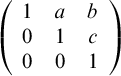 $\left (\begin {array}{lcr}1 & a & b\\ 0 & 1 & c\\ 0 & 0 & 1\end {array}\right )$
. It is clear that
 $T^u(3)$
is nilpotent locally compact, but not TSI. It follows from [Reference Ding and Zheng10, Theorem 1.2] that
 $E(T^u(3))\nleq _B E(H)$
for any TSI Polish group H. In particular, we have
 $E(T^u(3))\nleq _B E(\mathbb R^3)$
. So far, we do not know:
Question 7.2. Does
 $E(\mathbb R^3)\leq _B E(T^u(3))$
?
As mentioned at the end of Section 5, we do not know any example of
 $\omega $
-l.m.-unbalanced CLI Polish group. So perhaps the most noteworthy problem is:
Question 7.3. Does
 $\alpha $
-l.m.-unbalanced CLI Polish groups exist for each
 $\alpha <\omega _1$
? If not, can we find more sophisticated tools to form a hierarchy of length
 $\omega _1$
for all CLI Polish groups under Borel reducibility among equivalence relations induced by them?
Some questions asked in earlier versions of this article have been answered in [Reference Ding and Zheng9, Reference Ding and Zheng10]. For instance, Theorem 1.8 of [Reference Ding and Zheng10] is a positive answer for the following question.
Question 7.4. Let
 $G,H$
be two connected TSI Lie groups, does
 $E(G)\le _BE(H)$
iff there exists a continuous locally injective homomorphism from G to H?
Question 7.5. Let
 $G,H$
be two separable TSI Lie groups such that their identity components
 $G_0$
and
 $H_0$
are topologically isomorphic, does
 $E(G)\le _BE(H)$
iff there exists an topological isomorphism
 $\phi :G_0\to H_0$
such that
 $\phi \mathrm {Inn}_G(G_0)\phi ^{-1}\subseteq \mathrm { Inn}_H(H_0)$
?
Theorem 6.18 confirms the special case of
 $G,H$
are abelian for Question 7.4. And Corollaries 6.22 and 6.23 confirm the very special case of
 $G_0$
and
 $H_0$
are topologically isomorphic to either
 ${\mathbb {R}}$
or
 ${\mathbb {T}}$
for Question 7.5.
The authors [Reference Ding and Zheng10] considered equivalence relations induced by separable strongly NSS Fréchet spaces. So far, we know almost nothing about Borel reducibility among equivalence relations induced by non-strongly NSS infinitely dimensional Polish groups.
Acknowledgments
We thank Su Gao, Feng Li, Yiming Sun, Ruijun Wang, and Xu Wang for helpful discussions in seminars. We are grateful to Xiangjun Wang, Shizhuo Yu, Hui Zhang, and Fuhai Zhu for their advices on algebraic topology and Lie groups. Special thanks are due to Cheng Peng for carefully reading and suggestions on proofs of some results. We would like to thank the anonymous referee for helpful comments and suggestions.
Funding
L.D. was partially supported by the National Natural Science Foundation of China (Grant No. 11725103). Y.Z. was partially supported by the National Natural Science Foundation of China (Grant No. 12371002).



