On October 13, 1948, the Chamber of Deputies of the Mexican Republic became the setting for an unexpected debate. Elected officials had convened to examine a bill drafted by President Miguel Alemán with the object of creating a National Indigenista Institute (Instituto Nacional Indigenista, INI).Footnote 1 The fate of the “indigenous race,” described as the flesh and blood of the 1910 Revolution, was suddenly high on the political agenda. Practically speaking, the new institute was to succeed the Autonomous Department of Indigenous Affairs (Departamento Autónomo de Asuntos Indígenas, DAAI), founded in December 1935 and officially dissolved on January 1, 1947 after some of its powers had been transferred, towards the end of 1946, to the General Directorate of Indigenous Affairs (Dirección General de Asuntos Indígenas, DGAI), a subsidiary of the Ministry of Public Education (Secretaría de Educación Pública, SEP). While the presidential initiative was, as the secretary of the Chamber of Deputies put it, an “admirable proposition to pay the greatest possible attention to the country’s indigenous cores in view of studying and improving them,” it was above all a question of aligning Mexican law with its international commitments.Footnote 2 In April 1940, the First Inter-American Conference on Indian Life had been organized by President Lázaro Cárdenas (1934–1940) and held in Pátzcuaro, a city located in the president’s home state of Michoacán.Footnote 3 When Bolivia, where the idea had originated, withdrew from the initiative, it followed that not only would the conference be held in Mexico, but the Inter-American Indian Institute (Instituto Indigenista Interamericano, III) that emerged from it would also be founded and located there. The center of indigenismo at the continental level had thus shifted, without resistance, from the Andes to Mexico. The dissolution of the DAAI in 1947 therefore ran counter to the desire of Mexican elites to be a leading force in policy concerning indigenous peoples across Latin America.Footnote 4 To fill this gap, it proved necessary to create a new subsidiary agency of the III—hence the initiative to establish the INI. Furthermore, as stipulated in article 7 of the bill, in order to coordinate “indigenista” policy—that is, all measures concerning citizens perceived by the state as “indigenous”—the INI would be endowed with a “council” of representatives from various ministries and academic organizations.Footnote 5 The creation of this Institute meant that the regime in power, dominated by the Institutional Revolutionary Party (Partido Revolucionario Institucional, PRI, founded in 1946), was to share the fruits of the Revolution of 1910 (the very event from which the party originated and drew its legitimacy)Footnote 6 with the “indigenous people.” According to the logic of postrevolutionary elites, the “four million” Indians who remained at the margins of the Mexican Republic would finally be granted access to “social justice.”Footnote 7
Contrary to expectations, the parliamentary debate around the creation of the INI was anything but consensual. Two deputies opposed President Alemán’s bill, leading lawmakers to discuss the initiative article by article. The aims of indigenismo themselves were not called into question. A consensus had already been reached, over the course of numerous past debates, around the necessity of “incorporating” “indigenous” groups into “Western Civilization.” This social absorption was meant to respect the “racial personality” of the Indian, one of the key strands of a national construction conceived as an irreversible process of biological and cultural mestizaje.Footnote 8 More than a process of assimilation aimed at producing a uniform identity, the idea of incorporation, ubiquitous in political and scholarly discourses at the time, was in fact closer to a notion of integration that partially took into account indigenous alterity.Footnote 9 Geared towards a selective westernization of the indigenous peoples, it was also meant to preserve and stimulate Indian craftsmanship, which was seen as an aesthetic resource central to national identity.Footnote 10
At issue, therefore, was not the indigenista project as such, but rather its methods and, more specifically, the role that indigenous citizens should play in its implementation. The deputy Victoriano Anguiano Equihua, himself of Indian origin, provided the most vehement criticism of the bill and its article 7.Footnote 11 After decrying the strictly racial aspect of the initiative, suggesting ironically that the next logical step would be to create a “Department of Mestizos,” another for “whites,” and yet “another for mulattoes or … blacks,” the deputy turned his attention to the proposed directing council of the INI:
The forum for discussion, planning, and decision-making on practical measures established by article 7 is a council on which the different ministries are represented … along with the National Institute of Anthropology and History, the National Autonomous University of Mexico, and the National Polytechnic Institute. In addition to these institutions, which can lend their support to the procedures to be put in place, [the council will include] a representative designated by scholarly societies, preferably those dedicated to anthropological studies. But we continue to forget the presence of the indigenous man on a council that will discuss, decide, and act upon his very problems.Footnote 12
Anguiano Equihua directly proposed that the future council include “representatives of the most important indigenous cores,” disregarding the “problem of the diversity and the multiplicity of [Indian] races” (such as the Mixtec, the Zapotec, and the Purépecha) that had been raised in earlier debates. The commission charged with defending the text countered that this would be “materially impossible,” arguing that holding elections to select such representatives would sow seeds of division and risk giving rise to bloody “dramas.” Moreover, it was argued, were such elections to take place, the high number of “indigenous communities,” grouped into perhaps seven or eight zones, would multiply the number of representatives on the INI council and modify the balance of power between Indians and non-Indians.Footnote 13 That the council might count more indigenous people than indigenistas among its members was clearly inconceivable for the legislative commission. In reaction to this paternalist remark, a second deputy, Nabor Ojeda, asserting his own indigeneity and his “race,” reminded his fellow members of parliament that the successive presidencies of Cárdenas and Manuel Ávila Camacho (1940–1946) had explicitly encouraged the implication of “the indigenous” in politics:
There are capable indigenous people who speak their own language, who can represent their race, and this is very simple: the National Government has organized them in several parts of the country; indigenous congresses are held in many regions and in many of those regions, participants include more than one single race of Indians. Indians of several races participate in these congresses. What would be new in having these indigenous congresses—of which the Republic has acted as guarantor—elect a common representative of all these races, who would represent them at the Mexican Institute or the National Institute of Indigenista Research? … Are we afraid of the indigenous race? What prejudice exists towards it? Will we continue to allow skin color to guide us? Will we imitate the Yankees by sending indigenous people to reservations? No, gentlemen, this is cruel, and the Revolution was not realized to crucify the Indians or to satisfy the curiosity of scholars, but rather to solve the real problems afflicting them [the Indians].Footnote 14
Bolstered by this reference to anti-imperialism and the appeal to the lawmakers’ revolutionary culture, Ojeda and Anguiano Equihua’s position ultimately prevailed and article 7 of the bill was redrafted according to their recommendations. The law creating the INI, published in the Official Journal of the Federation on December 4, 1948, thus declared that the directing council should include, in addition to government and university representatives, “representatives of the most important indigenous cores.”Footnote 15 The law also stated, however, that the forms this participation would take were to be specified later on by a reglementary text. When it arrived, however, the said text was in total contradiction with the spirit of the law, reducing indigenous participation to the local level. No indigenous representative would ultimately have a seat at the directing council of the INI.Footnote 16 Despite the deputies’ wishes, the INI was therefore created as an authority with no indigenous representation, where elites who identified as “white” or “mestizo” would manage issues of ethnicity for half a century.Footnote 17
It is precisely the drive for the representation of indigenous alterity in politics, and the alternative political project this impulse gave rise to, that will be examined in the present article. The history of indigenismo in the twentieth century, both in its local, regional, and national configuration and on an inter-American scale, is currently undergoing a profound reevaluation.Footnote 18 After playing a role in legitimizing an inter-American anthropological discourse during the 1940s and 1950s, and then, in reaction, becoming the target of the postcolonial criticism of the 1960s and 1970s, indigenismo has itself become, since the first decade of the twenty-first century, a historical object.Footnote 19 Recent research has revealed how deeply labile and unstable the category of “indigenous”—widely used by the institutional promotors of indigenismo—actually was. It has also shed light on the “neither scientific nor colonialist” character of this specific program, which may well have been official but was largely experimental.Footnote 20 In the context of global history, others have shown that Mexican indigenismo may have served as point of reference, even a model, for the last supporters of reform in French Algeria, who also sought to integrate “indigenous” populations.Footnote 21
While my work does participate in this renewal of the field, it also seeks to shift the emphasis towards a political history of alterity, focusing on the emergence of collectives largely left out of the historiography, who identified themselves simultaneously and strategically as “aborigine,” “Indian,” and “indigenous”—and even sometimes as “indigenista.”Footnote 22 I will thus argue that an initial national “indigenous” movement emerged in critical dialogue with “governmental indigenismo” in the 1940s and 1950s—that is, during the golden age of this state indigenismo, supported by the elite of the PRI regime, that coincided with the successive six-year administrations of presidents Alemán (1946–1952) and Adolfo Ruiz Cortines (1952–1958). In so doing, I hope to accomplish two things. First, to nuance the idea, so often taken for granted in the social sciences, that indigenous movements in Latin America only truly began to structure themselves in the 1960s and 1970s.Footnote 23 In fact, a long organizational and activist continuum linked the 1940s and 1950s to the “global sixties.” It established forms of continuity, rather than rupture, between what could be called an “Old Left” and a “New Left” among Indian citizens. This “New Left” was itself born of intersecting receptions of the decolonization of Asia and Africa, the rise of the Third World, and the Cuban Revolution.Footnote 24 Second, I will emphasize how the racialist conceptions of indigenous actors, like those of Mexico’s political elites, were anchored in their discourses both before and after 1945—that is, independently of the general decline of the idea of race linked to the end of World War II and the UNESCO antiracism campaign.Footnote 25 Beyond an examination of the progressive, uncertain, and sometimes superficial reformulation of “race” into “culture” or “ethnicity,” this is also an attempt to explore the relational character of the “indigenous” category within a social space where the use of the adjectives “mestizo” and “indigenous” to describe an individual could depend on that person’s education, language, clothing, or even political opinions. In other words, alterity is understood here as positional and not essential.Footnote 26 Being considered indigenous could just as well result from the gaze of the other as from one’s own strategy. In this configuration, claiming indigenous identity for oneself or for others was a way of sustaining a supposed distinction between “us” and “them.” While, according to Fredrik Barth, maintaining this demarcation appears to be the defining element of ethnicity, it can also apply to race, insofar as it is also a social construct.Footnote 27 Indeed, the category of “indigenous,” born of the colonial situation, can be understood as a supraethnic concept.Footnote 28 Although as a notion it is often associated with domination and oppression, the “process of racialization” described here had an emancipating effect and should not be confused with a simple process of ethnification.Footnote 29 At the same time, indigenous identification cannot be analyzed without an exploration of the “global awareness” of the Mexican indigenous leaders, who were attentive both to other indigenous Latin American movements and to the multiple forms of racial discrimination in effect in the United States.Footnote 30 An analysis of the different strategies mobilized by indigenous actors to racialize politics in turn suggests several avenues for reinterpreting the history of the PRI, that “hegemonic” party at once central to political life in twentieth-century Mexico and strangely absent from historical studies.Footnote 31 While the history of the PRI largely remains to be written, the entry of the indigenous peoples of the Mexican Republic into politics provides insights into the relative malleability and popularity of this corporatist party, often described as a simple electoral tool.Footnote 32 First, however, we must turn our attention to the indigenous voices of postrevolutionary Mexico during the 1940s and 1950s, two decades profoundly shaped by the legacy of the Revolution.
The Emergence of the Indigenous Movement: Between Revolutionary Legacy and the Inter-Americanization of Indigenismo
In July 1952, the first issue of the periodical La Voz del Indio (The Voice of the Indian) was published, eloquently declaring its raison d’être:
Official statistics recognize that in Mexico we are more than four million to be called INDIANS. We also know that Jewish, Arabic, Chinese, Japanese, North American, English, German, Italian, and Spanish residents live in our country; they benefit from advantages that we INDIANS do not have: they establish businesses called department stores, hardware shops, laundries, bakeries, cafés, restaurants, hotels, and even cantinas; our class imitates them with booths where we sell cheap wares, tamales, fried foods, etc. They are a source of pride, and we are a source of shame. … The major newspapers and periodicals even devote special pages to them. … It is only … in the headlines of yellow-journalist rags that one speaks of INDIAN criminals, vultures, savages, etc., and never of their art, the colors of their festivals, the tragedy of their lives led in ignorance, abandon, and misery. … This is why we have founded THE VOICE OF THE INDIAN.Footnote 33
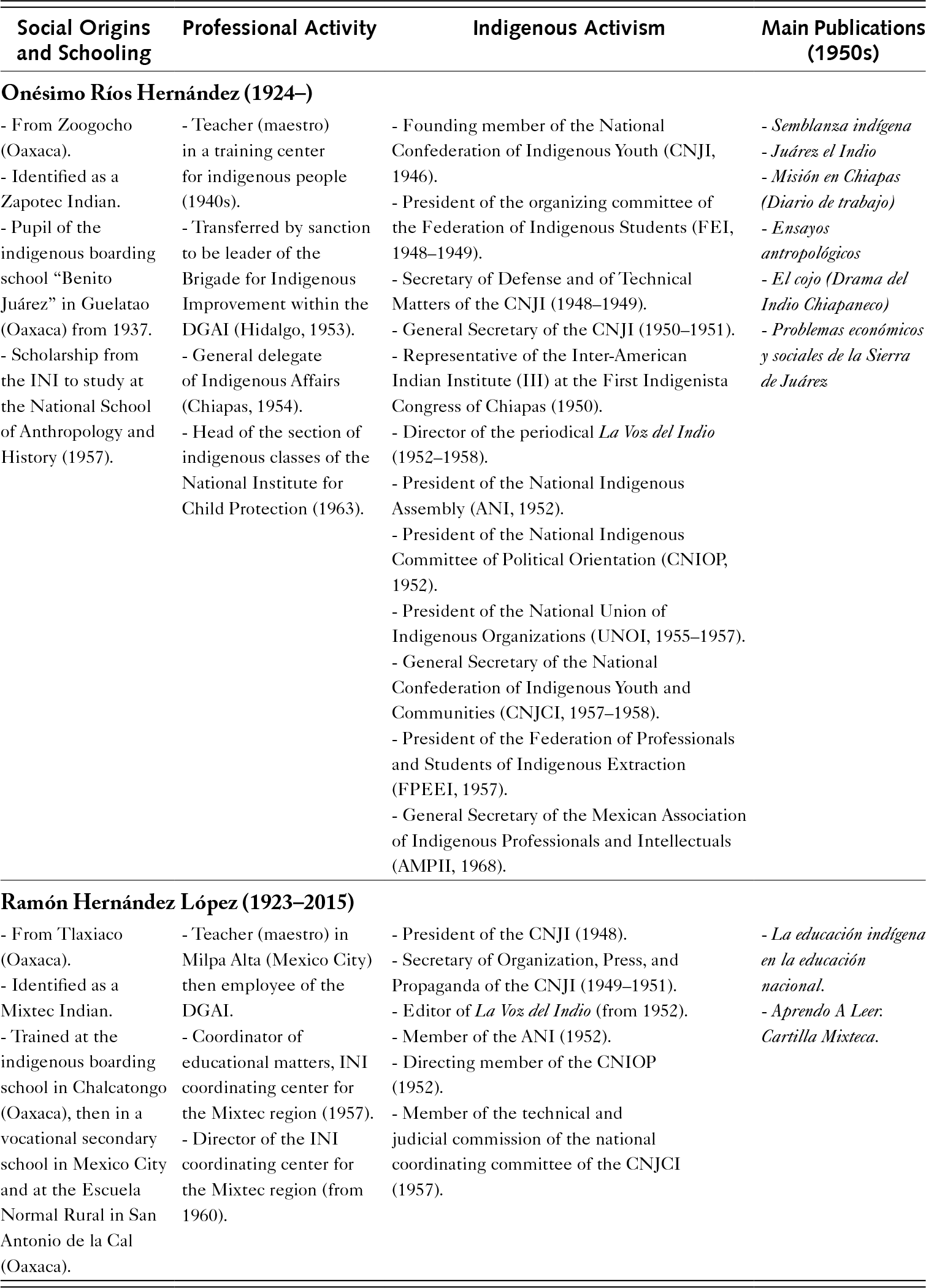
With Onésimo Ríos Hernández and Ramón Hernández López—both laying full claim to their indigenous identity (fig. 1)—at its helm, this newspaper, the first of its kind and imbued with nationalist language, was in fact the end result of many years of activism and indigenous identification. La Voz del Indio was in effect the mouthpiece of the National Confederation of Indigenous Youth and Communities (Confederación Nacional de Jóvenes y Comunidades Indígenas, CNJCI, founded in 1951).Footnote 34 The latter was modeled on the National Confederation of Indigenous Youth (Confederación Nacional de Jóvenes Indígenas, CNJI, created in 1946), itself the successor of the National Federation of Indigenous Students (Federación Nacional de Estudiantes Indígenas, FNEI, created in 1939). The CNJCI would subsequently underpin the occasional meetings of the National Indigenous Assembly (Asamblea Nacional Indígena, ANI) in 1952, the creation of the ephemeral National Indigenous Committee of Political Orientation (Comité Nacional Indígena de Orientación Política, CNIOP) in 1952, and the brief existence of the National Union of Indigenous Organizations (Unión Nacional de Organizaciones Indígenas, UNOI) in 1955. Its last offshoot was the Mexican Association of Indigenous Professionals and Intellectuals (Asociación Mexicana de Profesionistas e Intelectuales Indígenas, AMPII, founded in 1968), the distant by-product of a structure tied to the CNJCI, the Federation of Professionals and Students of Indigenous Extraction (Federación de Profesionistas y Estudiantes de Extracción Indígena, FPEEI, created in 1957). The apparent multiplicity of these organizations should not obscure the fact that they were led by the same actors and, more specifically, by one generation of indigenous leaders, for the vast majority born in the mid-1920s. Despite the proliferation of acronyms, the CNJI (from 1946 to 1951) and the CNJCI (from 1951 to the end of the 1950s) served as the stem organizations of these offshoots, sometimes loosely designated here as “the confederation.”
Teachers (Maestros) Onésimo Ríos Hernández and Ramón Hernández López: Two Indigenous Indigenistas
Source: AGN (MAV, exp. 437.1/99); Boletín indigenista; América Indígena; La Voz del Indio; information provided by the entourage of Onésimo Ríos Hernández and Ramón Hernández López.

Figure 1 Long description
The table compares the lives and works of Onsimo Rios Hernandez and Ramon Hernandez Lopez, focusing on their social origins, professional activities, indigenous activism, and main publications. It has four columns: Social Origins and Schooling, Professional Activity, Indigenous Activism, and Main Publications (1950s). The table has two main rows, one for each individual, with sub-rows detailing specific information. Row 1: Onsimo Rios Hernandez (1924-). Social Origins and Schooling: From Zoogocho (Oaxaca), identified as a Zapotec Indian, pupil of the indigenous boarding school Benito Juarez in Guelatao (Oaxaca) from 1937, scholarship from the INI to study at the National School of Anthropology and History (1957). Professional Activity: Teacher in a training center for indigenous people, transferred by sanction to lead the Brigade for Indigenous Improvement within the DGAI (Hidalgo, 1953), general delegate of Indigenous Affairs (Chiapas, 1954), head of the section of indigenous classes of the National Institute for Child Protection (1963). Indigenous Activism: Founding member of the National Confederation of Indigenous Youth (CNIJ, 1946), president of the organizing committee of the Federation of Indigenous Students (FEI, 1948-1949), secretary of Defense and of Technical Matters of the CNIJ (1948-1949), general secretary of the CNIJ (1950-1951), representative of the Inter-American Indian Institute (III) at the First Indigenista Congress of Chiapas (1950), director of the periodical La Voz del Indio (1952-1958), president of the National Indigenous Assembly (ANI, 1952), president of the National Indigenous Committee of Political Orientation (CNIOP, 1952), president of the National Union of Indigenous Organizations (UNIO, 1955-1957), general secretary of the National Confederation of Indigenous Youth and Communities (CNIJC, 1957-1958), president of the Federation of Professionals and Students of Indigenous Extraction (FPEEI, 1957), general secretary of the Mexican Association of Indigenous Professionals and Intellectuals (AMPI, 1968). Main Publications: Semblanza indigena, Juarez el indio, Mision en Chiapas (Diario de trabajo), Ensayos antropologicos, El cojo (Drama del Indio Chiapaneco), Problemas economicos y sociales de la Sierra de Juarez. Row 2: Ramon Hernandez Lopez (1923-2015). Social Origins and Schooling: From Tlaxiaco (Oaxaca), identified as a Mixtec Indian, trained at the indigenous boarding school in Chalcatongo (Oaxaca), then in a vocational secondary school in Mexico City and at the Escuela Normal Rural in San Antonio de la Cal (Oaxaca). Professional Activity: Teacher in Milpa Alta (Mexico City), then employee of the DGAI, coordinator of educational matters, INI coordinating center for the Mixtec region (1957), director of the INI coordinating center for the Mixtec region (from 1960). Indigenous Activism: President of the CNIJ (1948), secretary of Organization, Press, and Propaganda of the CNIJ (1949-1951), editor of La Voz del Indio (from 1952), member of the ANI (1952), directing member of the CNIOP (1952), member of the technical and judicial commission of the national coordinating committee of the CNIJC (1957). Main Publications: La educacion indigena en la educacion nacional, Aprendo A Leer. Cartilla Mixteca.
These new organizations were the first of their kind that claimed to massively represent the indigenous population on a national scale, with members numbering in the tens of thousands.Footnote 35 They represented both a rupture and a continuity with the revolutionary period, which had been marked first by the emergence of the indigenous question, then by the flowering of local indigenous organizations. In its first phase (1910–1920), the Revolution took the form of a violent civil war which caused the deaths of over a million Mexicans in a country with a population of fifteen million. The irruption of this “human tempest,” to use the expression of anthropologist Manuel Gamio, and the specter of mass death it left in its wake, brutally revealed the extremely fragile construction of the Mexican nation-state.Footnote 36 This political trauma led the governments that emanated from the Revolution (in the 1920s and 1930s) to progressively distinguish between a specific “indigenous problem” and a larger “rural problem” that was to be solved by agrarian reform.Footnote 37 Under the presidency of General Álvaro Obregón (1920–1924), the new Ministry of Public Education, founded in 1921 by the intellectual José Vasconcelos, established the first Department of Indigenous Education and Culture (Departamento de Educación y Cultura Indígena). In 1925, the latter was transformed into the Department of Rural Schools and Indigenous Cultural Incorporation (Departamento de Escuelas Rurales e Incorporación Cultural Indígena) under Obregón’s successor Plutarco Elías Calles (1924–1928), whose electoral campaign had brought the indigenous question to the forefront of the political stage. The arrival of Cárdenas to power in 1934 marked a departure from this initial phase of Mexican indigenismo, and the beginning of a dynamic of “empowerment” of Indian societies. This specific approach to the indigenous problem, which would come to be known as one of the characteristic features of Cardenismo, prompted the creation of regional indigenous congresses, each aimed at representing a specific “race” (in reality an ethnic group).Footnote 38 Operating with a top-down logic, these congresses had active political support, both at the federal level (on the initiative of the DAAI) and at the federated level (through local governments). General Cárdenas himself inaugurated the First Regional Indigenous Congress in 1936, designed to bring together the Otomi Indians. Because of his endorsement, it was perceived as a national event.Footnote 39 Nevertheless, these congresses did not give rise to lasting ethnic structures, with the exception of the Supreme Council of the Tarahumara Race (Consejo Supremo de la Raza Tarahumara, founded in 1939), which remained very active until the 1960s.Footnote 40 Many important figures of indigenismo, such as the archaeologist Alfonso Caso (director of the INI from 1948 to 1970), corresponded with some of these new organizations, for instance the Revolutionary Indigenista Federation of Oaxaca (Federación Indigenista Revolucionaria Oaxaqueña, FIRO, created in 1939), one of the first political structures to represent several “races” across a federated state.Footnote 41
How then to explain the emergence of a national indigenous movement in the 1940s? Beyond the convening effect triggered by the regional organizational dynamic upheld by Cardenismo, the creation of a sense of momentum among indigenous actors at a national level was intimately linked to the “educational revolution” of the 1920s and 1930s.Footnote 42 Seeking to “incorporate the Indian into civilization,” successive revolutionary governments experimented with different educational apparatuses aimed at Mexico’s “indigenous races.” In this respect, the first authentically indigenista policies were, from the outset, educational. The foundational experiment was the House of the Indigenous Student (Casa del Estudiante Indígena), which operated between 1926 and 1932 in the capital.Footnote 43 For its creators, the goal of this new boarding school was to bring indigenous youth of “pure race” to the heart of “civilization,” or Mexico City, in order to transform them into future promoters of social change. After this contact with modernity, the indigenous teenagers were, in theory, to return to their home communities and introduce progress in all its forms. This “redeeming enterprise” was, at least partially, a failure. Not only were the sanitary conditions of the boarding school deplorable and desertions frequent, but the indigenous youth who did survive the culture shock had no intention of returning to their communities. While they may very well have gained an awareness of belonging to a different “race” while studying in the capital, they often came to prefer the exciting life of Mexico City to the quieter pace of their home villages. Nevertheless, what the authorities saw as the failure of the House of the Indigenous Student can also be understood as its success: while the boarding school did not ultimately favor the redemption of indigenous communities as a whole, the education it provided and its geographic location did make individual upward social mobility possible.
The educational authorities learned from this experience. In 1932, the Ministry of Public Education closed the experimental structure and created eleven indigenous boarding schools scattered throughout the nation’s rural areas.Footnote 44 Indigenous education thus shifted from Mexico City to the provinces. Under Cárdenas, these educational centers multiplied and were finally attached to the DAAI. Ávila Camacho, when he took power in 1940, was relatively hostile to the form of education the centers represented and downsized the project.Footnote 45 Reduced in number from thirty-two to nineteen and renamed “economic training centers for the indigenous” (Centros de Capacitación Económica para Indígenas), under Ávila Camacho these schools were also moved from the remote countryside to the outskirts of small towns, with the ultimate goal of encouraging the nation’s industrialization at a time when World War II made such a perspective seem credible.
It was precisely this distribution of indigenous boarding schools across the territory that would allow for a national Indian movement to take form. In 1939, the director of the DAAI, Marxist historian Luis Chávez Orozco, encouraged the foundation of a first Mexican Federation of Indigenous Students.Footnote 46 The federation, dissolved by Chávez Orozco’s successor Isidro Candía in 1942, would reappear in 1944 under the Ávila Camacho administration before being entirely transformed in 1949.Footnote 47 Meanwhile, in July 1946, the former leaders of the discontinued federation created the CNJI,Footnote 48 whose representatives were deeply tied to the economic training centers for the indigenous.Footnote 49 Most of its members had been educated in these boarding schools.Footnote 50 Some, such as the linchpin of the movement Ríos Hernández, also worked there as teachers (fig. 1). Ríos Hernández toured the country visiting these establishments with a mission to legitimize local chapters of the organizations that were largely the fruit of his energetic labor.Footnote 51 Another figurehead of the movement, Cupertino de la Cruz, who was an alumnus of the House of the Indigenous Student from an earlier graduating class and a Chiapas Mam Indian, worked as a school inspector for the state of Chiapas in addition to being a teacher, or maestro. The inner circle of the CNJI was more largely made up of teachers “of indigenous race,” either identifying as such or so perceived by the executive power.Footnote 52 Many originated from the state of Oaxaca, one of the main indigenous regions of the country, including the two leaders, Ríos Hernández (born of a Zapotec father) and Hernández López (of Mixtec origin).Footnote 53 One of the confederation’s sponsors was the lawyer Genaro Vásquez, born of Mixtec and Zapotec parents, who had in fact been governor of Oaxaca in the mid-1920s and then head of the Labor Department under the Cárdenas administration, where he was also one of the organizers of the first regional indigenous congresses.Footnote 54
It is useful here to shed light on how a movement structured on a national scale was also anchored at the regional level. Although the different ethnic groups of Mexico were represented equally within the CNJCI, its leaders generally sought to favor the territory or milieu of their origins—the village they came from or the linguistic group they claimed to belong to—which provided them with local relays to help realize their projects. The development of Zoogocho, a small Zapotec village in the state of Oaxaca, thus owed a great deal to the ceaseless work of Ríos Hernández between the 1940s and the 1960s.Footnote 55 Nevertheless, one would be mistaken to consider the different Indian states of Mexico (such as Oaxaca, Guerrero, or Chiapas) as the main centers of gravity for indigenous mobilization. In fact, the leaders of the CNJCI all lived in Mexico City and were well-integrated into the indigenous circles of the capital.Footnote 56 In a country marked by its centralization, this was the logical nucleus of the movement.
Another factor is key to understanding the sudden rise of the national indigenous movement from the 1940s. If the indigenista authorities (that is, the DAAI followed by the DGAI and the INI) provided indigenous organizations with variable levels of aid, the continent-level reflection on the “Indian problem” taking place in parallel gave visibility to the issue and considerably encouraged the mobilization of indigenous peoples in Mexico and elsewhere in Latin America. Like their Bolivian and Panamanian counterparts, the FNEI, the CNJI, and finally the CNJCI saw their internal resolutions and agreements reprinted in the prestigious bilingual publications of the III. Footnote 57 The media coverage was entirely due to the III and not the INI, whose periodical Acción Indigenista never mentioned the activities of the Confederation of Indigenous Youth.
More broadly, the fact that Mexico progressively became the epicenter of continental indigenismo proved essential to the formation of the Indian movement. The high-level representatives of the III, alongside the civil servants of the INI and the DGAI, routinely attended the different congresses organized by the Mexican indigenous leaders; Indian activists in turn sometimes represented the III in their grassroots initiatives.Footnote 58 Although reduced in number, the presence of Indian delegates at the First Inter-American Conference on Indian Life in Pátzcuaro would subsequently nourish the many debates about the possibility of indigenous participation in indigenista policies.Footnote 59 The arrival of thirty-two indigenous Mexican representatives (out of the forty-seven total in attendance) at the Pátzcuaro congress in 1940 certainly encouraged the emergence of a national Indian consciousness linked to a collective desire to organize on a continental scale. The first connections between the indigenous peoples of the Americas date back to this congress, as shown by an exceptional document from Julián Escalante, former representative of the “Otomi race” at Pátzcuaro (incidentally but interestingly, the father of one of the future members of the Confederation of Indigenous Youth). At the moment when the Axis powers appeared to be triumphant in Europe, Escalante addressed the president of the Confederation of Workers of Latin America, Vicente Lombardo Toledano, in a letter:
At the [First Inter-American Conference on Indian Life] gathered at Pátzcuaro, I participated as delegate of the Otomi race of the region of the State of Mexico and I had the honor of being named president of a committee to organize the First National Indigenista Congress. … Unfortunately, neither the Department of Indigenous Affairs nor the National Peasant Confederation, nor the other revolutionary elements we solicited for help in organizing the congress had any desire to do so.… But now, based on letters that I have received from the organizing committee and on the suggestions of the delegate of the Apache tribe, established in the United States, who was in Mexico in the middle of the present month, I consider not only that the question of holding the National Indigenista Congress is a pressing one, but that holding an International—that is, Continental—Indigenista Congress is also necessary … [It] would serve to provide guidance to the great masses of indigenous peoples of all America concerning the problems that the war has created, to warn them of the dangers of Fascism and Nazism triumphing over democracy, and to ascertain their revolutionary position in this moment we are all living through.Footnote 60
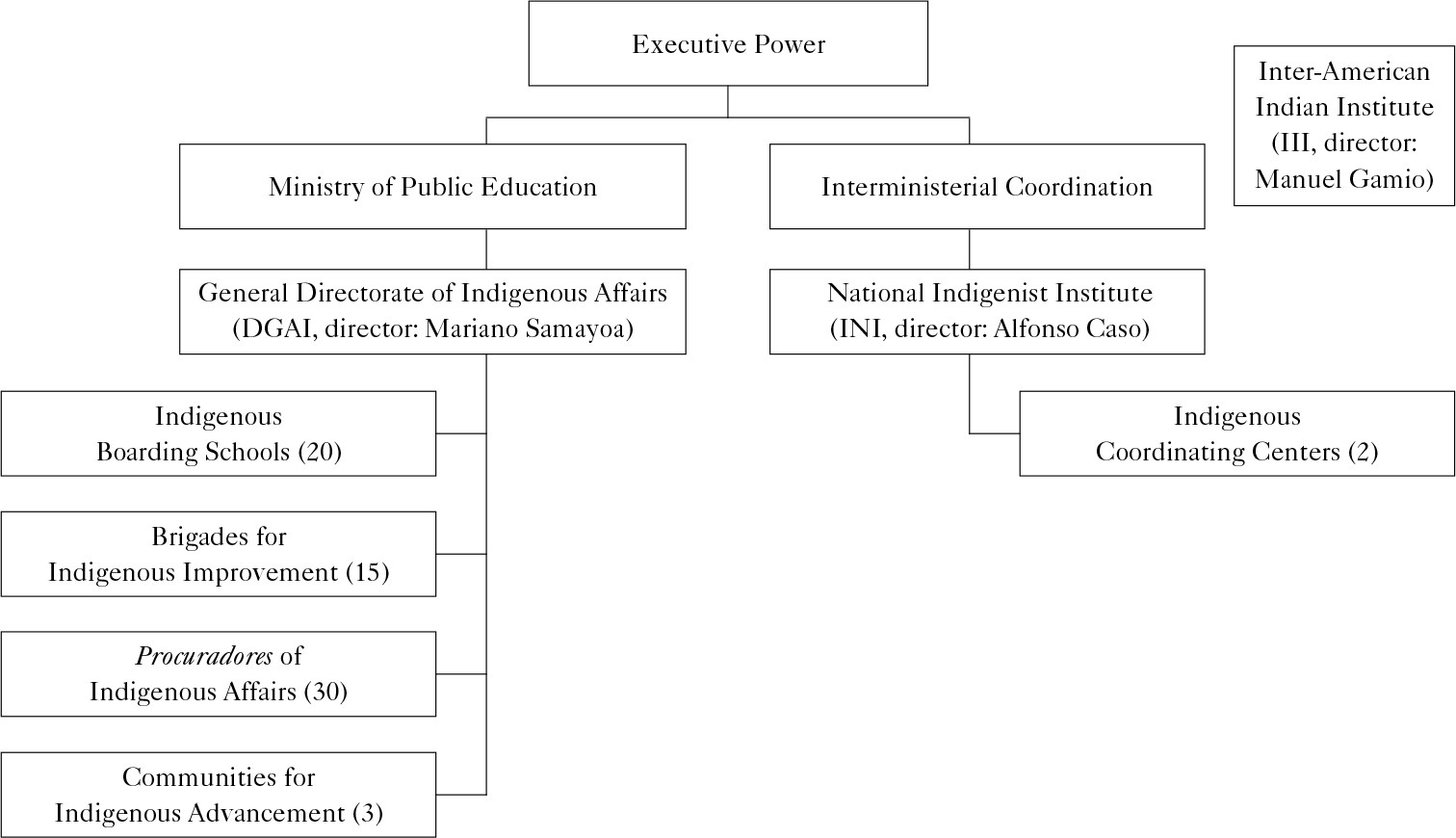
The use of the adjective “indigenista” to describe an “indigenous” congress suggests that these discussions were also to a great extent a space of social struggle to define the rules of the “field of indigenismo,” in full surge after the Pátzcuaro congress. In contrast to this inter-American mobilization, the main promoters of Mexican indigenismo, such as Caso, seemed somewhat reluctant regarding the participation of indigenous delegates, who they preferred to reduce to subaltern roles. In 1948, Caso and his peers were perfectly aware of the existence of new indigenous organizations; it would thus seem that they consciously neglected the integration of their representatives into the newly established directing council of the INI—one of the explicit requests of the CNJI, and, theoretically in any case, a criterion for the very foundation of the INI. Footnote 61 Nevertheless, this did not prevent the two structures from developing a cordial relationship despite the explicit paternalism of the technocrats promoting indigenismo.Footnote 62 The CNJI, formed within the milieu of the indigenous boarding schools, did benefit from the early support of actors in the field of educational indigenismo, the other principal pillar of the integration program (fig. 2). The DGAI, which functioned under the auspices of the SEP and was central to the implementation of the educational integration program, provided some material aid to the CNJI.Footnote 63 The strength of the ties between officials of the Ministry of Public Education and indigenous teachers probably explains the initial skepticism of the confederation, then headed by this specific category of teachers, towards the creation of the INI. Footnote 64
The opening up of this institutional space, the inter-Americanization of the Indian question, and the political legitimacy of the “indigenous” category that resulted from both contributed to the unprecedented rise of the Indian movement in Mexico during the 1940s and 1950s. With varying degrees of support from the III, the INI, and the DGAI, the CNJI and then the CNJCI organized many regional indigenous congresses, promoted multiple federations on the state level, and brought together a whole series of ad hoc organizations supporting women, students, or the practice of sports.Footnote 65 These were independent grassroots actions, very different from the top-down mobilization that had been typical of Cardenismo. Yet though the movement was collective, it nevertheless owed a great deal to the energy of two men, one of whom, Ríos Hernández, would go on to fascinate several generations of indigenous activists in Mexico.Footnote 66
Structures of the Mexican Indigenista Program at the End of the Alemán Administration (1952): A Dual System
Source: Onésimo Ríos Hernández, “Mexicanizar al Indio la meta de M. Alemán,” La Voz del Indio 1, no. 12, 30 Nov. 1952, p. 2 and 4.

“For the Redemption of the Indian”: The Indigenous Left and the Indigenista Program
Seeking to “redeem” the indigenous peoples and judging that, to do so, one must “Mexicanize the Indian rather than indigenize Mexico,” indigenous organizations demanded action regarding education, the socioeconomic situation, and health.Footnote 67 Adopting the language of “incorporation,” these aspirations were at first glance perfectly in keeping with the measures suggested by the indigenistas—so much so that it can seem difficult to distinguish them from the postrevolutionary governmental project or from inter-American indigenismo more broadly.Footnote 68
Many of their demands concerned improvements in education, a sector to which several of the movement’s leaders were linked through their own training and professional activity. The CNJI and its successive incarnations demanded more “economic training centers for the indigenous” (in particular for girls); more kindergartens, and more elementary and high schools; more teachers, libraries, scholarships, and material resources of all kinds—ranging from food rations to clothing (including underwear and shoes) for the Indian students, all of whom were extremely impoverished. Tractors, agricultural tools, and musical instruments were also requested for the boarding schools, those “transformative agents” of indigenous communities. The CNJI and the CNJCI also largely supported bilingual literacy programs, an inheritance from the Cárdenas project. The confederation furthermore managed to obtain an important number of scholarships for its members.
The socioeconomic demands, meanwhile, primarily focused on the road system and the development of communications networks—in the form of post offices, telegraph systems, and telephone lines—both of which were considered crucial to addressing the isolation of indigenous communities. The agricultural question was also central. According to the representatives of the “indigenous race,” it was necessary to resolve the land conflicts between Indian villages, as they sometimes degenerated into bloody clashes. They called for the redistribution of lands undertaken by the revolutionary governments to continue in order to provide the communities with plots, to foster agricultural credit, irrigation, and technical modernization, and to better protect indigenous-owned land from the repeated assaults of the “mestizos” and “whites” who were abetted by a justice system perceived as corrupt. To protect and conserve indigenous-owned waters and forests, indigenous organizations demanded that the existence of “indigenous community procuradores” (attorneys, among other roles they fulfilled) responsible for defending the Indians and dependent on the DGAI be maintained. In general, the national indigenous movement adhered to the discourse of development, calling for the rationalization of agricultural and artisanal production (from pottery to traditional clothing) through the introduction of cooperatives and the widespread use of electricity. Demands concerning public health—requests for the drilling of wells for potable water, the provision of medicine, vaccination against smallpox, programs aimed at combating alcoholism, the creation of dispensaries, and the formation of medical brigades—were also fervently voiced and corresponded to the official indigenista project, heir to a tradition of positive eugenics.
These demands, voiced repeatedly, did not stop the CNJI and the CNJCI from taking action into their own hands in order to improve the living conditions of their “brothers in race.”Footnote 69 The confederation organized several indigenous “ferias,” or fairs, with the aim of boosting local economy and culture.Footnote 70 It also encouraged indigenous communities to participate in building roads and schools, and was even able to provide medical and legal services for its members.Footnote 71 However, the aspirations of the national indigenous movement extended beyond reproducing a mere reflection of the government’s indigenismo. First, the indigenous elite constantly exercised its right to criticize; its members did not hesitate to point out the dysfunctional aspects of the indigenista program, in particular the economic training centers for the indigenous. In 1949, after conducting a statistical survey on the fate of the alumni of the boarding school system (at this point in its Ávila Camacho iteration), the young Ríos Hernández publicly remarked that while 80 percent initially returned to their home communities, they were unable to put the new knowledge they had acquired into practice due to a lack of material resources. His fear was that, one way or another, young indigenous people would eventually migrate permanently to the country’s major cities:
… we have realized that some of the centers are not well-located in relation to the aborigine cores to be developed because [the campuses] are situated in urban centers, which hinders the intensive and extensive agricultural practices necessary to train the student in the rational cultivation of the land, and the improvement of seeds, which, in my opinion, must be the primary concern of the General Directorate of Indigenous Affairs, in order to effectively succeed in making the aborigine sector part of the national peasantry. Rather than creating managers who become the exploiters of their own brothers, it is preferable to produce farmers who incorporate their production into the country’s economy.Footnote 72
He pointedly denounced the relocation of the indigenous boarding schools from the countryside to the outskirts of small towns, adopted under Ávila Camacho in the mid-1940s, along with the general abandonment of the countryside by the postwar governments. Six years later, Ríos Hernández repeated this trenchant observation, this time provoking the indignation of his indigenous peers. A journalist of La Voz del Indio recounted the incident:
When he referred to the inefficiency of the Indian boarding schools, … [Ríos Hernández] was met with a storm of protest: engineers, teachers, lawyers, medical interns, and university students; each argued that they too were the product of the Indian boarding schools and if they were not serving their communities, it was because they lacked the opportunity to do so, but that they were fully incorporated into the Mexican nation, which was the most important thing.Footnote 73
At the end of the 1950s, the relative failure of the boarding schools inevitably brought to mind the closing of the House of the Indigenous Student in 1932. The dream of an automatic and fruitful return of educated Indians to their home communities had clearly been shattered by the reality of personal strategies for social advancement.
In parallel to the constructive criticism of indigenista policies, indigenous representatives also systematically demanded a right to participate in the system thought up in their name: not only should teachers, police officers, and local authorities be “indigenous,” but indigenous representatives should be able to express their opinions freely at the INI, the DGAI, or within the framework of specific programs such as the one underway in the Mezquital Valley in the state of Hidalgo.Footnote 74 For these supporters of a strategic essentialism, the existence of an “indigenismo without Indians” was out of the question.Footnote 75 On the international scale, the CNJI also fought hard to represent the “indigenous cores” of Mexico at the great inter-American congresses. While the organizers of the Second Inter-American Conference on Indian Life held in Cuzco (Peru) in 1949 approved the CNJI’s request to participate, the small confederation still had to cover its own travel expenses, valued at 20,000 pesos. Gamio, the director of the III, only offered to contribute 1,000 pesos for the occasion, dashing any hope for indigenous Mexican representation.Footnote 76 Unsurprisingly, the announcement of the Third Inter-American Conference on Indian Life, to be held in La Paz (Bolivia) in 1954, provoked a skeptical reaction from another indigenous leader, Erasto Urbina, uncontested leader of the Chiapas Indians since the Cárdenas administration and general secretary of the Chiapas Indigenous Federation, a regional subsidiary of the CNJCI. “Indians are not going to this congress,” he was cited as saying in an article by Ríos Hernández, “so there is no point in going to speak with people who don’t understand us.”Footnote 77
The discourse of indigenous leaders was at times extremely ambivalent: while their horizon of expectation often seemed identical to that of the indigenistas (the construction of a homogeneous nation through rapid racial and cultural fusion), they also defended a form of indigenous autonomy, claiming a specific right to the land and promoting Indian languages as a defense against mestizo oppression. In his role as the general secretary of the CNJCI, Ríos Hernández articulated this clearly in a public letter addressed to President Ruiz Cortines in the summer of 1952:
… we must accept that the Castilianization of the Indian unfortunately facilitates the exploitation of which he is made victim by the Castilianized people, which is why the Indian thinks that they only want to teach him to read and Castilianize him for the ease and comfort of the whites and the mestizos. Hence our position that our dialects should be preserved as a means of defense, until we are culturally and economically equal to the rest of the population.Footnote 78
This subversive position provoked the wrath of Gamio who, as director of the III, responded scathingly in the columns of La Voz del Indio:
Frankly, I do not agree with the paragraph of the first issue of this weekly newspaper, in which you say to Mr. Alfonso Ruiz Cortines that the Castilianization of the Indian only benefits the mestizo and the white, and not himself, and [in which you] suggest that it should only be implemented once his economic and cultural conditions are improved. I believe that the main and most serious obstacle that the population of over two million Indians faces is their monolingualism, for it causes them to be foreigners in their own Fatherland, just like real foreigners. … Naturally, they should under no condition abandon their native languages which are a source of tradition and pride, just as they are for the Basque and Catalan peoples, etc.Footnote 79
The confederation’s discourse also contrasted with the point of view of Caso, then director of the INI, for whom education in indigenous languages was only a “preliminary phase to Castilianization.”Footnote 80 Still, the rationale of linguistic defense was common among indigenous representatives, even if it never became unanimous. In 1952, those in attendance at the First Indigenous Congress of the State of Guerrero advocated for the establishment of a “chair of native languages” in the Republic’s secondary schools and universities.Footnote 81 In 1954, Guerrero’s indigenous representatives reiterated this claim for the inclusion of Nahuatl in school curricula—once again in vain.Footnote 82 More consensually, other organizations that stemmed from the CNJCI, such as the National Indigenous Assembly in June, 1952, supported both Castilianization and bilingual literacy.Footnote 83
This critical stance did not stop the indigenous movement from largely keeping in step with the indigenista policies of the postrevolutionary governments. The CNJI constantly demanded the creation of new indigenous coordinating centers, the pride of the INI, which were growing in number in the 1950s.Footnote 84 Relations between indigenous representatives and the INI as well as the DGAI, which had been fractious between 1953 and 1954, became quite cordial in the late 1950s.Footnote 85 La Voz del Indio continued to communicate national and inter-American indigenous news.Footnote 86 The National Union of Indigenous Organizations (a short-lived incarnation of the CNJCI), the INI, and the III even founded projects together—notably one launched at the end of 1953 to create peoples’ reading centers.Footnote 87 The fact that several indigenous leaders had surpassed the barrier of higher education also allowed for a break with the paternalism that had prevailed until then. A handful of them, such as Ríos Hernández and Ulrick Lorenzo Figueroa Mata, pursued studies in anthropology or sociology. At the end of the 1950s, the CNJCI had three permanent representatives: one at the INI, another at the DGAI, and a third at the National Institute of Mexican Youth (Instituto Nacional de la Juventud Mexicana, INJM).Footnote 88 Roundtables during this period included both indigenista anthropologists—such as Juan Comas of the III and Gonzalo Aguirre Beltrán of the INI—and indigenous leaders such as Hernández López.Footnote 89 Revealingly, Hernández López became one of the architects of INI policy, directing several coordinating centers in the 1960s. The senior representatives of the “indigenous races” seemed finally to have a voice. Since they could not statutorily obtain decisive representation in governing bodies such as the directing council of the INI, these representatives took the institutions created for them and colonized them from below.
Indigenous Identification: A Political Resource, a Racial Frontier, and a Continental Projection
To a large extent, the indigenous representatives of the late 1940s were racial activists in that they advocated for a form of separatism—even if the term is undeniably equivocal.Footnote 90 To do so, they appropriated the language of the country’s political and scientific elite, who for decades had considered the indigenous people a whole made up of one or many “races.” Shaped by a specific system—the network of indigenous boarding schools—the indigenous representatives reframed their sense of alterity by strategically using the racialist language dominant at the time. From that point, they endowed the notion of “race” with a positive and inclusive meaning, in contradiction with the UNESCO experts who sought to limit the use of the word to physical anthropology alone. Even if indigenous representatives would go on to use it more sparingly—echoing the Mexican sociologists and anthropologists of the period—they initially laid claim to their “race” the better to defend it. Thus, in December 1949, the president of the First National Congress of Indigenous Youth explained to President Alemán that the object of this gathering was to study and solve the problems of the country’s “indigenous race.”Footnote 91 Two months earlier, the National Executive Committee of the CNJI had already emphasized to the president of the Republic that the organization was working towards the “unification of the autochthonous races” of Mexico.Footnote 92 In other words, the CNJI’s priority was to defend race over mestizaje, within the framework of a process of positive racialization. In a 1956 text seeking to define “the Indian,” La Voz del Indio continued to highlight the importance of the “concept of race.”Footnote 93 While employing a relatively loose terminology that allowed for a certain amount of ambiguity, the author of the article, a young lawyer named Rubén Armendáriz, employed a racialist logic, explicitly tying the Mexican “musical spirit” to “Indian blood.” According to Armendáriz, a person’s physical characteristics played a role in determining their psychological characteristics.Footnote 94 Two years before, he had emphasized the biological aspect of indigeneity, writing in the same newspaper that “we cannot abandon the idea that this originality that differentiates us stems from the immanence, in our beings, of Indian blood.”Footnote 95
La Voz del Indio was nevertheless a platform for discussion, echoing both the increasing deracialization of indigenismo and ongoing debates between experts in the social sciences. As early as 1952, Gamio, an overt disciple of Franz Boas and then director of the III, was encouraging the indigenous youth to adopt an exclusively cultural definition of indigeneity:
In Mexico, there are no racial prejudices, they are principally economic and cultural. … A great number of people considered indigenous due to their dark complexion and other physical characteristics have integrated into the highest social spheres … , and furthermore, it is no longer possible to anthropologically distinguish the so-called racially pure Indian from the mestizo, given the existence of aboriginal groups such as the Otomis of the Mezquital Valley, whose skin is less dark than that of other groups who have almost no Indian blood. … The term “race” has been scientifically devalued and it is meaningless to say the Mayan race or the Otomi race, etc. Linguistically, yes, one can say that specific individuals are Indian because they speak only languages of pre-Columbian origin or [one of these languages as well as] Spanish. Yet, this classification leaves aside millions of people that speak only Castilian but who still have a greater or lesser proportion of cultural characteristics that are indigenous, meaning of pre-Hispanic origin.Footnote 96
Toward the end of 1955, the teacher Félix Ramírez, of Purépecha origin, similarly defended a firmly antiracialist stance:
An individual can have an entirely European appearance and yet think and behave like an Indian, and, on the contrary, an Indian, anthropologically conforming to the Indian type, who has European mental habits, is no longer Indian; he thinks and behaves like a European.Footnote 97
Race and culture were thus detached from one another, even though this rhetoric was primarily used to defend mestizaje. Nevertheless, the same author could mobilize racialist references while also insisting on the purely cultural character of the differences between mestizos and Indians. In late 1955, the jurist and sociologist Figueroa Mata, a major figure among educated Indians, emphasized the absence of “racial tensions” in Mexico compared to the United States:
The individual of the purest indigenous blood, from the moment he adopts the external characteristics of mestizo culture, has access to the same opportunities … as other citizens. He can even peacefully increase mestizaje by courting and marrying a blond descendant of Europeans, who would by no means see her status diminished in relation to the rest of society. … In our lands, blood, tradition, and native culture have been converted into the symbol of Mexicanness.Footnote 98
Contrary to the segregated United States, Mexico was perceived by indigenous leaders as a racialized space with a potential for porosity between racial groups thanks to the leveling quality of the revolutionary ideology of mestizaje. For Figueroa Mata, becoming mestizo was as simple as adopting the “external characteristics” of the dominant (non-indigenous) culture. Skin pigment and distinct physical features were not necessarily discriminatory elements that set indigenous people apart. According to this vision, the racial barrier between mestizo and “indigenous” was more than tenuous. At the same time, this reasoning did not stop the author from adopting a largely biological definition of indigeneity. Mexico may well have been celebrated for its supposed lack of “racial tensions,” but indigenous alterity was explicitly understood in racial terms by a number of indigenous intellectuals and, under the cover of mestizaje, a racial struggle did in fact take place. For Figueroa Mata, this struggle allowed his “brothers in race” to obtain a form of autonomy. While Mexican law in principle protected citizens equally, it was still necessary, he argued, for indigenous people to fight for a larger “legal space” where “the modulations of [their] Native souls, which still [beat] in the pulsating spirit of [their] races,” could exist.Footnote 99 Thus, in the mid-1950s, some Indian leaders continued to skillfully make use of the racialist dialectic, amalgamating biological and cultural features in a way that was neither entirely nor straightforwardly metaphorical. Furthermore, if race was latent, class was also present. The two notions remained explicitly linked in indigenous discourses,Footnote 100 where the strength of the racial marker was explained by the social coherence of a given group. La Voz del Indio, for instance, described Mexico’s indigenous populations as the country’s disinherited class. However, this public discourse did not always correspond to individual experience. After interviewing the founding group of the CNJI, anthropologist Alicja Iwańska revealed that almost all of these defenders of indigeneity were in fact married to women of the Mexican middle class, socially considered mestizas.Footnote 101 Moreover, many proponents of biological or inherited indigeneity, including Ríos Hernández and Figueroa Mata, were, at least in part, of mestizo origin.Footnote 102 Torn between enduring racialist references and a new economic and cultural paradigm, and regularly contradicted by the matrimonial choices of its defenders, identification as indigenous ultimately corresponded to identification with a “social race” whose boundaries were flexible.Footnote 103
This strategic mobilization of alterity was not always accepted. The authorities did not hesitate to call to order educated citizens who actively laid claim to their indigeneity. For the indigenistas, a good Indian was mainly a passive and obedient subject, a second-class citizen, and the object of specific policies. Indigenous representatives considered to have crossed a line in the eyes of the administration regularly saw their claims to indigeneity denied.Footnote 104 They were, in a sense, “elevated” into the ranks of mestizos against their own will, with the aim of preventing them from representing the indigenous group to which they claimed to belong. From an indigenista perspective, this attribution was logical, given that the mestizo was the national subject par excellence, the historic driver of the Mexican Revolution, and the end result of the “racial fusion” at work since colonization—a fusion process that anthropologists were precisely seeking to accelerate. For different political and scholarly authorities obsessed with mestizaje, it was unthinkable that a citizen might claim indigeneity while completely taking on the visible and invisible elements of Western culture. The indigenistas planned for the “scientific acculturation of the Indian.”Footnote 105 A citizen who sought to invest in their identity as the indigenous other was thus potentially deviant; they should accept becoming mestizos like everyone else. The official discourse of the INI expressed this clearly:
If an individual leaves his community and learns Spanish and goes to work in a factory, for example, or to live in a city and takes on the customs … of the inhabitants of this city, he is no longer Indian but is part of the greater mass of the Mexican population.Footnote 106
The program put in place by the INI was intended to gradually phase out the existence of Indians while preserving a few of their cultural trappings, such as indigenous crafts. Indigenous representatives, as modern, educated Mexicans, could therefore be attacked for preserving and displaying their indigeneity. In an article entitled “Am I an Indian or Not?” the indigenous leader Ríos Hernández laid bare his own turmoil around the topic in order to defend his idea of active indigeneity. He began by identifying himself in geographical, biological, and cultural terms:
One question I have often asked myself is whether I am Indian or not, according to the common understanding of that word in Mexico. … I was born to Zapotec parents in my beloved village of Zoogocho, in the district of Villa Alta, in the state of Oaxaca. … Ethnically and linguistically, I can consider myself within the general schema characteristic of the inhabitants of my village, of a dolichocephalic oaxaquid [sic] type, with below average pigmentation and height, corresponding to the “Sierra Zapotec” family.Footnote 107
Born of a Zapotec father and a mestiza mother, Ríos Hernández went on to add that he had managed to “preserve [his] native language” and that he changed his dress when he returned to his village “so as not to stand out.” For him, his indigeneity was therefore beyond question. But others denied it many times over. As a student at the indigenous boarding school in Guelatao (Oaxaca) in 1938, for example, Ríos Hernández had become a member of the School Government, a council bringing together students and teachers, where he dared denounce the staff’s habit of pilfering food intended for pupils. In retaliation, the school’s director immediately expelled Ríos Hernández and his friends, calling them mestizos and thereby using their lack of indigeneity to justify their expulsion. A few years later, the director of the CNJI and his comrades were once again assigned this identity when they began to promote the collective organization of indigenous youth.
Whether with civil servants or with directors or employees of other institutions, our interviews always ended with them offering this categorical affirmation: “That’s all well and good, but if you’re no longer Indians…”
Ríos Hernández also recounted the occasion, in 1953, at which he was named head of a DGAI brigade for indigenous improvement in the state of Hidalgo. At first, he was publicly congratulated for his contributions to “Indian Day,” a festival promoted by the III. But he saw his indigeneity brutally denied shortly afterward, when his criticism of the judicial system elicited the following response: “You, what do you know? Perhaps if you were Indian, you could give a relevant opinion but, etc., etc.” The indigenous leader bitterly concluded that “whether I am Indian or not, I am above all Mexican, and as a Mexican, it is my right and my responsibility to participate in the integration of authentic Mexicanness. Whether I am Indian or not.”Footnote 108 It was therefore at times a delicate matter to maintain a clear racial boundary and in fact quite difficult for these indigenous representatives in coat and tie to establish a supra-ethnicity situated between the mestizo world, which sought to incorporate them and make them invisible, and the Indian communities for whom they were the spokespersons.
Still, if identifying as Indian was a precarious stance to take at the local or national level, on the international scale of the Americas, indigenismo was largely a boon to indigenous representatives. The internationalization of indigenista policies encouraged connections between indigenous leaders across the continent. The Pátzcuaro congress of 1940 had already brought together forty-seven Indian representatives, almost all of whom came from Mexico (thirty-two) and the United States (fourteen).Footnote 109 Though the autochthonous communities on either side of the Rio Bravo did not forge enduring connections at this congress, the lone indigenous Panamanian delegate, Rubén Pérez Kantule, managed to establish a lasting relationship with his Mexican peers. Through La Voz del Indio, Mexico’s indigenous youth were thus regularly informed of the situation of the Kuna of Panama, represented by Pérez Kantule and his son, Rubén Pérez Kantule Junior.Footnote 110 The two movements, one national and the other ethnic, exchanged views several times. In 1958, the CNJCI announced that it was in correspondence with indigenous organizations in eight Latin American countries.Footnote 111 Moreover, the III, headquartered in Mexico City, helped support national indigenous organizations such as the CNJI and the CNJCI. In return, these structures promoted the many programs and efforts of the III among their own activists. The inter-American framework thus enabled the strengthening of the CNJI, which focused on the preparation of a continental indigenous congress, a project that was discussed in 1950 and 1955 without resulting in a concrete plan of action.Footnote 112 This goal of uniting the indigenous peoples of the Americas was inseparable from a critical postcolonial discourse, which considered that the “indigenous problem” was born on October 12, 1492, and which denounced the “ignominious attitude” of the “euro-mestizos,” presenting the latter as the direct descendants of the conquistadors.Footnote 113
Towards a Racialization of Politics?
The political space that suddenly opened up in the 1940s and 1950s encouraged the young activists of indigeneity to colonize the PRI—in a context where the hegemonic party appears to have been trying to take the indigenous movement under its wing. In 1949, a confidential report delivered to the presidency of the Republic by the Ministry of the Interior described the CNJI as largely independent.Footnote 114 It had benefited from a subsidy from the PRI since August 1948, but this was “sporadic,” modest (limited to 150 pesos a month), and in no way covered the organization’s needs (amounting to 600 pesos a month).Footnote 115 It thus seems that the PRI gradually sought to harness, for the party’s own benefit, the rising grassroots surge incarnated by the CNJI. But the party itself was not a unified structure. It was in fact divided into three sectors—representing the workers, the peasants, and the rest of civil society—corresponding to three union oligopolies: the Confederation of Mexican Workers (Confederación de Trabajadores de México, CTM, created in 1936), the National Peasant Confederation (Confederación Nacional Campesina, CNC, 1938), and the National Confederation of Popular Organizations (Confederación Nacional de Organizaciones Populares, CNOP, 1942). In addition, the PRI’s orbit included a youth movement (The Confederation of Mexican Youth, Confederación de Jóvenes Mexicanos, CJM, 1939), and it maintained connections with other political parties (such as the PP, created in 1947 and tied to Lombardo Toledano, an important figure of the Marxist Left) characterized either by rivalry or by complementarity. Within this galaxy, the indigenous movement moved to its own rhythm, demarcating its own political space armed with the new ideological importance of the category of “indigenous.” The PRI therefore did not absorb the CNJI: instead, the CNJI became part of the PRI ecosystem while retaining a significant amount of independence, which allowed it to build a monopoly on indigenous political representation within that network. There is much to suggest that the confederation pursued a strategy of racializing the PRI universe. In June 1949, the CNJI published an open letter to indigenous students denouncing manipulation on the part of the PRI’s youth movement, the CJM, which had sought to rally the student societies of several indigenous boarding schools in order to draw them away from the FNEI, itself closely tied to the confederation.Footnote 116 According to certain leaders of the CNJI, five boarding school directors had requested that the CJM intervene with the goal of sowing discord between indigenous students. Beyond the conflict between indigenous students asking for basic school supplies and boarding school directors routinely described as corrupt, an explicit racial struggle was playing out between Indians and mestizos in the boarding school system. The CNJI extended the following warning:
… there are still people who believe that the Indian is still not prepared to resolve his own problems and that he still needs the TRUSTEESHIP of the mestizos. … Our wills have been shaped by the sufferings and vagaries of indigenous life and we will not sell ourselves at any price. … We have had the honor of being indigenous boarding school students, … we defend the integrity and the sovereignty of the indigenous peoples.Footnote 117
For the CNJI, the representation of indigenous youth was its exclusive prerogative, one it certainly did not intend to share with the CJM. The government and the wider PRI, observing the strength and autonomy of the indigenous youth movement, initially seemed to adopt the racialized stance that it was necessary to be Indian in order to represent Indians. The pact between the PRI and the CNJI would nevertheless emerge rather slowly. After the First National Congress of Indian Youth, organized by the CNJI in December 1949, a summary addressed to President Alemán stated that the congress had been set up “thanks to the help of the PRI” and had taken place in the presence of a representative of the party, and asserted that the “ideology” of the CNJI conveyed its full “loyalty to the government.”Footnote 118 A new confidential memorandum in 1951, also addressed to Alemán, insisted however that the CNJI was independent, did not receive any official subsidy, and was not answerable to the PRI or any ministry in particular.Footnote 119 The only tie between the CNJI and the PRI regime, according to this memorandum, was its headquarters, which were located in the offices of the General Directorate of Indigenous Affairs under the Ministry of Public Education. However, the same memorandum emphasized the potential for the PRI to instrumentalize the indigenous youth. According to the presidential adviser who authored the note, it was desirable that the second National Congress of Indigenous Youth approve the creation of a National Indigenista Organizational Committee. The note explains that such a structure would play a political role and lay the groundwork for the future victory of the PRI candidate, Ruiz Cortines, in the presidential election of July 6, 1952. The creation of this ad hoc committee should nevertheless allow the CNJI to maintain its apolitical position. But the ultimate goal, over and above the election, was the interest of the party: the memorandum clearly stated that “the political organizing of the indigenous sector [would] be done in order to prepare its entry as such into the PRI.” Footnote 120 As mentioned above, the PRI was a corporatist party divided into three “sectors.” In 1951, the executive power was therefore furtively anticipating the creation of a fourth, “indigenous,” sector, thereby consecrating the racial frontier between the mestizo subject and indigenous alterity. This would have meant the election of exclusively indigenous deputies and senators to represent the sector, along the lines of the popular (CNOP), the peasant (CNC), and the worker (CTM) wings of the party. The draft manifesto for the National Indigenista Organizational Committee confirmed this vision, stating the following as one of its missions:
To facilitate the means of organizing the Native tribes of the country as a sector of the population with specific concerns, so that it enters as such into the PRI and participates in the political life of the nation by supporting the positions that defend its cause, just as the with the workers and the peasants.Footnote 121
Although this plan never materialized, it nevertheless revealed the political capital the indigenous youth movement had gained among the highest authorities. From an indigenous perspective, this project for a fourth sector did not come out of nowhere. In 1939 the Revolutionary Indigenista Federation of Oaxaca had clearly expressed the same desire, one year after the foundation of the Party of the Mexican Revolution (PRM, the direct antecedent of the PRI): “Art. 31. The Revolutionary Indigenista Federation of Oaxaca considers itself part of the peoples’ sector of the PRM until it obtains the authorization to form a special sector designated as indigenista.”Footnote 122
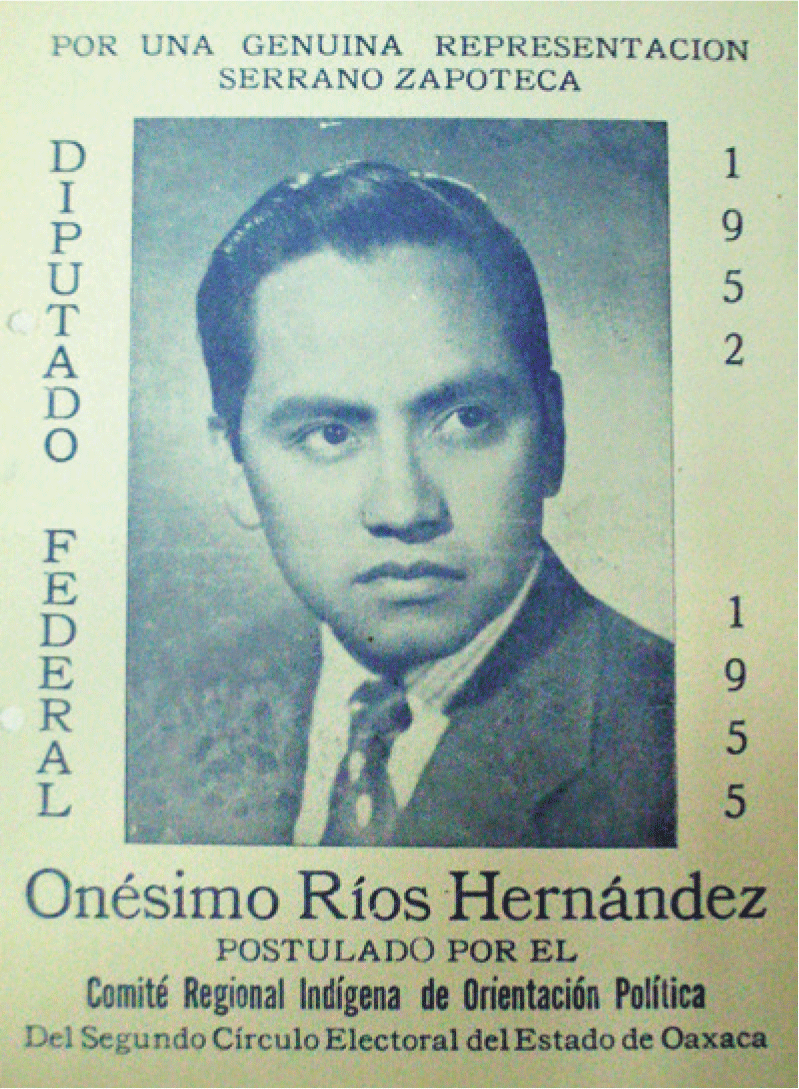
After its second congress in November of 1951, the CNJI became the National Confederation of Indigenous Youth and Communities (CNJCI): originally representing the “youth,” this organization—without changing leadership—now claimed to politically represent the whole of the indigenous world within Mexico’s borders. Having staked out this monopoly, the CNJCI made its official entry into the PRI as part of the third sector, that is, by joining the National Confederation of Popular Organizations (CNOP).Footnote 123 This decision was formalized at the second congress, even if contact had been made beforehand.Footnote 124 During the 1950s the CNJCI organized many activities under the aegis of the CNOP,Footnote 125 an organization that was entirely opposed to Lombardo Toledano’s PP.Footnote 126 While it did not become the organizing force of an independent indigenous sector, the CNJCI did establish itself as the sole interlocutor for the autochthonous question within the CNOP, and thereby retained its monopoly on indigenous representation. Towards the end of the decade, however, the founders of the CNJCI began to invest their energy in the professional sphere and the organization gradually began to peter out.Footnote 127 One of its major figures, Ríos Hernández, failed to obtain the PRI’s nomination to the legislative elections of 1952, missing his chance to become a federal deputy despite the support of the Zapotec of the Sierra de Juárez (Oaxaca) (fig. 3).
Alterity in Politics: The Failure of Onésimo Ríos Hernández’s Candidacy as a PRI Deputy
Source: Personal archives of Onésimo Ríos Hernández (photograph reprinted with his permission).

In conclusion, the indigenous youth movement, which grew out of the generalization of educational indigenismo and was brought to life by the spirit of the Pátzcuaro congress, seems to offer the missing link between the autochthonous mobilizations of the 1930s orchestrated by Cardenismo and the protests of the “global sixties.” Shaped by the system of indigenous boarding schools, young Indians quickly made their “race” a political and organizational resource. The category of “indigenous,” endowed with an inter-American legitimacy and equipped with a new range of organizational structures, allowed them to accumulate a new kind of political capital founded on the idea of a social race. While continuing to defend the legacy of the Revolution, the group led by Ríos Hernández and Hernández López paradoxically struggled against the ideology of mestizaje, perceived at the time as masking racial conflict. While strategically claiming to “Mexicanize the Indian,” this youth movement in fact defended an indigenous sovereignty for their “racial brothers.” While it became formally part of the PRI system, the indigenous movement managed to act as an independent sector of the party in all but name. Despite the gradual institutionalization of indigenismo, meanwhile, the struggle of these young Indians was far from easy, since this program for managing alterity was still considered by many anthropologists to be the exclusive preserve of intellectuals who identified as either white or mestizo. In 1967, confronted with rising protests, the Mexican anthropologist Aguirre Beltrán stated what, for him, was obvious:
Indigenismo is not a policy shaped by Indians to solve their problems, but rather that of non-Indians in regard to heterogeneous ethnic groups that receive the general designation of Indians.Footnote 128
This highly authoritative assertion, published in the III’s journal, was evocative of the debate around the foundation of the INI in 1948. Still, what had seemed flawed in 1948 was, in the late sixties, intolerable. The response of educated indigenous citizens, whose number had grown over the decade, was published in January of 1968. Signed by Ríos Hernández, then the representative of the Mexican Association of Indigenous Professionals and Intellectuals, this article reminded Aguirre Beltrán of the history of a movement born in the late 1940s, for which the management of the “so-called indigenous problem” was the responsibility of the indigenous people in general, and the most “prepared” among them in particular.Footnote 129
During the 1940s and 1950s, postrevolutionary Mexico had indeed been the stage of a strategic and emancipatory racialization that had largely escaped the control of political and indigenista authorities. The defense of race during this period enabled the indigenous representatives of the country to unite their aspirations despite their important ethnic differences and their position of social inferiority. For its proponents, the racial argument was also used as an arm in their attempt to modify the rules of the field of indigenismo to their benefit. Identification with a group regarded as a historically marginalized race provided an alternative to the sanctification proffered by a diploma from the National School of Anthropology and History: it created a platform that allowed for indigenous voices to be heard. Therein certainly lay the Indian reluctance to abandon the term “race,” malleable and inclusive as it was, in favor of the culturalist vision preached by 1950s anthropology. A close analysis of the militant uses of race by indigenous leaders should encourage social scientists to examine the processes of racialization through a different lens than that of simple, oppressive, top-down categorization. In the Mexican case, the oppressive form of categorization was in fact that which attempted to assimilate educated Indians to the national mestizo subject in order to reduce them to silence or invisibility. With the injunction to an all-encompassing mestizaje being expressed in the language of antiracism, it was fairly logical that the expression of alterity would draw from the vocabulary of indigenous blood and of race. If the indigenista program, considered by its architects as temporary, structured a “national regime of alterity,” tracing the political history of that alterity ultimately shows that in this case the “internal other” disrupted as much as it stabilized.
Was this Mexican history exceptional? The few studies on indigenous Latin American mobilizations prior to the 1960s and 1970s emphasize that the 1940s and 1950s were marked by an intricate overlap between the indigenista program and national autochthonous movements. In this sense, the birth of the Ecuadorian Federation of Indians in 1944 can be partially explained by the creation of an Indigenista Institute in Quito in 1942. As in Mexico, some of the educated Indians of Chile, using language based in discourses on “race” and “indigenous blood,” quickly became actors in the field of indigenismo. This was the case, for instance, of the Mapuche Venancio Coñuepán Huenchal, director of the Araucana Corporation in 1938, Chilean delegate to the Pátzcuaro congress in 1940, and Minister of Lands and Colonization in 1953, whose career largely anticipated that of Hernández López.
And yet a number of factors made the Mexican configuration unique: the accelerated development of two structures devoted to carrying out the indigenista program (the DGAI and the INI); the presence of their prestigious continent-level counterpart (the III) on Mexican soil; the stabilization of a partisan system (notably through the PRI and the CNOP), legitimated by a revolutionary ideology favorable to the “Indian” and seeking to oversee all social forces. The conjunction of these elements generated a political space for those who knew how to use their indigeneity as a tool for leverage.
The racialization described in this article was thus emancipatory for a movement that adopted, among others, the slogan, “We need Mexico and Mexico needs us.” This rallying cry is evocative of Subcomandante Marcos’s “No more Mexico without us,” adopted after 1994 by the Zapatista Army of National Liberation and taken up again by the candidate of the Indigenous Council of Government, María de Jesús Patricio, during the 2018 presidential election. These twentieth- and twenty-first-century strategies, whether collaborative or confrontational, are part of a long history of “indigenous negotiation” and its many intermediaries, stretching back to the Iberian colonization and the object of a number of recent studies. These strategies, in all their complexity, are a long way from the “black legend” of the Spanish Empire’s violence, or the “white legend” that casts colonization in a far more positive light.Footnote 130 The pragmatism of the representatives of early modern indigenous peoples, who instrumentalized Spanish institutions and adopted ancien régime legal culture, helped create a “hybrid colonial order”—without, however, fundamentally undermining the domination to which they were subjected. Centuries later, the history of the indigenous peoples of the Mexican Republic and their struggles for political representation in the 1940s and 1950s also points to indigeneity as a tactical position during the formation, and then the deconstruction, of the postrevolutionary PRI system. Since the Spanish colonialization of the Americas, indigeneity has always been a relationship rather than a consistent strategy, eluding any essentializing perspective. The concept of alterity—whether legal, racial, social, or cultural—was constantly mobilized, but was in sum only the blazing instrument of a political struggle in the service of a largely invisible minority.