






No CrossRef data available.
Article contents
Fixing the problems of deep neural networks will require better training data and learning algorithms
Published online by Cambridge University Press: 06 December 2023
Abstract
Bowers et al. argue that deep neural networks (DNNs) are poor models of biological vision because they often learn to rival human accuracy by relying on strategies that differ markedly from those of humans. We show that this problem is worsening as DNNs are becoming larger-scale and increasingly more accurate, and prescribe methods for building DNNs that can reliably model biological vision.
Information
- Type
- Open Peer Commentary
- Information
- Copyright
- Copyright © The Author(s), 2023. Published by Cambridge University Press
References
Baker, N., Lu, H., Erlikhman, G., & Kellman, P. J. (2018). Deep convolutional networks do not classify based on global object shape. PLoS Computational Biology, 14(12), e1006613.CrossRefGoogle Scholar
Bakhtiari, S., Mineault, P., Lillicrap, T., Pack, C., & Richards, B. (2021). The functional specialization of visual cortex emerges from training parallel pathways with self-supervised predictive learning. Advances in Neural Information Processing Systems, 34, 25164–25178.Google Scholar
Dapello, J., Marques, T., Schrimpf, M., Geiger, F., Cox, D., & DiCarlo, J. J. (2020). Simulating a primary visual cortex at the front of CNNs improves robustness to image perturbations. In Larochelle, H., Ranzato, M., Hadsell, R., Balcan, M. F., & Lin, H. (Eds.), Advances in neural information processing systems (Vol. 33, pp. 13073–13087). Curran.Google Scholar
Fel, T., Felipe, I., Linsley, D., & Serre, T. (2022). Harmonizing the object recognition strategies of deep neural networks with humans. In Koyejo, S., Mohamed, S., Agarwal, A., Belgrave, D., Cho, K., & Oh, A. (Eds.), Advances in neural information processing systems (Vol. 35, pp. 9432–9446). Curran Associates, Inc. https://proceedings.neurips.cc/paper_files/paper/2022/file/3d681cc4487b97c08e5aa67224dd74f2-Paper-Conference.pdfGoogle Scholar
Geirhos, R., Jacobsen, J.-H., Michaelis, C., Zemel, R., Brendel, W., Bethge, M., & Wichmann, F. A. (2020). Shortcut learning in deep neural networks. Nature Machine Intelligence, 2(11), 665–673.CrossRefGoogle Scholar
Geirhos, R., Narayanappa, K., Mitzkus, B., Thieringer, T., Bethge, M., Wichmann, F. A., & Brendel, W. (2021). Partial success in closing the gap between human and machine vision. In Ranzato, M., Beygelzimer, A., Dauphin, Y., Liang, P. S., & Wortman Vaughan, J. (Eds.), Advances in neural information processing systems (Vol. 34, pp. 23885–23899). Curran.Google Scholar
Kim, J., Linsley, D., Thakkar, K., & Serre, T. (2020). Disentangling neural mechanisms for perceptual grouping. In Z. Chen, J. Zhang, M. Arjovsky, & L. Bottou (Eds.), International Conference on Learning Representations, Addis Abada, Ethopia.Google Scholar
Kim, J., Ricci, M., & Serre, T. (2018). Not-So-CLEVR: Learning same-different relations strains feedforward neural networks. Interface Focus, 8(4), 20180011.CrossRefGoogle ScholarPubMed
Kubilius, J., Schrimpf, M., Nayebi, A., Bear, D., Yamins, D. L. K., & DiCarlo, J. J. (2018). CORnet: Modeling the neural mechanisms of core object recognition. bioRxiv, 408385. https://doi.org/10.1101/408385Google Scholar
Kumar, M., Houlsby, N., Kalchbrenner, N., & Cubuk, E. D. (2022). Do better ImageNet classifiers assess perceptual similarity better? https://openreview.net › forumhttps://openreview.net › forum. https://openreview.net/pdf?id=qrGKGZZvH0Google Scholar
Lillicrap, T. P., Santoro, A., Marris, L., Akerman, C. J., & Hinton, G. (2020). Backpropagation and the brain. Nature Reviews. Neuroscience, 21(6), 335–346.CrossRefGoogle ScholarPubMed
Linsley, D., Eberhardt, S., Sharma, T., Gupta, P., & Serre, T. (2017). What are the visual features underlying human versus machine vision? In Y. Song, C. Ma, L. Gong, J. Zhang, R. W. H. Lau, & M. Yang (Eds.), IEEE international conference on computer vision workshops, Venice, Italy (pp. 2706–2714).CrossRefGoogle Scholar
Linsley, D., Kim, J., Ashok, A., & Serre, T. (2019a). Recurrent neural circuits for contour detection. International conference on representation learning. https://openreview.net/forum?id=H1gB4RVKvB¬eId=H1gB4RVKvBGoogle Scholar
Linsley, D., Kim, J., Veerabadran, V., Windolf, C., & Serre, T. (2018). Learning long-range spatial dependencies with horizontal gated recurrent units. In Bengio, S., Wallach, H., Larochelle, H., Grauman, K., Cesa-Bianchi, N., & Garnett, R. (Eds.), Advances in neural information processing systems (Vol. 31, pp. 152–164). Curran.Google Scholar
Linsley, D., Malik, G., Kim, J., Govindarajan, L. N., Mingolla, E., & Serre, T. (2021). Tracking without re-recognition in humans and machines. In Ranzato, M., Beygelzimer, A., Dauphin, Y., Liang, P. S., & Vaughan, J. W. (Eds.), Advances in neural information processing systems (Vol. 34, pp. 19473–19486). Curran.Google Scholar
Linsley, D., Shiebler, D., Eberhardt, S., & Serre, T. (2019). Learning what and where to attend. In I. Loshchilov & F. Hutter (Eds.), 7th International conference on representation learning, New Orleans.Google Scholar
Lotter, W., Kreiman, G., & Cox, D. (2016). Deep predictive coding networks for video prediction and unsupervised learning. arXiv [cs.LG]. http://arxiv.org/abs/1605.08104Google Scholar
Malhotra, G., Dujmović, M., & Bowers, J. S. (2022). Feature blindness: A challenge for understanding and modeling visual object recognition. PLoS Computational Biology, 18(5), e1009572.CrossRefGoogle ScholarPubMed
Malhotra, G., Evans, B. D., & Bowers, J. S. (2020). Hiding a plane with a pixel: Examining shape-bias in CNNs and the benefit of building in biological constraints. Vision Research, 174, 57–68.CrossRefGoogle ScholarPubMed
Mildenhall, B., Srinivasan, P. P., Tancik, M., Barron, J. T., Ramamoorthi, R., & Ng, R. (2020). NeRF: Representing scenes as neural radiance fields for view synthesis. arXiv [cs.CV]. http://arxiv.org/abs/2003.08934Google Scholar
Mineault, P., Bakhtiari, S., Richards, B., & Pack, C. (2021). Your head is there to move you around: Goal-driven models of the primate dorsal pathway. In Ranzato, M., Beygelzimer, A., Dauphin, Y., Liang, P. S., & Vaughan, J. W. (Eds.), Advances in neural information processing systems (Vol. 34, pp. 28757–28771). Curran.Google Scholar
Nayebi, A., Bear, D., Kubilius, J., Kar, K., Ganguli, S., Sussillo, D., … Yamins, D. L. K. (2018). Task-driven convolutional recurrent models of the visual system. arXiv [q-bio.NC]. http://arxiv.org/abs/1807.00053Google Scholar
Orhan, E., Gupta, V., & Lake, B. M. (2020). Self-supervised learning through the eyes of a child. In Larochelle, H., Ranzato, M., Hadsell, R., Balcan, M. F., & Lin, H. (Eds.), Advances in neural information processing systems (Vol. 33, pp. 9960–9971). Curran.Google Scholar
Richards, B. A., Lillicrap, T. P., Beaudoin, P., Bengio, Y., Bogacz, R., Christensen, A., … Kording, K. P. (2019). A deep learning framework for neuroscience. Nature Neuroscience, 22(11), 1761–1770.CrossRefGoogle ScholarPubMed
Smith, L. B., & Slone, L. K. (2017). A developmental approach to machine learning? Frontiers in Psychology, 8, 2124.CrossRefGoogle ScholarPubMed
Sullivan, J., Mei, M., Perfors, A., Wojcik, E., & Frank, M. C. (2021). SAYCam: A large, longitudinal audiovisual dataset recorded from the infant's perspective. Open Mind: Discoveries in Cognitive Science, 5, 20–29.CrossRefGoogle ScholarPubMed
Vaishnav, M., Cadene, R., Alamia, A., Linsley, D., VanRullen, R., & Serre, T. (2022). Understanding the computational demands underlying visual reasoning. Neural Computation, 34(5), 1075–1099.CrossRefGoogle ScholarPubMed
Vaishnav, M., & Serre, T. (2023). GAMR: A guided attention model for (visual) reasoning. International conference on learning representations. https://openreview.net/pdf?id=iLMgk2IGNyvGoogle Scholar
Wiskott, L., & Sejnowski, T. J. (2002). Slow feature analysis: Unsupervised learning of invariances. Neural Computation, 14(4), 715–770.CrossRefGoogle ScholarPubMed
Yamins, D. L. K., Hong, H., Cadieu, C. F., Solomon, E. A., Seibert, D., & DiCarlo, J. J. (2014). Performance-optimized hierarchical models predict neural responses in higher visual cortex. Proceedings of the National Academy of Sciences of the United States of America, 111(23), 8619–8624.CrossRefGoogle ScholarPubMed
Zhuang, C., Yan, S., Nayebi, A., Schrimpf, M., Frank, M. C., DiCarlo, J. J., & Yamins, D. L. K. (2021). Unsupervised neural network models of the ventral visual stream. Proceedings of the National Academy of Sciences of the United States of America, 118(3), e2014196118. https://doi.org/10.1073/pnas.2014196118Google ScholarPubMed
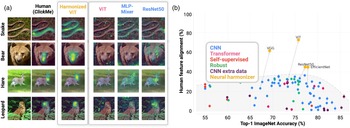
Figure 1 (Linsley and Serre). A growing misalignment between biological vision and DNNs (adapted from Fel et al., 2022). (a) Diagnostic features for object classification differ between humans and DNNs. (b) The Spearman correlation between human and DNN feature importance maps is decreasing as a function of DNN accuracy on ImageNet. This trade-off can be addressed with the neural harmonizer — a method for explicitly aligning DNN representations with humans for object recognition.
Target article
Related commentaries (29)
Beyond the limitations of any imaginable mechanism: Large language models and psycholinguistics
 Tal Golan
[Opens in a new window]Tal Golan
, JohnMark Taylor
[Opens in a new window]JohnMark Taylor
, Heiko Schütt
, Benjamin Peters
, Rowan P. Sommers
, Katja Seeliger
, Adrien Doerig
[Opens in a new window]Adrien Doerig
, Paul Linton
, Talia Konkle
, Marcel van Gerven
[Opens in a new window]Marcel van Gerven
, Konrad Kording
[Opens in a new window]Konrad Kording
, Blake Richards
, Tim C. Kietzmann
[Opens in a new window]Tim C. Kietzmann
, Grace W. Lindsay
and Nikolaus Kriegeskorte
[Opens in a new window]Nikolaus Kriegeskorte
Modelling human vision needs to account for subjective experience
Psychophysics may be the game-changer for deep neural networks (DNNs) to imitate the human vision
Statistical prediction alone cannot identify good models of behavior
Where do the hypotheses come from? Data-driven learning in science and the brain
Over the past decade, vision scientists have turned to deep neural networks (DNNs) to model biological vision. The popularity of DNNs comes from their ability to achieve human-level performance on visual tasks (Geirhos et al., Reference Geirhos, Narayanappa, Mitzkus, Thieringer, Bethge, Wichmann, Brendel, Ranzato, Beygelzimer, Dauphin, Liang and Wortman Vaughan2021) and the seemingly concomitant correspondence of their hidden units with biological vision (Yamins et al., Reference Yamins, Hong, Cadieu, Solomon, Seibert and DiCarlo2014). Bowers et al. marshal evidence from psychology and neuroscience to argue that while DNNs and biological systems may achieve similar accuracy on visual benchmarks, they often do so by relying on qualitatively different visual features and strategies (Baker, Lu, Erlikhman, & Kellman, Reference Baker, Lu, Erlikhman and Kellman2018; Malhotra, Evans, & Bowers, Reference Malhotra, Evans and Bowers2020, Reference Malhotra, Dujmović and Bowers2022). Based on these findings, Bowers et al. call for a reevaluation of what DNNs can tell us about biological vision and suggest dramatic adjustments going forward, potentially even moving on from DNNs altogether. Are DNNs the wrong paradigm for modeling biological vision?
Systematically evaluating DNNs for biological vision
While this commentary identifies multiple shortcuts in DNNs that are commonly used in vision science, such as ResNet and AlexNet, it does not delve into the root causes of these issues or how widespread they are across different DNN architectures and training routines. We previously addressed these questions with ClickMe, a web-based game in which human participants teach DNNs how to recognize objects by highlighting category-diagnostic visual features (Linsley, Eberhardt, Sharma, Gupta, & Serre, Reference Linsley, Eberhardt, Sharma, Gupta and Serre2017; Linsley, Shiebler, Eberhardt, & Serre, Reference Linsley, Shiebler, Eberhardt and Serre2019). With ClickMe, we collected annotations of the visual features that humans rely on to recognize approximately 25% of ImageNet images (https://serre-lab.github.io/Harmonization/). Human feature importance maps from ClickMe reveal startling regularity: Animals were categorized by their faces, whereas inanimate objects like cars were categorized by their wheels and headlights (Fig. 1a). Human participants were also significantly more accurate at rapid object classification when basing their decisions on these features rather than image saliency. In contrast, while DNNs sometimes selected the same diagnostic features as humans, they often relied on “shortcuts” for object recognition (Geirhos et al., Reference Geirhos, Jacobsen, Michaelis, Zemel, Brendel, Bethge and Wichmann2020). For example, a DNN called the Vision transformer (ViT) relied on background features, like grass, to recognize a hare, whereas human participants focused almost exclusively on the animal's head (Fig. 1a). Even more concerning is that the visual features and strategies of humans and DNNs are becoming increasingly misaligned as newer DNNs become more accurate (Fig. 1b). We and others have observed similar trade-offs between DNN accuracy on ImageNet and their ability to explain various human behavioral data and psychophysics (Fel, Felipe, Linsley, & Serre, Reference Fel, Felipe, Linsley, Serre, Koyejo, Mohamed, Agarwal, Belgrave, Cho and Oh2022; Kumar, Houlsby, Kalchbrenner, & Cubuk, Reference Kumar, Houlsby, Kalchbrenner and Cubuk2022). Our work indicates that the mismatch between DNN and biological vision identified by Bowers et al. is pervasive and worsening.
(Linsley and Serre). A growing misalignment between biological vision and DNNs (adapted from Fel et al., Reference Fel, Felipe, Linsley, Serre, Koyejo, Mohamed, Agarwal, Belgrave, Cho and Oh2022). (a) Diagnostic features for object classification differ between humans and DNNs. (b) The Spearman correlation between human and DNN feature importance maps is decreasing as a function of DNN accuracy on ImageNet. This trade-off can be addressed with the neural harmonizer — a method for explicitly aligning DNN representations with humans for object recognition.
The next generation of DNNs for biological vision
Bowers et al. argue that the inability of DNNs to learn human-like visual strategies reflects architectural limitations. They are correct that there is a rich literature demonstrating how mechanisms inspired by neuroscience can improve the capabilities of DNNs, helping them learn perceptual grouping (Kim, Linsley, Thakkar, & Serre, Reference Kim, Linsley, Thakkar and Serre2020; Linsley, Kim, Ashok, & Serre, Reference Linsley, Kim, Ashok and Serre2019a; Linsley, Kim, Veerabadran, Windolf, & Serre, Reference Linsley, Kim, Veerabadran, Windolf, Serre, Bengio, Wallach, Larochelle, Grauman, Cesa-Bianchi and Garnett2018, Reference Linsley, Malik, Kim, Govindarajan, Mingolla, Serre, Ranzato, Beygelzimer, Dauphin, Liang and Vaughan2021), visual reasoning (Kim, Ricci, & Serre, Reference Kim, Ricci and Serre2018; Vaishnav et al., Reference Vaishnav, Cadene, Alamia, Linsley, VanRullen and Serre2022; Vaishnav & Serre, Reference Vaishnav and Serre2023), robust object recognition (Dapello et al., Reference Dapello, Marques, Schrimpf, Geiger, Cox, DiCarlo, Larochelle, Ranzato, Hadsell, Balcan and Lin2020), and to more accurately predict neural activity (Bakhtiari, Mineault, Lillicrap, Pack, & Richards, Reference Bakhtiari, Mineault, Lillicrap, Pack and Richards2021; Kubilius et al., Reference Kubilius, Schrimpf, Nayebi, Bear, Yamins and DiCarlo2018; Nayebi et al., Reference Nayebi, Bear, Kubilius, Kar, Ganguli, Sussillo and Yamins2018). The other fundamental difference between DNNs and biological organisms is how they learn; humans and DNNs learn from vastly different types of data with presumably different objective functions. We believe that the limitations raised by Bowers et al. result from a mismatch in data diets and objective functions because we were able to significantly improved the alignment of DNNs with humans by introducing ClickMe data into their training routines (“Neural harmonizer,” Fig. 1).
Biologically inspired data diets and objective functions
We believe that the power of DNNs for biological vision is from their ability to generate computational- and algorithmic-level hypotheses about vision, which will guide experiments to identify plausible circuits. For instance, the great success of gradient descent and backpropagation for training DNNs has inspired the search for biologically plausible approximations (Lillicrap, Santoro, Marris, Akerman, & Hinton, Reference Lillicrap, Santoro, Marris, Akerman and Hinton2020). Visual neuroscience is similarly positioned to benefit from DNNs if we can improve their alignment with biology.
The most straightforward opportunity for aligning DNNs with biological vision is to train them with more biologically plausible data and objective functions (Smith & Slone, Reference Smith and Slone2017 Richards et al., Reference Richards, Lillicrap, Beaudoin, Bengio, Bogacz, Christensen and Kording2019). There have been efforts to do this with first-person video, however, these efforts have failed to yield much benefit in computer vision or other aspects of biological vision (Orhan, Gupta, & Lake, Reference Orhan, Gupta, Lake, Larochelle, Ranzato, Hadsell, Balcan and Lin2020; Sullivan, Mei, Perfors, Wojcik, & Frank, Reference Sullivan, Mei, Perfors, Wojcik and Frank2021; Zhuang et al., Reference Zhuang, Yan, Nayebi, Schrimpf, Frank, DiCarlo and Yamins2021), potentially because the small scale of these datasets makes them ill-suited for training DNNs. An alternative approach is to utilize advances in three-dimensional (3D) computer vision, like neural radiance fields (Mildenhall et al., Reference Mildenhall, Srinivasan, Tancik, Barron, Ramamoorthi and Ng2020), to generate spatiotemporal (and stereo) datasets for training DNNs that are infinitely scalable and can be integrated with other modalities, such as somatosensation and language. It is also very likely that objective functions that will lead to human-like visual strategies and features from these datasets have yet to be discovered. However, promising directions include optimizing for slow feature analysis (Wiskott & Sejnowski, Reference Wiskott and Sejnowski2002) and predictive coding (Lotter, Kreiman, & Cox, Reference Lotter, Kreiman and Cox2016; Mineault, Bakhtiari, Richards, & Pack, Reference Mineault, Bakhtiari, Richards, Pack, Ranzato, Beygelzimer, Dauphin, Liang and Vaughan2021), which could help align DNNs with humans without relying on ClickMe data.
Aligned DNNs may be all we need
Bowers et al. point out a number of ways in which DNNs fail as models of biological vision. These problems are pervasive and likely caused by the standard image datasets and training routines of DNNs, which are guided by engineering rather than biology. Bowers et al. may well be right that an entirely new class of models is needed to account for biological vision, but at the moment there are no viable alternatives. Until other model classes can rival human performance on visual tasks, we suspect that the most productive path forward toward modeling biological vision and aligning DNNs with biological vision is to develop more biologically plausible data diets and objective functions.
Acknowledgments
We thank Lakshmi Govindarajan for his helpful comments and feedback on drafts of this commentary.
Financial support
This work was supported by ONR (N00014-19-1-2029), NSF (IIS-1912280), and the ANR-3IA Artificial and Natural Intelligence Toulouse Institute (ANR-19-PI3A-0004).
Competing interest
None.