Since its initial conceptualization in the mid-1980s, the European Single Market has been central to both the European project and the constitutional order of the European Union.Footnote 1 Coinciding with the expansion of the European Union and the process of German unification, the program is considered to be of profound historical significance and has been credited with steering the European Union out of a profound crisis.Footnote 2 Driven by a perceived decline in Europe's position in the global economy, a key aim was the enhancement of European competitiveness.Footnote 3 This ambition was reflected in the emphasis placed on the global competitiveness of European firms in the key 1993 white paper Growth, Competitiveness, Employment, as well as in attempts to create a European Company Statute.Footnote 4 The primary means of achieving enhanced competitiveness were the twin policies of liberalization of markets and harmonization of regulations.Footnote 5 In short, European competitiveness was to be enhanced through the transformation of the European competitive environment.Footnote 6
In this article we explore the extent to which this transformation of the European competitive environment was reflected in changes to the corporate strategies of European firms, in terms of their product diversification and their internationalization. New competitive pressures are expected to stimulate both convergence on more efficient patterns of diversification and greater involvement in international markets. At the same time, the opening of geographically adjacent markets should provide opportunities for more intra-European expansion.
We focus on diversification and internationalization for a number of reasons. With regard to diversification, we build on a well-established tradition that links questions about the fate of the diversified firm in Europe to the position and competitiveness of “European” business in the international economy.Footnote 7 Initially, this research tradition was driven by the desire to understand the ability of European business to respond to the American competitive challenge.Footnote 8 However, diversification is much more than a matter of firm-level competitiveness. It has become an index of fundamental differences in patterns of economic organization and underlying models of practice, particularly between different types of developed capitalist economies.Footnote 9 Thus, in the European context, for example, changing patterns of diversification among large French, German, and British firms have been used to explore the extent of convergence on a single model of economic organization.Footnote 10
Internationalization—which is usually considered separately from diversification—has also been used as an indicator of fundamental differences in national patterns of organization.Footnote 11 By distinguishing between intra-European and extra-European internationalization, we address, at the firm-level, two different sources of efficiency gains through European integration: on the one hand, the scale benefits potentially available from all kinds of internationalization; and on the other hand, the increased pressures for efficiency brought about by the admission of new competitors into domestic markets from adjacent European countries.Footnote 12 Together with the consideration of product diversification, this offers a fuller picture of how the strategic orientation of European firms evolved after the formation of the European Single Market.
Our empirical focus is on the period following the completion of the internal market in the early 1990s, through an era of intensified pressures of globalization, up until the immediate aftermath of the global financial crisis in 2010.Footnote 13 Following calls to consider in more detail the strategic trajectories taken by firms outside of Europe's larger economies, we include firms from not only the three largest economies (France, Germany, and the United Kingdom), but also the midsized economies of Sweden and Finland in the North and those of Italy and Spain in the South.Footnote 14 With regard to diversification in particular, we consider the extent to which patterns are distinctively “European” or indicative of wider globalization by comparing European trends with those of the United States.Footnote 15 We track the diversification and internationalization strategies of all publicly listed firms in the focal economies. However, for the three largest economies, we also focus on the one hundred largest industrial firms (in terms of revenue), which enables a comparison to previous studies that focused on the same sampling approach and allows a consideration of possible ownership effects.Footnote 16
We will show that the strategic trajectory followed by European business demonstrates both substantial commonality and some distinctiveness. After a long-term trend toward greater diversification in the postwar decades, European firms have recently tended to focus their business portfolios, and markedly more so than American firms. Internationalization, however, has followed a less convergent pattern: the overseas strategies of British business stand out as markedly less European in focus.
The following section briefly considers how the formation of the Single Market may have influenced the key strategic dimensions of diversification and internationalization. We then set out our research methods, before considering the general trends of strategic change. To explore the drivers and patterns of diversification and internationalization in more detail, we conclude by presenting selected vignettes of companies that illustrate the trends observed at national levels.
The Influence of the Single Market on Diversification and Internationalization
Alfred Chandler and Edith Penrose recognized that diversification and internationalization—two key dimensions of corporate strategy—not only are shaped by a firm's resource profile and the desire to exploit underutilized resources, but may reflect a complex set of contextual factors.Footnote 17 On the resource side, these factors include the nature and structure of external financial markets, the supply of appropriate managerial skills available to manage the complexities of diversification strategy, and external resource markets more generally.Footnote 18 On the market side, patterns of diversification and internationalization are shaped by the presence and absence of opportunities in the external environment, as well as by the ability of organizations to exploit these through market development and entry.Footnote 19 It is ultimately through the dynamic interaction between the organizations' resources and the external environmental conditions—offering, in the terms of Penrose, the “productive opportunity”—as well as the preference of those who own and manage corporations that patterns for growth, including diversification and internationalization, are shaped.Footnote 20
The European Single Market affects these contextual parameters in a number of profound ways. As noted, the creation of the Single Market involved processes of deregulation at a national level and increased cross-national regulatory coordination, including the pursuit of integrationist policies by the European commission in areas such as competition policy.Footnote 21 Policies enabling and encouraging “freer intra-EC trade” thereby intensified competition through, for example, increasing interfirm rivalry and reducing barriers to entry.Footnote 22 Such contextual changes can be expected to have profound effects on product diversification and internationalization. With regard to diversification, the increase in competitive pressures is likely to require firms to look for greater efficiencies within individual business units and to leverage corporate resources more effectively across the overall portfolio; both business unit and portfolio gains are more readily achieved through more focused strategies. Regarding internationalization, legal harmonization and liberalization increase the opportunities for firms' expansion into adjacent markets; at the same time, increased competitive pressures increase the incentives for scale economies, available through international expansion within Europe and globally. From an economic perspective, therefore, the construction of the Single Market offered clear incentives to shift corporate strategies toward more focused diversification and increased internationalization within and outside of Europe.
While such economic considerations suggest common lines of strategic development for European firms, a number of factors point to possible differences. First, while the Single Market involved a remarkable harmonization of rules of exchange and an increasing alignment of governance structures, patterns of ownership have continued to exhibit strong national differences.Footnote 23 Distinctive national patterns of corporate ownership have already been shown to influence diversification and internationalization strategies in Europe.Footnote 24 This putative role for corporate ownership resonates strongly with the notion of varieties of capitalism and the view that national historical paths shape “differences in capabilities, organizational forms and internationalization patterns of their MNEs.”Footnote 25 For example, Hartmut Berghoff sees the avoidance of diversification as a characteristic of the family model of capitalism represented by the German Mittelstand.Footnote 26 On the other hand, it has been argued that the United Kingdom's “colonial past” accounts for its “outward looking commercial tradition.”Footnote 27 Cultural and linguistic factors have been shown to affect both the United Kingdom's acceptance of inward investment and its readiness to invest overseas.Footnote 28 This raises a number of interrelated questions about the development of European business in response to the formation of the European Single Market. First, can a notable change in the competitive orientation of European firms be identified? Second, do these changes suggest the formation of a common business space, with increased competition between neighboring countries? Third, to what extent are the historical specificities of national contexts still reflected in characteristic corporate strategies in the face of efforts to establish European commonality?
Research Methods
Our empirical analysis falls into two main parts. First, we investigate the strategic trajectories from the early 1990s to the immediate aftermath of the global financial crisis in 2010 of all listed firms in Europe's largest economies (i.e., the United Kingdom, France, and Germany) as well as the midsized northern and southern European economies of Sweden, Finland, Italy, and Spain. The sample includes all nonfinancial companies, regardless of their size, for which data on sales in different product and geographic segments between 1993 and 2010 were available in the Worldscope database. The database is based on annual reports. This resulted in a sample of 5,415 firms in total.
For the diversification analysis of these firms we used a fine-grained measure of diversification: the entropy measure.Footnote 29 This Standard Industrial Classification (SIC)–based index, which considers not only the number of different product segments in which a firm is active but also their relative importance, has been used extensively.Footnote 30 It is computed as ∑ Pi ln(1/Pi), where Pi is the share of a firm's total sales attributed to product segment i, and ln(1/Pi) is the weight of each product segment i. We calculated the entropy index by using annual data on a firm's sales in each of its four-digit SIC business segments. A firm focused on one single business segment has an entropy measure of zero, while the measure increases with increasing product diversity of the firm. Worldscope allows firms to report sales in a maximum of ten different product segments. Hence, the theoretical maximum of the entropy measure is 2.303 for a firm having diversified its sales equally across ten different business segments. The example of British American Tobacco (BAT) illustrates the entropy measure of diversification. Between 1984 and 1989, BAT acquired Eagle Star, Allied Dunbar, and Farmers Group to become the largest U.K.-based insurance group. In 1993, the company generated 46.33 percent of its sales from tobacco-related business (SIC 2111), while 27.34 percent and 26.33 percent of its sales came from life insurances (SIC 6311) and accident/health insurances (SIC 6320), respectively. This resulted in an entropy measure slightly above one. By contrast, in 2007, after a decade of refocusing attempts, BAT showed an entropy value of zero with 100 percent of its sales dedicated to tobacco related activities. The use of this measure allows a continuous overview of the trajectories of diversification strategies and enables cross-national comparisons. We compare the European diversification trends with those of the United States as it is a developed economy, roughly equivalent in size to the internal market of the European Union. More specifically, the United States has typically been considered the reference point for the development of the modern, diversified enterprise.Footnote 31
We capture internationalization with the foreign-sales ratio, which indicates the proportion of a firm's total sales from foreign operations. We distinguish between sales in other European countries and those outside Europe, as we are particularly interested in whether the integration of Europe changed the pattern of internationalization. Because of the different sizes of their home markets, and the irrelevance of the intra-/extra-European sales measure, we do not compare the internationalization of European firms with that of American firms.
For the second part of our empirical analysis, the focus is tightened to examine just the top one hundred industrial firms (by sales) in Europe's largest economies (i.e., Germany, France, and the United Kingdom).Footnote 32 In doing so, we study a subset of firms that has been the focus of the well-established Harvard Studies tradition of the strategic development of large European firms.Footnote 33 This allows us to establish any differences or similarities between the largest firms in the respective economies and their smaller counterparts. The analysis here will be briefer than for all listed firms, but this analysis also allows us to explore how ownership may have affected strategy adoption. Broader trends are illustrated by offering indicative examples of well-known companies.
Diversification and Internationalization Trends in Europe
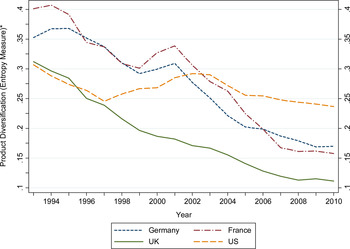
We consider the patterns of diversification and internationalization for all listed firms in two stages: first, those of the largest economies (France, Germany, and the United Kingdom), and then, those of the midsized economies (Finland, Sweden, Spain, and Italy). Figure 1 shows a clear downward trend in diversification levels for all listed firms in the United Kingdom, France, and Germany. Overall, the decline in diversification is most pronounced for French business, where the average entropy measure falls from 0.4 in 1993 to just over 0.15 in 2010. German business broadly follows this French trend, though less radically. The lowest level of diversification is that of the British firms, at around 0.11 by 2010. The trajectories of these large European economies—and, as we shall establish, those of European businesses more generally—differ from those of U.S. firms. Although diversification levels in the United States were lower by the time surrounding the financial crisis than in the early 1990s, the drop is much less pronounced than in Europe and the trajectory less clear. The relative levels of diversification between the United States and Europe have reversed over this period, with American business emerging as the most diversified.
Product Diversification: Germany, France, United Kingdom, United States, 1993–2010. (Source: Calculation based on business segment data from Thomson Reuters Worldscope database, https:// www.rimes.com/data/thomson-reuters-worldscope/).

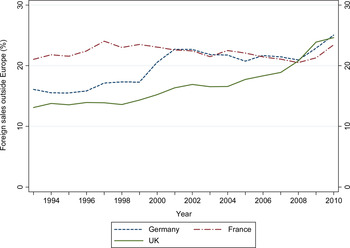
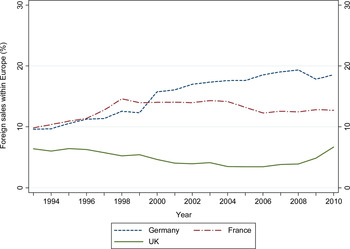
In terms of internationalization, it is the British firms that have increased their sales outside Europe most radically, rising from about 14 percent to 24 percent (Figure 2). French extra-European sales have been broadly flat, while German firms enjoyed a surge around the turn of the century. The British firms stand out also in terms of intra-European sales: throughout the period, theirs have been markedly below those of French and German firms, fluctuating around 7 to 8 percent (Figure 3). German firms present the strongest contrast to the British case, doubling their intra-European sales from about 10 percent to nearly 20 percent over the period. Siemens, for example, increased its intra-European sales from 23 percent in 1993 to 34 percent in 2010.
Foreign sales outside Europe: Germany, France, United Kingdom, 1993–2010. (Source: Calculation based on geographic segment data from Thomson Reuters Worldscope database, https:// www.rimes.com/data/thomson-reuters-worldscope/).

Foreign sales within Europe: Germany, France, United Kingdom, 1993–2010. (Source: Calculation based on geographic segment data from Thomson Reuters Worldscope database, https:// www.rimes.com/data/thomson-reuters-worldscope/).

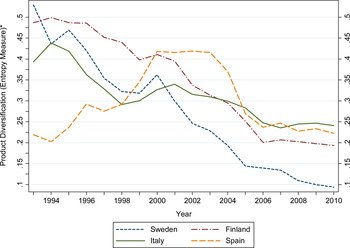
The midsized economies show common trends in terms of diversification but underline British firms' distinctive status as reluctant Europeans in terms of international sales. To start with diversification, Figure 4 shows both the northern European economies (Sweden and Finland) and the largest southern economy (Italy) following an almost identical downward trajectory from 1993 until 2010. Spanish firms show a slightly different pattern, with a surge in diversification in the late 1990s before a turn to the common European trajectory of refocusing from the early 2000s onwards. In other words, firms across a range of European midsized economies broadly followed the same refocusing strategies as those in the three largest economies, again distinctive from their American peers.
Product Diversification: Northern and southern European economies, 1993–2010. (Source: Calculation based on business segment data from Thomson Reuters Worldscope database, https:// www.rimes.com/data/thomson-reuters-worldscope/).

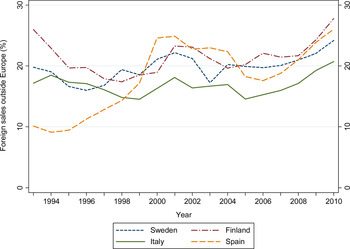
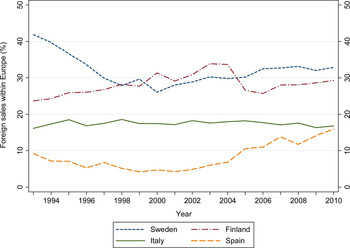
In general, firms from the midsized economies did not notably expand the proportion of their activities either outside Europe (Figure 5) or within Europe (Figure 6). Italian, Swedish, and Finnish firms generally followed uneven paths of internationalization in this period, though there were upticks in the last years. Among the four northern and southern European countries, only Spanish firms increased their internationalization, both within and outside of Europe, to a significant degree, albeit from a very low level. For Spain, this increase generally represents a catching up in the overall internationalization of its firms. Similar to British firms, they can leverage linguistic and cultural ties that link back to colonial times, South America in particular. The lower level of intra-European sales for Spain—and also for Italy—suggests that few firms from these economies are as competitive abroad as their northern counterparts. Despite this, Spanish and Italian firms show roughly twice the level of intra-European sales of British firms by the end of the period. Thus, relative both to this group of midsized economies and to France and Germany, British firms again stand out as reluctant Europeans.
Foreign sales outside Europe: Northern and southern European economies, 1993–2010. (Source: Calculation based on geographic segment data from Thomson Reuters Worldscope database, https:// www.rimes.com/data/thomson-reuters-worldscope/).

Foreign sales within Europe: Northern and southern European economies, 1993–2010. (Source: Calculation based on geographic segment data from Thomson Reuters Worldscope database, https:// www.rimes.com/data/thomson-reuters-worldscope/).

Large-Firm Strategies
We turn now to the one hundred largest industrial firms in each of France, Germany, and the United Kingdom, which are comparable to previous studies on product diversification of European corporations.Footnote 34 For these largest firms we are also able to trace the impact of ownership and provide more detailed accounts of diversification patterns. We shall focus here particularly on the strategies of firms where either the state or families were the largest owners, with stakes over 5 percent.
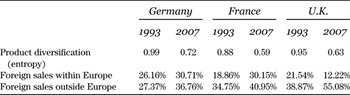
In terms of diversification, these large firms followed the wider trend by refocusing after the formation of the Single Market (see Table 1). In each of these countries, large-firm diversification decreased by a third between 1993 and 2007. By comparison with the increasing diversification of the postwar period, this suggests a significant strategic change in recent decades.Footnote 35
Strategy Evolution: Large Firms in Germany, France, U.K., 1993–2007

Source: Calculation based on business and geographic segment data from Thomson Reuters Worldscope database, https:// www.rimes.com/data/thomson-reuters-worldscope/.
For many French and German firms in particular, this refocusing activity occurred in direct response to the opportunities and pressures of the European Single Market. For example, Alstom was formed in 1998 out of a merger that brought together the former power and transport activities of the U.K.-based General Electric Company and the previously privatized French Compagnie Générale d'Electricité.Footnote 36 Bailed out by the French state in 2003, Alstom then embarked on a consolidation process that included the disposal of previously central activities—in some cases voluntarily, such as the sale of its industrial turbine business to Siemens, while in other cases as required by the European Competition Commission, such as the sale of its shipbuilding interests.Footnote 37 Similarly, for state-owned German utilities firm RWE, the divestment of its telecom business and the decision to refocus on water, gas, electricity, and waste management in the late 1990s in the pursuit of increasing scale in its core business through primarily European expansion was driven by an interplay between the market opportunities created by European integration and associated deregulation, on the one hand, and a simultaneous intensification of competition, on the other.Footnote 38 In terms of internationalization, the largest firms, while more internationalized than their smaller counterparts, followed the same nationally distinct trajectories. British firms again are the outliers; for them, the relative importance of foreign sales within Europe declined significantly over the time period, while sales outside of Europe increased notably (Table 1). The contrast with France is stark. French firms present themselves as particularly enthusiastic “Europeanizers,” with foreign sales inside Europe increasing from 19 percent to 30 percent. While for France, too, sales outside of Europe grew (from 35 percent to 41 percent), they did so to a much lower extent than did those of U.K. firms, which increased from 39 percent to 55 percent. For France in particular, such “Europeanization” has been particularly pronounced in sectors with strong political and regulatory involvement, such as electricity and energy but also the aerospace and defense sectors.Footnote 39 The contrast with the United Kingdom is well illustrated by comparing French defense firm Thales with BAE Systems. State-owned defense firm Thales, for example, was formed in 2000 after the acquisition of U.K.-based Racal Electronics by French Thomson-CSF, which had pursued an explicit growth strategy in the European defense industry over the 1980s and 1990s, acquiring, for example, the defense electronics activities of Philips. While Thomson-CSF reported 27 percent of foreign sales within Europe in 1993, for Thales foreign sales within Europe accounted for 57 percent in 2007. However, Thales' foreign sales outside Europe dropped from 39 percent in 2000 to 17 percent in 2007, reflecting a strategy of geographic concentration. By contrast, the establishment of BAE Systems involved a deliberate decision to forgo European expansion. In 1995, British Aerospace and Germany's DASA had originally intended to form a strong European champion in order to counter the dominance of U.S. defense companies.Footnote 40 Instead, the British company decided to merge with Marconi Electronic Systems, also from the United Kingdom, in 1999. While its initial plan was to grow in both Europe and the United States, commercial opportunities in the United States were considered more attractive. By 2004, further acquisitions or joint ventures in Europe were ruled out to boost investments in the United States.Footnote 41 Sales outside Europe increased accordingly, from 38 percent in 1993 to 66 percent in 2007, while at the same time intra-European sales decreased from 28 percent to 12 percent.
Germany followed a more balanced trajectory, leading to increased engagement both within Europe (26 percent to 31 percent) and outside (27 percent to 37 percent)—a pattern reflected in the strategies of prominent firms such as Siemens and BMW, whose activities inside and outside of Europe grew in very similar ways. For Siemens, which increased its sales outside of Europe from 17 percent to 39 percent and within Europe from 11 percent to 32 percent, internationalization was significantly driven by concerns over its competitiveness at both the European and the global level. The firm's senior management was, for example, conscious of falling behind General Electric in terms of profitability and started to leave consumer markets in the 2000s to invest in businesses that serve industrial customers.Footnote 42 Siemens exited computer hardware, lighting, household appliances, and the mobile and fixed-line phone business—a business area that originated in 1848.Footnote 43 Expansion not only extended to Europe but also focused on the United States and Asia as potential growth markets. An example is the 1997 acquisition of Westinghouse in the United States, which turned Siemens into the world's second-largest manufacturer of power generation technology.Footnote 44
While individual French and German firms thus clearly did have international ambitions, these typically encompassed expansion both within and outside of Europe. U.K. firms differ in that they not only focused more intensively on global expansion but also reduced their relative presence in Europe. Such patterns clearly resonate with observations about the impact of historic linkages between the United Kingdom, the Commonwealth, and other countries sharing linguistic and cultural ties, with this “Anglosphere” facilitating the development of social, political, and economic networks and relationships.Footnote 45 However, in part these national differences may reflect different patterns of ownership, in terms of both concentration and the types. On the systemic level, ownership is much more concentrated in France and Germany than in the United Kingdom, suggesting that U.K. firms are typically affected more immediately and directly by the pressures of the financial markets—the exceptions being firms such as state-owned defense firm QINETIC and nuclear processor BNFL whose activities are primarily in the United Kingdom.
In France and Germany, owner preferences often played a significant role. The impact of state ownership is particularly noteworthy in France. On average, French state-owned firms—such as defense firm Thales and automotive firm Renault—grew their sales to other European countries from 13 percent to 41 percent (substantially more than the average for all large French firms) while simultaneously reducing their exposure outside of Europe from 33 percent to 26 percent (contrary to the trend for all large French firms). For Germany too there is some, albeit weaker, evidence that state ownership was associated with a preference for Europeanization over globalization. While German state-owned firms increased their sales within Europe, they did so less extensively (from 23 percent to 33 percent—slightly more than all German large firms) while only incrementally increasing their involvement outside of Europe (from 18 percent to 19 percent—much less than for all German large firms).
Family ownership plays a significant role in both France (where family-owned firms increased from twenty-three to twenty-seven in the observation period) and Germany (from twenty-two to twenty-five family-owned firms). By contrast, the United Kingdom had only very few family-owned firms (increasing from three to five in the observation period). While French family firms slightly increased their already notable presence outside of Europe (from 37 percent to 42 percent)—a phenomenon substantially underpinned by the global activities of such firms as LVMH—they increased their international sales inside of Europe more substantially (from 19 percent to 27 percent); however, these intra-European sales were still below the French large-firm average. While German family-owned firms increased their presence outside of Europe to a more notable extent (from 27 percent to 36 percent), they did so from a much lower base than their French counterparts. In contrast to the wider patterns for Germany, this greater global orientation was accompanied by a slight reduction in the importance of their intra-European sales (from 32 percent to 30 percent).
Conclusion
The Single European Market was set up in an effort to enhance European integration and competitiveness in the context of the global economy. We have considered the possible impact of these profound institutional changes on one of the central characteristics of economic organization: corporate strategy. In particular, we have focused on the diversification and internationalization strategies of firms across Europe from the initiation of the European Single Market, in the early 1990s, to the immediate aftermath of the global financial crisis, in 2010. Our data offer a nuanced picture that points to a complex interplay between the intensification of competition generated by the creation of the Single Market and the impact of historically established national institutional and cultural specificities. The patterns thus reveal a range of changes across European business, with the completion of the Single Market generally being followed by vigorous refocusing in terms of diversification, but more selective patterns of internationalization, whether within or outside Europe. In the United Kingdom in particular, business has been distinctively global rather than European in its pattern of internationalization.
Reversing earlier trends, the reductions in diversification are in line with expectations, given the competitive stimulus to greater efficiency, and are more radical than trends in the United States. This suggests a “European” effect distinct from wider processes of globalization. Notably, this trajectory was not only followed by large firms in the three largest European economies but was common to a wide range of firms across Europe. It was shared by the economies of northern and southern Europe, as well as smaller firms in the largest economies. Our comparison with the United States, where the focusing of business was more moderate, speaks to the extent to which European institutional and competitive changes were conducive to focused diversification strategies that were putatively more efficient. On this count, we can speak of success in creating a more competitive European business space. European businesses have developed a common approach to diversification, following a trajectory distinctive from their American peers.
Less expected is the unevenness of changes in internationalization following completion of the Single Market. Notable increases in internationalization outside of Europe are concentrated on a small subset of European countries, most notably the United Kingdom. British firms have globalized, but they have also been consistent and distinctive in their low commitment to European sales in particular. While by and large the creation of the Single Market did little to increase the Europeanization of firms from other countries, those firms were consistently more regionally orientated than British ones. However, there were national differences even within the other European countries. Large French firms significantly increased their Europeanization, particularly under conditions of state ownership. Spanish firms took the opportunity to catch up with firms from other similar economies, and German firms experienced a surge in internationalization around the turn of the century. German firms have responded to the European Single Market by increasing both intra-European and wider global sales—in short, through balanced internationalization. Nonetheless, although some individual firms did embark on ambitious internationalization strategies, little change is seen in the wider global reach of European firms overall.
The pattern of findings thus offers a nuanced picture of the relationship between economic liberalization and institutional harmonization and the strategic trajectories of firms and national patterns of economic development more generally. That trajectories of product diversification have aligned themselves substantially across Europe speaks to the profound impact of the intensification of competition brought about by the changes in the institutional environment. The variety in internationalization paths taken by firms from different European economies, however, demonstrates the important role of national specificities in guiding the impact of forces of liberalization and institutional harmonization, reinforcing earlier work that highlighted the importance of historically shaped national institutional and cultural configurations.Footnote 46 Ownership patterns matter here. The French state, involved in the creation of the wider institutional framework of the European Common Market, also oversaw a clear strategy of Europeanization of firms under its ownership, setting the tone for the strengthening of European involvement by French firms. In the United Kingdom, the more strongly marketized financial system does not allow for such direct involvement of the state.
Here, the evidence suggests a role for more deeply embedded societal and cultural structures.Footnote 47 That U.K. firms pursued a globalized strategy while at the same time limiting their involvement in Europe is suggestive of the continued importance of ties to the Commonwealth and to the wider “Anglosphere.” The extent to which the distinct internationalization path of U.K. firms reflects either different patterns of opportunity or a rejection of European involvement by corporate strategists is a question that—post-Brexit—urgently deserves further research.