1 Introduction
For more than a century, the mathematical frameworks of dual numbers and dual quaternions, which we briefly review below, including their corresponding vectors and matrices, have been extensively studied and applied in various fields of mathematics and engineering. The theory of dual numbers originated in the late 19th century [Reference Clifford5] and was further developed in the early 20th century through the notion of dual angles and related geometric constructions [Reference Zindler33]. These early contributions provided a basis for employing dual numbers, along with their vector and matrix representations, in fields, such as kinematics, mechanics, and robotics [Reference Angeles, Lenarcic and Husty1, Reference Fischer11, Reference Gu and Luh13, Reference Pennestrì and Stefanelli19, Reference Pennestrì and Valentini20, Reference Udwadia27, Reference Wang28].
In subsequent years [Reference Ding, Li and Wei10, Reference Gao, Wang and Xie12], dual quaternions, specifically their unit forms, have gained prominence in various modern applications, including neuroscience, hand–eye calibration, cooperative control of multiple agents, and simultaneous localization and mapping (SLAM) [Reference Brambley and Kim2–Reference Cheng, Kim, Jiang and Che4, Reference Daniilidis6, Reference Hadi, Bendory and Sharon14, Reference Leclercq, Lefèvre and Blohm16, Reference Qi, Cui and Ouyang23, Reference Qi, Wang and Luo25, Reference Wang, Yu and Lin29]. More recently, dual complex matrices [Reference Liu, Wei and Xie17, Reference Xu, Wei, Wei and Xie32] have also been utilized in brain signal analysis [Reference Wei, Ding and Wei30]. These developments illustrate the continuing growth and relevance of dual matrix theory in both theoretical and applied settings.
The eigenvector–eigenvalue identity has evolved through a long and complex historical development. It has appeared, sometimes in slightly different or hidden forms, and has been rediscovered several times in different research areas, such as random matrix theory, numerical linear algebra, inverse eigenvalue problems, graph theory (including graph reconstruction, chemical graph theory, and walks on graphs), and even neutrino physics [Reference Demmel7–Reference Denton, Parke and Zhang9, Reference Mieghem18, Reference Stawiska26, Reference Wolchover31].
While the identity remains valid for all Hermitian matrices and admits extensions to normal and diagonalizable matrices, it is particularly significant in the case of symmetric tridiagonal matrices, such as Jacobi matrices, which play a central role in several core algorithms of numerical linear algebra. In several instances, the identity did not appear explicitly as a direct relation between eigenvalues and eigenvectors, but rather emerged implicitly as an auxiliary result in other analytical developments. The form and notation of the identity also varied widely, making it difficult to locate with normal literature searches.
Interest in the identity was revived following an expository publication by Wolchover in Quanta Magazine [Reference Wolchover31], which discussed its modern rediscovery by Denton et al. [Reference Denton, Parke, Tao and Zhang8, Reference Denton, Parke and Zhang9]. As reported in that article, Terence Tao remarked that “something this short and simple should have been in textbooks already.” This observation reflects the surprising historical trajectory of an identity that had largely escaped attention despite its elementary nature. In subsequent work, Denton et al. [Reference Denton, Parke, Tao and Zhang8] presented a concise survey of the identity, including several proofs and generalizations. Their rediscovery arose in the study of numerically stable formulas for the eigenvectors of neutrino oscillation Hamiltonians, where the authors derived the identity explicitly in the case of
$3 \times 3$
 matrices [Reference Denton, Parke and Zhang9].
The study of eigenvalue problems for dual matrices remains in its early stages and continues to offer opportunities for further investigation. Pennestrì and Stefanelli [Reference Pennestrì and Stefanelli19, Reference Pennestrì and Valentini20] formulated the problem of determining the eigenvalues and the singular values of matrices defined over dual numbers. Qi and Luo [Reference Qi and Luo24] demonstrated that a dual quaternion Hermitian matrix of order
$n \times n$
 possesses
$n$
 dual number eigenvalues and further established the singular value decomposition (SVD) for dual quaternion matrices. These results are also applicable to dual number matrices and dual complex matrices [Reference Qi and Cui22].
More recently, Qi and Cui [Reference Qi and Cui21] introduced a supplementary matrix approach for computing the eigenvalues of dual Hermitian matrices and demonstrated its applicability to problems in multi-agent formation control. Motivated by these developments, we establish in the present work an eigenvalue–eigenvector identity for dual Hermitian matrices.
To the best of our knowledge, no analog of the eigenvalue–eigenvector identity has previously been established for dual Hermitian matrices. The primary contribution of this article is the derivation of an explicit first-order correction to the classical eigenvalue–eigenvector identity in the setting of dual Hermitian matrices. Specifically, we show that the dual eigenvalue–eigenvector identity naturally decomposes into two parts. The standard component recovers the classical identity for Hermitian matrices, while the dual component yields an explicit first-order correction formula relating the corrections to the eigenvalues and eigenvectors to the perturbations of the corresponding principal submatrices. This decomposition extends the classical identity to the dual setting and provides a clear interpretation of the effect of infinitesimal perturbations on the spectral structure of dual Hermitian matrices.
To illustrate the proposed identities, we present two examples and verify the results using the supplementary matrix framework introduced by Qi and Cui [Reference Qi and Cui21] for computing the eigenvalues and eigenvectors of dual Hermitian matrices.
2 Preliminaries
Let
$\mathbb {R}$
 and
$\mathbb {C}$
 denote the fields of real and complex numbers, respectively, and let
$\mathbb {K}$
 represent either
$\mathbb {R}$
 or
$\mathbb {C}$
 . The corresponding sets of dual numbers and dual complex numbers are denoted by
$\widehat {\mathbb {R}}$
 and
$\widehat {\mathbb {C}}$
 , respectively. We write
$\widehat {\mathbb {K}}$
 to denote either of these two sets. An element of
$\widehat {\mathbb {K}}$
 will be called a dual element.
A dual element is an expression of the form
$a = a_{s} + a_{d}\varepsilon $
 , where
$a_s,a_d \in \mathbb {K}$
 , and
$\varepsilon $
 is an infinitesimal unit satisfying
$\varepsilon ^2 = 0$
 and commuting with all real or complex scalars. The quantities
$a_s$
 and
$a_d$
 are called the standard part and dual part of
$a$
 , respectively. The conjugate of
$a$
 is defined by
$a^* = a_s^* + a_d^* \varepsilon $
 , where
$a_s^*$
 and
$a_d^*$
 denote the ordinary conjugates of
$a_s$
 and
$a_d$
 . A dual element is said to be appreciable if
$a_s \neq 0$
 , and infinitesimal otherwise. Moreover, a dual element is said to be invertible if there exists a dual element
$b$
 such that
$ab=ba=1$
 . Equivalently, a dual element is invertible if and only if it is appreciable (see [Reference Qi and Cui21]).
A dual matrix
$A = A_s + \varepsilon A_d \in \widehat {\mathbb {K}}^{n\times n}$
 is said to be Hermitian if
$A=A^{*}$
 . A dual vector
$x=x_{s}+x_{d}\varepsilon $
 , where
$x_{s},~x_d \in \mathbb {K}^{n}$
 , is called a unit dual vector if
$\|x_s\|_{2}=1$
 and
$x_{s}^{*}x_{d}+x_d^{*}x_s=0$
 , where
$\|\cdot \|_2$
 denotes the standard Euclidean norm.
Let
$A = A_s + \varepsilon A_d \in \widehat {\mathbb {K}}^{n \times n}$
 be a dual Hermitian matrix. Suppose that
$A v_i = \lambda _i v_i$
 , where
$\lambda _i = \lambda _{i,s} + \varepsilon \lambda _{i,d}$
 is the
$i$
 -th eigenvalue of
$A$
 , and
$v_i = u_i + \varepsilon w_i$
 is a corresponding unit dual eigenvector, for
$i=1,\dots ,n$
 . Then,
$\|u_i\|_2 = 1$
 and
$u_i^{*} w_i + w_i^{*} u_i = 0$
 , for
$i=1,\dots ,n$
 . Throughout the manuscript,
$\operatorname {Re}(z)$
 denotes the real part of a complex number
$z\in \mathbb {C}$
 .
Let
$p_A:\mathbb {C}\rightarrow \mathbb {C}$
 denote the characteristic polynomial of
$A$
 . Then

where
$I_n$
 (or
$I$
 ) represents the
$n \times n$
 identity matrix.
Evaluating the derivative of
$p_A$
 at
$\lambda =\lambda _i$
 gives

For
$j=1,\ldots ,n$
 , let
$M_j$
 denote the
$(n-1)\times (n-1)$
 principal submatrix of
$A$
 obtained by deleting the
$j$
 -th row and column. Its characteristic polynomial is

The following result of Qi and Cui [Reference Qi and Cui21] provides the necessary framework for the subsequent results. Theorem 4.1 of [Reference Qi and Cui21] states that for a given dual Hermitian matrix
$A = A_s + \varepsilon A_d \in \widehat {\mathbb {K}}^{n \times n}$
 , let
$\lambda _{i,s}$
 be a simple eigenvalue of
$A_s$
 , and
$u_i$
 be the corresponding unit eigenvector of
$\lambda _{i,s}$
 for
$i=1,\dots ,n$
 . Then,
$\lambda _i = \lambda _{i,s} + \varepsilon \lambda _{i,d}$
 is a simple eigenvalue of
$A$
 , where
$\lambda _{i,d} = u_i^{*} A_d u_i$
 , with the corresponding eigenvector
$v_i = u_i + \varepsilon w_i$
 , where
$w_i$
 satisfies

for
$i=1,\dots ,n$
 .
3 Main results
The following proposition establishes the dual eigenvalue–eigenvector identity for dual Hermitian matrices with simple standard eigenvalues. Its proof adapts the adjugate-matrix argument of Denton et al. [Reference Denton, Parke, Tao and Zhang8] to the dual setting.
Proposition 3.1 Let
$A=A_s+\varepsilon A_d\in \widehat {\mathbb K}^{\,n\times n}$
 , where
$\mathbb K=\mathbb R$
 or
$\mathbb C$
 , be a dual Hermitian matrix. Assume that the eigenvalues
$\lambda _{1,s},\ldots ,\lambda _{n,s}$
 of
$A_s$
 are simple. Let

where
$v_i$
 is a unit dual eigenvector corresponding to
$\lambda _i$
 . Let
$M_j$
 be the principal submatrix of
$A$
 obtained by deleting the
$j$
 -th row and column. Then, for each
$i, j=1,\ldots ,n$
 ,

where
$v_{i,j}$
 is the
$j$
 -th component of the unit dual eigenvector
$v_i$
 associated with
$\lambda _i$
 .
Proof By Theorem 4.1 of Qi and Cui [Reference Qi and Cui21], for each simple eigenvalue
$\lambda _{i,s}$
 of
$A_s$
 , there exists a dual eigenvalue

and an associated appreciable dual eigenvector
$v_i=u_i+\varepsilon w_i$
 . The eigenvectors may be normalized so that
$v_i^*v_i=1$
 .
We first prove that
$v_1,\ldots ,v_n$
 are mutually orthogonal. Since
$\lambda _k=\lambda _{k,s}+\varepsilon \lambda _{k,d}$
 , we have

Because
$A_s$
 is Hermitian,
$\lambda _{k,s}\in \mathbb R$
 . Moreover,

Since
$A_d$
 is Hermitian,
$\lambda _{k,d}\in \mathbb R$
 . Hence,

Since
$A$
 is dual Hermitian,
$A^*=A$
 . For
$i\ne k$
 , we have

Thus,

On the other hand,

It follows that

Since
$\lambda _{i,s}\ne \lambda _{k,s}$
 , the dual number

has nonzero standard part and is therefore invertible. Hence,

Together with
$v_i^*v_i=1$
 , this gives

Thus,
$V$
 is dual unitary. Indeed,
$V^*V=I$
 implies

so
$\det (V)$
 is invertible in the dual-number algebra. Hence,
$V$
 is invertible and
$V^{-1}=V^*$
 .
Since
$Av_i=\lambda _i v_i$
 for all
$i$
 , we have

Multiplying on the right by
$V^*$
 , we obtain

Now let
$\lambda $
 be a dual number. Then

The determinant and adjugate are well defined over the commutative algebra of dual numbers. Since the entries belong to a commutative algebra, the standard polynomial identity

holds for every invertible matrix
$P$
 . This follows, for instance, from

which is a polynomial identity valid over every commutative ring. Therefore,

Since
$\lambda I-\Lambda $
 is diagonal, we have

Putting
$\lambda =\lambda _i$
 , all diagonal entries of
$\operatorname {adj}(\lambda _i I-\Lambda )$
 vanish except the
$i$
 -th one. Hence,

Taking the
$(j,j)$
 -entry of both sides gives

Since
$v_{i,j}v_{i,j}^*=|v_{i,j}|^2$
 , we get

It remains to identify the product with
$p_A'(\lambda _i)$
 . Since
$A=V\Lambda V^*$
 and
$V^*=V^{-1}$
 , we have

Therefore,

Hence,

This completes the proof.
Assume that the standard eigenvalues
$\lambda _{1,s},\ldots ,\lambda _{n,s}$
 of
$A_s$
 are simple. The dual Hermitian principal submatrix
$M_{j}$
 of order
$(n-1)\times (n-1)$
 , obtained by removing the
$j$
 -th row and column of
$A$
 , can be written in standard and dual parts as
$M_{j} = M_{j,s} + \varepsilon M_{j,d}$
 for
$j=1,\dots ,n$
 . For
$i=1,\dots ,n$
 , denote

By the Jacobi formula [Reference Horn and Johnson15], we obtain

The following theorem decomposes the dual eigenvalue–eigenvector identity into its standard and dual components. The standard component coincides with the classical identity, whereas the dual component provides an explicit first-order correction formula describing the interaction between the perturbations of the eigenvalues, eigenvectors, and principal submatrices.
Theorem 3.2 Let
$A = A_s + \varepsilon A_d \in \widehat {\mathbb {K}}^{n \times n}$
 be a dual Hermitian matrix. Assume that the standard eigenvalues
$\lambda _{1,s},\ldots ,\lambda _{n,s}$
 of
$A_s$
 are simple. Let
$v_i = u_i + \varepsilon w_i$
 be the unit dual vector corresponding to
$\lambda _i = \lambda _{i,s} + \varepsilon \lambda _{i,d}$
 ,
$i=1,\dots ,n$
 . Then, for each
$j=1,\ldots ,n$
 , we have the following:
-
(1) Standard identity:
(3.3) $$ \begin{align} |u_{i,j}|^2\,p^{\prime}_{A_s}(\lambda_{i,s}) = p_{M_{j,s}}(\lambda_{i,s}). \end{align} $$
-
(2) Dual correction identity:
(3.4) $$ \begin{align} \begin{aligned} &2\operatorname{Re}\left(u_{i,j}\overline{w_{i,j}}\right)\,p^{\prime}_{A_s}(\lambda_{i,s}) + |u_{i,j}|^2\,p^{\prime}_{A_s}(\lambda_{i,s}) \sum_{m\ne i} \frac{\lambda_{i,d}-\lambda_{m,d}}{\lambda_{i,s}-\lambda_{m,s}} \qquad \\ &\qquad \qquad \qquad \qquad= \lambda_{i,d}\,p^{\prime}_{M_{j,s}}(\lambda_{i,s}) -\operatorname{tr}\!\left( \operatorname{adj}(\lambda_{i,s}I-M_{j,s})M_{j,d} \right), \end{aligned} \end{align} $$


where
$u_{i,j}$
 and
$w_{i,j}$
 denote the
$j$
 -th components of
$u_i$
 and
$w_i$
 , respectively.
Proof Let
$X_{s}:=\lambda _{i,s} I-M_{j,s}$
 and
$Y:=\lambda _{i,d} I-M_{j,d}$
 . Then

From Jacobi’s formula [Reference Horn and Johnson15], which states that for any differentiable matrix function
$X(t)$
 ,

Consider

Then the scalar function
$f(t):=\det (X(t))$
 has the first-order Taylor expansion about
$t=0$
 ,

Since
$f(0)=\det (X_s)$
 and, by Jacobi’s formula,

we obtain

Substituting
$t=\varepsilon $
 and using
$\varepsilon ^2=0$
 yields

Now

and

By (3.2),

Hence,

Now

Since the standard eigenvalues are simple, we have

Hence, each dual number

has a nonzero standard part and is therefore invertible in the dual-number algebra. Factoring out the standard part from each factor, we obtain

Setting

Since
$\varepsilon ^2=0$
 , every term in the product containing two or more factors of
$\varepsilon $
 vanishes. Consequently, only the constant term and the terms containing exactly one factor of
$\varepsilon $
 contribute to the expansion. Therefore,

Hence,

Setting

we obtain

Now, we expand
$|v_{i,j}|^{2}$
 as

Since
$\varepsilon ^{2}=0$
 , the last term vanishes. Therefore,

Using (3.6) and (3.7), we obtain

Using (3.5) and (3.8) in (3.1), we obtain

Equating the standard (non
$\varepsilon $
 ) parts of (3.9) gives the standard identity (3.3). Substituting the value
$P_{s,i}$
 and
$P_{d,i}$
 , and equating the
$\varepsilon $
 parts of (3.9) gives the dual correction identity (3.4).
Corollary 3.3 Under the assumptions of Theorem 3.2, identity (3.1) holds if and only if the standard identity (3.3) and the dual correction identity (3.4) are simultaneously satisfied.
Proof From the proof of Theorem 3.2, equation (3.9) is precisely the decomposition of

into its standard and dual parts. By equating the standard and dual parts of both sides, we obtain (3.3) and (3.4). Conversely, if (3.3) and (3.4) hold, then the standard and dual parts of both sides coincide, and therefore identity (3.1) holds.
Remark 3.4 Equation (3.4) is new and couples the eigenvalue corrections
$\lambda _{i,d}$
 , the eigenvector corrections
$w_i$
 , and the dual perturbations
$A_d, M_{j,d}$
 . It provides an explicit first-order correction to the classical eigenvalue–eigenvector identity. It quantifies how perturbations in the dual part of a Hermitian matrix influence both the eigenvalue corrections and the eigenvector corrections through the corresponding principal submatrices.
4 Illustrative examples
The following examples illustrate the main ideas of Theorem 3.2 in both symbolic and numerical settings. We first consider a symbolic
$2\times 2$
 example to highlight the structure of the standard and dual correction identities in a simple setting. We then present a numerical
$3\times 3$
 example to demonstrate how the identities can be verified concretely for nontrivial dual Hermitian matrices.
Example 4.1 Consider the dual Hermitian matrix

where
$a,d,\alpha ,\delta \in \mathbb {R}$
 and
$c,\gamma \in \mathbb {C}$
 .
Assume that the standard part
$A_s$
 has distinct eigenvalues

with corresponding orthonormal eigenvectors

Let

for
$i=1,2$
 . For
$i=j=1$
 , the principal submatrix is

so that

Since

we have

Moreover,

Using

and comparing standard and dual parts, we obtain

which is the classical eigenvector–eigenvalue identity, together with the dual correction identity

This example illustrates how the dual identity naturally extends the classical relation through an additional correction term.
Example 4.2 Consider a dual Hermitian matrix
$A=A_s+\varepsilon A_d \in \widehat {\mathbb {R}}^{3 \times 3}$
 with
$A_s$
 and
$A_d$
 given as

For each simple standard eigenvalue
$\lambda _{i,s}$
 ,
$i=1,2,3$
 , a unit eigenvector
$u_i$
 of
$A_s$
 is computed. The corresponding dual eigenvalue correction is given by

The eigenvector correction
$w_i$
 is then obtained by solving

as given by Theorem 4.1 of Qi and Cui [Reference Qi and Cui21]. The corresponding dual eigenvectors are

where
$v_i$
 is chosen so that
$v_i^*v_i=1$
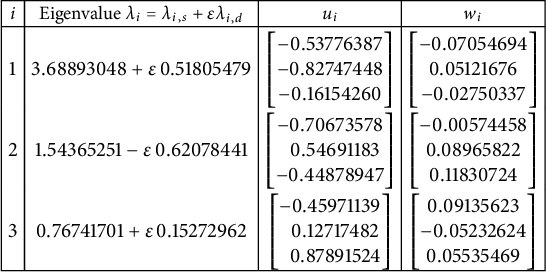
 . We now verify Theorem 3.2 for the dominant eigenvalue

The purpose of this example is to illustrate explicitly how the standard identity and the dual correction identity interact with the principal submatrices of
$A$
 (Table 1).
Computation of eigenvalues and eigenvectors of
$A = A_s + \varepsilon A_d$
 , where
$A_s$
 and
$A_d$
 are given in (4.1).

Table 1 Long description
The table consists of four columns and three data rows.
Column headers are:
1. i
2. Eigenvalue lambda sub i = lambda sub i,s + varepsilon lambda sub i,d
3. u sub i
4. w sub i
Row 1 (i = 1):
- Eigenvalue: 3.68893048 + varepsilon 0.51805479
- u sub 1: A column vector with elements -0.53776387, -0.82747448, and -0.16154260.
- w sub 1: A column vector with elements -0.07054694, 0.05121676, and -0.02750337.
Row 2 (i = 2):
- Eigenvalue: 1.54365251 minus varepsilon 0.62078441
- u sub 2: A column vector with elements -0.70673578, 0.54691183, and -0.44878947.
- w sub 2: A column vector with elements -0.00574458, 0.08965822, and 0.11830724.
Row 3 (i = 3):
- Eigenvalue: 0.76741701 + varepsilon 0.15272962
- u sub 3: A column vector with elements -0.45971139, 0.12717482, and 0.87891524.
- w sub 3: A column vector with elements 0.09135623, -0.05232624, and 0.05535469.
We first consider the case
$j=1$
 , corresponding to the removal of the first row and column of
$A$
 . In this case, the quantities appearing in equation (3.4) are computed directly from the associated principal submatrices
$M_{1,s}$
 and
$M_{1,d}$
 .
Corresponding to
$i=j=1$
 , the matrices
$M_{1,s}$
 and
$M_{1,d}$
 are obtained as

respectively. For the dual correction identity (3.4),

Using

we obtain

Moreover,

-
• The quantity
$$ \begin{align*}P_{s,1}=\prod_{k\neq1}(\lambda_{1,s}-\lambda_{k,s})=p^{\prime}_{A_s}(\lambda_{1,s}) \end{align*} $$measures the spectral separation of the eigenvalue $\lambda _{1,s}$
from the remaining eigenvalues of
$A_s$
. Numerically, $$ \begin{align*}P_{s,1}=6.267458. \end{align*} $$
-
• The corresponding dual correction term is
$$ \begin{align*}P_{d,1}=P_{s,1}\sum_{k\neq1}\frac{\lambda_{1,d}-\lambda_{k,d}}{\lambda_{1,s}-\lambda_{k,s}}, \end{align*} $$which captures the perturbative contribution of the dual eigenvalue corrections. In this example,
$$ \begin{align*}P_{d,1}=4.110858. \end{align*} $$
-
• The left-hand side of the dual correction identity (3.4) is therefore
$$ \begin{align*}\text{LHS}_{\varepsilon}(1,1):=\lambda_{1,d}p^{\prime}_{M_{1,s}}(\lambda_{1,s})-\operatorname{tr}(\operatorname{adj}(\lambda_{1,s}I-M_{1,s})M_{1,d})=1.664364. \end{align*} $$
-
• The right-hand side becomes
$$ \begin{align*}\text{RHS}_{\varepsilon}(1,1):=2\operatorname{Re}(u_{1,1}\overline{w_{1,1}})P_{s,1}+|u_{1,1}|^{2}P_{d,1}=1.664364.\end{align*} $$


Since
$\text {LHS}_{\varepsilon }(1,1) = \text {RHS}_{\varepsilon }(1,1)=1.664364$
 , the dual identity is verified for
$i=j=1$
 .
For the standard identity (3.3), we compute

while

Thus, the standard identity is also verified. Since
$p_{M_{1,s}}(\lambda _{1,s})=P_{s,1}|u_{1,1}|^{2}=1.812486$
 , the standard identity is verified for
$i=j=1$
 .
The same procedure may be repeated for
$j=2$
 . In this case,

Substituting these matrices into (3.4) gives

and

which agree up to rounding error, thereby confirming the dual correction identity.
For standard identity (3.3),
-
• $p_{M_{2,s}}(\lambda _{1,s})=\det (\lambda _{1,s}I-M_{2,s})=(\lambda _{1,s}-3)(\lambda _{1,s}-1)-0.04=1.812486$
; -
• $P_{s,1}|u_{1,2}|^{2}=1.812486$
.


Since
$p_{M_{2,s}}(\lambda _{1,s})=P_{s,1}|u_{1,2}|^{2}=1.812486$
 , the standard identity is verified for
$i=1,~j=2$
 . Similarly, the results can be verified for other values of
$i,j=1,2,3$
 .
This example shows how the classical eigenvector–eigenvalue identity for the standard part
$A_s$
 extends to the dual setting through an additional correction term involving both the dual perturbation matrix and the dual eigenvector corrections.
5 Conclusion
In this work, we established an eigenvalue–eigenvector identity for dual Hermitian matrices. The classical identity was decomposed into standard and dual components, leading to an explicit dual correction formula involving eigenvalue perturbations, eigenvector corrections, and principal submatrices.
Several directions remain open for future investigation. These include extensions to dual normal matrices, dual quaternion Hermitian matrices, and more general structured eigenvalue problems. It would also be of interest to investigate whether analogous correction identities arise in higher-order nilpotent or perturbative algebraic settings.
Data availability statement
No datasets generated or analyzed during this work.
Acknowledgements
hors are grateful to the anonymous referee for their helpful comments and suggestions, which have significantly improved the presentation and overall quality of this manuscript.
Competing interests
The authors declare that they have no possible competing interests.