



1 Introduction
In this article we prove several results concerning the “sizes” of subgroups and subrings of the reals. Here by “size,” we typically refer to the Hausdorff measure and dimension of such objects. The story of “sizes” has a rich history, which begins with a classical result in real analysis.
Theorem 1.1 [Steinhaus [Reference Steinhaus18]]
Suppose
$A \subseteq \mathbb {R}^n$
 is Lebesgue measurable and has positive measure. Then the difference set
$A-A:=\{x-y:x,y \in A\}$
 contains a ball with positive radius whose center is at the origin.
The next corollary follows immediately.
Corollary 1.2. If A is a measurable proper subgroup of
$(\mathbb {R},+)$
 , then A is null.Footnote
1
Subsequently, Volkmann and Erdős initiated the study of the dimension of subgroups/rings of the reals in the 1960s. In [Reference Volkmann and Erdös20] they showed that for each
$\alpha \in [0,1]$
 , there is a Borel subgroup of
$(\mathbb {R},+)$
 with Hausdorff dimension
$\alpha $
 . Edgar and Miller [Reference Edgar and Miller3], and independently Bourgain [Reference Bourgain1], showed that an analytic (see the definition before Fact 2.5) subring of
$\mathbb {R}$
 either has Hausdorff dimension 0 or is all of
$\mathbb {R}$
 . Mauldin [Reference Mauldin14] showed that assuming the continuum hypothesis (
$\!\! \mathrm {CH}$
 ), for each
$\alpha $
 ,
$0 \leqslant \alpha \leqslant 1$
 , there is a subfield of
$\mathbb {R}$
 with Hausdorff dimension
$\alpha $
 . Following the strategy of “discretization” used by Bourgain in [Reference Bourgain1], de Saxcé [Reference de Saxcé16] considered the problem in the setting of a connected simple real Lie group G endowed with a Riemannian metric and showed that there is no Borel measurable dense subgroup of G with Hausdorff dimension strictly between 0 and
$\mathrm {dim_H} (G)$
 . For a more detailed discussion on the early history, see [Reference Edgar and Miller3, p. 1122]. The subgroups and subrings of the reals are also natural objects appearing in geometric measure theory (see, e.g., [Reference Falconer4, Section 12.4]).
In this article we consider the following related question.
Definition 1.3. Given a subgroup A of
$(\mathbb {R},+)$
 and a real x, define

and

Question 1. Suppose
$A \subseteq (\mathbb {R},+,\cdot )$
 is a subobject in some algebraic sense, e.g., subgroup, subring, or subfield. Under what conditions on A is
$X_A$
 nonempty? And if
$X_A \neq \emptyset $
 , what do we know about the size of A? What do we know about
$X_A$
 ?
We prove the following main results.
Theorem 1.4. There is an
$F_\sigma $
 subgroup A of
$(\mathbb {R},+)$
 such that
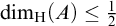
$\mathrm {dim_H}(A)\le \frac {1}{2}$
 and
$X_A \neq \emptyset $
 .
Theorem 1.5. Assume
$\mathrm {CH}$
 , holds:
$2^{\aleph _0} = \aleph _1$
 . There is a group A with
$\mathrm {dim_H} (A) = 0$
 such that
$X_A=\mathbb {R}\backslash \mathbb {Q}$
 .
Theorem 1.4 is proved via a concrete construction of A and
$x \in X_A$
 . For Theorem 1.5, we construct A using the concept of genericity and algorithmic dimension. We believe that this method may be used to construct other exotic subsets of reals.
We also consider what would happen if we restrict Question 1 to the analytic subgroups. By the Marstrand projection theorem, if A is an analytic subgroup of the reals and
$\mathrm {dim_H}(A)>\frac {1}{2}$
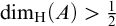 , then
$X_A$
 is co-nullFootnote
2
(Proposition 3.4). Our main results improve this proposition in terms of dimension. The restriction on analytic sets also enables us to use descriptive set theory. For example, if A is an analytic subgroup of the reals and
$x \in X_A$
 , then there is an
$F_\sigma $
 subgroup
$B\subseteq A$
 such that
$x \in X_B$
 (Theorem 3.8).
For subrings, the condition is different. If A is a subring of
$\mathbb {R}$
 and
$X_A \neq \emptyset $
 , then
$A =\mathbb {R}$
 (Proposition 2.4).
Besides Question 1, we also study the maximal subfields of
$\mathbb {R}$
 without a given point because the proof techniques suggest so. Given a field K and
$a \in K$
 , a maximal subfield of K without a is a maximal (with respect to inclusion) element of
$\{L \subseteq K: L \text { is a subfield of } K \text { and } a \notin L\}$
 . Such subfields have been well investigated in the literature. For example, Quigley [Reference Quigley15] described the structure of
$K / M$
 in detail where K is an algebraically closed field and M is a maximal subfield of K without a given point a, and used Galois theory to give existence proofs of M which he characterized as more precise than that trivially given by Zorn’s lemma. We restrict our attention to the case that
$K=\mathbb {R}$
 . We show that the usage of the axiom of choice (
$\mathrm {AC}$
 ) is necessary for the existence of a maximal subfield of
$\mathbb {R}$
 without a given point (Corollary 2.7). Hence, the claim that Quigley’s proof is “more precise” is arguable. On the other hand, by assuming CH, we construct a maximal subfield of
$\mathbb {R}$
 with Hausdorff dimension 0 such that some given point is not in its algebraic closure relative to
$\mathbb {R}$
 (Proposition 4.9).
The structure of the article is as follows: Section 2 deals with subrings and subfields of
$\mathbb {R}$
 . In Section 3 we discuss some simple results concerning the basic properties of subgroups and prove Theorem 1.4. In Section 4 we assume
$\mathrm {CH}$
 in the constructions and prove Theorem 1.5. We also show that A in Theorem 1.5 cannot be
$F_{\sigma }$
 (Proposition 4.6). Due to the variety of the tools used for the results and the independence of the methods, we postpone the introduction of notation and terminologies, and only recall them when being used.
2 Subrings and subfields
Recall that an ordered field
$(R,+,\cdot ,0,1,\le )$
 (
$\le $
 is a total order on F; if
$a \le b$
 then
$a+c\le b+c$
 ; and if
$0 \le a$
 and
$0 \le b$
 then
$0 \le a \cdot b$
 ) is real closed if:
(i) any positive element has a square root in R, and
(ii) any polynomial equation
$f (x) = 0$
 where
$f (x) \in R [x]$
 is of odd degree has a root in R.
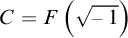
Fact 2.1 (Artin–Schreier, see [Reference Jacobson7, p. 674])
Let C be an algebrically closed field and F be a proper subfield of C such that
$C/F$
 is finite. Then F is real closed and
$C = F \left ( \sqrt {- 1} \right )$
 .
Fact 2.2 (“Lying-over,” see [Reference Jacobson7, p. 411])
Let E be a commutative ring and R a subring such that E is integral over R (for every element
$\alpha $
 of E, there is a monic polynomial
$f(x) \in R[x]$
 such that
$f(\alpha )=0$
 ). Then for each prime ideal p of R, there is a prime ideal P of E such that
$p = P \cap R$
 . In particular, if E is a field, so is R.
Let p be a prime number. Let
$a=\frac {b}{c}, b, c \in \mathbb {Z}$
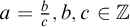 be nonzero. We extract from b and c as high a power of the prime number p as possible, namely choose m an interger such that

and we put the p-adic absolute value
$|a|_p=\frac {1}{p^m}$
 . The field of p-adic numbers
$\mathbb {Q}_p$
 is the completion of
$\mathbb {Q}$
 with respect to the metric
$d_p(x,y)=|x-y|_p$
 .
The following lemma is presumably well-known.
Lemma 2.3.
(i) If F is a subfield of
$\mathbb {R}$
 such that
$\mathbb {R}/F$
 is finite, then
$F=\mathbb {R}$
 .
(ii) If F is a subfield of
$\mathbb {Q}_p$
 such that
$\mathbb {Q}_p/F$
 is finite, then
$F=\mathbb {Q}_p$
 .
Proof. (i) follows from Fact 2.1. For (ii), consider the normal closure K of
$\mathbb {Q}_p/F$
 ; K is finite over
$\mathbb {Q}_p$
 and hence any automorphism of K is continuous. Hence any automorphism of K restricts to the identity on
$\mathbb {Q}_p$
 , which implies that
$\mathbb {Q}_p=F=K$
 .
Recall that we define
$X_A=\{x \in \mathbb {R}:A+xA=\mathbb {R}\}$
 .
Proposition 2.4.
(i) If A is a subring of
$\,\mathbb {R}$
 and
$X_A \neq \emptyset $
 , then
$A =\mathbb {R}$
 .
(ii) If A is a subring of
$\mathbb {Q}_p$
 and there is x such that
$A + x A =\mathbb {Q}_p$
 , then
$A =\mathbb {Q}_p$
 .
Proof. (i) By our assumption,
$\mathbb {R}$
 is finite over A and hence by Fact 2.2, A is a field since
$\mathbb {R}$
 is a field. Then Lemma 2.3(i) implies
$A =\mathbb {R}$
 .
(ii) By Fact 2.2 and our assumption, A is a subfield of
$\mathbb {Q}_p$
 . If
$A\neq \mathbb {Q}_p$
 , then
$[\mathbb {Q}_p:A]\neq 1$
 is finite. Then Lemma 2.3(ii) implies
$A =\mathbb {Q}_p$
 .
Both
$\mathbb {Q}_p$
 and
$\mathbb {R}$
 are Polish (separable completely metrizable) spaces. A subset A of a Polish space X is analytic if it is the projection of a Borel set
$B\subseteq X \times X$
 .
Fact 2.5 (See [Reference Jech8, Theorem 11.18])
Every analytic subset of
$\mathbb {R}$
 is measurable.
The proof of this fact is general enough to work for other measures in Polish spaces. For example, in the following Proposition 2.6, we will use the fact that every analytic subset of
$\mathbb {Q}_p$
 is
$\mu $
 -measurable where
$\mu $
 is the Haar measure on
$\mathbb {Q}_p$
 .
Given a field K and
$a \in K$
 , a maximal subfield of K without a is a maximal (with respect to inclusion) element of
$\{L \subseteq K: L \text { is a subfield of } K \text { and } a \notin L\}$
 .
Proposition 2.6. Let
$K=\mathbb {Q}_p$
 or
$\mathbb {R}$
 . Let F be an analytic subfield of K with some
$x\in K\setminus F$
 . Then there is
$y\in K\setminus F$
 such that
$x\notin F(y)$
 . Hence F is not a maximal subfield of K without x.
Proof. Assume otherwise, then F is a maximal subfield of K avoiding x. This implies that
$K/F$
 is algebraic. Indeed, if x is not algebraic over F, then
$x \notin F(x^2)$
 . Now if
$K/F$
 is not algebraic, then K contains a copy of
$F(X)$
 for X transcendental over F, which does not contain x.
So each
$y\in K\setminus F$
 satisfies a polynomial over F. Let
$D_n$
 denote the set of elements in K whose minimal polynomial over F is of degree at most n, this is an analytic set and
$\bigcup _{n\in \mathbb {N}}D_n=K$
 . In particular,
$D_n$
 is measurable by Fact 2.5. It is clear that
$D_n$
 is closed under multiplication by
$-1$
 . Note further that the difference of 2 elements of degree at most n over F has degree at most
$n^2$
 . Moreover, there must be n such that
$\mu (D_n)>0$
 where
$\mu $
 denote the Haar measure on K. So
$D_{n^2}=K$
 by the Steinhaus theorem for Haar measure on locally compact groups (see [Reference Stromberg19]). This means that any element in
$K/F$
 is of degree at most n for some
$n\in \mathbb {N}$
 . By the primitive element theorem, we have that
$[K:F]$
 is at most n. Then by Lemma 2.3,
$K=F$
 , a contradiction.
The assumption that F is analytic is used to guarantee that
$D_n$
 is measurable, so that we can use the Steinhaus theorem. If
$D_n$
 ’s are measurable a priori, then the proof will go through as is. It follows from
$\mathrm {AC}$
 that there is a non-measurable set. Under some weaker set theoretic axioms, the situation will be different. We use
$\mathrm {DC}$
 to denote the axiom of dependent choice, that is: suppose R is a relation on a nonempty set X; if for every
$a \in X$
 , there is a
$b \in X$
 such that
$a R b$
 , then there is a sequence
$\{ x_n\}_{n \in \omega }$
 in X such that
$x_n R x_{n+1}$
 for all
$n \in \omega $
 .
$\mathrm {DC}$
 follows from
$\mathrm {AC}$
 trivially. Solovay [Reference Solovay17] proved that
$\mathrm {ZF}+\mathrm {DC}+\text {Every subset of} \mathbb {R} \text {is measurable}$
 is consistent.
By the above discussion and the proof of Proposition 2.6, we have the following conclusion: without
$\mathrm {AC}$
 , one cannot construct a maximal subfield of
$\mathbb {R}$
 without a given point.
Corollary 2.7. Assume
$\mathrm {ZF}+\mathrm {DC}+\text {Every subset of }\,\mathbb {R} \text { is measurable}$
 . For any subfield F of
$\mathbb {R}$
 and
$x\in \mathbb {R}\setminus F$
 , F is not a maximal subfield of K without x.
3 Subgroups
We recall some terminology and notation from [Reference Falconer4]. Let
$A \subseteq X$
 , where
$(X,d_X)$
 is a metric space. Let the diameter of A, written
$\left | A \right |$
 , be the supremum of the distances between any two points in A, i.e.,
$\left | A \right | = \sup _{x, y \in A} d_X(x,y)$
 . Suppose
$s \ge 0$
 . For each
${\delta }> 0$
 , we define the s-dimensional Hausdorff measure of A by

$\mathcal {H}^s (A)$
 can be (and usually is) 0 or
$\infty $
 . There is a critical value of s at which
$\mathcal {H}^s (A)$
 “jumps” from
${\infty }$
 to 0. This critical value is called the Hausdorff dimension of A, written
$\mathrm {dim_H} (A)$
 . In other words,

We gather some of the basic properties of subgroups of the reals. Recall that we define
$X_A=\{x \in \mathbb {R}:A+xA=\mathbb {R}\}$
 .
Proposition 3.1. Suppose that A is a subgroup of
$\mathbb {R}$
 .
(i) For all
$x \in \mathbb {R}$
 ,
$A+xA$
 is a subgroup of
$\mathbb {R}$
 .
(ii) If
$p \in \mathbb {Q}$
 and
$p \in X_A$
 , then
$A =\mathbb {R}$
 .
(iii) If
$k \in \mathbb {N}$
 ,
$p_0, \ldots , p_k \in \mathbb {Q}$
 and
$A + \sum _{i = 0}^k p_i A = \mathbb {R}$
 , then
$A =\mathbb {R}$
 .
(iv) Define the tensor product

Then
$\mathrm {dim_H} \left ( \mathbb {Q}\otimes _{\mathbb {Z}} A \right ) = \mathrm {dim_H} (A)$
 .
(v) If
$x \in X_A$
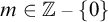
 , then for all
$m \in \mathbb {Z}-\{0\}$
 ,
$mx\in X_A$
 .
(vi) If
$x \in X_A$
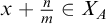
 , then for all
$m, n \in \mathbb {Z}-\{0\}$
 ,
$x+ \frac {n}{m}\in X_A$
 .
Proof. (i) By the definition of a subgroup.
(ii) Suppose that
$p = \frac {m}{n}$
 for some integers m and
$n \neq 0$
 . Then for any
$c \in \mathbb {R}$
 , there are
$a, b \in A$
 such that
$a + \frac {m b}{n} = c$
 . So
$n c = n a + m b \in A$
 . Thus
$\mathbb {R}= \frac {1}{n} A$
 . Since
$\mathrm {Char}(\mathbb {R})=0$
 , we have
$\mathbb {R}=n\mathbb {R}=A$
 .
(iii) Suppose that
$p_i = \frac {m_i}{n_i}$
 for some integers
$m_i$
 and
$n_i \neq 0$
 . Let n be the least common multiple of those
$n_i$
 . Then
$\mathbb {R}=A + \sum _{i = 0}^k p_i A \subseteq \frac {1}{n}A$
 , so
$A =\mathbb {R}$
 .
(iv) Note that
$\mathbb {Q}\otimes _{\mathbb {Z}}A \subseteq \bigcup _{n \ge 1}\frac {1}{n}A$
 . But it is clear that
$\mathrm {dim_H} (A) = \mathrm {dim_H} (\frac {1}{n} A)$
 for any
$n \ge 1$
 since
$f:\mathbb {R} \to \mathbb {R},x\mapsto nx$
 is bi-Lipschitz. So

(v) Note that

Since
$\mathrm {Char}(\mathbb {R})=0$
 , we have
$A+mxA= \mathbb {R}$
 .
(vi) Note that

By (v), we have
$A+(x+\frac {n}{m})A= \mathbb {R}$
 .
Remark 3.2. Let X be a Hamel basis of
$\mathbb {R}$
 over
$\mathbb {Q}$
 with
$\mathrm {dim_H} (X)=0$
 (such a basis exists by Lutz et al. [Reference Lutz, Qi and Liang11]), and let A be the group generated by X. Then by Proposition 3.1(iv),

Hence the additive group generated by a basis X may have Hausdorff dimension greater than
$\mathrm {dim_H} (X)$
 .
We can easily deduce from the Marstrand projection theorem: if A is “regular” and “large” enough, then there is x such that
$A+xA=\mathbb {R}$
 .
Fact 3.3 (Marstrand [Reference Marstrand13])
Let
$F \subseteq \mathbb {R}^2$
 be an analytic set with
$\mathrm {dim_H}(F)>1$
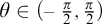
 . Then for almost all
$\theta \in (-\frac {\pi }{2},\frac {\pi }{2})$
 ,
$\mathrm {proj_\theta }(F)$
 (the projection of F on the line
$l_\theta :y=\mathrm {tan}\theta \cdot x$
 ) has positive length.
Proposition 3.4. If A is an analytic subgroup of
$(\mathbb {R},+)$
 with
$\mathrm {dim_H}(A)>\frac {1}{2}$
 , then
$X_A$
 is co-null.
This is a minor generalization of [Reference Falconer4, Exercise 6.8], which implies that for almost all x,
$A+xA$
 has Hausdorff dimension 1.
Proof. By the product formula of Hausdorff dimension (see [Reference Falconer4, Chapter 7]),

Hence for almost all
$\theta \in (-\frac {\pi }{2},\frac {\pi }{2})$
 ,
$\mathrm {proj_\theta }(A\times A)$
 has positive length. Let
$f(t)=\arctan t$
 for all
$t\in \mathbb {R}$
 . Define
$\Theta =\{\theta \in (-\frac {\pi }{2},\frac {\pi }{2}):\mathrm {proj_\theta }(A\times A) \text { has positive length}\}$
 . Since
$\Theta $
 is co-null (and hence measurable),
$f^{-1}(\Theta )$
 is measurable. We claim that
$f^{-1}(\Theta )$
 is co-null. Suppose not, then
$\mathbb {R} \backslash f^{-1}(\Theta )$
 has positive measure. Then there is
$N \in \mathbb {R}$
 such that
$\mathbb {R} \backslash f^{-1}(\Theta ) \cap [-N,N]$
 has positive measure. But
${\inf _{t\in [-N,N]}f'(t) >0}$
 , then
$f(f^{-1}(\Theta ) \cap [-N,N])$
 has positive measure, a contradiction.
Suppose
$(a,b)$
 ,
$(c,d) \in A \times A$
 ,
$a \neq c$
 and
$b \neq d$
 . Then the line passing through these two points is

The slope of
$l_{(a,b),(c,d)}$
 is
$\frac {b-d}{a-c}$
 . And if
$t\neq 0$
 and
$a+tb=c+td$
 , then
$t=-\frac {a-c}{b-d}$
 . So for
$(a,b),(c,d),$
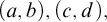 and t as above,
$a+tb=c+td$
 if and only if
$l_{(a,b),(c,d)}$
 is perpendicular to
$l_{\arctan t}: y= t\cdot x$
 . In particular,
$l_{\arctan t}$
 and
$A+tA$
 are homeomorphic via:

And

Hence the measure of
$A+t A$
 is equal to the measure of
$\mathrm {proj_{\arctan t}}(A \times A)$
 times
$\sqrt {1+t^2}$
 provided
$t \neq 0$
 . By Proposition 3.1(i),
$A+tA$
 is a group. Then by Corollary 1.2,
$A+tA= \mathbb {R}$
 if
$\mathrm {proj}_{\arctan t}(A\times A)$
 has positive length. Since
$f^{-1}(\Theta )$
 is co-null,
$\mathrm {proj}_{\arctan t}(A\times A)$
 has positive length for almost all t.
Next, we prove Theorem 1.4, which refines Proposition 3.4.
Proof of Theorem 1.4
As a convention, we consider a real a and its binary expansion
$m + 0. a_1 a_2 \dots a_n \dots $
 with infinitely many 0s to be equivalent, where
$m \in \mathbb {Z}$
 is the integer part of a and the numbers
$a_i \in \{0, 1\}$
 express its binary decimal part.
We first prove a weaker result: there is an
$F_\sigma $
 subgroup A of
$(\mathbb {R},+)$
 and
$x \in \mathbb {R}$
 such that
$A + x A =\mathbb {R}$
 and A is null.
Define
$Q_n =\{m \in \mathbb {N}: 3^{n - 1} \leqslant m < 3^n \} $
 for
$n \ge 1$
 . Then each
$Q_n$
 contains
$2 \cdot 3^{n - 1}$
 numbers. Divide
$\{1, 2,. . .\}$
 into two parts
$P_1, P_2$
 such that for all
$n \ge 1$
 , the first
$3^{n - 1}$
 numbers of
$Q_n$
 are in
$P_1$
 , and the other numbers of
$Q_n$
 are in
$P_2$
 . Formally,


Define

$A_0$
 consists of reals with segments of 0s of length
$3^k (k \in \mathbb {N})$
 , and ahead of each segment of 0s there is an arbitrary segment of the same length. Define for each n,

Fix
$n \ge 1$
 and
$\varepsilon>0$
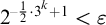
 . Choose
$k \ge 1$
 such that
(i)
$2^{- \frac {1}{2} \cdot 3^k + 1} < \varepsilon $
 ;
(ii) for all
$a = m + 0. a_1 a_2 \dots \in A_n$
 ,

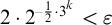
Then the measure of
$A_n$
 is no more than
$2 \cdot 2^{- \frac {1}{2} \cdot 3^k} < \varepsilon $
 . Since
$\varepsilon $
 is arbitrary,
$A_n$
 is null. Let A be the subgroup of
$(\mathbb {R},+)$
 generated from
$A_0$
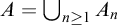
 . Then
$A = \bigcup _{n \ge 1} A_n$
 is null. Since
$A_0$
 is compact, A is
$F_{\sigma }$
 . Define
$x = 0. x_1 x_2 \dots $
 such that
$x_n = 1$
 if and only if
$\exists k(n = 3^k)$
 . Given any real
$y = m + 0. y_1 y_2 \dots $
 , we shall define a real
$b = 0. b_1 b_2 \dots \in A_0$
 such that
$b \cdot x$
 and y are equal on the nth binary place for each
$n \in P_2$
 . Then we can pick
$c \in A_0$
 such that
$c + b x = y$
 , so
$A + x A =\mathbb {R}$
 .
Intuitively, in the calculation
$b \cdot x$
 ,
$x_{3^k} = 1$
 causes the binary places of b to shift to the right
$3^k$
 places, i.e.,

Denote
$b x = 0. c_1 c_2 \dots .$
 By recursion on n, one can choose
$\{b_m : m \in Q_n \cap P_1 \}$
 such that
$c_m = y_m$
 for all
$m \in Q_n \cap P_2$
 as follows: suppose
$\{b_m : m \in Q_k \cap P_1, k < n\}$
 have been chosen so that
$c_m = y_m$
 for all
$k < n$
 and
$m \in Q_k \cap P_2$
 . Whatever
$\{b_m : m \in Q_k \cap P_1, k \ge n + 1\}$
 are chosen, we have

Hence
$\{c_m : m \in Q_n \cap P_2 \}$
 is determined only by
$\{b_m : m \in Q_k \cap P_1, k \leqslant n\}$
 . Now it is clear that we can choose
$\{b_m : m \in Q_n \cap P_1 \}$
 to ensure
$c_m = y_m$
 for all
$m \in Q_n \cap P_2$
 . This ends the proof of the weaker result.
Achieving
$\mathrm {dim_H} (A) = \frac {1}{2}$
 requires a bit more effort. Let
$\{p_n\}_{n \ge 1}$
 be an increasing sequence of even numbers such that
$\sum _{k<n}p_k=o(p_n)$
 and
$3^n=o(p_n)$
 . Define

Divide
$\{1, 2,. . .\}$
 into two parts
$P_1, P_2$
 such that for all
$n \ge 1$
 , the first half of the numbers of
$Q_n$
 are in
$P_1$
 , and the other numbers of
$Q_n$
 are in
$P_2$
 . Define

Define
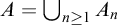
$A_n = \overbrace {A_0 \pm A_0 \pm \cdots \pm A_0}^n$
 and
$A = \bigcup _{n \ge 1} A_n$
 . As before, A is an
$F_\sigma $
 subgroup of
$(\mathbb {R},+)$
 and there is x such that
$A+x A=\mathbb {R}$
 . It remains to show that
$\mathrm {dim_H}(A_n)=\frac {1}{2}$
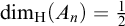 for all n. Fix n. For all
$k>n$
 and
$a=m+0.a_1a_2 \dots \in A_n$
 ,

Let
$\delta =2^{-\sum _{j \le k}p_j}$
 . If
$s>\frac {1}{2}$
 , then

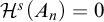
Since
$\sum _{j<k}p_j=o(p_k)$
 ,
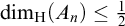
$\mathcal {H}^s(A_n)=0$
 . So
$\mathrm {dim_H}(A_n) \le \frac {1}{2}$
 .
Remark 3.5. Note that the analogue of the above holds in the p-adics as well. Namely, there is an
$F_\sigma $
 subgroup
$A\subseteq (\mathbb {Z}_p, +)$
 and
$x\in \mathbb {Z}_p$
 such that
$\mu (A)=0$
 and
$A+xA=\mathbb {Z}_p$
 , where
$\mu $
 denotes the Haar measure on
$\mathbb {Z}_p$
 . Moreover, one can also achieve that the Hausdorff dimension is
$1/2$
 . The proof follows from the same strategy as the previous proof. We include the details for the sake of completeness.
Proof. We only include the proof for the existence of such A, the calculation of the Hausdorff dimension of A is left to the reader as it follows from the same argument as in
$\mathbb {R}$
 .
Note that every element
$a \in \mathbb Z_p$
 has a unique expansion

Define

Put

and let

Thus the last part of
$Q_n$
 has length
$L_n$
 , while the first part has length
$s_n$
 , and
$s_n+L_n=N_n$
 . Partition the coordinates by putting the first
$s_n$
 indices of
$Q_n$
 into
$P_1$
 and the remaining
$L_n$
 indices into
$P_2$
 . Formally,

Define

Thus elements of
$A_0$
 have arbitrary digits on
$P_1$
 and vanish on
$P_2$
 . For each
$m\ge 1$
 , define

Let

Since
$A_0$
 is compact, every
$A_m$
 is compact, hence A is an
$F_\sigma $
 subgroup of
$(\mathbb Z_p,+)$
 .
We now make explicit the carry estimate used in the measure calculation. Fix m. In any signed sum of at most m elements of
$A_0$
 , the carry sequence is bounded in absolute value by a constant
$B_m$
 depending only on m and p. Indeed, at each digit the non-carry part is between
$-m(p-1)$
 and
$m(p-1)$
 , so the usual base-p carrying recursion keeps all carries in a fixed finite interval. Now suppose that the summand digits are all zero on a consecutive interval
$J\subseteq P_2$
 . After at most

positions, the carry has become either
$0$
 or
$-1$
 . Consequently all later output digits in J are, respectively, all
$0$
 or all
$p-1$
 .
Apply this to the interval
$P_2\cap Q_k$
 , whose length is
$L_k$
 . For all sufficiently large k, every element of
$A_m$
 has, on a terminal subinterval
$I_k\subseteq P_2\cap Q_k$
 of length at least
$L_k-d_m$
 , either only digits
$0$
 or only digits
$p-1$
 . Therefore
$A_m$
 can be covered by at most

balls of radius
$p^{-p^k}$
 . Since such a ball has Haar measure
$p^{-p^k}$
 , we get

Hence every
$A_m$
 is Haar null, and therefore A is Haar null.
Define

Notice that the shift used in each k-th block is
$s_k$
 , the length of the first part of
$Q_k$
 ; this is exactly what sends the first
$L_k$
 free coordinates of
$P_1\cap Q_k$
 onto
$P_2\cap Q_k$
 .
Let

We recursively construct

such that
$bx$
 agrees with y on all coordinates in
$P_2$
 . Suppose that the coordinates of b in
$P_1\cap Q_i$
 have already been chosen for all
$i<k$
 so that
$bx$
 agrees with y on
$P_2\cap Q_i$
 . Later choices have indices at least
$q_k$
 and all shifts in x are non-negative, so they cannot change any digit below
$q_k$
 ; hence the previously treated blocks remain fixed. It remains to choose the free coordinates in
$P_1\cap Q_k$
 . The term
$p^{s_k}$
 in x gives the direct shift

whose exponents are precisely the coordinates in
$P_2\cap Q_k$
 . Since the digits of
$bx$
 in
$P_2\cap Q_k$
 depend only on the choice of
$\{b_i\}_{i \le q_k+L_k-1}$
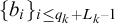 , we may choose

so that
$(bx)_n=y_n$
 for all
$n\in P_2\cap Q_k$
 . Proceeding block by block gives
$b\in A_0$
 with
$bx$
 agreeing with y on
$P_2$
 .
Define
$c=y-bx$
 . Since
$bx$
 already agrees with y on
$P_2$
 , the element c has vanishing digits on
$P_2$
 , hence
$c\in A_0$
 . Therefore
$y=c+bx\in A+xA$
 . Since
$y\in \mathbb Z_p$
 was arbitrary,
$A+xA=\mathbb Z_p$
 .
In the proof of Theorem 1.4, both A and x depend on the intervals
$Q_n$
 . What is the relation between A and elements of
$X_A$
 in general?
Proposition 3.6. If A is an analytic subgroup of
$(\mathbb {R},+)$
 and
$x \in X_A$
 , then there are
$c, d \in A$
 such that
$x=\frac {c}{d}$
 . In particular,
$cA+dA=\mathbb {R}$
 .
This result is an immediate corollary of the following theorem of Le Gac.
Fact 3.7 (Le Gac [Reference Le Gac5])
If G and H are analytic subgroups of
$(\mathbb {R},+)$
 such that
$G+H=\mathbb {R}$
 and
$G \cap H =\{0\}$
 , then either
$G=\mathbb {R}$
 or
$G=\{0\}$
 .
Recall that for each
$\alpha \in [0,1]$
 , there is a Borel subgroup
$A_\alpha $
 of
$(\mathbb {R},+)$
 with
$\mathrm {dim_H}(A_\alpha )=\alpha $
 [Reference Volkmann and Erdös20]. For
$\alpha>\frac {1}{2}$
 ,
$X_{A_\alpha }$
 is co-null by Proposition 3.4. The following theorem claims that for such groups
$A_\alpha $
 , there is an
$F_\sigma $
 subgroup
$B\subseteq A_\alpha $
 such that
$X_B$
 is co-null. It also reduces the problem of constructing an
$F_{\sigma }$
 proper subgroup B of the reals with
$X_B \neq \emptyset $
 to the problem of constructing an analytic proper subgroup A of the reals with
$X_A \neq \emptyset $
 .
Theorem 3.8. Suppose that A is an analytic subgroup of
$(\mathbb {R},+)$
 .
(i) If
$x \in X_A$
 , then there is an
$F_{\sigma }$
 subgroup
$B\subseteq A$
 such that
$x \in X_B$
 .
(ii) If
$X_A$
 is co-null, then there is an
$F_{\sigma }$
 subgroup
$B\subseteq A$
 such that
$X_B$
 is co-null.
By Proposition 3.1(vi),
$X_A=\bigcup _{q\in \mathbb {Q}}q+X_A$
 . Thus if
$X_A$
 has positive measure, it is automatically co-null. We need the following uniformization theorem in the proof.
Fact 3.9 (Jankov–von Neumann, see [Reference Kechris9, Theorem 18.1])
Let X, Y be standard Borel spaces and
$P \subseteq X \times Y$
 be analytic. Then there is a
$\Sigma $
 -measurable function
$f:X \to Y$
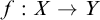 such that
$(x,f(x)) \in P$
 for all
$x \in proj_X(P)$
 (the projection from P to X), where
$\Sigma $
 is the
$\sigma $
 -algebra generated by the analytic sets.
In particular, if X and Y are Borel subsets of Euclidean spaces, then the function f is Lebesgue measurable by Fact 2.5.
Proof of Theorem 3.8
For (i), suppose that A is an analytic subgroup of
$(\mathbb {R},+)$
 and
$x \in X_A$
 . Then the graph of the function
$\varphi :A\times A \to \mathbb {R}$
 so that
$(a,b)\mapsto a+xb$
 is an analytic subset of
$\mathbb {R}^3$
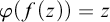
 . By Fact 3.9, there is a Lebesgue measurable function
$f:\mathbb {R} \to A\times A$
 such that for any
$z \in \mathbb {R}$
 ,
$\varphi (f(z))=z$
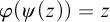
 . By the Lusin theorem, there is a compact set
$P\subseteq \mathbb {R}$
 with positive measure and a continuous function
$\psi : P\to A\times A$
 so that for any
$z\in P$
 ,
$\varphi (\psi (z))=z$
 . Let

and

Both
$C_0$
 and
$C_1$
 are compact and so is
$C_0\cup C_1$
 . Let B be the group generated by
$C_0\cup C_1 $
 . Then B is
$F_{\sigma }$
 and
$B \subseteq A$
 . Moreover, the image
$\varphi (B \times B)\supseteq P$
 has positive measure. Since
$\varphi (B \times B)$
 is a subgroup of
$\mathbb {R}$
 , by Corollary 1.2,
$\varphi (B \times B)=\mathbb {R}$
 . Hence
$x \in X_B$
 .
For (ii), suppose that A is an analytic subgroup of
$(\mathbb {R},+)$
 and
$X_A$
 is co-null. By the regularity of Lebesgue measure, there is a co-null
$F_{\sigma }$
 subset
$F \subseteq X_A$
 . It suffices to show that there is an
$F_\sigma $
 subgroup
$B \subseteq A$
 such that for almost all
$x \in F$
 , we have
$x\in X_B$
 .
The graph of the function

is an analytic subset of
$\mathbb {R}^5$
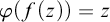
 . By Fact 3.9, there is a Lebesgue measurable function

such that for any
$z \in \mathbb {R} \times F$
 ,
$\varphi (f (z)) = z$
 . By the Lusin theorem, for all n, there is a compact subset
$K_n$
 of
$\mathbb {R} \times F$
 such that
$\psi _n := f \upharpoonright K_n$
 is continuous and

where
$\mu $
 is the Lebesgue measure on
$\mathbb {R}^2$
 and
$B_n (0) \subseteq \mathbb {R}^2$
 is the closed ball with radius n and center
$0$
 . Let

and

Both
$C_0$
 and
$C_1$
 are
$F_\sigma $
 and so is
$C_0\cup C_1$
 . Let B be the additive group generated by
$C_0\cup C_1 $
 . Then B is an
$F_{\sigma }$
 set and
$B \subseteq A$
 . Moreover, the projection of the image
$\varphi (B \times B \times \{x\})$
 to the first coordinate has positive measure for almost all
$x \in F$
 by the Fubini theorem since
$(\mathbb {R}\times F) \backslash \cup _n K_n$
 is null. So
$X_B$
 is conull.
4 Constructions assuming CH
The main goal of this section is to prove Theorem 1.5. It requires notions from recursion theory and algorithmic dimension. A standard reference is [Reference Downey and Hirschfeldt2]. We consider the elements of the Cantor space
$2^{\omega }$
 as reals. We denote the set of binary strings of finite length by
$2^{< \omega }$
 . Given
$\sigma , \tau \in 2^{< \omega }$
 , we write
$\sigma \prec \tau $
 if
$\sigma $
 is a proper initial segment of
$\tau $
 . The same notation is applied when
$\tau $
 is replaced by a real
$x \in 2^{\omega }$
 . We write
$\sigma \tau $
 to denote the string obtained by concatenating
$\sigma $
 and
$\tau $
 . The Cantor space is equipped with a topology generated by the basic clopen sets
$I_{\sigma } = \{ \sigma \alpha : \alpha \in 2^{\omega } \}$
 for
$\sigma \in 2^{< \omega }$
 . It is also a measure space: the Lebesgue measure
$\mu (I_{\sigma }) = 2^{- | \sigma |}$
 , where
$| \sigma |$
 is the length of the string
$\sigma $
 . For a co-infinite set
$z \subseteq \omega $
 , define

F is an “isometry” between the co-null subset of
$2^\omega $
 consisting of the co-infinite sets and the interval
$[0,1)$
 . Note that under F, the measure
$\mu $
 on
$2^\omega $
 turns into the Lebesgue measure on
$\mathbb {R}$
 . Similarly the Hausdorff dimension is also preserved between
$2^\omega $
 and
$\mathbb {R}$
 . For a rigorous proof of this fact, see [Reference Marks, Rossegger and Slaman12, Section 4]. There the authors proved that F preserves the property of having positive Hausdorff measure. Since the set of all the co-finite elements in
$2^\omega $
 is countable, it is
$\mu $
 -null. Hence we assume that every real
$x \in 2^\omega $
 we deal with is co-infinite and consider the arithmetic operations on
$2^{\omega }$
 to be the same as arithmetic operations on
$\mathbb {R} / \mathbb {Z}$
 . Given reals x, y. We write
$x \leq _T y$
 if x is Turing reducible to y. Given a real y, if
$W \subseteq 2^{< \omega }$
 is r.e. (recursively enumerable) in y, then the set
$U \subseteq 2^{\omega }$
 of reals with an initial segment in W is called a
$\Sigma ^0_1 (y)$
 set. Given
$\sigma \in 2^{< \omega }$
 and
$x \in 2^{\omega }$
 , let
$K (\sigma )$
 be the prefix-free Kolmogorov complexity of
$\sigma $
 and
$K^x (\sigma )$
 be the prefix-free Kolmogorov complexity of
$\sigma $
 relativized to x (see [Reference Downey and Hirschfeldt2]). Given reals
$x, y \in 2^{\omega }$
 , define the real
$x \oplus y$
 such that for each n,
$x \oplus y (2 n) = x (n)$
 and
$x \oplus y (2 n + 1) = y (n)$
 . Note that operation
$\oplus $
 is not associative. However, it is invariant under Turing degree. For example, we have
$(x_1 \oplus x_2)\oplus x_3 \equiv _T x_1 \oplus (x_2\oplus x_3)$
 . Then we define by recursion that

Definition 4.1. (i) A set
$S \subseteq 2^{< \omega }$
 is dense if for every
$\sigma \in 2^{< \omega }$
 , there is a string
$\tau \in S$
 such that
$\tau \succ \sigma $
 .
(ii) Given reals x and y. We say that x is y-generic
Footnote
3
if for every
$\Sigma ^0_1 (y)$
 dense set
$S \subseteq 2^{< \omega }$
 , there is a string
$\sigma \prec x$
 such that
$\sigma \in S$
 . We say that x is generic if x is
$x_0$
 -generic where
$x_0(n)=0$
 for all
$n \in \omega $
 . In particular, if x is y-generic for some y, then x is generic.
Fact 4.2 (Hölzl et al. [Reference Hölzl, Merkle, Miller, Stephan and Liang6])
There is a constant c such that for every generic real x and
$i \in \{0, 1\}$
 , there are infinitely many n such that

Fact 4.3 (The point-to-set principle, Lutz and Lutz [Reference Lutz and Lutz10])
For every set
$E \subseteq \mathbb {R}$
 ,

Lemma 4.4 (Folklore)
Let
$G = \{ x \in 2^{\omega } : x \text { } \mathrm {generic} \}$
 , then
$\mathrm {dim_H} (G) = 0$
 .
Proof. Note that
$K (n) \leqslant \log n + 2 \log \log n + O (1)$
 for every
$n \in \omega $
 (see [Reference Downey and Hirschfeldt2]). Then by Fact 4.2, we have
$ \liminf _{n \rightarrow \infty } \frac {K (x \upharpoonright n)}{n} = 0 $
 for every generic real x. Hence by Fact 4.3,
$\mathrm {dim_H} (G) = 0$
 .
The following lemma reflects the intuition that genericity is preserved under arithmetic operations. Recall that we consider the arithmetic operations on
$2^{\omega }$
 to be the same as arithmetic operations on
$\mathbb {R} / \mathbb {Z}$
 .
Lemma 4.5. Given
$x, a, b, g \in 2^{\omega } \backslash \{0\}$
 , if g is
$a \oplus b \oplus x$
 -generic, then
$g + b$
 ,
$a \cdot g$
 ,
$g^{n} (n \in \mathbb {Z}\backslash \{0\})$
 and
$a \cdot g + b$
 are
$a \oplus b \oplus x$
 -generic.
Proof. We proof that
$g+b$
 is
$a \oplus b \oplus x$
 -generic first. Fix a
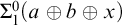
$\Sigma _1^0 (a \oplus b \oplus x)$
 dense set S and
$\{S_s\}_{s \in \omega }$
 an
$a \oplus b \oplus x$
 -recursive enumeration of S (
$S_n \subseteq S_{n+1}$
 for each n and there is exactly one element in
$S_{n+1} \backslash S_{n}$
 ). We inductively define
$S {}^{\prime }_s$
 at stage
$s+1$
 as follows:
Suppose
$\sigma \in S_{s+1} \backslash S_{s}$
 . Since there are infinitely many 0s in the sequence b, there is
$\tau $
 such that
$\forall y \succ \tau (y + b \succ \sigma )$
 . Choose
$\tau $
 of the least length and enumerate it into
$S{}'$
 .
It is clear that
$S{}'$
 is
$\Sigma _1^0 (a \oplus b \oplus x)$
 . Fix
$\gamma \in 2^{<\omega }$
 . Choose
$\gamma _1$
 such that
$\{y+b:y \succ \gamma \} \supseteq I_{\gamma _1}$
 . Since S is dense, there is
$\rho \in S$
 such that
$\rho \succ \gamma _1$
 . By the definition of
$S'$
 , there is
$\tau \in S'$
 such that
$\forall y \succ \tau (y+b \succ \rho )$
 . Then
$\tau \succeq \gamma $
 . Hence
$S'$
 is dense. Since g is
$a \oplus b \oplus x$
 -generic, there is
$\tau \prec g$
 such that
$\tau \in S{}'$
 . By the definition of
$S{}'$
 , there is
$\sigma \in S$
 such that
$\sigma \prec g+b$
 . So
$g+b$
 is
$a \oplus b \oplus x$
 -generic.
Similarly one can prove that
$a \cdot g$
 ,
$g^{-1}$
 and
$g^{2}$
 are
$a \oplus b \oplus x$
 -generic, which implies
$g^{n}$
 and
$a \cdot g + b$
 also are.
Proof of Theorem 1.5
Fix
$\{ (x_{\alpha }, y_{\alpha })\}_{\alpha < \aleph _1}$
 an enumeration of
$ (\mathrm {dom}(F)\backslash F^{-1}(\mathbb {Q})) \times \mathrm {dom}(F)$
 (F is defined at the beginning of this section). We construct a sequence of pairs of reals
$\{ (g_{\alpha }, h_{\alpha })\}_{\alpha < \aleph _1}$
 by induction on
$\alpha < \aleph _1$
 .
Stage
$\boldsymbol {\alpha }$
 . Define

Let

the Turing ideal generated by
$G_{\alpha }$
 . Since
$I_{\alpha }$
 is countable, there is a real
$g_{\alpha }$
 that is z-generic for all
$z \in I_{\alpha }$
 . Let
$h_{\alpha } = \frac {y_{\alpha } - g_{\alpha }}{x_{\alpha }}$
 .
Let
$A_0$
 be the group generated by
$\{g_{\alpha } : \alpha < \aleph _1 \} \cup \{h_{\alpha } : \alpha < \aleph _1 \}$
 . We claim that
$A_0$
 contains only generic reals. For any
$g \in A_0$
 , there are finite sequences
$\{g_{\alpha _i}, h_{\alpha _i}, s_i, t_i \}_{0 \leqslant i \leqslant n}$
 , where
$s_i$
 ,
$t_i \in \mathbb {Z}$
 , and ordinals
$\alpha _0 < \alpha _1 < \cdots < \alpha _n$
 such that
$s_n^2+t_n^2\neq 0$
 and

Define
$c = (\oplus _{0 \leqslant i \leqslant n - 1} (g_{\alpha _i} \oplus h_{\alpha _i})) \oplus x_{\alpha _n} \oplus y_{\alpha _n}$
 . By the construction,
$g_{\alpha _n}$
 is c-generic. Also

so

Since
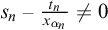
$x_{\alpha _n}$
 is irrational, we have that
$s_n - \frac {t_n}{x_{\alpha _n}} \neq 0$
 . By Lemma 4.5, g is c-generic and hence generic. Thus
$\mathrm {dim_H} (A_0) = 0$
 by Lemma 4.4. Let A be the subgroup of
$\mathbb {R}$
 generated by
$F(A_0)$
 . Then
$\mathrm {dim_H} (A) = 0$
 . For any pair
$ (x, y) \in [0,1] \times [0,1]$
 with
$x \not \in \mathbb {Q}$
 , there are members
$g, h \in A$
 so that
$h = \frac {y - g}{x}$
 and so
$g + x \cdot h = y$
 . So
$\mathbb {R}\backslash \mathbb {Q} \subseteq X_A$
 . By Proposition 3.1(ii),
$\mathbb {Q} \cap X_A= \emptyset $
 .

The complexity of A in Theorem 1.5 is not evident from the construction. The following proposition shows that at least it is impossible for A to be
$F_\sigma $
 .
Proposition 4.6. Suppose
$A \subseteq \mathbb {R}$
 is
$F_{\sigma }$
 and null,Footnote
4
then there is an irrational x such that
$A+xA$
 is null. Moreover, the set
$\{x : A+xA \text { is null}\}$
 is comeager.Footnote
5
Let
$\mu $
 be the Lebesgue measure on
$\mathbb {R}$
 . The following fact is clear.
Fact 4.7. Let
$\{I_i\}_{i\leq n}$
 be a finite set of open intervals and J an open interval, then

Proof of Proposition 4.6
Suppose
$A = \bigcup _{n \ge 1} A_n$
 is an
$F_{\sigma }$
 null subset of
$\mathbb {R}$
 with each
$A_n$
 compact. We claim that for each
$m, n \ge 1$
 , the set

contains a dense open subset of
$\mathbb {R}$
 .
Using this claim, the set
$\{x : \mu (A+xA)=0\}$
 is comeager by the Baire category theorem. It reclaims to prove the claim.
Given
$m, n \ge 1$
 , we shall show that
$D_{m, n}$
 contains a dense open set in
$(0, 1)$
 . It is not hard to generalize the proof to show that
$D_{m, n}$
 contains a dense open set in
$\mathbb {R}$
 .
Let
$\sigma $
 be a binary string and
$q \in \mathbb {N}$
 . Fix a real
$x = 0. \sigma 0^q x^{\ast } \in (0, 1)$
 , where
$x^{\ast } \in 2^{\omega }$
 is the tail of the binary expansion of x. Define
$y = 0. x^{\ast } \in (0, 1)$
 . Then

The set
$A_{n,\sigma }:=A_n+\sum _{0 \leqslant i \leqslant | \sigma | - 1} \sigma (i) 2^{- i - 1} A_n$
 is compact and

is null by Proposition 3.1(i) and Corollary 1.2. So there is a finite open interval cover
$\{ I_j \}_{1 \leqslant j \leqslant k}$
 of
$A_{n,\sigma }$
 such that
$\sum _{1 \leqslant j \leqslant k} | I_j | < \frac {1}{2 m}$
 . Suppose that
$A_n \subseteq [- N, N]$
 and so
$yA_n \subseteq [- N, N]$
 . Then if
$2^{- q+1} Nk < \frac {1}{2m}$
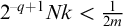 , by Fact 4.7, we have

Since
$\sigma $
 is arbitrary,
$D_{m,n}$
 contains a dense open set in
$(0,1)$
 .
Assuming
$\mathrm {CH}$
 , we can also construct a maximal subfield of
$\mathbb {R}$
 with Hausdorff dimension 0 such that some given real is not in its algebraic closure. Given a set
$A \subseteq {\mathbb {R}}$
 , let
$F(A)$
 be the field generated by A. Denote the relative algebraic closure of
$F(A)$
 in
$\mathbb {R}$
 by
$\mathrm {acl}_{\mathbb {R}}(A)$
 .
Fact 4.8 (Exchange of algebraic closure)
For a set
$A \subseteq \mathbb {R}$
 and reals a and b, if
$b \in \mathrm {acl}_{\mathbb {R}}(A \cup \{a\})$
 and
$b \notin \mathrm {acl}_{\mathbb {R}}(A)$
 , then
$a \in \mathrm {acl}_{\mathbb {R}}(A \cup \{b\})$
 .
Proposition 4.9. Assume
$\mathrm {CH}$
 . Given x a transcendental number, there is a subfield A of
$\mathbb {R}$
 such that
(i)
$\mathrm {dim_H} (A)=0$
 ;
(ii)
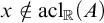
$x \notin \mathrm {acl}_{\mathbb {R}}(A)$
 ;
(iii) for any
$y \notin \mathrm {acl}_{\mathbb {R}}(A)$
 ,
$x \in \mathrm {acl}_{\mathbb {R}}(A \cup \{y\})$
 .
Proof. Fix
$\{ y_{\alpha } \}_{\alpha < \aleph _1}$
 an enumeration of
$\mathbb {R}$
 . Fix x a transcendental number. Define
$A = \bigcup _{\alpha < \aleph _1} A_{\alpha }$
 by induction on stages
$\alpha < \aleph _1$
 :
Stage 0. Define
$A_0=\mathbb {Q}$
 .
$x \notin \mathrm {acl}_{\mathbb {R}}(A_0)$
 since it is transcendental.
Stage
$\boldsymbol {\alpha>0}$
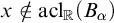
 . Recall that G is the set of generic reals (see Lemma 4.4). Suppose by induction that we have a countable field

such that
$x \notin \mathrm {acl}_{\mathbb {R}}(B_\alpha )$
 . Choose the least
$\gamma < \aleph _1$
 such that
$y_{\gamma } \notin \mathrm {acl}_{\mathbb {R}}(B_{\alpha })$
 and
$x \notin \mathrm {acl}_{\mathbb {R}}(B_{\alpha } \cup \{y_{\gamma }\})$
 (if such a
$\gamma $
 does not exist, end the whole construction). And if such a
$\gamma $
 exists, we say that
$\gamma $
 acts at stage
$\alpha $
 . Let
$I_\alpha $
 be the Turing ideal generated by
$B_\alpha \cup \{y_\gamma ,x\}$
 . Choose a real
$g_\alpha $
 such that
(i)
$g_\alpha $
 is y-generic for all
$y \in I_\alpha $
 ;
(ii)
$g_\alpha \notin \mathrm {acl}_{\mathbb {R}}(B_\alpha \cup \{y_\gamma ,x\} )$
 .
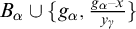
Let
$A_\alpha $
 be the subfield of
$\mathbb {R}$
 generated by
$B_{\alpha } \cup \{ g_\alpha , \frac {g_\alpha -x}{y_\gamma }\}$
 .
We first show that
$x \notin \mathrm {acl}_{\mathbb {R}}(A_\alpha )$
 if there is an ordinal
$\gamma $
 which acts at stage
$\alpha $
 . By induction, we assume that
$x \notin \mathrm {acl}_{\mathbb {R}}(B_\alpha )$
 . Let
$h_\alpha =\frac {g_\alpha -x}{y_\gamma }$
 . Then
$x\in \mathrm {acl}_{\mathbb {R}}(B_\alpha \cup \{g _\alpha ,h_\alpha \})$
 but
$x \notin \mathrm {acl}_{\mathbb {R}}(B_\alpha \cup \{g _\alpha \})$
 (
$x \notin \mathrm {acl}_{\mathbb {R}}(B_\alpha )$
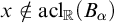 by the induction hypothesis, and
$g_\alpha \notin \mathrm {acl}_{\mathbb {R}}(B_\alpha \cup \{x\} )$
 by its choice, then by Fact 4.8,
$x \notin \mathrm {acl}_{\mathbb {R}}(B_\alpha \cup \{g _\alpha \})$
 ). So
${h_\alpha \in \mathrm {acl}_{\mathbb {R}}(B_\alpha \cup \{g _\alpha ,x \})}$
 by Fact 4.8. Then
$y_\gamma \in \mathrm {acl}_{\mathbb {R}}(B_\alpha \cup \{g _\alpha ,x \})$
 . And by Fact 4.8 again, since
$y_\gamma \notin \mathrm {acl}_{\mathbb {R}}(B_\alpha )$
 , we have
$y_\gamma \notin \mathrm {acl}_{\mathbb {R}}(B_\alpha \cup \{x\})$
 . So by Fact 4.8 again,
$g_\alpha \in \mathrm {acl}_{\mathbb {R}}(B_\alpha \cup \{y_\gamma ,x\})$
 , a contradiction.
By Lemma 4.5,
$A_{\alpha } \subseteq G \cup \mathbb {Q}$
 for all
$\alpha $
 . So the induction hypothesis holds at any stage before the construction ends.
Now we define
$A = \bigcup _{\alpha < \aleph _1} A_{\alpha }$
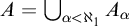 and verify that A satisfies the conditions in the statement. We may assume the construction does not end at any stage
$\alpha <\aleph _1$
 (otherwise A is countable and it is clear that the conditions hold). Since
${A = \bigcup _{\alpha < \aleph _1} A_{\alpha } \subseteq G \cup \mathbb {Q}}$
 ,
$\mathrm {dim_H} (A)=0$
 . If
$y\notin \mathrm {acl}_{\mathbb {R}}(A)$
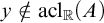 , choose
$\gamma < \aleph _1$
 such that
$y=y_\gamma $
 . Then
$x \in \mathrm {acl}_{\mathbb {R}}(A\cup \{y\})$
 . Otherwise,
$\gamma $
 acts at some stage
$\alpha < \aleph _1$
 . So
$g_\alpha $
 ,
$\frac {g_\alpha -x}{y}$
 and y are in
$\mathrm {acl}_{\mathbb {R}}(A\cup \{y\})$
 . Then x is also in
$\mathrm {acl}_{\mathbb {R}}(A\cup \{y\})$
 , a contradiction.



