1. Introduction
Congruence relations play an important role in algebraic structures, such as groups, rings, and modules. One of the well-known fundamental facts about algebraic structures is that the surjective homomorphisms between them are completely characterized as the quotients of their domains modulo kernel congruences. From this, there are typical fundamental homomorphism and isomorphism theorems for algebraic structures. These are also true for certain ordered algebraic structures.
Domain theory was first introduced by Dana Scott as a foundation for program semantics in the 1970s. In Gierz et al. (Reference Gierz, Hofmann, Keimel, Lawson, Mislove and Scott2003), the authors proposed a certain kind of congruence relation on continuous lattices, bounded complete domains corresponding to kernel operators which preserve directed sups, respectively, and they raised an open problem: Does the same result hold for continuous semilattices (see the second problem on page 92 of Gierz et al. (Reference Gierz, Hofmann, Keimel, Lawson, Mislove and Scott2003))? As far as we know, this problem remains unresolved. Also, in Jung et al. (Reference Jung, Libkin and Puhlmann1992), the authors studied congruence relations on algebraic distributive bounded complete dcpos, namely distributive Scott domains. Furthermore, in Fiech (Reference Fiech1996), Mahmoudi et al. (Reference Mahmoudi, Moghbeli and Pióro2017), and Mahmoudi et al. (Reference Mahmoudi, Moghbeli and Pióro2019), we can see some results about congruence relations on dcpos. Recently, we obtained some kind of congruence relation on
 $L$
-domains corresponding to strong homomorphisms among
 $L$
-domains in Jin and Li (Reference Jin and Li2022). There are no more results about quotients of domains and related structures according to the earlier literature.
In this paper, we introduce two kinds of congruence relations on domains called I-congruence relation and II-congruence relation on domains. Then, we conclude that there is a bijection between kernel operators preserving directed sups and I-congruence relations on domains which do not contain
 $P\times P$
on domain
 $P$
. There is also a bijection between closure operators preserving directed sups and II-congruence relations on domains which do not contain
 $P\times P$
on domain
 $P$
. Meanwhile, we describe and characterize the unique order on the quotient set.
In contrast to I-congruence relations and II-congruence relations on domains, we propose a new homomorphism between domains called I-homomorphism and II-homomorphism, respectively. The relationship of I-homomorphisms and II-homomorphisms and their corresponding congruence relations will be studied. Finally, we get the I-homomorphism and I-isomorphism theorems, as well as II-homomorphism and II-isomorphism theorems for domains.
Evidently, the images of I-homomorphism and II-homomorphism from a domain, an
 $L$
-domain, a bounded complete domain, a continuous semilattice, and a continuous lattice also have the same structure. Thus, we get the I-congruence and II-congruence relations on domains,
 $L$
-domains, bounded complete domains, continuous semilattices, continuous lattice, respectively. In particular, we show that the I-congruence relation on
 $L$
-domains is a generalization of the congruence relation on
 $L$
-domains in Jin and Li (Reference Jin and Li2022). Furthermore, the I-congruence relation on continuous lattices is precisely the congruence relation on continuous lattices defined in Gierz et al. (Reference Gierz, Hofmann, Keimel, Lawson, Mislove and Scott2003). At last, we take examples to reveal that the I-congruence and II-congruence relations on continuous lattices are different.
In addition, applying the above results to continuous semilattices, we obtain a positive answer to the open problem on homomorphisms and quotients of continuous semilattices mentioned above.
2. Preliminaries
To start with, we recall some standard definitions and notations of order theory and domain theory to be used in this paper, for more details refer to Chajda and Snášel (Reference Chajda and Snášel1998), Chajda et al. (Reference Chajda, Snášel and Jukl2009), Davey and Priestley (Reference Davey and Priestley2002), Gierz et al. (Reference Gierz, Hofmann, Keimel, Lawson, Mislove and Scott2003), Hofmann and Mislove (Reference Hofmann and Mislove1977), Goubault-Larrecq (Reference Goubault-Larrecq2013), Kolibiar (Reference Kolibiar1987), and Shum et al. (Reference Shum, Zhu and Kehayopulu2008).
A binary relation
 $R$
on a set
 $X$
is any subset of
 $X\times X$
. We write
 $x\mathrel {R}y$
instead of
 $(x,y)\in R$
.
 $R$
is reflexive if
 $x\mathrel {R}x$
for every
 $x\in X$
.
 $R$
is transitive whenever
 $x\mathrel {R}y$
and
 $y\mathrel {R}z$
, then
 $x\mathrel {R}z$
.
 $R$
is antisymmetric whenever
 $x\mathrel {R}y$
and
 $y\mathrel {R}x$
, then
 $x=y$
. A reflexive, transitive, and antisymmetric relation is called a partial order or an order for short and is usually written as
 $\leq$
. A set with an order is called a partially ordered set or a poset. A binary relation
 $R$
is symmetric whenever
 $x\mathrel {R}y$
, then
 $y\mathrel {R}x$
. An equivalence relation on
 $X$
is a binary relation on
 $X$
which is reflexive, symmetric, and transitive. An equivalence class or a block
 $[x]_{R}$
of
 $x\in X$
is the set of all
 $y\in X$
such that
 $x\mathrel {R}y$
. The quotient set
 $X/R$
is the set of all equivalence classes.
Next, we define a binary relation
 $\leq _{R}$
on the quotient set. In this paper, we will prove
 $\leq _{R}$
is an order on the quotient set if
 $R$
is a I-congruence relation and II-congruence relation on domains (see Lemmas 3.5 and 5.7, respectively).
Definition 2.1.
Let
 $P$
be a poset and
 $R$
an equivalence relation on
 $P$
. Define a binary relation
 $\leq _{R}$
on
 $P/R$
as follows:
 \begin{align*} [x]_{R}\leq _{R} [y]_{R}\textrm { if there exist }x_{0}\in [x]_{R}\textrm { and }y_{0}\in [y]_{R}\textrm { such that }x_{0}\leq y_{0}. \end{align*}
Let
 $P$
be a poset and
 $A\subseteq P$
. We say that
 $x$
is an upper bound of
 $A$
and
 $y$
is a lower bound of
 $A$
in
 $P$
if
 $a\leq x$
for all
 $a\in A$
and
 $y\leq a$
for all
 $a\in A$
, respectively.
 $A$
has a supremum in
 $P$
if
 $A$
has the least upper bound in
 $P$
, and it is written as
 $\vee A$
or
 $\sup A$
. Dually,
 $A$
has an infimum in
 $P$
if
 $A$
has the greatest lower bound in
 $P$
, and we write it as
 $\wedge A$
or
 $\inf A$
.
 $P$
is called a sup semilattice if any elements
 $x,y\in P$
have a least upper bound
 $x\vee y$
. We call
 $P$
is a complete lattice if every subset
 $B$
of
 $P$
has a least upper bound
 $\sup B$
and a greatest lower bound
 $\inf B$
. A subset
 $D$
of
 $P$
is directed provided that it is nonempty and every finite subset of
 $D$
has an upper bound in
 $D$
. The poset
 $P$
is called a dcpo if every directed subset
 $D$
in
 $P$
has a supremum. A subset
 $Q$
of
 $P$
is called a subdcpo whenever
 $D$
is a directed subset of
 $Q$
,
 $\sup _{P}D$
belongs to
 $Q$
.
 $P$
is called a complete semilattice if every nonempty subset has an infimum and every directed subset has a supremum. Let
 $x$
,
 $y \in P$
, we say that
 $x$
is way below
 $y$
, in symbols
 $x\ll y$
, if and only if for all directed subsets
 $D\subseteq P$
for which
 $\sup D$
exists, the relation
 $y\leq \mathrm{sup}D$
always implies the existence of an element
 $d\in D$
such that
 $x\leq d$
.
In the following, we introduce various types of domains.
Definition 2.2. (Gierz et al. (Reference Gierz, Hofmann, Keimel, Lawson, Mislove and Scott2003), Definition I-1.6). The poset
 $P$
is called continuous if the set
 $\{y\in P \mid y\ll x\}$
is directed and
 $x=\sup \{y\in P \mid y\ll x\}$
for all
 $x\in P$
.
-
(1) A dcpo which is continuous as a poset will be called a domain.
-
(2) A domain which is a complete lattice is called a continuous lattice.
-
(3) A domain which is also a semilattice is called a continuous semilattice.
-
(4) A complete semilattice which is a domain as a poset is called a complete continuous semilattice or alternatively a bounded complete domain.
-
(5) A domain in which every principal ideal
 $\mathord {\downarrow } x$
is a complete lattice (in its induced order) is called an
$L$
-domain.


Lemma 2.3. (Gierz et al. (Reference Gierz, Hofmann, Keimel, Lawson, Mislove and Scott2003), Exercise I-1.38). If
 $P$
is a dcpo, then the following conditions are equivalent:
-
1.
$\mathord {\downarrow } x$
is a continuous lattice for each
$x\in P$
; -
2.
$P$
is a domain in which every nonempty set that is bounded above has a greatest lower bound;
-
3.
$P$
is an
$L$
-domain.


This characterization of
 $L$
-domains will be essential in Section 7 when we study I-congruence relation on
 $L$
-domains.
Now, we introduce a general statement about posets.
Proposition 2.4.
Let
 $P$
and
 $Q$
be posets and
 $f:P\rightarrow Q$
a map. If
 $f$
is surjective, then we have two groups of equivalent statements:
-
(1) For any
$A\subseteq P$
,
$f$
satisfies the equation:
$\mathord {\downarrow } f(\!\cap _{a\in A}\mathord {\downarrow } a)=\cap _{a\in A}\mathord {\downarrow } f(a)$
; -
(2) For any
$A\subseteq P$
,
$f$
satisfies the equation:
$f(\!\cap _{a\in A}\mathord {\downarrow } a)=\cap _{a\in A}\mathord {\downarrow } f(a)$
. -
(1′) For any
$A\subseteq P$
,
$f$
satisfies the equation:
$\mathord {\uparrow } f(\!\cap _{a\in A}\mathord {\uparrow } a)=\cap _{a\in A}\mathord {\uparrow } f(a)$
; -
(2′) For any
$A\subseteq P$
,
$f$
satisfies the equation:
$f(\!\cap _{a\in A}\mathord {\uparrow } a)=\cap _{a\in A}\mathord {\uparrow } f(a)$
.


Furthermore,
 $f$
is order-preserving under any of the above four given equations.
Proof.
We only prove the equivalence of (1) and (2). The proof of equivalence for (
 $1^{\prime }$
) and (
 $2^{\prime }$
) is similar.
First, we show that
 $f$
is order-preserving under any of the above four given equations. Here, we only prove that
 $f$
is order-preserving when
 $f$
satisfies the equation:
 $\mathord {\downarrow } f(\!\cap _{a\in A}\mathord {\downarrow } a)=\cap _{a\in A}\mathord {\downarrow } f(a)$
. Let
 $x,y\in P$
and
 $x\leq y$
. Then,
 $x\in \mathord {\downarrow } x\cap \mathord {\downarrow } y$
. It implies that
 $f(x)\in \mathord {\downarrow } f(\mathord {\downarrow } x\cap \mathord {\downarrow } y)=\mathord {\downarrow } f(x)\cap \mathord {\downarrow } f(y)$
. So,
 $f(x)\leq f(y)$
.
 $(1)\Rightarrow (2)$
: For any
 $A\subseteq P$
, we know that
 $f(\!\cap _{a\in A}\mathord {\downarrow } a)\subseteq \cap _{a\in A}\mathord {\downarrow } f(a)$
. Conversely, let
 $x\in \cap _{a\in A}\mathord {\downarrow } f(a)$
. Then,
 $x\in \mathord {\downarrow } f(\!\cap _{a\in A}\mathord {\downarrow } a)$
by (1). Thus, there is an element
 $p\in \cap _{a\in A}\mathord {\downarrow } a$
such that
 $x\leq f(p)$
. Since
 $f$
is surjective, there exists an element
 $p_{x}\in P$
such that
 $f(p_{x})=x$
. Note that
 $x\in \mathord {\downarrow } f(p_{x})\cap f(p)=\mathord {\downarrow } f(\mathord {\downarrow } p_{x}\cap \mathord {\downarrow } p)$
. It follows that there exists an element
 $y\in \mathord {\downarrow } p_{x}\cap \mathord {\downarrow } p$
such that
 $x\leq f(y)$
. So we conclude that
 $y\in \cap _{a\in A}\mathord {\downarrow } a$
and
 $x=f(y)$
. This implies
 $x=f(y)\in f(\!\cap _{a\in A}\mathord {\downarrow } a)$
. Thus,
 $\cap _{a\in A}\mathord {\downarrow } f(a)\subseteq f(\!\cap _{a\in A}\mathord {\downarrow } a)$
. Therefore,
 $f(\!\cap _{a\in A}\mathord {\downarrow } a)=\cap _{a\in A}\mathord {\downarrow } f(a)$
.
 $(2)\Rightarrow (1)$
: For any
 $A\subseteq P$
, we have
 $f(\!\cap _{a\in A}\mathord {\downarrow } a)\subseteq \mathord {\downarrow } f(\!\cap _{a\in A}\mathord {\downarrow } a)$
. By (2),
 $f(\!\cap _{a\in A}\mathord {\downarrow } a)=\cap _{a\in A}\mathord {\downarrow } f(a)\subseteq \mathord {\downarrow } f(\!\cap _{a\in A}\mathord {\downarrow } a)$
. Conversely, since
 $f$
is order-preserving,
 $\mathord {\downarrow } f(\!\cap _{a\in A}\mathord {\downarrow } a)\subseteq \cap _{a\in A}\mathord {\downarrow } f(a)$
. So,
 $\mathord {\downarrow } f(\!\cap _{a\in A}\mathord {\downarrow } a)=\cap _{a\in A}\mathord {\downarrow } f(a)$
.
Next, we introduce the definitions and properties of Scott-continuous map, projection operator, closure operator, and kernel operator. Particularly, closure operator and kernel operators provide powerful tools for constructing quotient structures of domains. Their importance will become evident throughout the paper.
Definition 2.5. (Goubault-Larrecq (Reference Goubault-Larrecq2013)). Let
 $P,Q$
be posets and
 $f:P\rightarrow Q$
.
 $f$
is called Scott-continuous if
 $f$
preserves sups of directed subsets, that is,
 $f$
is order-preserving and
 $f(\!\sup D)=\sup f(D)$
, for all directed subsets
 $D\subseteq P$
for which
 $\sup D$
exists.
Definition 2.6. (Gierz et al. (Reference Gierz, Hofmann, Keimel, Lawson, Mislove and Scott2003), Definition O-3.8). Let
 $L$
be a poset.
-
(1) A projection operator (shortly projection) is an idempotent, monotone self-map
$p:L\rightarrow L$
. -
(2) A closure operator is a projection
$c$
on
$L$
with
$id_{L}\leq c$
. -
(3) A kernel operator is a projection
$k$
on
$L$
with
$k\leq id_{L}$
.


Lemma 2.7. (Gierz et al. (Reference Gierz, Hofmann, Keimel, Lawson, Mislove and Scott2003), Corollary I-2.3). Let
 $M$
be the image of a projection
 $p:L\rightarrow L$
preserving sups of directed sets. If
 $L$
is a domain, an
 $L$
-domain, a bounded complete domain, a continuous semilattice, and a continuous lattice, the same is true for the image
 $M$
.
Lemma 2.8. (Gierz et al. (Reference Gierz, Hofmann, Keimel, Lawson, Mislove and Scott2003), Remark on Page 81). For a closure operator
 $c$
on a domain
 $P$
preserving sups of directed sets, then for all
 $x,y\in P$
, one has
 $x\ll y$
implies
 $c(x)\ll _{c(P)}c(y)$
.
Lemma 2.9. (Gierz et al. (Reference Gierz, Hofmann, Keimel, Lawson, Mislove and Scott2003), Lemma I-2.4). A closure operator
 $c:L\rightarrow L$
on a dcpo
 $L$
preserves sups of directed sets if and only if its image
 $c(L)$
is closed in
 $L$
with respect to sups of directed sets.
Lemma 2.10.
A kernel operator
 $k:L\rightarrow L$
on a dcpo
 $L$
preserves sups of directed sets if and only if
 $(k\times k)^{-1}(\Delta )=\{(x,y)\in L\times L\mid k(x)=k(y)\}$
is a subdcpo of
 $L\times L$
.
Proof.
Assume first that
 $(k\times k)^{-1}(\Delta )$
is a subdcpo of
 $L\times L$
. Let
 $D$
be a directed subset of
 $L$
. As
 $k$
is a kernel operator, it is order-preserving,
 $\sup _{L}k(D)\leq k(\!\sup _{L}D)$
. Define
 $\mathcal{D}=\{(d,k(d)\mid d\in D)\}$
. Then
 $\mathcal{D}$
is directed in
 $(k\times k)^{-1}(\Delta )$
. Since
 $(k\times k)^{-1}(\Delta )$
is a subdcpo of
 $L\times L$
,
 $\sup \mathcal{D}=(\!\sup _{L} D,\sup _{L} k(D))\in (k\times k)^{-1}(\Delta )$
. It means that
 $k(\!\sup _{L} D)=k(\!\sup _{L} k(D))$
. Note that
 $k(\!\sup _{L} k(D))\leq \sup _{L} k(D)$
, which implies that
 $k(\!\sup _{L} D)\leq \sup _{L} k(D)$
. So,
 $\sup _{L}k(D)=k(\!\sup _{L}D)$
, that is,
 $k$
preserves sups of directed sets. Conversely, assume that
 $k$
preserves sups of directed sets. Let
 $\mathcal{D}$
be a directed subset in
 $(k\times k)^{-1}(\Delta )$
. Set
 \begin{align*} D_{1}=\{d_{1}\in L\mid \textrm { there exists an element }d_{2}\in L \textrm { such that }(d_{1},d_{2})\in \mathcal{D}\},\\ D_{2}=\{d_{2}\in L\mid \textrm { there exists an element }d_{1}\in L \textrm { such that }(d_{1},d_{2})\in \mathcal{D}\}. \end{align*}
Then,
 $\sup \mathcal{D}=(\!\sup D_{1},\sup D_{2})$
. We claim that
 $(\!\sup D_{1},\sup D_{2})\in (k\times k)^{-1}(\Delta )$
. It is easy to see that
 $k(D_{1})=k(D_{2})$
. Now, as
 $k$
preserves sups of directed sets,
 \begin{align*} k(\!\sup D_{1})=\sup \limits _{d_{1}\in D_{1}}k(d_{1})=\sup \limits _{d_{2}\in D_{2}}k(d_{2})=k(\!\sup D_{2}), \end{align*}
which implies that
 $(\!\sup D_{1},\sup D_{2})\in (k\times k)^{-1}(\Delta )$
. So,
 $(k\times k)^{-1}(\Delta )$
is a subdcpo of
 $L\times L$
.
Remark 2.11.
Let
 $P$
be a dcpo and
 $Q$
a poset. From the proof of Lemma 2.10
, we could conclude that for a Scott-continuous map
 $f:P\rightarrow Q$
between
 $P$
and
 $Q$
,
 $ker(\,f)=\{(x,y)\in P\times P\mid f(x)=f(y)\}$
is a subdcpo of
 $P\times P$
.
We now introduce the definition and properties of Galois connection. Galois connection is one of the most efficient tools in dealing with domains and plays a central role in I-homomorphism and II-homomorphism on domains.
Definition 2.12. (Gierz et al. (Reference Gierz, Hofmann, Keimel, Lawson, Mislove and Scott2003), Definition O-3.1). Let
 $S$
and
 $T$
be two posets. We shall say that a pair
 $(g,d)$
of functions
 $g:S\rightarrow T$
and
 $d:T\rightarrow S$
is a Galois connection or an adjunction between
 $S$
and
 $T$
provided that
-
(1) both
$g$
and
$d$
are monotone, and
-
(2) the relations
$g(s)\geq t$
and
$s\geq d(t)$
are equivalent for all pairs of elements
$(s,t)\in S\times T$
.


In an adjunction
 $(g,d)$
, the function
 $g$
is called the upper adjoint and
 $d$
the lower adjoint.
Theorem 2.13. (Gierz et al. (Reference Gierz, Hofmann, Keimel, Lawson, Mislove and Scott2003), Theorem O-3.6). For every pair of order-preserving functions between posets,
 $g:S\rightarrow T$
and
 $d:T\rightarrow S$
, the following conditions are equivalent:
-
(1)
$(g,d)$
an adjunction;
-
(2)
$dg\leq id_{S}$
and
$id_{T}\leq gd$
.Moreover, these conditions imply
-
(3)
$d=dgd$
and
$g=gdg$
, -
(4)
$gd$
and
$dg$
are idempotent.


Proposition 2.14. (Gierz et al. (Reference Gierz, Hofmann, Keimel, Lawson, Mislove and Scott2003), Proposition O-3.7). For an adjunction
 $(g,d)$
between posets
 $S$
and
 $T$
, the following conditions are equivalent:
-
(1)
$d$
is surjective;
-
(2)
$dg=id_{S}$
.


Likewise, the following statements are equivalent:
-
(1*)
$g$
is surjective;
-
(2*)
$gd=id_{T}$
; -
(3*)
$d$
is injective.


Lemma 2.15. (Gierz et al. (Reference Gierz, Hofmann, Keimel, Lawson, Mislove and Scott2003), Theorem O-3.3). Any upper adjoint preserves existing infs, any lower adjoint preserves existing sups.
Lemma 2.16. (Gierz et al. (Reference Gierz, Hofmann, Keimel, Lawson, Mislove and Scott2003), Theorem IV-1.4). Let
 $S$
be a poset,
 $T$
a domain, and
 $g$
the upper adjoint of
 $d:T\rightarrow S$
. Then the following statements are equivalent:
-
(1)
$g$
is Scott-continuous;
-
(2)
$d$
preserves
$\ll$
, that is, if
$t\ll t^{\ast }$
in
$T$
, then
$d(t)\ll d(t^{\ast })$
.


Let
 $P,Q$
be posets and
 $f:P\rightarrow Q$
. The kernel of
 $f$
is denoted by
 $ker(\,f)=\{(x,y)\in P\times P|f(x)=f(y)\}$
. In the following theorem, we investigate the relation between the kernels of kernel operators and closure operators, and the kernels of upper adjoints and lower adjoints. These are crucial for us to characterize the I-homomorphism theorem (see Theorem4.3) and II-homomorphism theorem (see Theorem6.9).
Theorem 2.17.
Let
 $P$
be a poset and
 $R$
an equivalence relation on
 $P$
. Then we have two groups of equivalent statements:
-
(1)
$R$
is the kernel of a kernel operator
$k:P\rightarrow P$
; -
(2) there is an adjunction
$(g,d)$
between
$P$
and some
$T$
with
$k=d\circ g$
and
$R=ker(g)$
. -
(1′)
$R$
is the kernel of a closure operator
$c:P\rightarrow P$
; -
(2′) there is an adjunction
$(g,d)$
between some
$S$
and
$P$
with
$c=g\circ d$
and
$R=ker(d)$
.


Proof. We only prove the equivalence of (1) and (2).
From Proposition O-3.10 in Gierz et al. (Reference Gierz, Hofmann, Keimel, Lawson, Mislove and Scott2003),
 $k:P\rightarrow P$
is a kernel operator on
 $P$
if and only if there is an adjunction
 $(g,d)$
between
 $P$
and some
 $T$
where
 $k=d\circ g$
. Next, we prove that
 $R=ker(g)$
. For any
 $(x,y)\in R$
, we have
 $k(x)=k(y)$
. That is,
 $dg(x)=dg(y)$
. Thus,
 $gdg(x)=gdg(y)$
. By Theorem2.13,
 $g(x)=g(y)$
. So,
 $(x,y)\in ker(g)$
. Conversely, if
 $(x,y)\in ker(g)$
, then
 $g(x)=g(y)$
; it implies that
 $dg(x)=dg(y)$
. Thus,
 $k(x)=k(y)$
. So,
 $(x,y)\in R$
. Therefore,
 $R=ker(g)$
.
3. I-Congruence Relations on Domains
In this section, we investigate the I-congruence relation on domains. First, we propose the concept of I-congruence relation on domains. Then we obtain that there is a bijective correspondence between all kernel operators which preserve directed sups and I-congruence relations which do not contain
 $P\times P$
on a domain
 $P$
. Furthermore, we describe and characterize the unique order on the quotient set. At last, we get a complete picture of the I-congruence relation on domains. In addition, we take some examples to illustrate that the conditions of I-congruence relation on domains are mutually independent and not a single one can be omitted.
Let
 $R$
be an equivalence relation on a poset
 $P$
. Then we call that
 $R$
satisfies the dual-link property or the co-link property if for any
 $a$
,
 $b$
,
 $b_{1}\in P$
, the following condition holds: if
 $a\leq b$
and
 $b\mathrel {R}b_{1}$
, then there exists an element
 $a_{1}\in P$
such that
 $a_{1}\leq b_{1}$
and
 $a\mathrel {R}a_{1}$
.
Definition 3.1. (Mahmoudi et al. (Reference Mahmoudi, Moghbeli and Pióro2017)). Let
 $P$
be a dcpo and
 $R$
an equivalence relation on
 $P$
. We say that
 $R$
is a dcpo congruence if
 $P/R$
with a suitable order is a dcpo and the quotient map
 $q:P\rightarrow P/R$
is Scott-continuous.
Definition 3.2.
An equivalence relation
 $R$
on a domain
 $P$
is called a I-congruence relation if either
 $R=P\times P$
or it satisfies:
-
1.
$R$
is a subdcpo of
$P\times P$
; -
2. each block of
$R$
has the smallest element;
-
3.
$R$
satisfies the dual-link property.


Now, we can give a more complete picture of I-congruence relation on domains and how they relate to kernel operators.
Theorem 3.3.
Let
 $P$
be a domain and
 $R\subseteq P\times P$
an equivalence relation. Then the following conditions are equivalent:
-
(1)
$R$
is a I-congruence relation on
$P$
; -
(2)
$R=P\times P$
or there is a kernel operator
$k$
on
$P$
preserving sups of directed sets such that
$R=(k\times k)^{-1}(\Delta )$
, where
$\Delta$
is the diagonal of
$P\times P$
; -
(3)
$P/R$
is a singleton set or
$P/R$
with a suitable order is a domain in such a way that the quotient map
$q:P\rightarrow P/R$
is an upper adjoint preserving sups of directed sets.


Proof.
 $(1)\Rightarrow (2)$
: If
 $R=P\times P$
, it naturally holds. Otherwise, for any
 $p\in P$
, from Condition 2 of Definition 3.2,
 $\inf [p]_{R}$
exists and
 $\inf [p]_{R}\in [p]_{R}$
. Define a map
 $k:P\rightarrow P$
by
 $k(p)=\inf [p]_{R}$
, where
 $p\in P$
. Then,
 $k$
is well defined and
 $k(p)\leq p$
. In fact,
 $k(p)$
is the smallest element in
 $[p]_{R}$
. It implies
 $k(k(p))=k(p)$
, that is,
 $k$
is idempotent. Next, for any
 $x,y\in P$
, suppose that
 $x\leq y$
. Then,
 $k(y)\mathrel {R}y$
. By Condition 3 of Definition 3.2, there exists an element
 $u\in P$
with
 $u\leq k(y)$
and
 $u\mathrel {R}x$
. Whence,
 $k(x)=k(u)\leq u\leq k(y)$
. It shows that
 $k$
is monotone. Thus,
 $k$
is a kernel operator.
Indeed, if
 $(x,y)\in R$
, then
 $k(x)=k(y)$
, and vice versa; therefore, we see that
 $(k\times k)^{-1}(\Delta )=R$
. From Condition 1 of Definition 3.2,
 $(k\times k)^{-1}(\Delta )$
is a subdcpo of
 $P\times P$
. So,
 $k$
preserves sups of directed sets by Lemma 2.10.
 $(2)\Rightarrow (3)$
: If
 $R=P\times P$
, then
 $P/R$
is a singleton set. Otherwise, assume that there is a kernel operator
 $k$
on
 $P$
preserving sups of directed sets such that
 $R=(k\times k)^{-1}(\Delta )$
. Since the image of a kernel operator
 $k$
on
 $P$
preserving sups of directed sets is a subdcpo of
 $P$
(see Gierz et al. (Reference Gierz, Hofmann, Keimel, Lawson, Mislove and Scott2003), Proposition O-3.12),
 $R$
is a dcpo congruence (see Mahmoudi et al. (Reference Mahmoudi, Moghbeli and Pióro2019), Corollary 4.7) and
 $P/R$
with the relation defined by
 $[x]_{R}\leq _{P/R}[y]_{R}$
if and only if
 $k(x)\leq k(y)$
is a dcpo and
 $q:P\rightarrow P/R$
preserves sups of directed sets (see Mahmoudi et al. (Reference Mahmoudi, Moghbeli and Pióro2019), Theorem 4.1). By the first isomorphism theorem for dcpos (see Mahmoudi et al. (Reference Mahmoudi, Moghbeli and Pióro2019), Corollary5.6),
 $(P/R,\leq _{P/R})\cong k(P)$
and since
 $k(P)$
is a domain by Lemma 2.7, we obtain that
 $P/R$
is a domain as well. Applying Decomposition Theorem for dcpos (see Mahmoudi et al. (Reference Mahmoudi, Moghbeli and Pióro2019), Theorem5.3), there is a Scott-continuous map
 $f:P/R\rightarrow P$
given by
 $f([p]_{R})=k(p)$
for any
 $[p]_{R}\in P/R$
, and
 $k=f\circ q$
. Based on Proposition O-3.10 in Gierz et al. (Reference Gierz, Hofmann, Keimel, Lawson, Mislove and Scott2003),
 $(q,f)$
is an adjunction. Therefore,
 $q$
is an upper adjoint preserving sups of directed sets.
 $(3)\Rightarrow (1)$
: We need to check the conditions of I-congruence relation on domains in Definition 3.2. If
 $P/R$
is a singleton set, then we can directly get that
 $R=P\times P$
. Otherwise, since the quotient map
 $q$
preserves sups of directed sets, we have
 $R$
is a subdcpo of
 $P\times P$
by Remark 2.11.
Since
 $q$
is an upper adjoint, there exists an order-preserving map
 $h:P/R\rightarrow P$
such that
 $(q,h)$
is an adjunction. Let
 $p\in P$
. For any element
 $x\in [p]_{R}$
, we have that
 $q(x)=q(p)$
, and it follows that
 $h\circ q(x)=h\circ q(p)$
. Because
 $(q,h)$
is an adjunction,
 $h\circ q(p)=h\circ q(x)\leq x$
and
 $q\circ h\circ q(p)=q(p)$
by Theorem2.13. Thus,
 $h\circ q(p)$
is the smallest element in
 $[p]_{R}$
.
Let
 $v$
,
 $a$
,
 $b\in P$
. Assume that
 $a\leq b$
and
 $b\mathrel {R}v$
. Then,
 $q(a)\leq q(b)=q(v)$
. So,
 $h\circ q(a)\leq h\circ q(v)\leq v$
and
 $h\circ q(a)\mathrel {R}a$
by Theorem2.13. Thus,
 $R$
satisfies the dual-link property.
From the above theorem, we immediately get that there is a bijective correspondence between the kernel operators of
 $P$
which preserve directed sups and I-congruence relations which do not contain
 $P\times P$
on
 $P$
.
Corollary 3.4.
Let
 $P$
be a domain. Then the rule
 $k\mapsto (k\times k)^{-1}(\Delta )$
, where
 $\Delta$
is the diagonal of
 $P\times P$
, associates with a kernel operator, its kernel congruence, and induces a bijection from the set of all kernel operators of
 $P$
preserving directed sups onto the set of all I-congruence relations on
 $P$
excluding
 $P\times P$
.
For a domain
 $P$
and a I-congruence relation
 $R$
on
 $P$
, by Theorem3.3, the quotient set
 $P/R$
is a singleton set or
 $P/R$
with a suitable order is a domain. In order to clarify the order on
 $P/R$
, we have the following lemma.
Lemma 3.5.
If
 $P$
is a domain and
 $R$
is a I-congruence relation on
 $P$
, then
 $\leq _{R}$
(see Definition 2.1) is an order on
 $P/R$
. Furthermore, it is the unique order on
 $P/R$
such that the quotient map
 $q$
is an upper adjoint.
Proof.
Obviously,
 $\leq _{R}$
is reflexive.
Assume that
 $[x]_{R}\leq _{R} [y]_{R}$
and
 $[y]_{R}\leq _{R} [x]_{R}$
. Then there exist
 $x_{1}$
,
 $x_{2}\in [x]_{R}$
,
 $y_{1}$
, and
 $y_{2}\in [y]_{R}$
such that
 $x_{1}\leq y_{1}$
and
 $y_{2}\leq x_{2}$
. It means that
 $x_{1}\leq y_{1}$
and
 $y_{1}\mathrel {R} y_{2}$
. Since
 $R$
satisfies the dual-link property, then there exists an element
 $x_{3}\in [x]_{R}$
such that
 $x_{3}\leq y_{2}$
. Thus,
 $x_{3}\leq y_{2}\leq x_{2}$
. Since
 $R$
is a I-congruence relation on
 $P$
, there exists an order
 $\leq _{P/R}$
on
 $P/R$
such that the quotient map
 $q:P\rightarrow P/R$
is an upper adjoint preserving sups of directed sets by Theorem3.3. Thus,
 $[x_{3}]_{R}\leq _{P/R}[y_{2}]_{R}\leq _{P/R}[x_{2}]_{R}$
. Because
 $[x_{3}]_{R}=[x_{2}]_{R}$
, we have that
 $[x]_{R}=[x_{3}]_{R}=[y_{2}]_{R}=[y]_{R}$
.
At last, for the transitivity of
 $\leq _{R}$
, suppose
 $[x]_{R}\leq _{R} [y]_{R}$
and
 $[y]_{R}\leq _{R} [z]_{R}$
. Then there exist
 $x_{1}\in [x]_{R}$
,
 $y_{1}$
,
 $y_{2}\in [y]_{R}$
and
 $z_{2}\in [z]_{R}$
such that
 $x_{1}\leq y_{1}$
and
 $y_{2}\leq z_{2}$
. Because
 $R$
satisfies the dual-link property, there exists
 $x_{2}\in [x]_{R}$
with
 $x_{2}\leq y_{2}$
. That is,
 $x_{2}\leq y_{2}\leq z_{2}$
. Thus,
 $[x]_{R}\leq _{R} [z]_{R}$
.
Therefore,
 $\leq _{R}$
is an order on
 $P/R$
.
Suppose that
 $\leq _{P/R}$
is an arbitrary order on
 $P/R$
such that
 $q$
is an upper adjoint. Then there is an order-preserving map
 $f:P/R\rightarrow P$
such that
 $(q,f)$
is an adjunction. For any
 $x,y\in P$
, if
 $[x]_{R}\leq _{P/R} [y]_{R}$
, then
 $f([x]_{R})\leq f([y]_{R})$
, that is,
 $fq(x)\leq fq(y)$
. Since
 $qfq(x)=q(x)$
and
 $qfq(y)=q(y)$
, we have that
 $[x]_{R}\leq _{R}[y]_{R}$
by the definition of
 $\leq _{R}$
. It follows that
 $\leq _{P/R}\subseteq \leq _{R}$
. Conversely, assume that
 $[x]_{R}\leq _{R} [y]_{R}$
. Then there exist
 $x_{0}\in [x]_{R}$
and
 $y_{0}\in [y]_{R}$
such that
 $x_{0}\leq y_{0}$
. Thus,
 $q(x)=q(x_{0})\leq _{P/R} q(y_{0})=q(y)$
. It means that
 $[x]_{R}\leq _{P/R}[y]_{R}$
. Thus,
 $\leq _{R}\subseteq \leq _{P/R}$
. Therefore,
 $\leq _{R}=\leq _{P/R}$
.
For a domain
 $P$
and a I-congruence relation
 $R$
on
 $P$
, we get that
 $\inf [p]_{R}$
exists and
 $\inf [p]_{R}\in [p]_{R}$
for any element
 $p\in P$
by Definition 3.2. So, we could define a new relation on
 $P/R$
as follows:
 \begin{align*} [x]_{R}\leq _{R}^{1} [y]_{R}\textrm { if }\inf [x]_{R}\leq \inf [y]_{R}\textrm { for all elements }x,y\in P. \end{align*}
Furthermore, we obtain the following proposition.
Proposition 3.6.
If
 $R$
is a I-congruence relation on a domain
 $P$
, then for all elements
 $x$
,
 $y$
in
 $P$
, the following conditions are equivalent:
-
(1)
$[x]_{R}\leq _{R} [y]_{R}$
; -
(2)
$[x]_{R}\leq _{R}^{1} [y]_{R}$
; -
(3)
$[x]_{R}\leq _{R}^{2} [y]_{R}$
which is defined by the condition that for any element
$b\in [y]_{R}$
, there exists an element
$a_{b}\in [x]_{R}$
such that
$a_{b}\leq b$
.


Proof.
It is easy to prove that
 $(2)\Rightarrow (1)$
and
 $(3)\Rightarrow (1)$
.
 $(1)\Rightarrow (2)$
: Since
 $[x]_{R}\leq _{R} [y]_{R}$
, there exist
 $x_{0}\in [x]_{R}$
and
 $y_{0}\in [y]_{R}$
such that
 $x_{0}\leq y_{0}$
. Note that
 $\inf [y]_{R}\mathrel {R} y_{0}$
and
 $x_{0}\leq y_{0}$
, then there is an element
 $c\in [x]_{R}$
such that
 $c\leq \inf [y]_{R}$
, which implies that
 $\inf [x]_{R}\leq c\leq \inf [y]_{R}$
; hence,
 $(2)$
holds.
 $(1)\Rightarrow (3)$
: Since
 $[x]_{R}\leq _{R} [y]_{R}$
, there exist
 $x_{0}\in [x]_{R}$
and
 $y_{0}\in [y]_{R}$
such that
 $x_{0}\leq y_{0}$
. For any element
 $b\in [y]_{R}$
, because
 $b\mathrel {R}y_{0}$
and
 $x_{0}\leq y_{0}$
, there exists an element
 $a_{b}\in [x]_{R}$
such that
 $a_{b}\leq b$
. Thus,
 $(3)$
holds.
Theorem 3.7.
Let
 $P$
be a domain and
 $R$
an equivalence relation on
 $P$
. Then the following are equivalent:
-
(1)
$R$
is a I-congruence relation on
$P$
; -
(2)
$P/R$
is a singleton set or
$(P/R,\leq _{R})$
is a domain such that the quotient map
$q:P\rightarrow P/R$
is an upper adjoint preserving sups of directed sets;
-
(3)
$P/R$
is a singleton set or for any element
$p\in P$
,
$[p]_{R}$
has the smallest element, and
$(P/R,\leq _{R}^{1})$
is a domain such that the quotient map
$q:P\rightarrow P/R$
is an upper adjoint preserving sups of directed sets;
-
(4)
$P/R$
is a singleton set or
$(P/R,\leq _{R}^{2})$
is a domain such that the quotient map
$q:P\rightarrow P/R$
is an upper adjoint preserving sups of directed sets.


Proof.
By Theorem3.3, it is straightforward to check that
 $(2)\Rightarrow (1)$
,
 $(3)\Rightarrow (1)$
, and
 $(4)\Rightarrow (1)$
.
If
 $R$
is a I-congruence relation on
 $P$
, then
 $\leq _{R}$
is an order on
 $P/R$
by Lemma 3.5. Moreover, from Proposition 3.6,
 $\leq _{R}=\leq _{R}^{1}=\leq _{R}^{2}$
. Hence, we only need to prove
 $(1)\Rightarrow (3)$
. Again by Theorem3.3,
 $R$
is a I-congruence relation if and only if
 $R=P\times P$
or there is a kernel operator
 $k$
on
 $P$
preserving sups of directed sets such that
 $R=(k\times k)^{-1}(\Delta )$
, where
 $\Delta$
is the diagonal of
 $P\times P$
. Recall that the proof of
 $(2)\Rightarrow (3)$
of Theorem3.3, the order on
 $P/R$
is defined as follows:
 \begin{align*} [x]_{R}\leq _{P/R}[y]_{R}\textrm { if and only if }k(x)\leq k(y)\textrm { for all }x,y\in P. \end{align*}
Now it remains to prove that
 $\inf [p]_{R}=k(p)$
for any element
 $p\in P$
. As
 $R=(k\times k)^{-1}(\Delta )$
and
 $k$
is a kernel operator, we can see that
 $k(p)\in [p]_{R}$
. Furthermore, let
 $x\in [p]_{R}$
. It means that
 $k(p)=k(x)\leq x$
. So,
 $k(p)$
is the smallest element in
 $[p]_{R}$
. Whence,
 $\inf [p]_{R}=k(p)$
.
Remark 3.8. All results about the I-congruence relation on domains do not rely on continuity; hence, these conclusions remain valid when the domain is replaced by a dcpo.
We now illustrate by examples that Conditions 1, 2, and 3 given in Definition 3.2 are mutually independent.
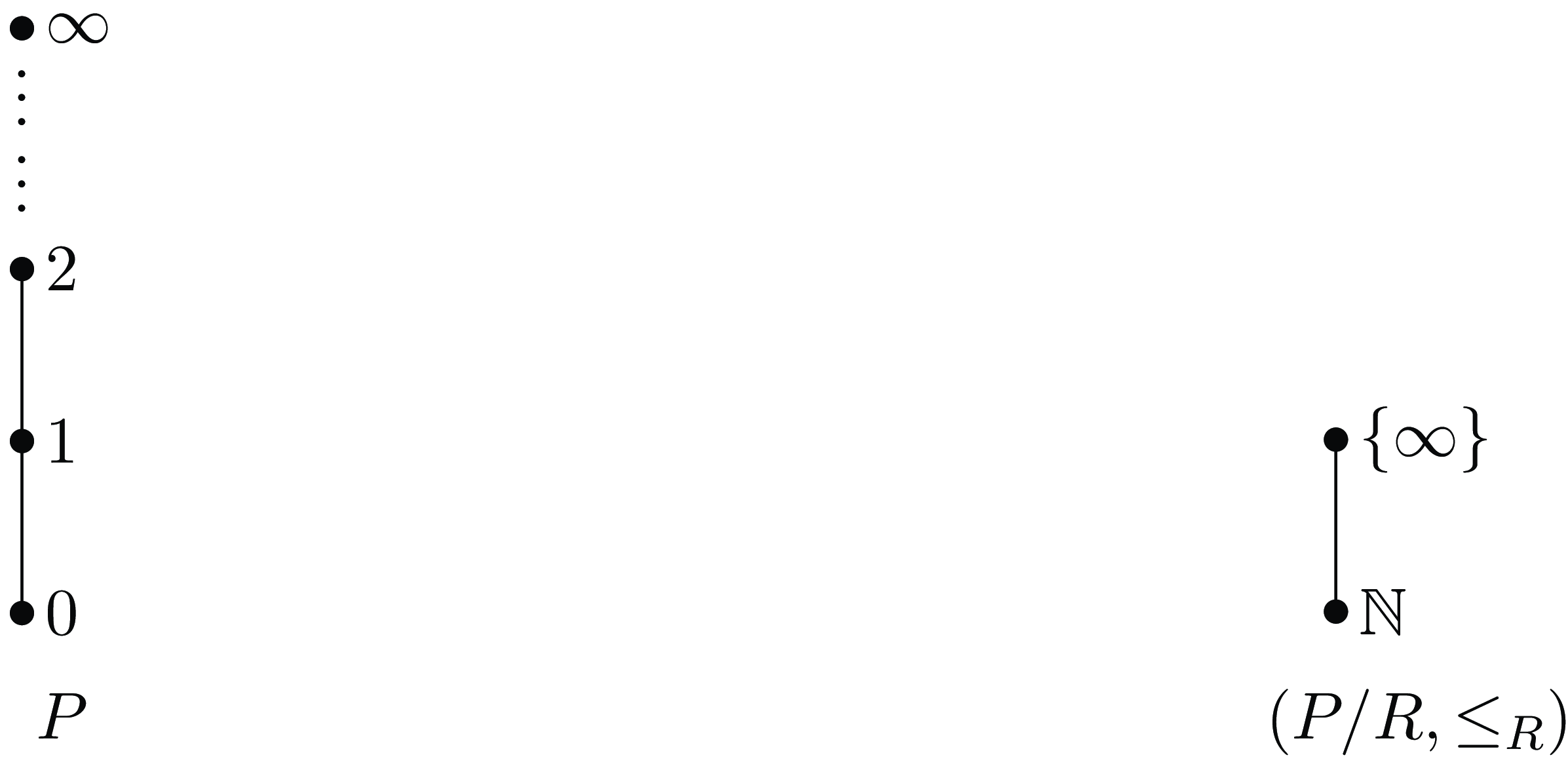
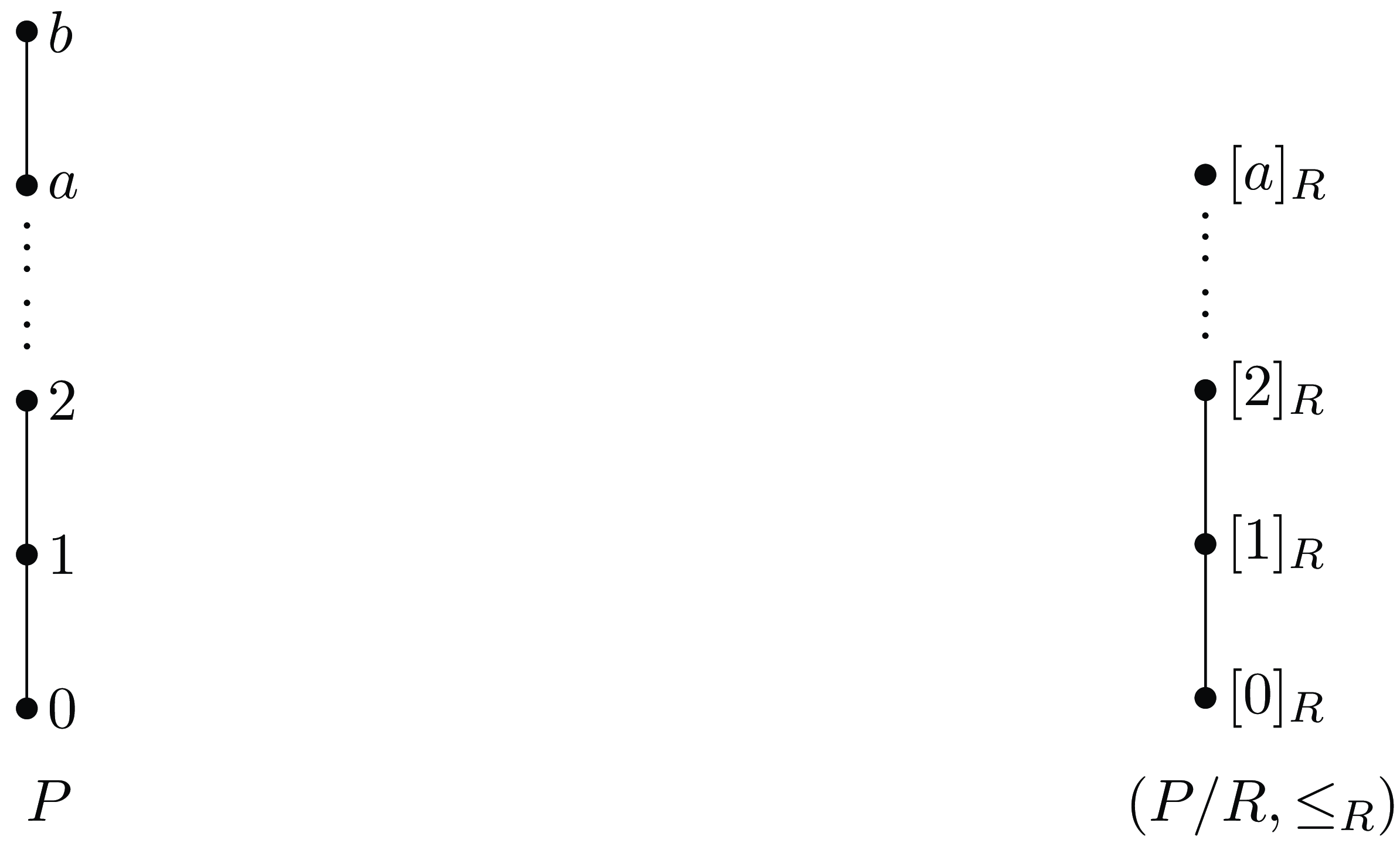
Example 3.9.
Let
 $\mathbb{N}=\{0, 1, 2, \cdots \}$
with the natural order and
 $P=\mathbb{N}\oplus \{\infty \}$
. Then it is easy to verify that
 $P$
is a domain. Consider an equivalence relation
 $R$
on
 $P$
consisting of exactly two blocks
 $\mathbb{N}$
and
 $\{\infty \}$
. In particular, Conditions 2 and 3 of Definition 3.2 hold. However, Condition 1 does not hold.
The Hasse diagrams in Example 3.9.

In fact, we could see that the quotient set
 $P/R=\{\mathbb{N},[\infty ]_{R}\}$
. Then,
 $(P/R,\leq _{R})$
is a domain and the quotient map
 $q:P\rightarrow (P/R,\leq _{R})$
is not Scott-continuous. By Theorem
3.3
,
 $R$
is not a I-congruence relation on domain
 $P$
. It implies that Condition 1 given in Definition 3.2 does not hold. The Hasse diagrams see Figure 1.
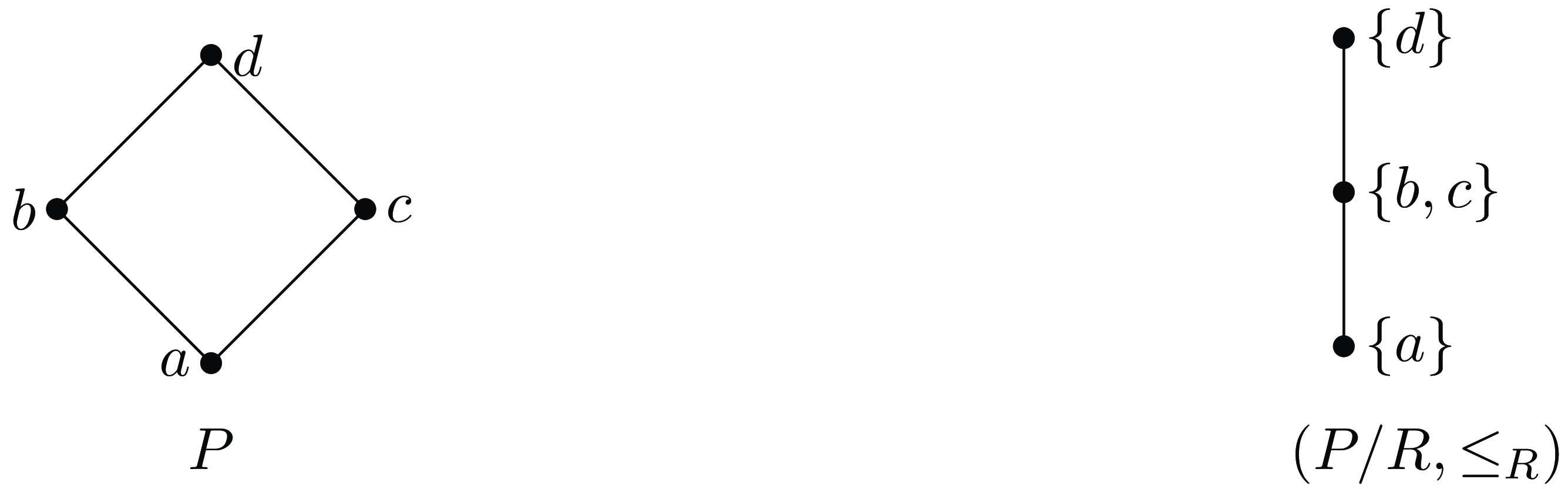
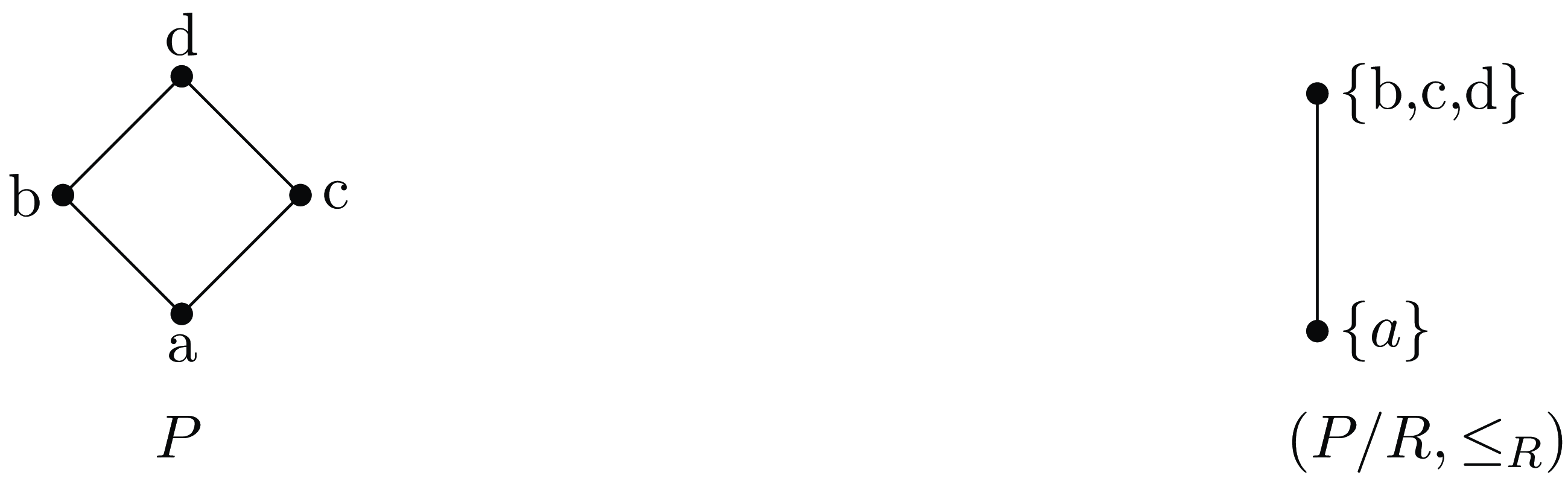
Example 3.10.
Suppose that the poset
 $P$
is given in the following:
 $P=\{a,b,c,d\}$
and the order
 $\leq _{P}$
is defined as follows:
 $a\leq b$
,
 $a\leq c$
,
 $b\leq d$
, and
 $c\leq d$
.
Let
 $R$
be an equivalence relation consisting of exactly three blocks
 $\{a\}$
,
 $\{b,c\}$
, and
 $\{d\}$
. Then the block
 $\{b,c\}$
does not have the smallest element. In particular, it is easy to check that
 $R$
satisfies Condition 3 of Definition 3.2
. Furthermore, we could see that the quotient set
 $P/R=\{[a]_{R},[b]_{R},[d]_{R}\}$
. Then
 $(P/R,\leq _{R})$
is a domain and the quotient map
 $q:P\rightarrow (P/R,\leq _{R})$
is Scott-continuous. It means that
 $R$
is a subdcpo of
 $P\times P$
by Remark 2.11
. Hence, Condition 1 given in Definition 3.2 holds. The Hasse diagrams see Figure 2.
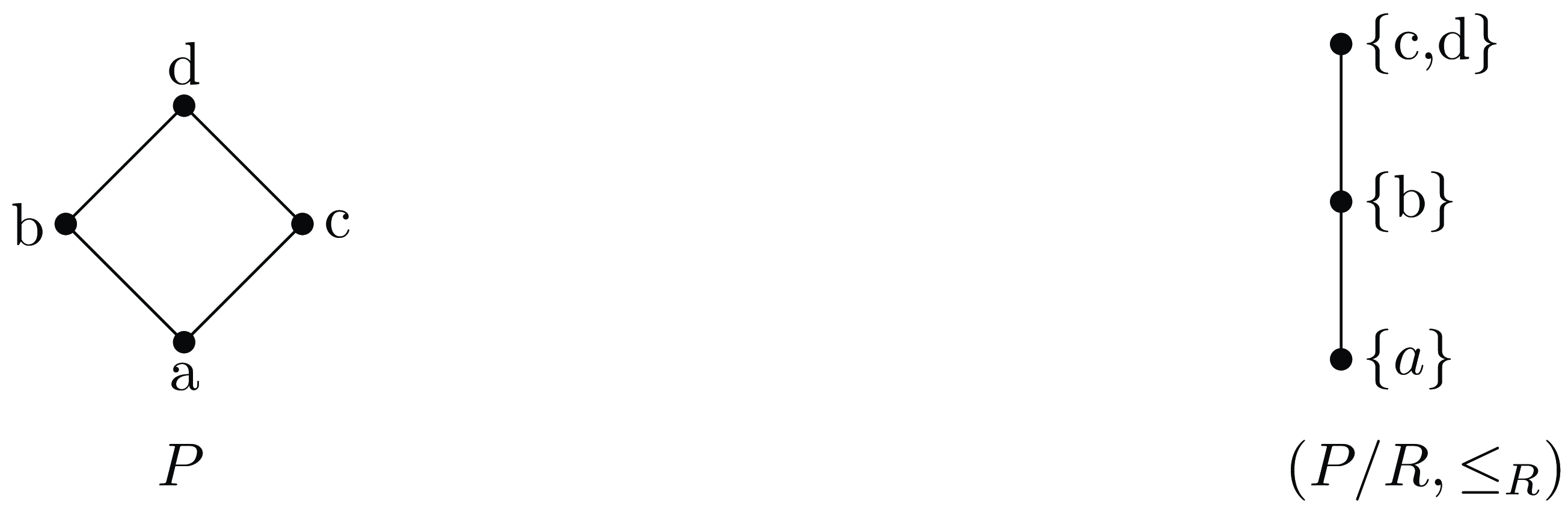
Example 3.11.
Take the domain
 $P$
in Example 3.10
. Let
 $R=\Delta _{P}\cup \{(c,d),(d,c)\}$
. Then
 $R$
is an equivalence relation on
 $P$
and satisfies Condition 2 of Definition 3.2
. Furthermore, we could see that the quotient set
 $P/R=\{[a]_{R},[b]_{R},[c]_{R}\}$
. Then,
 $(P/R,\leq _{R})$
is a three-element chain and the quotient map
 $q:P\rightarrow (P/R,\leq _{R})$
is Scott-continuous. Hence,
 $R$
satisfies Condition 1 given in Definition 3.2
. We could know that
 $b\leq d$
and
 $c\mathrel {R}d$
, but
 $b$
is the only element in the block
 $\{b\}$
and
 $b\not \leq c$
. So,
 $R$
does not satisfy the dual-link property. The Hasse diagrams see Figure 3.
The Hasse diagrams in Example 3.10.

The Hasse diagrams in Example 3.11.

4. I-Homomorphisms on Domains
In this section, we first define the I-homomorphism on domains, and later on, we will show that the kernel of a I-homomorphism on domains is a I-congruence relation on domains.
Definition 4.1.
Let
 $P$
and
 $Q$
be posets. A Scott-continuous map
 $f:P\rightarrow Q$
is called a I-homomorphism if
 $\mathrm{card}(\,f(P))=1$
or it is an upper adjoint.
Theorem 4.2.
Let
 $M$
be the image of a I-homomorphism
 $f: P\rightarrow Q$
. If
 $P$
is a domain, an
 $L$
-domain, a bounded complete domain, a continuous semilattice, and a continuous lattice, the same is true for the image
 $M$
.
Proof.
If
 $\mathrm{card}(\,f(P))=1$
, then
 $M$
is a singleton set. It implies that
 $M$
is a continuous lattice. Otherwise,
 $f$
is an upper adjoint. Then there exists an order-preserving map
 $g:Q\rightarrow P$
such that
 $(\,f,g)$
is an adjunction between
 $Q$
and
 $P$
. Since for any pair of adjunctions
 $(\,f,g)$
, the image of
 $f$
is order-isomorphic with the image of
 $gf$
which is a kernel operator and, of course, a projection map, by Lemma 2.7, this theorem trivially holds.
Theorem 4.3. (I-Homomorphism theorem). Let
 $P$
and
 $Q$
be domains, and let
 $f:P\rightarrow Q$
be a I-homomorphism on domains. Then
 $ker(\,f)=\{(x,y)\in P\times P\mid f(x)=f(y)\}$
is a I-congruence relation on
 $P$
and
 $f(P)\cong P/ker(\,f)$
.
Proof.
If
 $\mathrm{card}(\,f(P))=1$
, then
 $ker(\,f)=P\times P$
, and it is a I-congruence relation on
 $P$
and
 $f(P)\cong P/ker(\,f)$
. Otherwise,
 $f$
is an upper adjoint, based on Theorem2.17, the kernel of an upper adjoint is the kernel of a kernel operator and by Theorem3.3,
 $ker(\,f)$
is a I-congruence relation on
 $P$
and
 $f(P)\cong P/ker(\,f)$
, because the kernels of kernel operators are characterized as I-congruence relations on
 $P$
.
By Theorem4.3, we get the following corollary.
Corollary 4.4. (I-Isomorphism theorem). Let
 $P$
and
 $Q$
be domains and
 $f:P\rightarrow Q$
be a surjective I-homomorphism on domains. Then,
 $ker(\,f)=\{(x,y)\in P\times P\mid f(x)=f(y)\}$
is a I-congruence relation on
 $P$
and
 $Q\cong P/ker(\,f)$
.
5. II-Congruence Relations on Domains
In this section, we investigate the II-congruence relation on domains. First, we propose the concept of II-congruence relation on domains. Additionally, some necessary conditions for an equivalence relation to be a II-congruence relation on domains are given. Then, we obtain that there is a bijective correspondence between the closure operators which preserve directed sups and II-congruence relations which do not contain
 $P\times P$
on domain
 $P$
. Furthermore, we describe and characterize the unique order on the quotient set. At last, we get a complete picture of the II-congruence relation on domains. Furthermore, we take some examples to illustrate that the conditions of II-congruence relation on domains are mutually independent and not a single one can be omitted.
Let
 $R$
be an equivalence relation on a poset
 $P$
. Then we call that
 $R$
satisfies the link property (see Blyth and Janowitz (Reference Blyth and Janowitz1972) and Mahmoudi et al. (Reference Mahmoudi, Moghbeli and Pióro2017)) if for any
 $a$
,
 $b$
,
 $a_{1}\in P$
, the following condition holds: if
 $a\leq b$
and
 $a\mathrel {R}a_{1}$
, then there exists an element
 $b_{1}\in P$
such that
 $a_{1}\leq b_{1}$
and
 $b\mathrel {R}b_{1}$
.
Definition 5.1.
An equivalence relation
 $R$
on a domain
 $P$
is called a II-congruence relation if either
 $R=P\times P$
or it satisfies:
-
1.
$R$
is a subdcpo of
$P\times P$
; -
2. for any
$p\in P$
,
$[p]_{R}$
is a directed subset of
$P$
; -
3.
$R$
satisfies the link property;
-
4.
$\{\sup [p]_{R}\mid p\in P\}$
is a subdcpo of
$P$
.


Proposition 5.2.
Let
 $P$
be a domain and
 $R$
an equivalence relation on
 $P$
. If
 $R$
satisfies Conditions 1 and 2 in Definition 5.1
, then each block
 $B$
of
 $R$
is a subdcpo of
 $P$
. Moreover,
 $B$
has a top element.
Proof.
Let
 $B$
be a block of
 $R$
. If
 $D\subseteq B$
is directed, note that there is an element
 $p\in P$
such that
 $B=[p]_{R}$
. Define
 $\mathcal{D}=\{(d,p)\mid d\in D\}$
. Then
 $\mathcal{D}$
is directed in
 $R$
. Since
 $R$
is a subdcpo of
 $P\times P$
,
 $\sup \mathcal{D}=(\!\sup D,p)\in R$
. It implies that
 $\sup D\in [p]_{R}=B$
. That is,
 $B$
is a subdcpo of
 $P$
. Furthermore, from Condition 2 of Definition 5.1,
 $B$
is directed in
 $P$
, we deduce that
 $\sup B$
exists, and hence,
 $\sup B\in B$
. It shows that
 $B$
has a top element.
Now, we can give a more complete picture of II-congruence relation on domains and how they relate to closure operators.
Theorem 5.3.
Let
 $P$
be a domain and
 $R\subseteq P\times P$
an equivalence relation. Then the following conditions are equivalent:
-
(1)
$R$
is a II-congruence relation on
$P$
; -
(2)
$R=P\times P$
or there is a closure operator
$c$
on
$P$
preserving sups of directed sets such that
$R=(c\times c)^{-1}(\Delta )$
, where
$\Delta$
is the diagonal of
$P\times P$
; -
(3)
$P/R$
is a singleton set or
$P/R$
with a suitable order is a domain in such a way that the quotient map
$q:P\rightarrow P/R$
preserves sups of directed sets and the way-below relation
$\ll$
and for any elements
$x,y\in P$
,
$q$
satisfies the following equation:
\begin{align*} q(\mathord {\uparrow } x\cap \mathord {\uparrow } y))=\mathord {\uparrow } q(x)\cap \mathord {\uparrow } q(y). \end{align*}


Proof.
 $(1)\Rightarrow (2)$
: If
 $R=P\times P$
, it naturally holds. Otherwise, by Theorem 2.12 in M. Mahmoudi, H. Moghbeli & K. Pióro (Reference Mahmoudi, Moghbeli and Pióro2017), Lemma 2.9 and Proposition 5.2, (2) holds.
 $(2)\Rightarrow (3)$
: If
 $R=P\times P$
, then
 $P/R$
is a singleton set. Otherwise, assume that there is a closure operator
 $c$
on
 $P$
preserving sups of directed sets such that
 $R=(c\times c)^{-1}(\Delta )$
. Since the image of a closure operator
 $k$
on
 $P$
preserving sups of directed sets is a subdcpo of
 $P$
(see Lemma 2.9),
 $R$
is a dcpo congruence (see Mahmoudi et al. (Reference Mahmoudi, Moghbeli and Pióro2019), Corollary 4.7) and
 $P/R$
with the partial order
 $[x]_{R}\leq _{P/R}[y]_{R}$
if and only if
 $c(x)\leq c(y)$
is a dcpo and
 $q:P\rightarrow P/R$
preserves sups of directed sets (see Mahmoudi et al. (Reference Mahmoudi, Moghbeli and Pióro2019), Theorem 4.1). By the first isomorphism theorem for dcpos (see Mahmoudi et al. (Reference Mahmoudi, Moghbeli and Pióro2019), Corollary5.6),
 $(P/R,\leq _{P/R})\cong c(P)$
, we obtain that
 $P/R$
is a domain as well since
 $c(P)$
is a domain by Lemma 2.7. Applying Decomposition Theorem for dcpos (see Mahmoudi et al. (Reference Mahmoudi, Moghbeli and Pióro2019), Theorem5.3), there is a Scott-continuous map
 $f:P/R\rightarrow P$
given by
 $f([p]_{R})=c(p)$
for any
 $[p]_{R}\in P/R$
, and
 $c=f\circ q$
. For
 $x,y\in P$
, suppose that
 $x\ll y$
in
 $P$
. Let
 $\mathcal{D}\subseteq P/R$
be a directed subset and
 $[y]_{R}\leq _{P/R}\sup \mathcal{D}$
. Define
 $D=\{c(d)\mid [d]_{R}\in \mathcal{D}\}$
. Since
 $f$
is Scott-continuous, we get that
 $D$
is directed in
 $c(P)$
and
 \begin{align*} f(y)=c(y)\leq f(\!\sup \mathcal{D})=\sup \limits _{[d]_{R}\in \mathcal{D}}f([d]_{R})=\sup \limits _{[d]_{R}\in \mathcal{D}}c(d)=\sup D. \end{align*}
As
 $x\ll y$
, we have that
 $c(x)\ll _{c(P)}c(y)\leq \sup D$
by Lemma 2.8. It implies that there exists an element
 $[d]_{R}\in \mathcal{D}$
such that
 $c(x)\leq c(d)$
. That is,
 $[x]_{R}\leq _{P/R}[d]_{R}$
. Thus,
 $[x]_{R}\ll [y]_{R}$
. This indicates that
 $q$
preserves the way-below relation
 $\ll$
.
Finally, we show that for any
 $x,y\in P$
,
 $q(\mathord {\uparrow } x\cap \mathord {\uparrow } y))=\mathord {\uparrow } q(x)\cap \mathord {\uparrow } q(y)$
. Since
 $q$
is Scott-continuous, it is order-preserving, and we get that
 $q(\mathord {\uparrow } x\cap \mathord {\uparrow } y))\subseteq \mathord {\uparrow } q(x)\cap \mathord {\uparrow } q(y)$
. Conversely, assume that
 $[z]_{R}\in \mathord {\uparrow } q(x)\cap \mathord {\uparrow } q(y)$
. Then
 $[x]_{R}\leq _{P/R}[z]_{R}$
and
 $[y]_{R}\leq _{P/R}[z]_{R}$
. It means that
 $c(x)\leq c(z)$
and
 $c(y)\leq c(z)$
. Since
 $c$
is a closure operator,
 $x\leq c(x)\leq c(z)$
,
 $y\leq c(y)\leq c(z)$
, and
 $c(c(z))=c(z)$
. Therefore,
 $c(z)\in \mathord {\uparrow } x\cap \mathord {\uparrow } y$
. By (2),
 $R=(c\times c)^{-1}(\Delta )$
. So, we conclude that
 $c(z)\in [z]_{R}$
. Hence,
 $q(c(z))=[z]_{R}$
. It follows that
 $\mathord {\uparrow } q(x)\cap \mathord {\uparrow } q(y)\subseteq q(\mathord {\uparrow } x\cap \mathord {\uparrow } y))$
. Whence we have that
 $q(\mathord {\uparrow } x\cap \mathord {\uparrow } y))=\mathord {\uparrow } q(x)\cap \mathord {\uparrow } q(y)$
.
 $(3)\Rightarrow (1)$
: We need to check the conditions of Definition 5.1. If
 $P/R$
is a singleton set, we can directly get that
 $R=P\times P$
. Otherwise, first, since the quotient map
 $q$
preserves sups of directed sets, we could show that
 $R$
is a subdcpo of
 $P\times P$
by Remark 2.11.
Let
 $p\in P$
. Then,
 $p\in [p]_{R}$
. So,
 $[p]_{R}$
is nonempty. For any elements
 $x,y\in [p]_{R}$
, we have that
 $q(x)=q(y)=q(p)$
. It implies that
 $q(p)\in \mathord {\uparrow } q(x)\cap \mathord {\uparrow } q(y)$
. As
 $q(\mathord {\uparrow } x\cap \mathord {\uparrow } y)=\mathord {\uparrow } q(x)\cap \mathord {\uparrow } q(y)$
, there exists an element
 $z\in \mathord {\uparrow } x\cap \mathord {\uparrow } y$
such that
 $q(z)=q(p)$
. Therefore,
 $[p]_{R}$
is directed.
Let
 $u$
,
 $a$
,
 $b\in P$
. Assume that
 $a\leq b$
and
 $u\mathrel {R}a$
. Then,
 $q(u)=q(a)\leq q(b)$
. Note that
 $q(b)\in \mathord {\uparrow } q(u)\cap \mathord {\uparrow } q(b)$
. Again since
 $q(\mathord {\uparrow } u\cap \mathord {\uparrow } b)=\mathord {\uparrow } q(u)\cap \mathord {\uparrow } q(b)$
, there is an element
 $v\in \mathord {\uparrow } u\cap \mathord {\uparrow } b$
such that
 $q(v)=q(b)$
, which means that
 $u\leq v$
and
 $b\mathrel {R}v$
.
From the above proof, we can see that for all
 $p\in P$
,
 $\sup [p]_{R}$
exists. Finally, we need to prove that
 $\{\sup [p]_{R}\mid p\in P\}$
is a subdcpo of
 $P$
. Let
 $D\subseteq \{\sup [p]_{R}\mid p\in P\}$
be a directed subset. It is also directed in
 $P$
. So,
 $\sup D$
exists. We claim that
 $\sup D=\sup [\!\sup D]_{R}$
. Clearly,
 $\sup D\in [\!\sup D]_{R}$
. It is enough to show that
 $x\leq \sup D$
for all
 $x\in [\!\sup D]_{R}$
. Suppose not, there is an element
 $x_{0}\in [\!\sup D]_{R}$
such that
 $x_{0}\not \leq \sup D$
. Since
 $P$
is a domain, there exists an element
 $y\ll x_{0}$
but
 $y\not \leq \sup D$
. By (3), as
 $q$
preserves the way-below relation
 $\ll$
, we infer that
 $q(y)\ll q(x_{0})=q(\!\sup D)$
. Because
 $q$
is Scott-continuous and
 $D$
is directed,
 \begin{align*} q(y)\ll q(x_{0})=q(\!\sup D)=\sup \limits _{d\in D}q(d). \end{align*}
Thus, there exists
 $d\in D$
such that
 $q(y)\leq q(d)$
. Note that
 $q(d)\in \mathord {\uparrow } q(y)\cap \mathord {\uparrow } q(d))=q(\mathord {\uparrow } y\cap \mathord {\uparrow } d))$
, it implies that there is an element
 $z\in \mathord {\uparrow } y\cap \mathord {\uparrow } d$
such that
 $q(z)=q(d)$
. That is,
 $y\leq z$
,
 $d\leq z$
, and
 $d\mathrel {R}z$
. Since
 $d$
is the largest element in
 $[d]_{R}$
,
 $y\leq z=d$
. Hence,
 $y\leq d\leq \sup D$
, which is a contradiction. Whence
 $x\leq \sup D$
for all
 $x\in [\!\sup D]_{R}$
. Therefore,
 $\sup D=\sup [\!\sup D]_{R}$
. It follows that
 $\sup D\in \{\sup [p]_{R}\mid p\in P\}$
. So,
 $\{\sup [p]_{R}\mid p\in P\}$
is a subdcpo of
 $P$
.
From the above theorem, we immediately get that there is a bijective correspondence between the closure operators of
 $P$
preserving directed sups and II-congruence relations which do not contain
 $P\times P$
on
 $P$
.
Corollary 5.4.
Let
 $P$
be a domain. Then the rule
 $c\mapsto (c\times c)^{-1}(\Delta )$
, where
 $\Delta$
is the diagonal of
 $P\times P$
, associates with a closure operator its kernel congruence and induces a bijection from the set of all closure operators of
 $P$
which preserve directed sups onto the set of all II-congruence relations on
 $P$
excluding
 $P\times P$
.
Proposition 5.5.
Let
 $P$
be a domain and
 $R$
a II-congruence relation on
 $P$
. Then each block
 $B$
of
 $R$
is a convex subset of
 $P$
(i.e., for all
 $a,b,p\in P$
, if
 $a,b\in B$
and
 $a\leq p\leq b$
, then
 $p\in B$
).
Proof.
Take elements
 $a,b,p\in P$
such that
 $a\leq p\leq b$
and
 $a\mathrel {R}b$
. By Theorem5.3, there exists an order
 $\leq _{P/R}$
on the quotient set
 $P/R$
such that the quotient map
 $q:P\rightarrow P/R$
is Scott-continuous, so it is also order-preserving. Then
 $q(a)=q(b)$
and
 $q(a)\leq q(p)\leq q(b)$
. It implies that
 $q(a)=q(p)$
. Thus,
 $a\mathrel {R}p$
. It also follows from the analogous result for posets (see Blyth and Janowitz (Reference Blyth and Janowitz1972)), and dcpos (see Mahmoudi et al. (Reference Mahmoudi, Moghbeli and Pióro2017)), because
 $R$
is, particularly, a poset congruence, respectively a dcpo congruence.
From Proposition 5.2, Theorems5.3 and 2.12 in Mahmoudi et al. (Reference Mahmoudi, Moghbeli and Pióro2017), we obtain the following corollary.
Corollary 5.6.
Let
 $P$
be a domain and
 $R\neq P\times P$
an equivalence relation on
 $P$
. Then the following conclusions are equivalent:
-
(1)
$R$
is a II-congruence relation on
$P$
; -
(2)
$(a)$
each block of
$R$
has a top element and the set of all elements is a subdcpo of
$P$
,
$(b)$
$R$
satisfies the link property.


For a domain
 $P$
and a II-congruence relation
 $R$
on
 $P$
, from Theorem5.3, the quotient set
 $P/R$
is a singleton set or
 $P/R$
with a suitable order is a domain. In order to clarify the order on
 $P/R$
, we have the following lemma.
Lemma 5.7.
If
 $P$
is a domain and
 $R$
is a II-congruence relation on
 $P$
, then
 $\leq _{R}$
is an order on
 $P/R$
. Furthermore, it is the unique order on
 $P/R$
such that for any
 $x,y\in P$
, the quotient map
 $q$
satisfies the following equation:
 \begin{align*} q(\mathord {\uparrow } x\cap \mathord {\uparrow } y))=\mathord {\uparrow } q(x)\cap \mathord {\uparrow } q(y). \end{align*}
Proof.
Obviously,
 $\leq _{R}$
is reflexive.
Assume that
 $[x]_{R}\leq _{R} [y]_{R}$
and
 $[y]_{R}\leq _{R} [x]_{R}$
. Then there exist
 $x_{1}$
,
 $x_{2}\in [x]_{R}$
,
 $y_{1}$
,
 $y_{2}\in [y]_{R}$
such that
 $x_{1}\leq y_{1}$
and
 $y_{2}\leq x_{2}$
. It means that
 $x_{1}\leq y_{1}$
and
 $x_{1}\mathrel {R} x_{2}$
. Since
 $R$
satisfies the link property, there exists an element
 $y_{3}\in [y]_{R}$
such that
 $x_{2}\leq y_{3}$
. Thus
 $y_{2}\leq x_{2}\leq y_{3}$
. By Proposition 5.5,
 $[y]_{R}$
is convex, then we have that
 $x_{2}\in [y]_{R}$
. As equivalence classes are mutually disjoint, we get that
 $[x]_{R}=[y]_{R}$
. The antisymmetry of
 $\leq _{R}$
is proved.
At last, for the transitivity of
 $\leq _{R}$
, suppose
 $[x]_{R}\leq _{R} [y]_{R}$
and
 $[y]_{R}\leq _{R} [z]_{R}$
. Then there exist
 $x_{1}\in [x]_{R}$
,
 $y_{1}$
,
 $y_{2}\in [y]_{R}$
, and
 $z_{2}\in [z]_{R}$
such that
 $x_{1}\leq y_{1}$
and
 $y_{2}\leq z_{2}$
. Because
 $R$
satisfies the link property, there exists
 $z_{1}\in [z]_{R}$
with
 $y_{1}\leq z_{1}$
. That is,
 $x_{1}\leq y_{1}\leq z_{1}$
. Thus,
 $[x]_{R}\leq _{R} [z]_{R}$
.
Therefore,
 $\leq _{R}$
is an order on
 $P/R$
.
Suppose that
 $\leq _{P/R}$
is an arbitrary order on
 $P/R$
such that for any
 $x,y\in P$
,
 $q$
satisfies the equation
 $q(\mathord {\uparrow } x\cap \mathord {\uparrow } y)=\mathord {\uparrow } q(x)\cap \mathord {\uparrow } q(y)$
. For any
 $x,y\in P$
, if
 $[x]_{R}\leq _{P/R} [y]_{R}$
, then
 $[y]_{R}\in \mathord {\uparrow } q(x)\cap \mathord {\uparrow } q(y)=q(\mathord {\uparrow } x\cap \mathord {\uparrow } y)$
. It implies that there exists
 $z\in \mathord {\uparrow } x\cap \mathord {\uparrow } y$
such that
 $z\in [y]_{R}$
. Note that
 $x\leq z$
. So
 $[x]_{R}\leq _{R}[y]_{R}$
by the definition of
 $\leq _{R}$
. Thus,
 $\leq _{P/R}\subseteq \leq _{R}$
. Conversely, assume that
 $[x]_{R}\leq _{R} [y]_{R}$
. Then there exist
 $x_{0}\in [x]_{R}$
and
 $y_{0}\in [y]_{R}$
such that
 $x_{0}\leq y_{0}$
. Thus,
 $[y]_{R}\in q(\mathord {\uparrow } x_{0}\cap \mathord {\uparrow } y_{0})=\mathord {\uparrow } q(x_{0})\cap \mathord {\uparrow } q(y_{0})$
. It follows that
 $[x]_{R}\leq _{P/R}[y]_{R}$
. So
 $\leq _{R}\subseteq \leq _{P/R}$
. Therefore,
 $\leq _{R}=\leq _{P/R}$
.
For a domain
 $P$
and a II-congruence relation
 $R$
on
 $P$
, we get that for any element
 $p\in P$
,
 $\sup [p]_{R}$
exists and
 $\sup [p]_{R}\in [p]_{R}$
by Proposition 5.2. So, we could define a new relation on
 $P/R$
as follows:
 \begin{align*} [x]_{R}\leq _{R}^{\prime } [y]_{R}\textrm { if }\sup [x]_{R}\leq \sup [y]_{R}\textrm { for all elements }x,y\in P. \end{align*}
Furthermore, we obtain the following proposition.
Proposition 5.8.
If
 $R$
is a II-congruence relation on a domain
 $P$
, then for all elements
 $x$
,
 $y$
in
 $P$
, the following conditions are equivalent:
-
(1)
$[x]_{R}\leq _{R} [y]_{R}$
; -
(2)
$[x]_{R}\leq _{R}^{\prime } [y]_{R}$
; -
(3)
$[x]_{R}\leq _{R}^{\prime \prime } [y]_{R}$
which is defined by the condition that for any element
$a\in [x]_{R}$
, there exists an element
$b_{a}\in [y]_{R}$
such that
$a\leq b_{a}$
.


Proof.
It is easy to prove that
 $(2)\Rightarrow (3)$
and
 $(3)\Rightarrow (1)$
.
 $(1)\Rightarrow (2)$
: Since
 $[x]_{R}\leq _{R} [y]_{R}$
, there exist
 $x_{0}\in [x]_{R}$
and
 $y_{0}\in [y]_{R}$
such that
 $x_{0}\leq y_{0}$
. Note that
 $\sup [x]_{R}\mathrel {R} x_{0}$
and
 $x_{0}\leq y_{0}$
, then there is an element
 $c\in [y]_{R}$
such that
 $\sup [x]_{R}\leq c$
, which implies that
 $\sup [x]_{R}\leq c\leq \sup [y]_{R}$
; hence,
 $(2)$
holds.
Theorem 5.9.
Let
 $P$
be a domain and
 $R$
an equivalence relation on
 $P$
. Then the following are equivalent:
-
(1)
$R$
is a II-congruence relation on
$P$
; -
(2)
$P/R$
is a singleton set or
$(P/R,\leq _{R})$
is a domain such that the quotient map
$q:P\rightarrow P/R$
preserves sups of directed sets and the way-below relation
$\ll$
and for any
$x,y\in P$
,
$q$
satisfies the following equation:
\begin{align*} q(\mathord {\uparrow } x\cap \mathord {\uparrow } y)=\mathord {\uparrow } q(x)\cap \mathord {\uparrow } q(y); \end{align*}
-
(3)
$P/R$
is a singleton set or for all element
$p\in P$
,
$\sup [p]_{R}$
exists and
$(P/R,\leq _{R}^{\prime })$
is a domain such that the quotient map
$q:P\rightarrow P/R$
preserves sups of directed sets and the way-below relation
$\ll$
and for any
$x,y\in P$
,
$q$
satisfies the following equation:
\begin{align*} q(\mathord {\uparrow } x\cap \mathord {\uparrow } y)=\mathord {\uparrow } q(x)\cap \mathord {\uparrow } q(y); \end{align*}
-
(4)
$P/R$
is a singleton set or
$(P/R,\leq _{R}^{\prime \prime })$
is a domain such that the quotient map
$q:P\rightarrow P/R$
preserves sups of directed sets and the way-below relation
$\ll$
and for any
$x,y\in P$
,
$q$
satisfies the following equation:
\begin{align*} q(\mathord {\uparrow } x\cap \mathord {\uparrow } y)=\mathord {\uparrow } q(x)\cap \mathord {\uparrow } q(y). \end{align*}


Proof.
By Theorem5.3, it is straightforward to check that
 $(2)\Rightarrow (1)$
,
 $(3)\Rightarrow (1)$
, and
 $(4)\Rightarrow (1)$
.
If
 $R$
is a II-congruence relation on
 $P$
, then
 $\leq _{R}$
is an order on
 $P/R$
by Lemma 5.7. Moreover, from Proposition 5.8,
 $\leq _{R}=\leq _{R}^{\prime }=\leq _{R}^{\prime \prime }$
. Hence, we only need to prove
 $(1)\Rightarrow (3)$
. Again by Theorem5.3,
 $R$
is a II-congruence relation if and only if
 $R=P\times P$
or there is a closure operator
 $c$
on
 $P$
preserving sups of directed sets such that
 $R=(c\times c)^{-1}(\Delta )$
, where
 $\Delta$
is the diagonal of
 $P\times P$
. Recall that the proof of
 $(2)\Rightarrow (3)$
of Theorem5.3, we define the order on
 $P/R$
below:
 \begin{align*} [x]_{R}\leq _{P/R}[y]_{R}\textrm { if and only if }c(x)\leq c(y)\textrm { for all }x,y\in P. \end{align*}
Now it remains to prove that
 $\sup [p]_{R}=c(p)$
for any element
 $p\in P$
. As
 $R=(c\times c)^{-1}(\Delta )$
and
 $c$
is a closure operator, we can see that
 $c(p)\in [p]_{R}$
. Furthermore, let
 $x\in [p]_{R}$
. It follows that
 $x\leq c(x)=c(p)$
. So,
 $c(p)$
is the largest element in
 $[p]_{R}$
. Whence
 $\sup [p]_{R}=c(p)$
.
We now illustrate by examples that Conditions 1, 2, 3, and 4 given in Definition 5.1 are mutually independent.
Example 5.10.
Consider
 $P$
and
 $R$
as in Example 3.9
. In particular,
 $R$
satisfies Conditions 2, 3 and 4 of Definition 5.1
, but it does not satisfy Condition 1 of Definition 5.1
.
In fact,
 $\sup [0]_{R}=\sup [\infty ]_{R}=\infty$
. So,
 $[0]_{R}\leq _{R}^{\prime }[\infty ]_{R}$
and
 $[\infty ]_{R}\leq _{R}^{\prime }[0]_{R}$
, but
 $[0]_{R}\neq [\infty ]_{R}$
. Hence, we conclude that
 $\leq _{R}^{\prime }$
is not an order on
 $P/R$
. By Theorem
5.9
,
 $R$
is not a II-congruence relation on the domain
 $P$
. It implies that Condition 1 given in Definition 5.1 does not hold.
Example 5.11.
Consider
 $P$
and
 $R$
as in Example 3.10
. Then
 $R$
is an equivalence relation on
 $P$
and satisfies Conditions 3 and 4 of Definition 5.1
. For the block
 $\{b,c\}$
, it is not directed. So,
 $R$
does not satisfy Condition 2 of Definition 5.1
. Furthermore, we could see that the quotient set
 $P/R=\{[a]_{R},[c]_{R},[d]_{R}\}$
. Then,
 $(P/R,\leq _{R})$
is a domain and the quotient map
 $q:P\rightarrow (P/R,\leq _{R})$
is Scott-continuous. It follows that
 $R$
is a subdcpo of
 $P\times P$
. Hence, Condition 1 given in Definition 5.1 holds.
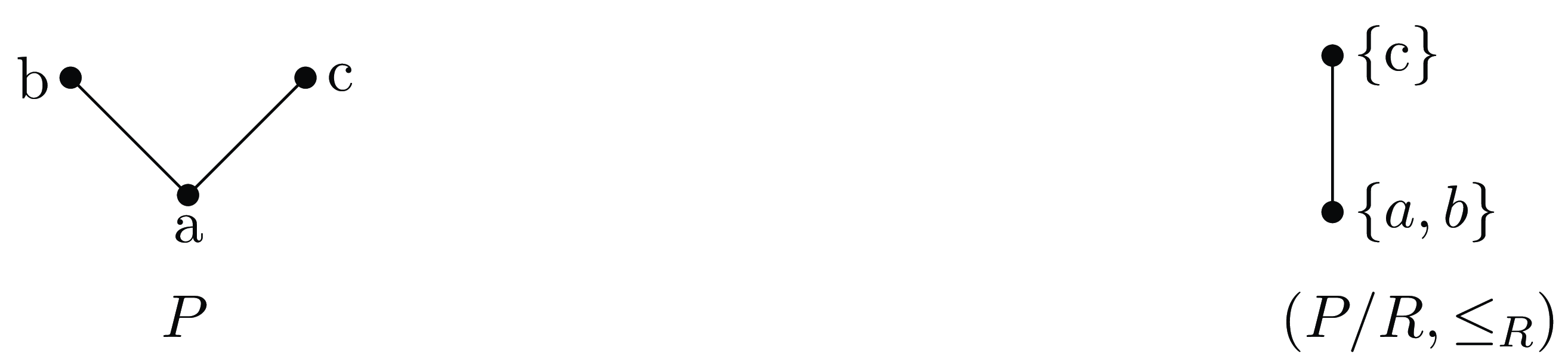
Example 5.12.
Take a domain
 $P$
, as given in the following:
 \begin{align*} P=\{a,b,c\}\textrm { with the order }a\leq b,\, a\leq c. \end{align*}
Consider
 $R$
is an equivalence relation composed of two blocks
 $\{a,b\}$
and
 $\{c\}$
. Then,
 $(P/R,\leq _{R})$
is a domain. It is easy to show that Conditions 1, 2, and 4 in Definition 5.1 hold. For Condition 3, we can see that
 $a\leq c$
and
 $a\mathrel {R}b$
, but
 $c$
is the only element of the block
 $\{c\}$
and
 $b\nleq c$
. Hence,
 $R$
does not hold the link property. The Hasse diagrams see Figure 4.
Let
 $B$
be a nonempty subset of a set
 $P$
. Recall that the equivalence relation on
 $P$
with
 $B$
being its only nontrivial block is called the Rees equivalence relation and denoted by
 $R_{B}$
(see Mahmoudi et al. (Reference Mahmoudi, Moghbeli and Pióro2017)). That is,
 $p \mathrel {R_{B}} q$
if and only if
 $p=q$
or
 $p,q\in B$
. To simplify the notation, we write
 $P/B$
and
 $[p]_{B}$
instead of
 $P/R_{B}$
and
 $[p]_{R_{B}}$
, respectively.
Example 5.13.
Let
 $\mathbb{N}=\{0,1,2,\cdots \}$
and
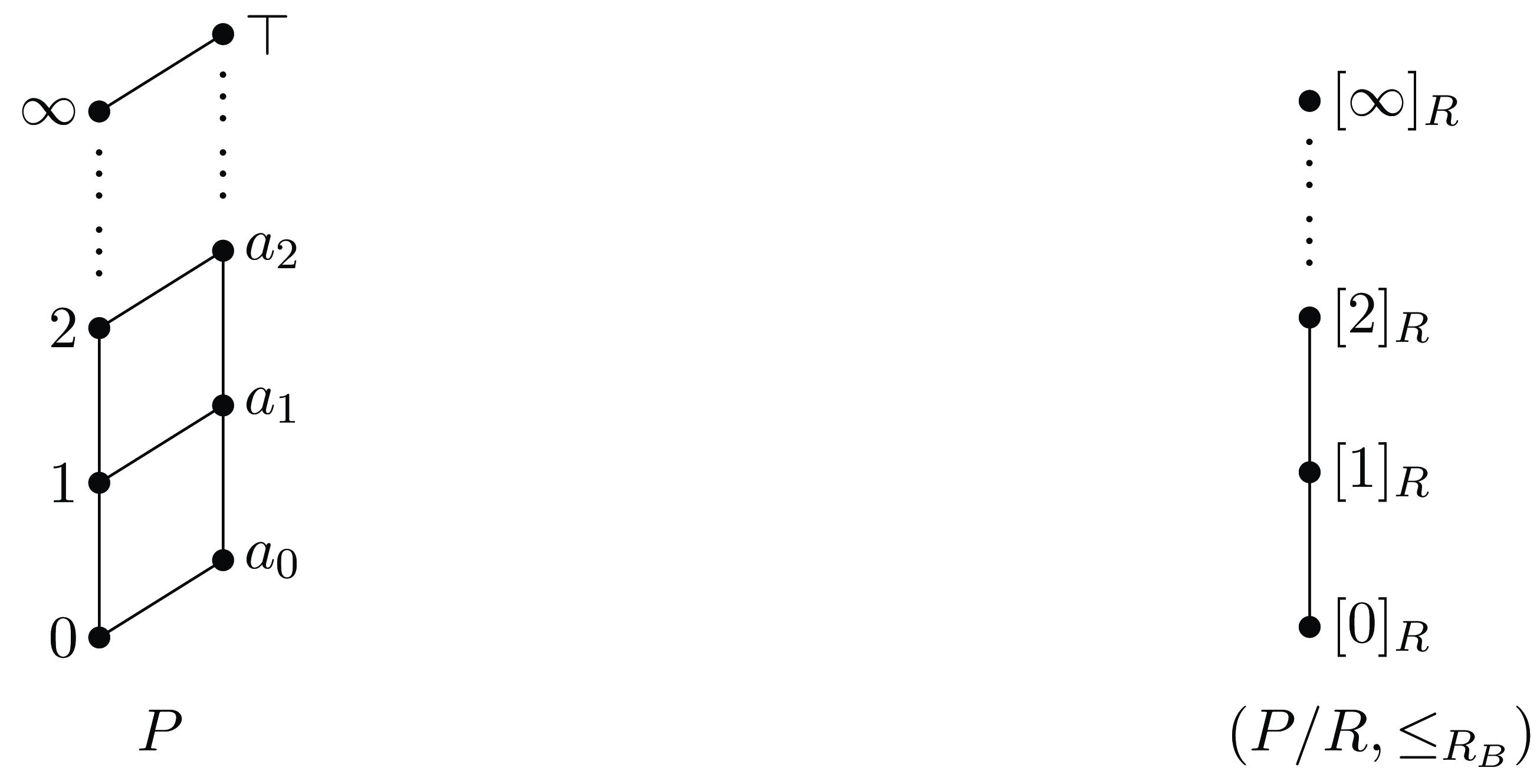
 $P=\mathbb{N}\cup \{\infty \}\cup \{a_{n}\mid n\in \mathbb{N}\}\cup \{\top \}$
. The order
 $\leq$
on
 $P$
is defined as follows:
-
•
$n\leq \infty$
for all
$n\in \mathbb{N}$
; -
•
$0\leq 1\leq 2\leq \cdots \leq n\leq \cdots$
; -
•
$n\leq a_{n}$
for all
$n\in \mathbb{N}$
; -
•
$a_{0}\leq a_{1}\leq a_{2}\leq \cdots \leq a_{n}\leq \cdots$
; -
•
$a_{n}\leq \top$
for all
$n\in \mathbb{N}$
; -
•
$\infty \leq \top$
.


Then,
 $P$
is a domain. Consider
 $R_{B}$
is the Rees equivalence relation with the nontrivial block
 \begin{align*} B=\{a_{n}\mid n\in \mathbb{N}\}\cup \{\infty ,\top \}. \end{align*}
Now, we could see that Conditions 2 and 3 of Definition 5.1 hold. Moreover,
 $\sup [p]_{B}$
exists for all
 $p\in P$
. However,
 $\{\sup [p]_{B}\mid p\in P\}$
is not a subdcpo. So, Condition 4 given in Definition 5.1 does not hold. For Condition 1, we get that the quotient set
 $P/B$
with the relation
 $\leq _{R_{B}}$
is a domain and the quotient map
 $q:P\rightarrow (P/B,\leq _{R_{B}})$
is Scott-continuous. It implies that
 $R_{B}$
is a subdcpo of
 $P\times P$
. Whence
 $R_{B}$
satisfies Condition 1 of Definition 5.1. The Hasse diagrams see Figure 5
.
The Hasse diagrams in Example 5.12.

The Hasse diagrams in Example 5.13.

6. II-Homomorphisms on Domains
In this section, we define the concept of II-homomorphism on domains, for which analogs of the homomorphism and isomorphism theorems of universal algebras hold.
Definition 6.1.
Let
 $P$
and
 $Q$
be posets. A Scott-continuous map
 $f:P\rightarrow Q$
is called a II-homomorphism if
 $\mathrm{card}(\,f(P))=1$
or it preserves the way-below relation
 $\ll$
and for any
 $x,y\in P$
,
 $f$
satisfies the following equation:
 \begin{align*} \mathord {\uparrow } f(\mathord {\uparrow } x\cap \mathord {\uparrow } y)=\mathord {\uparrow } f(x)\cap \mathord {\uparrow } f(y). \end{align*}
Proposition 6.2.
Let
 $P$
and
 $Q$
be posets and
 $f:P\rightarrow Q$
a map. If
 $P$
is actually a sup semilattice, then the following are equivalent:
-
(1) for all elements
$x,y\in P$
,
$f$
satisfies the following equation:
\begin{align*} \mathord {\uparrow } f(\mathord {\uparrow } x\cap \mathord {\uparrow } y)=\mathord {\uparrow } f(x)\cap \mathord {\uparrow } f(y); \end{align*}
-
(2) for all elements
$x,y\in P$
, we have that
$f(x\vee y)=f(x)\vee f(y)$
, that is,
$f$
preserves sups of finite sets.


By Proposition 2.4
, if
 $f$
is surjective, then the above conditions are equivalent to the following equation:
 \begin{align*} f(\mathord {\uparrow } x\cap \mathord {\uparrow } y)=\mathord {\uparrow } f(x)\cap \mathord {\uparrow } f(y),\textrm { for all }x,y\in P \end{align*}
Proof.
 $(1)\Rightarrow (2)$
: Let
 $x,y\in P$
and
 $x\leq y$
. Then,
 $y\in \mathord {\uparrow } x\cap \mathord {\uparrow } y$
. Whence
 \begin{align*} f(y)\in \mathord {\uparrow } f(\mathord {\uparrow } x\cap \mathord {\uparrow } y)=\mathord {\uparrow } f(x)\cap \mathord {\uparrow } f(y). \end{align*}
It implies that
 $f(x)\leq f(y)$
. Thus,
 $f$
is order-preserving. The same argument gives that
 $f(x\vee y)$
is an upper bound of
 $f(x)$
and
 $f(y)$
. Let
 $z$
be another upper bound of
 $f(x)$
and
 $f(y)$
. Then,
 $z\in \mathord {\uparrow } f(x)\cap \mathord {\uparrow } f(y)=\mathord {\uparrow } f(\mathord {\uparrow } x\cap \mathord {\uparrow } y)$
. It means that there is an element
 $p\in \mathord {\uparrow } x\cap \mathord {\uparrow } y$
such that
 $f(p)\leq z$
. Note that
 $x,y\leq p$
. Since
 $P$
is a sup semilattice,
 $x\vee y$
exists and
 $x\vee y\leq p$
. We get that
 $f(x\vee y)\leq f(p)\leq z$
. Hence,
 $f(x\vee y)=f(x)\vee f(y)$
. Thus,
 $f$
preserves sups of finite subsets.
 $(2)\Rightarrow (1)$
: Since
 $f$
preserves sups of finite sets, then
 $f$
is order-preserving. So,
 $\mathord {\uparrow } f(\mathord {\uparrow } x\cap \mathord {\uparrow } y)\subseteq \mathord {\uparrow } f(x)\cap \mathord {\uparrow } f(y)$
. Conversely, let
 $z\in \mathord {\uparrow } f(x)\cap \mathord {\uparrow } f(y)$
. Then,
 $f(x)\leq z$
and
 $f(y)\leq z$
. It implies that
 $f(x\vee y)=f(x)\vee f(y)\leq z$
. Note that
 $x\vee y\in \mathord {\uparrow } x\cap \mathord {\uparrow } y$
. It follows that
 $f(x\vee y)\in f(\mathord {\uparrow } x\cap \mathord {\uparrow } y)$
. Thus,
 $z\in \mathord {\uparrow } f(\mathord {\uparrow } x\cap \mathord {\uparrow } y)$
. Hence,
 $\mathord {\uparrow } f(x)\cap \mathord {\uparrow } f(y)\subseteq \mathord {\uparrow } f(\mathord {\uparrow } x\cap \mathord {\uparrow } y)$
. Therefore,
 $\mathord {\uparrow } f(x)\cap \mathord {\uparrow } f(y)=\mathord {\uparrow } f(\mathord {\uparrow } x\cap \mathord {\uparrow } y)$
.
Theorem 6.3.
Let
 $P$
and
 $Q$
be posets and
 $f:P\rightarrow Q$
a map. If
 $P$
is a complete lattice, consider the following conditions:
-
(1)
$f$
is a II-homomorphism;
-
(2)
$f$
preserves sups of arbitrary subsets and the way-below relation
$\ll$
.


Then,
 $(2)\Rightarrow (1)$
. Furthermore, if
 $f$
is surjective,
 $(1)\Rightarrow (2)$
.
Proof.
Since
 $P$
is a complete lattice, the map
 $f$
preserving sups of arbitrary subsets implies it is Scott-continuous and preserves sups of finite sets. Thus,
 $(2)\Rightarrow (1)$
by Proposition 6.2. When
 $f$
is surjective, the whole proof will be complete if we prove the following.
 $(1)\Rightarrow (2)$
: If
 $\mathrm{card}(\,f(P))=1$
, then it is easy to verify that
 $f$
preserves sups of arbitrary subsets and the way-below relation
 $\ll$
by the assumption that
 $f$
is surjective. Otherwise, since
 $f$
is Scott-continuous and preserves sups of finite sets, we have that
 $f$
preserves sups of nonempty subsets. It suffices to prove that
 $f$
preserves sups of the empty subset. We know that
 $\sup \emptyset =\bot$
. So,
 $f(\!\sup \emptyset )=f(\bot )$
. Note that
 $f(\bot )$
is a lower bound of
 $f(P)$
and
 $f(\bot )\in f(P)$
. Therefore,
 $f(\bot )$
is the smallest element in
 $f(P)$
. As
 $f$
is a surjective map,
 $f(P)=Q$
. This implies that
 $f(\bot )$
is the smallest element in
 $Q$
. Thus,
 $\sup f(\emptyset )=f(\bot )$
. It follows that
 $f(\!\sup \emptyset )=\sup f(\emptyset )$
. Whence we get that
 $f$
preserves sups of arbitrary subsets.
Lemma 6.4.
If
 $f:P\rightarrow Q$
is an order-preserving map between posets which has an upper adjoint, then it is Scott-continuous and for all
 $x,y\in P$
,
 $f$
satisfies the following equation:
 \begin{align*} \mathord {\uparrow } f(\mathord {\uparrow } x\cap \mathord {\uparrow } y)=\mathord {\uparrow } f(x)\cap \mathord {\uparrow } f(y). \end{align*}
Proof.
Since
 $f$
has an upper adjoint, there is an order-preserving map
 $g:Q\rightarrow P$
such that
 $(g,f)$
is an adjunction. By Lemma 2.15,
 $f$
preserves existing sups. So it is Scott-continuous. Thus, for all
 $x,y\in P$
,
 $\mathord {\uparrow } f(\mathord {\uparrow } x\cap \mathord {\uparrow } y)\subseteq \mathord {\uparrow } f(x)\cap \mathord {\uparrow } f(y)$
. Conversely , let
 $z\in \mathord {\uparrow } f(x)\cap \mathord {\uparrow } f(y)$
. Then
 $f(x)\leq z$
and
 $f(y)\leq z$
. So,
 $x\leq g(z)$
and
 $y\leq g(z)$
. It follows that
 $g(z)\in \mathord {\uparrow } x\cap \mathord {\uparrow } y$
. Hence,
 $fg(z)\in f(\mathord {\uparrow } x\cap \mathord {\uparrow } y)$
. Note that
 $fg(z)\leq z$
by Theorem2.13. Therefore,
 $z\in \mathord {\uparrow } f(\mathord {\uparrow } x\cap \mathord {\uparrow } y)$
. This implies that
 $\mathord {\uparrow } f(x)\cap \mathord {\uparrow } f(y)\subseteq \mathord {\uparrow } f(\mathord {\uparrow } x\cap \mathord {\uparrow } y)$
. Whence we get that for all
 $x,y\in P$
,
 $f$
satisfies the equation:
 $\mathord {\uparrow } f(\mathord {\uparrow } x\cap \mathord {\uparrow } y)=\mathord {\uparrow } f(x)\cap \mathord {\uparrow } f(y)$
.
Theorem 6.5.
Let
 $P$
be a dcpo and
 $Q$
a poset. If a map
 $f:P\rightarrow Q$
is surjective, then the following are equivalent:
-
(1)
$f$
has an upper adjoint;
-
(2)
$f$
is Scott-continuous and for all
$x,y\in P$
, it satisfies the following equation:
\begin{align*} f(\mathord {\uparrow } x\cap \mathord {\uparrow } y)=\mathord {\uparrow } f(x)\cap \mathord {\uparrow } f(y). \end{align*}


Proof.
It remains to prove that
 $(2)\Rightarrow (1)$
. For each
 $q\in Q$
, as
 $f$
is surjective,
 $f^{-1}(q)\neq \emptyset$
. Let
 $d_{1},d_{2}\in f^{-1}(q)$
. Then,
 $f(d_{1})=f(d_{2})=q$
. It implies that
 $q\in \mathord {\uparrow } f(d_{1})\cap \mathord {\uparrow } f(d_{2})$
. Since
 $f(\mathord {\uparrow } d_{1}\cap \mathord {\uparrow } d_{2})=\mathord {\uparrow } f(d_{1})\cap \mathord {\uparrow } f(d_{2})$
, there exists
 $d_{3}\in \mathord {\uparrow } d_{1}\cap \mathord {\uparrow } d_{2}$
such that
 $f(d_{3})=q$
. So,
 $f^{-1}(q)$
is directed. Because
 $P$
is a dcpo,
 $\sup f^{-1}(q)$
exists. Define a map
 $g:Q\rightarrow P$
by
 $q\mapsto \sup f^{-1}(q)$
, where
 $q\in Q$
.
Claim 1:
 $g$
is order-preserving.
Let
 $q_{1},q_{2}\in Q$
and
 $q_{1}\leq q_{2}$
. Since
 $f$
is surjective, there exist
 $p_{1},p_{2}\in P$
such that
 $f(p_{1})=q_{1}$
and
 $f(p_{2})=q_{2}$
. For each element
 $x\in f^{-1}(q_{1})$
, we get that
 $f(x)=q_{1}$
. So,
 $q_{2}\in \mathord {\uparrow } f(x)\cap \mathord {\uparrow } f(p_{2})$
. As
 $f(\mathord {\uparrow } x\cap \mathord {\uparrow } p_{2})=\mathord {\uparrow } f(x)\cap \mathord {\uparrow } f(p_{2})$
, there exists an element
 $y\in \mathord {\uparrow } x\cap \mathord {\uparrow } p_{2}$
such that
 $f(y)=q_{2}$
. Note that
 $x\leq y$
and
 $y\in f^{-1}(q_{2})$
. It implies that
 $x\leq \sup f^{-1}(q_{2})$
. Thus,
 $\sup f^{-1}(q_{1})\leq \sup f^{-1}(q_{2})$
. It follows that
 $g(q_{1})\leq g(q_{2})$
. Hence, the map
 $g$
is order-preserving.
Claim 2:
 $(g,f)$
is an adjunction.
For all pairs of elements
 $(p,q)\in P\times Q$
, first, let
 $f(p)\leq q$
. Then there exists an element
 $x\in P$
such that
 $f(x)=q$
. So,
 $q\in \mathord {\uparrow } f(p)\cap \mathord {\uparrow } f(x)=f(\mathord {\uparrow } p\cap \mathord {\uparrow } x)$
. Thus, there is an element
 $y\in \mathord {\uparrow } p\cap \mathord {\uparrow } x$
such that
 $f(y)=q$
. Hence,
 $p\leq y\leq \sup f^{-1}(q)$
. So,
 $p\leq g(q)$
. Second, let
 $p\leq g(q)$
. Since
 $f$
is Scott-continuous,
 \begin{align*} f(p)\leq f(g(q))=f(\!\sup f^{-1}(q))=\sup f(\,f^{-1}(q))=q. \end{align*}
Thus,
 $(g,f)$
is an adjunction.
Proposition 6.6.
Let
 $P$
be a dcpo and
 $Q$
a poset. For a Scott-continuous map
 $f:P\rightarrow Q$
which satisfies the following equation:
 \begin{align*} \mathord {\uparrow } f(\mathord {\uparrow } x\cap \mathord {\uparrow } y)=\mathord {\uparrow } f(x)\cap \mathord {\uparrow } f(y), \end{align*}
for all
 $x,y\in P$
, consider its image
 $f(P)$
in
 $Q$
with the induced order. Then the following properties hold.
-
(1) If
$X$
is a subset of
$f(P)$
and
$f^{-1}(X)$
has a sup in
$P$
, then
$X$
has a sup in
$f(P)$
and
$\sup _{f(P)}X=f(\!\sup _{P} f^{-1}(X))$
. -
(2) If
$P$
is a semilattice, a lattice, a bounded complete dcpo, a complete lattice, respectively, then the same holds for
$f(P)$
.


Proof.
(1) Let
 $X\subseteq f(P)$
and
 $\sup _{P} f^{-1}(X)$
exist. For
 $f:P\rightarrow f(P)$
, we have that
 $f(\mathord {\uparrow } x\cap \mathord {\uparrow } y)=\mathord {\uparrow }_{f(P)}f(x)\cap \mathord {\uparrow }_{f(P)}f(y)$
for all
 $x,y\in P$
. By Theorem6.5, we deduce that
 $f$
has an upper adjoint
 $g$
. So,
 $f(\!\sup _{P} f^{-1}(X))=\sup f(\,f^{-1}(X))=\sup _{f(P)}X$
by Lemma 2.15.
(2) We only prove (2) for
 $P$
which is a semilattice because the other cases are covered by (1). Suppose that
 $P$
is a semilattice. Let
 $q_{1},q_{2}\in f(P)$
. Then,
 $g(q_{1}),g(q_{2})\in P$
. Since
 $P$
is a semilattice,
 $g(q_{1})\wedge _{P} g(q_{2})$
exists. We claim that
 $f(g(q_{1})\wedge _{P}g(q_{2}))=q_{1}\wedge _{f(P)}q_{2}$
. Note that
 $g(q_{1})\wedge _{P}g(q_{2})\leq g(q_{1})$
and
 $g(q_{1})\wedge _{P}g(q_{2})\leq g(q_{2})$
, it implies that
 $f(g(q_{1})\wedge _{P}g(q_{2}))\leq q_{1}$
and
 $f(g(q_{1})\wedge _{P}g(q_{2}))\leq q_{2}$
. Thus, we conclude that
 $f(g(q_{1})\wedge _{P}g(q_{2}))$
is a lower bound of
 $q_{1}$
and
 $q_{2}$
. Let
 $q\in f(P)$
be another lower bound of
 $q_{1}$
and
 $q_{2}$
. Then there exists an element
 $p\in P$
such that
 $f(p)=q$
. It means that
 $f(p)\leq q_{1}$
and
 $f(p)\leq q_{2}$
. Whence
 $p\leq g(q_{1})$
and
 $p\leq g(q_{2})$
. Thus,
 $p\leq g(q_{1})\wedge _{P}g(q_{2})$
. So,
 $f(p)=q\leq f(g(q_{1})\wedge _{P}g(q_{2}))$
by the monotonicity of
 $f$
. Therefore,
 $f(g(q_{1})\wedge _{P}g(q_{2}))$
is the largest lower bound of
 $q_{1}$
and
 $q_{2}$
in
 $f(P)$
. It follows that
 $f(P)$
is a semilattice.
By Lemma 2.16 and Theorem6.5, we can get the following corollary directly.
Corollary 6.7.
Let
 $P$
be a domain and
 $Q$
a poset. For a map
 $f:P\rightarrow Q$
, consider the following two conditions:
-
(1)
$f$
has an upper adjoint
$g$
and
$g$
is Scott-continuous.
-
(2)
$f$
preserves sups of directed subsets and the way-below relation
$\ll$
and for all
$x,y\in P$
, satisfies the following equation:
\begin{align*} \mathord {\uparrow } f(\mathord {\uparrow } x\cap \mathord {\uparrow } y)=\mathord {\uparrow } f(x)\cap \mathord {\uparrow } f(y). \end{align*}


Then
 $(1)\Rightarrow (2)$
, and if the map
 $f:P\rightarrow Q$
is surjective, then the above two conditions are equivalent.
Theorem 6.8.
Let
 $M$
be the image of a II-homomorphism
 $f: P\rightarrow Q$
. If
 $P$
is a domain, an
 $L$
-domain, a bounded complete domain, a continuous semilattice, and a continuous lattice, then the same is true for the image
 $M$
.
Proof.
If
 $\mathrm{card}(M)=1$
, then the conclusions naturally hold. Otherwise, for
 $f:P\rightarrow f(P)$
, there exists a Scott-continuous map
 $g:f(P)\rightarrow P$
which is an upper adjoint of
 $f$
by Corollary 6.7. Since
 $f:P\rightarrow f(P)$
is surjective, we have that
 $f\circ g=id_{f(P)}$
by Proposition 2.14. Whence
 $f(P)$
is a Scott retract of
 $P$
. Because
 $P$
is a domain and the property of being a domain is preserved under Scott retracts, it follows that
 $f(P)$
is also a domain. As the various completeness properties are preserved under II-homomorphisms (see Proposition 6.6), we get the conclusions immediately.
Theorem 6.9. (II-Homomorphism theorem). Let
 $P$
and
 $Q$
be domains, and
 $f:P\rightarrow Q$
be a II-homomorphism. Then,
 $ker(\,f)=\{(x,y)\in P\times P\mid f(x)=f(y)\}$
is a II-congruence relation on
 $P$
and
 $f(P)\cong P/ker(\,f)$
.
Proof.
If
 $\mathrm{card}(\,f(P))=1$
, then
 $ker(\,f)=P\times P$
, it is a II-congruence relation on
 $P$
. Otherwise, for
 $f:P\rightarrow f(P)$
, we have that
 $f$
is a surjective II-homomorphism. It implies that there exists a Scott-continuous map
 $g:f(P)\rightarrow P$
which is an upper adjoint of
 $f$
by Corollary 6.7. Based on Theorem2.17, the kernel of a lower adjoint is that of a closure operator and by Theorem5.3
 $ker(\,f)$
is a II-congruence relation on
 $P$
and
 $f(P)\cong P/ker(\,f)$
, because the kernels of closure operators are characterized as II-congruence relations on
 $P$
.
By Theorem6.9, we get the following corollary.
Corollary 6.10. (II-Isomorphism theorem). Let
 $P$
,
 $Q$
be domains and
 $f:P\rightarrow Q$
be a surjective II-homomorphism. Then
 $ker(\,f)=\{(x,y)\in P\times P\mid f(x)=f(y)\}$
is a II-congruence relation on
 $P$
and
 $Q\cong P/ker(\,f)$
.
7. Applications
This section is devoted to giving some applications of the results of domains to continuous semilattices,
 $L$
-domains, bounded complete domains, and continuous lattices.
Evidently, the kernels of I-homomorphisms and II-homomorphisms between domains and I-congruence relations and II-congruence relations on domains are practically the same thing on account of the I-homomorphism theorem, respectively II-homomorphism theorem. By Theorems4.2 and 6.8, the images of I-homomorphism and II-homomorphism from an
 $L$
-domain, a bounded complete domain, a continuous semilattice, and a continuous lattice also have the same property. Thus, we can give the definition of I-congruence relation and II-congruence relation on
 $L$
-domains, bounded complete domains, continuous semilattices, and continuous lattices, respectively. These conclusions are consistent with those on domains.
Applying the above results to continuous semilattices, we obtain a positive answer to an open problem on homomorphisms and quotients of continuous semilattices in Gierz et al. (Reference Gierz, Hofmann, Keimel, Lawson, Mislove and Scott2003) (the second problem on page 92 of Gierz et al. (Reference Gierz, Hofmann, Keimel, Lawson, Mislove and Scott2003)). Furthermore, for I-congruence relation on continuous semilattices, we have a more complete picture.
Theorem 7.1.
Let
 $P$
be a continuous semilattice and
 $R\neq P\times P$
an equivalence relation on
 $P$
. Then, the following conditions are equivalent:
-
(1)
$R$
is a I-congruence relation on
$P$
; -
(2)
$(a)$
$R$
is closed in
$P\times P$
under the formation of finite infs and directed sups,
$(b)$
for
$x\in P$
,
$[x]_{R}$
has the smallest element in
$P$
.


Proof.
 $(1)\Rightarrow (2)$
: It remains to prove that
 $R$
is closed in
 $P\times P$
under finite infs. Since
 $R$
is a I-congruence relation, we conclude that the quotient set
 $P/R$
with a suitable order is a continuous semilattice in such a way that the quotient map
 $q:P\rightarrow P/R$
is an upper adjoint preserving sups of directed sets by Theorem3.3. From Lemma 2.15,
 $q$
preserves finite infs. Let
 $(a,b),(c,d)\in R$
. Then,
 $q(a)=q(b)$
and
 $q(c)=q(d)$
. Note that
 $q(a)\wedge q(c)=q(a\wedge c)$
and
 $q(b)\wedge q(d)=q(b\wedge d)$
. So,
 $q(a\wedge c)=q(b\wedge d)$
. It follows that
 $(a\wedge c,b\wedge d)\in R$
. Whence
 $R$
is closed in
 $P\times P$
under finite infs.
 $(2)\Rightarrow (1)$
: We only need to prove that
 $R$
satisfies the dual-link property. Let
 $a,b,b^{\ast }\in P$
. If
 $a\leq b$
and
 $b\mathrel {R}b^{\ast }$
, then
 $(a,a),(b,b^{\ast })\in R$
. As
 $R$
is closed in
 $P\times P$
under finite infs,
 $(a,a)\wedge (b,b^{\ast })=(a,a\wedge b^{\ast })\in R$
. It implies that
 $a\wedge b^{\ast }\leq b^{\ast }$
and
 $a\mathrel {R}a\wedge b^{\ast }$
. Thus,
 $R$
satisfies the dual-link property.
Second, we consider the case of
 $L$
-domains. For I-congruence relation on
 $L$
-domains, we find that it is a generalization of the congruence relation on
 $L$
-domains introduced in Jin and Li (Reference Jin and Li2022).
Lemma 7.2.
Let
 $P$
and
 $Q$
be posets and
 $f:P\rightarrow Q$
a map. For arbitrary subset
 $A$
of
 $P$
, if
 $f$
satisfies the following equation:
 \begin{align*} \mathord {\downarrow } f(\!\cap _{a\in A}\mathord {\downarrow } a)=\cap _{a\in A}\mathord {\downarrow } f(a), \end{align*}
then
 $f$
preserves existing infs.
Proof.
By Proposition 2.4,
 $f$
is order-preserving. Assume that
 $A$
is an arbitrary subset in
 $P$
for which
 $\inf A$
exists. As
 $f$
is order-preserving, we have that
 $f(\!\inf A)$
is a lower bound of
 $f(A)$
. Suppose
 $q$
is another lower bound of
 $f(A)$
in
 $Q$
. Then,
 $q\in \cap _{a\in A}\mathord {\downarrow } f(a)$
. Since
 $\mathord {\downarrow } f(\!\cap _{a\in A}\mathord {\downarrow } a)=\cap _{a\in A}\mathord {\downarrow } f(a)$
,
 $q\in \mathord {\downarrow } f(\!\cap _{a\in A}\mathord {\downarrow } a)$
. Thus, there is an element
 $x\in \cap _{a\in A}\mathord {\downarrow } a$
such that
 $q\leq f(x)$
. Note that
 $x\leq a$
, for any
 $a\in A$
, which implies that
 $x\leq \inf A$
. So
 $q\leq f(x)\leq f(\!\inf A)$
. Thus,
 $f(\!\inf A)=\inf f(A)$
.
Theorem 7.3.
Let
 $P$
and
 $Q$
be posets and
 $f:P\rightarrow Q$
a map. Consider the following two conditions:
-
(1)
$f$
is an upper adjoint;
-
(2) for arbitrary subset
$A$
of
$P$
,
$f$
satisfies the following equation:
\begin{align*} \mathord {\downarrow } f(\!\cap _{a\in A}\mathord {\downarrow } a)=\cap _{a\in A}\mathord {\downarrow } f(a). \end{align*}


Then,
 $(1)\Rightarrow (2)$
. Furthermore, if
 $P$
is an
 $L$
-domain and
 $f$
is a surjective map, then
 $(2)\Rightarrow (1)$
.
Proof.
 $(1)\Rightarrow (2)$
: Let
 $A\subseteq P$
. Since
 $f$
is an upper adjoint, it is order-preserving, we have
 $\mathord {\downarrow } f(\!\cap _{a\in A}\mathord {\downarrow } a)\subseteq \cap _{a\in A}\mathord {\downarrow } f(a)$
. Conversely, let
 $q\in \cap _{a\in A}\mathord {\downarrow } f(a)$
. Then,
 $q\leq f(a)$
, for any
 $a\in A$
. Again since
 $f$
is an upper adjoint, there exists an order-preserving map
 $g:Q\rightarrow P$
such that
 $(\,f,g)$
is an adjunction. Thus,
 $g(q)\leq a$
, for any
 $a\in A$
. It follows that
 $g(q)\in \cap _{a\in A}\mathord {\downarrow } a$
. So,
 $fg(q)\in f(\!\cap _{a\in A}\mathord {\downarrow } a)$
. Because
 $q\leq fg(q)$
,
 $q\in \mathord {\downarrow } f(\!\cap _{a\in A}\mathord {\downarrow } a)$
. Hence,
 $\cap _{a\in A}\mathord {\downarrow } f(a)\subseteq \mathord {\downarrow } f(\!\cap _{a\in A}\mathord {\downarrow } a)$
. Therefore,
 $\mathord {\downarrow } f(\!\cap _{a\in A}\mathord {\downarrow } a)=\cap _{a\in A}\mathord {\downarrow } f(a)$
.
Assume that
 $P$
is an
 $L$
-domain and
 $f$
is a surjective map. If for arbitrary subset
 $A$
of
 $P$
,
 $f$
satisfies the equation:
 $\mathord {\downarrow } f(\!\cap _{a\in A}\mathord {\downarrow } a)=\cap _{a\in A}\mathord {\downarrow } f(a)$
, then define a map
 $g:Q\rightarrow P$
by
 $q\mapsto \inf f^{-1}(q)$
, where
 $q\in Q$
.
Claim 1: For any
 $q\in Q$
,
 $\inf f^{-1}(q)$
exists.
Since
 $f$
is surjective, there exists an element
 $p\in P$
such that
 $f(p)=q$
. Then,
 $\mathord {\downarrow } p\cap f^{-1}(q)\neq \varnothing$
. As
 $P$
is an
 $L$
-domain,
 $\inf (\mathord {\downarrow } p\cap f^{-1}(q))$
exists by Lemma 2.3. For any
 $x\in f^{-1}(q)$
,
 $f(x)=q=f(p)$
. Thus,
 $f(x)\in \mathord {\downarrow } f(x)\cap \mathord {\downarrow } f(p)=\mathord {\downarrow } f(\mathord {\downarrow } x\cap \mathord {\downarrow } p)$
. Hence, there is an element
 $p_{x}\in \mathord {\downarrow } x\cap \mathord {\downarrow } p$
such that
 $f(x)\leq f(p_{x})$
. Because
 $p_{x}\leq x$
, we have
 $f(p_{x})\leq f(x)$
. So,
 $f(x)=f(p_{x})=q$
. That is,
 $p_{x}\in \mathord {\downarrow } p\cap f^{-1}(q)$
. Thus,
 $\inf (\mathord {\downarrow } p\cap f^{-1}(q))\leq p_{x}\leq x$
. It follows that
 $\inf (\mathord {\downarrow } p\cap f^{-1}(q))$
is a lower bound of
 $f^{-1}(q)$
. Let
 $y\in P$
be another lower bound of
 $f^{-1}(q)$
. Then for any
 $z\in \mathord {\downarrow } p\cap f^{-1}(q)$
,
 $y\leq z$
. So,
 $z\leq \inf (\mathord {\downarrow } p\cap f^{-1}(q))$
. Therefore,
 $\inf f^{-1}(q)=\inf (\mathord {\downarrow } p\cap f^{-1}(q))$
.
Thus,
 $g$
is well defined.
Claim 2:
 $g$
is order-preserving.
Let
 $q_{1},q_{2}\in Q$
and
 $q_{1}\leq q_{2}$
. For any
 $a\in f^{-1}(q_{2})$
,
 $f(a)=q_{2}$
. Since
 $f$
is surjective, there exists an element
 $p_{q_{1}}\in P$
such that
 $f(p_{q_{1}})=q_{1}$
. Thus,
 $f(p_{q_{1}})\in \mathord {\downarrow } f(p_{q_{1}})\cap \mathord {\downarrow } f(a)=\mathord {\downarrow } f(\mathord {\downarrow } p_{q_{1}}\cap \mathord {\downarrow } a)$
. It follows that there is an element
 $b\in \mathord {\downarrow } p_{q_{1}}\cap \mathord {\downarrow } a$
such that
 $f(p_{q_{1}})\leq f(b)$
. So
 $f(p_{q_{1}})\leq f(b)\leq f(p_{q_{1}})$
; hence,
 $f(p_{q_{1}})=f(b)=q_{1}$
. Note that
 $b\in f^{-1}(q_{1})$
and
 $b\leq a$
. Then,
 $\inf f^{-1}(q_{1})\leq a$
. So,
 $\inf f^{-1}(q_{1})\leq \inf f^{-1}(q_{2})$
, that is,
 $g(q_{1})\leq g(q_{2})$
.
Claim 3:
 $(\,f,g)$
is an adjunction.
For all pairs of elements
 $(p,q)\in P\times Q$
, first, let
 $g(q)\leq p$
. Then
 $\inf f^{-1}(q)\leq p$
. Thus,
 $f(\!\inf f^{-1}(q))\leq f(p)$
. By Lemma 7.2,
 $f$
preserves existing infs. Hence,
 \begin{align*} f(\!\inf f^{-1}(q))=\inf f(\,f^{-1}(q))=q\leq f(p). \end{align*}
Second, let
 $q\leq f(p)$
. Then
 $g(q)\leq gf(p)$
. Since
 $g(\,f(p))=\inf f^{-1}(\,f(p))=\inf (\mathord {\downarrow } p\cap f^{-1}(\,f(p))\leq p$
, we have
 $g(q)\leq p$
. Thus,
 $(g,f)$
is an adjunction.
So
 $f$
is an upper adjoint. Thus,
 $(2)\Rightarrow (1)$
.
Theorem 7.4.
Let
 $P$
be an
 $L$
-domain and
 $R\neq P\times P$
an equivalence relation on
 $P$
. Then the following conditions are equivalent:
-
(1)
$R$
is a I-congruence relation on
$P$
; -
(2)
$(a)$
$R$
is a subalgebra of
$P\times P$
(i.e.,
$R$
is closed in
$P\times P$
under the formation of infima of nonempty sets bounded from above and directed sups);
$(b)$
for
$x\in P$
,
$[x]_{R}$
has the smallest element in
$P$
; -
(3)
$P/R$
with a suitable order is an
$L$
-domain in such a way that
$q:P\rightarrow P/R$
preserves sups of directed sets and for arbitrary subset
$A$
of
$P$
,
$q$
satisfies the following equation:
\begin{align*} q(\!\cap _{a\in A}\mathord {\downarrow } a)=\cap _{a\in A}\mathord {\downarrow } q(a). \end{align*}


Proof.
By Proposition 2.4 and Theorems3.3, 7.3, we get that
 $(1)\Leftrightarrow (3)$
.
 $(1)\Rightarrow (2)$
: We need to prove that
 $R$
is closed in
 $P\times P$
under nonempty sets bounded above infs. Since (1) and (3) are equivalent and
 $P$
is an
 $L$
-domain, we have that
 $q$
preserves nonempty sets bounded above infs by Lemma 3.5. Let
 $\mathcal{A}$
be an arbitrary nonempty sets bounded above in
 $R$
. Set
 \begin{align*} A_{1}=\{a_{1}\in P\mid \textrm {there exists }a_{2}\in P \textrm { such that }(a_{1},a_{2})\in \mathcal{A}\},\\ A_{2}=\{a_{2}\in P\mid \textrm {there exists }a_{1}\in P \textrm { such that }(a_{1},a_{2})\in \mathcal{A}\}. \end{align*}
Then
 $A_{1}$
and
 $A_{2}$
are nonempty sets bounded above in
 $P$
. Since
 $P$
is an
 $L$
-domain,
 $\inf A_{1}$
and
 $\inf A_{2}$
exist. As
 $q$
preserves nonempty sets bounded above infs, we have
 \begin{align*} q(\!\inf A_{1})=\inf q(A_{1})=\inf q(A_{2})=q(\!\inf A_{2}). \end{align*}
Thus,
 $(\!\inf A_{1},\inf A_{2})\in R$
. So
 $R$
is closed in
 $P\times P$
under the formation of infima of nonempty sets bounded from above.
 $(2)\Rightarrow (1)$
: It is enough to prove that
 $R$
satisfies the dual-link property. Let
 $a,b,b^{\ast }\in P$
. If
 $a\leq b$
and
 $b\mathrel {R}b^{\ast }$
, then
 $(a,a),(b,\inf [b]_{R})\in R$
. Note that
 $(b,b)$
is an upper bound of
 $(a,a)$
and
 $(b,\inf [b]_{R})$
in
 $R$
. By Condition (a) of (2),
 $(a,a)\wedge (b,\inf [b]_{R})=(a,a\wedge \inf [b]_{R})\in R$
. So,
 $\inf [a]_{R}\leq a\wedge \inf [b]_{R}\leq \inf [b]_{R}\leq b^{\ast }$
and
 $a\mathrel {R}\inf [a]_{R}$
. Therefore,
 $R$
satisfies the dual-link property.
Let
 $P$
be an
 $L$
-domain and
 $R$
an equivalence relation on
 $P$
. If
 $R$
is a congruence relation defined in Jin and Li (Reference Jin and Li2022), recall Proposition 4.3 in Jin and Li (Reference Jin and Li2022), we know that each block of
 $R$
is a complete lattice. It follows that each block of
 $R$
has the smallest element. So it is a I-congruence relation on
 $P$
. Therefore, I-congruence relation on
 $L$
-domains is a generalization of the congruence relation on
 $L$
-domains introduced in Jin and Li (Reference Jin and Li2022).
Now we consider the case of continuous lattices. For a continuous lattice
 $P$
, there are various equivalent ways of looking at I-congruence relations and II-congruence relations on
 $P$
, respectively.
In Gierz et al. (Reference Gierz, Hofmann, Keimel, Lawson, Mislove and Scott2003), it introduced a kind of congruence relation on continuous lattices, corresponding to kernel operators which preserve directed sups (see Theorem I-2.15 of Gierz et al. (Reference Gierz, Hofmann, Keimel, Lawson, Mislove and Scott2003)). Next, we will show that it is in fact the I-congruence relation on continuous lattices.
Lemma 7.5. (Gierz et al. (Reference Gierz, Hofmann, Keimel, Lawson, Mislove and Scott2003)). Let
 $f:P\rightarrow Q$
be a map between posets of which
 $P$
is a complete lattice. Then
 $f$
preserves infs of arbitrary sets if and only if
 $f$
is order-preserving and has a lower adjoint.
Theorem 7.6.
Let
 $P$
be a continuous lattice and
 $R$
an equivalence relation on
 $P$
. Then the following conditions are equivalent:
-
(1)
$R$
is a I-congruence relation on
$P$
; -
(2)
$R$
is closed in
$P\times P$
under the formation of arbitrary infs and directed sups;
-
(3)
$P/R$
with a suitable order is a continuous lattice in such a way that the quotient map
$q:P\rightarrow P/R$
preserves infs of arbitrary sets and sups of directed sets.


Proof.
From Theorem I-2.15 in Gierz et al. (Reference Gierz, Hofmann, Keimel, Lawson, Mislove and Scott2003),
 $(2)\Leftrightarrow (3)$
. For
 $R=P\times P$
, since
 $P$
is a continuous lattice,
 $P\times P$
is also a continuous lattice. So,
 $P\times P$
is closed under the formation of arbitrary infs and directed sups. By Theorem3.3 and Lemma 7.5,
 $(1)\Leftrightarrow (3)$
.
Theorem 7.7.
Let
 $P$
be a continuous lattice and
 $R$
an equivalence relation on
 $P$
. Then the following conditions are equivalent:
-
(1)
$R$
is a II-congruence relation on
$P$
; -
(2)
$(a)$
$R$
is closed in
$P\times P$
under the formation of arbitrary sups,
$(b)$
$\{\sup [p]_{R}\mid p\in P\}$
is a subdcpo of
$P$
; -
(3)
$P/R$
with a suitable order is a continuous lattice in such a way that the quotient map
$q:P\rightarrow P/R$
preserves sups of arbitrary sets and the way-below relation
$\ll$
.


Proof. By Theorems6.3 and 5.3, (1) and (3) are equivalent.
 $(3)\Rightarrow (2)$
: We only need to prove Condition
 $(a)$
of (2). Assume that there is an order
 $\leq _{P/R}$
on the quotient set
 $P/R$
such that
 $q:P\rightarrow (P/R,\leq _{P/R})$
preserves sups of arbitrary sets and the way-below relation
 $\ll$
. Let
 $\mathcal{A}$
be an arbitrary subset in
 $R$
. Similar to the proof of
 $(1)\Rightarrow (2)$
in Theorem7.4, we have
 $(\!\sup A_{1},\sup A_{2})\in R$
. So,
 $R$
is closed in
 $P\times P$
under the formation of arbitrary sups.
 $(2)\Rightarrow (1)$
: Since
 $R$
is closed in
 $P\times P$
under arbitrary sups, we would get that
 $R$
is closed in
 $P\times P$
under directed sups. Thus,
 $R$
is a subdcpo of
 $P\times P$
. Let
 $p\in P$
and
 $x,y\in [p]_{R}$
. Then,
 $(x,y),(x,x)\in R$
. It implies that
 $(x,y)\vee (x,x)=(x,x\vee y)\in R$
. So,
 $x\vee y\in [p]_{R}$
; hence,
 $[p]_{R}$
is directed in
 $P$
. It remains to prove that
 $R$
satisfies the link property. For
 $x,y,u\in P$
, if
 $x\leq y$
and
 $x\mathrel {R} u$
, then
 $(x,u),(y,y)\in R$
. So,
 $(x,u)\vee (y,y)=(y,u\vee y)\in R$
, which implies that
 $u\leq u\vee y$
and
 $y\mathrel {R}u\vee y$
. Thus,
 $R$
satisfies the link property.
At last, we give examples to show that the I-congruence relation and II-congruence relation on continuous lattices mentioned above are different.
The Hasse diagrams in Example 7.8.

Example 7.8.
Consider
 $P$
in Example 3.11
. Then
 $P$
is a continuous lattice. Let
 $R$
be an equivalence relation comprising exactly two blocks
 $\{b,c,d\}$
and
 $\{a\}$
. Then
 $P/R=\{\{b,c,d\},\{a\}\}$
with the order
 $\leq _{R}$
is a two-element chain. Note that the block
 $\{b,c,d\}$
does not have the smallest element. So,
 $R$
is not a I-congruence relation on continuous lattices. But it is straightforward to check that
 $R$
is a II-congruence relation on continuous lattices. The Hasse diagrams see Figure 6.
Example 7.9.
Take
 $\mathbb{N}=\{0, 1, 2, \cdots \}$
. Let
 $P=\mathbb{N}\cup \{a,b\}$
, where the order
 $\leq _{P}$
is defined as follows:
-
•
$0\leq 1\leq 2\leq \cdots \leq n\leq \cdots$
; -
•
$n\leq a$
for all
$n\in \mathbb{N}$
; -
•
$n\leq b$
for all
$n\in \mathbb{N}$
; -
•
$a\leq b$
.


Obviously,
 $P$
is a continuous lattice. Let
 $R=\Delta \cup \{(a,b),(b,a)\}$
. Then
 $R$
is an equivalence relation on
 $P$
. Clearly, we can see that the quotient set
 $P/R$
with the order
 $\leq _{R}$
is also a continuous lattice and the quotient map
 $q:P\rightarrow (P/R,\leq _{R})$
preserves infs of arbitrary sets and directed sups. Then,
 $R$
is a I-congruence relation on continuous lattices by Theorem
7.6
. However,
 $\{\sup [p]_{R}\mid p\in P\}=\mathbb{N}\cup \{b\}$
is not a subdcpo of
 $P$
. So, Condition 4 given in Definition 5.1 does not hold. Thus,
 $R$
is not a II-congruence relation on continuous lattices. The Hasse diagrams see Figure 7.
The Hasse diagrams in Example 7.9.

Acknowledgments
We would like to thank the anonymous reviewers for their professional comments and valuable suggestions.
Competing interests
The authors declare that they have no known competing financial interests or personal relationships that could have appeared to influence the work reported in this paper.