


Introduction
Many people still live in underdeveloped and rural areas, which is also a key constraint on socio-economic advancement in developing countries. According to the Global Multidimensional Poverty Index published by the United Nations in 2023, 1.1 billion of the 6.1 billion people are living in poverty. Eradicating poverty and promoting social equality are the United Nations Sustainable Development Goals, so increasing the income welfare of poor people is the key to addressing poverty and inequality (Banerjee and Duflo Reference Banerjee and Duflo2020: Wen and Jiang Reference Wen and Jiang2023). Therefore, there is an urgent need to find a way to increase the income of residents in less developed areas. With the development of digital technology, e-commerce has opened up possibilities for people in rural and underdeveloped areas to escape poverty. E-commerce has made inter-regional connections closer, eliminating or compressing spatial distances (Lendle et al Reference Lendle, Olarreaga, Schropp and Vézina2016), thus facilitating the integration of those in local communities into the global wave of economic and social development (Guo et al Reference Guo, Wang, Zhang, Liang, Feng and Hu2023). E-commerce has not only become an important enabler for the integration of socially marginalised areas into the emerging digital economic ecosystem but also an important engine for improving the income and welfare of residents (Galperin and Fernanda Reference Galperin and Fernanda2017; Couture et al Reference Couture, Faber, Gu and Liu2021).
As a representative emerging country, China’s development also faces huge regional imbalances. Most of China’s old revolutionary areas are located in remote areas, with poor infrastructure, scarce resources, and a serious lag in economic development. Agricultural systems in old revolutionary areas usually consist of small-scale farmers, which, together with geographic constraints, result in these farmers being far from the production of the final product, and thus unable to meet the market demands of consumers. E-commerce not only overcomes these geographical constraints by bridging local business entities with end consumers (Goldmanis et al Reference Goldmanis, Hortaçsu, Syverson and Emre2010; Li and Qin Reference Li and Qin2022) but also provides new business models for local residents (Tang et al Reference Tang, Xiong and Zhang2022), which in turn raises per capita incomes and narrows the income gap between urban and rural residents (Yin and Choi Reference Yin and Choi2022; Liu and Zhou Reference Liu and Zhou2023). The well-being of the people in the old revolutionary areas is thus increased through these processes.
In order to give full play to the income-generating role of e-commerce, the Chinese Government has developed a series of initiatives to promote the development of rural e-commerce. These include the Digital Countryside Strategy, the Comprehensive Demonstration Project on E-commerce in Rural Areas, and the Revitalisation Strategy for Revolutionary Bases (Zhang and Wu Reference Zhang and Wu2021; Yang et al Reference Yang, Shao, Xu and Yang2022). They are aimed at helping the old revolutionary zones not only to realise the conversion of ecological value and improve economic vitality but also to increase the per capita income (Liu et al Reference Liu, Xiong, Yuan, Min, Sun and Fuller2014). Therefore, this study explores the internal law of income generation in the old revolutionary areas and provides insights for policymakers in other regions to formulate targeted policies.
The marginal contributions and innovations of this study are summarised as follows. First, this study explores for the first time the intrinsic pattern of e-commerce development on increasing farmers’ income in old revolutionary areas. Although articles have explored e-commerce poverty alleviation, the impact of e-commerce on old revolutionary areas has never been explored in detail. Secondly, the causes of poverty in the old revolutionary areas are the same as those in most poor areas, so a more in-depth analysis of the relevant internal mechanisms is necessary in order to formulate more targeted policy responses. Thirdly, the policy is analysed as a quasi-natural experiment to improve the accuracy of the conclusions, taking into account the different national contexts of each location and considering possible endogeneity issues.
The structure of this study is organised as follows; This introduction is followed by the background and theoretical analysis. The model design and data are found in the next section, followed by the baseline regression and robustness test. Next come the mechanism analysis and then the heterogeneity test and finally the conclusion and recommendations.
Background and theoretical analysis
Background of old revolutionary base areas in China
Old revolutionary base areas refer to those areas that were led and founded by the Communist Party of China during the Second Revolutionary Civil War and the War of Resistance against Japan in the 1930s and 1940s. The regions comprise 28 provinces and 1,599 counties, accounting for 55% of China’s population and 33% of its total land area (He et al Reference He, Zhou and Wen2024). Historically, because of the needs of the revolutionary struggle, most of the old revolutionary zones were built in remote mountainous areas with dangerous terrain, typical of areas adjacent to provincial borders. The characteristics of the difficult terrain and weak natural endowments have led to the fact that the local modern industrial system has not yet been formed, the level of basic public services is not high, and there has been a serious brain drain, all of which have seriously hampered the economic development of the old revolutionary areas. The backwardness of the old revolutionary areas runs counter to the sustainable development goals of the United Nations. Moreover, the old revolutionary areas belong to a specific type of area, in terms of their geographic, demographic, and economic structures, and are evidently different from that of other rural areas. As a result, some of the ways of increasing the income of residents in other areas may not be applicable to the old revolutionary areas. Therefore, it is crucial to explore how to make farmers in the old revolutionary areas earn more as well as realise high-quality development processes.
Certainly, e-commerce has flourished in rural areas. It has provided a new impetus and a new carrier for the construction of ‘digital villages’, and has gradually become one of the most important tools for promoting farmers’ income growth. In order to promote the development of the old revolutionary areas and respond to the sustainable development goals, studies have been conducted to assess the contribution of e-commerce to the speed and quality of economic growth in the old revolutionary areas. However, there are fewer studies on the empirical analysis of its intrinsic mechanism. Selecting the old revolutionary areas as the research object will fill the research gap, enrich the exploration of regional development planning with Chinese characteristics, and provide valuable perspectives and experiences for promoting the economic development of the same type of impoverished areas for e-commerce.
Policy of e-commerce development in China
In order to promote the development of e-commerce nationwide, China promulgated the Twelfth Five-Year Plan for the Development of E-Commerce in 2012 with the aim of improving the e-commerce system and creating a secure, trustworthy, standardised, and orderly environment. In 2016, the 13th Five-Year Plan for the Development of E-Commerce was promulgated with the objective of accelerating the pace of e-commerce and upgrading and promoting deep integration of e-commerce into traditional industries.
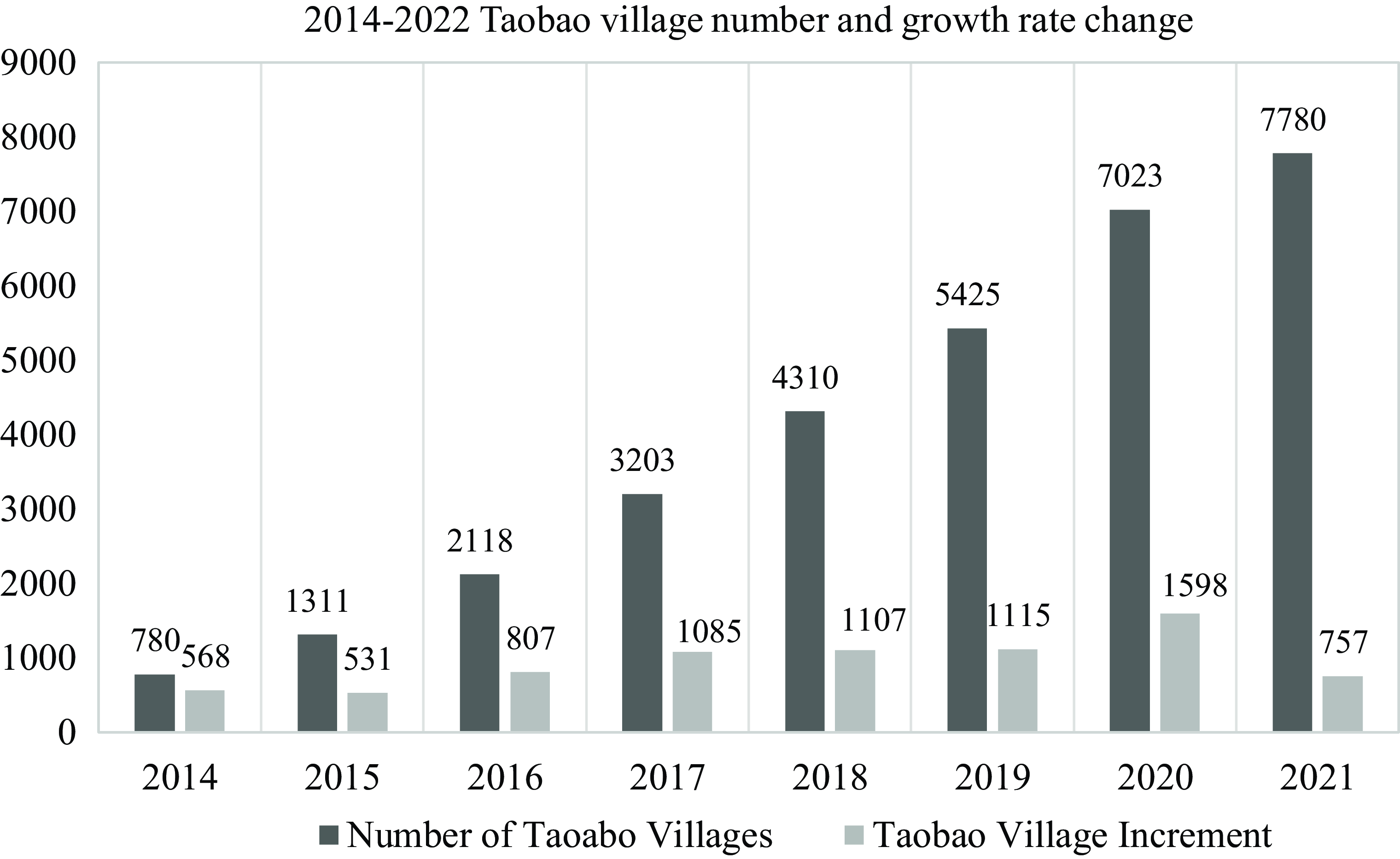
In order to promote the development of e-commerce in the old revolutionary areas, China’s Ministry of Finance and Ministry of Commerce jointly issued the Circular on the Comprehensive Demonstration of E-commerce in Rural Areas in 2014. The policy increased the number of e-commerce platforms in the old revolutionary areas in many ways, especially the number of so-called Taobao villages, which became the main rural e-commerce platforms. Figure 1 shows in concrete terms that the policy has significantly increased the number of Taobao villages, and their communities.
Results of the effect of policy on the number of Taobao villages.
Theoretical analysis of e-commerce effects on farmers’ well-being
The development of e-commerce in old revolutionary areas has helped to increase both farmers’ trust and awareness of society, and their income levels, thus enhancing their well-being. The use of the internet has thus had a significant positive impact on agricultural product prices and farmer welfare (Khanal et al Reference Khanal, Mishra and Koirala2015). E-commerce development can both enhance an individual’s well-being through the direct effect of receiving self-affirmation (Yin et al Reference Yin, Li and Yang2021), as well as by facilitating the efficient transfer of information, breaking down the information barriers between farmers and the market, so solving the problems of asymmetric information and poor marketing for disadvantaged groups (Sun et al Reference Sun, Zhang and Jiang2017). The development of rural e-commerce can effectively help farmers achieve local employment, which in turn improves their social capital and entrepreneurship (Wang and He Reference Wang and He2020; Liu and Han Reference Liu and Han2018). There are numerous positive effects including the enabling of agricultural production to be more scientific, the simplification of intermediate links, and capacity to make smarter sales decisions that reduce the blindness of agricultural production. All of these effects improve transaction efficiency and promote farmers’ income (Correa et al Reference Correa, Pavez and Contreras2017; Cui et al Reference Cui, Pan, Newell and Cui2017).
The development of e-commerce also fosters equal opportunities between urban and rural areas (Xu and Wen Reference Xu, Lv and Wen2015). It is not surprising then that e-commerce has become increasingly prominent in the rural areas of many developing countries. E-commerce not only breaks the spatial distance amongst economic activities and significantly reduces transaction costs but also lowers the threshold of rural economic development and creates more employment opportunities for migrant workers, thereby narrowing the digital divide and increasing the information dividend (Larose et al Reference LaRose, Strover, Gregg and Straubhaar2011). These advantages make e-commerce a potent tool to increase farmers’ income and encourage rural residents’ participation. The development of e-commerce promotes the modernisation of rural communities (Leong et al Reference Leong, Pan, Newell and Cui2016). The development of e-commerce platform has promoted the local rural revitalisation, urban-rural integration, and community governance transformation, which will further enhance the driving role of residents’ income, even in the remote old revolutionary base areas (Zhou 2019).
The increase in the level of farmers’ income not only more fully meets the basic needs of farmers and improves their quality of life but also helps to slow down the disparity between the rich and the poor; in other words, e-commerce can enhance social equality and fairness. Rural e-commerce allows resources to be effectively distributed across space and geography, which is conducive to alleviating the inequality of opportunity faced by farmers, which will improve their sense of well-being, making it possible to enhance the well-being of farmers. Figure 2 shows the mechanism by which e-commerce affects the income.
Mechanism of e-commerce development affecting the rural income.

Theoretical analysis of mechanism function
Direct mechanism and research hypotheses
In many developing countries, small-scale agricultural systems and imperfect markets can prevent small farmers from benefiting from market transactions. It is apparent that e-commerce can help these farmers overcome the barriers to market access (Li and Qin Reference Li and Qin2022). Moreover, e-commerce development improves the rural commodity flow system, connecting local products to the outside world (Wen et al Reference Wen, Chen and Zhou2023). Further, e-commerce also facilitates the development of characteristic rural resources and promotes the inflow of information, people, and capital. The diffusion of these key production factors from urban to rural regions can contribute to improving rural productivity (Zhang et al Reference Zhang, Long, Ma, Tu, Li and Ge2022). As a result, farmers are able to carry out or expand agricultural production. With the establishment of e-commerce platforms and the improvement of network information facilities and logistics infrastructure, the transaction costs of goods have been reduced. An adequate market feedback mechanism helps improve market efficiency, thereby increasing agricultural output (Jensen Reference Jensen2007). As the market trading volume of farmers in the old revolutionary bases under focus in this study increases, farmers will also expand their agricultural output.
According to the theory of the industrial void, the traditional model of economic operation divides agriculture into three segments: the pre-production segment is classified as industry, the post-production segment is classified as commerce, and farmers only account for the intermediate segment. But rural e-commerce ‘to intermediary’ characteristics of the farmers to change the main docking market must go through the intermediary practice, to help farmers directly with the consumer exchanges, transactions, which will make up for part of the tertiary industry profit hole, and further promote the agricultural revitalisation. Based on these arguments, this paper puts forward the following hypothesis.
Hypothesis 1 E-commerce development increases the income of residents in old revolutionary areas by increasing their agricultural output value.
E-commerce, as an emerging industrial process, is characterised by low-cost entrepreneurship and rapid development, which is conducive to increasing the probability of self-employment and entrepreneurship among farmers, and creating direct employment opportunities. Moreover, it can directly drive the upstream and downstream related industries and further create indirect employment opportunities (Wang et al Reference Wang, Mou and Sheng2019). Rural e-commerce will crack the ability barriers of rural residents, increase the opportunities for rural residents to communicate with the outside world, improve the social capital of rural residents, and obtain more employment opportunities through online channels, thus increasing the non-farm employment rate (Barnett et al Reference Barnett, Hu and Wang2019) Rural e-commerce development not only helps to solve the problem of resettlement of rural surplus labour but can also promote the return of farmers to their hometowns to find employment. The return of labour will stimulate local economic vitality and increase non-farm employment (Li et al Reference Li, Wang and Zhao2021). E-commerce will reduce trade and information costs in urban markets, which will further increase consumer demand. Demand-side optimisation will facilitate stronger local incentives for rural entrepreneurship to increase rural incomes (Couture et al Reference Couture, Faber, Gu and Liu2018).
The expansion and transformation of the employment model in e-commerce provide additional non-agricultural employment opportunities for the residents of old revolutionary base areas, thus elevating their income levels. E-commerce not only brings technological progress and diversified market demand to rural areas but also continually diminishes information asymmetry barriers, thereby creating a favourable environment for grassroots entrepreneurship. Therefore, e-commerce reduces the barriers and costs associated with starting a business and contributes to increased farmers’ income. E-commerce brings new opportunities for the local industry and significantly lowers the threshold for small enterprises entering the industry (Tang and Zhu. Reference Tang and Zhu2020). Based on these arguments, this paper puts forward the following hypothesis.
Hypothesis 2 E-commerce development improves and increases the income of residents in old revolutionary areas by increasing non-agricultural employment.
Indirect mechanism and research hypotheses
Producers in remote areas often stay away from end consumers, which leads to a lack of market for regional industries in the development process, while rich ecological resources make it difficult to achieve value conversion. Besides, information technology increases the number of digital entrepreneurs in the society by promoting the innovation of business models represented by e-commerce (Srinivasan and Venkatraman Reference Srinivasan and Venkatraman2018). These digital entrepreneurs leverage e-commerce to establish their businesses, thus leading to a proliferation of local enterprises and fostering an agglomeration effect. The formation of characteristic industries and the increase in entrepreneurial spirit have brought numerous benefits to the economic and social development of this region. In this case, e-commerce not only promotes a rapid growth of the local economy but also brings sufficient tax revenues to the local government and strengthens the financial capacity of old revolutionary base areas.
In order to promote the better development of rural e-commerce, the government has to increase investment to improve the hardware and software components of rural e-commerce and formulate scientific support policies. Considering the fact that the income-generating effect of e-commerce will be minimal if farmers are reluctant to engage in e-commerce activities due to high costs in the early stage of e-commerce activities, the government should build a best-selling incentive mechanism to ensure the continuous optimisation of the e-commerce development environment and reduce the costs of e-commerce activities for farmers. Only then can the digital empowerment potential of e-commerce be fully realised (Tang et al Reference Tang, Yang, Li and Zhu2020). With the advantages of e-commerce in reducing information asymmetry and significantly lowering transaction costs, farmers will not only able to access market information more conveniently and change the previous state of price takers (GoldfarbandTucker Reference Goldfarb and Tucker2019) but could also realise the matching of information across spatial and temporal constraints, which greatly expands the market space (Sun Puyang 2017). This not only helps individual farmers to increase production and income but the expansion of market scale can also lead to the development of related local industries, and might even form an e-commerce-orientated industrial agglomeration, generating greater supply-side economies of scale (Zhang et al Reference Zhang, Long, Ma, Tu, Li and Ge2022). In light of these notions, this paper puts forward the Hypothesis 3.
Hypothesis 3 E-commerce development will increase the size of government finances, which in turn will increase financial support to increase individual farmers’ incomes.
Data sources and research methods
Variable definition and description
The explained variable is the per capita disposable income in old revolutionary base areas (Rural-Income). Given that raising farmers’ income is the fundamental purpose of promoting rural development, income serves as a metric to determine whether the presence of e-commerce enhances residents’ living standards. This metric also provides a basis for this study to explore the mechanism of action.
The core explanatory variable is policy intervention (DID it ), that is, the. Comprehensive demonstration policy for e-commerce in rural areas. The quasi-experimental event impact is treated as the proxy variable to eliminate the disturbance effect of other factors and to accurately capture the effect of the policy.
The control variables are as follows: (1) Population age structure (Pop_Stru) reflects the scale of local primary and secondary school students; (2) government expenditure (Gov_Scale) reflects the proportion of fiscal expenditure in total expenditure; (3) household deposit rate (Finance) reflects the ratio of urban and rural resident savings balance to gross domestic product (GDP); (4) local PM2.5 annual mean (PM2_5) reflects the local natural ecological environment; (5) per capita regional GDP (lnRGDP) represents the degree of local economic development; (6) per capita grain output (lnFood); (7) proportion of service industry in local GDP (Ser_Industry) reflects the development level and contribution of the tertiary industry; and (8) number of patents (lnInnovation) reflects independent innovation ability.
Mechanism variables. With total grain output as its main focus, this study uses total grain output (AO) as a proxy for the level of local agricultural revitalisation. Non-agricultural employment (OE) reflects the share of local non-agricultural employment in the total population. Given that the financial capacity of the local government is measured by fiscal revenue (Besley and Persson Reference Besley and Persson2009), government support (GS) is used as a proxy for the fiscal capacity of local governments. To mitigate the impact of outliers and excessive standard deviation on the results, this study applies logarithmic transformations on total grain output (AO) and general budget revenue (Fiscal_Income). The specific calculations of the variables are shown in Table 1.
Data sources
This study uses panel data from 321 county-level old revolutionary base areas in China from 2003 to 2020 for an empirical analysis in order to explore the intrinsic mechanism of the pilot policy of the Comprehensive Demonstration Project for E-commerce in Rural Areas seeking to increase the number of farmers in old revolutionary areas. Since the policy was enacted in 2014, new pilot counties have been added every year, so this study uses a time-varying DID model. First, the availability of data on relevant indicators in each county. Second, it is not appropriate to assess the policy effects over too long a time period; if the time span is too long, many policy and event interferences will arise in the middle, making the regression results erroneous. Considering the above two points, this study uses data from 2003 to 2020 to ensure the reasonableness of the results. Data sources include the Easy Professional Superior database, China County Statistical Yearbook and List of pilot counties issued by the General Office of the Ministry of Finance of China. The sample is processed as follows. Firstly, representative old revolutionary base areas are selected, and an 18-year time span is set as the research period, thereby forming a robust data foundation for micro-research on the impact of e-commerce development on residents’ income in these areas. Secondly, those old revolutionary base areas with limited data are eliminated from the sample, and those samples with missing data are interpolated. The final sample consists of 5778 observations from 321 counties across 17 provinces. The descriptive statistics for each variable are shown in Table 2.
Variable definition

Descriptive statistics
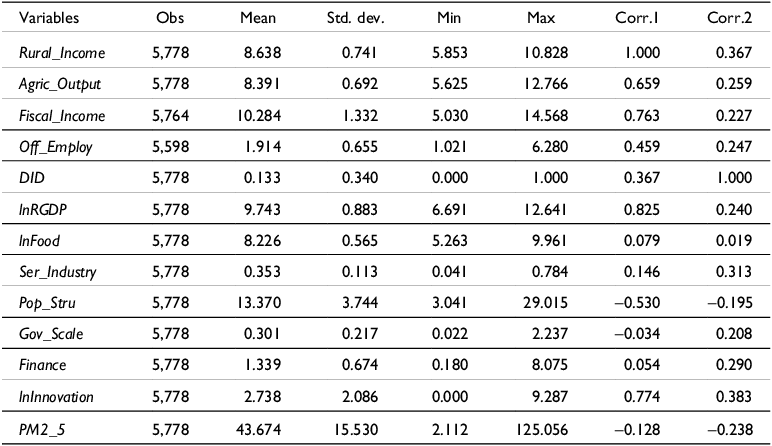
Note. Corr1 represents the correlation coefficient with Rural_Income. Corr2 represents the correlation coefficient with Treat × Post.
Model specification
The DID model can reduce the interference of irrelevant variables. Therefore, this method not only effectively identifies the effects of the policy individually but also accurately analyses the influence mechanism of policies related to e-commerce development on the income increase of rural residents in old revolutionary areas. This model defines the interaction term between the county group dummy variable (Treat) and the policy time point virtual variable before and after the implementation of the policy (Post). Subsequently, the DID model assesses the effect of place-based policies on income. The empirical model is specified as follows:
 $${{Rural}}\_{{Incom}}{{\rm{e}}_{it}} = {\alpha _0} + \delta {{DI}}{{{D}}_{it}} + {\mu _i} + {{\bf{\lambda }}_t} + \mathop \sum \nolimits_{k = 1}^K {\gamma _k}{{Contro}}{{{l}}_{kit}} + {\varepsilon _{it}}$$
DID = 1 when the old revolutionary area is a pilot area and after t is the pilot time. The coefficient of the interaction term (δ) is treated as the main estimator. If the coefficient δ is significantly positive, then the relevant policies have a positive effect on the income of residents in old revolutionary base areas; otherwise, these policies have a negative policy effect. Rural_Incomeit indicates the per capita disposable income of region i in period t, Controlsk
it represents the kth control variable, μ
i
represents the city-fixed effects and λ
t
represents the time-fixed effects. These variables aim to control the interference of individual variables that remain constant over time and those time variables that remain constant across individuals.
 ${\rm{\varepsilon }}$
it
is a random disturbance term on policy evaluation.
According to hypotheses 1–3, e-commerce development increases rural income in old revolutionary base areas through three mechanisms. To further examine whether the potential mediating variables have a significant impact on the relationship between e-commerce development and rural income, this paper adopts the empirical framework of the intermediary effect model based on model (1) and then establishes the following regression models:
 $${{Mediato}}{{{r}}_{it}} = {\rm{\;}}{\beta _1}{{DI}}{{{D}}_{it}} + \mathop \sum \nolimits_{k = 1}^K {\gamma _k}{{Contro}}{{{l}}_{kit}} + {\mu _i} + {\delta _t} + {\varepsilon _{it}}$$
 $${{Rural}}\_{{Income}}{_{it}} = {\rm{\;}}{{\rm{\alpha }}_1}{{DI}}{{{D}}_{it}}\; + {\rm{\;}}{{\rm{\alpha }}_3}{{Mediato}}{{{r}}_{it}} + \mathop \sum \nolimits_{k = 1}^K {\gamma _k}{{Contro}}{{{l}}_{kit}} + {{\rm{\lambda }}_t} + {\mu _i} + {\varepsilon _{it}}$$
where Mediator
it
is the potential mediating variable, Control
kit
denotes the relevant control variables, DID
it
and Rural_Income
it
are the core explanatory variable and dependent variable, respectively, and
 ${{\rm{\alpha }}_3}$
reflects the indirect effect of the potential mediating variables on rural income. The magnitude of the mediating effect is jointly measured by β1 and
 ${{\rm{\alpha }}_3}$
.
To ensure that the DID model aligns with the parallel trend assumption, the following model is established.
 $${{Rural}}\_{{Incom}}{{{e}}_{it}} = \Sigma _{k = - 6,K \ne - 1}^5{\beta _k}{{Yea}}{{{r}}_{Y + k}} \times {{Pos}}{{{t}}_{it}} + \mathop \sum \nolimits_{k = 1}^K {\gamma _k}{{Contro}}{{{l}}_{kit}} + {\mu _i} + {\lambda _t} + {\varepsilon _{it}}$$
where Year Y+k represents a series of dummy variables, k represents the years after the policy impact (a negative k represents the years before the policy impact) and Y denotes the year in which the policy is implemented. The definitions of the other variables are consistent with those in the benchmark model. The year before the policy shock is selected as the base group, thus excluding pre_1.
Empirical results and analyses
Benchmark regression results and analysis
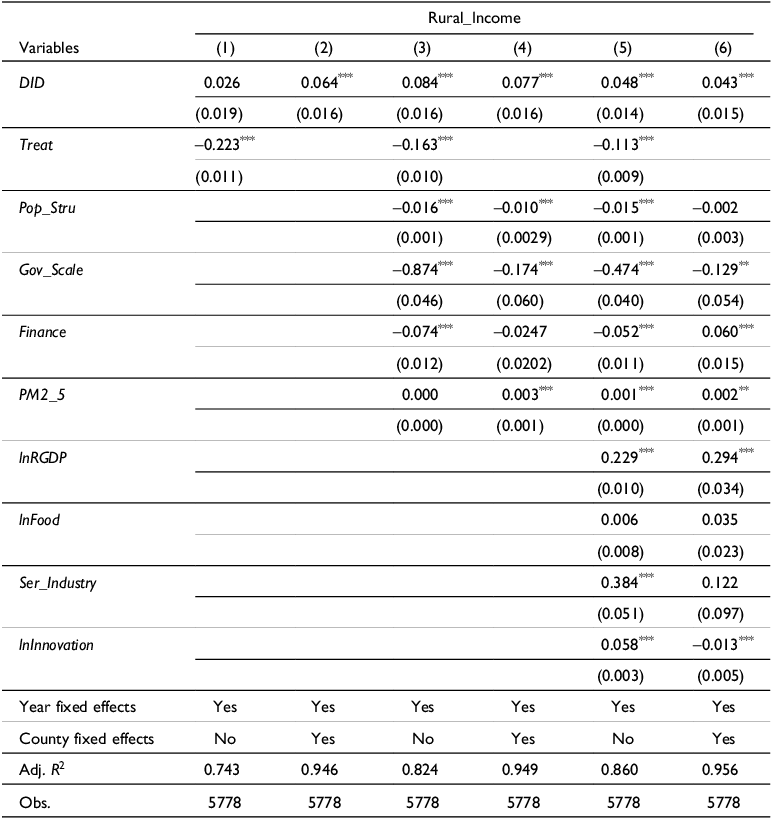
The results of the benchmark regression are shown in Table 3. First, some regression models do not control for county-fixed effects. Given the small variability of e-commerce development in some old revolutionary areas during the sample period, the regression controlling for county-fixed effects may exclude the influence of differences in e-commerce development characteristics on residents’ income growth. Second, this study adds all control variables in columns (5) and (6). The failure to effectively control these factors may result in omitted variable bias. Third, clustering standard error is applied to relax the random error assumption. Given that the data are panel data, the error items may possibly be correlated. If this correlation is not considered, then the standard error of the estimation may be biased.
Empirical results of baseline regression*
Note. Symbols refer to statistical significance at the corresponding levels.
* (10%).
** (5%).
*** (1%).
Table 3, column (6) shows the highest DID term coefficient, thereby suggesting that after the introduction of e-commerce, the per capita disposable income of residents in old revolutionary base areas has increased by 4.29%, representing a substantial economic significance. These results effectively prove that e-commerce can contribute to the economic development of old revolutionary base areas, thereby guiding policymakers towards strengthening the role of e-commerce in enhancing the per capita disposable income of residents. These successful experiences may also guide other countries in addressing poverty issues.
The control variables also have impacts on rural income. For instance, population age structure (Pop_Stru) has a negative impact on increasing the per capita disposable income of residents in old revolutionary areas. A higher proportion of primary and secondary school students brings burden to support systems, reduces the proportion of the labour force, and subsequently decreases per capita disposable income (Bloom and Williamson, Reference Bloom and Williamson1998). The effect of innovation ability (lnInnovation) on per capita disposable income is significantly positive. Innovation not only upgrades technology to reduce unemployment but also increases farmers’ income (Adriani and Wildayana Reference Adriani and Wildayana2019).
Empirical results of robustness analysis
Parallel trend test
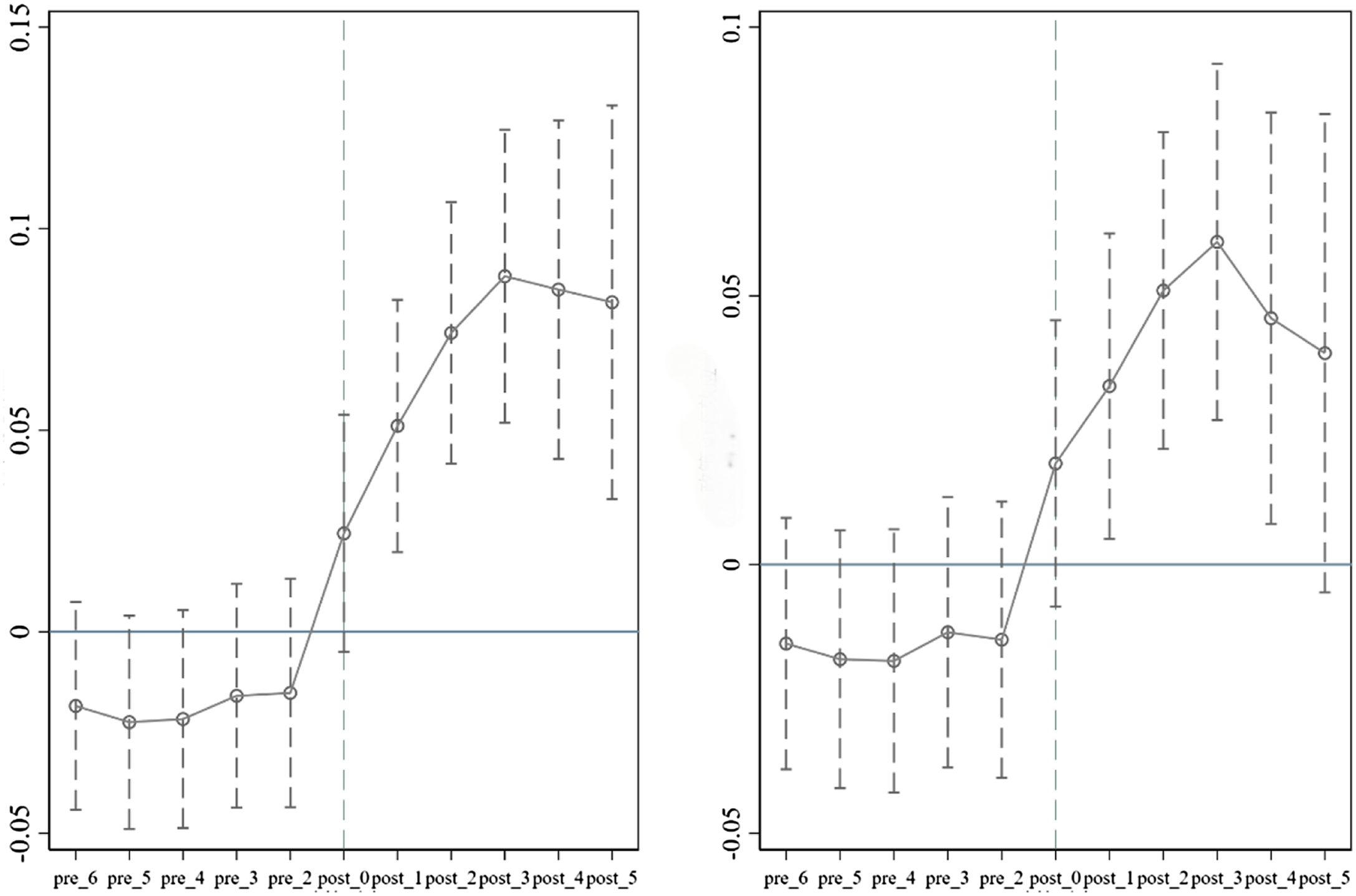
A prerequisite for using the DID model is that the parallel trend assumption must be met; otherwise, the results cannot represent the net effect of the policy. The relative policy time dummy variable coefficients before the policy are not significant and have small values, and the trends in the time-trend charts are basically consistent. In other words, before the implementation of the policy, no significant differences can be observed in the dynamic effects of the policy between the treatment and control groups, thus satisfying the parallel trend assumption. The results are shown in Figure 3. From the perspective of the dynamic effect, after the implementation of the policy, the dynamic effect of the policy suddenly increases. These results indicate that relevant policies have a positive effect on increasing the per capita disposable income of residents. The growth rate of the group without controlling for other factors is greater than that of the group that controls these factors, thereby implying that control variables encompass those factors that can increase income. Three years after the policy implementation, the dynamic effect of the policy shows a downward trend. These results highlight the need to formulate policies that are consistent with the specific situation across different stages of development.
Parallel trend test results. Note. Control variables were added to the right panel, and no control variables were added to the left panel.
Regression results using matching samples
The selection of e-commerce pilots may be affected by geographic location and information infrastructure, thus, non-random sample selection is possible. To reduce the impact of sample selection bias and omitted variable bias, this study uses radius matching, kernel matching, and nearest neighbour matching to re-match the scores of the samples and ran a regression with the matched data.
To address endogenous deviations in the sample and the significant differences in economic characteristics between the experimental and control groups, propensity score matching (PSM) and entropy balancing matching (EBM) are applied to generate matched subsamples, and these subsamples are then used to conduct a DID regression analysis. EBM not only enhances the effectiveness of regression and the policy evaluation robustness but also ensures the randomness and exogeneity of the experiment (Hainmueller Reference Hainmueller2012). Based on the key characteristics of the old revolutionary base areas, eight matching variables are selected. The corresponding descriptive statistics are shown in Tables 4 and 5.
Descriptive statistics before entropy matching

Descriptive statistics after entropy matching
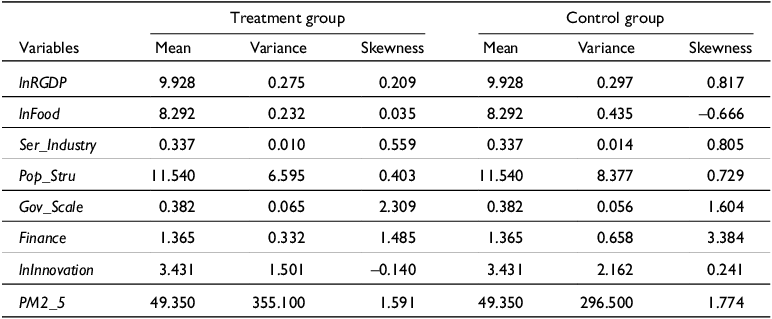
Tables 4 and 5 compare the variable balance between the treatment and control groups before and after EBM. Some imbalances are observed in the first three moment measures of multiple samples before matching. By weighting the control group data and adjusting the differences in the first-, second-, and third-order moments of the covariates, the covariate matrix of each variable in each control group is consistent with that of the experimental group. The kernel matching method in PSM is also applied to address data and selection biases and to prevent the interference from confounding factors. Only those samples with tendencies towards overlapping scores are retained in the sample to improve matching quality.
After overcoming the characteristic differences of covariates via PSM and EBM, a DID regression is applied using the matched data, and the results are presented in Table 6. Columns (1)–(3) present the regression results after EBM, whilst columns (4)–(6) present the results of the regression after kernel matching. Regression with matched data can minimise the interference of irrelevant factors and the differences between group characteristics. Table 6 shows that the coefficients of the DID term are all significantly positive at the 1% confidence level. Following the introduction of control variables, the coefficient of the DID term can accurately reflect the policy effect. These results indicate that the relevant policies have significantly improved the level of per capita disposable income in old revolutionary base areas. The development of electronic commerce has brought considerable economic and social benefits in terms of farmers’ flexible employment and poverty alleviation, thus contributing to the future development of rural and underdeveloped areas (Li and Qin Reference Li and Qin2022). These results support the hypotheses.
Regression results based on matched samples

Note. Symbols refer to statistical significance at the corresponding levels.
* (10%).
** (5%).
*** (1%).
Placebo test
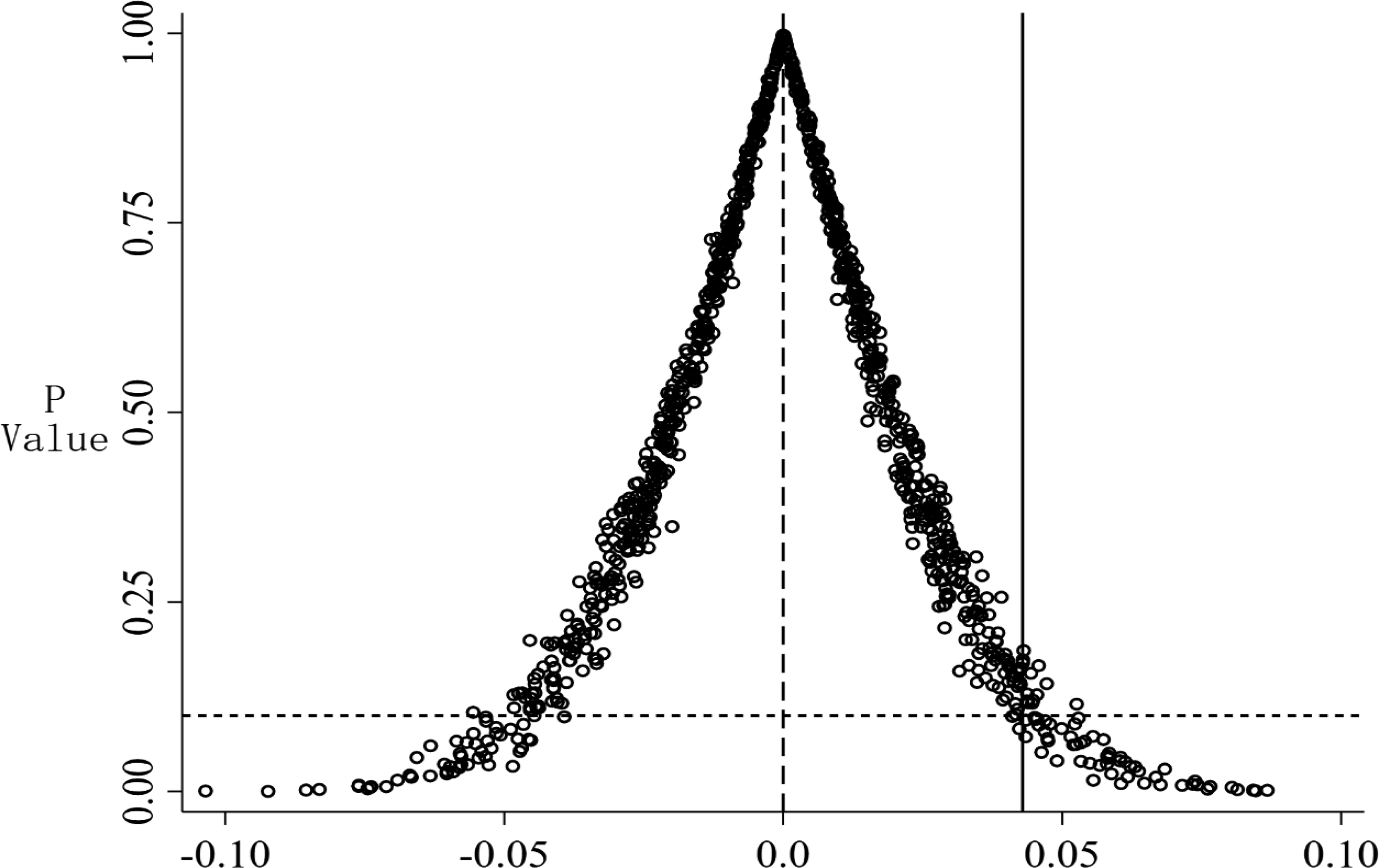
The placebo test performed by Abadie is replicated in this study to enhance the robustness of the results. This placebo test involves a fictitious treatment group and a fictitious policy impact year. Those groups that are not affected by this policy (Treatd=0) are selected as fictional treatment groups. The cross-terms are then constructed for regression, and the regression coefficients are recorded. This process is repeated 1000 times for the analysis. Theoretically, given that the virtual experimental groups are randomly generated, their crossover terms do not have a significant effect on the model-dependent variable.
Figure 4 presents the P value coefficient scatter plot, which shows that the estimated coefficients in the virtual experimental group exhibit an approximate normal distribution. The horizontal dotted line indicates P=0.1. After randomisation, the P value of most coefficients exceeds the P value=0.1 line, thereby suggesting that these coefficients are not significant at the 10% level. The majority of the scattered points are concentrated near 0, and only a few scattered points are in the vertical line of the real value, thereby indicating that the real value is an outlier after randomisation. To a certain extent, these results rule out the influence of other random factors on changes in the explained variable per capita disposable income (Rural_Income), thereby further verifying the robustness of the conclusions.
Results of placebo test.
Instrumental variable test
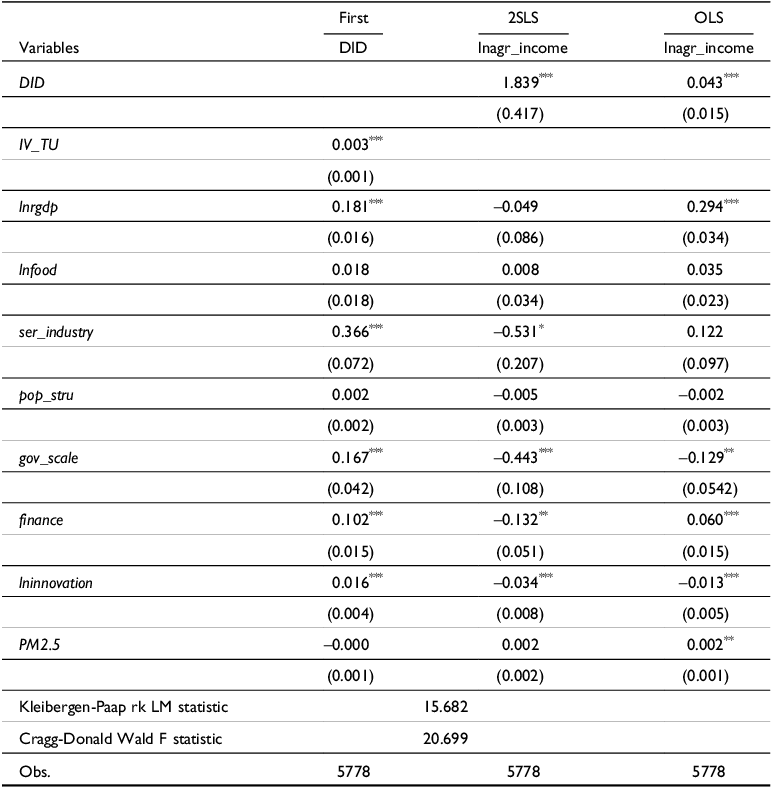
There is a potential for endogenous problems with county e-commerce development indicators. First, there may be a greater number of Taobao villages in the more economically developed old revolutionary areas. Second, per capita income and e-commerce development may be affected by unobservable factors. Therefore, this study attempts to mitigate the endogeneity problem with the help of instrumental variables. Referring to Kolko (Reference Kolko2012), the topographical relief of the county is used as an instrumental variable for e-commerce development in the old revolutionary areas. Firstly, to satisfy the assumption of correlation, topographical relief is closely related to e-commerce development in the county because the greater the topographical relief, the higher the cost of construction and maintenance of network communication, which will affect the Internet penetration, which will have a direct impact on the development of e-commerce. Secondly, to satisfy the assumption of exogeneity, the terrain undulation in the old revolutionary areas is completely natural, and there is no direct correlation with other economic variables. In summary, the topographic relief of the county will be a valid instrumental variable.
Considering that the degree of topographic relief of counties is cross-sectional data, this study, following Manacorda and Tesei (Reference Manacorda and Tesei2020), uses the interaction term of cross-sectional instrumental variables and time-trend variable in the fixed effect model of panel data and uses two-stage regression method for estimation. As can be seen Table 7, the results of the first stage regression show that: terrain relief is highly correlated with the development of e-commerce, the Cragg-Donald Wald F value is greater than the critical value of Stock-Yogo’s 10% level, which indicates that the instrumental variables do not have the problem of weak instrumental variables, and from the results, it can be seen that it meets the instrumental variables’ identifiability. The results of the second stage regression show that the development of e-commerce significantly contributes to the income of the population. Benchmark regression results are robust.
Exclusion of other policy effects
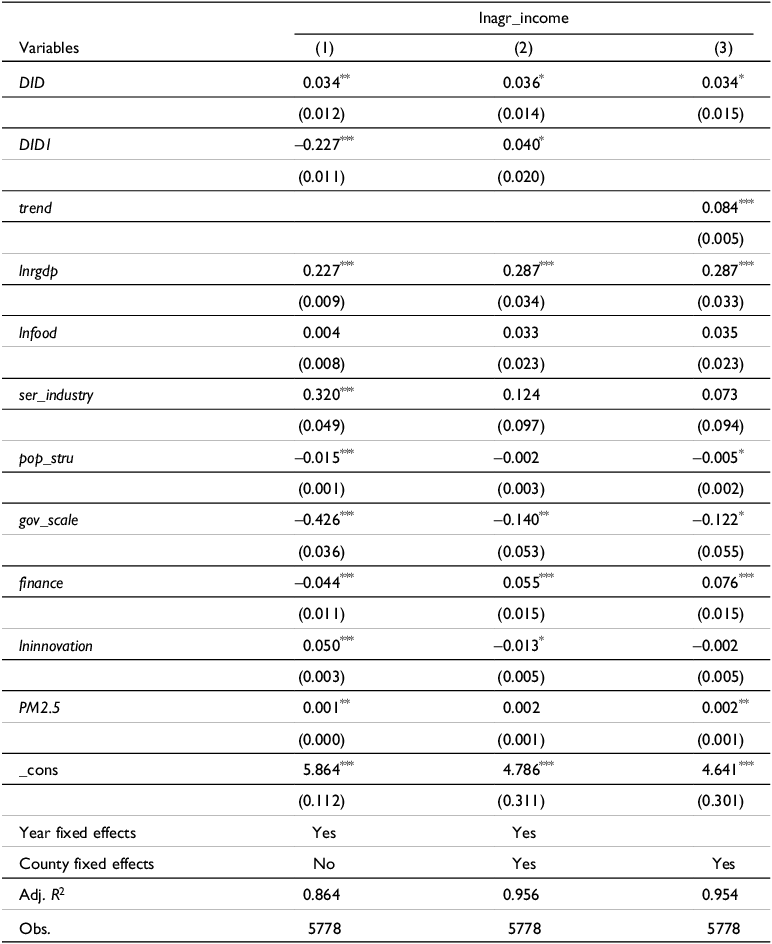
The increase in per capita income in the old revolutionary areas may be affected not only by the development of e-commerce platforms but also by other policies. In order to minimise the impact of other interfering policies, representative policies enacted in the same period were chosen for this study. China has been attacking the difficulty of increasing the per capita income of poor counties in recent years, and most of the old revolutionary areas are poor counties. Therefore, this study selects China’s ‘National List of 832 Poverty-stricken Counties’ issued in 2012 as the intervention policy. Drawing on Duan et al. (Reference Duan, Jiang and Qi2024). On the basis of the original baseline regression model, ‘China’s poor counties’ (DID1) is added as an interaction term in order to control the effect of the disturbance policy as much as possible. As can be seen from the results in Table 8, the policy effects of e-commerce in rural areas are significant and the coefficients are basically unchanged before and after the introduction of other policies, indicating that the results of the benchmark regression are robust.
Result of instrument variable regression
Note. Symbols represent significance levels. The values in parentheses are standard errors.
* (10%).
** (5%).
*** (1%).
Results of exclusion of other policy effects
Note. Symbols represent significance levels. The values in parentheses are standard errors.
* (10%).
** (5%).
*** (1%).
Other robustness tests
The robustness must be further tested for two important effects. On the one hand, there is a need to take into account the fact that during the period under study, large events took place in China, which may have affected the assessment of policy effects. Secondly, and on the other hand, it is important to control for time trends in different individual explanatory variables that may exist and are not explained by other control variables as well as fixed effects. This study adds a time-trend term to the baseline regression. The results are shown in column (1) of Table 9. To control for the effect of time trend, this study further incorporates an interaction term between the time trend term and the control variables based on the baseline model. The results are shown in column (2) of Table 9.
Other robustness test results**

Note. Symbols refer to statistical significance at the corresponding levels. trend indicates a time-trend item. Controls×trend denotes the interaction term between the time trend term and the control variable. CDV×trend denotes the interaction term between the time-trend term with the county dummy. PSV×year FE denotes the interaction term between the pilot selection variable and time-fixed effects.
* (10%).
** (5%).
*** (1%).
The demonstration programme was first implemented in 2014, but new counties are added each year, which can lead to possible differences in the rules for conducting the pilot programme from year to year, so this study draws on Wang et al (Reference Wang, Yin and Jiang2023) to include a time trend term and an interaction term for the county dummy variable in the regression. The results are shown in column (3) of Table 9. Finally, to address the issue that the selection of the demonstration counties is not completely randomised with reference to Li et al (Reference Li, Lu and Wang2016), an interaction of the pilot selection variable with time-fixed effects is introduced. The results are shown in column (4) of Table 9. All the above results show that e-commerce significantly increases farmers’ income.
Further analysis: mediating effect and influence mechanism
This study uses causal stepwise regression to explore the mechanism and path of the impact of the policy of e-commerce in rural areas on farmers’ income. Rural e-commerce promotes agricultural revitalisation in the old revolutionary areas, increases non-farm employment, and increases government financial support, thus contributing to the increase in farmers’ personal income. We will test the mechanism from these three aspects. If the mechanism is effective, it will form the basis for policy recommendations for countries.
Mediating effect of agricultural revitalisation
Column (1) of Table 10 shows that the coefficient of the DID term is positive, indicating that the development of e-commerce can significantly increase the food production in the old revolutionary areas, and the increase in food production will increase the personal income of farmers. Income from the agricultural sector has always dominated the total income of the residents in the old revolutionary areas. The development of rural e-commerce also drives the development of industries and upgrades the rural industrial structure, thereby increasing the development potential for rural revitalisation (Feng and Zhang Reference Feng and Zhang2022). Columns (2) show that the coefficients of total grain output are all significantly positive, thereby suggesting that an increase in grain output significantly boosts rural income. The coefficients of the DID term and grain output are significant, thereby indicating that this mechanism passes the mediating effect test (Chao et al Reference Chao, Biao and Zhang2021). In sum, e-commerce development in old revolutionary base increases the income of residents by increasing their total grain output, thus supporting Hypothesis 1.
Results of the mechanism test*

Note. Symbols represent significance levels. The values in parentheses are standard errors.
* (10%).
** (5%).
*** (1%).
Mechanism of non-agricultural employment
When non-farm employment is regressed as a mechanism variable, the coefficient of the DID term is significantly positive. E-commerce promotes the return of labour, reduces the cost of entrepreneurship, and improves economic vitality, which will increase the non-farm employment rate in the old revolutionary areas. Poor households with sufficient IT skills can easily start a business or be employed on e-commerce platforms (Cui et al Reference Cui, Pan, Newell and Cui2017). The development of e-commerce not only brings entrepreneurial opportunities to residents in old revolutionary areas but also gives them diversified choices, thereby increasing non-agricultural employment. The increase in employment opportunities and forms gives residents more ways to earn income. Internet access facilitates the establishment of information channels and the accumulation of intellectual capital for entrepreneurial activities, thereby increasing residents’ entrepreneurship probabilities and income-earning capacity. Professional information and digital human capital can also increase these residents’ entrepreneurial income (Liu Reference Liu2018). By relying on e-commerce, farmers can gain diversified ways to start a business and increase their income, thereby supporting Hypothesis 2.
Mechanism of fiscal capacity
Table 10 shows that the policy of e-commerce in rural areas has significantly increased the government’s financial capacity. Fiscal capacity is the basis for the strength of government financial support. On the one hand, it will ensure the completeness of local infrastructure related to e-commerce, which is the basic condition for the locality to be able to benefit from the development of e-commerce, and on the other hand, the government’s construction of an incentive mechanism will increase the rate of farmers’ participation and enhance the role of e-commerce in increasing farmers’ income. The sustained and rapid development of platform economy has also given birth to many new economic forms, which play an important role in improving the efficiency of resource allocation, promoting industrial upgrading, and opening up employment channels (Xu et al Reference Xu, Lv and Wen2015; Ju et al Reference Ju, Zhao and Sun2020). From the result of Column (6), it can be seen that the enhancement of financial capacity does promote the increase of personal income, and Hypothesis 3 is valid.
Analysis of heterogeneity effects
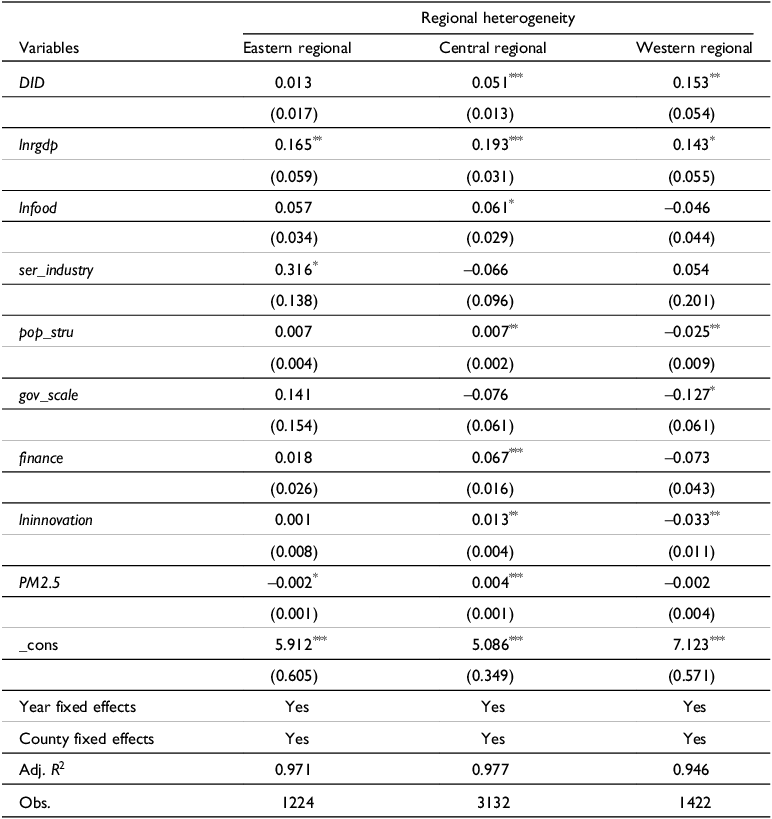
In this study, regional heterogeneity was further analysed by referring to Li et al (Reference Li, Wang and Zhao2021), where the old revolutionary areas were divided into east, central, and west for separate regressions. From Table 11, the results in column (1) show that the promotion of e-commerce development is not significant in the eastern old revolutionary areas, and from the data in columns (2) and (3), the promotion of e-commerce development is stronger in the west than in the centre. In this regard, this study considers the following reasons: first, the eastern region is better than the central and western regions in terms of market economy perfection and human capital accumulation, which may lead to the implementation of e-commerce in the rural areas of the policy, the space that can be improved in the place is smaller, so the policy effect is not significant. Second, the centre is better than the west in terms of institutional environment, geographical location, and economic structure, so the positive marginal effect brought by rural e-commerce will be smaller than that in the west. Third, the per capita income in the western region is lower than that in the central region, and relatively speaking, there is more room for farmers’ income growth. Therefore, the policy effect is not significant in the eastern region, while the income-generating effect on the western region is stronger than that on the central region.
Heterogeneity results for different regional
Note. Symbols represent significance levels. The values in parentheses are standard errors.
* (10%).
** (5%).
*** (1%).
Conclusion and suggestion
By providing opportunities for rural connected product markets in remote or underdeveloped areas, digital technology contributes to the development of industries with regional characteristics and the increase in rural residents’ income. This study employs panel data of 321 counties from 2003 to 2020 and empirically investigates the relationship between e-commerce development and rural income using DID, PSM-DID, and EB-DID models. Empirical results show that e-commerce development significantly increases the income of farmers in the old revolutionary areas, and, as shown by the results of causal stepwise regression, e-commerce has significantly increased per capita incomes in the old revolutionary areas by promoting agricultural revitalisation, increasing non-farm employment, and enhancing government support. It has also gradually increased the income-generating effects in the eastern, central, and western regions.
This study contributes to help per capita income growth in less developed regions and emphasises the importance of digital technology in expanding agro-industry and increasing farmers’ income at both theoretical and empirical levels. However, some limitations need to be noted. Firstly, the old revolutionary base areas of China are a superposition of ecologically fragile areas, administrative border areas, mountainous areas, and poor areas. Therefore, the above characteristics should be taken into account to further explore the mechanism of digital market to increase farmers’ income.
The findings of this work provide valuable insights into promoting the balanced development of regions and solving global poverty. Given that e-commerce only has a slight impact on income in those areas where education and Internet penetration are relatively weak (Liu and Zhou Reference Liu and Zhou2023), firstly, the government should further increase the popularisation rate of the Internet and e-commerce in poor areas to give full play to the ability of e-commerce to reduce poverty. Rural innovation and entrepreneurship led by e-commerce should be promoted along with the revitalisation of rural talents. The government should also actively improve the relevant facilities for the development of e-commerce, such as basic logistics, supply chain construction, and regional brand building (Gao Reference Gao2022). Secondly, education plays an important and positive role in the formation of TB-Villages (Qi et al Reference Qi, Zheng and Guo2019). Therefore, the rural e-commerce training system should be improved, and farmers’ awareness of rural e-commerce should be enhanced. Thirdly, the local government should promote integrated marketing coupled with agricultural production and rural life and deepen rural labour training (Huang and Yang Reference Huang and Yang2018).
Funding statement
This study is supported by the Key Project of Social Science Foundation of Jiangxi, China (No. 23ZXQH07).
Huwei Wen, Associate professor, School of Economics and Management, Nanchang University, Nanchang, Jiangxi, China. He is specialized in digital economics and green finance. He has published a series of papers in the journals of Energy Journal, Energy Economics, Economic Modeling, and Journal of Cleaner Production.
Anqi Qiu is a student at the School of Economics and Management of Nanchang University and a research assistant at the Digital Economy Research Institute of Nanchang University. Her research interests include digital economics and sustainable development.
Yulin Huang is a student of Ji luan academy of Nanchang University and a member of the Nanchang University Econometrics Research Society. Her research interests include digital economy and the development of old revolutionary areas in China.



