


4.1 Age and Language Ability
4.1.1 Individual Differences in Monolingual Typically Developing Children
A detailed discussion of language development in monolingual, typically developing children is beyond the scope of the current chapter. In this section, we highlight only important age-related individual variations in monolingual language acquisition to identify patterns that may help us distinguish typical language development from the development of late talkers and developmental trajectories of bilingual children. The primary focus is on variations in the rate of acquisition and learning style. The effects of the social-communicative environment on age-related individual variations in language acquisition are discussed in Chapter 6, “The Impact of Language Input on Cognitive Control.”
Variations in the rate of language acquisition in early childhood are well known and linked to the maturation of the brain, the input from the social-communicative environment, and the interactions between these factors (Hoff, Reference Hoff2013). A number of studies with an individual differences approach have focused on vocabulary development in young children because changes in early vocabulary are relatively easy to measure, and they provide researchers with a sensitive index of language development. In a large study, based on data from 1,800 children on the MacArthur Communicative Development Inventories (CDI), Bates and colleagues (Reference Bates, Marchman, Thal, Fenson, Dale, Reznick and Hartung2017) examined individual variations in vocabulary comprehension and production rates. Vocabulary comprehension positively correlated with age by sixteen months, but it only accounted for 36 percent of the variance. The results revealed a complex time course for vocabulary production in children during the first three years of life. While relatively little variance was observed within the first year of age, significant individual variations have been reported after thirteen months, with rapid growth of vocabulary in children with more advanced overall language skills. Even at thirty months of age, the skewed distribution of vocabulary was still present.
Findings with the CDI on a different sample of eight–fourteen-month-old infants/toddlers indicated additional rate differences; some children exhibited fast while others showed slow trajectories of vocabulary development, and there were significantly more girls in the fast group and more boys in the slow group (Bauer et al., Reference Bauer, Goldfield and Reznick2002). These gender differences in the rate of early vocabulary development have been thought to be linked to variations in brain maturation, particularly in the left inferior frontal gyrus (Blanton et al., Reference Blanton, Levitt, Peterson, Fadale, Sporty, Lee and Toga2004). Moreover, these gender differences in vocabulary development may also reflect girls’ superior processing efficiency of language input (Barbu et al., Reference Barbu, Nardy, Chevrot, Guellaï, Glas, Juhel and Lemasson2015).
The developmental patterns of vocabulary comprehension largely overlapped with those of vocabulary production in most children. There were, however, children who showed a dissociation between these two: rapid production despite slow comprehension or a reversed pattern (fast comprehension and slow production). Thus, it is important to note that comprehension and production are not always in synchrony, and this asynchronous pattern is more frequently observed in boys (Bauer et al., Reference Bauer, Goldfield and Reznick2002). These dissociations may be seen because both comprehension and production are highly influenced by other nonlinguistic factors, such as variations in attention functions and memory, as well as in learning styles.
Furthermore, early vocabulary development is remarkably linked to grammar acquisition. Although most children exhibited earlier and faster growth in comprehension than in production in both vocabulary and grammar acquisition, there were a few who indicated a reversed relationship: better production than comprehension (Fenson et al., Reference Fenson, Dale, Reznick, Bates, Thal, Pethick and Stiles1994). One possible explanation for this finding is that these children used more complex forms without analyzing them. They imitated forms that others used around them in the social environment, without fully comprehending them. Alternatively, the gap between comprehension and production reflects these children’s cautious and nonimitative behavior (Bates et al., Reference Bates, Marchman, Thal, Fenson, Dale, Reznick and Hartung1994). These contradictory explanations show the complexity of the relationship among age, individual variations in rate of acquisition, and learning styles.
One specific measure of early grammar development is the use of suffixes. Fenson and colleagues found that very few children use suffixes at the age of sixteen months, whereas almost all children do so by the age of thirty months. The individual variations between sixteen and thirty months are extensive. A particular aspect of suffix use is the onset of tense marking. This was studied within the framework of a maturational model in two–three-year-old slowly developing children (Hadley & Holt, Reference Hajcak, Moser, Yeung and Simons2006). Robust individual differences were observed even at 30 months of age, and the onset and growth of tense marking was strongly related to children’s skills for combining words and using different sentence structures. Children with earlier tense marking typically used longer and/or more complex sentences. Thus, these children showed more advanced overall cognitive-linguistic skills.
Similar to the gender differences in vocabulary, almost all measures of sentence length and complexity revealed a gender effect in a study by Fenson and colleagues (Reference Fine, Finney, Boynton and Dobkins1994). Girls outperformed boys, but the gender difference only accounted for 1–2 percent of the variance. Hence, there are consistent findings on gender differences in early language acquisition in the literature, but their contribution to overall individual variations is small, suggesting important roles of other influential factors that might interact with gender, such as social context and learning style.
Learning styles have been interpreted, either in relation to personality traits or as social psychological concepts, that are determined by a number of factors, personality being only one of them (Kolb & Kolb, Reference Kormos and Sáfár2005b). Depending on the child’s age, the communicative context, and the parents’ education level, children may exhibit different learning styles that represent a continuum of approaches and not a dichotomic system. For instance, children do not approach every learning situation, either analytically or holistically. If speed of processing is relevant in a given task, then a holistic approach might be more efficient, whereas accuracy would be better supported by a more analytic approach (Bates et al., Reference Bates, Dale, Thal, Fletcher and MacWhinney2017). Thus, these learning styles interact with speed-accuracy trade-offs. An alternative explanation associates these learning styles with children’s working memory capacity. Children with better memory functions may manipulate larger linguistic units (Plunkett, Reference Plunkett1993). Thus, they may seem to be more holistic in their language acquisition approach but during information processing, they may rely on their analytic skills because they have the memory capacity for it. Both speed of processing and working memory capacity show rapid development during childhood and reflect close links to language acquisition. For example, children with better nonword repetition skills (i.e., phonological working memory) exhibit larger vocabularies across age groups (Gathercole & Baddeley, Reference Gathercole, Pickering, Ambridge and Wearing1993).
Bates and colleagues (Reference Bauer, Goldfield and Reznick1994) examined the associations between age and learning style in early childhood and noted that the same measures may signal varying underlying mechanisms at different points in life. For example, the proportion of closed-class word production in children’s vocabulary during the first years of life (before the child produces 400 words) reflects stylistic variations, whereas in children with a vocabulary larger than 400 words, it is an index of productive grammar. This example also shows that separating learning styles from developmental patterns is often very difficult.
Taken together, these studies show that children’s language development, from their first words to early grammar, reflects great variability. This period of language acquisition is characterized by strong dissociations and associations. A dissociative example is that most children exhibit a gap between comprehension and production in both vocabulary and grammatical structures. There are multiple explanations for this finding, but the most likely reason is that these language skills are closely linked to other nonlinguistic cognitive abilities, as well as to environmental factors. Nonetheless, these two modalities explain how associations are further reflected by the robust relationship between vocabulary size and children’s sentence production. Studies of language development have to take into consideration both the individual differences and overall general patterns when examining the age effect.
4.1.2 Children Who Are Late or Early Talkers
Although a number of criteria have been used in the literature to identify children with delayed onset of language development, the most common criteria are small vocabulary size (less than 50 words) with no word combinations by the age of two years or vocabulary scores below the 15th percentile at eighteen–twenty-three months (MacRoy-Higgins et al., Reference Mainela-Arnold and Evans2013; Rice et al., Reference Rice, Taylor and Zubrick2008). Depending on the criteria of identification, 9–20 percent of toddlers exhibit late language emergence (Suttora et al., Reference Suttora, Guarini, Zuccarini, Aceti, Corvaglia and Sansavini2020; Zubrick et al., Reference Zubrick, Taylor, Rice and Slegers2007), but the majority of those children perform similarly to their typically developing peers on different language tasks by the time they enter school. These children exhibit a transient language delay. Children with persistent language delay, however, show language problems even at the beginning of the school years (Matte-Landry et al., Reference Matte-Landry, Boivin, Tanguay-Garneau, Mimeau, Brendgen, Vitaro and Dionne2020). A number of them are already diagnosed with developmental language disorder (DLD) during preschool. Despite these distinguishing features, late talkers form a heterogeneous group, and the outcomes of language measures vary as functions of age of identification and age at follow-up examination (Rescorla, Reference Rescorla2011). There are fewer children with persistent language delays among those who are identified as late talkers early, around 18 months, compared to those who are only identified around 30 months of age (Henrichs et al., Reference Henrichs, Rescorla, Schenk, Schmidt, Jaddoe, Hofman and Tiemeier2011). This finding highlights the importance of early identification and intervention.
Many researchers and clinicians have tried to determine which factors could predict later DLD in late talkers, but most of the predictors had low sensitivity and specificity values. Therefore, the findings were inconsistent (Dale et al., Reference Dale, Price, Bishop and Plomin2003). While a number of studies identified expressive language skills as critical predictors, the outcomes from a meta-analysis revealed that the receptive language skills of toddlers showed only a medium significant effect on expressive-language outcomes and expressive-vocabulary size with just a small significant effect for socioeconomic status (Fisher, Reference Fisher2017). In addition to different language tasks, several environmental factors, demographic and birth variables, as well as developmental milestones have been used as predictors, particularly in children below three years of age, but most of them have accounted for only a small percentage of variance (Rescorla, Reference Rescorla2011). These mixed outcomes on predictors were highly influenced by variations in tasks and selection criteria. Follow-up studies, however, showed more consistent patterns than did early identification studies. While children with persistent language delays exhibited a range of language and academic difficulties during school years, children with early transient language delays typically had no language or learning problems. These follow-up studies have also revealed that about 30–50 percent of children who were identified as late talkers at the age of two continued to exhibit low language skills even between four–ten years of age (Armstrong et al., Reference Armstrong, Scott, Whitehouse, Copland, Mcmahon and Arnott2017; Reilly et al., Reference Reilly, Wake, Ukoumunne, Bavin, Prior, Cini and Bretherton2010).
In contrast to late talkers, early talkers, children who produced sentences before the age of twenty-four months and who produced around 300 words by two years of age, showed advanced language and literacy skills during school age (Preston et al., Reference Preston, Frost, Mencl, Fulbright, Landi, Grigorenko and Pugh2010). Further, early talkers exhibited different vocabulary composition and structure than late talkers. These two groups of children knew different sorts of words and exhibited different word learning biases (Colunga & Sims, Reference Colzato, van den Wildenberg, Zmigrod and Hommel2017). Thus, the vocabularies of early talkers were not only larger than those of late talkers but qualitatively different. In addition to these behavioral differences, early and late talker status was strongly related to distinct neural activation patterns as well. At the cortical level, differences included variations in activation in the superior temporal gyrus in response to speech and print. At the subcortical level, it was the putamen and the thalamus that signaled group differences during language processing (Preston et al., Reference Preston, Frost, Mencl, Fulbright, Landi, Grigorenko and Pugh2010). These findings further support the notion that age-related differences in the rate of acquisition are linked to variations in brain maturation.
Taken together, research clarifies that early identification of expressive language problems is critical for both children with transient and persistent language delays. Early and late talkers show different neural activation patterns when processing language. Advanced early language abilities allow children to develop superior language skills later during school age, regardless of domain (e.g., children who produce their first sentences early also develop superior written language skills). In contrast, children who show delayed language emergence may either catch up with their typically developing peers by the time they enter school or exhibit language and academic problems throughout their school years. A large number of these children received the diagnosis of DLD. Language development in children with DLD is discussed in Chapter 1, “The Language Continuum” with a detailed review.
4.2 Age and Language Proficiency
4.2.1 Language Acquisition in Bilingual Children
There is converging evidence in the bilingualism literature about an overall link between age and success of second language (L2) acquisition. The more detailed findings, however, are less cohesive, in part, because there are many contributing factors to successful bilingual language acquisition, and age is only one of them. If we disregard these other factors for a moment, there is still a critical question in the literature related to the conceptualization of L2 age of acquisition. A number of criteria have been used across studies: active daily use of two languages (Luk et al., Reference Luk, De Sa and Bialystok2011), age of immersion in an L2 environment (Tao et al., Reference Tao, Marzecová, Taft, Asanowicz and Wodniecka2011), first exposures and inputs to L2 (Kalia et al., Reference Kalia, Wilbourn and Ghio2014), age at which a child begins to speak in L2 (Kapa & Colombo, Reference Karbach and Kray2013), and age at which a child becomes fluent in L2 (Pelham & Abrams, Reference Peña, Iglesias and Lidz2014). These age of acquisition criteria reflect very different points in early life. Therefore, they show distinct interactions with language performance.
A further problem is that even though age is a continuous variable, most studies in the literature used overall age of acquisition categories, such as native bilingual speaker (i.e., the child who grows up with two or more languages from birth), early bilingual, and late bilingual. While early bilingual speakers are those who acquire both of their languages during childhood, late bilingual speakers learn the second language typically after puberty or anytime during adulthood. These are gross categories, so the bilingual groups that were based on differences in age of acquisition included individuals with various language experiences. A few studies used more specific age criteria for early and late bilingual speakers, but there is still no consensus in the literature about the specific cut-off points. While Luk and colleagues (Reference Luna, Marek, Larsen, Tervo-Clemmens and Chahal2011) considered ten years of age as a cut-off point to distinguish between early and late bilingual groups, Kalia and colleagues (Reference Kang, Alexander, Wessel, Wimberger, Nitzsche, Kirschbaum and Li2014) used six years of age for the same purpose. Hence, many inconsistencies in findings in the bilingualism literature may be related to the use of different age-of-onset criteria and to the employment of broad age categories. This is particularly problematic in research with children where the cognitive and linguistic skills are constantly changing with increasing gains in bilingual experience and with the maturation of the brain.
Age-related changes in brain activation have been studied extensively in bilingual individuals, although more studies focused on young adults than on children. Overall, late bilingual speakers showed a greater amount of activation for L2 than individuals who acquired a second language early in childhood (Higby et al., Reference Higby, Kim and Obler2013). When early and late English-Spanish bilingual speakers were matched for language proficiency, late L2 learners showed increased activation in Broca’s area compared to early bilingual speakers during the processing of irregular grammatical items (Hernandez et al., Reference Hernandez, Hofmann and Kotz2007). Moreover, a number of imaging studies have revealed that in addition to showing an increased activation level, late bilingual individuals recruited wider brain regions than early L2 learners when they were processing speech stimuli (Abutalebi, Reference Abutalebi2008; Vingerhoets et al., Reference Vingerhoets, Van Borsel, Tesink, van den Noort, Deblaere, Seurinck, Vandemaele and Achten2003). In an electrophysiological study, Ortiz-Mantilla and colleagues (Reference Paap and Greenberg2010) found that late bilingual speakers showed increased brain responses to both speech and nonspeech stimuli compared to early learners. The findings across neurophysiological studies suggest that late bilingual speakers need to exert more effort when performing the same task compared to their early learner peers, even if they are highly proficient in both of their languages.
Gray matter density has been negatively correlated with age and positively with language proficiency. Overall, bilingual individuals showed greater gray matter density than monolingual speakers, and this effect was greater for early bilingual individuals (i.e., L2 acquisition before the age of 5 years) than for late bilingual speakers (i.e., L2 acquisition between 10–15 years of age). Greater gray matter density was found in the inferior parietal lobule and in adjacent regions of the temporo-parietal cortex (Della Rosa et al., Reference Della Rosa, Videsott, Borsa, Canini, Weekes, Franceschini and Abutalebi2013; Grogan et al., Reference Grogan, Jones, Ali, Crinion, Orabona and Mechias2012; Mechelli et al., Reference Mechelli, Crinion, Noppeney, O’Doherty, Ashburner and Frackowiak2004). These are important areas in phonological working memory performance, vocabulary acquisition, and semantic processing. Changes in gray matter density may occur quite rapidly in response to short-term language learning, and it strongly interacts with age and age of acquisition (Li et al., Reference Li, Legault and Litcofsky2014).
4.3 Age and Cognitive Control Development
4.3.1 Age-Related Changes in Cognitive Control in Typically Developing Monolingual Children
As discussed in Chapter 2, “Cognitive Control,” research in this area has shown remarkable growth over the last few decades. In this section, we provide examples of age-related changes in those cognitive control skills that play the most relevant role in language development and academic success. These include working memory, and attention control from four years through adolescence across the working memory components that differed in domain. The tasks in this study were relatively simple compared to those used by Marton and colleagues (Reference Marton, Yoon, Brooks and Kempe2006). The latter study used a theoretical account suggesting that individual differences in working memory capacity reflect variations in executive control, specifically in the ability to maintain goal-relevant information in a context of interference (Engle & Kane, Reference Erdodi, Sagar, Seke, Zuccato, Schwartz and Roth2004). To test this theoretical hypothesis, Marton and colleagues applied two modified listening span tasks with stimuli that varied in both length and linguistic complexity (i.e., simple short sentences, complex short sentences, and complex long sentences combined with nonword repetition and answers to questions). Three groups were examined in this study: children aged seven–eight and nine–eleven and young adults aged nineteen–twenty-two. The age effect was reflected by the number of errors (younger children made more errors), as well as by differences in performance patterns and error types, particularly with linguistically more complex stimuli. Both age groups of children produced significantly more interference errors than young adults. These findings are in line with Cowan’s (Reference Cowan2016) suggestions about the role of attention-control behind the age-related differences in working memory capacity.
Attention control itself shows important developmental changes between preschool and early school years. Even though attention control is often viewed as a unitary construct, the developmental trajectories of the different attention functions, such as alerting, orienting to sensory events, and executive attention, vary (Rueda & Posner, Reference Rutherford, Singh-Roy, Rush, McCartney, O’Hare and Forsyth2013). Several studies have reported developmental changes in alertness from preschool to school age and to adulthood. The most common paradigms that have been used to assess alertness are tasks that target responses to explicit cues and tasks of visual searching. Although it has been observed that alertness starts developing early in infancy, age-related changes still occur later in school age. Older children (i.e., 5–7 years) showed greater responsiveness to alerting cues and produced fewer omissions than younger ones, even within relatively restricted age ranges (Mezzacappa, Reference Mezzacappa2004). These findings suggest that older children are able to remain vigilant longer during task performance. Moreover, even ten-year-old children performed more poorly than adults in maintaining an alert state when there was no explicit signal (Rueda et al., Reference Rueda, Fan, McCandliss, Halparin, Gruber, Lercari and Posner2004). The reasons for the late development of these alerting skills and the age at which children achieve the same level as adults remain unclear.
Orienting has an early onset, as well. Although infants are able to orient their attention to different environmental stimuli, the attention system continues developing throughout childhood and adolescence (Rueda & Posner, Reference Rutherford, Singh-Roy, Rush, McCartney, O’Hare and Forsyth2013). Age differences in orienting functions, however, are also task-dependent. While Rueda and colleagues (Reference Rueda, Cómbita and Pozuelos2004) found no change in orienting after six years of age using a simple flanker task, Schul and colleagues (Reference Schwartz, Gorman, Dodge, Pettit and Bates2003) reported more accurate and faster orienting with age in children between seven and seventeen years of age and in adults with a variant of Posner’s cost-benefit attentional cueing paradigm, that included a focused attention and an attention shifting task. Younger children needed longer cue-to-target intervals to orient attention than older participants. The difference in performance with long (800 ms) versus short (100 ms) cue-to-target intervals gradually decreased with age.
The third component, executive attention, shows the latest onset. However, it is important to note that this function is often measured with more complex tasks, such as conflict paradigms. Different versions of spatial conflict tasks have been administered to children as early as two–four years of age. In these tasks, participants had to press a button or point to the target item (e.g., animals, stars) on a screen. The stimuli appeared either on the same side of the screen or on opposite sides. While two-year-old children showed difficulty with the task by exhibiting low accuracy and a significant congruency effect (i.e., more errors when the items were on opposite sides), their three-year-old peers performed with high accuracy and smaller congruency effect, although their speed was slower than that of older children or adults in previous studies (Gerardi-Caulton, Reference Giedd, Blumenthal, Jeffries, Castellanos, Liu, Zijdenbos and Rapoport2000). Further development in both speed and accuracy of conflict processing has been observed in children between four and seven and six and nine years of age using variations of the flanker task (e.g., the fish ANT task), in which children had to decide whether the central fish was facing left or right by pressing the corresponding left or right arrow key. In the congruent condition, all items faced the same direction, whereas in the incongruent condition, the central item faced the opposite direction from the surrounding items (Rueda & Posner, Reference Rutherford, Singh-Roy, Rush, McCartney, O’Hare and Forsyth2013; Rueda et al., Reference Rueda, Fan, McCandliss, Halparin, Gruber, Lercari and Posner2004). The results from different conflict paradigms indicate early development (around 3 years) in accuracy; a gradual decrease in speed throughout childhood; and simultaneously, a decrease in the congruency effect. Thus, children become more efficient in performing tasks with conflicts, an outcome which reflects age-related, positive changes in attention control and monitoring skills.
Error and performance monitoring in children are frequently studied with different neurophysiological methods or by calculating post-error slowing in behavioral performance. One common electrophysiological measure of error monitoring is error-related negativity (ERN), that typically peaks around 50–100 ms following an erroneous response in speeded tasks (Hajcak, Reference Hajcak2012; Tamnes et al., Reference Tamnes, Walhovd, Torstveit, Sells and Fjell2013). Even though a number of studies reported developmental changes throughout childhood in the ERN amplitude, particularly in more complex tasks, the findings were more mixed about the ERN latency (Davies et al., Reference Davies, Segalowitz and Gavin2004; Wiersema et al., Reference Wiersema, van der Meere and Roeyers2007). Davies and colleagues studied the age-related changes in the ERN in seven–twenty-five-year-old participants and documented an increase in the ERN amplitude in error trials with age. The findings linked the ERN to the dorsal and/or rostral part of the anterior cingulate cortex (ACC) and supported the concept of a late maturation of the ACC.
In a recent study, Kang and colleagues (Reference Kapa and Plante2021) combined error and novelty monitoring using the ERN and the N2, respectively, in eight–sixteen-year-old participants who performed a modified flanker task. At the behavioral level, older children showed higher accuracy rates, faster speed, and smaller variability in reaction time than the younger children. Likewise, the electrophysiological correlates showed age-related differences. While the error-related ERN was larger in the older children, the novelty-linked N2 was larger in the younger ones. In addition to these developmental trends, individual variations in the ERN amplitude correlated with children’s behavioral post-error slowing (see Chapter 8, “Processing Speed and Cognitive Control,” for detailed discussion). Larger ERN amplitude was linked to larger post-error slowing. Thus, the ERN amplitude reflected the behavioral adjustments in response to an error, and these processes were more mature in older than in younger children. This finding was in line with the outcomes of other studies that also reported major developmental changes in post-error slowing between six and ten years of age (Gupta et al., Reference Gupta, Kar and Srinivasan2009). The greater N2 amplitude in response to novelty in younger children may suggest a sensitivity in neural processes to irrelevant stimuli. It is well documented in the literature that younger children are less efficient in resisting interference from irrelevant stimuli than their older peers (Cragg, Reference Cragg2016; Marton et al., Reference Marton, Campanelli, Eichorn, Scheuer and Yoon2014).
Interference control has been conceptualized differently across theoretical models. According to one of the most widely accepted accounts (Friedman and Miyake, Reference Friedman and Miyake2004), resistance to interference is an inhibition-related function. In their model, three inhibitory functions are distinguished: inhibition of a prepotent response, resistance to distractor interference, and resistance to proactive interference. While response inhibition refers to the blocking of an automatic behavior in response to a stimulus (e.g., stopping the ongoing activity when a sound is presented), resisting distractor interference is about selectively focusing on the target while avoiding distraction from the surrounding items (e.g., choosing the appropriate picture from a pool that consists of targets and competing distractor items). Finally, proactive interference control is about resisting internal sources (memory traces) that may hinder efficient information processing (e.g., suppressing irrelevant information from previous tasks or items). The degree of correlation among these inhibition-related functions varies (response inhibition shows greater correlation with distractor interference than with proactive interference), and these three functions show distinct developmental trajectories.
Variations of Go-NoGo and Stop-Signal tasks have been used to examine response inhibition across age groups. There is converging evidence of age-related changes in children aged three–five years (Dowsett & Livesey, Reference Dreisbach2000) and six–eight years (Lewis et al., Reference Lewis, Reeve, Kelly and Johnson2017). The three-year-olds made more errors and indicated slower processing than their four–five-year-old peers. The error rate was also higher for children aged six–seven years than for older participants aged eight–eleven years. In contrast, speed of processing showed continuous development between the ages of six and twelve years (Lewis et al., Reference Lewis, Reeve, Kelly and Johnson2017; Williams et al., Reference Williams, Ponesse, Schachar, Logan and Tannock1999).
The most frequently used measures of distractor interference are the Simon, Stroop, and flanker tasks. The Simon and flanker tasks are considered to be conflict paradigms that reflect similar congruency effects (Hübner & Töbel, Reference Iluz-Cohen and Armon-Lotem2019). The Stroop test also measures conflict, but there is debate in the literature about the functions it reflects. While Stroop himself claimed that the task measures interference (MacLeod, Reference MacLeod1991), Houben and Wiers (Reference Houben and Wiers2009) suggested that the task assesses automatic response inhibition. Task impurity is a common issue with most cognitive control tasks, because they tend to measure multiple functions simultaneously (see Chapter 3, “Methodological Issues”). In a developmental study with adults and children aged five–fourteen years, Ambrosi and colleagues (Reference Ambrosi, Śmigasiewicz, Burle and Blaye2020) compared performance on these three interference tasks (i.e., Simon, Stroop, flanker). Even though these tasks are often used interchangeably in the literature, Ambrosi’s study showed that the developmental trajectories of the interference effects differed across tasks. Children as early as five years of age already showed adult-like performance on the Simon task, while age-related changes have been observed throughout childhood for the Stroop and flanker tasks, although for the latter, the findings were less consistent.
The third inhibitory function, proactive interference, is regularly examined using different versions of working memory or short-term memory tasks. Kail (Reference Kail2002) reported age-related decline in proactive interference based on two studies using the Brown-Peterson paradigm. The first study was a meta-analysis of twenty-six published papers including children aged four–nine years, whereas the second study reported findings from a new experiment with adults and children aged nine–twelve years. Findings from both studies indicated that resisting interference from previous items and memory traces develops throughout childhood. Moreover, the second study also showed that the age-related changes in proactive interference are mediated by the development of processing speed. Thus, increases in age are linked to decreases in proactive interference and to increases in the speed of processing.
Altogether, the findings indicate that while the three inhibition-related functions are conceptually linked, they also show dissociations. They differ in the age of maturation and in developmental trajectories. Response inhibition becomes mature toward the beginning of school age, whereas the different interference functions develop throughout childhood and adolescence. Task complexity and the underlying mechanisms that are reflected by the different experimental paradigms interact with age-related changes. The same children perform differently on tasks that are thought to measure the same functions. Moreover, none of these tasks target only one specific function, therefore the differences in developmental changes may also reflect interactions among cognitive control functions and processing speed.
Finally, task switching is typically examined with versions of the Dimensional Change Card Sort task (Zelazo, Reference Zelazo2006). Participants are instructed to sort binary cards first according to one dimension (e.g., color) and then according to another dimension (e.g., shape). Children at the age of three are able to sort the cards according to one of the dimensions but fail to switch to the other dimension when instructed. They perseverate with the post-switch items. By the age of five, typically developing children perform with great accuracy on this task, but children with various neurocognitive disorders, including DLD, show inflexibility and perseverate longer. Their diminished cognitive flexibility has been associated with weaknesses in working memory updating (Morton & Munakata, Reference Moyer2002) and delayed or impaired maturation of the prefrontal cortex (Friedman & Robbins, Reference Friedmann and Rusou2022).
While performance on the Dimensional Change Card Sort task becomes highly accurate by the age of five, processing speed continues to develop. Moreover, associations between slower processing speed and greater improvements in accuracy (i.e., speed-accuracy trade-off) have been identified in children between five and six years of age as well as between six and seven years. Besides these trade-offs, higher accuracy rates at six years predicted faster processing speed at seven years of age (Dumont et al., Reference Dumont, Castellanos‐Ryan, Parent, Jacques, Séguin and Zelazo2022).
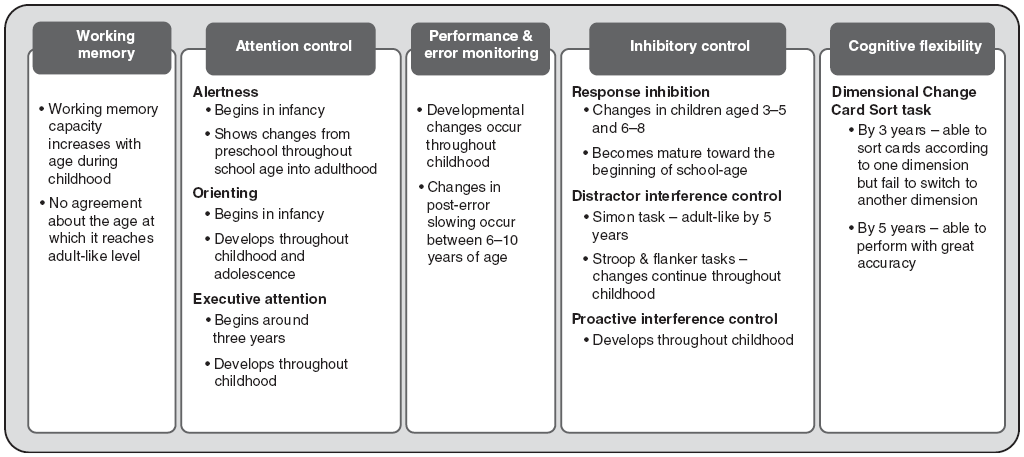
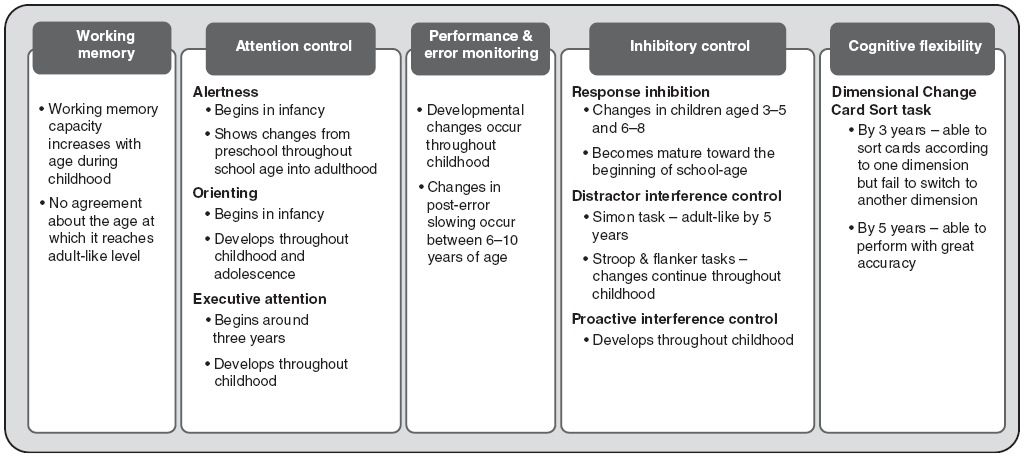
Taken together, the development of cognitive control functions is neither unitary nor linear. There are both associations and dissociations among the different functions that are also reflected in the variations in developmental trajectories of these cognitive control skills (see Figure 4.1). Age-related changes are influenced by a number of factors, in addition to brain maturation, such as task complexity and task impurity, individual variations in processing speed, and language status.
Age-related changes in cognitive control
4.3.2 Cognitive Control in Late Talkers
The focus in this section is primarily on preschool-age children because by school age, late talkers either catch up or are diagnosed with DLD. Age-related changes in cognitive control in typically developing children (i.e., children who catch up with their peers) have been discussed above, whereas cognitive control in children with DLD is discussed in detail in Chapter 5, “Associations among Language Ability, Language Proficiency, and Cognitive Control.”
The cognitive control skills of late talkers were examined to see whether they differed from those of preschool-age children who received an early diagnosis of DLD (Dodd, Reference Dodd2011). Even though both groups performed with low accuracy on a number of language tasks (phonology, vocabulary, etc.), children with DLD produced more severe errors than the late talkers. Furthermore, the groups differed in certain cognitive control functions, such as flexibility. Cognitive flexibility was measured with a card sorting task that included color, shape, and size as set rules. Children with DLD showed more difficulty sorting the cards following a rule switch than children with language delay. Children with DLD did perseverate on the first rule that they were presented with, while children with language delay performed the task with more flexibility. These findings support the idea that cognitive control tasks, particularly the ones with minimal language demands, may help to differentiate between children with DLD and children with language differences, such as delayed language development or low English L2 proficiency (Marton et al., Reference Marton, Gehebe and Pazuelo2019).
With a similar idea in mind, Kautto and colleagues (Reference Kheder and Kaan2021) tested whether the inhibitory functions at school age would distinguish between children who had a history of delayed language development but exhibited typical language skills in school age from those with a history of language delay and a later diagnosis of DLD. In addition to language testing, children were examined with a flanker task. Although the accuracy data did not show the expected interactions among early language status, flanker performance, and late talker outcomes, the reaction time data revealed overall slower processing in children with DLD. More efficient processing speed in the flanker task was associated with more advanced language skills. The authors listed many limitations of the study that may have contributed to the lack of group difference in accuracy on the flanker task. Therefore, future research is needed to see whether certain cognitive control skills in preschoolers could predict later language status.
Working memory performance proved to be a better measure for distinguishing among groups of children with typical language development, DLD, and a history of delayed language development but typical language outcomes by the age of five years (Petruccelli et al., Reference Petruccelli, Bavin and Bretherton2012). Working memory was tested using six different tasks across the domains of phonological memory, visuospatial memory, and linguistic span. Although children showed different performance patterns across modalities, the outcomes on nonword repetition and sentence recall clearly distinguished the groups. Both typically developing children and their peers with a history of language delay but no later language impairment performed better than the children with DLD. The former two groups performed similarly on every working memory measure. Although these data are promising, the question remains whether nonword repetition and sentence recall can distinguish late talkers at the age of three. Thus, future research should determine whether these tasks can be designed to predict who among the late talkers will catch up in language development by school age and who will continue showing language problems.
4.3.3 Interaction between Age of Language Acquisition and Cognitive Control in Bilingual Speakers
As demonstrated above, it is not easy to determine the age of second language acquisition because of the variations in the criteria that have been used in the literature and the individual differences in children’s bilingual experience. It is well known that the age of L2 acquisition interacts with other aspects of the bilingual experience, such as the frequency of language use or the amount of exposure. Given these challenges, there are only a few studies that have focused on the relationship between the age of L2 acquisition or the age of becoming bilingual and the development of cognitive control.
In a cross-sectional study, Carlson and Meltzoff compared (Reference Carp and Compton2008) three groups of kindergarten children on a number of cognitive control tasks (attention and interference control; task switching; and short-term memory). Children were either monolingual, Spanish–English bilingual from birth (i.e., native bilingual), or participated in a bilingual immersion program with a six-month exposure to the L2. While the native bilingual children outperformed the monolingual children on the cognitive control tasks, particularly on tasks that involved conflict, participants in the immersion program, who were emerging bilingual children, did not exhibit this cognitive advantage compared to their monolingual peers. Although the findings suggest an effect of age of language acquisition on cognitive control, it is important to note that the emerging bilingual and native bilingual children also differed in the amount of exposure and L2 language use. This study provides another example of how difficult it is to disentangle the different aspects of the bilingual experience.
Luk and colleagues (Reference Luna, Marek, Larsen, Tervo-Clemmens and Chahal2011) provided further evidence for the effect of age of L2 acquisition on cognitive control. They compared early and late bilingual individuals’ performance on a flanker task, in which participants had to indicate whether the direction of a red chevron in the center was the same as the directions of surrounding black chevrons. The flanker task is typically considered to measure resistance to distractor interference and sustained attention. In this study, early bilingual participants had become actively bilingual before the age of ten years, while late bilingual participants had acquired their L2 after ten years of age. Even though the early bilingual and monolingual college students exhibited similar levels of language proficiency in English, the two groups differed in the flanker effect. Early bilingual students showed better resistance to distractor interference than their monolingual peers. In contrast, late bilingual students showed lower language proficiency in English than the monolingual students, but the two groups performed similarly on the flanker task. Hence, early acquisition of two languages resulted in higher language proficiency and better resistance to interference than late L2 acquisition.
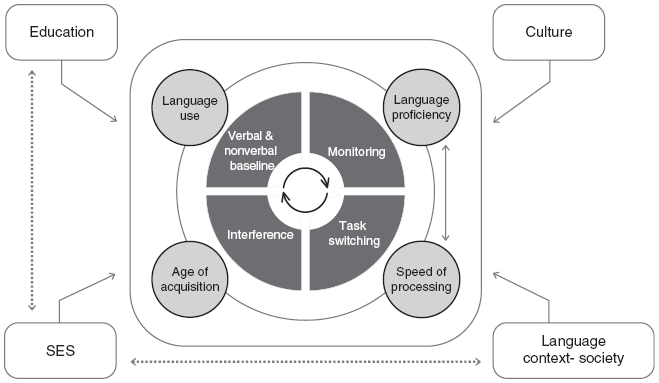
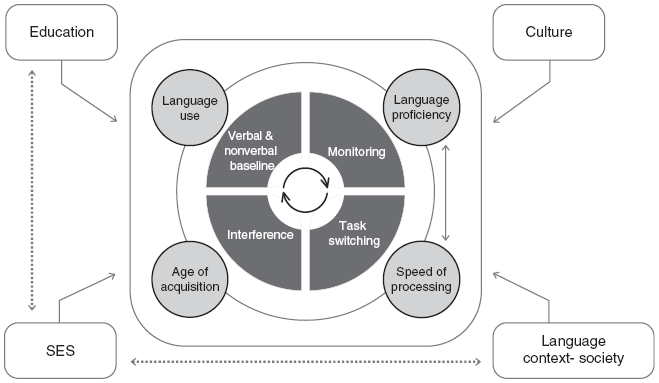
Interestingly, Tao and colleagues (Reference Thompson, Waskom, Garel, Cardenas-Iniguez, Reynolds, Winter and Gabrieli2011) found a more complex relationship between the age of language acquisition and cognitive control. In their study, early versus late bilingualism was determined by the age of arrival to the country. Early bilingual speakers arrived before the age of six years, whereas late bilingual individuals arrived after twelve years of age. Both early and late bilingual speakers showed superior performance compared to their monolingual peers on a task of monitoring and attention control. Furthermore, late bilingual speakers, who showed a high level of proficiency and language use, outperformed the early bilingual participants in conflict resolution. In contrast, early bilingual speakers exhibited better monitoring skills than their late bilingual peers. These outcomes are particularly interesting given that efficient conflict resolution requires good monitoring. These findings further confirm the complex relationship among the different aspects of the bilingual experience and their interaction with cognitive control (see Figure 4.2). Age of acquisition interacts with language input, frequency of language use, and language proficiency, and their cumulative effect on cognitive control results in different patterns of performance.
Interactions among language acquisition and proficiency, cognitive control, and environmental factors in bilingual speakers
4.4 Conclusions
Language acquisition is characterized by strong associations and dissociations among the different linguistic rule systems and other cognitive functions during the early years. Individual differences in language acquisition are linked to the development of other nonlinguistic cognitive abilities, brain maturation, and environmental factors. Hence, there is no single cut-off point that could be used to determine the specific age of L2 acquisition or that at which a language delay predicts the presence of a language disorder. Early identification of expressive language problems, however, is critical for children with both transient and persistent language delays. When specific cognitive control components and processes are examined, it becomes clear that the development of cognitive control functions is neither unitary nor linear. Nevertheless, various developmental trajectories can be observed in children with different language skills, as the age of language acquisition shows an overall interaction with cognitive control functions.

 Open access