

Introduction
The COVID-19 pandemic precipitated an unprecedented global crisis, profoundly disrupting labour markets worldwide. Beyond its immediate public health consequences, the pandemic led to historic declines in labour supply, with total working hours collapsing to levels not observed since the Great Depression (ILO-OECD 2020). In the second quarter of 2020 alone, global working-hour losses were equivalent to 525 million full-time jobs, far exceeding those observed during the 2009 global financial crisis (ILO 2021). Notably, reductions in hours worked surpassed outright employment losses, reflecting both job destruction and substantial contractions in hours among those who remained employed (Lemieux et al Reference Lemieux, Milligan, Schirle and Skuterud2020). As confinement measures compelled individuals to reconcile paid work with intensified caregiving and domestic responsibilities, working hours became a central margin of labour-market adjustment (Bertogg et al Reference Bertogg, Kulic and Strauss2022). Even before the pandemic, reductions in working hours were a critical yet often overlooked dimension of labour market disruption (Greenhalgh and Rosenblatt Reference Greenhalgh and Rosenblatt1984; Marcotte Reference Marcotte1995). Global working hours declined four to six times as much as during the 2009 crisis (ILO 2021; ILO-OECD 2020), underscoring the magnitude of labour supply adjustments. Crucially, these adjustments did not occur uniformly across workers.
A central question is whether the pandemic exacerbated pre-existing gender inequalities in working hours. Early discussions of a potential ‘shecession’ highlighted concerns that women might bear disproportionate economic costs (Alon et al Reference Alon, Coskun, Koll, Doepke and Tertilt2021; Todorovic et al Reference Todorovic, Van and Peluso2021). Unlike previous recessions, which often affected male-dominated sectors such as construction and manufacturing, the COVID-19 shock disrupted service-intensive sectors with higher female employment shares (Collins et al Reference Collins, Landiva, Ruppanner and Scarborough2021; Doepke and Tertilt Reference Doepke and Tertilt2016; Gontkovičová and Spišáková Reference Gontkovičová and Spišáková2024). Yet empirical findings remain mixed. Some studies find that women experienced larger reductions in working hours than men (Bluedorn et al Reference Bluedorn, Caselli, Hansen, Shibata and Tavares2023; Lemieux et al Reference Lemieux, Milligan, Schirle and Skuterud2020; Odate et al Reference Odate, Lead, Stem and Parmar2021), whereas others report gender-neutral or even male-biased effects (Birch and Preston Reference Birch and Preston2022; Brini et al Reference Brini, Lenko, Scherer and Vitali2021; Knize et al Reference Knize, Tobler, Christoph, Fervers and Jacob2022).
One important factor associated with women’s vulnerability is the responsibility for childcare. School and childcare centre closures intensified pre-existing gender asymmetries in unpaid work, constraining mothers’ working hours to a greater extent than fathers’ hours. Prior to the pandemic, caregiving responsibilities were already unevenly distributed within households (Alon et al Reference Alon, Doepke, Tertilt and Olmstead-Rumsey2020a; Johnston et al Reference Johnston, Mohammed and Linden2020). The closure of approximately two-thirds of childcare centres at the onset of the pandemic in the US disproportionately affected mothers, leading them to reduce their work hours at a rate four to five times higher than that of fathers (Collins et al Reference Collins, Landiva, Ruppanner and Scarborough2021; Lee and Parolin Reference Lee and Parolin2021).
The type of employment contract is another important factor associated with differential labour supply adjustments. Even before the pandemic, women were disproportionately represented in part-time employment and more likely to transition into part-time work following labour-market shocks. For many, part-time employment offered flexibility to reconcile paid and unpaid responsibilities, but at the cost of working hour reductions, reduced earnings, and heightened job insecurity (Antonie et al Reference Antonie, Gatto and Plesca2020; Cowan Reference Cowan2020; Roeters and Craig Reference Roeters and Craig2014; Stovell and Besamusca Reference Stovell and Besamusca2022; Warren Reference Warren2022). Emerging evidence indicates that part-time workers experienced more pronounced reductions in working hours during the pandemic relative to full-time workers (Kim and Golden Reference Kim and Golden2022; Rana et al Reference Rana, Cooper and Pardo2021; Warren and Lyonette Reference Warren and Lyonette2020). However, despite the centrality of contract type in shaping labour supply adjustments, only a few studies systematically examine how it interacts with gender in determining working-hour dynamics (Gontkovičová and Spišáková Reference Gontkovičová and Spišáková2024).
Occupational and sectoral segregation may also shape adjustments to working hours during the pandemic. Women are disproportionately concentrated in service-oriented and contact-intensive occupations that were heavily affected by lockdown measures and social distancing policies (Bluedorn et al Reference Bluedorn, Caselli, Hansen, Shibata and Tavares2023; ILO-OECD 2020; Mongey et al Reference Mongey, Pilossoph and Weinberg2021). These structural patterns may contribute to heterogeneous labour-market responses across workers.
Despite a rapidly expanding literature on pandemic-era labour-market outcomes, much of it has focused on job loss or remote work rather than nuanced changes in working hours (Agba et al Reference Agba, Ocheni and Agba2020; Bick et al Reference Bick, Blandin and Mertens2020; Bundervoet et al Reference Bundervoet, Dávalos and Garcia2021; Wight and Raley Reference Wight and Raley2009). Evidence on the long-run consequences of working-hour contractions remains limited, and most analyses are confined to single countries, sectors, or short time frames. Importantly, relatively few studies jointly examine how gender, childcare responsibilities, and employment contract types interacted to shape working-hour adjustments during the pandemic.
This study contributes to the literature by examining gender disparities in working hours during the COVID-19 pandemic, with particular attention to the role of childcare responsibilities and employment contract types. We draw on longitudinal data from two liberal welfare-state economies, Australia and the US, using the Household, Income and Labour Dynamics in Australia (HILDA) Survey and the Current Population Survey (CPS), respectively. Australia and the US are particularly well-suited for this comparison because both are liberal welfare-state economies with high rates of part-time employment, commodified childcare, and flexible labour markets, yet they diverged sharply in their crisis-policy responses. Australia deployed broad wage-subsidy retention schemes (JobKeeper), whereas the US relied primarily on unemployment-based transfers (Esping-Andersen Reference Esping-Andersen1990; Breunig and Sainsbury Reference Breunig and Sainsbury2023; Peter 2020). This contrast allows us to examine whether gendered working-hour adjustments reflect structural features common to liberal labour markets or are, instead, contingent on the specific design of crisis-support policies.
Our analysis contributes to the literature in three ways. First, we focus on working hours rather than employment status, highlighting an often-overlooked margin of labour-market adjustment during economic shocks. Second, we examine how gender differences interact with childcare responsibilities and employment contract types, providing new evidence on how family structure and labour-market segmentation jointly shape working-hour dynamics. Third, by analysing two countries with similar institutional traditions but different data structures, we provide evidence on the robustness of gendered labour-supply patterns across contexts while acknowledging the limits of strict cross-country comparability.
The results reveal substantial heterogeneity in working-hour adjustments during the pandemic. In particular, larger reductions in working hours are observed among workers with childcare responsibilities, especially mothers. By contrast, workers in part-time employment, particularly women, exhibit comparatively greater resilience in their working hours. These patterns highlight the importance of considering both household constraints and labour-market segmentation when analysing gender differences in labour-market outcomes during major economic disruptions.
Background
The labour-market consequences of the COVID-19 pandemic were severe and uneven across regions and worker groups. Global working hours declined sharply in 2020, reflecting the combined effects of lockdown policies, economic shutdowns, and behavioural responses to the public-health crisis (ILO 2020, 2021). These reductions were driven by both demand- and supply-side pressures. On the demand side, firms reduced activity, temporarily closed, or downsized their workforce. On the supply side, illness, mortality risks, and increased unpaid caregiving responsibilities constrained labour supply (Adams-Prassl et al Reference Adams-Prassl, Boneva, Golin and Rauh2020; Bundervoet et al Reference Bundervoet, Dávalos and Garcia2021; Fana et al Reference Fana, Torrejón and Fernández-Macías2020).
The selection of Australia and the US as the comparative contexts for this study is grounded in both theoretical and empirical considerations. Both countries are paradigmatic liberal welfare-state economies in Esping-Andersen’s (Reference Esping-Andersen1990) typology, characterised by residual public provision, market-oriented labour-market institutions, and household-level responsibility for balancing paid work and care. This shared institutional foundation generates common structural pressures on gendered labour supply; in both countries, childcare is predominantly market-provided and costly, collective bargaining coverage is comparatively low, and employment protection legislation is less stringent than in coordinated or social-democratic welfare regimes (Kalleberg Reference Kalleberg2000; OECD 2023, 2024; Roeters and Craig Reference Roeters and Craig2014). These features are directly relevant to the mechanisms under study (namely, how workers adjust working hours in response to shocks given the limited institutional buffers) and lead us to expect broadly similar patterns of gendered labour-supply adjustment across the two countries.
The US and Australia experienced substantial declines in working hours during the early stages of the pandemic. In the US, desired working hours fell sharply between February 2020 and late 2021, exceeding the decline in labour force participation (Faberman et al Reference Faberman, Mueller and Şahin2022). Within a single month, nearly one in five workers either lost employment or experienced reductions in working hours (Yong Reference Yong2020). Similarly, in Australia, approximately 32% of workers reported reductions in working hours during the initial pandemic phase, although some sectors, such as healthcare, experienced increases in labour demand (Nahum Reference Nahum2020; Smallwood et al Reference Smallwood, Pascoe, Karimi, Bismark and Willis2021).
At the same time, important institutional differences make the comparison analytically productive rather than redundant. Prior to the pandemic, part-time employment accounted for approximately 31.7% of total employment in Australia, one of the highest rates among OECD economies, compared with around 17% in the US (BLS 2020; OECD 2023; Stanford Reference Stanford2021). This difference partly reflects Australia’s stronger tradition of award-based minimum conditions and the historically embedded practice of ‘family-friendly’ part-time arrangements, particularly among mothers (Birch and Preston Reference Birch and Preston2022; Roeters and Craig Reference Roeters and Craig2014; Stanford Reference Stanford2021). Moreover, the two countries diverged sharply in their pandemic crisis–response strategies. Australia introduced the JobKeeper wage subsidy, which supported approximately 3.5 million workers and was explicitly designed to preserve employment relationships and hours (Bradbury and Hill Reference Bradbury and Hill2021; Breunig and Sainsbury Reference Breunig and Sainsbury2023; Goding Reference Goding2022). The US, by contrast, relied primarily on expanded unemployment insurance and direct transfers, with minimal mechanisms to retain hours.
This policy divergence is theoretically important: if gendered working-hour patterns are driven by the structural features shared by both liberal economies, we would expect broadly consistent results across countries despite these differences. If, instead, they are driven by the specific design of crisis support, we would expect a sharper divergence. Analysing both countries thus enables a form of comparative institutional analysis that is not possible in a single-country setting, although the shared welfare-state tradition provides a principled basis for placing the findings in dialogue with one another.
Long-standing gender norms and unequal divisions of unpaid labour contribute to persistent gender gaps in working hours (Erosa et al Reference Erosa, Fuster, Kambourov and Rogerson2022; Fleche et al Reference Fleche, Lepinteur and Powdthavee2018). Prior to the pandemic, women already performed a disproportionate share of childcare and household responsibilities, which influenced their labour supply decisions and working hours (Gimenez-Nadal and Molina Reference Gimenez-Nadal and Molina2020). The pandemic intensified these dynamics and generated widespread debate about a potential ‘shecession’ (Alon et al Reference Alon, Coskun, Koll, Doepke and Tertilt2021; Todorovic et al Reference Todorovic, Van and Peluso2021).
School and childcare facility closures substantially increased parental caregiving burdens, particularly among mothers (Alon et al Reference Alon, Doepke, Tertilt and Olmstead-Rumsey2020b; Carli Reference Carli2020; Yavorsky et al Reference Yavorsky, Qian and Sargent2021). Evidence from several countries indicates that women reduced their working hours more than men in response to these constraints (Cowan Reference Cowan2020; Gromada et al Reference Gromada, Richardson and Rees2020; Hanzl and Rehm Reference Hanzl and Rehm2023). For example, Alon et al (Reference Alon, Coskun, Koll, Doepke and Tertilt2021) estimate that childcare responsibilities account for approximately 18% of the gender gap in the decline in working hours and 14% of the gap in employment during the pandemic.
Nevertheless, empirical findings remain mixed. Some studies report more balanced redistributions of childcare or even larger reductions in men’s working hours in certain contexts (Boca et al Reference Boca, Oggero, Profeta and Rossi2020; Knize et al Reference Knize, Tobler, Christoph, Fervers and Jacob2022; Sevilla and Smith Reference Sevilla and Smith2020). Evidence from Australia and the US suggests that men experienced slightly larger average reductions in working hours in some periods of the pandemic (Landivar et al Reference Landivar, Ruppanner, Scarborough and Collins2020). Despite this variation, the dual burden of paid work and childcare responsibilities appears particularly pronounced among mothers with young children, potentially constraining their working hours during lockdown periods (Petts et al Reference Petts, Carlson and Pepin2021). Based on this literature, we hypothesise that reductions in working hours during the pandemic were more pronounced among workers with childcare responsibilities, particularly women (H1).
Employment contract type represents another mechanism shaping working-hour adjustments during economic shocks. Part-time employment has expanded significantly since the 1980s and is often viewed as a mechanism for increasing labour-market flexibility and redistributing working hours (Bertogg et al Reference Bertogg, Kulic and Strauss2022; OECD 1997; Stovell and Besamusca Reference Stovell and Besamusca2022). Women are disproportionately represented in part-time employment across many advanced economies. Prior to the pandemic, part-time employment accounted for a substantial share of total employment in both countries examined in this study. In the US, the proportion of part-time workers increased from around 20% in the early 2000s to approximately 27% of the workforce by 2016 (Cho Reference Cho2018; Osch and Schaveling Reference Osch and Schaveling2020). In Australia, part-time employment represented 31.7% of total employment in 2019, one of the highest shares among industrialised countries (Stanford Reference Stanford2021).
The implications of part-time employment during the pandemic are ambiguous. On the one hand, flexible part-time arrangements may have enabled workers to reconcile paid work with increased caregiving responsibilities, potentially mitigating reductions in working hours (Dubois et al Reference Dubois, Lambertini and Wu2022; Gontkovičová and Spišáková Reference Gontkovičová and Spišáková2024). On the other hand, part-time employment is often associated with greater job insecurity and weaker labour protections, potentially increasing vulnerability to economic shocks (ILO-OECD 2020; Stovell and Besamusca Reference Stovell and Besamusca2022). Some evidence suggests that part-time workers experienced greater reductions in working hours during the pandemic (Kim and Golden Reference Kim and Golden2022; Rana et al Reference Rana, Cooper and Pardo2021; Warren and Lyonette Reference Warren and Lyonette2020). Given women’s over-representation in part-time employment, the interaction between gender and contract type may play an important role in shaping working-hour dynamics during the pandemic. Accordingly, we hypothesise that reductions in working hours during the pandemic were more pronounced among part-time workers, particularly women (H2).
Finally, occupational and sectoral segregation may also contribute to gender differences in working-hour adjustments. Women are disproportionately represented in service-sector occupations, including hospitality, retail, and personal services, which were heavily affected by social distancing measures and lockdown restrictions (Albanesi and Kim Reference Albanesi and Kim2021; Bluedorn et al Reference Bluedorn, Caselli, Hansen, Shibata and Tavares2023; Shibata Reference Shibata2021). These occupations typically involve close physical proximity and limited opportunities for remote work. Pandemic-related restrictions, therefore, had particularly strong effects on sectors with high female employment shares. Alon et al (Reference Alon, Coskun, Koll, Doepke and Tertilt2021) estimate that occupational and sectoral segregation accounts for roughly 20% of the gender gap in the decline in working hours during the pandemic. Similarly, employment losses in service industries played a major role in the overall reduction in working hours (Douwere and Yuqian Reference Douwere and Yuqian2021). Similarly, many vulnerable firms, particularly small and less productive businesses in female-dominated sectors such as services, sales, and hospitality, were forced to close during the pandemic, disproportionately affecting women’s employment and working hours (Fernández-Cerezo et al Reference Fernández-Cerezo, Gonzalez, Izquierdo Peinado and Moral-Benito2023; Waldkirch Reference Waldkirch2021). Given that contact-intensive and service-sector occupations were highly vulnerable to pandemic-related shutdowns and social distancing measures, and given that women are disproportionately concentrated in such occupations, we hypothesise that reductions in working hours during the pandemic were more pronounced among workers in these occupations, particularly women (H3).
Data and methodology
This study uses two nationally representative datasets: the US CPS and the HILDA Survey. Both datasets provide detailed information on employment status, working hours, occupation, industry, and household characteristics and are widely used in labour-market research. The availability of panel information allows us to examine changes in individual working hours over time and to analyse heterogeneity across gender, employment contract type, and childcare responsibilities. Our analysis focuses on individuals aged between 15 and 64 in both countries.
The CPS is a monthly labour force survey covering approximately 60,000 households and between 100,000 and 150,000 individuals. Its distinctive rotation design interviews households for 4 consecutive months, excludes them for 8 months, and then re-interviews them for an additional 4 months. This structure enables researchers to observe individuals for up to 8 months within a 16-month period, most effectively through the outgoing rotation groups.
We exploit this quasi-longitudinal structure, which has rarely been utilised in COVID-19 research, to analyse individual-level changes in working hours. Following the matching algorithm proposed by Madrian and Lefgren (Reference Madrian and Lefgren2000), individuals are linked across survey months using unique combinations of household identifiers and person line numbers. Approximately 90% of eligible individuals can be successfully matched across 4 consecutive months, and more than 60% across 5 months within a 13-month period (Shibata Reference Shibata2021). To ensure match quality, we verify consistency across immutable characteristics such as sex, race, age, education, and relationship to the household head. Our CPS analysis focuses on March–June observations in 2019 and 2020, allowing comparison between the pre-pandemic period and the early phase of pandemic-related labour-market disruptions.
The HILDA Survey, by contrast, is a nationally representative longitudinal panel study of Australian households initiated in 2001. All individuals aged 15 and over within sampled households are interviewed annually, allowing researchers to track labour-market outcomes over extended periods. Each wave surveys approximately 9,500 households and more than 17,000 individuals (Gilfillan Reference Gilfillan2019; HILDA 2022). Fieldwork for each wave is conducted from July onwards. The survey maintains exceptionally high retention rates, increasing from 87% in wave 2 to more than 96% from wave 9 onwards (Watson and Wooden Reference Watson and Wooden2021), which makes it particularly suitable for analysing labour-market dynamics over time.
Our primary analysis uses HILDA data from 2010 onwards, which provide sufficient longitudinal depth to examine labour-market developments following the global financial crisis and during the COVID-19 pandemic. As a robustness check, we extend the analysis to include data from 2004 in order to capture a longer period of labour-market adjustment. We also conduct additional analyses restricting the sample to the period since 2018 to focus more directly on changes associated with the pandemic relative to the immediate pre-pandemic period.
The main outcome variable is weekly hours worked, which allows us to examine changes in individual labour supply over time. To examine the role of family responsibilities, we include an indicator for the presence of children under 18 in the household. This variable is harmonised across the two datasets to ensure consistency. The measurement of employment contract type is operationalised consistently across the two datasets. In both the CPS and the HILDA Survey, part- and full-time status is derived from reported usual weekly working hours across all jobs, with individuals working fewer than 35 hours per week classified as part-time and those working 35 hours or more classified as full-time (ABS 2021; BLS 2020). This hours-based threshold corresponds to the standard definition applied in national labour force statistics in both countries and is consistent with the wider comparative labour economics literature (OECD 1997). Notwithstanding this definitional consistency, the prevalence of part-time employment differs markedly between the two countries, reflecting genuine structural differences in their labour markets rather than measurement artefacts. The incidence of part-time work in total employment according to current definitions is high in Australia and medium in the US (ABS 2021; BLS 2020; OECD 1997; Stanford Reference Stanford2021). These structural differences are directly relevant to the patterns examined in this study and are taken into account when interpreting cross-country comparisons. Individuals reporting zero weekly working hours are classified as having no employment contract.
To capture occupational differences identified in the literature, we classify workers into three groups based on the ISCO-08 classification. The first group comprises high-skill and relatively autonomous occupations with greater potential for remote work, including managers, professionals, and technicians (ISCO-08 major groups 1–3). The second group includes occupations characterised by higher levels of interpersonal interaction and greater employment vulnerability, such as clerical, service, and sales occupations (ISCO-08 major groups 4–5). The third group consists of manual and production-oriented occupations, including agricultural workers, craft and trade workers, plant and machine operators, and elementary occupations (ISCO-08 major groups 6–9). Individuals reporting zero working hours are classified separately as having no occupation.
To examine the gendered dynamics of working hours and their association with contract type, childcare responsibilities, and occupational segregation, we estimate dynamic panel data models. Working hours are modelled as a function of gender, the COVID-19 shock, and their interactions with childcare responsibilities, employment contract type, and occupational category. The evolution of working hours Hit during the pandemic is estimated using a dynamic panel specification that incorporates lagged dependent variables, time-varying controls Xit, individual fixed effects μi capturing unobserved time-invariant heterogeneity, and state-specific time trends λst to account for cross-state variation and potential spurious correlations. The coefficients of interest φ 1 through φ 7 capture the effects of being female, the COVID-19 shock, the female–COVID interaction, childcare responsibilities, part-time employment, and occupational segregation, respectively. The parameter vector β represents the coefficients for additional control variables.
Our baseline model, estimated via pooled ordinary least squares (OLS), random-effects (RE), and correlated random-effects (CRE) estimators, is specified as:
 $\begin{align}\eqalign{{H_{it}} = & \, {\phi _1}\,femal{e_{it}} + {\phi _2}\,COVI{D_t} + {\phi _3}\,(femal{e_{it}}*COVI{D_t}) + {\rm{ }}{\phi _4}\,childcar{e_{it}} \cr & + {\phi _5}\,part - tim{e_{it}} + {\phi _6}\,occupatio{n_{it}} + {{X'}_{{{it}}}}\beta +{\mu _{{i}}}+{\lambda _{{{st}}}}+{\varepsilon _{it}}}\end{align}$
A key empirical challenge in modelling working hours arises from the dynamic nature of labour supply behaviour. Working hours typically exhibit persistence over time due to institutional constraints, contractual arrangements, and labour supply behaviour. To capture this persistence, we include a lagged dependent variable in the model. However, estimating such dynamic panel models using conventional estimators such as pooled OLS or fixed effects can lead to biased estimates when the time dimension is short relative to the cross-sectional dimension (Nickell Reference Nickell1981). This issue arises because the lagged dependent variable becomes correlated with the unobserved individual effects contained in the error term.
To address these empirical challenges, we employ the generalised method of moments (GMMs) estimator for dynamic panel models. Specifically, we use the system GMM estimator proposed by Blundell and Bond (Reference Blundell and Bond1998), which combines equations in first differences and levels. In this framework, lagged levels are used as instruments for the differenced equation, although lagged differences serve as instruments for the levels equation. This approach improves efficiency and reduces the risk of weak-instrument bias when the dependent variable is highly persistent and the panel’s time dimension is relatively short.
The models are estimated using the two-step system GMM estimator with robust standard errors. The one-step estimator assumes homoskedasticity and constructs the weighting matrix accordingly, whereas the two-step estimator uses the first-step residuals to construct a consistent estimate of the optimal weighting matrix. The two-step estimator is therefore asymptotically more efficient because it accounts for heteroskedasticity and potential serial correlation in the error structure (Arellano and Bond Reference Arellano and Bond1991; Hansen Reference Hansen1982). The two-step estimator yields efficient parameter estimates in the presence of heteroskedasticity, which is particularly important when analysing heterogeneous labour-market responses during the COVID-19 pandemic.
The dynamic model can be expressed as:
 $\begin{align}{H_{it}} - {H_{it - 1}} = &(\alpha - 1){H_{it - 1}} + {\phi _1}femal{e_{it}} + {\phi _2}COVI{D_t} + {\phi _3}(femal{e_{it}}*COVI{D_t}) \\&+ {\phi _4}childcar{e_{it}} + {\phi _5}part - tim{e_{it}} + {\phi _6}occupatio{n_{it}} + X'\beta {\rm{ + }}{\rm{ }}{\mu _{{i}}}{\rm{ + }}{\lambda _{{{st}}}}{\rm{ + }}{\varepsilon _{it}}\end{align}$
which can equivalently be estimated in level form as:
 $\eqalign{{H_{it}}& = \alpha {H_{it - 1}} + {\phi _1}femal{e_{it}} + {\phi _2}COVI{D_t} + {\phi _3}(femal{e_{it}}*COVI{D_t}) + {\rm{ }}{\phi _4}childcar{e_{it}} \cr & \quad+ {\phi _5}part - tim{e_{it}} + {\phi _6}occupation + {{X'}_{{{it}}}}\beta {\rm{ + }}{\rm{ }}{\mu _{{i}}}{\rm{ + }}{\lambda _{st}}{\rm{ + }}{\varepsilon _{it}}}$
The coefficient α captures the degree of persistence in working hours over time, with higher values indicating stronger temporal dependence.
After estimating the baseline model, we extend the specification by introducing interaction terms between gender, childcare responsibilities, employment contract type, and the COVID-19 indicator. These interactions allow us to examine whether pandemic-related changes in working hours differed systematically across gender groups depending on household constraints and employment arrangements. Because higher-order interaction terms can be difficult to interpret directly from coefficient estimates, we focus primarily on marginal effects when presenting the results. Finally, we include a comprehensive set of demographic and socioeconomic controls, including age, marital status, family size, race, income, potential for remote work, education, nationality, labour force status, government support, and union membership, to mitigate omitted-variable bias. Definitions and measurements of all variables are provided in Table 1 of the Supplementary Material.
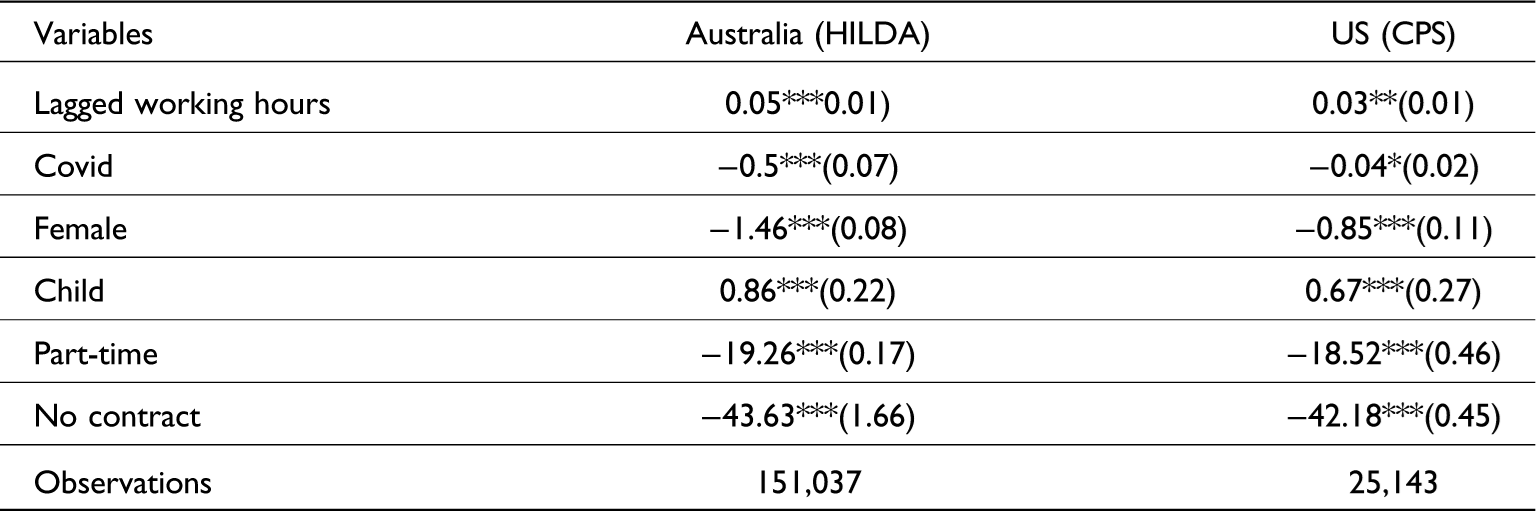
Two-step system GMM estimates of weekly working hours in Australia and the US

Table 1. Long description
A table comparing estimates of weekly working hours in Australia and the US. The table has 7 rows and 3 columns. The columns are labeled ‘Variables’, ‘Australia (HILDA)’, and ‘US (CPS)’. The rows are labeled with different variables: Lagged working hours, Covid, Female, Child, Part-time, No contract, and Observations. Each cell contains numerical values with standard errors in parentheses. The table shows the following data: Row 1: Lagged working hours, 0.05(0.01), 0.03(0.01). Row 2: Covid, -0.5(0.07), -0.04(0.02). Row 3: Female, -1.46(0.08), -0.85(0.11). Row 4: Child, 0.86(0.22), 0.67(0.27). Row 5: Part-time, 19.26(0.17), 18.52(0.46). Row 6: No contract, 43.63(1.66), 42.18(0.45). Row 7: Observations, 151,037, 25,143.
Result and discussion
Descriptive statistics
Working hours were disrupted across both countries during the pandemic, although the magnitude of disruption was modest. As detailed in Tables 16 and 17 in the Supplementary Material, average weekly working hours in Australia declined significantly during the pandemic (2020) compared with the pre-pandemic period (2019), by around 1.5 hours. In the US, the decline was more modest; average weekly working hours fell from approximately 42.6 hours in April 2019 to 41.7 hours in April 2020, a reduction of about an hour during the onset of the pandemic. These aggregate trends, although relatively modest in magnitude, mask important heterogeneity across gender groups and employment arrangements, as explored in the following sections.
Figure 1 illustrates the evolution of average weekly working hours in Australia and the US, highlighting gender-specific patterns before and during the COVID-19 pandemic. Notably, male workers experienced somewhat larger declines in working hours than female workers, a pattern that contrasts with early concerns about a potential ‘shecession’, which predicted disproportionate labour-market disruptions for women. Despite the persistent gender gap in working hours throughout the sample period, it narrowed during the pandemic’s peak. In Australia, for example, men’s average weekly working hours in 2020 were more than 1 hour lower than the previous year, whereas the decline among women was less than 1 hour.
Average weekly working hours by gender: Australia (Panel A) and the US (Panel B).

A similar pattern emerges in the US. During the early pandemic period, particularly in March and April 2020, men’s average weekly working hours fell by about an hour relative to the corresponding months of the previous year, whereas women experienced only negligible reductions of less than 0.2 hours over the same period (see Table 17 in the Supplementary Material). As a result, the gender gap in working hours narrowed measurably: in April 2019, prior to the pandemic, men worked approximately 3 hours more per week than women, on average, whereas by April 2020, this gap had narrowed to approximately 2 hours. Although men consistently worked longer hours than women throughout the sample period, the pandemic temporarily compressed the gender gap in working hours − a pattern broadly consistent with the evidence from Australia and with the modest ‘mancession’ narrative identified in the inferential analysis.
The gendered dimension of working hours becomes more pronounced when examined by employment contract type. In both countries, full-time workers reported substantially higher working hours than part-time workers, regardless of gender. As detailed in Table 16 in the Supplementary Material, in Australia, among full-time workers, the gender gap typically exceeded 2 hours per week and occasionally exceeded 4 hours during some periods over the study period (2010–2022). By contrast, the gender gap among part-time workers was generally small and in some cases negligible. As illustrated in Figure 2(a), the gender gap in average weekly working hours among full-time workers in Australia declined from roughly four hours prior to the pandemic (2019) to less than 2 hours during the pandemic (2020). Among part-time workers, male and female working hours converged at the onset of the pandemic, with negligible observable difference thereafter. Part-time working hours also remained relatively stable throughout the period.
Average weekly working hours by gender (Panel A) and employment contract transitions by gender during the pandemic (%) (Panel B), 2019–2020.

Changes in employment contract types were also observed during the pandemic, with a further transition towards part-time contracts, which served as a buffer against disruptions to working hours. A notable share of workers transitioned between full- and part-time employment. Approximately 58% of workers who changed contract type moved from full-time employment in 2019 to part-time employment in 2020, whereas 42% transitioned in the opposite direction. As shown in Figure 2(b), among men who changed contract type, around two-thirds moved from full-time to part-time employment. Among women, approximately 53% transitioned from full- to part-time positions in March 2020. These patterns coincide with the relatively stable working hours observed among part-time workers during the pandemic and with the buffering role of flexibility in part-time contracts against reductions in working hours.
A similar pattern emerges in the US. As depicted in Figure 3(a) and further detailed in Table 17 in the Supplementary Material, the gender gap among full-time workers remains above 2 hours across almost all months covered by the study. Using May as a representative pre- and during-pandemic comparison point, the full-time gender gap was 2.65 hours in May 2019 and 2.54 hours in May 2020, indicating remarkable stability in the full-time working-hours gap despite the pandemic shock. Among part-time workers, by contrast, the gender gap was negligible in most months of 2019, remaining below 1 hour in almost all pre-pandemic months. Strikingly, the direction of this gap reversed in all four pandemic months of 2020: female part-time workers averaged higher weekly working hours than their male counterparts throughout this period, with the gap turning negative. This reversal − particularly pronounced in April 2020, at the height of the first lockdown − suggests that part-time women were more resilient in maintaining their working hours than part-time men during the pandemic’s acute phase.
Average weekly working hours by gender (Panel A) and employment contract transitions (%) by gender during the pandemic, March 2019 to March 2020 (Panel B).

Figure 3. Long description
Panel A: This vertical bar graph shows average weekly working hours by gender from April 2019 to June 2020. The x-axis represents the year and month, while the y-axis represents the average weekly working hours. The graph includes four data series: male full-time, female full-time, male part-time, and female part-time. Male full-time workers consistently have the highest average weekly working hours, followed by female full-time workers. Male and female part-time workers have significantly lower average weekly working hours. Panel B: This vertical bar graph illustrates the percentage of employment contract transitions by gender during the pandemic. The x-axis shows the type of contract transition (full-time to part-time and part-time to full-time), and the y-axis represents the percentage. Males have a higher percentage of transitions from full-time to part-time, while females have a higher percentage of transitions from part-time to full-time.
The transition to part-time contracts during the pandemic further supports greater resilience and improved work–life balance for women. As depicted in Figure 3(b), consistent with the Australian case, among US workers who changed contract type between March 2019 and March 2020, approximately 59% of men and 56% of women moved from full- to part-time employment, whereas the remaining transitions were in the opposite direction. These descriptive patterns suggest that adjustments to employment contracts coincided with observed changes in working hours during the pandemic and are consistent with the buffering role of part-time flexibility documented in the inferential analysis.
Household composition is also associated with differences in working hours. In Australia (Figure 4a), fathers consistently worked longer hours than men without children, typically by at least 5 hours per week. In contrast, mothers worked slightly fewer hours than childless women, with an average difference of around 1 hour. During the pandemic, the difference between fathers and non-fathers narrowed, as fathers experienced larger reductions in working hours. A similar but less pronounced pattern is observed in the US (Figure 4b). Fathers worked between 0.7 and 3 hours more per week than non-fathers, whereas differences between mothers and childless women were comparatively small. Following the onset of the pandemic, fathers experienced noticeable reductions in working hours, reducing the gap between parents and non-parents.
Average weekly working hours by parental status: Australia (Panel A) and the US (Panel B).

Model estimation results and discussion
Our inferential analysis reveals a modest degree of persistence in working hours. Table 1 presents the baseline two-step system GMM regression results for Australia and the US. An additional hour worked in the previous year and month is associated with an increase of approximately 0.05 hours in Australia and 0.03 hours in the US, respectively. These estimates suggest that past labour-supply behaviour has a moderate influence on current working hours.
Consistent with our first hypothesis, the COVID-19 pandemic was associated with reductions in average working hours. In Australia, working hours declined by approximately half an hour per week during the pandemic period, consistent with earlier evidence documenting pandemic-related labour-market disruptions (Faberman et al Reference Faberman, Mueller and Şahin2022; Smallwood et al Reference Smallwood, Pascoe, Karimi, Bismark and Willis2021; Yong Reference Yong2020). In the US, reductions were not very significant but followed a similar direction.
Across both countries, women consistently reported fewer working hours than men. On average, women worked 1.46 fewer hours per week in Australia and 0.85 fewer hours per week in the US. These findings align with long-standing evidence of gender differences in labour supply, frequently attributed to structural labour-market inequalities and gendered divisions of paid and unpaid work (Landivar Reference Landivar2015; Sirianni and Negrey Reference Sirianni and Negrey2000).
The relationship between parenthood and working hours appears more nuanced. Surprisingly, parents worked slightly longer hours than non-parents during the pandemic, approximately 0.86 additional hours in Australia and 0.67 in the US. These results contrast with the ‘parenthood penalty’ frequently emphasised in the literature. One possible explanation is that parents face greater financial responsibilities, which may strengthen labour-market attachment and increase incentives to maintain working hours. In addition, parents may, on average, possess greater work experience or job stability, factors that could mitigate pandemic-related reductions in working hours.
The type of employment contract also remains a strong predictor of labour supply. As expected, part-time workers reported substantially fewer hours than full-time workers, with differences of approximately 19.3 hours per week in Australia and 18.5 hours in the US. These gaps reflect structural differences between employment arrangements rather than pandemic-specific shocks and highlight the distinct labour-market position of part-time employment.
To examine whether changes in working hours during the pandemic differed across groups, we estimate dynamic panel models that include interaction terms capturing gender, contract type, childcare responsibilities, and occupational segregation. The full coefficient estimates are reported in Tables 2 and 3 in the Supplementary Material. In all specifications, the reference category corresponds to men in the pre-pandemic period within the baseline group (full-time workers, non-parents, and managerial or professional occupations). Although the estimated coefficients indicate the significance and direction of interaction effects, the substantive implications of the models are more clearly illustrated through the marginal effects of the pandemic period across group combinations. The reported marginal effects represent within-group changes in working hours between the pre-pandemic and pandemic periods, holding other characteristics constant.
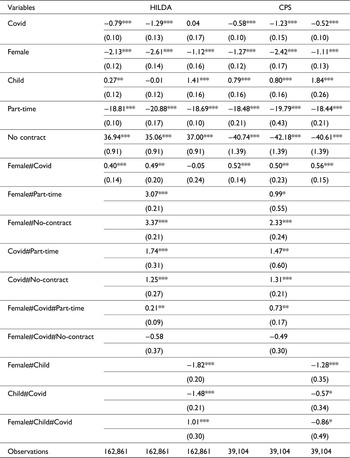
Hausman-Taylor estimates of gendered weekly working hours during the pandemic by parenthood and contract type
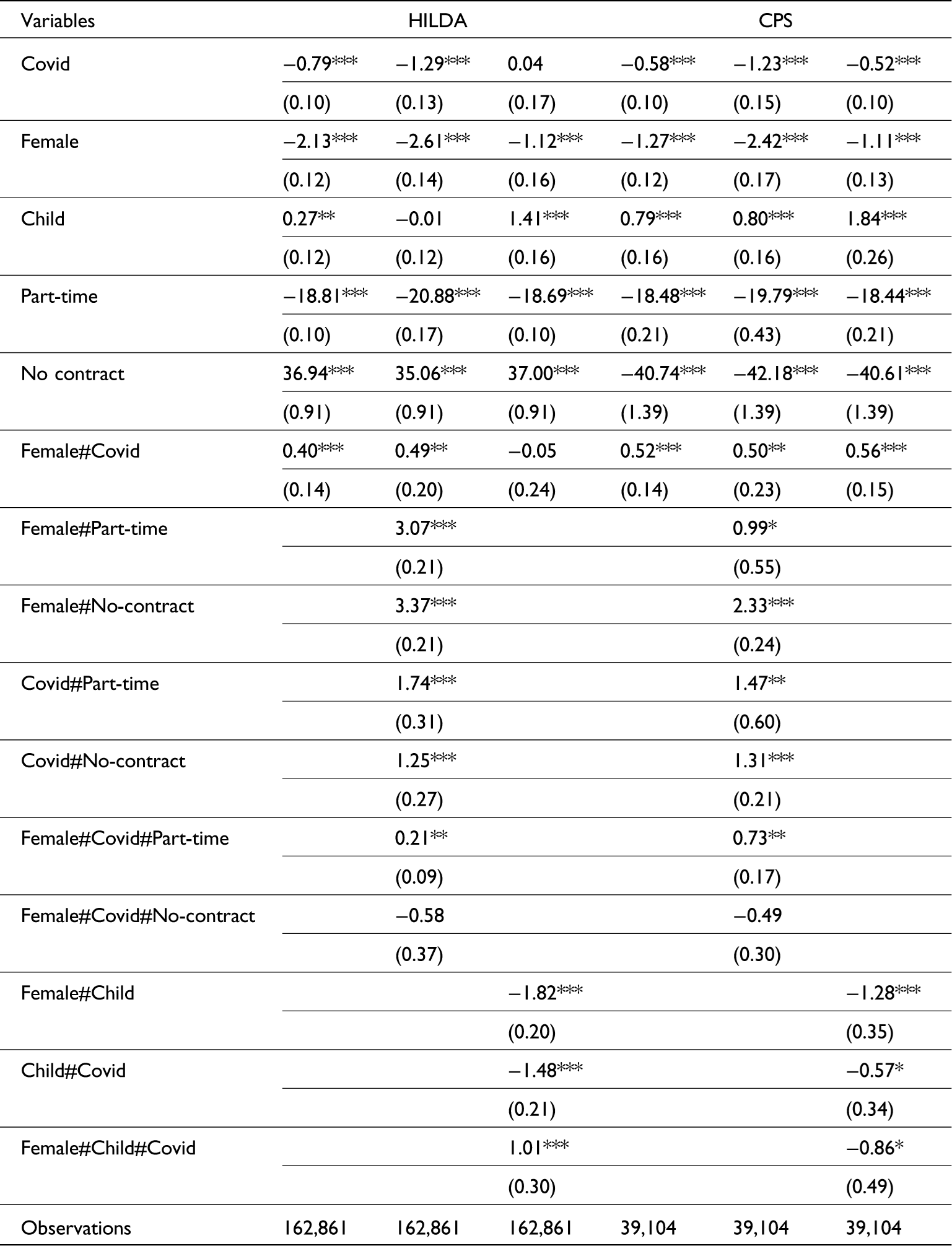
Long description
The table presents Hausman-Taylor estimates of gendered weekly working hours during the pandemic, categorized by parenthood and contract type. It includes data from two sources: HILDA and CPS. The table has 16 rows and 12 columns, including headers and observations. Row 1: Covid, -0.79, -1.29, 0.04, -0.58, -1.23, -0.52. Row 2: Female, -2.13, -2.61, -1.12, -1.27, -2.42, -1.11. Row 3: Child, 0.27, -0.01, 1.41, 0.79, 0.80, 1.84. Row 4: Part-time, -18.81, -20.88, -18.69, -18.48, -19.79, -18.44. Row 5: No contract, 36.94, 35.06, 37.00, -40.74, -42.18, -40.61. Row 6: Female#Covid, 0.40, 0.49, -0.05, 0.52, 0.50, 0.56. Row 7: Female#Part-time, 3.07, 0.99. Row 8: Female#No-contract, 3.37, 2.33. Row 9: Covid#Part-time, 1.74, 1.47. Row 10: Covid#No-contract, 1.25, 1.31. Row 11: Female#Covid#Part-time, 0.21, 0.73. Row 12: Female#Covid#No-contract, -0.58, -0.49. Row 13: Female#Child, -1.82, -1.28. Row 14: Child#Covid, -1.48, -0.57. Row 15: Female#Child#Covid, 1.01, -0.86. Row 16: Observations, 162,861, 162,861, 162,861, 39,104, 39,104, 39,104.
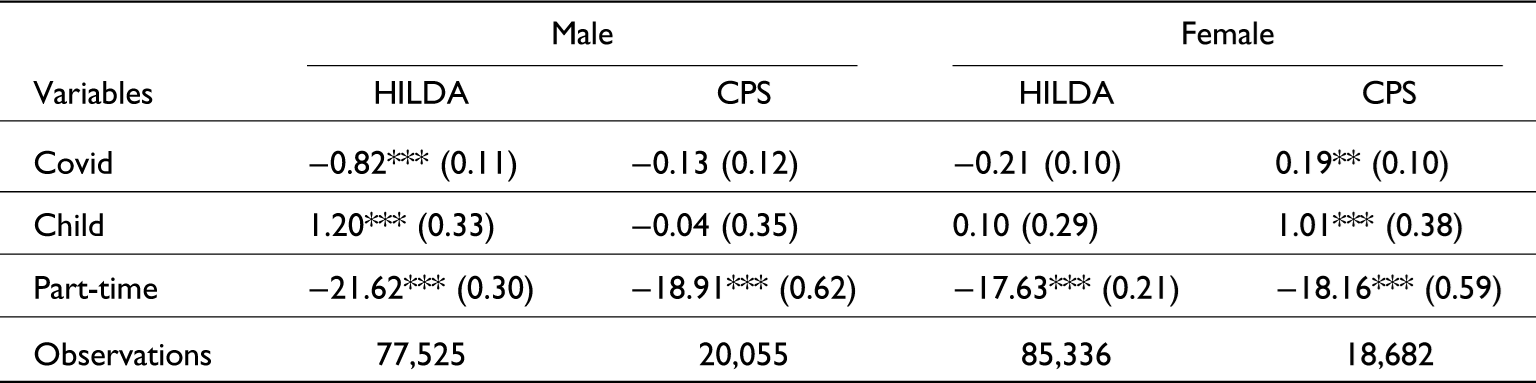
Two-step system GMM estimates of working hours disaggregated by gender
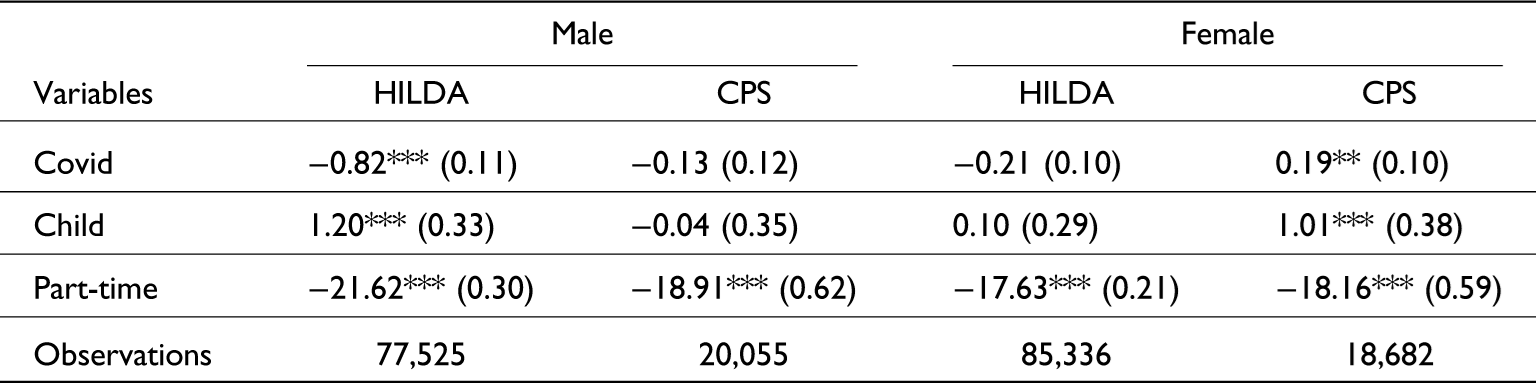
Long description
A table comparing two-step system GMM estimates of working hours disaggregated by gender. The table has four rows and six columns. Column headers are Variables, Male HILDA, Male CPS, Female HILDA, and Female CPS. Row labels are Covid, Child, Part-time, and Observations. Row 1: Covid, -0.82 (0.11), -0.13 (0.12), -0.21 (0.10), 0.19 (0.10). Row 2: Child, 1.20 (0.33), -0.04 (0.35), 0.10 (0.29), 1.01 (0.38). Row 3: Part-time, -21.62 (0.30), -18.91 (0.62), -17.63 (0.21), -18.16 (0.59). Row 4: Observations, 77,525, 20,055, 85,336, 18,682.
Contrary to our initial hypothesis but consistent with the descriptive evidence, the estimated models suggest that the gender gap in working hours narrowed during the pandemic. Prior to the pandemic, women worked, on average, 1.64 fewer hours per week than men in Australia and 1.04 fewer hours per week in the US. As depicted in Figure 5, during the pandemic, male workers experienced average reductions of approximately 0.82 hours per week in Australia and 0.25 hours in the US relative to their pre-pandemic working hours. In contrast, female workers experienced smaller adjustments: working hours declined by around 0.22 hours in Australia and increased slightly (0.32 hours) in the US relative to their pre-pandemic working hours.
Average marginal effects of COVID-19 on weekly working hours by gender in Australia (Panel A) and the US (Panel B).

These estimates indicate that the reduction in working hours during the pandemic was approximately 0.60 hours shorter for women than for men in Australia, and 0.56 hours shorter in the US. In other words, the pandemic period was associated with a modest narrowing of the gender gap in weekly working hours in both countries. This pattern is consistent with evidence reported by the European Institute for Gender Equality, which finds that between the second quarter of 2019 and the second quarter of 2020, men’s weekly working hours declined by 1.3 hours, compared with a decline of 0.8 hours among women (European Union 2021).
The interaction models further indicate that the type of employment contract plays an important role in shaping these patterns. The estimated coefficients reported in Tables 2 and 3 reveal substantial heterogeneity in working-hour adjustments across employment arrangements. Figure 6 presents the estimated marginal effects of the pandemic across gender and contract-type groups.
Average marginal effects of COVID-19 on weekly working hours by gender and contract type in Australia (Panel A) and the US (Panel B).

In Australia, full-time male workers experienced a reduction of approximately 1.26 hours per week during the pandemic, whereas full-time female workers experienced a smaller reduction of about 0.87 hours relative to their pre-pandemic working hours. Among part-time workers, the adjustments were considerably smaller. Part-time men experienced a statistically insignificant change in working hours, whereas part-time women experienced a small increase of approximately 0.34 hours per week. A broadly similar pattern emerges in the US. Full-time male workers experienced a reduction of around 1.08 hours per week during the pandemic relative to their pre-pandemic levels, whereas full-time female workers experienced a nonsignificant reduction. Among part-time workers, the adjustments differed more strongly by gender; part-time men experienced a nonsignificant decline in working hours, whereas part-time women experienced an increase of approximately 2.22 hours per week relative to their pre-pandemic levels.
These results indicate that pandemic-related working-hour adjustments differed systematically across both employment arrangements and gender groups. In both countries, reductions in working hours were concentrated primarily among full-time workers, whereas part-time workers experienced comparatively smaller adjustments. This pattern is particularly notable for women, who are disproportionately represented in part-time employment (approximately 72% of part-time workers in Australia and 61% in the US).
Several mechanisms may contribute to these findings. Part-time employment may provide greater flexibility in adjusting working hours during periods of labour-market disruption (Fox et al Reference Fox, Han, Ruhm and Waldfogel2013). In addition, a substantial share of workers transitioned from full- to part-time employment during the pandemic, with approximately 59% of male workers and 56% of female workers experiencing contract changes in this direction. Such shifts are consistent with broader labour-market adjustments observed during the COVID-19 crisis. Previous studies have similarly documented that part-time employment can play an adaptive role during periods of economic disruption (Bertogg et al Reference Bertogg, Kulic and Strauss2022; Gontkovičová and Spišáková Reference Gontkovičová and Spišáková2024). Moreover, evidence suggests that a significant portion of the overall decline in working hours during the pandemic was concentrated among full-time workers (Lafuente et al Reference Lafuente, Santaeulàlia-Llopis and Visschers2022).
It is important, however, to interpret this finding with a critical eye. The apparent resilience of part-time women’s working hours during the pandemic does not imply that part-time employment represents a desirable or equitable solution to gendered labour-market vulnerability. A substantial body of research documents that women’s concentration in part-time employment is associated with persistent penalties across the employment lifecycle: lower hourly wages, reduced access to employer-provided benefits, slower career progression, and greater exposure to economic insecurity in old age (Antonie et al Reference Antonie, Gatto and Plesca2020; Fouarge and Muffels Reference Fouarge and Muffels2009; Lyonette Reference Lyonette2015). In this sense, part-time employment may function as a coping mechanism that absorbs short-run disruptions at the cost of entrenching longer-run gender inequalities in earnings, career trajectories, and economic independence. Our findings, therefore, do not support the view that women should work part-time more often. Rather, they reinforce the case for policies that expand flexible working arrangements across the full employment distribution, including full-time contracts, while simultaneously reducing the structural pressures that currently confine many women to part-time work against their preferences.
Disaggregating gender differences by parenthood reveals important heterogeneity in working-hour adjustments during the pandemic. The baseline estimates reported in Tables 2 and 3 of the Supplementary Material indicate that, prior to the pandemic, women worked fewer weekly hours than men in both countries. Among individuals without children, before the onset of the pandemic, women worked approximately 0.98 fewer hours per week in Australia and 0.95 fewer hours per week in the US than otherwise similar men. Parenthood further widened this gender difference; before the onset of the pandemic, mothers worked 1.14 fewer hours than fathers in Australia and 1.29 fewer hours in the US.
The interaction estimates suggest that pandemic-related adjustments differed substantially by gender and childcare status. To facilitate interpretation of these interaction effects, Figure 7 reports the average marginal effects of the pandemic indicator across gender and childcare status. These marginal effects capture within-group changes in working hours relative to the pre-pandemic period. In Australia, male workers experienced reductions in weekly working hours regardless of childcare status, although the decline was substantially larger among fathers. Specifically, working hours declined by approximately 0.41 hours for childless men and by 1.11 hours for fathers relative to their pre-pandemic levels. A broadly similar pattern is observed in the US, although the decline among fathers is not statistically significant.
Average marginal effects of COVID-19 on weekly working hours by gender and childcare status in Australia (Panel A) and the US (Panel B).

Figure 7. Long description
Two graphs depict the average marginal effects of COVID-19 on weekly working hours by gender and childcare status in Australia and the US. Panel A: HILDA. This scatter plot shows the marginal effects on working hours for males and females, both with and without children. The x-axis represents gender (Male, Female), and the y-axis represents the marginal effects on working hours. Blue dots represent individuals without children, and red dots represent individuals with children. Error bars indicate the confidence intervals. For males, those without children have a marginal effect close to zero, while those with children have a negative effect around -1. For females, those without children have a positive marginal effect, while those with children have a negative effect around -0.5. Panel B: CPS. This scatter plot shows similar data for the US. The x-axis represents gender (Male, Female), and the y-axis represents the marginal effects on working hours. Blue dots represent individuals without children, and red dots represent individuals with children. Error bars indicate the confidence intervals. For males, those without children have a marginal effect close to zero, while those with children have a negative effect around -1. For females, those without children have a positive marginal effect, while those with children have a negative effect around -1.
Women’s responses, however, differ markedly depending on childcare responsibilities. Childless women did not experience meaningful reductions in working hours during the pandemic. Their working hours remained broadly stable and even increased slightly relative to the pre-pandemic period, although the effect is not very significant in Australia and modest (0.36 hours per week) in the US. In contrast, mothers experienced noticeable reductions in working hours during the pandemic. In Australia, mothers’ weekly working hours declined by approximately 0.32 hours, whereas in the US, the reduction was approximately 1 hour per week.
These results suggest that gender differences in pandemic-related labour-supply adjustments were primarily concentrated among parents. Women without childcare responsibilities were largely able to maintain, or even slightly increase, their labour supply during the pandemic, whereas mothers experienced clear reductions in working hours. Men, by contrast, showed comparatively similar adjustments regardless of parental status. These findings point to childcare responsibilities as an important mechanism through which the pandemic amplified gender differences in labour-market outcomes.
Our findings are consistent with a growing body of research documenting how school and daycare closures during the pandemic increased unpaid caregiving demands and disproportionately affected women’s labour-market participation (Alon et al Reference Alon, Doepke, Tertilt and Olmstead-Rumsey2020b; Collins et al Reference Collins, Landiva, Ruppanner and Scarborough2021; Kantamneni Reference Kantamneni2020). The loss of formal childcare and the shift to home-based schooling significantly increased household caregiving requirements, thereby reducing mothers’ availability for paid work. Although some studies suggest that fathers modestly increased their involvement in childcare during lockdowns, the evidence consistently shows that mothers continued to shoulder the majority of these responsibilities, leading to stronger labour-supply adjustments among women.
Finally, we examine whether gendered changes in working hours during the pandemic are associated with occupational segregation. As in the previous specifications, the analysis focuses on the average marginal effects of the COVID-19 indicator, which capture within-group changes in working hours relative to the pre-pandemic period. Given the strong gender segregation observed in our data, one might expect pandemic-related working-hour adjustments to differ across occupational groups. Employment in machinery operation, farming, and transport occupations is overwhelmingly male-dominated (86% in the US and 75% in Australia), whereas women are disproportionately represented in clerical, service, and sales occupations (71% in Australia and 58% in the US).
Contrary to this expectation and to our hypothesis, the empirical results provide limited evidence that gender differences in pandemic-related working-hour adjustments vary systematically across occupational categories. Instead, as depicted in Figure 8, the largest reductions in working hours occur in high-skill occupations, particularly among managers, professionals, and technicians, and are more pronounced among men. For example, in Australia, male workers in managerial, professional, and technical occupations, who account for approximately 59% of employment in these occupations, experienced a reduction of about 1.3 hours per week during the pandemic relative to the pre-pandemic period. The corresponding estimate for women in the same occupational group is smaller (approximately 0.63 hours) and statistically insignificant. Similar, although less statistically significant, patterns are observed in the US. As reported in Supplementary Material Tables 8 and 9, we further examine gender differences in working-hour adjustments during the pandemic across occupational categories. The results remain consistent and provide limited evidence that gender differences in pandemic-related working-hour adjustments vary systematically across occupations.
Average marginal effects of COVID-19 on weekly working hours by gender and occupation in Australia (Panel A) and the US (Panel B).

These results suggest that gender differences in pandemic-related working-hour adjustments are not primarily driven by occupational segregation. Instead, the concentration of working-hour reductions among managers and professionals, particularly men, may reflect greater discretion over working-time arrangements, higher task substitutability, and increased scope for efficiency gains or workload compression under remote and flexible work arrangements. This interpretation is consistent with external evidence indicating that working-hour reductions during the pandemic were relatively evenly distributed across occupational groups, except for managers, whose weekly working hours declined by 2.7 hours between the second quarters of 2019 and 2020 (Eurofound 2021).
Robustness checks
To assess the stability of our findings, we conducted a series of robustness checks using alternative estimation strategies, sample specifications, and variable definitions. First, in addition to the baseline system GMM estimator, we estimated pooled OLS, RE, Hausman–Taylor (HT), and CRE models. The HT estimator combines features of fixed-effects and RE models by allowing some regressors to be correlated with unobserved individual-specific effects while still permitting the estimation of time-invariant variables through internal instruments derived from the panel structure of the data (Baltagi Reference Baltagi2013; Hausman and Taylor Reference Hausman and Taylor1981). In contrast, the Mundlak (Reference Mundlak1978) CRE approach addresses potential correlation between regressors and unobserved individual effects by including the group means of time-varying variables, but it does not provide an instrumental-variables strategy for potentially endogenous time-invariant regressors. Consequently, when time-invariant variables are suspected to be correlated with individual effects, the HT estimator can provide a more appropriate identification strategy (Baltagi and Liu Reference Baltagi and Liu2016; Hausman and Taylor Reference Hausman and Taylor1981). This feature is particularly relevant in our context, where key explanatory variables include both time-varying and time-invariant characteristics, some of which may be endogenous. The Mundlak specification test also supports the CRE specification. The corresponding CRE estimates reported in Supplementary Material Tables 14 and 15 closely mirror the baseline GMM and HT results, both qualitatively and quantitatively, reinforcing the robustness of our main conclusions.
Across all estimators, we consistently observe a gender gap in working hours prior to the pandemic, with women working fewer hours than men. As presented in Table 2 and detailed in Tables 4 and 5 in the Supplementary Material, results from the HT estimation confirm the unexpected but consistent narrowing of this gender gap during the pandemic by roughly half an hour per week. The role of parenthood in shaping gendered working hours during the pandemic is also highly consistent across specifications. Childless women modestly increased or maintained their working hours during the pandemic, whereas mothers experienced noticeable reductions in both Australia and the US. These results confirm that childcare responsibilities amplified gendered disruptions in working hours independently of the estimation method. Furthermore, across all specifications, part-time employment consistently mitigates pandemic-related disruptions in working hours. Female part-time workers recorded increases in weekly working hours during the pandemic relative to the pre-pandemic period, whereas male part-time workers experienced small and statistically insignificant changes. This cushioning role of part-time contracts, particularly for women, remains robust across both countries. These patterns are consistent with the childcare- and contract-related mechanisms discussed above, reinforcing that the observed effects are not an artefact of the estimation method.
As an additional sensitivity test, we estimated the models separately for men and women. The results, summarised in Table 3 and detailed in Supplementary Tables 6 and 7, remain fully consistent with the baseline findings. For men, working hours declined modestly during the pandemic, whereas for women, the estimated changes were positive or statistically insignificant. Parenthood continues to play divergent roles across genders: fathers generally increased working hours under normal conditions but experienced modest reductions during the pandemic, while motherhood remained associated with larger pandemic-related declines. Across genders, part-time workers reported substantially fewer hours than full-time workers, yet part-time contracts again appear to buffer pandemic-related reductions, particularly for women.
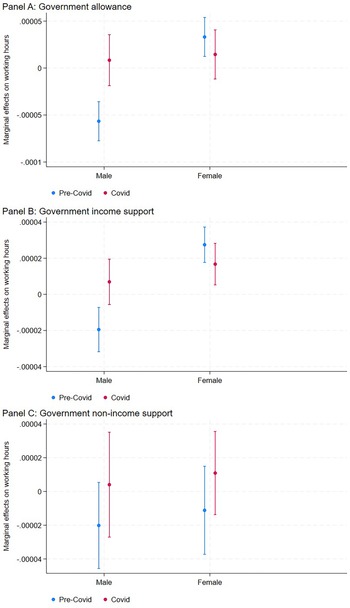
We further examine whether pandemic-related fiscal support in Australia influenced working-hour adjustments. Following the onset of COVID-19, the Australian government implemented extensive social protection measures, including the JobKeeper wage subsidy and expanded income-support programmes (Breunig and Sainsbury Reference Breunig and Sainsbury2023). These interventions substantially increased disposable income for many households. For example, the real value of the JobSeeker payment increased by approximately 12%, whereas disposable income among sole parents with a child under eight rose by 27.2% (Bradbury and Hill Reference Bradbury and Hill2021). Given the women’s disproportionate exposure to childcare closures and increased unpaid care responsibilities, we expect these policy interventions to generate gender-differentiated effects on labour supply and working hours.
However, despite this large fiscal expansion, we find little evidence that government support measures significantly affected working-hour adjustments. As illustrated in Figure 9 and detailed in Supplementary Table 10, the estimated marginal effects of government allowances, income support, and non-income-support measures on weekly working hours are small and statistically indistinguishable from zero for both men and women. Even where point estimates are non-zero, their magnitudes remain economically negligible, corresponding to changes of less than a fraction of a second per week.
Marginal effect of government allowance (Panel A) and support programmes (Panels B and C) on weekly working hours by gender and COVID-19 status.

Figure 9. Long description
Panel A: This panel contains two scatter plots showing the marginal effects of government allowance on working hours for males and females. The x-axis represents gender (Male and Female), and the y-axis represents the marginal effects on working hours. The data points are color-coded: blue for Pre-Covid and red for Covid. For males, the Pre-Covid data shows a negative effect, while the Covid data shows a positive effect. For females, both Pre-Covid and Covid data show positive effects, with the Covid effect being slightly higher. Panel B: This panel contains two scatter plots showing the marginal effects of government income support on working hours for males and females. The x-axis represents gender (Male and Female), and the y-axis represents the marginal effects on working hours. The data points are color-coded: blue for Pre-Covid and red for Covid. For males, the Pre-Covid data shows a negative effect, while the Covid data shows a positive effect. For females, both Pre-Covid and Covid data show positive effects, with the Covid effect being slightly higher. Panel C: This panel contains two scatter plots showing the marginal effects of government non-income support on working hours for males and females. The x-axis represents gender (Male and Female), and the y-axis represents the marginal effects on working hours. The data points are color-coded: blue for Pre-Covid and red for Covid. For males, the Pre-Covid data shows a negative effect, while the Covid data shows a positive effect. For females, both Pre-Covid and Covid data show positive effects, with the Covid effect being slightly higher.
To further assess the role of childcare responsibilities, we replace the child-presence indicator with the number of children in the household as a continuous measure. The results, presented in Figure 10 and detailed in the Supplementary Material Tables 11 and 12, remain fully consistent with the baseline specification. Prior to the pandemic, a larger number of children were positively associated with fathers’ weekly working hours in both countries. During the pandemic, this positive association persists but becomes weaker. For mothers, the number of children is not significantly associated with working hours prior to the pandemic; however, during the pandemic, an additional child is associated with reductions in weekly working hours, particularly in the US. These findings further reinforce the asymmetric relationship between childcare responsibilities and parental labour supply.
Marginal effect of the number of children on weekly working hours by gender and COVID-19 status in Australia (Panel A) and the US (Panel B).

Finally, we examine the temporal stability of our results. First, we extend the analysis back to 2004 to incorporate the global financial crisis period. Second, we restrict the sample to more recent observations by including only post-2018 HILDA Survey data (Table 13 in the Supplementary Material). Third, we redefine the COVID indicator to capture only 2020, the year most directly affected by pandemic-related shutdowns. Across all these alternative specifications, the core findings remain unchanged; gender gaps narrowed among childless workers, widened among parents, and part-time employment consistently buffered reductions in working hours.
Conclusion and recommendations
The COVID-19 pandemic generated unprecedented disruptions in labour markets, substantially affecting working hours across demographic and employment groups. Using longitudinal data from Australia and the US, this study examined how gender differences in working hours evolved during the pandemic and whether these adjustments were shaped by parenthood, employment contract type, and occupational segregation. Our findings reveal a modest narrowing of gender disparities in working hours during the pandemic. Before the pandemic, women worked on average 1.64 fewer hours than men in Australia and 1.04 fewer hours than men in the US. However, the reduction in working hours during the pandemic was approximately 0.60 hours smaller for women than for men in Australia and 0.56 hours smaller in the US. Rather than confirming the widely discussed ‘shecession’ narrative, our results are more consistent with a modest ‘mancession’ in terms of working-hour adjustments.
A more nuanced picture emerges once parenthood is taken into account. Childless women largely maintained their labour supply during the pandemic, whereas mothers experienced clear reductions in working hours in both countries relative to their pre-pandemic levels (0.99 in the US and 0.32 in Australia). By contrast, men’s working hours declined regardless of parental status, with somewhat larger reductions among fathers. These findings highlight the central role of childcare responsibilities in shaping gendered labour-supply responses during the pandemic. Although the overall gender gap in working hours narrowed, the adjustments were highly uneven across women, with mothers bearing the largest reductions.
Employment contract type further conditioned these gendered working-hour outcomes. Although part-time workers reported substantially fewer hours (19 fewer per week) than full-time workers on average, part-time employment appeared to buffer pandemic-related disruptions in working hours. Full-time male workers experienced a considerable reduction in weekly working hours of about 1.26 and 1.08 hours in Australia and the US, respectively, during the pandemic compared with their pre-pandemic levels, whereas full-time female workers experienced a modest and non-significant reduction. In contrast, part-time women experienced increases of 0.34 and 2.22 working hours during the pandemic compared with their pre-pandemic levels in Australia and the US, respectively. These results suggest that flexible employment arrangements may have allowed some workers, particularly women, to better reconcile paid work with increased unpaid responsibilities during the crisis. However, this finding should not be interpreted as evidence that part-time employment represents a desirable or equitable pathway to gender equality. Women’s concentration in part-time work is well documented to carry persistent long-run penalties − including lower lifetime earnings, reduced career progression, and reduced benefits − suggesting that part-time employment functioned here as a coping mechanism rather than a genuine solution to gendered labour-market vulnerability (Antonie et al Reference Antonie, Gatto and Plesca2020; Fouarge and Muffels Reference Fouarge and Muffels2009; Lyonette Reference Lyonette2015).
By contrast, occupational segregation played a limited role in explaining gender differences in pandemic-related working-hour adjustments. Although working hours declined most strongly in higher-skill occupations, particularly among managers and professionals, these patterns were not systematically linked to gender differences across occupational groups. Instead, the evidence indicates that family responsibilities and employment arrangements were more important determinants of gendered labour-supply adjustments than occupational segregation.
This study, however, is not without limitations. In particular, the accuracy of matching individuals across CPS months is constrained by rotation patterns, non-response, and potential recording errors. Although we employed multiple identifiers — Household Identifier (HHID), Household Number (HHNUM), and Line Number (LINEO) — and cross-checked against immutable characteristics (sex, race, age, education, relationship to household head, labour force status), concerns remain about representativeness. Nevertheless, the consistency of findings across robustness checks enhances confidence in the results. Another limitation of this study concerns the differences in survey design between HILDA and CPS, which limit the extent to which strict cross-country comparisons can be made. HILDA provides annual panel data covering a relatively long period. In contrast, CPS is a monthly survey with a very short window covering March–June in 2019 and the corresponding months in 2020. Despite these limitations, the study contributes new cross-national evidence on how gender, parenthood, and employment arrangements interact to shape working-hour adjustments during large-scale economic shocks.
In light of the findings, several policy implications follow. First, improving access to affordable childcare remains essential for reducing gender inequalities in labour-market outcomes, particularly during periods of economic disruption. Second, expanding flexible work arrangements, while ensuring adequate labour protections and benefits for part-time workers, may help mitigate gender-specific labour-supply constraints during future crises. Policies that combine accessible childcare with secure and flexible employment arrangements are therefore likely to play a crucial role in supporting gender equality and labour-market resilience in the post-pandemic period.
Supplementary material
The supplementary material for this article can be found at https://doi.org/10.1017/elr.2026.10080.
Funding statement
No funding was received to assist with the preparation of this article. The authors have no relevant financial or non-financial interests to disclose.






 Open access

