Merit selection is one of the last century’s most important institutional experiments in American politics. Under merit selection, judicial vacancies are filled through a two-stage process. At the state level, for instance, a commission first winnows an applicant pool and forwards a short list of nominees to the governor. Second, the governor appoints one of the forwarded nominees. More than half of all states use merit selection to fill at least some of their judicial vacancies. Furthermore, stakeholders in numerous states are currently debating whether to adopt or abolish merit selection. Although merit selection is most prevalent in the states, President Carter initiated commission-aided judicial selection reforms for the lower federal courts, and some state congressional delegations continue to use nominating commissions to help fill district and circuit court vacancies. Federal magistrate and bankruptcy judges are commonly chosen through merit selection, and prominent calls have been made to implement merit selection for US Supreme Court justices (e.g., Chemerinsky Reference Chemerinsky2015, 298–302). Judicial merit selection has also expanded globally, with adoptions in countries such as Canada, England, and South Africa.
Arguments for and against merit selection typically rely on rhetorical appeals rather than empirical evidence. Supporters often argue that merit selection insulates appointment decisions from the political process, resulting in a more qualified and diverse judiciary; critics contend that decision making under merit selection is nonetheless political and unlikely to produce a more qualified or diverse bench. Unfortunately, little systematic evidence is available to help adjudicate these competing empirical claims. The best available evidence tends to engage in comparative institutional analysis, contrasting outcomes across major selection mechanisms with respect to judicial performance (Choi, Gulati, and Posner Reference Choi, Gulati and Posner2010; Owens et al. Reference Owens, Tahk, Wohlfarth and Bryan2015) and ability to sort on characteristics such as qualifications or diversity (Goelzhauser Reference Goelzhauser2016). These external approaches are instructive but do not allow for evaluating institutional performance with respect to what makes merit selection unique: the two-stage selection of judges by different entities from fixed choice sets.
In this article, I analyze whether merit selection delivers with respect to its core tenets by modeling commission and gubernatorial selections from relevant choice sets. Using original data obtained through public records requests and scraped from individual applications in Nebraska (the only state to provide substantial information on commission and gubernatorial selections), the results are mixed. Although commissions and governors sort on certain legal qualifications, women are disadvantaged at the commission stage while partisanship matters at both stages. These results have important implications for the judicial selection debate (e.g., Bonneau and Hall Reference Bonneau and Gann Hall2009; Hall Reference Hall2015; Cann and Yates Reference Cann and Yates2016) and our understanding of state court diversification (e.g., Bratton and Spill Reference Bratton and Spill2002; Hurwitz and Lanier Reference Hurwitz and Noble Lanier2003; Goelzhauser Reference Goelzhauser2011). More specifically, this project provides the first systematic empirical evidence concerning merit selection’s institutional performance that separately accounts for and evaluates commission and gubernatorial choices from relevant candidate pools.
Competing Claims about Merit Selection
Proponents have long argued that merit selection emphasizes qualifications. As the American Judicature Society (n.d.) once put it, the system “is called ‘merit selection’ because the judicial nominating commission chooses applicants on the basis of their qualifications.” Scholars have taken two approaches to analyzing the link between merit selection and judicial quality. First, scholars have analyzed whether different selection systems produce better-qualified judges (Jacob Reference Jacob1964; Canon Reference Canon1972; Glick and Emmert Reference Glick and Emmert1987). For state supreme court justices seated from 1960 through 2014, for example, evidence suggests there is little difference in qualifications across selection systems (Goelzhauser Reference Goelzhauser2016). Second, scholars have examined the link between selection institutions and ex post judicial performance (Choi et al. Reference Choi, Gulati and Posner2010). For example, decisions from merit selection states are not more or less likely to be overturned by the US Supreme Court (Owens et al. Reference Owens, Tahk, Wohlfarth and Bryan2015).Footnote 1
In recent decades, merit selection has increasingly been linked to diversification. As one scholar put it, “There is no question but that the merit selection system affords greater opportunities for women and minorities to find their way to the bench” (Krivosha Reference Krivosha1987, 19). The argument is that merit selection creates more opportunities for people from historically disadvantaged groups by mitigating the importance of political connections. But the empirical evidence is mixed. One study found that selection system mattered little for the number of women and racial minorities on state appellate courts in 1985 and 1999 (Hurwitz and Lanier Reference Hurwitz and Noble Lanier2003). However, analyzing data on the seating of all state supreme court justices from 1960 through 2014 revealed that women are more likely to be seated under merit selection than unilateral elite appointment, while there is no difference between merit selection and election; black and nonwhite justices more generally are more likely to be seated under merit selection and unilateral elite appointment than election, but there is no difference between the appointment systems (Goelzhauser Reference Goelzhauser2016).
Merit selection’s proponents and critics often debate the extent to which the process is politicized. Proponents contend that merit selection is designed to “de-emphasize partisan affiliations” (Glick Reference Glick1978, 513), while critics argue that it “simply moves the focus for political considerations from the public arena to the closed door meetings of the nominating commission” (Bopp Reference Bopp2013, 94). Compared to debates over qualifications and diversity, there is little empirical evidence on the influence of politics under merit selection. Fitzpatrick (Reference Fitzpatrick2016) analyzes data on campaign contributions and primary voting by judges in a sample of states, concluding that certain indicia of “ideological skew” are more evident in merit selection states. And Bonica and Sen (Reference Bonica and Senforthcoming) find that judges chosen under merit selection are less politicized than judges picked through unilateral elite appointment or partisan election while exhibiting a similar level of politicization as judges selected under nonpartisan election.
Modeling Selection from Candidate Pools
Existing studies evaluate merit selection by comparing the outcomes it generates to those generated by other judicial selection systems. This type of comparative institutional analysis is fundamentally important because it allows for weighing evidence about the aggregate consequences of institutional design choices concerning judicial selection. But the results of these inquiries only partially inform our understanding of merit selection’s institutional performance. In terms of institutional design, the two-stage selection process is what makes merit selection unique. While the final outcome is important, a more complete evaluation of merit selection from an institutional design perspective would separately evaluate commission and gubernatorial decisions from their fixed choice sets. If merit selection works as intended, commissions and governors should be selecting on qualifications and diversity rather than political considerations. To date, however, there have been no systematic inquiries into the determinants of commission and gubernatorial decision making under merit selection.
Data limitations may be one reason for the lack of systematic inquiry into the determinants of commission and gubernatorial decision making under merit selection. Many states merely announce the governor’s appointee, providing little if any information about the broader applicant pool for any particular position. In an attempt to obtain the relevant information, I filed public records requests with every state that has a merit selection system instituted by constitutional or statutory rule.Footnote 2 The requests specifically asked for lists of applicants by vacancy, any application materials submitted, lists of commission nominees forwarded to the governor for each vacancy, and lists of appointees for each vacancy. Only Nebraska provided comprehensive information about the relevant candidate pools, returning relevant lists along with copies of a short application submitted by each applicant from 2000 through 2016. Most states reported discarding the relevant information or having laws exempting the information from disclosure.
Nebraska was among the first states to adopt merit selection when it did so for its supreme court and trial courts of general jurisdiction with a 1962 constitutional amendment; it later adopted merit selection for county courts in 1974 and the intermediate appellate court upon creation in 1990. In addition to being among merit selection’s earliest adopters, Nebraska reformers first associated the word “merit” with commission-based judicial selection (Winters Reference Winters1966, 1085). As in other states, Nebraska reformers argued that merit selection would “take [the] judicial office out of the political arena” (Haggart Reference Haggart1962, 731) and “assure appointment … of the best qualified judges” (Turner Reference Turner1961, 625). Furthermore, as has its branches in other states, the League of Women Voters of Nebraska has long supported merit selection in part because of its perceived benefits with respect to judicial diversification.Footnote 3 Many perceive the system to be working well, with a past president of the State Bar Association recently testifying to the legislature that “Nebraska’s merit system for the selection of judges has no peers; it is the best there is” (Duggan Reference Duggan2017).
The institutional design of Nebraska’s merit selection system is largely representative. Judicial nominating commissions, which are in place for each judicial district, include a Nebraska Supreme Court justice serving as a nonvoting ex officio member, four lawyers appointed by the State Bar Association, and four nonlawyers appointed by the governor. No more than four of the eight voting members can be copartisans. For any given vacancy, the relevant commission must forward at least two nominees to the governor for further consideration. The governor then has 60 days to make an appointment from the list of nominees; if the governor fails to make an appointment from the list within 60 days, the chief justice of the Nebraska Supreme Court is authorized to make the appointment from the same list.
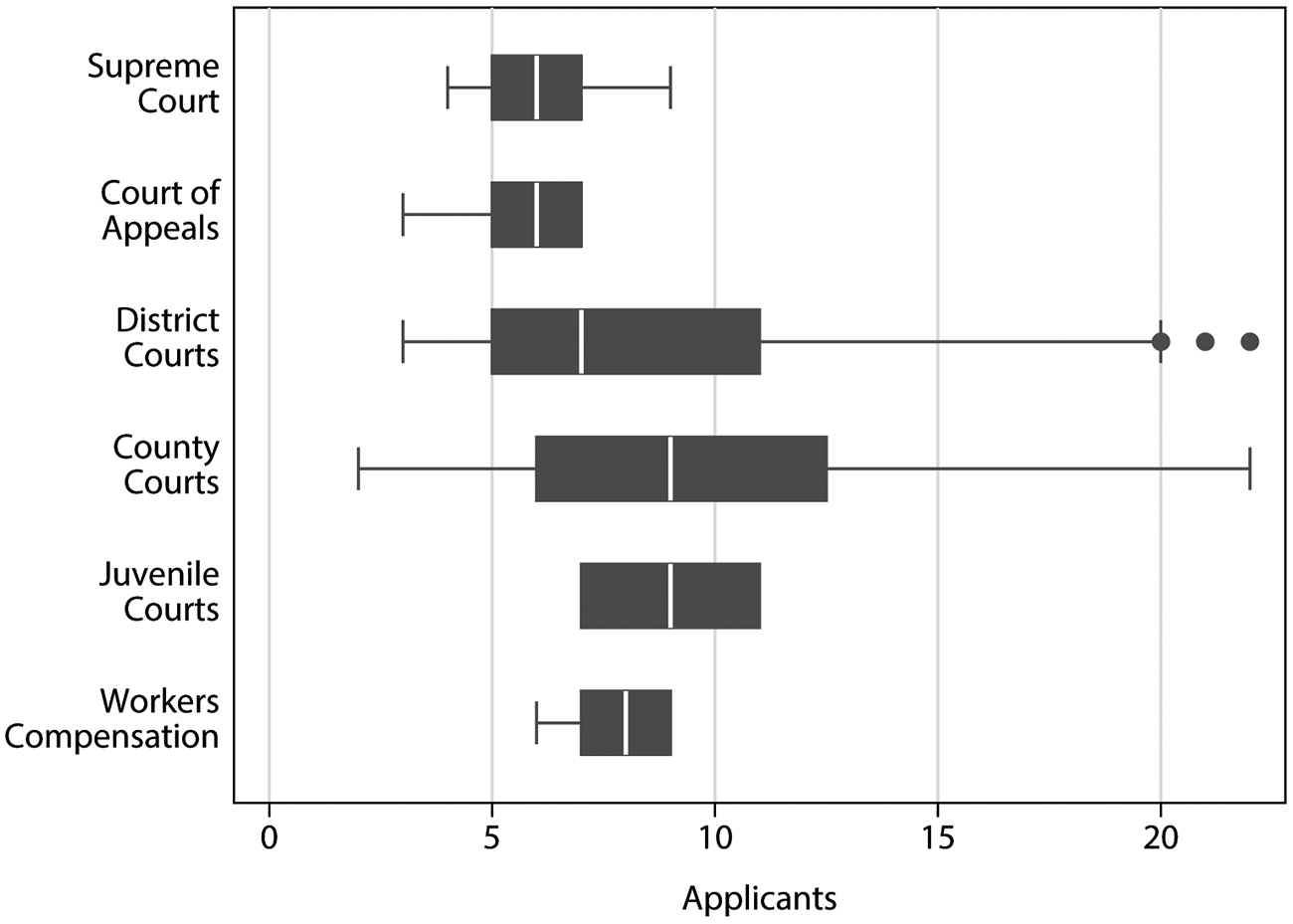
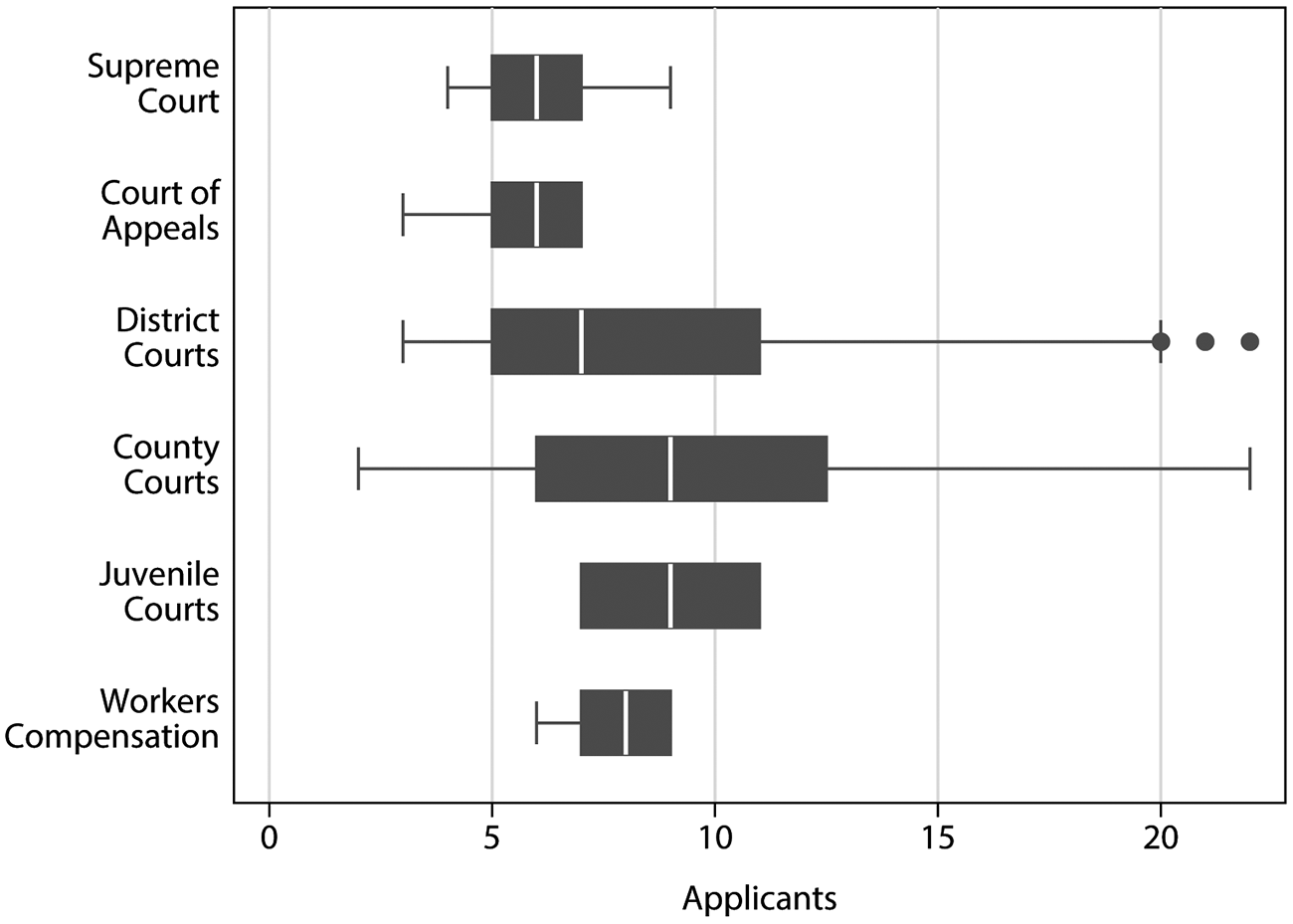
During the sample period from 2000 through 2016, there were 112 vacancies and a total of 980 applications. Of the 112 vacancies, 50 were for district courts, 44 for county courts, 3 for juvenile courts, and 5 each for the Workers’ Compensation Court, the Nebraska Court of Appeals, and the Nebraska Supreme Court. There were an average of 9 applications per vacancy, with a standard deviation of 4 and a range from 2 to 22. Figure 1 plots effect differences for the number of applicants by court. The box plots contain three types of information: the median number of applicants displayed with a vertical white line, the 25th and 75th percentiles displayed respectively in the lower and upper box edges, and lower and upper adjacent values displayed with whiskers (except where the relevant numbers are included within the 25th or 75th percentiles). On average, there were fewer applicants for appellate court vacancies than for other vacancies, although the mean is less than 10 for every level of the judicial hierarchy.
Effect differences for the number of applicants by court
There are two dependent variables. In the commission choice model, the outcome of interest is scored 1 if a particular applicant was nominated by the commission for further consideration by the governor and 0 otherwise. In the gubernatorial choice model, the outcome of interest is scored 1 if a particular commission-forwarded nominee was appointed by the governor and 0 otherwise. The key explanatory variables capture attributes relevant to the three core areas of debate concerning merit selection: qualifications, diversity, and politics.
To account for general experience in the practice of law, I include variables for the total number of years of professional experience and years of professional experience squared. The quadratic term captures potential declining marginal returns to additional years of experience and concavity as a result of reluctance to select individuals who would not serve long on the bench (although Nebraska does not have mandatory retirement). Given the importance of previous judicial experience in selection decisions (see, e.g., Epstein, Knight, and Martin Reference Epstein, Knight and Martin2003), I also include a variable capturing the total number of years of judicial experience. Although applicants for even the lowest positions may have obtained prior judicial experience through service on local or other state courts, I test for conditioning effects by interacting judicial experience with an indicator for appellate court vacancies.
Several additional measures tap into various perspectives on qualifications. To account for practice diversity, I include separate indicators for whether an applicant only has experience in private practice or public service, with experience in both serving as the excluded baseline. This accounts for the perceived value of having experience breadth. I also include indicators for whether the candidate noted having received any professional honors (e.g., an AV rating from Martindale-Hubbell) or having been reprimanded or disciplined for professional misconduct.Footnote 4 Two variables are included to tap into the quality of legal training and intelligence. As a measure of law school quality, I include an indicator scored 1 if the applicant graduated from the state’s flagship law school (the University of Nebraska–Lincoln) or an institution anywhere in the country ranked higher than the state’s flagship school in the U.S. News & World Report rankings.Footnote 5 I capture law school performance with an indicator for honors scored 1 if an applicant graduated law school with honors, served on the school’s flagship law review, or had a judicial clerkship after graduation.
Moving to nonlegal factors, gender is accounted for with an indicator variable scored 1 for female applicants and 0 for men. It is unclear whether Nebraska collects information on race or ethnicity, but in any event this information is not made available in the publicly disclosed application materials. As noted previously, claims regarding the influence of political connections are difficult to evaluate empirically in part because the concept remains underdeveloped in the judicial selection context. Furthermore, while there is a burgeoning political economy literature on the value of political connections, much of it relies on specialized measures that are inapplicable in the judicial selection context (see, e.g., Fisman Reference Fisman2001; Faccio, Masulis, and McConnell Reference Faccio, Masulis and McConnell2006; Ferguson and Voth Reference Ferguson and Voth2008). Examples of political connections that are relevant but difficult to systematically observe include friendship and family ties. An accessible although imperfect proxy is having held major political office or employment ties to a major officeholder (Goelzhauser Reference Goelzhauser2016, 41–45). None of the applicants held major political offices such as legislator or governor. However, I include separate indicators for applicants with position ties to the executive or legislative branches (e.g., legislative aid), scored 1 if these ties were present and 0 otherwise.
Partisan affiliation is captured in two ways. First, I obtained information about applicants’ registered partisan affiliation from the website of the Nebraska secretary of state.Footnote 6 I include three variables representing different search results: an indicator scored 1 for registered Democrats and 0 otherwise, an indicator scored 1 for registered nonpartisans and 0 otherwise, and an indicator scored 1 for those for whom no information was available and 0 otherwise.Footnote 7 Registered Republicans are the excluded baseline. Second, I use campaign donations as a proxy for partisanship (cf. Chilton and Posner Reference Chilton and Posner2015). With applicants who donated more to Republican candidates as the excluded baseline, I include one indicator for those who donated more to Democrats and a second for those who donated equally to both parties, which in all but one instance meant not donating to either party. Given that Nebraska is a relatively conservative state that had a Republican governor throughout the sample period, non-Republicans may be at a disadvantage. I also include an indicator for applicants who donated to the sitting governor.
Last, I include a battery of controls for certain types of professional experience: prosecutor, public defender, legal services, solo practitioner, and in-house counsel. Controlling for these potential confounders helps account for heterogeneity in practice experience that may be correlated with some of the key explanatory variables and the likelihood of success at either the commission or gubernatorial selection stages.
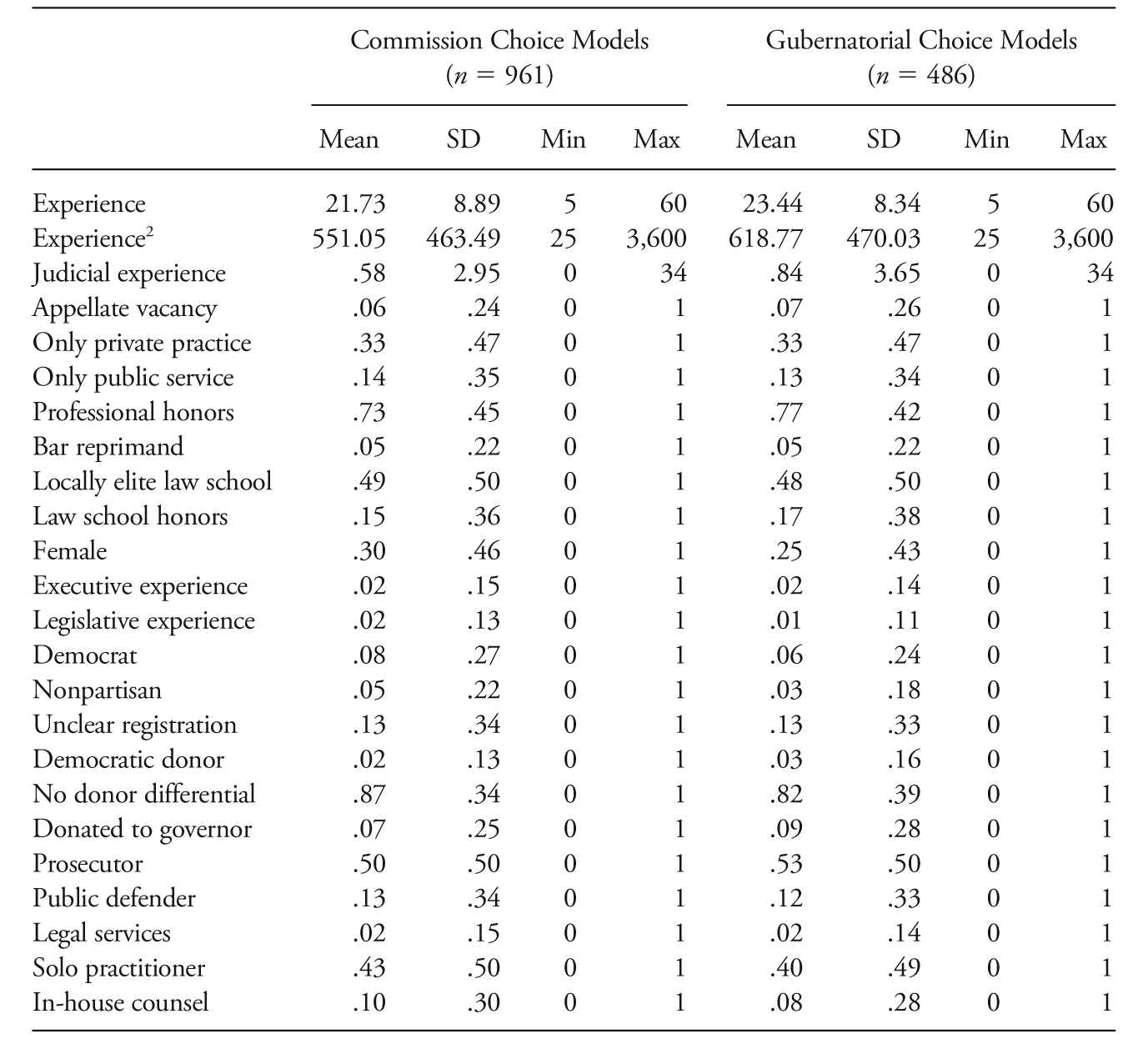
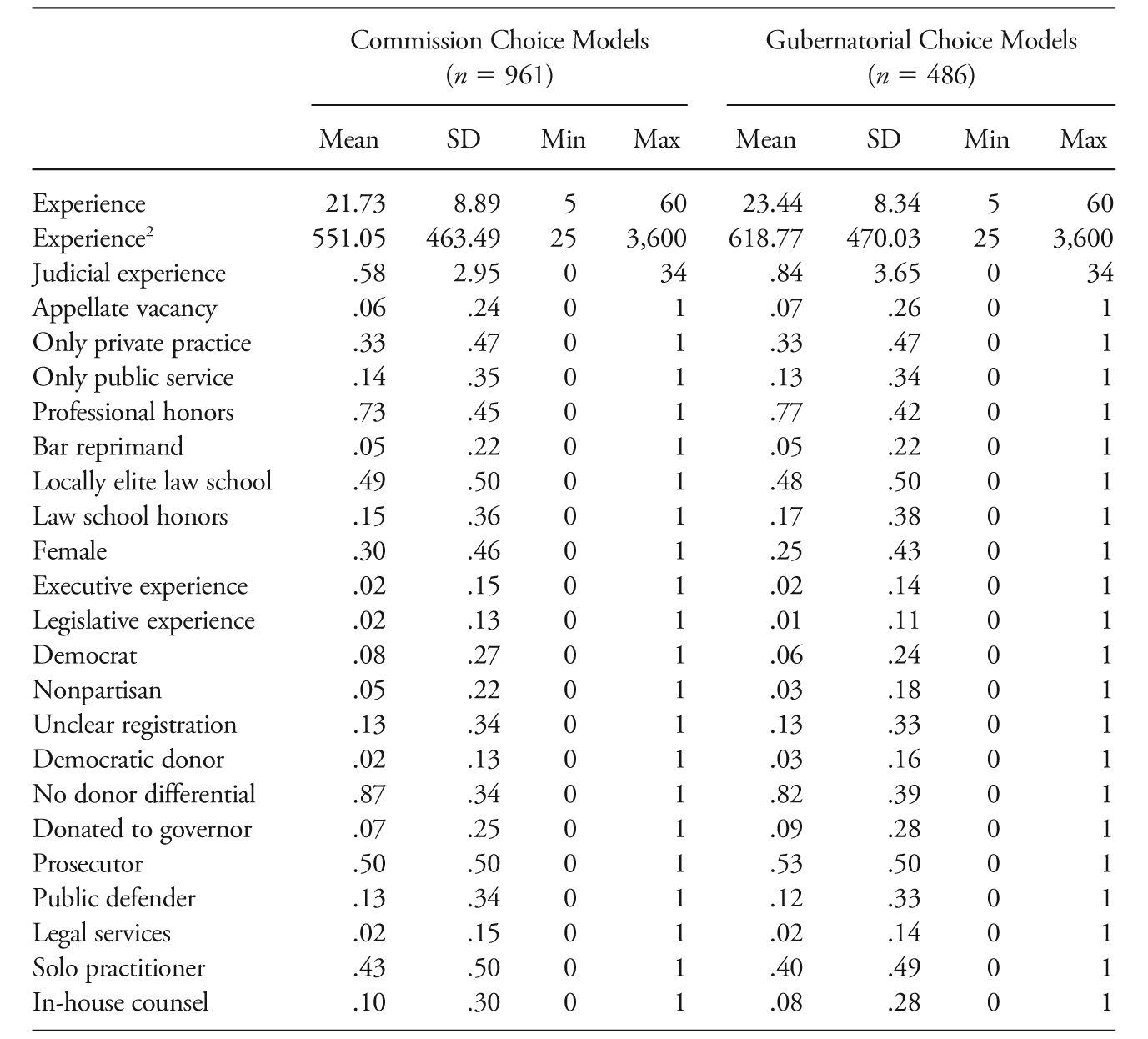
As noted previously, there were an average of nine applicants per vacancy in the sample. To get a sense of the characteristics of applicants in a typical pool, I calculated measures of central tendency for each vacancy and used those to get measures of central tendency across all sample vacancies. The average years of total experience for applicants across vacancies is about 22. In a typical pool, about 10% of applicants have judicial experience; 13% have only public sector experience; 33% have only private practice experience; 72% report having received a professional honor; 5% have been reprimanded by a bar association; 55% graduated from the state’s flagship law school or one ranked higher; 18% graduated law school with honors, served on a law review, or had a postgraduation judicial clerkship; 29% are female; and 76% are registered Republicans. Appendix table A1 provides respective summary statistics for samples included in the primary commission and gubernatorial choice models.
Empirical Analysis
Standard binary choice models such as logit and probit are inappropriate for modeling selection from fixed choice sets. Substantively, a standard binary choice model leverages variation in regressors across all observations to explain some outcome of interest. In the merit selection context, however, the relevant comparisons are across observations within the fixed choice sets presented to commissions and governors for a particular vacancy rather than across all observations comprising the sample period.Footnote 8 Although conditional logistic regression is well suited for modeling selection from fixed choice sets as a function of alternative-specific characteristics (McFadden Reference McFadden and Zarembka1973), marginal effects can only be estimated by setting the fixed effects equal to 0, which results in misleadingly high and potentially meaningless estimates that can fluctuate substantially based on arbitrary measurement choices for the explanatory variables (see, e.g., Chamberlain Reference Chamberlain, Heckman and Leamer2007, 1274–78; Karaca-Mandic, Norton, and Dowd Reference Karaca-Mandic, Norton and Dowd2012, 267; Beck Reference Beck2015; Kemp and Silva Reference Kemp and Santos Silva2016).Footnote 9 To get a clearer sense of substantive effects, I approximate the conditional logit by fitting a logistic regression with (estimated) vacancy fixed effects to account for unobserved heterogeneity across vacancies (see Beck Reference Beck2015). Alternative estimation strategies such as employing conditional logistic regression and accounting for potential selection effects in the two-stage process yield similar results and are provided in appendix B.
Commission Selection
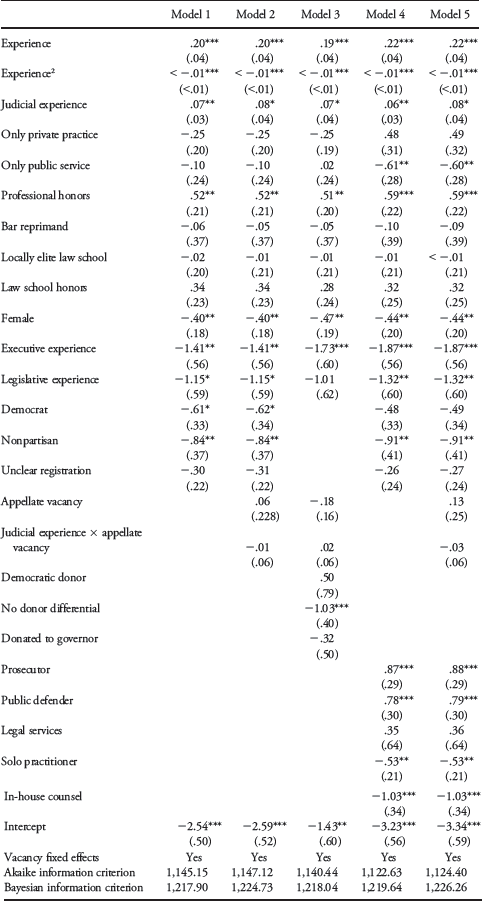
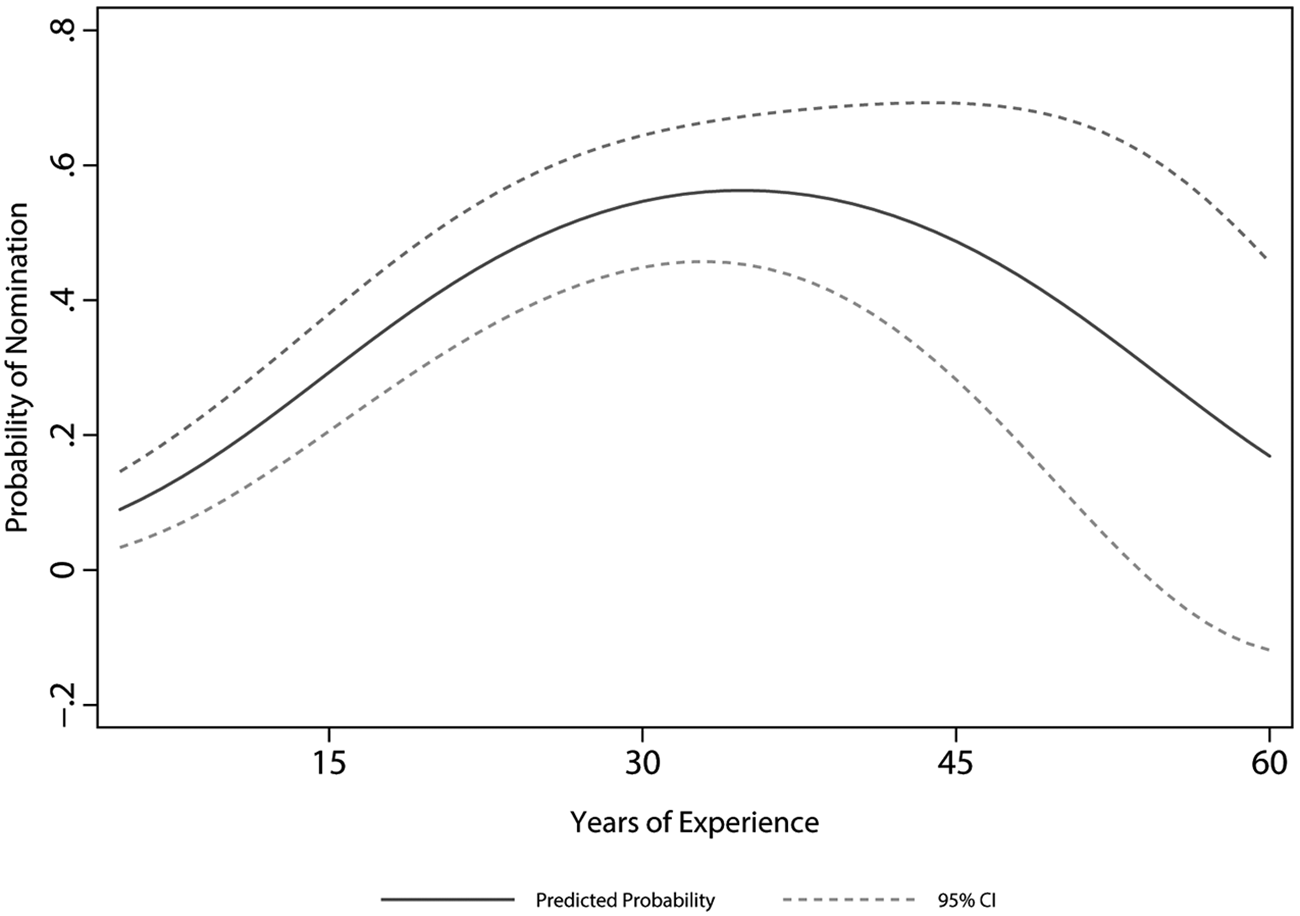
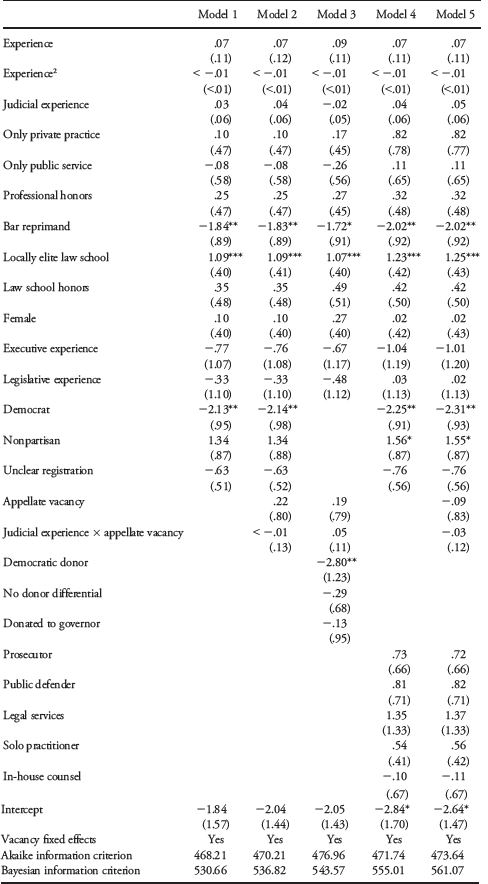
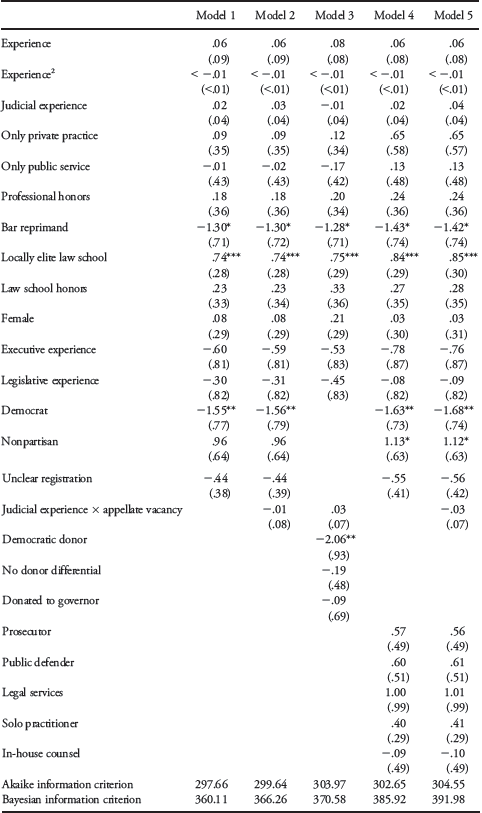
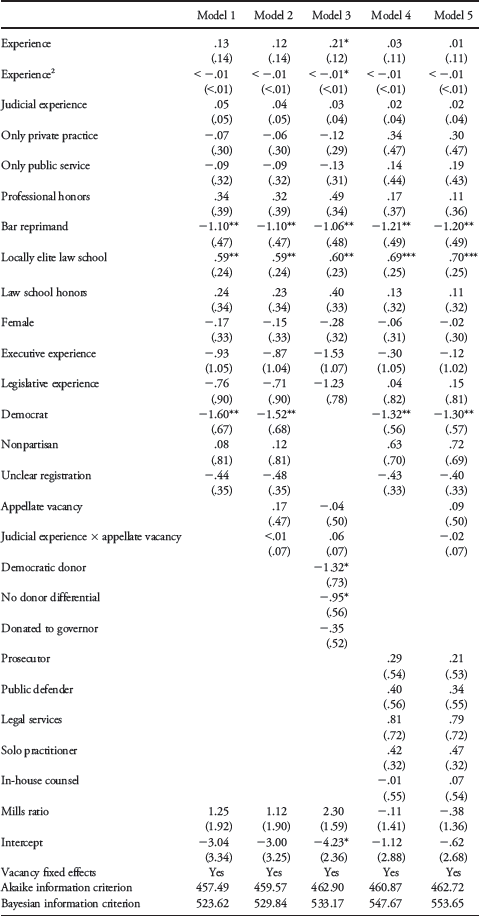
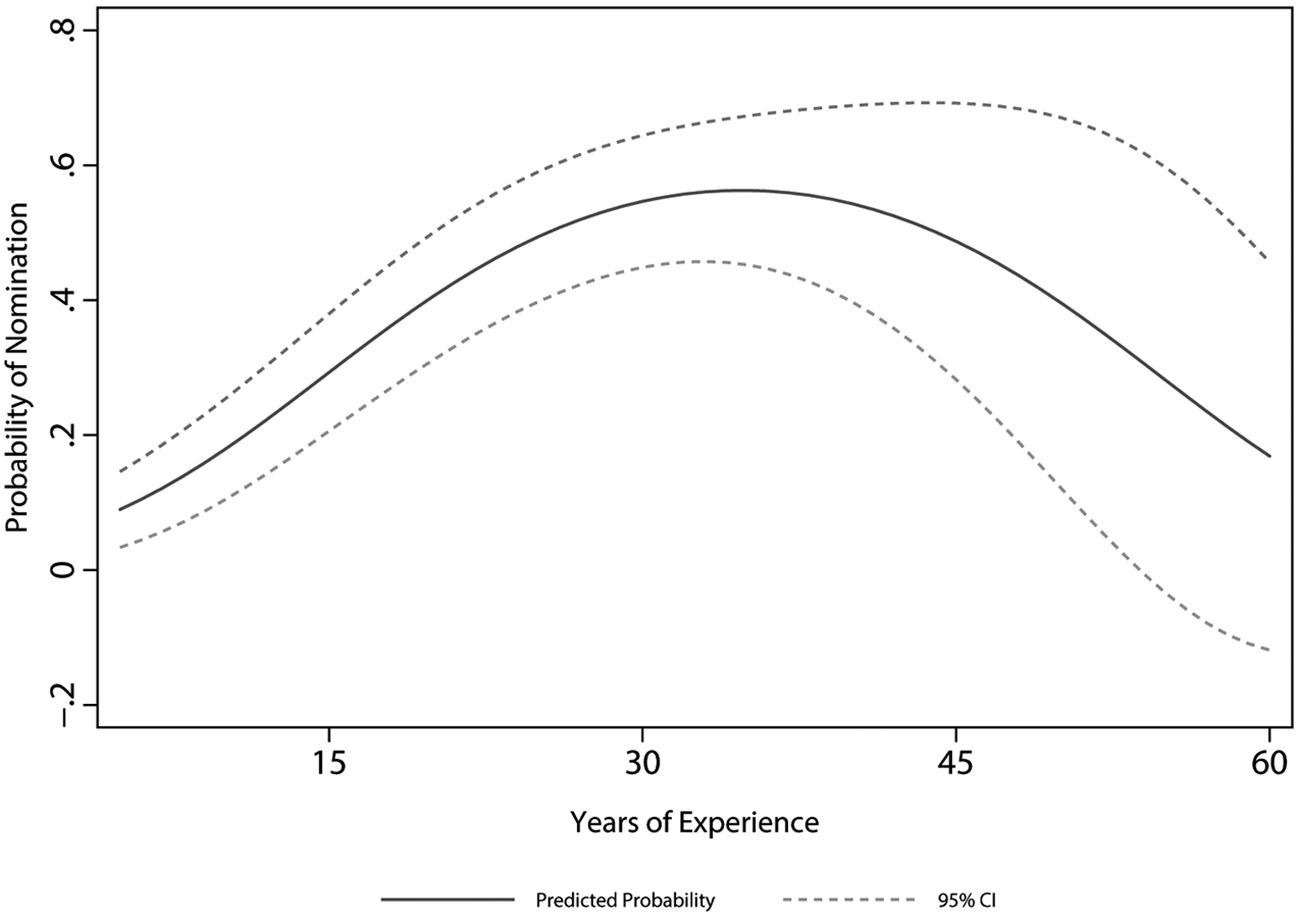
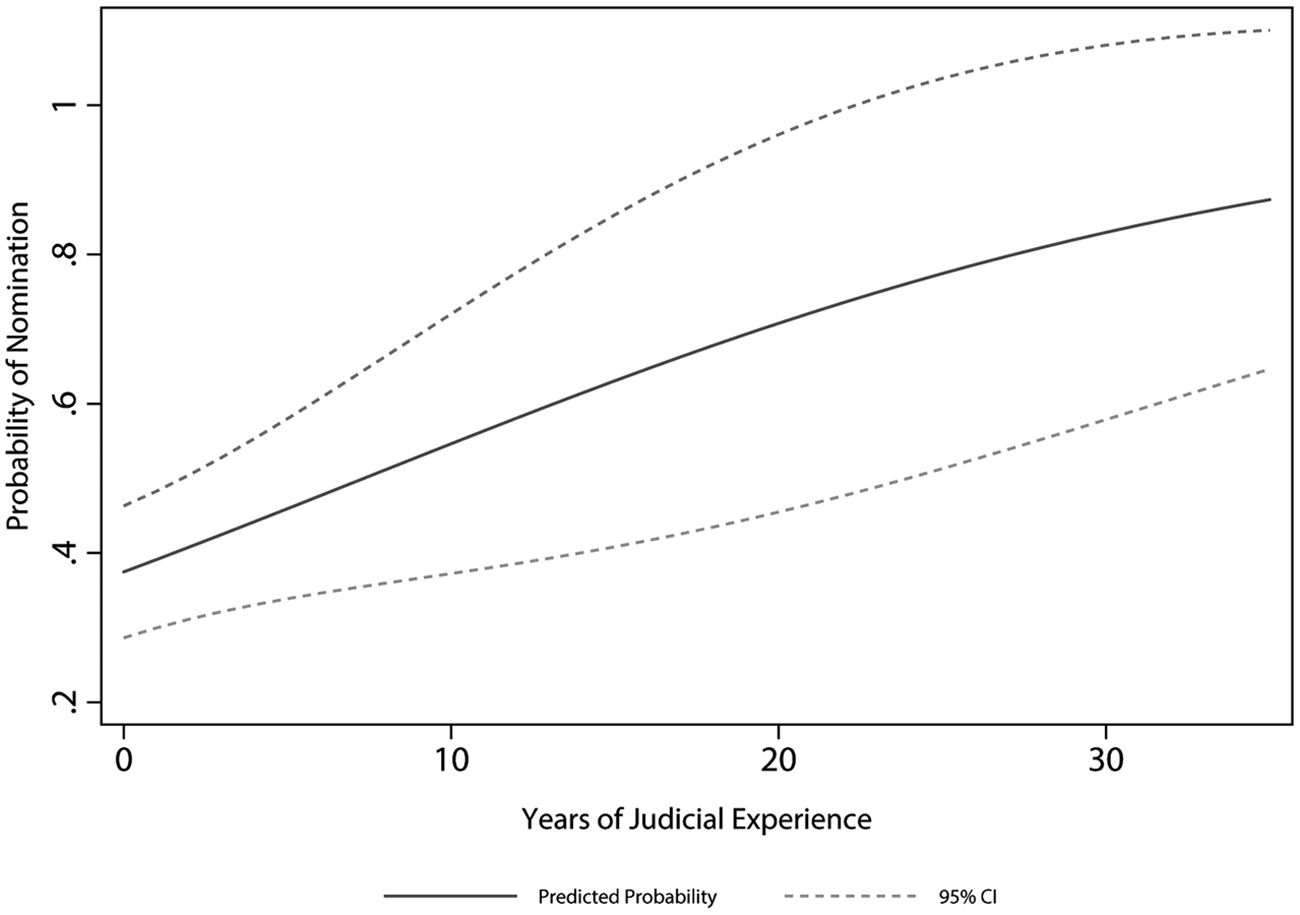
Table 1 presents results from the commission choice models.Footnote 10 Legal and nonlegal factors are associated with commission selections. As an initial matter, the estimated coefficient for the years of experience variable is positive and statistically distinguishable from zero, while the estimated coefficient for the quadratic term is negative and statistically distinguishable from zero. This indicates a concave relationship between years of experience and the probability of being nominated by a commission. Figure 2 plots the probability of being nominated across the range of sample values for total years of experience.Footnote 11 The probability of being nominated increases steadily through about 35 years of experience, at which point it begins to decrease; after 53 years of experience, estimate imprecision increases with a relative lack of data in this range and the lower confidence bound crosses zero.
Commission Choice of Nominees
Note.—Models fit with logistic regression and vacancy fixed effects. Standard errors (in parentheses) are clustered by vacancy. Dependent variable = 1 if an applicant was nominated by the commission and 0 otherwise. N = 944.
*. p < .10.
**. p < .05.
***. p < .01 (two-tailed).
Probability of being nominated across total years of experience
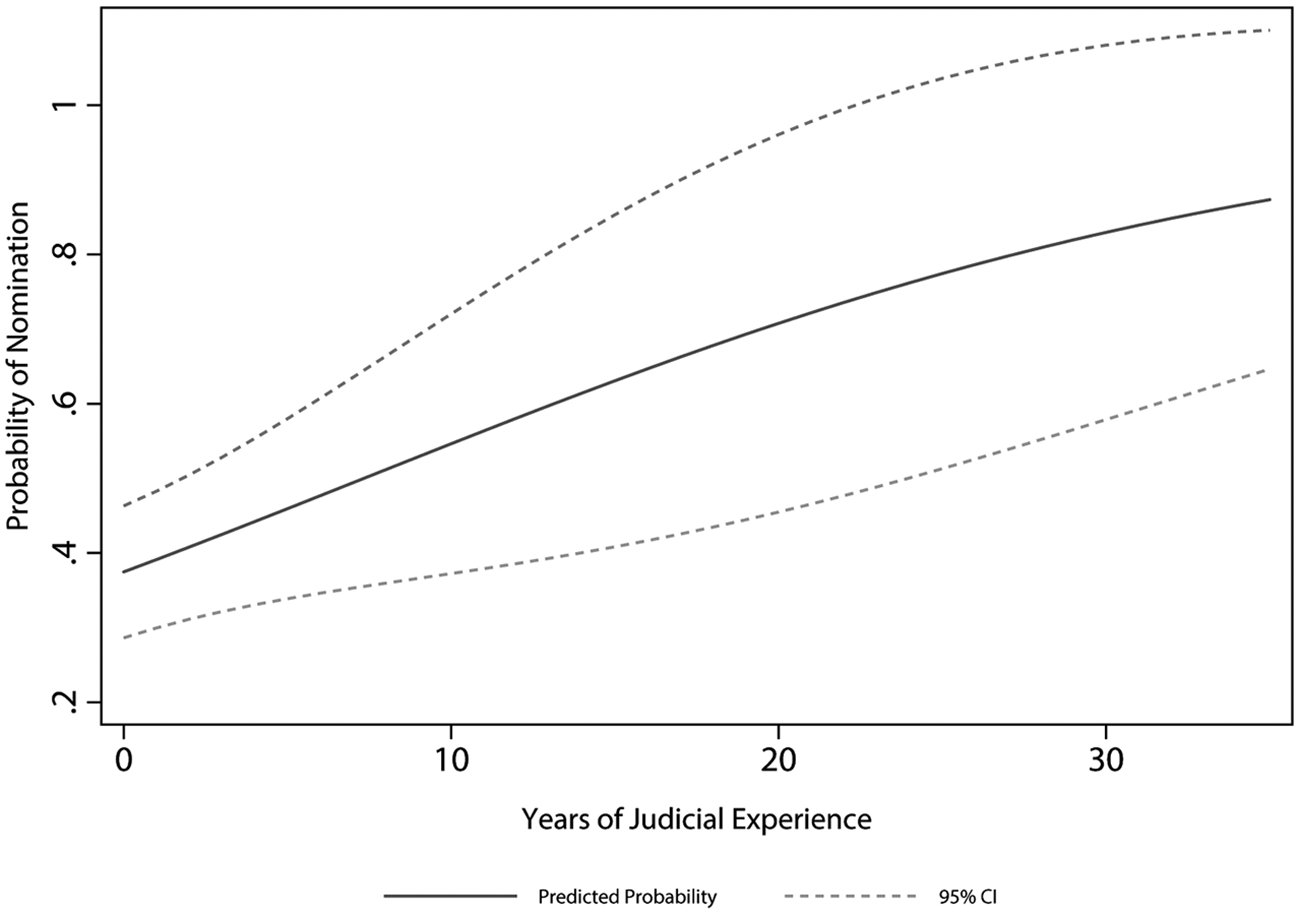
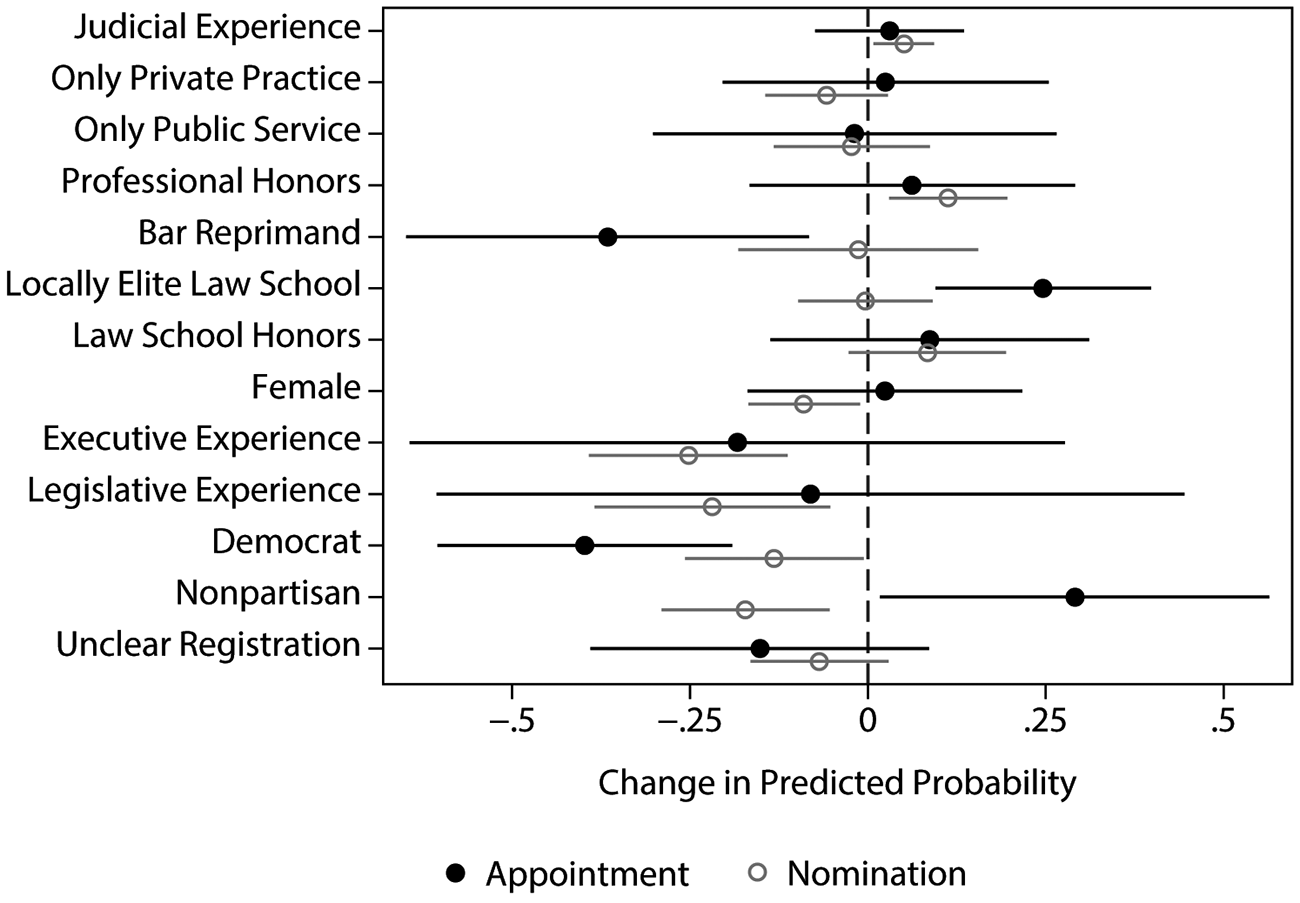
The estimated coefficient for judicial experience is positive and statistically distinguishable from zero.Footnote 12 Figure 3 plots the probability of being nominated across the range of sample values for total years of judicial experience. The substantive effects are substantial. Increasing judicial experience from its mean to 1 standard deviation above its mean is associated with a change in the probability of commission nomination from .38 [.29, .47] to .44 [.33, .54], a .05 [.01, .09] difference.Footnote 13 Figure 4 plots first differences for this change as well as changes from zero to one for the other explanatory variables in the primary model. Model 2 in table 1 includes an interaction term between years of judicial experience and the appellate vacancy indicator to explore potential modifying effects. Calculating marginal effects reveals that the change in the predicted probability of commission nomination comparing nonappellate and appellate vacancies is not statistically distinguishable from zero for any sample value of judicial experience.Footnote 14
Probability of being nominated across total years of judicial experience
Differences for the commission and gubernatorial choice models
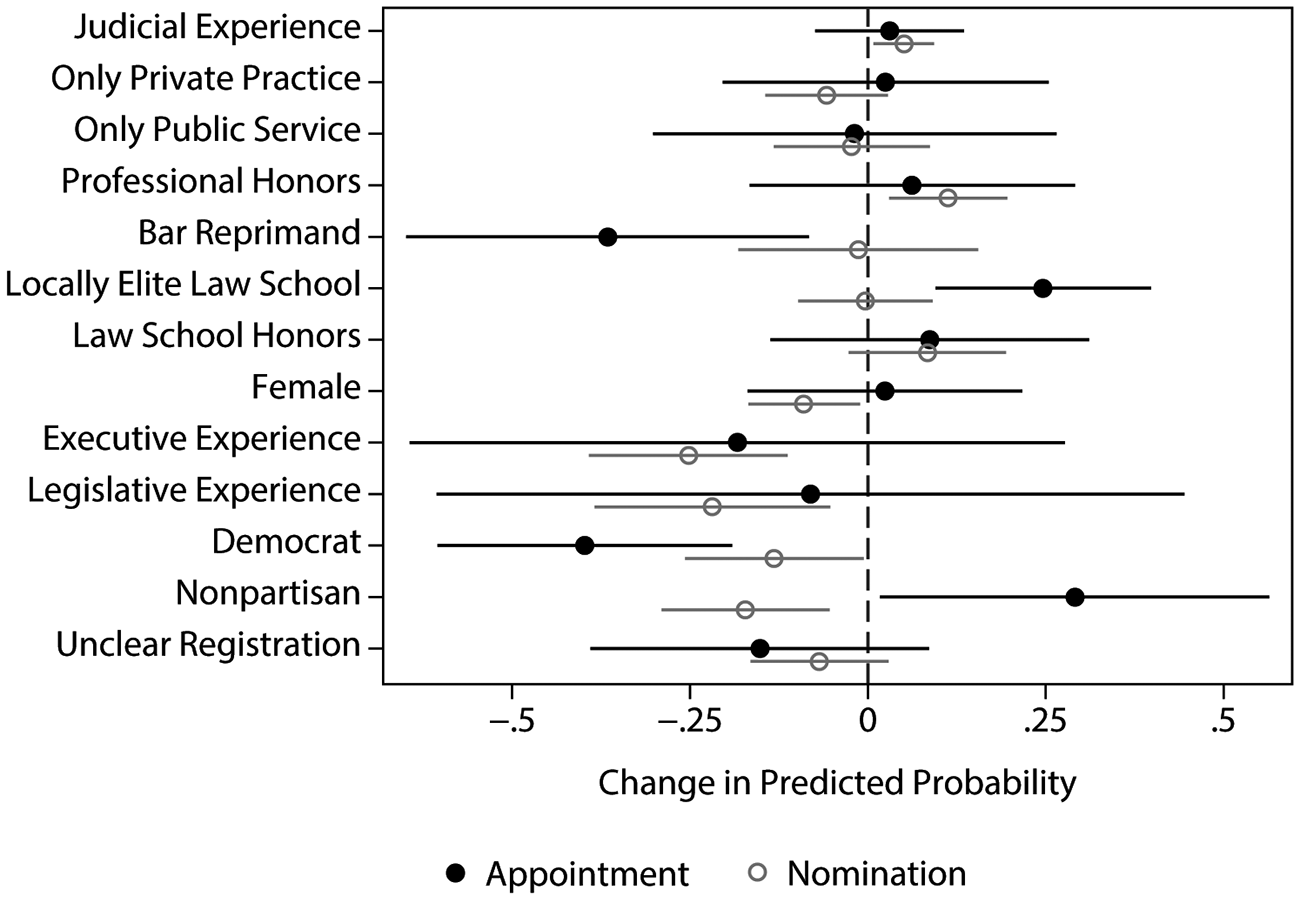
With respect to other measures of legal qualifications, receiving a professional honor is associated with a meaningful change in the likelihood of commission nomination. Substantively, having received a professional honor is associated with an increase in the predicted probability of commission nomination from .27 [.17, .37] to .38 [.29, .47], a difference of .11 [.03, .20]. Neither experiential diversity, captured by having public and private sector experience, nor law school quality and performance is associated with statistically significant changes in the probability of commission nomination.
Turning to nonlegal factors, there is a gender differential in the probability of commission nomination. Substantively, the predicted probability of being nominated by a commission decreases from .38 [.29, .47] for men to .29 [.20, .39] for women, a difference of −.09 [−.17, −.01]. This effect is substantively similar to the effect of a −1 to a +1 standard deviation change in years of judicial experience, long considered the most influential factor in judicial selection decisions. Furthermore, this result is consistent across model specifications. As discussed more fully below, the result may indicate that implicit bias affects commission evaluations similar to the way it affects judicial performance evaluations (Gill, Lazos, and Waters Reference Gill, Lazos and Waters2011; Gill Reference Gill2014). While there are obvious generalizability concerns, with commissions in other states potentially performing better, the result suggests that contrary to some arguments the mere institution of commission-aided selection is not in itself necessarily sufficient to improve opportunities for members of historically underrepresented groups.
Contrary to another of merit selection’s core tenets, there are a variety of partisan effects. In the baseline model, registered Democrats appear to be disadvantaged relative to Republicans in securing commission nominations. Substantively, the predicted probability of nomination decreases from .38 [.29, .47] for Republicans to .25 [.12, .39] for Democrats, a difference of −.13 [−.26, −.01]. However, this result disappears when controlling for different types of professional experiences (models 4 and 5). Nonpartisan applicants are more consistently disadvantaged relative to Republicans. The predicted probability of commission nomination decreases from .38 [.29, .47] for Republicans to .21 [.06, .36] for registered nonpartisans, a difference of −.17 [−.29, −.05]. Given the imposed party heterogeneity among commissioners in Nebraska, it may be that nonpartisans do not have a natural constituency (although registered nonpartisans can be appointed to commissions). Commissions may also desire signaling bipartisanship by sending Republicans and Democrats to the governor. There is no observable difference in the likelihood of nomination between Democrats and nonpartisans.
Model 3 reports results using campaign donations as an alternative proxy for partisanship. There is no observable difference between Democratic and Republican donors. However, applicants with no party donation differential (in all but one instance a result of not donating to either party) are disadvantaged relative to Republicans and Democrats, perhaps for the same reasons discussed with respect to partisan affiliation.Footnote 15 Substantively, the predicted probability of commission nomination decreases from .59 [.39, .80] for Republican donors to .34 [.26, .43] for nonpartisan donors, a difference of −.25 [−.44, −.06].Footnote 16 The difference is larger with respect to Democratic donors, with the predicted probability of commission nomination decreasing from .71 [.38, 1.03] to .34 [.26, .43], a difference of −.36 [−.66, −.06].Footnote 17 There is no observable difference in the likelihood of nomination between Democratic donors and those with no donation differential. Having donated to the governor is not associated with a meaningful change in the likelihood of commission nomination.
Politically connected professional experience indicating direct ties to governors or legislators is negatively associated with the likelihood of commission nomination. The predicted probability of nomination decreases from .38 [.29, .47] for applicants who do not have observable professional ties to the governor to .13 [.002, .26] for those who do, a difference of −.25 [−.39, −.11]. And the predicted probability of nomination decreases from .38 [.29, .47] for applicants who do not have observable employment ties to a legislator to .17 [.002, .33], a difference of −.22 [−.38, −.05]. These results hold when controlling for other types of professional experience in models 4 and 5. Nonetheless, it is important to be circumspect when drawing substantive conclusions. As an initial matter, it is worth reiterating that political connections are difficult to observe and measure in this context, and employment ties are likely to be under- and overinclusive with respect to the underlying concept of interest. Furthermore, while these results may suggest that commissions want to signal the relative unimportance of political connections, a less strategic interpretation may be that these types of positions come with an opportunity cost of not gaining experience thought to be better preparation for the bench.
With respect to professional experience, model 4 includes controls for common positions that may be considered more or less valuable by particular observers. Prosecutorial positions are widely considered to provide valuable experience for the bench, and the results indicate that having this experience is associated with an increase in the probability of commission nomination from .31 [.18, .43] to .52 [.40, .63], a difference of .21 [.08, .34]. Likewise, serving as a public defender is associated with an increase in the predicted probability of nomination from .52 [.40, .63] to .70 [.54, .86], a difference of .19 [.06, .31]. Combined, these results suggest that commissions value courtroom experience, having practiced in the area of criminal law, or both. Having been a solo practitioner, considered by some in the legal profession to be a low-prestige signal (see Carlin Reference Carlin1962), decreases the predicted probability of nomination from .52 [.40, .63] to .39 [.28, .49], a difference of −.13 [−.23, −.03]. Having served as in-house counsel, typically a specialized practice, is associated with a decrease in the probability of nomination from .52 [.40, .63] to .28 [.12, .44], a difference of −.24 [−.38, −.10].
Gubernatorial Selection
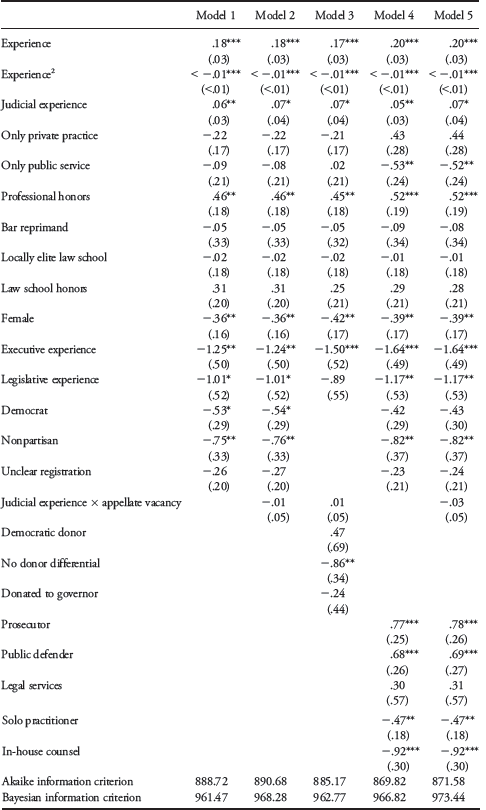
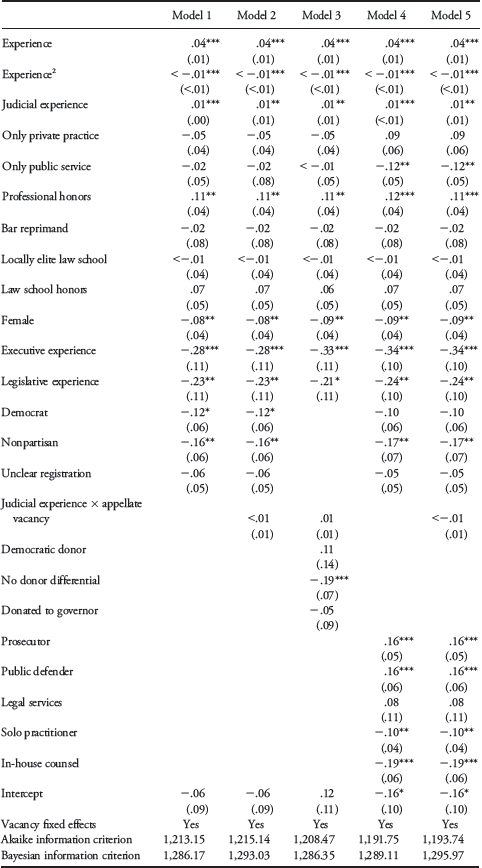
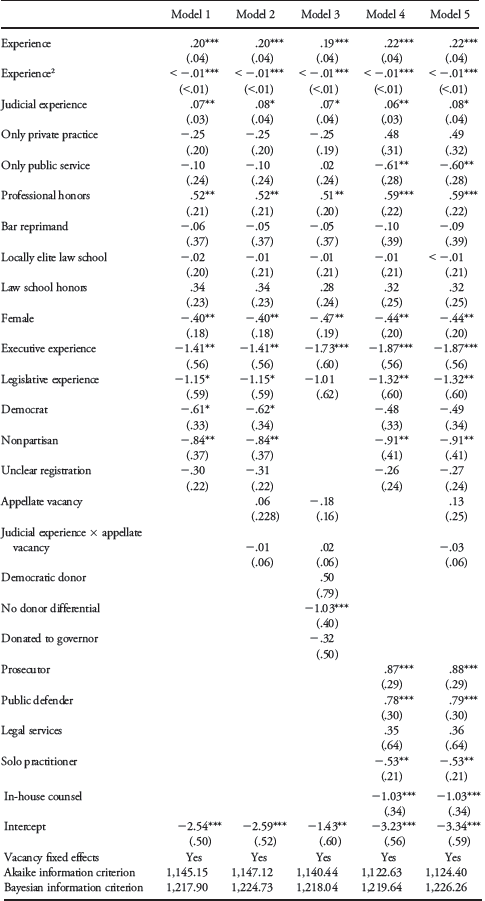
Table 2 displays results from the gubernatorial selection models. The results are noisier than with the commission choice models, owing to the smaller sample and less variation in the explanatory variables. Nonetheless, three explanatory variables emerge as consistent predictors of nominees being appointed to the bench. First, law school quality is positively associated with appointment. Having graduated from the state’s flagship law school or one ranked higher is associated with an increase in the probability of appointment from .51 [.31, .70] to .75 [.54, .97], a difference of .25 [.10, .40].Footnote 18 Second, having been reprimanded by the state bar is associated with a decrease in the probability of appointment from .51 [.31, .70] to .14 [−.03, .31], a difference of −.37 [−.65, −.08].
Governor Choice of Appointee
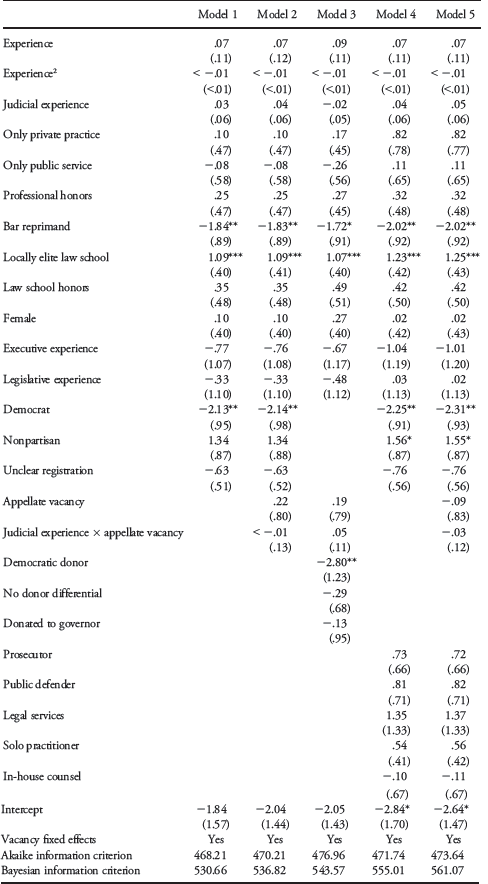
Note.—Models fit with logistic regression and vacancy fixed effects. Standard errors (in parentheses) are clustered by vacancy. Dependent variable = 1 if an applicant was nominated by the commission and 0 otherwise. N = 475.
*. p < .10.
**. p < .05.
***. p < .01 (two-tailed).
With respect to nonlegal factors, while Democratic applicants did not appear to be systematically disadvantaged relative to Republicans at the commission stage, they were at the appointment stage. The predicted probability of appointment decreases from .51 [.31, .70] for registered Republicans to .11 [−.09, .31] for Democrats, a difference of −.40 [−.61, −.19]. As shown in model 3 of table 2, the result is consistent when using donations to capture partisanship. There, the predicted probability of appointment decreases from .49 [.13, .85] to .06 [−.07, .18], a difference of −.44 [−.79, −.09]. Although this result is not surprising for anyone conditioned to think about judicial selection as an inherently political process, it contradicts claims made by merit selection proponents that partisan considerations do not affect selection decisions.
Democratic nominees are also disadvantaged relative to nonpartisans and those who do not have a history of making differential donations to one of the major political parties. The predicted probability of appointment increases from .11 [−.09, .31] for registered Democrats to .80 [.48, 1.12] for registered nonpartisans, a difference of .69 [.35, 1.03]. Likewise, the predicted probability of appointment increases from .06 [−.07, .18] for Democratic donors to .42 [.25, .60] for nominees with no donation differential by party, a change of .37 [.19, .54]. Figure 4 plots first differences for the commission and gubernatorial choice models for ease of comparison.
Conclusion
This article presents the first systematic empirical evidence regarding merit selection’s internal institutional performance. Although more than half of all states use merit selection to fill at least some of their judicial vacancies, little is known about the determinants of commission and gubernatorial choice under this mechanism. The results from this novel test of merit selection’s institutional performance are mixed. Consistent with proponents’ arguments, commissions and governors seem to emphasize certain legal qualifications in their selection decisions. While commissions appear to sort on legal and judicial experience, governors seem to emphasize law school quality and professional discipline by the state bar association. Although stakeholders will differ over whether these are the best indicators of judicial qualification, that debate is separate from the one concerning whether qualifications are relevant to decision making under merit selection.
Other findings point to merit selection’s institutional failure to deliver on certain core promises. Controlling for qualifications, women appear to be disadvantaged at the commission stage. That this result holds when accounting for differences across vacancies and commissions raises concerns about systematic bias. Although unraveling the mechanism underlying that bias lies beyond the scope of this project, the result is consistent with a broader literature emphasizing the pervasiveness of explicit or implicit bias against women in the legal profession (e.g., Gill Reference Gill2014; Sen Reference Sen2014; Collins, Dumas, and Moyer Reference Collins, Dumas and Moyer2017). This result also partially undermines justifications for the underrepresentation of women based on undersupply and a lower likelihood of proactively seeking these positions. Even when qualified women do seek judicial positions, the evidence presented here suggests they are less likely to be successful than similarly qualified men. As merit selection states such as Nebraska question how to increase diversity on the bench (see Chesterman Reference Chesterman2003), stakeholders should examine potential choke points within the selection process.Footnote 19
Although reformers arguing for Nebraska’s adoption of merit selection, as in other states, contend that “the political affiliation of the individual appointed by [the governor] would be of no consequence” (Haggart Reference Haggart1962, 732), empirical evidence suggests otherwise. Governors in Nebraska, a conservative state, appear to systematically favor Republican over Democratic nominees. But partisanship effects are more nuanced at the commission stage, where Republicans do not enjoy a clear advantage over Democrats, while nonpartisans and those whose partisanship is not readily observable fare worse than Republicans and to some extent even Democrats. Given that no more than half of a commission’s voting members can be copartisans, nonpartisans and those whose partisanship is difficult to observe may have more difficulty attracting a supporting coalition and be of less value for purposes of intracommission bargaining and compromise.Footnote 20 While finding that partisan considerations are relevant under merit selection will not surprise anyone accustomed to thinking about judicial selection and governmental institutions more broadly as inherently political, clear systematic evidence has been missing in the merit selection context. Moreover, the absence of partisan considerations has been a key selling point for proponents arguing for reform.
Data availability is an obvious limitation to this study. Although public records requests were made to every state with merit selection instituted by constitutional or statutory rule, Nebraska was the only one to provide enough information from the commission and gubernatorial selection stages to perform systematic quantitative analysis. This raises generalizability concerns that can only be fully resolved with more state cooperation and better record keeping. However, Nebraska’s merit selection system has long been in use and is broadly representative with respect to institutional design. Nebraska also resembles other merit selection states on a number of dimensions.Footnote 21 Moreover, notwithstanding the generalizability limitation, single-state studies are valuable in situations like this when states are not the relevant unit of analysis and there are important measurement advantages that enhance internal validity (Nicholson-Crotty and Meier Reference Nicholson-Crotty and Meier2002). While additional data would be welcome, this study offers an important first test of merit selection’s internal institutional performance and lays the foundation for future work.
With respect to generalizability, it is also important to stress that normative arguments concerning merit selection have emphasized the positive consequences of implementing a two-stage commission-led process regardless of state-specific political dynamics. Using diversification as an example, while a long line of research demonstrates that liberal states have more diverse courts, some proponents of merit selection argue along the lines that “there is no question but that the merit selection system affords greater opportunities for women and minorities to find their way to the bench” (Krivosha Reference Krivosha1987, 19; emphasis added). While the results presented here are based on evidence from one state, they demonstrate that merely instituting commission-based judicial selection is not a panacea for obtaining particular outcomes of interest such as increased diversification. It may be the case, for example, that merit selection implementation in a more liberal state would favor or at least not disadvantage women at the nomination stage, but this would likely say more about the state than its choice of judicial selection mechanism.
The broader results have important implications for policy debates concerning the design of judicial selection institutions. Combined with studies of performance in other judicial selection contexts (Bonneau and Hall Reference Bonneau and Gann Hall2009, Reference Bonneau and Gann Hall2016; Streb Reference Streb2009; Gibson Reference Gibson2012; Bonneau and Cann Reference Bonneau and Cann2015; Hall Reference Hall2015; Kritzer Reference Kritzer2015; Cann and Yates Reference Cann and Yates2016; Goelzhauser Reference Goelzhauser2016), the results presented here help inform policy choices about the potential consequences of large-scale institutional reform. Evidence concerning merit selection’s institutional performance with respect to sorting on qualifications and diversification, for example, can be weighed against competing concerns regarding democratic participation and perceptions of legitimacy. The results also spotlight the potential need for reform in states that are committed to using commission-based judicial selection. To combat potential gender discrimination at the commission stage, for example, evidence suggests that informing people about implicit bias can help to alleviate its influence on decision making (see, e.g., Devine et al. Reference Devine, Forscher, Austin and Cox2012; Smith et al. Reference Smith, Handley, Zale, Rushing and Potvin2015; Girod et al. Reference Girod, Fassiotto, Grewal, Candy Ku, Sriram, Nosek and Valentine2016).Footnote 22 Thus, states might consider training commissioners on issues concerning implicit bias.
It is worth closing with a note about transparency and evaluation. Meaningful evaluation of institutional performance under merit selection requires detailed information about the relevant commission and gubernatorial choice sets. Nonetheless, only one state produced a substantial amount of information about these choice sets. Others reported discarding the information or having state laws that exempted it from disclosure. Discarding the information prohibits even state officials and merit selection commissions from conducting meaningful internal performance evaluations. And while state officials may argue that public disclosure will discourage applications (an untested empirical question), safeguards can be implemented to deidentify the relevant data, as is common with sensitive releases concerning criminal justice and health. While this study provides an analytical guide for further evaluation, it is incumbent on states to develop infrastructures for the maintenance and dissemination of the information required to analyze the institutional performance of merit selection systems. In the interim, the lack of transparency and attendant inability to more systematically evaluate merit selection’s inner workings are relevant factors to consider in the broader judicial selection debate.
Appendix A.
Descriptive Statistics
Appendix B. Alternative Estimation Strategies
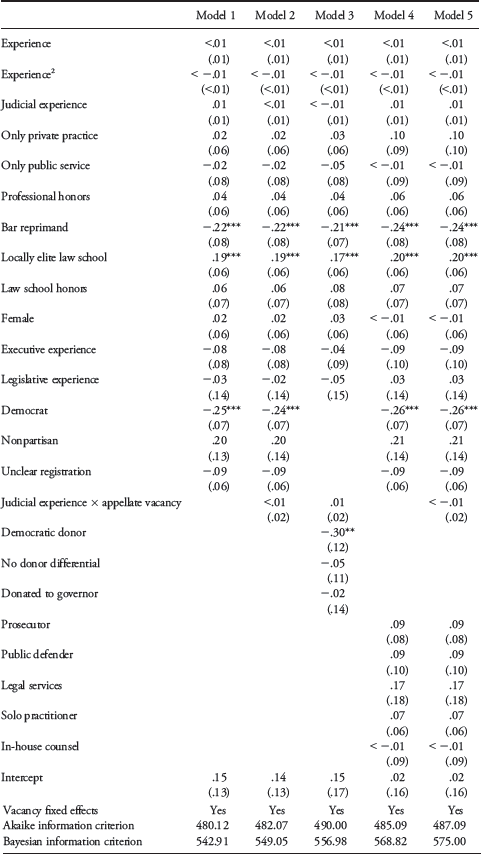
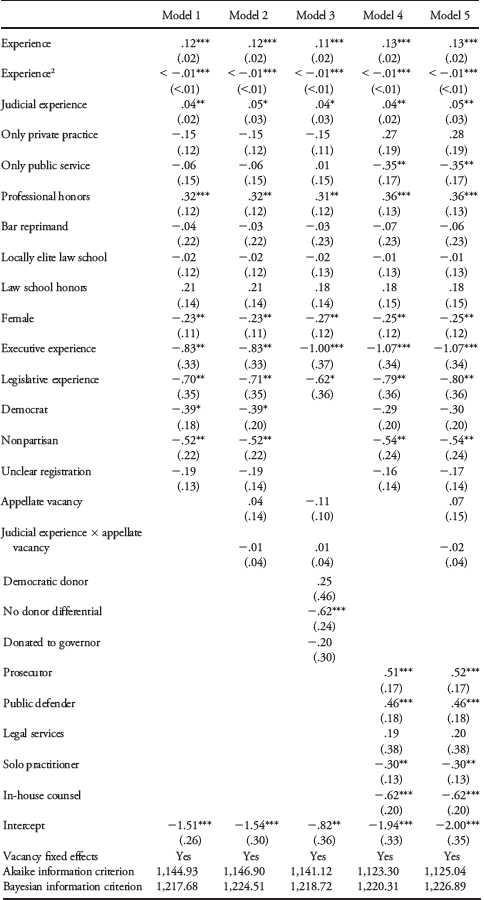
This appendix reports a series of robustness checks based on alternative estimation strategies. As noted previously, conditional logistic regression is well suited for modeling selection from fixed choice sets. Moreover, the conditional logit estimator lends credibility to inference by sweeping up unobserved heterogeneity that varies across but not within grouping units. In the merit selection context, this means controlling for potential vacancy-invariant confounders such as the identity of the governor or the position’s corresponding placement in the judicial hierarchy. Tables B1 and B2 display results from models estimated using conditional logit. Tables B3 and B4 present results based on a linear probability model with vacancy fixed effects—a common alternative modeling strategy in fixed choice contexts (see Beck Reference Beck2015).Footnote 23
The sequenced nature of merit selection decisions raises potential concerns about selection bias. To examine potential selection effects, I fit a probit model with vacancy fixed effects to explain commission decisions and used the results to calculate inverse Mills ratios for inclusion as explanatory variables in the gubernatorial choice models. The respective results are displayed in tables B5 and B6. The results are consistent with other estimation strategies, and the estimated coefficients for the inverse Mills ratios are not statistically distinguishable from zero.
Two additional strategies for dealing with potential selection effects are not viable here. While commentators have cautioned against using Heckman’s two-step correction with a probit outcome model owing to concerns about bias (e.g., Freedman and Sekhon Reference Freedman and Sekhon2010), the problem may be exacerbated when there is no credible strategy for satisfying the exclusion restriction, which tethers identification to inclusion of a regressor in the selection equation but not the outcome equation on the understanding that it helps drive selection but is unrelated to the outcome (e.g., Brandt and Schneider Reference Brandt and Schneider2007). As with other substantive applications (cf. Black and Boyd Reference Black and Boyd2010, 294 n. 10), it is difficult to identify a plausible regressor in the merit selection context that satisfies the exclusion restriction. Sartori (Reference Sartori2003) proposes an estimator that circumvents the exclusion restriction assuming certain conditions are met, but the model fails to converge with this sample while including vacancy fixed effects, which are essential to account for the dynamics of selection from fixed choice sets.
Commission Choice of Nominees (Conditional Logit)
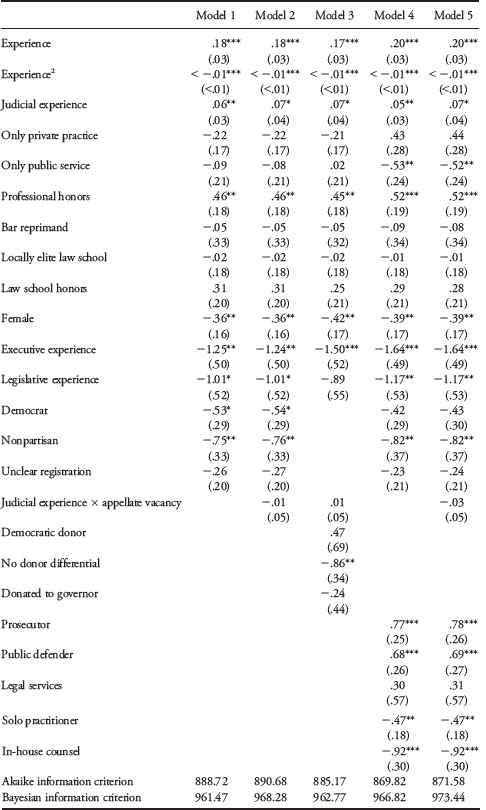
Note.—Models fit with conditional logistic regression with vacancy as the grouping variable. Standard errors (in parentheses) are clustered by vacancy. Dependent variable = 1 if an applicant was nominated by the commission and 0 otherwise. The coefficient for the appellate vacancy constitutive term is not estimated in these models because it is perfectly collinear with the fixed effects. This differs from the logit with vacancy fixed effects used to fit the primary models. Here, the fixed effects are not directly estimated. N = 944.
*. p < .10.
**. p < .05.
***. p < .01 (two-tailed).
Governor Choice of Nominees (Conditional Logit)
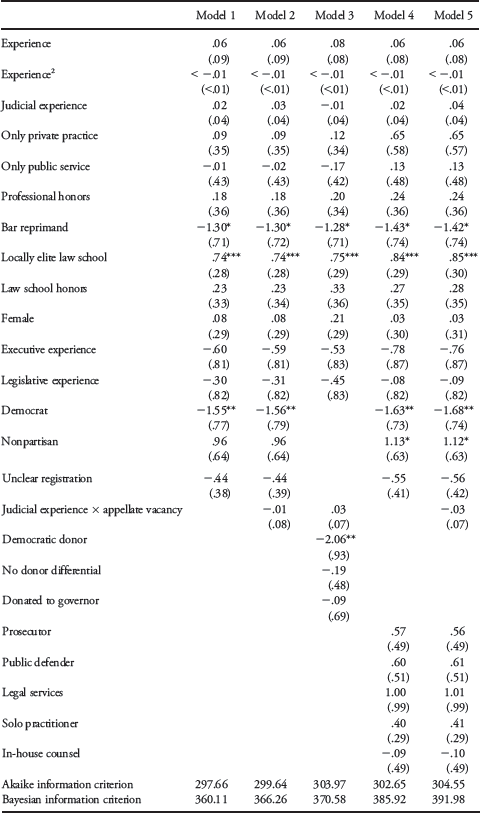
Note.—Models fit with conditional logistic regression with vacancy as the grouping variable. Standard errors (in parentheses) are clustered by vacancy. Dependent variable = 1 if a nominee was appointed by the commission and 0 otherwise. The coefficient for the appellate vacancy constitutive term is not estimated in these models because it is perfectly collinear with the fixed effects. This differs from the logit with vacancy fixed effects used to fit the primary models. Here, the fixed effects are not directly estimated. N = 475.
*. p < .10
**. p < .05.
***. p < .01 (two-tailed).
Commission Choice of Nominees (Linear Probability Model)
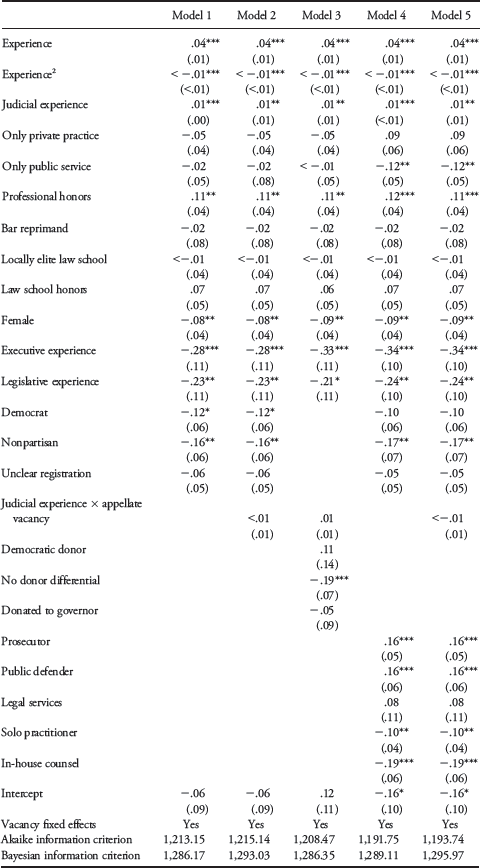
Note.—Models fit with fixed effects linear regression. Standard errors (in parentheses) are clustered by vacancy. Dependent variable = 1 if an applicant was nominated by the commission and 0 otherwise. The coefficient for the appellate vacancy constitutive term is not estimated in these models because it is perfectly collinear with the fixed effects. This differs from the logit with vacancy fixed effects used to fit the primary models. Here, the fixed effects are not directly estimated. N = 961.
*. p < .10.
**. p < .05.
***. p < .01 (two-tailed).
Governor Choice of Nominees (Linear Probability Model)
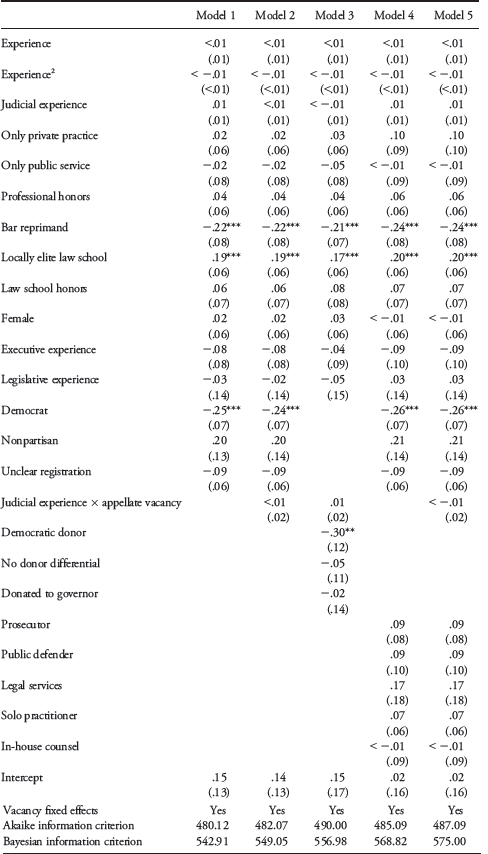
Note.—Models fit with fixed effects linear regression. Standard errors (in parentheses) are clustered by vacancy. Dependent variable = 1 if an applicant was nominated by the commission and 0 otherwise. The coefficient for the appellate vacancy constitutive term is not estimated in these models because it is perfectly collinear with the fixed effects. This differs from the logit with vacancy fixed effects used to fit the primary models. Here, the fixed effects are not directly estimated. N = 486.
*. p < .10.
**. p < .05.
***. p < .01 (two-tailed).
Commission Choice of Nominees (Probit)
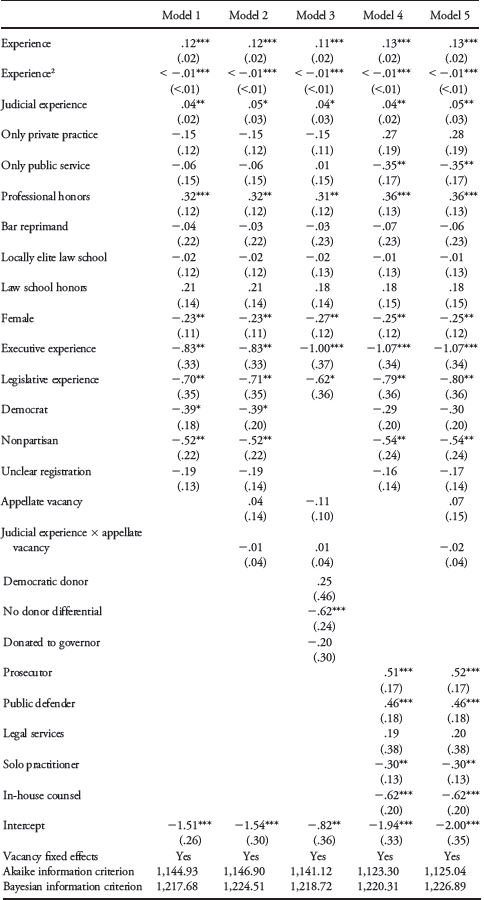
Note.—Models fit with probit and vacancy fixed effects. Standard errors (in parentheses) are clustered by vacancy. Dependent variable = 1 if an applicant was nominated by the commission and 0 otherwise. N = 944.
*. p < .10.
**. p < .05.
***. p < .01 (two-tailed).
Governor Choice of Nominees (Probit Accounting for Sample Selection)
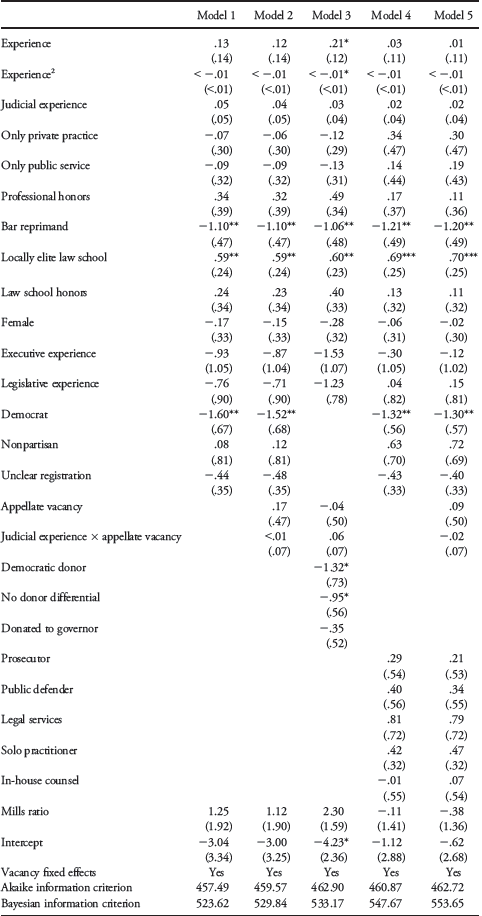
Note.—Models fit with probit and vacancy fixed effects. Standard errors (in parentheses) are clustered by vacancy. Dependent variable = 1 if a nominee was appointed by the governor and 0 otherwise. N = 461.
*. p < .10.
**. p < .05.
***. p < 0.01 (two-tailed).