

Introduction
The Chinese Government attaches importance to technological innovation and seeks to stimulate enterprise innovation through strategic planning, while also vigorously promoting the new type of nation building and forming an innovative development model with Chinese characteristics. Under the government’s innovation policy, China has become a major innovation country, with the R&D investment intensity jumping from 0.89% in 2000 to 2.40% in 2020, higher than the European Union (EU) average (Wan et al Reference Wan, Yuan, Yao and Zeng2023). However, according to the Global Innovation Index 2020 published by the World Intellectual Property Organization, China ranked 14th in the innovation index and 16th in the innovation quality index, which is in contrast to the rankings of Research and Development (R&D) investment and patent applications (Cornell et al 2020). So, can China further improve and refine its innovation support policy system so that it can move from being a big innovation country to a strong one?
This paper is based on research obtaining more than 640,000 examples of government procurement contract data from 2015 to 2020 through Python crawler technology. It adopts a textual analysis methodology to identify instances of government innovative procurement, and then matches this government innovative procurement contract data with Chinese A-share manufacturing listed enterprises to empirically test the role of government procurement in green technology innovation. In this way, the paper produces several marginal contributions as follows. First, textual analysis of government procurement contract data allowed us to differentiate government innovation procurement from overall government procurement, and so, to clarify the influencing factors for firms’ green technological innovations. To date, there has been a lack of discussion of government procurement and green technological innovation. Thus, this paper helps create the prerequisites for an accurate assessment of the innovation effects of government procurement policy and practice. Secondly, the paper illustrates the mechanism by which government innovation procurement affects enterprise innovation within a theoretical framework, followed by corresponding empirical tests, enriching research from both theoretical and empirical aspects; thirdly, the paper examines the coordination of innovation support policies from all policy mix perspectives, and provides important policy insights into approaches to better utilising ‘active government’ in innovation.
Literature review
Research on the impact of government procurement on corporate innovation
Recently, scholars have begun to realise the importance of government procurement for business. In addition to studying the government procurement effect on technological innovation and economic growth (Fan and Xiao Reference Fan and Xiao2021), they have also explored its facilitating effect in reducing audit costs, alleviating financing constraints, withstanding economic shocks, and improving investment efficiency (Yang et al Reference Yang, Wang and Ye2022; Yin et al Reference Yin, Qi, Ji and Zhou2023; Cohen et al Reference Cohen, Kadach and Ormazabal2023). In regional-level studies, government procurement effectively promotes provincial environmental quality improvement (Gui et al Reference Gui, Hu, Sun and Liu2021) and enhances corporate Environmental, Social, and Governance (ESG) performance (Jiang et al Reference Jiang, Zhang and Fei2022). Furthermore, Sun and Yang (Reference Sun and Yang2009) showed that government procurement had a significant innovation-driven effect on firms for nine European Union (EU) countries (see also Xu et al Reference Xu, Dai and Chang2015; Simcoe and Toffel Reference Simcoe and Toffel2014; Lichtenberg Reference Lichtenberg1990; Diederen Reference Diederen1996). In firm-level studies, for enterprises that have not yet carried out R&D, government procurement can promote their technological innovation. For enterprises that have already carried out R&D, government procurement can encourage them to intensify their innovation efforts, attract more high-tech talents, and accelerate the transformation of the relevant innovative research results (Ma et al Reference Ma, Wang, Yang and Liu2018; Xu et al Reference Xu, Yang and Xue2016; Jiang and Fei Reference Jiang and Fei2021; Wang Reference Wang2019). Although there is considerable established literature exploring the mechanisms, there are few systematic theoretical frameworks exploring the innovation impact of government procurement. In most existing literature, only financing constraint mitigation mechanisms have been tested. Dai et al (Reference Dai, Li and Chen2021) used a causal mediation model to identify the indirect effect, which in turn categorised the residual effect as a demand-pull effect (You et al Reference You, Lu and Yu2023).
Research on the influencing factors of enterprises’ green technology innovation
Most existing literature is about the internal influences on firms’ green technological innovations, or examines the joint role of internal and external factors.
Green capacity
From the resource-based viewpoint, some scholars have argued that State Owned Enterprises (SOEs) have easier access to technological knowledge and talent, relative to private firms, and are thus better able to provide sustained financial support for green technological innovations. Hence, their green capabilities are stronger (Li et al Reference Li, Zhai and Gu2018; Li and Xia Reference Li and Xia2008; Tan et al Reference Tan, Jan and Chen2012). The enterprises’ industrial development direction is determined by the corporate culture, which internally guides the enterprises to take the initiative to carry out green technological innovation (Zhang and Wang Reference Zhang and Wang2018; Cao et al Reference Cao, Geng, Zhang and Li2023).
Green orientation
Compared with traditional technological innovation, green technological innovation itself faces more uncertainties. Perhaps for this reason, scholars have conducted more studies on government’s role in green technological innovation process. Scholars have focused on government environmental policies including a low-carbon city pilot (Zhang et al Reference Zhang, Sun and Lu2022; Xiong et al Reference Xiong, Shi and Li2020), environmental protection target responsibility systems (Tao et al Reference Tao, Zhao and Zhou2021), natural resource asset departure audits (He et al Reference He, Tao, Meng, Chen, Yan and Vasa2021), and centralised environmental protection inspections (Li et al Reference Li, Gao and Wei2021).
Systemic support
Other scholars have studied the impact of institutional support, such as government subsidies, on enterprises. In so doing, they have explored the extent to which a government subsidy is less than the optimal value or the possibility of an incentive to efficiency increasing with the government subsidy amount, especially with enterprises actively carrying out green technology innovation (Ma and Xia Reference Ma and Xia2020; Luo Reference Luo2020, He et al Reference He, Lai, Liang and Zhu2020). In addition, where enterprises are located in different regions, the nature of property rights and industry types will also affect the impact of government environmental policies in supporting green technology innovation (Tian and Liu Reference Tian and Liu2021).
Literature evaluation
Existing literature thus recognises the importance of government procurement for business. In addition to studying the government procurement effect on firms’ technological innovation (Wu et al Reference Wu, Huang and Deng2021), recent research has also explored such issues as the facilitating effects on firms’ ability to reduce auditing costs, firms’ capacity to alleviate financing constraints or withstand economic shocks, and the options to improve investment efficiency (Chen et al Reference Chen, Hasan and Jiang2022; Cohen et al Reference Cohen, Kadach and Ormazabal2023). While comprehensive, existing research lacks a specific focus on the relationship between government procurement and firms’ green technology innovation. This article, therefore, reports on research directed at the impact of government green procurement on enterprises’ green technological innovation. On the one hand, this contributes to a deeper theoretical understanding, while on the other hand, it also aims to help improve the efficiency of the green transformation and to promote its accelerated adoption.
Theoretical analysis and research hypothesis
Impact of government procurement on green technology
Enterprises are essential to any national innovation system, yet they face many challenges in their innovation activities. They risk market failure because innovation results are uncertain and the innovation process cannot be divided (Arrow Reference Arrow1962). First, government procurement can promote enterprises’ green technological innovation by attracting market demand. The government is the largest consumer in the domestic market and can directly purchase green technologies. Li et al (Reference Li, Feng and Wang2016) show that not only is government procurement huge but also that most goes to corporations. Therefore, government procurement has a unique advantage, which stimulates enthusiasm for R&D, while also providing a stable market for green products. Secondly, government procurement can enhance the expected economic and non-economic returns. Finally, government procurement can support the financial needs of innovators. Government procurement is guaranteed by the state’s reputation and can bring considerable income to enterprises (Jiang et al Reference Jiang, Zhang and Fei2022). Partnerships with the government can also give firms a credit glow and improve the firm’s financing efficiency (Wang and Zhu Reference Wang and Zhu2022). Therefore, government procurement can bring cash inflows to enterprises and enhance their economic capacity for green technology innovation.
Based on the above analysis, this paper proposes the hypothesis:
H1: Obtaining government procurement orders can promote enterprises’ green technology innovation
Impact of government procurement on green technology innovation quality
According to theories of stages of technological progress, green technological innovation is divided into invention-based green technological innovation and improvement-based green technological innovation (Xu et al Reference Xu, Xu and Bai2022). Nowadays, inventive green technological innovation is more important to promote the national economy’s green development.
Firms’ green technology innovation at different quality levels is directly related to their motivation to innovate. When firms seek tax incentives or subsidies, they will pursue the green technology innovation quantity and neglect the quality (Tao et al Reference Tao, Zhao and Zhou2021). On the other hand, quality may be the focus when firms engage in substantial invention-based innovation in order to effectively improve their competitiveness (Braunerhjelm and Thulin Reference Braunerhjelm and Thulin2023). Under the government procurement influence, the bidding competition can create positive incentives for enterprises to innovate green technologies, favouring inventive green technological innovations. In addition, government procurement can hedge public risks, enhance business development confidence (Wu and Peng Reference Wu and Peng2022), and create a relaxed organisational environment for inventive green technology innovation. Based on the above analysis, this paper proposes a further hypothesis:
H2: Government procurement is more likely to promote firms’ inventive green technology innovations than improved green technology innovations.
Mechanisms acting on executives’ climate change perceptions
According to Upper Echelon Theory, organisational decisions are a mapping of executives’ values, thought patterns, and ideologies (Hambrick and Mason Reference Hambrick and Mason1984). Corporate green technology innovation is highly dependent on the executive team’s decision-making. Scholars have already found that the higher the climate change perceptions, the greener are innovative technology practices (Wu et al Reference Wu, Huang and Deng2021). In the process of collecting procurement information and accepting tender evaluation, enterprises that have obtained government procurement orders tend to read more policy documents and communicate more with government personnel, which in turn strengthens their appreciation of energy-saving policy. Coupled with the importance that firms place on government, corporate executives are likely to improve their ability to increase green technology innovation through climate change perceptions. Based on the above analysis, this paper proposes hypothesis:
H3: Government procurement can enhance the climate change perception and thus promote corporate green technology innovation.
Theoretical modelling
Based on the above analysis, this paper constructs the conceptual model of government procurement, executive team’s climate change perception, and green technology innovation based on higher-order theory and green technology innovation theory, as shown in Figure 1.
Theoretical model.

Research design
Model construction
In order to test the government procurement effect on enterprise green technology, this paper constructs the following model:
 $$Greenpr{o_{i,t + 1}} = {\alpha _0} + {\alpha _1}G{P_{i,t}} + {\alpha _2}Control{s_{i,t}} + \sum Year + \sum City + {\varepsilon _{i,t}}$$
In order to test the mechanism of government procurement to improve the climate change perception and then promote the green technological innovation, we constructed the following model:
 $$Greenpr{o_{i,t + 1}} = {\alpha _0} + {\alpha _1}G{P_{i,t}} + {\alpha _2}Control{s_{i,t}} + \sum Industry + \sum Year + \sum City + {\varepsilon _{i,t}}$$
 $$Clipe{r_{i,t}} = {\beta _0} + {\beta _1}G{P_{i,t}} + {\beta _2}Control{s_{i,t}} + \sum Industry + \sum Year + \sum City + {\varepsilon _{i,t}}$$
 $$\begin{gathered}Greenpr{o_{i,t + 1}} = {\gamma _0} + {\gamma _1}G{P_{i,t}} + {\gamma _2}Clipe{r_{i,t}} + {\gamma _3}Control{s_{i,t}} + \sum I ndustry + \sum Y ear \\ \!\!\!\!\!\!\!\!\!\!\!\!\!\!\!\!\!\!\!\!\!\!\!\!\!\!\!\!\!\!\!\!\!\!\!\!\!\!\!\!\!\!\!\!\!\!\!\!\!\!\!\!\!\!\!\!\!\!\!\!\!\!\!\!\!\!\!\!\!\!\!\!\!\!\!\!\!\!\!\!\!\!\!\!\!\!\!\!\!\!\!+ \sum C ity + {\varepsilon _{i,t}} \\ \end{gathered}$$
Greenpro denotes the green technological innovation. GP denotes government procurement, Cliper denotes executive climate change perceptions, and Controls denotes control variables. In addition, given that there may be other factors affecting firms’ green technology innovation at the industry, region, and time levels, the model controls for industry, year, and region fixed effects.
Variable selection
Dependent variable: green technology innovation (Greenpro)
Drawing on the work of Wang et al (Reference Wang, Phillips and Yang2021), this paper adopts the total number of enterprises’ green patent applications (Greenpro) to measure the overall green technological innovation, the number of green invention patent applications (Greeninvpro) to measure the invention-type green technological innovation, and the number of green utility model patent applications (Greenutypro) to measure the improvement-type green technological innovation. Considering that it takes a certain period to produce green patents, the number of green patent applications in the future is used in the model. In order to avoid the influence of zero value, the number of green patents is processed by adding 1 and taking the natural logarithm.
Independent variable: government procurement (GP)
We adopted (GP_If) and (Gp_Sale) as proxy variables for government procurement, respectively. GP_If indicates whether or not a government procurement order has been obtained; GP_Sale indicates the total amount of government procurement contracts/operating revenue.
Mechanistic variables: executive team climate change perceptions (Cliper)
With the latest AI-based technology development, more scholars have shown that natural language processing (NLP)-based textual analyses of corporate public reporting documents are have advantage over traditional content analyses due to validity and reliability (Sutner et al Reference Sutner, Van Lent, Vilkov and Zhang2023; Hu et al Reference Hu, Hao and Wang2022; Hong and Wang Reference Hong and Wang2022). Sutner et al (Reference Sutner, Van Lent, Vilkov and Zhang2023) construct a dictionary and measure climate change perceptions through a textual analysis of surplus conference call transcripts from US-listed companies, but such indicators do not take into account the Chinese context. Therefore, based on Chinese textual data from A-share listed manufacturing companies‘ annual reports, this study adopts NLP’s ‘seed words + Word2Vec similar words + BERT-W model’ to measure companies’ climate change perceptions based on Sutner et al. (Reference Sutner, Van Lent, Vilkov and Zhang2023).
Controls
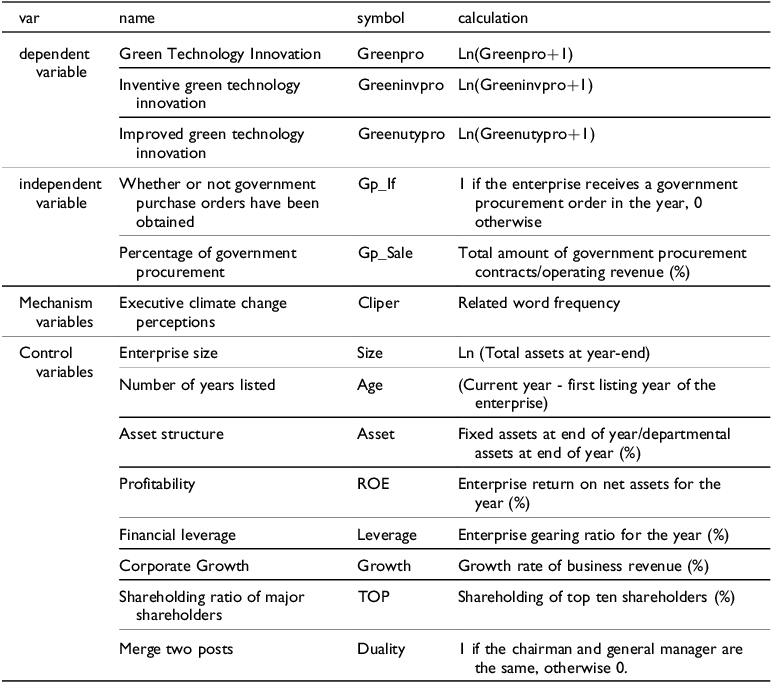
In this paper, we control the variables affecting enterprises’ green technological innovation, including enterprise size, including enterprise size (Size), years of listing (Age), asset structure (Asset), profitability (ROE), financial leverage (Leverage), enterprise growth (Growth), the proportion of shares held by major shareholders (TOP), and whether the chairman of the board of directors and the general manager of the two positions are combined (Duality). The definitions are shown in Table 1.
Variable definitions and descriptions

Data sources and data processing
The research data are disclosed in the China Government Procurement Network. The Regulations on the Implementation of the Government Procurement Law of the People’s Republic of China, which came into effect on March 1, 2015, stipulate that, ‘Within two working days from signing the government procurement contract, the purchaser should publicise the government procurement contract in the media designated by the people’s government finance department at or above the provincial level. Therefore, since March 2015, government procurement contracts have provided more detailed data on the China Government Procurement website. In this paper, we have selected the 2015–2020 period, focusing on the manufacturing industry. Manufacturing is the national economy’s supporting industry, with a wide range of industry categories, rapid technological iteration, and high industrial integration, Under the premise of foreign key technology blocks, the manufacturing industry is more necessary to break through the key core technologies and realise independent innovation through government procurement, tax breaks and other inclined policies.
The reasons for data from 2015 to 2020 are as follows: first, the China Government Procurement website has published standardised contract-level data disclosure since 2015 whereas previously, the data were released only in the form of a summary table, and lacked key information. Secondly, there is a lag cycle in enterprise technological innovation, and using only 2018–2020 data would leave out key transformation stages. Finally, 2020 serves as the latest complete intersection of data sources, which minimises missing values. The enterprise patent data are from the Chinese State Intellectual Property Office, the enterprise financial data are from the China Stock Market & Accounting Research Database (CSMAR), the data of the chairman and general manager concurrently are taken from the China Certified Emission Reduction database, and the industry division is based on the classification of national economic industries published by the National Bureau of Statistics in 2017 (GB/T4754-2017).
Since the manufacturing industry is the main source of green technology innovation, this paper excludes industries other than the manufacturing industry and performs the following screening:
-
(1) Excluding data from companies labelled as ST companies as well as *ST divisions;
-
(2) Excluding sample firms with seriously missing data;
-
(3) Excluding the sample that fails to operate continuously;
-
(4) In order to avoid the extreme values, the main continuous variables are shrink-tailed by 1% and 99%.
Finally, we obtained 9,155 annual observations.
Empirical analysis
Descriptive statistics
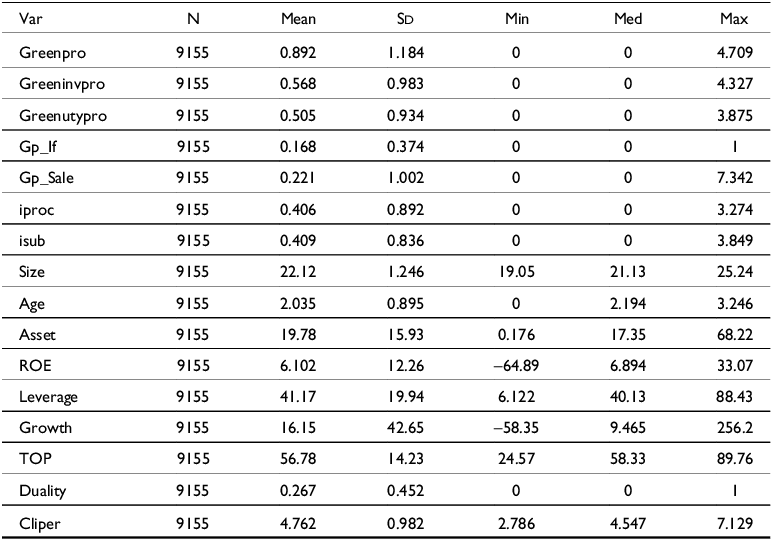
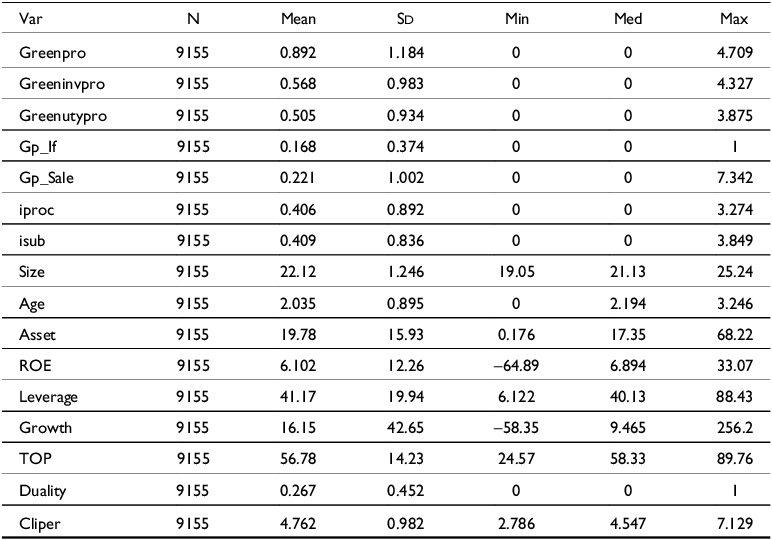
Descriptive statistics of the main variables are shown in Table 2. The Greenpro’s mean value is 0.892, which is greater than the median 0, indicating that the green patent data has a right-skewed distribution, and the standard deviation is 1.184, indicating that there is an obvious gap among enterprises in green technology innovation. The mean values of Greeninvpro and Greenutypro are 0.568 and 0.505, respectively, which are similar to each other, indicating that, on the whole, the number of inventive green technological innovations and improved green technological innovations is relatively the same in China. For government procurement, the Gp_If mean value is 0.168, indicating that about 16% of firms have received government procurement orders.
Descriptive statistics
Baseline regression
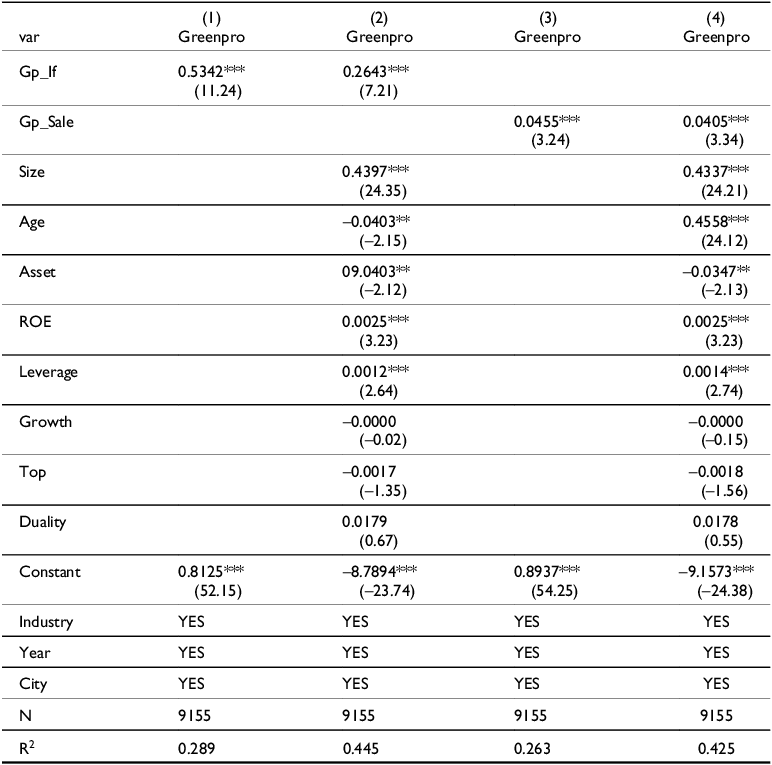
The model (1) regression results are shown in Table 3. Columns (1) and (2) show that the Gp_if is significantly positive at the 1 % with or without control variables. This indicates that green technology innovation is significantly higher for firms that received government procurement orders than for those that did not. Columns (3) and (4) show that the coefficient of Gp_Sale is significantly positive at the 1% level, whether or not the control variable is included, indicating that the higher the government procurement contract amount, the easier it is for enterprises to engage in green technological innovation. Given that the continuous variable Gp_Sale is a more reasonable measure than the 0–1 variable Gp_If for the government procurement impact on firms, this paper mainly uses Gp_Sale as the main dependent variable in the subsequent analysis. In summary, the results indicate that obtaining government procurement orders can promote enterprises’ green technological innovation, and H1 is preliminarily verified.
Baseline regression

Note. Robust t-statistics for clustering at the firm level are in parentheses; ***, **, and * denote significance levels of 1%, 5%, and 10%, respectively.
This conclusion is consistent with Liu and Chan (Reference Liu and Chan2017). Moreover, government intervention in innovative activities is an important complementary mechanism to compensate for innovation deficiencies, because technical activities are generally non-competitive and risky in character. Therefore, the government, as a new technology user, will set detailed requirements for new products to be procured, and so, guide firms towards technological research and development (Mwesiumo et al Reference Mwesiumo, Glavee-Geo, Olsen and Svenning2021). The possible reasons are as follows: first, government procurement is mainly based on public bidding, and enterprise bidding is also in a fair and impartial environment. In order to be able to compete for government procurement orders, enterprises can only meet the requirements by promoting R&D on green technology. Secondly, government procurement policy can guide the market to expand the demand for green technology, thereby increasing the enterprise’s motivation to develop green technology products. Finally, as the most credible and reputable suppliers, governments usually have very large purchase orders. If the Government clarifies the procurement intention in the contract and expands the procurement scope for green technological innovation products, the green technological innovation products’ market price can be increased (He et al Reference He, Liu and Chang2023).
In addition, this paper further finds that sustained government purchase orders are conducive to promoting technological innovation in listed manufacturing companies, which deepens the implementation approach and mechanism for demand-side government instruments. Accordingly, it can be seen that continuous government purchase orders, as opposed to occasional government purchases, are an important safeguard to reduce suppliers’ revenue volatility (Wang Reference Wang2024).
Endogeneity issues
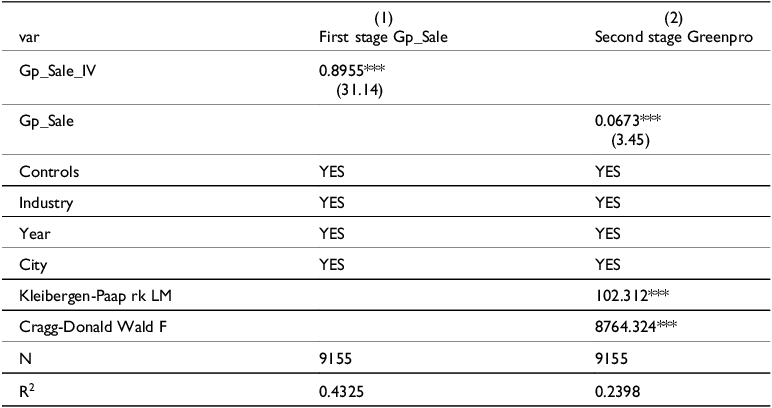
Does access to government procurement promote green technology innovation, or does the government select companies that are willing to carry out green technology innovation? In order to alleviate the problem of endogeneity, we referred to Zhang et al (2020), and used the annual mean of the city-industry government procurement amount share (Gp_Sale_IV) as an instrumental variable, using the least squares method to test. The regression results are shown in Table 4. Column (2) shows that the Kleibergen-Paap rk LM statistic in the unidentifiable test rejects the original hypothesis at the 1% significance level. The Cragg-Donald Wald F-statistic in the weak instrumental variables test is greater than the empirical value of 10, indicating that the baseline regression remains robust after excluding endogeneity issues.
Instrumental variables approach

Note. Robust t-statistics for clustering at the firm level are in parentheses; ***, **, and * denote significance levels of 1%, 5%, and 10%, respectively.
Robustness Tests
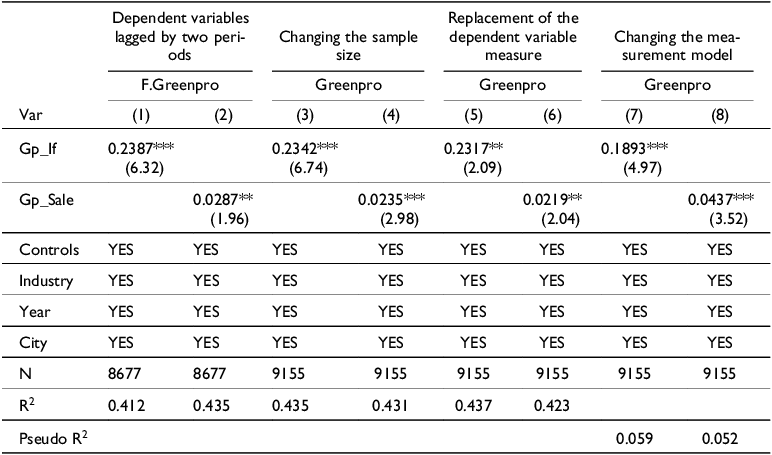
Four robustness tests were carried out: taking account of lag time; changing the sample size, changing the independent variable and changing the measurement model altogether.
-
(1) The dependent variable was lagged two periods. Given that green technology innovation may take a longer time from input to output, we used the number of green patent applications with a two-period lag to re-measure green technology innovation.
-
(2) Changed sample size. A new sample size was obtained by matching the government procurement data with the publicly traded subsidiaries’ data. We then matched and summed the purchases of the subsidiaries with those for the original parent company to get new government procurement data, and regressed the newly matched data on the original data.
-
(3) Replacement of dependent variable measures. Referring to Wang et al (Reference Wang, Fan, Zhao and Wang2016) and Qi and Ongena (Reference Qi and Ongena2020), we replaced the dependent variable measure with the green patent application number, and log the green patents applied to ensure the robustness. The regression results remained significant at the 1% level.
-
(4) Changing the measurement model. Given that there are more 0-values in the green patent number, we adopted a stochastic Tobit model. The above robustness test results are shown in Table 5, which all support the baseline regression.
Robustness tests

Note. Robust t-statistics for clustering at the firm level are in parentheses; ***, **, and * denote significance levels of 1%, 5%, and 10%, respectively.
The effect of government procurement on the green technology innovation quality
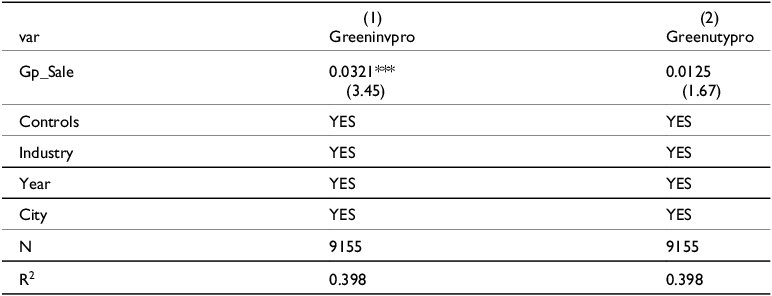
The regression results for Hypothesis 2 are shown in Table 6. Column (1) shows that the estimated coefficient on Gp_Sale is significantly positive at the 1% level when the dependent variable is green invention patents. When the dependent variable in column (2) is a green utility model patent, the estimated coefficient is not significant, indicating that government procurement mainly promotes enterprises’ inventive green technological innovation, a result consistent with Hypothesis 2.
Impact of government procurement on the green technology innovation quality

Note. Robust t-statistics for clustering at the firm level are in parentheses; ***, **, and * denote significance levels of 1%, 5%, and 10%, respectively.
Mechanisms test
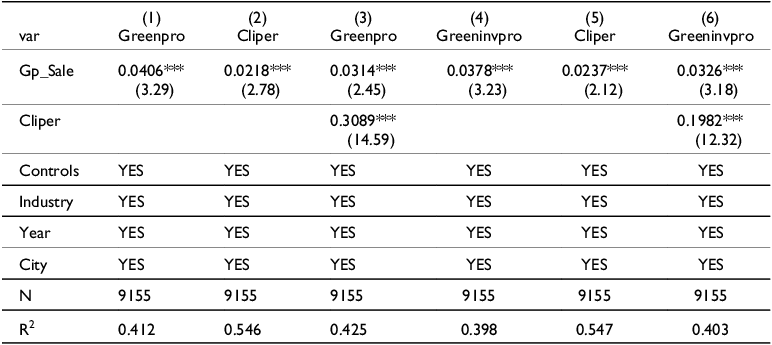
The results for the mechanisms test are shown in Table 7. Column (2) shows that government procurement had a significant positive effect on the executive team’s climate change perceptions at the 1% level, indicating that government procurement can significantly increase the executive team’s climate change perceptions. Column (3) shows that after adding the mediating variable Cliper to the main test equation, the coefficient is significantly positive at the 1% level. Here, the coefficient of Gp_Sale decreases from 0.0406 in the main regression column (1) to 0.0314, which is still significantly positive at the 1 % level. That suggests that executive climate change perceptions play a mediating role in government procurement to promote corporate green technologies. The regression results in columns (4)–(6) also show that government procurement promotes firms’ inventive green technology innovations by increasing the executive team’s climate change perceptions.
Mechanistic tests of climate change perceptions in executive teams

Note. Robust t-statistics for clustering at the firm level are in parentheses; ***, **, and * denote significance levels of 1%, 5%, and 10%, respectively.
Further analysis
Heterogeneity of the impact of government procurement on firms’ green technology innovation
Comparison of different regional enterprises
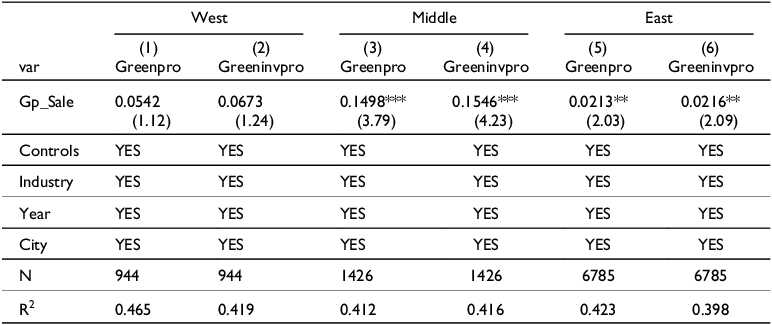
Green technologies are significantly less wasteful and less environmentally polluting than conventional technologies, largely offsetting the technologies’ negative impacts on ecosystems. Meanwhile, new growth theory and new economic geography have shown that economic growth activities are characterised by significant spatial agglomeration (He et al Reference He, Tao, Meng, Chen, Yan and Vasa2021). Thus, interprovincial innovation interactions generated by agglomeration are an important way to increase green technology innovation output. According to the National Development and Reform Commission, the divisions in the east\central\western parts are policy divisions. It can be seen that in the eastern region, the Gp_Sale coefficient is significantly positive, indicating that government procurement positively affects enterprises’ green technological innovation, while the western and central regions are not significant. This may be due to the fact that the eastern region is more economically developed, with green inputs and per capita contributing more to green technology innovation outputs. On this basis, the green technology stock in the eastern region will be higher than that in the western and central regions, and will be more competitive for government procurement orders.
Table 8 shows the regression results after adding regional heterogeneity
Split-sample test based on the firm’s location

Note. Robust t-statistics for clustering at the firm level are in parentheses; ***, **, and * denote significance levels of 1%, 5%, and 10%, respectively.
Comparison of ISO1401-certified companies and non-ISO14001-certified companies ///
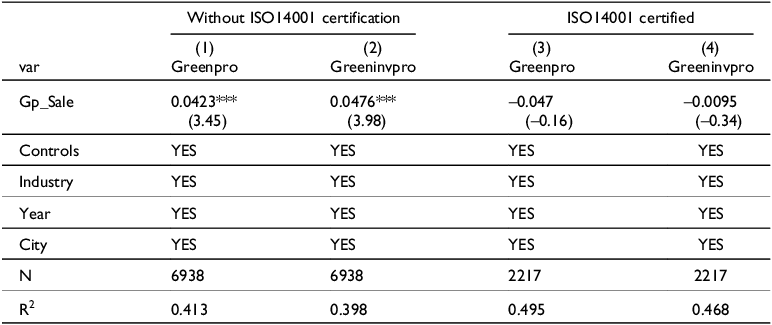
ISO14001 certification is the most popular environmental management system certification in the world (Yang et al Reference Yang, Wang and Ye2022). The samples are divided into two groups according to whether the enterprises have ISO14001 certification or not. Table 9 shows the results. The results show that the Gp_Sale coefficient is significantly positive in the non-ISO14001 certified group and not significant in the ISO14001 certified group. This suggests that government procurement has a greater impact on promoting green technological innovation in enterprises that are not ISO14001 certified.
Split-sample test based on whether firms have ISO14001 certification or not

Note. Robust t-statistics for clustering at the firm level are in parentheses; ***, **, and * denote significance levels of 1%, 5%, and 10%, respectively.
The reason is that government procurement has a signalling effect, so that maintaining a cooperative relationship with the government can convey positive information. In order to regain an environmentally friendly image, enterprises without ISO14001 certification have a stronger incentive to increase their investment in green technology innovation (He et al Reference He, Liu and Chang2023). Enterprises that are not ISO140001 certified may focus more on innovation. They may enhance their market position and competitiveness by continuously launching new products.
Synergies in policy implementation
Innovation incentive policies can be divided into two types: supply-side support policies and demand-side support policies. Supply-side support policies focus on reducing the costs of innovation activities, while demand-side support policies focus on increasing innovation market incentives. In order to examine the actual effect between the two policies, this paper constructs the regression model as follows:
 $$\begin{gathered}Greenpr{o_{i,t + 1}} = {\beta _0} + {\beta _1}ipro{c_{i,t}} + {\beta _2}ipr{c_{i,t}}\;{\text{*}}\;isu{b_{i,t}} + {\beta _3}isu{b_{i,t}} + {\beta _i}Control{s_{i,t}} \\ + \sum I ndustry + \sum Y ear + \sum C ity + {\varepsilon _{i,t}} \\ \end{gathered}$$
Here
 $ipro{c_{i,t}}*isu{b_{i,t}}$
is the interaction term between demand-side purchases and supply-side subsidies.
 $ipro{c_{i,t}}$
denotes the total innovative awarded to its total assets;
 $isu{b_{i,t}}$
denotes the ratio of government innovation subsidies received by the firm to its total assets for the year.
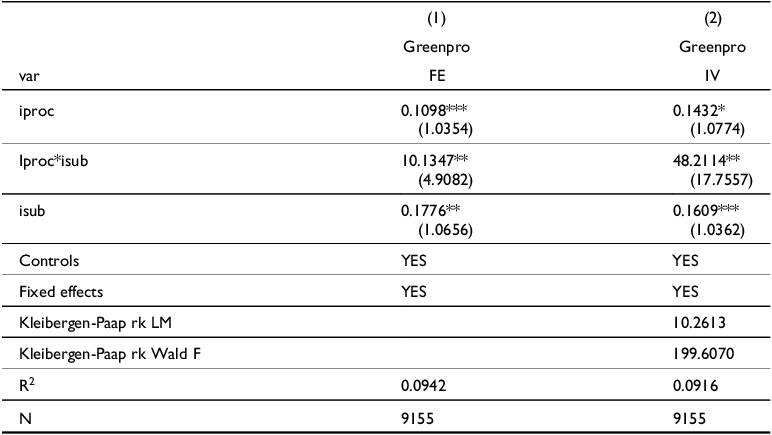
Table 10 reports the synergy baseline regression results between demand-side support policies and supply-side support policies. In column 1, the coefficient on the interaction term is significantly positive at the 5% level, suggesting that the combination of ‘two-sided’ policies achieves a ‘double synergy’ between lower R&D costs and higher market incentives. This results in mutually reinforcing synergistic effects on corporate innovation. Considering that the reliability may be affected by a reverse causality between ‘flanking’ policies and R&D by firms. This paper also uses the IV model for robustness regressions. As shown in columns 2 and 3, after controlling the endogeneity problem, the coefficient of the interaction term remains significantly positive, indicating that the bilateral policy synergy can effectively incentivise firms to innovate.
Synergies between demand-side support policies and supply-side support policies: baseline analysis

Against the multi-policy backdrop, some enterprises have accessed overlapping policy support. Therefore, on the basis of the previous examination on the unilateral policy effect, it is necessary to further analyse the demand-side policy ‘pull’ and the supply-side policy ‘push’ which may also differ depending on the implementation sequence. Accordingly, this paper further examines three policy implementation sequence combinations to explore optimal policy implementation strategies, i.e., ‘supply-side subsidies before demand-side purchases’ ‘Demand-side procurement before supply-side subsidies’. and ‘Supply-side subsidies are implemented simultaneously with demand-side procurement’. The following multi-temporal DID model is constructed in this paper:
 $$\begin{gathered}Greenpr{o_{i,t + 1}}{ = _0} + {\varphi _1}policymi{x_{i,t}} + {\varphi _i}Control{s_{i,t}} + \sum I ndustry + \sum Y ear + \sum C ity \\ \!\!\!\!\!\!\!\!\!\!\!\!\!\!\!\!\!\!\!\!\!\!\!\!\!\!\!\!\!\!\!\!\!\!\!\!\!\!\!\!\!\!\!\!\!\!\!\!\!\!\!\!\!\!\!\!\!\!\!\!\!\!\!\!\!\!\!\!\!\!\!\!\!\!\!\!\!\!\!\!\!\!\!\!\!\!\!\!\!\!\!\!\!\!\!\!\!\!\!\!\!\!\!\!\!\!\!\!\!\!\!\!\!\!\!\!\!\!\!\!\!\!\!\!\!\!\!\!\!\!\!\!\!\!\!\!\!\!\!\!\!\!\!\!\!\!\!\!\!\!\!\!\!\!\!\!\!\!\!\!\!\!\!\!\!\!\!\!\!\!\!\!\!\!\!\!\!\!\!\!\!\!\!+ {\varepsilon _{i,t}} \\ \end{gathered}$$
here
 $policymi{x_{i,t}}$
is a dummy variable, including three sub-indicators isubfirst, iprocfirst and sametime, representing the three policies mentioned above. The steps for identifying these three strategies are as follows: first, we identify the year in which each firm first received a supply-side subsidy versus a demand-side subsidy during the sample period; second, we classify the policy implementation type according to the year in which the two policy types were acquired. Considering that there may be a time lag in the ‘synergy’ between ‘bilateral’ policies, the policy mix is set to 1 from the year after firm i receives the second policy for the first time, and to 0 otherwise. The remaining variables are consistent with equation (1). To ensure comparable results, the control group for all three regressions are firms that ‘received neither supply-side subsidies nor demand-side purchases’.
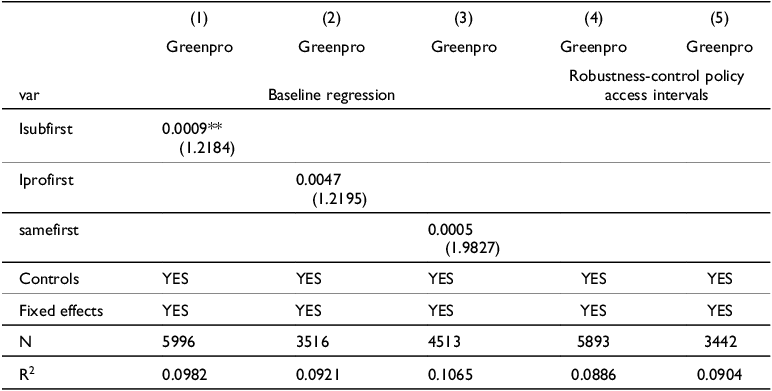
The results in columns (1)–(3) of Table 11 show that there are significant differences in the innovation effects of the three policy implementation strategies. Only the ‘supply-side subsidisation followed by demand-side procurement’ strategy has a significant positive impact on firm innovation, while the remaining two strategies fail to significantly promote firm innovation. The parallel trend test shows that the estimated coefficients are not significant until the ‘two-sided’ policy support is obtained, and the difference in difference (DID) model estimates are reliable. This result also excludes the reverse causality problem between support policies and firms’ R&D investment. However, when the time interval between the two policies is short, the ultimate effect of this ‘sequential’ strategy may not be significantly different from the ‘simultaneous’ strategy. To eliminate this problem, the sample with a one-year interval between the ‘two-sided’ policy acquisitions is further excluded from the robustness test. As can be seen in columns (4)–(5) of Table 11, the previous conclusions remain robust after controlling for the policy acquisition interval.
Policy implementation sequence

Supply-side policies help to develop the innovative capacity, while demand-side policies help to expand their markets. For enterprises, capability is the prerequisite, while the market determines the value realisation. Therefore, in the implementation strategy of ‘supply-side subsidies followed by demand-side procurement’, subsequently, the re-intervention of demand-side policies further enhances the expected market returns to innovation, reduces R&D uncertainty, and strengthens the incentives to utilise their innovative capabilities.
Conclusions and policy recommendations
Conclusions
The manufacturing industry sector is responsible for environmental issues. Government procurement policy plays an active role in promoting green technological innovation. In this context, this paper empirically examines the impact of government procurement on enterprises’ green technological innovation by taking listed manufacturing companies in Shanghai and Shenzhen A-shares from 2015 to 2020. The study found that government procurement significantly promotes enterprises’ green technological innovation, and mainly promotes invention-based green technological innovation. Government procurement can promote green technological innovation by raising the climate change perception. Heterogeneity analysis found that government procurement promotes green technology innovation for firms in the eastern region and firms without ISO14001 certification. Further analysis reveals that demand-side innovation procurement and supply-side innovation subsidies have a mutually reinforcing synergistic effect on firm innovation in general. Also, policy synergies vary depending on the policy implementation sequence.
Policy recommendations
The following recommendations are made in response to the findings:
Policy level
First, improve the long-term mechanism for government procurement to play an effective role, and fully incentivise technological innovation. Governments should further expand procurement and guide enterprises to strengthen their focus on technological innovation. Through preferential procurement and other means, we can create a favourable business environment and more fully utilise market orientation. Second, we need to formulate a practicable government procurement plan to effectively guide the social resources allocation. This means optimising the policy tools for innovation-oriented government procurement, gathering emerging industries for the innovative national construction, and effectively promoting the governance system and capacity modernisation.
Enterprise level
First, building a technological innovation mechanism and steadily improving the enterprise’s social credibility. Enterprises need to choose bidding strategies based on their own heterogeneous factors, build a mechanism for technological capabilities to steadily improve in building corporate credibility, and ultimately form an atmosphere for long-term development; secondly, enterprise management needs to cultivate good environmental awareness and link environmental issues with enterprise development, so as to achieve the maximisation of economic benefits while also balancing the sustainable development strategy.
Theoretical contributions
Compared with existing studies, the theoretical contribution of this article lies in the following three aspects: first, using textual analysis methods to identify government innovative purchases from overall government procurement, and expanding the influencing factors of firms’ green technology innovations; second, previous scholars have conducted empirical studies based on the macro level, and relatively few micro level studies due to missing systematic data. This article utilises big data technology to organise the CSMAR corporate information, which provides data guarantee for empirical studies and enriches the research perspective in this field. Third, this study innovatively examines the synergy of innovation support policies on both sides from the overall policy mix perspective, which provides important policy insights for maximising the government’s role in innovation drive.
Research limitations and perspectives
Despite expanding the research related to government procurement, there are still some limitations, and further research can follow up to explore the following issues. First, the research object can be expanded strategically. On the basis of extending the research object from manufacturing industries to service enterprises, we further propose that future research should focus on the commonalities and differences in the impact of government procurement among different industries. This cross-industry perspective will help to construct a more comprehensive framework of government procurement impacts. The second issue is the need to deepen the research content. In expanding the content of major projects, we should also pay attention to their long-term impact on the entire industrial chain. Taking typical projects such as the China Sky Eye and the Hong Kong-Zhuhai-Macao Bridge as examples, future research can analyse in depth how government procurement promotes technological breakthroughs and industrial upgrading through these kinds of major projects.
Data availability statement
The data can be obtained from the author on request.
Funding statement
This paper is supported by ‘Research Center for Ecological Civilization and Green Development of Shenzhen University’, the key research base of humanities and social sciences in Shenzhen (project number: 2020001); This paper is supported by the National Social Science Foundation ‘Research on the Thought of Ecological Civilization’ (Project No.: 18ZDA004).
Competing interests
The author declared no potential conflicts of interest with respect to the research, authorship, and/or publication of this article.
Consent to publish
All the authors consent to publish.
Xiaoyi Li is a PhD in Economics, main research fields: industrial economics; green innovation.