Introduction
Issue salience directs a range of political outcomes: parties selectively campaign on issues to attract votes (Petrocik, Reference Petrocik1996; De Vries and Hobolt, Reference De Swaan2012), coalition negotiations for ministries depend on parties’ preferences for specific topics (Bäck et al., Reference Bäck, Debus and Dumont2011; Dandoy, Reference Dandoy2014; Falcó-Gimeno, Reference Falcó-Gimeno2014), and governments distribute public policies consistent with their expressed issue priorities (Bevan et al., Reference Bevan and Greene2011). Parties prioritize important issues by dedicating their resources to them in government. In coalition settings, however, policy negotiations and broad disagreements between parties limit each individual party’s ability to unilaterally dictate policy on each issue. Instead, parties must find policy compromises.
Despite evidence of issue salience’s importance for a range of outcomes, little theoretical or empirical work explores its implications on coalition stability and duration. Popular accounts of coalition termination, however, emphasize that not only disagreement, but also the salience of an issue matter to the stability of governing coalitions. News reports often explain that coalition governments in Belgium, for example, fall apart due to disagreement on issues of regional autonomy, an extremely salient issue for most parties (for instance, see Traynor, Reference Traynor2010).Footnote 1 Extending this perspective further, I propose that the distribution of parties’ attention to issues in statements of preferences influences coalition stability. Like the Belgian anecdote, I predict that the presence of cabinet parties dedicating the majority of their emphasis to a small number of issues increase the chance that disagreements end the coalition prematurely. In contrast, cabinets that include parties that distribute their attention to a wider range of issues decrease the risk that disagreement leads to early dissolution; these parties are more open to negotiating policy on a wider range of topics.
I demonstrate support for this perspective by predicting coalition duration using a Cox proportional hazards model with data from the European Representative Democracy Database for 299 coalition governments in 24 European Democracies from 1945 to 2010 (Andersson et al., Reference Andersson, Torbjörn and Svante2014). To this data, I add a measure of issue diversity in parties’ election campaigns, the Effective Number of Manifesto Issues (ENMI). Like measures used to study issue diversity in public opinion (McCombs and Zhu, Reference McCombs and Zhu1995), election campaigns (Greene, Reference Greene and Jensen2015), ideological dimensionality (Stoll, Reference Stoll2011), attention in parliament (e.g. Bevan et al., Reference Bevan and Greene2011; Jennings et al., Reference Jennings, Bevan, Timmermans, Breeman, Brouard, Chaques-Bonafont, Green-Pedersen, John, Mortensen and Palau2011), or policy change (Boydstun et al., Reference Boydstun, Bevan and Thomas2014), this variable captures the relative concentration in each party’s platform to a small or large number of issues. The results demonstrate that higher levels of ideological disagreement between coalition members increase the risk of termination when coupled with parties that emphasize only a small number of issues. Consistent with the theory, coalition parties’ ENMI moderates the effect of ideological disagreement. Furthermore, the discovery of non-proportional hazards (NPH) in the analysis also provides broad evidence in support of the causal mechanism: the effect of the key variables change over time as coalition parties reevaluate the current value of staying in office. This effect is consistent with a story in which coalitions dedicate resources and time to topics that facilitate easy collaboration before shifting to more divisive issues.
These results hold important implications for research on party and coalition behavior as well as our broad conceptions of democratic accountability. Like recent findings related to manifesto construction and government participation (e.g. Dandoy, Reference Dandoy2014), these results help connect studies of parliamentary behavior to research on election strategy, policy agendas, and coalition negotiations. The evidence is consistent with an explanation in which parties’ priorities for policy on issues work in tandem with ideological disagreement to determine a range of outcomes. While the specific issues in parties’ platforms may reflect their electoral motivations, the distribution of their attention to these issues in office reflects their attempts to pursue policy consistent with their electoral pledges. Furthermore, the results suggest that policy compromise may be more easily facilitated among parties that are not only ideologically close, but also among parties campaigning on a wide range of topics.
Coalitions and party preferences
A multitude of factors influence the length of time coalition governments stay together (Laver, Reference Laver and Shepsle2003; Saalfeld, Reference Saalfeld2008).Footnote 2 Scholars show that ideological preferences play a key role in explaining coalition duration (e.g. Laver and Shepsle, Reference Laver1996; Tsebelis, Reference Tsebelis2002; Laver, Reference Laver and Shepsle2003; Saalfeld, Reference Saalfeld2008; Maoz and Somer-Topçu, Reference Maoz and Somer-Topçu2010). Warwick (Reference Warwick1994), for example, shows that the relative preferences of coalition members influence the cabinet’s ability to generate policy outputs. Tsebelis (Reference Tsebelis2002) adds that greater ideological distance between partisan veto players limits the coalition’s ability to produce policy changes. Broadly, these theories predict that ideologically diverse coalitions have a limited range of policies on which they can agree to develop policies. These coalitions end earlier than ideologically compact coalitions because they will have difficulty responding to changing world events.
Party preferences also influence cabinet stability by impacting parties’ alternate coalition options. Ideologically connected coalitions – those where all parties represented in parliament holding preferences falling between the most ideologically extreme coalition partners are included – increase coalition stability because few possible alternative coalition configurations would be more preferred by coalition parties (de Swaan, Reference De Vries and Hobolt1973; Warwick, Reference Warwick1979, Reference Warwick1992, Reference Warwick1994; Diermeier and Stevenson, Reference Diermeier and Stevenson1999). The relative location of parties’ preferences also matters. Moderate or ‘centrist’ parties increase cabinets’ stability (Van Roozendaal, Reference van Roozendaal1997). Laver and Shepsle (Reference Laver1996) add that the participation of parties that hold the median seat on the primary dimensions of conflict in parliament (and the corresponding cabinet portfolios) increase the coalition’s stability. These parties gain little benefit from alternate coalition arrangements. Alternatively, some evidence indicates that ideologically central parties may increase the likelihood of failure because they possess greater options for different coalition partners and make fewer policy plans in advance (Maoz and Somer-Topçu, Reference Maoz and Somer-Topçu2010).
Altogether, these studies find that preferences play an important role in coalition duration. An underlying theme in this research shows that preferences limit parties’ options for alternate coalition configurations or constrain coalitions’ abilities to negotiate policy compromises. Despite these advances, few studies consider the combined influence of party preferences and issue salience for coalition behavior.
However, research on coalition formation and policy change highlights the role of issue salience. There is evidence that both issue priorities and preferences influence government formation and behavior. Coalition negotiations, for instance, take longer between more ideologically distant parties (Martin and Vanberg, Reference Martin and Vanberg2003). Future cabinet parties prioritize salient issues in their negotiations for cabinet portfolios (Bäck et al., Reference Bäck, Debus and Dumont2011). Ideologically divisive coalitions often face delegation problems when issues become salient, although parliamentary rules provide governments with the tools to overcome many disagreements (Martin and Vanberg, Reference Martin and Vanberg2005, Reference Martin and Vanberg2011, Reference Martin and Vanberg2014). For example, coalition parties appoint oversight ‘watchdog’ junior ministers to portfolios with jurisdictions covering salient issues to monitor their coalition partners. Issue salience is particularly important for ministers from ideologically distant parties (Thies, Reference Thies2001; Martin and Vanberg, Reference Martin and Vanberg2011; Greene and Jensen, Reference Greene2014). Parties are less likely to engage in oversight activities on portfolios, however, when the issue is tangential to their own issue priorities (Falcó-Gimeno, Reference Falcó-Gimeno2014). More broadly, principal-agent perspectives show that policies often represent a compromise between coalition parties’ preferences and priorities (Martin and Vanberg, Reference Martin and Vanberg2011, Reference Martin and Vanberg2014).
There is evidence that ideological disagreement and issue salience in coalition settings hold further consequences for government policies. Parties’ issue priorities, for example, often lead to changes in policy (see e.g. Hibbs, Reference Hibbs1977; Green-Pedersen and Mortensen, Reference Green-Pedersen and Mortensen2010; Soroka and Wlezien, Reference Soroka and Wlezien2010; Bevan et al., Reference Bevan and Greene2011; Bevan and Greene, Reference Bevan, John and Jennings2016). Bevan et al. (Reference Bevan and Greene2011) show that the distribution of issues within parties’ agenda leads to consistent policy changes, although world events and economic conditions constrain governments’ ability to focus solely on partisan goals (Green-Pedersen and Mortensen, Reference Green-Pedersen and Mortensen2010). Research from a veto player perspective adds that the relative distance between parties limits the range of potential changes to status quo policies (Tsebelis, Reference Tsebelis2002).
Altogether, studies of coalition behavior, party preferences, and issue salience illustrate a complex relationship. Like this research, I propose that issue salience and disagreement jointly constrain parties’ abilities to govern effectively. Coalitions incapable of maintaining and developing broad compromises due to disagreements on salient issues end prematurely. Governments prepared to negotiate their resources on a wide range of issues can last longer in the face of disagreement.
Hypotheses on the consequences of issue diversity and party preferences
In this section, I outline the logic for hypotheses linking issue diversity and policy disagreement to coalition duration. I propose that coalitions composed of parties willing to compromise on a greater diversity of issues will be more stable than coalitions containing parties compromising on a narrower range of topics. Issue diversity and salience moderate the effect ideological disagreements have on coalition parties’ ability to negotiate policy compromise. Coalitions unable to respond to policy demands on important issues will be forced to end sooner than more flexible coalitions able to pursue policy change on a diverse set of issues. Consequently, the effect of issue diversity will be greatest later in the coalition’s term.
Issue salience and diversity are important for policy change and coalition stability because they indicate the breadth of parties’ policy goals and motivation to develop policies. Following from electoral accountability and issue attention perspectives, parties in a coalition government will be unwilling to consider policy compromises on issues they excluded from their election campaigns. Addressing these issues will make the parties appear unaccountable for the issues they emphasized in their election campaigns (e.g. Downs, Reference Döring1957; Carey, Reference Carey2008; Kam, Reference Kam2009).Footnote 3 Furthermore, the issues parties did not include in their campaigns are likely to be those that coalition parties sought to avoid in the last election due to their historic policy reputations, the rise of issue focused competitors, or because they hold relatively unpopular positions on those issues (e.g. Petrocik, Reference Petrocik1996; Meguid, Reference Meguid2005, Reference Meguid2008; de Vries and Hobolt, Reference De Swaan2012; Greene, Reference Greene and Jensen2015).
Past research indicates that focused attention on issues guides parties’ behavior in government. Parties gain cabinet portfolios consistent with their most salient issues (e.g. Bäck et al., Reference Bäck, Debus and Dumont2011), use oversight mechanisms on portfolios containing salient issues controlled by their coalition partners (e.g. Martin and Vanberg, Reference Martin and Vanberg2011; Greene and Jensen, Reference Greene2014), and even implement policies relating to their most salient issues (Green-Pedersen and Mortensen, Reference Green-Pedersen and Mortensen2010; Bevan et al., Reference Bevan and Greene2011). The logic follows that an overly narrow issue focus ties the hands of parties if they intend to foster an image of accountability.
Instead, parties that distribute their attention to a wide range of topics are likely freer to develop policies in the face of ideological disagreement. From this perspective, parties campaign broadly across issues to attract support, but avoid perceptions of incompetence or a lack of accountability. Disagreements over any single issue become less important, as coalition parties have more discretion to develop policies across a range of topics.Footnote 4 Furthermore, by spreading attention across numerous issues, parties’ positions on individual issues likely become ambiguous or blurred (e.g. Shepsle, Reference Shepsle1972; Rovny, Reference Rovny2012, Reference Rovny2013; Somer-Topcu, Reference Somer-Topçu2015; Greene, Reference Greene and Jensen2015).Footnote 5 Log rolls or policy trades on relatively unimportant issues they addressed in their platforms become possible because the parties do not fear appearing unaccountable.
Issue salience also plays an important role in contexts with little disagreement. When cabinet preferences are relatively close, parties allow greater discretion to their coalition partners. The risk of policy disagreements on an issue decreases when parties hold similar preferences. Coalition parties, for example, are less likely to engage in policy oversight using tools such as junior ministers to monitor ideologically close coalition partners (Thies, Reference Thies2001; Lipsmeyer and Pierce, Reference Lipsmeyer and Pierce2011; Martin and Vanberg, Reference Martin and Vanberg2011; Greene and Jensen, Reference Greene2014). More broadly, legislative involvement in the implementation of policies increases along with the degree of conflict between the minister and coalition parties to reduce the likelihood of ministerial drift (Franchino and Høyland, Reference Franchino and Høyland2009). Parties receive cabinet portfolios (Bäck et al., Reference Bäck, Debus and Dumont2011) and use junior ministers on the issues most salient to them (Greene and Jensen, Reference Greene2014). Because they dedicate greater relative attention to those issues, parties that only emphasize a small number of issues in an otherwise ideological cohesive coalition, therefore, likely earn more policy discretion on these issues.Footnote 6 From this perspective, ideologically close parties allow each other discretion to oversee the policy implementation of their most salient issues.
The effect of disagreement will be strongest on issues that the partners hold most salient. Ideological disagreement decreases the range of acceptable changes to the status quo (Tsebelis, Reference Tsebelis2002). Parties overly focused on a small number of issues signal their unwillingness to negotiate or compromise on policies addressing those topics.Footnote 7 To these parties, deviation from their limited set of salient issues redirects time and resources to issues other than those on which they campaigned. Attention to issues they excluded from their platforms increases the risk of appearing unaccountable and unfocused on their policy priorities. Given parliaments’ limited resources (e.g. Döring, Reference Downs2003), parties avoid attaching resources to issues they hold unimportant, particularly if the policy change would require greater compromise away from the party’ position on that issue.
Although coalitions develop agreements on which issues they will compromise prior to forming a coalition (e.g. Golder, Reference Golder2006; Bäck et al., Reference Bäck, Debus and Dumont2011; Eichorst, Reference Eichorst2014; Greene and Jensen, Reference Greene2014; Ibenskas, Reference Ibenskas2015), exogenous events cause other issues to become important. For example, changing economic conditions and world events necessitate that responsive cabinets address unforeseen topics (Green-Pedersen and Mortensen, Reference Green-Pedersen and Mortensen2010). The regular use of control mechanisms in coalition settings, such as junior ministers or parliamentary scrutiny, to monitor and oversee policies in coalition governance may even exacerbate policy-making tensions as ministers lack the discretion and flexibility to unilaterally determine policy (e.g. Saalfeld, Reference Saalfeld2000; Martin and Vanberg, Reference Martin and Vanberg2011).Footnote 8 Like previous studies of coalition duration (e.g. Warwick, Reference Warwick1994), I assume that coalitions failing to deliver policies in response to unforeseen changes will terminate prematurely.
Altogether, I argue that the relative salience of issues in coalition parties’ agendas moderates the effect of disagreement on government survival. Coalition parties emphasizing a large range of issues can work together more easily in the context of high disagreement, but coalitions of parties with strong emphasis on a small number of issues will be unwilling to negotiate policies in the face of large disagreements. At lower levels of disagreement, issue salience becomes less important as parties allow greater discretion to ministers or deliberate on policies broadly in advance. This logic leads to the first hypothesis.
Hypothesis 1 Coalitions containing parties with a larger diversity of issues in their platforms reduce the effect of ideological disagreement, increasing the coalition’s duration.
Policy compromise links the breadth and salience of parties’ agendas to coalition duration. Coalitions consisting of parties incapable of collaborating and responding to world events will end prematurely (e.g. Warwick, Reference Warwick1994). Policy disagreements, however, take on different importance throughout the coalition’s term in office. For example, the inability to agree on policy compromise might be less important immediately before a constitutionally mandated election than immediately following the coalition’s formation (see e.g. Strøm and Swindle, Reference Strøm and Swindle2002). Studies of parliamentary behavior and policy often emphasize a link between parliamentary behavior, policy, and the timing of elections (Huber, Reference Huber1996; Döring, Reference Downs2003; Smith, Reference Smith2003; Bevan and Greene, Reference Bevan, John and Jennings2016). For example, coalitions work through easy policy compromises early in the legislative cycle before turning to more difficult policy areas (Martin and Vanberg, Reference Martin and Vanberg2008). Likewise, governments are more likely to use parliamentary procedures to contrast individual MPs’ differences with their own leadership leading up to elections (Huber, Reference Huber1996).
Connecting this research to coalition behavior, I hypothesize that issue salience and disagreement will take on greater importance later in the legislative cycle. Policies agreed upon in coalition negotiations require time for governments to implement. Coalitions will need to develop solutions to large ideological disagreements prior to forming a government (Maoz and Somer-Topçu, Reference Maoz and Somer-Topçu2010). The benefits to staying involved in a coalition government also decrease as new constitutionally mandated elections approach. Disagreements, therefore, become more important as the value of staying in office decreases and unanticipated issues arise later in the coalition cycle.
This perspective implies that the effect of issue salience is not immediate. Being capable of compromising on a wide range of issues only becomes important once the initially agreed upon policies are implemented or new, unexpected policy demands are placed on the government. Based on this logic, I predict that the moderating effect of issue diversity will only become important later in the legislative cycle (once initial compromises have been completed).
Hypothesis 2 The moderating effect of issue diversity will be stronger later in the legislative cycle (as the next constitutionally mandated election nears).
Data and methods
I operationalize the dependent variable as the coalition’s number of days in office before it terminates into a new coalition that contains a different set of parties or an election is held. Similar to Saalfeld (Reference Saalfeld2008) and Diermeier and Stevenson (Reference Diermeier and Stevenson1999), I analyze the joint risk of coalition terminations in a competing risk framework to test for the alternate logics leading to each type of failure: a new cabinet or a new election.Footnote 9 For the combined risk, I pool together all failures and right-censor terminations occurring for technical reasons such as the death of the prime minister or to regularly scheduled elections. The data on coalition duration and composition comes from the European Representative Democracy Data Archive (ERDDA) (Andersson et al., Reference Andersson, Torbjörn and Svante2014).Footnote 10 I only include coalition governments or those cabinets containing more than one party according to the ERDDA because the hypotheses do not directly predict the ability of a single-party government to maintain parliamentary support. The resulting sample includes 299 coalition governments in 24 European Democracies from 1945 to 2010.Footnote 11 On average, coalitions last approximately 737 days with a std. dev. of 518 days. Descriptive statistics for the dependent and primary independent variables are presented in Table 1.
Descriptive statistics

ENMI=Effective Number of Manifesto Issues.
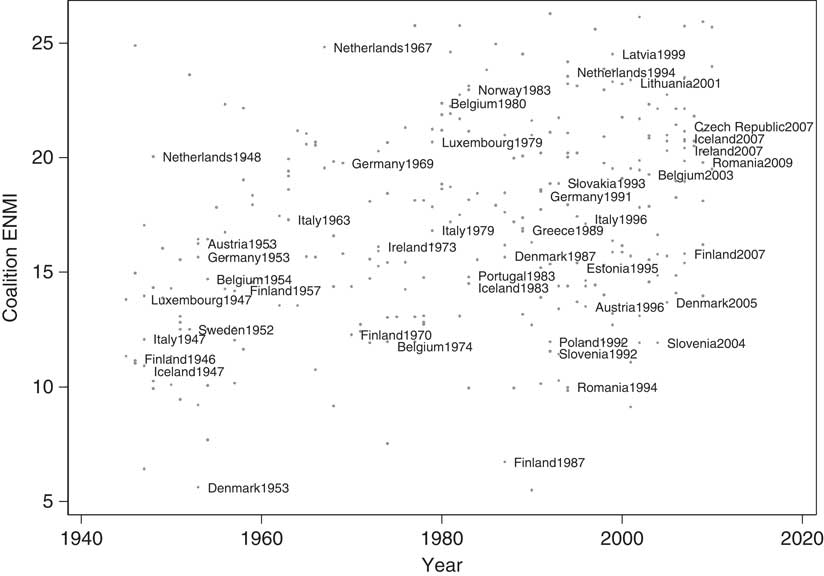
While a substantial literature discusses the measurement of government survival as a dependent variable, the operationalization of salience and breadth, namely issue diversity, of issues in parties’ agendas is less clear. However, public policy and media scholars have long been interested in studying the size of the government or media policy agenda (see e.g. McCombs and Zhu, Reference McCombs and Zhu1995; John and Jennings, Reference John and Jennings2010; Jennings et al., Reference Jennings, Bevan, Timmermans, Breeman, Brouard, Chaques-Bonafont, Green-Pedersen, John, Mortensen and Palau2011; Boydstun et al., Reference Boydstun, Bevan and Thomas2014). Like these scholars I convert a measure of entropy, Shannon’s H, to a measure of diversity (see the Appendix) to characterize both the overall number of topics and their relative salience in parties’ platforms using data from the Comparative Manifestos Project (Volkens et al., Reference Volkens, Lehmann, Matthieß, Merz, Regel and Werner2015). In particular, I measure the effective number of issues in parties’ platforms (ENMI).Footnote 12 For the main analysis, I aggregate this variable to the coalition level by finding the average coalition ENMI. I refer to this variable as C-ENMI or the coalition’s average ENMI.Footnote 13 Figure 1 presents C-ENMI over the course of the sample with selective country labels. Like individual parties’ ENMI (e.g. Greene, Reference Greene and Jensen2015), there is an upward trend overall, as parties and consequently cabinets now discuss more issues in the past.Footnote 14 See the Appendix for additional discussion of the primary independent variable.
Coalition’s average Effective Number of Manifesto Issues (C-ENMI) over time.

Using the coalition’s average ENMI as a general measure of their priority for detailed policy goals or collaboration on a larger number of issues, I then create an interaction between the C-ENMI and the level of ideological disagreement in the coalition.Footnote 15 I measure ideological disagreement as the distance between the coalition’s most extreme parties using Lowe et al.’s (Reference Lowe, Benoit, Mikhaylov and Laver2011) log scale.Footnote 16 I operationalize coalition disagreement as the absolute value of this difference. Larger values indicate greater disagreement, whereas smaller values indicate a more ideologically cohesive coalition.
In addition to the primary independent variables included in this analysis, I account for a number of theoretically important variables to control for the coalition’s initial bargaining conditions. I control for the coalition type using dummy variables for minimum winning coalitions and surplus majority coalitions as measures from the ERDDA. Both types of coalitions likely last longer than the alternative: a minority coalition. I include a measure of ideologically connected coalitions using the measure from the ERDDA. The variable equals one when all the parties in parliament that hold preferences on the primary dimension of conflict within the range of the most extreme coalition parties are members of the coalition (e.g. Warwick, Reference Warwick1979; Diermeier and Stevenson, Reference Diermeier and Stevenson1999). In addition, I include a dummy variable that is equal to one if the coalition includes a party holding the median position on the most important and second most important ideological dimensions as measured by the ERDDA. Dimension by dimension median parties may increase the risk of termination as they potentially have a larger number of ideologically close coalition partners.Footnote 17 To control for the relative preferences of the greater legislative body and the potential for alternative coalition partners (Maoz and Somer-Topçu, Reference Maoz and Somer-Topçu2010), I measure the amount of polarization in the larger legislative body. I measure polarization as the difference between the left-right positions of the most extreme parties in the legislature using Lowe et al.’s (Reference Lowe, Benoit, Mikhaylov and Laver2011) logged left-right scale.
I also control for institutional factors by including dummy variables for whether there is a powerful upper house in a parliament, if the government requires an absolute majority confidence vote or a constructive vote of confidence, and whether there is a popularly elected president who can disband the cabinet (Müller and Strøm, Reference Müller and Strøm1999, Reference Müller and Strøm2003; Saalfeld, Reference Saalfeld2008; Schleiter and Morgan-Jones, Reference Schleiter and Morgan-Jones2009; Elgie, Reference Elgie2011). I include a variable counting the days to the next mandatory election to account for differences in the Constitutional inter-election period (e.g. Lupia and Strøm, Reference Lupia and Strøm1995). Finally, I control for electoral conditions at the end of the coalition by including the inflation and unemployment data from the ERDDA. Positive inflation and low unemployment both increase the risk of an early election as coalition parties expect voters to reward them for the economy (Saalfeld, Reference Saalfeld2008, Reference Saalfeld2013). I run the models with and without economic variables because these data are limited for earlier periods.
Following from methodological advancements in the study of coalitions, I test the primary hypotheses using an event history framework. Event history models are more appropriate for longitudinal and comparative analysis than traditional cross-sectional time series regression techniques because event history analysis directly models the effect of the important variables on time in an essentially comparative framework rather than seeking to limit the impact of time on the analysis (King et al., Reference King, Burns and Laver1990; Warwick, Reference Warwick1992; Diermeier and Stevenson, Reference Diermeier and Stevenson1999; Box-Steffensmeier and Jones, Reference Box-Steffensmeier and Jones2004; Saalfeld, Reference Saalfeld2008). Like Saalfeld (Reference Saalfeld2008), I adopt Diermeier and Stevenson’s (Reference Diermeier and Stevenson1999) approach to estimating cabinet termination from a competing risks framework. This entails estimating three separate models of cabinet termination that account for right censoring in the dependent variable to analyze specific subsets of termination hazards (all terminations, replacement coalitions, and early elections). In addition, I account for right censoring in the data from a number of different sources unrelated to my theoretical perspective including terminations (the death of the Prime Minister or a regularly scheduled election). In the replacement and early election models, the estimates predict the risk of termination for coalitions that are replaced by new coalitions vs. coalitions that end in elections prior to the final constitutionally mandated date. I cluster the standard errors for all cabinets that follow an election to account for heterogeneity caused by the inclusion of multiple coalitions following the same election.Footnote 18
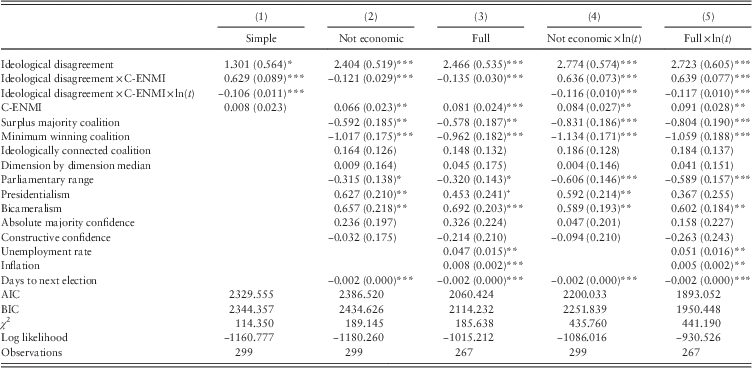
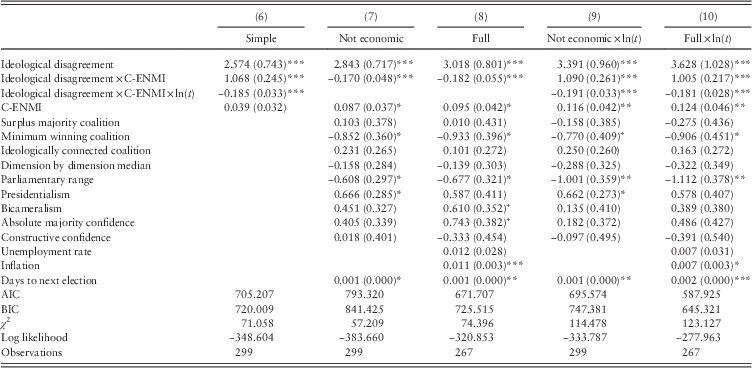
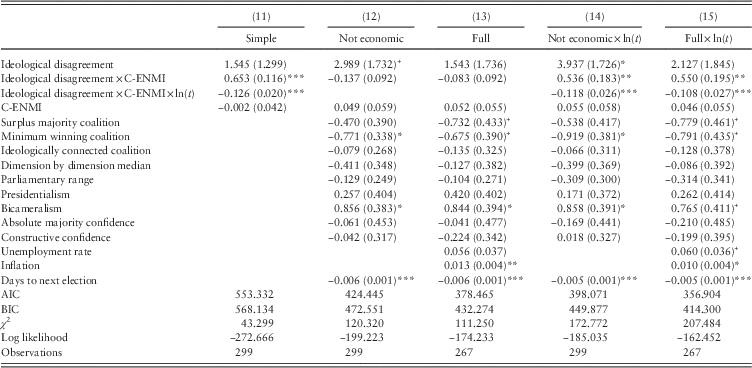
Finally, the theory expects a violation in a key assumption inherent to most event history models, the proportional hazards assumption; I predict that the moderating effect of C-ENMI will change depending on the value of the dependent variable. Like previous analyses using NPH (Box-Steffensmeier and Jones, Reference Box-Steffensmeier and Jones2004; Licht, Reference Licht2011), I include an interaction of the theoretically offending variables with the natural log of time.Footnote 19 This specification allows me to directly test whether the moderating effect of C-ENMI becomes more important later in a coalition’s term in office. I present the results from the primary analyses in Tables 2–4. In each table, I first show the results of a simple analysis with only the key independent variables and the interaction with the log of time,Footnote 20 before presenting two sets of models without the time interaction and two models accounting for the non-proportionality.
Cox hazards analysis of the combined risk of coalition termination

C-ENMI=coalition’s average Effective Number of Manifesto Issues; AIC=Akaike information criterion; BIC=Bayesian information criterion.
Results are from a Cox proportional hazards model of coalition duration. Coefficients represent the change in the baseline hazard of termination. Standard errors are clustered on the election date. P-values are presented in parentheses. A model including the economic variables and interactions with time do not converge.
All significance tests are two-tailed: + P<0.10, *P<0.05, **P<0.01, ***P<0.001.
Cox hazards analysis of the risk of a replacement cabinet

C-ENMI=coalition’s average Effective Number of Manifesto Issues; AIC=Akaike information criterion; BIC=Bayesian information criterion.
Results are from a Cox non-proportional hazards model of coalition duration. Coefficients represent the change in the baseline hazard of termination. Standard errors are clustered on the election date. P-values are presented in parentheses.
All significance tests are two-tailed: + P<0.10, *P<0.05, **P<0.01, ***P<0.001.
Cox hazards analysis of the risk of a cabinet ending in new elections

C-ENMI=coalition’s average Effective Number of Manifesto Issues; AIC=Akaike information criterion; BIC=Bayesian information criterion.
Results are from a Cox hazards model of coalition duration. Coefficients represent the change in the baseline hazard of termination. Standard errors are clustered on the election date. P-values are presented in parentheses.
All significance tests are two-tailed: + P<0.10, *P<0.05, **P<0.01, ***P<0.001.
Results
The results from the Cox hazards model in each table provide evidence in favor of Hypothesis 1; the coefficient for C-ENMI and its interaction with ideological disagreement is negative in the models that do not include the interaction of time. Coalitions with larger coalition C-ENMI reduce the risk of failure caused by ideological disagreement. These coefficients are statistically significant at the 99% confidence level for the combined risk and replacement risk models. The coefficients are in the correct direction in the election risk models, but not significantly different from 0.
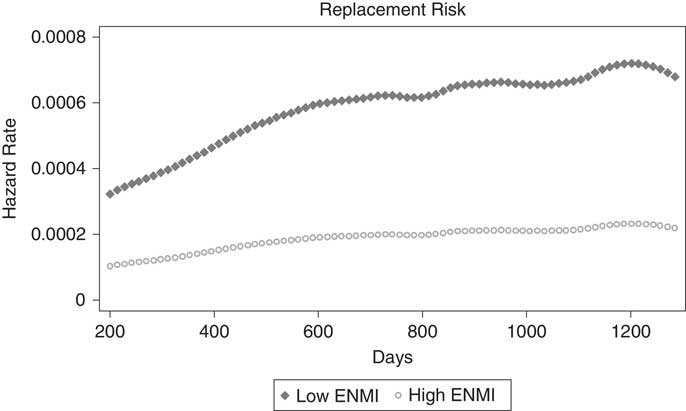
To show this effect for replacement cabinets, Figure 2 predicts the hazard rate for cabinets at risk of replacement at high levels of disagreement (1 std. dev. above the mean) for two levels of C-ENMI (1 std. dev. below and above the mean level of C-ENMI).Footnote 21 For coalitions above the mean level of disagreement, C-ENMI decreases the risk of a new coalition caused by ideological disagreement. C-ENMI provides a stabilizing impact as predicted by Hypothesis 1.
Hazard rates for multiple levels of coalition’s average Effective Number of Manifesto Issues (C-ENMI) at high disagreement. The predicted hazard of replacement is for coalitions with 1 std. dev. below and above the mean ENMI at high levels of disagreement (Mean + 1 std. dev.). Estimates are based on the results from Model 8.

In general, the results for the combined risk and replacement risk of termination support the first hypothesis. The results for cabinets ending in new elections are inconsistent with the first hypothesis in Table 4. The second hypothesis, however, predicts a more complicated relationship. The estimated coefficients are likely biased if the proportional hazards assumption is violated.
Empirically, a test of the residuals based in each of the models testing only the first hypothesis provide some evidence of a more complicated relationship. In contrast to many studies of government duration,Footnote 22 a test of the proportional hazards assumption using the Schoenfeld residuals indicates that the estimates in many of the models fail global tests of proportionality.Footnote 23 Stated differently, the effect of one or more independent variables relative to the baseline hazard rate of coalition termination is not consistent across the length of observed coalitions.
This non-proportionality may explain the inconsistent effect of ideological disagreement and C-ENMI for new elections in Table 4. To directly test the hypotheses in the non-proportional framework, I re-estimate the models, but allow the moderating effect of C-ENMI on ideological disagreement to change over time by including an interaction of it with the natural log of time.Footnote 24
The results from the non-proportional analysis demonstrate clearer support for the second hypothesis for all non-proportional models.Footnote 25 Consistent with the theory, the coefficients indicate that the effect of C-ENMI is non-proportional, although the coefficients for the interaction of coalition mean ENMI and disagreement (not interacted with time) are in the wrong direction. These coefficients imply that on the 1st day of the coalition, disagreement and C-ENMI together increase the risk of early termination. However, coalition ENMI and its interaction of disagreement when interacted with time are negative and statistically different from 0 for each type of coalition termination. This suggests that the long-term effect of both coalition C-ENMI and the interaction stabilizes the coalition, although it might initially increase the risk of termination.
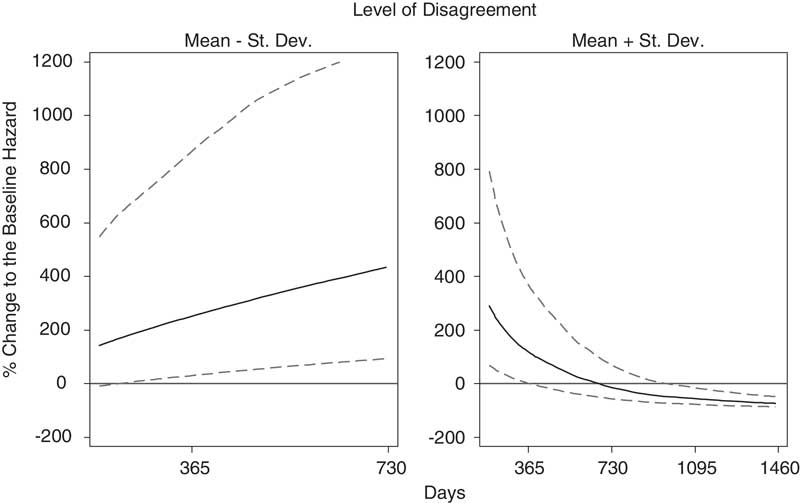
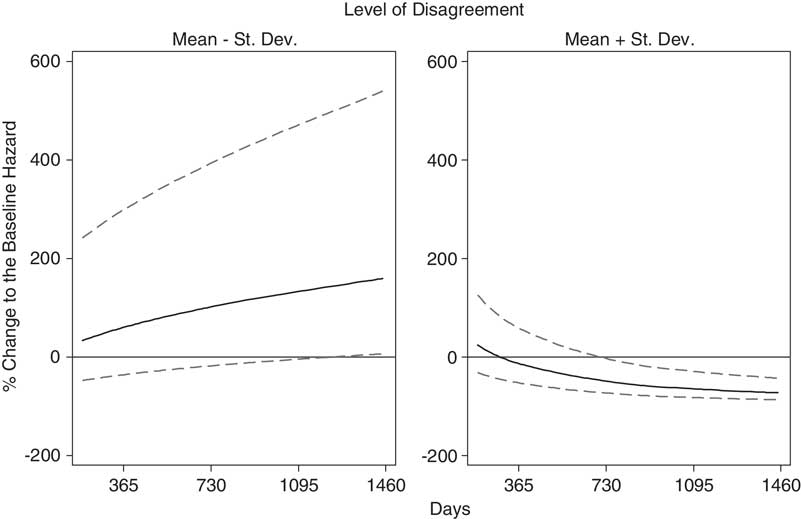
Given the large number of interactions, the combined effect of C-ENMI in each of the models is difficult to interpret using coefficients alone (Licht, Reference Licht2011). To demonstrate the non-proportional impact of C-ENMI and ideological disagreement, I present the first difference percentage change in the baseline hazard rate for cabinets at risk of replacement and new elections in Figures 3 and 4 for coalitions at low disagreement and high disagreement (1 std. dev. below and above the mean).Footnote 26
First difference change in the non-proportional risk of a replacement cabinet from coalition’s average Effective Number of Manifesto Issues (C-ENMI).

First difference change in the non-proportional risk of an election from coalition’s average Effective Number of Manifesto Issues (C-ENMI).

Figures 3 and 4 show support for the second hypothesis. In both figures, the results greatly differ according to the degree of ideological disagreement. Indeed, the moderating effect of ENMI actually increases the risk of termination at low levels of disagreement. For higher levels of disagreement, however, ENMI decreases the effect of disagreement later in the coalition’s lifecycle. Consistent with a moderating effect of ENMI (as predicted by Hypothesis 2), immediately following the formation of a new cabinet C-ENMI actually increases the risk of a cabinet being replaced in the 1st years of a coalition. This effect is significant for the 1st year of the cabinet.Footnote 27 However, the effect of C-ENMI decreases and eventually changes to become a stabilizing force. C-ENMI decreases the risk of termination after the coalition has lasted for approximately 2 years, although the exact point the effect switches depends on the level of disagreement. By around the end of the 3rd year of a coalition with disagreement at 1 std. dev. above the mean, C-ENMI reduces the risk of a replacement cabinet relative and early elections relative to the baseline hazard by just over 50%. Broadly, this finding is consistent with the explanation that C-ENMI reduces the effect of ideological disagreement once easy policy compromises have been reached for the risk of both replacement cabinets and early elections.
Finally, the controls generally perform as the previous literature expects in Tables 2 and 3. Many of these variables also exhibit previously unexplored non-proportional effects for the risk of new elections. Surplus majority coalitions increase the risk of replacement in some models, but decrease the risk of new elections. Minimum winning coalitions generally are at a decreased risk of termination. Ideologically connected coalitions have no statistically significant effect. Requirements for an absolute majority of parliament or constructive confidence rules generally do not impact the coalition’s tenure. Institutions such as presidentialism and bicameralism increase the risk of termination in the combined models, only bicameralism consistently shows a statistically significant effect in the competing risks analysis. These coefficients imply that alternate veto points that can delay or block legislation decrease governments’ ability to implement policy (e.g. Strøm and Swindle, Reference Strøm and Swindle2002). Lack of concurrent majorities for coalitions in bicameral countries may also limit the ability to negotiate policy compromises (e.g. Druckman and Thies, Reference Druckman2002). The coefficients for coalitions that include parties at the parliament’s dimension by dimension median ideological position generally decrease the risk of termination, but are not statistically different from 0; this might indicate that other measures of ideology better capture parties’ outside options. As Maoz and Somer-Topçu (Reference Maoz and Somer-Topçu2010) may have predicted, parliaments with larger ideological ranges generally have a slightly decreased risk of being replaced, but the effect is not statistically significant for the risk of new elections. Coalitions with longer constitutionally mandated inter-election periods or days until the next mandatory election face a reduced risk of both forms of termination as Lupia and Strøm (Reference Lupia and Strøm1995) would predict. Finally, the coefficients for inflation and unemployment are statistically significant in most of the models, although inflation has a more consistent effect across specifications.
Discussion
The theory presented here seeks to directly consider the relationship and identify the mechanism connecting ideological disagreement, issue salience, and coalition behavior over time. Provided that electoral platforms reflect a balance of the party’s policy and electoral goals, issue diversity in party platforms provide a window into the party’s relative priority for detailed policy goals or a broader willingness to negotiate their policy goals on a large number of issues. Parties with a large number of issues stabilize ideologically contentious coalitions through their willingness to work on a range of topics once the initial easy policy agreements have been completed. Coalitions of ideologically distant parties have a chance at long-term survival if the parties are willing to work on a range of issues to stay in office. However, parties that only prioritize a small number of issues, such as language and regional issues in Belgium, exacerbate ideological tensions once the coalition accounts for its initial compromises. Parties with greater issue diversity mitigate ideological tensions. The results imply that the high levels of disagreement in the Belgian five party-cabinet led by Martens in 1988, for example, was stabilized by comparably high levels of C-ENMI.Footnote 28 Based on this perspective, a coalition government designed to maximize stability with high levels of ideological disagreement would include coalition parties that campaign on a large diversity of issues.
This article tests the theory using an event history analysis of coalition duration in 24 European democracies using a new measure from party manifestos, the coalition mean ENMI. Using both proportional and NPH competing risk analysis, I show that issue diversity in party platforms mediates the relationship between ideological disagreement and coalition duration. C-ENMI moderates the extent to which ideological disagreement increases the risk that a coalition will break up. Second, I perform a thorough test of the theory using a NPH analysis for coalitions at risk of new elections. I demonstrate that parties with more comprehensive platforms significantly decrease the risk of breaking up later in the coalition’s term. Ideologically diverse coalitions may initially increase the risk of a replacement cabinet or new election, but stabilize cabinets in the long term. These results are robust to a range of modeling choices as presented in the Appendix.
The empirical tests confirm a theoretical and methodological explanation for the weak findings connecting disagreement to coalition duration (Warwick, Reference Warwick1994; Tsebelis, Reference Tsebelis2002; Saalfeld, Reference Saalfeld2008). The analyses are consistent with the explanation that the inability to negotiate policy leads coalitions to terminate early. Each additional issue parties include in their platforms may provide coalition partners with greater room to negotiate policy compromises and engage in log rolls. Parties that include substantial detail on a small number of issues may view compromise as too far outside their range of acceptability even if they constitute a relative improvement over the status quo. This evidence indicates that studies of parliamentary behavior would benefit by incorporating parties’ willingness to negotiate across a range of issues. Current models of public policy and parliamentary behavior may under predict the effect of ideological disagreement because they do not incorporate parties’ willingness to forego policy details as a bargaining tool.
Finally, by accounting for non-proportional effects, I add that issue diversity can influence parties’ strategic decision-making at different points in the parliamentary schedule in different ways. Although previous research found limited evidence of non-proportionalities (Warwick, Reference Warwick1994; Diermeier and Stevenson, Reference Diermeier and Stevenson1999), strategic bargaining contexts such as cabinet formation and termination generally face competing strategies that change over time as legislation and other factors influence the payoffs from bargaining (Licht, Reference Licht2011). The results here indicate that ideological disagreements leading to coalition termination arise within the first 1–2 years following a coalition’s formation. This links well with Martin and Vanberg’s (Reference Martin and Vanberg2008) contention that easy agreements are dealt with quickly in coalition settings. However, the finding that higher levels of ENMI decrease the risk of early election terminations toward the end of the coalition’s potential duration may indicate that they are more strategic about the timing of the next election than parties with fewer issues (Strøm and Swindle, Reference Strøm and Swindle2002; Smith, Reference Smith2003). Strategic bargaining contexts require accounting for non-proportional effects at both the theoretical and empirical stages. These results connect to other recent perspectives such as Druckman’s (Reference Druckman and Thies2008) call for dynamic studies of coalition behavior by suggesting a more dynamic approach to studying coalitions from a temporal perspective.
Acknowledgments
Versions of this article were presented at the European Consortium for Political Research in Potsdam, Germany in 2009 and the Midwestern Political Science Association in Chicago, IL in 2014. The author would like to thank Amanda Licht, Lanny Martin, Gail McElroy, Jae-Jae Spoon, Zeynep Somer-Topcu, and the anonymous reviewers for their helpful comments at various stages of this paper’s development. Portion of this work was supported by the Collaborative Research Center 884, the ‘Political Economy of Reforms’ (Project C2), funded by the German Research Foundation.
Supplementary Material
To view supplementary material for this article, please visit http://dx.doi.org/10.1017/S1755773916000114