


In recent years, population growth and the pursuit of healthy nutrition have increased demand for milk and dairy products. As of 2024, raw milk production in Türkiye has reached approximately 22.5 million tons, while the number of cattle has exceeded 16.9 million (Türkiye İstatistik Kurumu, 2024). This increase, in conjunction with the dissemination of contemporary dairy farming practices, underscores the need for more effective implementation of a scientific approach to address genetic, nutritional and health concerns. Maintaining production by preserving metabolic balance is becoming even more critical during the transition period covering the three weeks before and after calving, especially in breeds such as Holstein, which are targeted for high milk yield.
The transition period is the stage when hormonal, metabolic and immune system changes are most intense, and during this process, cows become more susceptible to metabolic disorders such as negative energy balance, ketosis and fatty liver disease (Drackley, Reference Drackley1999; Van Saun Reference Van Saun2023). During this period, dry matter intake decreases significantly due to reduced appetite, decreased rumen volume, increased inflammatory responses, and the effects of endotoxins. Increased energy demands associated with milk production trigger the mobilization of body fat, raising concentrations of non-esterified fatty acids (NEFA) and beta-hydroxybutyric acid (BHBA) in the bloodstream. These parameters are important biomarkers for evaluating energy metabolism disorders during the transition period (Goff and Horst, Reference Goff and Horst1997; Ospina et al., Reference Ospina, Nydam, Stokol, Overton and Lockwood2010).
In addition to the implementation of various strategies in the management of the transition period, the importance of components such as choline and methionine, which act as methyl donors, has also increased. These methyl donors play a critical role in regulating a variety of biological processes, including one-carbon metabolism, homocysteine detoxification, phospholipid synthesis and energy metabolism (Finkelstein, Reference Finkelstein1990; German et al., Reference German, Roberts and Watkins2003). Choline has been identified as a contributing factor in the synthesis of phosphatidylcholine, a vital component in the transportation of triglycerides within the liver, specifically in the form of very-low-density lipoproteins. On the other hand, methionine has been observed to play a dual role in both protein synthesis and transmethylation reactions (Zhou et al., Reference Zhou, Garrow, Dong, Luchini and Loor2017). However, the rapid degradation of these compounds by rumen microorganisms necessitates the use of rumen-protected forms, especially during this period (Pinotti et al., Reference Pinotti, Dell'Orto and Baldi2000).
Nutrigenomics and nutrigenetics have emerged as pivotal disciplines in elucidating the intricate interplay between nutritional intake and genetic composition. In particular, genetic variations in enzymes involved in one-carbon metabolism, such as methylenetetrahydrofolate reductase (MTHFR), have been demonstrated to directly affect animals’ methylation capacity, homocysteine metabolism and various related metabolic events (Gillies, Reference Gillies2003; Hasan et al., Reference Hasan, Feugang and Liao2019; Chmurzynska et al., Reference Chmurzynska, Seremak-Mrozikiewicz, Malinowska, Różycka, Radziejewska, Kurzawińska and Drews2020). It has been posited that polymorphisms of the MTHFR gene, such as 8137C > T, may result in hyperhomocysteinaemia by reducing enzyme activity (Song et al., Reference Song, Sun, Yang, Hua, Guo and Yang2011; Fedota et al., Reference Fedota, Skrypkina, Mitioglo, Tyzhnenko and Ruban2018). This condition is also predicted to negatively affect energy metabolism and liver function.
Homocysteine, an intermediate product of methionine metabolism, has been shown to induce oxidative stress, endothelial dysfunction and an imbalance in antioxidants. The regulation of homocysteine concentrations is contingent upon adequate concentrations of coenzymes, such as vitamin B12 and folic acid (Selhub et al., Reference Selhub, Jacques, Wilson, Rush and Rosenberg1993; McFadden et al., Reference McFadden, Girard, Tao, Zhou, Bernard, Duplessis and White2020). The interaction between polymorphisms in the MTHFR gene and feed additives has emerged as an important research focus due to its potential implications for metabolic regulation, milk production and animal health. Within this context, understanding how genetic variation, particularly MTHFR polymorphisms, modulates the metabolic response to dietary methyl donors is essential for elucidating differences in nutrient utilization and physiological adaptation. Such knowledge provides a critical foundation for the development of genotype-responsive feeding strategies aimed at improving metabolic efficiency and production performance in dairy cattle.
In this context, the aim of our study is to determine the MTHFR gene 8137C > T (rs110692574) polymorphism in Holstein dairy cows raised in Balıkesir province using molecular methods; to examine the effects of this genetic variation on metabolic parameters such as homocysteine, NEFA, BHBA, folic acid and vitamin B12 during the transition period; and to evaluate the interaction between rumen-protected choline and methionine supplementation used during this period and the aforementioned parameters and polymorphism.
Materials and methods
In this study, Holstein dairy cows reared at two farms affiliated with the Balıkesir Province Dairy Cattle Breeders Association were utilized. First, genetic screening was performed on a total of 356 cows to determine the MTHFR rs110692574 polymorphism. The isolation of deoxyribonucleic acid (DNA) from blood samples was carried out using a commercial spin column-based DNA isolation kit (PureLink™ Genomic DNA Mini Kit, Thermo Fisher Scientific, USA) in accordance with the manufacturer's protocol. The tetra-primer ARMS-PCR method was employed to detect the polymorphism (Medrano and De Oliveira, Reference Medrano and De Oliveira2014). In this study, four primers were designed to identify the 8137C/T (rs110692574) nucleotide variation in exon 9 of MTHFR. The Primer1 and BatchPrimer3 web-based tools were used for primer design, and the nucleotide sequences of the designed primers are provided in Table 1.
Nucleotide sequences of the primers used in PCR analysis

BTA, Bos taurus autosome.
a Sequencing primers.
The present study employed two distinct allele-specific PCR reaction mixtures for the C and T alleles of MTHFR. The PCR components for the C allele were as follows: 1.75 μL DNA, 0.35 μL primer (forward and reverse, Oligomer Biotechnology, Ankara, Türkiye), 10 μL 2 × Taq DNA Polymerase Master Mix (Ampliqon Inc., Odense, Denmark) and 7.55 μL nuclease-free water (Ambion Inc., Austin, TX, USA). For the T allele, the reaction mixture contained 2.25 μL DNA, 0.57 μL primer (forward and reverse, Oligomer Biotechnology, Ankara, Türkiye), 10 μL 2 × Taq DNA Polymerase Master Mix (Ampliqon Inc., Odense, Denmark) and 6.6 μL nuclease-free water (Ambion Inc., Austin, TX, USA). Reaction volumes were optimized separately for each allele-specific primer set.
PCR amplification was performed under the following thermal cycling conditions: initial denaturation at 94°C for 30 s; followed by 35 cycles of denaturation at 94°C for 30 s, annealing at 62.7°C for the C allele–specific primers or 62.5°C for the T allele–specific primers for 30 s and extension at 72°C for 35 s; with a final extension step at 72°C for 7 min. The analysis of PCR products was conducted through agarose gel electrophoresis, employing a gel composed of 1.5% agarose. The samples were also stained with GelRed (Biotium, Hayward, CA, USA) in 0.5X TBE (Tris-borate-EDTA) buffer (Thermo Fisher Scientific Inc., Waltham, MA, USA), and visualization under ultraviolet light was subsequently performed.
In this study, two dairy cattle farms with analogous feeding strategies during the dry period and lactation phase were selected for analysis. On both farms, corn silage and straw constituted the fundamental components of the roughage, while wheat silage and alfalfa hay were incorporated into the ration during the lactation period. The presence of the T allele in the population is at a low frequency, and there is a possibility that it exerts an influence on metabolic processes. Consequently, animals carrying this allele were preferentially included to ensure adequate representation; a total of 80 animals with 25 CT and 55 CC genotypes were included in the experimental group. The animals were also divided into groups: rumen-protected choline (CH) and rumen-protected choline + rumen-protected methionine (CH + MET) groups, based on the feed additive administered. Animals in the CH group were administered a supplement containing 7.5 g of choline chloride per 100 g at a daily dose of 200 g/animal/day. This supplementation occurred three weeks prior to calving and continued until three weeks after calving. Animals in the CH + MET group received an additive containing 40 g of choline chloride and 25 g of methionine per 100 g at a dose of 100 g/animal/day during the same period.
To determine concentrations of homocysteine, vitamin B12, folic acid and NEFA, blood samples were collected into yellow-capped tubes (Serum Separator Tube – SST) 21 days before calving (−21), on the day of calving (0) and 21 days after calving (+21). The collected samples were centrifuged at 3,000 rpm for 10 minutes to obtain serum and stored at −80°C until analysis.
Homocysteine concentrations (mmol/L) were analysed using the enzyme immunoassay method with the Bovine Homocysteine ELISA Kit (Sunlong, SL0319Bo). Folate (ng/mL) and vitamin B12 (pg/mL) concentrations were measured using photometric and chemiluminescence methods, respectively, on a blood analyser (Abbott Architect i8200; Abbott Diagnostics, USA). The NEFA (µmol/L) concentrations were determined using a spectrophotometric method on an RX Monza (Randox Laboratories Ltd., UK) biochemistry analyser.
Milk yield records, along with birth and calving dates, were obtained from farm records. BHBA data were obtained from farm records on days 7 and 14 postpartum.
Data analysis
All analyses were performed using the IBM SPSS Statistics 30 software package. The effects of MTHFR genotypes and feed supplement groups on biochemical parameters (homocysteine, folic acid, vitamin B12, NEFA and BHBA) measured at different time points were evaluated using repeated-measures ANOVA. The interrelationships among genotype, feed supplement and milk yield traits were investigated through the implementation of a general linear model (GLM). The linear models employed are enumerated below:
For biochemical parameters:  ${{\text{Y}}_{{\text{ijklmn}}}}{ = \mu + \text{a}}{}_{\text{i}}{\text{ + }}{{\text{b}}_{\text{j}}}{\text{ + }}{{\text{c}}_{\text{k}}}{\text{ + }}{{\text{d}}_{\text{1}}}{\text{ + }}{{\text{f}}_{\text{m}}}{\text{ + }}{{\text{e}}_{{\text{ijklmn}}}}$
Here, Yijklmn: observed value, µ: population mean, ai: genotype effect (CC, CT), bj: age effect (2, 3, 4+), ck: lactation order effect (1, 2, 3), dl: season effect (1, 2, 3, 4), fm: feed additive effect, eijklmn: error term.
For milk yield traits:
 \begin{equation*}{{\text{Y}}_{{\text{ijklmn}}}}{ = \mu + \text{a}}{}_{\text{i}}{\text{ + }}{{\text{b}}_{\text{j}}}{\text{ + }}{{\text{c}}_{\text{k}}}{\text{ + }}{{\text{d}}_{\text{1}}}{\text{ + }}{{\text{f}}_{\text{m}}}{\text{ + }}{{\text{e}}_{{\text{ijklmn}}}}\end{equation*}
Here, ai: genotype effect (CC, CT), bj: calving age effect (2, 3, 4+), ck: calving season effect (1, 2, 3, 4), dl: feed supplement effect, eijklm: error term.
Analogous GLM models were employed for the analysis of reproductive traits, including the number of inseminations, age at first calving and calving interval. The fixed factors genotype, feed supplement, calving season and calving age were incorporated into the model.
The genotype frequencies were evaluated using the chi-square (χ2) test in terms of Hardy–Weinberg equilibrium. The statistical analysis of the relationship between genotypes and health issues was conducted using two distinct methods: Pearson's chi-square test and Fisher's exact test, which was employed when the cell frequency was less than five. The Bonferroni correction was implemented to mitigate the risk of error in multiple comparisons.
AI-assisted tools were used solely to enhance the clarity and visualization of tables and figures. All data analyses and interpretations were conducted by the authors.
Results
PCR products were analysed using 1.5% agarose gel electrophoresis and visualized under UV light (Figure 1A). Genotyping of the MTHFR gene rs110692574 polymorphism was performed based on the size and number of electrophoretic bands. The C allele produced a 155 bp band, while the T allele produced a 127 bp band. Samples showing both bands were classified as heterozygous (CT), while those showing only the C or T band were classified as homozygous CC or TT, respectively. Among 356 samples, 311 were CC, 44 were CT and 1 was TT. The reliability of the Tetra ARMS-PCR method was validated by DNA sequencing of representative samples corresponding to each genotype (Figure 1B). For this purpose, the 240 bp fragment amplified using the common forward and reverse primers was analysed by the Sanger sequencing method (Table 1). Sequence data corresponding to all three genotypes (CC, CT and TT) were deposited in the GenBank database under accession numbers PX682292, PX682294 and PX682293, respectively.
(A) Appearance of PCR products on 1.5% agarose gel electrophoresis. M: 100 bp DNA marker; sample 1 has the TT genotype; samples 2, 3 and 5 have the CC genotype; sample 4 has the CT genotype. (B) Electropherogram images resulting from DNA sequencing analysis. A: CC, B: CT, C: TT genotypes. (B) Electropherogram images resulting from DNA sequencing analysis. A: CC, B: CT, C: TT genotypes.

Genotype and allele frequencies were calculated and assessed for Hardy–Weinberg equilibrium using the χ2 test. The genotype distribution across different farms is shown in Table 2.
Genotype and allele frequencies associated with the MTHFR gene rs110692574 polymorphism and heterozygosity rate

ns, non-significant.
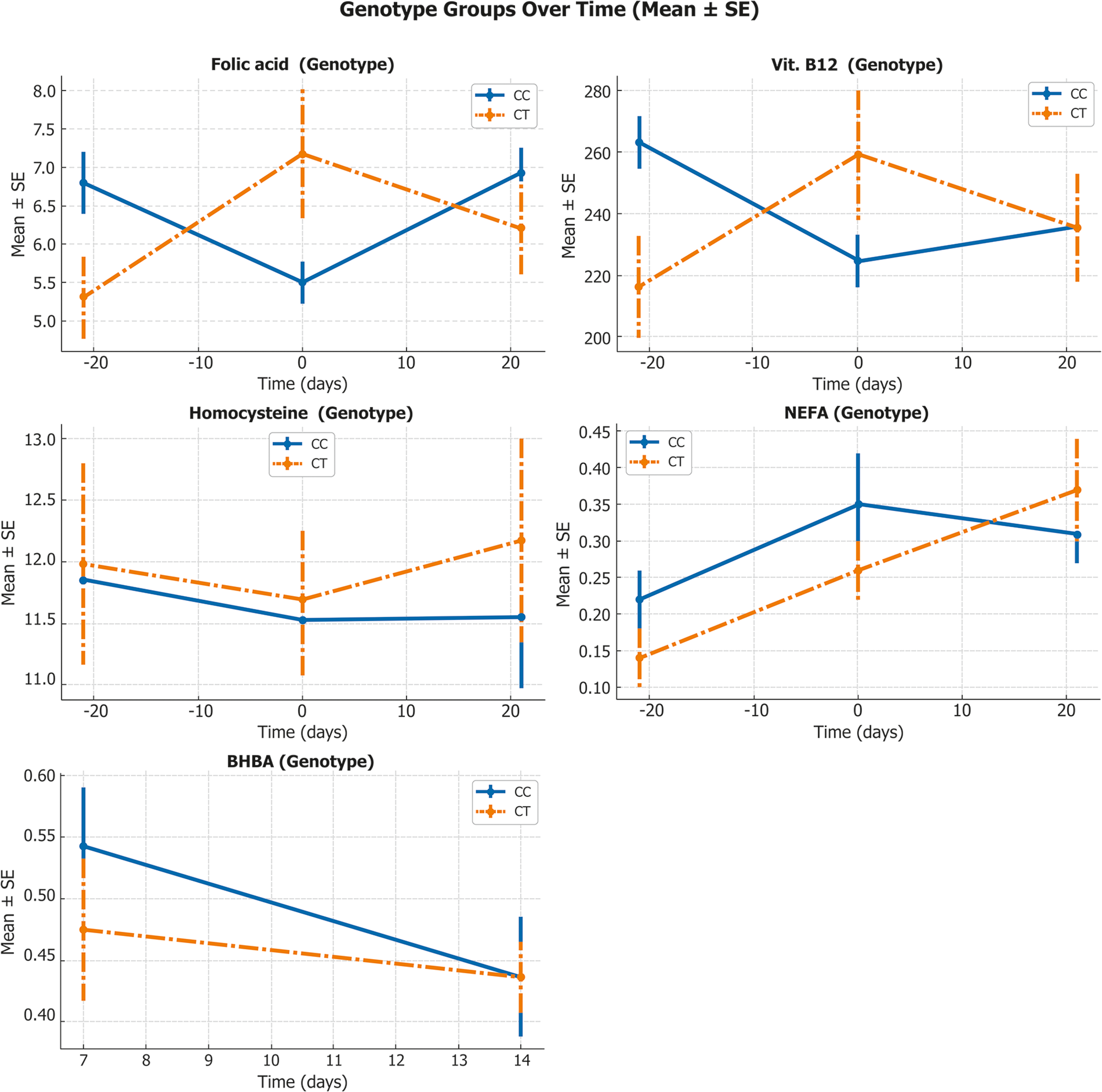
Biochemical evaluations assessed homocysteine, folic acid, vitamin B12, NEFA and BHBA concentrations in Holstein cows during the transition period (Figure 2). While time alone did not significantly affect any parameter (P > 0.05), a significant time × genotype interaction was found for folic acid and vitamin B12 (P < 0.05). No significant genotype interaction was found for homocysteine, NEFA, or BHBA. However, NEFA concentrations decreased after calving in CC cows but showed an increasing trend in CT cows.
Effects of time × genotype interaction on changes in biochemical blood parameter concentrations during the transition period.
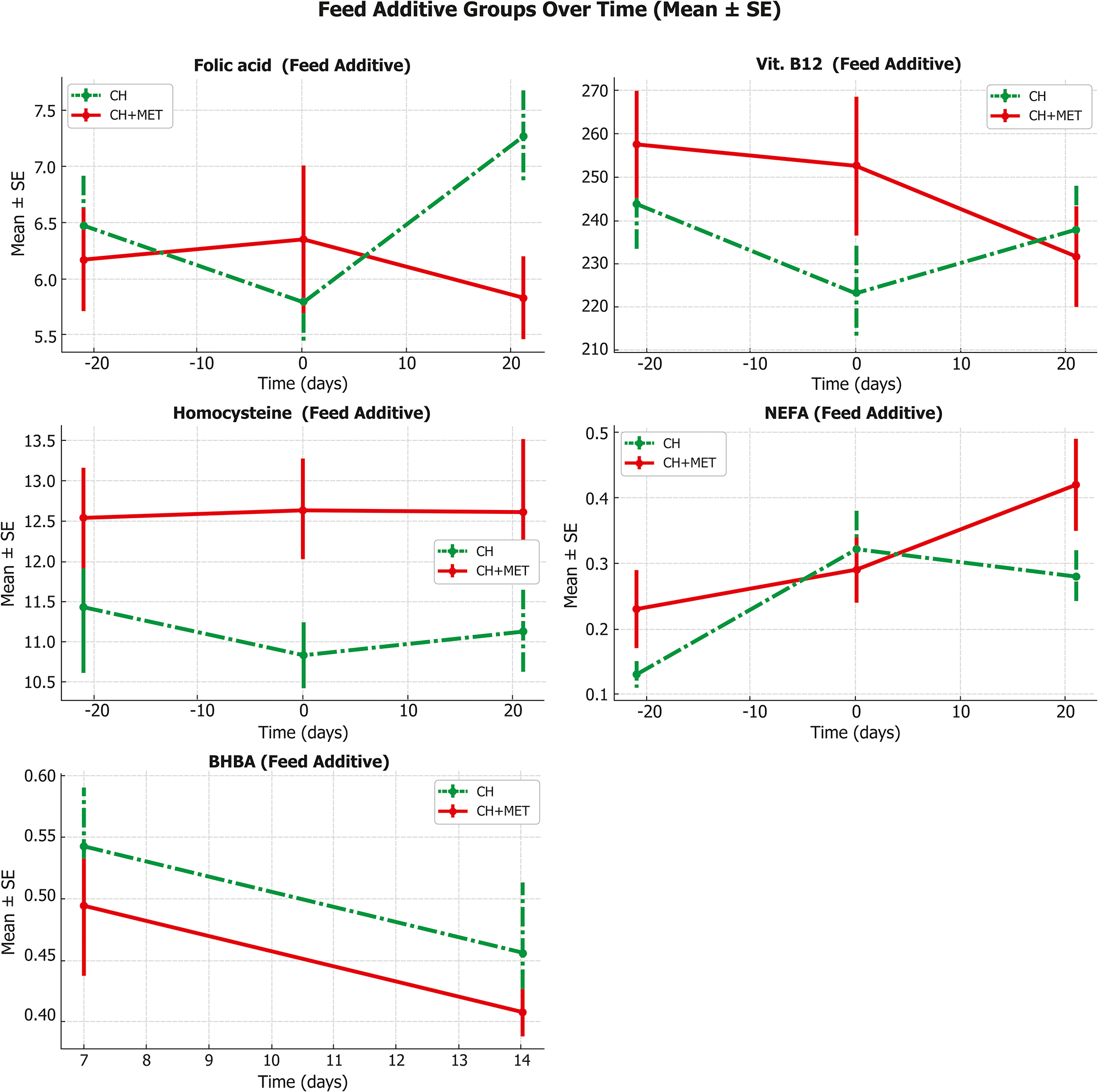
There was no significant time × supplement interaction for any biochemical parameter (P > 0.05) (Figure 3). On the day of calving, folic acid concentrations were higher in the CH + MET group compared to the CH group (P = 0.050) (Table 3). Folic acid and vitamin B12 concentrations before calving were higher in CT cows, while BHBA concentrations on day 7 postpartum were higher in CC cows (P < 0.05) (Table 3).
Effects of time × feed additive interaction on changes in biochemical blood parameter concentrations during the transition period.
Effects of genotype and feed additive groups on biochemical blood parameters during the transition period (x̄ ± Sx̄)

ns, non-significant.
Superscript letters (a, b) show the differences between group averages shown with different letters in the same column are significant (P < 0.05).
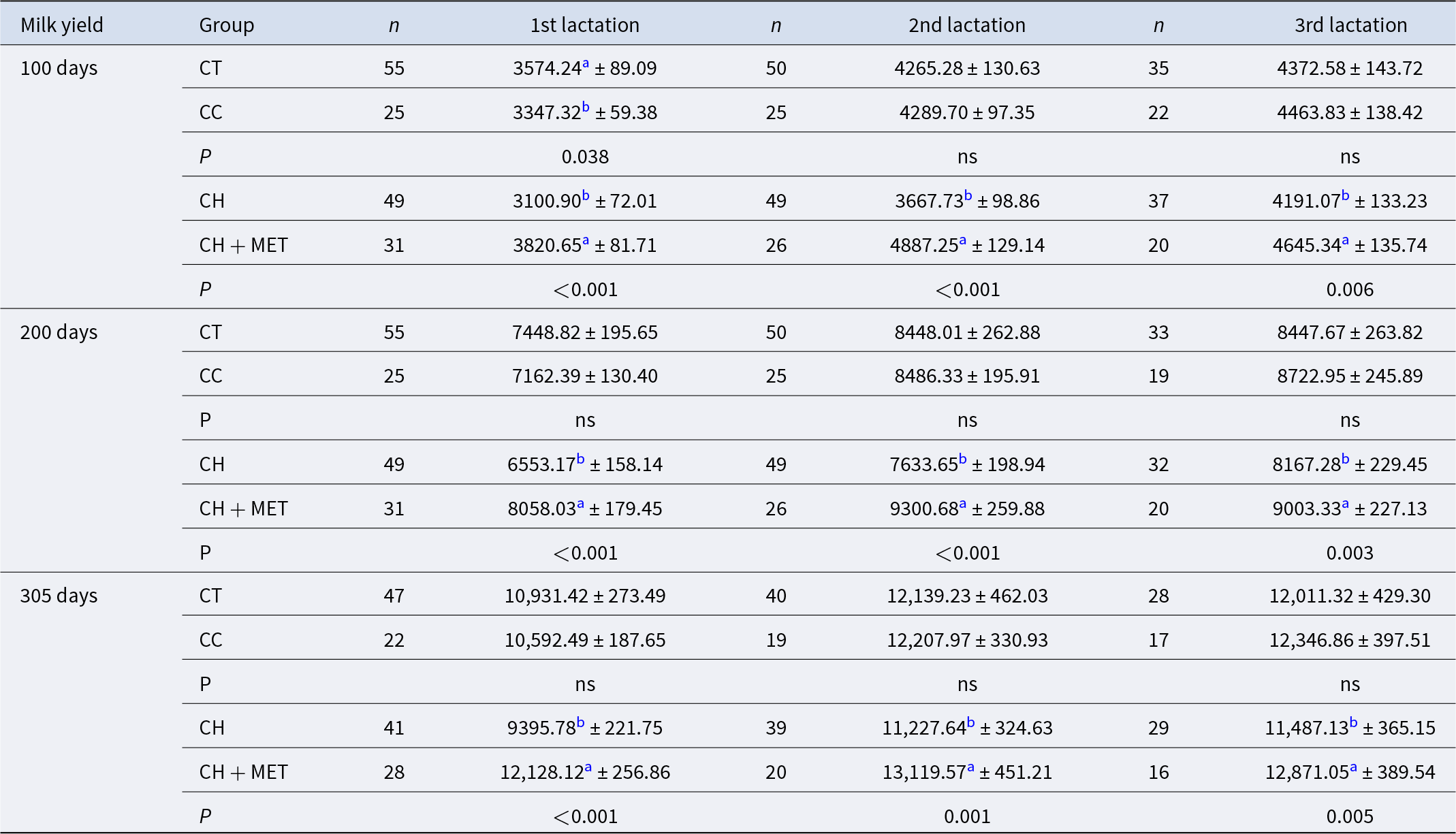
In terms of milk yield, CT cows produced significantly more milk during the first 100 days of the first lactation (P < 0.05), although no differences were observed in subsequent lactations (Table 4). The CH + MET group had consistently higher milk yields across all lactation periods compared to the CH group (P < 0.01) (Table 4).
Effects of genotype and feed additive groups on milk yield at 100, 200 and 305 days (x̄ ± Sx̄)
ns, non-significant.
Superscript letters (A, B) show the differences between group means indicated by different letters in the same column are significant (P < 0.01). Superscript letters (a, b) show the differences between group means indicated by different letters in the same column are significant (P < 0.05).
No statistically significant differences were found among genotypes regarding fertility parameters (P > 0.05) (Figure 4A). However, a near-significant difference was observed in the number of inseminations per pregnancy during the second calving period between supplement groups. Additionally, CT cows tended to calve later for the first time, with P = 0.055 (Figure 4B).
(A) Effects of genotype and feed additive groups on the number of inseminations per pregnancy. (B) Effects of genotype and feed additive groups on calving age and calving interval.

Health record analysis revealed that higher frequencies of mastitis, foot diseases, abortion, stillbirth and possible caecal dilatation were recorded in CT cows (Figure 5).
The relationship between certain health problems that cause productivity loss and MTHFR genotypes.

Discussion
This study successfully employed the Tetra-primer ARMS-PCR method to detect the MTHFR gene rs110692574 polymorphism in Holstein cattle. Sequence analysis confirmed the accuracy of the method, highlighting its reliability, cost-efficiency and ease of application. The T allele frequency was found to be 6.46% in the Turkish Holstein population, which is lower than in China (16.35%) (Song et al., Reference Song, Sun, Yang, Hua, Guo and Yang2011) and closer to values reported in Ukraine (5.70%) (Fedota et al., Reference Fedota, Skrypkina, Mitioglo, Tyzhnenko and Ruban2018). Notably, this study identified the TT genotype for the first time in Holstein cattle in Türkiye.
The homocysteine concentrations obtained in this study were found to be lower than those reported in some studies (Başbuğan et al., Reference Başbuğan, Yüksek and Altuğ2015; Kılıçkap and Kozat, Reference Kılıçkap and Kozat2017; Ardalan et al., Reference Ardalan, Batista and Titgemeyer2020; Ayvazoğlu et al., Reference Ayvazoğlu, Akyüz, Öğün, Demir and Gökçe2023), while higher than those reported in some other studies (Cannizzo et al., Reference Cannizzo, Gianesella, Casella, Giudice, Stefani, Coppola and Morgante2012; Fedota et al., Reference Fedota, Skrypkina, Mitioglo, Tyzhnenko and Ruban2018). In particular, Song et al. (Reference Song, Sun, Yang, Hua, Guo and Yang2011) reported that homocysteine concentrations in the late stage of pregnancy were 11.4 µmol/L in CC genotype animals and 19.9 µmol/L in CT genotype animals. However, data concerning homocysteine concentrations in dairy cattle is limited (Cotul et al., Reference Cotul, Cernea, Cătană and Andrei2020), and it has been noted that folic acid and vitamin B12 metabolism in ruminants may differ from that observed in other species (Girard and Matte, Reference Girard and Matte2005). This finding underscores the necessity for further research to enhance our understanding of homocysteine metabolism in dairy cattle.
In terms of folic acid concentrations, the values determined in this study (4.88–7.27 ng/mL) were below the range reported by Duplessis et al. (Reference Duplessis, Ritz, Socha and Girard2020, Reference Duplessis, Chorfi and Girard2023) (11.1–16.6 ng/mL). However, they are consistent with the values reported by Sun et al. (Reference Sun, Zou, Feng, Guo, Liu, Zhang and Wang2025). Vitamin B12 concentrations, on the other hand, are reported in a fairly wide range in the literature. Indeed, Duplessis et al. (Reference Duplessis, Chorfi and Girard2023) reported values of 238.6–268.6 pg/mL before calving and 191.7–223.0 pg/mL afterwards; İssi et al. (Reference İssi, Gül, Başbuğ and Şahin2010) reported 155.13 pg/mL and Ertaş (Reference Ertaş2015) reported 193.00 pg/mL, Kılıçkap and Kozat (Reference Kılıçkap and Kozat2017) reported 253.5 pg/mL. These differences may be due to various factors such as ration content, sampling time, physiological status and genetics.
The measured BHBA and NEFA concentrations in the study were found to be consistent with the reference ranges reported in the literature. In the context of dairy cows, the prevailing academic consensus suggests that NEFA concentrations should be maintained below 0.4 mmol/L during the dry period and below 0.7 mmol/L following calving (Duffield et al., Reference Duffield, LeBlanc, Bagg, Leslie, Ten Hag and Dick2003; LeBlanc et al., Reference LeBlanc, Lissemore, Kelton, Duffield and Leslie2006; Ospina et al., Reference Ospina, Nydam, Stokol, Overton and Lockwood2010; Kara et al., Reference Kara, Çelik and Şahin2016). For BHBA, values between 0.8 and 1.0 mmol/L indicate subclinical ketosis, while values between 1.2 and 1.4 mmol/L indicate clinical ketosis (Ospina et al., Reference Ospina, Nydam, Stokol, Overton and Lockwood2010). In summary, the findings on homocysteine, folic acid and vitamin B12 in this study suggest the necessity for further research to elucidate the physiological limits of these parameters in dairy cows and to enhance our comprehension of metabolic processes.
Research findings have revealed that the time × genotype interaction associated with the MTHFR gene rs110692574 polymorphism causes significant changes in the course of folic acid and vitamin B12 concentrations during the transition period. Differences observed in CC and CT genotype animals indicate that pre- and postnatal metabolic processes may be regulated in different ways depending on genotype. For other biochemical parameters, no significant time × genotype interactions were detected, suggesting that these variables may be influenced by a combination of nutritional, physiological and individual factors. Therefore, evaluating genotype-based feeding strategies together with a broader set of metabolic indicators may provide a more comprehensive understanding of metabolic adaptation during the transition period.
These results are consistent with previous studies indicating that MTHFR gene polymorphism may affect folate and B12 metabolism (Frosst et al., Reference Frosst, Blom, Milos, Goyette, Sheppard, Matthews and Rozen1995; Castro et al., Reference Castro, Rivera, Blom, Jakobs and Tavares de Almeida2006), and suggest that nutritional strategies during the transition period should be tailored not only to supplementation concentrations but also to genetic makeup. Research studies that have been published and which report on the effects of different gene regions, such as GH and IGF-I, on metabolic adaptation and feeding strategies also support this approach (Liu et al., Reference Liu, Stoop, Bruckmaier and Gross2021; Kerwin et al., Reference Kerwin, Burhans, Nydam and Overton2023). In a similar vein, Santos et al. (Reference Santos, Bisinotto, Ribeiro, Lima and Thatcher2011) examined the effects of metabolism and nutrition on reproductive performance during the transition period. They emphasized the importance of considering feeding management, genetic potential and metabolic adaptation together. Recent epigenetic studies also support this approach; Lesta et al. (Reference Lesta, Marín-García and Llobat2023) demonstrated that maternal diet can influence gene expression in mammary tissue, thereby causing permanent changes in milk yield and composition. Therefore, in the design of nutritional strategies during the transition period, a holistic assessment of genetic makeup, epigenetic responses and individual metabolic differences is critical for both maintaining metabolic health and fully utilizing genetic potential.
The present study ascertained that the interaction between time and feed additive exhibited no statistically significant impact on the course of the blood parameters under examination. However, subsequent analyses revealed that the feed additive groups had a significant effect on folic acid concentrations only on the day of calving and on day 21 post-calving. No statistically significant variations were observed in other parameters during the pre- and post-calving periods. These observations indicate that the metabolic response to methionine and choline supplementation during the transition period may be influenced by individual physiological or nutritional factors rather than producing uniform changes across all biomarkers. This interpretation is consistent with previous studies reporting that the effects of rumen-protected choline and methionine supplementation on metabolite profiles during the transition period are often modest or variable (Sharma and Erdman, Reference Sharma and Erdman1988; Zom et al., Reference Zom, Van Baal, Goselink, Bakker, De Veth and Van Vuuren2011). Similarly, Zhou et al. (Reference Zhou, Vailati-Riboni, Trevisi, Drackley, Luchini and Loor2016) found that methionine and choline supplementation did not elicit consistent alterations in several metabolic indicators in early-lactation dairy cows. In a similar vein, Osorio et al. (Reference Osorio, Ji, Drackley, Luchini and Loor2013) reported in their study investigating the effect of rumen-protected choline supplementation on metabolic stress indicators during the pre-calving period that choline supplementation had a limited effect on biochemical blood parameters. Arshad et al. (Reference Arshad, Yaqoob, Sattar and Ahmad2020) evaluated the effects of methionine and choline supplements on blood parameters related to energy metabolism and stated that individual variations were more dominant than the response to the supplements. Additionally, Alan and Salman (Reference Alan and Salman2019) reported that rumen-protected choline supplementation had no effect on BHBA and NEFA concentrations. There are also different studies showing that rumen-protected choline supplementation has no effect on NEFA concentrations (Hartwell et al., Reference Hartwell, Cecava and Donkin2000; Piepenbrink and Overton, Reference Piepenbrink and Overton2003; Guretzky et al., Reference Guretzky, Carlson, Garrett and Drackley2006; Zom et al., Reference Zom, Van Baal, Goselink, Bakker, De Veth and Van Vuuren2011). In this particular context, the results of our study align with the existing body of literature on the subject.
The observation that folic acid and vitamin B12 concentrations are considerably diminished in cows bearing the CT genotype during the pre-calving period indicates that this genotype may exhibit increased metabolic sensitivity and could potentially benefit from adjusted supplementation strategies. Additionally, the potential effects of methionine supplementation on folate metabolism necessitate the consideration of feed additives based on genetic structure in ration planning. The elevated BHBA concentrations detected in CC genotype animals on day 7 post-calving, as compared to the CT group, may be influenced by differences in sample size and individual metabolic variability among genotypes.
The considerably elevated milk yield exhibited by the CH + MET group across all lactation periods suggests that the concurrent utilization of rumen-protected methionine and choline may confer performance benefits. Studies by Abdelrahman (Reference Abdelrahman2009), Çetin (Reference Çetin2017), Zhou et al. (Reference Zhou, Vailati-Riboni, Trevisi, Drackley, Luchini and Loor2016) and Bilgeçli and Yılmaz (Reference Bilgeçli and Yilmaz2019) also support this finding. However, Sancanari et al. (Reference Sancanari, Paiva and Simões Neto2001) reported in their study investigating the effects of rumen-protected methionine and unprotected methionine on dairy cows that the addition of protected methionine did not increase milk yield but improved milk fat content in cows in early lactation. In a study by Huang et al. (Reference Huang, Khan, Kou, Chen, Liang, Ullah and Wang2023), both rumen-protected methionine and rumen-protected choline supplementation were reported to have positive effects on milk yield. Another study reported that rumen-protected choline supplementation improved milk production, reduced hyperketonemia and minimized hepatic lipidosis (Lima et al., Reference Lima, Sá Filho, Greco and Santos2024).
Fedota et al. (Reference Fedota, Skrypkina, Mitioglo, Tyzhnenko and Ruban2018) reported that polymorphism had significant effects on calving interval in their study. However, no relationship between polymorphism and calving interval was detected in this study. This difference is thought to stem from Fedota et al. (Reference Fedota, Skrypkina, Mitioglo, Tyzhnenko and Ruban2018) working with different cattle breeds, as the same mutation may exhibit different phenotypic effects in different breeds. In addition to biochemical findings, the higher frequency of health problems such as mastitis, foot diseases, abortion and stillbirth observed in CT genotype animals suggests a possible association between this polymorphism and health-related outcomes. The fact that abortion cases occur particularly in the late stages of pregnancy and were observed in some CT genotype cows during the transition period in our study limited the evaluation of these animals. This situation is similar to the results reported by Song et al. (Reference Song, Sun, Yang, Hua, Guo and Yang2011). Additionally, the tendency for the first calving age to occur later in the CT genotype is noteworthy. All these findings indicate that considering the MTHFR gene in future selection programs may contribute to improving herd health and production efficiency, although further validation is required.
This study highlights the role of MTHFR rs110692574 polymorphism and targeted supplementation in shaping metabolic, reproductive and productive outcomes in Holstein cows during the transition period. Individualized feeding strategies based on genotype may represent a promising approach to enhancing performance and health outcomes, offering a promising avenue for precision livestock management. Further large-scale and breed-diverse studies are warranted to validate these findings and expand their application.
Acknowledgements
The authors thank the Research Projects Coordination Unit of Balıkesir University, Türkiye, for financial support.
Funding and ethical approval
This research was supported by the Research Projects Coordination Unit of Balıkesir University, Türkiye (Project Number: 2024/059). This study was conducted with the approval of the Balıkesir University Local Animal Experiments Ethics Committee (28 April 2022; Approval No: 2022/3-3 and 27 February 2025; Approval No: 2025/2-11).
Conflict of interest
This article is based on Nazlıcan Dere's doctoral thesis. The authors declare that they have no other competing interests.
Availability of data and materials
The data used and analysed in this study are available from the corresponding author (N. Dere) on reasonable request.
Author contributions (CRediT format)
Conceptualization: N.D.; methodology: N.D. and M.G.; investigation: N.D.; data curation: N.D.; formal analysis: N.D.; visualization: N.D.; writing – original draft: N.D.; writing – review and editing: M.G.; supervision: M.G.; project administration: N.D. This article is part of the PhD thesis of N.D., supervised by M.G. All authors have read and approved the final version of the manuscript.



