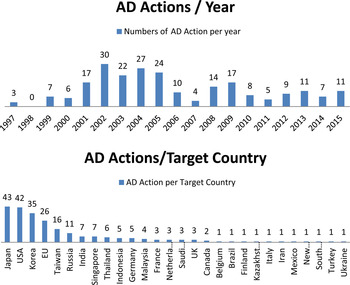
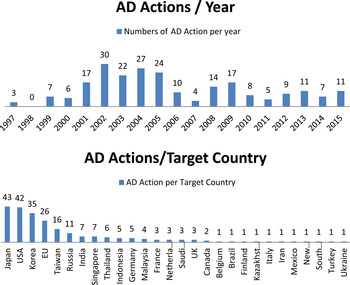
As one of the world's largest trading nations, China has been frequently involved in trade disputes concerning the use of anti-dumping measures. While dumping and anti-dumping measures are governed by the multilateral rules of the World Trade Organization (WTO), these rules have been proven to be ineffective at stopping the proliferation of unilateral anti-dumping actions.Footnote 1 Anti-dumping measures have become one of the most popular policy tools in response to protectionist pressure from domestic industries. The use of anti-dumping measures is now not limited to the traditional users (i.e. the US, the EU, Australia and Canada), but has become prevalent among new users.Footnote 2 China has become one of the top and most sophisticated users of anti-dumping actions. As shown in Figure 1, by the end of 2015 China had initiated a total of 232 anti-dumping investigations into exports from 28 countries.
China's Anti-dumping Actions
Many publications have attempted to explain China's behaviour in taking anti-dumping actions.Footnote 3 However, none of them have offered a systematic analysis of China's anti-dumping actions which have been challenged under the WTO. We undertake such an analysis by exploring not only China's behaviour in some of its most recent anti-dumping actions but also whether or not the WTO disputes have effectively led to a behaviour change by China. It is observed that the typical motivations behind China's resort to anti-dumping actions include protecting domestic import-competing industries, fostering industry development, retaliating against anti-dumping actions overseas, and safeguarding export interests. These motivations would likely outweigh China's observance of WTO obligations in the determination of whether to impose anti-dumping measures and whether to implement WTO findings unfavourable to China. Our observations have implications for China's trading partners. China has entered into 13 free trade agreements (FTA) which generally do not discipline the use of anti-dumping measures but merely incorporate the WTO rules.Footnote 4 China's use of such measures may frustrate the market opportunities that the FTAs are expected to create. Therefore, foreign governments and exporters should take steps to weaken or respond to China's anti-dumping motivations in order to avoid its anti-dumping actions.
Motivations Behind Anti-dumping Actions
Previous studies on why countries resort to anti-dumping actions have shown that they may be motivated by governments and/or industries/firms. Whether government-motivated or industry/firm-motivated, anti-dumping actions have little to do with economically harmful practices; rather, they represent blunt protectionism.Footnote 5 The protectionist effects of anti-dumping practices create incentives for import-competing industries to lobby for the use of anti-dumping measures.Footnote 6 Thus, a widely accepted motivation concerns the need for countries to use anti-dumping measures to counteract the effect of tariff reductions and resultant import surges so as to reduce foreign competition for domestic industries.Footnote 7 China's introduction of an anti-dumping regime was also influenced by the same motivation.Footnote 8 Typically, industries with high concentration would be the main users and beneficiaries of anti-dumping measures.Footnote 9 This is because, compared with industries with many producers of highly differentiated products,Footnote 10 they are much better organized to take collective actions and have higher economic incentives to do so given the larger benefits each firm could obtain from the application of anti-dumping duties. Moreover, the competing interests of downstream industries may influence anti-dumping decisions, depending on factors such as the political influence of, and the negative effects of anti-dumping protection on, these industries.Footnote 11 Finally, anti-dumping moves have often been motivated by retaliation or the threat of retaliation.Footnote 12 Retaliatory motivation is codified in Article 56 of China's Anti-dumping Regulation.Footnote 13 In practice, and in common with other users of anti-dumping actions, China's resort to anti-dumping measures may well be motivated by retaliation.Footnote 14
China's Anti-dumping Practices and WTO Disputes
By the end of 2016, China had been a respondent in 39 WTO disputes involving 26 different matters. There have been seven WTO disputes regarding China's anti-dumping actions.
Fasteners
The first WTO dispute over China's anti-dumping actions – China – Certain Iron and Steel Fasteners (“Fasteners”) Footnote 15 in 2009 – arose out of China's provisional anti-dumping measures against certain iron and steel fasteners from the EU.Footnote 16 While the EU raised many WTO consistency issues, the dispute was resolved at the consultation stage.Footnote 17
The dispute was just one in a chain of retaliatory anti-dumping and WTO actions concerning fasteners between the EU and China. China is one of the world's largest producers and exporters of fasteners.Footnote 18 The EU is one of the top destinations for China's fastener exports, and China is one of the largest export markets for fasteners originating in the EU.Footnote 19 In 2007, the EU initiated an anti-dumping investigation into fastener exports from China, resulting in an imposition of anti-dumping duties between 26.5 per cent and 85 per cent in 2009.Footnote 20 China took two actions in response. First, China initiated an anti-dumping investigation into fastener exports from the EU in 2008, which led to the imposition of the provisional anti-dumping measures challenged by the EU in Fasteners. This WTO dispute, therefore, is clearly a retaliatory action taken by the EU with the aim of forcing “China to make changes in the final decision or terminate the investigation.”Footnote 21 The dispute led to a reduction of the provisional duty from 16.8 per cent to 6.1 per cent for KAMAX-Werke Rudolf Kellermann GMBH & Co. KG (“Kamax”), the sole cooperating exporter, but a duty increase from 24.6 per cent to 26 per cent for all of the other EU exporters.Footnote 22 Apparently, the EU decided not to continue the WTO proceedings owing to the significant duty reduction for Kamax.Footnote 23 Overall, it was estimated that the duty would affect 140 million euros of EU fastener exports to China.Footnote 24 Second, China commenced WTO proceedings against the EU's anti-dumping actions in 2009, namely, the EC – Fasteners (China) dispute.Footnote 25 After losing the case, the EU implemented the WTO rulings by initiating a review of the original anti-dumping investigations, which resulted in a reduction of the original duties to a range from 22.9 per cent to 74.1 per cent.Footnote 26 In 2014, the EU initiated a sunset review of the original anti-dumping duties. A final decision was made in 2015 to maintain the duties.Footnote 27 The duties had effectively excluded Chinese fasteners from the EU market, cutting their market share from 26 per cent to 0.6 per cent.Footnote 28 In 2013, China continued the WTO proceedings by challenging the EU's compliance with the WTO rulings in EC – Fasteners (China). On 18 January 2016, the WTO Appellate Body issued its report, which found a range of WTO-inconsistencies in the EU's anti-dumping actions.Footnote 29 The WTO rulings brought an end to the seven-year long heavy anti-dumping duties against China's fastener exports.Footnote 30 In the meantime, however, China launched a sunset review of its anti-dumping duties on EU fastener exports in June 2015 and made a final decision to maintain the duties for another five years starting from 29 June 2016.Footnote 31 This decision may trigger another round of retaliatory actions.
The battle between China and the EU over fasteners involved not only retaliatory anti-dumping actions but also tit-for-tat WTO proceedings. It is unlikely that China's anti-dumping actions were taken for protectionist purposes; despite facing rising foreign competition domestically, the Chinese fastener industry remained strong and was growing at the time that it lost almost the entire EU market.Footnote 32 The high performance of the industry suggests that it was able to withstand foreign competition and was in no urgent need for protection. Rather, China's actions were likely motivated by retaliation and to demonstrate its concerns about the EU's abuse of anti-dumping duties. Given China's export interests in the EU market, the actions were apparently intended to force the EU to lower or remove the hefty anti-dumping duties. China's fastener industry is fragmented owing to the large number of domestic manufacturers. However, the industry consists of a group of major exporters and receives strong support when defending its export interests from industry associations such as the China Chamber of Commerce for Import and Export of Machinery and Electronic Products and the China Fastener Industry Association.Footnote 33 Finally, China's WTO actions also served to challenge the EU's discriminatory treatment of China as a non-market economy (NME) in anti-dumping investigations. The issues relating to NMEs are significant to China as they often lead to the imposition of higher anti-dumping duties on Chinese exports. After decades of economic reforms to promote the transformation from a planned economy to a market economy, it is also in China's interest to be recognized as a full market economy by the global community. Eventually, despite the retaliatory anti-dumping actions being ineffective, China successfully opened the EU market for its fastener exports through WTO actions. However, this success does not reduce the likelihood of the EU initiating a new investigation in response to its industry resistance to Chinese fastener exports or retaliating against China's continuous anti-dumping duties on EU fasteners.
GOES
The China – GOES Footnote 34 dispute concerned China's imposition of anti-dumping and countervailing duties on grain oriented flat-rolled electrical steel (GOES) exported from the US and Russia in 2010.Footnote 35 AK Steel Corporation and Allegheny Ludlum Corporation, the only GOES producers in the US, were respectively subject to anti-dumping duties of 7.8 per cent and 19.9 per cent, and countervailing duties of 11.7 per cent and 12 per cent. The “all other” rates were 64.8 per cent (anti-dumping) and 44.6 per cent (countervailing). The US immediately challenged the Chinese measures under the WTO.Footnote 36 China lost the case and implemented the WTO rulings by initiating a reinvestigation of the matter. This resulted in a reduction of the “all other” rates to 19.9 per cent (anti-dumping) and 3.4 per cent (countervailing) in 2013.Footnote 37 As the anti-dumping duties on the two US exporters remained unchanged, the US was unsatisfied with the result of the reinvestigation and continued the WTO proceedings in 2014 contending that China had failed to implement the WTO rulings.Footnote 38 In July 2015, the WTO compliance panel found a number of violations of China's reinvestigation decisions; however, it was unnecessary for China to implement the rulings as the duties expired in April 2015.Footnote 39
China's GOES investigation was likely motivated by retaliation against the anti-dumping and countervailing actions frequently taken by the US against China.Footnote 40 The US has long been a top user of these measures to protect its domestic steel industry, with China being the leading target. Just before China's GOES investigation, the US initiated one of its largest anti-dumping investigations against China aimed at steel line pipes.Footnote 41 This investigation became the trigger for China's tit-for-tat actions. China's choice of GOES as the target was a strategic decision, not only because the US had significant export interests in China but also because it was not hard for China to source substitute goods from other countries to satisfy the massive domestic demand.Footnote 42 Furthermore, for at least a decade, China's steel industry faced overwhelming anti-dumping and countervailing actions not only in the US but also in the EU, Australia and India. In recent years, the steel industry's economic conditions have been deteriorating owing to the slowdown of China's economic growth, weak domestic demand, and overcapacity.Footnote 43 In the face of the difficulties in both domestic and overseas markets, the industry urged the Chinese government to challenge and retaliate against anti-dumping and countervailing actions overseas and, in the meantime, implement these same measures domestically. Finally, like the EU, the US also treats China as a NME in anti-dumping investigations, and has indicated recently that the practice will continue.Footnote 44 The fact that this issue was raised by the Chinese president, Xi Jinping 习近平, during his recent visit to Washington signals that it has become one of the most sensitive issues in China's international trade policy and that China will take an increasingly firm stance against the practice.Footnote 45
X-ray equipment
The China – X-Ray Equipment Footnote 46 dispute concerned China's anti-dumping investigation into x-ray security inspection equipment exported from the EU. In January 2011, the Ministry of Commerce of the People's Republic of China (MOFCOM) decided to impose a 33.5 per cent anti-dumping duty on Smiths Heimann Gmbh (hereafter, Smiths), the only cooperating exporter, and an “all other” rate of 71.8 per cent (hereafter, referred to as the X-ray Tariff).Footnote 47 The EU initiated WTO proceedings against China in July 2011 and won the case on most of its claims in 2013. To implement the WTO rulings, China terminated the anti-dumping duty after a reinvestigation into the matter on 19 February 2014.Footnote 48
Smiths is a traditional and giant player in both the EU and the world's x-ray equipment market. For example, in 2010 it occupied 80 per cent of the EU's x-ray scanner production market,Footnote 49 and 32 per cent of the global security inspection equipment market.Footnote 50 However, a Chinese upstart, Nuctech Company Ltd, grew rapidly into a major competitor.Footnote 51 The expansion of Nuctech was supported by China's promotion of the x-ray scanner industry as part of its strategic industrial plan and national security policy.Footnote 52 Thanks to the industrial development policy, Nuctech has become not only the sole major producer in the Chinese market but also a formidable exporter, supplying over 130 countries worldwide.Footnote 53 Smiths and Nuctech have, therefore, been competing globally, including in both the EU and the Chinese markets. In 2008, while Smiths’ non-medical x-ray equipment exports to China accounted for around 57 per cent of all such exports to China, Nuctech's exports to the EU increased by around 334 per cent compared with the previous year.Footnote 54 To mitigate the impact of the Chinese imports, Smiths filed an anti-dumping petition in 2009, resulting in an imposition of an anti-dumping duty of 34 per cent in 2010.Footnote 55 Evidently, China's X-ray Tariff was motivated by retaliation. The two anti-dumping actions shared some common features. Apart from virtually the same level of dumping rate, they were both led by domestic firms with the aim of obtaining a competitive advantage over the other.Footnote 56 Beyond the common features, China's use of anti-dumping measures served its industrial development goals. Since the EU's WTO litigation lifted the Chinese anti-dumping duty, Smiths did not request a sunset review of the EU's duty, which expired in June 2015.Footnote 57
Broiler products
The China – Broiler Products Footnote 58 dispute involved another Chinese double-remedy investigation into US exports. On 27 September 2010, China imposed an anti-dumping duty ranging between 50.3 per cent and 53.4 per cent and a countervailing duty between 4 per cent and 12.5 per cent on 33 US exporters of broiler products, with the “all other” rates being 105.4 per cent (anti-dumping) and 30.3 per cent (countervailing) (hereafter, referred to as the Chicken Tariff).Footnote 59 The US commenced WTO proceedings against the Chicken Tariff in September 2011 and received favourable WTO rulings two years later. To implement the WTO rulings, China initiated a reinvestigation of the matter, with final decisions made in July 2014 to impose an anti-dumping duty ranging between 46.6 per cent and 73.8 per cent and a countervailing duty of around 4 per cent on 35 US exporters.Footnote 60 Therefore, while the countervailing duty was reduced, the anti-dumping rates were slightly increased for some of the US exporters. In 2015, the MOFCOM commenced a sunset review of the duties and a final decision was made in 2016 to extend both of the anti-dumping and countervailing duties for another five years.Footnote 61
This dispute was another escalated trade war between the US and China and originated from their dispute over Section 727 of the US Omnibus Appropriations Act 2009 which imposed a de facto ban on the importation of Chinese poultry into the US. This US measure triggered China's WTO action – the US – Poultry dispute – where the WTO tribunal found a number of violations in September 2010.Footnote 62 However, at the time of the WTO rulings, the US measure had expired so that no further action needed to be taken by the US to implement the rulings. Another US action in the same period concerned the application of safeguard measures in the form of an additional 35 per cent import tariff on certain passenger vehicle and light truck tyres exported from China (hereafter, the Tyre Tariff). China also challenged this action at the WTO but lost the case.Footnote 63 Therefore, it is likely that the Chicken Tariff was intended to target the two US measures above for at least two strategic reasons. First, while the US market absorbed one third of China's total tyre output (worth US$2.2 billion in 2008),Footnote 64 the US was the largest exporter of broiler products to China and was estimated to suffer a loss of $1 billion owing to the Chicken Tariff.Footnote 65 Coupled with another retaliatory action China took against US auto exports (which will be discussed below), the impact of the Chinese actions on the US exports was comparable to the impact of the US measure on Chinese tyres. China's actions also demonstrated its ability to undertake cross-sector retaliation and its growing sophistication in the use of trade remedies. Second, both the US tyre industry and the Chinese broiler industry were facing economic difficulties at the time.Footnote 66 Therefore, the measures implemented by the two countries against each other also served to protect the domestic industries from their largest foreign competitors. In the meantime, the measures were also intended to serve their own export interests by pushing the counterparty to remove the prohibitive tariffs. Unfortunately, other than the protectionist purpose, these objectives were not well served. While the Chicken Tariff remains in place, the US maintains high anti-dumping and countervailing duties on Chinese tyres.Footnote 67
Autos
The China – Autos (US) Footnote 68 case concerned China's imposition of an anti-dumping duty from 2 per cent to 21.5 per cent and a countervailing duty of 6.2 per cent or 12.9 per cent on certain US automobiles from 15 December 2011 to 14 December 2013 (hereafter, referred to as the Auto Tariff).Footnote 69 The US challenged the measures at the WTO in July 2012 and received favourable rulings by the panel in June 2014. Before the rulings were announced, however, the Auto Tariff had expired so there was no need for implementation.Footnote 70
The auto industry is of strategic importance to both the US and China. For example, in 2013 the US auto sector had 849,400 workers and $64.9 billion in exports, with $8.5 billion-worth going to China, “the second-largest export market for U.S. autos (after Canada).”Footnote 71 By estimation, the Auto Tariff affected $5.1 billion of US auto exports in 2013.Footnote 72 For China, the auto industry has long been regarded as one of the fundamental drivers of its economic reforms and growth and thus has received various forms of continuous policy support including high tariffs and quotas.Footnote 73 China's accession to the WTO led to significant reductions in or the removal of existing trade barriers, creating an urgent need for the government to implement other measures to protect the industry from rising foreign competition whilst at the same time promoting its exports.Footnote 74 In 2009, China became one of the world's leading auto producers (despite the global economic downturn) and continued to expand its exporting markets while the US auto industry was experiencing considerable economic difficulties.Footnote 75 China – Autos (US) was just one battle in the US–China trade war over access to markets and gaining competitive advantages for their own domestic auto manufacturers and exporters in line with their respective industrial development goals. For example, the first WTO case against China (brought by the US, the EU and Canada in 2006) concerned China's introduction of discriminatory measures to protect its auto industry right after the auto tariff cuts and removal of auto quotas pursuant to its WTO commitments.Footnote 76 In 2012, the US brought another WTO case challenging China's auto export subsidies.Footnote 77 These subsidies were not removed following the subsequent negotiations between the US and China aimed at achieving a mutually acceptable solution to the dispute.Footnote 78 This resulted in the US bringing a further WTO dispute challenging China's provision of export subsidies to the auto industry and six other industries,Footnote 79 which eventually led to China's agreement to terminate these subsidies.Footnote 80 In 2009, China initiated WTO proceedings against the United States’ Tyre Tariff mentioned above. Losing the case, China resorted to an alternative tit-for-tat measure – the Auto Tariff – as revenge for the Tyre Tariff. Thus, the series of US and Chinese actions were motivated by a mix of factors including retaliation, export interests, and industrial development policy. From a legal perspective, the China – Autos (US) dispute dealt with essentially the same substantive and procedural shortcomings of China's anti-dumping and countervailing investigations as the previous cases.Footnote 81 The fact that China continued its practice despite the previous WTO rulings against it suggests that “China has learned from the recalcitrance of other WTO members in bringing their WTO inconsistent policies into compliance.”Footnote 82 It also suggests that domestic economic and policy considerations are likely to outweigh the need to observe international obligations in China's political decision-making process.
HP-SSST
The goods subject to the China – HP-SSST Footnote 83 dispute were high-performance stainless steel seamless tubes (HP-SSST). In November 2012, the MOFCOM imposed anti-dumping duties of 9.2 per cent or 14.4 per cent on Japanese HP-SSST exports, and 9.7 per cent or 11.1 per cent on the exports from the EU.Footnote 84 Japan and the EU commenced WTO proceedings in December 2012 and June 2013, respectively. China lost the cases and terminated the duties to comply with the WTO rulings on 22 August 2016.Footnote 85
Since the dispute involved steel products, it was inevitably sensitive and strategically important to all of the parties. For China, the promotion of HP-SSST production was written into its 12th Five-Year Plan as one of the priorities in the restructuring and development of the domestic steel industry.Footnote 86 The Chinese anti-dumping action, therefore, had bearing on the industrial development policy. Furthermore, the action was also a typical reaction to the EU's frequent recourse to trade remedies against Chinese steel exports.Footnote 87 China's compliance with the WTO rulings in this case, therefore, by no means suggests that China will not use anti-dumping measures to protect its steel industry. Rather, it merely suggests that in this specific case, the value of WTO compliance outweighed the other purposes which may have been satisfied during the four years of imposition of the duties. Given the decline and over-capacity of steel industries worldwide, trade battles for markets are unlikely to cease in the near future.Footnote 88
Cellulose pulp
China – Cellulose Pulp Footnote 89 concerned China's application in April 2014 of anti-dumping duties from 16.9 per cent to 33.5 per cent (on US exporters), 13 per cent to 23.7 per cent (on Canadian exporters), and 6.8 per cent to 11.5 per cent (on Brazilian exporters) (hereafter, Pulp Tariff).Footnote 90 Six months later, Canada challenged the Pulp Tariff at the WTO. The case is currently at the WTO panel stage.
The pulp industry is one of the few Chinese industries which has been unable to meet domestic demand. China's lack of forest resources and advanced production technology has led to a shortage of high quality pulp, the demand for which has intensified owing to the rapid expansion of downstream industries such as the fibre industry and the textile industry.Footnote 91 For example, China's fibre industry is responsible for over 50 per cent of the world's fibre production.Footnote 92 In 2010, the fibre industry consumed 1.78 million tons of pulp, of which only 880,000 tons were supplied domestically.Footnote 93 Thus, China has relied heavily on imports from major producing countries to satisfy domestic needs.Footnote 94 Canada, the complainant in China – Cellulose Pulp, had almost half of its annual production of cellulose pulp exported to China in 2013, and was estimated to suffer a C$20 million (US$17.7 million) revenue loss because of the imposition of the Pulp Tariff.Footnote 95 China has committed to promoting the development of the cellulose pulp industry by, for example, listing “large-scale … paper and pulp production line and pulping equipment” as an “encouraged” project in its Catalogue for Guiding Industry Restructuring.Footnote 96 Thanks to the industrial development policy, the pulp industry has been expanding, and its production capacity increased to 1.2 million tons by 2014, “making up 17 per cent of the global total.”Footnote 97 In 2014, however, the industry was hit by an economic downturn in the fibre industry as well as by cheap imports, and suffered a huge loss.Footnote 98
Accordingly, the Pulp Tariff was inflicted essentially to mitigate the impacts of sluggish domestic demand and import surges on the local industry. The anti-dumping action also reconciles with the industry development policy by providing temporary relief for the growing pulp industry and hence fostering production and technological catch-up. However, the anti-dumping measures were detrimental to the downstream industries heavily dependent on cellulose pulp imports. For example, China's fibre industry strongly opposed the Pulp Tariff as it led to an increase in the price of pulp on the Chinese market.Footnote 99 However, the fact that the Pulp Tariff was imposed despite the detrimental impacts on the downstream industries suggests that a less concentrated industry may successfully seek anti-dumping protection even though the protection is opposed by more concentrated industries, as long as the protection serves industrial development policies advanced by the government. That the Pulp Tariff was set at relatively low rates rather than prohibitive rates, however, may reflect the government's considerations of its impacts on the downstream industries.
Concluding Remarks
The discussions above reveal a number of factors that may influence the Chinese government when it decides whether or not to impose anti-dumping actions. These factors include:
-
(1) whether an anti-dumping action supports a chosen industrial development policy which may be designed to foster the development of a new, uncompetitive or declining industry. Such policies often have more than one development goal, such as enhancing efficiency and competitiveness, bolstering output and production capacity, technological advancement, export promotion, import substitution, etc. Anti-dumping actions may be taken if the government holds the view that such actions would contribute to one or more of these goals;
-
(2) retaliation, which may be taken in response to not only the abuse of prohibitive anti-dumping, countervailing or safeguard duties by foreign countries but also discriminative treatment of China in anti-dumping investigations (for example, the NME issue) or other protectionist policy instruments (for example, the US Omnibus Appropriations Act). Furthermore, tit-for-tat anti-dumping actions may target the same or different goods as long as they are of great export interest to target countries. Retaliation may also be undertaken through WTO litigation;
-
(3) the interests of domestic import-competing industries and exporters. While an anti-dumping action affords protection to the former, a retaliatory action advances the latter's interests. The influence of industries/firms has proven important and effective in pushing for the imposition of anti-dumping duties and the taking of retaliatory actions. While industries with high concentration and strong support from industrial associations are politically influential, less concentrated industries could manage to obtain protection by way of anti-dumping duties if the other factors mentioned in (1) or (2) also support the application of the duties.
No matter which of the above motivations is behind an anti-dumping action, the action is likely to target the largest foreign competitors in order for it to be most effective. Finally, WTO rulings against an anti-dumping decision may not be effective in changing the decision in any significant way. Both the traditional and new users of anti-dumping measures have shown the ability to minimize the impact of adverse WTO rulings by simply initiating a reinvestigation or a review of the original matters. The effects of WTO rulings may also be avoided by an initiation of a de novo anti-dumping investigation into the same goods exported from the same countries. In short, like the other major users of anti-dumping practices, it is unlikely that China's behaviour would be affected by its obligation to comply with WTO rules or rulings; however, it may well succumb to the other motivations identified above. Compliance with WTO rulings in an individual case does not prevent China from using anti-dumping measures when any one of the motivations arises.
Accordingly, China's FTA partners, or potential partners, should be aware that China has become an experienced and skilful user of anti-dumping practices. Given its market potential, China's anti-dumping actions could have huge impacts on foreign exporters. For foreign exporters to reap the full benefits of an FTA with China, they should unite to form a stronger constituent and lobby against domestic protectionist actions against China so as to avoid China's retaliation. It would also be necessary to monitor the development of China's industrial policies constantly and analyse their significance for foreign businesses and the ways to react. If China initiates anti-dumping actions, WTO litigation is preferable to retaliatory anti-dumping measures, which are likely to ignite tit-for-tat actions to the detriment of exporters in all countries involved. As WTO litigation has proven inadequate to change China's anti-dumping behaviour, foreign governments should engage in negotiations with China on WTO-plus provisions on anti-dumping practices in FTAs, if doing so is also in their own interests.
Biographical note
Weihuan Zhou is a lecturer at the University of New South Wales (UNSW) Law and a member of UNSW Law's China International Business and Economic Law (CIBEL) Initiative. His research covers the laws of the WTO, trade remedies, FTAs, general international economic law, cross-border transactions and especially the two-way trade and investment between China and Australia, Chinese commercial law, China's trade and investment policies and regulations.
Shu Zhang is a post-doctoral research fellow of UNSW Law School and a member of CIBEL. Her research interests focus on law implementation and dispute resolution in trade, commerce and investment practices in the Asia-Pacific region, particularly from China's perspective.