Behavioral task: The Five Elements Kinship Identification (FEKI) task
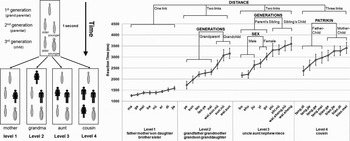
All possible kinship relationships in three generations can be represented by a schema of “kinship space” with five elements that distinguish sex, generations, distance and Relative age (Liu et al., submitted) (Fig. 1, left). The one element in the first generation represents the grandparent unit; the two elements in the second generation are siblings and represent parental units; whereas the two elements in the third generation are not siblings but corresponding offspring of the second generation, and represent child units. In the experiment, participants first saw this schema with only a prime unit (indicated by a circle outline) that was randomly presented around one of the five elements; then another schema was simultaneously shown with a prime unit and several male or female target units. The task was to orally report the kinship term representing the relationship between the prime unit and the farthest target unit (e.g., four female units in Fig. 1 left represent mother, grandmother, aunt and cousin, respectively).
Figure 1.
(Left) An illustration of the Five Elements Kinship Identification (FEKI) task. (Right) Reaction time data for 33 Chinese kin terms obtained with the FEKI task. Those constraints with significant reaction time differences were marked.
Chinese: A language with complex kin terms
Chinese has a very complicated kin term system (Kroeber Reference Kroeber1933). In Chinese, kinships are distinguished by SEX, DISTANCE, GRADE, PATRIKIN, GENERATIONS and AFFINES, resulting in 33 kinship terms in modern Mandarin Chinese without affines. This number increases dramatically with affines and marks. For example, Huang and Jia (Reference Huang and Jia2000) listed 52 Chinese kin terms with affines, whereas Chen and Shryock (Reference Chen and Shryock1932) identified a total of 270 terms with affines and marks. For decades, this complicated kinship terminology system has not received much attention from anthropologists using traditional descriptive methods. However, we argue that Chinese kinship terms provide a rich and previously untapped resource in kinship terminology studies and accordingly, in the current discussion, we use Chinese kin terms to test the filter-like OT principle.
We examined the five faithfulness constraints proposed by Jones using reaction time (RT) data obtained from 22 Chinese speakers with the FEKI task (Fig. 1, right). DISTANCE. RTs increased with four kinship levels, p<0.001, which is mostly due to the Distance difference. SEX. Sex differences were found only in level 3, between uncle terms (shu, bo, jiu) and aunt terms (gu, yi), p<0.05. PATRIKIN. Differences between Patrikin terms were found only in level 4, such that cousin terms in the father-child side with prefix “tang-” received faster RT than those in the mother-child side with prefix “biao-”, p=0.09. GENERATIONS and MARKEDNESS SCALES. We found significant effects of Generations between contrasts of Grandparents vs. Grandchild in level 2, p<0.05, and Parent's Sibling versus Sibling's Child in level 3, p<0.01. These Generation effects also intermingled with Markedness scales effect. The RTs of kin terms with marks (e.g., “wai-outside” and “nü- female” for Grandchild and Sibling's Child) were slower than those without marks (e.g., Grandparents and Parent's Sibling). GRADE. We did not find significant difference between Relative age, the only Grade constraint (see sect. 3.1 of the target article) distinguished in Chinese.
As implied by the filterlike OT principle Jones suggests, kin terms governed by different constraints (e.g., DISTANCE, GENERATION, PATRIKIN, SEX and Relative age) indeed showed different behavioral patterns, although they all are distinguished in Chinese kin terms. How do these behavioral results moderate the constraint ranking principles? We suggest that constraints that yield more RTs differences should be ranked higher than those that yield fewer differences. According to the assumption of serial filtering processes, constraints ranked higher might consume more cognitive resources than those ranked lower, resulting in different behavioral patterns for kin terms regulated by the former but similar behavioral patterns for kin terms regulated by the latter. Thus, the constraint ranking for Chinese kin terms, based on a behavioral approach, could be DISTANCE, GENERATION, PATRIKIN, SEX and GRADE. Comparing this result from behavioral approach with the one from the linguistic approach used by Jones may provide interesting insights into the underlying mechanism of why Jones' OT constraints work, and perhaps even how they work.





In the target article, Jones proposed that optimality theory (OT) is a universal principle for constructing human kinship terminology. However, his arguments focus mainly on the linguistic aspects of OT and kinship representation and relatively overlook the cognitive aspects, such as: How does the human mind process kin terms and what are the behavioral consequences of these processes? As cognitive psychologists, here we provide a discussion of the OT from a behavioral approach. Specifically, we focus on the filterlike OT constraint ranking principles Jones proposes and use an experimental design representing the kinship space to examine how the five linguistic OT constraints Jones proposes fit our behavioral data using Chinese kin terms, and how these results could modulate the constraint ranking principles.
One key feature of the OT, according to Jones, is that constraints “act as filters on randomly generated variation, with each constraint weeding out variants that violate it … each constraint strictly dominating lower ranking ones” (sect. 1; emphasis ours). From a cognitive psychology perspective, this assumption of serial filtering processes has big implications for how people access and process the meaning of kin terms at different constraint ranking levels. Because cognitive resources are always limited (Halford et al. Reference Halford, Wilson and Phillips1998), kin terms filtered by constraints ranked higher should be processed differently than those filtered by constraints ranked lower, thus resulting in different behavioral patterns for kin terms that are governed by different constraint levels. We argue that this cognitive hypothesis is an important extension of Jones' approach, allowing us to examine the cognitive mechanisms underlying linguistic OT principles.
To test this hypothesis, we proposed to (1) develop a behavioral task that can measure kinship representation; and (2) apply the task to a language with kin terms complex enough to distinguish between constraints and constraint rankings.
Behavioral task: The Five Elements Kinship Identification (FEKI) task
All possible kinship relationships in three generations can be represented by a schema of “kinship space” with five elements that distinguish sex, generations, distance and Relative age (Liu et al., submitted) (Fig. 1, left). The one element in the first generation represents the grandparent unit; the two elements in the second generation are siblings and represent parental units; whereas the two elements in the third generation are not siblings but corresponding offspring of the second generation, and represent child units. In the experiment, participants first saw this schema with only a prime unit (indicated by a circle outline) that was randomly presented around one of the five elements; then another schema was simultaneously shown with a prime unit and several male or female target units. The task was to orally report the kinship term representing the relationship between the prime unit and the farthest target unit (e.g., four female units in Fig. 1 left represent mother, grandmother, aunt and cousin, respectively).
(Left) An illustration of the Five Elements Kinship Identification (FEKI) task. (Right) Reaction time data for 33 Chinese kin terms obtained with the FEKI task. Those constraints with significant reaction time differences were marked.
Chinese: A language with complex kin terms
Chinese has a very complicated kin term system (Kroeber Reference Kroeber1933). In Chinese, kinships are distinguished by SEX, DISTANCE, GRADE, PATRIKIN, GENERATIONS and AFFINES, resulting in 33 kinship terms in modern Mandarin Chinese without affines. This number increases dramatically with affines and marks. For example, Huang and Jia (Reference Huang and Jia2000) listed 52 Chinese kin terms with affines, whereas Chen and Shryock (Reference Chen and Shryock1932) identified a total of 270 terms with affines and marks. For decades, this complicated kinship terminology system has not received much attention from anthropologists using traditional descriptive methods. However, we argue that Chinese kinship terms provide a rich and previously untapped resource in kinship terminology studies and accordingly, in the current discussion, we use Chinese kin terms to test the filter-like OT principle.
We examined the five faithfulness constraints proposed by Jones using reaction time (RT) data obtained from 22 Chinese speakers with the FEKI task (Fig. 1, right). DISTANCE. RTs increased with four kinship levels, p<0.001, which is mostly due to the Distance difference. SEX. Sex differences were found only in level 3, between uncle terms (shu, bo, jiu) and aunt terms (gu, yi), p<0.05. PATRIKIN. Differences between Patrikin terms were found only in level 4, such that cousin terms in the father-child side with prefix “tang-” received faster RT than those in the mother-child side with prefix “biao-”, p=0.09. GENERATIONS and MARKEDNESS SCALES. We found significant effects of Generations between contrasts of Grandparents vs. Grandchild in level 2, p<0.05, and Parent's Sibling versus Sibling's Child in level 3, p<0.01. These Generation effects also intermingled with Markedness scales effect. The RTs of kin terms with marks (e.g., “wai-outside” and “nü- female” for Grandchild and Sibling's Child) were slower than those without marks (e.g., Grandparents and Parent's Sibling). GRADE. We did not find significant difference between Relative age, the only Grade constraint (see sect. 3.1 of the target article) distinguished in Chinese.
As implied by the filterlike OT principle Jones suggests, kin terms governed by different constraints (e.g., DISTANCE, GENERATION, PATRIKIN, SEX and Relative age) indeed showed different behavioral patterns, although they all are distinguished in Chinese kin terms. How do these behavioral results moderate the constraint ranking principles? We suggest that constraints that yield more RTs differences should be ranked higher than those that yield fewer differences. According to the assumption of serial filtering processes, constraints ranked higher might consume more cognitive resources than those ranked lower, resulting in different behavioral patterns for kin terms regulated by the former but similar behavioral patterns for kin terms regulated by the latter. Thus, the constraint ranking for Chinese kin terms, based on a behavioral approach, could be DISTANCE, GENERATION, PATRIKIN, SEX and GRADE. Comparing this result from behavioral approach with the one from the linguistic approach used by Jones may provide interesting insights into the underlying mechanism of why Jones' OT constraints work, and perhaps even how they work.
ACKNOWLEDGMENTS
We thank Ellen Newman for comments. This work was supported by the NSF (30930031), the Ministry of Education, China (PCSIRT, IRT0710), National Key Technologies R&D Program (2009BAI77B01), and Global Research Initiative Program, NIH, USA (1R01TW007897) to Y.-J. Luo.