









1. Introduction and motivations
A measurable function f defined over an open set  $\Omega\subset\mathbb{R}^n\;(n\geq1)$ is said to have bounded mean oscillation and to belong to the space denoted by
 $BMO(\Omega)$ if the quantity
 \begin{equation}
\Vert f \Vert_{BMO} = \sup_{Q} \unicode{x2A0F}_Q {\vert f(x) - f_Q\vert} dx
\end{equation}
is finite, where the supremum is taken over all cubes  $Q \subseteq \Omega$ with sides parallel to the axes and fQ stands for the integral mean of f over Q, i.e.
 $f_Q= \unicode{x2A0F}_Q {f(x)} dx $.
The quantity (1.1) defines a seminorm as the elements of bounded mean oscillation (BMO) are identified only up to an additive constant. Hence we can consider (1.1) a norm on the quotient space modulo constants.
An equivalent definition can be given over balls, rectangles, and more generally over standard basis of shapes enjoying certain covering properties.
The normed space BMO was introduced by John and Nirenberg in 1961 [Reference John and Nirenberg6] and has a crucial relevance in harmonic analysis and partial differential equations. In fact, certain singular integral operators, which fail to be bounded from  $L_\infty$ to
 $L_\infty$, result to be bounded from
 $L_\infty$ to BMO.
Of course essentially bounded functions have BMO, and for  $f\in L^{\infty}$ it is
 $\Vert f \Vert_{BMO} \leq 2\Vert f \Vert_{L^\infty}$. On the other side, the inclusion
 $L^{\infty} \subset BMO$ is strict, and the function
 $\log \vert x \vert$ represents the standard example of unbounded function belonging to BMO.
A remarkable property of BMO, which is a Banach space once equipped with the norm (1.1), is that it is the dual of the Hardy Space  $\mathcal H^1$ [Reference Fefferman3]:
 \begin{equation*}(\mathcal H^1)^* = BMO.\end{equation*}
This duality property has been shown to be connected to the fact that BMO functions can be regarded as logarithms of weights belonging to the Muckenhoupt class  $A_\infty$ (see §2 for the definitions and the basic properties of
 $A_\infty$). Namely, we have that
 \begin{equation}
w \in A_2 \implies \log w \in BMO.
\end{equation}
An inverse implication also holds true but is less precise:
 \begin{equation}
f \in BMO \implies \exp{(\lambda f}) \in A_2
\end{equation}
for some ‘sufficiently small’ λ > 0.
Inequalities (1.2) and (1.3) hold true for any Ap class with p > 1. We point out that (1.3) does not provide any information on the size of λ.
Aim of this article is to investigate under what conditions, for a given function  $f \in BMO$, we have that
 $\exp f \in A_2$ (or, in other words, if and when we can choose λ = 1 in (1.3)). A counterexample shows that this is not true in general. In fact, the function
 $g=-\log \vert x \vert$ is a function in BMO but
 $\exp g = e^{-\log \vert x \vert} = \vert x \vert^{-1}$ does not belong to
 $A_\infty$.
The interest in this question relies on the several applications where the mapping between BMO and A 2 is used by assuming ‘λ sufficiently small’ or considering ‘functions with BMO norm sufficiently small’, without specifying what ‘sufficiently small’ precisely means. In particular in PDEs, the coefficients or the initial data are sometimes required to have small BMO norm to ensure existence or to avoid singularities of the solutions.
We point out that while (1.2) is a simple consequence of the Jensen inequality, the proofs of the inverse implication (1.3) require the fundamental property enjoyed by BMO functions which is the John–Nirenberg inequality (JN in short): There exist positive constants  $c_1, c_2$ independent on f such that
 \begin{equation}
\sup_{Q \subset \Omega} \frac 1{\vert Q \vert} \big \vert \{x \in Q : \vert f(x) - f_Q \vert \gt t \} \big \vert \leq c_1 e^{{- \frac {c_2}{\Vert f \Vert_{BMO}}\ t}}
\end{equation}
for every t > 0.
In particular, the proof of (1.3) shows that if we pick  $\lambda \lt c_2/\Vert f \Vert_{BMO}$ then λ is ‘sufficiently small’ to ensure that
 $e^{\lambda f}$ belongs to A 2.
On the other side, we observe that the JN inequality (1.4) remains true if we replace the constants with 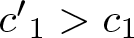 ${c^\prime}_1 \gt c_1$ and
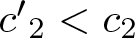 ${c^\prime}_2 \lt c_2$. Therefore, the condition
 $\lambda \lt c_2/\Vert f \Vert_{BMO}$ might provide information on the size of λ only if we consider the upper bound of the constant c 2 for which (1.4) holds true. As far as we know the sharp bounds
 $c^*_1$ and
 $c^*_2$ for the constants appearing in the JN inequality have been found only in dimension one. More precisely,
 $c^*_1 = \frac 12 e^{4/e} $ [Reference Lerner11] and
 $c^*_2 = 2/e$ [Reference Korenovskii9].
The first main result of this article answers the previous question by establishing the following characterization of the class A 2:
Theorem 1.1 (Characterization of A 2)
Let w be a weight defined on  ${\mathbb R}^n$ and set
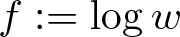 $f := \log w$. Then
 \begin{equation}
w \in A_2 \iff f \in BMO \,\text {with }\Vert f \Vert_{BMO} \lt c^*_2
\end{equation}
where
 \begin{equation*}c^*_2 = \sup \{c_2 \gt 0 : \ (1.4) \,\text{holds true for all } f \in BMO \}.\end{equation*}
In essence, theorem 1.1 shows that the natural logarithm maps A 2 into open balls of BMO of radius smaller than  $c^*_2$.
A corresponding mapping holds true if we restrict ourselves to the proper subsets  $BLO \subset BMO$ and
 $A_1 \subset A_2$. We recall that a measurable function f defined over Ω is said to have bounded lower oscillation, and we write
 $f \in BLO(\Omega)$, if the quantity
 \begin{equation}
\Vert f \Vert_{BLO} = \sup_Q (f_Q - {\mathrm{ess\,inf}}_{Q} f)
\end{equation}
is finite.
The space BLO was introduced by Coifman and Rochberg in 1980 [Reference Coifman and Rochberg1]. It comes out when we consider the action on BMO of the Hardy–Littlewood maximal operator defined by
 \begin{equation*}M f(x) = \sup_{Q\ni x} \unicode{x2A0F}_Q \vert f \vert.\end{equation*}
Namely, it results that the operator  $M : BMO \rightarrow BLO$ is bounded.
The space BLO is strictly contained in BMO but it is not a linear subspace of BMO as the classical counterexample shows:  $-\log \vert x \vert \in BLO$ but
 $\log \vert x \vert \not \in BLO$. Nevertheless, we refer to (1.6) as the BLO norm of the function f, being this ‘norm’ in fact subadditive and positive homogeneous.
From the definitions, it is easy to observe that  $BLO \, \cap\, - BLO = L_\infty$. Furthermore in [Reference Coifman and Rochberg1], Coifman and Rochberg proved that
 \begin{equation*}BMO = BLO - BLO.\end{equation*}
Corresponding relationships to (1.3) and (1.2) hold true. Indeed we have
 \begin{equation}
w \in A_1 \implies \log w \in BLO
\end{equation}
and
 \begin{equation}
f \in BLO \implies \exp{(\lambda f}) \in A_1
\end{equation}
for some λ > 0.
Therefore, the same question on the size of λ can be considered for the mapping  $A_1 \rightarrow BLO$. It is also interesting because this mapping provides a connection which ‘translates’ some properties of the BMO space into properties of the class
 $A_\infty$ and vice versa. As example, the statement
 $BMO = BLO - BLO$ is a property that can be regarded as the ‘BMO version’ of the Jones’ factorization theorem
 $A_2 = A_1/A_1$.
This strict connection is also visible via the Hardy maximal operator, by observing that the mapping  $BMO \rightarrow BLO$ is bounded as well as the mapping
 $A_\infty \rightarrow A_1$ is bounded.
Now, using the fact that the sharp bounds of the JN constants are known, it is possible to prove that in dimension one the natural logarithm maps A 1 into the unit ball of BLO. This is stated by the following theorem:
Theorem 1.2 (Characterization of A 1)
Let w be weight defined on  ${\mathbb R}$. Then
 \begin{equation}
w \in A_1 \iff \log w \in BLO \,\text {with }\Vert \log w \Vert_{BLO} \lt 1.
\end{equation}
As application we use theorem 1.1 to refine a result due to Pattakos and Volberg (see [Reference Pattakos and Volberg15]) who made the class  $A_\infty$ a metric space by introducing a distance between two elements
 $u, v \in A_\infty$ defined as follows:
 \begin{equation*}d_{A_\infty}(u,v) = \Vert \log u - \log v \Vert_{BMO}.\end{equation*}
They proved that the closed balls are complete spaces provided the radius is assumed, once again, ‘sufficiently small’. By using theorem 1.1, we can make this statement more precise by proving that the closed balls  $B_{A_\infty}(\rho)$ are Banach spaces for any
 $\rho \lt c^*_2$ (see §5).
The connection between the space BMO and the class of Muckenhoupt’s weights  $A_\infty$ has been largely investigated also in more general settings. As examples: The article by Kinnunen and Shukla studied the case of metric measure spaces under appropriate conditions (see [Reference Kinnunen and Shula8]), the article by Dafni, Gibara, and Lavigne (see [Reference Dafni, Gibara and Lavigne2]) studies these properties when BMO is defined on a measure space with appropriate covering properties, and the article by Nielsen and Sikic (see [Reference Nielsen and Šikić12]) consider the case when cubes are replaced by more general structured basis for
 ${\mathbb R}^n$ (including cubes, balls, rectangles, dyadic cubes). As future development, we consider of some interest to investigate under what conditions the results of this article could be proved also in these more general settings.
The article will proceed as follows: In §2, we provide definitions and some basic properties of  $A_\infty$ weights. In §3, we deepen the connection between BMO and A 2 in
 ${\mathbb R}^n$ and in §4 the connection between BLO and A 1 in
 ${\mathbb R}$. In §5, we briefly discuss the structure of
 $A_\infty$ as metric space. Finally, §6 contains the proofs of theorem 1.1 and theorem 1.2.
2. The Muckenhoupt class of weights  $A_\infty$

A weight function is a non-negative and locally integrable function defined on  $\Omega\subset\mathbb{R}^n$. For p > 1, we set
 \begin{equation}
[w]_{A_{p}} := \sup_{Q \subseteq \Omega} \ {\unicode{x2A0F}_Qw(x)}dx {\left( \unicode{x2A0F}_Q w^{\frac{1}{1-p}(x)}dx \right)^{p-1}}
\end{equation}
and the weight w is called a Muckenhoupt  $A_p$-weight if
 $[w]_{A_{p}} \lt \infty$.
In the limit case p = 1, we set
 \begin{equation}
[w]_{A_{1}} := \sup_{Q \subseteq \Omega} \ \unicode{x2A0F}_Q w(x)dx \ ({\mathrm{ess\,inf}}_{x\in Q} w(x))^{-1}
\end{equation}
and w is said an A1-weight if  $[w]_{A_{1}} \lt \infty$.
Similarly, in the limit case 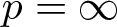 $p=\infty$, definition (2.1) becomes
 \begin{equation}
[w]_{A_{\infty}} := \sup_{Q \subseteq \Omega} \ \unicode{x2A0F}_Q w(x)dx \ \exp \left( \unicode{x2A0F}_{Q} \log \frac 1{w(x)}dx \right)
\end{equation}
and w is said an  $A_\infty$-weight if
 $[w]_{A_{\infty}} \lt \infty$.
We refer to the quantities  $[w]_{A_{p}}$,
 $[w]_{A_{1}}$, and
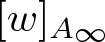 $[w]_{A_{\infty}}$, respectively, as the
 $A_p$ characteristic, the A1-characteristic, and the Hruscev
 $A_\infty$-characteristic of the weight w. The last name is due to the fact that the class
 $A_\infty$ can be also defined based on the Fujii–Wilson
 $A_{\infty}$-characteristic given by (see Hytönen and Pérez [Reference Hytönen and Pérez5]):
 \begin{equation}
(w)_{A_{\infty}} := \sup_{Q \subset \Omega} \unicode{x2A0F}_Q M(w \mathbf{1}_Q)
\end{equation}
where M stands for the usual Hardy–Littlewood maximal operator. The Hruscev characteristic  $[w]_{A_{\infty}}$ and the Fujii–Wilson characteristic
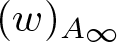 $(w)_{A_{\infty}}$ are equivalent and define the same class.
By the definitions and by an easy application of the Hölder inequality, it immediately follows that the application 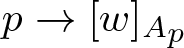 $p \rightarrow [w]_{A_{p}}$ is decreasing, i.e.
 $1 \leq [w]_{A_{\infty}} \leq [w]_{A_{p}} \leq [w]_{A_{1}}$ and it is known that it is also continuous, i.e.
 \begin{equation*}\lim_{p \rightarrow \infty} [w]_{A_{p}} = [w]_{A_{\infty}}
\ \ \ \ \ \ \ \ \ \ \ \ \lim_{p \rightarrow 1^+} [w]_{A_{p}} = [w]_{A_{1}}\end{equation*}
(see [Reference Popoli16] and the references therein).
Recall that an equivalent definition of  $A_\infty$ is given by
 \begin{equation*}A_\infty = \bigcup_{p \gt 1} A_p\end{equation*}
and if we replace the union of the Ap classes with their intersection we obtain the class
 \begin{equation*}A_{*}= \bigcap_{p \gt 1} A_p\end{equation*}
which is strictly larger than A 1. This class shows up in some interesting problems and has applications in obtaining higher integrability of local solutions in non-linear elliptic PDEs. The class was introduced in [Reference Garcia-Cuerva and Rubio de Francia4] to characterize the closure of  $L^\infty$ in BMO:
 \begin{equation*}f \in cl_{BMO}({L^\infty})\iff e^f, e^{-f} \in A_{*}.\end{equation*}
More recently, it has been proved that in dimension one it plays a role in another connection between BMO and  $A_\infty$. Namely, if we consider the inner compositions of a BMO function f with an increasing homeomorphism h, a well-known theorem of Jones [Reference Jones7] states that, for
 $f \in BMO$,
 \begin{equation*}f \circ h \in BMO \iff h' \in A_{\infty}\end{equation*}
but it also holds true that, for 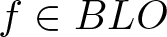 $f \in BLO$,
 \begin{equation*}f \circ h \in BLO \iff h' \in A_{*}\end{equation*}
(see [Reference Popoli17]).
The following proposition is a known characterization of A 2 which will be used in the following. We provide a little refinement of the statement and the proof for sake of completeness.
Proposition 2.1. Let f be a function in L 1 and define
 \begin{equation}
[f]_{\rm EXP} := \sup_Q \unicode{x2A0F}_Q e^{\vert f(x) - f_Q \vert} dx.
\end{equation}
Then
 \begin{equation*}e^{f} \in A_2 \iff [f]_{\rm EXP} \lt \infty\end{equation*}
and it is
 \begin{equation}
\frac 12 [f]_{\rm EXP} \leq [e^{f}]_{A_{2}} \leq [f]_{\rm EXP}^2.
\end{equation}
Proof. Assume 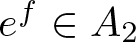 $e^f \in A_2$. We have
 \begin{equation*}
\begin{array}{ll}
\unicode{x2A0F}_Q e^{\vert f - f_Q \vert} &= \frac {1}{\vert Q \vert} \int_{\{x\in Q : f(x) \gt f_Q\}} e^{(f- f_Q)} + \frac{1}{\vert Q \vert} \int_{\{x\in Q : f(x) \leq f_Q\}} e^{(f_Q- f)}\\
&=e^{- f_Q} \frac {1}{\vert Q \vert }\int_{\{x\in Q : f(x) \gt f_Q\}} e^{f} + e^{f_Q} \frac {1}{\vert Q \vert }\int_{\{x\in Q : f(x) \leq f_Q\}} e^{- f}\\
&\leq e^{- f_Q} \unicode{x2A0F}_{Q} e^{f} + e^{f_Q} \unicode{x2A0F}_{Q} e^{- f} \leq 2 \unicode{x2A0F}_{Q} e^{f} \unicode{x2A0F}_{Q} e^{- f} \\
&\leq 2 [e^f]_{A_{2}}
\end{array}
\end{equation*}
which gives, passing to the supremum over cubes, the left-hand side of (2.6).
On the other side, assuming  $[f]_{\rm EXP} \lt \infty$, we have
 \begin{equation*}
\unicode{x2A0F}_{Q} e^{f} \unicode{x2A0F}_{Q} e^{- f} = \unicode{x2A0F}_{Q} e^{(f- f_Q)} \unicode{x2A0F}_{Q} e^{(f_Q- f)} \leq \left( \unicode{x2A0F} e^{\vert f - f_Q \vert} \right)^2 \leq [f]_{\rm EXP}^2
\end{equation*}
which provides the right-hand side of (2.6).
As consequence of this property, we have the (strict) inclusions
 \begin{equation}
L^{\infty} \subsetneq \log (A_2) \subsetneq BMO.
\end{equation}
3. The relationship between A 2 and BMO
As mentioned logarithms of A 2 weights are functions in BMO. The following proposition provides a quantitative version of this property.
Proposition 3.1. Let w be a weight defined on  ${\mathbb R}^n$. Then
 \begin{equation}
\Vert \log w \Vert_{BMO} \leq \log (2 \ [w]_{A_{2}}).
\end{equation}
Proof. Fix  $w \in A_2$ and set
 $A=\lbrack w\rbrack_{A_2}\text{ and}\ f=\log w$. By proposition 2.1, we know that
 $w \in A_2$ implies
 \begin{equation}
\unicode{x2A0F}_Q e^{\vert f - {f}_Q \vert \ } \leq 2 [w]_{A_{2}}.
\end{equation}
Applying in turn the Jensen inequality and (3.2) we obtain:
 \begin{equation}
\begin{array}{ll}
e^{\Vert \log w \Vert_{BMO}} & = \exp \left(\sup\limits_Q \unicode{x2A0F}_Q \vert f - {f}_Q \vert \ \right) \\
&= \sup\limits_Q \exp \left({\unicode{x2A0F}_Q \vert f - {f}_Q \vert \ } \right) \\
&\leq \sup\limits_Q \unicode{x2A0F}_Q \exp\left({\vert f - {f}_Q \vert \ }\right) \\
&= [f]_{\rm EXP} \leq 2 [w]_{A_{2}}.
\end{array}
\end{equation}
Remark 3.1. Proposition 3.1 can be obtained as corollary of a stronger inequality obtained by Korey in [Reference Korey10] (with a completely different proof):
 \begin{equation}
\Vert \log w \Vert_{BMO} \leq \log ({2 [w]_{A_{\infty}} })
\end{equation}
simply recalling that for any p > 1 is  $[w]_{A_{\infty}} \leq [w]_{A_{p}}$. Worth to notice that this estimate is stronger than the one found by Hytönen and Pérez in [Reference Hytönen and Pérez5]:
 \begin{equation}
\Vert \log w \Vert_{BMO} \leq \log ({2 e [w]_{A_{\infty}} }).
\end{equation}
Furthermore, it is interesting to mention that for flat weights such as  $[w]_{A_{2}} = 1 + \delta \lt 2$ the inequality (3.1) can be improved. The first result in this direction has been proved by Korey [Reference Korey10]:
 \begin{equation}
\Vert \log w \Vert_{BMO} \leq c \sqrt{\log ({[w]_{A_{\infty}} })}
\end{equation}
where c is a universal constant independent on w. The second one is due to Pattakos and Volberg [Reference Pattakos and Volberg15] who proved that for flat A 2 weights
 \begin{equation}
\Vert \log w \Vert_{BMO} \leq 2 \sqrt{[w]_{A_{2}} - 1}
\end{equation}
and both results clearly improve (3.1) in case of flat weights.
As seen, the precise embedding of A 2 weights in BMO is obtained in theorem 1.1 which can in short be restated as
 \begin{equation*}\log(A_2) = \left\{f\in BMO: \Vert f \Vert_{BMO} \lt c^*_2 \right\}.\end{equation*}
From the proof of theorem 1.1, we get two corollaries. The first one is a quantification of the known fact that functions in BMO are locally exponentially integrable.
Proposition 3.2. Let  $f\in BMO$. If
 $\lambda \in (0, c_2/\Vert f \Vert_{BMO})$ then
 \begin{equation}
[\lambda f]_{\rm EXP} \leq
1 + \frac{c_1 \lambda \Vert f \Vert_{BMO}}{c_2 - \lambda \Vert f \Vert_{BMO}}
\end{equation}
where c 1 and c 2 are the constants in the JN inequality 1.4.
Proof. By the JN inequality using the same standard argument as in (6.1), we have
 \begin{equation}
\int_Q e^{\lambda \vert f - f_Q \vert} \leq \vert Q \vert + \vert Q \vert \ c_1 \lambda \int_0^\infty e^{{\left(\lambda- \frac {c_2}{\Vert f \Vert_{BMO}}\right)\ t}}\ dt
\end{equation}
which gives
 \begin{equation*}[\lambda f]_{\rm EXP} = \sup_Q \unicode{x2A0F}_Q e^{\lambda \vert f - f_Q \vert}\leq 1 + c_1 \lambda \int_0^\infty e^{{\left(\lambda- \frac {c_2}{\Vert f \Vert_{BMO}}\right)\ t}}\ dt.\end{equation*}
Now the assumption  $\lambda \in (0, c_2/\Vert f \Vert_{BMO})$ ensures that the integral on the right-hand side converges and by a direct calculation we obtain (3.8).
Proposition 3.3. Let  $w\in A_\infty$ a weight defined on
 ${\mathbb R}^n$. Then
 $\log w \in BMO$ and
 \begin{equation}
[w]_{A_\infty} \leq 1 + \frac{c^*_1 \Vert \log w \Vert_{BMO}}{c^*_2 - \Vert \log w \Vert_{BMO}}
\end{equation}
where  $c^*_1, c^*_2$ are the sharp constants of the JN inequality.
Proof. By re-writing the condition  $A_\infty$ as follows
 \begin{equation}
[w]_{A_\infty} = \sup_Q \unicode{x2A0F}_Q w \exp {\left( \unicode{x2A0F}_Q \log \frac 1w \right)} = \sup_Q \unicode{x2A0F}_Q e^f \cdot e^{(- \log w)_Q}= \sup_Q \unicode{x2A0F}_Q e^{f - f_Q}
\end{equation}
where  $f = \log w$ we have that
 \begin{equation}
\unicode{x2A0F}_Q e^{f - f_Q } \leq \unicode{x2A0F}_Q e^{\vert f - f_Q \vert} \leq 1 + \frac{c_1 \Vert f \Vert_{BMO}}{c_2 - \Vert f \Vert_{BMO}}
\end{equation}
from which, passing to the supremum over cubes and over the infimum of the JN constants, the inequality (3.10) follows.
4. The relationships between A 1 and BLO
A first relationship between these spaces is stated by the following theorem; it can be found in [Reference Ou14] where the proof leverages the commutation property for the natural maximal operator. We give here a new simpler proof which does not require the use of commutators.
Theorem 4.1.
Let w be an  $A_{\infty}$ weight. Then
 $w \in A_1$ if and only if
 $log \ w \in BLO$ and
 \begin{equation}
e^{\Vert \log w\Vert_{BLO} } \leq [w]_{A_{1}} \leq [w]_{A_{\infty}} e^{\Vert \log w\Vert_{BLO} }.
\end{equation}
Remark 4.1. Of course the assumption  $w \in A_\infty$ is necessary only in one direction of the equivalence because
 $f \in BLO$ does not imply
 $e^f \in A_\infty$. It is redundant in the other direction as
 $w \in A_1$ trivially implies
 $ w \in A_\infty$.
Proof. The implication  $w \in A_1 \implies \log w \in BLO$ is known and follows by the Jensen inequality. We report here for completeness:
 \begin{equation}
\begin{array}{ll}
w \in A_1 & \implies \unicode{x2A0F}_Q w \leq [w]_{A_{1}} \mathop{\mathrm{ess\,inf}}\limits_Q w \\
&\implies \unicode{x2A0F}_Q e^{\log w} \leq [w]_{A_{1}} \mathop{\mathrm{ess\,inf}}\limits_Q e^{\log w} \\
&\implies e^{(\log w)_Q} \cdot e^{- {\mathrm{ess\,inf}}_ Q \log w} \leq [w]_{A_{1}} \\
&\implies e^{\Vert \log w \Vert_{BLO}} \leq [w]_{A_{1}}.
\end{array}
\end{equation}
This proves the first implication and the left-hand side of (4.1).
To prove the opposite implication assume  $f = \log w \in BLO\ \cap\ \log (A_\infty)$ and prove the right-hand side of (4.1).
Let us start by observing that the assumption  $w= e^f \in A_\infty$ can be written as a reverse Jensen inequality, i.e.
 \begin{equation*} \unicode{x2A0F}_Q w \cdot \exp \left({\unicode{x2A0F}_Q \log \frac1{w}}\right) \leq [w]_{A_{\infty}} \iff \unicode{x2A0F}_Q w \leq [w]_{A_{\infty}} e^{{\log w}_Q}.\end{equation*}
By definition, the assumption  $f \in BLO$ means
 \begin{equation*}f_Q - \mathop{\mathrm{ess\,inf}}\limits_Q f \leq \Vert f \Vert_{BLO} \end{equation*}
thus from  $f = \log w \in BLO \cap \log (A_\infty)$ follows that
 \begin{equation}
\begin{aligned}
\unicode{x2A0F}_Q e^{f} &\leq [w]_{A_{\infty}} \ e^{f_Q} \leq [w]_{A_{\infty}} \ e^{\Vert f \Vert_{BLO} + {\mathrm{ess\,inf}}_Q f}\\
&\leq [w]_{A_{\infty}} \ e^{\Vert f \Vert_{BLO}}\cdot e^{{\mathrm{ess\,inf}}_Q f} \leq [w]_{A_{\infty}} \ e^{\Vert f \Vert_{BLO}}\cdot \mathop{\mathrm{ess\,inf}}\limits_Q e^f.
\end{aligned}
\end{equation}
Hence we obtained
 \begin{equation*} \unicode{x2A0F}_Q w \leq [w]_{A_{\infty}} \ e^{\Vert \log w \Vert_{BLO}} \ \mathop{\mathrm{ess\,inf}}\limits_Q w\end{equation*}
and therefore
 \begin{equation*}[w]_{A_{1}} \leq [w]_{A_{\infty}} \ e^{\Vert \log w \Vert_{BLO}}\end{equation*}
which is the right-hand inequality of (4.1).
The next theorem establishes a sharp estimate in dimension one holding between the BMO and the BLO norms which involves the sharp constant  $c^*_2$.
Theorem 4.2.
If  $f \in BLO({\mathbb R})$ then
 \begin{equation}
\Vert f \Vert_{BMO} \leq c^*_2 \ \Vert f \Vert_{BLO}
\end{equation}
and the constant  $c^*_2 = 2/e$ is the best possible.
Proof of theorem 4.2
Fix  $f \in BLO$ and let
 $I \subset {\mathbb R}$ be an interval. We recall that, for any
 $f \in BMO$, the quantity
 \begin{equation*} \Vert f \Vert_{BMO_p} := \sup_{I} \left( \unicode{x2A0F}_I \vert f(x) - f_I \vert^p \right)^{\frac1p}
\end{equation*}
is finite for every  $p \geq 1$ and
 $\Vert \cdot \Vert_{BMO_p}$ defines a norm equivalent to
 $\Vert \cdot \Vert_{BMO}$.
When f also belongs to BLO, it can be proven that (see [Reference Osȩkowski13], theorem 1.1)
 \begin{equation}
\Vert f \Vert_{BMO_p} \leq K_p \ \Vert f \Vert_{BLO}
\end{equation}
where the optimal value of Kp for all  $p \geq 1$ is given by
 \begin{equation*}
K_p = \left(\int_{-1}^\infty \vert t \vert^p \ e^{-t - 1} \ dt \right)^{\frac 1p}.
\end{equation*}
The direct calculation of the integral shows that for p = 1 the sharp constant K 1 is equal to  $2/e$ which coincides with the sharp constant
 $c^*_2$ in the JN inequality, i.e.
 $K_1 = c^*_2 = 2/e$. Therefore, the inequality (4.5) for p = 1 becomes
 \begin{equation*}
\Vert f \Vert_{BMO} \leq \frac 2e \ \Vert f \Vert_{BLO}
\end{equation*}
where the constant is sharp in the sense that for the extremal function  $f_0 (x) = \ln \frac 1x (x \gt 0)$ we have
 \begin{equation*}\Vert f_0 \Vert_{BMO} = \frac 2e \ \ \ \ \ \ \Vert f_0 \Vert_{BLO} = 1\end{equation*}
so the constant cannot be decreased.
Theorem 4.2, at least in dimension one, helps us make the link between BLO and A 1 more precise than the one between BMO and A 2. In fact, it will be used to prove theorem 1.2, which can be in short rephrased as follows
 \begin{equation*}\log(A_1) = \left\{f\in BLO: \Vert f \Vert_{BLO} \lt 1 \right\}.\end{equation*}
It shows that the natural logarithm maps the Muckenhoupt class A 1 onto the open unit ball of BLO.
5. BMO and
$A_\infty$ as metric spaces

In [Reference Pattakos and Volberg15], Pattakos and Volberg showed that  $A_\infty$ can be equipped with a structure of metric space. We start by observing that as BMO functions can be identified only up to an additive constant, we can establish a corresponding equivalence relation in
 $A_\infty$ where functions are identified only up to a multiplicative constant. Namely for
 $u, v \in A_\infty$, we define
 \begin{equation*} u \sim v \iff \exists \ c \gt 0 : \ u = cv \ \ a.e. \end{equation*}
and, for  $p \in [1, +\infty]$, we can consider the quotient spaces
 \begin{equation*}A_p / \sim. \end{equation*}
For sake of simplicity, we will keep the same notation Ap for the quotient space. With this position, we can define a distance in  $A_\infty$ and in every Ap class. For any
 $u, v \in A_\infty$, we define
 \begin{equation*}d_{A_\infty}(u,v) = \Vert \log u - \log v \Vert_{BMO}.\end{equation*}
With these definitions, the closed unit ball of Ap of radius ρ is defined as the set of the Ap weights having distance from the constant weight 1 not greater than ρ:
 \begin{equation*}{B_{A_{p}}(\rho)} = \{w \in {A}_p : d_{A_\infty}(w, 1) \leq \rho \}.\end{equation*}
In [Reference Pattakos and Volberg15], Pattakos and Volberg showed that none of the Ap spaces can be complete, but they proved that the closed unit ball  ${B_{A_{p}}(\rho)}$ is actually complete for ‘sufficiently small’ radius ρ.
We want to make this statement more precise by using theorem 1.1 which also helps simplify the original proof. Namely, we prove the following:
Theorem 5.1.
For every  $p \in [1, +\infty]$, the closed ball
 ${B_{A_{p}}(\rho)}$ is complete in the metric space
 $(A_p, d_{A_\infty})$ whenever
 $\rho \lt c^*_2$.
Proof. Let  $(w_j)$ be a Cauchy sequence in
 ${B_{A_{p}}(\rho)}$ and set
 $f_j = \log w_j$. Hence, the sequence
 $(f_j)$ belongs to BMO and is a Cauchy sequence in BMO which is a complete space. Therefore, there exists
 $f \in BMO$ such that
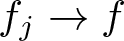 $f_j \rightarrow f$ in the BMO norm, i.e.
 \begin{equation}
\Vert f_j - f\Vert_{BMO} \rightarrow 0.
\end{equation}
Observing that 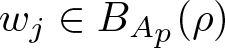 $w_j \in {B_{A_{p}}(\rho)}$ implies
 \begin{equation*}d_{A_\infty}(w_j, 1) \leq \rho \iff \Vert \log w_j - \log 1 \Vert_{BMO} \leq \rho \iff \Vert f_j \Vert_{BMO} \leq \rho\end{equation*}
by theorem 1.1 we have that  $w_j \in {B_{A_{2}}(\rho)}$. Moreover, this inequality together with (5.1) gives
 $\Vert f \Vert_{BMO} \leq \rho \lt c^*_2$. Again by theorem 1.1, we have that the weight
 $w = e^f$ belongs to
 ${B_{A_{2}}(\rho)}$ and we have that
 \begin{equation*}d_{A_\infty}(w_j, w) = \Vert \log w_j - \log w \Vert_{BMO} = \Vert f_j - f \Vert_{BMO} \rightarrow 0\end{equation*}
which shows that the arbitrary Cauchy sequence wj converges.
This completes the proof.
6. Proofs of theorems 1.1 and 1.2
Proof of theorem 1.1
Let us start by assuming  $f \in BMO$ with
 $\Vert f \Vert_{BMO} \lt c^*_2$. Pick c 2 such that
 $\Vert f \Vert_{BMO} \lt c_2 \lt c^*_2$. By the JN inequality using standard arguments, we obtain:
 \begin{equation}
\begin{array}{ll}
\int_Q e^{\vert f - f_Q \vert} &= \int_0^\infty \ \vert \{x \in Q : {e^{\vert f(x) - f_Q\vert}} \gt s \}\vert \ ds \\
&= \int_0^1 \ \vert \{x \in Q : {e^{\vert f(x) - f_Q\vert}} \gt s \}\vert \ ds\\
&\qquad+\,\int_1^\infty \ \vert \{x \in Q : {e^{\vert f(x) - f_Q\vert}} \gt s \}\vert \ ds\\
&= \vert Q \vert + \int_0^\infty e^t \ \vert \{x \in Q : {\vert f(x) - f_Q\vert} \gt t \}\vert \ dt \\
&\leq \vert Q \vert + \int_0^\infty e^t c_1 e^{- \frac {c_2}{\Vert f \Vert_{BMO}} t} \ dt \cdot \vert Q \vert \\
&= \vert Q \vert + \vert Q \vert \ c_1 \int_0^\infty e^{{\left(1- \frac {c_2}{\Vert f \Vert_{BMO}}\right)\ t}}\ dt
\end{array}
\end{equation}
where the integral in the second terms of (6.1) we made the change of variable  $s=e^t$. The assumption
 $\Vert f \Vert_{BMO} \lt c_2$ implies that the integral on the right-hand side converges and the direct calculation gives
 \begin{equation*} \unicode{x2A0F}_Q e^{\vert f - f_Q \vert} \leq
1 + \frac{c_1 \Vert f \Vert_{BMO}}{c_2 - \Vert f \Vert_{BMO}}.\end{equation*}
Passing to the supremum over cubes on the left-hand side and to the infimum over the constants on the right-hand side, we have
 \begin{equation}
[f]_{\rm EXP} \leq
1 + \frac{c^*_1 \Vert f \Vert_{BMO}}{c^*_2 - \Vert f \Vert_{BMO}} \lt \infty.
\end{equation}
Therefore, by proposition 2.1, from (6.2) and the assumption  $\Vert f \Vert_{BMO} \lt c^*_2$, it follows that
 $e^f \in A_2$.
To prove the opposite implication, let  $w \in A_2$ and set
 $f =\log w$. First we recall that
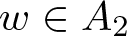 $w \in A_2$ implies
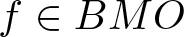 $f \in BMO$. In fact by the characterization of A 2 weights stated in proposition 2.1, we have
 \begin{equation*}\Vert f \Vert_{BMO} = \sup_Q \unicode{x2A0F}_Q \vert f(x) - f_Q \vert dx \leq \sup_Q \unicode{x2A0F}_Q e^{\vert f(x) - f_Q \vert} dx = [f]_{EXP} \lt \infty.\end{equation*}
Furthermore, by using the same standard arguments used in (6.1), for any  $\lambda \lt \frac {c_2}{\Vert f \Vert_{BMO} }$, we have that
 $e^{\lambda f} \in A_2$. Therefore, if we define
 \begin{equation*}\lambda_0(f) = \sup \{\lambda \gt 0 \ : \ e^{\lambda f} \in A_2 \}\end{equation*}
we have  $\frac {c_2}{\Vert f \Vert_{BMO} } \leq \lambda_0(f)$ and, considering that c 2 does not depend on f, passing to the supremum we have
 \begin{equation}
\frac {c^*_2}{\Vert f \Vert_{BMO} } \leq \lambda_0(f).
\end{equation}
Observe that if  $e^f \not \in A_2$ then
 $\lambda_0(f) \leq1$, thus from (6.3), it follows that
 \begin{equation*}f \in BMO \setminus \log A_2 \implies \Vert f \Vert_{BMO} \geq c_2^*.\end{equation*}
It remains to prove that
 \begin{equation}
f \in \log A_2 \implies \Vert f \Vert_{BMO} \lt c^*_2.
\end{equation}
Assume that there exists  $f \in \log A_2$ such that
 $\Vert f \Vert_{BMO} \geq c^*_2$. We consider two cases.
(i) First we consider the case when the equality
$\Vert f \Vert_{BMO} = c^*_2$ holds, i.e.
$\frac{c^*_2}{\Vert f \Vert_{BMO}} =1$. Pick σ such that
$\sigma \gt \lambda_0(f)$. As when
$f \in \log A_2$ is strictly
$\lambda_0(f) \gt 1$, clearly is σ > 1. Note that a basic property of A 2 weights gives
$e^f \in A_2 \implies e^{\frac f{\sigma}} \in A_2$ for every σ > 1. This means that
$\frac f{\sigma} \in \log A_2$ and applying (6.3) to the function
$\frac f{\sigma}$ we obtain
\begin{equation*} \sigma = \sigma \frac {c^*_2}{\Vert f \Vert_{BMO}} = \frac {c^*_2}{\Vert \frac f{\sigma} \Vert_{BMO}}\leq \lambda_0(f)\end{equation*}against the assumptions
$\sigma \gt \lambda_0(f)$. From the contradiction, we have that the equality
$\Vert f \Vert_{BMO} = c^*_2$ cannot hold true.(ii) If now assume that for some
$f \in \log A_2$,
$\Vert f \Vert_{BMO} \gt c^*_2$, for any ϵ < 1, we also have that
$\epsilon f \in \log A_2$. Hence, we can pick
$\epsilon_0 = \frac {c^*_2}{\Vert f \Vert_{BMO}} \lt 1$ so that
$\epsilon_0 f \in \log A_2$ and
$\Vert \epsilon_0 f \Vert_{BMO} = c^*_2$. But we have already seen in (i) that the equality cannot hold true.





Therefore in both cases, the assumption  $\Vert f \Vert_{BMO} \geq c^*_2$ gives a contradiction. This proves that
 $\Vert f \Vert_{BMO} \lt c^*_2$ and completes the proof.
Proof of theorem 1.2
Set  $f= \log w$ and assume first
 $\Vert f \Vert_{BLO} \lt 1$. By theorem 4.2 for any
 $f \in BLO$, we have that
 \begin{equation}
\Vert f \Vert_{BMO} \leq c^*_2 \Vert f \Vert_{BLO}
\end{equation}
so that the assumption  $\Vert f \Vert_{BLO} \lt 1$ implies
 $\Vert f \Vert_{BMO} \lt c^*_2$. Hence by theorem 1.1, we have that
 $w=e^f \in A_2 \subset A_\infty$. Finally, theorem 4.1 gives
 $w \in A_1$ with the norm control
 \begin{equation}e^{\Arrowvert f\Arrowvert_{BLO}}\leq\lbrack w\rbrack_{A_1}\leq\lbrack w\rbrack_{A_\infty}e^{\Arrowvert f\Arrowvert_{BLO}}.\end{equation}
To prove the opposite implication assume  $w \in A_1$, thus is also
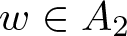 $w \in A_2$ and
 $f= \log w \in BMO$. By proposition 2.1, we have
 \begin{equation*}[f]_{\rm EXP} = \sup_Q \unicode{x2A0F}_Q e^{\vert f(x) - f_Q \vert} dx \lt \infty.\end{equation*}
Now we can estimate the constant  $[f]_{\rm EXP}$. Following the same steps as in theorem 1.1, the JN inequality gives
 \begin{equation}
\unicode{x2A0F}_Q e^{\vert f - f_Q \vert} = 1 + \ c_1 \int_0^\infty e^{{\left(1- \frac {c_2}{\Vert f \Vert_{BMO}}\right)\ t}}\ dt.
\end{equation}
By theorem 1.1, we have that  $w \in A_2 \implies \Vert f \Vert_{BMO} \lt c^*_2$. Therefore, for any c 2 such that
 $\Vert f \Vert_{BMO} \lt c_2 \lt c^*_2$, the integral converges and we have
 \begin{equation}
\unicode{x2A0F}_Q e^{\vert f - f_Q \vert} \leq 1 + \frac{c_1 \Vert f \Vert_{BMO}}{c_2 - \Vert f \Vert_{BMO}}.
\end{equation}
As c 1 and c 2 do not depend on f, passing to the sharp constant we define
 \begin{equation*}C(f) := 1 + \frac{c^*_1 \Vert f \Vert_{BMO}}{c^*_2 - \Vert f \Vert_{BMO}}\end{equation*}
and from (6.8), for every cube Q we have
 \begin{equation}
\unicode{x2A0F}_Q e^{f - f_Q } \leq \unicode{x2A0F}_Q e^{\vert f - f_Q \vert} \leq C(f).
\end{equation}
Now recall that  $w\in A_1$ implies
 $f= \log w \in BLO$ (theorem 4.1), i.e.
 \begin{equation}
\unicode{x2A0F}_Q f - {\mathrm{ess\,inf}}_Q f \leq \Vert f \Vert_{BLO}.
\end{equation}
Combining (6.9) and (6.10) follows that
 \begin{equation}
\begin{array}{ll}
\unicode{x2A0F}_Q e^{f} &\leq C(f) \ e^{f_Q} \leq C(f) \ e^{\Vert f \Vert_{BLO} + {\mathrm{ess\,inf}}_Q f} \\
& \leq C(f) \ e^{\Vert f \Vert_{BLO}}\cdot e^{{\mathrm{ess\,inf}}_Q f} \leq C(f) \ e^{\Vert f \Vert_{BLO}}\cdot \mathop{\mathrm{ess\,inf}}\limits_Q e^f
\end{array}
\end{equation}
and using the estimate  $e^{\Vert \log w \Vert_{BLO}} \leq [w]_{A_1}$ of theorem 4.1 we land to
 \begin{equation*} \unicode{x2A0F}_Q w \leq C(f) \ [w]_{A_1} \ \mathop{\mathrm{ess\,inf}}\limits_Q w.\end{equation*}
Therefore, by definition of A 1 characteristic,  $C(f) \geq 1$ which means
 \begin{equation}
\frac{c^*_1 \Vert f \Vert_{BMO}}{c^*_2 - \Vert f \Vert_{BMO}} \geq 0.
\end{equation}
Now apply again the sharp estimate (6.5) to obtain
 \begin{equation}
0 \leq \frac{c^*_1 \Vert f \Vert_{BMO}}{c^*_2 - \Vert f \Vert_{BMO}} \leq \frac{c^*_1 c^*_2 \Vert f \Vert_{BLO}}{c^*_2 - c^*_2 \Vert f \Vert_{BLO}} =\frac{c^*_1 \Vert f \Vert_{BLO}}{1 - \Vert f \Vert_{BLO}}
\end{equation}
that necessarily implies  $\Vert f \Vert_{BLO} \lt 1$. The proof is complete.
Acknowledgements
The author wishes to thank the anonymous referee for the accurate review and the valuable comments on the first version of this article.



