








1 Introduction
The twisted Alexander polynomial was first defined by Lin [Reference Lin8] for knots in
$S^3$
 and then by Wada [Reference Wada22] for finitely presentable groups. It is a generalization of the classical Alexander polynomial by using linear representations and has been very useful in low dimensional topology and knot theory. Let
$K \subset S^3$
 be a knot and
$G(K)$
 its knot group, which is the fundamental group of the knot exterior
$S^3 \setminus K$
 . Following [Reference Wada22], for a
$d$
 -dimensional linear representation
$\rho : G(K) \to \mathrm {SL}_d(\mathbb C)$
 , we can define a rational function
$\Delta ^{\rho }_{K}(t) \in \mathbb C(t)$
 up to multiplication by
$\pm t^i \, (i \in \mathbb Z)$
 . We call
$\Delta ^{\rho }_{K}(t)$
 the twisted Alexander polynomial of
$K$
 associated with
$\rho $
 . Like the classical Alexander polynomial
$\Delta _K(t)$
 , the twisted Alexander polynomial
$\Delta ^{\rho }_{K}(t)$
 contains information about the genus and fibering of
$K$
 . For example, the degree of
$\Delta ^{\rho }_{K}(t)$
 is bounded above by
$d(2g(K)-1)$
 , where
$g(K)$
 is the least genus of all Seifert surfaces bounding
$K$
 [Reference Friedl and Kim4]. In this article, we say that
$\Delta ^{\rho }_{K}(t)$
 determines the knot genus
$g(K)$
 if its degree is exactly equal to
$d(2g(K)-1)$
 . Regarding fibering, it is known that if
$K \subset S^3$
 is a fibered knot then
$\Delta ^{\rho }_{K}(t)$
 is expressed as a rational function of monic polynomials in
$t$
 [Reference Goda, Kitano and Morifuji5]. Here, a Laurent polynomial in
$t$
 is said to be monic if its leading coefficient equals
$\pm 1$
 .
We now focus on two-dimensional representations
$\rho : G(K) \to \mathrm {SL}_2(\mathbb C)$
 . Then the twisted Alexander polynomial
$\Delta ^{\rho }_{K}(t)$
 becomes a Laurent polynomial in
$t$
 if
$\rho $
 is a non-abelian
$\mathrm {SL}_2(\mathbb C)$
 -representation [Reference Kitano and Morifuji7]. When
$K \subset S^3$
 is a hyperbolic knot (namely, the knot exterior admits a complete hyperbolic metric of finite volume), up to conjugation there is a unique discrete and faithful representation
$\bar {\rho }_{0}: G(K) \to \mathrm {Isom}^+(\mathbb H^3) \cong \mathrm {PSL}_2(\mathbb C)$
 . This is called the holonomy representation corresponding to the hyperbolic structure. It lifts to a representation
$\rho _{0}: G(K) \to \mathrm {SL}_2(\mathbb C)$
 which is also discrete and faithful [Reference Thurston19]. By abuse of terminology, we also call
$\rho _{0}$
 the holonomy representation of
$K$
 . In [Reference Dunfield, Friedl and Jackson3], Dunfield et al. studied the twisted Alexander polynomial
$\Delta _{K}^{\rho _{0}}(t) \in \mathbb C[t^{\pm 1}]$
 for a hyperbolic knot
$K$
 . It is normalized as a symmetric Laurent polynomial in
$t$
 , which is denoted by
$\mathcal T_K(t)$
 and called the hyperbolic torsion polynomial of
$K$
 . Based on extensive experiments with all hyperbolic knots having at most
$15$
 crossings, they conjectured that
$\mathcal T_K(t) \in \mathbb C[t^{\pm 1}]$
 determines the knot genus
$g(K)$
 , in the sense that
$\deg \mathcal T_K(t)= 2(2g(K)-1)$
 . Moreover,
$K$
 is fibered if and only if
$\mathcal T_K(t)$
 is monic. This conjecture has been verified for some infinite families of hyperbolic knots [Reference Agol and Dunfield1, Reference Morifuji10, Reference Morifuji11, Reference Morifuji and Tran13, Reference Morifuji and Tran14, Reference Porti16].
There is another way to get a torsion polynomial by considering the twisted Alexander polynomial associated with the
$\mathrm {SL}_3(\mathbb C)$
 -representation obtained by composing the holonomy representation
$\rho _{0}: G(K) \to \mathrm {SL}_2(\mathbb C)$
 with the adjoint action, denoted by
$\mathrm {Ad}$
 , of
$\mathrm {SL}_2(\mathbb C)$
 on its Lie algebra
$\mathfrak {sl}_2(\mathbb C)$
 . In [Reference Dubois and Yamaguchi2], Dubois and Yamaguchi proved that the twisted Alexander polynomial
$\Delta _{K}^{\mathrm {Ad} \circ \rho _{0}}(t)$
 is actually a Laurent polynomial in
$t$
 . Moreover, it can be normalized as a Laurent polynomial
$\mathcal T^{\mathrm {Ad}}_K(t)$
 such that
$\mathcal T^{\mathrm {Ad}}_K(t^{-1}) = - \mathcal T^{\mathrm {Ad}}_K(t)$
 up to multiplication by
$t^i \, (i \in \mathbb Z)$
 . We call
$\mathcal T^{\mathrm {Ad}}_K(t)$
 the adjoint hyperbolic torsion polynomial of
$K$
 . Like the hyperbolic torsion polynomial
$\mathcal T_K(t)$
 , we can ask whether
$\mathcal T^{\mathrm {Ad}}_K(t)$
 determines the genus and fibering of
$K$
 or not. Note that
$\deg \mathcal T^{\mathrm {Ad}}_K(t) \le 3(2g(K)-1)$
 . In [Reference Dunfield, Friedl and Jackson3], Dunfield et al. pointed out that
$\mathcal T^{\mathrm {Ad}}_K(t)$
 does not always determine the knot genus
$g(K)$
 , in the sense that there exist hyperbolic knots
${\mathcal {K}} \subset S^3$
 such that
$\deg \mathcal T_{{\mathcal {K}}}(t) < 3(2g({\mathcal {K}})-1)$
 . However, for all hyperbolic knots with at most
$15$
 crossings, they numerically checked that
$K$
 is fibered if and only if
$\mathcal T^{\mathrm {Ad}}_K(t)$
 is monic.
In this article, we consider the adjoint hyperbolic torsion polynomial
$\mathcal T^{\mathrm {Ad}}_K(t)$
 for a two-parameter family of rational knots called double twist knots. Let
$J(k,l)$
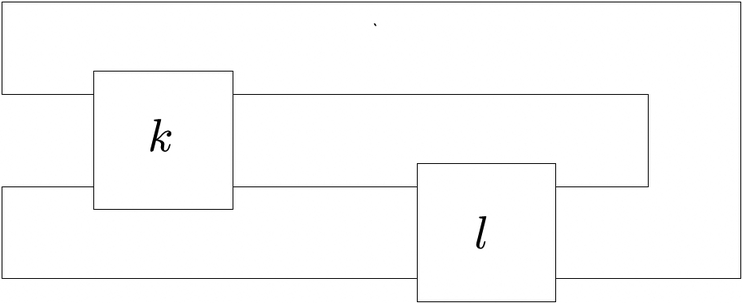
 denote the double twist knot/link indicated in Figure 1, where the integers
$k$
 and
$l$
 determine the signed number of half twists in the boxes. In the
$k$
 -box (resp.
$l$
 -box), negative (resp. positive) numbers correspond to right-handed half twists and positive (resp. negative) numbers correspond to left-handed half twists. Note that
$J(k,l)$
 is the same as the rational knot/link corresponding to the continued fraction
$-k+\frac {1}{l}$
 . It is a knot when
$kl$
 is even (and a two-component link if
$kl$
 is odd) and is the trivial knot if
$kl = 0$
 . Moreover,
$J(k,l)$
 is ambient isotopic to
$J(l,k)$
 and
$J(-k,-l)$
 is the mirror image of
$J(k, l)$
 . Therefore, up to mirror image, we will only consider double twist knots
$J(k, 2n)$
 for
$k>0$
 and
$n \not =0$
 . The knot
$J(k, 2n)$
 is hyperbolic unless it is
$J(2, -2)$
 (the trefoil knot) or
$J(1, 2n)$
 . Note that the knots
$J(2m, 2n)$
 are also known as genus one two-bridge knots and
$J(2,2n)$
 as twist knots. We will say that
$J(k, 2n)$
 is an even (resp. odd) double twist knot if
$k$
 is even (resp. odd).
The double twist knot/link
$J(k,l)$
 .

In [Reference Tran20], an explicit formula for the adjoint twisted Alexander polynomial
$\Delta _{K}^{\mathrm {Ad} \circ \rho }(t)$
 of even double twist knots
$J(2m, 2n)$
 was provided. The fact that these knots have genus one makes it possible to perform the calculations. The formula was then applied in [Reference Morifuji12, Reference Tran21] to show that the adjoint hyperbolic torsion polynomial
$\mathcal T^{\mathrm {Ad}}_K(t)$
 determines the genus and fibering of
$J(2m, 2n)$
 . The case of odd double twist knots
$J(2m+1, 2n)$
 is more challenging, since it is difficult to compute the adjoint twisted Alexander polynomial explicitly. However, by using properties of algebraic integers, we will prove that the adjoint hyperbolic torsion polynomial determines the genus and fibering of all double twist knots without knowing its explicit formula.
Theorem 1.1 Let
$K=J(k,2n)$
 be a hyperbolic double twist knot. Then the adjoint hyperbolic torsion polynomial
$\mathcal T^{\mathrm {Ad}}_K(t) \in \mathbb C[t^{\pm 1}]$
 determines the genus of
$K$
 , namely,
$\deg \mathcal T^{\mathrm {Ad}}_K(t) = 3(2g(K)-1)$
 . Moreover,
$K$
 is fibered if and only if
$\mathcal T^{\mathrm {Ad}}_K(t)$
 is monic.
We remark that a similar, but incomplete, result for the hyperbolic torsion polynomial
$\mathcal T_K(t)$
 of double twist knots was proved in [Reference Morifuji and Tran13]. More precisely, Morifuji and the author verified that
$\mathcal T_K(t)$
 determines the genus of all double twist knots, and moreover it determines the fibering of
$J(2m+1, 2n)$
 . However, it is still unknown whether
$\mathcal T_K(t)$
 determines the fibering of
$J(2m, 2n)$
 or not.
The article is organized as follows. In Section 2, we review the twisted Alexander polynomial, hyperbolic torsion conjecture, and algebraic integers. In Section 3, we first compute the Riley polynomial of double twist knots, then determine the highest and lowest degree terms of the adjoint twisted Alexander polynomial associated with the holonomy representation, and finally give a proof of Theorem 1.1.
2 Preliminaries
2.1 Twisted Alexander polynomial
Let
$K \subset S^3$
 be a knot and
$E_K= S^3 \setminus K$
 the knot exterior. Let
$G(K)=\pi _1(E_K)$
 be the knot group, which is the fundamental group of
$E_K$
 . We choose a Wirtinger presentation:

The abelianization homomorphism

is given by assigning to each generator
$x_i$
 the meridian element
$t \in H_1(E_K;\mathbb Z)$
 . Here, we denote the sum in
$\mathbb Z$
 multiplicatively.
Let
$\rho :G(K)\to \mathrm {SL}_d(\mathbb C)$
 be a
$d$
 -dimensional linear representation. The maps
$\rho $
 and
$\mathfrak {a}$
 naturally induce two ring homomorphisms
$\tilde {\rho }: {\mathbb Z}[G(K)] \rightarrow M_d(\mathbb C)$
 and
$\tilde {\mathfrak {a}}:{\mathbb Z}[G(K)]\rightarrow {\mathbb Z}[t^{\pm 1}]$
 , where
${\mathbb Z}[G(K)]$
 is the group ring of
$G(K)$
 and
$M_d(\mathbb C)$
 is the matrix algebra of degree
$d$
 over
${\mathbb C}$
 . The tensor product
$\tilde {\rho }\otimes \tilde {\mathfrak {a}}$
 defines a ring homomorphism
${\mathbb Z}[G(K)] \to M_d \left ({\mathbb C}[t^{\pm 1}]\right )$
 . Let
$F_l$
 denote the free group on the generators
$x_1,\ldots ,x_l$
 and
$\Phi :{\mathbb Z}[F_l]\to M_d\left ({\mathbb C}[t^{\pm 1}]\right )$
 the composition of the surjection
$\tilde {\phi }:{\mathbb Z}[F_l]\to {\mathbb Z}[G(K)]$
 induced by the presentation of
$G(K)$
 and the map
$\tilde {\rho }\otimes \tilde {\mathfrak {a}}:{\mathbb Z}[G(K)]\to M_d\left ({\mathbb C}[t^{\pm 1}]\right )$
 .
Let
$Q$
 denote the
$(l-1)\times l$
 matrix whose
$(i,j)$
 -entry is the
$d\times d$
 matrix
$\Phi \left (\frac {\partial r_i}{\partial x_j}\right ) \in M_d\left ({\mathbb C}[t^{\pm 1}]\right )$
 , where
$\frac {\partial }{\partial x}$
 denotes the Fox derivative. For
$1\leq j\leq l$
 , we denote by
$Q_j$
 the
$(l-1)\times (l-1)$
 matrix obtained from
$Q$
 by removing the
$j$
 -th column. We regard
$Q_j$
 as a
$d(l-1)\times d(l-1)$
 matrix with coefficients in
${\mathbb C}[t^{\pm 1}]$
 . Then Wada’s twisted Alexander polynomial [Reference Wada22] of
$K$
 associated with a representation
$\rho : G(K) \to \mathrm {SL}_d(\mathbb C)$
 is defined to be the rational function

It is well-defined up to multiplication by
$\pm t^{i}~(i\in {\mathbb Z})$
 .
Now, we focus on two-dimensional linear representations of knot groups. It is known that if
$\rho :G(K)\to \mathrm {SL}_2(\mathbb C)$
 is a non-abelian representation, the rational function
$\Delta _{K}^{\rho }(t)$
 becomes a Laurent polynomial in
$t$
 [Reference Kitano and Morifuji7, Theorem 3.1].
Let
$\mathrm {sl}_2(\mathbb C)$
 be the Lie algebra of
$2 \times 2$
 complex matrices with trace zero. The adjoint action, denoted by
$\mathrm {Ad}$
 , is the conjugation on
$\mathrm {sl}_2(\mathbb C)$
 by
$\mathrm {SL}_2(\mathbb C)$
 , that is,
$\mathrm {Ad}(V)(g)=VgV^{-1} \in \mathrm {sl}_2(\mathbb C)$
 for all
$V \in \mathrm {SL}_2(\mathbb C)$
 and
$g \in \mathrm {sl}_2(\mathbb C)$
 . For each representation
$\rho : G(K) \to \mathrm {SL}_2(\mathbb C)$
 , the composition
$\mathrm {Ad} \circ \rho $
 is a representation of
$G(K)$
 into
$\mathrm {SL}_3(\mathbb C)$
 and thus we can define a rational function
$\Delta _K^{\mathrm {Ad} \circ \rho } (t)$
 called the adjoint twisted Alexander polynomial of
$K$
 .
2.2 Hyperbolic torsion conjecture
For a hyperbolic knot
$K$
 in
$S^3$
 , recall that
$\rho _{0}: G(K) \to \mathrm {SL}_2(\mathbb C)$
 is a lift of the holonomy representation
$\bar {\rho }_{0}: G(K) \to \mathrm {PSL}_2(\mathbb C)$
 corresponding to the hyperbolic structure of the knot exterior. The representation
$\rho _{0}$
 is known to be discrete and faithful [Reference Thurston19]. In [Reference Dunfield, Friedl and Jackson3], Dunfield et al. studied the hyperbolic torsion polynomial
$\mathcal T_K(t)$
 which is a normalization of the twisted Alexander polynomial
$\Delta _{K}^{\rho _{0}}(t) \in \mathbb C[t^{\pm 1}]$
 such that
$\mathcal T_K(t) = \mathcal T_K(t^{-1})$
 . Based on many numerical computations, they conjectured that
$\mathcal T_K(t) \in \mathbb C[t^{\pm 1}]$
 determines the knot genus
$g(K)$
 , namely,
$\deg \mathcal T_K(t)= 2(2g(K)-1)$
 . Moreover,
$K$
 is fibered if and only if
$\mathcal T_K(t)$
 is monic. This conjecture has been verified for some families of hyperbolic knots [Reference Agol and Dunfield1, Reference Morifuji10, Reference Morifuji11, Reference Morifuji and Tran13, Reference Morifuji and Tran14, Reference Porti16].
On the other hand, we can also study the adjoint twisted Alexander polynomial associated with the holonomy representation. In [Reference Dubois and Yamaguchi2], Dubois and Yamaguchi proved that the twisted Alexander polynomial
$\Delta _{K}^{\mathrm {Ad} \circ \rho _{0}}(t)$
 is actually a Laurent polynomial in
$t$
 . The adjoint hyperbolic torsion polynomial
$\mathcal T^{\mathrm {Ad}}_K(t) \in \mathbb C[t^{\pm 1}]$
 is a normalization of
$\Delta _{K}^{\mathrm {Ad} \circ \rho _{0}}(t)$
 such that
$\mathcal T^{\mathrm {Ad}}_K(t^{-1}) = - \mathcal T^{\mathrm {Ad}}_K(t)$
 up to multiplication by
$t^i \, (i \in \mathbb Z)$
 . In [Reference Dunfield, Friedl and Jackson3], Dunfield et al. remarked that
$\mathcal T^{\mathrm {Ad}}_K(t)$
 does not always determine the knot genus. However, for all hyperbolic knots having at most
$15$
 crossings, they numerically checked that
$K$
 is fibered if and only if
$\mathcal T^{\mathrm {Ad}}_K(t)$
 is monic. In [Reference Morifuji12, Reference Tran21], by using an explicit formula for the adjoint twisted Alexander polynomial
$\Delta _{K}^{\mathrm {Ad} \circ \rho }(t)$
 from [Reference Tran20], Morifuji and the author proved that the adjoint hyperbolic torsion polynomial determines the genus and fibering of genus one two-bridge knots.
2.3 Algebraic integers
An algebraic integer is a complex number which is a root of some monic polynomial whose coefficients are integers. It is easily checked that the set of all algebraic integers, denoted by
$\mathbb A$
 , is closed under addition and multiplication. Hence,
$\mathbb A$
 is a commutative subring of
$\mathbb C$
 . We will show the following.
Proposition 2.1 Suppose
$P(t) = c_q t^q + \cdots + c_ 1 t + c_0 \in \mathbb Z[t]$
 is a non-constant polynomial, and there exists a prime number
$p$
 such that
$p \nmid c_0$
 and
$p \mid c_1, \ldots , c_q$
 . Then none of the roots of
$P[t]$
 are algebraic integers.
Proof The proof is similar to that of Eisenstein’s irreducibility criterion.
Suppose
$t_0$
 is a root of
$P(t)$
 . Let
$R(t)$
 be the minimal polynomial of
$t_0$
 over
$\mathbb Z$
 . Write
$R(t) = a_r t^r + \cdots + a_1 t + a_0 \in \mathbb Z[t]$
 . We claim that
$p \mid a_r$
 .
Note that
$R \mid P$
 . If
$\deg R = \deg P$
 , then
$P= d R$
 for some
$d \in \mathbb Z$
 . Since
$p \nmid c_0= da_0$
 , we have
$p \nmid d$
 . Then
$p \mid c_q = da_r$
 implies that
$p \mid a_r$
 .
Suppose
$\deg R < \deg P$
 then
$P(t) = R(t) S(t)$
 for some non-constant polynomial
$S(t) \in \mathbb Z[t]$
 . Write
$S(t) = b_s t^s + \cdots + b_1 t + b_0$
 . Note that
$p \nmid c_0=a_0 b_0$
 . Let
$i \le r$
 be the largest integer such that
$p \nmid a_i$
 , and
$j \le s$
 the largest integer such that
$p \nmid b_j$
 . Consider

If
$u>i$
 then
$p \mid a_u$
 . If
$u<i$
 then
$v=i+j-u>j$
 and so
$p \mid b_v$
 . This implies that
$p \mid a_u b_v$
 if
$u \not = i$
 . Hence,

Since
$p \nmid a_ib_j$
 , we obtain
$p \nmid c_{i+j}$
 . This only occurs when
$i+j=0$
 , namely,
${i=j=0}$
 . Hence,
$p \mid a_u$
 for all
$1 \le u \le r$
 . In particular,
$p \mid a_r$
 . This implies that
$a_r \not = \pm 1$
 and therefore
$t_0$
 cannot be an algebraic integer.
Corollary 2.2 Let
$P(t) \in \mathbb Z[t]$
 be a non-constant polynomial. Suppose
$q$
 and
$r$
 are co-prime integers such that
$|q| \ge 2$
 . Then none of the roots of
$Q(t):=q P(t)+r$
 are algebraic integers.
Proof Let
$p$
 be any prime factor of
$q$
 . Then all coefficients of
$q P(t)$
 are divisible by
$p$
 . Since
$r$
 is co-prime with
$q$
 , it is not divisible by
$p$
 . Hence, all coefficients, except the constant coefficient, of
$Q(t) = q P(t)+r$
 are divisible by
$p$
 . Then, by Proposition 2.1, none of the roots of
$Q(t)$
 are algebraic integers.
3 Double twist knots
In this section, we first compute the Riley polynomial of double twist knots, then determine the highest and lowest degree terms of the adjoint twisted Alexander polynomial associated with the holonomy representation, and finally give a proof of Theorem 1.1.
It is known that
${\mathcal {K}} := J(k, 2n)$
 , where
$k \ge 1$
 and
$n \not = 0$
 , is fibered if and only if
-
• ${\mathcal {K}}=J(1,2n)$
 ;
-
• ${\mathcal {K}}=J(2, \pm 2)$
(the trefoil knot and figure eight knot, respectively); -
• ${\mathcal {K}}=J(3,2n)$
for
$n \ge 1$
.


Moreover, its genus is given by

This can be proved by computing the Alexander polynomial and applying the fact that an alternating knot is fibered if and only if its Alexander polynomial is monic, that is, with leading coefficient
$\pm 1$
 . Moreover, the degree of the Alexander polynomial of an alternating knot is equal to twice the knot genus. Note that double twist knots are two-bridge knots which are alternating (see [Reference Macasieb, Petersen and van Luijk9, Lemma 7.3] and references therein).
By [Reference Hoste and Shanahan6], the knot group is
$G({\mathcal {K}})= \langle a, b \mid w^n a = bw^n \rangle $
 , where

3.1 The Riley polynomial
A representation
$\rho : G({\mathcal {K}}) \to \mathrm {SL}_2(\mathbb C)$
 is called non-abelian if its image
$\rho (G({\mathcal {K}}))$
 is a non-abelian subgroup of
$\mathrm {SL}_2(\mathbb C)$
 . Taking conjugation if necessary, we can assume that
$\rho $
 has the form

where
$(M, y) \in \mathbb C^2$
 satisfies
$\rho (w^n a) = \rho (bw^n)$
 . Note that
$y = {\mathrm {tr}} \rho (ab^{-1})$
 . By [Reference Riley18], the matrix equation
$\rho (w^n a) = \rho (bw^n)$
 is equivalent to a single polynomial equation
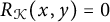
$R_{\mathcal {K}}(x,y)=0$
 , where
$x := {\mathrm {tr}} \rho (a) = {\mathrm {tr}} \rho (b) = M+M^{-1}$
 and
$R_{\mathcal {K}}(x, y):=\rho (w^n)_{11} + (M^{-1} - M) \rho (w^n)_{12} \in \mathbb {C}[x, y]$
 is the Riley polynomial of the two-bridge knot
${\mathcal {K}}$
 . Here,
$\rho (w^n)_{ij}$
 is the
$ij$
 -th entry of the matrix
$\rho (w^n)$
 .
To determine the Riley polynomial of
${\mathcal {K}} = J(k,2n)$
 , we first compute
$\rho (w)$
 via Chebyshev polynomials. Let
$S_l(v), \, l \in \mathbb Z,$
 be the Chebyshev polynomials of the second kind defined by
$S_0(v)=1$
 ,
$S_1(v)=v$
 , and
$S_{l}(v) = v S_{l-1}(v) - S_{l-2}(v)$
 for all integers
$l$
 .
The following properties of
$S_l(v)$
 ’s are well-known (see, e.g., [Reference Morifuji and Tran14]).
Lemma 3.1
$(1)$
 If
$v = a + a^{-1} \not = \pm 2$
 then
$S_l(v) = (a^{l+1} - a^{-l-1})/(a-a^{-1})$
 . Moreover,
$S_l( \pm 2)=(\pm 1)^l (l+1)$
 .
$(2)\, S_{-l}(v) = - S_{l-2}(v)$
 .
$(3)$
 For
$l \ge 1$
 , we have
$S_l(v) = \prod _{j=1}^l ( v - 2\cos \frac {j\pi }{l+1})$
 and
$S_l(v) - S_{l-1}(v) = \prod _{j=1}^l ( v - 2\cos \frac {(2j-1)\pi }{2l+1})$
 . In particular, all the roots of
$S_l(v)$
 and
$S_l(v) - S_{l-1}(v)$
 are real numbers in the interval
$(-2,2)$
 .
$(4)\, S^2_l(v) - v S_l(v) S_{l-1}(v) + S^2_{l-1}(v) = 1$
 .
We will also use the following result whose proof is based on the Cayley–Hamilton theorem
$V^2 = ({\mathrm {tr}} V) V - ( \det V)I$
 for
$2 \times 2$
 matrices
$V \in M_2(\mathbb C)$
 , where
$I$
 denotes the identity
$2 \times 2$
 matrix (see, e.g., [Reference Morifuji and Tran13]).
Lemma 3.2 Let
$V \in \mathrm {SL}_2(\mathbb C)$
 and
$v={\mathrm {tr}} V$
 . Then

for any integer
$l$
 .
Then the matrix
$\rho (w)$
 can be computed explicitly as follows.
Proposition 3.3
$(1)$
 If
$k=2m$
 , then

$(2)$
 If
$k=2m+1$
 , then

Proof
$(1)$
 If
$k=2m$
 , then
$w = (ba^{-1})^m(b^{-1}a)^m$
 . Since
${\mathrm {tr}} \rho (ba^{-1}) = {\mathrm {tr}} \rho (b^{-1}a) = y$
 , by Lemma 3.2, we have

By Lemma 3.1, we have
$S^2_m(y) - y S_m(y) S_{m-1}(y) + S^2_{m-1}(y) = 1$
 . Hence,

$(2)$
 If
$k=2m+1$
 , then
$w = (ba^{-1})^mba(b^{-1}a)^m$
 . Hence,

The lemma follows by using the matrix forms of
$\rho (a)$
 and
$\rho (b)$
 in (3.1).
Let
$z: = {\mathrm {tr}} \rho (w) = \rho (w)_{11} + \rho (w)_{22}$
 . By taking the trace of
$\rho (w)$
 in Proposition 3.3 and noting that
$M^2+M^{-2} = x^2-2$
 , we obtain

We can now compute the Riley polynomial
$R_{\mathcal {K}}(x,y) = \rho (w^n)_{11} + (M^{-1} - M)\rho (w^n)_{12}$
 . By Lemma 3.2, we have
$\rho (w^n) = S_{n-1}(z) \rho (w) - S_{n-2}(z) I$
 . Hence, we can write
$R_{\mathcal {K}} = t S_{n-1}(z) - S_{n-2}(z)$
 , where
$t = \rho (w)_{11} + (M^{-1} - M) \rho (w)_{12}$
 .
If
$k=2m$
 , then by Proposition 3.3, we have

If
$k=2m+1$
 , then it follows from Proposition 3.3 that

Hence,
$R_{\mathcal {K}}(x,y) = t S_{n-1}(z) - S_{n-2}(z)$
 , where

See [Reference Macasieb, Petersen and van Luijk9, Reference Morifuji and Tran13] for other ways to obtain (3.2) and (3.3).
Proposition 3.4 For
${\mathcal {K}} = J(k, 2n)$
 , the following holds:
$(1)$
 If
$k=2m$
 , then
$S_m(y)S_{n-1}(z) \not = 0$
 for any non-abelian
$\mathrm {SL}_2(\mathbb C)$
 -representation.
$(2)$
 If
$k=2m+1 \ge 3$
 , then
$S_m(y)S_{m-1}(y) \not = 0$
 for the holonomy representation
$\rho _0$
 .
Proof
$(1)$
 Suppose
$k=2m$
 . If
$S_{m-1}(y)=0$
 , then by (3.2) and (3.3), we have
$z=2$
 and
$t=1$
 . Hence,
$R_{\mathcal {K}}(x,y) = t S_{n-1}(z) - S_{n-2}(z) = S_{n-1}(2) - S_{n-2}(2) = n-(n-1) =1 \not = 0$
 .
If
$S_{n-1}(z)=0$
 , then
$S^2_{n-1}(z) - z S_{n-1}(z) S_{n-2}(z) + S^2_{n-2}(z)=1$
 (by Lemma 3.1) implies that
$S^2_{n-2}(z) = 1$
 . Thus,
$R_{\mathcal {K}}(x,y) = t S_{n-1}(z) - S_{n-2}(z) = - S_{n-2}(z) = \pm 1 \not = 0$
 .
Since
$R_{\mathcal {K}}(x,y)=0$
 for non-abelian
$\mathrm {SL}_2(\mathbb C)$
 -representations, we get
$S_m(y) S_{n-1}(z) \not = 0$
 .
$(2)$
 Suppose
$k=2m+1$
 . For the holonomy representation
$\rho _0$
 , we have
$x^2=4$
 .
If
$S_{m-1}(y)=0$
 , then by Lemma 3.1,
$y \in (-2, 2)$
 . Moreover,
$S^2_{m}(y) - y S_{m}(y) S_{m-1}(y) + S^2_{m-1}(y)=1$
 implies that
$S_m(y)= \pm 1$
 . By (3.2) and (3.3), we have
${z = 2- (y-2) = 4-y \in (2, \infty )}$
 and
$t=1$
 . Hence,
$R_{\mathcal {K}}(x,y) = t S_{n-1}(z) - S_{n-2}(z) =S_{n-1}(z)-S_{n-2} (z)$
 .
If
$n=1$
 , then
$R_{\mathcal {K}}(x,y)=1$
 . If
$n \ge 2$
 , then since
$z \in (2, \infty )$
 Lemma 3.1(3) implies that
$R_{\mathcal {K}}(x,y) =S_{n-1}(z)-S_{n-2} (z) \not = 0$
 . Similarly, if
$n \le -1$
 , then since
$S_{-k}(z) = - S_{k-2}(z)$
 we have
$R_{\mathcal {K}}(x,y) =-S_{|n|-1}(z) + S_{|n|} (z) \not = 0$
 .
If
$S_m(y)=0$
 , then by Lemma 3.1,
$y \in (-2, 2)$
 . Moreover,
$S^2_{m}(y) - y S_{m}(y) S_{m-1}(y) + S^2_{m-1}(y)=1$
 implies that
$S_{m-1}(y)= \pm 1$
 . By (3.2) and (3.3), we have
$z=2- (y-2)= 4-y$
 and
$t=1-(y-2)=3-y$
 . Hence,
$t = z-1$
 and

As in the previous case, since
$z \in (2, \infty )$
 , we have
$R_{\mathcal {K}}(x,y) \not =0$
 . This contradicts the fact that
$R_{\mathcal {K}}(x,y)=0$
 for non-abelian
$\mathrm {SL}_2(\mathbb C)$
 -representations. Therefore,
$S_m(y)S_{m-1}(y) \not = 0$
 for the holonomy representation
$\rho _0$
 .
3.2 The twisted Alexander polynomial
Recall that the knot group of
${\mathcal {K}} = J(k, 2n)$
 is
$G({\mathcal {K}})= \langle a, b \mid w^n a = bw^n \rangle $
 , where

Let
$r = w^naw^{-n}b^{-1}$
 . Then the adjoint twisted Alexander polynomial is given by
$\Delta ^{\mathrm {Ad} \circ \rho }_{\mathcal {K}}(t) = \det \Phi \left ( \frac {\partial r}{\partial a} \right ) \big /\det \Phi (1-b)$
 .
For
$l \ge 0$
 , we let
$\sigma _l(u) = \sum _{i=0}^l u^i$
 . We have

We now compute
$\frac {\partial w}{\partial a}$
 . If
$k=2m$
 , then
$w =(ba^{-1})^m(b^{-1}a)^m$
 and

If
$k=2m+1 \ge 3$
 , then
$w = (ba^{-1})^mb(ab^{-1})^m a$
 and

If
$k=1$
 , then
$w=ba$
 and
$\frac {\partial w}{\partial a} = b$
 . Hence,

Recall that the adjoint action
$\mathrm {Ad}$
 is the conjugation on
$\mathrm {sl}_2(\mathbb C)$
 by
$\mathrm {SL}_2(\mathbb C)$
 , that is,
$\mathrm {Ad}(V)(g)=VgV^{-1} \in \mathrm {sl}_2(\mathbb C)$
 for all
$V \in \mathrm {SL}_2(\mathbb C)$
 and
$g \in \mathrm {sl}_2(\mathbb C)$
 . We need the following lemma.
Lemma 3.5 [Reference Nguyen and Tran15, Lemma 2.1]
Suppose
$V = \left [ \begin {array}{cc} e& f \\ g & h \end {array} \right ] \in \mathrm {SL}_2(\mathbb C)$
 . Then

Moreover,
$\mathrm {Ad}(V) \in \mathrm {SL}_3(\mathbb C)$
 .
Proposition 3.6 For
$V \in \mathrm {SL}_2(\mathbb C)$
 and
$l \in \mathbb N$
 , we have

where
$v = {\mathrm {tr}} V$
 .
Proof Up to conjugation, we can assume that
$V= \left [ \begin {array}{cc} s& c \\ 0 & s^{-1} \end {array} \right ]$
 for some
$s \not = 0$
 . Since
$v = {\mathrm {tr}} V = s + s^{-1}$
 , we have
$S_l(v) = (s^{l+1} - s^{-l-1})/(s-s^{-1}) = s^{-l} (1 + s^2 + \cdots + s^{2l})$
 .
By Lemma 3.5, we have
$\mathrm {Ad}(V) =\left [ \begin {array}{ccc} s^2 & -2cs & -c^2 \\ 0 & 1& cs^{-1}\\ 0 & 0 & s^{-2} \end {array} \right ]$
 . Then

Hence,

We are ready to determine the highest and lowest degree terms of the adjoint twisted Alexander polynomial
$\Delta ^{\mathrm {Ad} \circ \rho _0}_{\mathcal {K}}(t)$
 , which is equal to the adjoint hyperbolic torsion polynomial
$\mathcal T^{\mathrm {Ad}}_{\mathcal {K}}(t)$
 up to multiplication by
$\pm t^{i}~(i\in {\mathbb Z})$
 . Recall from (3.1) that, up to conjugation, a non-abelian representation
$\rho : G({\mathcal {K}}) \to \mathrm {SL}_2(\mathbb C)$
 has the form

Let
$A=(\mathrm {Ad} \circ \rho ) (a)$
 ,
$B=(\mathrm {Ad} \circ \rho ) (b)$
 , and
$W=(\mathrm {Ad} \circ \rho ) (w)$
 , which are matrices in
$\mathrm {SL}_3(\mathbb C)$
 . Then
$\Phi (a) = t A$
 ,
$\Phi (b) = t B$
 and
$\Phi (w) = \begin {cases} t^0 W & \text {if~} k=2m,\\ t^6 W & \text {if~} k=2m+1. \end {cases}$

Since
$\rho (b) = \left [ \begin {array}{cc} M & 0 \\ 2-y & M^{-1} \end {array} \right ]$
 , by Lemma 3.5, we have

Then
$\det \Phi (1-b) = (1-t)(1 - tM^2)(1 - tM^{-2}) = (1-t)(t^2-t(x^2-2)+1)$
 . Hence,

For the holonomy representation
$\rho _0$
 , by [Reference Dubois and Yamaguchi2], the rational function
$\Delta ^{\mathrm {Ad} \circ \rho _0}_{\mathcal {K}}(t)$
 becomes a Laurent polynomial in
$t$
 . Its highest and lowest degree terms are given as follows.
Proposition 3.7 If
$n \ge 1$
 , then

Proof Since
$n \ge 1$
 , by (3.4), we have
$\frac {\partial r}{\partial a} = w^n \left ( 1+ (1-a) w^{-n} \sigma _{n-1}(w) \frac {\partial w}{\partial a}\right )$
 .
If
$k=2m$
 , then
$\frac {\partial w}{\partial a} = -ba^{-1} \sigma _{m-1}(ba^{-1}) + (ba^{-1})^m b^{-1} \sigma _{m-1}(ab^{-1})$
 (by (3.5)). This implies that

Taking determinant and applying Proposition 3.6, we obtain

Hence,
$ \Delta ^{\mathrm {Ad} \circ \rho _0}_{\mathcal {K}}(t) = - mn S^2_{m-1}(y) S^2_{n-1}(z) t^0 + \dots + mn S^2_{m-1}(y) S^2_{n-1}(z) t^{-3}$
 .
If
$k=2m+1 \ge 3$
 , then by (3.5), we have
$\frac {\partial w}{\partial a} = -ba^{-1} \sigma _{m-1}(ba^{-1}) + (ba^{-1})^m b \sigma _{m}(ab^{-1})$
 . This implies that

Since

we obtain

By Proposition 3.6, we have
$\det \Phi \left ( \frac {\partial r}{\partial a} \right ) = - t^{6n} m S^2_{m-1}(y) + \dots - t^{0} m S^2_{m-1}(y)$
 . Hence,

If
$k=1$
 , then
$w=ba$
 and
$\frac {\partial w}{\partial a} = b$
 . We have

Since
$(tA) (t^2BA)^{-n} (t^2BA)^{n-1} (tB) = I$
 , we get

Hence,
$\det \Phi \left ( \frac {\partial r}{\partial a} \right ) = t^{6n-3} + \dots + t^3$
 and
$\Delta ^{\mathrm {Ad} \circ \rho _0}_{\mathcal {K}}(t) = - t^{6n-6} + \dots +t^{3}$
 .
Proposition 3.8 If
$n \le -1$
 , then

Proof Since
$n \le -1$
 , by (3.4), we have
$\frac {\partial r}{\partial a} = w^{n} \left ( 1 - (1-a) \sigma _{|n|-1}(w) \frac {\partial w}{\partial a}\right )$
 .
If
$k=2m$
 , then
$\frac {\partial w}{\partial a} = -ba^{-1} \sigma _{m-1}(ba^{-1}) + (ba^{-1})^m b^{-1} \sigma _{m-1}(ab^{-1})$
 . By Proposition 3.6, we have

Hence,
$ \Delta ^{\mathrm {Ad} \circ \rho _0}_{\mathcal {K}}(t) = m|n| S^2_{m-1}(y) S^2_{|n|-1}(z) t^0 + \dots - m|n| S^2_{m-1}(y) S^2_{|n|-1}(z) t^{-3}$
 .
If
$k=2m+1 \ge 3$
 , then
$\frac {\partial w}{\partial a} = -ba^{-1} \sigma _{m-1}(ba^{-1}) + (ba^{-1})^m b \, \sigma _{m}(ab^{-1})$
 . By Proposition 3.6, we have

Note that
$ I + BA^{-1} \sigma _{m-1}(BA^{-1}) = \sigma _{m}(BA^{-1})$
 . Hence,

If
$k=1$
 , then
$w=ba$
 and
$\frac {\partial w}{\partial a} = b$
 . We have

Hence,
$\Delta ^{\mathrm {Ad} \circ \rho _0}_{\mathcal {K}}(t) = - t^{-3} + \dots + t^{6n}.$

3.3 Proof of Theorem 1.1
Recall that
$\mathbb A$
 denotes the set of all algebraic integers.
For the holonomy representation
$\rho _0$
 of a hyperbolic knot, we have
${\mathrm {tr}} \rho _0(\mu ) = \pm 2$
 , where
$\mu $
 is any meridian. By [Reference Riley17], the Riley polynomial
$R_K(\pm 2, y) \in \mathbb Z[y]$
 of a two-bridge knot
$K$
 is monic. This implies that for the holonomy representation
$\rho _0$
 of a hyperbolic two-bridge knot, we have
$y \in \mathbb A$
 .
Consider the double twist knot
${\mathcal {K}} = J(k, 2n)$
 and its holonomy representation
$\rho _0$
 . Since
$x = \pm 2$
 , by (3.2), we have

The proof of Theorem 1.1 is divided into three cases:
$(1)\, k=2m$
 ,
$(2)\, k=2m+1 \ge 3$
 , and
$(3)\, k=1$
 .
Case 1:
$k=2m$
 . Note that
$J(2m, 2n)$
 has genus one. Moreover,
$J(2m, 2n)$
 is fibered if and only if
$m=|n|=1$
 .
Since
$S_{-n-1}(z) = - S_{n-1}(z)$
 , by Proposition 3.4, we have
$S^2_{m-1}(y) S^2_{|n|-1}(z) \not = 0$
 . Hence, Propositions 3.7 and 3.8 imply that the adjoint twisted Alexander polynomial
$\Delta ^{\mathrm {Ad} \circ \rho _0}_{\mathcal {K}}(t)$
 is a polynomial of degree
$3$
 with highest coefficient
$- mn S^2_{m-1}(y) S^2_{|n|-1}(z)$
 .
If
$m|n|=1$
 , then
$m|n| S^2_{m-1}(y) S^2_{|n|-1}(z)=1$
 . Hence,
$\Delta ^{\mathrm {Ad} \circ \rho _0}_{\mathcal {K}}(t)$
 is monic.
If
$m|n| \ge 2$
 , then by applying Corollary 2.2 with
$q=m|n|$
 ,
$r = \pm 1$
 , and
$P(y) = S^2_{m-1}(y) S^2_{|n|-1}(z) \in \mathbb Z[y]$
 and noting that
$y \in \mathbb A$
 , we obtain
$m|n| S^2_{m-1}(y) S^2_{|n|-1}(z) \pm 1 \not = 0$
 . This means that
$\Delta ^{\mathrm {Ad} \circ \rho _0}_{\mathcal {K}}(t)$
 is not monic.
Case 2:
$k=2m+1 \ge 3$
 . Note that
$J(2m+1, 2n)$
 has genus
$|n|$
 . Moreover,
$J(2m+1, 2n)$
 is fibered if and only if
$m=1$
 and
$n \ge 1$
 .
By Proposition 3.4, we have
$S_m(y) \not = 0$
 and
$S_{m-1}(y) \not = 0$
 .
If
$n \ge 1$
 , then by Proposition 3.7,
$\Delta ^{\mathrm {Ad} \circ \rho _0}_{\mathcal {K}}(t)$
 is a polynomial of degree
$6n-3$
 with highest coefficient
$mS^2_{m-1}(y)$
 . If
$m=1$
 , then
$mS^2_{m-1}(y)=1$
 and hence
$\Delta ^{\mathrm {Ad} \circ \rho _0}_{\mathcal {K}}(t)$
 is monic. If
$m \ge 2$
 , then by applying Corollary 2.2 with
$q=m$
 ,
$r = \pm 1$
 , and
$P(y) = S^2_{m-1}(y) \in \mathbb Z[y]$
 and noting that
$y \in \mathbb A$
 , we obtain
$mS^2_{m-1}(y) \pm 1 \not = 0$
 . Thus,
$\Delta ^{\mathrm {Ad} \circ \rho _0}_{\mathcal {K}}(t)$
 is not monic.
If
$n \le -1$
 , then by Proposition 3.8,
$\Delta ^{\mathrm {Ad} \circ \rho _0}_{\mathcal {K}}(t)$
 is a polynomial of degree
${-3+6|n|}$
 with highest coefficient
$-(m+1)S^2_{m}(y)$
 . Since
$y \in \mathbb A$
 , Corollary 2.2 implies that
${(m+1)S^2_{m}(y) \pm 1 \not = 0}$
 . This means that
$\Delta ^{\mathrm {Ad} \circ \rho _0}_{\mathcal {K}}(t)$
 is not monic.
Case 3:
$k=1$
 . Note that
$J(1, 2n)$
 is fibered and its genus is given by

If
$n \ge 2$
 , then by Proposition 3.7,
$\Delta ^{\mathrm {Ad} \circ \rho _0}_{\mathcal {K}}(t)$
 is a monic polynomial of degree
$6n-9$
 .
If
$n \le -1$
 , then by Proposition 3.8,
$\Delta ^{\mathrm {Ad} \circ \rho _0}_{\mathcal {K}}(t)$
 is a monic polynomial of degree
${-3+6|n|}$
 .
In all three cases shown, we have
$\deg \Delta ^{\mathrm {Ad} \circ \rho _0}_{\mathcal {K}} (t) = 3 (2 g({\mathcal {K}})-1)$
 . Moreover,
$\Delta ^{\mathrm {Ad} \circ \rho _0}_{\mathcal {K}}(t)$
 is monic if and only if
${\mathcal {K}}$
 is fibered. This completes the proof of Theorem 1.1.
Acknowledgements
The author would like to thank the referee for valuable comments.




 Open access

