Introduction
Coastal and marine ecosystems are among the most productive ecosystems in the world (Brown et al., Reference Brown, Corcoran, Herkenrath and Thonell2006). The diverse and abundant fauna in intertidal and upper subtidal zones attracts huge numbers of predators: marine and coastal birds as well as marine and some terrestrial mammals. High concentrations of predators and prey are conducive to a wide occurrence of trophically transmitted helminths with complex life cycles. These parasites exercise a considerable influence on the population dynamics of their hosts. They are also involved in food webs (and modify them), and in substance and energy flows. Last, but not least, they affect the composition, structure and functioning of coastal communities (e.g. Minchella & Scott, Reference Minchella and Scott1991; Galaktionov, Reference Galaktionov1993; Combes, Reference Combes1996; Thomas et al., Reference Thomas, Renaud, de Meeus and Poulin1998; Mouritsen & Poulin, Reference Mouritsen and Poulin2002a, Reference Mouritsen and Poulin2010; Dobson et al., Reference Dobson, Lafferty, Kuris, Hechinger and Jetz2008; Kuris et al., Reference Kuris, Hechinger, Shaw, Whitney, Aguirre-Macedo, Boch, Dobson, Dunham, Fredensborg, Huspeni, Lorda, Mababa, Mancini, Mora, Pickering, Talhouk, Torchin and Lafferty2008; Lafferty et al., Reference Lafferty, Allesina, Arim, Briggs, De Leo, Dobson, Dunne, Johnson, Kuris, Marcogliese, Martinez, Memmott, Marquet, McLaughlin, Mordecai, Pascual, Poulin and Thieltges2008; Thieltges et al., Reference Thieltges, de Montaudouin, Fredensborg, Jensen, Koprivnikar and Poulin2008).
It is therefore unsurprising that interactions between hosts and parasites in coastal communities are attracting increasingly more scientific attention. The emphasis has recently been shifting to the assessment of the possible impacts of climate change on the transmission of parasites. Global climate warming has an equally strong effect on the terrestrial and the marine biota. It may cause an increase in the development rate and productivity of parasites, an intensification of their transmission, range extension and expansions into new hosts (e.g. Marcogliese, Reference Marcogliese2001; Harvell et al., Reference Harvell, Mitchell, Ward, Altizer, Dobson, Ostfeld and Samuel2002; Kutz et al., Reference Kutz, Hoberg, Polley and Jenkins2005; Dobson et al., Reference Dobson, Lafferty, Kuris, Hechinger and Jetz2008; Lafferty, Reference Lafferty2009; Mas-Coma et al., Reference Mas-Coma, Valero and Bargues2009; Polley et al., Reference Polley, Hoberg and Kutz2010; Rohr et al., Reference Rohr, Dobson, Johnson, Kilpatrick, Paull, Raffell, Ruiz-Moreno and Thomas2011).
Trematodes, the dominant helminths in marine coastal ecosystems, have attracted considerable interest because of the expected increase in the water temperature and the prolongation of the warm season (‘transmission window’) favourable for their transmission (Marcogliese, Reference Marcogliese2001; Galaktionov et al., Reference Galaktionov, Irwin, Prokofiev, Saville, Nikolaev and Levakin2006; Poulin, Reference Poulin2006; Poulin & Mouritsen, Reference Poulin and Mouritsen2006). Trematodes differ from other helminths in having an obligatory stage of parthenogenetic reproduction in the molluscan host (in the case of Aporocotylidae, in the polychaete host) in their complex life cycle (Cribb et al., Reference Cribb, Bray, Olson and Littlewood2003; Galaktionov & Dobrovolskij, Reference Galaktionov and Dobrovolskij2003). The production of great numbers of dispersive larvae (cercariae) by the parthenitae (rediae or daughter sporocysts) provides a powerful boost for further passage of the life cycle, culminating in the adult worm in the final host. Since molluscan hosts are ectotherms, the reproduction of parthenitae depends greatly on the ambient temperature, and so does the life activity of free-living cercariae. Therefore, an increase in the water temperature in the coastal waters is likely to influence the transmission of trematodes in the first place.
Almost all studies of helminths circulating in coastal ecosystems have been carried out in boreal seas (<60°N). Coastal areas of the Arctic and the subarctic seas are poorly studied in parasitological respects (Galaktionov, Reference Galaktionov1996a, Reference Galaktionov2016; Hoberg et al., Reference Hoberg, Kutz, Cook, Galaktionov, Haukisalmi, Henttonen, Laaksonen, Makarikov, Marcogliese, Meltofte, Josefson and Payer2013). At the same time, the climate change is especially pronounced in these regions. While a general increase in the surface air temperature by the end of the 21st century, as compared with 1986–2005, is forecast by different climatic scenarios to be, on average, 1–3.7°C, in the Arctic it is forecast to be 2.2–8.3°C (Stocker et al., Reference Stocker, Qin, Plattner, Tignor, Allen, Boschung, Nauels, Xia, Bex and Midgley2013). Besides, other effects associated with climate change would also be especially pronounced in the Arctic, such as the freshening of seawater, a decrease in the area of pack ice in the Arctic Ocean, erosion of seacoasts, permafrost melt, changes in the structure of currents, ocean acidification, etc. (Symon et al., Reference Symon, Arris and Heal2005; Stocker et al., Reference Stocker, Qin, Plattner, Tignor, Allen, Boschung, Nauels, Xia, Bex and Midgley2013). These processes have a profound impact on the biota of high latitudes, which explains a growing interest in their comprehensive study. Attempts to forecast the consequences of the ongoing transformation of Arctic ecosystems are being made (Phoenix & Lee, Reference Phoenix and Lee2004; Meltofte et al., Reference Meltofte, Josefson and Payer2013). Parasites circulating in Arctic coastal ecosystems, once their importance for ecosystem processes has been realized, have also come into focus in such studies (Hoberg et al., Reference Hoberg, Kutz, Cook, Galaktionov, Haukisalmi, Henttonen, Laaksonen, Makarikov, Marcogliese, Meltofte, Josefson and Payer2013).
In this review, I have tried to identify the patterns of biodiversity, distribution and transmission of helminths in the coastal ecosystems of the Arctic seas. The review focuses on the helminths of seabirds, since they are the largest component of the fauna of parasites circulating in these ecosystems. Huge colonies (seabird cliffs) formed by birds on the Arctic coasts promote the transmission of parasites in coastal ecosystems. Trematodes play a unique role in coastal communities and are comparatively better studied, therefore I give this helminth taxon most attention, especially when considering the effect of Arctic warming.
Biodiversity and distribution of helminths
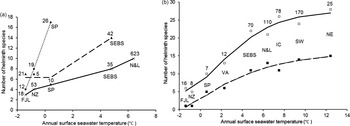
Low biodiversity is a characteristic feature of the Arctic (Meltofte et al., Reference Meltofte, Josefson and Payer2013). Helminths associated with coastal communities are no exception (Markov, Reference Markov1941; Baer, Reference Baer1956, Reference Baer1962; Threlfall, Reference Threlfall1968, Reference Threlfall1971; Bishop & Threlfall, Reference Bishop and Threlfall1974; Hoberg, Reference Hoberg1986; Galaktionov et al., Reference Galaktionov, Marasaev, Marasaeva and Matishov1993; Galaktionov, Reference Galaktionov1996a; Kuklin, Reference Kuklin2001; Hoberg et al., Reference Hoberg, Kutz, Cook, Galaktionov, Haukisalmi, Henttonen, Laaksonen, Makarikov, Marcogliese, Meltofte, Josefson and Payer2013). The number of helminth species in the Arctic regions is much smaller than that in the nearshore areas of the boreal seas (fig. 1). There are almost no trematodes in the high Arctic (Markov, Reference Markov1937, Reference Markov1941; Baer, Reference Baer1956; Galaktionov et al., Reference Galaktionov, Marasaev, Marasaeva and Matishov1993; Galaktionov, Reference Galaktionov1996a; Kuklin, Reference Kuklin2001). To give an example, the number of trematode species parasitizing the common eider, a seabird with the richest trematode fauna, decreases from 15 in The Netherlands (Borgsteede et al., Reference Borgsteede, Okulewicz, Zoun and Okulewicz2005) to a single species in Franz Josef Land (FJL) (Galaktionov et al., Reference Galaktionov, Marasaev, Marasaeva and Matishov1993) (fig. 1b). These dramatic differences are due to the fact that intermediate hosts of most trematodes of the coastal complex are boreal invertebrates, which are absent in the Arctic. This is true, first of all, for molluscs, the obligate first intermediate hosts in the digenean life cycle. Digeneans, with a few exceptions, have a narrow host specificity for these invertebrates (Cribb et al., Reference Cribb, Bray, Olson and Littlewood2003; Galaktionov & Dobrovolskij, Reference Galaktionov and Dobrovolskij2003).
Dependence of the number of parasite species (N) on the average annual surface seawater temperature (t, °C). A logistic regression model was used to construct the trend line [N = 1/(1 + e^(a + bt)) + c] since the dependence was non-linear (as indicated by a preliminary analysis of residuals of linear regression) and limited ‘above’ and ‘below’ by the tolerance temperature range of the host and/or the range of temperatures in which the life cycle of the parasite may be implemented. Numbers in the graph denote the number of birds examined in each of the regions. (Based on data in Markov (Reference Markov1937, Reference Markov1941), Belopolskaya (Reference Belopolskaya1952), Threlfall (Reference Threlfall1971), Bishop & Threlfall (Reference Bishop and Threlfall1974), Persson et al. (Reference Persson, Borg and Fält1974), Galaktionov et al. (Reference Galaktionov, Marasaev, Marasaeva and Matishov1993), Galaktionov (Reference Galaktionov1996a), Kuklin (Reference Kuklin2001), Borgsteede et al. (Reference Borgsteede, Okulewicz, Zoun and Okulewicz2005), Kuklin & Kuklina (Reference Kuklin and Kuklina2005), Kuklin et al. (Reference Kuklin, Galktionov, Galkin and Marasaev2005), Skírnisson (Reference Skírnisson2015) and our data.) (a) Thick-billed murre (Uria lomvia; ×, ––); black-legged kittiwake (Rissa tridactyla; triangles, – –); glaucous gull (Larus hyperboreus; diamonds, .. …..); (b) common eider (Somateria mollissima): open squares (––), all helminth parasites; closed squares (– –), trematodes. FJL, Franz Josef Land; IC, Iceland; NE, The Netherlands; N&L, Newfoundland and Labrador; NZ, Novaya Zemlya; SEBS, south-east of the Barents Sea; SP, Spitsbergen; SW, Sweden; VA, Vaygach Island. Average annual surface seawater temperature (SST-AA) values: here and in fig. 2 SST-AA values were taken from the following sources. For different regions of the Barents Sea (FJL, NZ, SEBS, SP, south-west of the Barents Sea (SWBS), VA) values were taken from Tereschenko et al. (Reference Tereschenko, Dvinina and Borovaya1985), Averintsev (Reference Averintsev1989), Loeng et al. (Reference Loeng, Blindhelm, Andalsvlk and Ottersen1992), Węsławski & Stempiewicz (Reference Węsławski, Stempiewicz and Barr1995), Adrov & Denisenko (Reference Adrov, Denisenko, Matishov, Tarasov and Denisov1996) and Denisenko (Reference Denisenko2013), for the White Sea (WS) they were taken from Babkov (Reference Babkov1998) and for other regions, from the website World Seawater Temperatures (https:// www.seatemperature.org)/

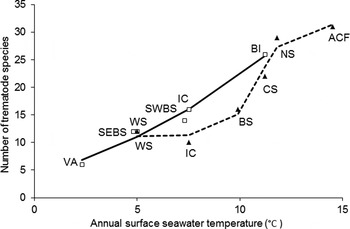
The recent meta-analyses of trematode richness in intertidal gastropods did not reveal any significant effect of latitude along European coasts (Poulin & Mouritsen, Reference Poulin and Mouritsen2003; Thieltges et al., Reference Thieltges, Ferguson, Jones, Noble and Poulin2009). These authors offered a reasonable explanation: the large-scale latitude effect is camouflaged by local factors (local abundance of final and intermediate hosts, the exposure level of the coast, etc.). These factors may prevent or, on the contrary, promote the transmission of trematodes at nearby coastal areas. Besides, only data on temperate regions (<60°N) were involved in that meta-analyses. If we take into account data on high latitudes, handle large regions to smooth the effect of the low-scale factors and use the annual surface seawater temperature (SST) rather than latitude as a predictor, we will get a decrease in the species richness of trematodes associated with intertidal gastropods (fig. 2). The use of the annual SST as a predictor is justified by the fact that the climate along the northern coast of Europe is mainly determined by the Gulf Stream and its influence weakens eastwards.
Dependence of the number of trematode species (N) associated with intertidal molluscs Littorina spp. (open squares, –––) and Hydrobia spp. (triangles, – –) in different parts of the European seacoast on the average annual surface seawater temperature (SST-AA). A logistic regression model was used to construct the trend line (N = 1/(1 + e^(a + bt)) + c) (see legend to fig. 1). The number of molluscs examined in each of the regions was more than 1000. (Based on data in Chubrik (Reference Chubrik and Polyanskiy1966), James (Reference James1968a, Reference Jamesb, Reference James1969), Combescot-Lang (Reference Combescot-Lang1976), Podlipaev (Reference Podlipaev and Poljanskiy1979), Lauckner (Reference Lauckner and Kinne1980), Deblock (Reference Deblock1980), Irwin (Reference Irwin1983), Matthews et al. (Reference Matthews, Montgomery and Hanna1985), Galaktionov & Bustnes (Reference Galaktionov and Bustnes1999); Galaktionov & Skírnisson (Reference Galaktionov and Skírnisson2000), Skírnisson & Galaktionov (Reference Skírnisson and Galaktionov2002, Reference Skírnisson and Galaktionov2014), Skírnisson et al. (Reference Skírnisson, Galaktionov and Kozminsky2004), Thieltges et al. (Reference Thieltges, Ferguson, Jones, Noble and Poulin2009) and our data.) ACF, Atlantic coast of France; BI, British Isles; CS, Celtic Sea; BS, Baltic Sea; NS, North Sea; IC, Iceland; SEBS, south-east of the Barents Sea; SWBS, south-west of the Barents Sea; VA, Vaygach Island; WS, White Sea.

For instance, in the areas of northern Norway (south-west of the Barents Sea: Tromsø, 69°40′58″N, 18°56′34″E) and of the Kola Peninsula (south-east of the Barents Sea: Dalnie Zelentzy, 69°07′05″N, 36°03′30″E) situated at approximately the same latitude, the annual SST is 7.3°C and 4.8°C, correspondingly. This difference underlies a somewhat lower species richness of trematodes in the most common intertidal periwinkles Littorina (Neritrema) spp. in the latter area (fig. 2). The effect of decreasing trematode species richness in the boreal periwinkle Littorina (Littorina) littorea can be seen only at the northern distribution boundary of this species at the Barents Sea coast of the Kola Peninsula, where these molluscs are not infected with trematodes (Chubrik, Reference Chubrik and Polyanskiy1966; Podlipaev, Reference Podlipaev and Poljanskiy1979; our data). This is probably due to the low density of L. littorea, since trematodes recorded in this snail in northern Norway (Cryptocotyle lingua, Podocotyle atomon, Himasthla sp., Microphallus pygmaeus and Microphallus similis) circulate in the nearshore areas of the Kola Peninsula using periwinkles Littorina saxatilis, L. obtusata and L. compressa (Chubrik, Reference Chubrik and Polyanskiy1966; Podlipaev, Reference Podlipaev and Poljanskiy1979; Galaktionov & Rusanov, Reference Galaktionov, Rusanov and Matishov1983; Galaktionov & Bustnes, Reference Galaktionov and Bustnes1999) as first intermediate hosts.
The absence of suitable intermediate hosts, or their low density, are not the only reasons preventing the dispersion of trematodes into the Arctic. Certain features of their life cycles also play an important role. A rich fauna of trematodes associated with intertidal molluscan hosts has been described from the coast of Great Britain and the Atlantic coast of France (fig. 2). Intermediate and final hosts of most of these trematodes also occur in the nearshore areas of Iceland and Norway (south-west of the Barents Sea) but there the trematode fauna associated with these molluscs is much poorer (fig. 2). The reason is that the life cycle of these trematodes includes miracidia and/or cercariae, that is, stages active in the environment. They seem to be very vulnerable to the extreme environmental conditions of the Arctic coasts, making further distribution of boreal trematode species northwards impossible (Galaktionov & Bustnes, Reference Galaktionov and Bustnes1999).
Few coastal trematodes (less than 20–30%) have free-swimming miracidia. In most of them, the miracidium hatches only after the ingestion of the egg by the molluscan host (Galaktionov, Reference Galaktionov2016). However, most species of coastal trematodes (up to 80–90% in boreal waters) have free-living cercariae (Galaktionov, Reference Galaktionov2016). This difference is due to the fact that the loss of the free-living miracidium does not hamper transmission much: the dispersive potential of these microscopic (up to 200 μm) larvae is low. In contrast, cercariae, first, have a much broader dispersion than miracidia because of their own activity, and, second, infect the second intermediate hosts (invertebrates or fish). These hosts ensure the spatial dispersion of the parasites and the transmission of infection to the final host via food web links. Therefore, the loss of free-living cercariae has an adverse effect on transmission. These considerations explain the success of trematode species with three-host life cycles (Cribb et al., Reference Cribb, Bray, Olson and Littlewood2003; Galaktionov & Dobrovolskij, Reference Galaktionov and Dobrovolskij2003).
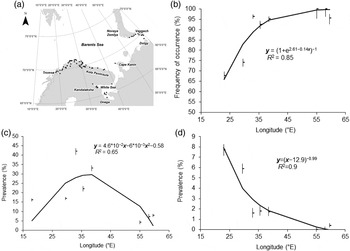
On the other hand, two-host life cycles – especially the so-called autonomous life cycles lacking larvae active in the environment – are effective for transmission in ecosystems with extreme environmental conditions, including those of the Arctic intertidal zone. The most common trematodes with two-host life cycles in the nearshore areas of northern Palaearctic seas are microphallids of the ‘pygmaeus’ group (MPG). Their first intermediate hosts, periwinkles Littorina spp., become infected by ingesting eggs containing miracidia, and metacercariae develop inside the daughter sporocysts parasitizing the molluscan host. The MPG dominate among trematodes associated with intertidal molluscan hosts Littorina (Neritrema) spp. regarding the frequency of occurrence everywhere along the southern coast of the Barents Sea (Galaktionov & Bustnes, Reference Galaktionov and Bustnes1999) (fig. 3). There is a clear trend towards increasing frequency of occurrence of MPG in the areas with a more pronounced Arctic climate (eastwards) (fig. 3b). The prevalence of these trematodes first grows, reaching a maximum at the longitudes 30–40°E (White Sea, the southern coast of the Barents Sea), and then decreases abruptly, sinking to a minimum at the Arctic coast of Vaygach and Novaya Zemlya (55–60°E) (fig. 3c).
Distribution of intramolluscan stages of trematodes parasitizing seabirds in periwinkles Littorina (Neritrema) spp. along the southern coast of the Barents Sea (based on data in Galaktionov & Bustnes, Reference Galaktionov and Bustnes1999). Error bars are confidence intervals. The number of periwinkles examined in each of the regions was in the range of 1500–10,000. (a) The distribution of sampling stations; (b) frequency of occurrence of trematodes with two-host life cycles (predominantly MPG) as a function of longitude; (c) prevalence of trematodes with two-host life cycles as a function of longitude; (d) prevalence of trematodes with three-host life cycles as a function of longitude.

The western coast of these islands coincides with the north-eastern boundary of the distribution of L. saxatilis. This species advances further into the Arctic than any other periwinkle. It seems that even MPG cannot do well under the hostile conditions of the Arctic nearshore waters. Optimal conditions for their transmission are associated with subarctic regions such as the White Sea and the Barents Sea coast of the Kola Peninsula. Further westwards (Varanger-fjord and Tromsø) the prevalence of MPG decreases, while the frequency of occurrence and the prevalence of trematodes with three-host life cycles, including free-living larval stage(s), increase considerably (fig. 3d). This trend strengthens further into boreal waters. In south-west Iceland, trematodes with two-host life cycles and those with three-host cycles have similar values of these parameters (Skirnísson & Galaktionov, Reference Skírnisson and Galaktionov2002). On the coast of the British Isles and the Atlantic coast of France, trematodes with three-host life cycles and free-living cercariae reign supreme, while MPG are scarce (James, Reference James1968a, Reference Jamesb, Reference James1969; Combescot-Lang, Reference Combescot-Lang1976; Irwin, Reference Irwin1983; Saville et al., Reference Saville, Galaktionov, Irwin and Malkova1997; Galaktionov et al., Reference Galaktionov, Bulat, Alekhina, Saville, Fitzpatrick and Irwin2004).
Cestodes (Tetrabothriidae, Dilepedidae, Aploparaksidae, Hymenolepididae) and acanthocephalans (Polymorphidae, Filicolidae) that parasitize seabirds have no free-living larvae. This eliminates an important obstacle on their way into the Arctic. Intermediate hosts of these parasites are crustaceans, which are abundant in the nearshore areas of the Arctic seas. For these reasons, the fauna of cestodes and acanthocephalans in the Arctic is less depauperate than that of trematodes (Markov, Reference Markov1941; Baer, Reference Baer1956, Reference Baer1962; Threlfall, Reference Threlfall1968, Reference Threlfall1971; Hoberg, Reference Hoberg1986; Galaktionov, Reference Galaktionov1996a; Kuklin, Reference Kuklin2001; Hoberg et al., Reference Hoberg, Kutz, Cook, Galaktionov, Haukisalmi, Henttonen, Laaksonen, Makarikov, Marcogliese, Meltofte, Josefson and Payer2013). Cestodes (e.g. Lateriporus spp., Alcataenia spp., Microsomacanthus spp., Tetrabothrius spp.) and some acanthocephalans (e.g. Polymorphus phippsi and Corynosoma strumosum) circulate successfully both in the high Arctic and in the coastal ecosystems of lower latitudes (Threlfall, Reference Threlfall1968, Reference Threlfall1971; Leonov & Belogurov, Reference Leonov and Belogurov1970; Leonov et al., Reference Leonov, Belogurov and Zueva1970; Bishop & Threlfall, Reference Bishop and Threlfall1974; Leonov, Reference Leonov1979; Bakke, Reference Bakke1985; Galkin et al., Reference Galkin, Galaktionov, Marasaev and Prokofyev1994; Kuklin & Kuklina, Reference Kuklin and Kuklina2005, Reference Kuklin, Kuklina and Makarevich2013; Regel & Atrashkevich, Reference Regel and Atrashkevich2008). At the same time, some species of cestodes and acanthocephalans do disappear, similarly to trematodes, in the higher latitudes because of the absence, or a low density, of intermediate hosts.
One such species is the acanthocephalan Profilicollis botulus, a common parasite of waterfowl in North Atlantic seas. Its intermediate hosts, decapods (Petrochenko, Reference Petrochenko1958; McDonald, Reference McDonald1988), are mainly represented in boreal waters by the green crab (Carcinus maenas) (Thompson, Reference Thompson1985). In the south-eastern part of the Barents Sea, where the green crab does not occur, the cystacanths of P. botulus develop in crabs Hyas araneus and hermit crabs Pagurus pubescens (Uspenskaya, Reference Uspenskaya1963). In the north-west of the Barents Sea and in the nearshore areas of the Arctic archipelagos Novaya Zemlya and FJL, these decapods are rare and the transmission of P. botulus cannot be successful (Galaktionov et al., Reference Galaktionov, Marasaev, Marasaeva and Matishov1993). Notably, the acanthocephalan P. phippsi, which is common in these areas, uses amphipods as intermediate hosts, which are abundant in the nearshore areas of the Arctic archipelagos.
The circulation ways of most nematodes parasitizing seabirds in the Arctic and the Subarctic (representatives of Capillariidae, Streptocaridae, Acauriidae, Anisakidae and some other families) are unknown. Anisakid nematodes Anisakis simplex, Pseudoterranova decipiens and Contracaecum osculatum, which are very common in marine ecosystems, use various invertebrates (mainly crustaceans) and fish as intermediate hosts (Nagasawa, Reference Nagasawa, Ishikura and Kikuchi1990; Andersen et al., Reference Andersen, des Clers, Jensen, Blix, Walløe and Ulltang1995; Køie & Fagerholm, Reference Køie and Fagerholm1995). These nematodes can reach maturity only in marine mammals, while fish-eating birds, where their larvae are often found, are the dead end of their development. Curiously, anisakid nematodes (single individuals) were only recorded at FJL from the thick-billed murres (Uria lomvia) (our data) although there are many marine mammals in the area. This might be due to the small proportion of fish in the diet of birds at FJL (see below).
Spirurid nematodes Paracuaria adunca, P. tridentata, Cosmocephalus obvelatus and Streptocara crassicauda, which are common in fish-eating seabirds, use crustaceans as intermediate hosts (mysids, amphipods) and fish as paratenic hosts (Anderson & Wong, Reference Anderson and Wong1982; Wong & Anderson, Reference Wong and Anderson1982; Marcogliese, Reference Marcogliese1992; Anderson, Reference Anderson2000). Similarly to anisakids, these nematodes have no larvae in the environment (Anderson, Reference Anderson2000). This promotes their circulation in the coastal ecosystems of the Arctic seas. Spirurid nematodes have been recorded from birds at Svalbard and FJL (Kuklin et al., Reference Kuklin, Galktionov, Galkin and Marasaev2005; Kuklin & Kuklina, Reference Kuklin, Kuklina and Makarevich2013; our data).
Birds in the high Arctic do not harbour helminths whose life cycles are associated with freshwater or terrestrial ecosystems. The only known exception is that of strongylid nematodes Amidostomum sp. found in the common eider at FJL (our data). Their larvae either penetrate the final host actively via the skin or are swallowed with food or water (McDonald, Reference McDonald1969; Baruš et al., Reference Baruš, Sergeeva, Sonin and Ryzhikov1978; Anderson, Reference Anderson2000; Borgsteede et al., Reference Borgsteede, Kavetska and Zoun2006). It is unclear where the common eider becomes infected – on land, where females spend a long time during the nesting period, or also in the sea (Borgsteede et al., Reference Borgsteede, Kavetska and Zoun2006). Amidostomum sp. seems to spend the cold season in the host and implements the part of their life cycle in the environment during the short Arctic summer. It is unknown whether its eggs and larvae can survive the long winter freezing, although this may well be so, since freezing tolerance has been reported for soil nematodes of the polar regions (Treonis & Wall, Reference Treonis and Wall2005; McGill et al. Reference McGill, Shannon, Pisani, Felix, Ramlov, Dix, Wharton and Burnell2015)
‘Borealization’ – colonization of high latitudes by boreal species – is one of the consequences of Arctic warming (Payer et al., Reference Payer, Josefson, Fjeldså, Meltofte, Josefson and Payer2013). Among the boreal species advancing into the Arctic are marine invertebrates and fish (e.g. Berge et al., Reference Berge, Johnsen, Nilsen, Gulliksen and Slagstad2005, Reference Berge, Renaud, Eiane, Gulliksen, Cottier, Varpe and Brattegard2009; Węsławski et al., Reference Węsławski, Wiktor and Kotwicki2010, Reference Węsławski, Kendall, Włodarska-Kowalczuk, Iken, Kędra, Legezynska and Sejr2011; Denisenko, Reference Denisenko2013; Josefson et al., Reference Josefson, Mokievsky, Bergmann, Blicher, Bluhm, Cochrane, Denisenko, Hasemann, Jorgensen, Klages, Schewe, Sejr, Soltwedel, Węsławski, Włodarska-Kowalczuk, Meltofte, Josefson and Payer2013; Kędra et al., Reference Kędra, Moritz, Choy, David, Degen, Duerksen, Ellingsen, Górska, Grebmeier, Kirievskaya, van Oevelen, Piwosz, Samuelsen and Węsławski2015). Some of them are the intermediate hosts of helminths circulating in the nearshore areas of boreal seas. The presence of suitable hosts and the climate warming in the Arctic might allow these parasites to carry out their life cycles in high latitudes. In particular, one may expect trematode species with three-host life cycles and the stage of free-living cercaria to advance into Arctic regions. This hypothesis is supported by observations in the nearshore areas of Svalbard. The south-western coast of western Spitsbergen, the largest island of the archipelago, is washed by the warm West and South Spitsbergen Currents (branches of the North Atlantic Current, which is an extension of the Gulf Stream). Owing to these warm currents, some boreal molluscs such as L. littorea, L. saxatilis, Cryptonatica clausa and Onoba aculeus (Golikov & Kusakin, Reference Golikov and Kusakin1978; Koszteyn et al., Reference Koszteyn, Kwaśniewski, Różycki and Węslawski1991) occur there. This, in turn, makes possible the circulation of several trematode species with three-host life cycles associated with them (Kuklin et al., Reference Kuklin, Galktionov, Galkin and Marasaev2005; Kuklin & Kuklina, Reference Kuklin, Kuklina and Makarevich2013).
The ongoing climate changes also affect the final hosts of parasites. Many birds have already extended their distribution northwards, and this process is likely to intensify (Newton, Reference Newton2003; Rehfisch & Crick, Reference Rehfisch and Crick2003; Valiela & Bowen, Reference Valiela and Bowen2003; Sparks et al., Reference Sparks, Bairlein, Bojarinova, Hüppop, Lehikoinen, Rainio, Sokolov and Walker2005; Ganter et al., Reference Ganter, Gaston, Anker-Nilssen, Blancher, Boertmann, Collins, Ford, Garðasson, Gauthier, Gavrilo, Gilchrist, Gill, Irons, Lappo, Mallory, Merkel, Morrison, Mustonen, Petersen, Sitters, Smith, Strøm, Syroechkovskiy, Tomkovich, Meltofte, Josefson and Payer2013). Some of the helminths parasitizing these birds may find favourable conditions for the implementation of their life cycles in the Arctic ecosystems transformed by the warming. This would result in the northwards expansion of these parasites.
Helminth abundance and host colonization
Crustaceans are abundant in Arctic nearshore waters, while the abundance of fish is relatively low. For these reasons, crustaceans, especially amphipods, are an important component of the seabird diet (Belopolsky & Shuntov, Reference Belopolsky and Shuntov1980; Lydersen et al., Reference Lydersen, Gjertz and Weslawski1989; Mehlum & Gabrielsen, Reference Mehlum and Gabrielsen1993; Węsławski et al., Reference Węsławski, Stempiewicz and Galaktionov1994). This means that seabirds in the Arctic are quite heavily infected with cestodes and acanthocephalans, which use crustaceans as intermediate hosts (Baer, Reference Baer1956, Reference Baer1962; Threlfall, Reference Threlfall1968, Reference Threlfall1971; Leonov & Belogurov, Reference Leonov and Belogurov1970; Leonov et al., Reference Leonov, Belogurov and Zueva1970; Bishop & Threlfall, Reference Bishop and Threlfall1974; Galaktionov et al., Reference Galaktionov, Marasaev, Marasaeva and Matishov1993; Galaktionov, Reference Galaktionov1996a, b; Kuklin, Reference Kuklin2001; Kuklin & Kuklina, Reference Kuklin and Kuklina2005; Kuklin et al., Reference Kuklin, Galktionov, Galkin and Marasaev2005). For instance, at FJL the infection intensity of the common eider (Somateria mollissima) with cestodes Microsomacanthus spp. reaches 200,000 individuals, and that with the acanthocephalan P. phippsi reaches 1000 individuals (Galaktionov, Reference Galaktionov1996a). In the south of the Barents Sea the maximum values of this parameter are 19,500 individuals for Microsomacanthus spp. and 247 individuals for P. phippsi, while at the White Sea these values are 55,000 individuals and 57 individuals, respectively (Belopolskaya, Reference Belopolskaya1952; Kulachkova, Reference Kulachkova and Uspenskiy1979). This is unsurprising, since amphipods are the second largest component of the diet of the common eider at FJL after the molluscs Margarites spp. (Węsławski et al., Reference Węsławski, Stempiewicz and Galaktionov1994). Further south, the common eider feeds mostly on blue mussels and some other bivalve and gastropod species (Bianki et al., Reference Bianki, Boyko, Ninburg, Shklarevich and Uspenski1979; Krasnov et al., Reference Krasnov, Shklyarevich and Goryaev2009).
A high infection intensity of seabirds in the Arctic with cestodes and acanthocephalans is bound to influence their population dynamics. All these helminths are pathogenic for their hosts and may cause death, especially in chicks, if the infection is intensive (Clark et al., Reference Clark, O'Mera and van Weelden1958; Garden et al., Reference Garden, Rayski and Thom1964; Kulachkova, Reference Kulachkova and Uspenskiy1979; Itamies et al., Reference Itamies, Valtonen and Fagerholm1980). The negative impact of helminths on seabirds may be not so evident but is nevertheless important (Galaktionov, Reference Galaktionov1996b; Thieltges et al., Reference Thieltges, Hussel and Baekgaard2006). Breeding success of the common eider nesting in the north of Norway was found to decrease as a consequence of infection with intestinal parasites (Warelius, Reference Warelius1993). Antiparasite treatment of female eiders in low body condition, which had lost or abandoned their nests, considerably increased their chances of next-year reproduction compared with untreated individuals (Hanssen et al., Reference Hanssen, Folstad, Erikstad and Oksanen2003). Bustnes et al. (Reference Bustnes, Erikstad, Hanssen, Tveraa, Folstad and Skaare2006) showed that in glaucous gulls nesting on Bear Island (Norwegian Arctic) helminths may be an important factor in triggering negative effects of organochlorine pollutants on reproduction. In addition, the negative effect of parasitism may also be aggravated by the extreme environmental conditions in the Arctic.
An increasing proportion of crustaceans in the diet of birds in the Arctic promotes the colonization of non-specific final hosts by helminths. Non-specific parasitism – the occurrence of parasites in unusual host species – is characteristic of cestodes and acanthocephalans parasitizing Arctic birds. For instance, at Svalbard the cestodes Microsomacanthus diorchis and M. microsoma, which typically parasitize anatids, were recorded from black-legged kittiwakes and glaucous gulls. These birds were also found to harbour dilepipid cestodes Arctotaenia tetrabothrioides, earlier recorded only in shorebirds (Kuklin et al., Reference Kuklin, Galktionov, Galkin and Marasaev2005). All these cestodes were mature, and their intensity of infection was considerable, especially in glaucous gulls (M. diorchis, up to 254 individuals; A. tetrabothrioides, up to 154 individuals).
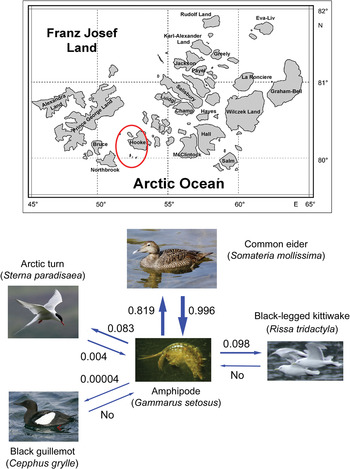
The acanthocephalan P. phippsi is a vivid example of non-specific parasitism (Galaktionov & Atrashkevich, Reference Galaktionov and Atrashkevich2015). Its final host in the Arctic is the common eider, but it has also been recorded from some other birds such as gulls, guillemots and the purple sandpiper (Calidris maritima). These birds mostly serve as eliminative hosts for P. phippsi. However, some individuals of this acanthocephalan can reach maturity in the black-legged kittiwake (Rissa tridactyla), the Arctic turn (Sterna paradisaea), the little auk (Alle alle) and, probably, in Sabine's gull (Xema sabini). Calculations for one of the FJL areas showed that infection flows through these hosts were very low (Galaktionov & Atrashkevich, Reference Galaktionov and Atrashkevich2015) (fig. 4). Nevertheless, it is a case of a parasite colonizing new hosts, phylogenetically unrelated to the main one. The extreme conditions of the Arctic seem to promote this process. Arctic birds expend more energy on the maintenance of physiological processes as compared to birds in southern areas, including greater energy expenditure on the maintenance of the optimal body temperature. This may reduce expenditure on the maintenance of a high-level immune status. This, in turn, promotes the survival and development of parasites in non-specific hosts.
Flowchart summarizing circulation and transmission dynamics of the acanthocephalan Polymorphus phippsi at Franz Josef Land (modified from Galaktionov & Atrashkevich, Reference Galaktionov and Atrashkevich2015). The study area (vicinity of the islands Hooker, May and Etteridge) is marked with a red oval; all numbers are proportions.

This state of things may be compared with that in coastal refugia of the northern Holarctic during the Quaternary glacials. As ice advanced along the Atlantic and the Pacific coast of the mainland and islands, marine refugia were formed. Seabirds and marine mammals that accumulated in these refugia fed on the same available foods. Hoberg (Reference Hoberg1992, Reference Hoberg1995) and Hoberg & Adams (Reference Hoberg and Adams1992, Reference Hoberg and Adams2000) suggested that such a situation opened new vistas for colonization of new hosts and thus accelerated speciation via host switching (the Arctic refugium hypothesis). In a way, the present-day conditions of parasites’ transmission in the high Arctic are comparable with those in the glacial refugia. The instances of non-specific parasitism can be considered as a model demonstrating different stages of lateral incorporation (sensu Parker et al., Reference Parker, Ball and Chubb2015) of new hosts, which may result in speciation of helminths.
The cestode Microsomacanthus ductilis (Linton, 1927) sensu Galkin et al., 1999 deserves mention in this respect. It has been recorded in the common eider at FJL and in some seaducks at Chukotka (Galkin et al., Reference Galkin, Galaktionov and Marasaev1999; Regel, Reference Regel2005). This species is remarkably close to M. ductilis (Linton, 1927), a typical parasite of gulls, which might indicate that it formed by host switching under Arctic conditions.
The rising temperature of waters over the Arctic shelves (due to increasing area and duration of open water) is likely to result in an increase in the abundance and biomass of boreal species, including zooplankton. Pelagic-feeding animals (some fish, marine mammals and seabirds) may consequently increase in abundance (Kędra et al., Reference Kędra, Moritz, Choy, David, Degen, Duerksen, Ellingsen, Górska, Grebmeier, Kirievskaya, van Oevelen, Piwosz, Samuelsen and Węsławski2015). This may promote the intensification of transmission of helminths and their increasing load on the host populations. However, climate warming is also likely to bring about considerable changes in the Arctic marine food webs (Węsławski et al., Reference Węsławski, Kendall, Włodarska-Kowalczuk, Iken, Kędra, Legezynska and Sejr2011; Kędra et al., Reference Kędra, Moritz, Choy, David, Degen, Duerksen, Ellingsen, Górska, Grebmeier, Kirievskaya, van Oevelen, Piwosz, Samuelsen and Węsławski2015). This would have a negative impact, first of all, on ice-depending organisms, such as some crustaceans and some fishes. Increased pelagic grazing and recycling in the water column may lead to a decrease in the biomass of benthic species, including intermediate hosts of helminths. The change in the species composition of zooplankton (which is already being observed), the penetration of boreal fish species into the Arctic waters and their growing abundance may shift (are, in fact, shifting – see Kidawa et al., Reference Kidawa, Jakubas, Wojczulanis-Jakubas, Stempniewicz, Trudowska, Boehnke, Keslinska-Nawrot and Błachowiak-Samołyk2015) priorities in the food choice by seabirds. The consequences for the transmission of helminths are difficult to predict. They would depend on the life-cycle features of the given parasite species and the impact of these changes on the hosts.
Transarctic transfer of helminths: retrospectives and perspectives
The modern parasitic fauna of marine mammals and birds of the Arctic areas of the Atlantic and the Pacific formed in the course of the Pleistocene glacial cycles, numbering c. 20 events (Hoberg, Reference Hoberg1992, Reference Hoberg1995; Hoberg & Adams, Reference Hoberg and Adams1992, Reference Hoberg and Adams2000; Waltari et al., Reference Waltari, Hoberg, Lessa and Cook2007; Hoberg & Brooks, Reference Hoberg and Brooks2008). The exchange between the faunas of the North Atlantic (NA) and North Pacific (NP) was interrupted during glacials/stadials, but was resumed to some extent during warm interstadials/interglacials. The dispersive potential of heteroxenous helminths is usually thought to be associated with the activity of the most vagile host in their life cycle. In this way, the modern composition of the cestode fauna of marine mammals and birds of NA and NP was determined by transarctic migrations of these hosts. These migrations became possible during some interstadials/interglacials of the Pleistocene (Hoberg, Reference Hoberg1992, Reference Hoberg1995; Hoberg & Adams, Reference Hoberg and Adams1992, Reference Hoberg and Adams2000). Two other factors contributed to this process: the lack of narrow specificity of cestodes to their intermediate hosts, crustaceans and fish (if they serve as second intermediate or paratenic hosts) and the broad transarctic distribution of many of these host species.
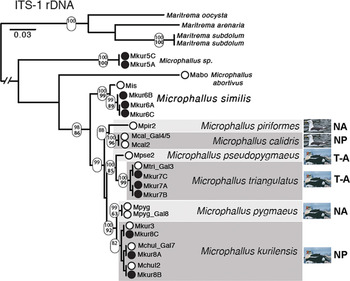
Although vertebrate hosts are extremely important for the geographic expansion of helminths, their vagility is not the only factor deciding the character of the expansion. In trematodes, with their narrow specificity to the first intermediate (molluscan) host, it is the range of the least vagile host that limits distribution (Brooks et al., Reference Brooks, McLennan, León-Régagnon and Hoberg2006; Miura et al., Reference Miura, Torchin, Kuris, Hechinger and Chiba2006; Galaktionov et al., Reference Galaktionov, Blasco-Costa and Olson2012). For instance, there are MPG species (Microphallus calidris and M. kurilensis) whose distribution area is limited to NP as well as MPG species (M. pygmaeus and M. piriformes) with a NA distribution (fig. 5). The most vagile final hosts in their life cycle, marine and coastal birds, do not make transarctic migrations nowadays. Birds from the Pacific populations fly as far eastwards as the Taimyr Peninsula, where they may encounter birds from the Atlantic populations (Johnson & Herter, Reference Johnson, Herter and Gwinner1990; Dau et al., Reference Dau, Flint and Petersen2000; Webster et al., Reference Webster, Marra, Haig, Bensch and Holmes2002; Petersen et al., Reference Petersen, Bustnes and Systad2006; Alerstam et al., Reference Alerstam, Bäckman, Gudmundsson, Hedenström, Henningsson, Karlsson, Rosén and Strandberg2007; Bustnes et al., Reference Bustnes, Mosbech, Sonne and Systad2010). However, at the coast of the Siberian seas, including the Taimyr nearshore waters, periwinkles, the first intermediate hosts of MPG, do not occur at present (Reid, Reference Reid1996). They are also absent in the Beaufort Sea and at the coast of the Canadian Arctic Archipelago (Reid, Reference Reid1996). This prevents the transmission of the MPG species in question in these areas and, correspondingly, limits the possibilities of genetic exchange between the Atlantic and the Pacific populations of these species (Galaktionov et al., Reference Galaktionov, Blasco-Costa and Olson2012). At the same time, one MPG species, Microphallus pseudopygmaeus, uses numerous species of gastropods as the first intermediate hosts, including the subtidal Margarites helicinus, M. groenlandicus umbilicalis and Cryptonatica clausa, widely distributed in the nearshore areas of Arctic seas. Unsurprisingly, M. pseudopygmaeus has a transarctic distribution. The reasons why the same distribution formed in Microphallus triangulatus are as yet unclear.
Bayesian inference phylogram of microphallids of the ‘pygmaeus’ group (MPG) derived from internal transcribed spacer 1 (ITS1) rRNA gene sequences with posterior probability and bootstrap percentage values above and below, respectively, within ellipses (modified from Galaktionov et al., Reference Galaktionov, Blasco-Costa and Olson2012). Black dots indicate adult specimens sequenced, whereas white dots indicate sporocysts or metacercariae stages sequenced. The main final hosts for each MPG species are indicated by the sign of the corresponding bird (gull or eider). Range of MPG species is indicated by letters (NA, North Atlantic; NP, North Pacific; T-A, transarctic).

Besides the vagility of the host and the availability of suitable first intermediate hosts, an important factor contributing to successful colonization of new geographic areas by trematodes are the life-cycle characteristics. One of these is the lifespan of parasites in the most vagile host. For example, the trematode Tristriata anatis (Notocotylidae), which has a two-host life cycle with cercariae encysting in the open, circulates in the same range of hosts (molluscan hosts Littorina spp. – waterfowl birds) and in the same geographic regions (nearshore waters of the northern Palaearctic seas) as MPG. The formation of T. anatis and MPG was accompanied by the same historical events. However, in contrast to MPG, representatives of T. anatis in NA and in NP did not diversify further than geographic races, identified by sequence analysis of the mitochondrial gene CO1 (Gonchar & Galaktionov, Reference Gonchar and Galaktionov2017).
This difference appears to be associated with a different lifespan of these parasites. Adult MPG never live for more than 7–10 days in the final host (Galaktionov, Reference Galaktionov1993), while adult notocotylids may survive for months (Filimonova, Reference Filimonova1985). A greater longevity of T. anatis adults seems to have increased the probability of their transarctic transfer by migratory birds. In this way, the eggs of these parasites were more likely to get into the areas of the NA and NP where periwinkles occurred. This could happen repeatedly during warm Quaternary interglacials/interstadials (e.g. during the most recent interglacial, the Eemian (from 130 ky bp to about 107 ky bp), when the climate was warmer than at present), ensuring a rather intensive gene flow between the Atlantic and the Pacific populations of T. anatis. The gene flow between them ceased during the last Ice Age and never resumed because of the modern distribution of periwinkles (see above) and the migratory pathways of birds in the northern Palaearctic.
The above considerations indicate that the interpenetration of the Pacific and the Atlantic parasitic faunas may be one of the consequences of Arctic warming. The ongoing borealization of the Arctic and the changes in the migratory pathways of the intermediate and the final hosts of helminths contribute further to this process. There is also an example of a helminth of Pacific birds penetrating into the Atlantic. The cestode Alcataenia longicervica, previously considered as endemic to the Pacific Ocean (Hoberg, Reference Hoberg1986), has recently been found in Atlantic populations of murres (Uria aalge and U. lomvia) (Muzaffar et al., Reference Muzaffar, Hoberg and Jones2005; Muzaffar, Reference Muzaffar2009). The intermediate hosts of this cestode are planktonic euphausiids Thysanoessa spp. These crustaceans are probably responsible for the penetration of A. longicervica into Atlantic populations of murres. Pacific euphausiids, abundant in the Bering Sea, the Chukchi Sea and the Beaufort Sea, made it into the nearshore waters of Siberia and Labrador as a result of the changing structure of currents due to Arctic warming. Some of them were infected with the larvae of A. longicervica, which, in this way, arrived at the border of the distribution area of the Atlantic populations of murres (Muzaffar, Reference Muzaffar2009).
Temperature and transmission of helminths
Parasite transmission in ecosystems is controlled by environmental temperature. It has a huge influence on the development of parasites in intermediate hosts (mostly ectothermic animals), the emergence of larvae into the environment, their infectivity and the process of host infection (Marcogliese, Reference Marcogliese2001; Mouritsen & Poulin, Reference Mouritsen and Poulin2002b; Pietrock & Marcogliese, Reference Pietrock and Marcogliese2003; Poulin, Reference Poulin2006; Poulin & Mouritsen, Reference Poulin and Mouritsen2006; Thieltges & Rick, Reference Thieltges and Rick2006; Studer et al., Reference Studer, Thieltges and Poulin2010; Morley & Lewis, Reference Morley and Lewis2013, Reference Morley and Lewis2014, Reference Morley and Lewis2015). One might assume that a lower transmission rate in cold waters results in lower infection levels of marine organisms. However, this idea was not supported by recent studies of marine bivalve infection with trematode metacercariae across a broad latitude (and temperature) range. Studer et al. (Reference Studer, Widmann, Poulin and Krkošek2013b) found no significant differences in the infection rates of cockles Austrovenus stutchburyi with metacercariae of Cututeria spp. and Acanthoparyphium spp. along the coast of New Zealand (12° latitude gradient, c. 7°C annual temperature range (12–18°C)). Similar data were obtained by Galaktionov et al. (Reference Galaktionov, Bustnes, Bardsen, Nikolaev, Sukhotin, Ivanov, Wilson, Skírnisson, Saville and Regel2015), who analysed the infection of blue mussels Mitylus edulis with metacercariae of Himasthla spp., Renicola spp. and Gymnophallus bursicola on the coasts of northern Palaearctic seas from Ireland in the south-west to the Barents Sea in the north-east (latitude and longitude gradients were 14° and 81°, respectively; 14°C gradient of maximal SST (8–22°C)). The influence of the temperature is often camouflaged by local factors, such as a local abundance of final hosts, the density of intermediate hosts, sheltered or exposed shore, etc. (Studer et al., Reference Studer, Poulin and Tompkins2013a, b; Wilson et al., Reference Wilson, Galaktionov, Sukhotin, Skírnisson, Nikolaev, Ivanov, Bustnes, Saville and Regel2013; Galaktionov et al., Reference Galaktionov, Bustnes, Bardsen, Nikolaev, Sukhotin, Ivanov, Wilson, Skírnisson, Saville and Regel2015) but, as it turns out, not only by them.
According to recent meta-analyses, the average daily cercarial output (the number of larvae shed by an infected marine mollusc, on average, during 24 h) does not differ significantly in low (≤35°N) and middle (36–60°N) latitudes (Thieltges et al., Reference Thieltges, de Montaudouin, Fredensborg, Jensen, Koprivnikar and Poulin2008; Studer & Poulin, Reference Studer and Poulin2014). Moreover, it does not differ considerably from the cercarial output recorded by Prokofiev et al. (Reference Prokofiev, Galaktionov and Levakin2016) in the same or closely related trematode species at the White Sea (66°N). This is due to the high acclimation potential of trematodes, underlying a broad variation of the optimal temperature range for the transmission of their larvae at different latitudes (Morley & Lewis, Reference Morley and Lewis2013, Reference Morley and Lewis2014, Reference Morley and Lewis2015).
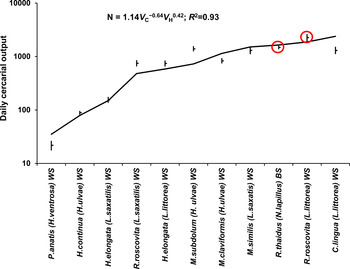
Cercarial development, emergence and survival, as well as the survival of miracidia, are not much influenced by temperature over optimum temperature ranges (Morley, Reference Morley2011, Reference Morley2012; Morley & Lewis, Reference Morley and Lewis2013, Reference Morley and Lewis2015). For instance, average daily cercarial output of Renicola spp. from the molluscan hosts L. littorea and Nucella lapillus is similar at the Barents Sea (69°N) and the White Sea (66°N) (fig. 6), and does not differ significantly from that of R. roscovita from L. littorea in the Wadden Sea (54°N) (Prokofiev et al., Reference Prokofiev, Galaktionov and Levakin2016). However, in the Wadden Sea, cercarial emergence stops altogether when the water cools down to 10°C (Thieltges & Rick, Reference Thieltges and Rick2006). In the White Sea, cercarial emergence of Renicola spp. remains stable at 10°C, but the average daily cercarial output decreases c. threefold as compared with that at the optimal temperature (15–22°C). At the Barents Sea, 10°C falls within the temperature range optimal for cercarial emergence (Prokofiev et al., Reference Prokofiev, Galaktionov and Levakin2016).
Daily cercarial output (DCO) (number cercariae/snail per day; N) of trematode species parasitizing intertidal snails in the White Sea and the Barents Sea (molluscan species are indicated in parentheses) as a function of cercarial size (cercarial volume, mm3; V C) and snail host size (shell volume, mm3; V S). The set of expected (line) and observed values (dots with bars; bars mark 95% confidence intervals) of DCO is arranged in the order of ascending expected DCO value (based on data in Prokofiev et al., Reference Prokofiev, Galaktionov and Levakin2016). The trematode species mentioned in the text are indicated by red ovals. Trematode species: Paramonostomum anatis, Himasthla continua, H. elongata, Renicola roscovita, R. thaidus, Maritrema subdolum, Microphallus claviformis, M. similis and Cryptocotyle lingua. Molluscan host species: Littorina littorea, L. saxatilis, Hydrobia ulvae, H. ventrosa and Nucella lapillus. BS, Barents Sea; WS, White Sea.

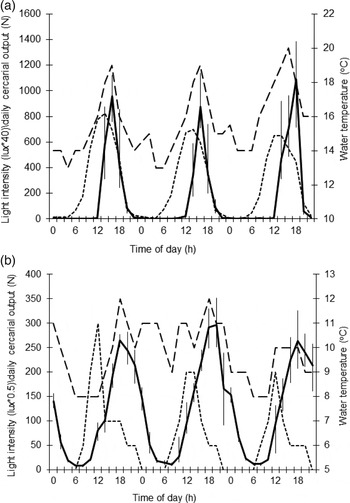
Besides the shift of the temperature optimum of cercarial emergence, there is at least one more temperature-associated phenomenon contributing to the levelling-out of the differences in the average daily cercarial output at different latitudes (Prokofiev et al., Reference Prokofiev, Galaktionov and Levakin2016). In the nearshore areas of temperate and even subarctic seas, the differences between the minimum and the maximum daily values of temperature and light intensity are quite large, as compared with Arctic seas. During our study of the rhythms of cercarial emergence at the intertidal of the White Sea and the Barents Sea, the amplitude of daily temperature at the White Sea was 10–15°C and that of light intensity was tens to hundreds thousands lux, while at the Barents Sea the corresponding values were 3–4°C and 200 lux (Prokofiev et al., Reference Prokofiev, Galaktionov and Levakin2016). A rapid increase in the temperature and light intensity stimulated a mass emergence of cercariae of the White Sea species. As a result, almost all the accumulated mature larvae left the molluscan host over a relatively short period, after which the emergence stopped for some time (‘precipitous emergence’) (fig. 7a). At the Barents Sea, considerably fewer cercariae emerged in a unit of time but the emergence lasted over a longer period (‘prolonged emergence’) (fig. 7b). In this way, trematodes at the Barents Sea can release considerable numbers of cercariae during the day – almost as many as in boreal seas (fig. 6). This adaptation is one of the keys to the success of trematode transmission in the intertidal ecosystems of cold-water seas.
Daily emergency rhythm of cercariae of (a) Renicola roscovita from the White Sea periwinkle Littorina littorea (the water temperature during observations was 15.5 ± 0.5°C (13–20°C)) and (b) Renicola thaidus from the Barents Sea dog whelk Nucella lapillus (the water temperature during observations was 9.7 ± 0.4°C (8–12°C)) (data obtained from in situ experiments described in Prokofiev et al., Reference Prokofiev, Galaktionov and Levakin2016). –––, Average number of emerged cercariae per snail (confidence intervals are indicated); - - -, light intensity, lux; ….., average water temperature, °C.

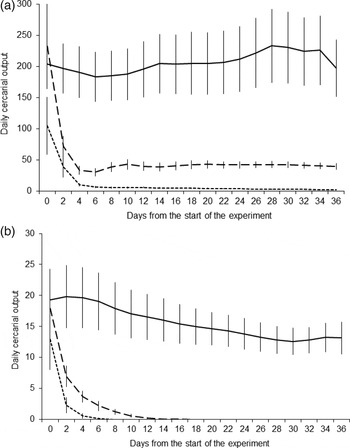
Acclimation potential of parasites, although considerable, is not unlimited. In the nearshore areas of Arctic and subarctic seas, the development and transmission of parasites are possible only during the warm season, the ‘transmission window’. At that time, all categories of host necessary for the implementation of the parasites’ life cycle are present, while the water is warm enough for the free-living stages to find and infect intermediate hosts. For trematodes at the White Sea, a temperature of 3–5°C blocks cercarial emergence from the infected molluscan hosts (fig. 8). If this temperature persists, the formation of embryos in the parthenitae stops temporarily, and their groups come into the state of developmental arrest (Galaktionov et al., Reference Galaktionov, Irwin, Prokofiev, Saville, Nikolaev and Levakin2006). The same applies to the larvae contained in eggs in the environment. In experiments where the White Sea molluscan hosts Hydrobia ulvae were infected with the eggs of trematodes Bunocotyle progenetica, the eggs ingested by mudsnails passed through their gut in intact condition at 4°C: miracidia did not hatch and the molluscan host remained uninfected (Galaktionov et al., Reference Galaktionov, Irwin, Prokofiev, Saville, Nikolaev and Levakin2006).
The general trend in long-term emergence dynamics of ‘psychrophilic’ cercariae of Cryptocotyle concava (a) and ‘thermophilic’ cercariae of Himasthla continua (b) from the White Sea mudsnail Hydrobia ulvae, extracted by singular spectral analysis (for description of the method see Prokofiev et al., Reference Prokofiev, Galaktionov and Levakin2016). Based on the original data obtained from a 37-day-long laboratory experiment under different constant temperatures: ––––, 10°C; - - -, 5°C; ……, 3°C. The confidence intervals are indicated.

The effect of temperature on cercarial emergence is certainly not the only impact of this factor on the life activity and transmission of marine trematodes. Locomotor activity of the larvae, their infectivity and lifespan, as well as reorganization in the group of parthenitae (sporocysts and rediae) in the molluscan host, also depend on temperature (Galaktionov et al., Reference Galaktionov, Irwin, Prokofiev, Saville, Nikolaev and Levakin2006; Thieltges & Rick, Reference Thieltges and Rick2006; Studer et al., Reference Studer, Thieltges and Poulin2010; Studer & Poulin, Reference Studer and Poulin2014). Besides, cercariae show high interspecific and intraspecific variations in their response to temperature, which should also be taken into account (Koprivnikar & Poulin, Reference Koprivnikar and Poulin2009; Koprivnikar et al., Reference Koprivnikar, Lim, Fu and Brack2010; Morely, 2011; Studer & Poulin, Reference Studer and Poulin2014). All these impacts are superimposed on local factors of the habitat, which may favour or prevent the transmission of a given trematode species. The totality of these factors makes a general assessment of the consequences of the climate warming on trematode transmission difficult. One can only say that these impacts are likely to be species-specific in different localities.
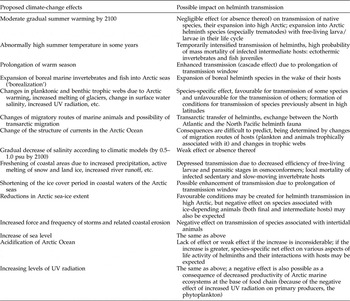
We may, however, conclude that, contrary to some earlier suggestions (Marcogliese, Reference Marcogliese2001; Galaktionov et al., Reference Galaktionov, Irwin, Prokofiev, Saville, Nikolaev and Levakin2006; Poulin, Reference Poulin2006), global warming is unlikely to result in an unambiguous intensification of trematode transmission in marine coastal ecosystems. According to recent models, the climate warming in the Arctic would be gradual, with the average annual air temperature increasing by 2.2–8.3°C by 2100 (Stocker et al., Reference Stocker, Qin, Plattner, Tignor, Allen, Boschung, Nauels, Xia, Bex and Midgley2013). Taking into account the temperature acclimation potential of trematodes (see above), a gradual increase in the summer temperature is unlikely to intensify their transmission much (Morley & Lewis, Reference Morley and Lewis2013; de Montaudouin et al., Reference de Montaudouin, Blanchet, Lavesque, Desclaux-Marchand and Bachelet2016a, Reference de Montaudouin, Blanchet, Bazairi, Nazik, Desclaux-Marchand and Bacheletb; Prokofiev et al., Reference Prokofiev, Galaktionov and Levakin2016). This also appears to be the case for other parasitic worms, even though their temperature adaptations in the nearshore areas of the polar seas are as yet unstudied.
In some years, climate warming may also be accompanied by a sudden and abrupt rise of the summer temperature, which may be more or less prolonged. In such a case, acclimation is impossible, and the consequences may be catastrophic on a local scale. For instance, an abnormally high water temperature (26°C) in May 1990 at the Wadden Sea coast stimulated cercarial production by infected snails H. ulvae, and this resulted in an intensive infection of the second intermediate hosts, amphipods Corophium volutator, with metacercariae, and their mass mortality due to hyperinfection (Jensen & Mouritsen, Reference Jensen and Mouritsen1992; Mouritsen & Jensen, Reference Mouritsen and Jensen1997). However, extreme temperatures have a different impact on different host–helminth associations and this impact is not necessarily as catastrophic as that. In experiments with intertidal molluscs (Littorina spp., Hydrobia spp., Cerithidea californica, Zeacumantus subcarinatus), the mortality rate of individuals infected with trematode parthenitae under the impact of extreme temperatures did not differ significantly from that of non-infected molluscs, and sometimes was even lower (Riel, Reference Riel1975; Galaktionov, Reference Galaktionov, Dobrovolskij, Galaktionov and Strelkov1990, Reference Galaktionov1993; Berger et al., Reference Berger, Galaktionov and Prokofiev2001; Bates et al., Reference Bates, Leiterer, Wiedeback and Poulin2011). Therefore, the effect of extreme impacts is also specific, depending on the helminth species and the host–parasite association.
It should be emphasized that the greatest warming in the Arctic is forecasted for autumn and winter (Kattsov & Källén, Reference Kattsov, Källén, Symon, Arris and Heal2005; Overland et al., Reference Overland, Wood and Wang2011; Dahl-Jensen et al., Reference Dahl-Jensen, Bamber, Boggild, Buch, Christensen, Dethloff, Fahnestock, Marshall, Rosing, Steffen, Thomas, Truffer and van der Veen2012). This means that the warm season – in other words, the seasonal ‘transmission window’ – would be prolonged. For trematodes, this would mean the prolongation of the season favourable for the functioning of parthenitae in molluscan hosts, the normal functioning of miracidia and cercariae in the environment, and the infection of hosts (Galaktionov et al., Reference Galaktionov, Irwin, Prokofiev, Saville, Nikolaev and Levakin2006; Hakalahti et al., Reference Hakalahti, Karvonen and Valtonen2006; Morley & Lewis, Reference Morley and Lewis2013; de Montaudouin et al., Reference de Montaudouin, Blanchet, Bazairi, Nazik, Desclaux-Marchand and Bachelet2016b; Prokofiev et al., Reference Prokofiev, Galaktionov and Levakin2016). It may trigger a cascade effect, enhancing transmission of the parasites along the entire chain of the hosts (Galaktionov et al., Reference Galaktionov, Irwin, Prokofiev, Saville, Nikolaev and Levakin2006; Poulin, Reference Poulin2006; Thieltges et al., Reference Thieltges, de Montaudouin, Fredensborg, Jensen, Koprivnikar and Poulin2008; Hoberg et al., Reference Hoberg, Kutz, Cook, Galaktionov, Haukisalmi, Henttonen, Laaksonen, Makarikov, Marcogliese, Meltofte, Josefson and Payer2013; Prokofiev et al., Reference Prokofiev, Galaktionov and Levakin2016).
A model suggested in a recent study (de Montaudouin et al., Reference de Montaudouin, Blanchet, Bazairi, Nazik, Desclaux-Marchand and Bachelet2016b) simulated the effect of water temperature increase on the infection of cockles by larvae of the trematode Himasthla quissetensis in Arcachon Bay (the south-western Atlantic coast of France). The authors came to the conclusion that an increase in the temperature by + 0.5 to + 6°C would not result in any considerable increase in cercarial emergence and an increased prevalence in cockles (de Montaudouin et al., Reference de Montaudouin, Blanchet, Bazairi, Nazik, Desclaux-Marchand and Bachelet2016b). The explanation was that the temperature in the warmest season would be above the optimal for cercarial emergence. Emergence would be suppressed and not even prolongation of the ‘transmission window’ would compensate for this effect.
However, de Montaudouin et al. (Reference de Montaudouin, Blanchet, Bazairi, Nazik, Desclaux-Marchand and Bachelet2016b) conducted their study in an area where the summer water temperatures are, even now, close to those inhibiting cercarial emergence (>22°C). Under these conditions, even a small increase prolongs the season when the water warms up above the optimal temperature for cercarial emergence. This is an unlikely scenario for subarctic and Arctic seas, with their low temperatures of the coastal waters. Besides, the model suggested by de Montaudouin et al. (Reference de Montaudouin, Blanchet, Bazairi, Nazik, Desclaux-Marchand and Bachelet2016b) implies the same temperature increase in all the seasons. However, if the increase, as predicted, would be smaller in summer and greater in autumn, the suppression of cercarial emergence, if any, would be inconsiderable. It is highly unlikely that it would override the effect of prolongation of the emergence in autumn/winter.
Other effects of climate change
As noted in the Introduction, global climate changes are accompanied not only by an increasing temperature but also by some other environmental changes possibly influencing the transmission of helminths in Arctic coastal ecosystems. Their effect is difficult to assess because these changes, especially in high-latitude seas, are poorly studied. The scarce available evidence has been obtained almost exclusively from trematodes.
Climate warming is expected to increase the freshwater flux into the Arctic Ocean. This is associated with the increasing main sources of freshwater entering the Arctic Ocean: river discharge, rainfall and meltwater from land ice (Loeng et al., Reference Loeng, Brander, Carmack, Denisenko, Drinkwater, Hansen, Kovacs, Livingston, McLaughlin, Sakshau, Bellerby, Browman, Furevik, Grebmeier, Jansen, Jónsson, Jørgensen, Malmberg, Østerhus, Ottersen, Shimada, Symon, Arris and Heal2005; Doney et al., Reference Doney, Ruckelshaus, Duffy, Barry, Chan, English, Galindo, Grebmeier, Hollowed, Knowlton, Polovina, Rabalais, Sydeman and Talley2012; Symon, Reference Symon2012). A possible effect of these events will be a change in the structure of currents (Loeng et al., Reference Loeng, Brander, Carmack, Denisenko, Drinkwater, Hansen, Kovacs, Livingston, McLaughlin, Sakshau, Bellerby, Browman, Furevik, Grebmeier, Jansen, Jónsson, Jørgensen, Malmberg, Østerhus, Ottersen, Shimada, Symon, Arris and Heal2005), which, in turn, would first of all affect plankton and organisms trophically connected with it. The effect of these events on the transmission of parasites is difficult to predict. It is likely to be determined largely by changes in the food webs of Arctic seas. The penetration of the Pacific metacestode A. longicervica into the Atlantic together with planktonic crustaceans illustrates a possible scenario (see above).
Freshening of coastal waters would be another consequence. By 2050, the salinity of the Arctic Ocean is expected to decrease by 0.3–0.5 practical salinity units (psu) and by 2100, by 0.5–1.0 psu (Loeng et al., Reference Loeng, Brander, Carmack, Denisenko, Drinkwater, Hansen, Kovacs, Livingston, McLaughlin, Sakshau, Bellerby, Browman, Furevik, Grebmeier, Jansen, Jónsson, Jørgensen, Malmberg, Østerhus, Ottersen, Shimada, Symon, Arris and Heal2005). Such a slight decrease of salinity is unlikely to have a noticeable effect on the transmission of helminths on the coasts of northern seas. Their intermediate hosts, invertebrates and fish (especially intertidal species), constantly experience considerable freshening during spring melting of land snow and ice, and during rain at low tides. Being adapted to these conditions, they have a high salinity tolerance (Berger, Reference Berger1986; Berger & Kharazova, Reference Berger and Kharazova1997). This is also true of the helminths parasitizing these animals. Prokofiev et al. (Reference Prokofiev, Galaktionov and Levakin2016) did not find any significant differences in the daily cercarial output (DCO) from infected snails for the same, or closely related, trematode species at the White Sea (salinity ~26 psu) and the Barents Sea (salinity ~35 psu). No significant effect of decreased salinity on cercarial emergence in the range of 6–10 psu was recorded for some other marine trematodes (Rees, Reference Rees1948; Sindermann, Reference Sindermann1960; Sindermann & Farrin, Reference Sindermann and Farrin1962; Prokofiev, 1999, 2001, Reference Prokofiev2006; Mouritsen, Reference Mouritsen2002; Lei & Poulin, Reference Lei and Poulin2011; Studer & Poulin, Reference Studer and Poulin2012). If salinity drops considerably, DCO decreases. Salinity may have quite different effects on cercarial emergence in different species, as shown for two opecoelid trematodes, whose parthenitae develop in molluscs Gibbula adansonii in Mediterranean lagoons. In a salinity gradient of 45–25 psu the output of cercariae of Macvicaria obovata did not change significantly, while that of Cainocreadium labracis decreased considerably with decreasing salinity (Born-Torrijos et al., Reference Born-Torrijos, Holzer, Raga and Kostadinova2014).
The lifespan and infectivity of cercariae are unaffected by salinity changes over a broad range (Stunkard & Shaw, Reference Stunkard and Shaw1931; Rees, Reference Rees1948; James, Reference James and Crisp1971; Prokofiev, 1999, Reference Prokofiev2006; Mouritsen, Reference Mouritsen2002; Studer & Poulin, Reference Studer and Poulin2012). Local adaptations seem to play an important role in determining the resistance to decreased salinity, as they do in respect of temperature (see above). In the experiments of Prokofiev (1999, 2001, Reference Prokofiev2006), a significant decrease in the lifespan of cercariae shed by infected intertidal molluscs at the Barents Sea (salinity ~35 psu) was observed starting from 16 psu, while the corresponding threshold for cercariae shed by molluscs at the White Sea (salinity ~26 psu) was 8 psu. The infectivity of cercariae of Himasthla elongata shed by the periwinkle L. littorea at the White Sea did not change in the range of 32–16 psu but decreased significantly starting from 8 psu, that is, showing the same kind of dependence on salinity as the lifespan (Nikolaev, pers. obs.).
Decreasing salinity also influences the survival of marine organisms infected with helminths. This phenomenon has been studied in detail for intertidal molluscs of the White Sea and Barents Sea infected with parthenitae and larvae of trematodes (Berger, Reference Berger1986; Sergievsky et al., Reference Sergievsky, Granovich and Mikhailova1986; Galaktionov, Reference Galaktionov, Dobrovolskij, Galaktionov and Strelkov1990, Reference Galaktionov1993; Berger et al., Reference Berger, Galaktionov and Prokofiev2001; Galaktionov et al., Reference Galaktionov, Berger and Prokofiev2002). However, in this case, too, a significant negative effect is observed only when the decrease in salinity is considerable. Mass mortality of the periwinkles L. saxatilis and L. obtusata was observed at the Barents Sea coast in some years when there was a strong freshening of the intertidal resulting from a rapid spring melting of land snow and ice; the prevalence of trematode parthenitae in the dead periwinkles reached 70% (Galaktionov, Reference Galaktionov, Dobrovolskij, Galaktionov and Strelkov1990).
These data indicate that the transmission of helminths in the nearshore areas of Arctic seas may be negatively affected by the seasonal prolonged and strong freshening of coastal waters during rapid melting of land snow and ice, which is forecast (Symon, Reference Symon2012), and the expanding of zones with a low salinity due to an increased river discharge. This has been supported by our observations in river estuaries at the White Sea: snails Littorina spp. occur there under conditions of low salinity but are almost uninfected with parthenitae and larvae of trematodes.
Climate-induced effects on species and ecosystems associated with a decrease in sea-ice extent and duration are already being observed in the marine Arctic (Loeng et al., Reference Loeng, Brander, Carmack, Denisenko, Drinkwater, Hansen, Kovacs, Livingston, McLaughlin, Sakshau, Bellerby, Browman, Furevik, Grebmeier, Jansen, Jónsson, Jørgensen, Malmberg, Østerhus, Ottersen, Shimada, Symon, Arris and Heal2005). In areas of reduced sea-ice cover, primary production is very likely to increase, which in turn is likely to increase zooplankton and possibly fish production (Loeng et al., Reference Loeng, Brander, Carmack, Denisenko, Drinkwater, Hansen, Kovacs, Livingston, McLaughlin, Sakshau, Bellerby, Browman, Furevik, Grebmeier, Jansen, Jónsson, Jørgensen, Malmberg, Østerhus, Ottersen, Shimada, Symon, Arris and Heal2005; Stocker et al., Reference Stocker, Qin, Plattner, Tignor, Allen, Boschung, Nauels, Xia, Bex and Midgley2013). At the same time, this would negatively affect ice-depending organisms, such as criopelagic plankton and fishes, seabirds (e.g. ivory gull (Pagophila eburnea) and little auk), ice-dependent seals (e.g. ringed seal (Pusa hispida), ribbon seal (Histriophoca fasciata) and bearded seal (Erignathus barbatus)), polar bears (Ursus maritimus), etc. Undoubtedly, these events would influence (possibly, are already influencing) the transmission of helminths in Arctic coastal ecosystems. Unfortunately, the lack of monitoring parasitological research in the marine Arctic makes a meaningful discussion impossible. Only one thing seems certain: the effect of the ongoing changes on the transmission of helminths will be species-specific and will depend on the life-cycle features of a given parasite species and the range of hosts involved therein.
Climate change is also expected to be manifested in an increase in storm activity in some regions (e.g. the Labrador, Nordic, Bering and Beaufort Seas) (Loeng et al., Reference Loeng, Brander, Carmack, Denisenko, Drinkwater, Hansen, Kovacs, Livingston, McLaughlin, Sakshau, Bellerby, Browman, Furevik, Grebmeier, Jansen, Jónsson, Jørgensen, Malmberg, Østerhus, Ottersen, Shimada, Symon, Arris and Heal2005; Symon, Reference Symon2012). This may have adverse consequences for the transmission of helminths since their free-swimming larvae, such as trematode cercariae and miracidia, are sensitive to increased water turbulence (James, Reference James1968b; Galaktionov, Reference Galaktionov1993; Galaktionov & Bustnes, Reference Galaktionov and Bustnes1999). The ongoing rise of the world ocean level due to melting of glaciers and ice sheets, which is predicted to be 0.9–1.6 m above the 1990 level by 2100 (Symon, Reference Symon2012), is also sure to affect the transmission of helminths in coastal waters. The erosion of the seacoast would destroy the habitat of intertidal organisms, which serve as intermediate hosts of many, if not all, helminths circulating in the coastal ecosystems, with all the expected consequences for their transmission.
Another threat for the transmission of helminths may be a growing ocean acidification, which is already considerably affecting marine ecosystems (e.g. Doney et al., Reference Doney, Balch, Fabry and Feely2009, Reference Doney, Ruckelshaus, Duffy, Barry, Chan, English, Galindo, Grebmeier, Hollowed, Knowlton, Polovina, Rabalais, Sydeman and Talley2012; Feely et al., Reference Feely, Doney and Cooley2009; Kroeker et al., Reference Kroeker, Kordas, Crim and Singh2010). It is caused by rising concentrations of atmospheric carbon dioxide (CO2), which drive changes in seawater carbonate chemistry and reduce the pH (Gattuso & Buddemeier, Reference Gattuso and Buddemeier2000). The largest pH changes are predicted to occur in Arctic surface waters, where the hydrogen ion concentration would increase by up to 185% by the end of the 21st century (∆pH = −0.45 to −0.5) (Feely et al., Reference Feely, Doney and Cooley2009; Steinacher et al., Reference Steinacher, Joos, Frölicher, Plattner and Doney2009; Stocker et al., Reference Stocker, Qin, Plattner, Tignor, Allen, Boschung, Nauels, Xia, Bex and Midgley2013). Studies of the effect of decreasing pH on free-living larvae of helminths and on stages of their life cycles parasitizing marine invertebrates and fish are just beginning. So far, such studies have only been made on trematodes. They show that a low pH (∆pH = −0.5 to −0.7) decreases the survival of cercariae and metacercariae encysting in the open, although this effect is species-specific (MacLeod & Poulin, Reference MacLeod and Poulin2015). Harland et al. (Reference Harland, MacLeod and Poulin2015) demonstrated that a lower survival of Maritrema novaezealandense cercariae under acidified conditions did not prevent them from infecting amphipods successfully. At the same time, the infection success was higher at the lowest acidity tested (pH = 7.4). This seems to be associated with the negative impact of the acidification on the resistance of amphipods to parasitic infection (Harland et al., Reference Harland, MacLeod and Poulin2015). The study of Harland et al. (Reference Harland, MacLeod and Poulin2015) indicates that an experimentally revealed effect of a factor (in this case, acidification) on a certain life-cycle stage of a helminth cannot be automatically extrapolated to its transmission under natural conditions, where it is affected by various interacting factors.
If we assume that the defence mechanisms of marine animals against parasitic infection generally weaken under conditions of reduced pH, it follows that ocean acidification may result in an increased parasitic load on their populations. However, it would be premature to derive this conclusion from a study of a single host–parasite association. It should be borne in mind that pH is likely to decrease gradually, over a number of years, rather than all at once. Therefore, considering ocean acidification, we should take into account the capacity of marine organisms, including helminths, to acclimation and genetic adaptation (Kelly & Hofmann, Reference Kelly and Hofmann2013), as we did when we discussed the effect of temperature (see previous section).
Assessing the effect of various stressors on helminth transmission, it should be emphasized that, in contrast to experimental conditions, in nature we deal with a synergic effect of various heterogeneous factors. The impact of a factor may be levelled or, on the contrary, intensified during interaction with another factor or factors. For instance, a lower and a higher salinity affected the emergence of Maritrema subdolum cercariae differently at different temperatures (Mouritsen, Reference Mouritsen2002), while the lifespan of M. novaezealandense cercariae was determined by interactions of several factors, of which the interactive negative effect of temperature and UV radiation was the most important (Studer & Poulin, Reference Studer and Poulin2013). Besides, as shown in the experiments described above, where amphipods were infected with M. novaezealandense cercariae under acidified conditions, a factor may have an ambiguous effect on helminth transmission (Harland et al., Reference Harland, MacLeod and Poulin2015). In that study, the effect was, on the one hand, negative (a shortened lifespan of transmissive larvae) and, on the other hand, positive (increased susceptibility of amphipod hosts to infection). Increased UV radiation has a similar net effect on the transmission of M. novaezealandense cercariae (Studer et al., Reference Studer, Lamare and Poulin2012). Therefore, when discussing the effect of climate changes on the circulation of helminths, we should take into account both a possible interaction of different factors and, sometimes, their possible antagonistic influence on various aspects of transmission and on interaction between parasites and hosts.
Conclusions and future research
In summary, the depauperation of the helminth fauna in the nearshore waters of Arctic seas is associated with the lack of suitable intermediate hosts (boreal invertebrates and fish) and with unfavourable conditions for the normal functioning of their free-living larvae. Species without these stages have an advantage under these conditions. Cestodes and acanthocephalans dominate in the helminth fauna of seabirds in the Arctic because of the greater proportion of the intermediate hosts, crustaceans, in their diet. A high intensity of infection of birds with cestodes and acanthocephalans in the Arctic indicates that these helminths, which are highly pathogenic, especially acanthocephalans, may considerably influence the host populations, aggravating the impact of harsh environmental conditions. Feeding characteristics and, possibly, a weakened immune system of birds in the Arctic promote their infection with non-specific helminths (the effect of non-specific parasitism). In this way, the helminths colonize new hosts more easily. In the long term, this may result in the formation of genetically different intraspecific races and speciation, according to the host-switching scenario.
Climate changes are likely to cause several considerable alterations in the composition of the helminth fauna, the levels of infection of the hosts and transmission pathways in Arctic coastal communities (table 1). ‘Borealization’ of the Arctic will promote colonization of high latitudes by helminth species with free-living larvae in their life cycles, whose intermediate hosts are boreal invertebrates and fish. We might also expect some degree of interpenetration of NA and NP helminth faunas of migratory animals. The effect of increased ambient temperature is unequivocal and calls for in-depth studies. At present, some intensification of helminth transmission as a result of the prolongation of the seasonal ‘transmission window’ may be expected. This may entail an increase in the parasitic load on the host populations.
Stressors related to climate change and their possible impact on helminth (mostly trematode) transmission in Arctic coastal ecosystems.

The effect of other factors related to climate change – decreased salinity, pH, coastal erosion, reduced sea-ice cover, enhanced hydrodynamics, etc. – on the transmission of helminths is much more difficult to predict. If, as assumed by climatic models, these processes are going to intensify gradually, their effect may be levelled due to acclimation/adaptation of helminths and their hosts. At the same time, a local negative effect may be considerable if the impact of a factor or several factors is especially strong at a given site. An example of this is a strong freshening due to intensified freshwater runoff of a coastal area or its erosion. The predicted changes in Arctic marine food webs, some of which are occurring before our very eyes, are likely to have an especially large impact on the circulation of helminths in the Arctic. The consequences of these changes are unclear. They may well prove favourable for the transmission of some helminths and suppressive for the transmission of some others.
It remains for me to acknowledge that at this stage we do not have enough information for an unbiased assessment of climate change on the transmission of helminths in Arctic coastal communities. The few studies available are patently insufficient. To fill the gaps in our knowledge, systematic parasitological research in the Arctic is necessary. Its priority directions should be:
-
• monitoring of the ongoing changes in the trophic webs of the Arctic seas and assessment of their effect on the transmission of helminths (at least, the dominant/most abundant and pathogenic species);
-
• monitoring of the effect of climate changes on the dynamics of infection of host populations by helminths, and the expansion/advancement of new helminth species possibly associated with ‘borealization’ and transarctic transfer (conducted at reference sites of the sea coast);
-
• experimental research into the optimal and tolerance ranges of the life-cycle stages of helminths developing in Arctic ectothermic marine animals and their free-living transmissive larvae (in relation to stressors associated with climate changes);
-
• study of genetic and phenotypic plasticity of populations of helminths and their associations with hosts in respect of stress factors, and the assessment of their capacity to adapt to changing environmental conditions.
Acknowledgements
I am grateful to Natalia Lentsman for her help with the translation of the manuscript into English and to Dr Ivan Levakin for his valuable assistance with statistics. I also thank the anonymous reviewers for their well-considered comments on an earlier draft of the manuscript.
Financial support
This study was financed by the programmes of the Russian Academy of Sciences (‘Fundamental Research for the Development of the Russian Arctic Zone’ and the Zoological Institute no. 01201351191) and the Russian Foundation for Basic Research (project no. 16-04-00753). The part of the study dealing with the analysis of non-specific parasitism and the transarctic transfer of parasites was supported by the Russian Science Foundation (project no. 14-14-00621).
Conflict of interest
None.