



In the original version of this article, we stated that the holotype of Protichnites septemnotatus Owen, Reference Owen1852, the type ichnospecies of Protichnites, is lost (Gass and Noffke, Reference Gass and Noffke2026, p. 3). That statement is incorrect. Shortly after publication of that article, we were informed that the holotype currently resides in the Canadian Museum of Nature (Christopher P. Brett, personal communication, 05 May 2026). The present authors were not aware of the abstract (MacNaughton et al., Reference MacNaughton, Brett, Coyne, Shepherd, Gouwy and Bell2017) in which those authors stated, “Recently, most of Logan’s specimens from Beauharnois were rediscovered in the collections of the Canadian Museum of Nature…”. The abstract did not specifically mention Protichnites septemnotatus. The present location of the holotype of that ichnospecies was never formally published. A photograph of the specimen was published in 2005, but it was misidentified as Kouphichnium from the Pennsylvanian of “Nova Scotia?” (Harrington et al., Reference Harrington, Foster, Holmes and Currie2005, p. 22), and a connection to the holotype was not made.
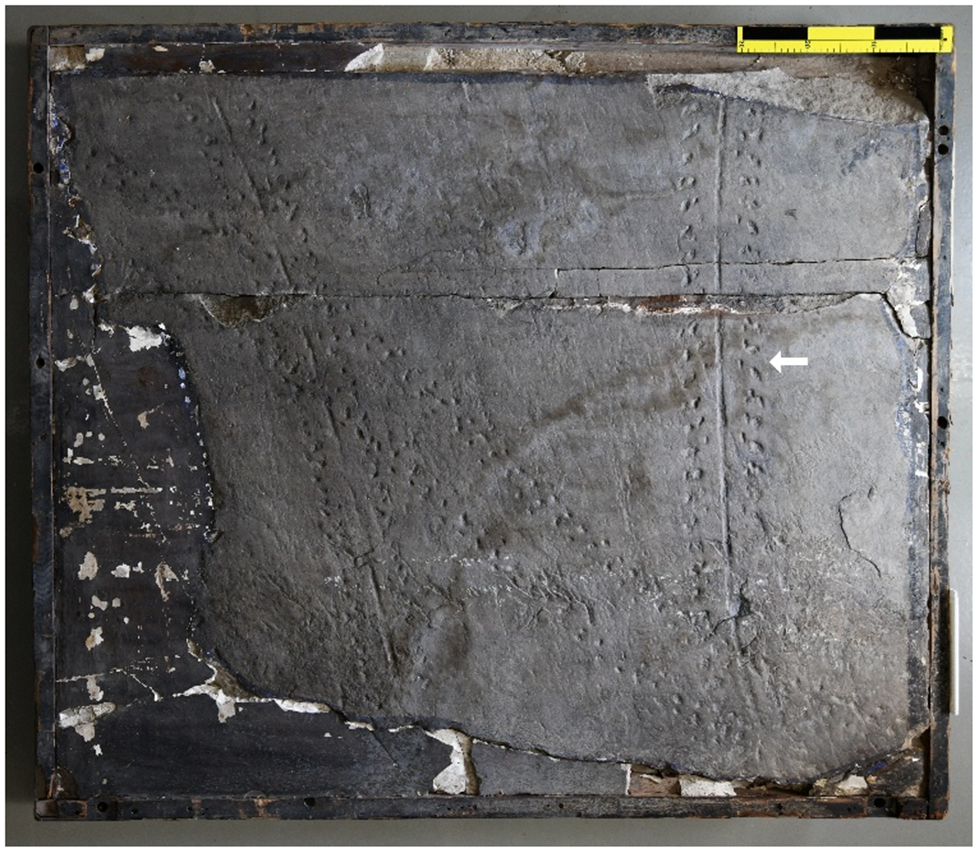
The holotype, CMNIF 34836, was again photographed at the Canadian Museum of Nature, Ottawa, Ontario, for this addendum (Fig. 1), showing that the placement and morphology of the tracks and medial impression of a section of this trackway are identical to those of Owen’s original drawing (Owen, Reference Owen1852, Pl. IX). Visual comparison of this photograph versus Owen’s drawing leaves no doubt that they do indeed represent the same specimen (Fig. 2).
Holotype of Protichnites septemnotatus, CMNIF 34836, at arrow; two other Protichnites are also present on the slab. Creative Commons Attribution–Non-Commercial 4.0 International license (CC BY-NC 4.0), https://creativecommons.org/licenses/by-nc/4.0/. Image created by Elyssa Loewen; ©Canadian Museum of Nature.
Holotype of Protichnites septemnotatus. (1) A section of CMNIF 34836, cropped from Figure 1; (2) Owen’s (Reference Owen1852, Pl. IX) original drawing of the holotype. Scale bar = 20 cm.
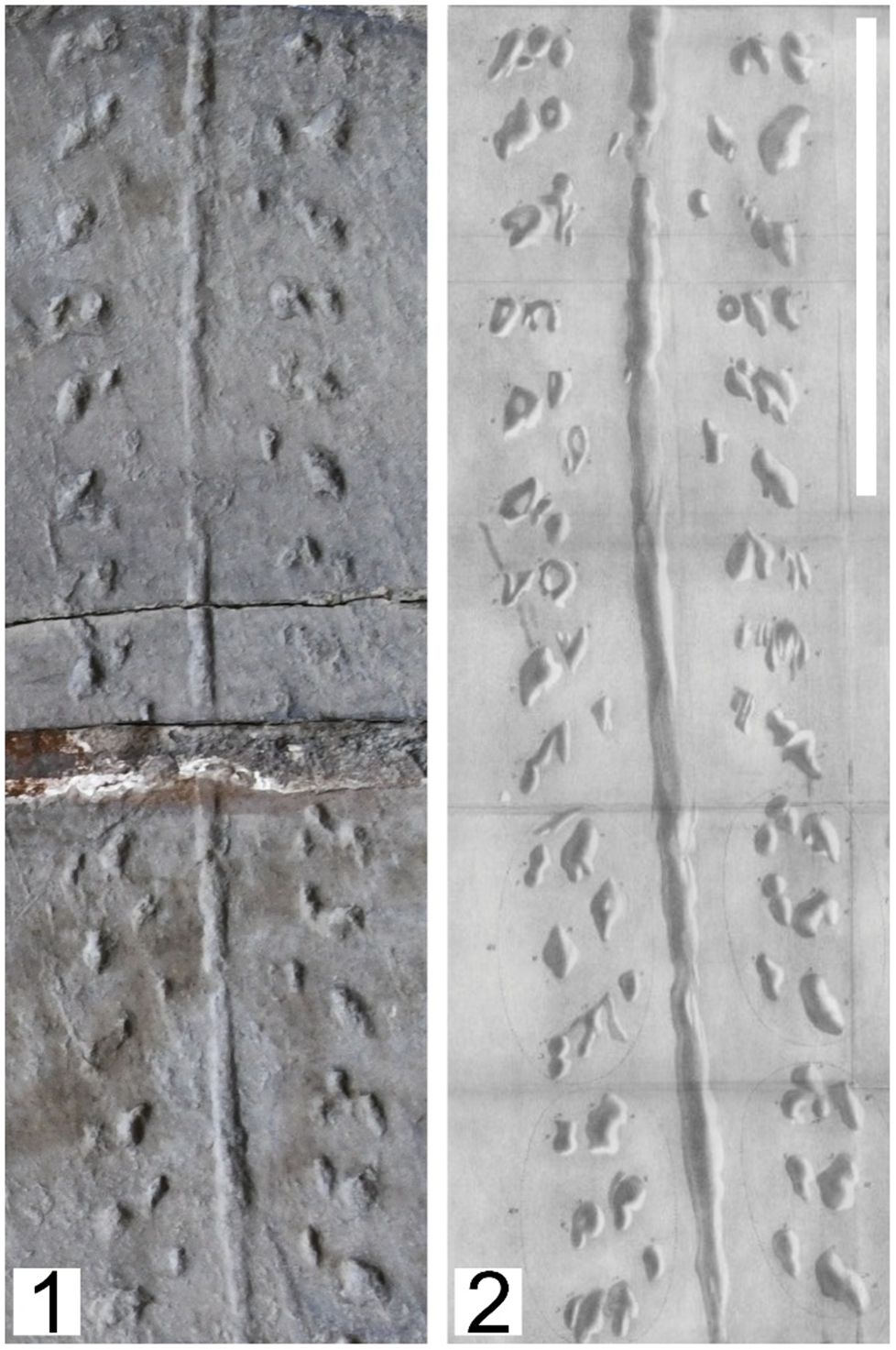
Figure 2 Long description
The image consists of two vertical panels labeled 1 and 2 at the bottom left of each section.
Panel 1 is a photograph of a gray stone slab containing the fossil trackway C M N I F 34836. A continuous, slightly raised vertical ridge runs down the center of the slab. On either side of this central ridge are two parallel rows of irregular, recessed impressions or footprints. The impressions are grouped in clusters, appearing as small, textured pits in the stone. A horizontal crack divides the slab into upper and lower sections.
Panel 2 is a grayscale line drawing of the same holotype from 1852. It mirrors the structure of the photograph with a central vertical furrow that has a wavy, rope-like texture. The lateral impressions are rendered as distinct, shaded shapes that highlight their three-dimensional form. In the lower half of the drawing, some clusters of impressions are enclosed in faint oval outlines to indicate grouping. A solid white vertical scale bar is positioned in the top right corner of this panel, representing 20 cm.
Canadian Museum of Nature specimens CMNIF 34835, CMNIF 34835A, CMNIF 34843, and CMNIF 34842 appear to be the type specimens of Protichnites alternans Owen, Reference Owen1852, Protichnites lineatus Owen, Reference Owen1852, Protichnites multinotatus Owen, Reference Owen1852, and Protichnites octonotatus Owen, Reference Owen1852, respectively (MacNaughton et al., Reference MacNaughton, Brett, Coyne, Shepherd, Gouwy and Bell2017); however, the present authors did not verify those identifications, as they are beyond the scope of this note.
This error did not affect the substance of our original publication.
Acknowledgments
We thank R. MacNaughton (Geological Survey of Canada) for background information, E. Loewen (Canadian Museum of Nature) for providing images and catalog data on the material, and C. Brett (Ontario) for alerting us to our error.



