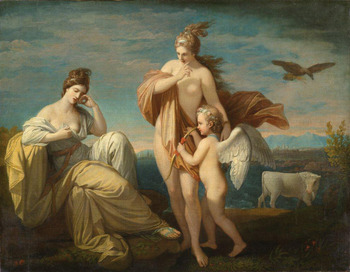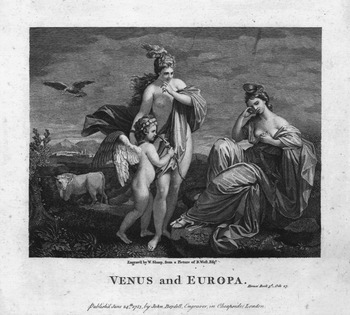


Horace's Odes may not seem the most obvious source of inspiration to a painter set on bringing mythological themes to canvas. But at some point in or around the year 1768 the Anglo-American artist Benjamin West saw fit to paint a large-scale Venus and Europa after Ode 3.27, and two years later, when the image appeared in print, it was dedicated ‘To Galatea’, thereby defining this version of the Europa myth firmly in relation to Horace's poem (Figs. 1 and 2).
Venus and Europa, by Benjamin West. Oil on canvas, ca. 1768. North Carolina Museum of Art, Raleigh, Gift of Mr. and Mrs. L. Y. Ballentine, G.60.13.1. Reproduced by kind permission of the North Carolina Museum of Art.

Venus and Europa, after Benjamin West. Print made by William Sharp and published by John Boydell, London, 1783. Reproduced by kind permission of the British Museum.

To readers of Ode 3.27, such a dedication will surely be a cryptic one. Scholars of Horace have long contested the nature of the relationship between Galatea and Europa, and indeed it is hardly clear to the viewer of the print, at least on first inspection, what West (or his printmaker, William Sharp of London) meant by the inclusion of Galatea in his dedication.
This paper is not about Benjamin West, but at its close I will return to West's images, suggesting that they make surprisingly appropriate use of the poem's themes (as I read them). The art historian Sarah Monks has recently written compellingly of the inseparability of West's mythological paintings from the political circumstances of their production and circulation, and it is my contention in this paper that one important and usually unremarked aspect of Ode 3.27 is also historically contingent – and that this aspect holds the key to the Galatea–Europa analogy.Footnote 1 Though the circumstances hinted at by poem and painting are oceans apart, both tell stories which go well beyond the disputed female bodies which lie so distractingly on their surfaces, and both Horace and Benjamin West use Europa's myth to play their own games of geopolitics, imperialism and embryonic cultural identities.
The main challenge to anyone attempting to elucidate 3.27 is to reconcile the address to Galatea with the long Europa analogy which monopolises the final two thirds of the poem. For some readers, such as Fraenkel, these two disjointed sections make for an ode entirely lacking in unity; for others, such as Nisbet and Rudd, it is sufficient to read the long mythical exemplum as a warning to Galatea, a past or current girlfriend apparently about to leave Horace for another man.Footnote 2 But even though we are given virtually no information on Galatea's identity or her relationship to Horace, the comparison between Galatea and Europa must surely be absurd on many counts, and by the final lines, tua sectus orbis | nomina ducet, the mismatch of mythical exemplum to amatory situation is blatant and unashamed. It is well known that Europa had a continent named after her in recompense for her rape by Zeus, but it is less than likely that one of Horace's ex-girlfriends would in similar fashion give her name to a section of the world.Footnote 3
The problem is easily resolved. For the Europa–Galatea analogy to make sense, Galatea must also correspond to a landmass. And in 23 BCE, when Odes 1–3 first saw the light of publication, it happens that the name Galatea corresponded remarkably well to a newly significant sectus orbis, Galatia in Asia Minor, which had two years earlier been transformed into a vast new Roman province.
Galatea as Galatia: the evidence for a cross-continental love affair
How farfetched is this proposed correspondence between Galatia and Galatea, and what point is Horace trying to make with it? Before delving into the question of a politicised love-affair and a quadruple analogy between two women and two landmasses, Galatea/Galatia–Europa/Europe, I offer supporting information both internal and external to the text for the presence of Galatia in Ode 3.27.
Most obviously there is an argument from political circumstance. The use of the name Galatea in the closing sequence of a book of tangentially politicised poems in 23 BCE would surely have sparked thoughts of Asia Minor. Galatia's transformation into a Roman province in 25 BCE was certainly a significant episode in the politics of the period;Footnote 4 it was the first kingdom to be transformed into a province since Actium, and this would have been an extremely appropriate time for an imaginative exercise which made reference to the event.
There are also etymological links between Galatea and Galatia beyond the obvious homophony of the two names. The kingdom of Galatia was originally named for the Galli who settled there in large numbers in the third century BCE, the remnants of the army led by Brennus in his 281 BCE attack on Greece. But Galatia, like many other cities and regions in Asia Minor, had also appropriated its own Hellenistic foundation myth,Footnote 5 in which the name Galatea was drawn from the name of the mythical founder Galatos, whose mother was none other than the sea nymph Galatea.Footnote 6 Mythologically speaking, therefore, the Galatians are Galatea's offspring, and if Horace were seeking to invent a personification of the province there is no more obvious name he could have chosen.Footnote 7
Looking within the text for possible Galatea/Galatia references, the least ambiguous pointer remains the final couplet. I list here a few more possible Asia Minor lusus, but it should be noted that my identification of them is circumstantial and based on an existing idea that there is analogy to be found within the poem – none of them necessarily declares an unequivocal allegiance to Asia Minor:
-
(a) At vv.25–6 Europa trusts her snowy flank, niveum latus, to a treacherous bull, dolosus taurus ; the snowy Taurus mountain range to the south of Galatia was a major geographical feature of Asia Minor, and, moreover, a region which was still strongly resisting incorporation into the new Roman province at the time this collection emerged into public view.Footnote 8 The Taurus is not actually within the geographical region of Galatia, but was close enough that it may well have been associated with Galatia in the Roman popular imagination.
-
(b) At vv.26–8 Europa pales at the scatentem | beluis pontum , the sea bubbling with beasts; Pontus in the northeast of Asia Minor had been the site of ferocious battles during the first century BCE, in the reign of Pompey's great adversary Mithridates VI, and had threatened to destroy Roman power east of Europe utterly.Footnote 9 Galatia had had a key part to play in relations between Rome and Pontus, and no history of Rome and Galatia could leave Pontus out of the picture.Footnote 10
-
(c) There may also be verbal play at vv.32–7, which contain the words vidit, victa and veni in quick succession; Julius Caesar's report to the senate on his 47 BCE victory in Galatia was the famously concise veni vidi vici.Footnote 11 A tough point to press, perhaps, but a teasingly neat sequence of verbs for the reader with a Galatian agenda in mind.
There are surely more such double entendres and covert references, no doubt revealing themselves according to how taken the reader is with the conceit of an underlying Asia Minor theme; whether it signifies, to take one example, that the last king but one of Galatia, a good enough friend to the Romans to have acquired the name Philoromaios, was called Deiotarus or ‘divine bull’, is surely beyond demonstration.
Moving outwards, the relevance of the analogy may also be wrapped up to some extent in 3.27's engagement with the works of earlier poets. I would tentatively suggest that Horace may have been thinking of Callimachus’ lost hexameter poem Galatea while writing about his own Galatea. There are only two remaining fragments of this poem, but one of these describes the Gallic leader Brennos leading his army over the sea to attack Greece, and if the attribution of the fragment is correct, then Horace's poem was probably not the first to have dealt in some way with the two competing etymologies of Galatia (Galli/Galatea) – Callimachus had been there before him. It would follow that 3.27 is likely to contain other references to Callimachus’ Galatea which are now largely untraceable.Footnote 12
Another model on which Horace certainly drew is Moschus’ Europa, written in Alexandria in the mid second century BCE and one of the main ancient models for the Europa myth.Footnote 13 While Moschus’ poem is not ultimately dominated by geography – the key theme, in the words of Fantuzzi and Hunter, being ‘Europa's own awakened sexuality and her naïve innocence’Footnote 14 – the girl's continental destiny is the opening point of the poem and unambiguously an important facet of the story. If the nymph Galatea is to be associated with the province Galatia and/or its founding mother then the poem's analogy with Europa, who was raped by Zeus and compensated by having Europe named after her, need baffle no reader. This extract from Europa's dream in the opening passage of Moschus’ Europa brings out the intercontinental aspects of the earlier text:
When Moschus’ Europa wakes up from her sleep she gathers her maidens and goes off to the longshore meadows to gather flowers, taking with her a golden basket. The images with which this basket is wrought add still more symbolic significance to the tale which follows; they show the rape of Europa's grandmother Io, who like Europa was seduced by a god and went on to give her name to a landmass, in this case Ionia. Moreover, we are told that the basket had initially belonged to Europa's grandmother Libye, who had also been raped by a god in her turn and had given her name to the continent Libya. As Hopkinson writes, ‘Europa inherits not only the basket, but also the experiences depicted on it.’Footnote 15
The continental bedrock of this Alexandrian ‘reference-point for the ode’ (Nisbet and Rudd)Footnote 16 firmly reinforces the sense that landmasses are important in 3.27.
While there is no unequivocal proof in the evidence I have offered – political timeliness, correspondence with Galatia's own foundation myths, possible textual play, and poetic predecessors – for the reading of the province Galatia into the identity of Horace's addressee Galatea, the aggregation of circumstance, taken in conjunction with the poem's loaded final lines, is surely enough to convince that a region of Asia Minor does indeed play a part in 3.27.
Galatia in the late 20s BCE
Before I provide further political context for the changing status of Galatia, both in actuality and in the Roman imagination, it is important to rein in the political, intercontinental aspects to the poem. Ode 3.27 is not only about Galatia, and clearly cannot be taken as a political tract. Firstly, the name Galatea has resonance beyond Asia Minor, as a name commonly used of Greek freedwomen and, memorably, the name of the mythic nymph beloved of the cyclops Polyphemus – whose popular image goes far beyond her identification with the region of Galatia.Footnote 17 When Horace waves goodbye to yet another of his lady friends it is certainly not unfair for the reader to set the shaggy senex singing a last (and potentially pretty vitriolic) song of unrequited love in an amusingly cyclopean context. We might note that at Propertius 1.8.12 the Nereid Galatea is invoked for the purposes of bringing good luck to a sea-voyage.Footnote 18 As I try to identify some of the implications of the farewell to Galatea it would be crude to imagine that the personification of a province constitutes the entire personage addressed by Horace in 3.27.
However, the state of affairs concerning the new province of Galatia and its place in the Roman imagination in c. 23 BCE should surely also be taken into account as we try to unravel Horace's interests here. I have mentioned that Galatia was the first kingdom to be annexed as a Roman province since the battle of Actium. We do not know exactly how Galatia became a Roman province in 25 BCE, although a remark of Strabo suggests that Amyntas, the last Galatian king, may have bequeathed it ‘to Augustus’ in his will.Footnote 19 From the perspective of 23 BCE, however, Augustus’ treatment of Galatia would have been an episode well worth attention, and one giving rise to many questions. What would this first annexation mean for the other semi-independent kingdoms of the Roman Empire? Was this the beginning of a period of much tighter imperial control from the centre?Footnote 20 What exactly was the new status of Galatia? Erich Gruen suggests that, rather than being a question of policy, this was more of an ad hoc, not to be repeated decision, but in 23 BCE this would have been by no means the inevitable reading of the situation.Footnote 21 Horace's poem is obviously not the most secure ground from which to make judgements of this sort, but it may have been far from ridiculous at the time (whether for Horace or for others) to view the annexing of Galatia as a potentially critical moment in the development of an Augustan empire – or at least one whose repercussions could not be foretold with any certainty. This was a period when such precedents were shaping the new political settlement hailed by the Odes collection, for all the Mediterranean world to digest.
We should also regard Galatia within a broader historical framework. The region had played a key role in Rome's troubled relations with Pontus, and also an uneven one: although after 86 BCE (when Mithridates treacherously murdered the tetrarchs of Galatia and their families)Footnote 22 Galatian allegiance was primarily to the Western invaders, Galatians had fought for both Mithridates and the Romans in their time.
Similarly shifting was the Galatian record of involvement in the Roman civil wars.Footnote 23 In 48 BCE at Pharsalus the Galatians supported Pompey and on Pompey's death they transferred loyalty to Mark Antony, but on the eve of Actium, like many others, they switched sides to support Octavian (in a move mentioned by Horace in Epodes 9.16–19 as a defining moment of the battle: ad hunc frementes verterunt bis mille equos | Galli, canentes Caesarem, | hostiliumque navium portu latent | puppes sinistrorsum citae – a grand moment for the Galatians, even if the words do contain a fair dose of irony at the warped idea of a victory reliant on non-Roman intervention).Footnote 24 In short, Galatian allegiance to Rome had been a chequered story, and Galatia's place in the Roman imagination of 23 BCE was, at least to some extent, up for grabs, ripe for redefinition under the glare of the spotlight currently trained on the brand new province.Footnote 25
Interpretation and equivocation
How should one interpret this poem in the light of such an influx of external contextual material? With a new and diversified identity assigned to Galatea the whole rationale behind the poem comes into question, but, while the presence of the province Galatia does demand some reformatting of ideas, the essential trajectory of the poem, its tone and its narrative strategies, remain largely unchanged by the geopolitical intrusion. In the following few paragraphs I will transfer wholesale many of the ideas and observations of Michèle Lowrie's reading of this poem in her book Horace's narrative odes, appending a few notes on how a Galatia reading would affect and be affected by her account.Footnote 26 Ode 3.27 challenges the reader to balance a political reading, where Galatea stands in for her eponymous province, with a romantic one, which the presence of a political undercurrent by no means usurps entirely, and also with the other possibilities of the lyric, such as the compelling suggestion of Kilpatrick that the voyage undertaken is that of Horace's book itself, ‘like Europa, starting out rashly, then suffering fear and self-reproach, but finally achieving fame’.Footnote 27 A geo-political interpretation can slot into and engage with, rather than crudely obliterating and replacing, the tones and trajectories already observed by readers of 3.27.
Lowrie's reading is one which, rather than trying to force sense on the contradictory and dislocated lyric and narrative threads of 3.27, embraces the contradictions and the dislocations as a conscious and complex poetic strategy. At the start of her analysis she writes that the poem ‘thwarts unity without entirely throwing it over as a criterion’, and that ‘C.3.27 uses all modes of signification at poetry's disposal… but in every case something keeps from adding up to a unified whole. The point? More than mere humour; a serious and rigorous sending up of the limits imposed by the desire for sense.’Footnote 28 She ends by stressing the ‘impossibility of any definitive ending’ to the poem, writing that ‘the lyric sense we are offered defies closure’.Footnote 29
Bringing Asia Minor into the poem doesn't have to work against this anti-closural reading, even if it does give a slightly more satisfactory closural weight to tua sectus orbis | nomina ducet in the final lines. At the beginning of the poem, where Horace demonstrates his unreliability as an auspex, misinterpreting, ‘whether wilfully, through ignorance, or through irony’ the jumble of omens of the first three stanzas,Footnote 30 it surely makes sense to transfer his pretensions and failures as a prophet of love to the role of political commentator, a role which he takes on of necessity by bringing such a volatile and current political state of affairs into his poem. And just as the omens failed to cohere for the prophet of love, so they fail to cohere for the prophet of empire: judging by the scattergun effect of his list of signs, Horace is neither advocating any particular policy nor predicting any particular future for Galatia; indeed it is to be expected that he would shrink from making too fixed a pronouncement on a still volatile situation involving a territory of such indeterminate cultural connotations.
As the poem progresses, the ambiguities remain. One traditional interpretative crux has been the question of Horace's relationship to Galatea, closely linked to the question of Jupiter's relationship to Europa. There have been many scholarly attempts to work out the location in the narrative of the rape or seduction of Europa by Jupiter, to decide whether or not Europa has already been raped when she makes her speech and whether the speech is couched in terms of foresight or of regret;Footnote 31 it has also been pointed out, most comprehensively by Strauss Clay in her article ‘Providus auspex’, that there is definite evocation of marriage rituals in the Galatea section of the poem as well as the obvious reference to marriage in Venus’ culminating promise to Europa that she is or soon will be (depending on how we translate esse nescis in v.73) the uxor invicti Iovis.Footnote 32 But the when and the where, and the specifics of the rape/marriage/seduction, are never set down in black and white. They are left instead to the imagination of the reader, however over- or underactive that happens to be. Translate this uncertainty onto the critical moment of the assimilation of Galatia as a Roman province, and to the relationship between Galatia and her metaphorical lover (whether we see Horace's analogue in this role as Rome or Augustus or a combination of the two)Footnote 33 , and we are left with an impression of Galatia's transition as something whose characteristics or significance cannot quite be pinned down. Has Galatia undergone a brutal rape at the hands of Rome, which will leave her as a miserable imperial concubine, or is her loss of independence going to be recompensed by a future of conjugal bliss as Rome's beloved bride? Whichever the answer, the imprint in 3.27 of a new Roman province can certainly help to rationalise the feeling of so many readers that Galatia's journey is to end in a marriage: a highly felicitous and appropriate outcome to an overseas affair. The positive note on which the poem closes, and the benevolence with which Horace bids good luck to Galatea at v.13, sis licet felix ubicumque mavis, seem to indicate hopes for a productive marriage between Galatia and Rome, even if the muddled omens and the obscuring of the actual moment of sex in the simile of Europa leave plenty of space for uncertainty – just as with Europa and Jupiter and with Galatea and Horace, we can never be quite certain from this poem whether Galatia's new relationship is in her interests or not.
Another issue pointed up by Lowrie among others is the question of who, in the second part of the poem, and if Europa is to be the analogue for Galatea, corresponds to the poet: ‘Jupiter, the ravisher? The paternal superego who admonishes the girl in her imagination? Venus, who orchestrates the joke at the girl's expense?’ Lowrie's eventual answer is that ‘each analogy has a grain of truth but fails to satisfy’.Footnote 34 Bringing Asia Minor into this picture would require the reader to associate these three figures not only with Horace but also with Rome, and perhaps Augustus. Rome is both imperial superpower and voice of judgement on the event, and Venus is the goddess claimed as ancestral deity by her ruler. Thus far in the Odes Horace has avoided associating Augustus with Jupiter, and it seems unlikely that Augustus’ views could be dissemblingly recreated as those of Europa's critical father, but it may be fair to see at least some hint at overlap between princeps and machinating deity.
We might also ask who can be associated with Europa's father – whether he represents the people of Galatia itself, for example, casting judgement and despising the kingdom for its lost autonomy – or whether his is simply a disembodied voice of opinion. When he tells Europa that she should commit suicide unless she wants to hand her royal blood over to a barbarian mistress whom she will serve as a courtesan (nisi erile mavis | carpere pensum | regius sanguis, dominaeque tradi | barbarae paelex)Footnote 35 , should the kingdom Galatia be taking this as a warning not to surrender her autonomy? Or should she listen rather to the assurances of (Augustan) Venus telling her that she is now (or is about to become) the wife of unconquered Jove, the honoured consort of the highest source of imperium in the world? Ultimately, the assigning of specific extra-poetic identities to these voices and characters is surely less important than recognition of their multiplicity and contrariness in relation to one another.
The poem ends with this appearance of Venus, whose speech is surely of great, if not necessarily clear-cut, import for the Galatia implications of the narrative.Footnote 36 Venus here must undoubtedly take on a degree of political significance as the goddess of the Augustan regime, a role that she will come to occupy more fully in Horace's later works, the Carmen Saeculare and Odes 4, but which has so far remained undeclared in Odes 1–3.Footnote 37 Her speech is introduced by the words ubi lusit satis, ‘when [the goddess] had had enough of games’; it opens by commanding the girl to dispel her anger and promising that the bull will render up his horns for punishment, and then consoles her with the promise of her future immortality as wife of Jupiter and eponym of a part of the world. For Lowrie, the concluding promise of immortality ‘takes the place of sex’, and immortality also implies ‘rereading and the impossibility of any definitive ending’.Footnote 38 Where Galatia is concerned, the mention of a marriage, as I mention above, looks like a hope for a harmonious political relationship, and on the question of why a bullish Rome might render up his horns to be torn, perhaps Horace implies that Rome as well as Galatia is investing a measure of trust in the relationship, and that she too could stand to lose if it all goes wrong. The promise of immortality perhaps suggests that Galatia's prospects of longevity (whether in literary or actual terms) will be significantly improved by her adjunction to the Roman Empire.
Of course, all this is spoken through (at least) a double veil of metaphor, and it would be rash to push such readings as unambiguous. And just to redouble the metaphoric veils, it is surely another of the demands that the poem makes of us that we question the wider significance of the comparison to Europa. On the one hand Europa is analogous to Galatea and Europe is analogous to Galatia, but on the other, Europe and Galatia are two very separate entities with a (semi-) concrete and definitely ranked relationship towards one another – one is a small kingdom/province, the other a continent. Just as commentators have often found the Galatea/Europa pairing a jarring one,Footnote 39 so the comparison of Galatia/Europe is unbalanced and surely precludes neat readings of the analogy.
It may also be fair to widen this poem out into a question of two cultural-geographical opposites rather than a continent (or an imperial power) versus a province, and to think of Galatia not only as a specific kingdom involved in specific events but as in some way metonymic for Asia Minor and indeed Asia, bringing the issues of the poem into a global context. When Herodotus opened his history of the Graeco-Persian wars with the tale of the reciprocal thefts of Io and Europa by eastern and western powers respectively, he was creating a backdrop of tit-for-tat against which to depict all major conflicts in the region.Footnote 40 Just so, by equating the case of Galatea (whatever that ‘case’ might entail) to the case of Europa, Horace creates yet another tit-for-tat narrative between East and West, another conflict focalised through sexual transgression, where one theft is not only just like another but is also inescapably linked to the last – and he thus gives to the case of Galatia the possibility of an almost unending ancestry of causation. This is an over-explication, but if we are to ask the question of why Galatea is so directly (l.25 sic) compared to Europa – a question that scholarship on this poem has always asked – then our answer must necessarily touch on larger scale, age-old questions of East–West relations. On the one hand, sic magnifies a minor event into a major one; on the other, it draws out the major cultural and historical currents which can be reignited by a potentially minor event.
The already mixed metaphor of East and West is rendered still more elaborate by a further sophistic twist. I mentioned earlier the curious ethnicity of the Galatians, whose provocative Gallic origins certainly dominate their identity as imagined by the Romans. The famous image of the dying Gaul in Hellenistic art is a representation of Pergamon's Gallic adversaries, the ancestors of these new Roman provincials, and Livy, for example, sees them as Gallo-Graeci (they are more usually Ἑλληνογαλάται, as in Diodorus Siculus)Footnote 41 , ‘Celtic Greeks’, combining the traditional effeminacy of the East with the traditional ferocity of the West.Footnote 42 However we begin to think of the Galatians – and however Horace intends us to look upon them – their exact ethnic identity (like their allegiance or otherwise to Rome) is, as well as an issue for genealogists and ethnographers, an irresistible stimulus for mythologisation and for discursive and exemplary analogising. How ‘Gallic’ can these people be painted, two and a half centuries after their ancestors first settled in Asia Minor?Footnote 43 For the purposes of simplification and writing allegory it is impossible to say whether the Galatians are Europeans or Asians, Westerners or Easterners – an ambiguity which no doubt adds to their fitness to purpose in the tangled web of analogy constructed by 3.27.
Finally, it should be borne in mind that the motif of a province as a sexualised girl is standard imperialising procedure in typifying a subject people; as A. K. Keith shows (with relation to epic) in her book Engendering Rome, the literal or symbolic inscription of women into heroic landscapes is a poetic commonplace,Footnote 44 and R. R. R. Smith notes that ‘Series of provinces and people . . . were a distinctively Roman way of representing their empire visually, and reflect a distinctively Roman and imperial mode of thought’.Footnote 45 For all the subtlety that this essay imputes to Horace's poem, 3.27 relies on basic ideas of gendered conquest to make its point. He will develop this use of the personified, sexualised ethnic group further in Odes 4, I believe, with the figure of Ligurinus in 4.1 and 4.10, who must surely correspond in some sense to the recently subdued Alpine peoples of cognate name, the Ligurians. Ligurinus is rendered more complex than Galatea by his gender, and by the fact that, in 4.10, he is actually envisaged as growing up, a transition which suggests a changing relationship on the one hand between Horace and the object of his pursuit, on the other between Rome and the Ligurians.Footnote 46 But at the same time one should probably also be thinking about the personifications of conquered ethnic groups which appear on monuments such as the Trophy of the Alps and the Sebasteion at Aphrodisias in the early imperial period – these too are comparanda for Horace's Galatea, however much the poet's skills as a wordsmith enable him to bring nuance and ambiguity to his subject matter.Footnote 47
Horace's bon voyage to Galatea is one which writhes and prevaricates and refuses to settle, not only on a storyline or a moral position but also on the question of the boundary between the life erotic and the life political – a boundary which the reader of this collection has surely found cause to wonder about already in the course of her or his journey through Odes 1–3, and for whose porosity Galatea provides an exemplary case-study. Of course, there are no grand conclusions or explanations to be found in this poem, unless a commitment to indecision is to be taken as in some sense exegetic on Horace's part – but then that in itself may seem too pat a formulation to carry much meaning.
I return finally to Benjamin West, and I repeat the arguments of Monks, from her article ‘The Wolfe man: Benjamin West's Anglo-American accent’, to show that, here if anywhere, the painting of Venus and Europa bears reproduction alongside Horace's poem. Like Horace, West was working against a volatile political backdrop. He painted Venus and Europa in or around the year 1768, in the period leading up to the American Revolutionary War of 1775–83; the engraving was published in 1779, and then again in 1783. In these turbulent years of transatlantic unrest, it has been argued that many of West's ostensibly non-politicised paintings should in fact be related to contemporary anxieties over the ongoing Anglo-American separation, and Monks writes that in several of his works, West may be envisioning the relationship between the two lands as an erotic one: ‘West's sustained imagery of love partakes of the rhetoric – of magnetic attraction and connection, of the lover's wounds, and of resistance affectionately withstood – with which transatlantic conflict and its ideal resolution were figured by British America's advocates.’ She sees his Venus and Europa, combining as it does ‘erotic mythological imagery with a meditation upon the consequences of independence and disloyalty’, as ‘the closest we get to an outright statement’ of such intentions.Footnote 48 The central positioning of Venus ‘in an ambivalent and contemplative pose . . . invit[ing] us to choose between a ravished figure mourning her moment of abandon to the left, and the brute force of history and its distant but glittering compensations to the right’, may be an embodiment of meditations on an impending political rupture.Footnote 49 The dedication of the print to Galatea, meanwhile, recalling Horace's farewell, sis licet felix ubicumque mavis, fits well into such an interpretationFootnote 50 – although it is unknown whether the well-wishing sentiment should be attributed to West himself or to someone else, conceivably his radically pro-American London engraver William Sharp.
Throughout her discussion, Monks emphasises West's avoidance of conclusive political statement or affiliation, both in relation to this painting and on the level of his visible personal politics. Ultimately, his image ‘refus[es] to resolve itself into a celebration of continental recompense or an empathetic treatment of wounded Europa. Simultaneously victim and victor, outcast and queen, she is an overloaded figure who stands for both the perils and the rewards of both independence and loyalty’.Footnote 51 It is an ambiguity which Monks sees as pervasive in West's work of this period, and which she relates to his own awareness of his customer base (George III was a patron): ‘West's non-specificity, multiplicity and equivocation allowed him to evade definition, ensuring that his polished surfaces and pictorial grandiosity would remain intact as indications of ready acquiescence to the demands placed upon him.’Footnote 52
The acrobatics of analogy demanded by West's painting are very different from those of Horace's poem. The nature of the patronage and the political reconfigurations of the two works are thousands of years and thousands of miles removed from one another, and any attempt at comparison would be purely rhetorical.Footnote 53 But if Monks is right, and if Galatea is (almost) Galatia, then Venus and Europa provides a complex and engaging (even if unintentional) response to the imperialising musings of Ode 3.27. That Horace's skit on a land about to lose its independence is refigured for a land about to gain its independence is perhaps no unseemly fate for a poem so determined to keep all its options open and preclude any definitive judgment on the part of the reader.