

Introduction
The rise of digital labour platforms has profoundly reconfigured global labour markets, enabling organisations to outsource tasks on demand while circumventing traditional employment protections (Aloisi Reference Aloisi2016; Prassl Reference Prassl2018). This transformation intensifies the core–periphery divide that has long been articulated in labour market segmentation theory, whereby a secure core’ workforce coexists with a larger, contingent ‘periphery’ that endures uncertain roles with minimal protection (Atkinson Reference Atkinson1984; Kalleberg Reference Kalleberg2003). Crucially, in platform settings, such as Upwork, Fiverr, and similar services, algorithmic matching systems and reputational metrics now replace human managers in allocating tasks, monitoring performance, and adjudicating disputes (Ajonbadi et al Reference Ajonbadi, Adekoya, Mordi, Cronk, Islam and Taofik2025; Meijerink et al Reference Meijerink, Fisher, McDonnell and Wiblen2024).
Much existing research on platform work has primarily examined these dynamics within high-income economies, emphasising low pay, algorithmic control, and diminished worker autonomy (Berg and Rani Reference Berg and Rani2018; Schor et al Reference Schor, Attwood-Charles, Cansoy, Ladegaard and Wengronowitz2020). By contrast, there is an emerging literature in developing-country contexts where distinctive features, such as high unemployment, weak regulatory frameworks, and unreliable infrastructure, have been found to reshape the interplay between precarity and opportunity (Anwar and Graham Reference Anwar and Graham2021; Cook and Rani Reference Cook and Rani2025; Porteous Reference Porteous2020). Investigating these settings is essential because pervasive informality, in which a significant number of employment arrangements exist outside formal contracts (Folawewo Reference Folawewo2016), combined with weak legal protections and frequent power and connectivity failures, reshapes how platform algorithms govern access to work and income stability (Adekoya et al Reference Adekoya, Mordi, Ajonbadi and Chen2025). Moreover, developing-country contexts shed light on how digital platforms can simultaneously act as economic lifelines and sites of heightened exploitation, offering critical empirical contrasts that refine our theoretical understanding of algorithmic labour markets and guide more inclusive policy interventions (Rani and Furrer Reference Rani and Furrer2021).
To address this gap, we employ a qualitative approach to investigate how labour market segmentation shapes the increasing incidence and lived experiences of web-based platform workers in developing-country contexts. Further, we explore how these segmented structures inform experiences of precarity, economic security, and work meaningfulness. Nigeria, Africa’s largest economy, provides a theoretically illuminating case. It occupies a paradoxical position in the global digital labour market in that it combines a rapidly expanding pool of digitally skilled youth with persistent reputational stigma, currency volatility, and infrastructural deficits that jointly shape how digital opportunity is experienced and constrained (Adekoya et al Reference Adekoya, Mordi, Ajonbadi and Chen2025; Dah et al Reference Dah, Zahonogo and Kaboré2025; Idowu and Elbanna Reference Idowu and Elbanna2022). Nigeria has become a continental hub for online freelancing and digital entrepreneurship, with Lagos, Abuja, and Port Harcourt all emerging as key centres for remote work and IT outsourcing (Adekoya et al Reference Adekoya, Mordi, Ajonbadi and Chen2025). Yet, Nigerian platform workers often report barriers linked to perceived national stigma and algorithmic biases that affect visibility and client trust (Ajonbadi et al Reference Ajonbadi, Adekoya, Mordi, Cronk, Islam and Taofik2025; Dah et al Reference Dah, Zahonogo and Kaboré2025). Moreover, macroeconomic instability, particularly naira devaluation, and weak internet and power infrastructure, create distinctive forms of precarity even for skilled digital workers (Idowu and Elbanna Reference Idowu and Elbanna2022).
This study contributes to the platform economy and labour studies literature in several ways. Specifically, we respond to calls for more context-specific, qualitative research on platform work in the Global South (Ajonbadi et al Reference Ajonbadi, Adekoya, Mordi, Cronk, Islam and Taofik2025; Anwar and Graham Reference Anwar and Graham2021). Existing literature disproportionately focuses on location-based platforms, such as Uber and Bolt, particularly in urban centres, while under-representing web-based forms of platform labour. Furthermore, our findings refine labour market segmentation theory by highlighting the technology-mediated mechanisms, which we conceptualise as algorithmic segmentation, through which platform-mediated visibility, client evaluation and reputational trust shape workers’ access to tasks, income stability, and bargaining power. We also demonstrate the importance of contextual moderators, notably infrastructural deficits and socio-cultural validations, that condition platform outcomes and inform perceptions of meaningful work (Hackman and Oldham Reference Hackman and Oldham1976; Rosso et al Reference Rosso, Dekas and Wrzesniewski2010). Finally, we offer practical policy recommendations, aligned with the United Nations’ Sustainable Development Goal (SDG) 8, ‘to promote sustained, inclusive and sustainable economic growth, full and productive employment and decent work for all’.
Literature review and theoretical underpinning
Labour market segmentation theory remains a useful framework for understanding structural inequalities and patterns of precarity within modern labour systems (Kesici Reference Kesici2022; Wilkinson Reference Wilkinson2013). The theory distinguishes between primary labour markets, characterised by secure, well-paid jobs and opportunities for progression, and secondary labour markets, where workers face instability, limited protection, low wages, and constrained mobility (Bosanquet and Doeringer Reference Bosanquet and Doeringer1973; Kalleberg Reference Kalleberg2003). These divisions are not temporary or merely individual outcomes but structural arrangements shaped by institutional rules, employer strategies, and unequal bargaining power (Harrison and Sum Reference Harrison and Sum1979). Atkinson’s (Reference Atkinson1984) flexible-firm model extends this logic by showing how firms preserve a relatively secure ‘core’ workforce while shifting uncertainty and risk to a flexible ‘periphery’. This framework remains important for analysing how employment systems distribute security and insecurity unevenly.
The rise of digital labour platforms has intensified these dynamics while also complicating established assumptions about segmentation. Platforms such as Upwork, Fiverr, and Freelancer allow firms and clients to access global labour pools while avoiding many obligations associated with standard employment (Aloisi Reference Aloisi2016; Prassl Reference Prassl2018). Platform work is often presented as flexible and autonomous (Hall and Krueger Reference Hall and Krueger2018; Lehdonvirta Reference Lehdonvirta2018), but critical studies show that such autonomy is frequently constrained by algorithmic control, customer ratings, information asymmetries, and limited avenues for redress (Berg and Johnston Reference Berg and Johnston2019; Schor et al Reference Schor, Attwood-Charles, Cansoy, Ladegaard and Wengronowitz2020; Wood et al Reference Wood, Graham, Lehdonvirta and Hjorth2019). Veen et al (Reference Veen, Barratt and Goods2020), for example, caution that platform control is not reducible to algorithms alone; rather, it operates through technological infrastructures, opaque performance systems, and asymmetries of information that restrict worker choice. This is important because it positions digital platform work not as a break from older forms of labour control, but as a reconfiguration of them through technological and contractual arrangements.
The proliferation of platform work also raises questions about the continuing relevance of segmentation theory and its treatment of precarity. Traditional models have often associated insecurity with low-skill or low-status work, yet many web-based platform workers are skilled professionals, including programmers, tutors, designers, and research assistants, who nonetheless experience income volatility and weak protection (Adekoya et al Reference Adekoya, Mordi, Ajonbadi and Chen2025; Lepak and Snell Reference Lepak and Snell2002). Skill and expertise no longer guarantee stability when access to work depends on platform visibility, digital reputation, client discretion, and algorithmic ranking (Schor et al Reference Schor, Attwood-Charles, Cansoy, Ladegaard and Wengronowitz2020). Segmentation is therefore increasingly reproduced within platforms, rather than only between firms, as workers are sorted into unequal positions through ratings, search visibility, task allocation, and client trust (Kuhn and Maleki Reference Kuhn and Maleki2017). These processes are further shaped by inequalities of geography, gender, nationality, ethnicity, and migration status, which affect how workers enter, remain in, and benefit from digital labour markets (Tassinari and Maccarrone Reference Tassinari and Maccarrone2020; Van Doorn et al Reference Van Doorn, Ferrari and Graham2023).
Recent scholarship has sharpened this differentiated view of platform work. Kougiannou and Mendonça (Reference Kougiannou and Mendonça2025) distinguish between gig-dependent workers, who rely on platform work for survival, and casual giggers, who use it as supplementary income. This distinction suggests why flexibility may be experienced as an opportunity by some workers but as insecurity by others. For gig-dependent workers, flexibility can become illusory because economic dependence reduces their ability to refuse work, exit the platform, or absorb income shocks. Mendonça and Kougiannou (Reference Mendonça and Kougiannou2025) similarly argue that platform workers’ ability to build individual and collective power varies according to their labour market position, nationality, migration status, and level of dependence on gig work. These studies are useful because they challenge any tendency to treat platform workers as a homogeneous group.
Van Doorn et al (Reference Van Doorn, Ferrari and Graham2023) offer a related intervention by showing that platform work can simultaneously degrade working conditions and provide much-needed livelihood opportunities for vulnerable workers. Their work on migrant labour is especially important because it rejects a simple exploitation-versus-empowerment binary. Platform work may provide access to income for workers excluded from standard labour markets, while still deepening their exposure to insecure, under-protected, and commodified forms of work. This duality is particularly relevant in developing-country contexts, where weak social protection, limited formal employment, and high informality may make platform work attractive even when it remains precarious (Anwar and Graham Reference Anwar and Graham2021; Graham et al Reference Graham, Hjorth and Lehdonvirta2017).
This duality also connects with debates on subjective job quality and meaningful work. Veen et al (Reference Veen, Barratt, Goods and Baird2026) argue that workers may report satisfaction with objectively poor-quality gig work because their perceptions are shaped by constrained agency, labour market objectives, and life stories. Workers’ assessments of platform work must therefore be understood in relation to their broader labour market exclusion, income needs, daily responsibilities, and desire for dignity or independence. This insight is important for analysing why platform workers may value autonomy, flexibility, or international client exposure without assuming that these subjective rewards eliminate precarity.
In sum, these debates reveal three tensions that labour market segmentation theory must confront in digital contexts. First, segmentation is no longer only firm-based; it is also platform-mediated through digital visibility, ratings, and task allocation. This transformation shifts the locus of control from organisations to platforms and data architectures, introducing new sources of digitally mediated insecurity. Second, precarious positioning is not confined to low-skilled work, since skilled and knowledge-intensive workers may remain peripheral when income depends on uncertain demand and reputational ranking. Third, platform outcomes are shaped by contextual conditions such as infrastructure, currency volatility, regulation, and socio-cultural perceptions, especially in the Global South (Adekoya et al Reference Adekoya, Mordi, Ajonbadi and Chen2025; Heyes and Yates Reference Heyes, Yates, Smith, Dibben and Wilkinson2025). These tensions suggest that segmentation theory remains highly relevant, but it requires adaptation to account for how technological and contextual forces shape workers’ access to income, security, and mobility.
This study, therefore, uses labour market segmentation theory as a sensitising framework (Peck Reference Peck1989; Wilkinson Reference Wilkinson2013) for examining web-based platform work in a developing-country context. Rather than assuming that digital platforms simply reproduce old inequalities or generate wholly new ones, we explore how platform-mediated work intersects with worker dependence, local infrastructure, global client relations, and socio-cultural meanings. This framing anchors our qualitative analysis of Nigerian web-based platform workers and enables us to examine how precarity, economic security, and meaningful work coexist within segmented digital labour markets.
Research context
Nigeria, Africa’s most populous nation and largest economy, presents a compelling context for exploring platform labour. Despite its economic scale, the country faces persistent unemployment (5.3% as of 2024), together with widespread underemployment and informality (National Bureau of Statistics 2024). A significant proportion of the workforce is engaged outside formal employment (Folawewo Reference Folawewo2016). By contrast, formal jobs are limited and often inaccessible due to bureaucratic and socio-economic barriers, prompting many to pursue informal or alternative forms of work (Adekoya et al Reference Adekoya, Mordi, Ajonbadi and Chen2025).
The Nigerian labour market exhibits marked characteristics of structural segmentation. Public and private employers have increasingly relied on casual and contract labour to reduce costs and limit obligations (Ajonbadi Reference Ajonbadi2019; Asaju et al Reference Asaju, Arome and Anyio2014). These dynamics reflect the core-periphery logic of labour market segmentation theory, wherein employers retain a small, secure workforce while relegating most workers to precarious, externalised roles. In this environment, digital platform work has gained traction, offering income opportunities amid a shrinking formal sector.
Despite infrastructural deficits, such as inconsistent power supply and unreliable internet, Nigeria hosts a growing population of digital workers. The country is a key contributor to Africa’s estimated 4.8 million platform workers, supported in part by initiatives such as the government-backed Naija Cloud, which promotes digital microwork and freelancing (Anwar and Graham Reference Anwar and Graham2021; Porteous Reference Porteous2020). However, web-based platform work in Nigeria exists in a regulatory vacuum. Labour laws do not recognise platform workers as employees, denying them access to minimum wage protections, social security, and collective bargaining rights (Ajonbadi et al Reference Ajonbadi, Adekoya, Mordi, Cronk, Islam and Taofik2025). Workers contracted through global platforms are further excluded from local oversight. These conditions reinforce precarity and expose workers to exploitation, especially in the absence of alternative livelihoods (Idowu and Elbanna Reference Idowu and Elbanna2022).
Social and cultural dynamics further shape platform work experiences. Gender norms often restrict women’s participation in traditional employment, making web-based work more attractive for its flexibility and domestic compatibility. Yet, this may inadvertently reinforce unpaid care burdens and labour feminisation (Adisa et al Reference Adisa, Mordi, Simpson and Iwowo2021). Additionally, global perceptions of Nigeria as a cybercrime hub affect trust in Nigerian freelancers, with some reporting discrimination or reduced job access based on nationality (University of Oxford 2024). Therefore, in this context, web-based platform work represents both an opportunity and a site of intensified labour precarity. Its rise in Nigeria reflects broader economic, institutional, and social asymmetries that demand closer scrutiny.
Methodology
Research approach and data collection
This study adopts the interpretivist paradigm to understand the study participants’ subjective meanings and experiences within the research context. Interpretivism helps to observe, collect, and interpret information by drawing inferences from the patterns that occur during an event or experience (Creswell and Creswell Reference Creswell and Creswell2018). The researchers aim to investigate the experiences of the Nigerian web-based platform workers to examine the broader implications for work and employment in Nigeria. Thus, the study adopts a qualitative research approach to allow the researchers to capture more in-depth perspectives of the researched phenomenon and enable the participants to provide deep and detailed accounts of their platform work experiences.
We focused on web-based platform workers in Nigeria to understand the experiences of this cohort, unlike many previous studies that have focused heavily on location-based platform labour, leading to the ‘Ubercentricity’ of research (Schor et al Reference Schor, Attwood-Charles, Cansoy, Ladegaard and Wengronowitz2020) or single-platform studies such as those focused on the popular Nigerian ride-hailing platforms, including Uber, Bolt and Gokada, or on-demand digital logistics platforms (e.g., MVXchange and KariGo). Instead, we focus on a multi-platform study of under-represented platform workers such as social media influencers, online tutors, online research assistants, online programmers, product reviewers, and online proofreaders. This group of platform workers contributes to global production networks rather than being limited to one geographical location. It also offers the opportunity to examine the heterogeneity in workers’ situations and experiences of platform work. Furthermore, it provides the possibility for a cross-platform study to explore similarities and distinctions between the web-based and location-based platform labour using the findings from previous studies on location-based platform labour.
Data was collected virtually through Zoom and Microsoft Teams. This communication medium was deemed appropriate in order to reach this geographically dispersed group of workers. It is challenging to reach this cohort of platform workers because they mainly operate in virtual space, so the snowballing sampling technique was adopted. This enabled us to leverage the rapport built within our internal networks, who then recommended other potential participants (Creswell and Creswell Reference Creswell and Creswell2018). While practical for hidden or networked populations (Saunders et al Reference Saunders, Lewis and Thornhill2019), snowballing carries a risk of bias toward digitally connected, English-speaking, or middle-class participants. To mitigate this, we deliberately sought variation in gender, occupation, region, and level of platform dependence. For instance, initial contacts included both full-time and part-time platform workers across six occupational categories, and subsequent referrals were screened to maximise diversity.
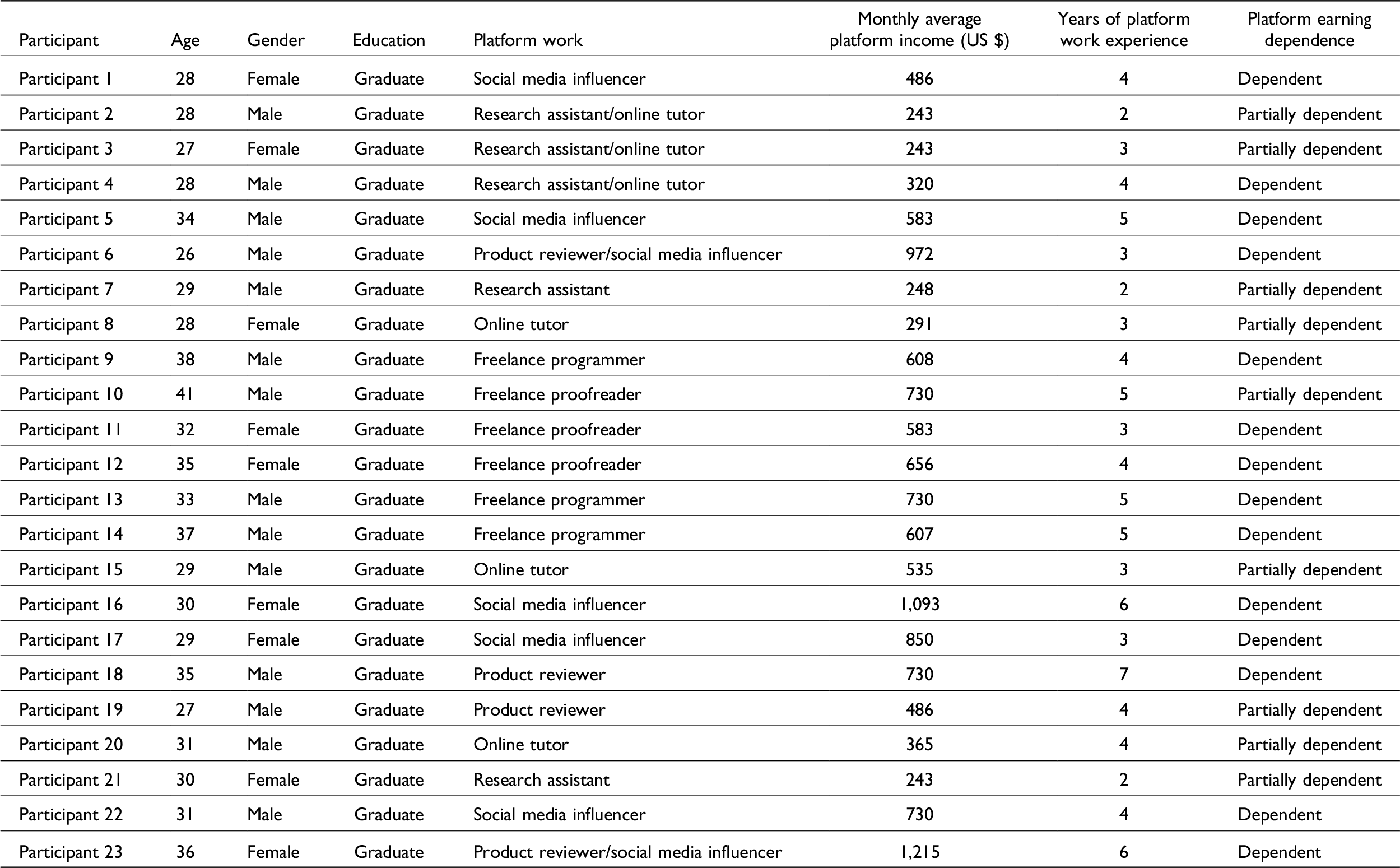
Each interview lasted approximately 40 minutes and followed a semi-structured guide exploring platform work histories, motivations, working conditions, income dependence, and perceptions of job security and meaning (see Appendix 1). Interviews continued until thematic saturation was reached – defined here not as complete saturation across all subgroups, but as cross-occupational thematic saturation, where no new conceptual insights emerged relevant to the overarching research questions (Saunders et al Reference Saunders, Lewis and Thornhill2019). This approach acknowledges that, given the heterogeneity of occupations studied, saturation within each subgroup was not the goal of this exploratory inquiry. In total, 23 semi-structured interviews (14 males, 9 females) aged between 20 and 45 years were conducted (see Table 1 for participant details). To ensure confidentiality, pseudonyms were assigned to all participants in line with ethical standards (Saunders et al Reference Saunders, Lewis and Thornhill2019).
Participants profile

Table 1. Long description
The table presents detailed information about 23 participants in a study on platform work. It includes columns for Participant, Age, Gender, Education, Platform work, Monthly average platform income (US $), Years of platform work experience, and Platform earning dependence. Each row provides specific data for individual participants. For example, Participant 1 is a 28-year-old female graduate who works as a social media influencer, earns 486 US dollars monthly, has 4 years of experience, and is dependent on platform earnings. Participant 2 is a 28-year-old male graduate who works as a research assistant/online tutor, earns 243 US dollars monthly, has 2 years of experience, and is partially dependent on platform earnings. This pattern continues for all 23 participants, detailing their respective information across the specified columns.
Data analysis
Following the interviews, which all the authors conducted, the collected data were immediately transcribed. We adopted a thematic analysis procedure and open-coding approach, followed by the development of themes (Braun et al Reference Braun, Clarke, Terry, Rohleder and Lyons2014). Open coding enabled the fragmentation and segmentation of meaningful data for analytic interpretation (Creswell and Creswell Reference Creswell and Creswell2018). Through this process, we identified recurring practices, experiences, and motivations among platform workers. These included job insecurity, income irregularity, client dependence, demand for foreign-currency earnings, work flexibility, infrastructure constraints, and perceived work meaningfulness.
However, our analysis moved beyond descriptive thematic categorisation. In line with the exploratory nature of the study, we adopted an abductive analytic logic, moving iteratively between the empirical data and labour market segmentation theory. This enabled us to examine how participants’ accounts reflected broader structural processes, rather than treating them only as individual experiences. For instance, codes such as ‘no contract’, ‘workflow unpredictability’, ‘payment delay’, and ‘client dependence’ were interpreted in relation to peripheral labour, limited bargaining power, and insecure access to work. Similarly, accounts of foreign-currency earnings, savings and work prestige were analysed in relation to the conditions under which platform work offers relative advantage without necessarily overcoming structural precarity.
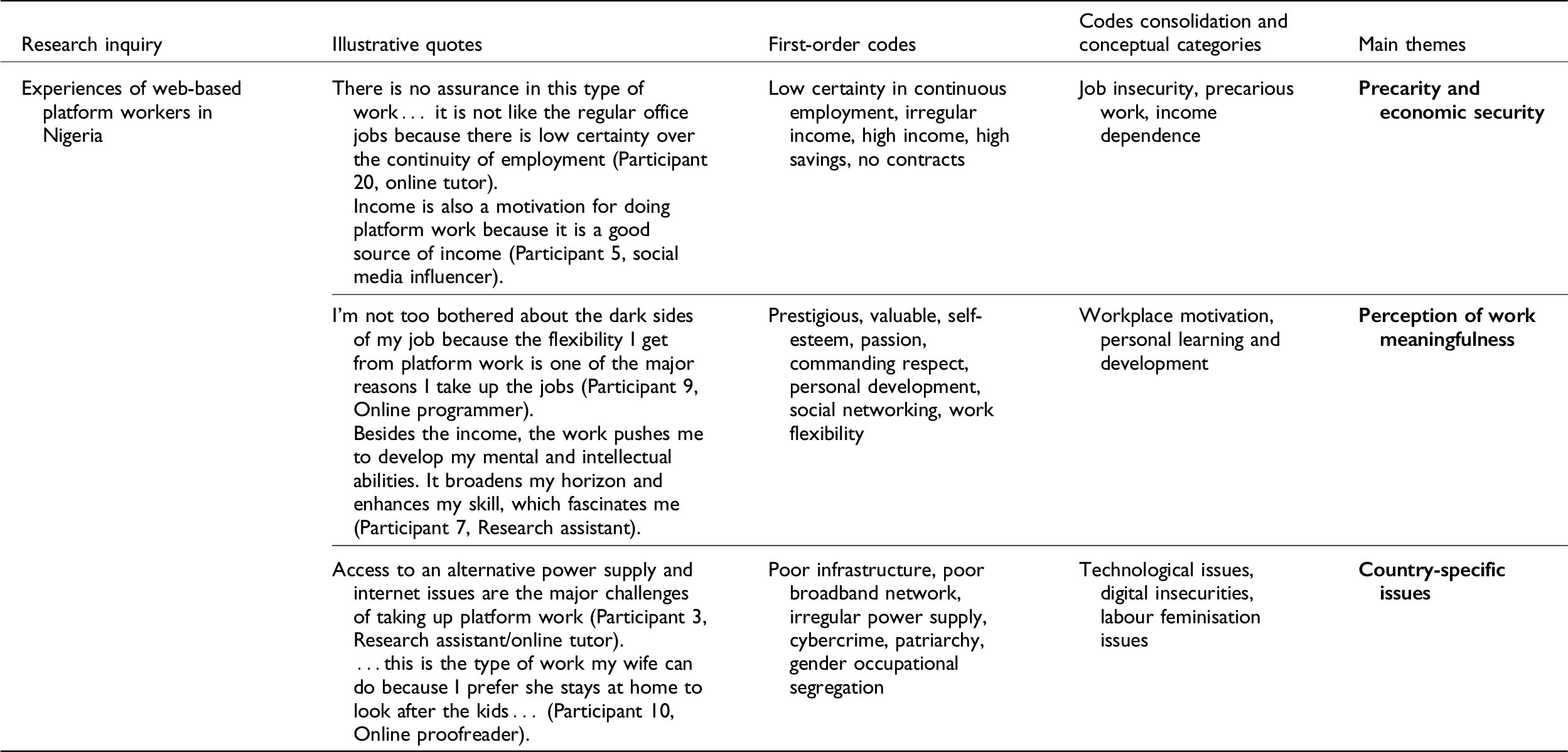
This process allowed us to identify not only what participants experienced but also how these experiences pointed to mechanisms through which segmentation is reproduced in web-based platform work. In particular, we examined how access to work, income stability, and perceived mobility were shaped by the interaction of platform-mediated task allocation, client evaluations, weak labour protections, and country-specific constraints such as poor infrastructure and reputational stigma. Thus, the analysis treated themes as entry points for theorising structural processes of segmentation, rather than as stand-alone descriptive categories. Table 2 presents the summary of our themes.
Key themes and codes
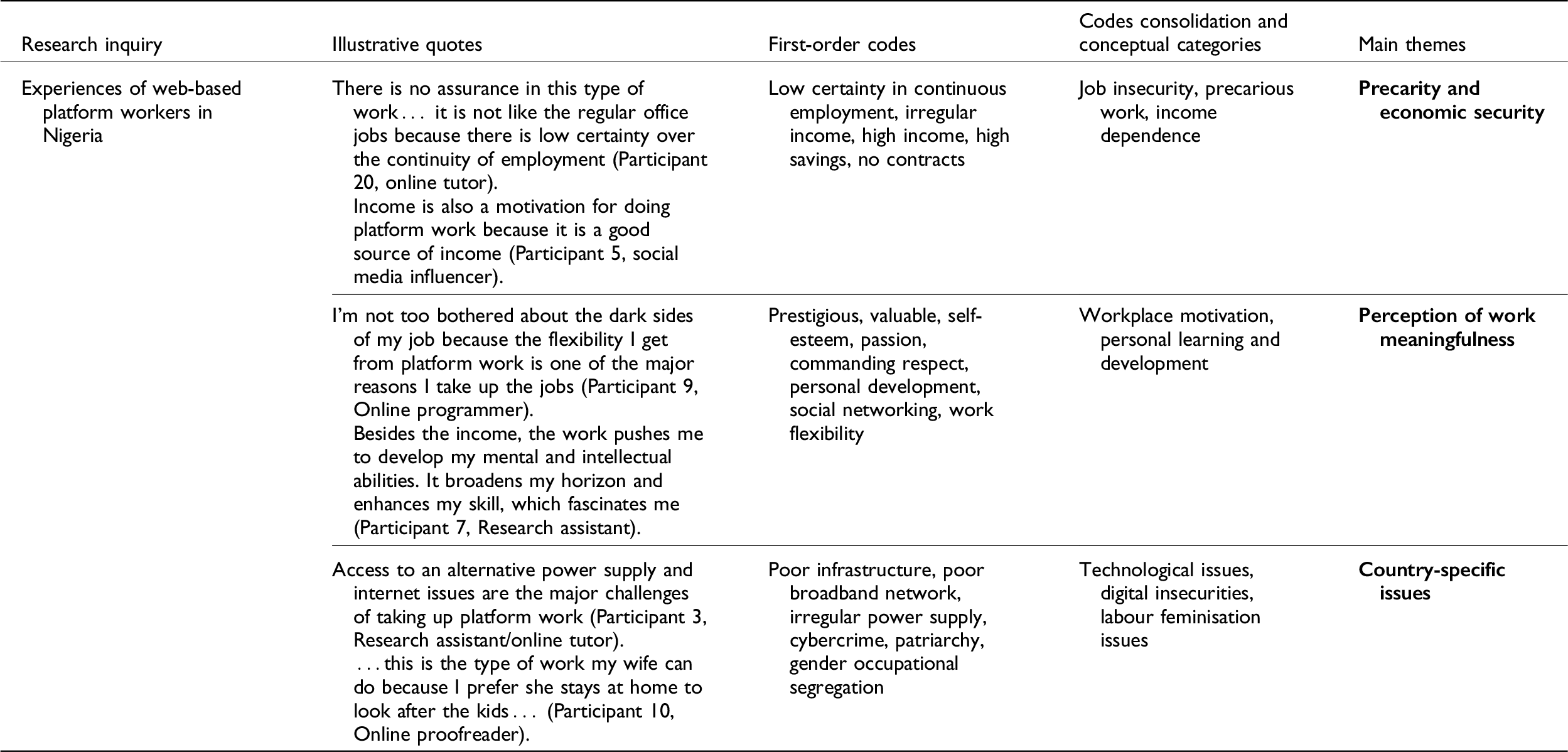
Table 2. Long description
A table with five columns and four rows, detailing research themes, illustrative quotes, first-order codes, consolidated codes, and main themes. The columns are labeled Research inquiry, Illustrative quotes, First-order codes, Codes consolidation and conceptual categories, and Main themes. Row 1: Research inquiry: Experiences of web-based platform workers in Nigeria; Illustrative quotes: There is no assurance in this type of work it is not like the regular office jobs because there is low certainty over the continuity of employment (Participant 20, online tutor). Income is also a motivation for doing platform work because it is a good source of income (Participant 5, social media influencer).; First-order codes: Low certainty in continuous employment, irregular income, high income, high savings, no contracts; Codes consolidation and conceptual categories: Job insecurity, precarious work, income dependence; Main themes: Precarity and economic security. Row 2: Research inquiry: Experiences of web-based platform workers in Nigeria; Illustrative quotes: I’m not too bothered about the dark sides of my job because the flexibility I get from platform work is one of the major reasons I take up the jobs (Participant 9, Online programmer). Besides the income, the work pushes me to develop my mental and intellectual abilities. It broadens my horizon and enhances my skill, which fascinates me (Participant 7, Research assistant).; First-order codes: Prestigious, valuable, self-esteem, passion, commanding respect, personal development, social networking, work flexibility; Codes consolidation and conceptual categories: Workplace motivation, personal learning and development; Main themes: Perception of work meaningfulness. Row 3: Research inquiry: Experiences of web-based platform workers in Nigeria; Illustrative quotes: Access to an alternative power supply and internet issues are the major challenges of taking up platform work (Participant 3, Research assistant/online tutor). This is the type of work my wife can do because I prefer she stays at home to look after the kids (Participant 10, Online proofreader).; First-order codes: Poor infrastructure, poor broadband network, irregular power supply, cybercrime, patriarchy, gender occupational segregation; Codes consolidation and conceptual categories: Technological issues, digital insecurities, labour feminisation issues; Main themes: Country-specific issues.
To enhance analytic rigour, all authors independently reviewed the transcripts and initial codes before comparing interpretations for investigator triangulation (Saunders et al Reference Saunders, Lewis and Thornhill2019). Discrepancies were discussed and resolved collectively, after which overlapping codes were consolidated into broader categories and final themes. We further confirmed and refined the themes through repeated engagement with the data and relevant literature.
During the data analysis process, we followed the validity procedure suggested by Hayashi et al (Reference Hayashi, Abib and Hoppen2019). Descriptive validity was supported by verbatim transcription and careful handling of the data. Interpretive validity was strengthened through member checks, whereby selected participants were contacted to verify whether our interpretations resonated with their lived experiences. Their feedback indicated that the interpretations were consistent with their accounts. Theoretical validity was pursued by iteratively moving between the data and labour market segmentation theory, allowing us to develop explanations that remained grounded in participants’ narratives while also speaking to broader theoretical debates.
Given the qualitative and exploratory design, the analysis does not claim statistical generalisability or direct observation of platform algorithms. Rather, our claims are analytically bounded, in that we theorise from workers’ reported experiences of platform-mediated work to identify perceived and experienced mechanisms of segmentation. The study therefore offers a contextually grounded explanation of how segmentation may operate in web-based platform work, while recognising that future research using platform-level data, comparative designs or longitudinal methods could further test and refine these mechanisms.
Findings
Our findings are categorised into three overarching themes: (1) precarity and economic security, (2) perception of work meaningfulness, and (3) country-specific issues, all of which are presented in the following sections.
Precarity and economic security
Precarity in employment has been a concern for many decades. However, as Garben (Reference Garben2019) suggested, platform labour may have exacerbated the level of precariousness. This is particular to our study, where the participants allude to the high level of job insecurity, given that platform work sometimes places them on ‘temporary’ or ‘no’ contracts. The following quotes exemplify the precariousness of platform work exacerbated by job insecurity:
My work is done solo, and I’m not registered under any government agency, so I don’t get to pay taxes … One thing that is inevitable about my type of job is that nothing is certain because you don’t get to know precisely when the next available task is… I have no contract because my work is based on the frequency of demand, so the contract isn’t a big issue for me despite workflow unpredictability. (Participant 3, Research assistant/online tutor)
The irregularity of income is a characteristic of my line of work… I don’t always get paid monthly, but sometimes I could get paid multiple times in a month, depending on the number of tasks available during that period… There is no job security, and you can’t actually ascertain when work will be available, so I tend to take them as they come. (Participant 18, Product reviewer)
These accounts underscore a structural lack of stability in platform-based work. Participants highlighted the unpredictability of workflow and the absence of contracts, making consistent employment and income impossible to guarantee. The uncertainty about task availability and client continuity reinforces a persistent sense of vulnerability, leaving workers with little control over their employment circumstances.
This persistent instability in job availability directly intersects with the broader nature of precarious working conditions that characterises platform labour. Participants highlighted the lack of formal protections, including paid leave, health insurance, and resources in disputes. One respondent noted:
If you fall sick or have a family emergency, there’s nothing like paid time off. You just don’t earn that period. (Participant 15, Online tutor)
Another participant explained:
Sometimes the clients delay payment or argue about the work even when it’s done well. And you can’t force anything; there’s no one to report to. (Participant 11, Freelance proofreader)
These statements reveal how vulnerability is embedded in the platforms’ work structure. Workers bear all risks associated with health, time, and payment delays, while clients and platforms remain largely unaccountable. The absence of enforceable contracts and accessible dispute resolution mechanisms further entrenches this precarity.
Despite the precarious nature of platform work in Nigeria, many participants expressed a sense of calm or acceptance toward its uncertainties. For most, web-based platform work provided a degree of economic security, especially in light of the country’s relatively high unemployment and underemployment rates and lack of social safety nets. Of the participants, 14 were fully dependent on platform income, while 9 were partially dependent. Regardless of dependence level, participants generally reported satisfaction with the financial outcomes that the platform work afforded them:
Platform work is not my major source of income, but an additional source… However, when the opportunities to generate income from this work arise, it comes in handy and helps to cater to things that I have not been able to afford with my fixed income… On average, I earn 350,000 naira [248 USD] monthly from platform work, which is a good income based on Nigeria’s standard. (Participant 7, Research assistant)
It would surprise you that the income from platform work is often double or triple what I earn from my permanent job as a lecturer in Nigeria. I depend so much on platform work because it pays more than my permanent job, given that I am paid in pounds or US dollars… the take-home pay from my permanent job sometimes doesn’t take me home [laughs]… I tend to save more from my uptake of platform work because I make up to 450,000 naira [320 USD] monthly. (Participant 4, Research assistant/online tutor)
These perspectives illustrate how platform work can provide a financial buffer, either by supplementing fixed salaries or serving as a primary income stream. This contrasts with dominant narratives in global literature that often equate platform work with low wages and exploitative pay structures. In the Nigerian context, however, the economic realities shift this perception. Unlike location-based platform workers (e.g., Uber drivers) who are paid in the local currency (Naira), most web-based platform workers reported being paid in foreign currencies (US dollars). Thus, the high exchange rate (1 USD to 1410 Naira at the time of data collection) meant that even modest foreign-currency earnings translated into substantial local income. The average platform income reported was 589 USD, significantly higher than Nigeria’s minimum wage (approximately 50 USD) and even the average worker’s income (70 USD) (Forbes Africa 2024). For participants with permanent jobs, platform work often yielded higher income and better savings potential. For those without other employment, it represented a viable and comparatively lucrative livelihood option.
In sum, these findings suggest that local economic contexts deeply shape the experience of platform work and that income dependence may offer not just subsistence but upward financial mobility for some Nigerian workers.
Perception of work meaningfulness
The concept of meaningful work, defined as ‘the degree to which the employee experiences the job as one which is generally meaningful, valuable, and worthwhile’ (Hackman and Oldham Reference Hackman and Oldham1976, 162), has recently been popularised and shown increasing interest by practitioners and academic researchers whose attention is drawn to work as a source of meaning and purpose (Bailey et al Reference Bailey, Yeoman, Madden, Thompson and Kerridge2019; Kubiak Reference Kubiak2020). When employees perceive their job as boring, mundane, and repetitive, they often become demotivated and find it challenging to understand how their work is significant to their organisation’s success (Chillakuri et al Reference Chillakuri2020). Our findings demonstrate the subjective perception of work meaningfulness among the participants:
I feel proud because this line of work means that I have something to offer that is valuable to people around the world and transcends my national territory. Given the fact that the educational standard overseas is much higher than in Nigeria, being able to comprehend the task I am given as a research assistant and online tutor means a lot to me because I can boast to my friends that I teach students in the UK, US and other countries (Participant 7, Research assistant/online tutor).
Similarly, another participant remarked:
Working for an international organisation makes me feel fulfilled when I get to see how I contribute to organisations beyond my locality. Many people get to see my pictures on their websites and social media platforms, and that alone gives me joy because people in Nigeria consider working for an international organisation a prestigious job…especially my friends, they tease me about my job and respect me a lot for the same reason (Participant 1, Social media influencer).
Despite the precarious nature of web-based platform work, the participants’ responses regarding the motive for taking up platform work reveal how they define their work as meaningful apart from being a source of income. The common words used by most participants in response to their motives for taking up platform work include ‘prestigious’, ‘valuable’, ‘self-esteem’, ‘passion’, and ‘commanding respect’. These may be less attainable in location-based platform work, where some platform workers have raised concerns regarding experiencing undesirable situations while working, especially how they are treated with contempt by clients and service users who devalue their jobs (Adekoya et al Reference Adekoya, Mordi, Ajonbadi and Chen2025).
Our findings also ascribe work meaningfulness to the fact that the participants mentioned that the web-based platform work provided opportunities for social networking and self-development. This shared narrative is exemplified in the quotes below:
Personal development is a very important aspect of my work because I understand what is obtainable in other countries besides Nigeria. I have learnt a lot from the platform work because I get some great ideas, and the exposure from interacting with others outside my locale is a great feeling, besides the income it generates. (Participant 15, Online tutor)
The online platform is an avenue to connect with the global world and create a mutual and socio-economic community to progress your work. It also shows that many people are willing to associate with your craft or work and be part of your big project far beyond the borders of your community and territory. The social networking benefit is impressive; for example, many international companies have contacted me for jobs based on referrals and my activeness on social media, and I get more followers on my social media platforms. (Participant 22, Social media influencer)
In addition, like most platform work studies, a superior motive for taking up web-based platform work is associated with the perceived high level of flexibility and independence derived from working remotely. For most participants, deciding when, where, and how work is done is an exciting aspect of web-based platform work, especially for those who depend partially on platform work to support their fixed-income jobs. This viewpoint is expressed in the following quotes:
The nature of my work is more like freelance work because I can work from anywhere (e.g., at home, on transit, and other remote modes). I like to be independent and not work a regular 9–5 job, and I believe I have the skills to make this career worthwhile in the near future… My work design suits me perfectly because having that independence makes a lot of sense. (Participant 14, Online programmer)
The flexibility I enjoy from platform work means I can choose when to do the work as long as I deliver on or before the due date. Working on these platforms requires less monitoring than in the traditional workplace, and I do not have to be micromanaged (Participant 10, Online proofreader).
Our findings are unlike the location-based platform work, where platform workers (e.g., ride-hailing drivers) have increased concerns about platform control and surveillance (Schor et al Reference Schor, Attwood-Charles, Cansoy, Ladegaard and Wengronowitz2020). This does not imply the absence of control and surveillance on the web-based platforms, but rather that it is less than that found in the location-based platforms, where algorithmic management inhibits platform workers’ flexibility and independence (Adekoya et al Reference Adekoya, Mordi, Ajonbadi and Chen2025).
Country-specific issues
We found that some of the challenges and issues related to the web-based platform work are country-specific. This is not to imply that they are entirely different from other countries, but instead, we suggest that they are marked by their weighty significance and influence on the experiences of and outcomes for web-based platform workers. For instance, one significant issue among web-based platform workers in Nigeria is the poor infrastructure that often inhibits their ability to work effectively and efficiently. As exemplified by the quotes below, all participants decried the deplorable state of infrastructure in the country and how the infrastructural decay often poses severe challenges to their work:
A major challenge with online platform work is the inadequacy of basic amenities such as power supply and low-quality internet connectivity (broadband). These have been very detrimental, affecting my productivity and eventually making me lose out on some jobs. (Participant 1, Social media influencer)
I face some work-related challenges on this job, most of which are peculiar to my geographical location (i.e., Nigeria). First is the issue of poor network connectivity, which can be very frustrating in my line of work because I need constant connectivity to the internet… The power supply challenge is also a big problem because I need to power my laptop and work gadgets. I sometimes have to spend more money to power my generating set. (Participant 4, Research assistant/online tutor)
Nigeria is different from other countries where social amenities and infrastructure are in abundance. Like the location-based platform workers, web-based platform workers depend even more on sophisticated infrastructure and technologies that allow them to perform effectively. Issues relating to the irregular power supply and poor internet connectivity – the two main resources required for web-based platform work – were echoed by all the participants to hamper their work effectiveness. In Nigeria, whereas location-based platform workers are challenged by bad roads and poor transport networks (e.g., heavy traffic), web-based platform workers rely heavily on internet connectivity that enables them to work in the online space. However, despite being one of Africa’s largest telecom markets with over 100 million Nigerians connected to the internet (Russon Reference Russon2020), issues around poor network coverage and slow broadband speed impede national development and globalisation (Olusola and Christianah Reference Olusola and Christianah2013) and, in particular, the efficiency of web-based platform workers.
Furthermore, the increasing rate of cybercrime and digital insecurity is another significant issue associated with web-based platforms in Nigeria. For example, some participants remarked:
Cybercrime is also a problem for this kind of work because our country has been ‘painted black’ by some individuals who paint a picture to those overseas that we cannot be trusted with online businesses… This is perhaps one of the reasons why I sometimes get turned down despite my skills. (Participant 9, Online programmer)
I will be right to blame those Nigerians involved in ‘yahoo-yahoo’ and ‘419’ activities as impediments to a regular work supply… On some occasions, I have been tempted to change my nationality on my profile on the platforms because immediately I reveal that I’m Nigerian, some organisations don’t want anything to do with me because of the fear of being scammed. (Participant 12, Online proofreader)
Being ranked 5th in the cybercrime index (University of Oxford 2024), it becomes challenging for Nigerians to do business online with international organisations due to digital insecurity. Participants noted a rise in “419” or “yahoo-yahoo” scams – names used to address fraudsters and cybercrime perpetrators in Nigeria – which had fuelled global distrust. As a result, web-based platform workers struggle to access consistent work. Unlike their location-based counterparts, they face greater obstacles due to the international perception of cybercrime. If this trend persists, competition for limited web-based jobs may intensify, impacting labour demand and supply.
Additionally, our findings also reveal a gendered case of web-based platform work. For most female participants, the web-based platform work was highly preferred because it allows them the flexibility to manage their work and non-work-related life such as carer and family responsibilities. This is perhaps why most female participants depended solely on platform income. For example, some participants remarked:
Platform work is very attractive to women like me because of the flexibility it offers to be able to manage work and family responsibilities. This is because our culture and tradition make it challenging for women to combine work and family duties, and Nigerian men prefer that we stay at home and look after the kids while they work and provide for the family (Participant 23, Product reviewer/social media influencer).
I have two young children, and it wouldn’t have been easy to care for them if I had a normal office job… Moreover, my husband is the main provider, but I undertake platform work because I don’t want to be the usual housewife who does nothing but take care of the kids and husband (Participant 12, Online proofreader).
These narratives highlight how socio-cultural differences contribute to the heterogeneity of experiences in platform labour. Our findings show that the socially and culturally constructed views, beliefs, and value systems influence the motives behind the uptake of web-based platform labour. Contrasting with research on location-based platform labour (especially the ride-hailing platforms), women often self-select not to take up jobs as chauffeurs or taxi drivers due to the perception of safety or lack thereof (Huet Reference Huet2015). In Nigeria, despite the increasing number of female private drivers, it is not the norm to find women at the wheel of public transport, mostly resulting from gender occupational segregation, because such jobs are regarded as ‘men’s work’ (Raji Reference Raji2018). Thus, analysing gender roles as a social organisation element of a society is essential to understanding the rationale for taking up web-based platform work.
Discussion and conclusions
This study examined how labour market segmentation shapes the rise and experiences of web-based platform workers in a developing-country context, using Nigeria as an illustrative case. The findings show that web-based platform work cannot be understood simply as either precarious or empowering. Rather, it produces a more ambivalent condition in which workers may access relatively valuable income, autonomy and social recognition, while remaining structurally exposed to irregular work, weak protection, client discretion and infrastructural constraints. The central argument emerging from this study is that web-based platform work creates conditional advantage within enduring precarity. That is, workers may benefit from foreign-currency earnings, flexibility and international exposure, but these benefits are fragile because they depend on unstable access to tasks, continued client trust, platform visibility and workers’ ability to absorb the costs of participation.
The first contribution of the study is to refine labour market segmentation theory for digitally mediated work. Traditional labour segmentation theory distinguishes between protected “core” workers and precarious “peripheral” workers (Atkinson Reference Atkinson1984; Kalleberg Reference Kalleberg2003). This framework remains useful because the participants in this study clearly occupied peripheral positions, given that they worked without stable contracts, paid leave, employment benefits, or reliable dispute resolution. However, the findings also show that such peripheral positioning in web-based platform work is not produced solely by formal employment status but is also reproduced through platform-mediated access to work, client evaluation, reputation, and visibility. Workers’ opportunities were shaped by irregular task availability, client discretion, payment uncertainty and the need to remain visible and trusted in competitive digital markets. We therefore use the term “algorithmic segmentation” to describe this process, referring to how platform-mediated mechanisms sort workers into unequal positions in terms of access, income stability, and bargaining power. This concept is not intended to replace existing accounts of algorithmic management, reputational control or platform precarity. Rather, it specifies how these mechanisms generate segmented labour-market outcomes among web-based platform workers.
This distinction is important because it clarifies what the concept adds to existing platform labour debates. Algorithmic management explains how platforms coordinate, monitor, and evaluate workers (Duggan et al Reference Duggan, Sherman, Carbery and McDonnell2020; Veen et al Reference Veen, Barratt and Goods2020). Algorithmic segmentation, as used here, focuses more specifically on how these practices shape workers’ relative positions within digital labour markets. The findings show that access to income was shaped by unpredictable task availability, client discretion, platform visibility, and reputational trust. Participants’ accounts of not knowing when the ‘next available task’ would come or of being unable to secure regular work due to client distrust indicate that access to income is structured by mechanisms less visible than conventional employment hierarchies, yet materially consequential. Thus, algorithmic segmentation provides explanatory leverage by linking platform governance to the central concern of segmentation theory, that is, the unequal distribution of security, mobility, and opportunity (Kalleberg Reference Kalleberg2003; Reich et al Reference Reich, Gordon and Edwards1973).
The second contribution is to clarify the relationship between precarity and economic opportunity. As with other studies (e.g., Schor et al Reference Schor, Attwood-Charles, Cansoy, Ladegaard and Wengronowitz2020; Veen et al Reference Veen, Barratt, Goods and Baird2026), our findings appear, at first glance, to create a tension, where participants reported insecure work and weak protections, but also comparatively high earnings, savings, and financial satisfaction. Rather than treating these as contradictory, this study specifies the conditions under which platform work becomes relatively advantageous. Platform work was most beneficial for workers with marketable digital skills, access to foreign-currency-paying clients, sufficient digital literacy, and the capacity to manage the costs of internet connectivity, electricity, and equipment. It was also more advantageous for those using platform work as supplementary income, since they had some protection from income shocks. For fully dependent workers, by contrast, platform work was more ambivalent because it provided livelihood opportunities in a difficult labour market but also intensified vulnerability as income depended heavily on irregular task availability and client decisions.
This helps explain why relative financial advantage does not necessarily translate into durable mobility out of precarity. Foreign-currency earnings may exceed local wages, but workers remain excluded from employment protections, pensions, paid leave, and enforceable grievance mechanisms. They may save more than some local workers, but they cannot reliably predict future earnings. They may serve international clients, but they remain individually responsible for the risks and costs of work. This finding aligns with Van Doorn et al.’s (Reference Van Doorn, Ferrari and Graham2023) argument that platform labour can simultaneously provide livelihood opportunities and deepen structural vulnerability. It also extends the distinction between gig-dependent workers and casual giggers by showing that dependence is a crucial condition shaping how workers interpret platform work, as Kougiannou and Mendonça (Reference Kougiannou and Mendonça2025) showed. Where workers have alternatives, flexibility may be experienced as autonomy; where they depend on platform income, the same flexibility can become compulsion.
The third contribution concerns the role of context in segmented digital labour markets. The findings show that platform work in developing-country contexts is shaped not only by platform design but also by infrastructural and reputational conditions. Poor electricity supply and unreliable internet connectivity directly affect workers’ ability to complete tasks, respond to clients, and remain competitive. These are not merely background inconveniences; they are labour-market conditions that influence access to work and income stability. Workers who can afford generators, data subscriptions, or alternative workspaces are better positioned than those who cannot. In this way, infrastructure becomes a mechanism through which digital labour markets are segmented.
Similarly, reputational stigma associated with Nigerian cybercrime perceptions affected workers’ ability to secure trust from international clients. Participants’ accounts of being turned down after revealing their nationality, or feeling tempted to change their nationality online, suggest that global digital labour markets are not neutral spaces of meritocratic exchange. They are shaped by unequal geographies of trust, suspicion, and visibility. This finding supports scholarship showing that platform work is mediated by broader social, institutional, and geographical inequalities (Graham et al 2017; Anwar and Graham Reference Anwar and Graham2021; Tassinari and Maccarrone Reference Tassinari and Maccarrone2020). It also suggests that labour market segmentation in digital contexts is both platform-mediated and contextually conditioned.
The fourth contribution relates to meaningful work. Participants described web-based platform work as prestigious, valuable, and personally rewarding. They associated it with autonomy, self-development, international exposure, and social respect. At one level, these findings support established meaningful work literature, which emphasises autonomy, competence, purpose, and social value (Bailey and Madden Reference Bailey and Madden2016; Hackman and Oldham Reference Hackman and Oldham1976; Rosso et al Reference Rosso, Dekas and Wrzesniewski2010). However, the contribution of this study lies in showing how meaningfulness interacts with segmentation rather than sitting outside it. Meaningfulness helps explain why workers remain attached to precarious platform work. For participants, working with international clients provided symbolic rewards that made platform work feel socially legitimate and personally valuable, even when it remained insecure. This does not mean that meaningful work cancels out precarity. Rather, it shows how subjective valuation can make segmented work more tolerable and desirable. In a context where formal employment may be scarce, poorly paid, or socially frustrating, platform work can offer dignity, pride, and recognition. This resonates with Veen et al.’s (Reference Veen, Barratt, Goods and Baird2026) argument that workers may report satisfaction with objectively poor-quality gig work when it aligns with their labour market objectives, constrained agency, and life circumstances. In this study, meaningfulness was shaped not only by individual autonomy but also by socio-cultural validation. The status attached to working for foreign clients gave platform work symbolic value, reinforcing workers’ continued participation despite insecurity.
Practically, the findings point to several implications. First, in line with SDG 8’s focus on decent work and economic growth, governments should formally recognise web-based platform workers within labour policy. This does not require treating every platform worker as a conventional employee, but it does require minimum standards around fair pay, dispute resolution, social insurance, and protection against non-payment. Second, platform companies should improve transparency around task allocation, account visibility, client disputes, and payment processes. Workers should not have to rely on opaque systems that determine their access to income without explanation or appeal. Third, infrastructure policy should be understood as labour policy. Reliable electricity, affordable broadband, and accessible digital work hubs would reduce the private costs currently borne by platform workers. Fourth, platforms and regulators should address nationality-based stigma by ensuring that identity verification, fraud prevention, and client review systems do not unfairly disadvantage workers from particular countries. Finally, worker associations, professional networks, and civil society organisations can provide digital literacy training, peer support, and collective voice, especially for workers who are heavily dependent on platform income.
The study has limitations that provide opportunities for future research. Its qualitative, single-country design allows for rich contextual insight but does not permit statistical generalisation. The use of snowball sampling was appropriate for reaching dispersed web-based workers, but it may have excluded less-connected or lower-income workers. The study also relies on workers’ accounts rather than platform-level data, so claims about platform-mediated visibility and task access are based on perceived and experienced mechanisms rather than direct observation of algorithms. Future studies could use mixed methods, platform analytics, or longitudinal designs to examine how ratings, client behaviour, responsiveness, nationality, and infrastructure shape access to work over time. Comparative research across developing-country contexts would also help assess whether similar forms of segmentation emerge elsewhere.
In conclusion, web-based platform work in Nigeria embodies a paradox of opportunity and vulnerability. It offers skilled workers access to income, autonomy and social recognition, but these benefits remain conditional, uneven and insecure. The study’s central contribution is to show that segmentation in digital labour markets is reproduced through the interaction of platform-mediated mechanisms, worker dependence and developing-country constraints. By clarifying this relationship, the paper moves beyond simple accounts of platform work as either empowerment or exploitation and provides a more grounded understanding of how decent work might be pursued in global digital labour markets.
Supplementary material
The supplementary material for this article can be found at https://doi.org/10.1017/elr.2026.10083.
Funding statement
The authors received no financial support for the research, authorship, and/or publication of this article.
Competing interests
The authors declare no potential conflicts of interest with respect to the research, authorship, and/or publication of this article.
Open access statement
For the purpose of open access, the author has applied a Creative Commons Attribution (CC BY) licence to any Author Accepted Manuscript version arising from this submission.
Hakeem Adeniyi Ajonbadi is an Associate Professor of International Human Resource Management and Organisational Development at the University of Doha for Science and Technology, Qatar. His research focuses on labour market segmentation, workload and work–life balance, organisational flexibility, social relations of production, and HRM in emerging economies. He has published widely in books and international journals and contributes to scholarship on contemporary work and employment relations.
Olatunji David Adekoya is a Senior Lecturer in Organisational Behaviour and Human Resource Management at Sheffield Business School, Sheffield Hallam University, UK. His key research covers broad areas of management studies and human resource management, exploring critical issues such as work-life balance, employee wellbeing, workplace flexibility, workplace technologies, gender and workplace issues, green HRM, and employment relations. His research has been published in prestigious international journals.
Juliet Gladies Jayasuria is an Assistant Professor of Human Resource Management at the College of Business, University of Doha for Science and Technology, Qatar. She has extensive experience teaching undergraduate and postgraduate students across Qatar, India, and Tanzania. She holds master’s degrees in human resource management, applied psychology and management, as well as a PhD in Management. Her academic leadership includes managing business administration programmes, fostering industry and international university collaborations, and contributing to programme development, curriculum design, and benchmarking. A recipient of Faculty Excellence Awards, her interests include activity-based learning, student development, organisational learning, artificial intelligence, and sustainability in human resource management.
Chima Mordi is an Associate Professor at the University of Doha for Science and Technology, Qatar. His research focuses on comparative and international human resource management, labour relations, employer flexibility, workload regulation, work–life balance, and management in emerging and developing economies. He has published widely in books and international journals and contributes to scholarship on African business, employment relations, and contemporary workplace practices.


 Open access

