


2.1 Conceptual Foundation
Given that the main theme of this book is about the relationship between cognitive control and language, specifically about the changes in cognitive control in populations with different language abilities and levels of proficiency, this chapter introduces various theoretical constructs and conceptual models of cognitive control. The description and interpretation of the core constructs are followed by a critical review of particular theoretical models and behavioral paradigms that have been used to measure cognitive control skills in children. This chapter provides the theoretical foundation of cognitive control for subsequent chapters that discuss various aspects of language development and their interactions with cognitive control. More details for consideration of cognitive control abilities across populations with different language skills are presented in Chapters 4–10.
Cognitive control is a comprehensive construct that encompasses all the processes necessary for adapting the cognitive system to achieve goal-directed behavior, even if there are other compelling or habitual acts present and the conditions keep changing (Botvinick et al., Reference Botvinick, Braver, Barch, Carter and Cohen2001; Cohen, Reference Cohen and Egner2017). Cognitive control is constantly needed in everyday-life situations that involve switching between activities, thoughts, or languages (Dreisbach, Reference Dreisbach2012). Depending on the context, people either complete the switch or resist the interference and keep performing the current task while monitoring their own behavior. Adaptive and flexible responses play essential roles in learning situations in general and even more so during language acquisition and language processing (Mazuka et al., Reference Mazuka, Jincho and Oishi2009). To perform well on cognitive-linguistic tasks, one needs to mobilize complex cognitive control processes, including working memory, inhibition, and attention control. Although the term “cognitive control” is often used interchangeably with “executive functions” in the literature, they are not synonymous. The cognitive control framework (Botvinick et al., Reference Botvinick, Braver, Barch, Carter and Cohen2001; Egner, Reference Egner and Egner2017) has been used in this book because the control processes play critical roles in language-related tasks: in word production (Badre & Wagner, Reference Badre and Wagner2007), language comprehension (Van Dyke & Johns, Reference Van Dyke and Johns2012), and bilingual language production (Abutalebi & Green, Reference Abutalebi and Green2007). Furthermore, the behaviors associated with the cognitive control accounts are clearly defined and closely linked to specific neurobiological structures and processes (Botvinick et al., Reference Botvinick, Cohen and Carter2004; Luna et al., Reference Luna, Marek, Larsen, Tervo-Clemmens and Chahal2015; Shenhav et al., Reference Shenhav, Botvinick and Cohen2013). In contrast, “executive functions” is a broad umbrella term that has been used with various meanings and definitions in the literature (Engle, Reference Engle2002; Miyake et al., Reference Miyake, Friedman, Emerson, Witzki, Howerter and Wager2000; Zelazo & Müller, Reference Zelazo and Müller2002). Although the terms, executive functions, and cognitive control, reflect differences in scientific approach, theory, and methods, it is important to note that both constructs comprise a number of similar cognitive components, such as switching and inhibitory control.
There are different theoretical accounts defining and describing the mechanisms of cognitive control, and while a number of them complement each other well, they do differ in their focus on specific components or processes of the control system (e.g., Botvinick & Braver, Reference Botvinick and Braver2015; Botvinick et al., Reference Botvinick, Braver, Barch, Carter and Cohen2001; Cohen, Reference Cohen and Egner2017; Shenhav et al., Reference Shenhav, Botvinick and Cohen2013). Most conceptual frameworks of cognitive control seek to answer fundamental questions about the mechanisms that are related to the core features of cognitive control; the recruitment of control resources; the selection of task-relevant processes; and the increase of efficiency during performance.
2.1.1 Critical Issues
2.1.1.1 Capacity Limitations
One of the most widely discussed, yet controversial topics in the literature is the capacity limitation of the control processes. Capacity constraints have been attributed to both functional (computational) and structural limitations, but no agreement has been reached about their nature, source, or extent (Botvinick & Cohen, Reference Botvinick and Cohen2014; Musslick & Cohen, Reference Musslick and Cohen2021). There is more agreement, however, about the notion that these constraints determine the number of control-demanding tasks that can be carried out simultaneously, therefore these constraints affect all human behaviors that require control-dependent processes. Thus, both lower-level (e.g., perception) and higher-level (e.g., problem-solving) processes are influenced by capacity constraints.
The working memory literature provides a demonstrative example of different theoretical accounts with various explanations for capacity limitations. Although similar attempts can be noticed in the literature on attention control and visual processing, most of those studies also examined the capacity limitations in relation to working memory (Martin et al., Reference Martin, Tsukahara, Draheim, Shipstead, Mashburn, Vogel and Engle2021; Unsworth et al., Reference Unsworth, Miller and Robison2021). Working memory studies have shown significant advancement in the past few decades, which is reflected by the amount of complex theoretical models and by the number of publications. The changes in working memory accounts over time indicate a gradual shift in conceptualization, moving away from theories that concentrate on the number of memory representations and control-dependent processes to models that focus on the nature and integrity of representations and control processes. The earlier models emphasized either the temporal or the numerical constraints (i.e., number of representations and control-demanding processes).
The first models explaining working memory constraints were the traditional decay theories (e.g., Baddeley, Reference Baddeley2003; Baddeley & Hitch, Reference Baddeley, Hitch and Bower1974). The key assumptions of these accounts were that memory representations decay over time, unless individuals mobilize specific reactivation processes, such as rehearsal. Baddeley’s working memory account is a multicomponent model, and one of the modality-specific units is the phonological loop where verbal material can be stored for a limited amount of time. To maintain the memory items in working memory, verbal rehearsal has to be employed. Thus, the capacity constraints, according to the decay models, are associated with temporal limitations. However, the decay process can be prevented by specific strategy use (i.e., verbal rehearsal).
The concept of numeric constraints was described by the resource theories examining the amount of activation needed to store items in working memory and perform computations during task completion (e.g., Just & Carpenter, Reference Just and Carpenter1992; King & Just, Reference King and Just1991). They compared the activation demands of various tasks to the working memory capacity of the participants. Most of these studies employed variations of span tasks (e.g., listening span, reading span). According to the resource theories, if there is a shortage in the storage function of working memory, then information will be forgotten, while a shortage in the activation of the computational functions results in slower processing. The resource theories have been criticized in the literature for not being specific enough in their definitions of activation, capacity, and resources (Cohen, Reference Cohen and Egner2017; Hasher et al., Reference Hasher, Lustig, Zacks, Conway, Jarrold, Kane, Miyake and Towse2007).
An integration of the temporal and numeric processes can be seen in the time-based resource-sharing model (Barrouillet & Camos, Reference Barrouillet and Camos2001). This account argued that the maintenance of items in working memory depends on both the number and complexity of the information to be remembered and the passage of time. The model held further that, during task performance, attention must be switched continuously between information processing and reactivation of the decaying memory traces.
More recent accounts of working memory capacity attribute the constraints to interference between memory representations and/or control processes. To dispute the accounts of temporal constraints, Lewandowsky and Oberauer conducted a series of experiments with the “serial order in a box” model (e.g., Lewandowsky et al., Reference Lewandowsky, Geiger and Oberauer2008, Reference Lewandowsky, Oberauer and Brown2009; Oberauer & Lewandowsky, Reference Oberauer and Lewandowsky2008). The results indicated that recall efficiency of memory items is highly influenced by the information that must be encoded. The more similar the pieces of information, the higher the chance for interference. In these experiments, recall performance was linked to the uniqueness of items at encoding rather than to the number of elements to be remembered or to the passage of time. A number of language studies also focused on interference effects. Although all of their findings indicated that similarity-based interference plays a critical role in sentence comprehension, it remains unclear whether this interference occurred during encoding or at retrieval (Gordon et al., Reference Gordon, Hendrick and Levine2002; Van Dyke & McElree, Reference Van Dyke and McElree2006).
Taken together, our current understanding of capacity constraints is still limited. There is evidence supporting various aspects of the aforementioned theories. Computational studies provide a promising line of research, highlighting more specific interactions and trade-offs between representations and control processes (Musslick & Cohen, Reference Musslick and Cohen2021). To better understand these dynamic relationships and the nature of the control processes, future studies must continue synthesizing behavioral and neural approaches of cognitive control research.
2.1.1.2 The Continuum of Processes: From Controlled to Automatic Behavior
The applied research literature, such as studies on bilingualism, developmental disorders, and second language learning, tends to categorize the cognitive control skills of people into specific groups. One group shows more advanced skills than others; they make fewer errors; or they perform faster than their peers. These are, of course, simplifications that reflect, in part, the limitations of the tasks that are being used and some constraints in conceptualization. Cognitive control is not a dichotomic system and can only be characterized along a continuum from automatic behaviors that require no or only minimal control to highly controlled behaviors. An important task for the system is to decide whether a behavior can be performed automatically, with some control, or with a high degree of control. A related question is whether a certain behavior consistently requires the same amount of control all the time.
One contributing factor to the degree of control is the context of the behavior. The cognitive control system adapts most efficiently during a goal-directed performance when the voluntary mobilization of the control system is aligned with both the task-goals and the context of the given behavior (Bocanegra & Hommel, Reference Bocanegra and Hommel2014). To demonstrate the effect of context, a number of scholars (see later on) have referred to the Stroop task. Any typically developing school-age child or adult would need only minimal cognitive control to name the color of given objects when using their primary language. Color naming would be basically automatic as reflected by fast response times, high accuracy rates, no or minimal monitoring, and minimal effort exertion (Meiran et al., Reference Meiran, Pereg, Kessler, Cole and Braver2015). In contrast, naming the color of the ink in the Stroop test, especially for the incongruent condition of mixed blocks (i.e., only some color-words are printed in matching ink, e.g., “green” in green ink vs. “green” in red ink), would greatly challenge the cognitive system because of the interference between the color of the ink and the meaning of the color-word (MacLeod, Reference MacLeod1991). This would be seen by an increase in reaction time and in error rate, as well as in effortful performance. In the Stroop task, one needs to overcome the interference between the color of the ink and the meaning of the color-word, whereas in a simple color naming task, there is no interference. Thus, the same skill, such as color naming, might be automatic in one condition but not in another (Marton & Wellerstein, Reference Marton, Wellerstein and Teiford2008).
At the neural level, earlier studies linked these differences in context processing to activation changes in the prefrontal cortex (Cohen & Servan-Schreiber, Reference Cohen and Servan-Schreiber1992). Later studies, such as the gating model (Braver & Cohen, Reference Braver and Cohen1999), added the modulating effect of the dopamine system. This model proposed that goal-directed behavior is supported by the activation of context processing in the prefrontal cortex, which is initiated by the dopamine system. Thus, context maintenance and updating are enabled through interactions between the prefrontal cortex and the dopamine modulatory system. One of the newest models provides a framework for synthesis and expansion of previous accounts by postulating dual mechanisms of control (Braver, Reference Braver2012). According to this model, there are two operating modes for cognitive control: proactive and retroactive. Goal-relevant information is maintained in an anticipatory manner in the lateral prefrontal cortex through the proactive control mode, whereas reactive control is used to reactivate goals in conditions with interference. An example of reactive control is post-error adjustment (i.e., post-error slowing, post-error increase in accuracy, post-error reduction in interference).
Practice is another major factor contributing to the degree of control. Most cognitive and motor tasks are performed faster and more accurately with practice. This can be observed at both the behavioral and neural levels. The role of the striatum has been proven critical at the subcortical level during these processes. Early learning/practice has been linked to the associative striatum, while neurons in the sensorimotor striatum show activation once automaticity has been developed for a given behavior (Ashby et al., Reference Ashby, Turner and Horvitz2010). Moreover, newer findings provide strong evidence that the striatum produces multiple learning signals and contributes to a distributed network, including other brain areas specialized for learning (Shohamy, Reference Shohamy2011). At the neural level, the degree of automaticity is closely linked to activation in the prefrontal cortex. An essential role has been attributed to the posterior-to-anterior gradient system for more controlled processes, whereas the more automatic processes are linked to the posterior-confined system with the involvement of posterior regions (Jeon & Friderici, Reference Jeon and Friederici2015).
Individual differences in cognitive control skills also affect how efficiently children reach automaticity in task performance. The following chapters provide examples from children with advanced cognitive control skills, as well as from children with weaknesses in their control processes. While children with a language talent have shown advanced cognitive control skills and efficient achievement of automaticity (Dörnyei & Skehan, Reference Dörnyei, Skehan, Doughty and Long2003), those with language impairment have shown difficulties in cognitive control and have demonstrated slower, less efficient learning with a need for more practice to reach automaticity (Marton & Scheuer, Reference Marton and Scheuer2020; Marton et al., Reference Marton, Campanelli, Eichorn, Scheuer and Yoon2014). The weaknesses in cognitive control in children with language impairment appear to interfere with these children’s ability to achieve automaticity efficiently (Pauls & Archibald, Reference Pauls and Archibald2016).
Finally, a critical issue, that has received the most attention in sports psychology, concerns the impact of the application of top-down control to behaviors that are typically automatic. The previous examples have demonstrated how the context of a task, the level of familiarity or practice with the task, and the individual’s abilities may determine the degree of control that is needed to perform a given task. There are, however, certain instances when applying control to an otherwise automatic behavior may interfere or even impair task performance. In a color-shape selection task, Bocanegra and Hommel (Reference Bocanegra and Hommel2014) showed that with sufficient contextual information for the cognitive system to mobilize automatic processes during task performance, the application of top-down control impaired the goal-directed behavior. These outcomes are in line with the matched filter hypothesis (Chrysikou et al., Reference Chrysikou, Weber and Thompson-Schill2014), suggesting that the degree of cognitive control needed varies depending on task demands. Research with individuals who stutter further supported this hypothesis. With the use of a dual-task paradigm, Eichorn demonstrated that the speech fluency of individuals who stutter may improve when the degree of cognitive control is reduced and participants are able to rely on more implicit modes of processing (Eichorn & Marton, Reference Marton2015; Eichorn et al., Reference Eichorn, Marton, Schwartz, Melara and Pirutinsky2016). These findings support the notion that depending on the context, demands of the task, amount of practice, and individual differences, the rule of “less can be more” may provide a more efficient approach for studies focusing on the continuum between automaticity and control.
2.1.1.3 Cognitive Flexibility
During our discussion of the effects of context and practice on the control processes, we have already highlighted the importance of adaptability and flexibility in cognition. Cognitive flexibility is a hallmark of cognitive control, and it refers to an essential set of skills that enable the system to selectively focus on the most relevant information, suppress irrelevant items, shift attention, and adapt itself to new and/or changing conditions. While performing goal-directed behavior, cognitive flexibility is recruited to maintain the task-goals; resist automatic responses that could interfere with current performance; and temporarily store and process information in working memory (Diamond, Reference Diamond2013). Frequent updating is needed to support the cognitive system’s adaptation processes during changes in task-goals, contexts, or other demands (Dreisbach & Fröber, Reference Dreisbach and Fröber2019). An essential question related to the mechanisms that drive flexibility concerns the nature of the representational code that guides performance (Cohen, Reference Cohen and Egner2017). Although there is debate in the cognitive control literature about the features of this code and the acquisition and regulation of control representations, there are clear behavioral indicators when either inappropriate representations are engaged, or the representations have not been updated.
One of the behaviors that signals when the system fails to perform the above processes is perseveration. It takes place when a previously appropriate response is repeated even though the task-goal or context or task demands have changed, rendering the given response no longer appropriate (Sandson & Albert, Reference Sandson and Albert1984). Perseveration may be caused by attentional inertia, a weakness in working memory updating, or a combination of these processes along with a problem in inhibitory control. In case of attentional inertia, the activation of the previous task-goal remains too high, which prevents the system from switching to the current goal. Therefore, redirecting attention becomes difficult (Kirkham et al., Reference Kirkham, Cruess and Diamond2003). Alternatively, if the latent working memory representations of the old rule are stronger than the current ones, then previous memory traces may interfere with current processes (Morton & Munakata, Reference Morton and Munakata2002). A third suggestion is that it is not the failure of any single mechanism that is responsible for the perseverative behavior but rather a dysfunctional interaction among the set of cognitive control skills (Diamond, Reference Diamond2016).
A further line of research describes the dynamic nature of the cognitive control system by the competition between stability and flexibility (e.g., Fröber et al., Reference Fröber, Raith and Dreisbach2018; Hund & Foster, Reference Hund and Foster2008). In general, the repeated presentation of specific items, cues, and contexts (i.e., practice) strengthens the particular representations related to these task elements, while flexibility is required to respond to changes in task conditions. This dynamic interaction between stability and flexibility can be demonstrated by using task-switching paradigms where performance on stay trials is improved by stronger stability, whereas performance on the switch trials requires a great amount of flexibility (see more details under “Behavioral Paradigms”). While stability helps to maintain and shield task-goals from distraction, flexibility aids the system in adapting to changing conditions. Finding a balance between stability and flexibility creates a great challenge for the cognitive control system. Different theoretical accounts provide distinct explanations about the mechanisms that are involved in detecting when control is needed, as some theories focus more on the regulatory processes, while others on the evaluative mechanisms.
2.2 Current Cognitive Control Frameworks
2.2.1 The Conflict Monitoring Hypothesis
The conflict monitoring account suggests that the cognitive demands during task performance are evaluated through a monitoring process (Botvinick et al., Reference Botvinick, Braver, Barch, Carter and Cohen2001). As indicated by the name of the model, it has been proposed that information processing is continuously monitored for conflict between competing representations and processes. Conflict monitoring has been linked to the anterior cingulate cortex (ACC), while the implementation of control for goal-directed behavior has been associated with the prefrontal cortex (e.g., Botvinick et al., Reference Botvinick, Cohen and Carter2004; Kerns et al., Reference Kerns, Cohen, MacDonald III, Cho, Stenger and Carter2004). Specifically, the ACC detects any conflict between competing representations and then signals the dorsolateral prefrontal cortex to resolve the conflict (Carter & van Veen, Reference Carter and Van Veen2007).
Conflict may occur at various levels of the control process; however, most attention has been given to conflicts among competing responses. These conflicts are related either to strategies or to automatic behaviors. For instance, an automatic or habitual response may interfere with the current goal-demanded response (e.g., reading the word in the Stroop task might interfere with naming the color of the ink). Another example is failure to withhold a response in a Stop-Signal or Go-NoGo task. The Stop-Signal task measures the ability to suppress a relatively automatic response in the presence of an auditory cue. Participants are typically instructed to press a button to indicate the direction of a visual stimulus on the computer screen (e.g., left-pointing or right-pointing arrow) but to withhold this response upon hearing an auditory beep signal. The Stop-Signal delay can be adjusted. The more frequent the go trials in the task, the more difficult it is to withhold the response when a cue is presented. When three conditions were created (i.e., certain go, uncertain go, stop), preparation time was negatively associated with performance; specifically, greater preparation time resulted in shorter reaction time, signaling more efficient task performance (Chikazoe et al., Reference Chikazoe, Jimura, Hirose, Yamashita, Miyashita and Konishi2009).
Another indicator of conflict monitoring is the post-error behavior. When an error is made, the cognitive system quickly corrects the behavior or performs specific adjustments (e.g., post-error slowing). These corrections are signaled by error-related negativity (ERN) in electrophysiological studies and by the activation of the ACC in imaging studies (Hajcak et al., Reference Hajcak, Moser, Yeung and Simons2005; Miltner et al., Reference Miltner, Lemke, Weiss, Holroyd, Scheffers and Coles2003). Some scholars view errors as conflicts, while others distinguish between conflict monitoring and error detection theories. Nevertheless, a number of studies have shown that the ERN indicates a conflict between an erroneous response and a subsequent correct response (Yeung et al., Reference Yeung, Botvinick and Cohen2004). Moreover, the amplitude of the ERN was greater for corrected than for uncorrected errors (Rodríguez-Fornells et al., Reference Rodríguez-Fornells, Kurzbuch and Münte2002). Another conflict-driven phenomenon is post-error slowing (Botvinick et al., Reference Botvinick, Braver, Barch, Carter and Cohen2001). When participants make an error, they typically slow down, even if no explicit feedback is provided. Several methods have been suggested to calculate post-error slowing; one of the most widely accepted measures is the comparison of pre-error and post-error reaction times (Dutilh et al., Reference Dutilh, Van Ravenzwaaij, Nieuwenhuis, Van der Maas, Forstmann and Wagenmakers2012). The reaction time difference signals a trade-off between accuracy and speed of processing. While some studies interpreted these changes as an indication that the monitoring system recognized the error and devoted more efficient attention to the response, others viewed this phenomenon as a reflection of a change in the strategic priming of the response (Carter & van Veen, Reference Carter and Van Veen2007).
In sum, a large number of empirical data from both the behavioral and the neurophysiological literature provide support for the conflict-monitoring theory. Most of the studies, however, focused on adults. In the future, more developmental studies are needed to better understand the age-related changes in ERN and in post-error behaviors (Tamnes et al., Reference Tamnes, Walhovd, Torstveit, Sells and Fjell2013; Wiersema et al., Reference Wiersema, van der Meere and Roeyers2007).
2.2.2 The Expected Value of Control (EVC)
The expected value of control account provides an integrative and expansive description of the different roles of the ACC, with a specific focus on the dorsolateral anterior cingulate cortex (dACC; Shenhav et al., Reference Shenhav, Botvinick and Cohen2013). This account posits that in addition to conflict/error monitoring, the dACC is also responsible for determining how much allocation of control is needed and the value of returns (Shenhav, Reference Shenhav2017). The EVC hypothesis suggests that the dACC combines information about the expected costs and rewards associated with a control-demanding task to determine the final value of control allocation for that particular task. Thus, the allocation of control is part of a decision process. When the system is faced with competing tasks, it is the dACC that determines whether it is worthwhile to allocate control to a given task and how much control should be invested. This decision-making process is the specification of the control signal (Shenhav et al., Reference Shenhav, Botvinick and Cohen2013). When a response conflict, interference, delay, or error is detected, the control signal has to be respecified because those problems indicate that insufficient control has been engaged. The respecification process of the control signal is linked to the effort to maximize the expected reward, such as the feeling of being correct. For instance, in the Stop-Signal task, when the auditory beep is presented with the visual stimuli (e.g., left or right arrows), there is competition between the responses: “respond to the arrow” or “respond to the beep.” The system needs to evaluate the outcomes, as well as the costs of control allocation. These processes – “How much control to engage?” and “Which task to choose?” – together determine the EVC.
Musslick et al. (Reference Musslick, Shenhav, Botvinick and Cohen2015) have used the EVC theory in a computational study to evaluate whether the idea can be applied to task-switching paradigms. Their model provided a valuable framework to explain how participants adjust control – balance stability and flexibility – in order to optimize the reward rate. Unlike other task-switching paradigms, the EVC allows the participants to choose which task to perform, how much control to engage, and how long to perform the task. For example, when the reward was increased for one previously avoided task, the model switched, despite the higher difficulty level of the task. When the difficulty level was increased, the model allocated more control processes. However, if the difficulty level kept increasing, the model switched to the easier task.
To apply this idea to everyday situations, Kool and Botvinick (Reference Kool and Botvinick2014) integrated the cognitive control theory with economic models. In daily life, we often have to make decisions about accepting or declining certain tasks/projects. In each case, we have to consider how much cognitive effort the task requires – control allocation – and how much reward it provides. Furthermore, we all live with time constraints. Therefore, we also need to consider whether we benefit more from performing that particular task or from declining the assignment and relaxing into easier, more comfortable habits. Kool and Botvinick (Reference Kool and Botvinick2014) examined different scenarios of decision-making about cognitive labor versus leisure. The overall results revealed that cognitive labor/leisure decisions depend on preferences that simultaneously evaluate income and leisure. When wage reductions occurred, participants tended to work less, and accepted a smaller income, while they were willing to give up leisure and work more when wage increases were promised. Thus, the expected reward played an important role in the decision process about cognitive investment.
2.2.3 The Integrative Model of Cognitive Control Development
The previously discussed models were based on behavioral and neural findings in young adults, as well as on data from computational studies. Although cognitive control skills start developing early in childhood, the maturation process continues through adolescence into adulthood (Geier & Luna, Reference Geier and Luna2009). Originally, developmental studies were focused on individual cognitive control components, such as inhibition, error-monitoring, and working memory (Bjorklund & Harnishfeger, Reference Bjorklund and Harnishfeger1990; Conklin et al., Reference Conklin, Luciana, Hooper and Yarger2007; Velanova et al., Reference Velanova, Wheeler and Luna2008), whereas follow-up research has taken a more integrated view by studying the interactions among different cognitive control components and the development of underlying brain mechanisms (Gratton et al., Reference Gratton, Cooper, Fabiani, Carter and Karayanidis2018; Grayson et al., Reference Grayson, Ray, Carpenter, Iyer, Dias, Stevens and Fair2014).
While critical reorganization of functional connectivity happens during brain development, there are several large-scale network features that develop early in childhood and remain stable over time, indicating that functional brain networks are organized similarly across ages (Power et al., Reference Power, Fair, Schlaggar and Petersen2010). When functional connectivity analysis was combined with wiring distance measures of white-matter fibers, the outcomes revealed that large-scale brain networks develop through the decrease of short-range functional connectivity along with the simultaneous increase of long-range functional connectivity (Supekar et al., Reference Supekar, Musen and Menon2009). Thus, the control networks involve both segregation (i.e., the attenuation of short-range connections) and integration (i.e., strengthening the long-range connections). These processes lead to a dual-network control architecture that underlies different learning mechanisms (Fair et al., Reference Fair, Dosenbach, Church, Cohen, Brahmbhatt, Miezin and Schlaggar2007). Despite agreement among researchers about these connectivity outcomes, more recent studies noted artifacts in the data due to participant head movements (Hallquist et al., Reference Hallquist, Hwang and Luna2013; Power et al., Reference Power, Barnes, Snyder, Schlaggar and Petersen2012). Power and colleagues (Reference Power, Barnes, Snyder, Schlaggar and Petersen2012) have recommended using graph theoretical measures to examine segregation and integration processes. Nevertheless, there is evidence that a critical part of cognitive control development is due to the integration of large-scale brain networks. Brain regions that underlie cognitive flexibility must encompass a large number of connections across several brain systems to support multiple cognitive control functions, such as monitoring and updating (Luna et al., Reference Luna, Marek, Larsen, Tervo-Clemmens and Chahal2015).
At the behavioral level, cognitive flexibility shows significant growth during the preschool years (Davidson et al., Reference Davidson, Amso, Anderson and Diamond2006). Although the Dimensional Change Card Sort task is classically viewed as a measure of cognitive flexibility (Zelazo et al., Reference Zelazo, Anderson, Richler, Wallner‐Allen, Beaumont and Weintraub2013), children’s performance appeared to reflect a more basic, underlying ability to sustain and control attention in the context of changing task demands as performance generally improved when experimental conditions increased attention to current task-goals (Benitez et al., Reference Benitez, Vales, Hanania and Smith2017; Moriguchi & Hiraki, Reference Moriguchi and Hiraki2009). The development of an attentional control network appears to be the driving force behind the age-related changes in cognitive control, although the control components are less distinct or separable in children than in adults, particularly during the preschool years when a more unitary construct of cognitive control can be observed (Nelson et al., Reference Nelson, James, Chevalier, Clark, Espy, Griffin, McCardle and Freund2016; Wiebe et al., Reference Wiebe, Sheffield, Nelson, Clark, Chevalier and Espy2011). The separability of components becomes more apparent during the elementary school years with the clearest separation of working memory from inhibition and flexible shifting (Brydges et al., Reference Brydges, Fox, Reid and Anderson2014; Nelson et al., Reference Nelson, James, Nelson, Tomaso and Espy2022).
Taken together, the outcomes from behavioral studies suggest a gradual separation of cognitive control functions throughout childhood and adolescence. In the meantime, both segregation and integration of brain connectivity are apparent. However, future research is needed to identify the specific processes in brain networks that determine the developmental course of component differentiation in cognitive control. Using a variety of tasks may show increasingly diverse performance in children, as their brain networks become more task-specific with development.
2.3 Behavioral Paradigms Used to Assess Cognitive Control
Most of the behavioral tasks that have been used to assess cognitive control skills in children are either experimental paradigms or clinical/educational tests. While the former tasks were developed specifically for experimental purposes, the latter were not, yet they are often used in research projects. These clinical/educational tests were created to differentiate between typical and atypical cognitive processing. The early neuropsychological tests were specifically developed to assess frontal lobe functions in individuals with aphasia, stroke, traumatic brain injury, or brain tumors (Absher & Cummings, Reference Absher and Cummings1995). The problem with these tasks is that they measure multiple cognitive control components simultaneously and provide global scores (Marton, Reference Marton, Sekerina, Spradlin and Valian2019; Valian, Reference Valian2015). For example, the Wisconsin Card Sorting Test, originally developed to measure conceptual thinking (Eling et al., Reference Eling, Derckx and Maes2008), is used today to measure task switching. Moreover, this test was also used to evaluate inhibition (Milner, Reference Milner1963); implicit learning and working memory (Eling et al., Reference Eling, Derckx and Maes2008); and learned irrelevance (Owen et al., Reference Owen, Roberts, Hodges and Robbins1993). Although this test has strong psychometric properties, its specificity is low (Gratton et al., Reference Gratton, Cooper, Fabiani, Carter and Karayanidis2018; see a more detailed discussion of task impurity in Chapter 3, “Methodological Issues”). The reason for these mixed reports is that the tests target broadly complex constructs and cannot address specific cognitive control processes.
The “unity and diversity” account (Friedman & Miyake, Reference Friedman and Miyake2017; Miyake et al., Reference Miyake, Friedman, Emerson, Witzki, Howerter and Wager2000) provides a useful description of the factor structure of cognitive control, and its components are linked to associated tasks. The three main cognitive components in this model are inhibition, updating, and shifting. Even though this is a data-driven classification of the cognitive control components, it is not an exhaustive list. The authors themselves emphasized that their classification provides only a useful reference framework and that a number of complex tasks involve additional control processes.
2.3.1 Response Inhibition Paradigms
There are multiple variants of response inhibition tasks that require frequent responses to a particular type of stimuli (e.g., left or right pointing arrows) with infrequent events (e.g., a beep sound) that signals the need to withhold the response. Variations of Go-NoGo tasks, Stop-Signal tasks, or the AX Continuous Performance Tasks all measure response inhibition. However, they also require a great deal of monitoring, sustained attention, and to some extent, working memory updating, particularly the AX Continuous Performance Task. Thus, a weakness in any of those cognitive control skills may have a negative effect on performance efficiency.
From a developmental perspective, it is important to note that there are shared underlying mechanisms behind automatic response inhibition and resistance to interference. However, these functions develop at different rates (Dempster & Corkill, Reference Dempster and Corkill1999; Friedman & Miyake, Reference Friedman and Miyake2004). While response inhibition develops typically during the preschool years (Mazuka et al., Reference Mazuka, Jincho and Oishi2009), interference control improves throughout adolescence (Bjorklund & Harnishfeger, Reference Bjorklund and Harnishfeger1990). The distinction between response inhibition and interference control has been further demonstrated by Blackwell and colleagues, who tested six-year-old children’s switching and inhibition functions with a card sorting task (Blackwell et al., Reference Blackwell, Chatham, Wiseheart and Munakata2014). Their main finding was that children who were good at switching showed poor response inhibition compared to children who tended to perseverate in the switch conditions. In contrast, switchers showed better interference control than perseverators. These results suggest a trade-off between these cognitive processes. The two most likely reasons for these phenomena are individual differences in working memory updating and variations in the maturation of the prefrontal cortex. Future studies using more specifically focused tasks involving fewer processes are needed to better understand the nature of this trade-off and to link this trade-off process to the developmental course of these cognitive control functions.
2.3.2 Working Memory Updating Paradigms
In order to perform well on a working memory task, current task-goals must be active and previous memory traces must be suppressed, as relevant and irrelevant items compete for the same limited capacity. During recall, participants aim to reconstruct the context linked to the target information, even if it is somewhat noisy (Unsworth et al., Reference Unsworth, Brewer and Spillers2013). However, as they perform a more extensive inspection, they often include some irrelevant information in their searches as well. Thus, a wider inspection provides them with more opportunities to find the target information on the one hand, with lowered recall probabilities due to increased interference on the other.
The relationship between working memory and interference control strengthens as children get older. They develop stronger working memory representations; more conscious differentiation between relevant and irrelevant items; and intentional suppression of irrelevant memory traces with age (Roncadin et al., Reference Roncadin, Pascual-Leone, Rich and Dennis2007). As a result, they demonstrate increased processing efficiency. The most common working memory updating tasks used with children are variations of the N-back paradigm and the Sternberg item-recognition task.
The N-back paradigm is one of the most robust measures of updating. Participants are presented with a sequence of stimuli, and their task is to judge whether the current item (a letter, an abstract shape, a picture of fruits, etc.) matches the one presented “n” steps back. Three item types are typically included in this task; the target that matches the item that was presented “n” steps back in the sequence, a neutral probe that the participant has not seen before, and an interfering lure that is a familiar item in the incorrect position. When n=1, participants may respond based on item familiarity, whereas with n >1, recollection is needed. Performance accuracy may reflect the efficiency of multiple processes, such as the maintenance of content-context bindings between items and their positions, suppression of items that lie further back in the sequence, and the ability to update the content-context bindings after each new stimulus (Oberauer, Reference Oberauer2005). Intrusion costs express the difference in reaction time between the interference and the neutral (new) probes (see Figure 2.1).
Working memory updating paradigms
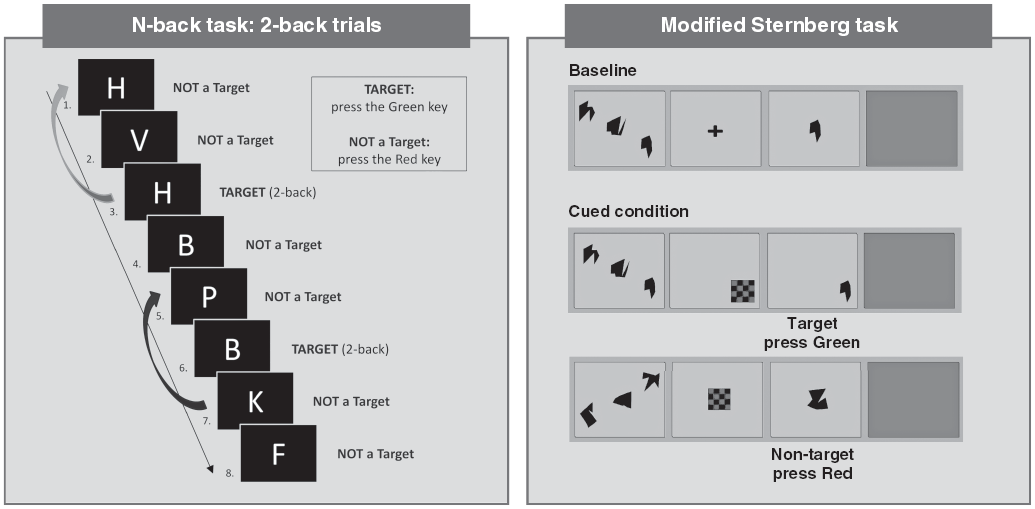
The Sternberg paradigm measures recollection, updating, and resisting interference. Participants are presented with a set of memory items (i.e., items to-be-remembered) that are followed by a probe. The task is to decide whether the probe was a member of the original memory set. In a modified version developed in our laboratory, we use this task as a baseline measure, which is followed by a cue-based retrieval condition. The structure of the trials is similar in these two conditions, but in the latter one, participants are presented with a cue, following the initial memory list. The cue highlights a specific location and indicates the item to be remembered from the list. Participants are instructed to make a judgment about the probe. The only possible target in this case is the item that was presented in the cued position in the original memory list (see Figure 2.1). All other items are various distractors. A new distractor is an item that was not presented before. An interference item is a stimulus that was presented in the original memory list but not in the cued position. A second type of intrusion distractor is an item that was the target in the previous trial but not in the cued position. Finally, a third interference distractor is an item that was the target in the previous trial and was presented in the cued position. These manipulations allow us to better understand whether the errors reflect a weakness with refreshing the contents in working memory or a content-context binding problem.
2.3.3 Switching Paradigms
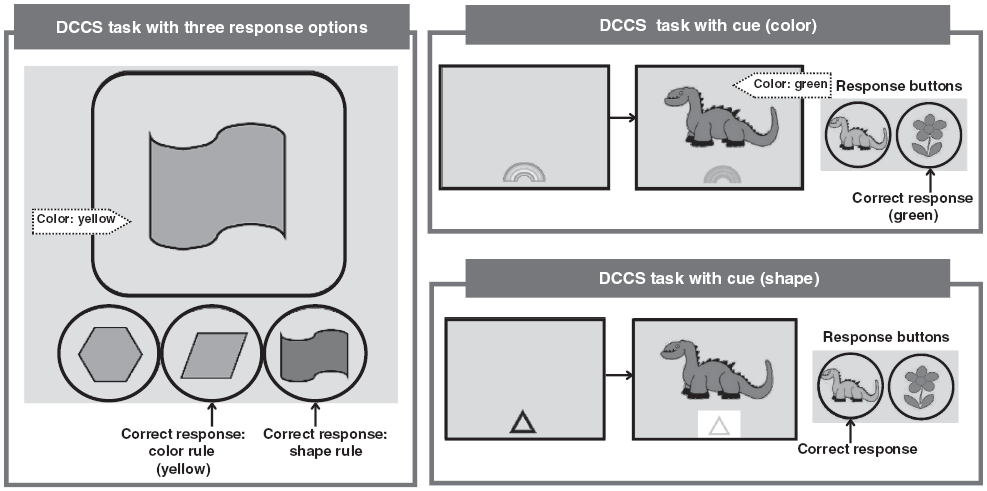
Switching paradigms are frequently used to test children’s cognitive flexibility skills. These tasks target shifting between task-goals or task-sets. Multiple versions of the most common switching task, the Dimensional Change Card Sort task, have been used in the literature (Zelazo, Reference Zelazo2006). In most versions of the task, participants are required to sort items according to one of two rules: according to shape or color (see Figure 2.2). When the sorting rule changes, participants must flexibly switch to the new rule. The switch requires the suppression of the old rule and the activation or the strengthening of the new rule’s representation. Two robust outcomes are typically reported for these tasks: switching cost and mixing cost. Switching costs or local costs refer to the difference in reaction time between stay trials and switch trials in mixed blocks (i.e., blocks in which the two rules alternate). Switch trials require the reconfiguration of action sets and reflect general response preparation (Rogers & Monsell, Reference Rogers and Monsell1995). These processes show relatively small age-related changes (Reimers & Maylor, Reference Reimers and Maylor2005). In contrast, mixing costs or global costs indicate how the different contexts affect participants’ responses to stay trials. They refer to the difference in reaction time between stay trials in single blocks (i.e., blocks in which only one rule is followed) and stay trials in mixed blocks. Mixing costs are associated with task-set interference resolutions and show large linear age-related changes (Reimers & Maylor, Reference Reimers and Maylor2005; Wiseheart et al., Reference Wiseheart, Viswanathan and Bialystok2016). Switching and mixing costs are highly influenced by both changes in task demands and adjustments in context (e.g., changes in switching frequency; Bonnin et al., Reference Bonnin, Gaonac’h and Bouquet2011; Dreisbach & Haider, Reference Dreisbach and Haider2006).
Switching paradigms
2.4 Conclusions
Although there are a number of theoretical accounts that define and describe the mechanisms of cognitive control from different perspectives, most of them complement each other well (e.g., Botvinick & Braver, Reference Botvinick and Braver2015; Botvinick et al., Reference Botvinick, Braver, Barch, Carter and Cohen2001; Cohen, Reference Cohen and Egner2017; Shenhav et al., Reference Shenhav, Botvinick and Cohen2013). They all seek to answer fundamental questions about the control mechanisms, recruitment of control resources, selection of task-relevant processes, and prevention of interference. However, they also provide distinct explanations about the mechanisms that are involved in detecting when control is needed, as some theories focus more on the regulatory processes, while others on the evaluative mechanisms.
There are many remaining questions about the sources of capacity limitations, the effects of contextual changes, and individual differences, particularly in the developmental literature. Future research is needed to identify the specific processes in brain networks that determine the developmental trajectories of the differentiation processes in cognitive control. The use of a variety of tasks shows increasingly diverse performance in children, as their brain networks become more task-specific with development. A critical issue is that the most widely used cognitive control tasks in the developmental literature provide global scores, target multiple underlying functions (Valian, Reference Valian2015), show no correlation with one another (Paap & Greenberg, Reference Paap and Greenberg2013), and do not provide a sensitive measure of the cognitive control construct (Marton, Reference Marton, Sekerina, Spradlin and Valian2019). When weaknesses are observed, it is difficult to identify the target functions because of task impurity. To better understand the developmental course of cognitive control and to provide a more subtle differentiation between typical and atypical control processes, we need to develop tasks with high specificity and sensitivity values. The integration of behavioral and neural data across age groups may also help us to better describe the dynamic processes behind goal-directed behaviors, such as learning and language acquisition.

 Open access