





The prevalence of paediatric obesity has drastically increased, now affecting 19·7 % of children in the USA(Reference Stierman, Afful and Carroll1). Along with the rise of paediatric obesity, the prevalence of metabolic dysfunction-associated steatotic liver disease (MASLD) is also increasing in this age group. MASLD is now the most common form of liver disease, affecting nearly 40 % of children with obesity(Reference Shneider, González-Peralta and Roberts2–Reference Schwimmer, Deutsch and Kahen4). MASLD diagnoses can range from simple fat infiltration to more advanced stages of the disease, including metabolic dysfunction-associated steatohepatitis and cirrhosis, leading to end-stage liver disease, which may require a liver transplant(Reference Browning and Horton5). The pathogenic deposition of lipid in the liver has been associated with insulin resistance, which increases the risk for type 2 diabetes. In adolescents with MASLD, early intervention is critical to reduce the risk of progression to advanced stages of liver disease and type 2 diabetes as they age into adulthood. Changes to lifestyle are critical to deplete hepatic lipid and reverse disease progression in children and adolescents with MASLD(Reference Nobili, Alkhouri and Alisi3).
Reduction in adiposity through energetic restriction and increased physical activity has been the primary therapeutic target for the treatment of MASLD in children(Reference Xu, Barnes and Yang6). However, energy restriction can result in several adverse side effects, including loss of muscle mass and bone mineral density, alterations in the hormonal milieu, metabolic adaptations that result in increased risk of weight regain and an increased risk of eating disorders among children and adolescents(Reference Browning and Horton5–Reference Amador, Ramos and Moroño8). More recent evidence suggests that weight loss through intentional energetic restriction may not be necessary to significantly deplete liver fat. Altering the macronutrient composition of the diet may have a direct effect on hepatic metabolism and the handling of lipid oxidation and storage(Reference Sumithran, Prendergast and Delbridge7–Reference Donnelly, Smith and Schwarzenberg12).
Studies in rodents show that reducing intake of carbohydrates (CHO) can be an effective means of reversing lipid accumulation in the liver by reducing insulin resistance, inflammation and primarily de novo lipogenesis(Reference Jensen-Urstad and Semenkovich11–Reference Diraison, Moulin and Beylot13). By limiting de novo lipogenesis, a process that converts dietary CHO into TAG in the fed state, lipid storage in hepatocytes is reduced and β-oxidation is enhanced(Reference McGarry and Foster14,Reference Ide, Nakazawa and Mochizuki15) . In a 2-week randomised clinical trial, Browning et al. found that a CHO-restricted diet (CRD) (< 20 g/d) compared with a reduced fat diet resulted in similar weight loss between groups but led to greater reduction in hepatic fat (–55 % v. –28 %, P < 0·001)(Reference Browning, Baker and Rogers16). This suggests potential metabolic advantage by limiting the substrates for de novo lipogenesis. We have previously shown in an 8-week pilot randomised control trial comparing the effectiveness of a moderately CRD v a fat-restricted diet (FRD) in adolescents with MASLD that after 8 weeks, the CRD resulted in significant reductions in hepatic lipid content (mean difference: –6·0 ± 1·4 v. –1·8 ± 1·0, P < 0·001) and Homeostatic Model for Insulin Resistance (HOMA-IR) (mean difference –1·18 ± 1·4 v. 5·3 ± 2·3, P < 0·05), an index of hepatic insulin resistance, whereas no change in hepatic lipid and an increase in HOMA-IR were observed in the FRD (control) group(Reference Goss, Dowla and Pendergrass17). While these results were promising, a controlled feeding trial of longer duration and larger sample size is needed to support the recommendation of a CRD for the treatment of paediatric MASLD in clinical practice.
Data from controlled feeding studies in children with MASLD are currently lacking. Most studies have either been underpowered to detect significant differences in the change of hepatic fat, relied on diet counselling without the provision of food, could not determine the effect of diet independent of weight loss, lacked parental and family involvement in the intervention or did not rigorously measure adherence(Reference Yurtdaş, Akbulut and Baran18–Reference Chan, So and Hui20). This study is the first 6-month family-based intervention with two phases – a 12-week controlled eucaloric feeding phase and a 12-week ‘free-living’ phase – to examine the effects of a weight-maintaining, moderately CRD v FRD in adolescents with MASLD on the depletion of hepatic lipid content, improvement in hepatic insulin sensitivity and changes in the plasma metabolome. The addition of metabolomics (plasma metabolome) will provide further insight into the underlying mechanisms by which a low-CHO diet works to deplete hepatic lipid in adolescents. The innovative and comprehensive approach to this study will address key gaps in knowledge for the treatment of MASLD in children and potentially provide effective diet recommendations tailored to improve metabolic health in this population of adolescents.
Methods
Study design
This study is a two-phase randomised clinical trial with two diet arms: a low glycaemic, moderately CRD and an FRD. The moderately CRD will consist of < 25 % energy from CHO, 25 % energy from protein and > 50 % energy from fat, while the low-fat diet will be 55 % energy from CHO, 25 % energy from protein and 20 % energy from fat. The first phase of the study will be 12 weeks of controlled feeding to measure the effects of diet composition on change in hepatic lipid, hepatic insulin sensitivity and plasma metabolome. For the second phase of the study, the participants will be in a 12-week ‘free-living’ phase where they will continue their assigned diet to determine if changes in hepatic fat can be maintained without food provisions. Because this is a family-based intervention, each participant will be randomised to a diet arm, and enough food will be delivered to feed the entire family of the participant. While adolescents are the primary participants and the focus of all outcome assessments, family members are included to support a family-based intervention approach aimed at enhancing adolescent adherence to the prescribed diet. Groceries will be ordered weekly by a Registered Dietitian (RD) and delivered from a local grocery store via a food delivery service app. Participants and at least one parent/caregiver will meet weekly via video call with an RD. In-depth education on meal plans, recipes and food preparation will be provided weekly by an RD during the feeding phase and monthly during the ‘free-living’ phase. Hepatic lipid content will be measured at baseline, at week 12 and at week 24 using MRI and magnetic resonance spectroscopy (MRS). Insulin sensitivity will be measured using the euglycaemic clamp at baseline and week 12. Metabolomics will be measured by fasting blood sample collected at baseline and week 12. Other laboratory measurements include markers of inflammation, body composition via dual-energy X-ray absorptiometry (DXA), blood pressure and resting energy expenditure via indirect calorimetry. Detailed tables of the study timeline and the assessments to be completed throughout the study can be found in Table 1 and Figure 1. This study was conducted according to the guidelines laid down in the Declaration of Helsinki, and all procedures involving human subjects/patients were approved by the University of Alabama at Birmingham (UAB) Institutional Review Board (IRB) (IRB-300007416). Written informed consent was obtained from all subjects/patients. The trial was registered at ClinicalTrials.gov Registry NCT05268042 (registered on 2/15/2022 and last update submitted 5/29/2026). This clinical trial is fully funded by the NIH R01DK128457; see https://clinicaltrials.gov/study/NCT05268042.
Assessments to be performed throughout the 6-month randomised control trial of CHO-restricted diet v. fat-restricted diet in adolescents with MASLD

Table 1. Long description
This table presents a schedule of study visits and procedures across a six-month diet intervention organized into baseline, Phase 1, End of Phase 1 testing, Phase 2, and End of Study Testing. At baseline, liver ultrasound, physcial activity questionnaire, food record, and diet randomization occurs. Baseline Hepatic MRI/MRS, body composition via DXA, REE, and euglycemic hyperinsulinemic clamp occurs before Phase 1. During phase 1, Grocery deliveries and meetings with the dietitian occur once a week. End of Phase 1 testing includes Hepatic MRI/MRS, DXA, REE, euglycemic hyperinsulinemic clamp, and blood draws. During phase 2, the dietitian meets with the participant weekly. End of study testing includes Hepatic MRI/MRS, DXA, REE, and a blood draw.
CHO,carbohydrate; MASLD, metabolic dysfunction-associated steatotic liver disease; MRI, magnetic resonance imaging; MRS, magnetic resonance spectroscopy; DXA, dual-energy X-ray absorptiometry; REE, resting energy expenditure.
Study design timeline. DXA, dual-energy X-ray absorptiometry; RD, Registered Dietitian; REE, resting energy expenditure.

Figure 2. Long description
A horizontal timeline shows the study phases with icons marking assessments at each point: red circle = abdominal MRI; blue triangle = insulin sensitivity clamp; purple square = fasting blood draw and REE; green star = DXA; yellow oval = RD meeting. Sequence: Screening leads to Baseline testing/randomization, where all five assessments occur. Weeks 1–12 ("Controlled feeding phase") involve weekly food deliveries and weekly RD calls. At Week 13 Follow-up, all five assessments repeat. Weeks 13–26 ("Free-living phase") involve no food deliveries and monthly RD calls. At the final Week 26 Follow-up, only MRI, blood draw/REE, and DXA are repeated; the clamp and RD meeting are not.
Participants and eligibility
Participants must have a clinician-documented diagnosis of MASLD in their medical record, defined by evidence of hepatic steatosis on ultrasound (i.e. diffusely echogenic liver). For participants without prior ultrasound-confirmed MASLD, an abdominal ultrasound will be obtained to confirm eligibility. Participants will be between the ages of 10 and 17 years and will have overweight or obesity (BMI > 75th percentile). Exclusion criteria include A1c > 7 %; pregnancy; history of parenteral nutrition; hepatic virus infections; use of medication known to induce steatosis, elevate liver enzymes or affect body weight or CHO metabolism (within the last 6 months); autoimmune liver disease, metabolic liver disease and Wilson’s disease; genetic conditions leading to hepatic steatosis; participants and parents/guardians unwilling to give informed consent, accept random assignment, attend dietary counselling sessions, adhere to treatment prescription or complete study measures; currently receiving intense lifestyle modification treatment; estimated glomerular filtration rate < 60; alcohol, tobacco or drug use; and inability to undergo MRI.
Recruitment strategies
We will primarily use the electronic health records (EHR) from Children’s of Alabama to recruit adolescents who fit our criteria. We will use this EHR system to filter for patients with the required inclusion criteria and reach out to their parents/guardians via mail and phone. To increase enrolment, we will also purchase advertisements in local newspapers and post flyers for the study around the UAB campus and in local paediatrician offices.
Screening
All individuals will be screened via telephone using an interview script. The script provides information about the study, eligibility criteria, the diet intervention and all tests and procedures. If the participant meets all inclusion criteria, an appointment time will be set up for the baseline visit. At the baseline visit, if eligible participants and at least one parent or guardian consent to all components of the study, including the diet intervention and testing, they will be enrolled into the trial and complete their baseline testing.
Randomisation
Participants will be randomly assigned to either the FRD or CRD. A statistician uses simple random sampling as implemented in statistical software (SAS version 9.4, 2002–2012 by SAS Institute Inc.) to ensure an allocation ratio of 1:1. The study statistician will place the randomisation letter in a sealed envelope, and participants are given the sealed letter following baseline testing. To minimise potential bias, only the study RD and project coordinator will have access to each participant’s diet assignment. Study personnel involved in data analysis are blinded to randomised diet assignment.
Diet intervention
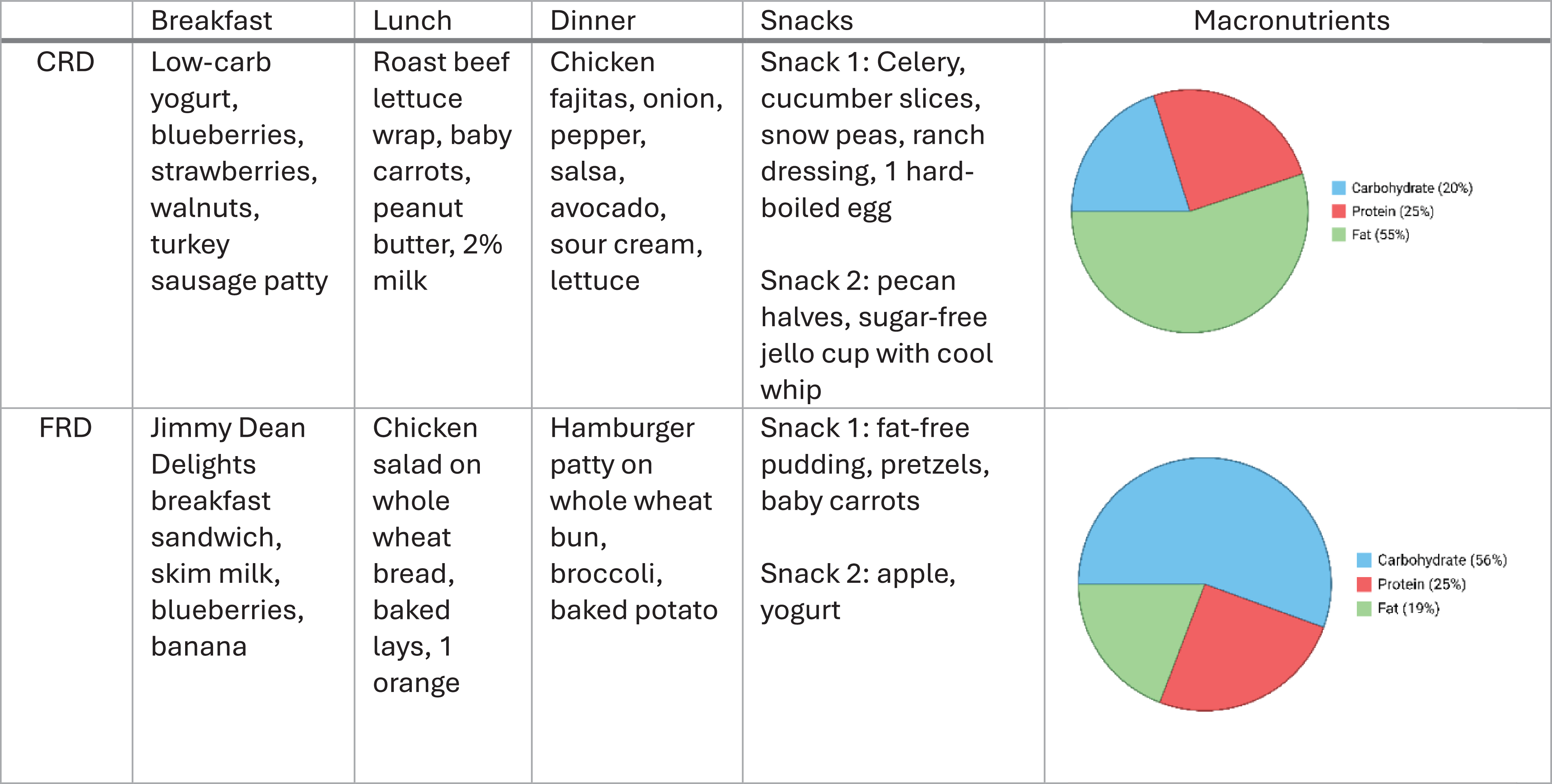
This diet intervention is centred around the family-based approach. While study outcomes will be measured in the child with MASLD, parents and guardians are encouraged to adopt the prescribed diet as well, since parental involvement can greatly improve adherence to diet(Reference Epstein21,Reference Epstein, Paluch and Roemmich22) . A trained RD in the Department of Nutrition Sciences at UAB will provide diet education and intervention. All food will be provided to participants and their guardian(s) during the first 12-week phase of the study as weekly grocery deliveries from a local grocery store using a delivery services app. The meal plans were prepared using the Nutrition Data System for Research (NDSR Software version 2012). An example of a meal plan from each diet arm can be found in Figure 2. The RD will also verify what the participant ate each week to confirm compliance with the study meal plan. Both diets will be prescribed at a weight-maintaining energy level calculated from resting energy expenditure measured using indirect calorimetry multiplied by a sex-specific activity factor (1·46–1·62 for females and 1·54–1·86 for males)(Reference Martincevic and Mouzaki23,Reference Blinman and Cook24) . Body weight will be monitored weekly during the first phase, and any participant who has significant weight gain or loss will have their prescription revised by the RD to maintain the participant’s weight within 5 lbs of their baseline body weight.
Sample meal plan for each diet arm with breakdown of macronutrients.

Participants will be asked to complete a 4-d food record at baseline to assess usual intake. The first phase of the study will also consist of weekly meetings with the RD to verify their food intake. Participants will receive a binder with weekly food checklists, recipes and menus. All food needed to follow the diet will be delivered weekly. They will be asked to check off each food they consumed and write down any possible deviations from the diet prescription to review with the RD during weekly meetings. For the second ‘free-living’ phase of the study, the RD will monitor dietary intake via monthly Zoom meetings. A second 4-d food record will also be collected at the final study visit to monitor participant adherence to the diet intervention during the ‘free-living’ phase, while groceries are not being delivered to the family.
Diet prescriptions
Carbohydrate-restricted diet
This study will use the low-glycaemic, moderately CRD that we have previously shown to be associated with depletion of hepatic lipid content and improvement in insulin resistance in adolescents with MASLD(Reference Goss, Dowla and Pendergrass17). This diet has a macronutrient composition of approximately 25 % energy from CHO, 20 % energy from protein and 55 % energy from fat. No food group is excluded in this diet prescription; however, the diet emphasises low-glycaemic sources of CHO fish and eggs. Fat-containing foods will include olive, coconut and nut oils; butter; tree nuts and nut butters; cheese; cream; coconut milk; avocados; and the fat found in meat. Several full-fat dairy products will be included. Saturated fat will be limited to 10 % of total fat intake. Participants will obtain the majority of their fat intake from PUFA and MUFA at a 4:1 ratio (from nuts, nut butters and fresh fish), and saturated fat will be primarily derived from medium-chain TAG and dairy products.
Fat-restricted diet
The fat-restricted control diet will be compatible with both American Academy of Pediatrics(Reference Styne, Arslanian and Connor25) and United States Department of Agriculture(Reference Perez-Escamilla, Obbagy and Altman26) guidelines for children. It will consist of approximately 60 % CHO, 20 % protein and 20 % fat. Participants will be given low-fat foods, whole-grain foods, fruits and vegetables. The meal plans will minimise cholesterol, high-fat foods, high-cholesterol foods, processed starches and added sugar and will provide < 2300 mg/d of Na. Saturated fat will be limited to 10 % of total fat intake, and all dairy products will be fat-free (or low fat). Patients will obtain the majority of their fat intake from PUFA and MUFA at a 4:1 ratio matched to the CHO-restricted group; however, total grams will be lower. Although the FRD will be a high-quality, healthful diet, it will include a greater amount of CHO foods from such sources as bread, potatoes and pasta that will distinguish it qualitatively from the CRD. In addition, it will have a higher glycaemic load than the CRD. Thus, the greater glycaemic load of the FRD will derive from both the inclusion of foods with a higher glycaemic index and the incorporation of a greater proportion of total energy from CHO.
Outcome measures
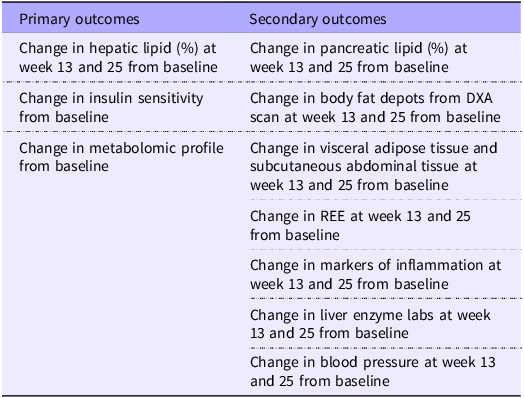
All primary and secondary outcome measures can be found in Table 2.
Summary of primary and secondary outcome measures

Table 2. Long description
This table shows a summary of primary and secondary outcomes for the study. Primary outcomes include change in hepatic lipid (%) at week 13 and 25 from baseline, change in insulin sensitivity from baseline, and change in metabolomic profile from baseline. Secondary outcomes include change in pancreatic lipid (%) at week 13 and 25 from baseline, change in body fat depots from DXA scan at week 13 and 25 from baseline, change in visceral adipose tissue and subcutaneous abdominal adipose tissue at week 13 and 25 from baseline, change in REE at week 13 and 25 from baseline, change in markers of inflammation at week 13 and 25 from baseline, change in liver enzyme labs at week 13 and 25 from baseline, and change in blood pressure at week 13 and 25 from baseline.
DXA, dual-energy X-ray absorptiometry; REE, resting energy expenditure.
Hepatic lipid (MRI and magnetic resonance spectroscopy)
All imaging will take place at the Civitan International Neuroimaging Laboratory (CINL) using Siemens LiverLab software which integrates the multi-point 3D Dixon imaging technique and H1MRS for an immediate, comprehensive evaluation of organ lipid content at baseline, week 12 and week 24. This imaging method provides high-resolution continuous images of the abdomen in breath-hold durations; it is not limited by a single voxel of interest; and its intrinsic 3D imaging capability allows whole organs and spatial variations in ectopic fat across any region of the imaged anatomy to be evaluated. The fat fraction is computed from the separated water and fat signals on a voxel-by-voxel basis. The accuracy of this method of computing fat fraction has been validated in several hepatic fat quantification studies using the following equation: Fat fraction = Signal Intensity (SI)FAT/(SIWATER + SIFAT) × 100 %(Reference Goss, Dowla and Pendergrass17,Reference Hu, Kim and Nayak27) .
Siemens LiverLab software also automates the post-processing of the spectrum acquired from H1 MRS for organ-specific fat fraction and the reconstruction and post-processing of multi-point 3D Dixon imaging with lipid and Fe quantification including several features that compensate for confounding effects (T1, T2 and lipid resonance effects). Visceral and subcutaneous abdominal fat volume will be assessed from the L1 to the L5 vertebrae.
Image acquisition will be done at the CINL using a state-of-the-art Prisma 3.0-Tesla whole-body MRI scanner. Image analysis will be conducted by a single trained image analyst using OsiriX v14.0 software and SliceOmatic (Tomovision version 5.0).
Anthropometric measurements and vital signs
Blood pressure will be measured by certified staff using an automated oscillometric OMRON 907 device. The measurement will be repeated twice and averaged for each time point, and this will constitute the outcome variable for systolic and diastolic blood pressure.
Euglycaemic–hyperinsulinemic clamp
To measure insulin sensitivity, we will be using the gold-standard euglycaemic–hyperinsulinemic clamp at baseline and week 12. At baseline, all participants will be instructed to follow a weight maintenance diet for 7 d before the study and refrain from any physical activity for the 24 h prior to baseline testing. Participants will arrive for testing after an overnight fast of 10–12 h. Two intravenous catheters (one for blood sampling and one for infusion of dextrose and insulin) will be placed, one in the antecubital vein of each arm. Hepatic and peripheral insulin sensitivity will be measured by a two-step euglycaemic clamp by infusing insulin (regular Humulin, Eli Lilly & Co., Indianapolis, IN) combined with normal saline at 120 MU/m2min for 4 h using a calibrated syringe pump. Participants began with a low-dose insulin (10 mU/m2/min) and then increased to the high-dose insulin (80 mU/m2/min) at the 130-min time point until the end of the clamp procedure. Blood samples will be collected every 5–10 min for measurement of both serum insulin and blood glucose concentrations, and the rate of infusion of 20 % dextrose will be adjusted as needed to maintain fasting levels. The 30-min steady- state period will be determined at least 1 h after the beginning of the insulin infusion in which the CV for blood glucose and dextrose infusion rate will be less than 5 %(Reference Weiss, Dufour and Taksali28). The measure of insulin sensitivity will be calculated as M/(G × ΔI), where M represents the steady-state dextrose infusion rate per kilogram of body weight, G is the steady-state blood glucose concentration and ΔI is the difference between basal and steady-state serum insulin levels(Reference Katz, Nambi and Mather29).
Metabolomics
At both baseline and 12 weeks, metabolomic profiling of over 1000 metabolites in fasting blood samples will be analysed. Analyses will be performed using a standardised workflow by Metabolon that enhances rigour and reproducibility(Reference Evans, DeHaven and Barrett30). Sample preparation will be conducted using the MicroLab STAR system (Hamilton Robotics, Inc.) and an aqueous methanol extraction mixture to allow for maximum recovery of small molecules with the highest quality control. Before analysis of samples, extracts will be reconstituted with appropriate solvents. Samples will be analysed using Ultra-Performance Liquid Chromotography/MS/MS in positive ion mode and in negative mode, as well as GC/MS. Samples are analysed within each experimental group to assess between-batch variability and serve as blank controls, respectively. Peak detection and integration are performed using an in-house software program that will calculate a list of detected mass:charge ratios (m/z ratio) with retention index values and AUC values(Reference Evans, DeHaven and Barrett30,Reference Dehaven, Evans and Dai31) . Peaks are matched against a library of authentic standards.
Resting energy expenditure
Resting energy expenditure and respiratory quotient will be determined in the NORC Core Laboratory by indirect calorimetry (TrueOne 2400, Parvo Medics). Participants will be tested in the fasted (10 h) condition following a 30-min supine rest.
Blood draw and laboratory analysis
Samples will be analysed in the Human Physiology Core Laboratory of UAB’s Diabetes Research Center (DRC). Markers of inflammation will be assessed by measuring Interferon-γ, IL-1-β, IL-6, IL-8, IL-10, IL-12p70, and TNF-α, which will be measured in duplicate with MesoScale Discovery Proinflammatory Panel I kits using chemiluminescence. Glucose, total cholesterol, HDL-cholesterol and TAG will be measured using a SIRRUS analyser (Stanbio Laboratory). Insulin will be assayed by immunofluorescence on a TOSOH AIA-II analyser (TOSOH Corp.). High-sensitivity C-reactive protein will be assessed by turbidometric methods by using a SIRRUS analyser (Stanbio Laboratory) with reagents obtained from Pointe Scientific. A serum fatty acid profile assesses thirty different fatty acids using mass spectrometry. Liver enzymes, including alanine aminotransferase, aspartate aminotransferase and gamma-glutamyl transferase, will also be assessed. Liver enzyme samples will be centrifuged, aliquoted and sera stored at –85℃; concentrations of serum-derived analytes were assayed at the DRC Core Laboratory and the UAB Outreach Laboratory.
Body composition
Body composition will be assessed by the DXA NORC/DRC Core facility (iDXA; GE Healthcare Lunar). Participants will be asked to wear light clothing and lie flat on their backs with arms by their sides during the DXA scan. Girls of childbearing age will be required to complete a urine pregnancy test prior to DXA scans. Any female with a positive pregnancy test result will be excluded from participation in the study. Total body fat mass, trunk fat mass and lean body mass in kg, as well as % body fat, will be recorded.
Physical activity
Participants will be instructed to continue their baseline level of physical activity throughout the study and will be given a Fitbit (Inspire 2 and 3) to wear during the 12-week controlled feeding period to estimate their number of steps taken and energy expended. Data from the Fitbit will be reported at the weekly meeting with the study RD. Physical activity data will be used to control for changes in energy expenditure that could affect participant outcomes, allowing for identification of the independent effects of diet.
Adherence markers and dietary intake
Objective measures of adherence will be measured at baseline, 12 weeks and 24 weeks. These measures will include fasted respiratory quotient from indirect calorimetry(Reference de Souza, Bray and Carey32,Reference Veum, Laupsa-Borge and Eng33) , fasted serum beta-hydroxybutyrate (BHB) concentration, fasted 1,5-anhydroglucitol (a biomeasure of CHO intake), fasted insulin:glucagon ratio and serum fatty acid composition. All of these are reliable and well-documented measures of diet composition. Diets higher in sugar and processed CHO will result in a higher respiratory quotient, higher insulin:glucagon ratio and lower serum BHB, whereas a low-CHO diet will produce the opposite pattern.
Food records
A 7-d food record will be collected at baseline. During the first phase, the record will be a simple checklist to indicate that the correct foods were consumed, with space to add any deviations from the protocol. Deviations are strongly discouraged, but we emphasise that it is critical to report them. To gauge adherence to the prescribed diet during the free-living period, a 4-d food record will be collected from the participant during this period and returned at their final visit. Data from the food logs will be entered into the computer as it is collected and analysed using the NDSR.
Hunger, satiety and quality of life
Hunger and satiety will be assessed using visual analogue scales. Participants will be asked to provide a rating response to several questions (e.g. How hungry did you feel this week?). Choosing from ‘not at all’ to ‘extremely’, participants will indicate their perceptions by marking an ‘X’ on the appropriate spot(Reference Flint, Raben and Blundell34). Participants will also complete the Food Craving Inventory, which assesses cravings related to fats, sweets, CHO and starches(Reference White, Whisenhunt and Williamson35). QoL, well-being and fatigue will be assessed for both adolescent and parent via PedsQL Pediatric QoL questionnaire(Reference Awasthi, Agnihotri and Chandra36), General Well-Being Scale(Reference Awasthi, Agnihotri and Chandra36) and Multidimensional Fatigue Scale(Reference Varni, Limbers and Bryant37).
Adverse event monitoring
Adverse events will be routinely discussed at each clinic visit and phone call throughout the study with both participants and their parents. The study physician is on call in the case of an adverse event during testing. The adverse event protocol includes immediate reporting of the event to the UAB IRB and review by the investigative team. If any individuals and/or the IRB identified any adverse events related to the study protocol, all study testing would be suspended and the protocol would be amended accordingly.
Statistical considerations
Descriptive statistics such as means, standard deviations and frequency counts will be used to characterise the study population. The primary outcome to be measured is a change in hepatic lipid as assessed by MRI and MRS. To test the changes in hepatic lipid from baseline to 12 weeks within groups, paired t tests will be used to assess change in hepatic fat within groups. Between-group comparisons will be analysed by using generalised linear models with the change in hepatic fat as the dependent variable, adjusting for baseline hepatic fat with the randomised diet group as the predictor.
Insulin sensitivity will be examined by computing change scores for each variable, and differences in change scores will be examined by models as described above from baseline to 12 weeks. We will examine correlations between changes in hepatic lipid content and insulin sensitivity as well as other measures including fasting insulin, markers of inflammation and lipids. These measures will be examined by Spearman’s correlation coefficients.
To test the changes in the metabolome, statistical and pathway analyses will be performed using MetaboAnalyst. Repeated-measures two-way ANOVA will be performed to compare data between intervention groups and across study time points, assessing for effects by group, time and the group-by-time interaction. Multiple hypotheses testing corrections will be performed using the Benjamini–Hochberg false discovery rate procedure(Reference Benjamini, Drai and Elmer38). The extent and pattern of missing data will be evaluated for all outcome measures, and if the proportion of missing data is less than 5 %, analyses will be performed using complete participant data only.
Sample size calculations
Our preliminary study(Reference Goss, Dowla and Pendergrass17) demonstrated a mean change in liver fat of 4·25 units with an estimated sd of 4·71 units with a sample size of thirty-two participants. Assuming a two-sided α = 0·05, a between-group difference of 4·25 units and equal allocation to two dietary intervention groups, a sample size of twenty-seven participants per group would provide approximately 90 % power to detect the hypothesised treatment effect. Allowing 20 % attrition, thirty-four participants per group (sixty-eight total) would be required. Therefore, enrolment of forty participants per group (eighty total) would provide approximately 94 % power under these assumptions. We do not have an estimate for the change in liver fat in the free-living maintenance phase from week 12 to 24, but with sixty-eight analysable subjects, the study is expected to have adequate power to detect changes during the maintenance phase that are 25 % lower than the reductions observed at 12 weeks. Sample size and power estimates have not been adjusted for multiple comparisons or multiple endpoints, or stratifications.
Strengths and limitations
This is the first study to use a 6-month family-based intervention with two phases, a 12-week controlled isoenergetic feeding phase and a 12-week free-living phase, to examine the effects of a weight-maintaining, moderately CRD v FRD on adolescents with MASLD. As a family-based intervention, all food will be provided for the participants for the duration of the controlled feeding phase of the study. The free-living phase of this study will provide insight on how well the child is able to continue following their diet without the provision of food. Another strength of this study is the multi-point 3D Dixon imaging technique and H1MRS for an accurate and comprehensive evaluation of hepatic lipid. We will also use the gold-standard euglycaemic–hyperinsulinemic clamp to measure hepatic insulin sensitivity before and after diet intervention. Our main limitation in this study is participants potentially not adhering to the diet. To minimise this limitation, we will carefully screen participants and families who are likely to adhere to the prescribed diet. Participants deemed likely to adhere will be those who acknowledge their ability to comply with the prescribed diet, report no significant food aversions or dietary restrictions that would interfere with the intervention and demonstrate willingness to comply during a standardised screening assessment. Additional limitations include reliance on self-reported dietary intake during the free-living phase, which may lead to underreporting. Furthermore, neither participants nor study staff will be blinded to diet assignment; however, all personnel conducting data analysis will remain blinded to minimise potential bias.
Dissemination plan
Prior to the enrolment of participants, details of this trial were registered on the ClinicalTrials.gov website (registration number: NCT05268042). The record will be updated annually. Within 12 months of the trial completion date, after all participants have completed the proposed intervention, results of the trial will be posted to the ClinicalTrials.gov website. During the informed consent process, participants will be made aware of the trial registration on the ClinicalTrials.gov website and be given information on how to navigate to the site for study details and information. UAB’s Office of Sponsored Programs has an internal policy in place to ensure that all clinical research at the university complies with the dissemination requirements in NOT-OD-16-149, and this policy is posted on the university’s website.
Acknowledgements
The authors would also like to acknowledge the staff of the UAB Metabolism Core Laboratory (Nutrition Obesity Research Center, Clinical Research Unit, Civitan International Neuroimaging Laboratory and Diabetes Research Center) for their involvement in this study.
This study is funded by the National Institutes of Health (NIH), which has no role in study design, data collection, data management, data analysis or decisions regarding future publication.
C. D.: Data curation-Equal, Investigation-Equal, Project administration-Equal, Writing – original draft-Lead, Writing – review and editing-Equal; A. M. G.: Conceptualisation-Equal, Funding acquisition-Equal, Investigation-Equal, Methodology-Equal, Project administration-Equal, Writing – original draft-Equal, Writing – review and editing-Equal; B. A. G.: Conceptualisation-Equal, Funding acquisition-Equal, Methodology-Equal, Project administration-Equal, Supervision-Equal; A. A.: Conceptualisation-Equal, Funding acquisition-Equal, Methodology-Equal, Project administration-Equal, Writing – review and editing-Equal; J. A.: Conceptualisation-Equal, Funding acquisition-Equal, Methodology-Equal, Project administration-Equal, Writing – review and editing-Equal; M. B.: Conceptualisation-Equal, Funding acquisition-Equal, Methodology-Equal, Project administration-Equal, Writing – review and editing-Equal; F. B.: Data curation-Equal, Writing – review and editing-Equal; Y. C.: Methodology-Equal, Project administration-Equal, Writing – review and editing-Equal; A. L-McP.: Data curation-Equal, Project administration-Equal, Writing – review and editing-Equal; R. H.: Data curation-Equal, Project administration-Equal, Writing – review and editing-Equal. All authors reviewed, edited and approved the final draft. Ethical approval has been obtained by the UAB IRB (IRB-300007416).
The investigators of this study have no financial conflicts of interest to report.
Data will be made available to other researchers upon reasonable request.



 Open access

