


1. The domain of folk-economic beliefs
1.1. What folk-economic beliefs are
The term folk-economic beliefs denotes a large domain of explicit, widespread beliefs, to do with economic and policy issues, held by individuals without systematic training in economic theory. These beliefs include mental representations of economic topics as diverse as tariffs, rents, prices, unemployment, and welfare or immigration policies, as well as mental models of interactions between different economic processes, for example, inflation and unemployment.
Our perspective on the origins and forms of folk-economics is based on two major assumptions. First, we argue that folk-notions of the economy should not be described solely in terms of deviations from normative economic theory. That has, unfortunately, been the common approach to the subject. Folk-views are generally described as the outcome of “biases,” “fallacies,” or straightforward ignorance. But describing how human cognition fails to work according to some norm of rationality tells us little about how it actually works. Second, we propose to make sense of folk-economic beliefs by considering the environment in which many, if not most, human cognitive mechanisms evolved.
The study of folk-economic beliefs should be distinguished from other domains of investigation. Microeconomics addresses actual choices of agents in conditions of scarcity, independently of whatever mental representations trigger these behaviors in actual individuals, and also of the representations they may form of their behavior upon reflection. Another field, behavioral economics often uses experimental designs as a way to elucidate tacit motivations and capacities that direct economic choices in contexts where experimenters can manipulate incentives and information flow between agents (Plott Reference Plott1974; Smith Reference Smith1976). Finally, neuro-economics elucidates the brain systems involved in appraising utility and making economic decisions (Camerer et al. Reference Camerer, Bhatt, Hsu, Frey and Stutzer2007; Loewenstein et al. Reference Loewenstein, Rick and Cohen2008).
The scope of a study of folk-economics is quite different from these three fields (see Figure 1). It focuses on people's deliberate, explicit beliefs concerning economic facts and processes, for example, that foreign prosperity is good or bad for one's own nation, that welfare programs are necessary or redundant, that minimal wages help or hurt the poor, and that rent controls make prices go down or up, and so forth.
A summary of the systems and representations involved in forming folk-economic beliefs. External information about economic matters triggers activation of specific mental systems, which results in both economic behavior and explicit folk-economic beliefs. The latter's effects on behavior cannot be assumed. Different fields, represented as clouds, focus on different parts of these processes. The model presented here is about the causal arrow linking specific mental systems to the occurrence of folk-economic beliefs in people's minds.
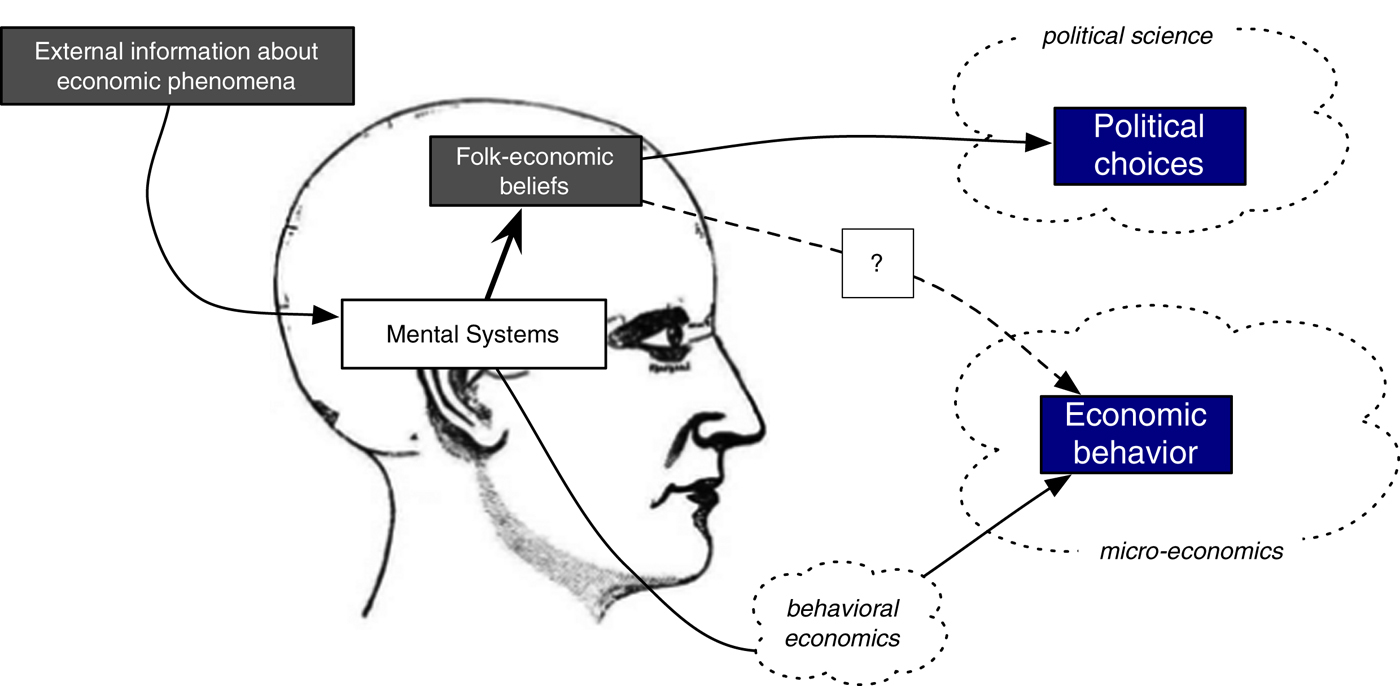
One should not assume that folk-economic beliefs (henceforth FEBs) have direct and coherent effects on actual economic behaviors. Many FEBs are about macro-economic processes – for example, the level of unemployment, or the need for foreign trade, or the need for a nation to balance its budget – that are unrelated to people's everyday transactions. Also, even FEBs that do bear on micro-economic realities, for example, on “fair” prices or wages, may remain insulated from the psychological processes that drive actual economic behavior, as we explain below, which is why people may recommend specific policy outcomes and behave in ways that contradict that choice (Smith Reference Smith2008, p. 165).
Figure 1 summarizes the different domains of thought and behavior and the research programs involved.
1.2. Why folk-economic beliefs (FEBs) matter
Understanding FEBs is of crucial importance, even if they do not govern people's economic behavior, because they play a critical role in political choices. Perceptions of macro-economic developments influence how favorably people view the government and how they cast their votes (Nannestad & Paldam Reference Nannestad and Paldam1994). The translation of inflation, unemployment, and income dynamics into political choices is mediated by people's beliefs about the economy, for example, whether rising unemployment is affected by government policy (Peffley Reference Peffley1984; Rudolph Reference Rudolph2003a, Reference Rudolph2003b). Similarly, economic beliefs underpin people's answers to such questions as: Is it a good idea to increase welfare benefits, impose tariffs on imports, cap rent increases, or institute minimum wages? Folk-economic beliefs constitute a largely unexplored background against which most information about policy is acquired, processed, and communicated among nonprofessionals (Rubin Reference Rubin2003).
1.3. A different approach to the study of folk-economic beliefs
It is a matter of common knowledge that most people, including the educated public in modern democratic societies, do not think like economists (Smith Reference Smith2008, pp. 147–66). It is, for instance, a familiar finding that people are over-influenced by consideration of sunk costs (Magalhães & White Reference Magalhães and White2016) or fail to consider opportunity costs (Hazlitt Reference Hazlitt2010) in evaluating possible courses of action. More important for social and political debates, people often also express views on economic processes that seem misguided, if not downright fallacious, to most professional economists. There is a growing literature documenting this divergence (see, e.g., Blinder & Krueger Reference Blinder and Krueger2004; Caplan Reference Caplan2006; Haferkamp et al. Reference Haferkamp, Fetchenhauer, Belschak and Enste2009; Hirshleifer Reference Hirshleifer2008; Rubin Reference Rubin2003; Sowell Reference Sowell2011; Wood Reference Wood2002; Worstall Reference Worstall2014). However, there is still very little research on why such beliefs appear, and why they are so widespread.
We argue that many folk-views on the economy are strongly influenced by the operation of non-conscious inference systems that were shaped by natural selection during our unique evolutionary history, to provide intuitive solutions to such recurrent adaptive problems as maintaining fairness in exchange, cultivating reiterated social interaction, building efficient and stable coalitions, or adjudicating issues of ownership, all within small-scale groups of foragers.
The inference systems we describe further on are not specified as ad hoc explanations for folk-economic beliefs. All of these systems have been independently documented by evolutionary biologists, psychologists, and anthropologists who focus on such issues as the evolution of exchange and trade, its form in the small-scale societies in which humans evolved, and its consequences for psychological dispositions and preferences that can be observed in experimental studies on individuals in modern societies; for an overview, see Buss (Reference Buss2015). So, we are not proposing a new description or interpretation of the human evolved psychology of exchange, but rather, using prior findings to illuminate the emergence of folk-economic beliefs in modern contexts.
1.4. Models of folk-economic beliefs are not normative
The model described here is emphatically not a normative proposal. That is, we do not intend to suggest that there is a right way to consider economic processes, and to evaluate folk-economic beliefs in terms of their validity or coherence. This deserves mention, for two reasons.
First, as discussed below, most descriptions of these beliefs, in the literature, were originally motivated by the realization that people do not think like economists, and that they often commit what trained economists would describe as fallacies. By contrast, we argue that this is not a promising way of approaching cultural beliefs in this domain, as the validity (or lack thereof) of these beliefs do not explain their spread.
Second, because FEBs are politically consequential, readers may wonder whether studying them is by itself a political project. That would be the case if, for instance, widespread beliefs were contrasted with a supposedly true picture of the economy, and if that picture was associated with a particular kind of political project. But we suspect (and to a certain degree, the evidence confirms) that individuals of all kinds of political persuasions are equally likely to entertain beliefs that are, in some sense, misguided or incoherent.
Indeed, one could argue that the epistemic value of FEBs is largely orthogonal to their political import. That is, the economy is not a political end in itself but a political means to ends that are essentially contested. In principle, even completely misguided FEBs might give rise to outcomes that are, by some other standards, “good” or “just,” at least as far as some specific social group is concerned.
Our more general point is that we believe that the question of whether FEBs are correct or incorrect is orthogonal to the importance of studying them. Few individuals receive formal training in economics and, hence, if they happen to hold correct beliefs, this is as much in need of an explanation as when they generate incorrect ones.
2. Some folk-economic beliefs and possible explanations
Evidence for folk-economic beliefs is still scattered and unsystematic. Some FEBs are widespread and well-documented, either through surveys of attitudes such as the General Social Survey (see General Social Survey 2011), or by more-specific, smaller-scale investigations such as the Kaiser Foundation's Survey of Americans and Economists on the Economy (see Kaiser Foundation 1996). Others are less systematically documented, being inferred from the platforms and common phraseology of political operators, as well as from common journalistic discourse (Wood Reference Wood2002; Worstall Reference Worstall2014).
2.1. Examples of folk-economic beliefs
In the following, we present a few examples of widespread beliefs about the economy, selected for their potential influence on political choice. Given that such beliefs are often expressed in vague or emotional terms (e.g., “markets are bad for society,” “trade will make us poorer and others richer”), what we propose here are, by necessity, reconstructions of possible beliefs as implied by people's explicit statements or questionnaire responses.
FEB 1. International trade is zero-sum, has negative effects. The notion is expressed in many forms in everyday conversations and in political discourse, and it was also a recurrent theme in early political economy (Hiscox Reference Hiscox2006). This belief may take many forms. For instance, trade is said to create unemployment at home because foreigners instead of locals are making the things we need (Wood Reference Wood2002, pp. 53–55). Also, it is claimed that a nation should always try to export more goods than it imports (Worstall Reference Worstall2014, pp. 29–32). This belief is often associated with the assumption that the wealth of nations is the outcome of a zero-sum game. As a consequence, the assumption that foreigners profit from trade entails that “we” are losing out. Consistent with this assumption, many people believe (against possible comparative advantage) that trade cannot be beneficial if “we” import goods that we could manufacture ourselves (Baron & Kemp Reference Baron and Kemp2004, p. 567). After the 2008 recession, many Americans interpreted increased unemployment as an effect of international trade and feared that continued trade would worsen their conditions (Mansfield et al. Reference Mansfield, Mutz and Brackbill2016).
FEB 2. Immigrants “steal” jobs. Beliefs about the negative economic impact of immigration lie at the center of many policy debates. It is a consistent finding among political scientists that immigration, especially of low-skilled immigrants, is viewed as threatening (Hainmuller & Hiscox Reference Hainmuller and Hiscox2010), and a common formulation is that immigrants “take our jobs” (R. Simon & Lynch Reference Simon and Lynch1999). This view is associated with the assumption that there is a fixed quantity of jobs to share among people (Wood Reference Wood2002, p. 23; Worstall Reference Worstall2014, p. 75).
FEB 3. Immigrants abuse the welfare system. Another belief, almost diametrically opposite but equally widespread, is that immigrants are a fiscal burden on the welfare system, using up common resources (Sniderman et al. Reference Sniderman, Petersen, Slothuus and Stubager2014). So, immigrants are intuitively viewed as free-riding both on the jobs “we” created and the welfare systems “we” paid for (Alesina & Glaeser Reference Alesina and Glaeser2004). Given these beliefs, co-occurrences of immigration and fiscal stress can be viewed as causally linked, with important consequences in terms of both policy opinions and of holding immigration-friendly politicians accountable on Election Day.
FEB 4. Necessary social welfare programs are abused by scroungers. Welfare programs, for example, unemployment benefits, are the object of apparently opposing economic beliefs (Aarøe & Petersen Reference Aarøe and Petersen2014; Alesina & Glaeser Reference Alesina and Glaeser2004). Experimental studies show the coexistence of those contrary beliefs within individuals. On the one hand, welfare programs are viewed as desirable insurance schemes against unavoidable, essentially random misfortune. On the other hand, unemployment benefits are widely viewed as encouraging laziness and a culture of dependency (Aarøe & Petersen Reference Aarøe and Petersen2014; Kameda et al. Reference Kameda, Takezawa, Tindale and Smith2002).
FEB 5. Markets have a negative social impact (“emporiophobia”). Paul Rubin (Reference Rubin2014) coined the term emporiophobia for the generally negative attitude towards markets observed in many modern societies and documented in many surveys. The belief is that markets as such produce negative outcomes for most participants. Surveys offer evidence that many people, against economists, see markets not as the encounter of buyers and sellers who mutually benefit from trade, but as a place of struggle between partners with unequal bargaining power. The anti-market attitude may also contribute to the rejection of market solutions for the allocation of “sacred” goods, like organs or children in need of adoption. Many people seem to consider more arbitrary allocations (lotteries, first come first served) as not just more fair than auctions, but also probably more efficient (Fiske & Tetlock Reference Fiske and Tetlock1997; Tetlock et al. Reference Tetlock, Kristel, Elson, Green and Lerner2000).
FEB 6. The profit motive is detrimental to general welfare. The profit motive is seen as an attempt to extract more from transactions than would be warranted by “fair” pricing. That is why there is a tendency to see private firms as less “caring” than non-profits, and therefore more likely to create negative externalities (Bhattacharjee et al. Reference Bhattacharjee, Dana, Baron, Dahl, Johar and van Osselaer2011). One version of this belief is that there is a special class of “excessive” profit that differs from the regular or fair allocation of profit to businesses (Wood Reference Wood2002, pp. 10–12). Related to this assumption is the notion that regulation is required to limit the excesses of profit-driven businesses (Hirshleifer Reference Hirshleifer2008). In general, then, the belief seems to be that if most economic actors act on the basis of maximizing their profits, non-economic social domains will be negatively affected, for example, by externalities such as pollution, or more generally through a decrease in solidarity, social trust, and so forth. Contra Adam Smith, the notion that private self-regard creates general welfare seems to be unintuitive (Rubin Reference Rubin2003).
FEB 7. Labor is the source of value. This is the assumption that the amount of labor necessary to produce a good is an essential (or the only) factor that determines its “value,” a (generally undefined) quantity that is not necessarily expressed by market price. This assumption is not often expressed in such general terms, but the proposition is implicit in many widespread beliefs about labor and wages (Wood Reference Wood2002, pp. 175–78; Worstall Reference Worstall2014, pp. 15–17). It is also present in opinions on the unfairness of low wages for hard or unpleasant jobs, especially those involving hard physical labor.
FEB 8. Price-regulation has the intended effects. The belief is that regulation generally does what it is supposed to do, as government policy can direct the economy towards desired results (Hirshleifer Reference Hirshleifer2008; Wood Reference Wood2002, p. 77). For example, in the United States, many cities imposed rent-control in the 1960s – and such measures were a major item in politicians' platforms (Dreier Reference Dreier1999, p. 211) – with the goal of creating an ample supply of cheap housing; see Schipper (Reference Schipper2015) for similar processes in Israel. The FEB here is that such regulation efforts will work as intended, for example, that rents will stay low after the imposition of rent-control, or that minimum wages can affect wages without affecting the demand for labor (some people even think that the latter measure could boost employment rates (Haferkamp et al. Reference Haferkamp, Fetchenhauer, Belschak and Enste2009, p. 533). More broadly, regulation is often seen as an efficient way to protect people against undesirable market dynamics. Chinese respondents, for instance, believe that China was spared the worst effects of the 2008 downturn by its government regulations (Yuen & Greene Reference Yuen and Greene2011).
This is only a short list of widespread folk-beliefs about the economy. Because there is very little study of such cultural beliefs as of yet, we have scant evidence for the relative cultural spread of each of these FEBs, and of possible associations between them and various social or cultural variables. The beliefs in question may well vary between social classes, cultures, age-groups, and so on. One aim of this article is to demonstrate the importance and theoretical interest of this domain of cultural beliefs and motivate more detailed empirical research in the domain.
2.2. Common explanations: Ignorance, self-interest, biases
There are three main ways of explaining the divergence between laypeople's and economists' views: in terms of ignorance, in terms of self-interest, or as the outcome of specific biases that affect people's perception of economic facts.
2.2.1. Lack of economic knowledge or training
The ignorance hypothesis simply assumes that non-normative views stem from a lack of relevant information, similar to the widespread ignorance in the political domain, long lamented by political scientists (Converse Reference Converse and Apter1964). It is certainly true that most laypeople are unaware of many fundamental principles of economic analysis. For instance, if people knew some rudiments of price theory, they would not be surprised that useful water is much cheaper than useless diamonds. If they knew about comparative advantage, they might see international trade in a different way (Haferkamp et al. Reference Haferkamp, Fetchenhauer, Belschak and Enste2009). However, this interpretation has one major defect – it predicts that people's common views will be non-normative, but it does not predict that they will be non-normative in any particular way. Not knowing about a domain would predict random, vague, or nonexistent opinions, as in popular conceptions of quantum mechanics, rather than the specific set of beliefs observed (Caplan Reference Caplan2008, pp. 9–11).
2.2.2. Self-interested beliefs
If beliefs are not random, that may be because they are influenced by people's perception of their interests. In this view, people adopt beliefs that would justify more resources being apportioned to them and less to their enemies or competitors (Dahl & Ransom Reference Dahl and Ransom1999). One difficulty with this interpretation is that it accounts for only some of the beliefs described above. It can explain, for example, how industrial workers in the United States might feel they will lose out if their jobs move to China, and therefore consider that protectionism is overall a good thing. But beliefs are sometimes less clearly connected to self-interest. For instance, many people feel that markets are bad, even though larger, more competitive markets provide them with cheaper goods, which is clearly in their interest. So, self-interest is at best an incomplete explanation, and in general is not a straightforward predictor of economic beliefs, or indeed of political choices (Caplan Reference Caplan2008; Green & Shapiro Reference Green and Shapiro1994). It should be noted that one type of interest that does seem to explain some variation in FEBs is partisan interests. During economic downturns, for example, people are much more likely to ascribe the government responsibility if they identify with the opposition party than with the government party (Bisgaard Reference Bisgaard2015; Bisgaard & Slothuus Reference Bisgaard and Slothuus2018b). However, although partisanship provides a motivation to reach certain conclusions (e.g., “the government is responsible for this economic downturn” or “the government is not responsible for this downturn”), the question still remains as to how people generate the particular beliefs about the workings of the economy that allow them to reach their desired conclusion.
2.2.3. Cognitive biases
Finally, another alternative to the knowledge gap is to consider that people's views are the outcome of specific biases. The term denotes tacit patterns of reasoning that orient people towards a limited set of conclusions from the evidence. There is a vast psychological literature for reasoning biases (Gilovich et al. Reference Gilovich, Griffin and Kahneman2002). For example, the “confirmation bias” is the tendency to notice and remember instances of the hypotheses we hold and to ignore other cases as noise, with the result that prior assumptions seem ever more strongly confirmed.
In the domain of beliefs about the economy, Bryan Caplan, for instance, identified an anti-foreign bias (what is good for foreigners is bad for us), an anti-market bias (inability to see how markets would turn private greed into a social good), a make-work bias (if people work more, there will be more wealth), and a pessimistic bias (economies are heading towards less prosperity) (Caplan Reference Caplan2008). In a similar way, Haferkamp et al. argue that the divergence between economists' and laypeople's views does not reduce to self-interest or ignorance, but rather results from multiple biases, like the well-documented status-quo bias and omission bias (doing something detrimental is worse than not doing something beneficial) (Haferkamp et al. Reference Haferkamp, Fetchenhauer, Belschak and Enste2009, p. 530). Finally, people's selection of economic beliefs often reflects own-side partisan bias (Bisgaard Reference Bisgaard2015).
2.3. Proximate and ultimate factors
Models based on identifying particular cognitive “biases” have the merit of taking seriously the fact that the emergence of these beliefs may lie in the way information about the economy is processed in human minds, which is certainly the right starting point. However, we propose that the study of folk-economic beliefs should move beyond a description on terms of fallacies and biases. One major problem with bias-oriented accounts of cognitive phenomena is that a bias is often simply a re-description of the empirical phenomenon under investigation (Gigerenzer Reference Gigerenzer1991; Gigerenzer et al. Reference Gigerenzer and Todd1999). For example, when it is observed that people attend more to more recent and vivid information, this is explained by an “availability heuristic” that simply stipulates that people attend more to more recent information. In a sense, this is fine; after all, science requires the systematization of observations about the world. But explanations require causal models as well.
Within the biological sciences, researchers distinguish between “proximate” and “ultimate” explanations, where proximate explanations describe how a biological system works and ultimate ones explain why the system exists (Buss et al. Reference Buss, Haselton, Shackelford, Bleske and Wakefield1998; Scott-Phillips et al. Reference Scott-Phillips, Dickins and West2011). Bias-based models are largely equivalent to proximate explanations. To develop a scientific understanding of folk-economic beliefs, we need to attend also to the level of ultimate explanations, not just because doing so provides a more complete understanding, but also because we will then be able to develop more precise predictions about the psychology behind folk-economic beliefs.
3. Our model: Inference systems, beliefs, cultural transmission
In the model we propose here, the emergence and spread of folk-economic beliefs is influenced by specific intuitions about interpersonal exchange. These are not the outcome of explicit scholarly training. Nor are they the simple consequence of persuasion from political elites (politicians, journalists, pundits, etc.), or the straightforward absorption of particular cultural values. Rather, because of evolution in the context of small groups with intensive exchange, humans have developed an intuitive psychology of exchange, for which there is independent anthropological and psychological evidence (Cosmides & Tooby Reference Cosmides, Tooby and Buss2015a). This psychology consists of a collection of highly specialized inference systems, each of which is designed to solve one kind of exchange problem recurrent in our ancestral environments.
3.1. Properties of domain-specific inference systems
We can describe the mind as consisting of many distinct, specialized systems, each of which corresponds to recurrent adaptive challenges in human evolution, attends to limited domains of available information, is organized along specific inferential principles, orchestrates neural structures in a specific functional manner, and is the outcome of a specific developmental pathway (Boyer & Barrett Reference Boyer, Barrett and Buss2015; Cosmides & Tooby Reference Cosmides, Tooby and Buss2015b; Hirschfeld & Gelman Reference Hirschfeld and Gelman1994a).
A few examples may help illustrate the relevant functional properties of this broad class of cognitive systems. In the auditory stream, the sound events identified as instances of lexical items are handled by a parsing system that assigns various syntactic roles to the different words (Pickering & van Gompel Reference Pickering, van Gompel, Traxler and Gernsbacher2006). In the visual field, some configurations are identified as human faces by a face-recognition system that computes a holistic description of the face, which is then processed by other memory and affective systems (Doris & Margaret Reference Doris and Margaret2008; Kanwisher Reference Kanwisher2000; Solomon-Harris et al. Reference Solomon-Harris, Mullin and Steeves2013). Information from multiple modalities is integrated to compute the extent to which a particular person is attractive as a potential mate (Fink & Penton-Voak Reference Fink and Penton-Voak2002; Grammer & Thornhill Reference Grammer and Thornhill1994).
However different the domains, there are some important functional properties common to these systems:
1. Specific input format. The face-identification systems respond to visual displays that include points or lines interpreted as eyes and mouth. Any such elements presented in the appropriate configuration trigger the system, which is why cartoons and other stylized renditions of human faces activate it, whereas displays with scrambled features, or features in the wrong alignment, do not. The parsing system responds only to words in the stream of speech. Other sounds are not processed. Sexual attractiveness computations only consider very narrow aspects of information about a person, for example, the pitch of the voice rather than prosody, skin-reflectance (an index of youth) rather than skin-tone, facial symmetry rather than facial length, and so on. In general, then, domain-specific inference systems may ignore information that might be relevant to an organism but fails to meet the input conditions.
2. Automatic activation. Specialized inference systems are neither initiated nor stopped by deliberate intentions. Once information with the appropriate input format is detected, the systems proceed to produce the relevant inferences, which are then passed on to other inference systems.
3. Specific inference rules. Each system operates on highly specific inferential rules. The computational principles that assign words to their syntactic roles are found only in that domain, and the same goes for the matching between faces and memories about persons, or the computation of sexual attractiveness.
4. Unconscious computation. The operation and inference rules of each system are generally outside conscious access. Only some outputs of these computational systems can be accessed, such as, for example, the meaning of a sentence or the general attractiveness of an individual.
5. Intuitive output. The output of specialized inference systems, when consciously accessible, consists of intuitions – that is, a description of a particular situation or a motivation to behave in a particular way – that do not include any indication of the computational steps that resulted in that particular description or motivation.
3.2. Intuitive systems output can lead to reflective beliefs
It is important here to keep in mind the difference between intuitive output on the one hand, and reflective representations on the other (Sperber Reference Sperber1997). Reflective representations add information to intuitions, explicate them, extend or restrict their scope, offer a comment on the intuitions, or link them to specific sources, as in, for example, “the reason this sentence is strange is that there is no verb,” or “this person has the same round face as Humpty Dumpty,” or “it is sad that this attractive person has a bad personality,” and so forth. (Cosmides & Tooby Reference Cosmides, Tooby and Sperber2000; Sperber Reference Sperber1997; Reference Sperber and Sperber2000).
Most of our “folk-theories” of particular domains consist of explicit, conscious reflective beliefs about our intuitions. That is why we can better understand the diffusion of beliefs in social groups, if we follow closely the interaction between intuitions delivered by specialized inference systems, on the one hand, and their reflective interpretation, on the other.
Here, again, examples may be of help. Human minds include an intuitive physics, a set of assumptions that helps us predict the trajectory of objects, expect solid objects to collide when their trajectories intersect, and so forth. These expectations appear early in infancy long before language acquisition (Baillargeon et al. Reference Baillargeon, Kotovsky, Needham, Sperber, Premack and Premack1995; Spelke et al. Reference Spelke, Phillips, Woodward, Sperber, Premack and James-Premack1995). But we can also entertain explicit thoughts that (to some extent) explicate and comment on these intuitions, for example, a belief that heavy objects have more momentum than lighter ones. Some of these reflective beliefs are wrong, others are too vague even to be wrong, and some are in agreement with physical science (Kaiser et al. Reference Kaiser, Jonides and Alexander1986). In the same way, we have a set of intuitive biological expectations, for example, that all living things come in exclusive, taxonomically ordered categories (Atran Reference Atran, Sperber, Premack and Premack1995), and that they are propelled by internal energy sources (R. Gelman et al. Reference Gelman, Durgin, Kaufman, Sperber, Premack and Premack1995; Tremoulet & Feldman Reference Tremoulet and Feldman2000). But we also have reflective and explicit beliefs, for example, that each species has unique essential properties that cannot change (S. A. Gelman & Wellman Reference Gelman and Wellman1991); that there must be some “catness” about cats that makes them what they are. Here, the intuitive expectation (all cats share external features, their behavior is highly predictable, etc.) is explained by the reflective belief, which postulates a hidden, undefined essence inside organisms of the same species.
Folk-economic beliefs are widespread, culturally transmitted, explicitly held reflective beliefs about economic processes. These are to be distinguished from the intuitive thoughts that emerge as a result of the operation of specialized intuitive systems. We reserve the term “folk” for beliefs held by layfolk as a result of the interaction between information about the economy, and the operation of some inference systems. (This is in contrast to some parts of the psychological literature, where the term folk- has been sometimes, confusingly, used to characterize both the products of intuitive inference systems and the cultural beliefs that emerge as a result of their operation.)
3.3. Why we should not expect consistency or coherence in FEBs
Explicit reflective beliefs may be extremely vague in their implications. One may hold that there must be a special essence present in all cats that makes them different from dogs, without specifying what that essence consists of – in fact, that is the most common form of essentialism (S. A. Gelman Reference Gelman2004).
Also, reflective beliefs may be inconsistent or incoherent, mostly because they come in a meta-representational format. In contrast to the output of intuitive systems, for example, the intuitive belief that “there is a cat here on the mat,” reflective beliefs consist in comments on intuitions, for example, “it is true in some sense that ‘the market is bad.’” A meta-representational format allows one to be committed to a belief, without the contents of the belief being processed in detail (Cosmides & Tooby Reference Cosmides, Tooby and Sperber2000; Mercier & Sperber Reference Mercier, Sperber, Evans and Frankish2009; Sperber Reference Sperber1997). That is the case for mystical or religious statements, for example, “the true path is not a path” or “three persons are one being,” which people can hold to be true, in the form “the proper interpretation of ‘p’ is true,” without processing their contents (Mercier & Sperber Reference Mercier, Sperber, Evans and Frankish2009; Sperber Reference Sperber1997).
This applies to the domain of folk-economic beliefs as well. A belief that markets are socially negative can be held true, without triggering specific representations about, for example, how markets would decrease social welfare, in what domains of activity, to what extent, through what economic mechanisms, and so forth, as long as it is held in a meta-representational format, for example, “It is true in some sense that ‘markets are bad for society.’” For the same reason, one can hold that meta-representational belief, and also hold other beliefs that may seem to contradict it, for example, “It is a good thing that we have many butchers here, so they have to keep prices low.” Finally, if folk-economic opinions consist of reflective, meta-representational beliefs, then different beliefs can be held in relative isolation from each other without ever being integrated in a general theory of the economy. So, we should not expect precision, consistency, or integration in the domain of reflective folk-economic beliefs.
3.4. Proposed mechanism: Intuitions, beliefs, cultural transmission
Folk-economic beliefs are cultural beliefs – which simply means that they are represented in roughly similar ways in the minds of different individuals in a group, as a result of communication between individuals. Folk-economic beliefs are communicated – between laypeople, but also between media and their customers, and between political entrepreneurs and the public. That is why it is important to consider the mechanisms that lead to their cultural spread, that is, the extent to which they are likely to be entertained, in roughly similar ways, by different minds.
An essential component of cognitive theories of cultural transmission is that prior psychological assumptions and expectations make certain representations easier to acquire, store, and communicate than others (Boyd & Richerson Reference Boyd and Richerson1985; Sperber Reference Sperber and Fraser1991). Cognitive dispositions make people transform input in such a way that it is more similar to the types that match these dispositions, an “attraction” process that results in the spread of highly particular mental representations (Claidière et al. Reference Claidière, Scott-Phillips and Sperber2014).
In section 4, we document the existence of various intuitive inference systems dedicated to representing social exchange. We then examine how these different systems make particular views of the economy, in general, particularly easy to acquire and represent, turning them into cultural beliefs.
4. Relevant cognitive systems
4.1. Relevant systems evolved before and outside markets
Evolutionary theory predicts that cognitive systems are geared towards solving specific, recurrent problems in environments in which humans evolved. Specifically, what evolutionary theorists call the environment of evolutionary adaptedness (or EEA) for a trait is a statistical construct, an aggregate of the conditions under which there was selection for or against that trait, weighted for frequency and time. In that sense, the EEA is not a particular time or place, but a collection of features. As an illustration, we can consider that optimization problems such as hunting, foraging, choosing the best mate, selecting nutritious foods, and garnering social support were present, and relevant to fitness, throughout human evolution. By contrast, urban life, mass-communication, rapid long-distance travel, and mass-market economies only occurred for a small duration and only in some places at first. So it is more plausible that human minds were selected for systems geared to the first kind of adaptive problems, than to the second.
One feature that is universally prominent in both modern and ancestral human societies is the exchange of goods (e.g., tools, food) and services (everything from back-up in conflicts to help with hunting, foraging, parenting, or shelter-building) (Brown Reference Brown1991). Developmental psychology studies show that children readily engage in exchange in early years (Levitt et al. Reference Levitt, Weber, Clark and McDonnell1985). Exchange provides significant fitness benefits. It allowed our ancestors, as it allows us, to exploit cooperative positive-sum games, engage in collective action, and buffer against predicaments such as hunger and injury (Gurven Reference Gurven2004; Sugiyama Reference Sugiyama2004). For us and for our ancestors, engaging in exchange requires the existence of distinct, specialized cognitive mechanisms (Cosmides & Tooby Reference Cosmides, Tooby, Barkow, Cosmides and Tooby1992), including mechanisms for estimating costs and benefits of goods and services for the self and other; for comparing them in an abstract format (equivalent to utility in the vocabulary of economics); and for motivating exchange when the benefits of exchange exceed the costs for oneself.
The human mind, in other words, contains a rudimentary exchange psychology, evolved by natural selection to help facilitate transactions. Although it evolved within ancestral small-scale hunter–gatherer groups, the cues inherent in modern markets economies (transactions, bargaining, prices, etc.) also bring it online. However, market economies are a novelty at the scale of biological evolution, so we should not expect specific adaptations to their features, as the differences between ancestral exchange and the market are vast (Rubin Reference Rubin2003).
A crucial difference is that economic activity in non-market societies, and by extension during most of human evolution, does not and did not take place in isolation from other aspects of social interaction. Indeed, the clear separation between economic exchange and other forms of social interaction is a by-product of market conditions (Polanyi Reference Polanyi, Granovetter and Swedberg1957/2001). Throughout human evolution, most transactions affected not only the agents' welfare, what they gained or lost on the spot, but also their reputation, their social standing, the nature of their relationship to exchange partners, the extent to which they could rely on others, the cohesiveness of the groups they belonged to, and so forth. That is why mechanisms for reasoning about exchange are designed to take in a whole range of social considerations that are not relevant in the impersonal modern market.
In the following pages, we examine some of the systems that evolved to facilitate exchange, the evidence for their operating principles, and their potential effects on the perception of modern market phenomena.
4.2. Detecting free-riders in collective action
In any exchange, it is crucial to monitor whether the implicit or explicit terms of the exchange are being followed. For example, if two individuals take turns helping each other forage, does one person provide less help than he receives? To solve this problem, human exchange psychology needs to contain specific mechanisms for detecting and responding to free-riders. There is considerable evidence that humans, in general, are attentive to potential cheating in social exchanges, so proximate psychological mechanisms are congruent with the ultimate fitness benefit of detecting and deterring free-riders. Indeed, a situation where some agent has taken a benefit without paying the cost for it is psychologically more salient than the opposite situation of an agent paying some cost but not getting the associated benefit (Cosmides Reference Cosmides1989; Cosmides & Tooby Reference Cosmides, Tooby and Buss2005; Gigerenzer & Hug Reference Gigerenzer and Hug1992; Sugiyama et al. Reference Sugiyama, Tooby and Cosmides2002). Also, information that some agent received benefits from cooperation without contributing triggers punitive motivations, as a way of depriving them of the benefits of free-riding (Price et al. Reference Price, Cosmides and Tooby2002). The ultimate rationale for free-riding detection is to preserve cooperation, including in the future. This would suggest that we do not intuitively classify as free-riders those individuals who make honest mistakes or whom accidents bar from cooperating. Indeed, Delton et al. have shown that the intuitive free-rider categorization is highly sensitive to intentions, rather than just tallying who contributed what to the collective action (Delton et al. Reference Delton, Cosmides, Guemo, Robertson and Tooby2012).
4.3. Partner-choice for exchange
To engage in exchange, one needs to choose among available social partners. Given the possibility of choice, human exchange and cooperation from ancestral times have taken place in the context of competition for cooperation (Noë & Hammerstein Reference Noë and Hammerstein1994), as each agent could advertise a willingness to cooperate (and signal how advantageous cooperation would be), and could choose or reject partners depending on their past and potential future behavior (Barclay Reference Barclay2016; Delton & Robertson Reference Delton and Robertson2012; Panchanathan & Boyd Reference Panchanathan and Boyd2004). Cases of mutualism between species illustrate the efficiency of partner-choice for stabilizing mutually beneficial cooperation, for example, between cleaner fish and their clients (Bshary & Grutter Reference Bshary and Grutter2005). Human communicative abilities allow this kind of mutualism to occur between conspecifics, with reputation as an essential factor in the selection of partners. Agents have access to information about other agents' past interactions as an index of likely future behaviors. In such conditions, there is of course a cost in engaging with free-riders, but also a cost in not cooperating with an honest partner (in terms of potential cooperative positive-sum games) (Krasnow et al. Reference Krasnow, Cosmides, Pedersen and Tooby2012; Milinski et al. Reference Milinski, Semmann and Krambeck2002).
Competition for cooperation has specific consequences on fairness intuitions in the context of collective action. Given that two (or more) partners contribute equal effort to a joint endeavor, and receive benefits from it, an offer to split the benefits equally is likely to emerge as the most frequent strategy – anyone faced with a meaner division of spoils will be motivated to seek a more advantageous offer from other partners. So, to the extent that people have partner options, the constraints of partner-choice explain the spontaneous intuition that benefits from collective action must be proportional to each agent's contribution (André Reference André2010; André & Baumard Reference André and Baumard2011; André & Day Reference André and Day2007).
The existence of partner-choice based on shared information and reputation may explain why people select partners, in the context of laboratory economic games, on the basis of criteria that may seem economically irrational, but that happened to be ecologically predictive in our environments of evolution. For instance, people prefer partners who express moral judgments in deontic (i.e., “moral” and emotional) rather than rational terms (Everett et al. Reference Everett, Pizarro and Crockett2016). They also prefer potential partners whose faces suggest productivity, prosocial attitudes, and relatively high social status (Eisenbruch et al. Reference Eisenbruch, Grillot, Maestripieri and Roney2016).
4.4. Exchange and assurance by communal sharing
One important form of social relations is founded on communal sharing, where resources are pooled (Fiske Reference Fiske1992). This is found to some variable extent in all human groups, particularly in food provision, and seems crucial to social interaction in small-scale societies, especially in foraging economies similar to those in which humans evolved (Kelly Reference Kelly1995). That is why this form of apparently unconditional altruism has been the focus of so much research in evolutionary anthropology and psychology (Kaplan & Gurven Reference Kaplan, Gurven, Gintis, Bowles, Boyd and Fehr2005). A major result of those observations and models is that communal allocations is not the outcome of an indiscriminate motivation to share with others, but rather follows implicit rules that make sense given the conditions of human evolution.
For example, band-wide sharing in hunter-gatherer economies is generally confined to game, especially large game, whereas gathered and extracted foods are mostly shared with close kin. An explanation for this spontaneous preference in allocations lies in the differences in variance in the supply of these goods (Cosmides & Tooby Reference Cosmides, Tooby, Barkow, Cosmides and Tooby1992), as gathering typically produces low-variance resources, in contrast with hit-or-miss hunting expeditions. So communal sharing provides insurance against random bad luck such as the vicissitudes of hunting expeditions (Kaplan & Hill Reference Kaplan and Hill1985b) or injury that prevents hunters from going on expeditions (Sugiyama Reference Sugiyama2004). This is reinforced by the low marginal value of food units when they come in large packages, like big game. Communal sharing, although typically presented as including all group members, is often in fact modulated by past or expected reciprocation. Even where there is a norm of unconditional sharing, those who give more freely also receive more (Gurven Reference Gurven2004; Gurven et al. Reference Gurven, Hill, Kaplan, Hurtado and Lyles2000).
Communal sharing is founded on specific assumptions and principles, distinct from those that govern, for example, direct exchange or authority-based social relations (Fiske Reference Fiske1992). The norm of communal sharing is readily acquired by children, and intuitively deployed by adults in the appropriate contexts (Birch & Billman Reference Birch and Billman1986; Hamann et al. Reference Hamann, Warneken, Greenberg and Tomasello2011; Rao & Stewart Reference Rao and Stewart1999). In different places, different sets of resources and occasions are designated as proper goods to share. People notice (and are usually shocked by) the application of one type of inference system to the wrong domain according to the local norms, for example, offering to pay your friends for coming to dinner, or asking for a discount as a personal favor at a supermarket checkout.
The structure of the psychology for exchange resources through communal sharing implies that if people find that a need is caused by random circumstances beyond their own control, they intuitively represent that need as potentially alleviated through communal sharing. By consequence, they would think it as unfair if others try to profit from this type of need (i.e., turning the exchange into direct form of exchange rather than communal sharing).
4.5. Coalitional affiliation
Humans are special in that they build and maintain highly stable associations bounded by reciprocal and mutual duties and expectatons. Such groups – called alliances or coalitions – may be found at many different levels of organization, such as political parties, street gangs, office cliques, academic cabals, and groups of close friends, and can include thousands or millions of individuals when ethnic or national categories are construed as coalitions (Tooby & Cosmides Reference Tooby, Cosmides and Høgh-Olesen2010).
The psychology underlying coalitional strategies include the following assumptions: (a) relevant payoffs to other members of the coalition are considered as gains for self (and obviously, negative payoffs as losses to self); (b) payoffs for rival coalitions are assumed to be zero-sum – the rival coalition's success is our loss, and vice-versa; and (c) the other members' commitment to the common goal is crucial to one's own welfare (Pietraszewski Reference Pietraszewski, Banaji and Gelman2013; Reference Pietraszewski2016). These assumptions reflect two crucial selection pressures operating on human groups: First, that alliances are competitive and exclusive, because social support is a rival good. Second, that resources, status, and many other goods are zero-sum and, hence, the object for rivalry between alliances. As consequence, allied agents spontaneously share the intuition that achieving their goal requires avoiding or overcoming opposition from other, similar alliances and coalitions in a zero-sum fashion (Tooby & Cosmides Reference Tooby, Cosmides and Høgh-Olesen2010).
A vast literature in social psychology and behavioral economics documents the proximate psychological mechanisms involved in coalitional situations. For instance, people do indeed consider benefits for the coalition as (presumed) benefits for themselves (Baron Reference Baron2001). Second, social psychology studies of in-group favoritism show how very subtle cues of group membership and coalitional rivalry can activate coalitional assumptions. In so-called minimal group paradigms, people favor fellow members of an arbitrarily constructed category (Tajfel Reference Tajfel1970). This occurs when the categories in question are construed by participants as groups within which members can reciprocate favors (Karp et al. Reference Karp, Jin, Yamagishi and Shinotsuka1993; Kiyonari & Yamagishi Reference Kiyonari, Yamagishi, Suleiman, Budescu, Fischer and Messick2004).
In human coalitions, members monitor each other's level of commitment, are motivated to demonstrate their commitment to the other members, and are also motivated to make defection less likely, notably by making it costly. Monitoring of other people's behavior is frequent, all the more so if the collective action is risky and success is crucially dependent on numbers. Such surveillance is manifest in voluntary groups and associations, and the extent to which monitoring is possible is a predictor of group stability (Hechter Reference Hechter1987b, pp. 146–56).
4.6. Ownership psychology
For exchange to happen over human evolutionary history, our ancestors needed an elaborate psychology of ownership. Who is entitled to enjoy possession of a good, and to exchange it? Ownership is expressed in all human languages (Heine Reference Heine1997); in all human cultures, there is a principled distinction between mere possession and ownership; and ownership is associated everywhere with specific emotions and motivations (Brown Reference Brown1991). At the same time, explicit norms of ownership and property rights differ from one place or time to another in terms of both scope (who can own things and what things can be owned) and implications (what one may do with specific types of property) (Hann Reference Hann1998). Surprisingly, despite a long history of legal and economic reflection on property, there are only recent and relatively sparse experimental studies of our spontaneous intuitions about use, possession, and ownership (Boyer Reference Boyer, Margolis and Laurence2015; DeScioli & Karpoff Reference DeScioli and Karpoff2015; Friedman Reference Friedman2010).
We must distinguish between intuitions and reflective representations about ownership. Adults and even very young children have definite intuitions about who owns what particular good, in a specific situation. For instance, they generally assume that ownership applies to rival resources (that is, such that one person's enjoyment of the resource diminishes another person's); that prior possession implies ownership; that extracting a resource from the environment makes one the owner; that transforming an existing resource confers ownership rights; and that ownership can be transferred, but only through codified interactions (Friedman et al. Reference Friedman, Neary, Defeyter, Malcolm, Ross and Friedman2011). By contrast, people's explicit beliefs about ownership are often vague and sometimes incoherent (Noles & Keil Reference Noles, Keil, Ross and Friedman2011). Also, these explicit, reflective norms often do not even reflect actual legal practices. In fact, people who live in societies with legal systems generally (and often wrongly) assume that the law must somehow accord with their intuitions – see Ellickson (Reference Ellickson1991) for an illustration in the domain of externalities and tort.
In terms of proximate mechanisms, this suggests that the inference system takes as its input information about specific connections between a thing and an agent and outputs an “owner” tag. In particular, this system is highly sensitive to such cues as first possession (Friedman & Neary Reference Friedman and Neary2008), but also to information about an object's history (e.g., past possession, transactions between past and present possessor) (Blake & Harris Reference Blake and Harris2009; Friedman et al. Reference Friedman, Neary, Defeyter, Malcolm, Ross and Friedman2011), as well as the work invested in the object by its current possessor; even young children consider that creative work that transforms an object creates, at least presumptively, a claim to ownership (Kanngiesser et al. Reference Kanngiesser, Gjersoe and Hood2010).
5. Effects of intuitive systems on folk-economic beliefs
In our model, folk-economic beliefs are a result of the activation of the intuitive systems for exchange described above (and many others). The processes are illustrated in Figure 2 below. Information about economic processes, from news media, political discourse, from occasional pronouncements by economists, from other individuals, or any other sources, sometimes happens to match the input conditions of some intuitive inference system. As a consequence, the system is activated and produces specific inferences in the form of intuitive representations. These intuitive representations, in some cases, become the object of explicit, deliberate reflections, which may attribute an intuition to a source, put together several intuitive inferences, or compare them, or provide an explanatory context for intuitions, giving rise to folk-economic beliefs. In this context, it is also worth emphasizing again that a single belief need not be the product of a single, intuitive inference system. The more inference systems that are underlying a particular belief, the more cognitive scaffolding it receives (see Fig. 2).
Illustration of the sequence of cognitive processes involved in the acquisition of economy-related information and generation of folk-economic beliefs.
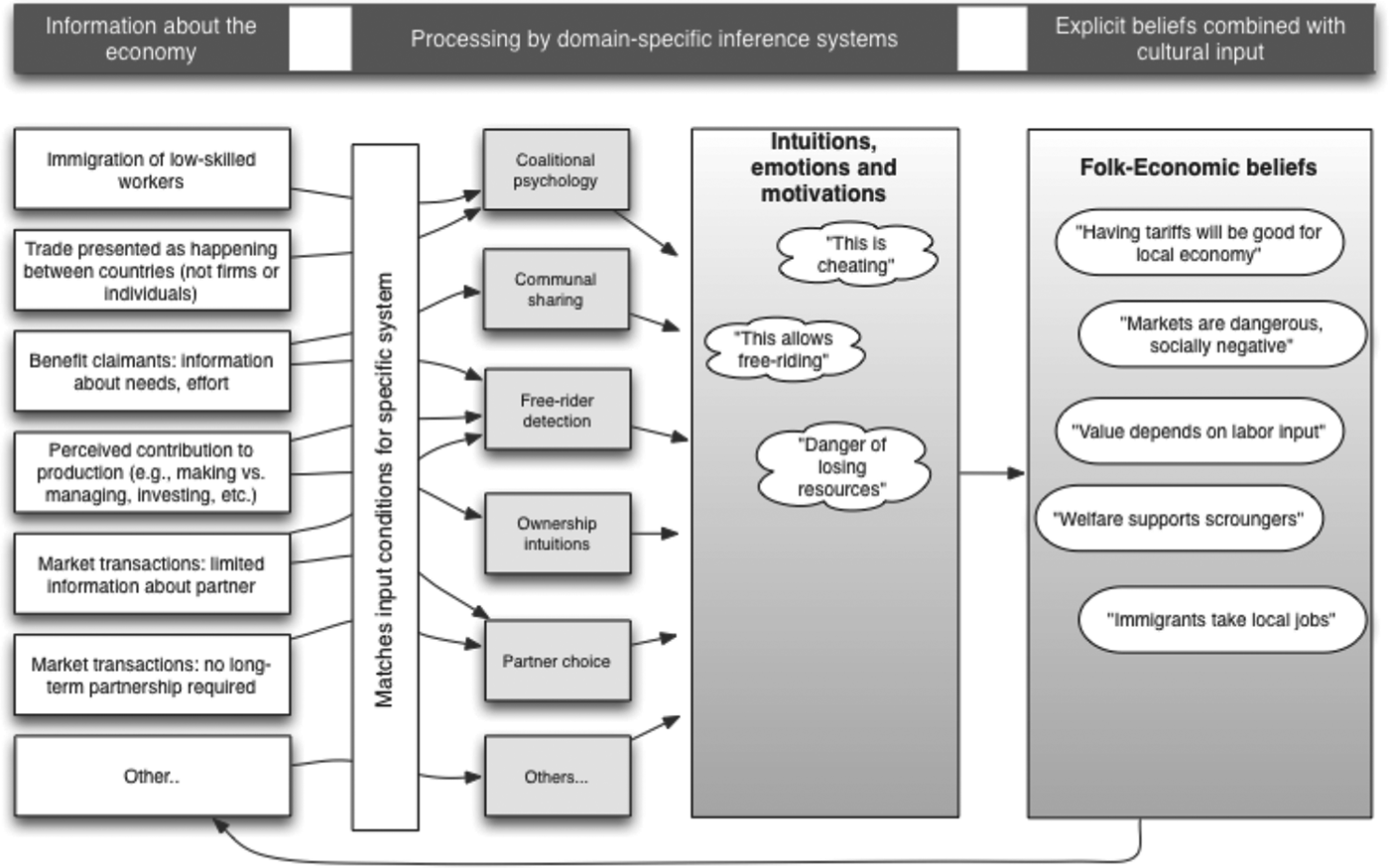
In the following sections, we discuss the possible connections between specific evolved inference systems and specific folk-economic beliefs – that is, how activation of the systems may make a particular belief received from external sources more natural and compelling. The examples that we draw on are meant as mere illustrations of many potential connections, providing the first small steps towards an empirical research program.
5.1. Explaining FEB 1: International trade as coalitional rivalry
We begin with what we referred to above as FEB 1, the statement that international trade has negative consequences. This contains several pieces of information likely to activate specific inference systems. Let us consider a news headline like “China sells more to the U.S. than to Russia.” Selling involves receiving resources and, importantly, resources in this case transfer from one nation to another. In psychological terms, nations are “imagined communities” (Anderson Reference Anderson1983) or, with the vocabulary presented above, nations are coalitions to the mind and, hence, mention of nations activates the coalitional psychological machinery (Gat Reference Gat2006; Hechter Reference Hechter1987a). Nations are exclusive groups, citizens of a nation are assumed to have common interests, and nations are equipped with armies to fight each other. The activation of this machinery has the downstream consequence, we argue, that Americans will evaluate the transfer of resources to China – and, hence, the headline – negatively. As argued above, one key assumption of the coalitional system, once activated about two categories or groups, is that there is a zero-sum interaction between the mutually exclusive groups. As a consequence, there is a strong prior belief that any advantage to another group is detrimental to one's own (Hiscox Reference Hiscox2006). Any information to the effect that other groups are prosperous, or getting better, is equivalent to a threat-cue, indicating that our group stands to lose out.
It is relevant to note how this interpretation of FEB 1 (i.e., the disadvantage of trade) is different from the standard “fallacy”-oriented interpretation. According to our view, FEB 1 does not occur as a result of any cognitive or intellectual dysfunction. Instead, we argue that the zero-sum assumption is part of the design of coalitional reasoning. The resulting motivations are part of the architecture of this system. To maintain stable and efficient coalitions, humans in many different contexts must have assumed that other groups' advantage was a potential loss.
Viewing the “international trade is bad” belief as supported by coalitional psychology does not just explain the belief but also suggests novel testable predictions. In particular, we should expect the view that trade is bad to be particularly attractive when the trading crosses perceived coalitional boundaries. It is predicted to invariably occur in the context of, precisely, debates about trade between countries. American consumers may find it intuitive that the United States might suffer from Chinese prosperity, but, on this theory, they would find it less compelling that development in Vermont damages the economy of Texas. Similarly, the survival value of the belief might depend on the relationship between the countries. Trading between long-term allies (e.g., trading between Great Britain and the United States) should be viewed as less problematic than trading between rivals (e.g., trading between China and the United States), even if all else were equal.
5.2. Explaining FEB 2 and FEB 3: Immigration and the dual activation of the psychologies of coalitions and cheater-detection
In section 2, we outlined two FEBs about immigration. FEB 2 is the belief that immigrants “steal” jobs and FEB 3 the somewhat contrary belief that “immigrants abuse welfare systems.” Although these two beliefs seem inconsistent (how can immigrants take both jobs and unemployment benefits?), they do share a key common assumption, a stipulation that immigrants use up valuable resources to which they are not entitled. This assumption, we argue, is what makes either of these ideas resonate with the evolved psychology of social exchange.
Specifically, the representation of recipients as not entitled to resources receives support from the interaction of two crucial inference systems: (a) coalitional psychology, and (b) cheater-detection. Immigrants are by definition newcomers to the community. Psychological research has shown that newcomers to groups activate this connection between coalitional cognition and cheater-detection, in particular, in situations where group membership is construed as conferring particular benefits. In such situations, newcomers are typically regarded with great suspicion. Cimino and colleagues interpret this in terms of cheater-detection. When new members join a group, they are in a position to receive some of the benefits of membership (e.g., becoming a Marine makes one a respected member of a prestigious military corps), without having (yet) paid any costs (e.g., risked one's life in action). This combination of features may activate cheater-detection mechanisms, as persons in this situation effectively meet the input criterion of Benefit Received without Cost Paid, which would explain the considerable hostility towards newcomers in many voluntary groups that is sometimes expressed in the form of painful hazing and initiation rituals (Cimino Reference Cimino2011). Experiments show that there is indeed an implicit concept of newcomer that motivates such aggressive attitude, even when people consider membership in imaginary groups (Cimino & Delton Reference Cimino and Delton2010; Delton & Cimino Reference Delton and Cimino2010).
The tight relationship between the concepts of nation and coalition (see above) may explain the attractiveness of the statement that immigrants must be free-riders, scrounging on the past efforts of the host community. But, at the same time, the involved psychological systems leave open whether it is on job creation or on the welfare system that immigrants free-ride.
This interpretation suggests new research avenues. The argument is that the public's intuitions about the economic effects of immigration does not just reflect diffuse prejudice (Stephan et al. Reference Stephan, Ybarra and Bachman1999) but is the outcome of very precise psychological mechanisms that work in tandem with beliefs about jobs, the welfare state, and so on, as collectively produced resources. As a consequence, it will be difficult for immigrant populations to behave in ways that increase acceptance by the native population. Any involvement with what is construed as a “resource” is likely to trigger intuitions of free-riding – see, for example, Guimond et al. (Reference Guimond, De Oliveira, Kamiesjki and Sidanius2010). Furthermore, our interpretation suggests that there is an intimate connection between the perceived motivations of immigrants and the presumed economic consequences of immigration. Only in instances where specific immigrant groups are seen as willing to sacrifice self-interest for collective goods – that is, the exact opposite of free-riding motivations – should the public view the economic effects as positive.
Finally, this shows that there is no one-to-one mapping from specific systems for social exchange and specific FEBs. When FEBs – sometimes contradictory ones like FEB 2 and FEB 3 – become culturally available, their acceptance depends on the degree to which they resonate with human exchange psychology. In this particular case, it is the dual appeal of the FEBs to both coalitional psychology and cheater-detection psychology that ensures their cultural survival in the minds of the public.
5.3. Explaining FEB 4: Social welfare and intuitions about free riding and communal sharing
FEB 4 refers to beliefs about the effects of economic investments in welfare programs. In fact, as laid out in Section 2, folk-economic beliefs about these effects consist of two separate and diametrically opposed beliefs. One belief is that unemployment benefit programs, for instance, lead to decreased economic activity because welfare programs benefit unproductive individuals. Another belief is that, in the long run, these benefits increase economic activity because they sustain productive individuals during periods of bad luck and, hence, facilitate the transition to new jobs. These opposite beliefs are not randomly distributed. In fact, their distribution demonstrates our key point about the relevance of FEBs: that they are associated with particular political positions. Support for welfare programs is strongly related to the belief that they sustain unfortunate individuals. Opposition to welfare programs is strongly related to the belief that they sustain unproductive – that is, lazy – individuals.
In our perspective, beliefs surrounding welfare programs – and, in particular, the link between beliefs about welfare recipients' productivity and support for welfare programs – are a key example of how psychological adaptations designed for social exchange shape economic policy views. What is surprising is not just the existence but also the strength of this link between perceived character of recipients and presumed economic benefits of welfare programs. In one of the most extensive studies of Americans' views on welfare, Gilens (Reference Gilens1999) concluded that the perception of welfare recipients as “undeserving” is the strongest predictor of individual-level opposition to welfare programs. This, we argue, is a consequence of the way in which the cues surrounding welfare programs activates mechanisms designed for cheater-detection.
Debates about welfare programs contain a number of cues that should elicit cheater-detection psychology. Welfare recipients are in need, and welfare programs provide benefits to the recipients and does so at a cost for the collective. For a mind designed to scan the social environment for cheaters, this particular set of cues automatically raises the question: Have the recipients paid sufficient costs in order to be entitled to these benefits? (Petersen et al. Reference Petersen, Sznycer, Cosmides and Tooby2012). Or, more specifically: Are the recipients valuable enough as cooperation partners to be included within the exchange system? This, then, motivates scanning for additional information about the cooperative motivations of welfare recipients, activating either cheater-avoidance motivations (if low) or communal sharing motivations (if high), and, in the end, providing an exceptionally fertile soil for infusing economic opinions with beliefs about whether or not welfare recipients are lazy.
This psychological process is one of the more well-studied aspects of folk-economics. The most direct test comes from a series of studies utilizing the memory confusion paradigm. They suggest that welfare recipients are mentally represented by activating the exact same psychological categories that people use to represent cheaters and reciprocators in everyday social interaction (Petersen Reference Petersen2012). The results show that memory processes confuse lazy welfare recipients with everyday cheaters and unfortunate recipients with everyday reciprocators (but not lazy recipients and everyday reciprocators or unfortunate recipients with cheaters). Participants in these studies even forget whether those specific individuals were presented in the context of economically relevant welfare debates or everyday face-to-face interaction. This process operates in a similar fashion, regardless of people's political ideology, their level of political engagement, and whether they live in a society with an expansive welfare state (Denmark) or a reduced one (United States).
This particular explanation for FEB 4 makes sense of empirical findings concerning the relationship between cultural factors and beliefs about welfare. Individuals with liberal or left-leaning views tend to view social welfare recipients as productive individuals. Individuals with conservative or right-leaning views tend to view welfare recipients as unproductive individuals. Similarly, in social democratic societies, the former belief tends to dominate, whereas the latter belief dominates in societies with minimal welfare states. As consequence, cultural explanations have largely dominated the literature. For example, Americans' perception that many welfare recipients are lazy, and the association with anti-welfare sentiments, has been argued to reflect an “individualistic” American culture (Gilens Reference Gilens1999). Similar arguments have been made with regard to right-wing ideology: that it contains an “ideological script” that binds together perceptions of laziness and welfare opposition in the mind of right-wing individuals (Skitka & Tetlock Reference Skitka and Tetlock1993). From the evolutionary cognitive perspective, however, this structure is imposed by evolved mechanisms for exchange that are operating flexibly on the available cues. As a consequence, it should be easy to reverse apparently stable cultural patterns in welfare beliefs, if the right cues are provided. Research shows that this is indeed the case. Among a sample of Danish political science majors (who should be able to reason ideologically), ideological differences in opinions completely disappear when the participants form views about the deservingness of recipients cast as either lazy or unfortunate (Petersen et al. Reference Petersen, Sznycer, Cosmides and Tooby2012). Even more dramatically, cultural differences between Scandinavians and Americans in support for the welfare state completely disappear when participants from these populations have to form views about specific recipients. Two sentences of text that contain evolutionarily relevant cues for cheater-detection are enough to displace 150 years of historical experience with two very different welfare systems (Aarøe & Petersen Reference Aarøe and Petersen2014).
Another insight from the evolutionary cognitive perspective is that people's priority with regard to welfare economy is not so much to ensure a particular overall distribution of resources but more to ensure that resources go to the right individuals. Although the notion that people generally prefer equal to unequal distributions of resources (Fehr et al. Reference Fehr, Schmidt, Kolm, Ythier, Kolm and Ythier2006) has been popular, recent research suggests that people are much more concerned with a fair distribution. Unequal distributions are perfectly acceptable, if those who are bypassed are viewed as cheaters (Starmans et al. Reference Starmans, Sheskin and Bloom2017).
5.4. Explaining FEBs 5 and 6: Impersonal markets and mechanisms for partner-choice
A common feature across numerous FEBs is the notion that markets are, in different ways, “bad” for general welfare. FEB 5 is an expression of what Rubin (Reference Rubin2014) called emporiophobia. FEB 6 refers to the more specific notion that transactions on the market are somehow “unfair.” There is a common thread in these beliefs, the role of perceived social motivations. In most cases, the perceived negative effects of the market are seen as originating from particular sets of social motivations, believed to be pervasive in market transactions. From a cognitive evolutionary perspective, we argue, these beliefs emerge naturally due to the way market interactions differ from the types of social exchanges we evolved to value.
Specifically, to explain these FEBs, we need to describe in cognitive terms, in what way market transactions are, as is often claimed, “impersonal.” This description combines several features of potential relevance to our intuitive systems. First, people in modern conditions do not in principle need information about their exchange partners, beyond knowledge of their positions (seller, buyer), the particular goods they sell or buy, and their price. Second, there is no expectation that considerations other than price and utility should govern people's behaviors in such exchanges. That is, you may be interested in patronizing local stores because that helps keep the town pleasant, but that motivation is clearly extrinsic to the terms of exchange. Third, there is no expectation of reiterated transactions. One can in principle behave in opportunistic ways, patronizing Baker A when his prices are lower and defecting to Baker B when that is more advantageous.
These features all constitute advantages of market transactions from an economic standpoint. Yet, for intuitive inference systems designed for established, long-term, cooperative exchange, these same features will be interpreted in a different manner – as threat-cues. First, our partner-choice system requires that the parties in a transaction be identifiable as specific individuals. In small-scale interactions, the balancing of costs and benefits occurs over reiterated exchanges, and, in order to predict these long-term outcomes, information about the partner's reputation and past exchanges are key. Impersonal transactions, in contrast, are often anonymous, and therefore make it more difficult to track the reputation of one's partners. To a psychology designed for partner-choice, this is likely to trigger an alarm signal, indicating that such a situation should be avoided. Second, strictly impersonal exchange goes against motivations to generate bonds of cooperation with particular individuals, as a form of social insurance. This may reinforce the intuition that impersonal transactions involve, if not danger, at least a missed opportunity. Finally, systems for partner-choice are set up to avoid engaging in exchange relationships with individuals who are much more powerful, in order to avoid exploitation (Petersen Reference Petersen2013; Trivers Reference Trivers1971). In modern markets, however, many exchanges take place with corporations or business that seem exceptionally powerful from the perspective of the individual. While these corporations are actually affected by consumer choice, this only occurs at the aggregate level. As a result, each individual can form the perception that powerful corporations set the terms of exchange in potentially exploitative ways.
Such intuitive computations would provide the cognitive context in which the mind processes socially transmitted information, for example, to the effect that it seems true that “markets are cruel and selfish,” or that “a free market makes wolves free to attack sheep.” In such circumstances, external information provides a context in which some of the intuitions described here receive an explanation or a justification. Conversely, such explicit discourse about the economy is attention-grabbing for people to the extent that it matches some of these intuitions.
This perspective on the emergence of emporiophobia is a recent theoretical proposal (Rubin Reference Rubin2014). There is no specific test of the hypothesis as yet. However, a range of evidence on related phenomena is congruent with this psychological description. Behavioral economics studies show how trust and cooperation are inhibited when social situations are made anonymous (Bohnet & Frey Reference Bohnet and Frey1999; Hoffman et al. Reference Hoffman, McCabe and Smith1996); neuro-economic studies show how monetary rewards elicit greater emotional responses if we experience the source as a human rather than, for example, an impersonal computer – for a review, see Petersen et al. (Reference Petersen, Roepstorff, Serritzlew, Svendsen and Svendsen2009); and management studies show that more impersonal forms of interaction (e.g., e-mail rather than face-to-face interaction) reduce satisfaction with the interaction, in part because of a lack of emotional coordination (Baltes et al. Reference Baltes, Dickson, Sherman, Bauer and LaGanke2002).
Future research could test the proposed explanation directly by utilizing an individual differences approach: Do individual differences in attention to cooperative positive-sum games in everyday life predict endorsement of emporiophobia-related beliefs? This would not only provide a test of the link between perceptions of the market and social motivations, but also could illuminate some of the political implications of FEBs. Emporiophobia is more outspoken among liberals than conservatives and, consistent with the proposed explanation, there is evidence that liberals in general are more oriented towards cooperative, positive-sum games, in particular with strangers (Hibbing et al. Reference Hibbing, Smith and Alford2013). In this regard, it is important to note, again, that emporiophobia is a matter of stated, explicit beliefs, which may or may not reflect the intuitive principles that actually guide people's economic behavior. People who say that markets are “bad” may still behave as roughly rational agents in markets, and they may even detect the advantages of competition in their everyday economic behavior. But, if asked whether a given domain of activity should be left to a market of competitors, or when asked the extent to which markets should be regulated, they readily express the view that market outcomes are socially detrimental.
5.5. Explaining FEB 7: Wages, labor, and the effects of ownership intuitions
FEB 7 is the belief that labor is the source of “value.” Experimental studies have carefully documented this effect. For instance, adults and even young children assume that working to transform an object carries a potential claim to ownership such that, for example, the artist, not the owner of the quarry, is the owner of a sculpture. This ownership claim is made stronger by the extent of the transformation (Friedman Reference Friedman2010; Friedman & Neary Reference Friedman and Neary2008; Friedman et al. Reference Friedman, Neary, Defeyter, Malcolm, Ross and Friedman2011).
From a cognitive evolutionary perspective, human ownership psychology reflects the features of evolutionarily recurrent environments. Ancestrally, most valued and owned goods were previously unclaimed natural resources that time and effort turned into something useable (whether food, tools, or shelter). In such situations, labor is indeed the exclusive generator of both “value” and ownership. Features of modern economies that influences ownership and price, such as ownership of capital and consumer demand, were not crucial features of ancestral environments in the context of production. For example, claiming ownership over something processed by an unrelated person ancestrally would instead signal the existence of a clear dominance relationship.
Although good evidence exists for the importance of labor for intuitions of ownership and value, future studies should seek to directly test people's intuitions about the relative contributions of labor, as well as capital provision and consumer demands, in determining ownership. The prediction that emerges from the cognitive evolutionary perspective is that labor should be intuitively associated with ownership, while other factors are represented in explicit afterthoughts rather than through automatic intuitions. Studies utilizing measures of explicit and implicit processing could tease such effects apart.
This set of folk-economic beliefs (and, in particular, intuitions about value) illustrates an important point: that information that does not meet the input conditions of a system is simply not handled by that system. Here, our ownership inference system takes as its input the fact of original possession, the original state, and the amount of work that transformed a thing. These are the conceptual slots, the place-holders, to be filled by appropriate information. By contrast, the fact that there is, or is not, some demand for the work in question, does not fit any specific conceptual slot in our intuitive ownership system. So, it is simply not processed at all by the relevant intuitive system.
These beliefs also illustrate the political importance of FEBs. Intuitions about ownership and value resonate with arguments about large wage differentials between, for example, managers and frontline workers being unfair, and that the latter contribute more “value” than the former. Such arguments have particular appeal if used to argue in favor of higher taxation or the regulation of business. Historically, Marxian ideologies have also continuously framed owners of capital as exploitive. In this regard, the evolutionary cognitive model entails novel testable predictions: The underlying intuition that owners of companies or factories are exploiting workers may not ultimately stem from observed differences in wealth, or poor conditions for the workers. Instead, an important contribution may lie in the fact that workers are perceived as investing more effort, often in the form of more physically demanding labor. To the evolved mind, this may trigger the intuition that workers are natural owners of products. Future studies could directly test this by examining how different factors such as wealth differences between management and workers, differences in working conditions, and differences in effort, shape the view that particular corporations are exploiting their employees.
5.6. Explaining FEB 8: Large-scale regulation and small-scale minds
FEB 8 is the belief that regulation has the intended economic effects. Specific examples include the belief that rent controls drive down the average rent, that minimum wages increase average income, or that there is a fixed amount of work to be done, so that limiting the working hours will palliate unemployment by distributing that amount (Worstall Reference Worstall2014, p. 75). Economists generally point out that, even in the best scenario, unintended effects occur and, in some cases, reverse the desired outcome. Trust in regulation seems to be based on specific non-economic assumptions (Hirshleifer Reference Hirshleifer2008) and, in particular, an assumption of stable supply. For example, people expect price-controls to affect market prices but have no effect on quantities supplied.
To explain this FEB, we need to take into account the fact that unintended consequences of this kind are second-order effects that occur in large-scale social systems. They reflect aggregate market responses to changes in costs and benefits (e.g., if the price of the good is regulated downwards, the market responds by decreasing quantities supplied). But our psychology of social exchange is designed for small-scale social systems, for personal exchanges between oneself and one or more identified others. The intuitive inference systems that evolved to deal with such situations do not, because of the small-scale nature of the situations, include any conceptual slots for aggregate dynamics such as origins of supply. In this way, FEBs about regulation do not emerge from a single set of intuitive inference systems. Rather, they emerge from the failure of particular pieces of information to be processed by any intuitive inference system.
Let us consider the specific example of rent control to illustrate this interpretation in more detail. To the evolved mind, rent control can be intuitively construed as a form of assistance that makes sense from a small-scale perspective, as it seems that resources are transferred from richer landlords to poorer tenants. It is likely that systems designed for cheater-detection provides the motivational impetus to support such policies. The situation can be mentally represented as including a generic landlord who intentionally takes an extra benefit (increasing rent) without incurring an extra cost (providing better housing), thereby meeting the input conditions for the “cheater” concept. In this context, the regulatory state appears to redress the situation; the rent ideally decreases, so that the situation no longer activates free-riding detection. Economists have pointed out that the adverse consequences of rent controls (i.e., a lower supply of rental units) may offset any positive effects, although there is disagreement over the size of these negative dynamics (Jenkins Reference Jenkins2009). From an evolutionary cognitive perspective, people will fail to consider such aggregate effects, as the activation of evolved categories entails a perception of the situation as small-scale interaction. The cheater-detection system has no slot for information about the origin of supply and takes quantity supplied as a given. Indeed, in the exchange situations typical of our ancestral past, distribution typically had little effect on production. As described above, opportunity costs, insurance expectations, and reputation management made it possible for people to both distribute most of the game they caught and be motivated to hunt again. Since there is no conceptual slot for information about the origin of supply – for example, the incentives that make people offer housing for rent – this information does not enter into computations about regulations, thereby allowing a belief that regulation will have only the intended effects.
No existing studies have directly tested this argument, and there is only scant evidence at present concerning the psychological representation of regulation (Hirshleifer Reference Hirshleifer2008). An initial set of evolutionary cognitive studies on regulation should test (1) whether the presence of evolutionarily recurrent cues (e.g., cues of cheaters) automatically induces the intuition that regulation in the relevant domain (e.g., rent) works, and (2) whether explicit information about second-order dynamics (e.g., decreased supply) are discounted in the face of such cues.
6. Transmission and effects of folk-economic beliefs
6.1. Intuitive systems create cultural attractors
So far, we have analyzed the ways in which various cognitive systems could affect the relevance of particular pieces of information about the economy, making some views about, for example, unemployment or trade, particularly salient because of their fit with the contents of intuitive assumptions. We can now examine how the agreement or discrepancy between intuitions and some explicit notions of the economy impacts the transmission of information between individuals, thereby creating culturally successful representations. Here we are extending the work of economists who emphasized some particular ways in which individual psychology may influence economic beliefs (Caplan Reference Caplan2008; D. D. Friedman Reference Friedman2004; Rubin Reference Rubin2002). Closest to the kind of model presented here, David Hirshleifer described what he called a “psychological attraction” account of popular opinion on regulation, arguing that “certain beliefs … are especially good at exploiting psychological biases to attract attention and support” (Hirshleifer Reference Hirshleifer2008, p. 857).
Our model extends this form of explanation to most domains of folk-economic opinion. We predict that information about economic matters will be all the more widespread, easy to acquire, natural, compelling, and so forth, when it matches the input conditions of the inference systems described above, thereby creating widespread folk-economic beliefs.
Human communication does not consist in “downloading” representations from one mind to another. Rather, it consists of inferential processes, whereby a listener makes use of observable cues provided by a speaker to reconstruct that individual's possible communicative intentions (Scott-Phillips Reference Scott-Phillips2014; Sperber & Wilson Reference Sperber and Wilson1995). Because of this interpretive quality of communication, cultural transmission will often follow unpredictable paths. We should not expect the contents of two minds from the same social group to be similar. And to a large degree, of course, they are not. Among the myriad mental representations created and sustained in individual human minds, only a minuscule fraction are shared with other individuals. Precisely for that reason, these common beliefs require special explanation. Why do people in a social group sometimes hold roughly similar representations? This question stands in contrast to the questions of classical social science, for which social change was the problem, while the continuity of traditions was taken for granted (Morin Reference Morin2016).
A crucial insight of evolutionary anthropology is that cultural transmission processes are strongly constrained by the structure of human psychology (Sperber Reference Sperber1985; Reference Sperber1996). The mind is prepared to acquire certain representations more easily than others. As a consequence, these representations are found, in roughly similar forms, in many different minds, becoming what we call cultural beliefs. The combination of expectations from our domain-specific intuitive systems, with communicative input from other members of our group, form what anthropologists call cultural attractors, positions in the space of possible representations where many minds seem to converge (Claidière et al. Reference Claidière, Scott-Phillips and Sperber2014; Claidière & Sperber Reference Claidière and Sperber2007). Cultural transmission creates stable representations, not just because people discard or forget material that is far from the attractors, but also because human minds actively distort fragmentary or deviant material. In other words, transmission is reconstructive rather than just selective (Claidière & Sperber Reference Claidière and Sperber2007; Morin Reference Morin2013).
This perspective on cultural transmission helps make sense of the cultural recurrence of some folk-economic beliefs, explaining for instance why the belief that imports from other countries are a bad thing, or the notion that immigrants are welfare-scroungers, are made more salient by their interaction with intuitions about coalitions and communal sharing. It is important to notice that the effect of intuitive systems on the spread of cultural beliefs are probabilistic. For example, our intuitive free-rider detection system, or our evolved set of preferences for partner-choice, do not by themselves directly generate particular views of the economy. The intuitive systems only provide a context against which external information, provided by mass media, economists, political entrepreneurs, or simply other individuals, is likely to become relevant, attention-grabbing, and therefore susceptible of cultural transmission.
Conversely, we are obviously not suggesting that the human mind is condemned to process only mental representations that are relevant to our intuitive systems. There are many circumstances in which humans have acquired and communicated thoughts that are entirely non-intuitive, in the sense that they do not match our evolved inference systems. People can, for instance, learn to think in terms of scientific physics, which often go against our intuitive physics. In the case at hand, people can learn economics and produce reasoning that diverges from the beliefs described here. However, acquisition of such non-intuitive thoughts requires effort, and in most cases institutional support for sustained learning (Boyer Reference Boyer1998).
6.2. Folk-beliefs do not reveal an implicit theory of the economy
Is there an economic system in the mind, a set of processes specially dedicated to economic transactions? It would be tempting, though in our view seriously misleading, to consider the set of folk-economic beliefs as a (spontaneous, popular, perhaps misguided) alternative to economic theory. In this view, FEBs would be the outcome of a particular vision of society and the economy.
We resist this interpretation, as there is little evidence for such an integrated, quasi-theoretical picture of the economy among layfolk. In fact, the few studies of lay models clearly suggest the opposite. For instance, Williamson and Wearing interviewed 95 individuals and extracted from this material their implicit views about economic processes. They conclude that “the outcome was 95 unique cognitive models” (Williamson & Wearing Reference Williamson and Wearing1996, p. 3).
Indeed, folk-economic beliefs may vary not just between individuals, but also within the same person, at different times or in different contexts. That is, people do not seem to have stable economic beliefs, in long-term memory, that they could pull out on demand. In the field of public opinion, researchers have made a strong case that we should dispense with such “file-drawer” models of opinion formation (Wilson & Hodges Reference Wilson and Hodges1992; Zaller Reference Zaller1992). People do not build and store stable, organized beliefs about the economy, ready to be made available when surveyed by a pollster. Instead, they make up their attitudes and beliefs “on the spot,” by retrieving relevant cultural representations, and (in our view) activating the relevant intuitive inference systems. For most individuals in modern mass-societies, there is little monetary incentive to evaluate one's own beliefs about the economy or the political process (in contrast to many other domains in their everyday lives), and there is almost no price to pay for being factually wrong, which would explain why there is relatively little cognitive investment in evaluating their validity (Caplan Reference Caplan2008).
The exceptional range of different understandings of the model identified by Williamson and Wearing (Reference Williamson and Wearing1996) also suggests that, for each individual, the model might be different if surveyed in another context. Indeed, there is evidence for such systematic changes. In an analysis of British voters during the recent economic crisis, Bisgaard (Reference Bisgaard2015) found that people rapidly shift their understanding of how much control the government has over the economy, depending on how the economy is doing and whether or not their favored party is in government. If the economy gets worse and people support the governing party, the government is suddenly no longer viewed as in control. From an evolutionary cognitive perspective, such partisan motivations most likely stem from the operations of coalitional psychology (Haidt Reference Haidt2012; Petersen Reference Petersen and Buss2016). People signal support to their coalition by construing beliefs that protect it against criticism. Experimental results show that, like national or ethnic identities, partisanship is processed as a coalitional affiliation to the evolved mind (Pietraszewski et al. Reference Pietraszewski, Curry, Petersen, Cosmides and Tooby2015). Hence, it might matter for people whether they have the “right” FEBs from a coalitional perspective but not whether they have the “true” FEBs from an epistemic perspective.
The fact that folk-economic beliefs can change rapidly should not be surprising, as most of them are reflective, not intuitive beliefs. To illustrate this reflective nature of FEBs, consider “emporiophobia.” Information about the fact that market transactions are one-shot interactions can lead to the intuition “there is danger here,” because our evolved social exchange preferences include reiterated transactions with known individuals. This intuition of danger can then lead to forming, acquiring, or accepting explicit reflective beliefs of the form “the market is bad.”
From an evolutionary standpoint, it should come as no surprise that human minds do not comprise a specific “economics” module. Decision-making under scarcity, traditionally described as the domain of economic models, is not a unified domain of social interaction, for which evolution would have given us specific inference systems. Instead, the evidence from experimental psychology studies suggests that human evolution resulted in specialized systems for scarcity in food provision (foraging), in mates (sexual preferences), in social support (coalitional psychology), and so on (see Buss Reference Buss2015). Even in the domain of social exchange, as described above, we spontaneously activate diverse systems with different principles and potentially inconsistent responses.
6.3. Relationship between FEBs and economic behavior
The model presented here leaves a gap in our understanding, as concerns the connections (or lack thereof) between folk-economic views on the one hand, and economic behavior on the other. Many people in modern societies have explicit folk-economic views that do not just fly in the face of economic theory, but are also incompatible with their own behavior in markets. For example, people may both have the explicit belief that “markets produce negative outcomes” and an implicit trust in competition in their search for the best prices.
We propose here that economic beliefs are largely constrained by evolved, domain-specific systems concerned with social exchange. So, there might be connections between FEBs and economic behavior, to the extent that these same domain-specific intuitive systems are activated when people engage in actual economic transactions.
Unfortunately, this aspect of economic cognition is still very much a terra incognita. We can assume that economic decision-making is governed by a variety of intuitive systems, the aggregate output of which is an intuition that the transactions is desirable or best avoided, and that intuition motivates the eventual decision. Over the last decades, studies within behavioral economics have demonstrated how this intuitive output diverges, in relatively systematic ways, from the subjective utility maximization predictions of standard microeconomics (Plott Reference Plott2001; Smith Reference Smith2003).
However, we still lack a computationally precise and reasonably predictive description of the cognitive processes engaged (Ross Reference Ross2005). Indeed, a large part of the behavioral economic literature assumes what could be called a person-level description of economic decision-making, in which information about possible strategies is combined and evaluated by a general-purpose, centralized utility-evaluating system – the difference from neoclassical models being that considerations of fairness, reputation, and other non-standard forms of utility are added to the classical homo economicus agent. This notion of utility as considered by a centralized agent corresponds to what Dennett calls the “intentional stance,” in which we explain behavior in terms of reasons, knowledge, and intentions (Dennett Reference Dennett1987). This way of explaining behaviors is produced by our intuitive psychology, or “theory of mind.” It is very successful in explaining and predicting other human beings' behavior. The operation of this intuitive psychology is so natural and invisible that it often seems difficult even to imagine another way of explaining behavior.
But there is an alternative, what Dennett called a “design stance,” in which we consider behavior in terms of the various computational systems involved in acquiring information about the environment and motivating specific behaviors (Dennett Reference Dennett1987). Approaching economic decision-making in this perspective could make economic theory more congruent with findings and models from the cognitive sciences (Ross Reference Ross2005). In that perspective, decision-making in any domain is the outcome of a competition between distinct computational processes – and this of course applies to economic decisions as well (Kenrick et al. Reference Kenrick, Li, White, Neuberg, Forgas, Fiedler and Sedikides2013), a view that is supported by behavioral evidence (Ainslie & Monterosso Reference Ainslie and Monterosso2004) and neurocognitive findings (Glimcher Reference Glimcher and Gazzaniga2009; Loewenstein et al. Reference Loewenstein, Rick and Cohen2008). However, it is still difficult to describe how these models and findings could be integrated with classical, and often empirically successful, descriptions of economic behavior in terms of rationality (Ross Reference Ross2005) and utility (Burnham Reference Burnham2013). As a consequence, the actual connections between micro-processes of economic decision-making on the one hand, and folk-economic beliefs on the other, remain unexplored.
6.4. Political relevance of folk-economic beliefs
In this model, because of the activation of intuitive inference systems, some ways of presenting economic processes are more compelling than others. This would constrain political communication, not just from elites to the rest of the population, but also among layfolk, with important consequences for political debate. Importantly, this would imply that a particular economic issue is often not discussed in the format that provides most information about the causes and consequences of policy, but in the format that is intuitively compelling, even if that obscures a great deal of the relevant information.
FEBs are politically important because they act as a set of background assumptions that forms the basis of the formation of political opinions. One important area of opinions relates to political candidates. A wealth of research within political science has shown that incumbent parties or candidates are punished and rewarded for bad and good economic developments, respectively. When unemployment soars, incumbents are more likely to lose. Importantly, however, research also shows that the link between economic circumstances and voting behavior is mediated by the perceived responsibility of the incumbents (Rudolph Reference Rudolph2003a; Reference Rudolph2003b). Assignment of responsibility for macro-economic events necessarily relies on FEBs and an interpretation of the relationship between the actions of the candidate and the economic developments. Beliefs about the relationship between economic hardship, on the one hand, and international trade and immigration, on the other hand, could be influential. If the economy is doing badly and the incumbent government has increased immigration and trade, then our analyses suggest that it is more likely that the government will be held accountable on Election Day.
Such effects of intuitive systems are also relevant to policy choices. FEBs, and the intuitive systems underlying them, shape political behavior because they make certain ways of organizing the economy more compelling. Importantly, these compelling policies will in some cases be misguided, as the psychological systems were designed for small-scale exchange rather mass markets. For example, in the small-scale environments of our ancestors, helping was a matter of transferring resources to a needy individual. Arguments for welfare policy that are framed that way should be persuasive. In modern markets, however, the effectiveness of any social solutions is also affected by equilibrium considerations. Consider the difference between targeted versus universal welfare programs. From a small-scale perspective, targeted programs should be most effective in helping the needy, because they bring resources specifically to those in need. Yet, in market economies, comparative studies provide compelling evidence that welfare programs are more redistributive, and help the neediest people more, when they are universal rather than targeted. That is due, again, to macro-level dynamics ignored by our intuitive systems. Research shows that it is possible to sustain high levels of benefits from a welfare program, but only when the politically influential middle-class are among those benefiting from that program (Korpi & Palme Reference Korpi and Palme1998; Rothstein Reference Rothstein1998). When they do not benefit, most voters are persuaded that the benefits should be scaled down. Because of this electoral dynamic, universal programs are on balance more redistributive than targeted programs. This net result arises from both their high benefit rates and the fact that higher-income groups contribute more to the program by means of taxation than low-income groups. But, again, evolved exchange intuitions would make people less likely to be persuaded by arguments that touch on such dynamics, compared to arguments that fit our intuitive systems for allocating benefits between individuals.
Folk-economic beliefs are politically important because they constrain how politicians can talk about policies to the public. Political scientists have documented the effects of “framing” on policy views (Chong & Druckman Reference Chong and Druckman2007). The model presented provides a more specific understanding of these processes. In our view, certain policy-related messages are more compelling or persuasive, not just because they are framed in more “concrete” or “simple” or “vivid” terms, as is often suggested, but also because they meet specific expectations from our intuitive systems. For instance, policies that increase international trade with rival countries or that allow more immigrants to enter the country can be more easily framed as economically problematic than as beneficial, not because the former description is “simpler” but because of the match it offers between intuitive inference systems and a particular constellation of arguments (Arceneaux Reference Arceneaux2012).
7. Conclusion
In 1922, the American journalist Walter Lippmann grasped the characteristic of modern mass societies when he wrote: “Our opinions cover a bigger space, a longer reach of time, a greater number of things, than we can directly observe” (Lippmann Reference Lippmann1922, p. 42). If this was true in 1922, it is even more true in the twenty-first century. And if it is true about mass societies, in general, it is nowhere else as true as with the market. No citizen can ever observe each of the distant transactions that comprise the market economy. It is not just a matter of practicality. The market mechanism is in principle unobservable. Even if all transactions could be observed, one would still not observe the economy as such – such a claim would be a category-mistake in the sense of Ryle (Reference Ryle1949/2009). The “hand” that governs the causal processes of the market is, as already pointed out by Adam Smith, invisible – that is, not just hidden but in principle difficult to detect (Nozick Reference Nozick1994). As consequence, laypeople, when forming their internal representations of the economy, cannot rely on much, if any, feedback from direct experience. And without external experiences as a reality-check on their beliefs, they are left with what others report and what they themselves can imagine.
We proposed a new explanation for the differences between laypeople and economists' views on a number of economic issues. Instead of considering folk-economic views as irrational deviations from normative understandings of economic processes, we explain them as the outcome of principled cognitive systems. These appeared in human evolution as adaptive response to specific challenges, and they are automatically activated whenever a situation meets their input criteria. The intuitions provide support for deliberate, explicit, reflective thoughts, among which are the culturally transmitted folk-economic beliefs considered here.
How and why people acquire and stabilize beliefs about the economy is, obviously, crucial to understanding political dynamics. Economic policies are central to the overt choices offered in most liberal democracies, but we are only starting to figure out the effects of intuitive systems, typical of all normal human minds, on the acquisition and transmission of people's explicit beliefs about the economy.
ACKNOWLEDGMENTS
We are grateful to Nicolas Baumard, Martin Bisgaard, Timothy Blaine, Thom Scott-Phillips, Don Ross, Paul Rubin, and four anonymous reviewers for thoughtful and detailed comments on a previous version.
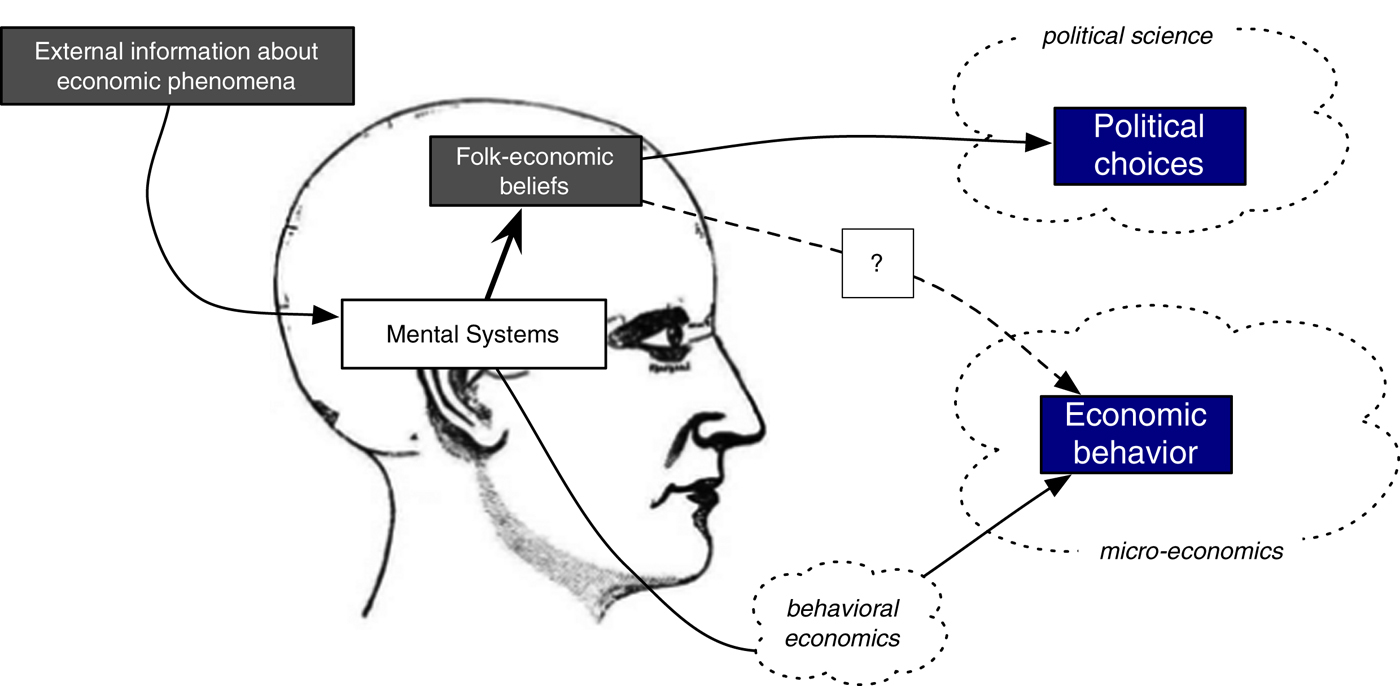
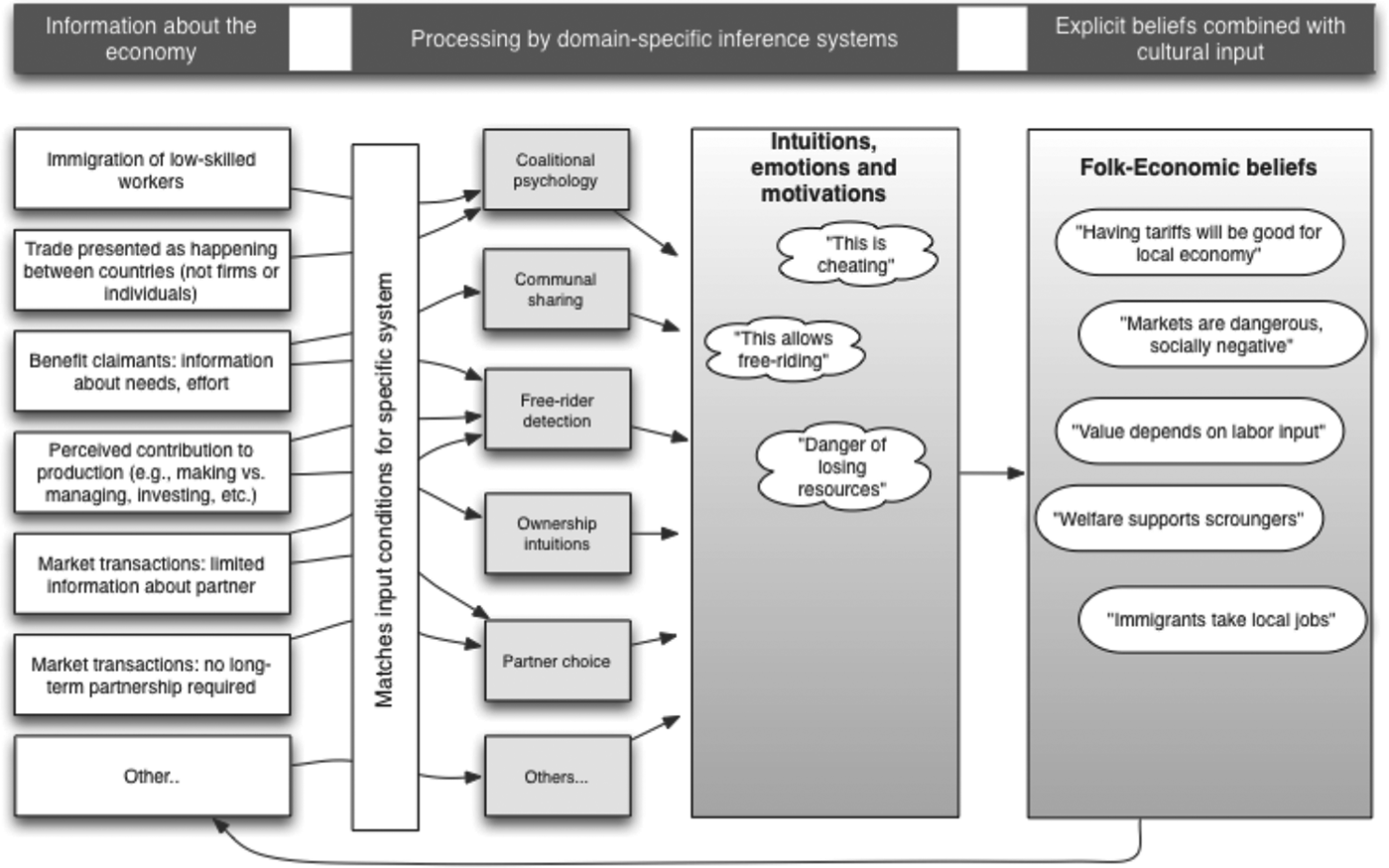



Target article
Folk-economic beliefs: An evolutionary cognitive model
Related commentaries (32)
A grounded cognition perspective on folk-economic beliefs
A theory of how evolved psychology underpins attitudes towards societal economics must go beyond exchanges and averages
Adding culture and context improves evolutionary theorizing about human cognition
Beyond market behavior: Evolved cognition and folk political economic beliefs
Broadening the role of “self-interest” in folk-economic beliefs
Challenges of folk-economic beliefs: Coverage, level of abstraction, and relation to ideology
Coalitional rivalry may hurt in economic exchanges such as trade but help in war
Developmental and cultural factors in economic beliefs
Do the folk actually hold folk-economic beliefs?
Does evolutionary cognitive psychology crowd out the better angels of our nature?
Economic complexities and cognitive hurdles: Accounting for specific economic misconceptions without an ultimate cause
Elaborating the role of reflection and individual differences in the study of folk-economic beliefs
Evolutionary model of folk economics: That which is seen, and that which is not seen?
Fairness, more than any other cognitive mechanism, is what explains the content of folk-economic beliefs
Fear of economic policies may be domain-specific, and social emotions can explain why
Folk-economic beliefs as moral intuitions
Folk-economic beliefs as “evidential fiction”: Putting the economic public discourse back on track
Folk-economics: Inherited biases or misapplication of everyday experience?
How Homo economicus lost her mind and how we can revive her
How does “emporiophobia” develop?
Mapping the terra incognita of economic cognition will require an experimental paradigm that incorporates context
Not all folk-economic beliefs are best understood through our ancestral past
Partisan elites shape citizens' economic beliefs
People are intuitive economists under the right conditions
Social transmission bias and the cultural evolution of folk-economic beliefs
Spoiled for choice: Identifying the building blocks of folk-economic beliefs
The challenge of accounting for individual differences in folk-economic beliefs
The mind of the market: Lay beliefs about the economy as a willful, goal-oriented agent
Understanding the development of folk-economic beliefs
Why do people believe in a zero-sum economy?
Why do people think that others should earn this or that?
Zero-sum thinking and economic policy
Author response
What is seen and what is not seen in the economy: An effect of our evolved psychology