





No CrossRef data available.
Article contents
If lullabies and hero stories are super-attractors, what are music and language? Absolute universals imply genetic mechanisms
Published online by Cambridge University Press: 10 July 2026
Abstract
I praise the synthesis and expansion of attractor theory to explain statistical universals, but critique its failure to explain absolute universals. I agree that lullabies, hero stories, and shamanism are good candidates for primarily cultural evolutionary explanations, but argue that the larger, most universal categories they are sub-phenomena of – music, language, religion – require gene-culture coevolutionary explanations.
Information
- Type
- Open Peer Commentary
- Information
- Copyright
- © The Author(s), 2026. Published by Cambridge University Press
References
Alagöz, G., Eising, E., Mekki, Y., Bignardi, G., Fontanillas, P., 23andMe Research Team, Nivard, M. G., Luciano, M., Fisher, S. E., & Gordon, R. L. (2025). The shared genetic architecture and evolution of human language and musical rhythm. Nature Human Behaviour, 9, 376–390. https://doi.org/10.1038/s41562-024-02051-y
CrossRefGoogle ScholarPubMed
Albouy, P., Mehr, S. A., Hoyer, R. S., Ginzburg, J., Du, Y., & Zatorre, R. J. (2024). Spectro-temporal acoustical markers differentiate speech from song across cultures. Nature Communications, 15, Article 4835, 1–13. https://doi.org/10.1038/s41467-024-49040-3
CrossRefGoogle ScholarPubMed
Anikin, A., Canessa-Pollard, V., Pisanski, K., Massenet, M., & Reby, D. (2023). Beyond speech: Exploring diversity in the human voice. iScience, 26(11), 108204. https://doi.org/10.1016/j.isci.2023.108204
CrossRefGoogle ScholarPubMed
Aubinet, S. (2024). Lullabies and universality: An ethnographic review. Cross-Cultural Research, 58(5), 411–446. https://doi.org/10.1177/10693971241272406
Google Scholar
Bickel, B. (2011). Absolute and statistical universals. In Hogan, P. C. (Ed.), The cambridge encyclopedia of the language sciences (pp. 77–79). Cambridge University Press. https://doi.org/10.5167/uzh-48991
Google Scholar
Boas, F. (1896). The limitations of the comparative method of anthropology. Science, 4, 901–908. https://doi.org/10.1126/science.4.103.901
CrossRefGoogle ScholarPubMed
Enard, W., Przeworski, M., Fisher, S. E., Lai, C. S. L., Wiebe, V., Kitano, T., Monaco, A. P., & Pääbo, S. (2002). Molecular evolution of FOXP2, a gene involved in speech and language. Nature, 418(6900), 869–872. https://doi.org/10.1038/nature01025
CrossRefGoogle ScholarPubMed
Fisher, S. E. (2019). Human genetics: The evolving story of FOXP2. Current Biology, 29(2), R65–R67. https://doi.org/10.1016/j.cub.2018.11.047
CrossRefGoogle ScholarPubMed
Fitch, W. T. (2010). The evolution of language. Cambridge University Press. https://doi.org/10.1017/CBO9780511817779
CrossRefGoogle ScholarPubMed
Haesler, S., Rochefort, C., Georgi, B., Licznerski, P., Osten, P., & Scharff, C. (2007). Incomplete and inaccurate vocal imitation after knockdown of FoxP2 in songbird basal ganglia nucleus area X. PLoS Biology, 5(12), e321. https://doi.org/10.1371/journal.pbio.0050321
CrossRefGoogle ScholarPubMed
Kirby, S. (2017). Culture and biology in the origins of linguistic structure. Psychonomic Bulletin & Review, 24, 118–137. https://doi.org/10.3758/s13423-016-1166-7
CrossRefGoogle ScholarPubMed
Mehr, S. A., Singh, M., Knox, D., Ketter, D. M., Pickens-Jones, D., Atwood, S., Lucas, C., Jacoby, N., Egner, A. A., Hopkins, E. J., Howard, R. M., Hartshorne, J. K., Jennings, M. V., Simson, J., Bainbridge, C. M., Pinker, S., O’Donnell, T. J., Krasnow, M. M., & Glowacki, L. (2019). Universality and diversity in human song. Science, 366, eaax0868. https://doi.org/10.1126/science.aax0868
CrossRefGoogle ScholarPubMed
Niarchou, M., Gustavson, D. E., Sathirapongsasuti, J. F., Anglada-Tort, M., Eising, E., Bell, E., McArthur, E., Straub, P., 23andMe Research Team, McAuley, J. D., Capra, J. A., Ullén, F., Creanza, N., Mosing, M. A., Hinds, D. A., Davis, L. K., Jacoby, N., & Gordon, R. L. (2022). Genome-wide association study of musical beat synchronization demonstrates high polygenicity. Nature Human Behaviour, 6(9), 1292–1309. https://doi.org/10.1038/s41562-022-01359-x
CrossRefGoogle ScholarPubMed
Ozaki, Y., Tierney, A., Pfordresher, P. Q., McBride, J., Benetos, E., Proutskouva, P., Chiba, G., Liu, F., Jacoby, N., Purdy, S. C., Opondo, P., Fitch, W. T., Hegde, S., Rocamora, M., Thorne, R., Nweke, F., Sadaphal, D., Sadaphal, P., Hadavi, S., … Savage, P. E. (2024). Globally, songs and instrumental melodies are slower and higher and use more stable pitches than speech: A registered report. Science Advances, 10(20), adm9797. https://doi.org/10.1126/sciadv.adm9797
CrossRefGoogle ScholarPubMed
Patel, A. D. (2008). Music, language and the brain. Oxford University Press. https://doi.org/10.1093/acprof:oso/9780195123753.001.0001
Google Scholar
Patel, A. D. (2018). Music as a transformative technology of the mind: An update. In Honing, H. (Ed.), The origins of musicality (pp. 113–126). MIT Press. https://doi.org/10.7551/mitpress/10636.003.0009
CrossRefGoogle Scholar
Patel, A. D. (2023). Human musicality and gene-culture coevolution: Ten concepts to guide productive exploration. In Margulis, E. H., Loui, P., & Loughridge, D. (Eds.), The science-music borderlands: Reckoning with the past and imagining the future (pp. 15–37). MIT Press. https://doi.org/10.7551/mitpress/14186.001.0001
CrossRefGoogle Scholar
Patel, A. D. (2024). Beat-based dancing to music has evolutionary foundations in advanced vocal learning. BMC Neuroscience, 25(65), 1–16. https://doi.org/10.1186/s12868-024-00843-6
Google ScholarPubMed
Patel, A. D., Iversen, J. R., Bregman, M. R., & Schulz, I. (2009). Experimental evidence for synchronization to a musical beat in a nonhuman animal. Current Biology, 19, 827–830. https://doi.org/10.1016/j.cub.2009.03.038
CrossRefGoogle Scholar
Savage, P. E. (2019). Universals. In Sturman, J. L. (Ed.), SAGE international encyclopedia of music and culture (pp. 2282–2285). SAGE Publications. https://doi.org/10.4135/9781483317731.n759
Google Scholar
Savage, P. E. (In press). Comparative musicology: Evolution, universals, and the science of the world’s music. Oxford University Press. https://doi.org/10.31234/osf.io/b36fm
CrossRefGoogle Scholar
Savage, P. E., Loui, P., Tarr, B., Schachner, A., Glowacki, L., Mithen, S., & Fitch, W. T. (2021). Music as a coevolved system for social bonding. Behavioral and Brain Sciences, 44(e59), 1–22. https://doi.org/10.1017/S0140525X20000333
CrossRefGoogle Scholar
Savage, P. E., Ampiah-Bonney, A., Arabadjiev, A., Arhine, A., Ariza, J. F., Arnese, F., Bamford, J. S., Barbosa, B. S., Beck, A.-K., Belyk, M., Benetos, E., Bulbulia, J. A., Cabildo, A., Calhoun, S., Chiba, G., Dabaghi Varnosfaderani, S., Dias, R., Duran, S. I., Echim, S., Færøvik, U., Zariquiey, R., et al. (In Principle Accepted). Does synchronised singing enhance social bonding more than speaking does? A global experimental Stage 1 Registered Report. Peer Community In Registered Reports. Preprint: https://doi.org/10.31234/osf.io/pv3m9 [Peer Community In Registered Reports editorial recommendation and peer review: https://rr.peercommunityin.org/articles/rec?id=890]
Google Scholar
Schachner, A., Brady, T. F., Pepperberg, I. M., & Hauser, M. D. (2009). Spontaneous motor entrainment to music in multiple vocal mimicking species. Current Biology, 19, 831–836. https://doi.org/10.1016/j.cub.2009.03.061
CrossRefGoogle ScholarPubMed
Singh, M., & Hill, K. (2025). Loss of dance and infant-directed song among the Northern Aché. Current Biology, 35, 2444–2447. https://doi.org/10.1016/j.cub.2025.04.018
CrossRefGoogle ScholarPubMed
Wesseldijk, L. W., Ullén, F., & Mosing, M. A. (2023). Music and genetics. Neuroscience & Biobehavioral Reviews, 152, 105302. https://doi.org/10.1016/j.neubiorev.2023.105302
CrossRefGoogle ScholarPubMed
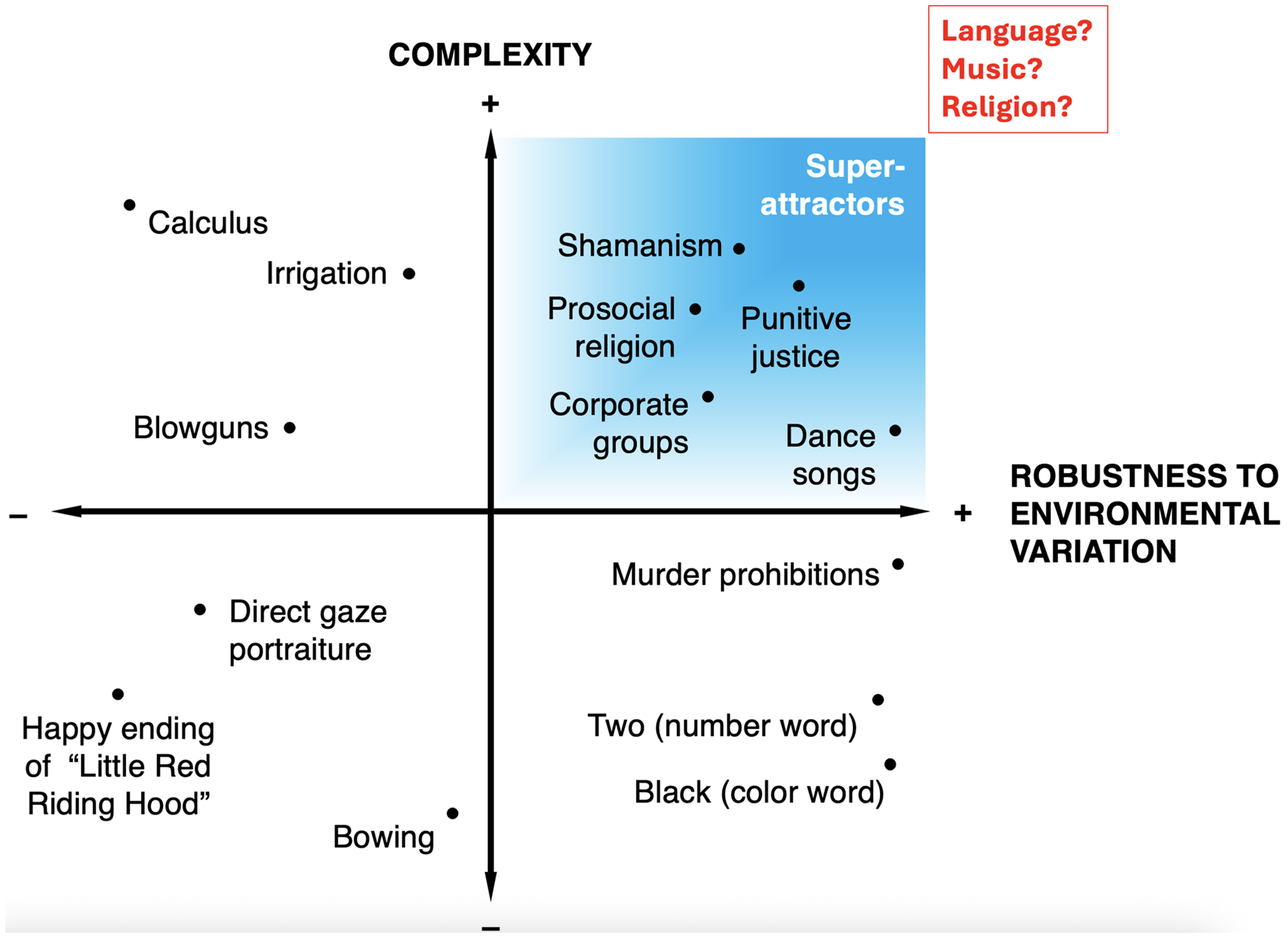
Figure 1. An adapted version of Figure 1 from Singh’s target article with an added red box containing some of the most complex and universal cultural domains. These “absolute universals” found in all known human societies without exception (e.g., language, music, religion) appear beyond the explanatory framework of super-attractor theory, and instead imply at least some genetic component.
Target article
Related commentaries (27)
Language is a super-attractor: Does it evolve through subjective selection?
Silent forces: How normative ecologies reshape super-attractors
Subjective selection needs socially transmitted goals and culturally evolving problems
 You have
Access
Singh’s explanation of near-universal “super-attractors” is the most persuasive case I’ve read yet, generalising cultural attractor theory to phenomena widespread across cultures. Singh frames his approach as addressing what he calls “laws that apply across time and throughout human history” in order to solve what Boas (Reference Boas1896) called “the most difficult problem of anthropology.” This makes it sound like Singh will address what are known as “absolute universals” found in all societies without exception. But in fact, Singh focuses on “near-universal” traditions (also known as “statistical universals”; Bickel, Reference Bickel and Hogan2011; Brown, Reference Brown1991; Savage, Reference Savage and Sturman2019)
At the top of most lists of absolute universals is the uniquely human capacity for language, which has been described as “what makes us human” (Fitch, Reference Fitch2010). Arguably, next on the list might be music (for which Singh has helped provide some of the strongest evidence for absolute universality; Mehr et al., Reference Mehr, Singh, Knox, Ketter, Pickens-Jones, Atwood, Lucas, Jacoby, Egner, Hopkins, Howard, Hartshorne, Jennings, Simson, Bainbridge, Pinker, O’Donnell, Krasnow and Glowacki2019), along with things like religion, tool use, and control of fire (Brown, Reference Brown1991).
The examples of super-attractors Singh provides include multiple examples that can be seen as restricted cases of broader absolute universals such as music (e.g., lullabies, dance songs), language (e.g., hero stories, happy endings), or religion (e.g., shamanism, prosocial religions). Yet the broader, most universal domains of music, language, and religion themselves are curiously absent from the target article (Fig. 1).
An adapted version of Figure 1 from Singh’s target article with an added red box containing some of the most complex and universal cultural domains. These “absolute universals” found in all known human societies without exception (e.g., language, music, religion) appear beyond the explanatory framework of super-attractor theory, and instead imply at least some genetic component.
Super-attractor theory is proposed as a phenomenon relying purely on cultural evolutionary mechanisms, without requiring any genetic component. This contrasts with alternative theories that invoke gene-culture coevolutionary mechanisms (e.g., Patel, Reference Patel and Honing2018, Reference Patel, Margulis, Loui and Loughridge2023; Savage et al., Reference Savage, Loui, Tarr, Schachner, Glowacki, Mithen and Fitch2021; Savage, Reference SavageIn press). Singh argues that the existence of societies such as the Northern Aché without lullabies (Aubinet, Reference Aubinet2024; Singh & Hill, Reference Singh and Hill2025) is a key challenge to gene-culture coevolutionary theories of the evolution of musicality. Yet this conflates the broader, universal category of music with the narrower, less universal sub-phenomenon of lullabies. Even the Northern Aché still sing other, non-lullaby songs (Singh & Hill, Reference Singh and Hill2025), as do every other known human society throughout history (Brown, Reference Brown1991; Mehr et al., Reference Mehr, Singh, Knox, Ketter, Pickens-Jones, Atwood, Lucas, Jacoby, Egner, Hopkins, Howard, Hartshorne, Jennings, Simson, Bainbridge, Pinker, O’Donnell, Krasnow and Glowacki2019; Savage, Reference SavageIn press).
The analogy of “cheesecake” recurs repeatedly to explain super-attractor theory. Pinker (Reference Pinker1997) famously used the cheesecake metaphor to argue that music (“auditory cheesecake”) and other aspects of arts and culture were non-adaptive byproducts of other adaptations, such as the capacity for language. But even Pinker acknowledges that the language instinct, at least, suggests biological adaptive explanations beyond a purely cultural evolutionary one (although cf. Reference KirbyKirby, 2017, for potential cultural evolutionary mechanisms in language evolution). Further, I have argued that this “cheesecake” metaphor is fundamentally flawed because it again conflates a non-universal sub-phenomenon (cheesecake) with the universal category it is a part of (food; Savage, Reference SavageIn press).
It is true that our capacity for synchronised dancing to a beat may have originated as a byproduct of learning, as it appears to have done in other vocal learners such as cockatoos (Patel, Reference Patel2024; Patel et al., Reference Patel, Iversen, Bregman and Schulz2009; Schachner et al., Reference Schachner, Brady, Pepperberg and Hauser2009). But among those non-human animals that have the capacity to synchronise to a beat, they do not universally employ this capacity. Humans do, which I have argued was a result of a gene-culture coevolutionary selection following its initial origins as a byproduct of vocal learning (Savage, Reference SavageIn press).
Singh correctly notes that one of the major challenges for biological explanations of music (and other cultural universals) is the “absence of evidence of adaptation.” But there is relatively strong evidence for the adaptive value of language, at least (Patel, Reference Patel2008), and the absence of evidence for music is not necessarily the same as evidence of absence. Global experiments reveal strong and cross-culturally consistent acoustic differences between singing and speaking (Albouy et al., Reference Albouy, Mehr, Hoyer, Ginzburg, Du and Zatorre2024; Anikin et al., Reference Anikin, Canessa-Pollard, Pisanski, Massenet and Reby2023; Ozaki et al., Reference Ozaki, Tierney, Pfordresher, McBride, Benetos, Proutskouva, Chiba, Liu, Jacoby, Purdy, Opondo, Fitch, Hegde, Rocamora, Thorne, Nweke, Sadaphal, Sadaphal, Hadavi and Savage2024), and follow-ups are underway to directly test the potentially adaptive social bonding functions of singing vs. speaking (Savage et al., Reference Savage, Ampiah-Bonney, Arabadjiev, Arhine, Ariza, Arnese, Bamford, Barbosa, Beck, Belyk, Benetos, Bulbulia, Cabildo, Calhoun, Chiba, Dabaghi Varnosfaderani, Dias, Duran, Echim, Færøvik and ZariquieyIn Principle Accepted).
Studies of the genetic bases of musicality and language are still in their infancy, but already a number of potential candidates have begun to emerge, such as the FOXP2 gene that could be implicated in either song and/or speech evolution (Enard et al., Reference Enard, Przeworski, Fisher, Lai, Wiebe, Kitano, Monaco and Pääbo2002; Fisher, Reference Fisher2019; Haesler et al., Reference Haesler, Rochefort, Georgi, Licznerski, Osten and Scharff2007). Genome-wide association studies have started identifying dozens of other genetic variants associated with musicality and language (Alagöz et al., Reference Alagöz, Eising, Mekki, Bignardi, Fontanillas, Nivard, Luciano, Fisher and Gordon2025; Niarchou et al., Reference Niarchou, Gustavson, Sathirapongsasuti, Anglada-Tort, Eising, Bell, McArthur, Straub, McAuley, Capra, Ullén, Creanza, Mosing, Hinds, Davis, Jacoby and Gordon2022; Wesseldijk, Ullén, & Mosing, Reference Wesseldijk, Ullén and Mosing2023). More will likely come as the quantity and quality of data and methods continue to improve.
Such new data will provide an important opportunity to test Singh’s cultural evolutionary predictions against predictions of alternative hypotheses that invoke genetic mechanisms. However, as currently framed, Singh’s predictions do not mention genetics. Future studies should aim to formulate testable hypotheses, making specific predictions for purely cultural evolutionary theories vs. those that include genetic components. I will admit, however, that this is easier said than done. We did make some genetic predictions for our gene-culture coevolution hypothesis (e.g. “genetic differences (e.g., in DRD2) may predict variation in bonding experienced through musical activities.”; Savage et al., Reference Savage, Loui, Tarr, Schachner, Glowacki, Mithen and Fitch2021). However, it is not immediately clear how to conclusively test such predictions against alternative predictions of a purely cultural evolutionary theory, such as Singh’s.
On that note, I’d like to emphasise that it is much easier to criticise than to propose constructive new theories, and my criticisms of Singh’s proposal should not detract from the value he has provided by proposing an impressive and broad new theory. I look forward to future tests of his and competing theories to help us understand the complex cultural and biological bases of human evolution.
Acknowledgements
I thank Manvir for introducing his article to me while it was still in press when visiting my lab in Japan, and for extensive discussion about it then and afterwards.
Financial support
I am supported by funding from the New Zealand and Japanese governments via the Royal Society Te Apārangi (Marsden Fast-Start Grant MFP-UOA2236 and Rutherford Discovery Fellowship RDF-UOA2202) and the Japan Society for the Promotion of Science (KAKENHI Grant-in-Aid #19KK0064).
Competing interests
I am the lead author of one of the competing gene-culture coevolutionary hypotheses (Savage et al., Reference Savage, Loui, Tarr, Schachner, Glowacki, Mithen and Fitch2021). No other competing interests.