



Homo sapiens is a paragon of behavioral diversity. Despite exhibiting some of the lowest levels of genetic diversity among primates (Osada, Reference Osada2015), our species has rapidly colonized most of the world’s terrestrial habitats (Ellis et al., Reference Ellis, Gauthier, Goldewijk, Bird, Boivin, Díaz, Fuller, Gill, Kaplan, Kingston, Locke, McMichael, Ranco, Rick, Rebecca Shaw, Stephens, Svenning and Watson2021), from Arctic Greenland to lonely Pacific islands. This global expansion was enabled by exceptional behavioral flexibility and capacity for cultural learning (Boyd, Richerson, & Henrich, Reference Boyd, Richerson and Henrich2011; Henrich, Reference Henrich2016), as our species not only perfected toolkits specific to each environment but also underwent social reconfigurations, reworking hierarchy, family structure, and residence patterns in response to shifting ecologies (e.g., Holden & Mace, Reference Holden and Mace2003; Singh & Glowacki, Reference Singh and Glowacki2022; Smith & Codding, Reference Smith and Codding2021).
And yet, just as striking as our differences are our commonalities. Humans everywhere construct a bevy of complex traditions with near-fated predictability. Ranging from dance songs to shamanism, hero stories to institutions of punitive justice, these super-attractors represent an empirical gauntlet to develop and test theories about culture and human behavior. In the target article, I argued that subjective selection, comprising the production, modification, and selective retention of cultural variants evaluated as satisfying goals, is the primary process responsible for the development of super-attractors. My goal was to help elucidate the origins of these ubiquitous behaviors while showcasing the explanatory power of subjective selection, which, I maintain, is a central but mostly overlooked engine of cultural evolution.
Across twenty-seven commentaries, an impressive and varied group of thinkers responded. Some sought clarification. Others were more explicitly critical. Still others extended and nuanced the frameworks I had put forward. Many of their comments exposed deeper debates about the social, psychological, and evolutionary origins of cultural behaviors, from whether cultural evolution involves selection to whether maladaptive practices can persist over long time scales. I am grateful for such thoughtful responses, which have sharpened my own thinking on subjective selection and super-attractors. I hope my responses contribute to clarifying not just these topics but also deeper conceptual disagreements in the naturalistic study of culture.
R1. Conceptual clarification about subjective selection
Subjective selection, presented as the major driver of super-attractors, naturally attracted critique and discussion. The commentators’ concerns map onto seven conceptual questions.
R1.1. What is subjective (and new) about subjective selection?
Morin and Jackson and Cao agree that cultural evolution has devoted little attention to individuals’ instrumental motivations and mention many potential reasons for the oversight, including the field’s basis in population genetic models and the historical novelty of “blind” processes. Other commentators find the “recentering of individual preferences and evaluations” to be “refreshing” (Baumard, Dubourg, and André [Baumard et al.]) and commend my giving “pride of place to individuals’ interests and motivations in adopting or modifying ‘cultural’ representations” (Boyer; see also Borba and Becker; Hong; Moon; Winters and Charbonneau).
Mesoudi, however, disagrees. He does not see my approach as “so different to existing strands of cultural evolution research” and mentions many mechanisms of cultural transmission in which subjective appeal determines the spread of cultural variants. For example, “people copy others whom they perceive as being prestigious,” they preferentially transmit and recall information that is disgusting, and they are attentive to news about other people.
I agree that many sources of subjectivity are either implicit in cultural evolutionary research or have been well-explored (Sperber & Hirschfeld, Reference Sperber and Hirschfeld2004; Stubbersfield, Reference Stubbersfield2022). But subjective selection does not encompass any cultural evolutionary process in which cognitively engaging variants are favored. Stories about people eating their dogs or selling maggot-infested cakes might spread because they are more memorable (Eriksson & Coultas, Reference Eriksson and Coultas2014), but that is not, prima facie, an example of subjective selection.
Subjective selection means something narrower and more demanding. It is, as I define in the target article, the process by which “people craft and selectively retain cultural variants that best satisfy evaluations of goal-oriented, instrumental utility” (see also Singh, Reference Singh2022a; see R1.4 for further conceptual clarification). The sources of subjectivity are people’s goals (which Mesoudi likewise sees as a promising focus) and the processes by which they evaluate goal-oriented value. As stated, the framework of subjective selection is consistent with dominant paradigms (section 2.1). Nevertheless, as Morin and Jackson and Cao observe, cultural evolutionary research has largely sidelined the roles of goals and instrumental evaluations in favor of other, often counterintuitive, mechanisms and processes.
R1.2. Does subjective selection involve “selection”?
Subjective selection, as I wrote, can occur at different scales. At one end is individual trial-and-error, as when a person generates solutions, assesses how well they serve a goal, and preferentially retains some as templates for future attempts. At the other end is a population-level process involving the differential retention of variants transmitted across individuals.
Lewens advances several places in which these two interpretations presumably clash (or “come apart”). First, he notes that selection requires parent-offspring relations between the variants undergoing selection, with the implication, it seems, that individual trial-and-error does not involve such relations.
But the implication does not follow. A person composing a melody or crafting a tool generates successive versions connected to each other in clear ancestor-descendant relations. It’s true that, in natural selection, ancestor-descendant relations between genetic variants usually span generations, but this is because genetic reproduction is tied to organismal reproduction (with well-known exceptions, like somatic selection in cancer). This is not the case for technological evolution, where the production and preferential retention of increasingly functional variants can operate within individuals (e.g., Allen, Smith, & Tenenbaum, Reference Allen, Smith and Tenenbaum2020; Derex, Godelle, & Raymond, Reference Derex, Godelle and Raymond2012, Reference Derex, Bonnefon, Boyd and Mesoudi2019; Zwirner & Thornton, Reference Zwirner and Thornton2015).
A second issue, according to Lewens, is my contrasting of convergent subjective selection with deep ancestry as explanations of super-attractors. He reasons that the distinction is incoherent, because selection always involves ancestry; without it, “it makes no sense to think of cultural selection at work.”
Again, I agree that proper selection requires inheritance relations, but Lewens’s critique seems to blur microevolutionary and macroevolutionary processes when it’s necessary to distinguish them. An analogy from genetic evolution might be helpful. Consider tool use, which has been observed in clades as varied as primates, corvids, and cetaceans (Mann et al., Reference Mann, Heithaus, Connor, Bejder and Sherwin2005; Rutz & Clair, Reference Rutz and Clair2012; Whiten et al., Reference Whiten, Goodall, McGrew, Nishida, Reynolds, Sugiyama, Tutin, Wrangham and Boesch1999). We might argue that the behavior exists in such diverse taxa because of convergent evolution rather than because primates, corvids, and cetaceans all inherited tool use from a common ancestor – just as we might argue that the near-universality of shamanism, lullabies, and hero stories reflects convergent subjective selection more than inheritance from a common ancestor. The convergent evolution hypothesis does not deny that selection acts, nor does it deny that, on a microevolutionary scale, traits are transmitted and stand in ancestral chains; in fact, it assumes both. It only maintains that deep, shared ancestry fails to explain large-scale similarities.
R1.3. Is subjective selection driven by conscious decision-making?
Heintz and Nettle write that my “framework privileges conscious, goal-directed behaviors,” while Morin spends much of his commentary showing that decision-making is not driven by desires that are consciously available or coherent. In fact, he writes, the desires people report are often post-hoc rationalizations rather than “causally efficacious.”
To clarify, the subjective selection framework makes no commitments about conscious awareness. My use of “subjective” is meant to highlight the roles of goals and evaluations, not to describe how those are mentally represented. If anything, I assume people are oblivious to many of their goals (sect. 2.1.1, para. 1: “Decades of research on goal pursuit show that people are often not conscious of their goals and how those goals guide their behavior”) and to how they evaluate goal-directed behavior (sect. 2.2.2, para. 1: “Both [evaluative processes] can occur outside of conscious awareness”).
Morin’s analysis of post-hoc rationalization and incoherent motivations is consistent with a subjective selection framework. As Jackson and Cao show, people often engage in model-free learning, evaluating and adopting behaviors purely using expected reward and thus without “know[ing] how something will benefit them.” Lacking insight into why they adopt the behaviors they do, people should be expected to confabulate motivations. And the inconsistency he emphasizes is exactly the kind of psychological detail that a subjective selection framework can leverage to explain cultural peculiarities.
R1.4. Should production count as selection?
Heintz and Nettle ask whether “subjective selection” is an appropriate label. Their critique mixes two related concerns:
-
1. Unlike genetic mutations, innovations in cultural evolution are not random.
-
2. Goal-directed creation or transformation is distinct from selection.
The first concern, although true, does not invalidate that selective retention occurs and can accelerate the development of complex cultural design. The process by which variation is introduced appears to have little bearing on whether selection occurs.
The second is more serious. Here, and in previous work (Singh, Reference Singh2022a), I have used “subjective selection” broadly to encompass the combined processes of production, modification, and retention of variants evaluated as satisfying goals. This is partly because subjective evaluations of instrumental utility occur at every stage, from individuals simulating effects of actions before executing them (Allen et al., Reference Allen, Smith and Tenenbaum2020) to people assessing products produced and shared by others (Rogers, Reference Rogers2003). I agree that we gain analytical precision, however, by disaggregating instrumental generation (which I’ve characterized using terms like “craft” and “tweak”) from the selective retention of variants after they have been produced and evaluated. For clarity, throughout this response, I continue to use “subjective selection” to refer to the broader framework and set of processes of goal-directed cultural evolution, while reserving “selection proper” for the narrower process of differential retention conditional on evaluations.
R1.5. What about reconstruction?
Resuscitating a decades-old debate (Claidiere, Scott-Phillips, & Sperber, Reference Claidiere, Scott-Phillips and Sperber2014; Claidière & Sperber, Reference Claidière and Sperber2007; Henrich & Boyd, Reference Henrich and Boyd2002; Nettle, Reference Nettle2020), Boyer rejects the role of selection, declaring, “Most cultural materials are not selected in that sense, as they are re-constructed by individuals on the basis of fragmentary cues taken from other individuals’ public representations.”
But selection and reconstruction are not mutually exclusive. The requirements of reconstruction can bias cultural form and stabilize the transmission of some cultural variants (Morin Reference Morin2016); those variants, in turn, can undergo selection. For example, both narratives and supernatural content are canalized by cognitive mechanisms (e.g., Barrett, Reference Barrett1998; Barrett & Keil, Reference Barrett and Keil1996; Black & Bower, Reference Black and Bower1980; Mandler et al., Reference Mandler, Scribner, Cole and DeForest1980), yet storytellers and shamans have also been observed attending to and adopting elements that better entertain audiences (Scheub, Reference Scheub1975) or convince clients they can successfully extract illness (Boas, Reference Boas1930). Likewise, whereas the potential design space of material technologies is certainly delimited by anatomical and cognitive constraints of reconstruction, an enormous literature demonstrates that participants selectively retain tweaks that more effectively achieve desired aims (Caldwell, Atkinson, & Renner, Reference Caldwell, Atkinson and Renner2016). Reconstruction casts much of the landscape that selection proper then prunes.
R1.6. What value does the truthiness of subjective selection bring?
Morgan writes that subjective selection is “undoubted closer to reality” than many alternative theories of behavior and culture. But he’s skeptical about the payoffs of inching closer. Comparing my article to Gould and Lewontin’s (Reference Gould and Lewontin1979) critique of adaptationism, he asks, “What value does truthiness bring us?”
This isn’t the place to litigate Gould and Lewontin’s contribution, which I perceive to have been more impactful than Morgan does. Still, despite our shared distrust of excess adaptationism, the analogy seems overstated. My argument is not merely a critique but a shift in explanatory framework. The thesis is not just that, as a field, we have been overeager to search for objective, functional benefits; nor is it just that more attention should be paid to goals and evaluation. Rather, my main contention is that, by attending to goals and evaluation, a powerful but simple model of cultural evolution becomes apparent – one capable of explaining the adaptive traits explained by blind processes, as well as much more of cultural design, from shamanism (Singh, Reference Singh2025) to addictive digital interfaces (Braganza) to punitive institutions that fail to deter crime (Alam and Rai). Where we might usually rely on cultural group selection or other blind processes, a more parsimonious evolutionary process suffices – and explains more of cultural design.
Morgan partly concedes this, writing that “the manuscript makes a good start” at explaining “a range of recurrent cultural phenomena that other theories cannot.” He asserts, fairly, that proving utility requires that subjective selection “provide novel predictions…of specific cultural phenomena that other theories would not anticipate.” I strove to enumerate such predictions in sections 3 through 5 and in previous work. These have included:
-
1. Predictions about the form of shamanism across cultures, including shamans’ jurisdictions, features of trance performances, people’s perceptions of them, people’s intuitions about self-denial, how competition should mediate features of shamanism, and the conditions favoring the loss of shamanism (Singh, Reference Singh2018a, Reference Singh2018b)
-
2. Five testable predictions about the sympathetic plot (Singh, Reference Singh2021a)
-
3. Nine predictions about prosocial religions (Fitouchi et al., Reference Fitouchi, Singh, Andé and Baumard2025)
-
4. Seven predictions about punitive justice (Fitouchi & Singh, Reference Fitouchi and Singh2023)
-
5. Ten predictions about how conceptions of witches and sorcerers will vary with social conditions (Singh, Reference Singh2021b)
Many of these predictions contrast with those of adaptationist accounts.
In short, the truthiness of subjective selection buys it explanatory reach. It combines the psychological richness of traditional cultural attractor perspectives with the functionalism often assumed under approaches like cultural group selection, at once explaining elegant utility, kludgy inefficiency, and the ever-growing carnival of hyper-addictive technologies (Braganza).
R1.7. Do the old critiques of functionalism still apply?
Ongaro compares my framework to the functionalism endorsed by Malinowski (Reference Malinowski1960), asking whether the criticisms that applied to earlier brands of functionalism apply to my framework. It’s a fair concern to raise, especially given my arguments for “subjective functionalism” (sect. 7.2, para. 2). But the classic objections do not easily carry over.
First, Ongaro asks whether my approach is circular. I addressed this concern in Box 1. My response was that functional approaches structure hypotheses, which, in turn, generate testable predictions. The hypothesis that lullabies developed to soothe fussy infants makes many predictions, including about the design features of lullabies, the contexts in which people should use them, and the practices that should crowd lullabies out. To the degree that these predictions are supported, especially compared to predictions derived from alternative approaches, they lend credence to the proposed function.
I presented several broadly applicable predictions in Box 1 (see Arslan’s first and second predictions for domain-specific examples). Borba and Becker note that any hypothesis about an instrumental cultural behavior also generates predictions about the environmental events that should function as “effective learning signals.” If we hypothesize that lullabies are for soothing infants, then a relaxed infant should serve as a positive learning signal for reinforcing the use of a lullaby – exactly the kind of independent criterion Ongaro requests. As Morgan states, the more interesting, and perhaps approach-exclusive, predictions are those about specific cultural phenomena; for examples, see the previous subsection.
Second, Ongaro declares that the approach fails to explain the holistic nature of culture, such as correspondences between bride-price institutions and forms of shamanism in Siberia. Here, I partly agree and partly disagree.
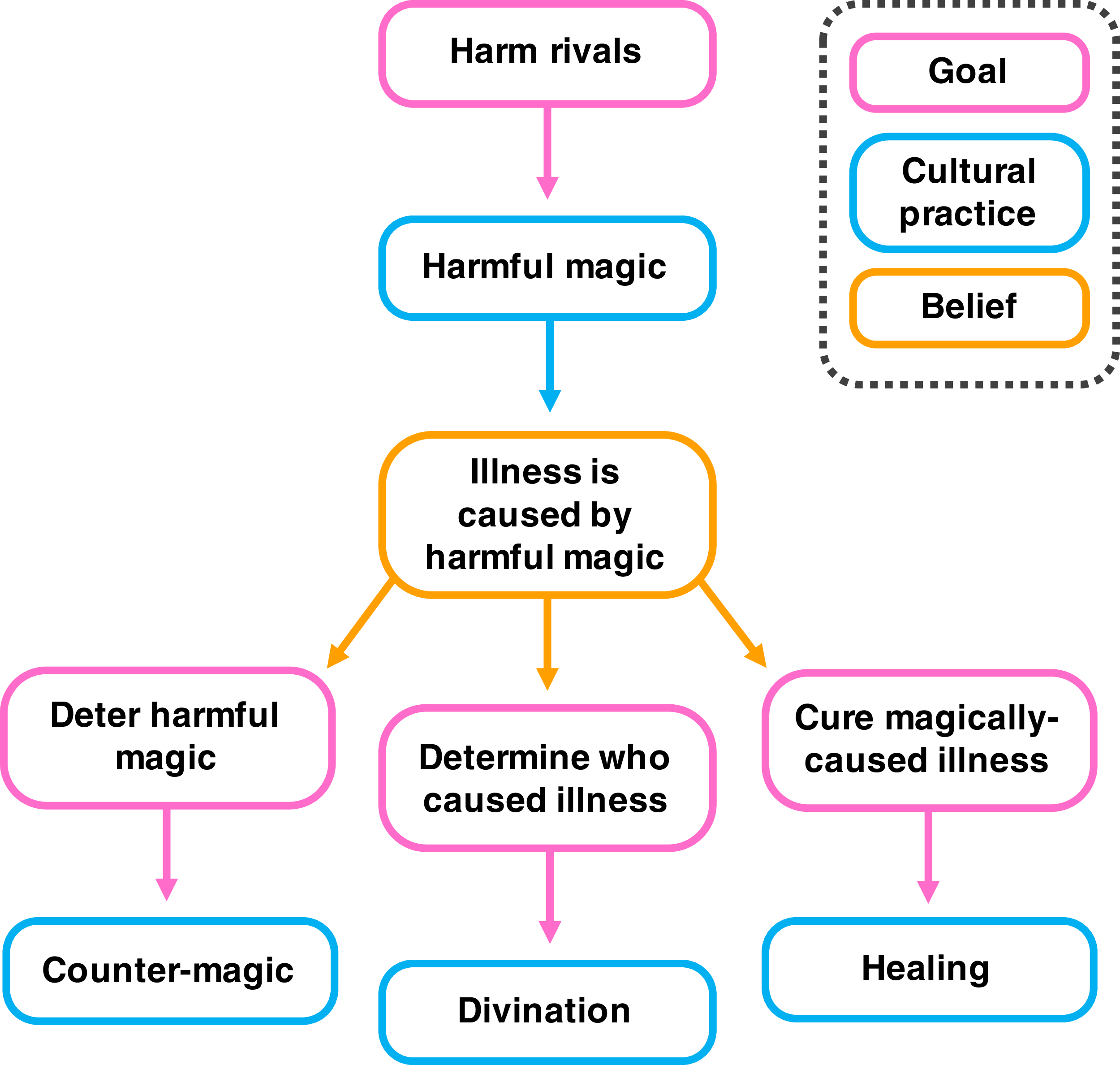
To start with the disagreement, subjective selection does help illuminate dependencies and correspondences between aspects of culture. For example, a single cultural practice, which develops to satisfy a goal, can produce a cultural ecosystem. Consider traditions of malicious sorcery, which I have argued evolve partly as people fashion compelling practices to harm others from afar (Singh, Reference Singh2021b). Once such practices are established, they reinforce beliefs that misfortune is sometimes caused through mystical means. These beliefs, in turn, create new goals (deterring harmful magic, determining who caused illness, and curing witchcraft-caused illness) and thus new practices (counter-magic, divination, and healing) (Figure R1). In a case like this, a subjective selection framework helps clarify how one cultural practice can beget an array of related traditions.
An example of how a single goal – harming rivals, in this case – can give rise first to a corresponding practice (harmful magic) and subsequently to new beliefs, new goals, and other cultural practices. Reproduced from Singh (Reference Singh2022a).

Several commentators show how a subjective selection framework can further elucidate cultural correspondences. Hong notes that culturally inherited causal beliefs, such as about where rain comes from, shape other cultural practices, such as rainmaking rituals, by influencing how people evaluate usefulness. Zhang, Ding, and Mu [Zhang et al.] describe in detail how subjective selection interacts with norms and other attitudes. Using Old Kingdom pyramid-building as an example, Winters and Charbonneau discuss how goals can generate technologies, which spawn new problems, solutions, and even techniques for exploring the problem space (see R2.2.2).
Still, I also partly agree with Ongaro. Subjective selection is not a theory of everything. It is a hypothesized process (or set of interacting processes) of cultural evolution. I am convinced that it occurs and that it explains a lot, but it is far from a complete framework. To explain the totality of culture, we also need to consider subjective selection alongside distributions of power (section R4), ecological conditions (section R2.2.1), the broader historical context (Chentsova-Dutton and Ryder), norms and attitudes (Zhang et al.), other aspects of psychology (Heintz and Nettle; Kumaar; Jackson & Cao; Morin; Thomas & Samani), and other hypothesized processes of cultural evolution. Indeed, many of the questions Ongaro raises about shamanism are ones I address in my book, often by looking beyond instrumental function, including to power relations (see, e.g., Singh, Reference Singh2025, Ch. 7). Malinowski-style functionalism may have faltered by treating its analyses as exhaustive, but that weakness doesn’t apply here.
R2. Sharpening goals and evaluation
I argued that much of cultural design can be explained by considering people’s goals and the psychological processes involved in evaluating goal fulfillment. Some commentators used their responses to refine, critique, and expand the discussion of these psychological forces. Many described factors that I overlooked. Incorporating their comments deepens the psychological foundations of subjective selection, improves the framework’s predictive power, and bolsters its ability to explain similarities and differences in cultural form.
R2.1. Further incorporating evolved psychology
Baumard et al. and Boyer both call for more evolutionary psychology. In broad terms, we all agree that proximate goals trace to evolved goal states and that we gain explanatory power by better identifying the evolutionary foundations and cognitive structure of human motivation. Against this background, some of their critiques rest on a misreading of my claims. For example, Baumard et al. write that I identify “proximate goals that cultural forms appear to satisfy” and then supposedly stop. Crucial, they write, is linking proximate goals to “evolved reward systems that make them subjectively compelling.” Yet I proposed something similar in the target article (sect. 2.2.1, p. 4); indeed, I cited a short comment co-authored by two of the commentators to support this point (Dubourg, Chambon, & Baumard, Reference Dubourg, Chambon and Baumard2025).
In a similar vein, Boyer writes that I rely “mostly on commonsense criteria that do not provide a solid basis for fundamental assumptions about human psychology.” He uses the example of why parents aim to pacify infants. He reports that my view is something like, “Mostly because parents themselves tell us, and because our folk-psychology tells us that it must be their motivation,” critiquing that this “is not an explanation of their behavior, let alone an evolutionary explanation.” But this wasn’t my claim. In Figure 3B, I speculated that reducing infant distress is an instrumental goal in service of evolved goal states such as caring for current offspring (insofar as one is using fussiness as a cue of costly distress) and investing in other offspring. This might be inaccurate; it is certainly incomplete. But it is more evolutionarily informed than appealing to folk psychology.
Still, Baumard et al. and Boyer identify a genuine difference in emphasis. Both commentators rightly sensed that my account invoked fewer “evolved, domain-specific psychological adaptations” (Boyer) than many evolutionary psychologists would have liked. For example, whereas I hazarded that the reduction of infant fussiness may function instrumentally in the pursuit of other evolved goal states, Baumard et al. proposed that offspring distress-reduction is, itself, the superordinate goal. Likewise, whereas my explanation of corporate groups invoked the goal of best mobilizing cooperation, Boyer argued that humans evaluate numerous, more specific targets, including cohesiveness, commitment, and contributions.
Their proposals are reasonable, and the point is well-taken. The accounts I presented are first approximations and will benefit from much more psychological richness. To the extent that empirically attested motivations can replace the provisional ones I put forward, I am eager to incorporate them.
R2.2. Explaining variation in goals
Because one of my primary aims was to explain super-attractors, I focused on universal goals. But several commentators highlighted how humans’ motivations also vary tremendously, laying out different sources of such variation.
R2.2.1. Environmental variation creates new goals
Some commentators note that goals change with shifting environments. For example, people in drought-prone societies turn more often to weather control (Hong). Those in wealthier societies apparently place greater emphasis on mutual attraction and long-term commitment when choosing mates (Baumard et al.). Massive disruptions, like the COVID-19 pandemic, can increase the salience of some goals, such as protecting against disease, while also creating new goals, like social distancing (Zhang et al.).
These examples suggest different mechanisms by which changing ecologies might shift people’s goals. In some cases, environmental variation tunes the expression of evolved motivational systems, just as higher population density induces gregariousness in locusts (Simpson, Caffery, & Hägele, Reference Simpson, Caffery and Hägele1999). In other cases, people acquire new intermediate goals through learning and problem-solving, devising novel strategies to pursue core biological goals in unfamiliar ecologies.
Whatever the mechanism, I agree that considering how environments produce new goals will be critical to explaining cultural variation, including, as Hong points out, puzzling behaviors apparently decoupled from fitness interests, such as contraception use.
R2.2.2. The dynamic emergence of goals
Two sets of commentators discuss dynamic processes of goal emergence. According to Haraldsen et al., new goals can arise during the creative process. As writers produce literary text or film editors cut and splice physical reels, they interact with their material, developing new intentions in response to their creative output.
Haraldsen et al. present such goals in opposition to the broader goal of evoking pleasure, but two points are worth making. First, evoking pleasure is not meant to describe all esthetic activity; rather, it is a common and important goal that seems responsible for the emergence of dance songs and the sympathetic plot. A creator can have many other goals, including signaling virtuosity, sharing personal stories, and transmitting information, each of which will imprint on the forms of their creations. Second, the shifting micro-intentions described by Haraldsen et al. are organized within larger goal hierarchies. In their study of the Norwegian comic artist Anders Kvammen, for instance, Haraldsen and Trasmundi (Reference Haraldsen and Trasmundi2025, p. 4) describe a hierarchy of intentions in which “the higher levels set more general action goals that are used by the lower levels to bias the choice of the next affordance.” Kvammen, the artist, starts with an overall idea for a narrative, works on individual scenes, and eventually makes creative decisions in response to single pen strokes, yet even on that smallest scale, overarching goals, like producing forms that are visually appealing, still dictate which intentions are pursued.
Winters and Charbonneau also describe a dynamic process of goal setting, although on a different scale. They write about “constructed problems,” defined as self-imposed goals whose solutions are “far removed from adaptive concerns of survival and reproduction.” They use the example of pyramid construction in Old Kingdom Egypt and show how a goal (building pyramids) can generate new problems (finding materials that support the weight of the monuments), thereby selecting for new solutions (stone bricks and a corresponding industry for working with them). They also observe that people must refine problem spaces or learn how to structure problems. Pyramid builders who found their monuments crumbling had to determine the issue that needed addressing, whether related to building materials or the slopes of the sides.
These examples testify to the complex processes by which goals emerge. They demonstrate that issues that I only briefly touched upon – such as how technologies can spawn new goals or how smaller decisions can be organized within larger goals – can be studied rigorously. Given the importance I ascribe to goals in directing cultural evolution, I agree that better characterizing such processes is valuable.
R2.3. Addressing supposedly non-instrumental behavior
Several authors push back against my emphasis on instrumental behavior. Hong, for instance, mentions the “vast domain of human behaviors where instrumental ends are opaque or absent.” I concede that subjective selection would be less relevant to such behaviors, but I wonder whether non-instrumentality is being muddled or overstated. Hong writes:
Often, this is expressed as a precautionary belief: if the practice is not performed in the “right way,” some unspecified misfortune will occur (Hong, Reference Hong2024). Here, it may be said that the operative goal for the individual is not an explicit external outcome, but rather the subordinate goal of correct performance itself.
In Hong’s own words, then, there is an explicit external outcome at play here: avoiding “some unspecified misfortune.” In fact, the paper cited here is about taboos (Hong, Reference Hong2024), and it seems that a useful starting point when explaining the design of taboos is to think about the misfortune they are supposed to discourage. For example, in many societies, pregnant women are tabooed from tying knots – a rule that’s hard to understand without appreciating its connection to fears of umbilical cord strangulation (Frazer, Reference Frazer1922).
Similar concerns apply to the literature on goal-demotion more broadly, where behaviors, despite being goal-oriented, are often described as non-instrumental. Take the ritual stance, which Hong discusses. As Jagiello, Heyes, and Whitehouse (Reference Jagiello, Heyes and Whitehouse2022, p. 3) explain:
In a ritual stance, we do not necessarily expect observed behavior to be directed towards the accomplishment of specifiable end goals and, even if we do, we assume (implicitly or explicitly) that at least some of the actions required to perform the behavior correctly do not contribute to those end goals in ways that are potentially knowable.
Yet, the same authors, on the same page, link the ritual stance to goal-directed motivations. A learner adopting the ritual stance is “oriented to social and affiliative outcomes” (p. 3). Participants in collective rituals are “at least partly motivated by the rewards of belonging” (p. 3). A Christian congregant learning to cross herself upon entering a church is “driven by the motivation of simply wanting to fit in with the other church goers” (p. 3).
Scholars of ritual are not alone in treating behavior as non-instrumental when the goals are social. Describing how people might try to show that they are good parents or committed to getting better, Chentsova-Dutton and Ryder write that “adults pursue goals for reasons that are not only instrumental, but also socially normative.” Likewise, Kumaar argues that some cultural forms may develop through symbolic, rather than instrumental, evaluation. While I agree that cultural variants may be appealing because of non-instrumental factors, some of the examples presented – such as “support[ing] shared cultural identities through collective ritual engagement” – seemed difficult to distinguish from instrumental social goals.
To clarify, then, my usage of “instrumental” and “goal-oriented” encompasses social motivations. These include goals like identity signaling and social belonging, as well as normative behaviors that have become ends themselves (Zhang et al.). For example, if people are sanctioned for being disrespectful, they will strive to show respect and adopt behaviors that help satisfy that goal. For my purposes, such behavior is as instrumental as healing illness, soothing a baby, experiencing pleasure, or killing an animal.
This is crucial because we should expect social motivations to matter for cultural evolution, including processes of subjective selection. Rituals or taboos will manifest differently depending on whether participants seek to avert misfortune, signal commitment, display competence, experience aesthetic pleasure, or forge bonds. Treating these as non-instrumental obscures how they, like all goals, mold culture.
R2.4. Elaborating models of evaluation
Several authors built on my provisional model of evaluation, putting forward additional constraints that limit the evolution of adaptive culture (Jackson and Cao) and detailing how factors such as norms, attitudes, cultural beliefs, and history might guide how people evaluate cultural traits (Chentsova-Dutton and Ryder; see also Zhang et al.).
R2.4.1. “Blindness” during evaluation and the maintenance of cultural inefficiencies
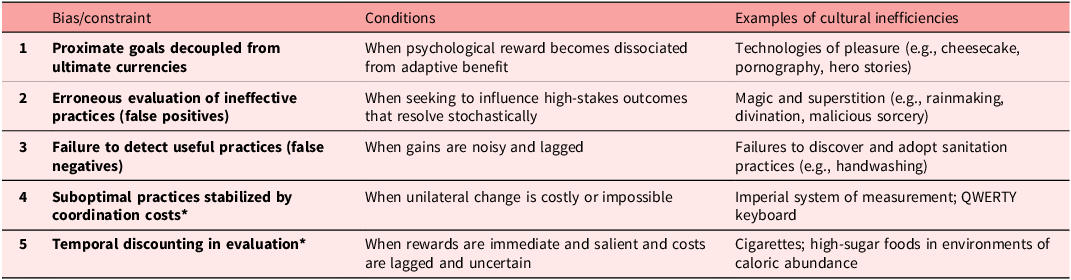
By focusing on how people’s goals and evaluations ultimately guide cultural evolution, a subjective selection framework can explain various cultural inefficiencies, including suboptimal or even maladaptive practices. I outlined several ways in which cognitive limitations might interfere with the identification of useful practices, and Jackson and Cao helpfully added to this list. They explain that cultural practices can persist even when people know of better alternatives, because of, for example, the costs of coordination, and that temporal discounting can lead people to adopt culture that seems appealing or beneficial on an immediate timescale but can be costly in the long run. Both are important to emphasize and help explain further cultural inefficiencies. Table R1 lists these two “forms of blindness” along with three biases and constraints I discussed in the target article.
Biases or constraints of goal-oriented evaluations and corresponding cultural inefficiencies

* Described by Jackson and Cao
These factors can interact. Braganza discusses the trend in modern culture favoring “ever more addictive goods.” This dynamic seems to emerge from the interaction of factors 1 and 5 in Table R1: When psychological rewards are dissociated from adaptive benefit (an example of “proxy failure”: John et al., Reference John, Caldwell, McCoy and Braganza2024), and when they are immediate and powerful relative to delayed costs, subjective selection can drive the evolution of technologies that induce progressively more intense responses. In a similar vein, Reggente and Schoeler suggest that the pleasure of aesthetic chills often indexes something adaptive – a generative model achieving a sudden leap in explanatory power – but that it can also be induced through neuromodulation and technologies that generate sensations along the spine. In both cases, the elaboration of technologies of pleasure will be accelerated when producers are incentivized to proffer such goods to consumers – whether through market forces (Braganza) or opportunities for manipulation (Reggente and Schoeler) – with potentially damaging consequences for consumers’ health, autonomy, or psychological well-being.
R2.4.2. Norms, culture, and the power of placebo
Chentsova-Dutton and Ryder nuance what they see as an overly simplistic model of evaluation. They make at least three points:
-
1. People’s judgments about efficacy are shaped by both their personal history with a practice and local beliefs.
-
2. Norms and cultural attitudes affect which solutions are preferred or seen as effective (see also Zhang et al.).
-
3. Expectations of efficacy can lead to objective effects, exemplified in work on placebos and the “common factors” shared across psychotherapeutic modalities.
I agree with all three points. I touched upon the first in the target article (see the brief discussion of lizard rainmaking in section 2.2) but recognize that there is much more work to be done on how cultural beliefs interact with personal experience and other factors to influence evaluation. The third, although largely left out of the target article, is something I have explored in detail elsewhere (Singh, Reference Singh2025, Ch. 5).
Despite points of overlap, I am less certain of their conclusion. Chentsova-Dutton and Ryder write, “From this vantage point, we find it hard to believe that people across a wide range of cultural-historical settings would continually make similar subjective judgments about effectiveness in domains with multi-determined outcomes.” But the inference doesn’t follow. Even if, for example, people’s judgments about lullabies are shaped by cultural attitudes about which styles are most effective, or part of the motivation for singing lullabies is to signal that one is a good parent, convergent features of lullabies across societies can still emerge from parents creating and retaining features that seem best at putting their infants to sleep. Myriad motivations and cultural inputs into evaluation do not preclude universal goals and comparable ways of achieving those goals from generating cultural similarities.
R3. Revisiting super-attractors and the cultural manifold
A major thrust of the target article was that societies near-universally develop complex sociocultural traditions, termed “super-attractors,” and that these collectively constitute the “cultural manifold.” Commentators sought conceptual clarification about super-attractors, contested my de-emphasizing of processes other than subjective selection, proposed other super-attractors and contexts in which they might be observed, and outlined additional psychological capacities or processes that might be involved in the development of super-attractors.
R3.1. Super-attractors, by-products, and the need for group selection
Polimeni argues that the concept of super-attractors should not replace or distract from concepts such as byproducts or adaptations. I agree, but I would emphasize that they refer to distinct levels of analysis. “Super-attractor” is a descriptive term; it describes sociocultural traditions that exhibit features such as ubiquity and internal complexity. Terms like “adaptation” and “by-product,” meanwhile, are functional; they describe the ultimate reasons a behavior exists.
The two classes of terms do not compete. If anything, comprehensive explanations of super-attractors necessarily invoke functional concepts. For example, in seeking to explain the sympathetic plot, I argued that people represent characters as other people, often feeling sympathy for them and sympathetic joy when they succeed (Singh Reference Singh2021a). Such emotional responses seem to be by-products of psychological mechanisms that evolved for interacting with flesh-and-blood humans, not with made-up protagonists. Other by-products implicit in the accounts in the target article included superstitions as by-products of systems for selecting useful behaviors under uncertainty (D. D. P. Johnson et al., Reference Johnson, Blumstein, Fowler and Haselton2013; Singh, Reference Singh2022b) and rhythmic entrainment as a by-product of vocal learning (Patel, Reference Patel2021; Singh & Mehr, Reference Singh and Mehr2023; although see Savage; Rajendran et al., Reference Rajendran, Prado, Marquez and Merchant2025). Once humans find pleasure in the antics of made-up characters, enjoy synchronized movement, or adopt superstitions to stop rain, subjective selection can drive the elaboration of technologies that most compellingly achieve the relevant ends.
Appreciating the role of by-products addresses other issues raised by commentators. Borba and Becker claimed that, “without group-level selection, it is difficult to account for why such perceptual biases would stabilize common misattributions (such as supernatural elements) that appear to compete with true goal attainment.” Yet a success of the cognitive and evolutionary science of religion has been to demonstrate how maladaptive or erroneous attributions could have emerged as by-products of individually adaptive cognitive capacities (Atran & Norenzayan, Reference Atran and Norenzayan2004; Bloom, Reference Bloom2007; Boyer, Reference Boyer2001; Guthrie, Reference Guthrie1995; Willard & Norenzayan, Reference Willard and Norenzayan2013).
In a similar vein, Morgan argues against the possibility that subjective selection might maintain maladaptive behaviors, because, as he writes, “for any sufficiently costly cultural side-effect, biological evolution can, in theory, rework our subjective appetites to remove it.” Yet, as he acknowledges, there are constraints on the pace and evolvability of such compensatory adaptations.
Consider malicious sorcery again. Historically, humans around the world used spells, charms, and amulets to try to harm each other (Singh, Reference Singh2021b). These practices can sometimes become very intricate. In southern Siberut, Indonesia, a Mentawai person intending to harm someone must abstain from sex and beverages, gather dangerous objects (e.g., snake teeth, bee stingers, and poisoned arrows), and summon a spirit to capture the victim’s soul, which is enclosed in a container. With the soul in hand, the sorcerer is believed capable of causing illness and death.
Practices like this seem maladaptive. Aside from expending time and other resources, such rituals contribute to suspicions that death and illness are caused by mystical harm, which can sow distrust and paranoia even among close family members (e.g., Talayesva & Simmons, Reference Talayesva and Simmons1942). Yet the superstitious tendency underlying evil sorcery does not seem like something that biological evolution can easily rework. It appears to be a by-product of cognitive systems that are otherwise beneficial, particularly our capacity to discover useful, goal-directed behaviors under conditions of uncertainty (Foster & Kokko, Reference Foster and Kokko2009; D. D. P. Johnson et al., Reference Johnson, Blumstein, Fowler and Haselton2013; Singh, Reference Singh2022b). It’s plausible that, given enough time, natural selection could theoretically rejigger human psychology to somehow sever costly superstitions from a general competence at extracting instrumental regularities from noisy observations. But given that the best-attested examples of gene-cultural coevolution postdating the emergence of Homo sapiens involve traits with simple genetic architectures (e.g., Stock & Wells, Reference Stock and Wells2023), I would expect it to take much longer.
Morgan also proposes that cultural group selection can filter out costly cultural practices. But here I would repeat the issues raised in section 6.2 in the target article:
-
1. Cultural group selection requires variation, and it is unclear how this can be produced or maintained when some practices are compelling and easily reconstructed.
-
2. Even if cultural group selection occurs and costly practices are filtered out, it is unclear what would prevent them from again appearing, evolving, and spreading.
-
3. It remains unclear how important cultural group selection is in naturalistic settings.
Until these are resolved, it is premature to conclude that “the only long-lasting cultural spandrels will be those that do not harm fitness” (Morgan). Indeed, anthropologists have documented numerous apparently costly practices that have not only persisted but also appeared around the world (Edgerton, Reference Edgerton1992), bloodletting being a paradigmatic example (Miton, Claidière, & Mercier, Reference Miton, Claidière and Mercier2015).
R3.2. Considering additional super-attractors
The list of super-attractors I proposed in the target article was necessarily incomplete. I hoped that researchers would add to the list, and, to my delight, several commentators proposed candidates worth discussing. Here, I consider those additions as well as the defining criteria of super-attractors.
R3.2.1. Shamanism and dance songs are super-attractors, while music and religion are (probably) not
Observing that I treat shamanism, dance songs, and hero stories as super-attractors, Savage asks why I do not include broader domains, such as religion, music, and language. He is right that these comprise behaviors that are ubiquitous and complex (Evans & Levinson, Reference Evans and Levinson2009; Jackson et al., Reference Jackson, Dillion, Bastian, Watts, Buckner, DiMaggio and Gray2023; Mehr et al., Reference Mehr, Singh, Knox, Ketter, Pickens-Jones, Atwood, Lucas, Jacoby, Egner, Hopkins, Howard, Hartshorne, Jennings, Simson, Bainbridge, Pinker, O’Donnell, Krasnow and Glowacki2019; Peoples, Duda, & Marlowe, Reference Peoples, Duda and Marlowe2016; Pinker, Reference Pinker1994; Savage et al., Reference Savage, Brown, Sakai and Currie2015). But, putting aside language, which I discuss below, religion and music do not strike me as super-attractors, because they do not seem to exhibit the degree of functional integration characteristic of clearer classes. I wrote:
Importantly, the attractors composing a super-attractor are not merely a collection of discrete components; rather, they relate dynamically to produce new, emergent properties or functions that are not present in any individual attractor. (Section 1)
Super-attractors are roughly analogous to organs like the heart or lungs. Each is complex; each has components that reliably co-occur and that work together to sustain emergent functions. In contrast, “music” is a label for a family of super-attractors, much like “organ” is a label for a family of systems. “Music” encompasses traditions like dance songs, lullabies, and healing songs, but these are not functionally integrated. There is, for example, no necessary reason why lullabies require dance songs, nor a patterned way in which lullabies and dance songs interact to yield larger functions.
The components of religion may be better integrated. For example, shamans are believed to interact with supernatural agents, and such interactions might feature in myths. Yet the integration across such components seems much weaker than within-component integration. Shamanism always includes trance and services like healing and divination, often alongside dramatic initiations and self-denial. Yet, the connection between shamanism and myth seems more tenuous, less cross-culturally predictable, and less critical for the form or the function of either shamanism or mythology. “Religion,” at least broadly defined, seems more like an ecology of super-attractors and related traditions than a single super-attractor. Despite the qualms I’m expressing here, it’s possible that future investigations will identify higher-order super-attractors composed of traditions that I currently treat as distinct.
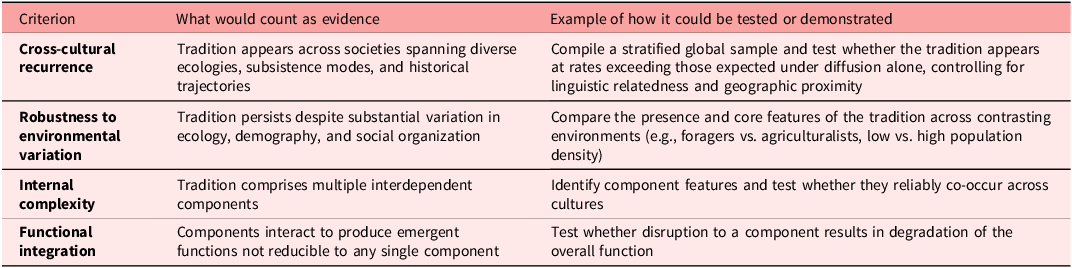
None of this contradicts Savage’s separate point that music and religion may each arise, in part, from specialized genetically evolved adaptations. The concept of super-attractors does not imply a lack of a genetic component. Rather, a “super-attractor” is a sociocultural tradition that is ubiquitous, robust to environmental variation, internally complex, and functionally integrated (Table R2). I argued that subjective selection “is the most important [process] in driving the emergence of super-attractors and producing their regularities” (section 1), but this doesn’t deny the contribution of processes like genetic adaptation. I am open to the hypothesis that the complexity exhibited by lullabies is partly a product of natural selection; I take seriously the possibility that humans possess evolved capacities for music.
Core criteria for identifying super-attractors

So, do they? Savage reviews findings from comparative, cross-cultural, and genetic research but seems to agree that nothing is definitive and that the question of whether human musicality involves evolved specialized adaptations remains unresolved.
A final point of clarification: Savage writes that I regard the absence of lullabies among the Northern Aché as evidence against an evolved basis of music. This is a misunderstanding. Given that lullabies, along with dance songs, appear to have been lost during larger cultural declines (Singh & Hill, Reference Singh and Hill2025), their absence indicates that cultural transmission is partly required for the maintenance of these musical domains. The implication is less about the genetic basis of music than about the necessary role of cultural transmission in sustaining dance and lullabies, in particular.
R3.2.2. Language
Savage and Heintz and Nettle argue that language is a super-attractor. “In fact,” write Heintz and Nettle, “language may be the paradigmatic super-attractor even though Singh makes no mention of it.”
They make a compelling case, citing its universality, complexity, constituent attractors, and overall function for communication. Although, as Savage reviews, natural selection likely favored linguistic abilities in humans, many structural regularities across languages apparently emerge as cultural evolution adapts to human psychology (Christiansen & Chater, Reference Christiansen and Chater2008), including through subjective selection. Heintz and Nettle provide several plausible examples. Kinship terminology, for example, likely develops as people use and preferentially “retain linguistic distinctions serving their instrumental goals to shape and refer to social relations,” producing both global commonalities and local idiosyncrasies in how languages carve up relations.
Still, insist Heintz and Nettle, “subjective selection has limits.” Along with Morin, they argue that cognitive biases unrelated to instrumental decision-making and evaluation also contribute to cultural design. Yet the example they use – vowel spacing – is contestable. Languages appear to optimize their inventories of vowels such that vowels are maximally distinct from each other acoustically and opportunities for misclassification are minimized. Heintz and Nettle attribute the pattern to biases during learning, concluding that “subjective goals play no direct role in the explanation.” However, the goal of effective communication seems to feature here, as well. Increased vowel spacing improves listener comprehension, and speakers frequently employ it to increase intelligibility (Ferguson & Kewley-Port, Reference Ferguson and Kewley-Port2007; Picheny, Durlach, & Braida, Reference Picheny, Durlach and Braida1986; Smiljanić & Bradlow, Reference Smiljanić and Bradlow2009). Two meta-analyses confirm that vowel space expansion is also a common feature of infant-directed speech across languages (Cox et al., Reference Cox, Bergmann, Fowler, Keren-Portnoy, Roepstorff, Bryant and Fusaroli2023; Lovčević et al., Reference Lovčević, Benders, Tsuji and Fusaroli2025). It is thus plausible that vowel spacing partly results from attempts to communicate clearly, including when speaking to young language learners.
As vowel spacing demonstrates, finding instances in which instrumental behavior does not play a role in shaping culture may be more difficult than it seems. Nevertheless, I agree with Heintz and Nettle and Morin: subjective goals and evaluations, while important, are not the exclusive psychological pressures shaping culture, and complete explanations of cultural patterns require looking beyond them.
R3.2.3. Identifying other potential super-attractors
Several commentators put forward other super-attractors, including sports (Polimeni), dietary practices (Arslan), healing rituals (Arslan; see also Bui; Chentsova-Dutton and Ryder), and status signaling systems (Braganza). The proposals, although intriguing, mostly lacked the evidence necessary for establishing that these are super-attractors – a reasonable limitation given that most of the relevant work has yet to be conducted. To help clarify what such demonstrations would require and to spur future research, Table R2 summarizes how core criteria of super-attractors might be tested or demonstrated.
R3.3. Experimental edens
Following Fox (Reference Fox, Eisenberg and Dillon1971), I speculated that hypothetically cultureless humans placed on an island and capable of generating society anew would produce the cultural manifold. Ongaro pointed out that such a scenario is empirically impossible. Fair enough, but this misses the point of a thought experiment. My goal wasn’t to outline a testable scenario but to make a theoretical claim – namely, that ubiquitous cultural forms arise because humans reliably reproduce them, even in the absence of shared cultural history.
Still, the impossibility of true experimental edens shouldn’t discourage us from seeking contexts in which cultural practices might emerge spontaneously and with minimal cultural influence. My search landed me on the Andaman Islands (section 6.1). Bui proposes a different setting: the Intensive Care Unit, or ICU. She describes it as “an archetype of the ‘empty habitat’” where “patients, families, and clinicians unconsciously rebuild culture under extreme conditions of uncertainty and death.” She explains how rituals related to spirituality and healing emerge in such contexts, attesting to their robust appeal. It is a fascinating proposal and deserves future investigation, but, without additional details, it seems hasty to conclude that an ICU is culturally pristine. There are numerous opportunities for patients, families, and clinicians to introduce practices that they have encountered outside of the hospital. In either case, ICUs seem informative as sites where super-attractors might be redeployed in novel environments, revealing their portability and widespread utility.
R3.4. Core knowledge
Thomas and Samani propose that core knowledge systems, such as about objects, agents, and social relations, help explain super-attractors. Defining core knowledge as the set of “innate (or very easily learned), abstract cognitive representations that humans possess,” they outline two mechanisms by which they might shape super-attractors:
-
1. Universal, innate priors make some solutions more likely to be considered and easier to learn.
-
2. Universal, innate priors are shared across individuals, which is relevant for cultural traditions in which people need to coordinate or reason about others’ minds, such as some social institutions and magico-religious traditions.
The first mechanism likely plays a role. Magic is a straightforward example. Anthropologists have long recognized that magical practices around the world exhibit principles of “sympathetic” causality (Frazer, Reference Frazer1922; Hong, Reference Hong2022; Nemeroff & Rozin, Reference Nemeroff and Rozin2000). According to the “law of contagion,” for example, objects once in contact continue to affect each other at a distance, as when a sorcerer manipulates a person’s clothing to make them sick. Given the prevalence of such principles across cultures, it is plausible that they derive from innate or easily learned priors about causality, and the research directions Thomas and Samani describe, such as infant cognition and developmental cross-cultural studies, seem like promising avenues to investigate their origins in core knowledge.
The second mechanism is trickier to evaluate. Take the example that Thomas and Samani propose – that shamans engage with spirits partly because they understand others to believe in them. In their example, core knowledge intuitions about agents or objects presumably underlie beliefs in supernatural agents and predispose both shamans and their clients to believe in or reason about them (mechanism 1). But it’s not clear what explanatory work core knowledge intuitions are doing beyond creating a local belief. To appreciate this, consider money managers, who also promise control over ultimately uncontrollable systems (S. G. B. Johnson, Reference Johnson2018; Millsap, Reference Millsap2020). The clients of money managers have very different causal models from those of shamans, yet money managers just as easily adapt their methods to these understandings. Magical service providers seem competent at working with beliefs their clients hold, regardless of whether those are idiosyncratic or universally resonant.
R4. Power, influence, and affordances
Several commentators observe that the same cultural product can have different uses for different people – a feature that Chentsova-Dutton et al. call “multifinality.” Moon helpfully uses the analogy of “affordances”: beliefs, practices, and technologies afford people distinct opportunities. He argues that this helps explain demographic differences in religiosity. Considering that many world religions regulate sexual behavior, puritanical parents may have more of a reason to adopt and endorse religious creeds than their sexually active offspring. Similarly, women and lower-status individuals may be more religious in some contexts, but, in others, men and elites seem more interested in the supernatural, especially when they can deploy beliefs and traditions for social control (Bentzen & Gokmen, Reference Bentzen and Gokmen2023; Buckner, Reference Buckner2025).
Affordances and multifinality connect to a related set of questions raised by commentators. Sure, culture might be intuitive, compelling, or subjectively appealing, particularly for achieving goals, but they ask for more: “Intuitive to whom?” (Alam and Rai) “Compelling to whom?” (Haraldsen et al.) “Whose subjectivity?” (Garfield)
For these commentators, the answers to these questions lie in power structures and networks of influence (see also Ongaro). Individuals with greater enforcement power or access to communication channels can perpetuate traditions that they perceive to be useful even when they harm the interests of other group members (see also Baumard et al.).
As someone who has argued that cultural evolution needs to attend more to power asymmetries (Singh, Wrangham, & Glowacki, Reference Singh, Wrangham and Glowacki2017), I am sympathetic to these ideas and agree that comprehensive attempts to explain culture must incorporate them. Based on existing research and the commentaries, we can identify at least three mechanisms by which power and influence might influence how subjective selection occurs:
-
1. Powerful parties selectively retain self-serving traditions and maintain them through enforcement. As long as some parties have a greater capacity to impose their preferences, such as because they have disproportionate access to institutions of rule-making and enforcement (Alam and Rai), variants can evolve to better satisfy their perceived self-interest (Singh et al., Reference Singh, Wrangham and Glowacki2017). This dynamic likely characterizes the development of many oppressive systems (Wilkerson, Reference Wilkerson2020), including legally enforced segregation in the southern United States following the American Civil War (Woodward, Reference Woodward1974). It may also underlie the evolution of norms that demand deference to high-status individuals (Zhang et al.).
-
2. Individuals who control channels of communication can bias which variants are introduced (Garfield). Potential examples include adults who manage the information their children encounter, storytellers who curate which narratives are in circulation, and social media companies whose algorithms determine the media their users consume. In all these cases, gatekeepers’ interests filter the variation that subjective selection can act on.
-
3. Influential individuals shape others’ goals or evaluations of usefulness (Garfield). There are many hypothetical ways in which influential individuals might bias goals or evaluations. A political leader might coordinate instrumental behavior, such as putting forward an agenda to achieve a shared objective. More intriguing, however, is the proposal that leaders can shift followers’ goals or evaluations in ways that would diverge from what we would predict based on the instrumental pursuit of core biological goals. Can leaders reweight their followers’ motivations or distort judgments of utility? Garfield suggests that they can, but it seems an open question of how and to what extent.
Alam and Rai present an example of how subjective selection may interact with power asymmetries. They focus on harsh punitive institutions, which appear minimally effective at deterring crime, despite substantial support in some Western societies and the common impression that modern punitive practices are more efficient or humane than their historical counterparts (see, e.g., Lavazza). They argue that harsh punitive institutions succeed because people wrongly expect them to boost cooperation – a claim they support with experimental evidence.
Crucially, Alam and Rai point out that “the intuitive appeal of punitive justice is unevenly distributed.” They suggest that people disproportionately targeted by such severe practices might be more skeptical of their effects than people who are never punished. As long as the people who shape punitive institutions are mostly untouched by them (which appears to be the case in some Western contexts), then we should expect them to persist regardless of their inefficiencies. Although various details in their account remain unresolved – for example, they do not provide evidence that real-world communities targeted more often by harsh punishment regard it as less effective – their case study illustrates the importance of both subjective evaluations and political influence in sustaining culture.
R5. Concluding remarks and future directions
R5.1. Explaining moral progress and other historical trends
“Cultural evolution is not only a story of attractors,” writes Lavazza; “it is also a story of breakthroughs.” Societies today look nothing like they did three hundred years ago – let alone thousands of years ago – and the shifts involved in such transformations “appear difficult to reduce to subjective utility alone,” he claims.
Lavazza focuses on the example of “genuine moral progress,” which, for him, encompasses “the transition from irrational to rational beliefs, from retributive to consequentialist models of justice, or from common-sense intuitions to counterintuitive scientific commitments,” as well as “the expansion of moral status.” The trends he describes are genuine and profound, although we should be careful not to overstate their scope or direction. Yes, an epistemology that prioritizes rigorous scientific experimentation has spread and weakened less empirically supported beliefs (Wootton, Reference Wootton2015). Nevertheless, large proportions of Westerners still believe in ghosts (National Folklore Survey of England, 2025) and souls (Pew Research Center, 2023) and engage in superstitious behavior (Caspi, Shmuel, & Chajut, Reference Caspi, Shmuel and Chajut2024). And despite Lavazza’s contention that “primitive forms of punishment – now considered cruel and unacceptable – are gradually replaced by sanctions oriented toward the rehabilitation of the offender,” a simple contrast between the more restorative justice systems of small-scale societies (Fitouchi & Singh, Reference Fitouchi and Singh2023; Hoebel& Reference Hoebel1954; Singh & Garfield, Reference Singh and Garfield2022; Wiessner, Reference Wiessner2020) and the harsh punitive institutions of many Western states (Alam and Rai) would suggest the opposite trend.
Complexities aside, can subjective selection explain historical trends such as these? On its own, no. A complete account would require considering many other factors, including ecology, power relations, and historical contingency (Diamond, Reference Diamond1997; Morris, Reference Morris2010). But subjective selection may play a role. Take the expansion of the moral circle, the process by which groups such as propertyless men, women, religious minorities, and homosexuals gained moral status. I have elsewhere argued that this was driven, in part, by the reputational benefits of appearing committed to principles of human equality and liberty (Singh & Hoffman, Reference Singh and Hoffman2022). Those principles, in turn, appear to have evolved through subjective selection as people crafted and adopted ideologies that justified resistance against authorities and built coalitions, especially in relatively fluid social ecologies.
The paradigmatic case here involves the Huguenots during the French Wars of Religion, who sought “a theory of resistance capable of appealing not merely to the ranks of their co-religionists, but also to a much wider spectrum of opposition to the government” (Skinner, Reference Skinner1978, p. 268). After cycling through different ideologies, they eventually developed the now-familiar principle of natural liberty, which proved effective at attracting both French Protestants and some Catholics. In the decades afterward, the ideology spread within France; into the Netherlands, where a version was used to justify revolt against Habsburg Spain; and eventually into England, where it was articulated by the Levellers and their successors during the English Civil War (Hill, Reference Hill1972; see Singh & Hoffman, Reference Singh and Hoffman2022, pp. 15–16). Although subjective selection cannot, on its own, explain the entirety of historical trends, it can help clarify the currents that comprised them.
R5.2. Formalizing subjective selection
The discipline of cultural evolution is firmly rooted in mathematical modeling, especially approaches from population genetics and evolutionary game theory (Boyd & Richerson, Reference Boyd and Richerson1985; Cavalli-Sforza & Feldman, Reference Cavalli-Sforza and Feldman1981). These frameworks have provided powerful tools for studying topics as varied as cultural group selection (Boyd & Richerson, Reference Boyd and Richerson2009, Reference Boyd and Richerson2010), ethnic markers (McElreath, Boyd, & Richerson, Reference McElreath, Boyd and Richerson2003), and norm enforcement (Boyd & Richerson, Reference Boyd and Richerson1992). Along with other approaches (e.g., Acerbi & de Courson, Reference Acerbi and de Courson2025; Enquist, Ghirlanda, & Eriksson, Reference Enquist, Ghirlanda and Eriksson2011), however, they are less well suited to modeling the processes emphasized by subjective selection: the instrumental production of cultural variants and their evaluation using often imperfect criteria of usefulness. Modeling subjective selection requires representing agents who search cultural design spaces, generate variants in biased ways, evaluate them, and preferentially maintain those that appear to best satisfy goals.
A promising source of inspiration is computational cognitive science, which provides formal tools of internal simulation, production, and evaluation. An illustrative example is the “sample, simulate, update” (SSUP) model developed by Allen et al. (Reference Allen, Smith and Tenenbaum2020), in which agents simulate tools before implementing them and then modify those tools after observing their effects in the world. As illustrated in Table R1, some inefficiencies expected from subjective selection depend on the structure of feedback; models that vary parameters like the timing and noisiness of rewards and costs could thus generate sharper predictions about the conditions under which useful cultural practices should not evolve or ineffective practices should persist. Other relevant literature describes models of hierarchical planning (Correa et al., Reference Correa, Sanborn, Ho, Callaway, Daw and Griffiths2025) and hierarchical reinforcement learning (Eppe et al., Reference Eppe, Gumbsch, Kerzel, Nguyen, Butz and Wermter2022), as well as efforts to integrate these with model-based approaches (Botvinick & Weinstein, Reference Botvinick and Weinstein2014). The modern behavioral sciences offer an impressive collection of modeling approaches, many engineered to capture the sophistication and quirks of human decision-making. Even if not used to formalize subjective selection, applying them to cultural evolution will likely yield insights not possible with current frameworks.
R5.3. Going beyond transmission fidelity to explain human-unique cultural evolution
Cultural evolution has long been dominated by what might be called the “social learning paradigm.” Definitions equate culture with socially learned information (see, e.g., Table 1 in Rendell & Whitehead, Reference Rendell and Whitehead2001). Theories of cultural adaptations have emphasized how social learning, when iterated, gives rise to cultural evolutionary processes that produce adaptive design (Boyd et al., Reference Boyd, Richerson and Henrich2011; Boyd & Richerson, Reference Boyd and Richerson1985).
The social learning paradigm has been influential in explanations of human uniqueness. Human culture is clearly distinct from that of other animals, and theories for why have long emphasized the cumulative nature of human culture, or the tendency to accumulate modifications such that cultural forms exceed the innovative capacity of any single individual (Boyd & Richerson, Reference Boyd and Richerson1996; Henrich, Reference Henrich2016; Mesoudi & Thornton, Reference Mesoudi and Thornton2018; Tomasello, Reference Tomasello1999). Cumulative culture, in turn, has been explained with reference to social learning. Research programs have centered on how social learning differs between humans and other apes (Tomasello, Kruger, & Ratner, Reference Tomasello, Kruger and Ratner1993; Whiten et al., Reference Whiten, McGuigan, Marshall-Pescini and Hopper2009), with researchers pointing to high-fidelity transmission as the critical factor enabling human uniqueness (Dean et al., Reference Dean, Vale, Laland, Flynn and Kendal2014; Lewis & Laland, Reference Lewis and Laland2012).
Although social learning features in the subjective selection framework, it is not nearly as critical a mechanism as in previously theorized processes of cultural evolution. Rather, what is central is the production, evaluation, and adoption of behavior directed at the satisfaction of hierarchically nested goals. Key capacities thus include the ability to represent hierarchies of goals and flexibly modulate behavior at any level within them, including creating elaborate, entirely new goal schemes.
This reorientation parallels recent work suggesting that open-endedness, more than the mere accumulation of modifications, makes human culture unique. Derex (Reference Derex2022) provided evidence that only humans can continuously exploit a broader set of natural phenomena to build progressively complex and effective technologies. Morgan and Feldman (Reference Morgan and Feldman2025) argued that, whereas non-human cultural behaviors are usually limited to specific domains, especially feeding and communication systems, human cultural behaviors seem possible in many more contexts.
Combining their insights, humans seem uniquely capable not only of combining many novel sub-routines to satisfy a goal but also of modifying a larger array of goal-directed actions. In fact, Morgan and Feldman (Reference Morgan and Feldman2025, p. 35) similarly conclude that studying “how individuals mentally represent actions and their goals” is a fruitful direction for assessing open-endedness and human uniqueness. While the primary place afforded to social learning has no doubt been scientifically generative, future progress – whether in identifying what makes us special or in explaining where cultural forms come from – may come from directing some attention away from transmission and toward evaluation within flexible goal hierarchies.
Acknowledgments
This response was written with the assistance of ChatGPT 5.2, accessed between December 15, 2025, and January 2, 2026, at https://chat.openai.com/. Uses of ChatGPT included finding synonyms for words, generating suggestions for alternate phrasing, parsing sections of commentaries, preparing first drafts of Tables R1 and R2, and eliciting feedback on tone, readability, and logical coherence.



Target article
Subjective selection, super-attractors, and the origins of the cultural manifold
Related commentaries (27)
Basic emotions underlie both proximal and distal behaviors, resulting in social institutions that are either adaptive, vestigial, or a little of both
Beyond usefulness: Symbolic super-attractors in the cultural manifold
Core knowledge shapes what actions are considered and how others will perceive them
Cultural affordances
Cultural evolution by revealed preferences – from status signals to alien porn
Cultural super-attractors in critical care: The intensive care unit as a living manifold of meaning
From attractors to ecological strategies: Embedding subjective selection in an evolutionary-ecological framework
From selection to surgery: Aesthetic chills bridge subjective functionalism and cognitive calibration
Functionalism versus the structuralist tradition
Healing rituals and dietary practices as cultural super-attractors
If lullabies and hero stories are super-attractors, what are music and language? Absolute universals imply genetic mechanisms
Language is a super-attractor: Does it evolve through subjective selection?
Moral progress as a counter-attractor
On the originality of subjective selection and the importance of payoff-biased diffusion and migration in shaping the cultural manifold
Reasons to be fussy about subjective selection and super-attractors
Silent forces: How normative ecologies reshape super-attractors
Spandrels in the cathedral of the mind
Subjective selection as an outcome of natural selection
Subjective selection is a mechanistic and behaviorally integrative account of group-level selection, not a replacement
Subjective selection needs context: Culture shapes goal selection, evaluations of usefulness, and “actual” effectiveness
Subjective selection needs socially transmitted goals and culturally evolving problems
Subjective selection requires objective constraints
The nature of goals in subjective selection: Origins, shaping forces, and salience
The pros and cons of reverting to methodological individualism
Western jurisprudence and criminal justice systems as superstitious belief
Whose subjectivity? Power and inequality in cultural selection
Will cultural evolution regain its sight?
Author response
Goals, power, and selection: Foundational issues in the naturalistic study of culture