

Introduction
The Portuguese economy, like that of the majority of developed economies, has exhibited timid and declining growth rates in the last decades (Barradas Reference Barradas2020 Reference Barradas2022; Pariboni et al Reference Pariboni, Paternesi and Tridico2020). This already represents a stylised fact of economic growth, and it has revived fears around a new ‘secular stagnation’ (Krugman Reference Krugman2013; Pariboni et al Reference Pariboni, Paternesi and Tridico2020; Summers Reference Summers2014). Against this backdrop, the orthodox view claims that countries should pursue wage restraint policies and more deregulation and flexibilisation of labour markets as necessary conditions to improve their macroeconomic performance in the near future (Naastepad and Storm Reference Naastepad and Storm2006). The argument invoked is that a decrease in wages will promote an increase in private investment through higher profits and an increase in net exports through lesser unit labour costs, and a corresponding rise in competitiveness that will more than compensate for the expected contraction of private consumption.
Nonetheless, the labour share has exhibited a decreasing trend in the majority of developed countries in the last decades (Barradas Reference Barradas2019; Dünhaupt Reference Dünhaupt2011; Karabarbounis and Neiman Reference Karabarbounis and Neiman2014; Kristal Reference Kristal2010; Lin and Tomaskovic-Devey Reference Lin and Tomaskovic-Devey2013; Stockhammer Reference Stockhammer2012 Reference Stockhammer2017; Stockhammer and Wildauer Reference Stockhammer and Wildauer2016), including Portugal (Abreu Reference Abreu2020; Barradas and Lagoa Reference Barradas and Lagoa2017), which seems to contradict mainstream claims of the existence of a negative relationship between the labour share growth and economic growth.
According to a heterodox approach supported by post-Keynesian economics, the fall of the labour share effectively decreases aggregate demand and, thereat, depresses economic growth because the negative effect on private consumption more than supplants the positive effect on private investment and on net exports. This happens because most countries follow a wage-led growth regime (or a wage-led demand model) instead of a profit-led growth regime (or a profit-led growth model), despite the orthodox view tends to assume that all countries follow a profit-led growth regime (Naastepad and Storm Reference Naastepad and Storm2006). Several reasons could explain this positive relationship between labour share growth and economic growth. The first reason emphasises that corporations operate with spare productive capacity, which makes it possible for them to rapidly increase production in response to relevant increases in aggregate demand (Kalecki Reference Kalecki1939). The second reason claims that profitability is less important in bank-based financial systems because non-financial corporations in these countries primarily fund their activities with retained earnings or with long-term bank loans, which suggests their willingness to make long-term investments and to accept lower returns on capital (Naastepad and Storm Reference Naastepad and Storm2006). The third reason stresses that countries that follow a profit-led growth regime are also penalised by policies around wage restraint measures because their performance depends on private investment and on net exports that are clearly influenced by the level of private consumption in countries that follow a wage-led growth regime (Naastepad and Storm Reference Naastepad and Storm2006). The fourth reason reinforces that wages are an additional source of demand, and investment decisions are also influenced by the level of aggregate demand (Lavoie Reference Lavoie2009). The fifth reason states that wage income is normally related to higher consumption propensities than are profit incomes (Stockhammer Reference Stockhammer2012).
From the point of view of empirical studies, some have been developed to examine the relationship between labour share growth and economic growth. There are essentially two important types of empirical studies on this matter. The first is the so-called structural approach, according to which the labour share is considered to be exogenous, and the effect of changes in the labour share on private consumption, private investment, and net exports are separately assessed (Bowles and Boyer Reference Bowles, Boyer, Epstein and Gintis1995; Ederer and Stockhammer Reference Ederer, Stockhammer, Hein and Truger2007; Gordon Reference Gordon, Epstein and Gintis1995; Naastepad Reference Naastepad2006; Naastepad and Storm Reference Naastepad and Storm2006; Onaran and Galanis Reference Onaran and Galanis2014; Onaran and Obst Reference Onaran and Obst2016; Onaran and Stockhammer Reference Onaran and Stockhammer2005; Stockhammer and Onaran Reference Stockhammer and Onaran2004; Stockhammer et al Reference Stockhammer, Onaran and Ederer2008). The second type of empirical study adopts an aggregative approach, according to which the direct effect on aggregate demand of changes in the labour share are evaluated (Barbosa-Filho and Taylor Reference Barbosa-Filho and Taylor2006; Kiefer and Rada Reference Kiefer and Rada2015; Nikiforos and Foley Reference Nikiforos and Foley2012; Rada and Kiefer Reference Rada and Kiefer2016; Stockhammer and Onaran Reference Stockhammer and Onaran2004; Teixeira et al Reference Teixeira, Missio and Dathein2022).
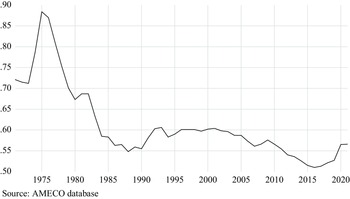
The research reported in this article examines the impact of labour share growth on economic growth in Portugal from 1971 to 2021 through a time series econometric analysis that extends the existing literature in four different directions. First, this study is centred on Portugal, for which the empirical evidence is almost non-existent (Onaran and Obst Reference Onaran and Obst2016). Portugal offers a useful case study because labour share has exhibited a strong decline since the 1970s and the Portuguese economy has decelerated at the same time (Figures 1 and 2), which suggests that these two features could be interrelated. Secondly, this paper employs a time series econometric analysis that allows a consideration of the historical, social, economic, and institutional forces behind the evolution of the labour share as well as its effects on growth. Thirdly, this paper follows the so-called aggregative approach by directly estimating the effect of labour share growth on economic growth in Portugal. This approach has some advantages in comparison to the so-called structural approach. It captures some dynamic interactions that are potentially missed by the latter, by separately estimating the effect of the changes in labour share on the individual components of aggregate demand (Blecker and Setterfield Reference Blecker and Setterfield2019). The majority of empirical studies that examine this issue follow the structural approach, and the few that follow the aggregative approach are centred on developed countries (Teixeira et al Reference Teixeira, Missio and Dathein2022). To the best of our knowledge, this is the first paper focused on Portugal that considers the aggregative approach. Fourthly, this paper also determines economic effects (McCloskey and Ziliak Reference McCloskey and Ziliak1996; Ziliak and McCloskey Reference Ziliak and McCloskey2004) to assess the role of labour share growth in explaining the trend of weaker and anaemic growth in Portugal since the 1970s.
Adjusted labour share (% of GDP at current market prices) in Portugal from 1971 to 2021.
Source: AMECO database.

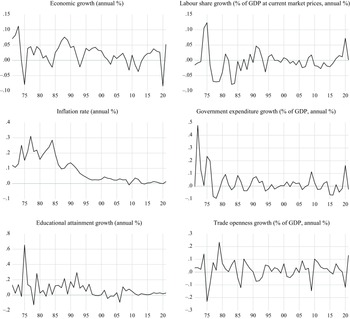
Plots of our variables for Portugal from 1971 to 2021.

Our estimates were produced using the generalised method of moments (GMM) continuous updating estimator proposed by Hansen et al. (Reference Hansen, Heaton and Yaron1996), which ensures reliability even in the case of small samples. We will estimate a growth model according to which Portuguese economic growth depends on labour share growth, the lagged growth rate of the real gross domestic product per capita, the inflation rate, government expenditure growth, educational attainment growth, and the growth of the degree of trade openness.
The findings show that the labour share growth, the lagged growth rate of the real gross domestic product per capita, educational attainment growth, and the growth of the degree of trade openness positively impact Portuguese economic growth, while the inflation rate and government expenditure growth exert a negative effect on Portuguese economic growth. The paper thereby confirms that the Portuguese economy is following a wage-led growth regime, which suggests the urgent need to adopt public policies to support the growth of wages to avoid more decades of dismal growth in Portugal and a new ‘secular stagnation’.
The remainder of the paper is structured as follows. The section, ‘Labour share and growth: Theoretical and empirical evidence’ reviews the literature on the relationship between labour share and economic growth. ‘The growth model and hypotheses’ defines the growth model that will be estimated and presents the corresponding hypotheses. The dataset is assessed in ‘The dataset’, and the estimation methodology is explained in the section titled ‘The estimation methodology’. “The estimation results and discussion” presents and discusses the main results. Finally, ‘Conclusions’ contains conclusions, particularly relating to policy implications, and a proposal for investigating one unexpected finding, relating to public sector impacts.
Labour share and growth: theoretical and empirical evidence
For Ricardo (Reference Ricardo1821), trying to understand the laws that regulated functional income distribution (among rents, profits, and wages) was the main problem of political economy. For Marx (Reference Marx1867), the main economic law of modern societies was based on the ‘class struggle’ between labour and capital, which affected economic growth and technological changes. Nonetheless, the constancy over time of the labour share and of the profit share has typically been assumed by the traditional/classical theories (Barradas Reference Barradas2019) and is considered as a stylised fact of economic growth in the long term (Kaldor Reference Kaldor and Lutz1961) or even as a law (Bowley Reference Bowley1937).
More recently, the constancy of the labour share and of the profit share over time has been questioned, particularly because of empirical evidence on the downward (upward) trend of the labour (profit) share since the 1970s. This phenomenon has been happening on a global scale (Barradas Reference Barradas2019; Dünhaupt Reference Dünhaupt2011; Karabarbounis and Neiman Reference Karabarbounis and Neiman2014; Kristal Reference Kristal2010; Lin and Tomaskovic-Devey Reference Lin and Tomaskovic-Devey2013; Stockhammer Reference Stockhammer2012 Reference Stockhammer2017; Stockhammer and Wildauer Reference Stockhammer and Wildauer2016), including in Portugal (Abreu Reference Abreu2020; Barradas and Lagoa Reference Barradas and Lagoa2017). Smith (Reference Smith1776) had already concluded that the labour share is not constant over time by representing a balance of the bargaining power between workers and capitalists. This is the reason the constancy of the labour share and of the profit share over time was considered a mirage by Keynes (Reference Keynes1939) or a bit of a miracle by Solow (Reference Solow1958).
There is substantial literature that addresses the impact of changes in functional income distribution on economic growth. In the most orthodox models in macroeconomics, functional income distribution has no impact on economic growth in the long term because this is determined by supply-side factors (Aghion and Howitt Reference Aghion and Howitt1997; Romer Reference Romer1986; Solow Reference Solow1956). Public policies intended to promote technical progress or make prices and wages more flexible contribute to an acceleration of the potential growth of economies and also foster job creation. Due to these assumptions, most governments all over the world have adopted so-called pro-capital policies (Lavoie and Stockhammer Reference Lavoie, Stockhammer, Lavoie and Stockhammer2013). Examples of pro-capital policies are theflexibilization of labour legislation, a reduction in collective bargaining and union power, and a reduction in corporate taxation.
By contrast, in macroeconomic models developed by post-Keynesians, changes in functional income distribution can influence economic growth in the long term. Against this backdrop, the Marxian economist, Kalecki (Reference Kalecki1939) noted that since the marginal propensity to save through profits is higher, the transfer of income from capital to labour could contribute to an increase in private consumption.Footnote 1 Regarding private investment, this author stated that there are two contradictory effects. On the one hand, wages constitute a relevant increase in corporate costs, which depresses private investment. On the other hand, wages are an additional source of demand, which boosts private investment. Note that investment decisions are influenced by the level of aggregate demand rather than dependent on the level of previously existing savings (Lavoie Reference Lavoie2009). Since the productive capacity of corporations is not fully utilised, corporations are able to immediately increase production to meet the relevant increases in aggregate demand.Footnote 2 Thus, for a given level of output, an increase in the labour share results in a lower profit margin for corporations (the so-called profitability effect), but it is possible that the level of capacity utilisation of corporations may increase (the so-called acceleration effect). Thus, in situations in which the acceleration effect is greater than the profitability effect, private investment will increase. By contrast, when the profitability effect is more intense than the acceleration effect, private investment decreases. In general terms, when an increase in the labour share leads to an increase in private consumption that more than compensates for the decrease in private investment, aggregate demand increases and, therefore, economic growth accelerates. When an increase in the labour share leads to a decrease in private investment that is not compensated for by an increase in private consumption, aggregate demand decreases and, thereat, economic growth decelerates. According to these assumptions, two economic regimes are typically defined, namely a wage-led growth regime (or a wage-led demand model) that corresponds to the first situation and a profit-led growth regime (or a profit-led growth model)Footnote 3 that corresponds to the second situation.
Finally, the impact of an increase in the labour share on net exports tends to be negative. This happens because a reduction in the profit margin means that some exporters cease to be economically viable or lose external competitiveness, while there is a corresponding tendency to increase imports (due to the increase in the labour share).
The adoption of pro-capital policies accelerates economic growth in a profit-led growth regime but decelerates it in a wage-led growth regime. Pro-labour policies promote more economic growth in a wage-led growth regime, but they penalise economic growth in a profit-led growth regime. This should be taken into account because the adoption of economic policy measures that are contrary to the current regime would contribute to higher economic instability.
The first generation of post-Keynesian models was developed by Kaldor (Reference Kaldor1955) and Robinson (Reference Robinson1956 Reference Robinson1962). In Kaldor’s growth model (Reference Kaldor1955), the author did not attach great importance to the level of aggregate demand in the long term, considering that the share of profits and wages in aggregate income could fluctuate.Footnote 4 Thus, a transfer of income from the labour factor to the capital one would contribute to an increase in aggregate saving (due to a higher marginal propensity to save through profits), allowing for a greater capital accumulation.Footnote 5 One of the conclusions of this model is that a more unequal functional income distribution (with a rising share of profits) could enable faster growth in the early stages of economic development.Footnote 6 On the other hand, in Robinson’s growth model (Reference Robinson1956 Reference Robinson1962), the investment decisions depend on the expected future profit rate of entrepreneurs.Footnote 7 One of the conclusions of this model is that an exogenous increase in the marginal propensity to save (owing to a transfer of income from labour to capital) would cause a decline in the level of effective savings, the aggregate corporate profit level, and the aggregate demand.Footnote 8
Later on, Rowthorn (Reference Rowthorn1981), Blecker (Reference Blecker1989) and Bhaduri and Marglin (Reference Bhaduri and Marglin1990) have also developed post-Keynesian models in order to address the relationship between functional income distribution and economic growth. In Rowthorn’s initial model,Footnote 9 although the capitalist’s profit margin decreased, it was assumed that an increase in the level of capacity utilisation of corporations was strong enoughFootnote 10 so that aggregate profits would increase (a wage-led growth regime). Bhaduri and Marglin (Reference Bhaduri and Marglin1990) noted that occasionally, an increase in wages might have counterproductive effects on economic activity. They assumed that the economy could be in a wage-led growth regime or a profit-led growth regime. In their model, an increase in labour share leading to an increase in aggregate demand (and in the level of capacity utilisation) was defined as a stagnationist regime. The opposite situation was defined as an exhilarationist regime. The authors also claimed that occasionally, an increase in the labour share could result in an increase in the aggregate level of profits (despite a lower profit margin) by providing considerable increases in capacity utilisation. In this situation, capitalists and workers can cooperate as both are in an advantageous situation. On the other hand, when an increase in the labour share has a minor impact on increasing capacity utilisation by corporations, the aggregate profit level decreases, and a conflicting situation arises since workers are left in a better situation, but capitalists end up in a relatively worse situation.
Empirical studies that assess the relationship between the labour share and economic growth take two general approaches. The first is the so-called structural approach, in which the functional income distribution is considered to be exogenous, and the effect of changes in the labour share on private consumption, private investment and net exports is estimated separately (Bowles and Boyer Reference Bowles, Boyer, Epstein and Gintis1995; Ederer and Stockhammer Reference Ederer, Stockhammer, Hein and Truger2007; Gordon Reference Gordon, Epstein and Gintis1995; Naastepad Reference Naastepad2006; Naastepad and Storm Reference Naastepad and Storm2006; Onaran and Galanis Reference Onaran and Galanis2014; Onaran and Obst Reference Onaran and Obst2016; Onaran and Stockhammer Reference Onaran and Stockhammer2005; Stockhammer and Onaran Reference Stockhammer and Onaran2004; Stockhammer et al Reference Stockhammer, Onaran and Ederer2008). The second approach is the so-called aggregative approach, according to which the direct effect of changes in the labour share on aggregate demand are evaluated (Barbosa-Filho and Taylor Reference Barbosa-Filho and Taylor2006; Kiefer and Rada Reference Kiefer and Rada2015; Nikiforos and Foley Reference Nikiforos and Foley2012; Rada and Kiefer Reference Rada and Kiefer2016; Stockhammer and Onaran Reference Stockhammer and Onaran2004; Teixeira et al Reference Teixeira, Missio and Dathein2022).
Most of these empirical studies have concluded that larger economies or those with a higher level of development tend to be in the wage-led growth regime, albeit with several exceptions. Naastepad and Storm (Reference Naastepad and Storm2006) focussed on eight OECD countries (France, Germany, Italy, Japan, Netherlands, Spain, the UK, and the US) over the period 1960 to 2000, and only Japan and the US exhibited a profit-led growth regime. According to these authors, one of the reasons for the existence of a profit-led growth regime in Japan and especially in the US is that the profitability effect is less relevant in bank-based financial systems compared to countries that have market-based financial systems. Onaran and Galanis (Reference Onaran and Galanis2014) concluded that Argentina, China, India and Mexico can be categorised within a profit-led growth model. Onaran and Obst (Reference Onaran and Obst2016) concluded that the majority of European economies are classified by a wage-led growth regime except for Austria, Belgium, and Ireland due to their smaller dimensions but higher degree of openness. These authors reinforced that an increase in the labour share in all European countries would produce greater positive effects, even in the countries that have profit-led growth regimes.
To best of our knowledge, this is the first study focused on Portugal that analyses the relationship between labour share growth and economic growth by performing a time series econometric analysis from 1971 to 2021 and by considering the aggregative approach.
The growth model and hypotheses
Our growth model is inspired by the growth regressions proposed by Barro (Reference Barro1991), with the inclusion of a variable to assess the labour share growth in Portugal. Our growth model takes the following form:
 $${Y_t} = {\beta _0} + {\beta _1}L{S_t} + {\beta _2}{X_t} + {u_t}$$
where t is the time period (years), Y is the growth rate of the real gross domestic product per capita, LS is the labour share growth, X is a set of control variables, and u is an independent and identically distributed (white noise) disturbance term with null average and constant variance (homoscedastic).
Our control variables encompass variables that are widely (theoretical and empirically) accepted as important determinants of economic growth, namely the lagged growth rate of the real gross domestic product per capita, the inflation rate, government expenditure growth, educational attainment growth and the growth of the degree of trade openness (Barradas Reference Barradas2020 Reference Barradas2022; Beck et al Reference Beck, Degryse and Kneer2014; Breintenlechner et al Reference Breitenlechner, Gächter and Sindermann2015; Ehigiamusoe and Lean Reference Ehigiamusoe and Lean2018; Cecchetti and Kharroubi Reference Cecchetti and Kharroubi2012; Hassan et al Reference Hassan, Sanchez and Yu2011; Rioja and Valev Reference Rioja and Valev2004a Reference Rioja and Valev2004b; Rousseau and Wachtel Reference Rousseau and Wachtel2011). Therefore, our growth model takes the following form:
 $${Y_t} = {\beta _0} + {\beta _1}{Y_{t - 1}} + {\beta _2}L{S_t} + {\beta _3}I{R_t} + {\beta _4}G{E_t} + {\beta _5}E{A_t} + {\beta _6}T{O_t} + {u_t}$$
where t is the time period (years), Y is the growth rate of the real gross domestic product per capita, LS is the labour share growth, IR is the inflation rate, GE is government expenditure growth, EA is educational attainment growth, TO is the growth of the degree of trade openness and u is an independent and identically distributed (white noise) disturbance term with null average and constant variance (homoscedastic).
Our hypotheses assume that the lagged growth rate of the real gross domestic product per capita, the labour share growth, government expenditure growth, educational attainment growth and the growth of the degree of trade openness exert a positive impact on economic growth, while the inflation rate exerts a negative impact on economic growth. The estimated coefficients should present the following signs:
 $${\beta _1} \gt 0,\,{\beta _2} \gt 0,\,{\beta _3} \lt 0,\,{\beta _4} \gt 0,\,{\beta _5} \gt 0,\,{\beta _6} \gt 0$$
The lagged growth rate of the real gross domestic product per capita should positively impact the economic growth according to the steady-state predictions by the neoclassical theory (Alexiou et al Reference Alexiou, Vogiazas and Nellis2018; Hassan et al Reference Hassan, Sanchez and Yu2011).
As described previously, the labour share growth should exert a positive influence on economic growth following the predictions of the post-Keynesian theory about the positive effects of the labour share on the rise of aggregate demand, particularly in the case of countries that have wage-led growth regimes.
Economic growth is negatively dependent on the inflation rate two reasons. First, an increase in the inflation rate is associated with more uncertainty, which implies a decrease in saving, investment and capital accumulation with harmful effects on economic growth (Barro Reference Barro2003; Fischer Reference Fischer1993). Second, an increase in the inflation rate is related to the worst institutional development and less macroeconomic stability, which also represent a constraint on economic growth (Alexiou et al Reference Alexiou, Vogiazas and Nellis2018; Schnabl Reference Schnabl2009).
Government expenditure growth is expected to exert a positive influence on economic growth, translating the theoretical predictions of the Keynesian theory on the existence of a (short-term) positive effect of public expenditures on economic growth (Alexiou and Nellis Reference Alexiou and Nellis2013; Alexiou et al Reference Alexiou, Vogiazas and Nellis2018; Arestis and Sawyer Reference Arestis, Sawyer, Arestic and Sawyer2005; Ehigiamusoe and Lean Reference Ehigiamusoe and Lean2018).
Educational attainment growth is also expected to positively influence economic growth due to the positive role played by human capital on economic growth (Ehigiamusoe and Lean Reference Ehigiamusoe and Lean2018; Rousseau and Wachtel Reference Rousseau and Wachtel2011).
Finally, economic growth is also positively dependent on the growth of the degree of trade openness (Ehigiamusoe and Lean Reference Ehigiamusoe and Lean2018; Rousseau and Wachtel Reference Rousseau and Wachtel2011). These authors maintained that higher levels of trade openness are commonly associated with more competition and technological progress, which are more growth enhancing.
The dataset
Our dataset is composed of a total of 51 observations due to the use of annual data for Portugal from 1971 to 2021. This represents the period and the periodicity for which all variables are available. Proxies to assess government expenditure growth and the degree of trade openness are effectively only available from 1970 onwards, proxies for the majority of our variables are not available yet for the year 2022, and the proxy to measure educational attainment is only available on a yearly basis. All data were collected in June 2023.
Our sample covers a relatively long period, during which we observed rather anaemic economic growth and a generally decreasing trend in the evolution of the labour share (Figures 1 and 2). This seems to suggest that these two features of the Portuguese economy could be interrelated.
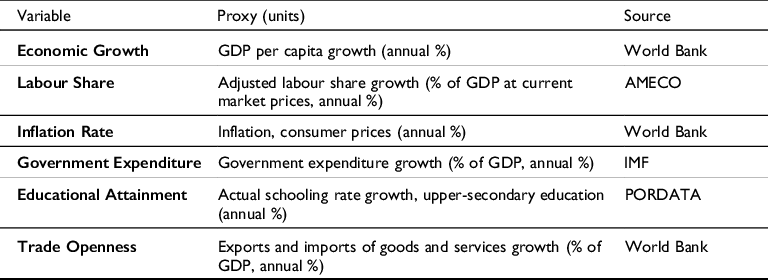
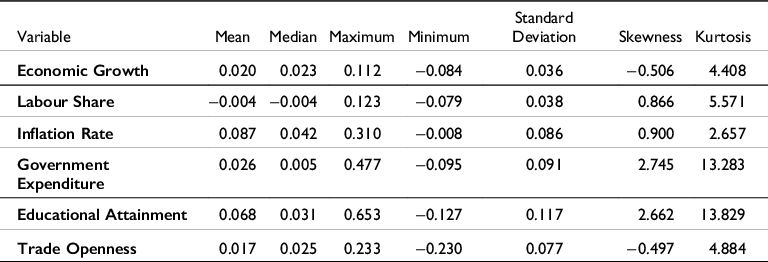
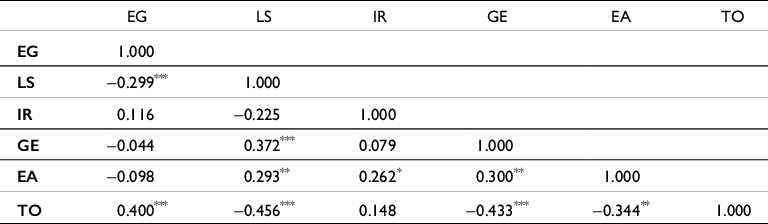
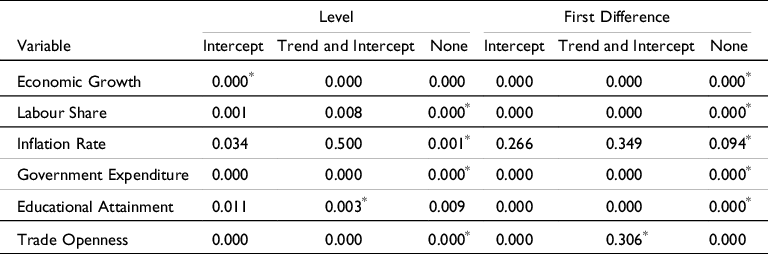
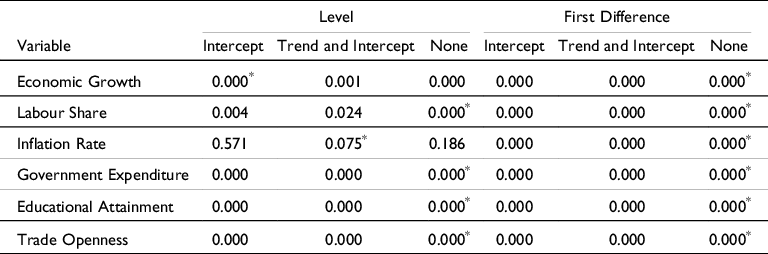
Table 1 displays the variables, proxies, units, and sources. Table 2 provides the descriptive statistics for each variable, Table 3 represents the correlation matrix between the different variables, Table 4 contains the traditional augmented Dickey and Fuller (ADF) (Reference Dickey and Fuller1979) unit root test for each variable, Table 5 shows the conventional Phillips and Perron (PP) (Reference Phillips and Perron1998) unit root test for each variable, and Figure 2 illustrates the respective plots of our variables.
Variables, proxies, units, and sources

Data from the World Bank database could be obtained directly through https://data.worldbank.org. Data from the AMECO database could be obtained directly through AMECO online. Data from the IMF database could be obtained directly through https://data.imf.org. Data from the PORDATA database could be obtained directly through https://www.pordata.pt/
The descriptive statistics

Correlation matrix between all the variables

Note: ***indicates statistical significance at 1% level,
**indicates statistical significance at 5% level and
*indicates statistical significance at 10% level. EG is the economic growth, LS is the labour share growth, IR is the inflation rate, GE is the government expenditure growth, EA is educational attainment growth, and TO is the growth of the degree of trade openness.
P-values of the ADF unit root test

Note: The lag lengths were selected automatically based on the Schwarz information criterion and *indicates the exogenous variables included in the test according to the Schwarz information criterion
P-values of the PP unit root test

Note: *indicates the exogenous variables included in the test according to the Schwarz information criterion
Note that we treat all variables as being integrated of order zero, that is, stationary in levels, which will favour the analysis of our estimated coefficients. Three reasons support this decision. First, all of our variables are defined in annual growth rates (economic growth, labour share, inflation rate, government expenditure, educational attainment, and trade openness) (Table 1), which seems to exclude the hypothesis that they are not stationary in levels. Second, the plots of our variables (Figure 1) also reinforce the assumption that they are stationary in levels. Third, the conduction of unit root tests corroborates the assumption that all of our variables are indeed stationary in levels at the traditional significance levels (Table 4 and Table 5).
We confirm that the deceleration of economic growth since the 1970s represents a stylised fact in the evolution of the Portuguese economy (Figure 2). Note that the Portuguese economy has exhibited an anaemic growth of 2.0% on average since the 1970s (Table 2). During that time, a deceleration in the inflation rate and an acceleration in government expenditure, educational attainment, and the degree of trade openness were not enough to support a higher economic dynamism in the evolution of the Portuguese economy (Table 2 and Figure 2). These trends have occurred simultaneously with a decline in the labour share, which seems to suggest that the fall of the labour share has represented one of the primary constraints on Portuguese economic growth in the past five decades (Figures 1 and 2). The negative correlation between the labour share growth and Portuguese economic growth sustains these beliefs (Table 3).
The estimation methodology
Our growth model was estimated based on the estimation methodology popularised by Hansen (Reference Hansen1982), that is, the GMM estimator. Three reasons supported this choice. The first was related to the estimation of a dynamic growth model due to the use of the lagged growth rate of the real gross domestic product per capita among our independent variables. The second was associated with the need to overwhelm the potential problem of endogeneity that could be relevant in our growth model due to the omission of other relevant variables to explain the Portuguese economic growth and/or the existence of simultaneity among our variables.Footnote 11 The third was linked to the consistent, asymptotically normally distributed and asymptotically efficient estimates produced by the GMM estimator under suitable regularity conditions (Greene Reference Greene2003; Hansen Reference Hansen1982).
To produce our estimates using the GMM estimator, we needed to define a set of instruments, that is, the so-called instrumental variables. The number of instruments should be greater than or equal to the number of independent variables, and they should be chosen to guarantee that they are exogeneous in relation to the disturbance error and strongly correlated with the independent variables (Greene Reference Greene2003; Hansen Reference Hansen1982). The traditional rule of thumb is to use lags of the independent variables and validate them according to the conventional J-statistic proposed by Hansen (Reference Hansen1982). Our growth models were estimated using five lags for each independent variable as instruments, that is, the lags from t-2 to t-6 for the growth rate of the real gross domestic product per capita and the lags from t-1 to t-5 for the remaining independent variables. Note that we chose a relatively small set of instruments in order to avoid an increase in estimation bias (Ravenna and Walsh Reference Ravenna and Walsh2006) and a reduction in the power of the J-statistic arising from the introduction of too many instruments (Mavroeidis Reference Mavroeidis2005).
Our growth model was estimated using the EViews software (version 12). We employed the Newey-West option for the weighting matrix, which is a heteroskedasticity and autocorrelation consistent estimator, as well as the Bartlett kernel option procedure for the weighting matrix. We implemented the GMM continuous updating estimator proposed by Hansen et al. (Reference Hansen, Heaton and Yaron1996), according to which the weighting matrix and the coefficients’ vector are estimated simultaneously. This estimator produces reliable estimates even in the case of small samples because it has better finite-sample properties and performance in terms of consistency and efficiency in the presence of weak instruments (Hahn et al Reference Hahn, Hausman and Kuersteiner2004; Hansen et al Reference Hansen, Heaton and Yaron1996), particularly when compared to the traditional GMM estimator created by Hansen (Reference Hansen1982). Finally, we also performed the Hall and Sen (Reference Hall and Sen1999) O-statistic in order to confirm the stability and the absence of structural breaks in our instruments and the corresponding estimates.
The estimation results and discussion
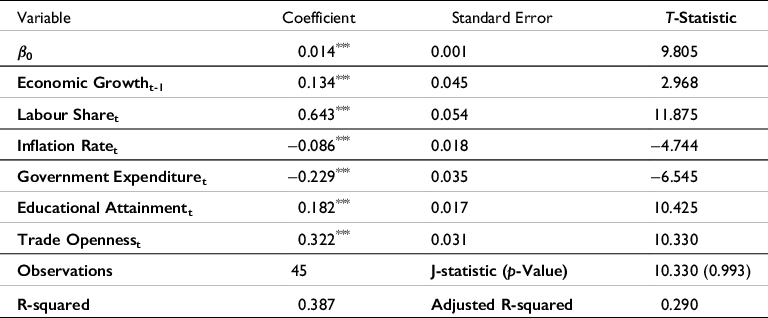
The estimation results for our growth model are presented in Table 6. The moderately high values for R-squared and for adjusted R-squared indicate that our growth model describes Portuguese economic growth relatively well. Our growth model effectively explains more than 38% of the evolution (variation) in Portuguese economic growth. We can also confirm the suitability of the estimation results for our growth model and the validation of the chosen instruments because we cannot reject the null hypothesis of the J-statistic, which implies that our set of instruments satisfies the orthogonality conditions, that is, they are exogeneous in relation to the disturbance error and strongly correlated with the independent variables (Hansen Reference Hansen1982). We can also exclude the existence of structural breaks because we reject the null hypothesis of the Hall and Sen (Reference Hall and Sen1999) O-statistic, which implies that our estimates (and instruments) are stable over time.Footnote 12
Estimation results for our growth model

Note: ***indicates statistically significance at 1% level, **indicates statistically significance at 5% level, and *indicates statistically significance at 10% level.
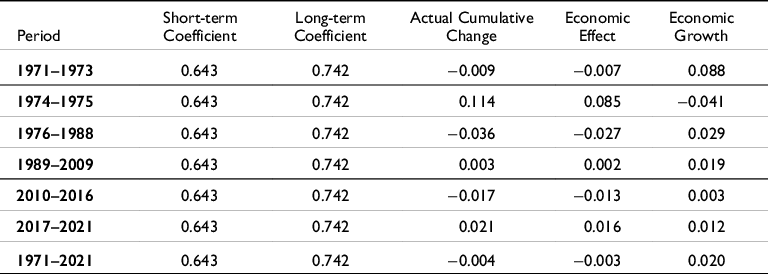
Economic effects of the labour share growth on Portuguese economic growth

Note: The short-term coefficient corresponds to the estimated coefficient of the labour share growth. The long-term coefficient is obtained through the ratio between the short-term coefficient and one minus the coefficient of the autoregressive estimation (estimated lagged economic growth coefficient). Thus, the long-term impact of the labour share growth on Portuguese economic growth is 0.742, which means that a rise of 1% point in labour share growth contributes to an increase in economic growth by around 0.742% points. The actual cumulative change corresponds to the average of the annual growth rates of the labour share during that period. The economic effect is the multiplication of the long-term coefficient by the actual cumulative change. Economic growth refers to the average of the annual growth rates of the real gross domestic product per capita during that period.
At the conventional significance levels, all variables are statistically significant and have the expected signs. The only exception was the variable of government expenditure growth that exerted unexpected negative effect on Portuguese economic growth.Footnote 13 The negative relationship between government expenditure growth and Portuguese economic growth does not support the theoretical predictions of the Keynesian theory, which could be related to higher wages of public servants, higher inflation pressures, inefficient state-owned corporations, corruption or other phenomenon that are not growth-inducing (Alexiou et al Reference Alexiou, Vogiazas and Nellis2018). The negative effect could also be explained by the higher levels of taxation to sustain the rise in government expenditure during that time (Figure 2). Rioja and Valev (Reference Rioja and Valev2004a Reference Rioja and Valev2004b), Hassan et al. (Reference Hassan, Sanchez and Yu2011), Rousseau and Wachtel (Reference Rousseau and Wachtel2011), Cecchetti and Kharroubi (Reference Cecchetti and Kharroubi2012), Breintenlechner et al. (Reference Breitenlechner, Gächter and Sindermann2015) and Barradas (Reference Barradas2020 Reference Barradas2022) also found a detrimental effect from government expenditure on economic growth, including for the specific case of Portugal. Note that Portugal was one of the European countries hit by the sovereign debt crisis in the beginning of the last decade (Barradas et al Reference Barradas, Lagoa, Leão and Mamede2018). The remaining variables had the expected effects on Portuguese economic growth. Lagged economic growth was a positive determinant of economic growth in Portugal, which corroborates the steady-state predictions of the neoclassical theory (Alexiou et al Reference Alexiou, Vogiazas and Nellis2018; Hassan et al Reference Hassan, Sanchez and Yu2011). Hassan et al. (Reference Hassan, Sanchez and Yu2011), Breitenlechner et al. (Reference Breitenlechner, Gächter and Sindermann2015), Alexiou et al. (Reference Alexiou, Vogiazas and Nellis2018) and Barradas (Reference Barradas2020 Reference Barradas2022) reported similar results. The inflation rate negatively impacted Portuguese economic growth, as was also found by Rioja and Valev (Reference Rioja and Valev2004a Reference Rioja and Valev2004b), Hassan et al. (Reference Hassan, Sanchez and Yu2011), Breitenlechner et al. (Reference Breitenlechner, Gächter and Sindermann2015), Ehigiamusoe and Lean (Reference Ehigiamusoe and Lean2018) and Barradas (Reference Barradas2020 Reference Barradas2022).Footnote 14 The positive relationship between educational attainment growth and Portuguese economic growth also supports theoretical beliefs on the positive role played by human capital (Ehigiamusoe and Lean Reference Ehigiamusoe and Lean2018; Rousseau and Wachtel Reference Rousseau and Wachtel2011).Footnote 15 Portuguese economic growth was positively impacted by the growth of the degree of trade openness, which is in line with the theoretical claims that the degree of trade openness is growth enhancing due to its supportive role on competition and technological progress (Ehigiamusoe and Lean Reference Ehigiamusoe and Lean2018; Rousseau and Wachtel Reference Rousseau and Wachtel2011). Finally, labour share growth also positively impacted Portuguese economic growth, confirming the predictions of the post-Keynesian theory of the positive effects of labour share growth on the rise of aggregate demand.Footnote 16 This confirms that the Portuguese economy is characterised by a wage-led growth regime, which is in accordance with the findings obtained by (Onaran and Obst Reference Onaran and Obst2016).
We also re-estimated our growth model by using different specifications to assess the robustness of results.Footnote 17 First, our results are quite similar if we use the growth rate of the real gross domestic product instead of the growth rate of the real gross domestic product per capita as a proxy of economic growth. Second, our results do not radically change in terms of statistical significance and/or signs if we exclude the years 2020 and 2021, and/or we use a dummy variable for the years 2020 and 2021 in order to take into account the deleterious effects on the Portuguese economy of the COVID-19 pandemic (Figure 2). This is not too surprising because we had already excluded the existence of structural breaks in our estimates in accordance with the results of the Hall and Sen (Reference Hall and Sen1999) O-statistic. Third, our results did not considerably change if we excluded the years from 1971 to 1975 and/or if we used a dummy variable for the year of 1975 in order to take into account the negative consequences on the Portuguese economy caused by the strong turbulence related to the Carnation Revolution that instituted democracy in the country after 48 consecutive years of a conservative dictatorship (Figures 1 and 2).
Table 6 presents the economic effects of labour share growth on Portuguese economic growth (McCloskey and Ziliak Reference McCloskey and Ziliak1996; Ziliak and McCloskey Reference Ziliak and McCloskey2004). This allows us to identify the contribution of labour share growth in explaining the trend of weaker and anaemic growth in Portugal since the 1970s. This analysis was performed only for labour share growth and not for the remaining control variables given our interest in assessing the role of labour share growth on Portuguese economic growth in the last five decades.
We observed that since the 1970s, the evolution of the Portuguese labour share can be divided into six main subperiods (Figure 1). The first subperiod corresponds to the years from 1971 to 1973 in which the labour share exhibited a slight decrease of around 0.9% on average per year, probably due to the acceleration in inflation that occurred on an international scale and to the negative effects caused by the Colonial War that occurred from 1961 to 1974. During that time, Portuguese economic growth was relatively strong at around 8.8% on average per year, which is explained by the rapid industrialisation after Portugal joined the European Free Trade Association in 1960. Nonetheless, Portuguese economic growth would have been even higher by about 0.7% on average per year if there had not been a decline in the labour share during these years.
The second subperiod is related to the revolutionary period of 1974 and 1975. In those two years, the Portuguese labour share rose sharply due to a corresponding rise in real wages caused by the social pressures to improve the general living conditions and the adoption of left-wing oriented economic policies (Lagoa et al Reference Lagoa, Leão, Mamede and Barradas2014). Abreu (Reference Abreu2020) enumerated several public policies that contributed to this increasing trend in the Portuguese labour share and were adopted in these years; they were the creation of the minimum wage, the introduction of 14 months of wages, the definition of wage careers (some of them with automatic progression), the implementation of extraordinary and supplementary remuneration schemes, the nationalisation of the majority of corporations and the participation of workers on the boards of directors. During thoese two years, the increase in the labour share favoured an acceleration in Portuguese economic growth of around 8.5% on average per year, which was not enough to avoid an economic recession in Portugal of around 4.1% on average per year.
The third subperiod is linked to the post-revolutionary period from 1976 to 1988 in which the Portuguese labour share steeply declined by about 3.6% on average per year, preventing a higher economic growth in Portugal during that time. Portuguese economic growth would effectively have been greater by about 2.9% on average per year if there had not been a decline in the labour share during these years. This evolution can be attributable to a drop in wages caused by the emergence of several international economic crises, the existence of strong external imbalances and the adoption of two adjustment programmes and the corresponding austerity measures imposed by the International Monetary Fund in 1977 and 1983 (Barradas et al Reference Barradas, Lagoa, Leão and Mamede2018; Lagoa et al Reference Lagoa, Leão, Mamede and Barradas2014). High levels of inflation and the adoption of wage ceilings in several years by the Portuguese government also contributed to a decline in real wages and a corresponding fall in the labour share (Abreu Reference Abreu2020).
The fourth subperiod corresponds to the years from 1989 to 2009 in which the Portuguese labour share remained relatively stable, albeit denoting a slight increase of around 0.3% on average per year. This happened in a context of low levels of inflation and moderate levels of economic growth along with a positive momentum in the international economy, lower levels of oil prices, favourable exchange rate developments (with the dollar appreciating against the European currencies) and the rise in social expenditures and public investment (Barradas et al Reference Barradas, Lagoa, Leão and Mamede2018). From 1989 to 2009, the rise in the labour share contributed to an acceleration of Portuguese economic growth by around 0.2% on average per year.
The fifth subperiod occurred in the years between 2010 and 2016, and it was characterised by the negative effects caused by the subprime crisis and the sovereign debt crisis in Portugal that culminated with the adoption of a new adjustment programme and a new wave of austerity measures imposed by the International Monetary Fund, the European Commission and the European Central Bank (the so-called ‘Troika’). During that time, Portuguese economic growth would have even been higher by about 1.3% on average per year if there had not been a fall in the labour share by around 1.7% on average per year.
The sixth subperiod corresponds to the years from 2017 to 2021. During these years, the labour share increased by around 2.1% on average per year, which more than compensated for the decline observed in the previous subperiod. This happened due to the coalition between the left-parties in the elections for the Portuguese parliament that occurred at the end of 2015. This coalition adopted a set of measures to restore a recuperation in purchase power, which translated to a growth in real wages. During these years, the rise of the labour share favoured an acceleration in Portuguese economic growth by around 1.6% on average per year.
Considering the entire period, we noted a general decreasing trend in the labour share in Portugal and an expected detrimental effect on economic growth. The Portuguese economic growth would effectively have been even greater by about 0.3% on average per year if there had not been a drop in the labour share by around 0.4% on average per year since the 1970s.
In summary, we confirm the existence of a positive relationship between labour share growth and Portuguese economic growth, which confirms that Portugal has been following a wage-led growth regime and suggests the need to adopt public policies to promote the growth of wages in the coming years in order to avoid more decades of dismal growth and a new ‘secular stagnation’ in Portugal.
Conclusions
This paper analysed the relationship between labour share and economic growth by performing a time series econometric analysis focused on Portugal from 1971 to 2021. During that period, the labour share exhibited a significant decline that coincided with a trend towards weaker and anaemic growth in Portugal. This seems to suggest that the fall in labour share represented an important constraint on Portuguese economic growth that is in accordance with heterodox claims and, particularly, with post-Keynesian economics on the beneficial effects played by the growth of wages on private consumption that tends to supplant the corresponding detrimental effects on private investment and net exports.
We estimated a growth model by using the GMM continuous updating estimator proposed by Hansen et al. (Reference Hansen, Heaton and Yaron1996), according to which Portuguese economic growth depends on the labour share growth and on five control variables (the lagged growth rate of the real gross domestic product per capita, the inflation rate, government expenditure growth, educational attainment growth, and the growth of the degree of trade openness) that are typically used in empirical works on economic growth (Barradas Reference Barradas2020 Reference Barradas2022; Beck et al Reference Beck, Degryse and Kneer2014; Breintenlechner et al Reference Breitenlechner, Gächter and Sindermann2015; Cecchetti and Kharroubi Reference Cecchetti and Kharroubi2012; Ehigiamusoe and Lean Reference Ehigiamusoe and Lean2018; Hassan et al Reference Hassan, Sanchez and Yu2011; Rioja and Valev Reference Rioja and Valev2004a Reference Rioja and Valev2004b; Rousseau and Wachtel Reference Rousseau and Wachtel2011).
Our results confirm that the labour share growth, the lagged growth rate of the real gross domestic product per capita, educational attainment growth and the growth of degree of trade openness positively impact Portuguese economic growth, while the inflation rate and government expenditure growth exert a negative effect on Portuguese economic growth. The results confirming that Portugal follows a wage-led growth regime, also suggests the need to adopt public policies to promote the growth of wages in the coming years to avoid more decades of dismal growth and a new ‘secular stagnation’ in Portugal.
To achieve this, Portuguese policymakers should prevent (and reverse) the progressive deregulation and flexibilisation of the labour market at the level of unemployment benefits, employment protection, employment rights and minimum wage. In the same vein, Portuguese policymakers should promote the recovery of the general workers’ bargaining power by stimulating more collective bargaining at the national level, at least among public servants; reinforcing the role of trade unions and unionisation levels; and encouraging the creation of workers’ commissions and their respective participation on the board of directors of most corporations. Portuguese policymakers should also establish public policies for the purpose of reducing the greater importance placed on profit share. Some examples could be a rise in taxation on large corporations, on wealth, and on capital gains on stock market returns and/or other financial assets.
This paper employed a time series econometric analysis that allowed a consideration of the historical, social, economic and institutional forces behind the evolution of the labour share in the last decades, as well as its harmful effects on Portuguese economic growth. This seems to suggest that our results offer a limited capacity of generalisation to other countries or regions because each one has its own idiosyncrasies. In order to overcome this limitation, further research about this subject could perform a panel data econometric analysis by assessing a large sample of countries over time, which tends to produce more generalisable results and more consistent and efficient estimates. Further research should also explore in more detail the reasons for the counterintuitive obtained result, according to Keynesian economics, pertaining the negative relationship between government expenditure growth and economic growth in Portugal.
Acknowledgements
The authors thank the helpful comments and suggestions of three anonymous referees and the area editor, as well as, Ricardo Paes Mamede, Sérgio Lagoa, and the participants in 6º Encontro Annual de Economia Política (Universidade de Trás-os-Montes e Alto Douro, Janeiro de 2023). João Alcobia also gratefully acknowledge the financial support of Fundação para a Ciência e Tecnologia under the doctoral grant number UI/BD/150768/2020. The usual disclaimer applies.
Funding statement
João Alcobia also gratefully acknowledge the financial support of Fundação para a Ciência e Tecnologia under the doctoral grant number UI/BD/150768/2020.
Competing interests
The authors declared no potential conflicts of interest with respect to the research, authorship, and/or publication of this article.
João Alcobia is Researcher at Research in Economics and Mathematics at Lisbon School of Economics and Management. He is a Ph.D Candidate in Economics and his main research interest are in the fields of political economy, post-Keynesian economics, structural change, and income inequality.
Ricardo Barradas is Assistant Professor in the Department of Political Economy at Iscte – Instituto Universitário de Lisboa and Researcher at Centre for the Study of Socioeconomic Change and the Territory in Lisbon, Portugal. His main research interests are in the fields of political economy, post-Keynesian economics, financialisation, and other related areas.