INTRODUCTION
Measurement outcomes such as quality of life and health status are now a common topic of concern in palliative research (Antunes et al., Reference Antunes, Harding and Higginson2014). Gathering information in these areas is considered crucial for interventions (Cormier & Askew, Reference Cormier and Askew2011; Dawson et al., Reference Dawson, Doll and Fitzpatrick2010; Higginson & Carr, Reference Higginson and Carr2001; Rose & Bezjak, Reference Rose and Bezjak2009; Sloan et al., Reference Sloan, Halyard and Frost2007). Patient-reported outcome measures, defined as “standardized, validated questionnaires that are completed by patients to measure their perceptions of their own functional status and well-being” (Dawson et al., Reference Dawson, Doll and Fitzpatrick2010, p. 464), are used more frequently (Antunes et al., Reference Antunes, Harding and Higginson2014; Dawson et al., Reference Dawson, Doll and Fitzpatrick2010; Higginson & Carr, Reference Higginson and Carr2001; Mularski et al., Reference Mularski, Rosenfeld and Coons2007; Bossola et al., Reference Bossola, Murri and Onder2010). As explained by Antunes et al. (Reference Antunes, Harding and Higginson2014), systematic collection of patient-reported outcomes using validated questionnaires can benefit clinical practice in palliative care by facilitating screening; providing information on progression and treatment; facilitating communication among clinicians, patients, and family members; and helping to effectively monitor costs.
However, some authors have pointed out that, although the quantity of palliative care research has been steadily increasing, the quality of the care provided is sometimes questionable (Harding et al., Reference Harding, Simon and Benalia2011). In fact, few of the assessment tools meet the accepted standards for development of outcome measures (Hearn & Higginson, Reference Hearn and Higginson1997; Mokkink et al., Reference Mokkink, Terwee and Patrick2010; Terwee et al., Reference Terwee, Bot and de Boer2007). Following the guidelines of the European Association for Palliative Care, these standards include validity, reliability, appropriateness, acceptability, responsiveness to change, and interpretability (Bausewein et al., Reference Bausewein, Daveson and Benalia2011).
Together with these essential properties, the aims and reasons for using a measure should also be taken into account. In this context, clinicians have been advocating for briefer, more user-friendly scales, as they require rapid and valid tools that can be used to screen for a wide variety of symptoms. In a online study conducted among palliative care professionals from Europe and Africa (Daveson et al., Reference Daveson, Simon and Benalia2012), doctors reported that the lack of time was the most common reason for not using a tool, and nurses ranked time constraints as the second most common reason. Both preferred brief outcome measures, and both were influenced by whether or not a measure was validated for use in the context of palliative care. In the same vein, in a pan-European survey of tool users carried out by Harding et al. (Reference Harding, Simon and Benalia2011), respondents called for instruments with simple formats, arguing that “they should be short and easy to understand for patients” and “they should be short, not complicated, and easy to take.”
These arguments have been gaining weight in the palliative care literature, especially in the areas of psychological distress, spirituality, and dignity. Almost two decades ago, Chochinov et al. (Reference Chochinov, Wilson and Enns1997) pointed out that screening tools for depression were lacking and needed to be brief and acceptable. Good examples can be found in the more recent literature. There is the Distress and Impact Thermometer, a two-item questionnaire that has demonstrated psychometric properties comparable to those of the Hospital Anxiety and Depression Scale (Akizuki et al., Reference Akizuki, Yamawaki and Akechi2005). Julião et al. (Reference Julião, Nunes and Sobral2015) encouraged research in this area by asking a simple question: “Are you depressed?” Benito et al. (Reference Benito, Oliver and Galiana2014) presented an eight-item tool for assessing spiritual resources and needs in palliative care patients. Rudilla et al. (Reference Rudilla, Oliver and Galiana2016a ) developed the eight-item Palliative Patients' Dignity Scale for Spanish-speaking populations, which demonstrated the appropriate psychometric properties. However, such an instrument has not been developed for assessment of demoralization.
Several outcome measures have been developed to assess demoralization, including: the Psychiatric Epidemiology Research Interview (Dohrenwend et al., Reference Dohrenwend, Shrout and Egri1980); the Demoralization Scale of the Minnesota Multiphasic Personality Inventory, 2nd ed. (MMPI–2; Butcher et al., Reference Butcher, Graham and Williams1990), and the Demoralization Scale (DS; Kissane et al., Reference Kissane, Wein and Love2004). The DS is the most widely used of this group. It is a 24-item self-report demoralization measure that aims to describe patient morale. It has been translated into and adapted for several languages: Dutch (De Jong et al., Reference De Jong, Kissane and Geessink2008), German (Mehnert et al., Reference Mehnert, Vehling and Hocker2011), Hungarian (Hadnagy et al., Reference Hadnagy, Csikós and Nagy2012), Italian (Costantini et al., Reference Costantini, Picardi and Brunetti2013), Mandarin (Hung et al., Reference Hung, Chen and Chang2010), and Spanish (Rudilla et al., Reference Rudilla, Galiana and Oliver2016b ). While examining the psychometric properties of the DS, these studies have revealed a controversy when it comes to its factorial structure, and their results have not been successfully replicated. Kissane et al. (Reference Kissane, Wein and Love2004), for instance, found five dimensions: “loss of meaning,” “dysphoria,” “disheartenment,” “helplessness,” and “sense of failure.” In adapting the DS for Irish and Mandarin, Mullane et al. (Reference Mullane, Dooley and Tiernan2009) and Hung et al. (Reference Hung, Chen and Chang2010) again found five dimensions, but with variations as to the composition of individual items. Mehnert et al. (Reference Mehnert, Vehling and Hocker2011) found four dimensions in the German version of the instrument. The DS demonstrated appropriate psychometric properties in its Spanish version but again with a new and different structure (Rudilla et al., Reference Rudilla, Galiana and Oliver2016b ). In addition to these structural contradictions, the DS is too long to be employed for rapid screening of patients and should not be included in palliative care research protocols.
With these and other problems in mind, Kissane and colleagues (see Robinson et al., Reference Robinson, Kissane and Brooker2016a ; Reference Robinson, Kissane and Brooker2016b ) developed a new and shorter version of the DS: the Demoralization Scale–II (DS–II). This version has demonstrated adequate psychometric properties and includes 16 items (of the total 25) that survived exploratory factor analysis.
Following the demand for briefer assessment tools and the limitations of previous research, and taking into account that demoralization has proved to be a symptom that needs to be controlled and treated in the palliative care context, there is a growing need for a shorter demoralization scale that meets outcome measures standards. The aim of the present study was to introduce a five-item measure for demoralization measurement, the Short Demoralization Scale (SDS).
METHODS
Scale Development
The Short Demoralization Scale is based on Kissane and colleagues' (Reference Kissane, Wein and Love2004) theoretical approach to demoralization. Five items designed to capture the five dimensions proposed by the original authors were developed. These are original, new items, but they are based on Kissane's conceptualization of demoralization (Kissane et al., Reference Kissane, Wein and Love2004).
The heading used was the same as that used by Kissane et al. (Reference Kissane, Wein and Love2004): “For each statement below, please indicate how strongly you have felt this way over the last two weeks.” The items reproduced the names of the five dimensions of the Demoralization Scale: “loss of meaning,” “helplessness,” “disheartenment,” “dysphoria,” and “sense of failure.” The response format was also maintained, so that a Likert-type scale with five answers was used, ranging from 0 (never) to 4 (all the time), with higher scores indicating more severe demoralization.
We would like to emphasize that the SDS is not merely an adaptation of Kissane's SD, not a validation of a previously existing measure. Rather, it is a new scale, derived from our work based on the psychometrics literature and our own demoralization research. Its Spanish and English versions are provided in the Appendix.
Design, Procedure, and Sample
Our study employed a cross-sectional design. Participants from three different units (the hospital, the home care unit, and the continued care unit) from the Hospital General Universitario de Valencia were invited to participate. The protocol was approved by the ethics committee of the research foundation of the hospital. The inclusion criteria included: (1) patients had to be admitted to the home care unit of the hospital for palliative treatment; (2) they had to be adults (≥18 years old); (3) they had to have an advanced/terminal illness; and (4) they had to have knowledge of their diagnosis and prognosis. The exclusion criteria were as follows: (1) if less than two weeks of survival were expected, as measured by the Palliative Prognostic Index (PPI; Morita et al., Reference Morita, Tsunoda and Inoue2001); (2) if there was a conspiracy of silence, “where the patient and medical staff knew the truth but withheld it from the patient” (Zimmermann & Rodin, Reference Zimmermann and Rodin2004, p. 121); and (3) if the patient suffered from cognitive impairment (comprehension/expression problems) as assessed with the Short Portable Mental Status Questionnaire (Pfeiffer, Reference Pfeiffer1975). All patients gave their informed consent before participating.
A total of 226 palliative care patients were surveyed about demoralization, anxiety, depression, spirituality, and quality of life. Half were women; most were married (72.6%); 21.2% were widowed, 5.3% single, and 0.9% divorced; 83.2% were oncological patients. The mean age of the sample was 70.94 years (SD = 11.54).
Outcome Measures
Together with the new SDS and the abovementioned sociodemographic data, the following instruments were utilized:
-
1. The Demoralization Scale (DS; Kissane et al., Reference Kissane, Wein and Love2004). This instrument measures five dimensions of demoralization (loss of meaning, helplessness, disheartenment, dysphoria, and sense of failure) with 24 items. We employed the Spanish version (Rudilla et al., Reference Rudilla, Galiana and Oliver2016b ).
-
2. The Hospital Anxiety and Depression Scale (HADS; Zigmond & Snaith, Reference Zigmond and Snaith1983). This instrument measures anxiety and depression in patients with comorbid physical illness. It has a total of 14 items, 7 for each dimension. The values of Cronbach's α were 0.702 for anxiety and 0.832 for depression.
-
3. The Grupo de Espiritualidad (GES) Questionnaire (Benito et al., Reference Benito, Oliver and Galiana2014). This instrument includes six open questions, eight items that assess the general dimension of spirituality, and three subscales (intrapersonal, interpersonal, and transpersonal spirituality). The value of α for this tool was 0.767.
-
4. Two items from the EORTC Quality of Life C30 (EORTC–QLQ–C30; Bjordal et al., Reference Bjordal, de Graeff and Fayers2000): “How would you rate your overall health during the previous week?” and “How would you rate your overall quality of life during the previous week?” These items have been used in previous research (Rudilla et al., Reference Rudilla, Galiana and Oliver2015; 2016a) to evaluate possible physical deterioration. The value of Cronbach's α for this instrument was 0.851.
Statistical Analyses
Validity
In order to study the factorial structure of the SDS, an a-priori one-factor confirmatory factor analysis model was tested and employed. The model's plausibility was assessed using several criteria of fit: (1) the chi-square statistic; (2) the comparative fit index (CFI); and (3) the root-mean-squared error of approximation (RMSEA). Hu and Bentler (Reference Hu and Bentler1999) suggested that a CFI of at least 0.90 and a RMSEA less than 0.08 would indicate a good fit. Correlations among SDS score and the dimensions of the Spanish version of the Demoralization Scale (Rudilla et al., Reference Rudilla, Galiana and Oliver2016b ) were calculated to study concurrent validity. Cohen's (Reference Cohen1988) cutoff criteria for effect size r were employed, with values of 0.10 indicating small, 0.30 medium, and 0.50 large effects.
Reliability
The reliability study included estimations of the internal consistency of the SDS: Cronbach's alpha (α), item means, standard deviations, and reliability estimates. Values of α greater than 0.70 indicated adequate reliability, and values greater than 0.80 indicated high reliability (Cicchetti, Reference Cicchetti1994).
Appropriateness and Acceptability
Although appropriateness and acceptability were not statistically tested, those responsible for application of the survey were trained to detect any complaints or comprehension problems regarding the new SDS scale or any of the other instruments used during our protocol.
Interpretability
Finally, to study the proposed cutoff point for the SDS, we constructed contingency tables and conducted t tests for independent samples. Dichotomous clinical anxiety and depression variables were also utilized. A score ≥10 on the HADS questionnaire—considered indicative of psychopathology (Zigmond & Snaith, Reference Zigmond and Snaith1983)—was chosen as the cutoff criterion. A cutoff point of 10 was chosen for the SDS, where scores can vary from 0 to 20. Thus, patients with scores ≤10 were classified as not demoralized, whereas those with scores above 10 (11 or more) were classified as demoralized. We also calculated the values of phi (&phis;) and conducted a significance test in order to interpret contingency tables. A value of &phis; of 0.10 was considered to represent a small effect, a value of 0.30 a medium effect, and 0.50 a large effect. In the case of the t tests, and as previously reported, the value of Cohen's d was calculated for effect size measurement using the aforementioned rationale.
RESULTS
Validity
A theoretical structure for the general factor of demoralization was specified, estimated, and evaluated with this a-priori structure. Overall fit indices supported the one-factor structure of the scale: the chi-square value was 12.915, with five degrees of freedom (p = 0.024); the CFI was 0.999, and the RMSEA was 0.084 (with a 95% confidence interval [CI 95%] of [0.028, 0.141]). Overall, the model was deemed to be an adequate representation of the observed data.
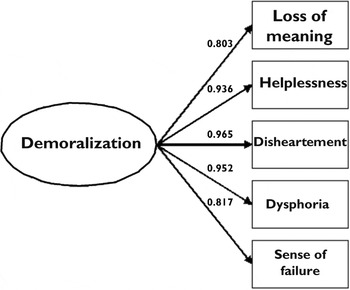
The analytical fit was also appropriate, with factorial loadings that ranged from 0.803 (item 1, “loss of meaning”) to 0.965 (item 3, “disheartenment”). Detailed information can be obtained from Figure 1.
Analytical fit of the confirmatory factor analysis. All factor loadings and correlations were statistically significant (p < 0.01). For the sake of clarity, errors are not shown.

With respect to concurrent validity, correlations among the short-form of the DS and the dimensions of the DS (Kissane et al., Reference Kissane, Wein and Love2004) showed positive and medium to large relationships among the SDS and four of the five dimensions posited by Kissane and coworkers: loss of meaning, helplessness, disheartenment, and dysphoria (see Table 1). However, there was no correlation with sense of failure. The correlations among the dimensions of the Demoralization Scale were as expected, except for, again, sense of failure, which correlated statistically significantly and positively with loss of meaning and helplessness, but statistically significantly and negatively with disheartenment and dysphoria. These four correlations were small in magnitude.
Correlations among the SDS and the dimensions of the Spanish version of the DS

** p < 0.01.
Reliability
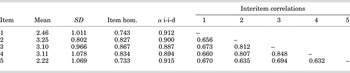
The value of Cronbach's α for the SDS was 0.920. The descriptive statistics, item homogeneity, α if-item-deleted, and interitem correlations are presented in Table 2. All pointed to the appropriate reliability of this scale.
Means, standard deviations, item homogeneity, alpha if-item-deleted, and interitem correlations for SDS items

SD = standard deviation; item hom. = item homogeneity; α i-i-d = alpha if-item-deleted.
Appropriateness and Acceptability
Patients did not report any comprehension problems, nor were there any other complaints voiced while the protocol was running.
Interpretability
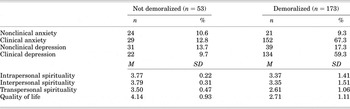
The chi-square tests revealed that the cutoff criterion of 10 for the SDS (calculated using the overall sum of the five item scores) was appropriate for detecting demoralized patients. Our results found a significant association between demoralized patients and patients with clinical anxiety (χ2(224) = 27.948; p < 0.001; V = 0.352) and depression (χ2(224) = 24.521; p < 0.001; V = 0.329). In the case of spirituality and quality of life, the t tests also yielded a significant difference between demoralized and not-demoralized patients on every dimension: intrapersonal spirituality (t(224) = 6.667; p < 0.001; d = 1.047); interpersonal spirituality (t(224) = 5.827; p < 0.001; d = 0.915); transpersonal spirituality (t(224) = 5.822; p < 0.001; d = 0.914); and quality of life (t(224) = 8.445; p < 0.001; d = 1.326). We found that patients scoring above 10 on the SDS are more likely to suffer clinical anxiety and depression, and have low levels of spirituality and quality of life (see Table 3).
Descriptive statistics for patients according to SDS scores

DISCUSSION
The objective of our study was to introduce the Short Demoralization Scale, a straightforward and easy-to-use measure based on Kissane's original 24-item questionnaire (Kissane et al., Reference Kissane, Wein and Love2004). Although based on Kissane and colleagues' conceptualization of demoralization, the SDS is an entirely new scale. We analyzed its validity, reliability, and interpretability instrument in a sample of Spanish palliative care patients.
Our results support the appropriateness of the factorial structure of the SDS. Its five items, named after Kissane's scale factors, loaded into a single dimension of demoralization. Both the analytical and overall fit of the model were thus excellent. When concurrent validity was examined, positive relationships were found among the SDS and the dimensions of the Spanish version of the Demoralization Scale, except “sense of failure.” This dimension also presented problems during the validation of the Spanish version of the DS (Rudilla et al., Reference Rudilla, Galiana and Oliver2016b ), where it demonstrated low reliability. Such items as “I cope fairly well with life,” “I am proud of my accomplishments,” and “I am a worthwhile person” changed valence from negative to positive statements, which required patients to make a response shift, which they found confusing. In addition, “sense of failure” has also posed problems in recent work focused on the DS (Robinson et al., Reference Robinson, Kissane and Brooker2016b ). Items of this factor in the original DS were characterized by a reversed response valence in the wording of the original items. These types of items have repeatedly been shown to impact the quality of scales, affecting their validity (Dalal & Carter, Reference Dalal, Carter, Lance and Vanderberg2015) and possibly creating a method effect. With respect to reliability, this was also appropriate, with a high estimation of α and no recommendation for removing any items. Although appropriateness and acceptability were not tested statistically, it is worth mention that patients did not report any problems with comprehension and did not register any complaints about the scale. Although this last property should be adequately tested in future research, no acceptability problems were detected in this first study.
Finally, our results regarding interpretability provided empirical evidence for a cutoff score of 10. This criterion was found to be useful in detecting demoralized patients, revealing higher levels of clinical anxiety and depression and lower levels of spirituality and quality of life. However, one particularity of our sample was a high prevalence of clinical anxiety and depression. Thus, future studies trying to replicate our findings in palliative care populations with lower levels of depression and anxiety would be most welcome. Nonetheless, we considered the psychometric properties of the SDS to be adequate.
Although our research has its limitations—for example, the lack of an examination of responsiveness to change—we still believe that the SDS can offer a robust contribution to the field. Indeed, the scale addresses the previous limitation of length, which can be an obstacle for patients in taking the examination and for professionals in administering it. It also has a simple scoring system, has no costs related to its use, and is widely available. These aspects are particularly important in the palliative care context, where patients' time is limited, professionals attend to them in different settings, and their condition poses several challenges to outcome measurement. We therefore believe that the SDS offers the needed balance between adequate psychometric properties and feasibility for clinical use. Further research is encouraged to study the SDS in different sociocultural and clinical contexts.
APPENDIX
Spanish and English Versions of the SDS