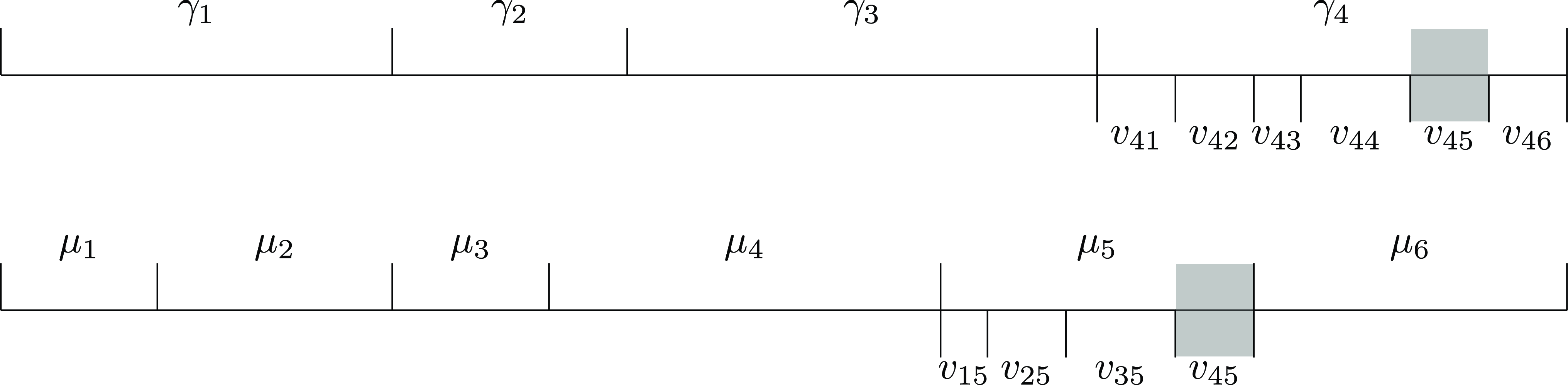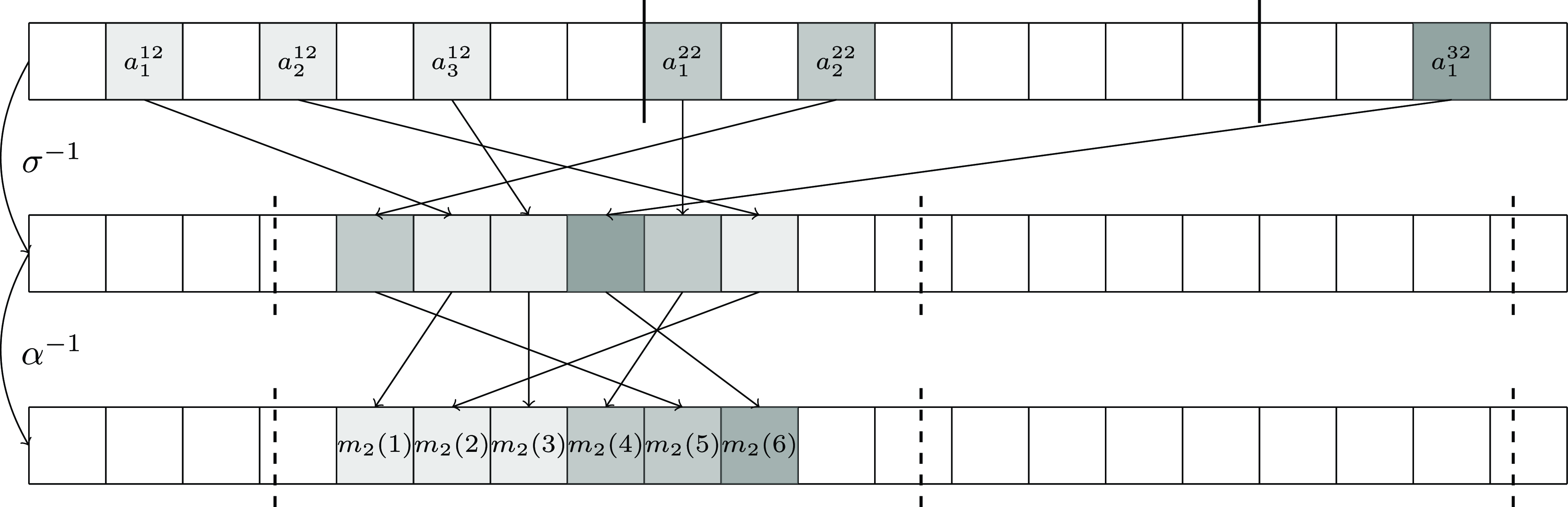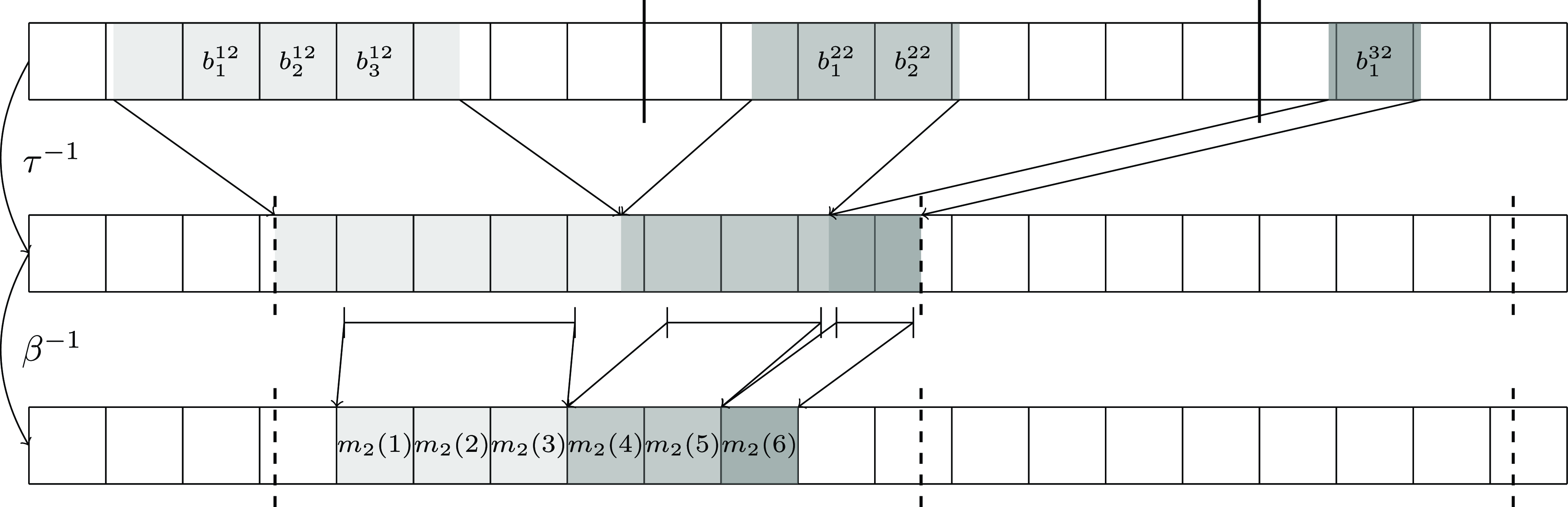



1. Introduction
The study of large deviation problems on random graphs has a long and rich history in Probability and Combinatorics. Research in this area is motivated by the following fundamental question: What is the structure of a random graph, conditioned on a rare event?
In a seminal paper, Chatterjee and Varadhan [Reference Chatterjee and Varadhan14] formalised this question by combining the theory of graph limits [Reference Lovász32] with classical Large Deviations theory [Reference Dembo and Zeitouni19], and established a Large Deviation Principle (LDP) for the Erdős–Rényi binomial random graph
 $G(n,p)$
. This is the simplest random graph model, constructed by adding edges independently among
 $n$
vertices with probability
 $p$
. As an application of this LDP, Chatterjee and Varadhan [Reference Chatterjee and Varadhan14] examined upper tail large deviations for regular subgraph counts. The homomorphism density
 $t(H,G)$
of a graph
 $H$
on
 $v$
vertices measures the probability that
 $H$
appears on
 $v$
randomly chosen vertices of a graph
 $G$
(see Definition 5). Let
 $H$
be a
 $d$
-regular graph, and for notational convenience, define the event
 $\mathcal{E}_{\delta }=\{t(H,G) \gt (1+ \delta ) \mathbb{E}[t(H, G)]\}$
. Chatterjee and Varadhan [Reference Chatterjee and Varadhan14] established the existence of
 $0\lt \delta _{\min }(H) \lt \delta _{\max }(H)$
such that if
 $\delta \lt \delta _{\min }(H)$
or
 $\delta \gt \delta _{\max }(H)$
, conditioned on
 $\mathcal{E}_\delta$
,
 $G(n,p)$
‘looks like’ an Erdős–Rényi random graph, albeit with a higher edge density. They call this the ‘replica symmetric’ phase. On the contrary, [Reference Chatterjee and Varadhan14] also establishes that for
 $p$
sufficiently small, there exists
 $\delta \in [\delta _{\min }(H), \delta _{\max }(H)]$
such that conditioned on
 $\mathcal{E}_\delta$
, the graph is not distributed as an Erdős–Rényi random graph – this regime was termed as the ‘replica symmetry breaking’ regime. Using the framework of [Reference Chatterjee and Varadhan14], Lubetzky and Zhao [Reference Lubetzky and Zhao34] characterised the precise boundary between the symmetry and the symmetry breaking regimes, in terms of
 $\delta$
and
 $p$
. We defer an in-depth survey of large deviations on random graphs to Section 1.7.
Random graphs are simple stochastic models for large networks observed in a myriad of scientific applications, and in this context, it is often natural to study graph models with inhomogeneities or constraints. Large deviation phenomena are of natural interest in this general setting, although progress in this direction requires several new ideas. The study of large deviations for constrained random graphs has been initiated in the recent literature – [Reference Dembo and Lubetzky18] studies large deviations for the uniform random graph with a given number of edges, while in [Reference Dhara and Sen20], in joint work with Souvik Dhara, S.S. studied large deviations for random graphs with given degrees. Finally, [Reference Bhattacharya and Dembo7] focuses on large deviations for random regular graphs in the sparse regime. In contrast, large deviations for inhomogeneous random graphs is relatively unexplored (see [Reference Bhattacharya and Dembo7] for some preliminary results on sparse graphs). This paper seeks to fill this gap by initiating the study of large deviations for block model random graphs.
We study large deviations for block model graphs drawn from a ‘base graphon’ with
 $k$
blocks that is specified by a set of values
 $\{p_{ij}\}_{1 \leq i \leq j \leq k}$
,
 $p_{ij} \in [0,1]$
. A graph on
 $kn$
vertices is sampled from this model as follows: (i) collect the vertices into
 $k$
groups of size
 $n$
, indexed by
 $1, \ldots , k$
, and (ii) connect two vertices from groups
 $i$
and
 $j$
with probability
 $p_{ij}$
. (See Section 1.1 for a formal definition.) Our contributions in this article can be summarised as follows:
-
1. We adopt the framework of [Reference Chatterjee and Varadhan14], and establish an LDP for block model random graphs, viewed as random graphons. The induced law of the random graph satisfies an LDP with speed
 $n^2$
– the rate function in this case is the lower semicontinuous envelope of an appropriate relative entropy functional (see formal statement as Theorem 11). Perhaps surprisingly, although the block model is quite similar to the Erdős–Rényi random graph, our derivation of the LDP requires going substantially beyond the ideas introduced in [Reference Chatterjee and Varadhan14]. In particular, the derivation of the LDP in [Reference Chatterjee and Varadhan14] relies heavily on the fact that an Erdős–Rényi random graph remains invariant in law under permutations of the vertices, a fact that is no longer true for general block models. To overcome this barrier, we rely on a two-step approach. (a) Using Szemerédi’s Regularity Lemma, we construct a Szemerédi net of block graphons and cover an event by a finite union of open balls centred on the elements of this net. Thus it suffices to characterise the limiting probability of each open ball. (b) To this end, we employ a ‘method of types’-style argument, similar to the classical proof of Sanov’s Theorem. A similar two-step strategy was employed earlier in [Reference Dhara and Sen20] while deriving an LDP for random graphs with given degrees. A crucial technical difference between the two settings is that in [Reference Dhara and Sen20], the graphon being sampled from was bounded away from zero and one, whereas our results include block models that take value zero or one. As an immediate application of this general result, we obtain an LDP for the Erdős–Rényi bipartite graph.
-
2. Our general LDP, in turn, directly implies an LDP for graph parameters continuous with respect to the cut topology (see Theorem 16), e.g., homomorphism density, largest eigenvalue, etc. For such graph parameters, the rate function is expressed as a variational problem on the space of graphons.
-
3. Next, we turn our attention to the variational problem for upper tail large deviations of regular subgraphs. In Theorem 19, we establish that close to the expected value, this problem exhibits a symmetric phase – where the variational problem admits solutions which exhibit the same block structure as the base graphon. We also demonstrate that for large target values of the homomorphism density, the variational principle admits symmetric solutions.
-
4. In some specific block graphons, we exhibit the existence of a non-symmetric phase – where there does not exist a symmetric minimiser (see Section 1.5 for the specific examples). This establishes an analogue of the reentrant phase transition Footnote 1 phenomenon, noted earlier for the upper tail problem on Erdős–Rényi random graphs [Reference Chatterjee and Dey13, Reference Chatterjee and Varadhan14].
-
5. Finally, we turn to the bipartite Erdős–Rényi random graph in Section 1.6 and study the variational problems corresponding to the upper tails of regular subgraphs and largest eigenvalue. We extend the analysis of Lubetzky and Zhao [Reference Lubetzky and Zhao34] and determine the precise transition boundary between the symmetric and the symmetry breaking regimes.

We present a brief review of the relevant facts from graph limit theory [Reference Borgs, Chayes, Lovász, Sós and Vesztergombi8, Reference Borgs, Chayes, Lovász, Sós and Vesztergombi9, Reference Lovász and Szegedy33] and detail our main results in the rest of this section.
1.1 Graph limit theory: a brief review
In this section, we collect some facts from the theory of dense graph limits [Reference Borgs, Chayes, Lovász, Sós and Vesztergombi8, Reference Borgs, Chayes, Lovász, Sós and Vesztergombi9, Reference Lovász and Szegedy33] which will be relevant for the subsequent discussion. We refer the interested reader to [Reference Lovász32] for an in-depth survey of this area. Define the function
 $\vartheta _n \;:\; [0,1] \to [n]$
as
 \begin{align} \vartheta _n(x) &= \begin{cases} 1 & 0 \leq x \leq \frac {1}{n},\\[5pt] i & \frac {i-1}{n} \lt x \leq \frac {i}{n}, \,\, 1\lt i \leq n. \end{cases} \end{align}
Definition 1 (Graphon). Let
 $\mathcal{W}$
be the space of all measurable functions
 $f \;:\; [0,1]^2 \mapsto [0,1]$
such that
 $f(x,y) = f(y,x)$
for all
 $(x,y) \in [0,1]^2$
. We call
 $f \in \mathcal{W}$
a graphon.
Definition 2 (Empirical Graphon). Let
 $G$
be a simple graph on
 $[n]= \{ 1, \ldots , n\}$
. The empirical graphon
 $f^G\;:\;[0,1]^2 \to [0,1]$
is defined as follows
 \begin{equation*}f^G(x,y)= \begin{cases} 1 & \text{if}\quad (\vartheta _n(x), \vartheta _n(y)) \text{ is an edge in $G$},\\[5pt] 0 &\text{otherwise}. \end{cases} \end{equation*}
Next, we recall the notions of the cut distance and cut metric.
Definition 3 (Cut Distance). The cut distance between two graphons
 $f, g\in \mathcal{W}$
is defined as
 \begin{equation*}d_{\square }(f, g) = \sup _{S,T \subseteq [0,1]} \left | \int _{S \times T} \left (f(x,y) - g(x,y) \right ) dx dy \right |,\end{equation*}
where
 $S,T$
are measurable subsets of
 $[0,1]$
.
Definition 4 (Cut Metric). For
 $f, g \in \mathcal{W}$
, the cut metric is defined as
 \begin{equation*}\delta _{\square }(f, g) = \inf _{\phi \in \mathcal{M}} d_{\square }(f, g^{\phi })= \inf _{\phi , \psi \in \mathcal{M}} d_{\square }(f^{\psi }, g^{\phi })=\inf _{\psi \in \mathcal{M}} d_{\square }(f^{\psi }, g),\end{equation*}
where
 $\mathcal{M}$
denotes the set of bijective, Lebesgue measure-preserving maps
 $\phi \;:\; [0,1] \mapsto [0,1]$
.
We will establish our large deviation principle in the natural quotient space associated with
 $\delta _\square$
. For
 $f,g \in \mathcal{W}$
, write
 $f \sim g$
if
 $\delta _\square (f,g) = 0$
and
 $\tilde f$
for the equivalence class of all
 $f'\sim f$
. For convenience of notation, we write
 ${\tilde f}^G$
rather than
 $\widetilde {f^G}$
for the equivalence class containing the step function
 $f^G$
.
Set
 ${\widetilde {\mathcal W}}= \mathcal{W} /_{\sim }$
. For
 $f,g \in \mathcal{W}$
, we set
 \begin{equation*}\delta _{\square }(\tilde {f}, g) = \delta _{\square }(f, g) \qquad \text{and}\qquad \delta _{\square }(\tilde {f}, \tilde {g}) = \delta _{\square }(f, g).\end{equation*}
The above are well-defined, as for all
 $f_1, f_2$
such that
 $f_1 \sim f_2$
, it holds that
 $\delta _{\square }(f_1, g) = \delta _{\square }(f_2, g)$
. In [Reference Lovász and Szegedy33], Lovász and Szegedy prove one of the central results in graph limit theory – the metric space
 $({\widetilde {\mathcal W}}, \delta _\square )$
is compact. In particular, it is separable, which implies that the Borel
 $\sigma$
-algebra over
 $\widetilde {\mathcal W}$
is generated by the open balls. We use
 $\tilde {\mathcal A}$
to denote this
 $\sigma$
-algebra.
Throughout the paper we use
 $V(G)$
and
 $E(G)$
to denote the sets of vertices and edges of the graph
 $G$
respectively.
Definition 5 (Homomorphism Density). Let
 $H = (V(H), E(H))$
be a simple graph, where the vertices are labelled as
 $[v]=\{1,\ldots ,v\}$
, where
 $v=|V(H)|$
. Define the homomorphism density of
 $H$
in
 $f \in \mathcal{W}$
as
 \begin{align*} t(H,f) &= \int _{[0,1]^v} \prod _{(i,j) \in E(H)} f(x_i, x_j) dx_1 \ldots dx_v. \end{align*}
Since
 $t(H,f)=t(H,g)$
whenever
 $f \sim g$
,
 $t(H, \cdot )$
is well-defined on
 $\widetilde {\mathcal W}$
. With a slight abuse of notation, we use the same symbol for the function
 $t(H, \cdot ):{\widetilde {\mathcal W}}\to [0,1]:\tilde f\mapsto t(H,\tilde f)$
. As shown in [Reference Borgs, Chayes, Lovász, Sós and Vesztergombi8, Reference Lovász and Szegedy33], this function is continuous for any finite graph
 $H$
.
In this article, we study large deviations for block model random graphs. To this end, we denote as
 $\mathcal{B}^\gamma$
the set of block graphons where the width of the blocks are given by the values in the vector
 $\gamma$
, which we assume to be rational. Let
 $\Delta _m= \{\gamma \in [0,1]^m \cap \mathbb{Q}^m\;:\; \sum _{i=1}^m \gamma _i=1 \}$
denote the
 $(m-1)$
-dimensional simplex restricted to rational points.
Definition 6. Given
 $\gamma \in \Delta _m$
, we define
 $I_1=[0,\gamma _1]$
and
 \begin{equation*}I_j=\left (\sum _{k=0}^{j-1} \gamma _k ,\sum _{k=0}^{j} \gamma _{k} \right ]\qquad 1\lt j\leq m.\end{equation*}
From these intervals, define the interval membership function
 \begin{align} \vartheta _{\gamma }(x) = \sum _{j=1}^m j \unicode {x1D7D9}\{x \in I_j\}. \end{align}
When
 $\gamma$
is clear from context, we write
 $\vartheta (x)$
. Let
 $\mathcal{B}^\gamma$
be the set of graphons
 $f \in \mathcal{W}$
of the form
 \begin{equation*}f(x,y) = p_{\vartheta (x), \vartheta (y)},\end{equation*}
where
 $p_{ij}=p_{ji}\in [0,1]$
. We call such a graphon an
 $m$
-block graphon. When
 $\gamma$
is clear from context, we write
 $f \in \mathcal{B}^\gamma$
as
 $f=(p_{ij})_{i,j \in [m]}$
. When
 $\gamma =(1/m, \ldots 1/m)$
, we say
 $f \in \mathcal{B}^\gamma$
is a uniform size (or simply uniform)
 $m$
-block graphon. When
 $m = 2$
, we write
 $\mathcal{B}^{(\gamma , 1-\gamma )}$
for
 $\gamma \in (0,1) \cap \mathbb{Q}$
to denote the set of graphons with blocks of size
 $\gamma$
and
 $1-\gamma$
.
Let
 \begin{equation*}\mathcal{B}^{\gamma ,*}= \left \{ f \in \mathcal{B}^\gamma \;:\; f \not \in \mathcal{B}^\eta \text{ for all } \eta \in \Delta _{m-1} \right \}.\end{equation*}
In other words,
 $\mathcal{B}^{\gamma , *}$
is the subset of graphons in
 $\mathcal{B}^{\gamma }$
that cannot be described by a smaller number of blocks. Let
 \begin{equation*}\tilde {\mathcal{B}}^\gamma = \{ \tilde {f} \in {\widetilde {\mathcal W}}\;:\; \delta _\square (\tilde f, g) =0 \text{ for some } g \in \mathcal{B}^\gamma \}.\end{equation*}
Finally we define the sampling distribution for dense block model random graphs. We recall that
 $\tilde {\mathcal A}$
denotes the Borel
 $\sigma$
-algebra over the metric space
 $({\widetilde {\mathcal W}},\delta _{\square })$
.
Definition 7 (Sampling from a block model). Let
 $W_0 =(p_{ij})_{i,j\in [k]}$
be a uniform
 $k$
-block graphon. Let
 ${\mathbb{P}}_{kn,W_0}$
denote the probability distribution over
 $\mathcal{W}$
obtained by sampling from
 $W_0$
as follows. Construct a simple graph
 $G$
on
 $kn$
vertices with unique labels in
 $[kn]$
. Independently, add an edge between vertex
 $i$
and vertex
 $j \neq i$
with probability
 $W_0(i/kn,j/kn)=p_{\lceil i/{n} \rceil , \lceil j/{n} \rceil }$
. Return the empirical graphon
 $f^G$
. Let
 $\tilde {\mathbb{P}}_{kn,W_0}$
denote the probability distribution induced on
 $\widetilde {\mathcal W}$
by the measure
 $\mathbb{P}_{kn,W_0}$
, i.e.,
 $ \tilde {\mathbb{P}}_{kn,W_0}(\tilde A)={\mathbb{P}}_{kn,W_0}({\tilde f^G}\in \tilde A)$
for all
 $A\in \tilde {\mathcal A}$
.
Remark 8. Note that any graphon with rational-length blocks is a uniform
 $k$
-block graphon for some
 $k$
, and thus the above scheme can be used to sample from such graphons.
1.2 A large deviation principle for block models
First we define the relative entropy function, both pointwise and for entire graphons. These definitions will be used to define the rate function for the LDP. Throughout we use the conventions
 $0\log 0=0$
and
 $0\log (0/0)=0$
.
Definition 9 (Relative entropy). Define
 $I_{W_0}\;:\; \mathcal{W} \to \mathbb{R} \cup \{\infty \}$
as
 \begin{equation*} I_{W_0}(f) = \frac {1}{2}\int _{[0,1]^2} h_{W_0(x,y)} \left (f(x,y)\right ) dx dy, \end{equation*}
where
 $h_p(u)$
is the usual relative entropy,
 \begin{equation*}h_p(u) = u \log \frac {u}{p} + (1-u) \log \frac {1-u}{1-p}. \end{equation*}
While the previous definition applies to all graphons, we now specialise to block graphons. Given
 $W_0$
, let
 $\Omega = \{(x,y) \;:\; W_0(x,y)\in (0,1)\}$
. Define
 \begin{equation} \mathcal{W}_{\Omega } = \{f \in \mathcal{W} \;:\; \lambda \left (\{(x,y) \in \Omega ^c \;:\; f(x,y) \neq W_0(x,y) \}\right ) = 0 \} \end{equation}
and
 \begin{equation} {\widetilde {\mathcal W}}_\Omega =\{ \tilde {f} \in {\widetilde {\mathcal W}} \;:\;\delta _\square (f, g)=0 \text{ for some $g \in \mathcal{W}_\Omega $}\}, \end{equation}
where
 $\lambda (\cdot )$
is the Lebesgue measure on
 $[0,1]^2$
. In other words,
 $\mathcal{W}_{\Omega }$
is the set of graphons that agree with
 $W_0$
wherever
 $W_0$
takes value
 $0$
or
 $1$
, except possibly on a measure-zero set. Note that
 $\mathbb{P}_{kn, W_0}$
and
 $\tilde {\mathbb{P}}_{kn, W_0}$
are supported on
 $\mathcal{W}_\Omega$
and
 ${\widetilde {\mathcal W}}_\Omega$
respectively. Lemma 31 states that
 ${\widetilde {\mathcal W}}_\Omega$
is closed (and hence compact), and Proposition 34 states that
 $I_{W_0}$
is bounded on
 $\mathcal{W}_\Omega$
, and infinite on
 $\mathcal{W}\setminus \mathcal{W}_\Omega$
.
Note that Erdős–Rényi random graphs correspond to the constant base graphon
 $W_0 = p$
– this model satisfies an LDP with speed
 $n^2$
, and rate function
 $I_{p}$
[Reference Chatterjee and Varadhan14]. However, in the general case, the function
 $I_{W_0}(\cdot )$
is not well-defined on the quotient space
 $\widetilde {\mathcal W}$
, and thus cannot be the rate function for our LDP. We introduce our candidate rate function
 $J_{W_0}$
on
 $\widetilde {\mathcal W}$
as follows. To this end, we will use the symbols
 $B$
and
 $S$
to denote the closed balls in
 $\mathcal{W}$
and
 $\widetilde {\mathcal W}$
:
 \begin{align*} B(\tilde {f}, \varepsilon ) &= \{ g \in \mathcal{W} \;:\; \delta _\square ( \tilde {f}, g) \leq \varepsilon \}\\[5pt] S(\tilde {f}, \varepsilon ) &= \{\tilde {g} \in {\widetilde {\mathcal W}}\;:\; \delta _{\square }(\tilde {f}, \tilde {g}) \leq \varepsilon \}. \end{align*}
Definition 10 (Rate function). The rate function is defined as
 \begin{equation*}J_{W_0}(\tilde {f}) = \begin{cases} \sup _{\eta \gt 0} \inf _{ h \in B( \tilde {f}, \eta )} I_{W_0}(h) & \tilde {f}\in {\widetilde {\mathcal W}}_\Omega \\[5pt] \infty & \tilde {f}\not \in {\widetilde {\mathcal W}}_\Omega . \end{cases} \end{equation*}
In Section 2.1 we prove that
 $J_{W_0}$
is lower semi-continuous on
 $\widetilde {\mathcal W}$
(Lemma 32), and that it is bounded by some constant
 $C(W_0)\lt \infty$
on
 ${\widetilde {\mathcal W}}_\Omega$
(Proposition 34). Follow-up work by Grebik and Pikhurko [Reference Grebík and Pikhurko24] simplified the expression for the rate function, and established that one can instead work with
 \begin{equation*}J_{W_0}(\tilde {f}) = \inf _{ h : \delta _{\square }(h, \tilde {f}) = 0} I_{W_0}(h). \end{equation*}
It would be interesting to see if this alternate expression can simplify our subsequent analysis. Additional follow-up work by Markering [Reference Markering35] showed that the same rate function applies when
 $\log (W_0), \log (\textbf{1} - W_0) \in L^1([0,1]^2)$
. Note that a block graphon with blocks containing zeros or ones does not satisfy such an integrability condition.
Theorem 11. Let
 $W_0$
be a uniform
 $k$
-block graphon. The sequence
 $\tilde {\mathbb{P}}_{kn, W_0}$
obeys a large deviation principle in the space
 $\widetilde {\mathcal W}$
(equipped with the cut metric
 $\delta _\square$
) with speed
 $(kn)^2$
and rate function
 $J_{W_0}$
. Explicitly,
-
1. For any open set
$\tilde {U} \subseteq {\widetilde {\mathcal W}}$
,
$\liminf _{n \to \infty } \frac {1}{(kn)^2} \log \tilde {\mathbb{P}}_{kn, W_0}(\tilde {U}) \geq - \inf _{\tilde {h} \in \tilde {U}} J_{W_0}(\tilde {h})$
, -
2. For any closed set
$\tilde {F} \subseteq {\widetilde {\mathcal W}}$
,
$\limsup _{n \to \infty } \frac {1}{(kn)^2} \log \tilde {\mathbb{P}}_{kn, W_0}(\tilde {F}) \leq - \inf _{\tilde {h} \in \tilde {F}} J_{W_0}(\tilde {h})$
,


(where we define the
 $\inf$
over the empty set to be
 $\infty$
.)
Remark 12. Note that any graphon with rational-length blocks is a uniform
 $k$
-block graphon for some
 $k$
. Therefore, our result also describes large deviations events for any base graphon with rational-length blocks.
The proof of the LDP requires several new ideas, beyond those introduced in [Reference Chatterjee and Varadhan14]. To explain the main additional difficulties, note that for the Erdős–Rényi random graph,
 $W_0$
is the constant graphon taking a value
 $p$
, and thus the cut-distance
 $\delta _\square (W_0,f)$
to an arbitrary graphon
 $f\in \mathcal{W}$
is equal to the distance
 $d_\square (W_0,f)$
. Somewhat related, the relative entropy
 $I_{W_0}$
is a well-defined rate function on equivalence classes
 $\tilde f=\{g:\delta _{\square }(f,g)=0\}$
. Neither of these holds if
 $W_0$
is a block model with more than one block. To some extent, similar issues were faced in [Reference Dhara and Sen20] in the context of large deviations for dense random graphs with given degrees. Our proof follows their general proof outline. However, the graphons
 $W_0$
considered in [Reference Dhara and Sen20] are bounded away from zero and one, thus making the distinction between
 $\tilde {\mathcal{W}}$
and
 $\tilde {\mathcal{W}}_{\Omega }$
unnecessary. In contrast, the base graphon
 $W_0$
in our setting can have zero or one blocks – this creates many new analytic and probabilistic hurdles, and makes our analysis substantially more challenging.
1.3 LDP for graph parameters and the associated variational problem
In this section, we turn our attention to upper tail large deviations for continuous graph parameters.
Definition 13. A graph parameter is a function
 $\tau \;:\; {\widetilde {\mathcal W}} \to \mathbb{R}$
. We extend such a function
 $\tau$
to
 $\mathcal{W}$
by setting
 $\tau (f)=\tau (\tilde f)$
, where as before,
 $\tilde f$
is the equivalence class containing
 $f$
. We further write
 $\tau (G) = \tau (f^{G})$
for any graph
 $G$
. We set
 $t_{\max }^{\tau }({\widetilde {\mathcal W}})=\max _{\tilde f\in {\widetilde {\mathcal W}}}\tau (\tilde f)$
and
 $t_{\max }^{\tau }({\widetilde {\mathcal W}}_\Omega )=\max _{\tilde f\in {\widetilde {\mathcal W}}_\Omega }\tau (\tilde f)$
. When
 $\tau$
and
 $\widetilde {\mathcal W}$
or
 ${\widetilde {\mathcal W}}_{\Omega }$
are clear from context, we simply write
 $t_{\max }$
. We similarly define
 $t^{\tau }_{\min }({\widetilde {\mathcal W}})$
,
 $t^{\tau }_{\min }({\widetilde {\mathcal W}}_{\Omega })$
, and
 $t_{\min }$
as the corresponding minimal graph parameter values.
A graph parameter
 $\tau$
is continuous if it is continuous with respect to
 $\delta _{\square }$
.
Remark 14. Note that the metric space
 $({\widetilde {\mathcal W}},\delta _{\square })$
is compact, and thus every continuous graph parameter is, in fact, uniformly continuous with respect to
 $\delta _{\square }$
.
Note that by the compactness of
 $\widetilde {\mathcal W}$
and
 ${\widetilde {\mathcal W}}_\Omega$
, the maxima in the above expressions are actually maxima and not suprema. Also, note that
 $t_{\max }^{\tau }({\widetilde {\mathcal W}}) = \max _{f \in \mathcal{W}} \tau (f)$
.
Definition 15. Let
 $\tau$
be a continuous graph parameter. For
 $W_0 \in \mathcal{W}$
and
 $t \leq t^{\tau }_{\max }({\widetilde {\mathcal W}})$
we set
 \begin{align} \phi _{\tau }(W_0,t) = \min \{J_{W_0}(\tilde {f}) \;:\; \tilde {f} \in {\widetilde {\mathcal W}}, \tau (\tilde f) \geq t\}. \end{align}
For
 $t\gt t^{\tau }_{\max }({\widetilde {\mathcal W}})$
, we set
 $\phi _\tau (W_0,t)=\infty$
.
Note that continuity of
 $\tau$
and compactness of
 $({\widetilde {\mathcal W}}, \delta _{\square })$
imply that
 $\{ \tilde {f} \in {\widetilde {\mathcal W}}\;:\; \tau (\tilde {f}) \geq t\}$
is compact. Since the lower semi-continuous function
 $J_{W_0}$
(Lemma 32) attains its minimum on any compact set, it follows that
 $\phi _{\tau }(W_0,t)$
is well defined. Note also that
 $\{ \tilde {f} \in {\widetilde {\mathcal W}}\;:\; \tau (\tilde {f}) \geq t\}$
has non-empty intersection with
 ${\widetilde {\mathcal W}}_\Omega$
if
 $t\leq t^{\tau }_{\max }({\widetilde {\mathcal W}}_\Omega )$
, in which case
 $\phi _{\tau }(W_0,t)$
is bounded above by a constant depending on
 $W_0$
, and that
 $\{ \tilde {f} \in {\widetilde {\mathcal W}}\;:\; \tau (\tilde {f}) \geq t\}\cap {\widetilde {\mathcal W}}_\Omega =\emptyset$
and
 $\phi _{\tau }(W_0,t)=\infty$
if
 $t\gt t_{\max }$
. So in particular,
 $\phi _{\tau }(W_0,t)$
is discontinuous at
 $t=t_{\max }$
. In addition,
 $\phi _{\tau }(W_0,t)=0$
if
 $t\leq \tau (W_0)$
, and
 $\phi _{\tau }(W_0,t)\gt 0$
on
 $( \tau (W_0), t_{\max } ]$
. To see this, observe that if
 $t\leq \tau (W_0)$
, then
 $\{ \tilde {f} \in {\widetilde {\mathcal W}}\;:\; \tau (\tilde {f}) \geq t\}$
contains the equivalence class
 $\widetilde {W}_0$
, and thus
 $\phi _{\tau }(W_0,t)=0$
. On the other hand,
 $J_{W_0}(\tilde {f})=0$
if and only if
 $\delta _{\square }(\tilde {f},W_0)=0$
(Proposition 40), and thus
 $\phi _{\tau }(W_0, t) \gt 0$
for
 $t\in (\tau (W_0), t_{\max }]$
.
Our next result establishes
 $\phi _{\tau }$
as the rate function for the upper tail large deviation of the graph parameter
 $\tau$
. Moreover, this result proves that conditioned on the rare event, the random graph concentrates on the minimisers of (5). This result is a direct adaptation of [Reference Lubetzky and Zhao34, Theorem 2.7] to general
 $k$
-block graphons
 $W_0$
.
Theorem 16. Let
 $W_0$
be a uniform
 $k$
-block graphon. Let
 $\tau$
be a continuous graph parameter,
 $t \leq t^{\tau }_{\max }({\widetilde {\mathcal W}})$
, and let
 $G_{kn}$
be the graph on
 $kn$
vertices sampled from
 $W_0$
according to the probability distribution
 $\mathbb{P}_{kn,W_0}$
. Recall
 $\phi _{\tau }(W_0, t)$
from (5), and assume that
 $\phi _{\tau }(W_0, \cdot )$
is continuous at
 $t$
. Then
 \begin{equation*}\lim _{n \to \infty } \frac {1}{(kn)^2} \log \mathbb{P}_{kn,W_0}\left (\tau (G_{kn}) \geq t \right ) = - \phi _{\tau }(W_0, t). \end{equation*}
Set
 $\tilde {F}^{\star }$
to be the set of minimisers of (5). Then
 $\tilde {F}^{\star }$
is a non-empty compact subset of
 $\widetilde {\mathcal W}$
. If
 $t\gt t_{\max }$
, then
 $\mathbb{P}_{kn,W_0} \left ( \tau (G_{kn}) \geq t\right )=0$
, and if
 $t\lt t_{\max }$
, then for
 $n$
sufficiently large and each
 $\varepsilon \gt 0$
, there exists
 $C = C(\tau , \varepsilon , W_0, t) \gt 0$
such that
 \begin{equation*} \mathbb{P}_{kn,W_0} \left (\delta _{\square }(G_{kn}, \tilde {F}^{\star }) \lt \varepsilon \Big | \tau (G_{kn}) \geq t\right ) \geq 1 - \mathsf{exp} (\!-\!Cn^2). \end{equation*}
In particular, if
 $\tilde {F}^{\star } = \{\tilde {f}^{\star }\}$
for some
 $\tilde {f}^{\star } \in {\widetilde {\mathcal W}}$
, then as
 $n \to \infty$
, the conditional distribution of
 ${\tilde f}^{G_{kn}}$
given the event
 $\tau (G_{kn}) \geq t$
converges to the point mass at
 $\tilde {f}^{\star }$
.
Remark 17. Note that, in general, Theorem 16 holds only at the continuity points of
 $\phi _\tau (W_0, t)$
. Remark 60 explains that
 $\phi _\tau$
has at most countably many points of discontinuity when
 $\tau$
is a continuous graph parameter. Moreover, we establish (see Lemma 58) that
 $\phi _\tau$
is continuous on
 $\mathbb{R} \setminus \{t_{\max }\}$
if
 $\tau$
satisfies the ‘sufficient increase property’ (Definition 57). In turn, the proof of Lemma 55 establishes that homomorphism densities
 $t(H,\cdot )$
have the sufficient increase property for all finite graphs
 $H$
and all step functions
 $W_0$
, and the proof of Lemma 56 establishes that the operator norm has the sufficient increase property for a specific family of graphons
 $W_0$
, namely those which generate bipartite Erdős–Rényi graphs.
So in particular, we know that for these graph parameters, the conclusions of Theorem 16 hold for all
 $t$
, with the possible exception of
 $t=t_{\max }$
. As we will see in Theorem 21, for the graph parameter
 $\tau = t(H, \cdot )$
, where
 $H$
is a finite
 $d$
-regular graph, they also hold at
 $t = t_{\max }$
, in spite of the fact that
 $\phi _\tau (W_0, t)$
is not continuous at this point.
Theorem 16 establishes that typical behaviour under the upper tail large deviation event is governed by the solutions of the variational problem (5). This directly motivates our subsequent investigations into the properties of this problem.
Definition 18 (Symmetric Regime). Let
 $m \in \mathbb{Z}^+$
,
 $\gamma \in \Delta _m$
,
 $W_0 \in \mathcal{B}^{\gamma , \ast }$
, and let
 $\tau$
be a continuous graph parameter. We say that
 $t \leq t_{\max }^{\tau }({\widetilde {\mathcal W}}_{\Omega })$
is in the symmetric regime for
 $W_0$
and
 $\tau$
if all minimisers
 $\tilde {g}$
of
 \begin{align} \min _{\tilde f \in {\widetilde {\mathcal W}}}\{ J_{W_0}(\tilde {f}) \colon \tau (\tilde f) \geq t\}, \end{align}
satisfy
 $\tilde {g} \in \tilde {\mathcal{B}}^\gamma$
. We call the symmetric solution unique if a unique element of
 ${\widetilde {\mathcal W}}_\Omega$
minimises (6).
Theorem 16 implies that in the symmetric regime, the conditional distribution of the random graph concentrates on a set of graphons with block structure agreeing with
 $W_0$
. In addition, if there is a unique symmetric solution, the graph concentrates on the point mass corresponding to this solution. Our subsequent results explore the existence of a symmetric regime for specific graph parameters and establish uniqueness for a class of bipartite graphons
 $W_0$
.
Next we specialise to the graph parameter defined by
 $d$
-regular subgraph densities, i.e., to the graph parameter
 $\tau \;:\;\tilde f\mapsto t(H,\tilde f)$
for a
 $d$
regular graph
 $H$
. In Section 1.4, we first show that for
 $\delta$
sufficiently small,
 $t=(1+\delta )t(H, W_0)$
is in the symmetric regime of
 $W_0$
and this graph parameter. Then we show that when
 $t$
is sufficiently close to the maximum homomorphism density,
 $t$
is also in the symmetric regime. In Section 1.5, we study examples of two-block graphons
 $W_0$
that have a non-symmetric regime – this exhibits that in these examples, these two symmetric regimes are separated by a non-symmetric regime, establishing a ‘reentrant’ phase transition phenomenon for large deviations in stochastic block models, analogous to the one established in [Reference Chatterjee and Dey13, Reference Chatterjee and Varadhan14] for large deviations in Erdős–Rényi random graphs.
1.4 The existence of a symmetric regime for
$d$
-regular graphs

The next theorem establishes the existence of a symmetric regime for
 $\delta$
sufficiently small.
Theorem 19. Let
 $m \in \mathbb{Z}^+$
,
 $\gamma \in \Delta _m$
,
 $W_0 \in \mathcal{B}^{\gamma , \ast }$
. Let
 $H$
be a
 $d$
-regular graph, and let
 $\tau = t(H, \cdot )$
. If
 $t(H, W_0)\lt t_{\max }^{\tau }({\widetilde {\mathcal W}}_{\Omega })$
, then there exists
 $\delta \gt 0$
sufficiently small such that for all
 $t \in [t(H, W_0), (1+\delta ) t(H, W_0))$
,
 $t$
is in the symmetric regime for
 $W_0$
and
 $t(H, \cdot )$
. If
 $h$
is a minimiser, then
 \begin{equation*}J_{W_0}(\tilde {h})=I_{W_0}(h)=\min \{I_{W_0}(g)\;:\; g \in \mathcal{B}^\gamma , t(H, g) \geq (1+\delta )t(H, W_0)\}.\end{equation*}
Next, we explore the variational problem near the maximum homomorphism density, and establish the existence of a symmetric regime in this setting.
Theorem 20. Let
 $m \in \mathbb{Z}^+$
,
 $\gamma \in \Delta _m$
,
 $W_0 \in \mathcal{B}^{\gamma , \ast }$
. Let
 $H$
be a
 $d$
-regular graph, and let
 $\tau = t(H,\cdot )$
. If
 $t(H, W_0)\lt t^{\tau }_{\max }({\widetilde {\mathcal W}}_{\Omega })$
, then exists
 $\eta \gt 0$
such that for all
 $t \in ((1-\eta )t_{\max },t_{\max } ]$
,
 $t$
is in the symmetric regime for
 $W_0$
and
 $t(H, \cdot )$
. In addition, if
 $h$
is a minimiser, then
 \begin{equation*}J_{W_0}(\tilde {h})=I_{W_0}(h)=\min \{I_{W_0}(g)\;:\; g \in \mathcal{B}^\gamma , t(H, g) \geq (1+\delta )t(H, W_0)\}.\end{equation*}
Theorems 19 and 20 establish the existence of a symmetric regime for the homomorphism density of regular graphs. This is challenging due to the form of the rate function
 $J_{W_0}(\cdot )$
, and is one of the main technical contributions of this paper. To this end, our first contribution is to establish that
 \begin{align} \min \{J_{W_0}(\tilde {f}) \;:\; \tilde {f} \in \mathcal{W}, \tau (\tilde f) \geq t\}= \inf \{I_{W_0}(f) \;:\; f \in \mathcal{W}, \tau (f) \geq t\} \end{align}
under mild assumptions on the graph parameter
 $\tau$
, which are satisfied for homomorphism densities and the operator norm (Lemma 64). This insight facilitates our subsequent analysis, and allows us to work with the relatively entropy functional
 $I_{W_0}$
, instead of the complicated rate function
 $J_{W_0}$
.
Even with this simplification, our proof is quite involved. To exhibit the existence of a symmetric phase, we will establish that for certain ranges of
 $t$
(depending on
 $W_0$
), any minimiser of (6) is in
 $\tilde {\mathcal{B}}^\gamma$
. To this end, we will establish that if
 $\tilde {f}$
is a minimiser of (6), there exists a sequence of block constant graphons
 $\{f_n\;:\; n \geq 1\} \subseteq \mathcal{B}^\gamma$
such that
 $\delta _\square (\tilde {f},f_n) \to 0$
. This will imply that
 $\tilde {f} \in \tilde {\mathcal{B}}^\gamma$
, as
 $\tilde {\mathcal{B}}^\gamma$
is closed in
 $({\widetilde {\mathcal W}}, \delta _\square )$
. We refer the reader to Section 4 for details on the construction of this sequence
 $\{f_n \;:\; n \geq 1\}$
.
Combined with Theorem 16, these two theorems characterise the ‘typical’ structure of the graph, conditioned on an upper tail large deviation event for the graph parameter
 $\tau = t(H, \cdot )$
in the vicinity of the endpoints of
 $[t(H, W_0), t_{\max }]$
. However, as stated, Theorem 16 applies only for
 $t \in [t(H, W_0), t_{\max })$
. It is natural to wonder what happens when
 $t=t_{\max }$
. This is the content of the next theorem.
To state it, we recall the notation
 $W_0=(p_{ij})_{i,j\in [m]}$
for a graphon with blocks
 $I_{i}\times I_{j}$
,
 $i,j\in [m]$
, and define a block
 $I_{a}\times I_{b}$
to be relevant if
 $p_{ab}\gt 0$
and
 $t(H,W_0)$
strictly decreases if
 $p_{ab}$
is lowered. Note that by definition, all blocks where
 $p_{ab}=0$
are not relevant, while the blocks where
 $p_{ab}=1$
may or may not be relevant. Note that the maximum homomorphism density of a fixed subgraph
 $H$
in a random graph drawn from
 $\mathbb{P}_{kn,W_0}$
is
 $\max _{f \in \mathcal{W}_\Omega } t(H, f)$
.
Theorem 21. Let
 $W_0$
be a uniform
 $k$
-block graphon. Let
 $H$
be a finite
 $d$
-regular graph, let
 $\tau = t(H, \cdot )$
, and let
 $f_{\max }$
be the step function which is equal to
 $1$
on all relevant blocks, and equal to
 $W_0$
on all irrelevant blocks. Then
 $\tilde f_{\max }$
is the unique minimiser of (6) at
 $t^{\tau }_{\max }({\widetilde {\mathcal W}}_{\Omega })$
. Moreover, for any
 $\varepsilon \gt 0$
, there exists a constant
 $C\gt 0$
such that
 \begin{align*} \mathbb{P}_{kn, W_0} \left ( \delta _{\square }( f^{G_{kn}} , \tilde {f}_{\max } ) \lt \varepsilon \Big | t(H, G_{kn}) \geq t_{\max } \right ) \geq 1- \mathsf{exp} (\!-\!Cn^2), \end{align*}
implying that as
 $n \to \infty$
, the conditional distribution of
 ${\tilde f}^{G_{kn}}$
given the event
 $\tau (G_{kn}) \geq t_{\max }$
converges to the point mass at
 $\tilde {f}_{\max }$
.
Remark 22. If
 $\tau (\tilde {f}) = t^{\tau }_{\max }(\widetilde {\mathcal{W}}_{\Omega })$
has a unique solution
 $\tilde {f}_{\max }$
, it is immediately clear that
 \begin{align*} \mathbb{P}_{kn,W_0}\left (\delta _{\square }(f^{G_{kn} },\tilde {f}_{\max } )=0 \Big | \tau (\tilde {f}^{G_{kn}}) \geq t_{\max } \right ) =1, \end{align*}
implying that the conditional distribution of
 $\tilde {f}^{G_{kn}}$
given the event
 $\{ \tau (\tilde {f}^{G_{kn}}) \geq t_{\max } \}$
is the point mass at
 $\tilde {f}_{\max }$
. The equation
 $\tau (\tilde {f}) = t^{\tau }_{\max }({\widetilde {\mathcal W}}_{\Omega })$
has a unique solution, for example, if
 $\tau =t(H, \cdot )$
, where
 $H$
is a finite
 $d$
-regular graph, and all blocks of
 $W_0$
that are subsets of
 $\Omega$
are relevant. In this case
 $f_{\max } = \textbf{1}_{W_0\gt 0}$
. This also holds if
 $W_0$
is a bipartite graphon with two blocks and
 $\tau (\tilde {f}) = \| f\|_{\text{op}}$
(see Theorem 28), again with
 $f_{\max } = \textbf{1}_{W_0 \gt 0}$
. See the Appendix for additional details.
The proof of Theorem 21 is relatively straightforward given the proofs of Theorems 16, 19 and 20, and is deferred to the Appendix.
1.5 A non-symmetric regime in special cases
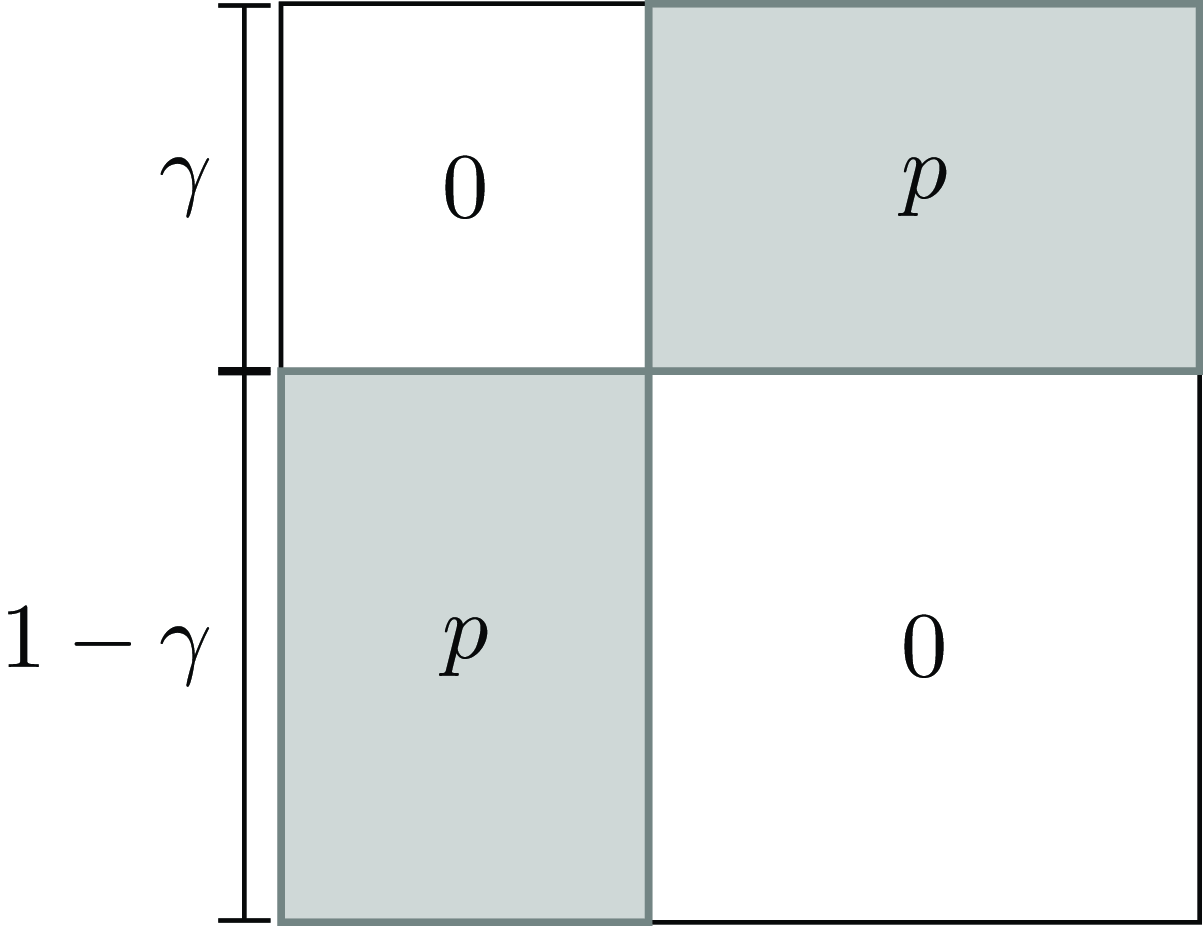
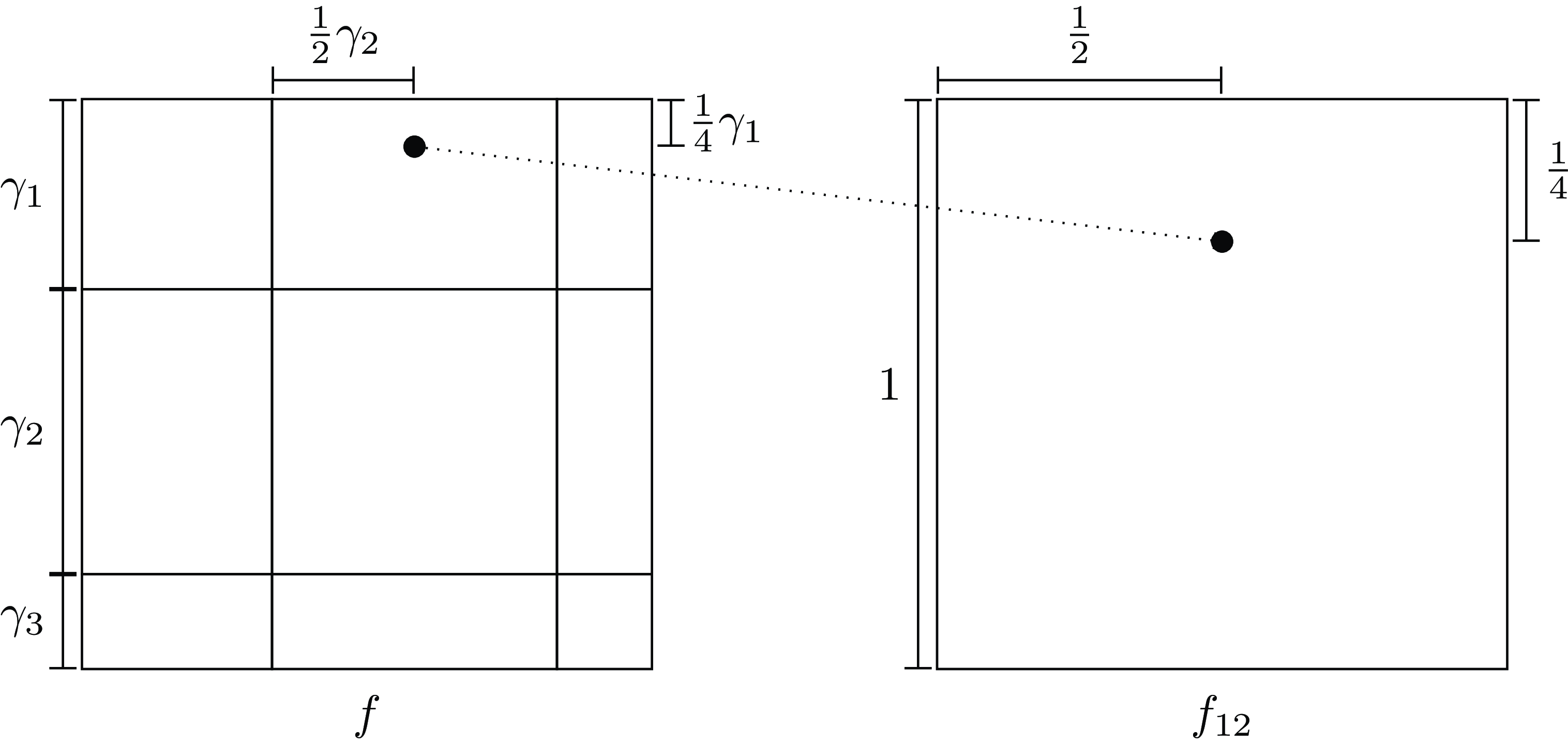
Next, we establish the existence of a non-symmetric regime in some specific families of two-block graphons. Let
 \begin{align*} f_{p,q,r}^{\gamma }(x,y) &= \begin{cases} p & \text{if } (x,y) \in [0,\gamma ]^2\\[5pt] r &\text{if } (x,y) \in (\gamma , 1]^2\\[5pt] q & \text{otherwise.} \end{cases} \end{align*}
Illustration of the graphon
 $f_{p,q,r}^{\gamma }$
.

We show the existence of a non-symmetric regime for base graphons of the form
 $f_{0,p,p}^\gamma ,f_{1,p,p}^\gamma , f_{1,p,0}^\gamma$
when
 $p$
is sufficiently small. The first model corresponds to an Erdős–Rényi random graph with a planted independent set, while the second example covers Erdős–Rényi graphs with a planted clique. Finally, the third graphon leads to a bipartite Erdős–Rényi random graph with a planted clique in one of the partitions.
Theorem 23. Let
 $\gamma \in (0,1) \cap \mathbb{Q}$
and
 $H$
be a
 $d$
-regular graph. Assume that
-
1.
$0 \lt t\lt t(H, f^\gamma _{0,0,1})$
and denote
$W_p=f_{0,p,p}^\gamma$
, or -
2.
$t(H, f^\gamma _{1,0,0}) \lt t\lt 1$
and denote
$W_p=f_{1,p,p}^\gamma$
, or -
3.
$t(H,f^\gamma _{1,0,0}) \lt t\lt t(H, f^\gamma _{1,1,0})$
and denote
$W_p=f_{1,p,0}^\gamma$
.


Separately, under each of these assumptions, there exists
 $p_0 \gt 0$
such that if
 $p \lt p_0$
,
 \begin{equation*}\min \{ J_{W_p}(\tilde {g}) \;:\; t(H,\tilde {g}) \geq t\}\lt \min \{ J_{W_p}(\tilde {g}) \;:\; \tilde {g} \in \tilde {\mathcal{B}}^{\left (\gamma , 1-\gamma \right )}, t(H,\tilde {g}) \geq t\}.\end{equation*}
These statements imply that for
 $p$
small enough, the minimiser of the variational problem (6) is non-symmetric.
In Proposition 43, we show that
 $\{\tilde {g} \in \tilde {\mathcal{B}}^{\left (\gamma , 1-\gamma \right )}\;:\; t(H,\tilde {g}) \geq t\}$
is compact, which justifies the minimum on the right hand side in Theorem 23. Note that in the second and third case, we cover all
 $t\in (t_{\min },t_{\max })$
, where
 $t_{\min },t_{\max }$
are the minimal and maximal values of
 $t(H, W_p)$
ranging over
 $p \in (0,1)$
. On the other hand, in the first case, we do not consider the full range, since we exclude
 $t \in [t(H, f^\gamma _{0,0,1}), t(H, f^\gamma _{0,1,1}))$
.
To establish this result, we recall that
 $I_{W_0}$
is significantly more tractable than the rate function
 $J_{W_0}$
. Our first step (see Lemma 85) is to show that if
 $W_0$
is a graphon of the form
 $f_{0,p,p}^{\gamma }$
or
 $f_{1,p,p}^{\gamma }$
, then
 \begin{align} \min \{ J_{W_0}(\tilde {f})\;:\; \tilde {f} \in \tilde {\mathcal{B}}^{(\gamma ,1-\gamma )},\, \tau (f) \geq t\}= \min \{ I_{W_0}(f)\;:\; f \in \mathcal{B}^{(\gamma ,1-\gamma )} \cup \mathcal{B}^{(1-\gamma , \gamma )}, \, \tau (f) \geq t\}. \end{align}
A similar simplification occurs for
 $W_0$
of the form
 $f_{z_1,p,z_2}^\gamma$
, where
 $z_1, z_2 \in \{0,1\}$
.
Next we show that for graphons
 $W_p$
of the form
 $W_p=f_{0,p,p}^\gamma$
and
 $W_p=f_{1,p,p}^\gamma$
, there exists
 $p_0 \gt 0$
such that if
 $p \lt p_0$
,
 \begin{align} \inf \{I_{W_p}(f)\;:\; t(H,f) \geq t\} \lt \min \{ I_{W_p}(f)\;:\; f \in \mathcal{B}^{(\gamma ,1-\gamma )} \cup \mathcal{B}^{(1-\gamma , \gamma )}, \, t(H,f) \geq t\} \end{align}
for some range of
 $t$
(Lemma 86). We establish this by constructing explicit graphons with lower entropy than that of all graphons in
 $\mathcal{B}^{(\gamma ,1-\gamma )} \cup \mathcal{B}^{(1-\gamma , \gamma )}$
. A similar simplification occurs for
 $W_p=f_{1,p,0}^\gamma$
. Together with (7) and (8), (9) implies the desired conclusion.
Illustration of the graphon
 $f_p^{\gamma }$
.

1.6 Bipartite Erdős–Rényi graphs: symmetry vs. symmetry breaking
Lubetzky and Zhao [Reference Lubetzky and Zhao34] characterise the symmetric regimes for
 $d$
-regular subgraph counts and the largest eigenvalue in the Erdős–Rényi model. We extend these results to bipartite Erdős–Rényi random graphs. Let
 $f_p^{\gamma }$
denote the graphon
 $f_{0,p,0}^\gamma$
, i.e.,
 \begin{align*} f_p^{\gamma }(x,y) &= \begin{cases} 0 & (x,y) \in [0,\gamma ]^2 \cup (\gamma , 1]^2\\[5pt] p & \text{otherwise}. \end{cases} \end{align*}
For
 $W_0$
of the form
 $f_p^\gamma$
, the following theorem completely characterises the symmetric and non-symmetric regimes for
 $t(H, \cdot )$
, where
 $H$
is a regular graph.
Theorem 24. Fix
 $0 \lt p \lt 1$
,
 $\gamma \in (0,1) \cap \mathbb{Q}$
, and
 $H$
a
 $d$
-regular graph with
 $d\geq 1$
. Let
 $W_0 = f_p^\gamma$
. Let
 $r \in [p,1]$
and define
 $t_r^\gamma =t(H, f_r^\gamma )$
.
-
1. If
$(r^d, h_p(r))$
lies on the convex minorant of
$x \mapsto h_p(x^{1/d})$
, then
$t_r^\gamma$
is in the symmetric regime for
$W_0$
and
$t(H, \cdot )$
. Moreover,
$\tilde {f}_r^\gamma$
is the unique symmetric solution. -
2. If
$(r^d, h_p(r))$
does not lie on the convex minorant of
$x \mapsto h_p(x^{1/d})$
, then
$t_r^\gamma$
is not in the symmetric regime of
$W_0$
and
$t(H, \cdot )$
.


Remark 25. The symmetric regime for subgraph counts in Erdős–Rényi graphs [Reference Lubetzky and Zhao34] takes a similar form, with
 $t_r^{\gamma }$
replaced by
 $t(H, r)$
, where
 $r$
denotes the constant graphon with value
 $r$
.
Finally, we characterise the symmetric regime for the largest eigenvalue. Similar to Erdős–Rényi graphs, the boundary for the symmetric regime for the largest eigenvalue coincides with that of the density of two-regular graphs.
Definition 26. For a graphon
 $f \in \mathcal{W}$
, define the Hilbert–Schmidt kernel operator
 $T_f$
on
 $L^2([0,1])$
by
 \begin{equation*}(T_f u)(x) = \int _0^1 f(x,y) u(y) dy \end{equation*}
for any
 $u \in L^2([0,1])$
. The operator norm is given by
 $${\left\| f \right\|_{op}} = \min \{ c \ge 0\;:{\left\| {\;{T_f}u} \right\|_2} \le c{\left\| u \right\|_2}{\rm{for}}\,{\rm{all}}\,u \in {L^2}([0,1])\} .$$
Lemma 27 ([Reference Lubetzky and Zhao34], Lemma 3.6). The function
 ${\left\| \cdot \right\|_{op}}$
is a continuous extension of the normalised graph spectral norm, i.e.,
 $\lambda _1(G)/n$
for a graph
 $G$
on
 $n$
vertices, to
 $({\widetilde {\mathcal W}}, \delta )$
. Moreover,
 ${\left\| \cdot \right\|_{op}}$
is a continuous graph parameter.
Theorem 28. Fix
 $0 \lt p \lt 1$
,
 $\gamma \in (0,1) \cap \mathbb{Q}$
, and let
 $W_0 = f_p^\gamma$
. Let
 $r \in [p,1]$
and define
 $t_r^\gamma = {\left\| {f_r^\gamma } \right\|_{op}}$
.
-
1. If
$(r^2, h_p(r))$
lies on the convex minorant of
$x \mapsto h_p(x^{1/2})$
, then
$t_r^\gamma$
is in the symmetric regime for
$W_0$
and
${\left\| \cdot \right\|_{op}}$
. Moreover,
$\tilde {f}_r^\gamma$
is the unique symmetric solution. -
2. If
$(r^2, h_p(r))$
does not lie on the convex minorant of
$x \mapsto h_p(x^{1/2})$
, then
$t_r^\gamma$
is not in the symmetric regime for
$W_0$
and
${\left\| \cdot \right\|_{op}}$
.


Remark 29. It is not hard to see that for
 $\tau =t(H,\cdot )$
and
 $\tau =\|\cdot \|_{\text{op}}$
, the function
 $r\mapsto \tau (f_r^\gamma )$
is a continuous and non-decreasing function on
 $ [p,1]$
and that
 $ \tau (f_1^\gamma ) =t^{\tau }_{\max }({\widetilde {\mathcal W}}_{\Omega })$
. Thus Theorems 24 and 28 cover the full range
 $[\tau (W_0),t_{\max }]$
.
To establish Theorems 24 and 28, we follow the general approach introduced in [Reference Lubetzky and Zhao34]. Lemma 85 implies that (8) holds for
 $\tau (g) = t(H, g)$
where
 $H$
is a
 $d$
-regular graph or
 $\tau (g) = \Vert g \Vert _{\text{op}}$
, meaning that we can again reason about symmetry through the function
 $I_{W_0}$
rather than
 $J_{W_0}$
. For
 $r \in (0,1]$
, let
 $f_r^{\gamma }$
be the bipartite graphon with value
 $r$
, and
 $t_r^{\gamma } = t(H, f_r^{\gamma })$
be the corresponding homomorphism density of a
 $d$
-regular graph
 $H$
. We apply a generalised Hölder inequality to show that whenever
 $f \in \mathcal{W}_{\Omega }$
satisfies
 $t(H,f) \geq t(H, f_r^{\gamma })$
, it holds that
 $\Vert f \Vert _d^d \geq 2 \gamma (1-\gamma ) r^d$
(Lemma 93). Finally, we show that if
 $(r^d, h_p(r))$
lies on the convex minorant of
 $x \mapsto h_p(x^{1/d})$
and
 $\Vert f \Vert _d^d \geq 2 \gamma (1-\gamma ) r^d,$
then
 $I_{W_0}(f) \geq I_{W_0}(f_r^\gamma )$
, with equality occurring if and only if
 $f = f_r^\gamma$
(Lemma 92). To establish the non-symmetric regime, we show that whenever
 $(r^d, h_p(r))$
is not on the convex minorant, we can construct a graphon
 $g$
with
 $t(H,g) \gt t(H,f_r^\gamma )$
and
 $I_{W_0}(g) \lt I_{W_0}(f_r^\gamma )$
(Lemma 91). This construction is more complicated than the one in [Reference Lubetzky and Zhao34], due to the bipartite nature of the underlying graph (see Figure
8 for the construction). The proof for the spectral norm
 $\tau (g) = \Vert g \Vert _{\text{op}}$
follows using similar arguments.
1.7 History and related work
The upper tail large deviation problem for subgraphs of
 $G(n,p)$
has attracted considerable attention in Probability and Combinatorics. By applying the theory of graph limits, Chatterjee and Varadhan found the precise constant in the large deviation probability in the dense case [Reference Chatterjee and Varadhan14]. This approach does not work in the sparse regime where
 $p\to 0$
, as graphon theory only applies to dense graphs.
The challenge of deriving an LDP for sparse graphs has attracted considerable attention in recent years. In the sparse regime, even determining the right order of this probability on the exponential scale proved to be considerably challenging. Following partial advances [Reference Janson, Oleszkiewicz and Ruciński27–Reference Kim and Van30, Reference Van37], this was finally resolved for
 $H=K_3$
in [Reference Chatterjee10, Reference DeMarco and Kahn16]. Subsequently, [Reference DeMarco and Kahn17] identified the right order of this probability for
 $H= K_r$
,
 $r\geq 4$
, and formulated a conjecture regarding the correct order for general subgraphs. See [Reference Šileikis and Warnke36] for a recent counterexample to this general conjecture. Recently, the development of general theory [Reference Austin2, Reference Chatterjee and Dembo12, Reference Eldan22] and problem-specific ideas [Reference Augeri1, Reference Basak and Basu3, Reference Cook and Dembo15, Reference Harel, Mousset and Samotij25] have contributed to rapid progress on large deviations in the sparse setting. These results relate the large deviation probability to an entropic variational problem. In turn, some of these variational problems have also been solved [Reference Bhattacharya and Ganguly4–Reference Bhattacharya, Ganguly, Shao and Zhao6], leading to deep insights regarding the structure of the random graph, conditioned on the rare event.
We emphasise that these remarkable results are mostly applicable for sparse random graphs or hypergraphs [Reference Liu and Zhao31], and do not shed any direct insight on the problem considered in this paper. Instead, our work is the first step towards a full generalisation of the work of [Reference Chatterjee and Varadhan14] and [Reference Lubetzky and Zhao34] to block models. As [Reference Chatterjee and Varadhan14] did for Erdős–Rényi graphs, we establish an LDP for block models and demonstrate the existence of a reentrant phase transition for the upper tail of
 $d$
-regular subgraph counts. While we exhibit a reentrant phase transition for a limited class of block models, we show the existence of a symmetric regime for arbitrary block models. Our methods are inspired by the work of [Reference Lubetzky and Zhao34], which completely characterises the symmetric and non-symmetric regimes for Erdős–Rényi graphs. Moreover, analogous to [Reference Lubetzky and Zhao34], we fully characterise the symmetric and non-symmetric regimes for bipartite Erdős–Rényi graphs. As discussed in the introduction, our work fits into the broader theme of large deviations for dense random graphs with inhomogeneities or constraints, and provides the first rigorous analysis of the large deviations problem for dense block models.
Following the posting of this paper to arXiv, there has been some follow-up work. Grebik and Pikhurko [Reference Grebík and Pikhurko24] simplified our function given by Definition 10 showing that taking the lower-semicontinuous regularisation is not necessary. Building on our work, Grebik and Pikhurko [Reference Grebík and Pikhurko24] derived an LDP for graphs sampled from step graphons whose blocks are not necessarily of rational length. Markering [Reference Markering35] derived a large deviation principle for inhomogeneous Erdős–Rényi random graphs, showing that the rate function takes a simple form under certain integrability assumptions.
Outline: The rest of the paper is structured as follows. We establish our main LDP results, Theorem 11 and Theorem 16, in Section 2. In Section 3, we derive some analytic properties of
 $\phi _{\tau }$
which are crucial in the analysis of the variational problem. Section 4 establishes the existence of a symmetric regime in the upper tail, while Section 5 establishes the existence of a non-symmetric regime in specific examples. Finally, we characterise the symmetric regime in Erdős–Rényi bipartite models in Section 6. We finish with some open problems in Section 7.
2. Large deviation principle
In this section we establish the LDP. Since the space
 $({\widetilde {\mathcal W}},\delta _\square )$
is compact, it will be enough to prove the bounds in Theorem 11 for balls in the metric
 $\delta _\square$
; the precise statement is given in the following lemma.
Lemma 30. Since the space
 $({\widetilde {\mathcal W}},\delta _\square )$
is compact, the bounds in Theorem 11 are equivalent to
-
1. For all
$\varepsilon \gt 0$
and
$\tilde {h} \in {\widetilde {\mathcal W}}$
,
$ \liminf _{n \to \infty }\frac {1}{(kn)^2} \log \tilde {\mathbb{P}}_{kn, W_0}\left (S (\tilde {h}, \varepsilon )\right ) \geq - J_{W_0}(\tilde {h})$
; -
2. For all
$\tilde {g} \in {\widetilde {\mathcal W}}$
,
$ \lim _{\alpha \to 0} \limsup _{n \to \infty } \frac {1}{(kn)^2} \log \tilde {\mathbb{P}}_{kn,W_0}\left (S(\tilde {g}, \alpha )\right ) \leq -J_{W_0}(\tilde g).$


The proof is standard (see e.g., [Reference Dembo and Zeitouni19, Theorems 4.1.11, 4.1.18]), and is thus omitted.
In Section 2.1, we begin by establishing several useful facts about the rate function and the space
 $\mathcal{W}_\Omega$
. We establish the LDP lower and upper bounds in Sections 2.2 and 2.3 respectively. Finally, in Section 2.4, we prove Theorem 16, which establishes upper tail large deviations for continuous graph parameters.
2.1 Preliminaries
In this section, we establish a variety of useful analytical properties. Of particular interest are Lemma 31 and Lemma 32, which state that
 ${\widetilde {\mathcal W}}_\Omega$
is closed and that
 $J_{W_0}$
is lower semi-continuous on
 $({\widetilde {\mathcal W}}, \delta _\square )$
.
Lemma 31. For any
 $m \in \mathbb{Z}^+$
,
 $\gamma \in \Delta _m$
, and
 $W_0\in \mathcal{B}^\gamma$
, the set
 ${\widetilde {\mathcal W}}_\Omega$
is closed in
 $\widetilde {\mathcal W}$
with respect to the cut metric topology
 $({\widetilde {\mathcal W}}, \delta _\square )$
.
Lemma 32. For any
 $m \in \mathbb{Z}^+$
,
 $\gamma \in \Delta _m$
, and
 $W_0\in \mathcal{B}^\gamma$
, the function
 $J_{W_0}(\cdot )$
is lower semi-continuous on
 $({\widetilde {\mathcal W}}, \delta _{\square })$
.
We start by stating some elementary properties of the relative entropy
 $h_p(\cdot )$
.
Lemma 33. Let
 $\beta \in (0,1/2]$
and let
 $G_p(a,q)=aq-\log (pe^a+1-p)$
. Then the following holds
-
(i) For all
$p\in [\beta ,1-\beta ]$
,
$\|h_p\|_\infty \leq \log (2/\beta )$
. -
(ii) The family of functions
$(h_p)_{p\in [\beta ,1-\beta ]}$
is equicontinuous on
$[0,1]$
. -
(iii) For all
$p\notin \{0,1\}$
,
$h_p(q)=\sup _{a\in \mathbb{R} }G_p(a,q)$
-
(iv) For
$q\notin \{0,1\}$
, the
$\sup$
in (iii) is achieved by
$a=\log \left (\frac q{1-q}\frac {1-p}p\right )$
.


Proof. (i) Follows by observing that
 $|x\log x+(1-x)\log (1-x)|\leq \log 2$
and
 $|x\log p|+|(1-x)\log p|\leq x| \log \beta |+(1-x)|\log \beta |=-\log \beta$
.
(ii) Follows from uniform continuity of the function
 $x\mapsto x\log x+(1-x)\log (1-x)$
.
(iii) and (iv) are elementary exercises left to the reader.
The function
 $I_{W_0}$
also comes up naturally in [Reference Dhara and Sen20] – however, in [Reference Dhara and Sen20] it is assumed that the base graphon
 $W_0$
is bounded away from zero and one, and thus the function
 $I_{W_0}$
is necessarily finite. This is not the case in our context. We use
 $Im(W_0)$
to denote the image of
 $W_0$
in
 $[0,1]$
.
Proposition 34. Let
 $W_0 \in \mathcal{W}$
. If
 $f \not \in \mathcal{W}_\Omega$
, then
 $I_{W_0}(f)=\infty$
. If
 $f \in \mathcal{W}_\Omega$
and
 $W_0$
obeys the assumption
 \begin{equation} \beta = \inf \{w\gt 0\;:\; w \in Im(W_0) \text{ or } 1-w \in Im(W_0)\}\gt 0, \end{equation}
then
 $I_{W_0}(f) \leq \frac 12 \log (2/\beta )$
.
Proof. Since
 $h_0(x) =\infty$
for
 $x \not =0$
and
 $h_1(x)=\infty$
for
 $x \not =1$
, it follows that
 $I_{W_0}(f)=\infty$
when
 $f \not \in \mathcal{W}_\Omega$
. To bound
 $I_{W_0}(f)$
for
 $f\in \mathcal{W}_\Omega$
, observe that
 \begin{equation} I_{W_0}(f) = \frac {1}{2}\int _{\Omega } h_{W_0(x,y)} \left (f(x,y)\right ) dx dy, \end{equation}
since
 $f$
and
 $W_0$
agree on
 $ \Omega ^c$
. The proof is completed by invoking Lemma 33 (i).
Proposition 35. Let
 $\varepsilon \gt 0$
and assume that
 $W_0\in \mathcal{W}$
obeys the condition (10). Then there exists
 $\eta \gt 0$
such that if
 $f, g \in \mathcal{W}_\Omega$
and
 $\Vert f-g \Vert _\infty \leq \eta$
, then
 $|I_{W_0}(f)- I_{W_0}(g)| \leq \varepsilon$
.
Proof. Fix
 $\varepsilon \gt 0$
. By Lemma 33 (ii) there exists an
 $\eta \gt 0$
such that
 $|h_p(u)- h_p(v)| \leq \varepsilon$
whenever
 $|u-v| \leq \eta$
and
 $p\in [\beta ,1-\beta ]$
. Inserted into (11), this completes the proof.
We derive a variational representation for
 $I_{W_0}$
using convex duality.
Proposition 36. Let
 $W_0 \in \mathcal{W}$
and let
 $S$
be the set of all symmetric functions in
 $ L_2([0,1]^2)$
. For
 $a\in S$
and
 $f\in \mathcal{W}$
, define
 \begin{align} K_{W_0}(f,a) &= \int _{[0,1]^2} \left [a(x,y) f(x,y) - \log \Big (W_0(x,y) e^{a(x,y)} + 1-W_0(x,y)\Big ) \right ]dx dy . \end{align}
Then
 $ I_{W_0}(f)=\frac 12 \sup _{a\in S} K_{W_0}(f,a)$
.
Proof. First, we consider the case
 $f \not \in \mathcal{W}_\Omega$
(in which case
 $ I_{W_0}(f)=\infty$
by Proposition 34). Then there exists
 $\Gamma \subseteq [0,1]^2$
with positive measure such that
 $W_0(x,y)\in \{0,1\}$
and
 $W_0(x,y) \not = f(x,y)$
for
 $(x,y) \in \Gamma$
. Choosing
 \begin{equation*} a_M(x,y)= \begin{cases} 0 & (x,y) \not \in \Gamma \\[5pt] M & W_0(x,y)= 0\\[5pt] -M & W_0(x,y)= 1. \end{cases} \end{equation*}
and taking
 $M \to \infty$
, we see that
 $\sup _{a\in S} K_{W_0}(f,a)=\infty$
in this case.
Next we consider the case
 $f \in \mathcal{W}_\Omega$
. Recalling the definition of
 $G_p$
from Lemma 33 and noting that the integrand in (12) is zero if
 $W_0(x,y)=f(x,y) \in \{0,1\}$
, we then have
 $K_{W_0}(f,a)=\int _\Omega G_{W_0(x,y)}(a(x,y),f(x,y))dxdy$
. Combined with (11) and Lemma 33 (iii), this shows that
 \begin{equation*} I_{W_0}(f)=\frac 12 \int _\Omega h_{W_0(x,y)}(f(x,y))dxdy\geq \frac 12 \sup _{a\in S}\int _\Omega G_{W_0(x,y)}(a(x,y),f(x,y))dxdy =\frac 12 \sup _{a\in S} K_{W_0}(f,a). \end{equation*}
To prove equality, we may w.l.o.g. assume that the right hand side is finite. We may further restrict the integrals on both sides to the subset
 $\tilde \Omega \subset \Omega$
where
 $f(x,y)\not \in \{0,1\}$
, since the contributions of both sides to the complement can easily be seen to be equal. Finally, on
 $\tilde \Omega$
, we may use Lemma 33 (iv) to conclude that
 \begin{equation*} \int _{\tilde \Omega } h_{W_0(x,y)}(f(x,y))dxdy=\int _{\tilde \Omega } G_{W_0(x,y)}(a_0(x,y),f(x,y))dxdy \end{equation*}
where
 $a_0(x,y)=\log \left (\frac {f(x,y)}{1-f(x,y)}\frac {1-W_0(x,y)}{W_0(x,y)}\right )$
. If
 $a_0\in L^2(\tilde \Omega )$
, the right hand side is bounded by the
 $\sup$
over all
 $a\in S$
, giving the desired upper bound. If it is not, we replace
 $\tilde \Omega$
on both sides by its intersection with the set of points for which
 $|a_0(x,y)|\leq M$
before bounding the right hand side by a
 $\sup$
over all square integrable
 $a$
. The proof is concluded by using the monotone convergence theorem.
The following propositions will be used to establish the lower semi-continuity of
 $I_{W_0}$
.
Proposition 37. Let
 $m \in \mathbb{Z}^+$
and
 $\gamma \in \Delta _m$
. For
 $W_0\in \mathcal{B}^\gamma$
, the set
 $\mathcal{W}_\Omega$
is a closed subset of
 $\mathcal{W}$
with respect to the topology
 $(\mathcal{W},d_\square )$
.
Proof. Let
 $\{f_n\;:\; n \geq 1\} \subseteq \mathcal{W}_\Omega$
be a convergent sequence of graphons satisfying
 $d_\square (f_n, f) \to 0$
for some
 $f \in \mathcal{W}$
. Then on each block
 $I \times J$
of
 $W_0$
that takes value
 $0$
or
 $1$
,
 $f_n= W_0$
for all
 $n \geq 1$
. Since
 $|\int _{I \times J} f_n - f | \leq d_\square (f_n, f)$
and
 $d_\square (f_n, f) \to 0$
, it follows that
 $f= W_0$
on
 $I \times J$
. Thus
 $f \in \mathcal{W}_\Omega$
.
Proposition 38. Let
 $(S,d)$
be either
 $(\mathcal{W}, d_\square )$
or
 $(\tilde {\mathcal{W}}, \delta _\square )$
, and let
 $F \subseteq S$
be a closed subset of
 $S$
. Let
 $f\;:\; F \to \mathbb{R}$
be a lower semi-continuous function on
 $(F, d)$
. The extension
 $f^*\;:\; S \to \mathbb{R} \cup \{ \infty \}$
where
 \begin{equation*}f^*(x)= \begin{cases} f(x) & x \in F\\[5pt] \infty & x \in S \setminus F\end{cases}\end{equation*}
is lower semi-continuous on
 $(S, d)$
.
Proof. We show that
 $f^*$
is lower semi-continuous on
 $S$
by demonstrating that for all
 $\alpha \in \mathbb{R}$
, the set
 $\{x \in S |f^{*}(x) \gt \alpha \}$
is open. Observe
 \begin{equation*} \{x \in S |f^{*}(x) \gt \alpha \}=\{x \in F | f(x) \gt \alpha \} \cup \left ( S \setminus F\right ).\end{equation*}
By lower semi-continuity of
 $f$
on
 $F$
,
 $A=\{x \in F | f(x) \gt \alpha \}$
is open in
 $F$
, and so
 $A^c$
is relatively closed with respect to
 $F$
and therefore closed in
 $S$
(since
 $F$
is closed). It follows that
 \begin{equation*}\{x \in S | f^*(x) \gt \alpha \}^c= F \cap A^c\end{equation*}
is closed, and so we conclude that
 $\{x \in S | f^*(x) \gt \alpha \}$
is open.
Lemma 39. Let
 $m \in \mathbb{Z}^+$
and
 $\gamma \in \Delta _m$
. For
 $W_0\in \mathcal{B}^\gamma$
, the function
 $I_{W_0}(\cdot )$
is lower semi-continuous on
 $(\mathcal{W}, d_{\square })$
.
Proof. First, note that by Propositions 37 and 38, and the observation that
 $I_{W_0}(f) =\infty$
for all
 $f \in \mathcal{W} \setminus \mathcal{W}_\Omega$
, it is enough to establish that
 $I_{W_0}$
is lower semi-continuous on
 $(\mathcal{W}_\Omega , d_\square )$
. Second, by Proposition 36,
 $I_{W_0}$
can be written as supremum over the functions
 $K_{W_0}(\cdot ,a)$
, so it will be enough to show that for all
 $a\in S$
, the function
 $K_{W_0}(\cdot ,a)$
is continuous on
 $(\mathcal{W}_\Omega , d_\square )$
.
Consider two functions
 $f,g\in \mathcal{W}_\Omega$
, and observe that every
 $a\in S$
can be approximated by step functions in
 $L^2$
. Given
 $\varepsilon$
and
 $a$
we can therefore find
 $k\lt \infty$
and a
 $k$
-step function
 $a_k$
such that
 $\|a-a_k\|_2\leq \frac \varepsilon 2$
. As a consequence
 \begin{align*} \Big |K_{W_0}(f,a)-K_{W_0}(g,a)\Big| &= \Big |\int a(f-g)\Big |\leq \|a(f-g)\|_1\leq \|a_k(f-g)\|_1+\frac \varepsilon 2 \leq \|a_k\|_\infty k^2 d_{\square }(f,g)\nonumber \\&\quad+ \frac \varepsilon 2. \end{align*}
This is smaller than
 $\varepsilon$
if
 $d_{\square }(f,g)\lt \varepsilon /( \|a_k\|_\infty k^2)$
, which proves that
 $K_{W_0}( \cdot , a)$
is continuous on
 $(\mathcal{W}_\Omega , d_\square )$
, as required.
The following proposition will be used to prove that for any continuous graph parameter
 $\tau$
and graphon
 $W_0$
, the function
 $\phi _{\tau }(W_0, \cdot )$
is strictly positive on
 $(\tau (W_0), t_{\max }]$
.
Proposition 40. For
 $m \in \mathbb{Z}^+$
,
 $\gamma \in \Delta _m$
,
 $W_0\in \mathcal{B}^{\gamma }$
, and
 $\tilde {f} \in {\widetilde {\mathcal W}}$
, it holds that
 \begin{equation*}J_{W_0}(\tilde {f})=0 \text{ if and only if } \delta _\square (\tilde f, W_0)=0.\end{equation*}
Proof. Noting that our definition of
 $J_{W_0}$
agrees with the definition of
 $J_{W_0}$
given in [Reference Dhara and Sen20] whenever
 $f \in \mathcal{W}_\Omega$
, and that
 $\delta _{\square }(f,W_0)\gt 0$
if
 $f \notin \mathcal{W}_\Omega$
, the proposition follows from the analogous statement in [Reference Dhara and Sen20, Lemma 2.2].
Our next result establishes that
 ${\widetilde {\mathcal W}}_\Omega$
is closed in the cut metric. For a partition
 $\mathcal{P}$
of
 $[0,1]$
, we define
 $W_{\mathcal{P}}$
as the step function graphon that is obtained by averaging over all blocks induced by the partition classes. Setting
 $\Gamma (x) \subseteq [0,1]$
to be the partition class in
 $\mathcal{P}$
that contains
 $x$
, we obtain
 \begin{equation*} W_{\mathcal{P}}(x,y)=\frac {1}{|\Gamma (x)|\cdot |\Gamma (y)|} \int _{\Gamma (x) \times \Gamma (y)} W(u,v) du dv.\end{equation*}
We call
 $\mathcal{P}$
an equipartition if all classes have the same measure, and use
 $|\mathcal P|$
to denote the number of classes in
 $\mathcal P$
. Note that up to sets of measure zero, there is just one equipartition of
 $[0,1]$
into
 $n$
intervals; for definiteness and consistency with our previous conventions, we use the partition
 $([0,1/n],(1/n,2/n],\ldots ,((n-1)/n,1])$
.
Lemma 41 (Corollary 3.4 of [Reference Borgs, Chayes, Lovász, Sós and Vesztergombi8]). Let
 $f \in \mathcal{W}$
and
 $s$
be a positive integer. For every equipartition
 $\mathcal{Q}$
of
 $[0,1]$
, there is an equipartition
 $\mathcal{P}$
with
 $s|\mathcal Q|$
classes such that
 $\mathcal{P}$
refines
 $\mathcal{Q}$
and
 \begin{equation*}d_\square ( f, f_{\mathcal{P}}) \leq \sqrt {\frac {20}{\log _2 s}}.\end{equation*}
The next lemma follows from Lemma 41.
Lemma 42. Let
 $m \in \mathbb{Z}^+$
,
 $\gamma \in \Delta _m$
, and
 $W_0\in \mathcal{B}^\gamma$
. Then there exists a sequence of refining partitions
 $\mathcal P_k$
of
 $[0,1]$
into equal length intervals such that for all
 $f\in \mathcal{W}_\Omega$
there exists a sequence of step functions
 $f_k\in \mathcal{W}_\Omega$
with steps in
 $\mathcal P_k$
such that (i)
 $(f_{k+1})_{\mathcal P_{k}}=f_{k}$
and (ii)
 $\delta _\square (f,f_k)\leq 1/k$
for all
 $k\geq 1$
.
Proof. Let
 $s_k$
be such that
 $\sqrt {{20}/{\log _2s_k}}\leq 1/k$
, let
 $q_1$
be such that the lengths of the intervals described by
 $\gamma$
are integer multiples of
 $1/q_1$
, define
 $q_k$
inductively by
 $q_k=s_kq_{k-1}$
, and let
 $\mathcal P_k$
be the partition of
 $[0,1]$
into intervals of lengths
 $1/q_k$
. We will define
 $f_k$
as
 $f_k=(g_k)_{\mathcal P_k}$
where
 $g_k\in \mathcal{W}_\Omega$
will be inductively defined in such a way that (a)
 $(g_{k})_{\mathcal P_{k-1}}=(g_{k-1})_{\mathcal P_{k-1}}$
for all
 $k\geq 2$
, (b)
 $\delta _\square (f,g_k)=0$
for all
 $k\geq 1$
and (c)
 $d_\square (g_{k},(g_{k})_{\mathcal P_k})\leq 1/k$
for all
 $k\geq 1$
. This clearly implies the statement of the lemma, since
 $g_k\in \mathcal{W}_\Omega$
implies
 $(g_k)_{\mathcal P_k}\in \mathcal{W}_\Omega$
by the fact that
 $\mathcal P_k$
is a refinement of
 $\mathcal P_1$
,
 \begin{equation*} (f_{k+1})_{\mathcal P_k}=((g_{k+1})_{\mathcal P_{k+1}})_{\mathcal P_k}=(g_{k+1})_{\mathcal P_k}=(g_k)_{\mathcal P_k}=f_k \end{equation*}
by (a) and the fact that
 $\mathcal P_{k+1}$
is a refinement of
 $\mathcal P_k$
, and the two statements (b) and (c) imply (ii).
We start our inductive construction by setting
 $g_1=f$
. Noting that
 $d_\square (h,h')\leq 1$
for all
 $h,h'\in \mathcal{W}$
, this shows that
 $g_1$
satisfies the inductive assumptions.
Let
 $k\geq 2$
and assume that
 $g_{k-1}$
satisfies the inductive assumption. By Lemma 41, we can find an equipartition
 $\mathcal Q_{k}$
of
 $[0,1]$
into
 $q_k=s_k|\mathcal P_{k-1}|$
classes such that
 $\mathcal Q_{k}$
refines
 $\mathcal P_{k-1}$
and
 $d_\square (g_{k-1},(g_{k-1})_{\mathcal Q_k})\leq 1/k$
. We now define a measure preserving bijection
 $\phi \;:\;[0,1]\to [0,1]$
as follows: Let
 $I$
be an interval in
 $\mathcal P_{k-1}$
, and let
 $Y_1,\ldots Y_{s_k}$
those elements of
 $\mathcal Q_k$
subdividing
 $I$
. By Theorem A.7 in [Reference Janson26], we can find a measure preserving bijection from
 $I$
to itself such that the image of
 $Y_1,\ldots Y_{s_k}$
are the
 $s_k$
intervals in
 $\mathcal P_k$
that subdivide
 $I$
. Doing this for all intervals in
 $\mathcal Q_k$
we obtain a measure preserving bijection
 $\phi$
such that the images of the partition classes of
 $\mathcal Q_k$
are the partition classes of
 $\mathcal P_k$
, and such that
 $\phi$
maps each interval in
 $\mathcal P_{k-1}$
onto itself. Applying this bijection to
 $g_{k-1}$
gives a graphon
 $g_k\in \mathcal{W}_\Omega$
such that
 $\delta _\square (g_k,g_{k-1})=0$
and
 $d_\square (g_{k},(g_{k})_{\mathcal P_k})=d_\square (g_{k-1},(g_{k-1})_{\mathcal Q_k})\leq 1/k$
. By the inductive assumption (b) we have that
 $\delta _\square (g_k,f)=0$
, and by the fact that
 $\phi$
maps each interval in
 $\mathcal P_{k-1}$
onto itself we have that
 $(g_k)_{\mathcal P_{k-1}}=(g_{k-1})_{\mathcal P_{k-1}}$
. This completes the inductive proof.
We show that
 ${\widetilde {\mathcal W}}_\Omega$
is closed, using ideas from the proof that
 $({\widetilde {\mathcal W}} , \delta _\square )$
is compact [Reference Lovász and Szegedy33, Theorem 5.1].
Proof of Lemma 31. We establish the lemma by showing that
 ${\widetilde {\mathcal W}}_\Omega$
contains its limit points. Let
 $(\widetilde {W}_n)_{n \geq 0}$
be a sequence of graphons in
 ${\widetilde {\mathcal W}}_\Omega$
that converges to
 $\widetilde {W}\in {\widetilde {\mathcal W}}$
. Since
 $\widetilde {W}_n \in {\widetilde {\mathcal W}}_\Omega$
, we may chose a sequence
 $W_n \in \mathcal{W}_\Omega$
such that
 $\delta _\square (W_n,\widetilde W)\to 0$
. We claim that
 $\widetilde {W} \in {\widetilde {\mathcal W}}_\Omega$
.
By Lemma 42, we can find a sequence of refining partitions
 $\mathcal P_k$
of
 $[0,1]$
into intervals of length
 $1/|\mathcal P_k|$
and sequences
 $W_{n,k}\in \mathcal{W}_\Omega$
such that
-
1.
$\delta _\square ( W_n, W_{n,k}) \leq 1/k$
-
2.
$(W_{n,k+1})_{\mathcal P_k}=W_{n,k}$
.


Next we claim that it is possible to replace
 $(W_n)$
with a subsequence such that for all
 $k$
,
 $W_{n,k}$
converges almost everywhere to a step function
 $U_k$
with steps made out of the intervals in
 $\mathcal P_k$
. Indeed, select a subsequence of
 $(W_n)$
such that the value of
 $W_{n,1}$
converges on the product of all intervals
 $I,I'\in \mathcal P_1$
. We obtain
 $W_{n,1} \to U_1$
almost everywhere for
 $U_1$
a step function on
 $s_1$
intervals of
 $[0,1]$
. Taking further subsequences for
 $k=2,3 \ldots$
, we obtain a subsequence of
 $(W_n)$
such that
 $W_{n,k} \to U_k$
almost everywhere for all
 $k$
. By the Dominated Convergence Theorem,
 $\Vert W_{n,k}- U_k \Vert _1 \to 0$
, and so
 $d_\square ( W_{n,k}, U_k) \to 0$
. Each
 $U_k$
is a step function on
 $s_k$
intervals of
 $[0,1]$
. Note that since
 $W_{n,k} \in \mathcal{W}_\Omega$
and
 $d_\square (W_{n,k}, U_k) \to 0$
, Proposition 37 implies that
 $U_k \in \mathcal{W}_\Omega$
. For the remainder of this proof, we replace
 $(W_n)$
with this subsequence; doing so does not change the limit of the corresponding sequence in
 $\widetilde {\mathcal W}$
.
Next we claim that the sequence
 $(U_k)_{k\geq 1}$
has a limit
 $U$
in
 $\mathcal{W}_\Omega$
. It follows from (ii) that
 $U_k=(U_\ell )_{\mathcal{P}_k}$
for all
 $\ell \gt k$
. Let
 $(x,y)$
be a uniform random point in
 $[0,1]$
. Since
 $U_k=(U_\ell )_{\mathcal{P}_k}$
, the sequence
 $(U_1(x,y), U_2(x,y), \ldots )$
is a martingale with respect to the canonical filtration. The random variables
 $U_i(x,y)$
are bounded, and so the Martingale Convergence Theorem [Reference Durrett21, Theorem 4.2.11] implies that the sequence
 $(U_1(x,y), U_2(x,y), \ldots )$
converges with probability one. Thus there exists
 $U \in \mathcal{W}$
such that
 $U_k \to U$
almost everywhere. By the Dominated Convergence Theorem,
 $\Vert U_k -U \Vert _1 \to 0$
and therefore
 $d_\square (U, U_k) \to 0$
. Since
 $U_k \in \mathcal{W}_\Omega$
for all
 $k$
, and
 $\mathcal{W}_\Omega$
is closed, it follows that
 $U \in \mathcal{W}_\Omega$
. Moreover
 $\tilde {U} \in {\widetilde {\mathcal W}}_\Omega$
.
It remains to show that
 $\delta _\square (W_n,U) \to 0$
(as this implies that
 $\delta _\square ( {\widetilde {W}}_n, \widetilde {U}) \to 0$
, which establishes that the limit of the sequence is in
 ${\widetilde {\mathcal W}}_\Omega$
). Let
 $\varepsilon \gt 0$
. Choose
 $k \gt 3/\varepsilon$
sufficiently large such that
 $\Vert U - U_k \Vert _1 \lt \varepsilon /3$
. For this fixed
 $k$
, there exists
 $n_0$
such that
 $\Vert U_k - W_{n,k} \Vert _1 \lt \varepsilon /3$
for all
 $n \geq n_0$
. Observe that
 \begin{align*} \delta _\square (U, W_n) &\leq d_\square (U, U_k) + d_\square (U_k, W_{n,k}) + \delta _\square (W_{n,k}, W_n)\\[5pt] &\leq \Vert U- U_k\Vert _1 + \Vert U_k- W_{n,k}\Vert _1 + \delta _\square (W_{n,k}, W_n) \leq \varepsilon . \end{align*}
Proof of Lemma 32. We modify the proof of [Reference Dhara and Sen20, Lemma 2.1] to allow for
 $W_0$
with values in
 $\{0,1\}$
. For
 $\tilde {f} \in {\widetilde {\mathcal W}}$
, let
 \begin{equation*} H(\tilde {f}) = \inf _{g \in \mathcal{W} \;:\; \delta _\square (g, \tilde {f}) =0} I_{W_0}(g). \end{equation*}
If
 $\tilde f\notin {\widetilde {\mathcal W}}_\Omega$
, then
 $g\notin \mathcal{W}_\Omega$
for all
 $g$
contributing to the infimum and by Proposition 34,
 $H ( \tilde {f})= \infty$
. On the other hand, if
 $\tilde f\in {\widetilde {\mathcal W}}_\Omega$
, there exists a
 $g\in \mathcal{W}_\Omega$
contributing to the infimum, so with the help of Proposition 34 we conclude that
 $H(\cdot )$
is bounded on
 ${\widetilde {\mathcal W}}_\Omega$
. Combined with the fact that
 \begin{equation*} h\in B(\tilde {f}, \delta )\iff \delta _\square (\tilde {g},h)=0 \text{ for some } \tilde {g} \in S(\tilde {f}, \delta ), \end{equation*}
we obtain that for
 $\tilde {f} \in {\widetilde {\mathcal W}}_\Omega$
 \begin{align*} J_{W_0}(\tilde {f}) = \sup _{\delta \gt 0} \inf _{ h \in B( \tilde {f}, \delta )} I_{W_0}(h) = \sup _{\delta \gt 0} \inf _{ \tilde {g} \in S(\tilde {f}, \delta )} H(\tilde {g}) = \sup _{\delta \gt 0} \inf _{ \tilde {h} \in S( \tilde {f}, \delta ) \cap {\widetilde {\mathcal W}}_\Omega } H(\tilde {h}) = \liminf _{\tilde {h} \to \tilde {f}} H(\tilde {h}). \end{align*}
Therefore,
 $J_{W_0}(\cdot )$
is the pointwise
 $\liminf$
of a bounded function. This implies that
 $J_{W_0}(\cdot )$
is lower semi-continuous on
 ${\widetilde {\mathcal W}}_\Omega$
.
Note that
 $J_{W_0}(f)=\infty$
for all
 $f \in {\widetilde {\mathcal W}} \setminus {\widetilde {\mathcal W}}_\Omega$
. Therefore the lower semi-continuity of
 $J_{W_0}(\cdot )$
on
 $\widetilde {\mathcal W}$
follows by Proposition 38 and Lemma 31.
We close this preliminary section with a proposition and a lemma which will be used in the proofs of Theorems 19, 20 and 23.
Proposition 43. Let
 $m \in \mathbb{Z}^+$
and
 $\gamma \in \Delta _m$
. Let
 $\tau$
be a continuous graph parameter. Then the following holds:
-
(i) The set
$\{\tilde {g} \in \tilde {\mathcal{B}}^\gamma \;:\; \tau (\tilde g) \geq t\}$
is a compact set in
$({\widetilde {\mathcal W}}, \delta _\square )$
. -
(ii) The set
$\{{g} \in {\mathcal{B}}^\gamma \;:\; \tau ( g) \geq t\}$
is a closed set in
$(\mathcal{W}, d_\square )$
.


Proof. Since
 $\widetilde {\mathcal W}$
is compact, it suffices to show that
 $\{\tilde {g} \in \tilde {\mathcal{B}}^\gamma \;:\; \tau (\tilde g) \geq t\}$
is closed. Let
 $\tilde {f}_n \in \tilde {\mathcal{B}}^\gamma$
be such that
 $\tau ( \tilde {f}_n) \geq t$
and
 $\tilde {f_n}$
converges to some graphon
 $\tilde {f}$
. Since
 $\tau$
is continuous,
 $\lim _{n \to \infty } \tau ( \tilde {f}_n) = \tau ( \tilde {f}) \geq t$
.
It remains to show that
 $\tilde {f} \in \tilde {\mathcal{B}}^\gamma$
. Without loss of generality, we may assume
 $f_n \in \mathcal{B}^\gamma$
, and write
 $f_n= (\alpha _{ij}^n)_{i,j \in [m]}$
, where each
 $\alpha _{ij}^n \in [0,1]$
. By the compactness of
 $[0,1]^{m^2}$
, there exists a subsequence such that
 \begin{equation*}\alpha _{ij}^{n_k} \to \beta _{ij} \text{ for all $i,j \in [m]$}.\end{equation*}
Let
 $g=(\beta _{ij})_{i,j \in [m]} \in \mathcal{B}^\gamma$
. Since
 $f_{n_k} \to g$
pointwise and
 $d_\square (f_{n_k}, g) \leq \Vert f_{n_k}-g\Vert _1$
, the Dominated Convergence Theorem implies that
 $d_\square (f_{n_k}, g) \to 0$
. Since
 $\delta _\square (\tilde {f}_n, \tilde {f}) \to 0$
, we have
 $\delta _\square (\tilde {g}, \tilde {f})=0$
and thus
 $\tilde {f} \in \tilde {\mathcal{B}}^\gamma$
.
The proof of the second statement is identical, except that it starts from a sequence
 ${f}_n \in {\mathcal{B}}^\gamma$
such that
 $\tau ({f}_n) \geq t$
and
 $f_n$
converges to some
 ${f}\in \mathcal{W}$
in the metric
 $d_\square$
.
Lemma 44. Suppose
 $f \in \mathcal{W}$
is of the form
 $f=\sum _{i,j\in [k]}\beta _{ij}1_{Y_i}1_{Y_j}$
where
 $\beta _{ij}=\beta _{ji}\in [0,1]$
and
 $Y_1,\ldots ,Y_k$
form a partition of
 $[0,1]$
into measurable sets. Let
 $g\in \mathcal{W}$
. Then
 $\delta _\square (f,g)=0$
if and only if there exists a partition of
 $[0,1]$
into measurable subsets
 $Y'_1,\ldots Y_k'$
such that
 $g=\sum _{i,j\in [k]}\beta _{ij}1_{Y'_i}1_{Y'_j}$
and
 $\lambda (Y_i)=\lambda (Y_i')$
almost everywhere.
Proof. If
 $g$
can be written as
 $\sum _{i,j\in [k]}\beta _{ij}1_{Y'_i}1_{Y'_j}$
with
 $\lambda (Y_i)=\lambda (Y_i')$
almost everywhere, then clearly
 $\delta _{\square }(f,g) = 0$
. To establish the other direction, we will use Theorem 8.6 (vi) from [Reference Janson26]. This will require us to turn
 $f$
into what is called a twin-free graphon, defined as a graphon
 $W$
such that there exists no pair
 $(x,x')\in [0,1]$
such that
 $W(x,\cdot )=W(x',\cdot )$
almost everywhere. Unfortunately, by their very definition, step functions are not twin-free. To remedy this, we introduce graphons over a general probability space
 $(\Omega ,\mathcal F,\mu )$
, defined as measurable functions
 $W:\Omega ^2\to [0,1]$
such that
 $W(x,y)=W(y,x)$
for all
 $x,y\in \Omega$
. We also need to define a cut distance between graphons
 $W_i$
on (potentially) different probability spaces
 $(\Omega _i,\mathcal F_i,\mu _i)$
,
 $i=1,2$
. It is defined as
 \begin{equation*} \delta _\square (W_1,W_2)=\inf _\mu \sup _{S,T\subset \Omega _1\times \Omega _2}\left |\int (W_1(x,x')-W_2(y,y'))d\mu (x,y)d\mu (x',y')\right | \end{equation*}
where the
 $\inf$
goes over all couplings of
 $\mu _1$
and
 $\mu _2$
. It is easy to see that for graphons defined on
 $[0,1]$
, this definition agrees with the previous one (see, e.g., Lemma 3.5 in [Reference Borgs, Chayes, Lovász, Sós and Vesztergombi8]). With these new definitions, we define two graphons
 $W_1$
,
 $W_2$
over two possibly different probability spaces to be equivalent if
 $\delta _\square (W_1,W_2)=0$
.
With this definition, the graphon
 $f$
is equivalent to the ‘discrete’ graphon
 $f_{ij}'=\beta _{i,j}$
where
 $i$
and
 $j$
lie in the probability space
 $([k],2^{[k]},\mu )$
with
 $\mu (i)=\lambda (Y_i)$
(use the coupling which pairs
 $i\in [k]$
with the uniform measure on
 $Y_i$
). It is also easy to turn
 $f'$
into a twin free graphon as follows: if
 $i$
and
 $i'$
are twins, i.e., if the
 $i^{\text{th}}$
and
 $j^{\text{th}}$
row of
 $\beta$
are identical, just merge the sets
 $Y_i$
and
 $Y_j$
into a new set of measure
 $\lambda (Y_i)+\lambda (Y_j)$
, reducing
 $k$
by one. Note that this does not change the function
 $f$
, just the representation of the form
 $f=\sum _{i,j\in [k]}\beta _{ij}1_{Y_i}1_{Y_j}$
. Iterating this procedure, we eventually obtain a twin free graphon
 $f'$
which has cut-distance zero from
 $f$
,
 $\delta _\square (f',f)=0$
.
At this point, we use Theorem 8.6 (vi) from [Reference Janson26] which says that
 $\delta _\square (f',g)=0$
if and only if there exists a measure preserving map
 $\phi \;:\;[0,1]\to [k]$
such that
 $g(x,y)=f'_{\phi (x),\phi (y)}$
almost everywhere. Defining
 $Y'_i=\phi ^{-1}(\{i\})$
proves the lemma, in the case where the rows of
 $\beta$
are pairwise distinct. Otherwise, the intervals of
 $g$
may be split in order to match the representation of
 $f$
.
2.2 Lower bound
In order to prove Statement (1) of Theorem 11, we closely follow the proof of Theorem 2.3 in [Reference Chatterjee and Varadhan14].
Proof of Theorem 11, Statement (1). We will prove the bound in the form given in Lemma 30. Let
 $f^{G_{kn}}$
be the empirical graphon of a graph on
 $kn$
vertices drawn according to
 $\mathbb{P}_{kn,W_0}$
. First, we claim that if
 \begin{align} \liminf _{n \to \infty } \frac {1}{(kn)^2} \log { \mathbb{P}_{kn, W_0}\left (d_\square (f^{G_{kn}},g) \leq \varepsilon \right )} \geq - I_{W_0}(g) \end{align}
holds for all
 $g \in \mathcal{W}$
and
 $\varepsilon \gt 0$
, then the theorem follows.
To see this, we first observe that for
 $\tilde h\in {\widetilde {\mathcal W}}$
,
 $0\lt \eta \leq \varepsilon /2$
and
 $g \in B(\tilde {h}, \eta )$
 \begin{equation*} \tilde {\mathbb{P}}_{kn, W_0}(S(\tilde {h}, \varepsilon )) ={\mathbb{P}}_{kn, W_0}(\delta _\square (f^{G_{kn}},\tilde h)\leq \varepsilon ) \geq {\mathbb{P}}_{kn, W_0}(d_\square (f^{G_{kn}},g)\leq \varepsilon /2) \end{equation*}
where the identity follows from the definition of
 $\tilde {\mathbb{P}}_{kn, W_0}$
and
 $S(\tilde {h}, \varepsilon )$
, and the lower bound follows upon noting that
 $\delta _\square (f^{G_{kn}},\tilde h)\leq d_\square (f^{G_{kn}},g)+\delta _\square (g,\tilde h)$
. Therefore, assuming (13) yields
 \begin{equation*} \liminf _{n \to \infty } \frac {1}{(kn)^2} \log \tilde {\mathbb{P}}_{kn, W_0}(S(\tilde {h}, \varepsilon )) \geq - I_{W_0}(g) \end{equation*}
for all
 $0\lt \eta \leq \varepsilon /2$
and all
 $g\in B(\tilde {h},\varepsilon /2)$
. It follows that
 \begin{equation*}\liminf _{n \to \infty } \frac {1}{(kn)^2} \log \tilde {\mathbb{P}}_{kn, W_0}(S(\tilde {h}, \varepsilon )) \geq -\sup _{\eta \in (0,\varepsilon /2]}\inf _{g \in B(\tilde {h}, \eta )} I_{W_0}(g) = -\sup _{\eta \gt 0}\inf _{g \in B(\tilde {h}, \eta )} I_{W_0}(g)=-J_{W_0}(\tilde {h}) \end{equation*}
as required.
We have shown that (13) implies the theorem; we now turn to its proof. By Proposition 34, (13) holds trivially for
 $g \not \in \mathcal{W}_\Omega$
. We may assume
 $g \in \mathcal{W}_\Omega$
. Let
 $\varepsilon \gt 0$
. We define
 $(g_n)_{n\geq 1}$
, a sequence of
 $kn \times kn$
block graphons that approximate
 $g$
. Recall (1). For
 $i,j \in [kn]$
, let
 \begin{equation*}p_{ij}^{(n)}= (kn)^2 \int \int _{[\frac {i-1}{kn},\frac {i}{kn}] \times [\frac {j-1}{kn},\frac {j}{kn}]} g(x,y) dx dy \qquad \text{and}\qquad g_n(x,y)= p_{\vartheta _{kn}(x), \vartheta _{kn}(y)}^{(n)}.\end{equation*}
Since
 $\|g_n - g\|_{1} \to 0$
, in order to prove (13) it suffices to show that
 \begin{equation*}\liminf _{n \to \infty } \frac {1}{(kn)^2} \log { \mathbb{P}_{kn, W_0}\left ( B_{\varepsilon ,n}\right )} \geq - I_{W_0}(g),\end{equation*}
where
 $B_{\varepsilon ,n}= \{f\;:\; d_\square (f, g_n) \leq \varepsilon /2\}$
. We will apply the following proposition, which is proved as part of Theorem 2.3 in [Reference Chatterjee and Varadhan14]. For completion, we include a proof sketch in the Appendix (Section 8.2).
Proposition 45. Let
 $f_n$
be a graphon drawn from the measure
 $\mathbb{P}_{kn, g_n}$
, with
 $g_n$
as defined above. For any
 $\varepsilon \gt 0$
, it holds that
 \begin{equation*}\lim _{n \to \infty } \mathbb{P}_{kn, g_n} ( d_\square (f_n, g_n) \geq \varepsilon )= 0.\end{equation*}
We now apply a tilting argument to establish the lower bound, following [Reference Chatterjee and Varadhan14]. Note that since
 $g\in \mathcal{W}_\Omega$
,
 $g_n \in \mathcal{W}_\Omega$
, and so the support of
 $\mathbb{P}_{kn, g_n}$
is contained in the support of
 $\mathbb{P}_{kn, W_0}$
. Therefore we may write
 \begin{align*} \mathbb{P}_{kn, W_0}(B_{\varepsilon , n}) &= \int _{B_{\varepsilon , n}} d\mathbb{P}_{kn, W_0}= \int _{B_{\varepsilon , n}} \textsf{exp} \left (- \log \frac {d\mathbb{P}_{kn, g_n}}{d \mathbb{P}_{kn, W_0}}\right ) d\mathbb{P}_{kn, g_n}\\[5pt] &= \mathbb{P}_{kn, g_n}(B_{\varepsilon ,n}) \frac {1}{\mathbb{P}_{kn, g_n} (B_{\varepsilon , n})} \int _{B_{\varepsilon , n}} \textsf{exp} \left (- \log \frac {d\mathbb{P}_{kn, g_n}}{d \mathbb{P}_{kn, W_0}}\right ) d\mathbb{P}_{kn, g_n}. \end{align*}
Proposition 45 implies that for
 $n$
sufficiently large,
 $\mathbb{P}_{kn, W_0}(B_{\varepsilon , n})\gt 0$
. Taking the logarithm of both sides and applying Jensen’s inequality, we obtain
 \begin{align*} \log \mathbb{P}_{kn, W_0}(B_{\varepsilon , n}) \geq \log \mathbb{P}_{kn, g_n}(B_{\varepsilon , n}) - \frac {1}{\mathbb{P}_{kn, g_n}(B_{\varepsilon , n})} \int _{B_{\varepsilon , n}} \log \left (\frac {d \mathbb{P}_{kn, g_n}}{d \mathbb{P}_{kn, W_0}}\right ) d \mathbb{P}_{kn, g_n}. \end{align*}
By Proposition 45, it holds that
 $\mathbb{P}_{kn,g_n}(B_{\varepsilon , n}) \to 1$
. Furthermore, letting
 $p_{\text{min}}$
and
 $p_{\text{max}}$
be the minimal and maximal values taken on by
 $W_0$
in
 $(0,1)$
, we have
 \begin{align*}&\frac {1}{(kn)^2}\int _{\mathcal{W}_\Omega \setminus B_{\varepsilon , n}}\log \left (\frac {d \mathbb{P}_{kn, g_n}}{d \mathbb{P}_{kn, W_0}}\right ) d \mathbb{P}_{kn, g_n}\\& \leq \frac {1}{(kn)^2} \int _{\mathcal{W}_\Omega \setminus B_{\varepsilon , n}} \log \left (\left (\frac {1}{\min \{p_{\text{min}}, 1 - p_{\text{max}}\}}\right )^{\binom {kn}{2}}\right ) d \mathbb{P}_{kn, g_n} \to 0. \end{align*}
Therefore,
 \begin{align*} \liminf _{n \to \infty } \frac {1}{(kn)^2}\log \mathbb{P}_{kn, W_0}(B_{\varepsilon , n}) &\geq - \limsup _{n \to \infty } \frac {1}{(kn)^2} \int \log \left (\frac {d \mathbb{P}_{kn, g_n}}{d \mathbb{P}_{kn, W_0}}\right ) d \mathbb{P}_{kn, g_n}. \end{align*}
Observe that the probability of sampling a graph
 $G$
on
 $kn$
vertices is
 \begin{equation*} \mathbb{P}_{kn, g_n}(\{G\})=\prod _{\substack {i,j \in [kn]\\[5pt] i\lt j}} \left ( p_{ij}^{(n)}\unicode {x1D7D9}_{(i,j) \in E(G) } + (1-p_{ij}^{(n)})\unicode {x1D7D9}_{(i,j) \not \in E(G)}\right ). \end{equation*}
By construction if
 $W_0(i/(kn), j/(kn))=0$
, then
 $p_{ij}^{(n)}=0$
and if
 $W_0(i/(kn), j/(kn))=1$
, then
 $p_{ij}^{(n)}=1$
. Let
 $V(G)$
denote the vertex set of
 $G$
. Recalling the convention that
 $0 \log (0/0)=0$
, we obtain
 \begin{align*} & \limsup _{n \to \infty } \frac {1}{(kn)^2} \int \log { \left ( \frac {d\mathbb{P}_{kn, g_n}}{d\mathbb{P}_{kn,W_0}}\right )} d\mathbb{P}_{kn,g_n} \\[5pt] &= \limsup _{n \to \infty } \frac {1}{(kn)^2} \sum _{G: V(G)=[kn]} \mathbb{P}_{kn, g_n}(\{G\})\log \left (\frac { \mathbb{P}_{kn, g_n}(\{G\})}{\mathbb{P}_{kn, W_0}(\{G\})}\right )\\[5pt] &= \limsup _{n \to \infty } \frac {1}{(kn)^2} \sum _{G: V(G)=[kn]} \prod _{\substack {i,j \in [kn]\\[5pt] i\lt j}} \left ( p_{ij}^{(n)}\unicode {x1D7D9}_{(i,j) \in E(G) } + (1-p_{ij}^{(n)})\unicode {x1D7D9}_{(i,j) \not \in E(G)}\right ) \times \\[5pt] &\,\,\,\,\, \left (\sum _{\substack {i,j \in [kn]\\[5pt] i\lt j}} \log { \frac {p_{ij}^{(n)}}{W_0(\frac {i}{kn},\frac {j}{kn})}} \unicode {x1D7D9}\{(i,j) \in E(G)\} +\log { \frac {1-p_{ij}^{(n)}}{1-W_0(\frac {i}{kn},\frac {j}{kn})}} \unicode {x1D7D9}\{(i,j) \not \in E(G)\}\right ) \\[5pt] &=\limsup _{n \to \infty } \frac {1}{(kn)^2} \sum _{\substack {i,j \in [kn]\\[5pt] i\lt j}} p_{ij}^{(n)}\log { \frac {p_{ij}^{(n)}}{W_0(\frac {i}{kn},\frac {j}{kn})}} +(1-p_{ij}^{(n)})\log { \frac {1-p_{ij}^{(n)}}{1-W_0(\frac {i}{kn},\frac {j}{kn})}}\\[5pt] &= \limsup _{n \to \infty }I_{W_0}(g_n) = I_{W_0}(g). \end{align*}
The last equality follows from a straightforward adaptation of an argument from [Reference Chatterjee11, Lemma 5.7]: for any
 $\varepsilon \gt 0$
, set
 $A_{\varepsilon }=\{(x,y)\;:\; \|g_n(x,y)-g(x,y)\|_1\gt \varepsilon \}$
. Observe that
 $\Vert g_n - g\Vert _1 \geq \lambda (A_{\varepsilon }) \varepsilon$
, implying
 $\lambda (A_{\varepsilon }) \to 0$
for any
 $\varepsilon \gt 0$
. In addition, note that
 $Im(W_0)$
is finite and
 $h_p(\cdot )$
is uniformly continuous for any fixed
 $p$
. Therefore, for every
 $\delta \gt 0$
, there exists
 $\varepsilon \gt 0$
such that
 $|h_{W_0(x,y)}(g_n(x,y)) - h_{W_0(x,y)}(g(x,y))|\lt \delta$
whenever
 $|g_n(x,y) - g(x,y)| \lt \varepsilon$
. Consequently,
 \begin{align*} |I_{W_0}(g_n) - I_{W_0}(g)| &\leq \frac {1}{2} \int _{A_{\varepsilon }} |h_{W_0(x,y)}(g_n(x,y)) - h_{W_0(x,y)}(g(x,y))| dx dy \\[5pt] &+ \frac {1}{2} \int _{[0,1]^2\backslash A_{\varepsilon }} |h_{W_0(x,y)}(g_n(x,y)) - h_{W_0(x,y)}(g(x,y))| dx dy \\[5pt] &\leq \frac {C}{2} \lambda (A_{\varepsilon }) + \frac {1}{2}\delta \end{align*}
where
 $C\gt 0$
is such that
 $h_{W_0(x,y)}(a)\lt C$
for all
 $a\in [0,1]$
and
 $(x,y) \in [0,1]^2$
. This completes the proof.
2.3 Upper bound
In this section we prove the upper bound of Theorem 11. The proof requires two key lemmas. The first one establishes that as long as we look at balls around block constant graphons, we can restrict to a finite number of measure preserving bijections, and the second one gives an upper bound on the probability that sampling a graphon and applying an invertible transformation yields a graphon in a particular
 $d_\square$
ball. This is formalised in the following two lemmas. Let
 $\mathcal{M}_{kn}$
be the set of all permutations of
 $[0,1]$
corresponding to permuting the vertices of a graph on
 $kn$
vertices, i.e. if
 $\sigma \in \mathcal{M}_{kn}$
, then for all
 $i \in [kn]$
, the image of the interval
 $\vartheta _{kn}^{-1}(i)$
under
 $\sigma$
is an interval of the form
 $\vartheta _{kn}^{-1}(j)$
for some
 $j \in [kn]$
.
Lemma 46. Let
 $s_h,s_w \in \mathbb{Z}^+$
and
 $\eta \gt 0$
. Given
 $\mu \in \Delta _{s_h}$
,
 $\gamma \in \Delta _{s_w}$
,
 $h \in \mathcal{B}^{\mu }$
, and a
 $k$
-uniform block graphon
 $W_0 \in \mathcal{B}^\gamma$
, there exists a finite set of invertible measure preserving transformations
 $T \subseteq \mathcal{M}$
with
 $|T|=N(\eta ,s_w, s_h)$
such that the following holds for all
 $n\gt 12s_h^2 s_w /(k\eta )$
: For all
 $\sigma \in \mathcal{M}_{kn}$
there exists
 $\tau \in T$
such that for all
 $\varepsilon \gt 0$
 \begin{equation*}\mathbb{P}_{kn,W_0}\left ( d_\square (f^{G_{kn}^\sigma },h) \leq \varepsilon \right ) \leq \mathbb{P}_{kn,W_0}\left ( d_\square (f^{G_{kn}^\tau },h) \leq \varepsilon + \eta \right ), \end{equation*}
where
 $f^{G_{kn}}$
is the empirical graphon obtained by sampling
 $W_0$
according to
 $\mathbb{P}_{kn,W_0}$
.
Lemma 47. Let
 $W_0$
be a uniform
 $k$
-block graphon,
 $\varepsilon \gt 0$
and
 $h \in \mathcal{W}$
. Let
 $G_{kn}$
be the graph drawn from
 $\mathbb{P}_{kn, W_0}$
, and let
 $f^{G_{kn}}$
denote the corresponding empirical graphon. For all invertible
 $\tau \in \mathcal{M}$
, it holds that
 \begin{equation*} \limsup _{n \to \infty } \frac {1}{(kn)^2} \log \mathbb{P}_{kn, W_0} \left (d_\square \left (f^{G_{kn}^\tau },h \right ) \leq \varepsilon \right ) \leq -\inf _{f: \delta _\square (f, h) \leq \varepsilon } I_{W_0}(f).\end{equation*}
To prove the second lemma, we use the following LDP upper bound with respect to the weak topology. Recall that the weak topology on
 $\mathcal{W}$
is the smallest topology under which the maps
 $f \mapsto \int _{[0,1]^2} f(x,y) g(x,y) dx dy$
are continuous for every
 $g \in L^2([0,1]^2)$
.
Theorem 48. Let
 $W_0$
be a uniform
 $k$
-block graphon. For every weakly closed set
 $F \in \mathcal{W}$
,
 \begin{equation*}\limsup _{n \to \infty } \frac {1}{(kn)^2} \log \mathbb{P}_{kn, W_0}\left ( F\right ) \leq - \inf _{f \in F} I_{W_0}(f).\end{equation*}
The proof of Theorem 48 is a straightforward generalisation of Theorem 5.1 of [Reference Chatterjee11]. For completeness we include the proof in the Appendix. We delay the proofs of Lemmas 46 and 47 to the end of the section and proceed to the proof of the upper bound in Theorem 11.
In the proof of the upper bound in Theorem 11, we also use the following version of the Weak Regularity Lemma, which follows directly from Theorem 3.1 in [Reference Chatterjee11].
Lemma 49 (Weak Regularity Lemma). Given
 $\varepsilon \gt 0$
there exists a finite set
 $H(\varepsilon )\subset \mathcal{W}$
of block-graphons, such that if
 $f$
is a uniform
 $n$
-block graphon there exists
 $\sigma \in \mathcal{M}_{n}$
and an
 $h\in H(\varepsilon )$
such that
 \begin{equation*} d_\square (f^\sigma ,h)\lt \varepsilon . \end{equation*}
We call such a set
 $H(\varepsilon )\subset \mathcal{W}$
an
 $\varepsilon$
-net.
Proof of Theorem 11, Statement 2. We prove the bound in the form given in Lemma 30. Fix
 $\tilde {g}$
and
 $\alpha \gt 0$
. Let
 $\varepsilon , \eta \lt \alpha /2$
, let
 $H(\varepsilon /2)$
be an
 $\varepsilon /2$
net as given in Lemma 49, and let
 $T^*$
be the union of the sets of invertible transformations
 $T$
given by Lemma 46 for each
 $h \in H(\varepsilon /2)$
. We index the finite set as
 $T^*=\{\tau _1, \tau _2, \ldots \tau _{N(\eta , W_0, \varepsilon )}\}$
. Then
 \begin{align*} \tilde {\mathbb{P}}_{kn,W_0}\left (S(\tilde {g}, \alpha )\right ) &= \mathbb{P}_{kn,W_0}\left ( \delta _\square (f^{G_{kn}} ,g )\leq \alpha \right ) \\[5pt] &\leq \sum _{h \in H(\varepsilon /2)} \mathbb{P}_{kn,W_0}\left ( \bigcup _{\sigma \in \mathcal{M}_{kn}} \left \{f^{G_{kn}^\sigma } \in \{ f\;:\; \delta _\square ( f, g ) \leq \alpha \} \cap \left \{ f \;:\; d_\square (f,h) \leq \frac \varepsilon 2\right \}\right \}\right ) \\[5pt] &\leq \sum _{h \in H(\varepsilon /2)}\sum _{\sigma \in \mathcal{M}_{kn}} \mathbb{P}_{kn,W_0}\left (\left \{f^{G_{kn}^\sigma } \in \{ f\;:\; \delta _\square ( f, g ) \leq \alpha \} \cap \left \{ f \;:\; d_\square (f,h) \leq \frac \varepsilon 2\right \}\right \}\right ) \\[5pt] &\leq \sum _{\substack {h \in H(\varepsilon /2)\\[5pt] \delta _\square (g,h) \leq \alpha +\varepsilon /2 } }\sum _{\sigma \in \mathcal{M}_{kn} } \mathbb{P}_{kn,W_0}\left ( d_\square (f^{G_{kn}^\sigma },h) \leq \frac \varepsilon 2\right ) \\[5pt] & \leq (kn)!|H(\varepsilon /2)| \max _{\substack {h \in H(\varepsilon /2)\\[5pt] \delta _\square (g,h) \leq \alpha +\varepsilon /2 \\[5pt] i \in [N(\eta , W_0, \varepsilon )]}} \mathbb{P}_{kn,W_0}\left ( d_\square (f^{G_{kn}^{\tau _i}},h) \leq \frac \varepsilon 2 + \eta \right ), \end{align*}
where the last inequality follows from Lemma 46. Lemma 47 implies that
 \begin{align*} \limsup _{n \to \infty } \frac {1}{(kn)^2} \log \mathbb{P}_{kn,W_0}\left ( d_\square (f^{G_{kn}^{\tau _i}},h) \leq \frac \varepsilon 2 + \eta \right ) &\leq -\inf _{f: \delta _\square (f,h) \leq \frac \varepsilon 2 +\eta }I_{W_0}(f) \\[5pt] &\leq - \inf _{f: \delta _\square (f,\tilde {g}) \leq \alpha +\varepsilon +\eta } I_{W_0}(f), \end{align*}
when
 $h$
is such that
 $\delta _\square (g,h) \leq \alpha +\varepsilon /2$
and
 $\tau _i$
is invertible.
Let
 $M \in \mathbb{Z}^+$
, and consider the
 $M$
sequences
 $\{y_n^i\}_{n \geq 1}$
where
 $i \in [M]$
. A basic analysis argument implies that if
 $\limsup _{n \to \infty } \frac 1{(kn)^2}\log y_n^{i} \leq C$
for all
 $i \in [M]$
, then
 $\limsup _{n \to \infty } \frac 1{(kn)^2} \log \left ( \max _{i \in [M]} y^{i}_n\right ) \leq C$
. It follows that
 \begin{align*} \limsup _{n \to \infty } &\frac {1}{(kn)^2} \log \tilde {\mathbb{P}}_{kn,W_0}\left (S(\tilde {g}, \alpha )\right ) \\[5pt] &\leq \limsup _{n \to \infty } \frac {1}{(kn)^2} \log \left ( (kn)! |H(\varepsilon /2)| \max _{\substack {h \in H(\varepsilon /2)\\[5pt] \delta _\square (g,h) \leq \alpha +\varepsilon /2 \\[5pt] i \in [N(\eta , W_0, \varepsilon )]}}\mathbb{P}_{kn,W_0}\left ( d_\square (f^{G_{kn}^{\tau _i}},h) \leq \varepsilon /2 + \eta \right )\right )\\[5pt] &= \limsup _{n \to \infty } \frac {1}{(kn)^2} \log \left ( \max _{\substack {h \in H(\varepsilon /2)\\[5pt] \delta _\square (g,h) \leq \alpha +\varepsilon /2 \\[5pt] i \in [N(\eta , W_0, \varepsilon )]}}\mathbb{P}_{kn,W_0}\left ( d_\square (f^{G_{kn}^{\tau _i}},h) \leq \varepsilon /2 + \eta \right )\right )\\[5pt] &\leq - \inf _{f: \delta _\square (f,\tilde {g}) \leq \alpha +\varepsilon +\eta } I_{W_0}(f). \end{align*}
Since
 $\varepsilon , \eta \lt \alpha /2$
, we obtain
 \begin{equation*}\limsup _{n \to \infty } \frac {1}{(kn)^2} \log \tilde {\mathbb{P}}_{kn,W_0}\left (S(\tilde {g}, \alpha )\right )\leq - \inf _{f: \delta _\square (f,\tilde {g}) \leq 2\alpha } I_{W_0}(f).\end{equation*}
Since
 $(\!-\! \inf _{f: \delta _\square (f,\tilde {g}) \leq 2\alpha } I_{W_0}(f))$
is a non-increasing function as
 $\alpha \to 0$
,
 \begin{align*} \lim _{\alpha \to 0} \limsup _{n \to \infty } \frac {1}{(kn)^2} \log \tilde {\mathbb{P}}_{kn,W_0}\left (S(\tilde {g}, \alpha )\right ) &\leq \inf _{\alpha \gt 0 } \left (- \inf _{f: \delta _\square (f,\tilde {g}) \leq 2\alpha } I_{W_0}(f)\right )\\[5pt] &= - \sup _{\alpha \gt 0 } \inf _{f: \delta _\square (f,\tilde {g}) \leq 2\alpha } I_{W_0}(f)\\[5pt] &= - J_{W_0} (g), \end{align*}
as required.
We will use the following definition and proposition in the proof of Lemma 46.
Definition 50. Let
 $\phi \in \mathcal{M}$
. Let
 $I_1 \ldots , I_k$
be a partition of
 $[0,1]$
. We say that
 $\phi$
respects the interval structure of
 $I_1, \ldots , I_k$
if for all
 $j$
and
 $X \subseteq I_j$
,
 $\phi (X) \subseteq I_j$
.
Proposition 51. Let
 $h$
be a graphon that is constant on each block
 $I_i \times I_j$
for
 $i,j \in [k]$
. If
 $\phi$
is invertible and respects the interval structure of
 $I_1 \ldots I_k$
, then for all
 $g \in \mathcal{W}$
 \begin{equation*}d_\square (g^\phi , h) = d_\square (g,h).\end{equation*}
Proof. Note that since
 $h$
is constant on each block
 $I_i \times I_j$
and
 $\phi$
respects the interval structure,
 \begin{equation*}h^\phi (x,y)= h(\phi (x), \phi (y))= h(x,y).\end{equation*}
It follows that
 \begin{equation*}d_\square (g,h)=d_\square (g^\phi , h^\phi )= d_\square (g^\phi , h).\end{equation*}
Proof of Lemma 46. For ease of notation, we denote
 $f=f^{G_{kn}}$
as the empirical graphon obtained by sampling
 $W_0$
according to
 $\mathbb{P}_{kn,W_0}$
. Let
 $\{H_i\;:\; i \in [s_h]\}$
and
 $\{W_{0,j}\;:\; j \in [s_w]\}$
denote the intervals of the block structure governed by
 $\mu$
and
 $\gamma$
respectively; formally,
 $H_1 = [0, \mu _1]$
,
 $W_{0,1} = [0, \gamma _1]$
,
 \begin{equation*}H_i =\left (\sum _{j=1}^{i-1} \mu _j, \sum _{j=1}^{i} \mu _j\right ] \text{ for } 2 \leq i \leq s_h, \quad \text{ and } \quad W_{0,i} =\left (\sum _{j=1}^{i-1} \gamma _j, \sum _{j=1}^{i} \gamma _j\right ] \text{ for } 2 \leq i \leq s_w.\end{equation*}
 $\{H_i\}$
are the intervals corresponding to the blocks of
 $h$
and
 $\{W_{0,i}\}$
are the intervals corresponding to the blocks of
 $W_0$
.
We begin with a proof outline. First we construct a finite set of measure preserving transformations
 $T \subseteq \mathcal{M}$
such that each
 $\sigma \in \mathcal{M}_{kn}$
is ‘close’ to a transformation
 $\tau$
in
 $T$
. Then, in order to compare
 $f^{\sigma }$
and
 $f^{\tau }$
, we define
 $\alpha , \beta$
invertible transformations that respect the intervals
 $H_1, \ldots H_{s_h}$
. Proposition 51 implies that
 $d_\square (f^\sigma ,h) = d_\square ((f^{\sigma })^\alpha ,h)$
and
 $d_\square (f^{\tau },h) = d_\square ((f^{\tau })^\beta ,h)$
. It follows that
 \begin{align} \mathbb{P}_{kn,W_0}\left ( d_\square (f^\sigma ,h) \leq \varepsilon \right )&= \mathbb{P}_{kn,W_0}\left ( d_\square (\left (f^\sigma \right )^\alpha ,h) \leq \varepsilon \right ), \end{align}
 \begin{align} \mathbb{P}_{kn,W_0}\left ( d_\square (f^{\tau },h) \leq \varepsilon + \eta \right )&=\mathbb{P}_{kn,W_0}\left ( d_\square (\left (f^{\tau }\right )^\beta ,h) \leq \varepsilon + \eta \right ). \end{align}
Finally, we will describe a coupling of
 $f$
and
 $g$
, each with marginal distribution
 $\mathbb{P}_{kn,W_0}$
, that guarantees
 \begin{equation} d_\square \left ( \left (f^\sigma \right )^\alpha ,\left (g^{\tau }\right )^\beta \right ) \leq \eta \end{equation}
with probability one. The triangle inequality implies
 \begin{align} \mathbb{P}_{kn,W_0}\left ( d_\square (\left (f^\sigma \right )^\alpha ,h) \leq \varepsilon \right )\leq \mathbb{P}_{kn,W_0}\left ( d_\square (\left (f^{\tau }\right )^\beta ,h) \leq \varepsilon + \eta \right ). \end{align}
The statement follows directly from (14), (15), and (17).
To complete the proof according to this outline, we must complete the following tasks:
-
1. Define a finite net of measure preserving transformations
$T \subseteq \mathcal{M}$
with
$|T|=N(\eta , s_h, s_w)$
. -
2. For each transformation
$\sigma \in \mathcal{M}_{kn}$
, define a ‘close’ transformation
$\tau \in T$
. Informally, we will say that two transformations are close if they map approximately the same amount of mass from
$W_{0,i}$
to
$H_j$
for all
$i \in [s_w]$
and
$j \in [s_h]$
. -
3. Define
$\alpha$
and
$\beta$
, invertible transformations that respect the intervals
$H_1 \ldots H_{s_h}$
. -
4. Exhibit a coupling of
$f$
and
$g$
each sampled according to
$\mathbb{P}_{kn,W_0}$
that guarantees (16).


We begin with (a). For convenience we index vectors
 $v \in \mathbb{R} ^{s_w\cdot s_h}$
by pairs
 $(i,j) \in [s_w] \times [s_h]$
. Let
 \begin{equation*}V= \bigg \{ v \in \mathbb{R} _{\geq 0}^{s_w\cdot s_h} \bigg | \sum _{i=1}^{s_w} \sum _{j=1}^{s_h} v_{ij}=1, \sum _{i=1}^{s_w} v_{ij}= \mu _j, \sum _{j=1}^{s_h} v_{ij}= \gamma _i \bigg \}.\end{equation*}
Recall that
 $\{H_i\}$
are the intervals corresponding to the blocks of
 $h$
and
 $\{W_{0,i}\}$
are the intervals corresponding to the blocks of
 $W_0$
. For each
 $v \in V$
we associate an invertible measure preserving transformation
 $\tau _v \in \mathcal{M}$
that maps an interval of length
 $v_{ij}$
contained in
 $W_{0,i}$
to an interval that is contained completely in
 $H_j$
for each
 $(i,j)$
. To this end, let
 \begin{equation*}I_{11} = \left [0, v_{11} \right ] \qquad \text{and}\qquad I_{ij}=\left ( \sum _{a=1}^{i-1} \gamma _a + \sum _{b=1}^{j-1} v_{ib},\sum _{a=1}^{i-1} \gamma _a + \sum _{b=1}^{j} v_{ib} \right ], (i,j) \neq (1,1).\end{equation*}
Note that the intervals
 $I_{ij}$
are sorted first by the first index, then by the second index. Define
 $\tau \;:\;[0,1]\to [0,1]$
to be the transformation that translates the intervals so they are first sorted by the second index, then by the first index,
 \begin{equation*}\tau (I_{11}) = [0, v_{11}] \qquad \text{and} \qquad \tau (I_{ij}) =\left ( \sum _{b=1}^{j-1} \mu _b + \sum _{a=1}^{i-1} v_{aj},\sum _{b=1}^{j-1} \mu _b + \sum _{a=1}^{i} v_{aj} \right ], (i,j) \neq (1,1).\end{equation*}
For an illustration of this transformation, see Figure 3.
Illustration of the transformation
 $I_{45} \mapsto \tau (I_{45})$
.

Observe that
 $I_{ij} \subseteq W_{0,i}$
and
 $\tau (I_{ij}) \subseteq H_j$
. Note that
 $V$
is a compact set, and thus we can construct a finite net
 $V^* \subseteq V$
such that for all
 $v \in V$
, there exists
 $v^* \in V^*$
such that
 $\Vert v- v^* \Vert _\infty \leq \eta /(8s_ws_h)$
. Let
 $T= \{\tau _v | v \in V^*\} \cup \{\tau _v^{-1} | v \in V^*\}$
.
Next we address (b). Let
 $M= \{\bar {m}_1, \ldots \bar {m}_{kn}\}$
be the set of intervals corresponding to vertices in an empirical graphon with
 $kn$
vertices, where
 $\bar {m}_1 = \left [0, \frac {1}{kn}\right ]$
and
 \begin{equation*}\bar {m}_i= \left ( \frac {i-1}{kn}, \frac {i}{kn}\right ] \text{ for } 2 \leq i \leq kn.\end{equation*}
We call the intervals in
 $M$
‘vertex intervals’.
For each transformation in
 $\mathcal{M}_{kn}$
, we find a transformation in
 $T$
that moves roughly the same amount of mass between intervals
 $W_{0,i}$
and
 $H_j$
for all
 $i \in [s_w]$
and
 $j \in [s_h]$
. We construct an element in
 $T$
that is close to
 $\sigma ^{-1}$
rather than
 $\sigma$
to make the construction in the next section more convenient. (Note that both
 $\sigma$
and
 $\sigma ^{-1}$
are in
 $\mathcal{M}_{kn}$
.)
Let
 $N_{ij}$
be the set of vertex intervals that are mapped from
 $W_{0,i}$
to
 $H_j$
under
 $\sigma ^{-1}$
,
 \begin{equation*} N_{ij}= \{ \bar {m}_\ell \in M | \bar {m}_\ell \subseteq W_{0,i} \text{ and } \sigma (\bar {m}_\ell ) \subseteq H_j\}, \end{equation*}
and let
 $n_{ij} =|N_{ij}|$
.
Each vertex interval is contained in some
 $W_{0,i}$
by construction. Since
 $\sigma ^{-1}$
maps at most
 $s_h -1$
vertex intervals to the boundary between intervals of
 $h$
,
 \begin{equation*}\sum _{i=1}^{s_w}\sum _{j=1}^{s_h} n_{ij} \geq kn - s_h+1.\end{equation*}
Define
 $v \in \mathbb{R} ^{s_w\cdot s_h}$
,
 $v_{ij}= n_{ij}/(kn)$
. We claim that there exists
 $v' \in V$
with
 $v'_{ij}\geq v_{ij}$
for all
 $i,j$
such that
 \begin{equation*} \Vert v - v' \Vert _\infty \leq \frac {s_h-1}{kn}\lt \frac {\eta }{8s_w s_h}. \end{equation*}
To see this, let
 $\tilde \mu _j= \sum _{i=1}^{s_w} v_{ij}$
and
 $\tilde \gamma _i=\sum _{j=1}^{s_h} v_{ij}$
. Then
 $\tilde \mu _j\leq \mu _j$
and
 $\tilde \gamma _i\leq \gamma _i$
and
 \begin{equation*} \sum _i(\gamma _i-\tilde \gamma _i)=\sum _j(\mu _j-\tilde \mu _j)=1-\sum _{i=1}^{s_w} \sum _{j=1}^{s_h} v_{ij}\;=\!:\;\Delta , \qquad \Delta \leq \frac {s_h-1}{kn}. \end{equation*}
Taking a coupling
 $\zeta _{ij}$
of the probability distributions
 $\left (\frac 1\Delta (\gamma _i-\tilde \gamma _i)\right )_{i\in [s_w]}$
and
 $\left (\frac 1\Delta (\mu _j-\tilde \mu _j)\right )_{j\in [s_h]}$
and setting
 $v_{ij}'=v_{ij}+\zeta _{ij}\Delta$
proves the claim. (Observe that
 $n\geq 8{s_h}^2 s_w /(k\eta )$
by the assumption of the lemma.)
Choosing
 $v^* \in V^*$
such that
 $\Vert v' - v^* \Vert _\infty \leq \eta /(8s_w s_h)$
, we then have
 \begin{equation*}\Vert v- v^* \Vert _\infty \lt \frac {\eta }{4s_ws_h}.\end{equation*}
We associate
 $\sigma ^{-1}$
with
 $\tau _{v^*}\in T$
. Let
 $\tau = \tau _{v^*}^{-1}$
, and note
 $\tau \in T$
.
Next we address (c), defining the transformations
 $\alpha$
and
 $\beta$
. We must define
 $\alpha$
and
 $\beta$
in a way that conveniently facilitates a coupling satisfying (16) in step (d). In particular, we will define a coupling so that
 $\left (f^\sigma \right )^\alpha$
and
 $\left (g^{\tau }\right )^\beta$
are identical on many sets of the form
 $\bar {m} \times \bar {m}'$
where
 $\bar {m}$
and
 $\bar {m}'$
are vertex intervals. We can exactly couple the values
 $f(\sigma (\alpha (x)),\sigma (\alpha (y)))$
and
 $g(\tau (\beta (x)),\tau (\beta (y)))$
on
 $\bar {m} \times \bar {m}'$
, provided
 $\sigma (\alpha (x))$
and
 $\tau (\beta (x))$
are in the same interval
 $W_{0,i}$
and
 $\sigma (\alpha (y))$
and
 $\tau (\beta (y))$
are in the same interval
 $W_{0,j}$
. In this case, on both
 $\bar {m}$
and
 $\bar {m}'$
 $f(\sigma (\alpha (x)),\sigma (\alpha (y))), g(\tau (\beta (x)),\tau (\beta (y))) \sim Bern(p_{ij})$
where
 $p_{ij}$
is the value of
 $W_0$
on
 $W_{0,i} \times W_{0,j}$
, and thus they can be coupled.
We say that a vertex interval
 $\bar {m} \in M$
is ‘synchronised’ if
 $\bar {m} \subseteq H_j$
for some
 $j \in [s_h]$
, and
 $\sigma (\alpha (\bar {m}))$
and
 $\tau ( \beta (\bar {m}))$
are vertex intervals that belong to the same interval
 $W_{0,i}$
for some
 $i \in [s_w]$
. We construct
 $\alpha$
and
 $\beta$
so that at least a
 $(1-\eta /2)$
fraction of the vertex intervals
 $\bar {m} \in M$
are synchronised. In step (d), we will couple the behaviour of the vertices corresponding to
 $\sigma (\alpha (\bar {m}))$
and
 $\tau ( \beta (\bar {m}))$
for each synchronised vertex interval
 $\bar {m}$
.
Let
 $n_{ij}, I_{ij}, v^*$
be as defined in parts (a) and (b). Let
 $k_{ij}= \min \{ n_{ij}, \lfloor v^*_{ij}kn \rfloor -1 \}$
. We will construct
 $\alpha$
and
 $\beta$
so that there are
 $k_{ij}$
synchronised vertex intervals contained in
 $H_j$
whose images under
 $(\sigma \circ \alpha )$
and
 $(\tau \circ \beta )$
are contained in
 $W_{0,i}$
.
The transformations
 $\sigma ^{-1}$
and
 $\tau ^{-1}$
map approximately the same amount of mass from
 $W_{0,i}$
to
 $H_j$
for all
 $i \in [s_w]$
and
 $j \in [s_h]$
, but the intersection of the image of
 $W_{0,i}$
and
 $H_j$
may be very different under the two maps. We design
 $\alpha ^{-1}$
and
 $\beta ^{-1}$
so that
 $\alpha ^{-1} \circ \sigma ^{-1}$
and
 $\beta ^{-1} \circ \tau ^{-1}$
both map mass from
 $W_{0,i}$
to the same subinterval of
 $H_j$
. Working with the inverse functions allows us to think of
 $\alpha ^{-1}$
and
 $\beta ^{-1}$
as functions that reorganise the images of
 $W_{0,i}$
under
 $\sigma ^{-1}$
and
 $\tau ^{-1}$
(respectively) within each interval
 $H_j$
. We now formally construct
 $\alpha$
and
 $\beta$
by constructing their inverses.
First we construct
 $\alpha ^{-1}$
, as illustrated in Figure 4. There are
 $n_{ij}$
vertex intervals contained in
 $W_{0,i}$
that are mapped to vertex intervals in
 $H_j$
under
 $\sigma ^{-1}$
. Informally,
 $\alpha ^{-1}$
will rearrange the images of these vertex intervals within
 $H_j$
by sorting them by their origin interval
 $W_{0,i}$
. Under
 $\alpha ^{-1}$
, the image of vertex intervals originating in
 $W_{0,1}$
are mapped to the leftmost vertex intervals contained completely in
 $H_j$
.
The construction of
 $\alpha ^{-1}$
. The tall solid vertical lines represent the divisions between the intervals
 $W_{0,1}, \ldots W_{0,3}$
, and the tall dashed vertical lines represent the divisions between the intervals
 $H_1, \ldots H_4$
. All arrows indicate that the respective transformations map the specified vertex intervals to vertex intervals by translation.

Formally, let
 $a^{ij}_1,a^{ij}_2 \ldots a^{ij}_{k_{ij}}$
enumerate
 $k_{ij}$
of the
 $n_{ij}$
vertex intervals contained in
 $W_{0,i}$
that are mapped to vertex intervals in
 $H_j$
under
 $\sigma ^{-1}$
. Let
 $m_j(i)$
be the
 $i^{th}$
interval of
 $M$
that is entirely contained in
 $H_j$
. Define
 $\alpha \in \mathcal{M}$
so that
 $\alpha ^{-1}$
translates the interval
 $\sigma ^{-1}(a_\ell ^{ij})$
to the vertex interval specified as follows:
 \begin{equation*}\alpha ^{-1}(\sigma ^{-1}(a_\ell ^{ij}))=m_j\left (\sum _{z=1}^{i-1} k_{zj} + \ell \right ),\end{equation*}
and
 $H_j\setminus \left (\bigcup _{i=1}^{s_w}\bigcup _{\ell =1}^{k_{ij}}\sigma ^{-1}(a^{ij}_\ell )\right )$
maps to
 $H_j\setminus \left (\bigcup _{i=1}^{s_w}\bigcup _{\ell =1}^{k_{ij}}\alpha ^{-1}( \sigma ^{-1}(a^{ij}_\ell ))\right )$
under
 $\alpha ^{-1}$
in any invertible manner. Since
 $\alpha ^{-1}(H_i)=H_i$
,
 $\alpha$
and
 $\alpha ^{-1}$
respect the intervals
 $H_1, \ldots H_{s_h}$
.
Next we construct the map
 $\beta ^{-1}$
, as illustrated in Figure 5. Recall the definition of
 $I_{ij}$
described in the construction of
 $ \tau _{v^*}=\tau ^{-1}$
. Each interval
 $I_{ij}$
is contained in
 $W_{0,i}$
and
 $\tau ^{-1}(I_{1j})$
,
 $\tau ^{-1}(I_{2j})$
, …
 $\tau ^{-1}(I_{s_h j})$
are consecutive intervals (in that order) whose union is
 $H_j$
. Unlike
 $\sigma ^{-1}$
,
 $\tau ^{-1}$
may not be in
 $\mathcal{M}_{kn}$
, and so the image of vertex intervals under
 $\tau ^{-1}$
are not necessarily vertex intervals. Informally,
 $\beta ^{-1}$
will map the images of vertex intervals under
 $\tau ^{-1}$
to vertex intervals in a way that maintains their relative order in
 $H_j$
.
The construction of
 $\beta ^{-1}$
. The tall solid vertical lines represent the divisions between the intervals
 $W_{0,1}, \ldots W_{0,3}$
, and the tall dashed vertical lines represent the divisions between the intervals
 $H_1, \ldots H_4$
. The arrows corresponding to
 $\tau ^{-1}$
illustrate that
 $\tau ^{-1}$
map intervals to intervals by translation. The arrows depicting
 $\beta ^{-1}$
show that
 $\beta ^{-1}$
maps adjacent intervals of the form
 $\tau ^{-1}(b_{\ell }^{ij})$
(shown by horizontal line segments) to vertex intervals by translation.

We now formally describe
 $\beta ^{-1}$
. Since
 $I_{ij}$
has length
 $v^*_{ij}$
, there are at least
 $\lfloor v^*_{ij}kn \rfloor -1$
vertex intervals contained in
 $I_{ij}\subseteq W_{0,i}$
, all of which are mapped to
 $H_j$
under
 $\tau ^{-1}$
. Let
 $b^{ij}_1,b^{ij}_2 \ldots b^{ij}_{k_{ij}}$
enumerate
 $k_{ij}$
of these vertex intervals contained in
 $I_{ij}$
. Define
 $\beta \in \mathcal{M}$
so that
 $\beta ^{-1}$
translates the interval (which is not necessarily a vertex interval)
 $\tau ^{-1}(b_\ell ^{ij})$
to the vertex interval specified as follows:
 \begin{equation*}\beta ^{-1}(\tau ^{-1}(b_\ell ^{ij}))=m_j\left (\sum _{z=1}^{i-1} k_{zj} + \ell \right ),\end{equation*}
and
 $H_j\setminus \left (\bigcup _{i=1}^{s_w}\bigcup _{\ell =1}^{k_{ij}}\tau ^{-1}(b^{ij}_\ell )\right )$
maps to
 $H_j\setminus \left (\bigcup _{i=1}^{s_w}\bigcup _{\ell =1}^{k_{ij}}\beta ( \tau ^{-1}(b^{ij}_\ell ))\right )$
under
 $\beta ^{-1}$
in any invertible manner. Since
 $\beta (H_i)=H_i$
,
 $\beta$
and
 $\beta ^{-1}$
respect the intervals
 $H_1, \ldots H_{s_h}$
.
Next we construct
 $K$
, a set of synchronised vertex intervals. Note that for all triples
 $i,j, \ell$
with
 $i \in [s_w]$
,
 $j \in [s_h]$
, and
 $\ell \in [k_{ij}]$
,
 $m_j\left (\sum _{z=1}^{i-1} k_{zj} + \ell \right )$
is a synchronised vertex interval since
 $a_\ell ^{ij}$
and
 $b_\ell ^{ij}$
are vertex intervals contained in
 $W_{0,i}$
. Let
 \begin{equation*}K=\left \{ m_j\left (\sum _{z=1}^{i-1} k_{zj} + \ell \right ) |i \in [s_w], j \in [s_h], \text{ and }\ell \in [k_{ij}]\right \}.\end{equation*}
Finally, we bound the size of
 $K$
. Recall that by construction
 $v_{ij}=n_{ij}/(kn)$
and
 $\Vert v- v^*\Vert _\infty \leq \eta /(4s_w s_h)$
. It follows that
 \begin{equation*}|n_{ij} - v^*_{ij}kn| \leq \frac {\eta k n}{4s_ws_h}.\end{equation*}
Since
 $| \lfloor v^*_{ij}kn \rfloor -1-v^*_{ij}kn| \leq 2$
, it follows that
 \begin{equation*}k_{ij}= \min \{ n_{ij}, \lfloor v^*_{ij}kn \rfloor -1 \} \geq n_{ij} -2 - \frac { \eta kn }{4 s_w s_h}.\end{equation*}
We use this to lower bound the total number of synchronised intervals in
 $K$
,
 \begin{align*} |K|&=\sum _{i=1}^{s_w}\sum _{j=1}^{s_h}k_{ij}\geq \left (\sum _{i=1}^{s_w}\sum _{j=1}^{s_h}n_{ij}\right ) - 2s_ws_h -\frac { \eta k n }{4}\geq kn -s_h+1 - 2s_ws_h -\frac { \eta k n }{4} \\[5pt] &\geq kn \left (1 - \frac {3s_w s_h}{kn}- \frac {\eta }{4}\right )\geq kn \left (1 -\eta /2\right ), \end{align*}
since
 $n\geq 12s_h^2 s_w /(k\eta )\geq 12s_h s_w /(k\eta )$
by the assumption of the lemma.
Finally, we address (d). We construct a coupling of
 $f$
and
 $g$
so that
 $(f^\sigma )^\alpha$
and
 $(g^\tau )^\beta$
agree on sets of the form
 $\bar {m} \times \bar {m}'$
where
 $\bar {m}, \bar {m}' \in K$
are synchronised intervals. Let
 $v$
and
 $v'$
be the vertices in
 $f$
corresponding to the vertex intervals that are mapped to
 $\bar {m}$
and
 $\bar {m}'$
respectively under
 $\sigma \circ \alpha$
. Let
 $u$
and
 $u'$
be the vertices in
 $g$
corresponding to the vertex intervals that are mapped to
 $\bar {m}$
and
 $\bar {m}'$
respectively under
 $\tau \circ \beta$
. By construction,
 $v$
and
 $u$
correspond to vertex intervals contained in the same interval
 $W_{0,i}$
, and likewise
 $v'$
and
 $u'$
correspond to vertex intervals contained in the same interval
 $W_{0,j}$
. Let
 $X_{ab}$
and
 $Y_{ab}$
be the indicator random variables for the events that there is an edge between vertices
 $a$
and
 $b$
in
 $f$
and
 $g$
respectively. Recall that
 $p_{ij}$
denotes the value
 $W_0$
takes on
 $W_{0,i} \times W_{0,j}$
. Since
 $X_{v v'} \sim Bern(p_{ij})$
and
 $Y_{u u'} \sim Bern(p_{ij})$
, we can couple
 $X_{v v'}$
and
 $Y_{u u'}$
exactly, which then guarantees that
 $(f^\sigma )^\alpha$
and
 $(g^\tau )^\beta$
agree on the set
 $\bar {m} \times \bar {m}'$
.
Since
 $(f^\sigma )^\alpha$
and
 $(g^\tau )^\beta$
agree on the synchronised vertex intervals
 $\left (\bigcup _{\bar {m} \in K} \bar {m}\right )^2$
and
 $|\left (\bigcup _{\bar {m} \in K} \bar {m}\right )|\geq 1-\eta /2$
, it follows that
 $d_\square \left ((f^\sigma )^\alpha ,(g^\tau )^\beta \right ) \leq \eta$
, as desired.
Proof of Lemma 47. Fix
 $\tau \in \mathcal{M}$
. Note that
 $\tau$
is invertible and
 $d_\square (f^\tau , g)= d_\square (f, g^{\tau ^{-1}})$
. It follows that
 \begin{align*}\mathbb{P}_{kn, W_0} \left (d_\square \left (f^{G_{kn}^\tau },h \right ) \leq \varepsilon \right )&=\mathbb{P}_{kn, W_0} \left (d_\square \left (f^{G_{kn}},h^{\tau ^{-1}} \right ) \leq \varepsilon \right )\nonumber \\&=\mathbb{P}_{kn, W_0} \left ( f^{G_{kn}} \in \left \{g\;:\; d_\square \left (g, h^{\tau ^{-1}} \right ) \leq \varepsilon \right \}\right ).\end{align*}
Note that [Reference Chatterjee11, Lemma 5.4] implies that the set
 $\{g\;:\; d_\square (g, h^{\tau ^{-1}} ) \leq \varepsilon \}$
is closed in the weak topology. Applying Theorem 48, we obtain
 \begin{align*} &\limsup _{n \to \infty } \frac {1}{(kn)^2} \log \mathbb{P}_{kn, W_0} \left (d_\square (f^{G_{kn}^\tau },h) \leq \varepsilon \right )\\&\quad= \limsup _{n \to \infty } \frac {1}{(kn)^2} \log \mathbb{P}_{kn, W_0}\left ( f^{G_{kn}} \in \left \{g\;:\; d_\square \left (g, h^{\tau ^{-1}} \right ) \leq \varepsilon \right \}\right )\\[5pt] &\qquad\leq - \inf _{f \in \{g: d_\square (g, h^{\tau ^{-1}} ) \leq \varepsilon \}} I_{W_0}(f) \leq -\inf _{f: \delta _\square (f, h) \leq \varepsilon } I_{W_0}(f), \end{align*}
where the last line follows from the observation that
 $\delta _\square (g,h)\leq d_\square (g, h^{\tau ^{-1}} )$
.
2.4 Proof of Theorem 16
We begin with the following theorem, which is a direct adaptation of [Reference Chatterjee and Varadhan14, Theorem 3.1] to general
 $k$
-block graphons
 $W_0$
. As usual, for
 $\tilde {f} \in \mathcal{W}$
and
 $\tilde {H} \subseteq {\widetilde {\mathcal W}}$
, define
 $\delta _{\square }(\tilde {f}, \tilde {H}) \triangleq \inf _{\tilde {h} \in \tilde {H}} \delta _{\square }(\tilde {f}, \tilde {h})$
.
Theorem 52. Let
 $W_0$
be a uniform
 $k$
-block graphon. Let
 $\tilde {F}$
be a closed subset of
 $\widetilde {\mathcal W}$
, and let
 $\tilde {F}^0$
be its interior. Suppose
 \begin{align} \inf _{\tilde {h} \in \tilde {F}^0} J_{W_0}(\tilde {h}) &= \inf _{\tilde {h} \in \tilde {F}} J_{W_0}(\tilde {h}). \end{align}
Let
 $\tilde {F}^{\star }$
be the subset of
 $\tilde {F}$
where
 $J_{W_0}$
is minimised. Then
 $\tilde {F}^{\star }$
is non-empty and compact, and
 \begin{equation} \min _{\tilde {h} \in \tilde {F}} J_{W_0}(\tilde {h}) =-\lim _{n\to \infty } \frac {1}{(kn)^2} \log \tilde {\mathbb{P}}_{kn, W_0}( \tilde {F}). \end{equation}
If
 $\min _{\tilde {h} \in \tilde {F}} J_{W_0}(\tilde {h})\lt \infty$
, then for all sufficiently large
 $n$
and all
 $\varepsilon \gt 0$
,
 $\tilde {\mathbb{P}}_{kn,W_0}(\tilde f^{G_{kn}}\in \tilde {F})\gt 0$
and
 \begin{equation*}\tilde {\mathbb{P}}_{kn,W_0}\left (\delta _{\square } (\tilde {f}^{G_{kn}}, \tilde {F}^{\star }) \geq \varepsilon \Big | {\tilde f^{G_{kn}}} \in \tilde {F} \right ) \leq e^{-C(\varepsilon , \tilde {F}) (kn)^2},\end{equation*}
where
 $C(\varepsilon , \tilde {F})$
is a positive constant depending only on
 $\varepsilon$
and
 $\tilde {F}$
. In particular, if
 $\tilde {F}^{\star }$
contains only one element
 $\tilde {h}^{\star }$
(and
 $J_{W_0}(\tilde {h}^{\star })\lt \infty$
), then the conditional distribution of
 $\tilde f^{G_{kn}}$
given
 ${\tilde f^{G_{kn}}} \in \tilde {F}$
converges to the point mass at
 $\tilde {h}^{\star }$
as
 $n \to \infty$
.
Proof. Since
 $\widetilde {\mathcal W}$
is compact and
 $\tilde {F}$
is closed,
 $\tilde {F}$
is also compact. By Lemma 32, the function
 $J_{W_0}$
is lower semi-continuous on
 $\tilde {F}$
. Since
 $\tilde {F}$
is compact,
 $J_{W_0}$
must attain its minimum on
 $\tilde {F}$
. Therefore,
 $\tilde {F}^{\star }$
is non-empty. Moreover, by the lower semi-continuity of
 $J_{W_0}$
,
 $\tilde {F}^{\star }$
is closed, and hence compact. Finally, by Theorem 11,
 \begin{equation*} \begin{aligned} -\inf _{\tilde {h} \in \tilde {F}^0} J_{W_0}(\tilde {h}) &\leq \liminf _{n \to \infty } \frac {1}{(kn)^2} \log \tilde {\mathbb{P}}_{kn, W_0}(\tilde {F}^0) \leq \liminf _{n \to \infty } \frac {1}{(kn)^2} \log \tilde {\mathbb{P}}_{kn, W_0}(\tilde {F}) \\[5pt] &\leq \limsup _{n \to \infty } \frac {1}{(kn)^2} \log \tilde {\mathbb{P}}_{kn, W_0}(\tilde {F}) \leq - \inf _{\tilde {h} \in \tilde {F}} J_{W_0}(\tilde {h})=-\min _{\tilde {h} \in \tilde {F}} J_{W_0}(\tilde {h}). \end{aligned} \end{equation*}
Combined with (18) this proves (19).
Next, assume that the
 $\inf$
in (18) is finite. This is only compatible with (19) if
 $ \tilde {\mathbb{P}}_{kn, W_0}(\tilde {F^0})\gt 0$
for all
 $n$
larger than some
 $n_0$
. Fix
 $\varepsilon \gt 0$
and let
 \begin{equation*}\tilde {F}_{\varepsilon } \triangleq \left \{ \tilde {h} \in \tilde {F} \;:\; \delta _{\square } (\tilde {h}, \tilde {F}^{\star }) \geq \varepsilon \right \}, \end{equation*}
which is also a closed subset. Observe that
 $\tilde {F}_{\varepsilon } \cap \tilde {F}^{\star } = \emptyset$
. Then
 \begin{align*} \tilde {\mathbb{P}}_{kn,W_0} \left (\delta _{\square }({ \tilde f^{G_{kn}}} , \tilde {F}^{\star }) \geq \varepsilon | {\tilde f^{G_{kn}}} \in \tilde {F} \right ) &= \frac {\tilde {\mathbb{P}}_{kn,W_0} \left ({ \tilde f^{G_{kn}}} \in \tilde {F}_{\varepsilon } \right )}{\tilde {\mathbb{P}}_{kn,W_0}\left ( {\tilde f^{G_{kn}}} \in \tilde {F} \right )}\leq \frac {\tilde {\mathbb{P}}_{kn,W_0} \left ( {\tilde f^{G_{kn}}} \in \tilde {F}_{\varepsilon } \right )}{\tilde {\mathbb{P}}_{kn,W_0} \left ( {\tilde f^{G_{kn}}} \in \tilde {F}^0 \right )}. \end{align*}
Using Theorem 11 again, this shows that,
 \begin{align*} &\limsup _{n \to \infty } \frac {1}{(kn)^2} \log \tilde {\mathbb{P}}_{kn,W_0} \left (\delta _{\square }( {\tilde f^{G_{kn}}} , \tilde {F}^{\star }) \geq \varepsilon | {\tilde f^{G_{kn}}} \in \tilde {F} \right ) \\[5pt] &\leq \limsup _{n \to \infty } \frac {1}{(kn)^2} \left [\log \tilde {\mathbb{P}}_{kn,W_0} \left ( {\tilde f^{G_{kn}}} \in \tilde {F}_{\varepsilon } \right ) - \log \tilde {\mathbb{P}}_{kn,W_0} \left ( {\tilde f^{G_{kn}}} \in \tilde {F}^0 \right ) \right ]\\[5pt] &= \limsup _{n \to \infty } \frac {1}{(kn)^2} \log \tilde {\mathbb{P}}_{kn,W_0} \left ( {\tilde f^{G_{kn}}} \in \tilde {F}_{\varepsilon } \right ) - \liminf _{n \to \infty } \frac {1}{(kn)^2} \log \tilde {\mathbb{P}}_{kn,W_0} \left ( {\tilde f^{G_{kn}}} \in \tilde {F}^0 \right ) \\[5pt] &\leq \inf _{\tilde {h} \in \tilde {F}^0} J_{W_0}(\tilde {h}) - \inf _{\tilde {h} \in \tilde {F}_{\varepsilon }} J_{W_0}(\tilde {h})\\[5pt] &=\inf _{\tilde {h} \in \tilde {F}} J_{W_0}(\tilde {h}) - \inf _{\tilde {h} \in \tilde {F}_{\varepsilon }} J_{W_0}(\tilde {h}). \end{align*}
It now suffices to show that
 $\inf _{\tilde {h} \in \tilde {F}} J_{W_0}(\tilde {h}) \lt \inf _{\tilde {h} \in \tilde {F}_{\varepsilon }} J_{W_0}(\tilde {h})$
. Clearly,
 $\inf _{\tilde {h} \in \tilde {F}} J_{W_0}(\tilde {h}) \leq \inf _{\tilde {h} \in \tilde {F}_{\varepsilon }} J_{W_0}(\tilde {h})$
. Suppose that equality holds. The compactness of
 $\tilde {F}_{\varepsilon }$
and the lower semi-continuity of
 $J_{W_0}$
(Lemma 32) imply that there exists
 $\tilde {g} \in \tilde {F}_{\varepsilon }$
that attains the infimum. It follows that
 $J_{W_0}(\tilde {g}) = \inf _{\tilde {h} \in \tilde {F}_{\varepsilon }} J_{W_0}(\tilde {h}) = \inf _{\tilde {h} \in \tilde {F}}J_{W_0}(\tilde {h})$
. But then
 $\tilde {g} \in \tilde {F}^{\star }$
, and so
 $\tilde {F}_{\varepsilon } \cap \tilde {F}^{\star } \neq \emptyset$
, which is a contradiction.
Proof of Theorem 16. We will prove the theorem by establishing condition (18) in Theorem 52. We first note that the continuity of
 $\phi _{\tau }(W_0,\cdot )$
at
 $t$
excludes the trivial case
 $\tau (\mathcal{W})=\{t\}$
, since then
 $\tau ({\widetilde {\mathcal W}})=\{t\}$
as well, which shows that
 $\phi _{\tau }(W_0,\cdot )$
jumps from a finite constant to
 $\infty$
at
 $t$
. Therefore, we may assume the graph parameter
 $\tau$
is not constant.
Next we recall that
 $\phi _{\tau }(W_0,t) = \min \{J_{W_0}(\tilde {f}) \;:\; \tilde {f}\in \tilde F\}$
, where
 $\tilde {F} = \{ \tilde {f}\in {\widetilde {\mathcal W}} \;:\; \tau (\tilde f) \geq t \}$
. By the continuity of
 $\tau$
,
 $\tilde {F}$
is closed. Also by the continuity of
 $\tau$
, the open set
 $\tilde O=\{\tilde {f}\in {\widetilde {\mathcal W}} \;:\; \tau (\tilde f)\gt t\} \subseteq \tilde {F}^0$
contains
 $\tilde F_\varepsilon =\{ \tilde {f}\in {\widetilde {\mathcal W}} \;:\; \tau (\tilde f) \geq t+\varepsilon \}$
for all
 $\varepsilon \gt 0$
. As a consequence,
 \begin{equation*} \phi _{\tau }(W_0,t) =\inf _{\tilde {h} \in \tilde {F}} J_{W_0}(\tilde {h})\leq \inf _{\tilde {h} \in \tilde {F}^0} J_{W_0}(\tilde {h}) \leq \inf _{\tilde {h} \in \tilde {O}} J_{W_0}(\tilde {h}) \leq \inf _{\tilde {h} \in \tilde {F_\varepsilon }} J_{W_0}(\tilde {h})= \phi _{\tau }(W_0,t+\varepsilon ). \end{equation*}
Sending
 $\varepsilon \to 0$
and using the continuity of
 $\phi _{\tau }(W_0,\cdot )$
at
 $t$
, we see that the first inequality is saturated, proving (18).
Recall that
 $\mathbb{P}_{kn,W_0}$
is supported in
 $\mathcal{W}_\Omega$
. The proof is completed by noting that
 $\phi _\tau (W_0,t)\lt \infty$
if and only if
 $t\leq t_{\max }$
.
3.
$\phi _{\tau }$
: Monotonicity, continuity, and examples

In this section, we establish some analytical properties of the function
 $\phi _{\tau }$
, which will be critical for our discussion of symmetry/symmetry breaking in the subsequent sections. Section 3.1 collects some preliminary properties of homomorphism densities and the cut distance. In Section 3.2, we introduce the ‘sufficient increase property’, which guarantees the continuity of
 $\phi _{\tau }$
. Further, we establish that homomorphism densities satisfy this property, and the operator norm satisfies this property under additional assumptions. Finally, Section 3.3 establishes an alternative variational representation of
 $\phi _\tau$
at points of continuity. Using this representation, we identify a class of parameters
 $\tau$
such that
 $\phi _{\tau }$
is strictly increasing.
3.1 Preliminaries
In subsequent sections, it will be necessary to express the homomorphism density as the sum of interval labelled homomorphisms and identify interval labelled homomorphisms that are always zero on
 $\mathcal{W}_\Omega$
. Given
 $m \in \mathbb{Z}^+$
,
 $\gamma \in \Delta _m$
and
 $W_0 \in \mathcal{B}^\gamma$
, let
 $I_1, I_2, \ldots I_m$
be the intervals of
 $\gamma$
, i.e.
 $I_1 = [0, \gamma _1]$
and
 $I_j= (\sum _{i=1}^{j-1}\gamma _i, \sum _{i=1}^{j}\gamma _i]$
for
 $j \geq 2$
. When we proved Theorem 16, we used
 $k$
to denote the total number of intervals and assumed that all intervals have the same length. Here the intervals need not be the same length – to emphasise this we now use
 $m$
to denote the total number of intervals. The blocks of
 $W_0$
have the form
 $I_i \times I_j$
for
 $i,j \in [m]$
. Let
 $v= |V(H)|$
be the number of vertices in
 $H$
, and let
 $Y \in [m]^{v}$
be a vector of vertex interval indices. Define the interval-labelled homomorphism density as
 \begin{equation*}t(H, g, Y)= \int _{x_1 \in I_{Y_1}} \int _{x_2 \in I_{Y_2}} \ldots \int _{x_v \in I_{Y_v}} \prod _{\{i,j\} \in E(H)} g(x_i, x_j) \, dx_v \ldots dx_{2} dx_1.\end{equation*}
In other words,
 $t(H,g,Y)$
accounts for the homomorphisms in which the
 $j^{th}$
vertex is in
 $I_{Y_j}$
for all
 $j \in [v]$
and so
 \begin{equation*}t(H,g) = \sum _{Y \in [m]^v} t(H,g,Y).\end{equation*}
Next, we define relevant blocks to be the blocks whose values may affect the homomorphism density of a graphon in
 $\mathcal{W}_\Omega$
. Increasing the value of a graphon
 $g$
in
 $\mathcal{W}_\Omega$
on a relevant block has the potential to increase
 $t(H,g)$
. Figure 6 gives an example of a block that is not relevant.
For
 $W_0$
the graphon above and
 $H$
a triangle, the block
 $I_1 \times I_2$
is not relevant. Increasing the number of edges between
 $I_1$
and
 $I_2$
will not increase the number of triangles in the graph since any triangle has at least two vertices coming only from
 $I_3$
.

Definition 53. Fix a finite graph
 $H$
and
 $\mathcal{W}_\Omega$
. We say an interval labelling vector
 $Y$
is irrelevant with respect to
 $W_0$
if there exists
 $\{i,j \} \in E(H)$
such that the block
 $I_{Y_i} \times I_{Y_j}$
takes value zero on
 $W_0$
. Equivalently,
 $Y$
is irrelevant if
 $t(H,g,Y)=0$
for all
 $g \in \mathcal{W}_\Omega$
. We say
 $Y$
is relevant otherwise.
We say a block
 $I_a \times I_b$
contributes to the interval-labelled homomorphism density
 $t(H,g,Y)$
if
 $Y_i=a$
and
 $Y_j=b$
for some
 $\{i,j\} \in E(H)$
. We say the block
 $I_a \times I_b$
is relevant if
 $I_a \times I_b$
contributes to some
 $t(H,g,Y)$
with
 $Y$
relevant. Let
 $R \subseteq [0,1]^2$
be the union of all relevant blocks.
Note that a block
 $I_a\times I_b$
is relevant if and only if
 $p_{ab}\gt 0$
and
 $t(H,W_0)$
strictly decreases when
 $p_{ab}$
is lowered.
Our next result establishes that if the cut distance between two graphons is at least a constant, one can find a region where the values on the graphons differ by at least a constant. This result will be crucially used to establish the ‘sufficient increase property’ in this section. In our subsequent discussion, we will use this result to establish the existence of nearby graphons with lower entropy.
Lemma 54. Let
 $f,g \in \mathcal{W}$
. Let
 $S_\beta ^+=\{(x,y) \in [0,1]^2\;:\; f(x,y) -g(x,y) \geq \beta \}$
and
 $S_\beta ^-=\{(x,y) \in [0,1]^2\;:\; g(x,y) -f(x,y) \geq \beta \}$
.
-
1. If
$f \geq g$
pointwise and
$d_\square (f,g) \geq \varepsilon$
, then
$|S_{\varepsilon /2}^+| \gt \varepsilon /2$
. -
2. If
$d_\square (f,g) \gt \varepsilon$
, then
$|S_{\varepsilon /4}^+|\geq \varepsilon /4$
or
$|S_{\varepsilon /4}^-|\geq \varepsilon /4$
.


Proof. Suppose
 $f \geq g$
pointwise and
 $d_\square (f,g) \geq \varepsilon$
. Since
 $f \geq g$
pointwise,
 $d_\square (f,g)= \Vert f-g \Vert _1$
. It follows that
 \begin{equation*}\varepsilon \leq d_\square (f,g) = \Vert f-g \Vert _1 =\int _{[0,1]^2}f-g \leq |S_{\varepsilon /2}^+| + \frac {\varepsilon }{2} (1-|S_{\varepsilon /2}^+|),\end{equation*}
and so
 $|S_{\varepsilon /2}^+| \geq \varepsilon /(2-\varepsilon ) \gt \varepsilon /2$
.
Next suppose
 $d_\square (f,g) \gt \varepsilon$
with no additional assumptions on
 $f,g \in \mathcal{W}$
. Let
 $S^+=\{(x,y) \in [0,1]^2\;:\; f(x,y) \geq g(x,y)\}$
and
 $S^-=\{(x,y) \in [0,1]^2\;:\; f(x,y) \lt g(x,y)\}$
. Since
 $d_\square (f,g) \gt \varepsilon$
, there exists
 $A,B \subseteq [0,1]$
such that
 \begin{equation*}\left | \int _{A \times B} f- g \right | \geq \varepsilon .\end{equation*}
Observe
 \begin{equation*}\left | \int _{A \times B} f- g \right | \leq \int _{A \times B}\left | f- g \right | = \int _{(A \times B )\cap S^+} f-g + \int _{(A \times B) \cap S^-} g-f. \end{equation*}
It follows that
 $\int _{(A \times B )\cap S^+} f-g \geq \varepsilon /2$
or
 $\int _{(A \times B) \cap S^-} g-f \geq \varepsilon /2$
. In the first case, let
 $\overline {f}(x,y) = f(x,y)$
for
 $(x,y) \in (A \times B) \cap S^+$
, and otherwise set
 $\overline {f}(x,y) = g(x,y)$
. Then
 $\overline {f} \geq g$
pointwise, and
 $d_{\square }(\overline {f},g) \geq \frac {\varepsilon }{2}$
. By the first statement, we obtain
 $|S^+_{\frac {\varepsilon }{4}}| \geq \frac {\varepsilon }{4}$
. A similar argument applies to the second case.
3.2 Establishing the continuity of
$\phi _\tau$

In this subsection we establish that
 $\phi _\tau$
is continuous for certain graph parameters
 $\tau$
. When
 $\tau$
is clear from context, we let
 $\phi (t)= \phi _\tau (W_0, t).$
Lemma 55. Let
 $H$
be a finite graph, let
 $\tau = t(H, \cdot )$
, let
 $m \in \mathbb{Z}^+$
,
 $\gamma \in \Delta _m$
, and
 $W_0 \in \mathcal{B}^\gamma$
. Then
 $\phi$
is continuous on
 $\mathbb{R} \setminus \{t^{\tau }_{\max }({\widetilde {\mathcal W}}_{\Omega })\}$
.
Lemma 56. Let
 $$\tau (g) = {\left\| g \right\|_{op}}$$
, let
 $W_0$
be a two-block bipartite graphon with
 $W_0 \in \mathcal{B}^{(\gamma , 1-\gamma )}$
where
 $\gamma \in (0,1) \cap \mathbb{Q}$
. Then
 $\phi$
is continuous on
 $\mathbb{R} \setminus \{t^{\tau }_{\max }({\widetilde {\mathcal W}}_{\Omega })\}$
.
In order to establish the above lemmas, we describe the sufficient increase property of
 $\tau$
and
 $W_0$
, and show that having this property guarantees that
 $\phi _\tau$
is continuous. Then we show that homomorphism densities have this property (with any block constant base graphon
 $W_0$
), and the operator norm has this property when
 $W_0$
is a two block bipartite graphon.
Definition 57. We say that
 $\tau$
has the sufficient increase property on
 $\mathcal{W}_\Omega$
if the following is true. Fix any
 $\eta \gt 0$
and
 $t^{\tau }_{\min }({\widetilde {\mathcal W}}_{\Omega }) \leq t \lt t^{\tau }_{\max }({\widetilde {\mathcal W}}_{\Omega })$
. Then there exist
 $\alpha = \alpha (t, t_{\max },\eta ), \beta =\beta (t, t_{\max },\eta ) \gt 0$
, such that the following holds for all
 $g \in \mathcal{W}_\Omega$
. If
 $\tau (g) \geq t- \alpha$
, then there exists
 $g^* \in \{ f\;:\; \Vert f-g \Vert _\infty \leq \eta \} \cap \mathcal{W}_{\Omega }$
such that
 $\tau (g^*) \geq t+ \beta$
.
Lemma 58. Let
 $m \in \mathbb{Z}^+$
,
 $\gamma \in \Delta _m$
,
 $W_0 \in \mathcal{B}^\gamma$
, and let
 $\tau$
be a continuous graph parameter that has the sufficient increase property on
 $\mathcal{W}_\Omega$
. Then
 $\phi$
is continuous on
 $\mathbb{R} \setminus \{t^{\tau }_{\max }({\widetilde {\mathcal W}}_{\Omega })\}$
.
In [Reference Lubetzky and Zhao34], Lubetzky and Zhao studied the variational problem (6) when
 $W_0$
is a constant graphon. They defined a ‘nice graph parameter’ as a graph parameter
 $\tau$
that is (i) continuous with respect to
 $\delta _\square$
and (ii) has the property that every local extremum of
 $\tau$
with respect to
 $L_\infty$
is necessarily a global extremum. They showed that for any nice graph parameter
 $\tau$
,
 $\phi _\tau$
is continuous in the setting where the base graphon
 $W_0$
is constant. Their proof technique cannot be directly adapted to the setting where
 $W_0$
is a block constant graphon with a zero or one block. When
 $W_0$
take values zero or one, the entropy function
 $I_{W_0}$
can be infinite, creating a technical hurdle. In particular, it is not clear how to establish right continuity of
 $\phi _\tau$
for arbitrary nice graph parameters. We instead use Definition 57 as a sufficient condition for the right continuity of
 $\phi _\tau$
.
Before proving Lemma 58, we establish the left continuity of
 $\phi _\tau$
without any assumptions on the block graphon
 $W_0$
or the continuous graph parameter
 $\tau$
.
Lemma 59. Let
 $\tau$
be a continuous graph parameter, and let
 $m \in \mathbb{Z}^+$
,
 $\gamma \in \Delta _m$
, and
 $W_0 \in \mathcal{B}^\gamma$
. Then
 $\phi$
is left-continuous.
Proof. We first note that we may assume that
 $t\leq t^{\tau }_{\max }({\widetilde {\mathcal W}}_\Omega )$
, since
 $\phi =\infty$
and hence constant above
 $t_{\max }$
. Let
 $t_n \nearrow t$
. Since
 $\phi$
is non-decreasing in
 $t$
, the sequence
 $ \phi (t_n)$
has a limit, and
 $\lim _{n \to \infty } \phi (t_n) \leq \phi (t)$
. To prove an upper bound on
 $\phi (t)$
, recall the definition (5) of
 $\phi (t)$
as a minimum. For each
 $k \geq 1$
, there exists
 $\tilde {g}_k$
such that
 $\tau ( \tilde {g}_k)\geq t_k$
and
 $J_{W_0}(\tilde {g}_k)= \phi (t_k)$
. By the compactness of
 $\widetilde {\mathcal W}$
, there exists a convergent subsequence
 $\tilde {g}_{k_j}$
such that
 $\delta _\square (\tilde {g}_{k_j}, \tilde {g}) \to 0$
for some
 $\tilde {g} \in \widetilde {\mathcal{W}}$
. Since
 $\tau (\tilde {g}_{k_j}) \geq t_{k_j}$
and
 $t_{k_j} \nearrow t$
, it follows that
 $\tau (\tilde {g}) \geq t$
, and thus
 $ \phi (t)\leq J_{W_0}(\tilde {g})$
. Combined with the lower semi-continuity of
 $J_{W_0}$
(Lemma 32), we get
 \begin{equation*} \phi (t)\leq J_{W_0}(\tilde {g})\leq \liminf _{j \to \infty } J_{W_0} ( \tilde {g}_{k_j}) =\liminf _{j \to \infty } \phi (t_{k_j}) =\lim _{n \to \infty } \phi (t_n). \end{equation*}
Remark 60. Since
 $\phi$
is left-continuous (Lemma 59) and non-decreasing,
 $\phi$
can have at most countably many points of discontinuity.
We now prove Lemma 58, which establishes the continuity of
 $\phi _\tau$
when
 $\tau$
has the sufficient increase property.
Proof of Lemma 58. By Lemma 59, it suffices to establish the right-continuity of
 $\phi$
at
 $t$
. By assumption,
 $t\neq t_{\max }$
. Since
 $\phi$
is constant on
 $(\!-\!\infty ,t_{\min }]$
and
 $(t_{\max },\infty )$
(where it is
 $0$
and
 $\infty$
, respectively), we may assume that
 $t_{\min }\leq t \lt t_{\max }$
. Consider a sequence
 $t_n \searrow t$
, and an arbitrary
 $\varepsilon \gt 0$
. We need to show that there exists
 $n$
sufficiently large such that
 $\phi (t_n) \leq \phi (t) +\varepsilon$
.
Let
 $\eta \gt 0$
be such that if
 $f, g \in \mathcal{W}_\Omega$
and
 $\Vert f-g \Vert _\infty \leq \eta$
, then
 $|I_{W_0}(f)- I_{W_0}(g)|\lt \varepsilon$
; Proposition 35 guarantees the existence of such an
 $\eta$
. Let
 $\tilde {g} \in {\widetilde {\mathcal W}}_\Omega$
be such that
 $\tau (\tilde {g})\geq t$
and
 $\phi (t)=J_{W_0}(\tilde g)$
. By definition of
 $J_{W_0}( \cdot )$
there exists a sequence
 $f_k \in \mathcal{W}_\Omega$
such that
 \begin{equation*}I_{W_0}(f_k) \to J_{W_0}(\tilde {g}) \quad \text{ and } \quad \delta _\square (f_k, \tilde {g}) \to 0.\end{equation*}
Since
 $\tau$
has the sufficient increase property on
 $\mathcal{W}_\Omega$
, there exist
 $\alpha , \beta \gt 0$
such that
 \begin{equation*}\tau (h) \geq t- \alpha \implies \exists \, h^* \text{ with } \Vert h^*-h \Vert _\infty \leq \eta \text{ and } \tau (h^*) \geq t+ \beta .\end{equation*}
Since
 $\tau$
is continuous in
 $( {\widetilde {\mathcal W}}_\Omega , \delta _\square )$
and
 $\tau (g)\geq t$
, there exists
 $k_0$
sufficiently large such that for all
 $k\geq k_0$
,
 $\tau (f_k) \geq t-\alpha$
. Thus, for all
 $k \geq k_0$
, there exists
 $f_k'$
such that
 \begin{equation*}\tau (f_k') \geq t+\beta \quad \text{ and } \quad \Vert f_k' - f_k \Vert _\infty \leq \eta .\end{equation*}
The choice of
 $\eta$
implies
 \begin{equation*}|I_{W_0}(f_k')-I_{W_0}(f_k)| \leq \varepsilon .\end{equation*}
By compactness of
 $({\widetilde {\mathcal W}}_\Omega , \delta _\square )$
, there exists a convergent subsequence such that
 $\tilde {f}_{k_j}' \to \tilde {h}$
for some
 $\tilde {h} \in {\widetilde {\mathcal W}}_\Omega$
. Since
 $\tau$
is continuous with respect to
 $\delta _\square$
,
 $\tau (\tilde {f}_{k_j}') \to \tau (\tilde {h})$
, and so
 $\tau (\tilde {h}) \geq t+\beta$
. It follows that
 \begin{align*} \phi (t +\beta ) \leq J_{W_0}(\tilde {h})& \leq \liminf _{j \to \infty } I_{W_0}(f_{k_j}')\leq \liminf _{j \to \infty } I_{W_0}(f_{k_j}) +\varepsilon = J_{W_0}(\tilde {g}) +\varepsilon =\phi (t)+\varepsilon . \end{align*}
Taking
 $n$
sufficiently large such that
 $t_n \leq t+ \beta$
and noting
 $\phi (t_n) \leq \phi (t +\beta )$
yields the desired statement.
Next we establish that homomorphism densities have the sufficient increase property. To this end, we introduce the following graphon
 $g^{+\eta }$
,
 \begin{align} g^{+\eta }(x,y) &= \begin{cases} g(x,y) & (x,y) \not \in \Omega \\[5pt] \min \left \{g(x,y) + \eta , 1 \right \} & \text{otherwise} \end{cases} \end{align}
and note the following fact.
Fact 61. Let
 $\ell , u,w,z \in \mathbb{R}$
with
 $u \geq 0$
. Suppose that
 $\ell \geq uz$
and
 $\ell \geq w-z$
. Then
 $\ell \geq \frac {uw}{u+1}$
.
Proof. Note that for all
 $z \in \mathbb{R}$
,
 $uz \geq \frac {uw}{u+1}$
or
 $w-z \geq \frac {uw}{u+1}$
. The fact follows directly.
Lemma 62. Let
 $\tau = t(H, \cdot )$
where
 $H$
is a finite graph, let
 $m \in \mathbb{Z}^+$
,
 $\gamma \in \Delta _m$
, and
 $W_0 \in \mathcal{B}^\gamma$
, and let
 $t_{\max }$
denote
 $t^{\tau }_{\max }({\widetilde {\mathcal W}}_\Omega )$
. Fix
 $\eta \in (0,1]$
. Then there exists
 $c= c(\gamma , H, \eta ) \in (0,1]$
such that
 $ \tau (g^{+\eta }) \geq \tau (g)+c(t_{\max }-\tau (g))^2$
for all
 $g \in \mathcal{W}_\Omega$
.
Proof. Define
 $g^{\text{max}}$
as follows
 \begin{equation*}g^{\text{max}}(x,y)= \begin{cases} g(x,y) & (x,y) \in ([0,1]^2\setminus R)\cup \Omega ^c\\[5pt] 1 & \text{ otherwise}, \end{cases} \end{equation*}
where
 $R$
is the union of relevant blocks, as defined above. Note that since
 $g=W_0$
on
 $[0,1]^2 \setminus \Omega$
,
 $g^{\text{max}} \in \mathcal{W}_\Omega$
. Also note that
 $\tau (g^{\text{max}})= \max _{f \in \mathcal{W}_\Omega }\tau (f)= t_{\max }.$
Let
 $e_H=|E(H)|$
and
 $v= |V(H)|$
be the numbers of edges and vertices in
 $H$
. Let
 \begin{equation*} d= \frac {t(H, g^{\text{max}})- t(H,g)}{e_H}= \frac {t_{\max }- \tau (g)}{e_H}. \end{equation*}
Since the statement of the lemma is trivial if
 $\tau (g)=t_{\max }$
we may assume w.l.o.g. that
 $d\gt 0$
. The Counting Lemma [Reference Borgs, Chayes, Lovász, Sós and Vesztergombi8, Theorem 3.7] [Reference Lovász32, Lemma 10.23] implies that
 $\delta _\square (g^{\text{max}}, g)\geq d$
, and so
 \begin{equation*}d_\square (g, g^{\text{max}})\geq \delta _\square (g,g^{\text{max}}) \geq d.\end{equation*}
Let
 $S=\{(x,y) \in [0,1]^2\;:\; g^{\text{max}}-g \geq d/2\}$
. Since
 $g^{\text{max}} \geq g$
pointwise, Lemma 54 implies that
 $|S| \geq d/2$
. Let
 $\eta '\triangleq \min \{\eta , d/2\}$
. It follows that
 $g^{+\eta } -g \geq \eta '$
on
 $S$
. By construction,
 $S \subseteq R$
. Recall that
 $m$
denotes the number of blocks in
 $W_0$
. Therefore, there are at most
 $m^2$
relevant blocks of
 $[0,1]^2$
of the form
 $I_i \times I_j$
for
 $i,j \in [m]$
. Thus, there exists
 $a,b \in [m]$
such that
 $I_a \times I_b$
is relevant and
 $|(I_{a} \times I_{b})\cap S |\geq d/(2m^2)$
.
It suffices to show that increasing
 $g$
to
 $g^{+\eta }$
on
 $(I_{a} \times I_{b})\cap S$
yields a constant increase in the homomorphism density. Since
 $I_{a} \times I_{b}$
is a relevant block, there exists a relevant
 $Y \in [m]^v$
such that
 $Y_p=a$
,
 $Y_q=b$
for some
 $\{p,q\} \in E(H)$
.
Define
 \begin{equation*}Z_{\overline {S}}(H,g,Y)= \int _{x_1 \in I_{Y_1}} \ldots \int _{x_v \in I_{Y_v}} \prod _{\{i,j\} \in E(H)} g(x_i, x_j) \unicode {x1D7D9}\{(x_p, x_q) \not \in S\} \, dx_v \ldots dx_1. \end{equation*}
 \begin{equation*}Z_{S}(H,g,Y)= \int _{x_1 \in I_{Y_1}} \ldots \int _{x_v \in I_{Y_v}} \prod _{\{i,j\} \in E(H)} g(x_i, x_j)\unicode {x1D7D9}\{(x_p, x_q) \in S\} \, dx_v \ldots dx_1. \end{equation*}
In other words,
 $Z_{S}(H,g,Y)$
accounts for the homomorphisms in which the
 $\{p,q\}$
edge lies in
 $S$
, and
 $Z_{\overline {S}}(H,g,Y)$
accounts for the homomorphisms in which the
 $\{p,q\}$
edge does not lie in
 $S$
. Therefore,
 \begin{equation*}t(H,g,Y)= Z_{\overline {S}}(H,g,Y)+Z_{S}(H,g,Y).\end{equation*}
Since
 $g^{+\eta }\geq g$
pointwise,
 $Z_{\overline {S}}(H,g^{+\eta },Y) \geq Z_{\overline {S}}(H,g,Y)$
. Next we derive two lower bounds on
 $Z_{S}(H,g^{+\eta },Y)$
.
First observe
 \begin{align*} Z_{S}(H,g^{+\eta },Y)&= \int _{x_1 \in I_{Y_1}} \ldots \int _{x_v \in I_{Y_v}} \prod _{\{i,j\} \in E(H)} g^{+\eta }(x_i, x_j)\unicode {x1D7D9}\{(x_p, x_q) \in S\} \, dx_v \ldots dx_1\\[5pt] &= \int _{x_1 \in I_{Y_1}} \ldots \int _{x_v \in I_{Y_v}} g^{+\eta }(x_p, x_q) \prod _{\substack {\{i,j\} \in E(H)\\[5pt] \{i,j\} \not = \{p,q\}}} g^{+\eta }(x_i, x_j)\unicode {x1D7D9}\{(x_p, x_q) \in S\} \, dx_v \ldots dx_1\\[5pt] &\geq \int _{x_1 \in I_{Y_1}} \ldots \int _{x_v \in I_{Y_v}} (g(x_p, x_q)+\eta ') \prod _{\substack {\{i,j\} \in E(H)\\[5pt] \{i,j\} \not = \{p,q\}}} g(x_i, x_j)\unicode {x1D7D9}\{(x_p, x_q) \in S\} \, dx_v \ldots dx_1\\[5pt] &\geq Z_{S}(H,g,Y)( 1+\eta '). \end{align*}
The final inequality follows from noting that
 $g + \eta ' \geq (1+ \eta ')g$
. Our goal is to lower bound the difference
 $t(H,g^{+\eta })- t(H,g)$
by a constant. The above computation implies that
 $t(H,g^{+\eta })- t(H,g) \geq \eta 'Z_{S}(H,g,Y)$
. This lower bound may not be sufficient if
 $Z_{S}(H,g,Y)$
is too small. We derive another lower bound for this case.
Let
 $\beta = \min _{j \in [m]} |I_j|$
. Observe that for all
 $\{i,j\}\in E(H)$
,
 $g^{+\eta }(x_i,x_j)\geq \eta$
when
 $x_i \in I_{Y_i}$
and
 $x_j \in I_{Y_j}$
, as
 $Y$
is relevant. It follows that
 \begin{equation*}Z_S(H, g^{+\eta },Y) \geq \eta ^{e_H} |S\cap ( I_{a} \times I_{b})|\prod _{j \in [m]\setminus \{p,q\}} |I_{Y_j}| \geq \eta ^{e_H} |S\cap ( I_{a} \times I_{b})| \beta ^{v-2}.\end{equation*}
We have shown that
 \begin{equation*}Z_{S}(H,g^{+\eta },Y)- Z_{S}(H,g,Y) \geq \eta ' Z_{S}(H,g,Y)\end{equation*}
and
 \begin{equation*}Z_{S}(H,g^{+\eta },Y)- Z_{S}(H,g,Y) \geq \eta ^{e_H} |S\cap ( I_{a} \times I_{b})| \beta ^{v-2} - Z_{S}(H,g,Y).\end{equation*}
Applying Fact 61 with
 $u=\eta ', w= \eta ^{e_H}|S\cap ( I_{a} \times I_{b})|\beta ^{v-2}, z=Z_{S}(H,g,Y) ,$
and
 $\ell =Z_{S}(H,g^{+\eta },Y)- Z_{S}(H,g,Y)$
, we obtain
 \begin{equation*}Z_{S}(H,g^{+\eta },Y)- Z_{S}(H,g,Y) \geq \frac {\eta '(\eta ^{e_H}|S\cap ( I_{a} \times I_{b})|\beta ^{v-2})}{\eta '+1}.\end{equation*}
We now simplify our lower bound using the facts that
 $|S\cap ( I_{a} \times I_{b})| \geq d/(2m^2)$
,
 $\eta '/(1+\eta ') \geq \eta '/2$
,
 $\eta ' \geq \eta d/2,$
and
 $d= (t_{\max }-\tau (g))/e_H$
, obtaining
 \begin{equation*}\frac {\eta '(\eta ^{e_H}|S\cap ( I_{a} \times I_{b})|\beta ^{v-2})}{\eta '+1}\geq \frac {\eta ^{e_H+1} d^2\beta ^{v-2}}{8m^2} = \frac {\eta ^{e_H+1} (t_{\max }-\tau (g))^2\beta ^{v-2}}{8e_H^2 m^2}. \end{equation*}
Set
 $c=\frac {\eta ^{e_H+1} \beta ^{v-2}}{8e_H^2 m^2}.$
Note that
 $c$
is a function only of
 $H$
,
 $\gamma$
, and
 $\eta$
. It follows that
 \begin{align*} t(H,g^{+\eta },Y)&= Z_{\overline {S}}(H,g^{+\eta },Y)+Z_{S}(H,g^{+\eta },Y)\\[5pt] &\geq Z_{\overline {S}}(H,g,Y)+Z_{S}(H,g,Y)+c(t_{\max }-\tau (g))^2\\[5pt] &= t(H,g,Y) +c(t_{\max }-\tau (g))^2. \end{align*}
Thus,
 $t(H,g^{+\eta }) \geq t(H,g) +c(t_{\max }- \tau (g))^2$
.
Next we establish that
 $\phi _\tau$
is continuous when
 $\tau$
is a homomorphism density by using Lemma 62 to show that homomorphism densities have the sufficient increase property.
Proof of Lemma 55. By Lemma 58 it suffices to show that
 $\tau$
has the sufficient increase property. Fix
 $\eta$
and
 $t$
. Let
 $\alpha = \beta = \frac {c}{8}(t_{\max } -t)^2$
, where
 $c \in (0,1]$
is from Lemma 62. If
 $\tau (g)\gt t+\frac 12 (t_{\max }-t)$
, we can choose
 $g^*=g$
. Next, suppose
 $\tau (g)\leq t+\frac 12 (t_{\max }-t)$
. But then
 $ t_{\max }-\tau (g)\geq \frac 12 (t_{\max }-t)$
and by Lemma 62,
 $ \tau (g^{+\eta })\geq \tau (g)+\frac c4 (t_{\max }-t)^2.$
The assumption
 $\tau (g)\geq t-\alpha$
then implies
 \begin{equation*} \tau (g^{+\eta })\geq t+\frac c8 (t_{\max }-t)^2 = t + \beta . \end{equation*}
Noting that
 $\beta \leq \frac 12 (t_{\max }-t)^2\leq \frac 12 (t_{\max }-t)$
completes the proof.
Next we show that the operator norm has the sufficient increase property. We begin with the following lemma.
Lemma 63. Let
 $\tau (g)= \Vert g \Vert _{{\text{op}}}$
and let
 $W_0 \in \mathcal{B}^{(\gamma , 1-\gamma )}$
where
 $\gamma \in (0,1)\cap \mathbb{Q}$
be a bipartite graphon. Let
 $g^{+\eta }$
be as defined in (20). Fix any
 $\eta \in (0,1]$
and
 $g \in \mathcal{W}_{\Omega }$
such that
 $\tau (g) \lt t^{\tau }_{\max }({\widetilde {\mathcal W}}_\Omega )$
. Then
 \begin{equation*}\tau (g^{+\eta })^2 \geq \max \left \{ \eta ^2 t^2_{\max },\left (1 + \frac {\eta ^4}{2^{25}} \left (t_{\max } - \tau (g)\right )^{20}\right )\tau (g)^2\right \}.\end{equation*}
Proof. Recalling the definition of a bipartite graphon
 $f_p^{\gamma }$
from Section 1.6, we note that except for the trivial case
 $p\in \{0,1\}$
(in which case
 $\mathcal{W}_\Omega =\{W_0\}$
and
 $\tau (g)=t_{\max }$
for all
 $g\in \mathcal{W}_\Omega$
), the set
 $\Omega$
is
 $[0,\gamma ]\times (\gamma ,1]\cup (\gamma ,1]\times [0,\gamma ]$
. Let
 $h^{\text{max}} =f_1^\gamma$
be the graphon that takes value
 $1$
on
 $\Omega$
and agrees with
 $W_0$
on
 $\Omega ^c$
(where both are
 $0$
). Note that if
 $f \leq g$
pointwise, then
 $\Vert f\Vert _{\text{op}} \leq \Vert g \Vert _{\text{op}}$
. It follows that
 $\tau (h^{\text{max}})= t_{\max }$
. The graphon
 $h^{\text{max}}$
satisfies
 $f \leq h^{\text{max}}$
for every
 $f \in \mathcal{W}_{\Omega }$
.
To prove the first lower bound, we note that
 $g^{+\eta }\geq f_\eta ^\gamma$
pointwise, implying that
 $\Vert g^{+\eta }\Vert _{\text{op}}\geq \Vert f_\eta ^\gamma \Vert _{\text{op}}= \eta \Vert f_1^\gamma \Vert _{\text{op}}=\eta t_{\max }$
.
To prove the second lower bound, we note that it follows from the proof of [Reference Lubetzky and Zhao34, Lemma 3.6] that for
 $f, g \in \mathcal{W}$
 \begin{equation*}\frac {( \Vert f \Vert _{\text{op}}- \Vert g \Vert _{\text{op}})^4}{4}\leq \delta _\square (f,g).\end{equation*}
Let
 $d=\frac {( t_{\max }- \Vert g \Vert _{\text{op}})^4}{4}$
. It follows that
 \begin{equation*}d \leq \delta _\square (h^{\text{max}},g) \leq d_\square (h^{\text{max}},g).\end{equation*}
Next, let
 $\eta '= \min \{\eta , d/2\}$
and
 $S= \{(x,y) \in \Omega \;:\; h^{\text{max}}(x,y)- g(x,y) \geq \eta ' \}.$
Since
 $h^{\text{max}}=g$
on
 $[0,1]^2 \setminus \Omega$
and
 $h^{\text{max}} \geq g$
pointwise, Lemma 54 implies that
 $|S| \geq d/2$
.
Since
 $T_g$
is a self-adjoint compact nonnegative linear operator, there exists
 $u \in L_2([0,1])$
such that
 $u(x) \geq 0$
,
 $\Vert u \Vert _2 =1$
and
 $T_gu(x)= \Vert g \Vert _{\text{op}} u(x)$
for almost all
 $x \in [0,1]$
[Reference Chatterjee11, Proposition 2.11]. Let
 $P \subseteq [0,1]$
be a measure one subset where this proposition holds. We will derive a lower bound on
 $\tau (g^{+\eta })^2$
by showing that for some
 $c\gt 0$
,
 \begin{align} T_{g^{+\eta }}u(x) &\geq T_{g}u(x) +c, \end{align}
for
 $x$
in some subset of
 $[0,1]$
. The construction of this subset will depend on
 $S$
and
 $u$
. For ease of notation, we let
 $\varepsilon = \eta / 2$
. Define
 \begin{equation*}A_\varepsilon = \{ x \in [0,1]\;:\; u(x) \geq \varepsilon \} \quad \text{ and } \quad A_\varepsilon ^c = [0,1] \setminus A_\varepsilon .\end{equation*}
We will consider two cases that depend on the size of
 $A_\varepsilon ^c$
. In each case we find a subset of
 $[0,1]$
and
 $c\gt 0$
satisfying (21).
Before proceeding to the cases, we establish a useful property of
 $u$
. Define
 \begin{equation*}u_1 = \int _{0}^\gamma u(x) dx \quad \text{ and } \quad u_2 = \int _{\gamma }^1 u(x) dx.\end{equation*}
Since
 $\Vert u \Vert _2=1$
, there exists a subset of
 $[0,1]$
with positive measure where
 $u \geq 1$
on the subset. Let
 $z$
be an element of the intersection of this subset with
 $P$
. We assume that
 $z \in [0, \gamma ]$
. After completing the proof under this assumption, we will discuss how a similar argument applies when
 $z \in (\gamma , 1]$
. Since
 $z \in [0,\gamma ]$
,
 $g$
is zero on
 $\{z\} \times [0,\gamma ]$
and so
 \begin{align} \Vert g \Vert _{\text{op}} \leq \Vert g \Vert _{\text{op}} u(z)= T_gu(z) = \int _0^1 g(z,y) u(y) dy = \int _\gamma ^1 g(z,y) u(y) dy \leq u_2. \end{align}
Case 1:
 $ \vert A_\varepsilon ^c \cap [0, \gamma ] \vert \geq d/16$
. Let
 $x \in A_\varepsilon ^c \cap [0, \gamma ] \cap P$
. Observe
 \begin{equation*}T_gu(x)= \Vert g \Vert _{\text{op}} u(x) \leq \Vert g \Vert _{\text{op}} \varepsilon = \frac { \eta \Vert g \Vert _{\text{op}} }{2}.\end{equation*}
Note that
 $g^{+\eta }(x,y) \geq \eta$
for all
 $y \in (\gamma ,1]$
and
 $g^{+\eta }(x,y) =0$
for all
 $y \in [0, \gamma ]$
by construction. It follows that
 \begin{equation*}T_{g^{+\eta }}u(x) = \int _{\gamma }^1 g^{+\eta }(x, y) u(y) dy\geq \eta u_2 \geq \eta \Vert g \Vert _{\text{op}}.\end{equation*}
Thus for all
 $x \in A_\varepsilon ^c \cap [0, \gamma ] \cap P$
 \begin{equation*}T_{g^{+\eta }}u(x) - T_gu(x) \geq \frac {\eta \Vert g \Vert _{\text{op}}}{2}.\end{equation*}
Observe that
 \begin{align*} \tau (g^{+\eta })^2 &= \Vert g^{+\eta } \Vert _{\text{op}}^2\geq \Vert T_{g^{+\eta }}u \Vert _2^2= \int _{0}^1 (T_{g^{+\eta }}u(x))^2 dx\\[5pt] &\geq \int _{ A_\varepsilon ^c \cap [0, \gamma ]} \left (T_gu(x)+ \frac {\eta \Vert g \Vert _{\text{op}}}{2}\right )^2 dx + \int _{( A_\varepsilon ^c \cap [0, \gamma ] )^c}T_gu(x)^2 dx\\[5pt] &\geq \Vert T_{g}u \Vert _2^2 + |A_\varepsilon ^c \cap [0, \gamma ]|\frac {\eta ^2 \Vert g \Vert _{\text{op}}^2}{4}\geq \tau (g)^2 + \frac {d\eta ^2 \Vert g \Vert _{\text{op}}^2}{64}. \end{align*}
Case 2:
 $ \vert A_\varepsilon ^c \cap [0, \gamma ] \vert \lt d/16$
. Recall
 $|S| \geq d/2$
. For each
 $x \in [0,1]$
, define
 $S_x= \{y \in [0,1]\;:\; (x,y)\in S\}$
, and let
 $X=\{x \in (\gamma ,1]\;:\; |S_x| \gt d/8\}$
. Since
 $g$
is symmetric,
 $(x,y) \in S$
if and only if
 $(y,x) \in S$
. It follows that
 \begin{align} \frac {d}{4}\leq \frac {|S|}{2}= \int _\gamma ^1 |S_x| \leq |X| + \frac {d}{8}(1-\gamma -|X|) \leq |X| + \frac {d}{8}(1 -|X|) \leq \frac {d}{8} + |X|. \end{align}
Therefore
 $|X| \geq d/8$
. Note that for all
 $x \in X$
,
 $|S_x \cap A_\varepsilon | \gt d/16$
because
 $|S_x| \gt d/8$
,
 $S_x \subseteq [0, \gamma ]$
and
 $|A_\varepsilon ^c \cap [0,\gamma ]|\lt d/16$
. Recall that for
 $y \in S_x$
,
 $g^{+\eta }(x,y) \geq g(x,y)+ \eta '$
and that for
 $y \in A_\varepsilon$
,
 $u(y) \geq \varepsilon$
. Therefore, for all
 $x \in X$
,
 \begin{align*} T_{g^{+\eta }}u(x) &= \int _0^1 g^{+\eta }(x,y) u(y) dy \geq \int _{ S_x \cap A_\varepsilon } (g(x,y)+ \eta ') u(y) dy + \int _{( S_x \cap A_\varepsilon )^c} g(x,y) u(y) dy\\[5pt] &\geq T_gu(x) + \varepsilon \eta ' |S_x \cap A_\varepsilon | \geq T_gu(x) + \frac {d\varepsilon \eta '}{16}. \end{align*}
Finally, observe that
 \begin{align*} \tau (g^{+\eta })^2 &\geq \int _{0}^1 (T_{g^{+\eta }}u(x))^2 dx \geq \int _{ X} \left ( T_gu(x) +\frac {d \varepsilon \eta '}{16}\right )^2 dx + \int _{ X^c}T_gu(x)^2 dx\\[5pt] &\geq \Vert T_{g}u \Vert _2^2 + |X|\left (\frac {d \varepsilon \eta '}{16}\right )^2 \geq \tau (g)^2 + \frac {d^3\varepsilon ^2 \eta {\prime }^2}{2^{11}}. \end{align*}
Recalling that
 $\varepsilon = \eta /2$
,
 $\eta ' \geq \eta d/2$
, and
 $d= ( t_{\max } - \tau (g))^4/4$
, we see that in the first case, we have
 \begin{align*} \tau (g^{+\eta })^2- \tau (g)^2 \geq \frac {d \eta ^2 \Vert g \Vert _{\text{op}}^2}{64} = \frac {\eta ^2 (t_{\max } - \tau (g))^4 \tau (g)^2}{2^{8}} \end{align*}
and in the second case,
 \begin{align*} \tau (g^{+\eta })^2- \tau (g)^2 \geq \frac {d^3 \varepsilon ^2 \eta {\prime }^2}{2^{11}} \geq \frac {d^3 \eta ^2}{2^{13}} \left (\frac {\eta d}{2}\right )^2 = \frac {\eta ^4 d^5}{2^{15}} = \frac {\eta ^4 (t_{\max } - \tau (g))^{20}}{2^{25}}. \end{align*}
Therefore, in both cases
 \begin{equation*}\tau (g^{+\eta })^2- \tau (g)^2 \geq \frac {\eta ^4}{2^{25}} ( t_{\max } - \tau (g))^{20}\tau (g)^2.\end{equation*}
Finally we revisit our assumption prior to the case work that the value
 $z \in P$
such that
 $u(z) \geq 1$
is in
 $[0,\gamma ]$
. Suppose instead that
 $z \in (\gamma , 1]$
. The equation analogous to (22) implies that
 $u_1 \geq \Vert g \Vert _{\text{op}}$
. Now switching the roles of
 $[0, \gamma ]$
and
 $(\gamma , 1]$
in Case 1 gives the same lower bounds on
 $\tau (g^{+\eta })^2$
.
Next we establish the continuity of
 $\phi _\tau$
when
 $\tau$
is the operator norm and
 $W_0$
is a bipartite graphon with
 $W_0 \in \mathcal{B}^{(\gamma , 1-\gamma )}$
. We use Lemma 63 to establish the sufficient increase property.
Proof of Lemma 56. By Lemma 58, it suffices to show that
 $\tau$
has the sufficient increase property. Fix
 $\eta$
and
 $t$
. If
 $t=0$
, the choice
 $\beta =\eta t_{\max }$
and the first bound in Lemma 63 implies that
 $\tau (g^{+\eta })\geq \beta$
.
If
 $t\gt 0$
, the proof proceeds along the same lines as the proof of Lemma 55. Set
 $\alpha =\min \{t/2,ct/4\}$
and
 $\beta =\min \{ct/4, (t_{\max }-t)/2\}$
, where
 \begin{equation*}c=\sqrt {1 + \frac {\eta ^4}{2^{25}} \left (t_{\max } - t\right )^{20}}-1.\end{equation*}
As before, the required bound is easy if
 $\tau (g)\gt t+\frac 12 (t_{\max }-t)$
. In this case, we again choose
 $g^*=g$
. Next, suppose
 $\tau (g)\leq t+\frac 12 (t_{\max }-t)$
. But then
 $ t_{\max }-\tau (g)\geq \frac 12 (t_{\max }-t)$
and by the second bound in Lemma 63,
 $\tau (g^{+\eta }) \geq (1+c)\tau (g)$
. The assumption
 $\tau (g)\geq t-\alpha$
implies
 \begin{equation*} \tau (g^{+\eta }) \geq (t-\alpha ) +(t-\alpha )c\geq t-ct/4+ct/2\geq t+ct/4\geq t+\beta . \end{equation*}
3.3 Properties of
$\phi _\tau$
at points of continuity

Lemma 64 below states that at points of continuity, the function
 $\phi _\tau (W_0,t)$
can be alternatively expressed as the minimum of
 $I_{W_0}$
over a subset of
 $\mathcal{W}$
. We use this characterisation of
 $\phi _\tau$
to establish that
 $\phi _\tau$
is strictly increasing when
 $\tau$
is an increasing, uniformly continuous graph parameter and
 $\phi _\tau$
is continuous (Lemma 65).
Lemma 64. Fix
 $m \in \mathbb{Z}^+$
,
 $\gamma \in \Delta _m$
,
 $W_0 \in \mathcal{B}^\gamma$
, and let
 $t\in \mathbb{R}$
. If
 $\phi _{\tau }(W_0,\cdot )$
is continuous at
 $t$
, then
 \begin{equation} \phi _{\tau }(W_0,t) = \inf \{I_{W_0}(f) \;:\; f \in \mathcal{W}, \tau (f) \geq t\}. \end{equation}
Lemma 65. Fix
 $m \in \mathbb{Z}^+$
,
 $\gamma \in \Delta _m$
,
 $W_0 \in \mathcal{B}^\gamma$
, and let
 $\tau$
be a graph parameter that is uniformly continuous (with respect to
 $\delta _\square$
) and increasing, meaning that if
 $ f \geq g$
pointwise then
 $\tau (f) \geq \tau (g)$
. Suppose that
 $\phi _{\tau }(W_0, \cdot )$
is continuous on the open interval
 $(\tau (W_0), t^{\tau }_{\max }({\widetilde {\mathcal W}}_\Omega ))$
. Then
 $\phi _{\tau }(W_0,\cdot )$
is strictly increasing on
 $[\tau (W_0), t_{\max }]$
.
Therefore, if
 $\tau$
is a uniformly continuous increasing graph parameter,
 $\phi _\tau (W_0,\cdot )$
is continuous on
 $(\tau (W_0), t_{\max })$
, and
 $\tilde {f}$
is a minimiser of the variational problem (5), then
 $\tau (f)=t$
for all
 $t\in [\tau (W_0), t_{\max }]$
.
Remark 66. Note that the Counting Lemma [Reference Lovász and Szegedy33, Lemma 10.23] and [Reference Lubetzky and Zhao34, Lemma 3.6] imply that homomorphism densities and the operator norm are each uniformly continuous with respect to
 $\delta _\square$
.
Proof of Lemma 64. Let
 $h(t)= \inf \{I_{W_0}(f) \;:\; f \in \mathcal{W}, \tau (f) \geq t\}$
. It is clear from the definition that
 $\phi \leq h$
. We will show that the right continuity of
 $\phi$
at
 $t$
implies that
 $\phi (t) \geq h(t)$
.
To this end, we claim that for all
 $a \in \mathbb{R}$
,
 \begin{align} \inf \{J_{W_0} ( \tilde {f}) \;:\; \tau (\tilde {f}) \gt a\}=\inf \{I_{W_0} ( f) \;:\; \tau (f) \gt a\}. \end{align}
Indeed, it is clear the left hand side is at most the right hand side. Since both sides are infinite if the set
 $\{\tilde f\in {\widetilde {\mathcal W}}_\Omega \;:\;\tau (\tilde f)\gt a\}$
is empty, we may assume that this set contains at least one
 $\tilde {f}\in {\widetilde {\mathcal W}}_\Omega$
such that
 $\tau (\tilde {f}) \gt a$
. By the definition of
 $J_{W_0}$
, there exists
 $g_n$
such that
 $\delta _\square (g_n , \tilde {f}) \to 0$
and
 $I_{W_0}(g_n) \to J_{W_0}( \tilde {f})$
. By continuity of
 $\tau$
, there exists
 $n_0$
sufficiently large such that for all
 $n \gt n_0$
,
 $\tau (g_n) \gt a$
. Thus
 \begin{equation*}J_{W_0}(\tilde {f}) \geq \inf \{ I_{W_0}(h) \;:\; \tau (f) \gt a\},\end{equation*}
and so (25) follows.
We now turn to showing that if
 $\phi$
is right continuous at
 $t$
, then
 $\phi (t) \geq h(t)$
. Applying (25), we obtain
 \begin{align*} \phi (t + \varepsilon ) &\geq \inf \{ J_{W_0}(\tilde {f}) \;:\; \tau (\tilde {f}) \gt t+ \varepsilon /2\}\\[5pt] &=\inf \{ I_{W_0}(f) \;:\; \tau (f) \gt t + \varepsilon /2\}\\[5pt] &\geq \inf \{ I_{W_0}(f) \;:\; \tau (f) \geq t\}\\[5pt] &= h(t) \end{align*}
for any
 $\varepsilon \gt 0$
. It follows by right continuity of
 $\phi$
at
 $t$
that
 \begin{equation*}\phi (t) = \lim _{\varepsilon \to 0} \phi (t +\varepsilon ) \geq h(t).\end{equation*}
Lemma 67. Fix
 $m \in \mathbb{Z}^+$
,
 $\gamma \in \Delta _m$
, and
 $W_0 \in \mathcal{B}^\gamma$
, and let
 $f, g \in \mathcal{W}_\Omega$
. For any
 $\varepsilon \gt 0$
, there exists
 $\eta = \eta (\varepsilon ,W_0)\gt 0$
such that if
 $f \geq g \geq W_0$
pointwise and
 $d_\square (f,g) \geq \varepsilon$
, then
 \begin{equation*}I_{W_0}(g) \leq I_{W_0}(f)-\eta .\end{equation*}
Proof. We may assume that
 $\varepsilon \lt 2(1-p)$
for
 $p \in Im(W_0) \setminus \{0,1\}$
. Recall the definition
 \begin{equation*}S_{\varepsilon /2}^+= \{(x,y) \in [0,1]^2 \;:\; f-g \geq \varepsilon /2\}.\end{equation*}
Lemma 54 implies that
 $|S_{\varepsilon /2}^+| \gt \varepsilon /2$
. Let
 \begin{equation*}\eta '= \min _{p \in Im(W_0)\setminus \{0,1\}} \min _{x \in [p,1-\varepsilon /2]} [h_p(x +\varepsilon /2)- h_p(x)]\gt 0.\end{equation*}
Since
 $f \geq g \geq W_0$
and
 $h_{p}(\cdot )$
is increasing on
 $[p,1]$
, we have that
 \begin{equation*} h_{W_0(x,y)}(f(x,y)) \geq h_{W_0(x,y)}(g(x,y) +\varepsilon /2) \geq h_{W_0(x,y)}(g(x,y)) +\eta ' \end{equation*}
for all
 $(x,y) \in S_{\varepsilon /2}^+$
. As a consequence,
 \begin{align*} I_{W_0}(f) &= \int _{[0,1]^2} h_{W_0(x,y)}(f(x,y))\, dx \,dy\\[5pt] &\geq \int _{[0,1]^2\setminus S_{\varepsilon /2}^+} h_{W_0(x,y)}(g(x,y))\, dx \,dy+ \int _{S_{\varepsilon /2}^+} (h_{W_0(x,y)}(g(x,y))+\eta ')\, dx \,dy \\[5pt] &\geq I_{W_0}(g) +\eta ' |S_{\varepsilon /2}^+| \geq I_{W_0}(g)+\frac {\varepsilon \eta '}{2}. \end{align*}
Taking
 $\eta = \eta ' \varepsilon /2$
completes the proof.
Proof of Lemma 65. The lemma is trivial if
 $\tau (W_0) =t^{\tau }_{\max }({\widetilde {\mathcal W}}_\Omega )$
so we may assume that
 $\tau (W_0) \lt t_{\max }$
. Furthermore, since
 $\phi _\tau (W_0,\cdot )$
is non-decreasing, it is enough to prove that it is strictly increasing on the open interval
 $(\tau (W_0), t_{\max })$
. Let
 $\tau (W_0)\lt t_1 \lt t_2\lt t_{\max }$
. We will prove that
 $\phi _\tau (W_0,t_1)\lt \phi _\tau (W_0,t_2)$
by applying Lemma 64 and showing that
 \begin{equation*} \inf \{I_{W_0}(f)\;:\; \tau (f) \geq t_1\} \lt \inf \{I_{W_0}(f)\;:\; \tau (f) \geq t_2\}.\end{equation*}
To establish the above statement, it suffices to show that there exists
 $\eta = \eta (t_1,t_2)\gt 0$
such that the following is true. If
 $f \in \mathcal{W}_\Omega$
is such that
 $\tau (f) \geq t_2$
, then there exists
 $g' \in \mathcal{W}_\Omega$
such that
 $\tau (g') = t_1$
and
 $I_{W_0}(g') \leq I_{W_0}(f)-\eta$
.
Given
 $f \in \mathcal{W}_{\Omega }$
with
 $\tau (f) \geq t_2$
, we will define
 $g$
and
 $g'$
satisfying
 $\delta _{\square }(g, g') \geq \beta$
where
 $\beta$
is a function of
 $t_2 - t_1$
. We will then show that
 $I_{W_0}(g) \leq I_{W_0}(f)$
and
 $I_{W_0}(g') \leq I_{W_0}(g) - \eta$
, for
 $\eta = \eta (\beta )$
. Define
 $g \in \mathcal{W}_\Omega$
such that
 $g(x,y) = \max \{ W_0(x,y), f(x,y)\}$
. Since
 $g \geq f$
pointwise and
 $\tau$
is increasing,
 $\tau (g) \geq \tau (f) \geq t_2$
. Moreover
 $g \geq W_0$
pointwise. Next define
 $g_\alpha \in \mathcal{W}_\Omega$
where
 \begin{equation*}g_\alpha (x,y) = W_0(x,y) + \alpha (g(x,y)-W_0(x,y)). \end{equation*}
By construction
 $g_1=g$
and
 $g_0=W_0$
, and so
 $\tau (g_1)\geq t_2$
, and
 $\tau (g_0) \leq t_1$
. Since
 $\tau ( g_\alpha )$
decreases continuously as
 $\alpha \to 0$
, there exists some
 $\alpha _0$
such that
 $\tau (g_{\alpha _0}) = t_1$
. Let
 $g'= g_{\alpha _0}$
. Since
 $\tau (g)- \tau (g') \geq t_2-t_1$
, the uniform continuity of
 $\tau$
implies that
 $\delta _\square (g,g') \geq \beta$
for some positive
 $\beta = \beta (t_2-t_1)$
. It follows that
 $d_\square (g,g') \geq \beta$
. Note also that
 $g,g' \in \mathcal{W}_\Omega$
and
 $g \geq g'$
pointwise. Therefore Lemma 67 implies that there exists
 $\eta =\eta (\beta )$
such that
 $I_{W_0} (g') \leq I_{W_0} (g) -\eta .$
By construction,
 $I_{W_0}(g) \leq I_{W_0}(f)$
and so
 $I_{W_0} (g') \leq I_{W_0} (f) -\eta$
.
4. The symmetric regime in general block models
In this section we prove Theorems 19 and 20, which establish that for any
 $d$
-regular graph
 $H$
and
 $W_0\in \mathcal{B}^\gamma$
, there exists a symmetric regime for
 $W_0$
and
 $t(H, \cdot )$
.
Notation. Throughout this section we fix a particular
 $d$
-regular graph
 $H$
with
 $d\geq 2$
. Since we consider
 $d$
to be fixed, we suppress the dependence on
 $d$
in our notation.
Definition 68. Let
 $p \in (0,1)$
and
 $d \geq 2$
. We define
 $\psi _p\;:\; [0,1] \to \mathbb{R}$
as
 \begin{equation*}\psi _p(x) = h_p(x^{1/d}),\end{equation*}
and let
 $\hat {\psi }_p(x)$
denote the convex minorant of
 $\psi _p(x)$
.
Proposition 98 in the Appendix collects some useful properties of
 $\psi _p$
.
Next, we introduce notation that allows us to reason about individual blocks within a graphon. Let
 $m \in \mathbb{Z}^+$
and let
 $\gamma \in \Delta ^m$
be a vector of interval widths that determines block membership. Let
 $I_j$
for
 $j \in [m]$
be as given in Definition 6. For
 $x \in [0,1]$
, recall that
 $\vartheta (x)$
denotes the membership of
 $x$
, so that
 $x \in I_{\vartheta (x)}$
.
Let
 $f \in \mathcal{W}$
. For each
 $i,j \in [m]$
, we define a function
 $f_{ij}\;:\;[0,1]^2\to [0,1]$
that describes
 $f$
restricted to the block
 $ I_i \times I_j$
by Footnote 2
 \begin{equation} f_{ij}(x,y)=f\left (\sum _{k=0}^{i-1}\gamma _k+x\gamma _i,\sum _{k=0}^{j-1}\gamma _k +y\gamma _j\right ) \end{equation}
with
 $\gamma _0 = 0$
. We write
 $f = (f_{ij})_{i,j \in [m]}$
to indicate that
 \begin{align} f(x,y) &= f_{\vartheta (x), \vartheta (y)}(r(x), r(y)), \end{align}
where
 \begin{align} r(x) = \frac {x - \sum _{i=0}^{\vartheta (x) - 1} \gamma _i}{\gamma _{\vartheta (x)}} \end{align}
(see Figure 7). By an abuse of notation, when a graphon
 $f$
takes constant values on the blocks defined by
 $\gamma$
(as in Definition 6), we write
 $f=(f_{ij})_{i,j \in [m]}$
where each
 $f_{ij} \in \mathbb{R}$
is a constant rather than a constant function.
Illustration of the graphon
 $f = (f_{ij})_{i,j \in [m]}$
for
 $m = 3$
. The indicated point in the graphon
 $f$
is in the
 $(1,2)$
block. The point is mapped to a point in the function
 $f_{12}$
, with a scaled position.

In this section, we will utilise the restricted functions
 $f_{ij}$
. Note that in contrast to the original graphon
 $f \in \mathcal{W}$
, the
 $f_{ij}$
functions are not necessarily symmetric. However, we will continue to use the cut distance
 $d_{\square }$
on these functions. In particular, we will crucially use Lemma 54 – we note that the proof of this result does not utilise the symmetry of the functions, and thus continues to hold in this extended setting.
Definition 69. Let
 $d\gt 0$
and
 $m \in \mathbb{Z}^+$
. For a graphon
 $f = (f_{ij})_{i,j \in [m]}$
, we define the corresponding
 $d$
-averaged block constant graphon
 \begin{equation*}f^{*} = (\|f_{ij}\|_d)_{i,j \in [m]},\end{equation*}
where the
 $d$
-norm is defined as
 $\Vert g \Vert _d = \left (\int _{[0,1]^2} g(x,y)^d dx dy \right )^{\frac {1}{d}}$
.
Definition 70. Let
 $m \in \mathbb{Z}^+$
,
 $\gamma \in \Delta _m$
, and
 $W_0\in \mathcal{B}^{\gamma , *}$
with
 $W_0= (p_{ij})_{i,j \in [m]}$
. We say that the graphon
 $f= (f_{ij})_{i,j \in [m]}$
satisfies the
 $\varepsilon$
-neighbourhood minorant condition with respect to
 $W_0$
if for all
 $(i,j)$
such that
 $p_{ij} \in (0,1)$
,
 $\psi _{p_{ij}} = \hat {\psi }_{p_{ij}}$
in an
 $\varepsilon$
-neighbourhood around
 $\Vert f_{ij} \Vert _d^d$
, meaning
 \begin{equation*}x \in \left (\Vert f_{ij} \Vert _d^d - \varepsilon , \Vert f_{ij} \Vert _d^d + \varepsilon \right ) \cap [0,1] \implies \psi _{p_{ij}}(x) = \hat {\psi }_{p_{ij}}(x).\end{equation*}
Remark 71. To avoid ambiguity, we define the
 $\varepsilon$
-neighbourhood minorant condition for
 $W_0$
with respect to the minimal block structure describing
 $W_0$
. For this reason we require
 $W_0 \in {B}^{\gamma ,*}$
in Definitions 18 and 70 and Theorems 19 and 20.
4.1 A key lemma for establishing the symmetric regime
We will establish the symmetric regimes for
 $\delta$
small and
 $\delta$
large (Theorems 19 and 20 respectively) by applying the following lemma.
Lemma 72. Let
 $m \in \mathbb{Z}^+$
,
 $\gamma \in \Delta _m$
, and
 $W_0 \in \mathcal{B}^{\gamma , *}$
,
 $\varepsilon \gt 0$
, and
 $H$
be a
 $d$
-regular graph. Suppose
 $\tilde {f}$
is a minimiser of the variational problem (6) for
 $\tau = t(H, \cdot )$
and there exists a sequence of graphons
 $f_n \in \mathcal{W}_\Omega$
such that each
 $f_n$
satisfies the
 $\varepsilon$
-neighbourhood minorant condition,
 $\delta _\square (f_n, \tilde {f}) \to 0$
, and
 $I_{W_0}(f_n) \to J_{W_0}(\tilde {f}).$
Then
 $\tilde {f} \in \tilde {\mathcal{B}}^\gamma$
and
 $J_{W_0}(\tilde {f})= I_{W_0}(g)$
for some
 $g \in \mathcal{B}^\gamma$
with
 $\tilde {g}= \tilde {f}$
.
The proof relies on the following two lemmas. We delay their proofs until the end of the subsection.
Lemma 73. Let
 $H$
be a
 $d$
-regular graph. Let
 $f = (f_{ij})_{i,j \in [m]}$
and
 $f^*=( \Vert f_{ij} \Vert _d)_{i,j \in [m]}.$
Then
 \begin{align*} t(H,f) \leq t(H,f^*). \end{align*}
Lemma 74. Let
 $H$
be a
 $d$
-regular graph,
 $m \in \mathbb{Z}^+$
,
 $\gamma \in \Delta _m$
, and
 $W_0 \in \mathcal{B}^{\gamma , *}$
. Let
 $f= (f_{ij})_{i,j \in [m]} \in \mathcal{W}_{\Omega }$
. Assume that
 $f \in \mathcal{W}_{\Omega }$
satisfies the
 $\varepsilon$
-neighbourhood minorant condition with respect to
 $W_0$
for some
 $\varepsilon \gt 0$
. If
 $d_\square (f, f^*) \geq \alpha \gt 0$
, there exists
 $\eta =\eta (\varepsilon , d, W_0, \alpha )\gt 0$
, such that
 \begin{equation*}I_{W_0}(f)\geq I_{W_0}(f^*) +\eta .\end{equation*}
Consequently,
 $I_{W_0}(f) = I_{W_0}(f^*)$
if and only if
 $f \in \mathcal{B}^\gamma$
.
Proof of Lemma 72. Let
 $\tilde {f}$
be a minimiser of the variational problem (6). Let
 $f_n \in \mathcal{W}_\Omega$
be such that each
 $f_n$
satisfies the
 $\varepsilon$
-neighbourhood minorant condition,
 $\delta _\square (f_n, \tilde {f}) \to 0$
, and
 $I_{W_0}(f_n) \to J_{W_0}(\tilde {f}).$
For each
 $f_n$
, define
 $f_n^*$
to be the corresponding
 $d$
-averaged graphon. We claim that
 $d_\square (f_n^*, f_n) \to 0$
.
Indeed, suppose for the sake of contradiction that there exists
 $\beta \gt 0$
and a subsequence
 $\{f_{n_i}\}_{i \geq 1}$
such that
 $d_\square (f_{n_i}^*, f_{n_i}) \geq \beta$
for all
 $i$
. By Lemma 74, there exists some
 $\eta \gt 0$
such that
 $I_{W_0}(f_{n_i}) \geq I_{W_0}(f_{n_i}^*) +\eta$
. Consider the sequence
 $\{\tilde {f}_{n_i}^*\}_{i\geq 1}$
. By the compactness of
 ${\widetilde {\mathcal W}}_\Omega$
, there exists a convergent subsequence
 $\tilde {f}_{n_{i_k}}^* \to \tilde {f'}$
for some
 $f' \in \mathcal{W}_\Omega$
. By Lemma 73,
 $t(H,f_{n_{i_k}}^*) \geq t(H,f_{n_{i_k}})$
and so
 $t(H, f' ) \geq t(H,f) \geq t$
. It follows that
 $J_{W_0}(\tilde {f'}) \geq \min \{J_{W_0}(\tilde {g}) \;:\; \tau (g) \geq t\}$
. Observe
 \begin{align*} J_{W_0}(\tilde {f}) &= \liminf _{k \to \infty } {I_{W_0}(f_{n_{i_k}})} \geq \liminf _{k\to \infty }{I_{W_0}(f^*_{n_{i_k}})} +\eta \geq J_{W_0}(\tilde {f'})+\eta \\[5pt] &\geq \min \{J_{W_0}(\tilde {g}) \;:\; \tau (g) \geq t\} +\eta , \end{align*}
and thus we have reached a contradiction.
We have shown that
 $d_\square (f_n^*, f_n) \to 0$
. It follows that
 $\delta _\square (f_n^*, \tilde {f} ) \to 0$
. Since each
 $f_n^* \in \mathcal{B}^\gamma$
, we can write
 $f_n^*= (\alpha _{ij}^n)_{i,j \in [m]}$
where each
 $\alpha _{ij}^n \in [0,1]$
. By the compactness of
 $[0,1]^{m^2}$
, there exists a subsequence such that
 \begin{equation*}\alpha _{ij}^{n_k} \to \beta _{ij} \text{ for all $i,j \in [m]$}.\end{equation*}
Let
 $g=(\beta _{ij})_{i,j \in [m]}$
,
 $ g \in \mathcal{B}^\gamma$
. Since
 $f_{n_k}^* \to g$
pointwise and
 $d_\square (f_{n_k}^*, g) \leq \Vert f_{n_k}^*- g \Vert _1$
, the Dominated Convergence Theorem implies that
 $d_\square (f_{n_k}^*, g) \to 0$
. Since
 $\delta _\square (f_{n_k}^*, \tilde {f}) \to 0$
, we have
 $\delta _\square (\tilde {g}, \tilde {f})=0$
. Thus
 $\tilde {f} \in \tilde {\mathcal{B}}^\gamma$
. Note
 $\tau (g) \geq t$
.
Next we show that
 $I_{W_0}(g)= J_{W_0}(\tilde {f}).$
Since
 $\delta _\square (f_n^*, \tilde {f}) \to 0$
,
 $\liminf _{n \to \infty } I_{W_0}(f_{n}^*)\geq J_{W_0}(\tilde {f}).$
Further, since each
 $f_{n}$
satisfies the
 $\varepsilon$
-neighbourhood minorant condition, then by Lemma 74,
 $\limsup _{n \to \infty } I_{W_0}(f_{n}^*) \leq \lim _{n \to \infty } I_{W_0}(f_{n})=J_{W_0}(\tilde {f})$
. Thus,
 $\lim _{n \to \infty } I_{W_0}(f_{n}^*)=J_{W_0}(\tilde {f})$
. Since
 $f_{n_k}^* \to g$
pointwise and
 $f_{n_k}, g \in \mathcal{W}_\Omega$
, the continuity of
 $h_p$
for any fixed
 $p \in (0,1)$
implies that
 \begin{equation*}I_{W_0}(g)= \lim _{k \to \infty } I_{W_0}(f_{n_k}^*)=J_{W_0}(\tilde {f}).\end{equation*}
4.1.1. Proofs of supporting lemmas
We turn to the proofs of Lemmas 73 and 74.
Proof of Lemma 73. The lemma is a direct consequence of the generalised Hölder inequality of [Reference Finner23] (stated as Theorem 97 in the Appendix). Let
 $v = |V(H)|$
be the number of vertices in
 $H$
. Recall the definition of
 $t(H,f)$
:
 \begin{align*} t(H,f) &= \int _{[0,1]^{v}} \prod _{(i,j) \in E(H)} f(x_i, x_j) dx_1 \cdots dx_{v}. \end{align*}
We break up the integration over the blocks specified by the vector
 $\gamma$
. Recall the definition of
 $I_j$
(Definition 6). We have
 \begin{align*} t(H,f)&= \sum _{i_1 = 1}^m \ldots \sum _{i_{v} = 1}^m \int _{x_1 \in I_{i_1}} \ldots \int _{x_{v} \in I_{i_v}} \prod _{(a,b) \in E(H)}f(x_a, x_b) dx_1 \cdots dx_{v}. \end{align*}
Recall that
 $f(x,y) = f_{\vartheta (x),\vartheta (y)}(r(x),r(y))$
as stated in (28) and (27). It follows that
 \begin{align*} f(x_a, x_b) &= f_{\vartheta (x_a),\vartheta (x_b)}(r(x_a), r(x_b))= f_{i_a,i_b}(r(x_a), r(x_b)). \end{align*}
Substituting and applying a change of variables, we obtain
 \begin{align*} t(H,f)&= \sum _{i_1 = 1}^m \ldots \sum _{i_{v} = 1}^m \int _{x_1 \in I_{i_1}} \ldots \int _{x_{v} \in I_{i_v}} \prod _{(a,b) \in E(H)}f_{i_a,i_b}(r(x_a), r(x_b)) dx_1 \cdots dx_{v}\\[5pt] &= \sum _{i_1 = 1}^m \ldots \sum _{i_{v} = 1}^m \left (\prod _{j = 1}^{v} \gamma _{i_j}\right ) \int _{x \in [0,1]^{v}} \prod _{(a,b) \in E(H)}f_{i_a,i_b}(x_a, x_b) dx_1 \cdots dx_{v}. \end{align*}
By the generalised Hölder inequality (Theorem 97),
 \begin{align*} t(H,f)&\leq \sum _{i_1 = 1}^m \ldots \sum _{i_{v} = 1}^m \left (\prod _{j = 1}^{v} \gamma _{i_j}\right ) \prod _{(a,b) \in E(H)} \left \Vert f_{i_a,i_b} \right \Vert _d = t(H, f^*). \end{align*}
We will apply Lemmas 75, 77 and 78 in the proof of Lemma 74.
Lemma 75. Fix
 $m \in \mathbb{Z}^+$
,
 $\gamma \in \Delta _m$
, and let
 $f,g \in \mathcal{B}^\gamma$
be two graphons with
 $f = (f_{ij})_{(i,j) \in [m]^2}$
and
 $g = (g_{ij})_{(i,j) \in [m]^2}$
. Then
 $d_\square (f,g)\leq \max _{i,j}d_\square (f_{ij},g_{ij})$
.
Proof. Recalling the definition of
 $d_\square$
, we will need to bound
 $\sup _{S,T}|\int _{S\times T}(f-g)|$
over all measurable subsets
 $S,T\subset [0,1]$
. Fix two such subsets, and recall that
 $I_i$
is the
 $i$
th block. By the triangle inequality,
 \begin{align*} \left | \int _{S \times T} \left (f(x,y) - g(x,y) \right ) dx dy \right | &= \left | \sum _{(i,j) \in [m]^2} \int _{\{S \times T\} \cap \{I_i \times I_j\}} \left (f(x,y) - g(x,y) \right ) dx dy \right |\\[5pt] &\leq \sum _{(i,j) \in [m]^2}\left | \int _{(S \times T) \cap (I_i \times I_j)} \left (f(x,y) - g(x,y) \right ) dx dy \right |. \end{align*}
Setting
 $T_i=r(T\cap I_i)$
and
 $S_i=r(T\cap I_i)$
, where
 $r$
is as described in (28) and (27), we write the right hand side as
 \begin{equation*} \sum _{(i,j) \in [m]^2}\left | \gamma _i\gamma _j \int _{(S_i \times T_i) } \left (f_{ij}(x,y) - g_{ij}(x,y) \right ) dx dy\right | \leq \sum _{i,j}\gamma _i\gamma _j\max _{k,\ell }d_\square (f_{k\ell },g_{k\ell })=\max _{k,\ell }d_\square (f_{k\ell },g_{k\ell }). \end{equation*}
Since
 $S,T\subset [0,1]$
were arbitrary, this completes the proof.
Definition 76. Given
 $f\;:\;[0,1]^2\to [0,1]$
measurable,
 $c \in \mathbb{R}$
, and
 $\varepsilon \in [0,1]$
, define the sets
 \begin{equation*}A^+_\varepsilon (f, c)=\{ (x,y) \in [0,1]^2\;:\; f(x,y)-c \geq \varepsilon \}\end{equation*}
 \begin{equation*}A^-_\varepsilon (f, c)=\{ (x,y)\in [0,1]^2\;:\; c- f(x,y) \geq \varepsilon \}.\end{equation*}
Lemma 77. Let
 $f\;:\;[0,1]^2 \to [0,1]$
be measurable, and let
 $g$
be the constant graphon that takes value
 $\Vert f \Vert _d$
. There exists
 $\beta =\beta (\varepsilon )$
such that if
 $d_\square (f , g) \geq \varepsilon$
, then
 \begin{equation*}|A^+_\beta (f^d, \Vert f\Vert _d^d)| \geq \beta \quad and \quad |A^-_\beta (f^d, \Vert f\Vert _d^d)| \geq \beta \end{equation*}
where
 $f^d$
denotes the function
 $f^d(x,y)= f(x,y)^d$
.
Proof. Without loss of generality, we may assume that
 $\varepsilon$
is small enough such that
 $1\geq {\varepsilon }/{4} \geq d \left ({\varepsilon }/{8}\right )^d.$
We begin by observing that for
 $u,v \geq 0$
satisfying
 $u- v\geq \varepsilon /4$
and
 $a(x) =x^d$
,
 \begin{align} a(u)-a(v) = \int _{v}^u a'(x) dx \geq \int _{v+\varepsilon /8}^{v+\varepsilon /4} a'(x) dx \geq \frac {\varepsilon }{8} a'\left (\frac {\varepsilon }{8}\right ) = d\left (\frac {\varepsilon }{8}\right )^d. \end{align}
Let
 $f\;:\;[0,1]^2 \to [0,1]$
satisfy the hypotheses of the lemma. Lemma 54 implies that
 $|A^+_{\varepsilon /4}(f, \Vert f \Vert _d) | \geq \varepsilon /4$
or
 $|A^-_{\varepsilon /4}(f, \Vert f \Vert _d) | \geq \varepsilon /4$
. We will establish the result in the case that
 $|A^+_{\varepsilon /4}(f, \Vert f \Vert _d) | \geq \varepsilon /4$
. The other case follows by an analogous argument. Note that if
 $f(x,y) - \Vert f\Vert _d \geq \varepsilon /4$
, then (29) implies
 \begin{equation*}f^d (x,y) -\Vert f\Vert _d^d \geq d\left (\frac {\varepsilon }{8}\right )^d.\end{equation*}
Let
 $c= d(\varepsilon /8)^d$
. Since
 $|A^+_{\varepsilon /4}(f, \Vert f \Vert _d) | \geq \varepsilon /4$
and
 $A^+_{\varepsilon /4}(f, \Vert f \Vert _d) \subseteq A^+_{c}(f^d, \Vert f \Vert _d^d)$
, it follows that
 $|A^+_{c}(f^d, \Vert f \Vert _d^d) | \geq \varepsilon /4\geq c$
. For ease of notation, let
 $A^+=A^+_{0}(f^d, \Vert f \Vert _d^d)$
and
 $A^-=A^-_{0}(f^d, \Vert f \Vert _d^d)$
. Observe
 \begin{equation*} c^2 \leq \int _{A^+_{c}(f^d, \Vert f \Vert _d^d)} f^d- \Vert f \Vert _d^d \leq \int _{A^+} f^d- \Vert f \Vert _d^d= \int _{A^-} \Vert f \Vert _d^d-f^d \leq |A^-_{c^2/2}(f^d, \Vert f \Vert _d^d)| + \frac {c^2}{2}.\end{equation*}
It follows that
 $|A^-_{c^2/2}(f^d, \Vert f \Vert _d^d)| \geq c^2/2$
. Since
 $|A^+_{c^2/2}(f^d, \Vert f \Vert _d^d)| \geq |A^+_{c}(f, \Vert f \Vert _d) | \geq c \geq c^2/2$
, taking
 $\beta =c^2/2$
completes the proof.
Lemma 78. Let
 $p \in (0,1)$
,
 $\varepsilon \gt 0$
, and
 $f\;:\;[0,1]^2 \to [0,1]$
measurable. There exists
 $\eta =\eta (p, \varepsilon , \beta )\gt 0$
such that if
 $|A^-_\beta (f, \Vert f \Vert _1)|,|A^+_\beta (f, \Vert f \Vert _1)| \geq \beta$
and
 $\psi _p(x) = \hat {\psi }_p(x)$
for all
 $x \in \left (\Vert f \Vert _1 -\varepsilon , \Vert f \Vert _1+\varepsilon \right )$
, then
 \begin{equation*}\int _{[0,1]^2} \hat {\psi }_p(f) \geq \hat {\psi }_p \left (\Vert f \Vert _1\right ) +\eta .\end{equation*}
Proof. For ease of notation let
 $z= \Vert f\Vert _1$
. Since
 $\psi _p$
is differentiable, it follows that
 $\hat {\psi }_p$
is differentiable at
 $z$
, and so
 $\hat {\psi }_p'(z)=\psi _p'(z)$
is a subdifferential of
 $\hat {\psi }_p$
at
 $z$
. Let
 \begin{equation*}g(w)= \psi _p(z) + \psi _p'(z)(w-z).\end{equation*}
Moreover, since
 $\psi _p'(z)$
is a subdifferential of
 $\hat {\psi }_p$
at
 $z$
,
 $\hat {\psi }_p(w) \geq g(w)$
for all
 $w \in [0,1]$
. Since
 $g$
is a linear function,
 \begin{align} \int _{[0,1]^2} g(f(x,y))= g\left (\int _{[0,1]^2} f(x,y)\right )=g\left (\Vert f \Vert _1\right )= \psi _p\left (\Vert f \Vert _1\right )= \hat {\psi }_p\left (\Vert f \Vert _1\right ). \end{align}
Define
 \begin{equation*}d(w)= \psi _p(w)-g(w),\end{equation*}
and note that
 $d'(w)=\psi _p'(w)-\psi _p'(z)$
. Assuming
 $w\geq z + \beta /2$
and applying the Fundamental Theorem of Calculus twice, we obtain
 \begin{align*} d(w)&= d(w)-d(z)= \int _{z}^w d'(a)\, da = \int _z^w \int _z^a \psi _p''(b) \,db\, da \\[5pt] &= \int _z^{z + \beta /2} \int _z^a \psi _p''(b) \,db\, da + \int _{z+\beta /2}^w \int _z^a \psi _p''(b) \,db\, da,\\[5pt] &\geq \frac {(w-z-\beta /2)^2}{2} \min \{ \psi _p''(x)\;:\; x \in [z+\beta /2,w]\}, \end{align*}
provided that
 $\psi _p''(x)$
is non-negative on
 $[z, w]$
. The same argument applies for
 $w\leq z$
, and one obtains a similar lower bound, with
 $\min \{\psi _p''(x)\;:\; x \in [w,z-\beta /2]\}$
instead.
Next, we construct a set
 $S \subseteq [0,1]^2$
and choose
 $\eta '\gt 0$
such that for all
 $(x,y) \in S$
,
-
(i)
$\psi _p(f(x,y))= \hat {\psi }_p(f(x,y))$
, -
(ii)
$|f(x,y)- z | \geq \beta$
, -
(iii)
$\psi _p''(b) \geq \eta '$
for all
$b \in [f(x,y),z-\beta /2]$
if
$f(x,y) \leq z$
, or for all
$b \in [z+\beta /2,f(x,y)]$
if
$f(x,y) \geq z$
, -
(iv)
$\psi _p''$
is non-negative on
$[f(x,y),z]$
if
$f(x,y) \leq z$
or non-negative on
$[z,f(x,y)]$
if
$f(x,y) \geq z$
, and -
(v)
$|S| \geq \beta$
.


Our construction of
 $S$
depends on
 $\psi _p$
and
 $z$
. Let
 $p_0$
be as given in Proposition 98. There are three cases concerning
 $p_0$
. In each case,
 $\eta '$
is well-defined because it is the minimum of a continuous function over a compact set.
-
(1) If
$p \gt p_0$
, then
$\psi _p''$
is positive on
$[0,1]$
. Let
$S= A^+_\beta (f, z)$
and
$\eta '= \min \{ \psi _p''(x)\;:\; x \in [0,1]\}$
. -
(2) If
$p \lt p_0$
, then the function
$\psi _p$
has two inflection points
$r_1$
and
$r_2$
, and
$\psi _p''(x) \gt 0$
on
$[0,r_1)$
and
$(r_2, 1]$
and
$\psi _p''(x) \lt 0$
on
$(r_1,r_2)$
. Note that
$z \not \in (r_1 - \varepsilon , r_2 + \varepsilon )$
, since
$\psi _p=\hat {\psi }_p$
is convex in an
$\varepsilon$
-neighbourhood around
$z$
.-
– If
$z\leq r_1 - \varepsilon$
, let
$\eta '= \min \{ \psi _p''(x)\;:\; x \in [0,r_1-\varepsilon ]\}$
. Note
$\eta ' \gt 0$
since
$\psi _p''$
is positive on
$[0,r_1-\varepsilon ]$
. Let
$S= A^-_\beta (f, z)$
. -
– If
$z \geq r_2 +\varepsilon$
, let
$\eta '= \min \{ \psi _p''(x)\;:\; x \in [r_2+\varepsilon ,1]\}$
. Note
$\eta ' \gt 0$
since
$\psi _p''$
is positive on
$[r_2+\varepsilon ,1]$
. Let
$S= A^+_\beta (f, z)$
.
-
-
(3) If
$p=p_0$
, then the function
$\psi _p$
has one point
$r$
such that
$\psi _p''(r)=0$
and
$\psi _p''(x) \gt 0$
on
$[0,r)$
and
$(r, 1]$
. If
$z \lt r$
, let
$\eta '= \min \{ \psi _p''(x)\;:\; x \in [0, z - \beta /2]\}$
and
$S= A^-_\beta (f, z)$
. If
$z \geq r$
, let
$\eta '= \min \{ \psi _p''(x)\;:\; x \in [z + \beta /2, 1]\}$
and
$S= A^+_\beta (f, z)$
. Since
$A^+_\beta (f,z), A^{-}_\beta (f,z)$
are non-empty,
$0\lt z - \beta /2\lt z+\beta /2\lt 1$
.


By our choice of
 $S = A_{\beta }^-(f,z)$
or
 $S = A_{\beta }^+(f,z)$
as needed, it is easy to see that properties (i), (ii), and (v) are satisfied. To see how the remaining properties are satisfied, consider for example Case (2), where
 $z \leq r_1 - \varepsilon$
. In this case,
 $(x,y) \in S = A_{\beta }^-(f,z)$
implies
 $f(x,y) \leq z - \beta \leq r_1 - \varepsilon - \beta$
. Since
 $\psi _p''(x) \gt 0$
on
 $[0,r_1)$
, property (iv) is satisfied. Property (iii) is satisfied since
 $\psi _p''(b) \geq \eta '$
for all
 $b \in [0,r_1 - \varepsilon ] \supset [f(x,y), z - \beta /2]$
, where the inclusion holds for any
 $(x,y) \in S$
.
Note that if
 $(x,y) \in S$
and
 $f=f(x,y) \geq z$
, then properties (i)-(iv) imply that
 \begin{equation} \hat {\psi }_p(f)- g(f)= \psi _p(f)- g(f)= d( f) \geq \frac {(f-z-\beta /2)^2}{2} \min \{ \psi _p''(b)\;:\; b \in [z+\beta /2,f]\} \geq \frac {\eta '\beta ^2}{8}. \end{equation}
The same bound holds if
 $f(x,y) \leq z$
.
Recall that
 $\hat {\psi }_p(w)\geq g(w)$
for all
 $w \in [0,1]$
. It follows by (30), (31) and property (v) that
 \begin{align*} \int _{[0,1]^2} \hat {\psi }_p(f(x,y)) \, dx \, dy - \hat {\psi }_p\left (\Vert f \Vert _1\right )&= \int _{[0,1]^2} \hat {\psi }_p(f(x,y))- g(f(x,y)) \, dx \, dy \\[5pt] &\geq \int _S \hat {\psi }_p(f(x,y))- g(f(x,y))\, dx \, dy \geq |S| \frac {\eta '\beta ^2}{8} \geq \frac {\eta ' \beta ^3}{8}. \end{align*}
Taking
 $\eta =\eta ' \beta ^3 / 8$
completes the proof.
Proof of Lemma 74. Suppose
 $f$
is a graphon that satisfies the
 $\varepsilon$
-neighbourhood minorant condition, and has the property that
 $d_\square (f, f^* ) \geq \alpha$
. Since
 $d_\square (f, f^* ) \geq \alpha$
, Lemma 75 implies that there exists some
 $a,b \in [m]^2$
such that
 $d_\square (f_{ab}, \Vert f_{ab}\Vert _d) \geq \alpha$
(where by an abuse of notation,
 $\Vert f_{ab}\Vert _d$
denotes the constant function that takes that value
 $\Vert f_{ab}\Vert _d$
). Since
 $f \in \mathcal{W}_\Omega$
,
 $f_{ij}$
is constant whenever
 $p_{ij}\in \{0,1\}$
and the values
 $a,b$
are such that
 $ p_{ab} \in (0,1)$
. Lemma 77 implies that there exists
 $\beta = \beta (\alpha )$
such that
 $|A^+_\beta (f_{ab}^d, \Vert f_{ab}\Vert _d^d)| \geq \beta$
and
 $|A^-_\beta (f_{ab}^d, \Vert f_{ab}\Vert _d^d)| \geq \beta$
.
For each
 $(i,j)$
such that
 $p_{ij} \in (0,1)$
, Lemma 78 implies that there exists
 $\eta _{ij}=\eta _{ij}(p_{ij}, \varepsilon , \beta )$
such that if
 $g \;:\; [0,1]^2 \to [0,1]$
,
 $|A^-_\beta (g, \Vert g \Vert _1)|,|A^+_\beta (g, \Vert g \Vert _1)| \geq \beta$
and
 $\psi _{p_{ij}}(x) = \hat {\psi }_{p_{ij}}(x)$
for all
 $x \in \left (\Vert g \Vert _1 -\varepsilon , \Vert g \Vert _1+\varepsilon \right )$
, then
 \begin{align} \int _{[0,1]^2} \hat {\psi }_{p_{ij}}(g) \geq \hat {\psi }_{p_{ij}} \left (\Vert g \Vert _1\right ) +\eta _{ij}. \end{align}
Let
 $\eta '= \min _{(i,j)} \{ \eta _{ij} \;:\; p_{ij} \in (0,1)\}$
.
Since
 $f$
satisfies the
 $\varepsilon$
-neighbourhood minorant condition,
 $\psi _{p_{ab}}= \hat {\psi }_{p_{ab}}$
in an
 $\varepsilon$
-neighbourhood around the value
 $\Vert f_{ab}\Vert _d^d=\Vert f_{ab}^d \Vert _1$
. Applying (32) to
 $f_{ab}^d$
, we obtain
 \begin{align*} \int _{[0,1]^2} &h_{p_{ab}}(f_{ab}(x,y)) dx dy = \int _{[0,1]^2} \psi _{p_{ab}}\left (f^d_{ab}(x,y)\right ) dx dy \geq \int _{[0,1]^2} \hat {\psi }_{p_{ab}}\left (f^d_{ab}(x,y)\right ) dx dy\\[5pt] &\geq \hat {\psi }_{p_{ab}}\left (\left \Vert f_{ab} \right \Vert _d^d\right ) + \eta ' = \psi _{p_{ab}}\left (\left \Vert f_{ab} \right \Vert _d^d\right ) +\eta ' = h_{p_{ab}}\left (\left \Vert f_{ab} \right \Vert _d\right )+ \eta '. \end{align*}
For all
 $i,j$
such that
 $p_{ij}\in (0,1)$
, the point
 $\left ( \Vert f_{ij} \Vert _d^d, h_p(\Vert f_{ij} \Vert _d)\right )$
lies on the convex minorant of
 $\psi _{p_{ij}}(x)= h_{p_{ij}}(x^{1/d})$
, and so applying Jensen’s Inequality we obtain
 \begin{align*} \int _{[0,1]^2} h_{p_{ij}}(f_{ij}(x,y))& dx dy = \int _{[0,1]^2} \psi _{p_{ij}}\left (f^d_{ij}(x,y)\right ) dx dy \geq \int _{[0,1]^2} \hat {\psi }_{p_{ij}}\left (f^d_{ij}(x,y)\right ) dx dy\\[5pt] &\geq \hat {\psi }_{p_{ij}}\left (\int _{[0,1]^2} f^d_{ij}(x,y) dx dy\right ) = \hat {\psi }_{p_{ij}}\left (\left \Vert f_{ij} \right \Vert _d^d\right ) = \psi _{p_{ij}}\left (\left \Vert f_{ij} \right \Vert _d^d\right ) = h_{p_{ij}}\left (\left \Vert f_{ij} \right \Vert _d\right ). \end{align*}
Since
 $f \in \mathcal{W}_{\Omega }$
, it holds that
 $f(x,y) = W_0(x,y)$
for all
 $(x,y)$
such that
 $W_0(x,y) \in \{0,1\}$
. Let
 $c_{ij}$
be the indicator that
 $p_{ij} \in (0,1)$
. Observe
 \begin{align*} I_{W_0}(f) &= \sum _{i=1}^m \sum _{j=1}^m \gamma _i \gamma _j c_{ij} \int _{[0,1]^2} h_{p_{ij}}(f_{ij}(x,y)) dx dy\\[5pt] &\geq \eta ' \gamma _a \gamma _b +\sum _{i=1}^m \sum _{j=1}^m \gamma _i \gamma _j c_{ij} h_{p_{ij}}\left (\left \Vert f_{ij} \right \Vert _d\right )\\[5pt] &=\eta ' \gamma _a \gamma _b + I_{W_0}\left (f^* \right ). \end{align*}
Taking
 $\eta = \eta '\min _{(i,j) } \{\gamma _i \gamma _j \;:\; p_{ij} \in (0,1) \}$
yields the desired result.
4.2 Symmetry for small
$\delta$

We now prove Theorem 19, which establishes the existence of a symmetric regime when
 $\delta$
is small. We state the key lemmas used in the proof and defer the proofs of these lemmas to the end of the subsection.
Lemma 79. Given
 $m \in \mathbb{Z}^+$
,
 $\gamma \in \Delta _m$
,
 $W_0 \in \mathcal{B}^{\gamma , *}$
and a finite
 $d$
-regular graph
 $H$
, there exist
 $\delta _{0}=\delta _{0}(H, W_0)$
and
 $\varepsilon =\varepsilon (W_0)\gt 0$
such that the following is true. For all
 $0 \lt \delta \lt \delta _0$
, if
 $\tilde {f}$
is a minimiser of the variational problem (6) with
 $t=(1+\delta )t(H,W_0)$
, then there exists a sequence of graphons
 $f_n \in \mathcal{W}_\Omega$
such that
 $\delta _\square (f_n, \tilde {f}) \to 0$
,
 $I_{W_0}(f_n) \to J_{W_0}(\tilde {f})$
and each
 $f_n$
satisfies the
 $\varepsilon$
-neighbourhood minorant condition.
We now use Lemma 79 to prove Theorem 19.
Proof of Theorem 19. Let
 $W_0 \in \mathcal{B}^{\gamma ,*}$
, and let
 $H$
be a finite
 $d$
-regular graph. Let
 $\delta _0\gt 0$
and
 $\varepsilon \gt 0$
be as in Lemma 79, and assume that
 $\delta \lt \delta _0$
. Suppose that
 $\tilde {f}$
is a minimiser of the variational problem (6) with
 $t=(1+\delta )t(H,W_0)$
. By Lemma 79, there exists a sequence of graphons
 $f_n \in \mathcal{W}_\Omega$
such that each
 $f_n$
satisfies the
 $\varepsilon$
-neighbourhood minorant condition,
 $\delta _\square (f_n, \tilde {f}) \to 0$
, and
 $I_{W_0}(f_n) \to J_{W_0}(\tilde {f}).$
Lemma 72 implies that
 $\tilde {f} \in \tilde {\mathcal{B}}^\gamma$
and
 $J_{W_0}(\tilde {f})= I_{W_0}(g)$
for some
 $g \in \mathcal{B}^\gamma$
with
 $\tilde {g}= \tilde {f}$
. Thus, the problem is in the symmetric regime.
Let
 $\tilde {h}$
be a minimiser of the variational problem (6) with
 $t=(1+\delta )t(H,W_0)$
. By the above argument we may assume that
 $h \in \mathcal{B}^\gamma$
and
 $I_{W_0}(h) = J_{W_0}(\tilde {h})$
. Note that
 \begin{equation*}\min \{I_{W_0}(g)\;:\; g \in \mathcal{B}^\gamma , t(H, g) \geq (1+\delta )t(H, W_0)\} \leq I_{W_0}(h)=J_{W_0}(\tilde {h})\end{equation*}
and
 \begin{align*} \min \{I_{W_0}(g)\;:\; g \in \mathcal{B}^\gamma , t(H, g) \geq (1+\delta )t(H, W_0)\} &\geq \min \{J_{W_0}(\tilde {g})\;:\; \tilde {g }\in \tilde {\mathcal{B}}^\gamma , t(H, g)\geq (1+\delta )t(H, W_0)\}\\[5pt] &= J_{W_0}(\tilde {h})=I_{W_0}(h). \end{align*}
It follows that
 \begin{equation*}J_{W_0}(\tilde {h})=I_{W_0}(h)=\min \{I_{W_0}(g)\;:\; g \in \mathcal{B}^\gamma , t(H, g) \geq (1+\delta )t(H, W_0)\}.\end{equation*}
4.2.1. Proofs of supporting lemmas
We now prove Lemma 79. We first show that graphons with homomorphism density close to
 $t(H,W_0)$
must be close to
 $W_0$
pointwise except possibly on a small set.
Lemma 80. Let
 $m \in \mathbb{Z}^+$
,
 $\gamma \in \Delta _m$
,
 $W_0 \in \mathcal{B}^\gamma$
such that
 $\gamma \in \mathbb{R} ^m$
, and let
 $H$
be a finite
 $d$
-regular graph. Suppose
 $f \geq W_0$
pointwise and
 $t(H,f) \leq (1+\delta ) t(H,W_0)$
for
 $\delta \gt 0$
. Let
 $Y$
be a relevant interval labelling vector with respect to
 $W_0$
. Suppose
 $I_a \times I_b$
contributes to
 $Y$
, i.e.
 $Y_i=a$
and
 $Y_j=b$
for some
 $\{i,j \} \in E(H)$
. (See Definition 53.) Let
 $S_\varepsilon =\{ (x,y) \in I_a \times I_b \;:\; f(x,y) \geq W_0(x,y) +\varepsilon \}$
. Then
 \begin{equation*}\varepsilon |S_\varepsilon | \leq \frac {\delta t(H, W_0)p_{ab} \gamma _a \gamma _b}{t(H,W_0, Y)},\end{equation*}
where
 $p_{ab}$
is the value of
 $W_0$
on
 $I_a \times I_b$
,
 $\gamma _a=|I_a|$
, and
 $\gamma _b= |I_b|$
.
Proof. Let
 $v= |V(H)|$
be the number of vertices in
 $H$
. Observe
 \begin{align*} t(H,f,Y)&= \int _{x_1 \in I_{Y_1}} \ldots \int _{x_v \in I_{Y_v}} \prod _{\{u,w\} \in E(H)} f(x_u, x_w) \, dx_v \ldots dx_1\\[5pt] &\geq \left (\prod _{u \in [v]\setminus \{i,j\}}|I_{Y_u}| \prod _{\{u,w\}\in E(H)\setminus \{i,j\}} p_{Y_uY_w}\right ) \int _{x_i \in I_a} \int _{x_j \in I_b} f(x_i,x_j) dx_i \, dx_j\\[5pt] &\geq \left (\prod _{u \in [v]\setminus \{i,j\}}|I_{Y_u}| \prod _{\{u,w\}\in E(H)\setminus \{i,j\}} p_{Y_uY_w}\right ) \left (\int _{(x_i,x_j) \in I_a \times I_b \setminus S_\varepsilon } p_{ab}+\int _{(x_i,x_j) \in S_\varepsilon } (\varepsilon + p_{ab}) \right )\\[5pt] &= \left (\prod _{u \in [v]\setminus \{i,j\}}|I_{Y_u}| \prod _{\{u,w\}\in E(H)\setminus \{i,j\}} p_{Y_uY_w}\right ) \left ( |I_a| |I_b| p_{ab}+\varepsilon |S_\varepsilon | \right )\\[5pt] &= t(H,W_0,Y) + \frac {\varepsilon |S_\varepsilon |}{p_{ab} \gamma _a \gamma _b}t(H,W_0,Y) . \end{align*}
We use this to lower bound the homomorphism density of
 $f$
, and obtain
 \begin{align*} (1+\delta ) t(H,W_0) \geq t(H,f) &= \sum _{Z \in [m]^v} t(H,f,Z) \\[5pt] &\geq \frac {\varepsilon |S_\varepsilon |}{p_{ab} \gamma _a \gamma _b}t(H,W_0,Y)+ \sum _{Z \in [m]^v} t(H, W_0, Z)\\[5pt] &= \frac {\varepsilon |S_\varepsilon |}{p_{ab} \gamma _a \gamma _b}t(H,W_0,Y)+ t(H,W_0). \end{align*}
The statement of the lemma follows directly.
Lemma 81. Fix
 $m \in \mathbb{Z}^+$
,
 $\gamma \in \Delta _m$
,
 $W_0 \in \mathcal{B}^{\gamma }$
and
 $H$
a finite
 $d$
-regular graph. There exist
 $\delta _0=\delta _0(H, W_0)$
and
 $\varepsilon =\varepsilon (W_0)\gt 0$
such that the following is true. If
 $f \in \mathcal{W}_\Omega$
,
 $f\geq W_0$
pointwise,
 $f=W_0$
on irrelevant blocks (Definition 53), and
 $t(H, f) \leq (1+\delta _0) t(H, W_0)$
, then
 $f$
satisfies the
 $\varepsilon$
-neighbourhood minorant condition.
Proof. Let
 $W_0=(p_{ij})_{i,j \in [m]}$
. By Proposition 98, for
 $p_{ij} \in (0,1)$
the function
 $\psi _{p_{ij}}:(0,1)\to \mathbb{R}$
is either convex or
 $\hat {\psi }_{p_{ij}}$
is constructed by replacing
 $\psi _{p_{ij}}$
with its lower common tangent on exactly one interval. If
 $\psi _{p_{ij}}$
is convex, then the minorant condition is trivially satisfied for the
 $(i,j)$
block. Otherwise, let
 $q_{ij}$
be such that
 $q_{ij}^d$
is the left point of intersection between
 $\psi _{p_{ij}}$
and its lower common tangent. Let
 $P=\{(i,j)\;:\; \psi _{p_{ij}}''(x)=0 \text{ for some } x \in [p_{ij}^d,1] \}$
and define
 \begin{align*} \varepsilon &= \min _{(i,j)\in P }q_{ij}^d- p_{ij}^d. \end{align*}
Since
 $\psi '_{p_{ij}}(p_{ij}^d) = 0$
for all
 $(i,j)$
, we have
 $q_{ij} \gt p_{ij}$
for all
 $(i,j) \in P$
, so that
 $\varepsilon \gt 0$
.
Let
 $f \in \mathcal{W}_\Omega$
,
 $f\geq W_0$
pointwise,
 $f=W_0$
on irrelevant blocks (Definition 53), and
 $t(H, f) \leq (1+\delta ) t(H, W_0)$
. Let
 $(a,b) \in P$
. When
 $I_a \times I_b$
is irrelevant,
 $\Vert f_{ab} \Vert _d^d=p_{ab}^d \leq q_{ab}^d - \varepsilon$
. Since
 $\psi _{p_{ab}} = \hat {\psi }_{p_{ab}}$
on
 $[0, q_{ab}^d]$
,
 $\psi _{p_{ab}} = \hat {\psi }_{p_{ab}}$
in an
 $\varepsilon$
-neighbourhood around
 $\Vert f_{ab}\Vert _d^d$
. It suffices to show that for
 $\delta$
sufficiently small,
 $\psi _{p_{ab}}=\hat {\psi }_{p_{ab}}$
in a neighbourhood around
 $\Vert f_{ab} \Vert _d^d$
for all
 $(a,b) \in P$
such that
 $I_a \times I_b$
is relevant.
Fix such a pair
 $(a,b)$
. Let
 $S_\eta =\{ (x,y) \in I_a \times I_b \;:\; f(x,y) \geq W_0(x,y) +\eta \}$
. Let
 $S_\eta ^c=(I_a \times I_b) \setminus S_\eta$
. Observe
 \begin{align*} \Vert f_{ab}\Vert _d^d &= \frac {1}{\gamma _a \gamma _b}\left (\int _{S_\eta ^c}f(x,y)^d dx \, dy+\int _{S_\eta } f(x,y)^d dx \, dy \right ) \\[5pt] &\leq \frac {1}{\gamma _a \gamma _b} \left (|S_{\eta }^c|(p_{ab}+ \eta )^d + |S_\eta | \right )\\[5pt] &\leq (p_{ab}+ \eta )^d + \frac {1}{\gamma _a \gamma _b}|S_\eta |. \end{align*}
Let
 $\eta (\delta ) = \sqrt { \frac {\delta t(H, W_0)p_{ab} \gamma _a \gamma _b}{t(H,W_0, Y)}}$
. By Lemma 80,
 \begin{equation*}\eta (\delta )|S_{\eta (\delta )}| \leq \frac {\delta t(H, W_0)p_{ab} \gamma _a \gamma _b}{t(H,W_0, Y)} \implies |S_{\eta (\delta )}| \leq \eta (\delta ).\end{equation*}
It follows that
 \begin{equation*} \Vert f_{ab} \Vert _d^d \leq \left ( p_{ab} +\eta (\delta )\right )^d + \frac {\eta (\delta )}{\gamma _a \gamma _b}.\end{equation*}
Note that as
 $\delta \to 0$
,
 $\eta (\delta ) \to 0$
, and the above expression approaches
 $p_{ab}^d$
. Thus we can pick
 $\delta$
sufficiently small so that
 $\Vert f_{ab} \Vert _d^d\lt q_{ab}^d-\varepsilon$
. Since
 $\psi _{p_{ab}} = \hat {\psi }_{p_{ab}}$
on
 $[0, q_{ab}^d]$
,
 $\psi _{p_{ab}}=\hat {\psi }_{p_{ab}}$
in an
 $\varepsilon$
-neighbourhood around
 $\Vert f_{ab} \Vert _d^d$
. Repeating the argument for each block concludes the proof.
We will combine Lemma 81 with the following lemma to prove Lemma 79.
Lemma 82. Let
 $\tilde {f}$
be a minimiser of the variational problem (6) with
 $t= (1+\delta ) t(H,W_0)$
for
 $\delta \gt 0$
. Then there exists a sequence
 $\{f_n\}_{n \geq 1}$
such that
 $f_n \in \mathcal{W}_\Omega$
,
 $f_n \geq W_0$
pointwise,
 $f_n=W_0$
on irrelevant blocks,
 $I_{W_0}(f_n) \to J_{W_0}(\tilde {f})$
and
 $\delta _\square ( f_n, \tilde {f}) \to 0$
.
Proof. Let
 $\tilde {f}$
be a minimiser of the variational problem (6) with
 $t= (1+\delta ) t(H,W_0)$
. There exists a sequence
 $\{f_n\}_{n \geq 1}$
such that
 $f_n \in \mathcal{W}_\Omega$
,
 $I_{W_0}(f_n) \to J_{W_0}(\tilde {f})$
and
 $\delta _\square ( \tilde {f}, f_n) \to 0$
. Let
 $R\subseteq [0,1]^2$
be the union of the relevant blocks (Definition 53). Define
 $f_n' \in \mathcal{W}_\Omega$
such that
 \begin{equation*}f_n'(x,y)= \begin{cases} \max \{f_n(x,y), W_0(x,y)\} & (x,y) \in R\\[5pt] W_0(x,y) & (x,y) \not \in R \end{cases} \end{equation*}
Note that this ensures that
 $f_n' \geq W_0$
pointwise, and note further that
 $f_n'=W_0$
whenever
 $f_n'\neq f_n$
, which in turn implies that
 $h_{W_0(x,y)}( f'_{n}(x,y)) \leq h_{W_0(x,y)}( f_{n}(x,y))$
for all
 $(x,y) \in [0,1]^2$
and hence
 $I_{W_0}(f_n') \leq I_{W_0}(f_n)$
.
We claim that the lemma follows from showing that
 $d_\square (f'_n, f_n) \to 0$
. Indeed, if
 $d_\square (f'_{n}, f_{n}) \to 0$
, then
 $\delta _\square (f'_n, \tilde {f}) \to 0$
. Thus
 $\liminf I_{W_0}(f_n') \geq J_{W_0}(\tilde {f})$
. Since
 $I_{W_0}(f_n') \leq I_{W_0}(f_n)$
for each
 $n$
,
 $\limsup I_{W_0}(f_n') \leq \limsup I_{W_0}(f_n)= J_{W_0}(\tilde {f})$
. Thus,
 $ I_{W_0}(f_n') \to J_{W_0}(\tilde {f})$
as
 $n \to \infty$
. Note that by construction
 $f'_{n} \geq W_0$
pointwise and
 $f'_{n}=W_0$
on irrelevant blocks. This completes the proof.
It remains to prove that
 $d_\square (f'_n, f_n) \to 0$
. Suppose for contradiction that there exists
 $\varepsilon \gt 0$
and a subsequence such that
 $d_\square ( f'_{n_i}, f_{n_i}) \geq \varepsilon$
for all
 $i\geq 1$
. Let
 \begin{equation*}\eta = \min _{p \in Im(W_0) \setminus \{0,1\}} \min \{ h_p(p+\varepsilon /4), h_p(p-\varepsilon /4)\},\end{equation*}
where we have chosen
 $\varepsilon \gt 0$
sufficiently small so that
 $p +\varepsilon /4, p - \varepsilon /4 \in (0,1)$
for all
 $p \in \text{Im}(W_0) \setminus \{0,1\}$
. We will show that
 $I_{W_0}(f_{n_i}') \leq I_{W_0}(f_{n_i}) -\varepsilon \eta /4$
, and then use this to derive a contradiction.
Indeed, let
 $S_{\varepsilon /4}^+=\{(x,y) \in [0,1]^2\;:\; f'_{n_i}(x,y)-f_{n_i}(x,y) \geq \varepsilon /4\}$
and
 $S_{\varepsilon /4}^-=\{(x,y) \in [0,1]^2\;:\; f_{n_i}(x,y)-f'_{n_i}(x,y) \geq \varepsilon /4\}$
. Let
 $S= S_{\varepsilon /4}^+ \cup S_{\varepsilon /4}^-$
. Lemma 54 implies that
 $|S|\geq \varepsilon /4$
.
If
 $(x,y) \in S_{\varepsilon /4}^+ \cap R$
, then
 $\max \{ f_{n_i}(x,y), W_0(x,y) \} - f_{n_i}(x,y) \geq \varepsilon /4$
. It follows that
 $f_{n_i}'(x,y)= W_0(x,y)$
. If
 $(x,y) \in S_{\varepsilon /4}^+ \setminus R$
, then
 $ W_0(x,y) - f_{n_i}(x,y) \geq \varepsilon /4$
. In both cases
 $f_{n_i}(x,y) \leq W_0(x,y) -\varepsilon /4$
, and so
 $h_{W_0(x,y)}(f_{n_i}(x,y)) \geq \eta$
. Therefore
 \begin{equation*}h_{W_0(x,y)}( f'_{n_i}(x,y))=0 \leq h_{W_0(x,y)}(f_{n_i}(x,y))-\eta .\end{equation*}
If
 $(x,y) \in S_{\varepsilon /4}^-$
, then
 $(x,y) \not \in R$
because
 $f_n' \geq f_n$
on
 $R$
. It follows that
 $f_{n_i}'(x,y) = W_0(x,y)$
, and so
 $f_{n_i}(x,y) \geq W_0(x,y) +\varepsilon /4$
. Thus
 $h_{W_0(x,y)}( f_{n_i}(x,y)) \geq \eta$
, which implies
 \begin{equation*}h_{W_0(x,y)}( f'_{n_i}(x,y))=0 \leq h_{W_0(x,y)}(f_{n_i}(x,y))-\eta .\end{equation*}
Recall that
 $h_{W_0(x,y)}( f'_{n_i}(x,y)) \leq h_{W_0(x,y)}( f_{n_i}(x,y))$
for all
 $(x,y) \in [0,1]^2$
and that
 $|S|\geq \varepsilon /4$
. Therefore
 \begin{align*} I_{W_0}(f_{n_i}') \leq \int _{[0,1]^2 \setminus S} h_{W_0(x,y)}( f_{n_i}(x,y)) _+ \int _{S} \left [h_{W_0(x,y)}( f_{n_i}(x,y))- \eta \right ] \leq I_{W_0}(f_{n_i}) - \frac {\varepsilon \eta }{4}. \end{align*}
Next, consider the sequence
 $\{\tilde {f}_{n_i}'\}_{i\geq 1}$
. By the compactness of
 ${\widetilde {\mathcal W}}_\Omega$
, there exists a convergent subsequence
 $\tilde {f}'_{n_{i_k}} \to \tilde {h}$
for some
 $\tilde {h} \in {\widetilde {\mathcal W}}_{\Omega }$
. Since
 $f'_{n_i} \geq f_{n_i}$
on all relevant blocks,
 $t(H, f'_{n_i})\geq t(H, f_{n_i})$
, and so
 $t(H, h) \geq t(H,f) \geq (1+\delta )t(H,W_0)$
. It follows that
 $J_{W_0}(\tilde {h}) \geq \min \{J_{W_0}(\tilde {g}) \;:\; t(H,g) \geq (1+\delta ) t(H, W_0)\}$
, which in turn implies
 \begin{align*} J_{W_0}(\tilde {f}) &= \liminf {I_{W_0}(f_{n_{i_k}})} \geq \liminf {I_{W_0}(f'_{n_{i_k}})} +\frac {\varepsilon \eta }{4} \geq J_{W_0}(\tilde {h})+\frac {\varepsilon \eta }{4}\\[5pt] &\geq \min \{J_{W_0}(\tilde {g}) \;:\; t(H,g) \geq (1+\delta ) t(H, W_0)\} +\frac {\varepsilon \eta }{4} =J_{W_0}(\tilde {f}) +\frac {\varepsilon \eta }{4}. \end{align*}
We thus have reached a contradiction.
Proof of Lemma 79. By Lemma 81, there exists
 $\delta _0, \varepsilon$
such that if
 $f \in \mathcal{W}_\Omega$
,
 $f\geq W_0$
pointwise,
 $f=W_0$
on irrelevant blocks (Definition 53), and
 $t(H, f) \leq (1+\delta _0) t(H, W_0)$
, then
 $f$
satisfies the
 $\varepsilon$
-neighbourhood minorant condition. Let
 $0 \lt \delta \lt \delta _0$
, and let
 $\tilde {f}$
be a minimiser of the variational problem (6) with
 $t=(1+\delta )t(H,W_0)$
.
Lemmas 55 and 65 imply that
 $t(H,f)= (1+\delta ) t(H, W_0)$
. By Lemma 82, there exists a sequence
 $\{f_n\}_{n \geq 1}$
such that
 $f_n \in \mathcal{W}_\Omega$
,
 $f_n \geq W_0$
pointwise,
 $f_n=W_0$
on irrelevant blocks,
 $I_{W_0}(f_n) \to J_{W_0}(\tilde {f})$
, and
 $\delta _\square (\tilde { f}, f_n) \to 0$
. Since
 $\delta _\square ( \tilde {f}, f_n) \to 0$
,
 $t(H,f_n) \to (1+\delta ) t(H, W_0)$
. Since
 $\delta \lt \delta _0$
, there exists
 $n_0$
such that for all
 $n \geq n_0$
,
 $t(H,f_n) \leq (1+ \delta _0) t(H,W_0)$
. It follows by the assumption on
 $\delta _0$
that for all
 $n\geq n_0$
,
 $f_n$
satisfies the
 $\varepsilon$
-neighbourhood minorant condition.
The next proposition derives crucial properties for the minimiser of the relative entropy problem, which will be useful in the subsequent analysis.
Proposition 83. Let
 $m \in \mathbb{Z}^+$
,
 $\gamma \in \Delta _m$
,
 $W_0 \in \mathcal{B}^\gamma$
, a finite regular graph
 $H$
,
 $\tau = t(H, \cdot )$
, and
 $t(H,W_0)\leq t\leq t^{\tau }_{\max }({\widetilde {\mathcal W}}_{\Omega })$
. If
 $f$
is a minimiser of
 \begin{equation*}\min \{I_{W_0}(g)\;:\; g \in \mathcal{B}^\gamma , t(H,g) \geq t\}, \end{equation*}
then
 $W_0\leq f$
pointwise, with equality on the irrelevant set. Furthermore,
 $t(H,f) =t$
.
Proof. Let
 $W_0=(p_{ij})_{i,j \in [m]}$
and let
 $f= (\alpha _{ij})_{i,j \in [m]}$
be a minimiser. First, if
 $\alpha _{ij}\lt p_{ij}$
, we can decrease
 $I_{W_0}$
while maintaining the constraint
 $ t(H,g) \geq t$
by increasing
 $\alpha _{ij}$
. Next observe that if
 $I_i\times I_j$
is irrelevant, then
 $ t(H,f)$
does not depend on
 $f_{ij}$
; since
 $h_p(\beta )$
has a unique minimum at
 $\beta =p$
, this implies
 $f_{ij}=p_{ij}$
.
To prove the last statement, suppose for contradiction that
 $t(H, f)\gt t$
. There exists a relevant block
 $I_{a} \times I_{b}$
such that
 $\alpha _{ab} \gt p_{ab}$
. Let
 $R$
be the union of the relevant blocks. Let
 $f_\beta$
be the following graphon
 \begin{equation*} f_\beta (x,y)= \begin{cases} \beta & (x,y) \in I_a \times I_b\\[5pt] f(x,y) & (x,y) \in R \setminus I_a \times I_b\\[5pt] W_0(x,y) & \text{otherwise}. \end{cases} \end{equation*}
Since
 $h_p(\beta )$
is strictly increasing for
 $\beta \in [p,1]$
,
 $I_{W_0}(f_\beta )$
is strictly increasing for
 $\beta \geq p_{ab}$
. Combined with the continuity of
 $t(H, f_\beta )$
as a function of
 $\beta$
, we conclude that there exists
 $\beta \in [p_{ab}, \alpha _{ab})$
such that
 $t(H,f_{\beta }) \gt t$
and
 $I_{W_0}(f) \gt I_{W_0}(f_\beta )$
. This is a contradiction.
4.3 A symmetric regime for larger
$\delta$

We now establish the existence of a symmetric regime for larger
 $\delta$
(Theorem 20).
Lemma 84. Fix
 $m \in \mathbb{Z}^+$
,
 $\gamma \in \Delta _m$
,
 $W_0 \in \mathcal{B}^\gamma$
and
 $H$
a finite
 $d$
-regular graph. There exists
 $\delta =\delta (W_0, H), \varepsilon =\varepsilon (W_0)\gt 0$
for which
 $(1+\delta )t(H, W_0) \lt \max _{g\in \mathcal{W}_\Omega } t(H,g)$
such that the following is true: If
 $f \in \mathcal{W}_\Omega$
,
 $f \geq W_0$
pointwise,
 $f= W_0$
on irrelevant blocks, and
 $t(H,f) \geq (1+\delta ) t(H,W_0)$
, then
 $f$
satisfies the
 $\varepsilon$
-neighbourhood minorant condition.
Proof. Let
 $W_0=(p_{ij})_{i,j \in [m]}$
. By Proposition 98, for
 $p_{ij} \in (0,1)$
the function
 $\psi _{p_{ij}}:(0,1)\to \mathbb{R}$
is either convex or
 $\hat {\psi }_{p_{ij}}$
is constructed by replacing
 $\psi _{p_{ij}}$
with its lower common tangent on exactly one interval. If
 $\psi _{p_{ij}}$
is convex, then the minorant condition is trivially satisfied for the
 $(i,j)$
block. Otherwise, let
 $\underline {q}_{ij}$
and
 $\overline {q}_{ij}$
be such that
 $\underline {q}_{ij}^d$
and
 $\overline {q}_{ij}^d$
are respectively the left and right points of intersection between
 $\psi _{p_{ij}}$
and its lower common tangent. Let
 $P=\{(i,j)\;:\; \psi _{p_{ij}}''(x)=0 \text{ for some } x \in [p_{ij}^d,1] \}$
, let
 $R$
denote the relevant blocks, and define
 \begin{align*} \varepsilon _1 &= \min _{(i,j)\in P }\left (1 - \overline {q}_{ij}\right )^d\\[5pt] \varepsilon _2 &= \min _{(i.j) \in P \setminus R}\,\, \underline {q}_{ij}^d - p_{ij}^d\\[5pt] \varepsilon &= \min \{\varepsilon _1, \varepsilon _2\}. \end{align*}
Since
 $\psi '_{p_{ij}}(p_{ij}^d) = 0$
and
 $\psi '_{p_{ij}}(1) = \infty$
for all
 $i,j$
, we have
 $\underline {q}_{ij} \gt p_{ij}$
and
 $\overline {q}_{ij} \lt 1$
for
 $(i,j) \in P$
, so that
 $\varepsilon \gt 0$
. Let
 $g_{ij}$
be the graphon in
 $\mathcal{W}_\Omega$
that takes value
 $\overline {q}_{ij} +\varepsilon ^{1/d}$
on the block
 $I_i \times I_j$
and takes value
 $1$
on the rest of
 $\Omega$
. Let
 $\delta$
be such that
 $(1+\delta )t(H,W_0)=\max _{(i,j) \in P} t(H, g_{ij})$
.
Suppose
 $f \in \mathcal{W}_\Omega$
,
 $f \geq W_0$
pointwise,
 $f=W_0$
on irrelevant blocks, and
 $t(H,f ) \geq (1+\delta )t(H,W_0) \geq t(H,g_{ij})$
. Lemma 73 implies that for
 $(i,j) \in P$
,
 $t(H,g_{ij}) \leq t(H,f)\leq t(H, f^*)$
where
 $f^*= ( \Vert f_{ij} \Vert _d )_{i,j \in [m]}$
is the
 $d$
-averaged graphon. Let
 $(a,b) \in P$
. When
 $I_a \times I_b$
is irrelevant,
 $\Vert f_{ab} \Vert _d^d=p_{ab}^d \leq \underline {q}_{ab}^d - \varepsilon$
. Since
 $\psi _{p_{ab}} = \hat {\psi }_{p_{ab}}$
on
 $[0, \underline {q}_{ab}^d]$
,
 $\psi _{p_{ab}} = \hat {\psi }_{p_{ab}}$
in an
 $\varepsilon$
-neighbourhood around
 $\Vert f_{ab}\Vert _d^d$
. Next suppose
 $I_a \times I_b$
is relevant. Since
 $t(H,f^*)\geq t(H,g_{ab})$
and
 $g_{ab} \geq f^*_{ab}$
on
 $[0,1]^2 \setminus (I_a \times I_b)$
,
 $f^*$
must be greater than
 $g_{ab}$
on
 $I_a \times I_b$
. It follows that
 $\Vert f_{ab} \Vert _d \geq \overline {q}_{ab}+\varepsilon ^{1/d}$
, and so
 $\Vert f_{ab} \Vert _d^d \geq \overline {q}_{ab}^d +\varepsilon$
. Since
 $\psi _{p_{ab}} = \hat {\psi }_{p_{ab}}$
on
 $[ \overline {q}_{ab}^d,1]$
,
 $\psi _{p_{ab}}=\hat {\psi }_{p_{ab}}$
in an
 $\varepsilon$
-neighbourhood around
 $\Vert f_{ab} \Vert _d^d$
.
Proof of Theorem 20. Let
 $W_0 \in \mathcal{B}^{\gamma ,*}$
. By Lemma 84, there exist
 $\delta , \varepsilon \gt 0$
such that if
 $f \in \mathcal{W}_\Omega$
,
 $f \geq W_0$
pointwise,
 $f=W_0$
on irrelevant blocks, and
 $t(H,f) \geq (1+\delta ) t(H,W_0)$
, then
 $f$
satisfies the
 $\varepsilon$
-neighbourhood minorant condition. Let
 $\eta$
be such that
 $(1+\delta ) t(H,W_0)= (1-\eta )t_{\max }$
. Since
 $(1+\delta )t(H, W_0) \lt \max _{g\in \mathcal{W}_\Omega } t(H,g)$
, it holds that
 $\eta \gt 0$
. Let
 $t\in ((1-\eta )t_{\max },t_{\max } ]$
Let
 $g$
be a minimiser of the variational problem (6) with this value of
 $t$
. Lemma 82 implies that there exists a sequence
 $g_n \in \mathcal{W}_\Omega$
such that
 $I_{W_0}(g_n) \to J_{W_0}(\tilde {g})$
, each
 $g_n \geq W_0$
pointwise, and
 $\delta _\square (g_n, \tilde {g}) \to 0$
. It follows that
 $t(H,g_n) \to t(H,g) \geq t$
. Since
 $t \gt (1+\delta ) t(H,W_0)$
, there exists some
 $n_0$
such that for all
 $n \geq n_0$
,
 $t(H, g_n) \geq (1+\delta ) t(H,W_0)$
. It follows by Lemma 84 that for all
 $n \geq n_0$
,
 $g_n$
satisfies the
 $\varepsilon$
-neighbourhood minorant condition. Lemma 72 implies that
 $\tilde {g} \in \mathcal{B}^\gamma$
, which establishes symmetry in this case. The rest of the proof is the same as that of Theorem 19.
5. Symmetry breaking in special cases
In previous sections we let
 $\gamma \in \Delta _m$
and defined
 $\mathcal{B}^\gamma$
as the set of block graphons in which the interval structure is given by the vector
 $\gamma$
. In this section, we let
 $\gamma \in (0,1) \cap \mathbb{Q}$
and let
 $\mathcal{B}^{(\gamma , 1-\gamma )}$
denote the set of block graphons with two intervals, the first of length
 $\gamma$
and the second of length
 $1-\gamma$
.
Recall the definition
 \begin{align*} f_{p,q,r}^{\gamma }(x,y) &= \begin{cases} p & \text{if } (x,y) \in [0,\gamma ]^2\\[5pt] r &\text{if } (x,y) \in (\gamma , 1]^2\\[5pt] q & \text{otherwise.} \end{cases} \end{align*}
We prove Theorem 23, which establishes the existence of a non-symmetric regime for graphons of the form
 $f_{0,p,p}^\gamma ,f_{1,p,p}^\gamma ,$
and
 $f_{1,p,0}^\gamma$
when
 $p$
is sufficiently small.
Lemma 85. Let
 $\gamma \in (0,1)\cap \mathbb{Q}$
and
 $W_0\in \mathcal{B}^{(\gamma , 1-\gamma )}$
be a graphon with
 $Im(W_0) \in \{0,p,1\}$
. If
 $g \in \mathcal{W}_\Omega$
, then
 $J_{W_0}(\tilde {g})= I_{W_0}(g).$
Moreover, if
 $\tau$
is a continuous graph parameter and
 $W_0$
is a graphon of the form
 $f_{z,p,p}^\gamma$
with
 $z \in \{0,1\}$
, then
 \begin{equation*}\min \{ J_{W_0}(\tilde {f})\;:\; \tilde {f} \in \tilde {\mathcal{B}}^{(\gamma ,1-\gamma )},\, \tau (\tilde {f}) \geq t\}= \min \{ I_{W_0}(f)\;:\; f \in \mathcal{B}^{(\gamma ,1-\gamma )} \cup \mathcal{B}^{(1-\gamma , \gamma )}, \, \tau (f) \geq t\},\end{equation*}
provided
 $t \in \mathbb{R}$
is such that the above minima are finite. If
 $W_0$
is a graphon of the form
 $f_{z_1,p,z_2}^\gamma$
with
 $z_1, z_2 \in \{0,1\}$
, then
 \begin{align*} \min \{ J_{W_0}(\tilde {f})\;:\; \tilde {f} \in \tilde {\mathcal{B}}^{(\gamma ,1-\gamma )},\, \tau (\tilde {f}) \geq t\}= \min \{ I_{W_0}(f)\;:\; f \in \mathcal{B}^{(\gamma ,1-\gamma )}, \, \tau (f) \geq t\}, \end{align*}
again provided
 $t \in \mathbb{R}$
is such that these minima are finite.
Proposition 43 establishes that sets of the form
 $\{\tilde {f} \in \tilde {\mathcal{B}}^{(\gamma ,1-\gamma )}:\, \tau (\tilde {f}) \geq t\}$
are compact under
 $\delta _\square$
, and therefore the above left-hand minima are well-defined. Since
 $f \in \mathcal{B}^{(\gamma ,1-\gamma )}$
can be identified with
 $[0,1]^3$
, the set
 $\mathcal{B}^{(\gamma ,1-\gamma )}$
is compact with respect the Euclidean metric. Since
 $I_{W_0}$
is continuous, it follows that the righthand minima are well-defined.
Lemma 86. Let
 $\gamma \in (0,1) \cap \mathbb{Q}$
and
 $H$
be a
 $d$
-regular graph with
 $v$
vertices. Assume that
-
1.
$0 \lt t\lt t(H, f^\gamma _{0,0,1})$
and denote
$W_p=f_{0,p,p}^\gamma$
,
$\mathscr{C}(\gamma ) = \mathcal{B}^{(\gamma ,1-\gamma )} \cup \mathcal{B}^{(1-\gamma , \gamma )}$
, or -
2.
$t(H, f^\gamma _{1,0,0}) \lt t\lt 1$
and denote
$W_p=f_{1,p,p}^\gamma$
,
$\mathscr{C}(\gamma ) = \mathcal{B}^{(\gamma ,1-\gamma )} \cup \mathcal{B}^{(1-\gamma , \gamma )}$
, or -
3.
$t(H,f^\gamma _{1,0,0}) \lt t\lt t(H, f^\gamma _{1,1,0})$
and denote
$W_p=f_{1,p,0}^\gamma$
,
$\mathscr{C}(\gamma )= \mathcal{B}^{(\gamma ,1-\gamma )}$
.


Separately, under each of these assumptions, there exists
 $p_0 \gt 0$
such that if
 $p \lt p_0$
,
 \begin{equation*}\inf \{I_{W_p}(f)\;:\; t(H,f) \geq t\} \lt \min \{ I_{W_p}(f)\;:\; f \in \mathscr{C}(\gamma ), \, t(H,f) \geq t\}.\end{equation*}
Proof of Theorem 23. We apply Lemma 86 to conclude that there exists
 $p_0 \gt 0$
such that if
 $p \lt p_0$
,
 \begin{equation*}\inf \{I_{W_p}(f)\;:\; t(H,f) \geq t\} \lt \min \{ I_{W_p}(f)\;:\; f \in \mathscr{C}(\gamma ), \, t(H,f) \geq t\}.\end{equation*}
Lemmas 55, 64 and 85 imply that
 \begin{equation*}\min \{ J_{W_p}(\tilde {g}) \;:\; t(H,g) \geq t\} \lt \min \{ J_{W_p}(\tilde {f})\;:\; \tilde {f} \in \tilde {\mathcal{B}}^{(\gamma ,1-\gamma )},\, t(H,f) \geq t\}.\end{equation*}
Therefore if
 $\tilde {g}$
is a minimiser of (6), then
 $\tilde {g} \not \in \tilde {\mathcal{B}}^{(\gamma ,1-\gamma )}$
, meaning
 $t$
is not in the symmetric regime.
5.1 Proof of Lemma 85
Proposition 87. Let
 $\gamma \in (0,1) \cap \mathbb{Q}$
and
 $W_0\in \mathcal{B}^{(\gamma , 1-\gamma )}$
be a graphon such that
 $Im(W_0) \subseteq \{0, p,1\}$
. Let
 $I_p(f)= \int _{[0,1]^2} h_p(f(x,y)) dx dy$
, and let
 $\Omega _q=\{(x,y) \in [0,1]^2 \;:\; W_0(x,y)=q\}$
for
 $q \in \{0,p,1\}$
. For all
 $f \in \mathcal{W}_\Omega$
,
 \begin{equation*}I_{W_0}(f)=I_{p}(f) - |\Omega _0| h_p(0) - |\Omega _1| h_p(1).\end{equation*}
Proof. Suppose
 $f \in \mathcal{W}_\Omega$
. Then for
 $q \in \{0,1\}$
,
 $f=q$
almost everywhere on
 $\Omega _q$
. It follows that
 \begin{align*} I_{W_0}(f) &= \int _{\Omega _p} h_p(f(x,y)) dxdy + \int _{\Omega _0} h_0(f(x,y)) dx \,dy +\int _{\Omega _1} h_1(f(x,y)) dx \,dy\\[5pt] &=\int _{\Omega _p} h_p(f(x,y)) dx\,dy\\[5pt] &=\int _{[0,1]^2} h_p(f(x,y)) dx\,dy - |\Omega _0| h_p(0) - |\Omega _1| h_p(1)\\[5pt] &= I_{p}(f) - |\Omega _0| h_p(0) - |\Omega _1| h_p(1). \end{align*}
Lemma 88. Let
 $\gamma \in (0,1) \cap \mathbb{Q}$
and
 $W_0\in \mathcal{B}^{(\gamma , 1-\gamma )}$
. Let
 ${\widetilde {\mathcal W}}_\Omega$
be defined with respect to
 $W_0$
.
-
(i) Suppose
$W_0= f_{z,p,p}^\gamma$
, and
$z \in \{0,1\}$
. If
$\tilde {f} \in \tilde {\mathcal{B}}^{(\gamma ,1-\gamma )} \cap {\widetilde {\mathcal W}}_\Omega$
, there exists
$g$
such that
$\delta _\square (\tilde {f},g)=0$
and
$g \in (\mathcal{B}^{(\gamma ,1-\gamma )} \cup \mathcal{B}^{(1-\gamma , \gamma )}) \cap \mathcal{W}_\Omega$
. -
(ii) Suppose
$W_0= f_{z_1,p,z_2}^\gamma$
, and
$z_1, z_2 \in \{0,1\}$
. If
$\tilde {f} \in \tilde {\mathcal{B}}^{(\gamma ,1-\gamma )} \cap {\widetilde {\mathcal W}}_\Omega$
, there exists
$g$
such that
$\delta _\square (\tilde {f},g)=0$
and
$g \in \mathcal{B}^{(\gamma ,1-\gamma )} \cap \mathcal{W}_\Omega$
.


Proof. Since
 $\tilde {f} \in \tilde {\mathcal{B}}^{(\gamma , 1-\gamma )}\cap {\widetilde {\mathcal W}}_\Omega$
, there exists some
 $g \in \mathcal{B}^{(\gamma , 1-\gamma )}$
and
 $h \in \mathcal{W}_\Omega$
such that
 $\delta _\square (\tilde {f},h) =0$
and
 $\delta _\square (\tilde {f},g) =0$
. Thus
 $\delta _\square (\tilde {h}, \tilde {g}) =0$
. Since
 $g$
is of the form
 $g=\sum _{ij}\alpha _{ij}1_{Y_i}\times 1_{Y_j}$
with
 $Y_1=[0,\gamma ]$
and
 $Y_2=(\gamma ,1]$
, we can use Lemma 44 to conclude that
 $h$
must be of the same form with appropriate sets
 $Y_1', Y_2'$
of sizes
 $\gamma$
and
 $1-\gamma$
.
First suppose that
 $W_0$
has the form
 $f_{z,p,p}^\gamma$
for
 $z \in \{0,1\}$
. We consider cases:
-
(a) If
$|Y_1' \cap [0, \gamma ]|\gt 0$
, then
$\alpha _{11}=z$
and
$g \in \mathcal{W}_\Omega$
, which completes the proof. -
(b) If
$|Y_1' \cap [0, \gamma ]|=0$
, it must be the case that
$\gamma \leq 1/2$
and
$|Y_2' \cap [0,\gamma ]|\gt 0$
, implying that
$\alpha _{22}=z$
. Note that we can always re-define
$g$
on the measure zero set
$(\{\gamma \} \times [0,1]) \cup ([0,1] \times \{\gamma \})$
so that
$g^{\phi } \in \mathcal{B}^{(1-\gamma , \gamma )}$
for
$\phi (x) = 1- x$
. Since
$\gamma \leq 1/2$
,
$g^\phi =z$
on
$[0, \gamma ] \times [0, \gamma ]$
meaning
$g^\phi \in \mathcal{W}_\Omega$
. By construction,
$g^\phi \in \mathcal{B}^{(1-\gamma , \gamma )}$
and
$\delta _\square (g^\phi , \tilde {f})=0$
.


Next, suppose that
 $W_0$
has the form
 $f_{z_1,p,z_2}^\gamma$
for
 $z_1, z_2 \in \{0,1\}$
. As
 $h\in \mathcal{W}_\Omega$
,
 $h$
takes value
 $z_1$
on
 $[0, \gamma ]^2$
and value
 $z_2$
on
 $(\gamma ,1]^2$
.
-
(a) If
$|Y'_1 \cap [0, \gamma ]|\gt 0$
and
$|Y'_2 \cap (\gamma ,1]|\gt 0$
, then
$\alpha _{11}=z_1$
,
$\alpha _{22}=z_2$
and again
$g\in \mathcal{W}_\Omega$
. -
(b) If
$|Y'_1 \cap [0, \gamma ]|=0$
, then
$\gamma \leq 1/2$
,
$|Y'_2 \cap [0, \gamma ]|\gt 0$
and
$|Y_1' \cap ( \gamma ,1]|\gt 0$
. It follows that
$\alpha _{11}=z_2$
and
$\alpha _{22}=z_1$
.-
– Suppose
$\gamma =1/2$
. As before, by re-defining
$g$
on the boundary if necessary, we note that for
$\phi (x) = 1-x$
,
$g^\phi$
takes value
$z_1$
on
$[0,\gamma ] \times [0,\gamma ]$
, and value
$z_2$
on
$(\gamma , 1] \times (\gamma , 1]$
. Thus
$g^\phi \in \mathcal{W}_\Omega$
. By construction
$g^\phi \in \mathcal{B}^{(\gamma , 1-\gamma )}$
and
$\delta _\square (g^\phi , \tilde {f})=0$
. -
– If
$\gamma \lt 1/2$
, then
$|Y'_2|= 1-\gamma = |( \gamma ,1]|\gt 1/2$
. Thus
$|Y'_2 \cap (\gamma ,1]|\gt 0$
, and
$\alpha _{22}=z_2$
. Thus
$z_2=z_1$
and
$h$
must take value
$z_1 = z_2$
almost everywhere, meaning
$g$
does as well, so
$g \in \mathcal{W}_\Omega \cap \mathcal{B}^{(\gamma , 1-\gamma )}$
.
-
-
(c) The case that
$|Y'_2 \cap ( \gamma ,1]|=0$
follows analogously to the above case. Note that if
$\gamma \neq 1/2$
, cases (b) and (c) only occur when
$z_1=z_2$
. Therefore when
$z_1 \not = z_2$
,
$g \in \mathcal{B}^{(\gamma , 1-\gamma )} \cap \mathcal{W}_\Omega$
.


Proof of Lemma 85. First we show that if
 $g \in \mathcal{W}_\Omega$
, then
 $J_{W_0}(\tilde {g})= I_{W_0}(g).$
Let
 $g \in \mathcal{W}_\Omega$
. There exists a sequence of graphons
 $\{g_n\}_{n \geq 1}$
with each
 $g_n \in \mathcal{W}_\Omega$
such that
 $I_{W_0}(g_n ) \to J_{W_0}(\tilde {g})$
and
 $\delta _\square (g_n, \tilde {g}) \to 0$
. It follows that there exists a sequence
 $\phi _n \in \mathcal{M}$
such that
 $d_\square (g_n^{\phi _n},g) \to 0$
. Note that
 $I_p(g_n^{\phi _n})= I_p(g_n)$
. Let
 $c=|\Omega _0| h_p(0) +|\Omega _1| h_p(1)$
. By Proposition 87,
 $I_{W_0}(g)= I_p(g) -c$
and
 $I_{W_0}(g_n)= I_p(g_n) -c$
since
 $g_n, g \in \mathcal{W}_\Omega$
. Leveraging the lower semi-continuity of
 $I_p$
with respect to
 $d_\square$
(Lemma 39), we obtain
 \begin{align*} J_{W_0}(\tilde {g}) &= \liminf _{n \to \infty } I_{W_0}(g_n) = \liminf _{n \to \infty } I_{p}(g_n)-c = \liminf _{n \to \infty } I_{p}(g_n^{\phi _n})-c \geq I_p(g) -c =I_{W_0}(g). \end{align*}
Since the definition of
 $J_{W_0}$
implies that
 $J_{W_0}(\tilde {g}) \leq I_{W_0}(g)$
, it follows that
 $J_{W_0}(\tilde {g}) =I_{W_0}(g)$
.
Next suppose
 $W_0$
is of the form
 $f_{z,p,p}^\gamma$
or
 $f_{z_1,p,z_2}^\gamma$
where
 $z,z_1, z_2 \in \{0,1\}$
and
 $z_1= z_2$
. Clearly
 $\min \{ I_{W_0}(f)\;:\; f \in \mathcal{B}^{(\gamma ,1-\gamma )} \cup \mathcal{B}^{(1-\gamma , \gamma )}, \,\tau (f) \geq t\}\geq \min \{ J_{W_0}(\tilde {g}) \;:\; \tilde {g} \in \tilde {\mathcal{B}}^{(\gamma ,1-\gamma )}, \tau (g) \geq t\}.$
Let
 $h$
be such that
 $J_{W_0}(\tilde {h})= \min \{ J_{W_0}(\tilde {g}) \;:\; \tilde {g} \in \tilde {\mathcal{B}}^{(\gamma ,1-\gamma )}, \tau (\tilde {g}) \geq t\}$
. Lemma 88 implies that we may assume
 $h \in (\mathcal{B}^{(\gamma ,1-\gamma )} \cup \mathcal{B}^{(1-\gamma , \gamma )}) \cap \mathcal{W}_\Omega$
. Observe
 \begin{align*} \min \{ J_{W_0}(\tilde {f}) \;:\; \tilde {f} \in \tilde {\mathcal{B}}^{(\gamma ,1-\gamma )}, \tau (f) \geq t\}&=J_{W_0}(\tilde {h}) =I_{W_0}(h)\\[5pt] &\quad \geq \min \{ I_{W_0}(f)\;:\; f \in \mathcal{B}^{(\gamma ,1-\gamma )} \cup \mathcal{B}^{(1-\gamma , \gamma )}, \, \tau (f) \geq t\}. \end{align*}
This establishes the claim in these cases. The proof for
 $W_0 = f_{z_1, p,z_2}^{\gamma }$
,
 $z_1, z_2 \in \{0,1\}$
,
 $z_1 \neq z_2$
is analogous.
5.2 Proof of Lemma 86
Our construction of a non-symmetric graphon with lower entropy than any symmetric graphon is different for each of the three cases. Each proof uses the following proposition.
Proposition 89. Let
 $\{W_p\}_{p \in (0,1)}$
be a family of graphons where
 $W_p$
takes value in
 $\{0,p,1\}$
. Assume further that the sets where
 $W_p$
assumes the values
 $\{0,p,1\}$
is the same for all
 $p\in (0,1)$
. For
 $i \in \{0,p,1\}$
, let
 $\Omega _i= \{(x,y) \in [0,1]\;:\; W_p(x,y)=i\}$
. Let
 $E$
be the graph with two vertices and one edge. If
 $f \in \mathcal{W}_\Omega$
, then
 \begin{equation*}\lim _{p \to 0} \frac {I_{W_p}(f)}{\log {1/p}}=\frac {1}{2} \left ( t(E,f) - |\Omega _1|\right ).\end{equation*}
Proof. First observe that for a fixed
 $\alpha$
,
 \begin{align} \lim _{p \to 0} \frac {h_p(\alpha )}{\log \frac {1}{p}}= \lim _{p \to 0} \frac {\alpha \log \frac {\alpha }{p} + (1-\alpha ) \log \frac {1-\alpha }{1-p} }{\log \frac {1}{p}} =\alpha . \end{align}
Since
 $\frac { h_p(f)}{\log {1/p}}$
is bounded as
 $p\to 0$
(using Lemma 33) and
 $f \in \mathcal{W}_\Omega$
, the Dominated Convergence Theorem implies that
 \begin{align*} \lim _{p \to 0} \frac {I_{W_p}(f)}{\log {1/p}}= \lim _{p \to 0}\frac {1}{2}\int _{\Omega _p} \frac { h_p(f)}{\log {1/p}} = \frac {1}{2}\int _{\Omega _p}\lim _{p \to 0} \frac { h_p(f)}{\log {1/p}} =\frac {1}{2} \int _{\Omega _p} f = \frac {1}{2} \left ( t(E,f)- |\Omega _1|\right ). \end{align*}
5.2.1. Erdős–Rényi graphs with a planted independent set
In this subsection, we prove the existence of a non-symmetric regime for
 $d$
-regular subgraph counts in graphons of the form
 $f^\gamma _{0,p,p}$
when
 $p$
is sufficiently small. We will do this by showing that the union of isolated vertices with a clique will have lower relative entropy than the minimum in
 $ \mathcal{B}^{(\gamma ,1-\gamma )} \cup \mathcal{B}^{(1-\gamma , \gamma )}$
.
Proof of Lemma 86, Statement 1. Let
 $W_p= f^\gamma _{0,p,p}$
. First note that
 \begin{align} &\min \{ I_{W_p}(f)\;:\; f \in \mathcal{B}^{(\gamma ,1-\gamma )} \cup \mathcal{B}^{(1-\gamma , \gamma )}, \, t(H,f) \geq t\}\nonumber \\[5pt] &=\min \{ I_{W_p}(f_{0, \alpha ,\beta }^z)\;:\; \alpha , \beta \in [p,1], z \in \{\gamma , 1-\gamma \}, \,t(H, f^z_{0,\alpha , \beta }) \geq t\}. \end{align}
We can restrict to graphons of the form
 $f^z_{0,\alpha ,\beta }$
since
 $I_{W_p}(f_{\eta , \alpha ,\beta }^z)= \infty$
when
 $\eta \not =0$
. We can further restrict to
 $\alpha , \beta \geq p$
since
 $h_p(\cdot )$
is decreasing on
 $[0, p]$
and
 $t(H, \cdot )$
is an increasing function.
Define the non-symmetric graphon
 $\chi _t$
as follows.
 \begin{align*} \chi _t(x,y) &= \begin{cases} 1 & (x,y) \in [1-t^{\frac {1}{v}}, 1]^2\\[5pt] 0 & \text{otherwise.} \end{cases} \end{align*}
In other words, the graphon
 $\chi _t$
is the union of a clique and isolated vertices that has the required subgraph density (by the fact that
 $t(H,\chi _t)=t$
). Note that the assumption that
 $t \leq t(H, f^\gamma _{0,0,1})$
implies that
 $t^{1/v} \leq 1-\gamma$
and so
 $\chi _t \in \mathcal{W}_\Omega$
. By (34), it suffices to show
 \begin{align} \lim _{p \to 0} \frac {I_{W_p}(\chi _t)}{\log \frac {1}{p}} \lt \lim _{p \to 0} \frac {I_{W_p}(f_{0,\alpha , \beta }^{z})}{\log \frac {1}{p}} \end{align}
for each triple
 $z \in \{\gamma , 1-\gamma \}$
,
 $\alpha , \beta \in [p,1]$
such that
 $t(H, f^z_{0,\alpha , \beta }) \geq t$
.
Let
 $E$
be the graph with two vertices and one edge. By Proposition 89, for
 $z\in \{ \gamma , 1-\gamma \}$
 \begin{equation*}\lim _{p \to 0} \frac {I_{W_p}(f_{0,\alpha , \beta }^{z})}{\log \frac {1}{p}}= \frac {1}{2} t(E, f_{0,\alpha , \beta }^z)\quad \text{ and } \quad \lim _{p \to 0} \frac {I_{W_p}(\chi _t)}{\log \frac {1}{p}} = \frac {1}{2} t(E, \chi _t) = \frac {1}{2} t^{\frac {2}{v}}.\end{equation*}
Therefore to establish (35), it suffices to show that
 \begin{align*} t ^{\frac {2}{v}} \leq t(H, f_{0,\alpha , \beta }^{z})^{\frac {2}{v}} \lt t (E, f_{0,\alpha , \beta }^{z}). \end{align*}
By the generalised Hölder inequality (Theorem 97) and the facts that
 $E(H)=dv/2$
and
 $g^d\leq g$
for any graphon
 $g$
,
 \begin{align} t(H, g) &= \int _{[0,1]^v} \prod _{(i,j) \in E(H)} g(x_i, x_j) dx_1 \ldots dx_v \leq \left (\int _{[0,1]^2} \left (g(x,y)\right )^d \, dx \, dy \right )^{\frac {e(H)}{d}}\nonumber \\[5pt] &\leq \left (\int _{[0,1]^2} g(x,y) \, dx \, dy \right )^{\frac {v}{2}} = t(E, g)^{\frac {v}{2}} \end{align}
The second inequality is strict if
 $g$
takes values in
 $(0,1)$
on a set with positive measure, as is the case for all graphons in the set of potential minimisers described on the right hand side of (34), with the exception of graphons of the form
 $f^z_{0,1,1}$
. We claim that for such graphons, the first inequality is strict. When we apply Theorem 97, we take
 $f_{1}(x_i, x_j)= f^z_{0,1,1}(x_i,x_j)$
. To have equality,
 $f_1$
must have a product representation
 $f_1(x_i,x_j)=f_{1i}(x_i)f_{1j}(x_j)$
. Suppose such a representation exists. For
 $x_i,x_j \in [0,z)^2$
,
 $f_1(x_i,x_j) =0$
, and so
 $f_{1i}(x_i) =0$
or
 $f_{1j}(x_j)=0$
. However, then
 $f_1(x_i, \cdot ) = 0$
or
 $f_1(\cdot , x_j) = 0$
on a set of positive measure, which is not consistent with the structure of the graphon
 $f^z_{0,1,1}$
. Finally, taking
 $g= f_{0,\alpha , \beta }^z$
and rearranging establishes (35).
5.2.2. Erdős–Rényi graphs with a planted clique
In this subsection, we prove the existence of a non-symmetric regime for
 $d$
-regular subgraph counts in graphons of the form
 $f^\gamma _{1,p,p}$
when
 $p$
is sufficiently small. Again it will be the union of a clique and isolated vertices which has lower relative entropy than the minimiser in
 $ \mathcal{B}^{(\gamma ,1-\gamma )} \cup \mathcal{B}^{(1-\gamma , \gamma )}$
.
Proof of Lemma 86, Statement 2. Let
 $W_p= f^\gamma _{1,p,p}$
. First note that
 \begin{align} &\min \{ I_{W_p}(f)\;:\; f \in \mathcal{B}^{(\gamma ,1-\gamma )} \cup \mathcal{B}^{(1-\gamma , \gamma )}, \, t(H,f) \geq t\}\nonumber \\[5pt] &=\min \{ I_{W_p}(f_{1, \alpha ,\beta }^z)\;:\; z \in \{\gamma , 1-\gamma \}, \alpha , \beta \in [p,1], \,t(H, f^z_{1,\alpha , \beta })\geq t\}, \end{align}
by similar reasoning to the proof of Lemma 86, Statement 1. Define the non-symmetric graphon
 $\chi _t$
as follows.
 \begin{align*} \chi _t(x,y) &= \begin{cases} 1 & (x,y) \in [0, t^{\frac {1}{v}}]^2\\[5pt] 0 & \text{otherwise.} \end{cases} \end{align*}
In other words, the graphon
 $\chi _t$
is the union of a clique and isolated vertices that has the required subgraph density. Note that since
 $t\geq t(H,f^{\gamma }_{1,0,0})$
,
 $t^{1/v} \geq \gamma$
and so
 $\chi _t \in \mathcal{W}_\Omega$
. By (37), it suffices to show that
 \begin{align*} \lim _{p \to 0} \frac {I_{W_p}(\chi _t)}{\log \frac {1}{p}} \lt \lim _{p \to 0} \frac {I_{W_p}(f_{1,\alpha , \beta }^{\gamma })}{\log \frac {1}{p}} \end{align*}
for each triple
 $z \in \{\gamma , 1-\gamma \}$
,
 $\alpha , \beta \in [p,1]$
such that
 $t(H, f^z_{1,\alpha , \beta })\geq t$
.
Let
 $E$
be the graph with two vertices and one edge. By Proposition 89, for
 $z\in \{ \gamma , 1-\gamma \}$
 \begin{equation*} \lim _{p \to 0} \frac {I_{W_p}(f_{1,\alpha , \beta }^{z})}{\log \frac {1}{p}} = \frac { t(E, f_{1,\alpha , \beta }^z)- \gamma ^2}{2} \quad \text{ and } \quad \lim _{p \to 0} \frac {I_{W_p}(\chi _t)}{\log \frac {1}{p}} = \frac {t(E, \chi _t)- \gamma ^2}{2} = \frac {t^{\frac {2}{v}}-\gamma ^2}{2}. \end{equation*}
Therefore, it suffices to show that
 \begin{align*} \frac {1}{2} \left (t^{\frac {2}{v}} - \gamma ^2 \right ) \lt \frac {1}{2}\left (t(E, f_{1,\alpha , \beta }^{z}) - \gamma ^2\right ) \impliedby t ^{\frac {2}{v}} \leq t(H, f_{1,\alpha , \beta }^{z})^{\frac {2}{v}} \lt t (E, f_{1,\alpha , \beta }^{z}). \end{align*}
This holds by (36), as long as one of
 $\alpha$
or
 $\beta$
is not equal to
 $1$
. Finally, note that
 $f^{z}_{1,1,1}$
is clearly not an optimiser since
 $t(H, f^{z}_{1,1,1}) \gt t$
and so we can always produce
 $g \in \mathcal{B}^{(z,1-z)} \setminus \{f^{z}_{1,1,1}\}$
such that
 $t(H,g) \geq t$
and
 $I_{W_p}(g) \lt I_{W_p}(f^{z}_{1,1,1})$
.
5.2.3. Erdős–Rényi graphs with a planted clique and independent set
In this subsection, we prove the existence of a non-symmetric regime for
 $d$
-regular subgraph counts in graphons of the form
 $f^\gamma _{1,p,0}$
when
 $p$
is sufficiently small. This time, it will be the union of a clique, a bipartite complete graph and isolated vertices which has lower relative entropy than the minimiser in
 $ \mathcal{B}^{(\gamma ,1-\gamma )}$
.
Proof of Lemma 86, Statement 3. Let
 $W_p=f^\gamma _{1,p,0}$
and
 $ t(H, f^\gamma _{1,0,0})\lt t\lt t(H, f^\gamma _{1,1,0})$
. First note that
 \begin{align} &\min \{ I_{W_p}(f)\;:\; f \in \mathcal{B}^{(\gamma ,1-\gamma )} , \, t(H,f) \geq t\}\nonumber \\[5pt] &=\min \{ I_{W_p}(f_{1, \alpha ,0}^\gamma )\;:\; \alpha \in [0,1], \,t(H, f^z_{1,\alpha , 0})\geq t\}\nonumber \\[5pt] &=\min \{ I_{W_p}(f_{1, \alpha ,0}^\gamma )\;:\; \alpha \in [0,1], \,t(H, f^z_{1,\alpha , 0})= t\}. \end{align}
The first equality follows because
 $I_{W_p}(f_{\eta , \alpha ,\beta }^z)= \infty$
when
 $\eta \not =1$
or
 $\beta \not =0$
. The second equality follows by Proposition 83.
We construct a non-symmetric graphon
 $\chi _{\alpha }$
such that
 $t(H,\chi _\alpha )=t(H, f_{1,\alpha ,0}^{\gamma })$
. Let
 \begin{align*} \chi _{\alpha }(x,y) &= \begin{cases} 1 & (x,y) \in [0, \gamma +(1-\gamma ) \alpha ^d]^2 \setminus (\gamma ,1]^2\\[5pt] 0 & \text{otherwise.} \end{cases} \end{align*}
Let
 $s_k$
be the number of labelled independent sets of size
 $k$
in
 $H$
, and let
 $v=|V(H)|$
be the number of vertices of
 $H$
. In any homomorphism of
 $H$
in
 $f_{1, \alpha ,0}^{\gamma }$
, the vertices of
 $H$
mapped to the interval
 $(\gamma ,1]$
must form an independent set. Counting homomorphisms by the number of vertices that map to
 $(\gamma , 1]$
, we obtain
 \begin{equation*}t(H, f_{1,\alpha ,0}^{\gamma })=\sum _{k=0}^v s_k \gamma ^{v-k} (1-\gamma )^k \alpha ^{dk} =\sum _{k=0}^v s_k \gamma ^{v-k} ((1-\gamma )\alpha ^d)^k 1^{dk} =t(H,\chi _\alpha ).\end{equation*}
To establish symmetry breaking, it suffices to show that
 $\chi _{\alpha }$
has lower entropy than the class of symmetric graphons
 $f^{\gamma }_{1,\alpha ,0}$
. Thus by (38), it is enough to show that
 \begin{align} \lim _{p \to 0} \frac {I_{W_p}(\chi _\alpha )}{\log \frac {1}{p}} \lt \lim _{p \to 0} \frac {I_{W_p}(f_{1, \alpha , 0}^{\gamma })}{\log \frac {1}{p}} \end{align}
for all
 $\alpha$
such that
 $t(H, f_{1,\alpha ,0}^\gamma )=t$
. Since
 $ t(H, f^\gamma _{1,0,0})\lt t\lt t(H, f^\gamma _{1,1,0})$
,
 $t(H, f_{1,\alpha ,0}^z)\not = t$
when
 $\alpha \in \{0,1\}$
. Thus, it suffices to establish (39) when
 $\alpha \in (0,1)$
.
Observe using (33) that
 \begin{align*} \lim _{p \to 0}\frac {I_{W_p}(\chi _\alpha )}{\log \frac {1}{p}} =\lim _{p \to 0} \frac {(1-\gamma ) \alpha ^d \gamma h_p(1) + (1 - \gamma -(1-\gamma ) \alpha ^d)\gamma h_p(0)}{\log \frac {1}{p}}= (1-\gamma ) \gamma \alpha ^d \end{align*}
and
 \begin{align*} \lim _{p \to 0} \frac {I_{W_p}(f_{1,\alpha , 0}^{\gamma })}{\log \frac {1}{p}} = \lim _{p \to 0} \frac {(1-\gamma )\gamma h_p(\alpha )}{\log \frac {1}{p}} =(1-\gamma )\gamma \alpha . \end{align*}
Noting that
 $0 \lt \alpha \lt 1$
establishes (39), and completes the proof.
6. Bipartite Erdős–Rényi graphs
In this section, we prove Theorems 24 and 28, which precisely identify the symmetric and non-symmetric regimes for
 $d$
-regular subgraph counts and the operator norm in bipartite Erdős–Rényi graphs respectively. Throughout this section, we fix
 $p \in (0,1)$
and
 $\gamma \in (0,1) \cap \mathbb{Q}$
. We use the notation
 $f_p^\gamma$
to denote the bipartite graphon with density
 $p$
and blocks of size
 $\gamma$
and
 $1-\gamma$
, as illustrated in Figure
2.
6.1 Density of
$d$
-regular subgraphs

We will apply Lemmas 90 and 91 to identify the symmetric and non-symmetric regimes respectively.
Lemma 90. Let
 $p \in (0,1)$
,
 $\gamma \in (0,1) \cap \mathbb{Q}$
and
 $W_0= f_p^\gamma$
. Let
 $H$
be a
 $d$
-regular graph with
 $d \geq 1$
. Let
 $0 \lt p \leq r \leq 1$
be such that
 $(r^d, h_p(r))$
is on the convex minorant of
 $\psi _p$
. If
 $f \in \mathcal{W}_\Omega$
and
 $t(H,f) \geq t(H, f_r^\gamma )$
, then
 $I_{W_0}(f) \geq I_{W_0}(f_r^\gamma )$
with equality if and only if
 $f=f_r^\gamma$
almost everywhere.
Lemma 91. Let
 $p \in (0,1)$
,
 $\gamma \in (0,1) \cap \mathbb{Q}$
and
 $W_0= f_p^\gamma$
. Let
 $H$
be a
 $d$
-regular graph with
 $d \geq 1$
. Let
 $0 \lt p \lt r \lt 1$
be such that
 $(r^d, h_p(r))$
is not on the convex minorant of
 $\psi _p$
. Then there exists
 $g \in \mathcal{W}$
such that
 $t(H,g) \gt t(H, f_r^\gamma )$
and
 $I_{W_0}(g) \lt I_{W_0}(f_r^\gamma )$
.
We now prove Theorem 24, which completely characterises the symmetric and non-symmetric regimes for
 $d$
-regular homomorphism densities in bipartite Erdős–Rényi graphons.
Proof of Theorem 24. Suppose that the point
 $(r^d, h_p(r))$
lies on the convex minorant of
 $\psi _p$
. We will show that
 $t_r^\gamma = t(H, f_r^\gamma )$
is in the symmetric regime for
 $t(H, \cdot )$
. Let
 $\tilde {g} \in {\widetilde {\mathcal W}}_\Omega$
be such that
 $J_{W_0}(\tilde {g})= \min \{J_{W_0}(\tilde {f})\;:\; t(H,f) \geq t_r^\gamma \}$
. We may assume that
 $g \in \mathcal{W}_\Omega .$
By Lemma 85,
 $J_{W_0}(\tilde {g})= I_{W_0}(g)$
. Since
 $t(H,g) \geq t_r^\gamma$
and
 $(r^d, h_p(r))$
lies on the convex minorant of
 $\psi _p$
, Lemma 90 implies that
 $I_{W_0}(g) \geq I_{W_0}(f_r^\gamma )$
. Since
 $I_{W_0}(g)=J_{W_0}(\tilde {g})= \min \{J_{W_0}(\tilde {g})\;:\; t(H,g) \geq t_r^\gamma \} \leq I_{W_0}(f_r^\gamma )$
, it follows that
 $I_{W_0}(f_r^\gamma )= I_{W_0}(g)$
. Lemma 90 implies that
 $g = f_r^\gamma$
, meaning that
 $\tilde {f_r^\gamma }$
is the unique symmetric solution.
Next, suppose that the point
 $(r^d, h_p(r))$
does not lie on the convex minorant of
 $\psi _p$
. We will show that
 $t_r^\gamma = t(H, f_r^\gamma )$
is not in the symmetric regime for
 $t(H, \cdot )$
. Lemma 91 implies that there exists
 $g \in \mathcal{W}_\Omega$
such that
 $t(H,g) \gt t(H,f_r^\gamma )$
and
 $I_{W_0}(g) \lt I_{W_0}(f_r^\gamma )$
. By Lemma 85,
 $J_{W_0}(\tilde {g})= I_{W_0}(g)$
. We apply Lemma 85 and obtain
 \begin{align*} \min \{J_{W_0}(\tilde {g}) \;:\;t(H,g) \geq t_r^\gamma , \tilde {g} \in \tilde {\mathcal{B}}^{(\gamma , 1-\gamma )}\}&= \min \{I_{W_0}(g) \;:\;t(H,g) \geq t_r^\gamma , g \in \mathcal{B}^{(\gamma , 1-\gamma )} \cup \mathcal{B}^{( 1-\gamma , \gamma )} \} \\[5pt] &= \min \{I_{W_0}(f_q^\gamma ) \;:\; q \in [0,1], t(H,f_q^\gamma ) \geq t_r^\gamma \} =I_{W_0}(f_r^\gamma )\\[5pt] & \gt I_{W_0}(g) \geq \min \{ J_{W_0}(\tilde {g})\;:\; t(H,g) \geq t_r^\gamma \}. \end{align*}
The second equality follows by noting that if
 $\gamma \not = 1/2$
and
 $g \in \mathcal{B}^{( 1-\gamma , \gamma )}$
, then
 $I_{W_0}(g)=\infty$
or
 $g$
is the zero graphon. The third equality follows by noting that
 $I_{W_0}(f_q^\gamma )$
and
 $t(H, f_q^\gamma )$
are increasing functions of
 $q$
.
6.1.1. Proof for the symmetric regime
The following lemma describes a norm condition on
 $f$
that implies that the graphon
 $f_r^\gamma$
has lower entropy.
Lemma 92. Suppose that
 $d \geq 1$
and
 $p \leq r \leq 1$
are such that the point
 $(r^d, h_p(r))$
lies on the convex minorant of
 $\psi _p$
and
 \begin{equation*} \Vert f \Vert _d^d \geq 2 \gamma (1-\gamma ) r^d . \end{equation*}
Then
 $I_{W_0}(f) \geq I_{W_0}(f_r^\gamma )$
, with equality occurring if and only if
 $f = f_r^\gamma$
almost everywhere.
Proof. The statement is trivial if
 $f \not \in \mathcal{W}_\Omega$
. For
 $f\in \mathcal{W}_\Omega$
,
 \begin{align} I_{W_0}(f) &= \int _{0}^{\gamma } \int _{\gamma }^1 h_p(f(x,y)) dx dy = \int _{0}^{\gamma } \int _{\gamma }^1 \psi _p\left (f^d(x,y)\right ) dx dy \nonumber \\[5pt] &\geq \int _{0}^{\gamma } \int _{\gamma }^1 \hat {\psi }_p \left (f^d(x,y)\right ) dx dy \nonumber \\[5pt] &\geq \gamma (1-\gamma ) \hat {\psi }_p\left ( \frac {1}{\gamma (1-\gamma )} \int _0^{\gamma } \int _{\gamma }^1 f^d(x,y) dx dy \right ) \end{align}
 \begin{align} & = \gamma (1-\gamma ) \hat {\psi }_p\left ( \frac {1}{\gamma (1-\gamma )} \frac {\Vert f \Vert _d^d }{2} \right )\nonumber \\[5pt] &\geq \gamma (1-\gamma ) \hat {\psi }_p(r^d) \nonumber \\[5pt] &= \gamma (1-\gamma ) \psi _p(r^d) = \gamma (1-\gamma ) h_p(r) = I_{W_0}(f_r^\gamma ). \end{align}
Note that (40) is an application of Jensen’s inequality, and (41) is due to
 $\hat {\psi }_p$
being an increasing function on
 $[r^d, 1]$
. If
 $f \not = f_r^\gamma$
, then the step using Jensen’s inequality is a strict inequality. Therefore,
 $I_{W_0}(f) \geq I_{W_0}(f_r^\gamma )$
, with equality occurring if and only if
 $f = f_r^\gamma$
almost everywhere.
The following lemma establishes a norm condition on graphons that satisfy the subgraph density requirement.
Lemma 93. Let
 $p,r \in (0,1)$
,
 $\gamma \in (0,1) \cap \mathbb{Q}$
and
 $W_0= f_p^\gamma$
. Let
 $H$
be a
 $d$
-regular graph with
 $d \geq 1$
. Let
 $f \in \mathcal{W}_\Omega$
be such that
 $t(H,f) \geq t(H, f_r^\gamma )$
. Then
 $\Vert f \Vert _d^d \geq 2 \gamma (1-\gamma ) r^d$
.
Proof. We may assume
 $H$
is bipartite. Since
 $H$
is
 $d$
-regular,
 $H$
must have
 $m$
vertices in each partition class and
 $dm$
edges for some
 $m \in \mathbb{Z}^+$
. Let
 $c$
be the number of connected components of
 $H$
. Note that
 $t(H, f_r^\gamma )= 2^c (\gamma (1-\gamma ))^ m r^{dm}$
. Let
 $f$
be any graphon such that
 $I_{W_0}(f) \lt \infty$
and
 $t(H,f) \geq t(H, f_r^\gamma )$
. Then
 $t(H, f_r^\gamma ) \leq t(H, f)$
implies
 \begin{align} t(H, f_r^\gamma ) &= 2^c \gamma ^m (1-\gamma )^m r^{dm} \leq \int _{[0,1]^{2m}} \prod _{(i,j) \in E(H)} f(x_i, x_j) dx_1, \ldots , dx_{2m} \nonumber \\[5pt] &= 2^c \int _{0}^{\gamma } \int _{\gamma }^1 \cdots \int _{0}^{\gamma } \int _{\gamma }^1 \prod _{(i,j) \in E(H)} f(x_i, x_j) dx_1, \ldots , dx_{2m} \end{align}
 \begin{align} &\leq 2^c \gamma ^m (1-\gamma )^m \prod _{(i,j) \in E(H)} \left (\frac {1}{\gamma (1-\gamma )}\int _{x_i = 0}^{\gamma } \int _{x_j = \gamma }^1 f(x_i, x_j)^d dx_j\, dx_i \right )^{\frac {1}{d}} \\[5pt] &= 2^c \gamma ^m (1-\gamma )^m \left (\frac {1}{\gamma (1-\gamma )}\int _{x = 0}^{\gamma } \int _{y = \gamma }^1 f(x, y)^d dy \,dx \right )^{\frac {md}{d}} \nonumber \\[5pt] &= 2^c \left (\int _{x = 0}^{\gamma } \int _{y = \gamma }^1 f(x, y)^d dy\, dx \right )^m = 2^c\left (\frac {1}{2} \Vert f \Vert _d^d \right )^m.\nonumber \end{align}
In (42) we rewrite the density by ordering the vertices so that they alternate between the sides of the bipartition. The factor
 $2^c$
accounts for the fact that within each component, a partition class of vertices can map to either
 $[0, \gamma ]$
or
 $(\gamma , 1]$
, and the other partition class will map to the other interval. The generalised Hölder inequality from Theorem 97 implies (43). In the application of Theorem 97, we set
 $p_i = d$
for every
 $i \in [2m]$
. The Radon–Nikodym derivatives of the measures are given by
 \begin{align*} \frac {d\mu _{2k+1}}{dx} &= \begin{cases} \frac {1}{\gamma } & 0 \leq x \leq \gamma \\[5pt] 0 & \gamma \lt x \leq 1 \end{cases} \,\,\,\,\, \, \,\,\, \text{ and } \,\,\,\,\, \, \,\,\, \frac {d\mu _{2k}}{dx} = \begin{cases} 0 & 0 \leq x \leq \gamma \\[5pt] \frac {1}{1-\gamma } & \gamma \lt x \leq 1 \end{cases} \end{align*}
for
 $k \in \{0, 1, \ldots , m\}$
, i.e.
 $\mu _{2k+1}$
is uniform on
 $[0, \gamma ]$
and
 $\mu _{2k}$
is uniform on
 $(\gamma ,1]$
. The sets
 $A_1, \ldots , A_{e(H)}$
correspond to the set
 $E(H)$
. We conclude that
 $\Vert f \Vert _d^d \geq 2 \gamma (1-\gamma ) r^d$
.


6.1.2. Proof for the non-symmetric regime
Proof of Lemma 91. Since
 $(r^d, h_p(r))$
is not on the convex minorant of
 $\psi _p(x)= h_p(r^{1/d})$
, we may use Proposition 98 to conclude there exist
 $r_1, r_2, r$
such that
 $p\lt r_1 \lt r\lt r_2 \leq 1$
and
 $(r^d, h_p(r))$
lies strictly above the line segment joining
 $(r_1^d, h_p(r_1))$
and
 $(r_2^d, h_p(r_2))$
. Let
 $s \in (0,1)$
be such that
 \begin{equation*}r^d = s r_1^d + (1-s) r_2^d,\end{equation*}
and thus
 \begin{equation} s h_p(r_1) +(1-s) h_p(r_2) \lt h_p(r). \end{equation}
We use the values
 $r_1, r_2,$
and
 $s$
to define a family of graphons
 $(g^\varepsilon )_{\varepsilon \gt 0}$
. We will prove that for
 $\varepsilon \gt 0$
sufficiently small (i)
 $t(H, g^{\varepsilon }) \gt t(H, f)$
and (ii)
 $I_{W_0}(g^\varepsilon ) \lt I_{W_0}(f_r^\gamma )$
. Define
 \begin{equation} \begin{split} \alpha _1& = \gamma s \varepsilon ^2\\[5pt] \alpha _2& = (1- \gamma ) s \varepsilon ^2 \\[5pt] \alpha _3&=(1-\gamma ) \left ((1-s) \varepsilon ^2 +\varepsilon ^3\right )\\[5pt] \alpha _4 &= \gamma \left ( (1-s) \varepsilon ^2 +\varepsilon ^3\right ) \end{split} \quad \quad \quad \quad \quad \quad \begin{split} I_1&= [0, \alpha _1]\\[5pt] I_2&= (\gamma , \gamma + \alpha _2]\\[5pt] I_3&=(1- \alpha _3,1]\\[5pt] I_4&=(\gamma -\alpha _4 , \gamma ]. \end{split} \end{equation}
Let
 \begin{equation*}I_{c14}= [0, \gamma ] \setminus (I_1\cup I_4)\quad \text{ and } \quad I_{c23}= ( \gamma , 1] \setminus (I_2\cup I_3).\end{equation*}
Define
 \begin{align*} g^\varepsilon (x,y) &= \begin{cases} 0 & (x,y) \in ([0, \gamma )\times [0, \gamma )) \cup ((\gamma ,1] \times (\gamma ,1])\\[5pt] r_1 & (x,y) \in (I_1 \times I_{c23}) \cup (I_{c23} \times I_1) \cup (I_2 \times I_{c14}) \cup (I_{c14} \times I_2) \\[5pt] r_2 & (x,y) \in (I_3 \times I_{c14}) \cup (I_{c14} \times I_3) \cup (I_4 \times I_{c23}) \cup (I_{c23} \times I_4) \\[5pt] r & \text{otherwise}. \end{cases} \end{align*}
Figure 8 illustrates the construction of the graphon
 $g^{\varepsilon }$
.
Construction of
 $g^{\varepsilon }$
.

Next we claim that
 $t(H,g^\varepsilon ) \gt t(H,f_r^\gamma )$
for sufficiently small
 $\varepsilon$
. Let
 $m$
be such that
 $H$
has
 $2m$
vertices and
 $dm$
edges. Let
 $c$
be the number of connected components of
 $H$
. Note that the only embeddings of
 $H$
into
 $g^\varepsilon$
which contribute a value other than
 $r^{e(H)}$
to the integral in
 $t(H, g^\varepsilon )$
are such that at least one vertex of
 $H$
is mapped to
 $\bigcup _{j=1}^4 I_j$
. Since each
 $\alpha _i$
is of order
 $\varepsilon ^2$
, in order to compute
 $t(H,g^\varepsilon ) - t(H,f_r^\gamma )$
up to error
 $O\left (\varepsilon ^4\right )$
it suffices to consider embeddings in which only one vertex is mapped to
 $\bigcup _{j=1}^4 I_j$
. Observe
 \begin{align*} &t(H,g^\varepsilon ) - t(H,f_r^\gamma )\\&=2^c \int _0^\gamma \int _\gamma ^1 \cdots \int _0^\gamma \int _\gamma ^1 \left (\prod _{(i,j) \in E(H)} g^\varepsilon (x_i,y_j) -r^{e(H)}\right ) dx_1 \ldots dx_{2m}\qquad\qquad\qquad\qquad \end{align*}
 \begin{align*} &= 2^c m \left [\alpha _1 \gamma ^{m-1} (1-\gamma )^m (r_1^d -r^d) r^{e(H)-d} + \alpha _2(1-\gamma )^{m-1} \gamma ^{m} (r_1^d - r^d) r^{e(H)-d} \right .\\[5pt] &\quad \quad \left .+ \alpha _3 (1-\gamma )^{m-1} \gamma ^m (r_2^d - r^d) r^{e(H)-d} +\alpha _4 \gamma ^{m-1} (1-\gamma )^m (r_2^d -r^d) r^{e(H)-d}\right ] +O\left (\varepsilon ^4\right )\\[5pt] &= 2^{c+1}m \gamma ^m (1-\gamma )^m r^{e(H)-d} \left (s\varepsilon ^2 (r_1^d -r^d) + \left ((1-s)\varepsilon ^2+\varepsilon ^3\right ) \left (r_2^d-r^d\right ) \right ) + O \left (\varepsilon ^4\right )\\[5pt] &= 2^{c+1}m \gamma ^m (1-\gamma )^m r^{e(H)-d} \left (r_2^d-r^d\right )\varepsilon ^3 +O\left (\varepsilon ^4\right ). \end{align*}
Since
 $r_2 \gt r$
, the above computation implies that
 $ t(H,g^\varepsilon ) - t(H,f_r^\gamma ) \gt 0$
for
 $\varepsilon$
sufficiently small.
Next we show that
 $I_{W_0}(g^\varepsilon ) \lt I_{W_0}(f_r^\gamma )$
for sufficiently small
 $\varepsilon$
. Observe
 \begin{align*} &I_{W_0}(g^\varepsilon ) - I_{W_0}(f_r^\gamma )\\&= \left (\alpha _1 \left (1-\gamma -\alpha _2 -\alpha _3\right ) +\alpha _2 \left ( \gamma -\alpha _1 -\alpha _4\right )\right ) \left ( h_p(r_1) -h_p(r)\right )\\[5pt] &\quad + \left ( \alpha _3 \left (\gamma -\alpha _1 -\alpha _4\right ) + \alpha _4 \left (1-\gamma -\alpha _2-\alpha _3\right )\right )\left ( h_p(r_2) -h_p(r)\right )\\[5pt] &=2 \gamma (1-\gamma )\left (1-\varepsilon ^2-\varepsilon ^3 \right )\left [ s\varepsilon ^2 \left ( h_p(r_1) -h_p(r)\right ) +\left ((1-s)\varepsilon ^2+\varepsilon ^3\right ) \left ( h_p(r_2) -h_p(r)\right )\right ]\\[5pt] &=2 \gamma (1-\gamma )\left (1-\varepsilon ^2-\varepsilon ^3 \right )\varepsilon ^2\left [ s h_p(r_1)+(1-s)h_p(r_2) -h_p(r)+\varepsilon \left ( h_p(r_2) -h_p(r)\right )\right ]. \end{align*}
Using the condition (44), we conclude that there exists
 $\varepsilon$
sufficiently small such that
 $I_{W_0}(g^\varepsilon ) - I_{W_0}(f_r^\gamma )\lt 0$
, as desired.
6.2 Largest eigenvalue
In this subsection we prove Theorem 28, which characterises the symmetric and non-symmetric regimes for the largest eigenvalue of the adjacency matrix of a bipartite graph. Recall that
 $\Vert \cdot \Vert _{\text{op}}$
is a continuous extension of the normalised graph spectral norm (Lemma 27). Note that
 $\Vert f_r^{\gamma } \Vert _{\text{op}} = r \sqrt {\gamma (1-\gamma )}$
. We will use the following two lemmas to prove Theorem 28.
Lemma 94. Let
 $\gamma \in (0,1) \cap \mathbb{Q}$
and let
 $W_0 = f_p^{\gamma }$
. For every
 $f$
such that
 $f \in \mathcal{W}_\Omega$
, we have
 ${\left\| f \right\|_1} \le {\left\| f \right\|_{op}} \le {1 \over {\sqrt 2 }}{\left\| f \right\|_2}$
.
Lemma 95. Let
 $0 \lt p\leq r \lt 1$
be such that
 $(r^2, h_p(r))$
does not lie on the convex minorant of
 $x \mapsto h_p(\sqrt {x})$
. Then there exists some
 $g \in \mathcal{W}_\Omega$
with
 ${\left\| g \right\|_{op}} < r\sqrt {\gamma (1 - \gamma )} $
and
 $I_{W_0}(g) \lt I_{W_0}(f_r^\gamma )$
.
Proof of Theorem 28. Let
 $\psi _p(x)=h_p(\sqrt {x})$
. Suppose that the point
 $(r^2, h_p(r))$
lies on the convex minorant of
 $\psi _p$
. We will show that
 $t_r^\gamma = \Vert f_r^\gamma \Vert _{\text{op}}$
is in the symmetric regime for
 $t(H, \cdot )$
. Let
 $\tilde {g} \in {\widetilde {\mathcal W}}_\Omega$
be such that
 $J_{W_0}(\tilde {g})= \min \{J_{W_0}(\tilde {g})\;:\; \Vert g \Vert _{\text{op}} \geq t_r^\gamma \}$
. We may assume that
 $g \in \mathcal{W}_\Omega .$
By Lemma 85,
 $J_{W_0}(\tilde {g})= I_{W_0}(g)$
. Since
 $\Vert g \Vert _{\text{op}} \geq t_r^\gamma =r \sqrt { \gamma (1-\gamma )}$
, Lemma 94 implies that
 $\Vert g \Vert _{2} \geq r \sqrt { 2\gamma (1-\gamma )}.$
Next, by Lemma 92, we have
 $I_{W_0}(g) \geq I_{W_0}(f_r^\gamma )$
with equality if and only if
 $g = f_r^\gamma$
. Since
 $I_{W_0}(g)=J_{W_0}(\tilde {g})= \min \{J_{W_0}(\tilde {g})\;:\; t(H,g) \geq t_r^\gamma \} \leq I_{W_0}(f_r^\gamma )$
, it follows that
 $I_{W_0}(f_r^\gamma )= I_{W_0}(g)$
. By Lemma 92, we conclude that
 $g = f_r^\gamma$
, meaning that
 $\tilde {f_r^\gamma }$
is the unique symmetric solution.
Next, suppose that the point
 $(r^2, h_p(r))$
does not lie on the convex minorant of
 $\psi _p$
. We will show that
 $t_r^\gamma = \Vert f_r^\gamma \Vert _{\text{op}}$
is not in the symmetric regime for
 $t(H, \cdot )$
. Lemma 95 implies that there exists
 $g \in \mathcal{W}_\Omega$
such that
 $\Vert g \Vert _{\text{op}} \gt r \sqrt {\gamma (1-\gamma )}$
and
 $I_{W_0}(g) \lt I_{W_0}(f_r^\gamma )$
. By Lemma 85,
 $J_{W_0}(\tilde {g})= I_{W_0}(g)$
. We apply Lemma 85 and obtain
 \begin{align} \min \{J_{W_0}(\tilde {g}) \;:\;\Vert g\Vert _{\text{op}} \geq t_r^\gamma , \tilde {g} \in \tilde {\mathcal{B}}^\gamma \}&= \min \{I_{W_0}(g) \;:\;\Vert g\Vert _{\text{op}} \geq t_r^\gamma , g \in \mathcal{B}^{(\gamma , 1-\gamma )} \cup \mathcal{B}^{( 1-\gamma , \gamma )} \}\nonumber \\[5pt] &= \min \{I_{W_0}(f_q^\gamma ) \;:\; q \in [0,1], \Vert f_q^\gamma \Vert _{\text{op}} \geq t_r^\gamma \}=I_{W_0}(f_r^\gamma )\nonumber \\[5pt] &\gt I_{W_0}(g)\geq \min \{ J_{W_0}(\tilde {g})\;:\; \Vert g\Vert _{\text{op}} \geq t_r^\gamma \}. \end{align}
The second equality follows by noting that if
 $\gamma \not = 1/2$
and
 $g \in \mathcal{B}^{( 1-\gamma , \gamma )}$
, then
 $I_{W_0}(g)=\infty$
or
 $g$
is the zero graphon. The third equality follows by noting that
 $I_{W_0}(f_q^\gamma )$
and
 $\Vert f_q^\gamma \Vert _{\text{op}}$
are increasing functions of
 $q$
.
It follows by (46) that any minimiser
 $\tilde {g} \not \in \tilde {\mathcal{B}}^{(\gamma , 1-\gamma )}$
, and so the problem is not in the symmetric regime.
Proof of Lemma 94. As stated in [Reference Lubetzky and Zhao34], the left inequality follows from the observation that
 \begin{equation*}\Vert f\Vert _1 = \Vert T_f \boldsymbol{1} \Vert _1\leq \Vert T_f \boldsymbol{1} \Vert _2 \leq \Vert f \Vert _{\text{op}}.\end{equation*}
To derive the upper bound, we use the Cauchy–Schwarz inequality. Observe that for any
 $u\;:\; [0,1] \to \mathbb{R}$
,
 \begin{align*} \Vert T_f u\Vert _2^2 &= \int _0^1 \left ( \int _0^1 f(x,y) u(y) dy\right )^2 dx\\[5pt] &= \int _0^\gamma \left ( \int _\gamma ^1 f(x,y) u(y) dy\right )^2 dx+\int _\gamma ^1 \left ( \int _0^\gamma f(x,y) u(y) dy\right )^2 dx\\[5pt] &\leq \int _\gamma ^1 u(y)^2 dy \left ( \int _0^\gamma \int _\gamma ^1 f(x,y)^2 dy dx\right )+\int _0^\gamma u(y)^2 dy \left ( \int _\gamma ^1 \int _0^\gamma f(x,y)^2 dy dx\right ) \\[5pt] &= \frac {1}{2} \Vert u \Vert _2^2 \Vert f \Vert _2^2. \end{align*}
It follows that
 $\Vert T_f u\Vert _2 \leq \frac {1}{\sqrt {2}}\Vert f \Vert _2 \Vert u \Vert _2$
for all
 $u$
, and thus
 $\Vert f \Vert _{\text{op}} \leq \frac {1}{\sqrt {2}} \Vert f \Vert _2$
.
Proof of Lemma 95. Let
 $g^{\varepsilon }$
be as defined in the proof of Lemma 91. We have already shown that
 $I_{W_0}(g^{\varepsilon }) \lt I_{W_0}(f_r^\gamma )$
for small enough
 $\varepsilon \gt 0$
. It remains to show that
 $\Vert g^{\varepsilon } \Vert _{\text{op}} \gt r\sqrt { \gamma (1-\gamma )}$
.
For this claim, it suffices to exhibit a function
 $u \in L^2([0,1])$
such that
 $(T_{g^{\varepsilon }} u)(x) \gt r \sqrt {\gamma (1-\gamma )} u(x)$
for all
 $x \in [0,1]$
. Recall the definitions given in (45). Let
 \begin{equation*} u(x)= \begin{cases} \frac {\sqrt {1-\gamma }}{\gamma }(\gamma - \alpha _1 - \alpha _4) r_1 & x \in I_1\\[5pt] r \sqrt {1-\gamma } & x \in I_{c14}\\[5pt] \frac {\sqrt {1-\gamma }}{\gamma }(\gamma - \alpha _1 - \alpha _4) r_2 & x \in I_4\\[5pt] \frac {\sqrt {\gamma }}{1-\gamma }(1 - \gamma - \alpha _2 - \alpha _3) r_1 & x \in I_2\\[5pt] r \sqrt {\gamma } & x \in I_{c23}\\[5pt] \frac {\sqrt {\gamma }}{1-\gamma }(1 - \gamma - \alpha _2 - \alpha _3) r_2 & x \in I_3.\end{cases} \end{equation*}
Recall that
 \begin{equation*}1 - \varepsilon ^2 - \varepsilon ^3 = \frac {1}{\gamma }(\gamma - \alpha _1 - \alpha _4) = \frac {1}{1-\gamma }(1-\gamma - \alpha _2 - \alpha _3). \end{equation*}
We consider six cases, and assume
 $\varepsilon$
is sufficiently small in each. For
 $x \in I_1$
,
 \begin{align*} T_{g^{\varepsilon }}u(x) &= \int _{0}^1 g^{\varepsilon }(x,y) u(y) dy\\[5pt] &= \alpha _2 r \cdot \frac {\sqrt {\gamma }}{1-\gamma } (1-\gamma - \alpha _2 - \alpha _3) r_1 + (1-\gamma - \alpha _2 - \alpha _3) r_1 \cdot \sqrt {\gamma } r \\ &\quad + \alpha _3 r \cdot \frac {\sqrt {\gamma }}{1-\gamma } (1-\gamma - \alpha _2 -\alpha _3) r_2 \\[5pt] &\gt (1-\gamma - \alpha _2 - \alpha _3) r_1 \sqrt {\gamma } r =\frac {1-\gamma }{\gamma } (\gamma - \alpha _1 - \alpha _4)\sqrt {\gamma } r_1 r\\[5pt] &= r \sqrt {\gamma (1-\gamma )} \frac {\sqrt {1-\gamma }}{\gamma } (\gamma - \alpha _1 - \alpha _4)r_1= r \sqrt {\gamma (1-\gamma )} u(x). \end{align*}
For
 $x \in I_4$
,
 \begin{align*} T_{g^{\varepsilon }}u(x) &\gt (1-\gamma - \alpha _2 - \alpha _3) r_2 \sqrt {\gamma } r =\frac {1-\gamma }{\gamma }(\gamma - \alpha _1 -\alpha _4) r_2 \sqrt {\gamma } r\\[5pt] &= r \sqrt {\gamma (1-\gamma )} \frac {\sqrt {1-\gamma }}{\gamma } (\gamma - \alpha _1 - \alpha _4) r_2 = r \sqrt {\gamma (1-\gamma )} u(x). \end{align*}
For
 $x \in I_2$
,
 \begin{align*} T_{g^{\varepsilon }}u(x) &\gt (\gamma - \alpha _1 - \alpha _4) r_1\sqrt {1-\gamma } r = \frac {\gamma }{1-\gamma } (1-\gamma - \alpha _2 - \alpha _3) r_1 \sqrt {1-\gamma } r\\[5pt] &=r \sqrt {\gamma (1-\gamma )}\frac {\sqrt {\gamma }}{1-\gamma } (1-\gamma - \alpha _2 -\alpha _3)r_1 = r\sqrt {\gamma (1-\gamma )} u(x). \end{align*}
For
 $x \in I_3$
,
 \begin{align*} T_{g^{\varepsilon }}u(x) &\gt (\gamma - \alpha _1 - \alpha _4) r_2 \sqrt {1-\gamma } r = \frac {\gamma }{1-\gamma } (1-\gamma - \alpha _2 -\alpha _3) r_2\sqrt {1-\gamma }r \\[5pt] &= r \sqrt {\gamma (1-\gamma )} \frac {\sqrt {\gamma }}{1-\gamma }(1-\gamma - \alpha _2 -\alpha _3) r_2 = r \sqrt {\gamma (1-\gamma )} u(x). \end{align*}
Next consider
 $x \in I_{c14}$
. Using the fact that
 $r^2 = sr_1^2 + (1-s)r_2^2$
, along with
 $\alpha _2 = (1-\gamma ) s \varepsilon ^2$
and
 $\alpha _3 = (1-\gamma )\left ((1-s)\varepsilon ^2 + \varepsilon ^3\right )$
, we obtain
 \begin{align*} T_{g^{\varepsilon }}u(x) &= \left (1 - \gamma - \alpha _2 - \alpha _3\right ) \left (\alpha _2 \frac {\sqrt {\gamma }}{1-\gamma } r_1^2 + \sqrt {\gamma } r^2 + \alpha _3 \frac {\sqrt {\gamma }}{1-\gamma } r_2^2\right )\\[5pt] &= (1-\gamma )(1-\varepsilon ^2 - \varepsilon ^3) \left ( \frac {\sqrt {\gamma }}{1-\gamma } \left (\alpha _2 r_1^2 + \alpha _3 r_2^2 \right ) + \sqrt {\gamma } r^2\right )\\[5pt] &= (1-\gamma )(1-\varepsilon ^2 - \varepsilon ^3) \left ( \frac {\sqrt {\gamma }}{1-\gamma } \left ((1-\gamma ) s \varepsilon ^2 r_1^2 + (1-\gamma ) \left ((1-s)\varepsilon ^2 + \varepsilon ^3\right ) r_2^2 \right ) + \sqrt {\gamma } r^2\right )\\[5pt] &= \sqrt {\gamma } (1-\gamma )(1-\varepsilon ^2 - \varepsilon ^3) \left ( s \varepsilon ^2 r_1^2 + \left ((1-s)\varepsilon ^2 + \varepsilon ^3\right ) r_2^2 + r^2\right )\\[5pt] &= \sqrt {\gamma } (1-\gamma )(1-\varepsilon ^2 - \varepsilon ^3) \left (\varepsilon ^2 r^2 + \varepsilon ^3 r_2^2 + r^2\right ) = \sqrt {\gamma } (1-\gamma )\left (r^2 + \left (r_2^2 - r^2\right )\varepsilon ^3 + O(\varepsilon ^4) \right )\\[5pt] &\gt \sqrt {\gamma }(1-\gamma ) r^2 = r \sqrt {\gamma (1-\gamma )} \sqrt {1-\gamma } r = r \sqrt {\gamma (1-\gamma )} u(x), \end{align*}
where the inequality holds for sufficiently small
 $\varepsilon \gt 0$
since
 $r_2 \gt r$
.
Similarly, for
 $x \in I_{c23}$
,
 \begin{align*} T_{g^{\varepsilon }}u(x) &= \left (\gamma - \alpha _1 - \alpha _4\right ) \left (\alpha _1 \frac {\sqrt {1-\gamma }}{\gamma } r_1^2 + \sqrt {1-\gamma }r^2 + \alpha _4 \frac {\sqrt {1-\gamma }}{\gamma } r_2^2 \right )\\[5pt] &= \gamma (1-\varepsilon ^2 - \varepsilon ^3) \left (\frac {\sqrt {1-\gamma }}{\gamma } \left ( \alpha _1 r_1^2 + \alpha _4 r_2^2\right ) + \sqrt {1-\gamma } r^2 \right )\\[5pt] &= \gamma (1-\varepsilon ^2 - \varepsilon ^3) \left (\frac {\sqrt {1-\gamma }}{\gamma } \left ( \gamma s \varepsilon ^2 r_1^2 + \gamma \left ((1-s)\varepsilon ^2 + \varepsilon ^3\right ) r_2^2\right ) + \sqrt {1-\gamma } r^2 \right )\\[5pt] &= \gamma \sqrt {1-\gamma } (1-\varepsilon ^2 - \varepsilon ^3) \left (s \varepsilon ^2 r_1^2 + \left ((1-s)\varepsilon ^2 + \varepsilon ^3\right ) r_2^2 + r^2 \right )\\[5pt] &= \gamma \sqrt {1-\gamma } (1-\varepsilon ^2 - \varepsilon ^3) \left ( \varepsilon ^2 r^2 + \varepsilon ^3 r_2^2 + r^2\right ) = \gamma \sqrt {1-\gamma } \left (r^2 + (r_2^2 - r^2) \varepsilon ^3 + O(\varepsilon ^4)\right )\\[5pt] &\gt \gamma \sqrt {1-\gamma } r^2 = r \sqrt {\gamma (1-\gamma )} \sqrt {\gamma } r = r\sqrt {\gamma (1-\gamma )} u(x), \end{align*}
where again the inequality holds for sufficiently small
 $\varepsilon \gt 0$
.
We have shown that
 $T_{g^{\varepsilon }}u(x) \gt r \sqrt {\gamma (1-\gamma )} u(x)$
for all
 $x \in [0,1]$
, for
 $\varepsilon \gt 0$
sufficiently small. Therefore, there exists
 $\varepsilon \gt 0$
such that
 $\Vert g^{\varepsilon } \Vert _{\text{op}} \gt r \sqrt {\gamma (1-\gamma )}$
.
7. Open questions
We collect here some questions arising naturally from our investigations.
-
1. Our results establish a ‘reentrant phase transition’ in upper tail large deviations for homomorphism densities in specific block model random graphs. Note that our results on the symmetric regime are quite general, and applicable for arbitrary block graphons. In contrast, our proof for the existence of a symmetry breaking regime is case-specific, and does not generalise directly. It is natural to believe that this reentrant phase transition phenomenon should hold for a much wider family of block graphons, and it would be interesting to investigate this further.
-
2. A natural follow up question concerns the precise boundary between the symmetric and non-symmetric regimes. So far, this boundary has been identified for very homogeneous graphs – the Erdős–Rényi random graph in [Reference Lubetzky and Zhao34] and the Erdős–Rényi bipartite graph in this article. We expect the general case to be significantly more challenging and is beyond the scope of this paper.
-
3. Theorems 19 and 20 together identify a symmetric regime for the homomorphism density of a regular subgraph. In this regime, is the solution to the variational problem unique?
-
4. Another natural direction of inquiry concerns the behaviour of the minimiser(s) in the symmetry breaking regime. In fact, we do not even know whether the upper tail variational problem (6) has a unique minimiser in the symmetry breaking phase. Any tangible progress on this uniqueness question would be a promising start in this direction. Moreover, it would be of interest to identify the structure of the minimiser(s) in the non-symmetric regime. These questions remain open even for Erdős–Rényi graphs, and were already raised in [Reference Chatterjee and Varadhan14] and [Reference Lubetzky and Zhao34].
-
5. Finally, we note that our analysis of the upper tail variational problem (6) is restricted to regular subgraphs. Non-trivial extensions to non-regular graphs will likely require new ideas, and will provide new insights on the upper tail problem.
8. Appendix
8.1 Weak topology LDP upper bound
To prove the upper bound LDP in the weak topology, Theorem 48, we will use a general LDP upper bound given in [Reference Chatterjee11, Section 4.3] which we restate as Lemma 96 below.
We need some notation. Let
 $\mathscr{H}$
be a real topological vector space whose topology satisfies the Hausdorff property. Let
 $\mathscr{H}^*$
denote the dual space of continuous linear functionals on
 $\mathscr{H}$
. Let
 $\mathscr{B}$
denote the Borel sigma-algebra of
 $\mathscr{H}$
and let
 $\{\mu _n\}_{n \geq 1}$
be a sequence of probability measures on
 $(\mathscr{H}, \mathscr{B})$
. Define the logarithmic moment generating function
 $\Lambda _n\;:\; \mathscr{H}^* \to (\!-\!\infty , \infty ]$
of
 $\mu _n$
as
 \begin{equation*}\Lambda _n(\lambda ) = \log \int _{\mathscr{H}} \textsf{exp} ( \lambda (x)) d \mu _n (x).\end{equation*}
Given a ‘rate’
 $\{ \varepsilon _n\}_{n\geq 1}$
, i.e., a sequence of positive real numbers
 $\varepsilon _n$
tending to
 $0$
, we define
 $\bar {\Lambda } \;:\; \mathscr{H}^* \to [\!-\!\infty , \infty ]$
and its Fenchel-Legendre transform
 $\bar {\Lambda }^* \;:\; \mathscr{H} \to [\!-\!\infty , \infty ]$
as
 \begin{equation*}\bar {\Lambda }(\lambda )= \limsup _{n \to \infty } \varepsilon _n \Lambda _n ( \lambda / \varepsilon _n)\end{equation*}
 \begin{equation*}\bar {\Lambda }^*(x)= \sup _{\lambda \in \mathscr{H}^*} ( \lambda (x)- \bar {\Lambda }(\lambda )).\end{equation*}
Lemma 96 (Theorem 4.1 of [Reference Chatterjee11]). For any compact set
 $\Gamma \subseteq \mathscr{H}$
,
 \begin{equation*}\limsup _{n \to \infty } \varepsilon _n \log \mu _n (\Gamma ) \leq - \inf _{ x \in \Gamma } \bar {\Lambda }^*(x).\end{equation*}
Proof of Theorem 48. We closely follow the proof of Theorem 5.1 in [Reference Chatterjee11]. Let
 $\mathscr{H}$
be the vector space
 $L^2([0,1]^2)$
with the weak topology. For each
 $a,f \in \mathscr{H}$
, define
 $\lambda _a$
in the dual space
 $\mathscr{H}^*$
as
 \begin{equation*} \lambda _a(f)= \int _{[0,1]^2} a(x,y) f(x,y) dx dy.\end{equation*}
Setting
 $\mu _n = \mathbb{P}_{kn, W_0}$
, define
 $\Lambda _n\;:\; \mathscr{H}^* \to \mathbb{R}$
as
 \begin{equation*}\Lambda _n(\lambda ) = \log \int _{\mathscr{H}} \textsf{exp} ( \lambda (f)) d \mathbb{P}_{kn, W_0}(f) = \log \left (\mathbb{E}_{f \sim \mathbb{P}_{kn, W_0}}\left [ \textsf{exp} (\lambda (f)) \right ]\right ).\end{equation*}
Set
 $\varepsilon _n = \frac {2}{(kn)^2}$
, and let
 \begin{equation*} \bar {\Lambda }(\lambda ) = \limsup _{n \to \infty } \frac {2 \Lambda _n ((kn)^2 \lambda /2)}{(kn)^2}.\end{equation*}
Let
 $f^G$
be the empirical graphon on
 $kn$
vertices drawn from
 $W_0$
. For
 $i,j \in [kn]$
, let
 $X_{ij}$
be the indicator for the event that
 $\{i,j\}$
is an edge in
 $G$
. Since
 $G$
is a simple undirected graph
 $X_{ij}=X_{ji}$
and
 $X_{ii}=0$
. For ease of notation let
 $W_0^{ij} = W_0(i/(kn), j/(kn))$
. Note
 $X_{ij} \sim Bern(W_0^{ij})$
. Let
 $I_{kn,1}=[0,1/kn]$
,
 $I_{kn,i}=((i-1)/kn,i/kn]$
for
 $i=2,\ldots , kn$
and let
 $B_{i,j, n}$
be the square
 $I_{kn,i}\times I_{kn,j}$
. Let
 $S$
be the set of symmetric
 $L^2$
functions. For
 $a \in S$
, let
 $\hat {a}_{n}$
denote the level
 $kn$
approximant, i.e.
 \begin{equation*}\hat {a}_n(x,y)= (kn)^2 \int _{B}a(w,z) dw \, dz\end{equation*}
where
 $B= B_{i,j,n}$
is such that
 $(x,y) \in B_{i,j,n}.$
Observe that for an empirical graphon
 $f^G$
,
 \begin{equation*} \lambda _a(f^G) = \sum _{1 \leq i, j \leq kn, i \neq j} X_{ij} \int _{B(i,j,n)} a(x,y) dx\, dy= \sum _{1 \leq i \lt j \leq kn} X_{ij} \int _{B(i,j,n) \cup B(j,i,n)}a(x,y) dx\, dy.\end{equation*}
Recall
 $X_{ij} \sim Bern(W_0^{ij})$
, and so for any
 $\theta$
 \begin{equation*}\mathbb{E}\left [ \textsf{exp} \left ( \theta X_{ij}\right )\right ]= W_0^{ij}\textsf{exp} (\theta ) + 1- W_0^{ij}.\end{equation*}
Since the events
 $\{X_{ij}\}_{i \lt j}$
are independent, it follows that for any
 $a \in S$
 \begin{align} \Lambda _n((kn)^2 \lambda _a/2)&=\log \left (\mathbb{E}_{f \sim \mathbb{P}_{kn, W_0}}\left [\textsf{exp} \left ( (kn)^2 \lambda _a(f)/2\right ) \right ]\right ) \nonumber \\[5pt] &=\log \left (\mathbb{E}_{f \sim \mathbb{P}_{kn, W_0}}\left [\textsf{exp} \left ( \frac {(kn)^2}{2} \sum _{1 \leq i \lt j \leq kn} X_{ij} \int _{B(i,j,n) \cup B(j,i,n)}a(x,y) dx dy\right ) \right ]\right ) \nonumber \\[5pt] &= \log \prod _{1 \leq i \lt j \leq kn} \left (W_0^{ij}\textsf{exp} \left ( \frac {(kn)^2}{2} \int _{B(i,j,n) \cup B(j,i,n)} a(x,y) dx dy\right ) +1 - W_0^{ij}\right )\nonumber \\[5pt] &= \sum _{1 \leq i \lt j \leq kn} \log \left (W_0^{ij}\textsf{exp} \left ( \frac {(kn)^2}{2} \int _{B(i,j,n) \cup B(j,i,n)} a(x,y) dx dy\right ) +1 - W_0^{ij}\right )\nonumber \\[5pt] &=(kn)^2 \sum _{1\leq i \lt j \leq kn} \int _{B(i,j,n) }\log \left (W_0^{ij} \textsf{exp} \left (\hat {a}_n(x,y)\right )+1- W_0^{ij}\right )dx dy\nonumber \\[5pt] &= \frac {(kn)^2}{2} \int _{[0,1]^2 \setminus B_n} \log \left ( W_0(x,y) \textsf{exp} \left (\hat {a}_n (x,y)\right )+1- W_0(x,y)\right ) dx dy \end{align}
where
 $B_n \triangleq \bigcup _{i=1}^n B(i,i,n)$
.
Next we consider
 $u_p(x)\triangleq \log \left ( p e^x+1-p\right ),$
in order to reason about the limit of the above integral as
 $n\to \infty$
. For
 $p \in [0,1]$
,
 $u_p'(x)= pe^x/(pe^x+1-p)$
, and so
 $|u_p'(x)| \leq 1$
everywhere. Thus
 $|u_p(x)-u_p(y)| \leq |x-y|$
for all
 $x,y \in \mathbb{R}$
. It follows that
 \begin{align*} |\log &\left ( W_0(x,y) \textsf{exp} \left ( \hat {a}_n(x,y)\right )+1-W_0(x,y)\right ) -\log \left ( W_0(x,y) \textsf{exp} \left (a(x,y)\right )+1-W_0(x,y)\right )| \\[5pt] &\leq |\hat {a}_n(x,y) - a(x,y)|. \end{align*}
By Proposition 2.6 of [Reference Chatterjee11],
 $\hat {a}_n \to a$
in
 $L^2$
, and therefore using the above inequality and the Cauchy–Schwarz inequality, we obtain
 \begin{align*} &\int _{[0,1]^2} \log \left ( W_0(x,y) \textsf{exp} \left ( \hat {a}_n(x,y)\right )+1-W_0(x,y)\right )\\[5pt]& - \left ( \log \left ( W_0(x,y) \textsf{exp} \left (a(x,y)\right )+1-W_0(x,y)\right )\right ) dx dy\\[5pt] &\leq \int _{[0,1]^2} |\hat {a}_n(x,y) - a(x,y)| dx dy\\[5pt] &\leq \left (\int _{[0,1]^2} \left (\hat {a}_n(x,y) - a(x,y)\right )^2 dx dy\right ) ^{\frac {1}{2}} \to 0. \end{align*}
Therefore,
 \begin{align} &\lim _{n \to \infty } \int _{[0,1]^2} \log \left ( W_0(x,y) \textsf{exp} \left ( \hat {a}_n(x,y)\right )+1-W_0(x,y)\right ) dx \,dy \nonumber \\[5pt] &= \int _{[0,1]^2} \log \left ( W_0(x,y) \textsf{exp} \left (a(x,y)\right )+1-W_0(x,y)\right ) dx \,dy. \end{align}
Next we consider the limit of the above integral over the set
 $B_n$
. Since
 $|u_p(x)-u_p(y)| \leq |x-y|$
, taking
 $y=0$
, we obtain
 $|u_p(x)| \leq |x|$
. The Cauchy–Schwarz inequality then implies that
 \begin{align*} &\bigg | \int _{B_n} \log \left ( W_0(x,y) \textsf{exp} \left ( \hat {a}_n(x,y)\right )+1-W_0(x,y)\right ) dx dy \bigg | \leq \bigg | \int _{B_n} |\hat {a}_n(x,y)| dx dy \bigg | \\[5pt] &\quad \quad \leq \left ( |B_n| \int \hat {a}_n(x,y)^2 dx dy \right )^{1/2} \leq \frac {\Vert \hat {a}_n\Vert _2 }{\sqrt {kn}}. \end{align*}
Since
 $\hat {a}_n\to a$
in
 $L^2$
,
 \begin{align} \lim _{n \to \infty }\int _{B_n} \log \left ( W_0(x,y) \textsf{exp} \left ( \hat {a}_n(x,y)\right )+1-W_0(x,y)\right ) dx \,dy=0. \end{align}
Finally we use (47), (49), and (48) to compute for
 $a \in S$
 \begin{align*} \overline {\Lambda }(\lambda _a)&= \limsup _{n \to \infty } \frac {2\Lambda _n\left ( (kn)^2 \lambda _a/2\right )}{(kn)^2}\\[5pt] &=\limsup _{n \to \infty }\int _{[0,1]^2 \setminus B_n} \log \left ( W_0(x,y) \textsf{exp} \left (\hat {a}_n (x,y)\right )+1- W_0(x,y)\right ) dx \,dy\\[5pt] &=\limsup _{n \to \infty }\int _{[0,1]^2} \log \left ( W_0(x,y) \textsf{exp} \left (\hat {a}_n (x,y)\right )+1- W_0(x,y)\right ) dx \,dy\\[5pt] &=\int _{[0,1]^2} \log \left ( W_0(x,y) \textsf{exp} \left (a (x,y)\right )+1- W_0(x,y)\right ) dx\, dy. \end{align*}
For
 $f \in \mathscr{H}$
, let
 \begin{equation*}\bar {\Lambda }^*(x)\triangleq \sup _{\lambda \in \mathscr{H}^*} ( \lambda (f)- \bar {\Lambda }(\lambda )).\end{equation*}
By Proposition 36,
 \begin{equation*}\bar {\Lambda }^*(f) \geq \sup _{a \in S} ( \lambda _a(f)- \bar {\Lambda }(\lambda _a))=2 I_{W_0}(f).\end{equation*}
Combined with the compactness of the weak topology [Reference Chatterjee11, Proposition 2.8], [Reference Chatterjee11, Theorem 4.1], stated here as Lemma 96, implies that
 \begin{equation*}\limsup _{n \to \infty } \frac {2}{(kn)^2} \log \mathbb{P}_{kn, W_0}\left ( F\right ) \leq - \inf _{f \in F} 2I_{W_0}(f).\end{equation*}
8.2 Other useful results
The following theorem appears in [Reference Finner23]. We include the notation given by [Reference Lubetzky and Zhao34].
Theorem 97. Let
 $\mu _1, \ldots , \mu _n$
be probability measures on
 $\Omega _1, \ldots , \Omega _n$
, respectively, and let
 $\mu = \prod _{i=1}^n \mu _i$
be the product measure on
 $\Omega = \prod _{i=1}^n \Omega _i$
. Let
 $A_1, \ldots , A_m$
be nonempty subsets of
 $[n] = \{1, \ldots , n\}$
and write
 $\Omega _A = \prod _{l \in A} \Omega _l$
and
 $\mu _A = \prod _{l \in A} \mu _l$
. Let
 $f_i \in L^{p_i}(\Omega _{A_i}, \mu _{A_i})$
with
 $p_i \geq 1$
for each
 $i \in [m]$
and suppose in addition that
 $\sum _{i : l \in A_i} \frac {1}{p_i} \leq 1$
for each
 $l \in [n]$
. Then
 \begin{equation*}\int \prod _{i=1}^m |f_i| d \mu \leq \prod _{i=1}^m \left ( \int |f_i|^{p_i} d \mu _{A_i} \right )^{\frac {1}{p_i}}. \end{equation*}
Assume without loss of generality that the sets
 $\{k \;:\; i \in A_k\}$
are distinct for each
 $i \in [n]$
, and
 $\int | f_j|^{p_j} d \mu _{A_j} \gt 0$
for all
 $j \in [m]$
. Then equality holds if and only if there exist functions
 $f_{ji}$
on
 $\Omega _i$
and constants
 $\alpha _{ji} \gt 0$
such that
-
1. for all
$j \in [m]$
,
$|f_j| = \prod _{i \in A_j} |f_{ji}|$
almost everywhere with respect to
$\mu _{A_j}$
-
2. for all
$i \in [n]$
,
$r,s \in \{k \;:\; i \in A_k\}$
, and
$r \not = s$
,
$\alpha _{ri} |f_{ri}|^{p_r}= \alpha _{si} |f_{si}|^{p_s}$
almost everywhere with respect to
$\mu _i$
.


If
 $p_i = d$
for every
 $i \in [m]$
, the inequality reduces to
 \begin{equation*}\int \prod _{i=1}^m |f_i| d \mu \leq \prod _{i=1}^m \left ( \int |f_i|^{d} d \mu _{A_i} \right )^{\frac {1}{d}}. \end{equation*}
Proof of Proposition 45. The proof is very similar to that of Theorem 2.3 [Reference Chatterjee and Varadhan14], and we only sketch it here. Since both
 $f_n$
and
 $g_n$
are block graphons, the distance
 $d_\square (f_n, g_n)$
can be written as a maximum over
 $4^{kn}$
pairs of sets
 $S,T\subset [0,1]$
, that are unions of a subset of the intervals used in the definition of
 $g_n$
. But given
 $S$
and
 $T$
, the expectation of
 $\int _{S\times T}f_n$
is
 $\int _{S\times T}g_n$
. Azuma’s inequality then shows that the probability that the difference is larger than
 $\varepsilon$
is bounded by
 $e^{-c\varepsilon ^2 (kn)^2}$
for some universal constant
 $c\gt 0$
. The union bound now implies the proposition.
Proposition 98 (Lemma A.1 of [Reference Lubetzky and Zhao34]). Let
 $d\geq 1$
and
 $p \in (0,1)$
. Consider
 $\psi _p(x) = h_p\left (x^{1/d}\right )$
with domain
 $[0,1]$
.
-
1. The function
$\psi _p(x)$
is decreasing on
$[0,p^d]$
and increasing on
$[p^d, 1]$
. -
2. Let
\begin{equation*}p_0= \frac {d-1}{d-1 + e^{\frac {d}{d-1}}}.\end{equation*}
-
(a) If
$p\gt p_0$
, then
$\psi _p(x)$
is convex and
$\psi _p''\gt 0$
on
$[0,1]$
. -
(b) If
$p=p_0$
, then
$\psi _p(x)$
is convex and
$\psi _p''=0$
at exactly one point in
$(p^d,1)$
. -
(c) For
$p \lt p_0$
, the function
$\psi _p(x)$
has exactly two inflection points
$r_1^d$
and
$r_2^d$
with
$p\lt r_1 \lt r_2\leq 1$
. The function
$\psi _p$
is convex on
$[0,r_1^d] \cup [r_2^d,1]$
and concave on
$[r_1^d,r_2^d]$
. Moreover
$\psi _p''$
is strictly positive on
$[0,r_1^d) \cup (r_2^d,1]$
.
-


8.3 Behaviour at
$t = t_{\max }$

8.3.1. Proof of Theorem 21
In this subsection we prove Theorem 21.
Proof of Theorem 21. First, observe
 $t(H, \tilde {f}_{\max }) = t_{\max }$
. Consider the optimisation problem
 \begin{align} \min \{J_{W_0}(\tilde {f})\;:\; t(H, \tilde {f} ) \geq t_{\max }\}. \end{align}
Let
 $\tilde {f}_*$
be a minimiser of (50). Lemma 82 states that there exists a sequence
 $f_n \in \mathcal{W}_{\Omega }$
such that
 $t(H, f_n) \to t_{\max }$
,
 $f_n \geq W_0$
pointwise,
 $f_n = W_0$
on irrelevant blocks,
 $I_{W_0}(f_n) \to J_{W_0}(\tilde {f}_*)$
, and
 $\delta _{\square }(f_n, \tilde {f}_*) \to 0$
. For
 $n \geq n_0$
, the
 $f_n$
satisfy the
 $\varepsilon '$
-neighbourhood minorant condition for some
 $\varepsilon ' \gt 0$
(this follows from Lemma 84). It suffices to prove the claim for
 $\varepsilon$
satisfying
 $0 \lt \varepsilon \leq \varepsilon '$
; we therefore assume this inequality. Lemma 72 implies that
 $\tilde {f}_* \in \tilde {\mathcal{B}}^{\gamma }$
, and
 $J_{W_0}(\tilde {f}_*) = I_{W_0}(g) \lt \infty$
for some
 $g \in \mathcal{B}^{\gamma }$
. Therefore
 \begin{align*} I_{W_0}(g) = \min \{J_{W_0}(\tilde {f})\;:\; t(H, \tilde {f} ) \geq t_{\max }\} \leq I_{W_0}(f_{\max })\lt \infty , \end{align*}
and thus
 $g \in \mathcal{B}^{\gamma } \cap \mathcal{W}_{\Omega }$
. Further,
 $\delta _{\square }(f_*, g) =0$
implies
 $t(H, g) = t_{\max }$
. This implies
 $g =1$
on the relevant blocks. Moreover,
 $I_{W_0}(g) \leq I_{W_0}(f_{\max })$
which is possible iff
 $g = W_0$
on the irrelevant blocks. We therefore conclude that
 $g = f_{\max }$
. We then have
 $\tilde {f}_* = \tilde {f}_{\max }$
and
 $J_{W_0}(\tilde {f}_*) = J_{W_0}(\tilde {f}_{\max }) = I_{W_0}(f_{\max })$
. We have thus established that
 $\tilde {f}_{\max }$
is the unique minimiser to the upper tail variational problem for
 $t= t_{\max }$
.
Next, we have,
 \begin{align} \mathbb{P}_{kn, W_0} \left ( \delta _{\square }(f^{G_{kn}} , \tilde {f}_{\max } ) \geq \varepsilon \Big | t(H, G_{kn}) \geq t_{\max } \right ) = \frac {\mathbb{P}_{kn, W_0} \left (\delta _{\square }( f^{G_{kn}}, \tilde {f}_{\max } ) \geq \varepsilon , t(H, G_{kn}) \geq t_{\max }\right ) }{\mathbb{P}_{kn, W_0} \left ( t(H, G_{kn}) \geq t_{\max } \right ) } . \end{align}
Note that the set
 $\{ \tilde {f} \;:\; \delta _{\square }(\tilde {f}, \tilde {f}_{\max } ) \geq \varepsilon , t(H, \tilde {f}) \geq t_{\max } \}$
is closed, and thus Theorem 11 implies
 \begin{align*} \limsup _{n \to \infty }& \frac {1}{(kn)^2} \log \mathbb{P}_{kn, W_0} \left (\delta _{\square }(f^{G_{kn}} , \tilde {f}_{\max } ) \geq \varepsilon , t(H, G_{kn}) \geq t_{\max }\right ) \\[5pt] &\leq - \inf \{J_{W_0}(\tilde {f}) \;:\; \delta _{\square }(\tilde {f}, \tilde {f}_{\max }) \geq \varepsilon , t(H, \tilde {f}) \geq t_{\max } \} \;=\!:\;-C'. \end{align*}
We conclude that for every
 $\eta \gt 0$
, there exists
 $N(\eta )$
such that if
 $n \geq N(\eta )$
, then
 \begin{align*} &\frac {1}{(kn)^2} \log \mathbb{P}_{kn, W_0} \left (\delta _{\square }(f^{G_{kn}} , \tilde {f}_{\max } ) \geq \varepsilon , t(H, G_{kn}) \geq t_{\max }\right ) \leq - C' + \eta , \end{align*}
or equivalently
 \begin{align} \mathbb{P}_{kn, W_0} \left (\delta _{\square }(f^{G_{kn}} , \tilde {f}_{\max } ) \geq \varepsilon , t(H, G_{kn}) \geq t_{\max }\right ) \leq \textsf{exp} \left (-(kn)^2(C' - \eta ) \right ). \end{align}
Next, we turn to the denominator. Let
 $(I_i\times I_j)_{i,j\in [k]}$
be the blocks of
 $W_0$
, and let
 $R \subset [0,1]^2$
denote the union of the relevant blocks. Recall the definition of
 $\vartheta (\cdot )$
from (2), let
 $A = (A_{ij})_{i,j\in [kn]}$
denote the adjacency matrix of
 $G_{kn}$
and let
 $S$
be the set of relevant edges:
 \begin{equation*}S = \left \{(i,j) \in [kn]^2 \;:\; I_{k\left (\frac {i}{kn}\right )} \times I_{k\left (\frac {j}{kn}\right )} \subset R\right \}.\end{equation*}
Observe that
 \begin{align*} \mathbb{P}_{kn, W_0} (t(H, G_{kn}) = t_{\max }) &= \mathbb{P}\left (\cap _{(i,j) \in S} \{ A_{ij} = 1\} \right ) \\[5pt] &= \prod _{a: I_a \times I_a \subset R} p_{aa}^{\binom {n}{2}} \prod _{a \lt b : I_a \times I_b \subset R} p_{ab}^{n^2}. \\[5pt] &= \textsf{exp} \left (\binom {n}{2} \sum _{a: I_a \times I_a \subset R} \log (p_{aa}) + n^2 \sum _{a \lt b : I_a \times I_b \subset R} \log (p_{ab}) \right )\\[5pt] &= \textsf{exp} \left (\frac {1}{2} n^2 \sum _{a,b : I_a \times I_b \subset R} \log (p_{ab}) - \frac {n}{2} \sum _{a: I_a \times I_a \subset R} \log (p_{aa}) \right )\\[5pt] &= \textsf{exp} \left (-\frac {1}{2} (kn)^2 \sum _{a,b : I_a \times I_b \subset R}\frac {1}{k^2} \log \left (\frac {1}{p_{ab}} \right ) - \frac {n}{2} \sum _{a: I_a \times I_a \subset R} \log (p_{aa}) \right )\\[5pt] &= \textsf{exp} \left (- (kn)^2 I_{W_0}(f_{\max }) \left (1+ o(1)\right ) \right ). \end{align*}
Recall that
 $I_{W_0}(f_{\max }) = J_{W_0}(\tilde {f}_{\text{max}})$
, so that
 \begin{align} \mathbb{P}_{kn, W_0} (t(H, G_{kn}) \geq t_{\max }) = \textsf{exp} \left (- (kn)^2 J_{W_0}(\tilde {f}_{\max }) (1+o(1)) \right ). \end{align}
Applying (52) and (53) to (51), we obtain for
 $n \geq N(\eta )$
 \begin{align*} \mathbb{P}_{kn, W_0} \left ( \delta _{\square }(f^{G_{kn}} , \tilde {f}_{\max } ) \geq \varepsilon \Big | t(H, G_{kn}) \geq t_{\max } \right ) &\leq \textsf{exp} \left (-(kn)^2(C' - \eta ) + (kn)^2 J_{W_0}(\tilde {f}_{\max }) (1+o(1))\right )\\[5pt] &= \textsf{exp} \left (-(kn)^2\left (C' - \eta - J_{W_0}(\tilde {f}_{\max }) (1+o(1)) \right )\right ). \end{align*}
Recalling that
 $\tilde {f}_{\max }$
is the unique minimiser of (50), the proof is complete by observing that
 \begin{align*} C'&= \inf \{J_{W_0}(\tilde {f}) \;:\; \delta _{\square }(\tilde {f}, \tilde {f}_{\max }) \geq \delta , t(H, \tilde {f}) \geq t_{\max } \} \\[5pt] &\gt \inf \{J_{W_0}(\tilde {f}) \;:\; t(H, \tilde {f}) \geq t_{\max } \} = J_{W_0}(\tilde {f}_{\max }). \end{align*}
8.3.2. Elaboration on Remark 22
Let
 $W_0$
be a uniform
 $k$
-block graphon, and
 $\tau = t(H, \cdot )$
, where
 $H$
is a finite
 $d$
-regular graph. By Lemma 73,
 $t(H, f) \leq t(H, f^*) \leq t_{\max }$
, with equality if and only if
 $f^* = \textbf{1}_{W_0\gt 0}$
, as all non-trivial blocks of
 $W_0$
are relevant. Thus
 $f^* = \textbf{1}_{W_0\gt 0}$
is the unique solution to
 $t(H,f) = t_{\max }$
in this setting.
Note that if
 $W_0 = f_p^{\gamma }$
, and
 $\tau (\tilde {f}) = \| f \|_{\text{op}}$
,
 $t_{\max }= \sqrt {\gamma (1-\gamma )}$
. Further, using Lemma 94, we conclude that
 $\| \tilde {f}^{G}\|_{\text{op}} \geq t_{\max }$
implies that
 $\|f^{G}\|_2^2 \geq 2 \gamma (1 - \gamma )$
. This is possible if and only if
 $\tilde {f}^{G} = \tilde {f}_1^{\gamma }$
. This establishes the desired claim.
Acknowledgments
This work was initiated when CB, JC, JG, and SP were affiliated with Microsoft Research New England (MSR NE). The authors all thank MSR NE for the vibrant research environment. SP was supported by the NSF Graduate Research Fellowship DGE-1650044. JG was supported by a Microsoft Research PhD fellowship. The work was continued while SP was at the School of Mathematics at the Georgia Institute of Technology and then at the NSF-Simons Center for the Mathematical and Statistical Analysis of Biology at Harvard, and JG was at the Operations Research Center and then the Mathematics Department, Massachusetts Institute of Technology. The authors thank Yufei Zhao and Souvik Dhara for helpful discussions during the early part of the project. They also thank Oleg Pikhurko and Jan Grebik for generously sharing their results on LDPs for
 $W$
-random graphs. Finally, the authors thank the anonymous referee for pointing out an error regarding the uniqueness of the optimiser in the symmetric phase in an earlier version of this manuscript.