Five years ago, I began training in martial arts. I practiced jeet kune do, muay Thai, Brazilian jiu-jitsu, and Filipino martial arts on a daily basis alongside highly skilled people, some of whom were half my age. My greatest challenge did not come from the physical demands of the practices; my body adapted rapidly to the different forms, acquiring the enhanced cardiovascular function demanded by punching and kicking drills; stronger deltoids developed by keeping my guard up; and an ability to move between the light footwork of the kicking arts and the grounded stance of grappling.
I struggled, instead, with an ability to synthesize and retain movement. I confronted a feature that is common to much movement experience but becomes explicit in martial arts: executing movements relies on the ability to extract its defining features, translating visual demonstration into physical enactment. The presence of a partner in drills and the interlocking yet divergent sequences that each partner carries out mean that a martial arts practitioner has to learn two roles at once, figure out how they differ as well as how they connect, and practice one role only to switch to another.Footnote 1 These challenges are simultaneously mental and physical. This realization raised conceptual questions as I turned initially to phenomenology then to theories of neuroplasticity in order to grasp a complex situation in which a trainee's learning process depends on other practitioners and on props, such as weapons, focus mitts, and kick shields. I embarked on collaboration with Robert Bilder, a neuropsychologist who directs the Tennenbaum Center for the Biology of Creativity, in order to design and run a scientific study that could address these questions.
This essay reflects on this collaboration as it raises issues of cross-disciplinary exchange as well as interdisciplinary debate regarding what constitutes the self and how that self is positioned in a social context. Taking a lead from such authors as Sally Ness (Reference Ness, Dils and Albright2001), Anand Prahlad (Reference Prahlad2005), and Gene Ayres (Reference Ayres2010), I deploy the methods of ethnographic memoir, reflecting on my experience as it opens out to larger concerns. In the vein of Bernard Cohn (Reference Cohn1987), my aim is to use ethnographic methods to reflect on differences between intellectual disciplines. In addition, I rely on the critical dance studies methodologies that have informed my work to date,Footnote 2 extrapolating from specific examples to their larger significance. My intention is to offer a series of thick-description (Geertz Reference Geertz1973) reflections, as they prompt discussion about the investments of critical dance studies and cognitive neuroscience. These differences open out to larger conversations between the natural sciences and the humanities. My aim is to investigate where these differing fields can meet and to suggest that it is not only productive but also imperative that they do so.
The ease of some martial arts drills and the difficulty I faced in others emerged from my own movement history: having danced for decades, I had moved more recently toward other physical practices, such as rock climbing and yoga. Rock climbing and yoga require continual adaptation to physical circumstances, but in contrast to martial arts, they require minimal intersubjectiveFootnote 3 exchange and little in the way of retaining movement sequences. Because of their emphasis on alternating partner drills, martial arts complicated the methods of learning I had encountered in my training in bharata natyam, ballet, and various forms of modern and postmodern dance. In concert dance training, I was used to watching a teacher, sometimes marking or dancing at the same time, executing movement with full effort, then responding to critique. In group class situations, each dancer was responsible for her or his own learning but not for the learning of others. In the solo classes more typical of bharata natyam, the process relied on an interaction with the teacher that was still primarily unidirectional. While martial artists who are also swing dancers, for instance, reflect on commonalities between their practices,Footnote 4 my concert dance training differed from martial arts more than it aligned.Footnote 5
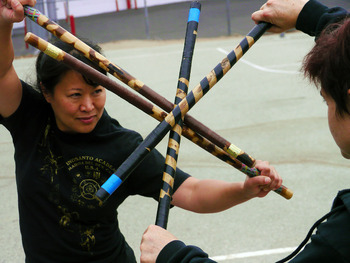
Filipino martial arts (FMA) and its stick-fighting practices, in particular, frequently confused me; simply detecting whose turn it was to strike and whose it was to defend sometimes left me stumped. Figuring out how to disarm a stick-wielding partner, especially when there were multiple steps in the process, puzzled me. I confronted this difficulty so often I took to calling it “FMA Brain Scramble.” I joked about it in martial arts classes and wrote a blog post about it, thinking I was reflecting ironically on my own limitations. But other martial arts practitioners, including highly accomplished ones, recognized the state invoked by the phrase with no explanation required.
Alternating striking and blocking drills account for the complexity of Filipino martial arts. Martial artists: Dan Park and Janet O'Shea. Photo courtesy of Tim Becherer.

As I read works by neuroscientists, social psychologists, cognitive psychologists, and psychiatrists, I noted that neuroplasticity,Footnote 6 the proposal that the topography of the brain is constructed through experience, could account for the process through which an incomprehensible phrase of movement eventually becomes familiar. Discussions about neuroplasticity not only illuminate the skills acquisition process (Merzenich Reference Merzenich2013) but also indicate that the self can be revised through intentional effort (Schwartz and Begley Reference Schwartz and Begley2002).Footnote 7 Such insights intersect with the central tenet of phenomenology, that the self is crafted by lived experience.Footnote 8 Phenomenological studies such as those of Iris Marion Young (Reference Young1990), Greg Downey (Reference Downey2005, Reference Downey and Sands2010), and Vivian Sobchack (Reference Sobchack2005) suggest that particular, socially contingent sets of physical experience create different social selves through a process of “enskilment” (Ingold in Downey Reference Downey2005, 34).Footnote 9 Phenomenology and neuroscience align clearly enough that cognitive neuroscientists have mobilized phenomenological theories in their efforts to understand consciousness. Such conversations led to my theory that Filipino martial arts required shifts in the perception and processing of information and that these requirements produced changes in self-identity and self-perception. This process, I thought, could be reflected on through phenomenology and measured via cognitive neuroscience.
This theory led to a series of meetings with neuropsychologist Robert Bilder, a successful UCLA Transdisciplinary Seed Grant proposal, and a small scientific study that tested changes in cognition after training in martial arts. Focusing on the stick-fighting techniques of Filipino martial arts, we set out to analyze how training in martial arts might transform the brain in distinctive ways. Our aim was to show that the physicalized insights of martial arts created a specific, experiential self.
A total of eighty-eight naïve subjects, those new to martial arts, between the ages of 18 and 35 were assigned to two groups: a study group who practiced thrice weekly Filipino martial arts for eight weeks and a control group that trained in conditioning classes.Footnote 10 Participants took a series of computer-based social psychology tests at the beginning and the end of the study, which evaluated mental processing speed, working memory, response inhibition, spatial processing, divergent-convergent thinking, and overall well-being. The following social psychology tests evaluated top-level effects of martial arts on cognition: Coding, Trails A/B (processing speed), Digit Span, Letter-Number Sequencing (working memory), Color Word Interference Test, Conners CPT III (response inhibition), Mental Rotation Test, Remote Associates Test (divergent-convergent thinking), Positive and Negative Affect Scale, Satisfaction with Life Scale, and Scales of Psychological Well-Being (well-being and positive/negative affect).Footnote 11
The study encountered a number of obstacles, some common to pilot studies, others unique to this project. The study was small because of the funding parameters. We were unable to compensate our participants beyond the provision of free martial arts or conditioning classes so it was a struggle to reach target numbers. In addition, immediately before the study began, a flood damaged much of UCLA Recreation's training spaces, causing a last-minute scramble to house the projectFootnote 12 and reducing our participant roster further yet. In addition, because of its timing at the end of our summer break, we confronted a high rate of attrition so that only twenty-three participants completed the second set of tests. The findings of the study were likewise limited. Only one indicator saw a statistically significant shift, so that our study ended with what I now know to be a common refrain in the sciences: “more research is needed.”Footnote 13
Despite the limitations of the research, the study took on a life of its own. I was invited to give a general-interest talk that included a demo team's presentation of Filipino martial arts for UCLA Parents Weekend; the same demo team also presented at a UCLA conference entitled Exercise and the Brain; UCLA Public Relations produced a video, and UCLA Magazine ran a story on the project.Footnote 14 This suggested an ethnographic reach to the project that extended beyond the scientific findings, a significance that likely emerged from the study's tangible, performativeFootnote 15 nature as well as from a more general, contemporary concern with the brain and its malleable nature. This experience of collaborating across different fields yielded a series of insights about the importance of qualitative, descriptive methodologies, especially to understanding the complexity of a mutable self. It also prompted reflection as to the ways in which contrasting disciplinary preoccupations shed light on pressing societal concerns.
The Demands of Specificity: Exceeding the Quantitative
September 24, 2013
Robert and I sat on the veranda of Café Synapse, talking over my ideas for collaboration between dance and neuroscience through martial arts. I explained to him my reasoning: martial arts training, because of its fast-paced, frequently changing, interactive drills, develops specific skills in the perception and execution of movement. These skills, I suspected, might be reflected in cognitive as well as physical changes in the practitioners. It seemed to me that neuroscience, with its attention to highly particular elements of cognitive function, could test for these changes. Robert listened attentively, but when I finished, he responded:
“That's interesting, but it's already been done. We know that martial arts practice enhances cognition. There've been loads of studies on tai chi, yoga, meditation.”
“That's not what I mean,” I said. “We hit each other.”
“OK,” he said. “That is different.” Footnote 16
October 2, 2014
Following the completion of the study but before its results were available, the instructional team for the study group presented on the training process that undergirded the project. Thanks to the initiative of the project's head instructor, Paul McCarthy, a demo team consisting of four martial arts instructors and myself, offered a demonstration at a conference entitled Exercise and the Brain, hosted by cognitive psychologist Sarah McEwen and held at UCLA. The visiting neuroscientists listened attentively as I spoke about the study and Paul reflected on the training process. When senior instructors Anna and Alain got up and began to move, working on increasingly complex empty-hand Footnote 17 strike-and-defend drills, a frisson of exhilaration pulsed through the room. When Vincent and I began our portion of the demo, striking sticks in a series of increasingly complex patterns, the enthusiasm turned audible. The first time our sticks hit one another, gasps of excitement followed. As the rhythmic clacking continued and the friction of our sticks emitted a sulfurous scent, soft “oohs” emerged across the auditorium.
The striking of stick-on-stick can prompt a visceral response in unfamiliar viewers of Filipino martial arts. Martial artists: Monique Askins and Janet O'Shea. Photo courtesy of Tim Becherer.

These interactions echo a long-standing interest on the part of neuroscientists and cognitive psychologists in movement.Footnote 18 For example, scientists have noted the role that dance, as a complex activity, can play in reducing cognitive decline among older adults (Verghese et al. Reference Verghese, Lipton and Katz2003), while other studies suggest that the improvement in cognitive function initiated by dance and walking is similar (Merom et al. Reference Merom, Grunseit, Eramudugolla, Jefferis, Mcneill and Anstey2016). Still other studies indicate that greater intensity, rather than complexity, inhibits the onset of Alzheimer's disease (Raji et al. Reference Raji, Merrill and Sravya2016).Footnote 19 While findings vary, they point to common insights: movement is necessary for effective cognitive function.
My observations in interacting with neuroscientists, however, signal that the specifics of movement exceed the quantitative analysis of their effects. Particulars of movement, when experienced, witnessed live, or even when described vividly, can be surprising in their immediacy. Far from implying that movement is ineffable, this reveals the need for methodologies specific to the apprehension, description, and analysis of movement. Elements such as the intention behind a movement, its dynamic quality, the complexity introduced by the use of a tool or weapon, and the complex biomechanics involved in redirecting an opponent's force point to an insight that is evident in dance studies but is less apparent in other fields: that the “how” and “why” of movement demand attention. The multifaceted focus and real-time observation skills required to effectively perceive a movement event develop the ability to isolate such concerns as time, space, force, and intention.
Dance studies therefore makes tangible the claim of the qualitative research more generally:Footnote 20 that there is nothing “mere” about description. Description is an essential part of analysis. It is not secondary or preliminary. Dance scholars are trained to look closely at movement,Footnote 21 to perceive its complexities as it is happening, to extract its principles and qualities, and to identify the significance of these specifics. Moreover, most dance scholars describe, analyze, and interpret movement informed by their experience of dancing, even when their analytical perspective is primarily visual.
Attending to the particulars of movement is not unique to dance studies, however. Philosophers such as Iris Marion Young (Reference Young1990), Erin Manning (Reference Manning2007), and Eric Anthamatten (Reference Anthamatten2014) have argued that the specifics of movement construct particular kinds of selves. Indeed, phenomenologists argue that movement, particularly the experience of mastery through movement, constitutes the self (Downey Reference Downey2005; Young Reference Young1990).Footnote 22
When scientific concerns intersect with constructivist theories, such as those concerned with neuroplasticity, they can benefit from dance studies, phenomenology, and other movement-based fields that emphasize how the specifics of physical action constitute individual selves and the communities these individuals constitute. Neuroscientific methodologies have been applied to dance as well as to sports, focusing on how a phenomenon, such as balance, enhanced motor skills, or the entrainment between performers, comes into being.Footnote 23 While neuroscientists have engaged with and drawn from phenomenology, they have been less swift to engage with the methodologies of dance studies, especially as those destabilize the notion of the self. Most scientific studies of dance and sports retain a structure in which neuroscience operates as the methodology and movement as the example. My experience with a neuroscientific study of FMA suggests that there is ample room for analysis to move in the other direction so dance studies methodologies can shed light on neuroscientific ones. Specifically, dance studies can elucidate the problems of consciousness that, following David Chalmers (Reference Chalmers1996), are known as “hard problems.”Footnote 24
The Messiness of the Real
June 7, 2015
I put forward a first draft of the material explored here in a presentation for the Cut and Paste: Advocating for Dance in an Age of Austerity conference in Athens, Greece, as part of a panel on somatic and cognitive approaches to dance studies. One of my copanelists, Eleni Sgouramani, is a scientist who looks at timing in movement through laboratory-based studies. She reflected on the relative stability of lab-based tests, commenting that “scientists prefer the lab because real life is messy.”Footnote 25
Although the range of effects we attended to in this study were tested in the lab, the training constituted an attempt to account for the messiness of practices and experiences outside the study parameters, what is conventionally, if problematically, known as “real life.” The participants experienced a training that, in a general sense, represented what takes place in FMA classes outside this study. FMA, like most martial arts, endeavors to accommodate factors outside of itself. The multifaceted nature of training called for testing that emerged not only from a lineage of inquiry but also from the relationship of the practice to a world beyond its parameters.
As I argue elsewhere (forthcoming), martial arts stand in a troubled relationship to an idea of the real. Unlike other sports and physical arts, martial arts contend directly, rather than metaphorically,Footnote 26 with the problem of human violence. They do this in a variety of ways: aesthetic practices, such as tai chi, manage violence by turning it into a highly regulated set of codified practices; Filipino martial arts and ninjutsu carry forward tactical techniques developed in guerilla warfare and apply them to self-defense; competitive sports, as in muay Thai, western boxing, and Brazilian jiu-jitsu, abstract and externalize violence through strict rules and codes of behavior.Footnote 27
Martial artists therefore debate the relevance of their art to real-world violence.Footnote 28 On the one hand, the fixation on “the real” is misleading: a kickboxing match is absolutely real. It is real sport fighting. While the ring is a regulated space, what happens in it remains unpredictable, given that it brings together individuals with competing agendas. Any live practice in martial arts—sparring, grappling, tai chi's push hands, or wing chun's chi sao—contends with the divergent possibilities presented by another person's oppositional actions. On the other hand, combat sport, where two fighters test one another's skills, is nothing like violence in which an aggressor aims to eradicate the will of another person.Footnote 29 Violence, as distinct from sport fighting, introduces conditions of greater unpredictability.Footnote 30
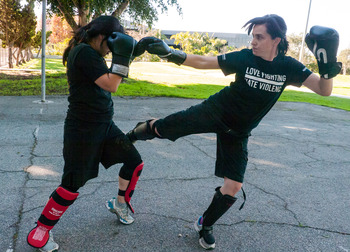
Martial art practices therefore include structural decisions as to how to contend with the mutable nature of the world beyond the dojo, gym, or academy. These practices, like academic methodologies, emphasize different aspects of experience. Martial arts emphasize particular fight ranges (weapons, kicks, striking, hand-trapping, and/or grappling) and, typically, exclude or downplay others. Sometimes, in doing so, they put forward a vision of “reality” that aligns with the investments of their practice, creating, in the process, a worldview inflected by their training. For instance, FMA foregrounds the extension of the body through weapons, urging adherents to expect a weapon in a real-life confrontation. Others, such as Brazilian jiu-jitsu, attend to grappling, maintaining that most fights go to the ground. Still others focus on empty hand work and on stand-up fighting, as in western boxing, muay Thai, and savate, maintaining that striking is the basis from which all other fighting develops.
Kickboxing arts emphasize kicks and punches as well as elbow and knee strikes, excluding weapon work and grappling. Martial artists: Monique Askins and Janet O'Shea. Photo courtesy of Tim Becherer.

This consideration of how training creates a view of the world outside its parameters returns to my original question of how training creates a self. An experiential self depends not only on specific physical and cognitive skills but also on the process through which physical skills produce such an experiential reality. In other words, such an inquiry opens up questions of consciousness and the role of the body in the philosophy of mind.
What Is It Like to Be a Stick Fighter? Physical Training and the Hard Problems of (Somatic) Consciousness
July and August 2014
My love of martial arts drew me into the studio where the study classes took place. I found it impossible to retain the distance typically expected of a scientist. I alternated between attending conditioning classes and martial arts classes, acting simultaneously as a practitioner, a neophyte scientist, and an ethnographer. But my role in the martial arts classes differed fundamentally from that of the conditioning classes. Although I trained alongside the new practitioners rather than acting as part of the instruction team, I took on the role of senior student, training with a range of partners while also coaching them in some of the drills.
We practiced strikes in pairs, executing continuous repetitions of particular patterns of strikes. We struck retracting high forehand strikes on our right and left sides in a pattern known as cob-cob, then diagonals, forehand and backhand, to form the Equis, or X, pattern. We moved on to alternating high and low line strikes.
This striking acts as a substitute for hitting the body of an opponent. The practitioner aims at the head, hand, body, or knee of the partner, but the partner blocks so the strikes miss and the sticks hit each other instead. Footnote 31 It's easy to fixate on the stick, to watch it and treat it as the target. The desire for the satisfying clicking sound of stick-on-stick can be strong enough that the stick becomes the target and the function of the strike as an attack is lost.
I am not sure which instructor I got this from, but I picked up a metaphor that seemed to help beginners understand this crucial point without frightening them with talk of aiming the stick at their heads: imagine you and I are striking at an opponent who stands between us. Swing your stick at this person's head. Our sticks just happen to meet. Footnote 32
November 23, 2015
Robert, Paul, and I met to go through the study results. The results for mental rotation were promising but so limited it was hard to draw conclusions from them. The other results showed improvement for both groups across indicators, as expected, with martial arts trainees scoring higher across the board; their capabilities were not so enhanced as to suggest statistical significance. The study numbers were so small and attrition so great that it was hard to say what it might mean. Perhaps, Robert suggested, those who finished the training, particularly the martial arts training, simply had “more grit.”
That core group of students who saw the FMA training to completion took to it with exuberance, adapting quickly to its requirements. Several of them went on to pursue martial arts training on a regular and sustained basis, integrating its practice into their daily lives. Footnote 33 For these students, the training's conclusion was bittersweet.
These two aspects of the study signal the role of imagery in physical training and the importance of experiential states in acquiring physical and cognitive skills. Visual imagery and subjective experience, in turn, open out to questions of consciousness, a consideration that has brought cognitive neuroscience and continental philosophy into conversation. Such issues bring this project beyond a consideration of neuroplasticity and into an investigation of the philosophy of mind as it might shed light on physical training.
Perspectives on the mind split into two camps. Physicalists (also known as monists, determinists, or reductionistsFootnote 34 ) argue that consciousness is an effect of the mechanisms of the brain. Dualists maintain that a consciousness or will guides the activity of the brain. The concept of consciousness allows for a responsive understanding of subjectivity, as it creates a greater space for experience and reflection. However, most proponents of consciousness rely on a mind-body split. This poses a “mind-body problem” in philosophy and suggests a need for an understanding of consciousness as rooted in the body and its actions as linking the mind and the brain.
The role of the humanities in these debates has largely been taken up by philosophy. As such, I allow a slippage here between the humanities generally and philosophy in particular. However, as I hope to show, these conversations suggest a need for contributions from movement-centered disciplines, such as dance studies, and signals the ways in which attention to movement training might complicate discussions around the philosophy of mind and the mind-body problem.
Physicalists argue that human consciousness is an effect of the structure of the brain.Footnote 35 They critique the idea of the mind and argue that a claim for a mental agent beyond the physical topography of the brain is an appeal to “the ghost in the machine.” Insisting that “the mind is what the brain does,” physicalists reduce the experience of qualitative states to the physicality of the brain.
Physicalism offers an important contribution to understandings of cognition and human agency as it represents a departure from the dualistic thinking of several centuries of Western philosophers. The physicalist perspective allows a critique of the assumption that a mystical or otherworldly influence guides human thought. Likewise, it enables a shift away from the religiosity that had guided much philosophical thinking and challenged the long-standing disparagement of the body in Western philosophy. Perhaps for these reasons, physicalism holds an appeal for the humanities. Recent decadesFootnote 36 have seen a “cognitive turn” in fields ranging from literary studies to music and dance, with the emergence of neuroaesthetics as a theoretical paradigm. Scientific data appears to provide a causal explanation for subjective experiences (Samson Reference Samson2015, 31). Aesthetic experience seems to become tangible when its appeal emerges from the “hardwiring” of the brain.Footnote 37
Physicalism confronts a set of challenges in the face of consciousness, however. Physicalism conflates the physical processes that initiate a phenomenon with why and how it is experienced as it is. Likewise, physicalism reduces the meaning of experience into the physical components that make it up, turning “a question about understanding into one of composition” (Samson 2015, 34). Consciousness troubles a conflation of understanding with cause because it raises the question of why particular states produce specific experiences, a question that is not answered by recourse to brain morphology or to behavior (Chalmers Reference Chalmers1996).
The central issue for a theory of mind is that consciousness differs, fundamentally, from other phenomena. As philosopher Thomas Nagel (Reference Nagel1974) points out, for any entity to have a conscious experience requires that “there is something it is like to be that organism” (1974, 436). This means that consciousness is inherently subjective, rooted in a first-person reality, yet tied to specific, categorical kinds of physical experiences. Hence, Nagel takes as a central example the question of what it is like to be a bat, an animal morphologically similar to humans but with a fundamentally different sensory and kinesthetic existence. That we can't grasp what it's like to be a bat signals the relationship between experience, imagination, and subjectivity. Nagel also maintains that this gulf in perception is not an obstacle to understanding consciousness: it is at the crux of what needs to be grasped in the first place. Experience does not exist outside of a viewpoint (1974, 444).
Extending Nagel's argument, cognitive scientist and philosopher David Chalmers (Reference Chalmers1996) argues that physical explanations can address the “easy problems” of consciousness but not the “hard problems.” The “easy problems” of consciousness consists of how the brain processes stimuli, how it integrates information, and how it reports on internal states. The hard problem is why any of this is accompanied by an inner life, with its experience of selfhood and its qualitative feel (1996, 4). While physicalists reference behavior as an explanation for consciousness, Chalmers argues that behavior does not encompass consciousness. To illustrate this point, Chalmers puts forward a thought experiment: a zombie, a being who can learn, report on states, and focus attention, but lacks consciousness is conceptually coherent (1996, 96).Footnote 38 He therefore argues that conscious experience is not “logically entailed by the facts [of] … functional organization” (1996, 97).Footnote 39
Chalmers raises key questions that arise in a consideration of how movement training produces a specific, experiential self, questions such as why skills acquisition might shift self-perception. And, yet, movement appears, in Chalmers’ analysis, largely as a question of function, not of consciousness. Although Chalmers considers proprioception as part of consciousness (9), he does not include considerations such as: Why does acquiring mastery produce a feeling of accomplishment? Why does physical training shift how we perceive ourselves as well as how we act? Why does the impulse toward mastery, beyond the necessity of function, arise at all? There are, in other words, hard and easy problems of movement and skills acquisition.
A focus on physical training thus sheds light on the problematic aspects of both of monism and scientific dualism. Just as a physicalist theory of mind confronts a problem in the form of consciousness, it also encounters a conundrum in physical training: subjective experience often drives physical training at the same time that training creates first-person experiences. The ways in which physical practice seems to exceed its quantitative depiction arise out of these qualitative elements. Physical training prompts questions that, in Nagel's terms pertain to “what-is-it-like-ness” and that, in Chalmers's terms are the hard questions of “why?” and “why does it matter?” Chalmers's emphasis on hard questions is useful for understanding the implications of the malleability of the self through intentional effort. But Chalmers downplays the role of intentional physical action in creating consciousness.
Philosopher Hyjin Lee (Reference Lee2011) attends to this lacuna by delving further into Chalmers's thought experiment. Lee puts Chalmers's zombie experiment into conversation with Richard Shusterman's (Reference Shusterman2008) understanding of muscle memory, the embodied, implicit recollection of movement that allows us to carry out everyday tasks and to undertake intentional training (Lee Reference Lee2011: 200). Lee argues that zombies are conceivable because we implicitly accept not only that consciousness is separate from the physical brain but also that muscle memory enables behavior (200). She extends this argument beyond Shusterman's definition of muscle memory by signaling the role of “sensual muscle imagination” in crafting patterned behavior, so that training, the process of learning to “control [the] body,” creates new behavior as we conjure what movement might look and feel like (201). This process, Lee argues, results in a sense of satisfaction and accomplishment that Lee describes as “enhanced vitality” (201).
Lee's theory goes a long way toward explaining the phenomena I witnessed in this study of Filipino martial arts and cognition. The importance of invoking a visual image to correct the angle of a strike may or may not have to do with the brain's ability to establish neurological patterning through imagination as well as through movement. Neurological patterning does not, however, explain the satisfaction that accompanies the “aha!” moment that occurs when a stick fighter corrects the angle of a strike. Likewise, the exuberance I noted is a common effect of physical training, at least for those with the tenacity to push through frustration to experience mastery. The tenacity itself, what Robert called grit, is another example of a state, the experience of which exceeds whatever its link to brain function. The vitality that Lee argues arises from the deployment of “sensual muscle imagination” indicates that exuberance and tenacity appear as central, recurrent attributes, rather than as incidental benefits of physical training.
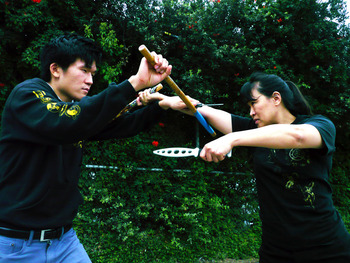
Working with different sized weapons requires a nuanced appraisal of space, distance, and position. Martial artists: Dan Park and Monique Askins. Photo courtesy of Tim Becherer.

Philosophies such as Lee's that attend to the role of the body in subjectivity mobilize such terms as “embodied” and “somatic,” terms that are arguably (and intentionally) generalized. Such approaches have yet to engage the corporeal, a concept more concrete and more intentionally located in the social, cultural, political, and economic circumstances that establish the parameters within which a plastic self emerges.Footnote 40
A corporeal approach to consciousness, in line with the hermeneutic tradition, hones in on a definition of terms. As Lee points out, definitions of mind and body in philosophy of mind debates remain notoriously vague (2011, 179). Philosopher Gary Gutting (Reference Gutting2013) likewise outlines a major contribution of the hermeneutic tradition: the ability to problematize terms and to consider whether there is consensus on what they mean. As Gutting points out, there is much at stake when we invoke a state of being and assume agreement as to our understanding of what constitutes that state.
In contrast to phenomenology, which typically examines physical action as indicative of subjective experience,Footnote 41 corporeality treats physical practice as a link between subjective experience and larger social conditions. Perspectives within dance studies, ranging from traditional dance analysis to critical dance studies' poststructuralist textual analysis, externalize understandings of movement practices, intentionally delinking them from subjective states.Footnote 42 Theories of corporeality, broadly understood, extend from physical experience to considerations of social, cultural, political, and economic concerns.Footnote 43
Corporeal approaches to consciousness consider, for instance, what sets of experience yield subjective states and how these experiences are constituted socially, politically, and economically. These approaches ask how muscle memory is constituted socially and is acquired within a social context. They examine how the sense of vitality is experienced differently in relationship to contrasting experiences outside of the movement practice studied. They address how broader social, cultural, and economic circumstances contribute to the “what-is-it-likeness” that characterizes experience. Such perspectives create yet another bridge between understandings of neuroplasticity, consciousness, somatic experience, and cultural and social realities.
Why It Matters How We Move
The natural sciences and the humanities converge at an important point: research in the sciences, as in the humanities, cannot prove the validity of a theory. Researchers can only reach a persuasive conclusion in the face of evidence. Unlike the humanities, science can disprove a finding when the data contradicts it. But proving remains impossible as a future study could undercut the insights of the current one. Accepting contradiction and disagreement is therefore central to intellectual endeavors across disciplines. A willingness to engage with scientific disciplines and concepts as well as an ability to problematize them is necessary when science denial has gripped mainstream politics and egregious forms of subjugation operate through physical, environmental conditions. At the same time, the solution is not simply an uncritical turn to the natural sciences, given the ease with which the natural sciences have been manipulated to support racist, sexist, and ableist agendas (Fine Reference Fine2010; Snyder and Mitchell Reference Snyder and Mitchell2006).
Scientism, the belief that all phenomena can be reduced to objective criteria and understood via the scientific method, poses several risks for intellectual practice. Scientism, as Gary Gutting (Reference Gutting2013) points out, can lead us to gloss over nuances of meaning in a haste to locate universal principles, when assuming that relative terms such as human welfare, free will, and happiness can be understood empirically. Scientism replaces what Chalmers (Reference Chalmers1996) calls the hard questions with easier ones. In doing so, it leads to a tautology: if we assume that the most important questions can be answered by science and science alone, then we are left with only the questions that science can answer (Gutting Reference Gutting2013). More troubling is the assumption that, in Taylor Dotson's (Reference Dotson2015) terms, science can do our politics for us, that questions of value and power can be successfully addressed through quantitative means (Dotson Reference Dotson2015).Footnote 44
The risks of science denial are more immediate yet. A science denialist position takes science's inherent limitations as evidence that scientific results are wholly subjective.Footnote 45 Because scientific discoveries are relative to and dependent upon nonobjective circumstances, such as funding and the point of view, background, and positionality of scientists, science denialists insist that the results of scientific studies can be discounted.
Critical collaborations between the sciences and the humanities can counter both scientism and science denial. Critical interdisciplinary debates that signal the limits of the natural sciences and those that contend with philosophies of body and mind can counter scientism by highlighting the questions that the natural sciences struggle to answer. Paradoxically, they can also counter science denial. Signaling what questions lie outside the boundaries of scientific inquiry, such projects frame up, by virtue of exclusion, what answers the natural sciences excel at providing. We can continue to benefit from the value given to specificity, observability, and repeatability of the sciences, acknowledging that the scientific method is part of our scholarly lineage in the humanities. At the same time, we can acknowledge that the natural sciences consist of multiple methodologies that reveal some insights more effectively than others.
Salman Rushdie (Reference Rushdie1991, 85) said of the postcolonial condition, “if history creates complexities, let us not try to simplify them.” The same could be said of other aspects of lived reality: when conditions are multifaceted, let us not to try to reduce them. Instead, we can engage with the intricacy of lived experience, for attention to nuance illuminates the complexity of phenomena such as a socially contingent but idiosyncratic self and the means through which this self changes through intentional effort.
Like martial arts drills, arts-based disciplines, such as dance studies, require that we accurately apprehend circumstances before we contend with them; elements of lived reality need to be detected, drawn out, and identified before they can be understood. In parallel to martial arts training, dance studies, and aligned fields show us how to mobilize the knowledge we gain from observation. Martial arts, like dance studies, represent an attempt to engage head-on with the “messiness” of lived experience. The proliferation of methodologies within the sciences and the humanities, like the diversity of martial arts forms, provides solutions to different kinds of problems. They are evidence of how nuanced and multifaceted lived reality can be.
My goal, then, is not to harmonize neuroscience and dance studies. Rather, as in the martial arts training that this study investigated, the meeting of oppositional positions can be productive. Finding a meeting point between two differing intentions reveals much about varied tactics and strategies, unquestioned habits, and contrasting vulnerabilities and strengths.Footnote 46 In intellectual work, as in martial arts practice, respectful confrontation can be productive.