

The problem of Roman endogamy
Early in Dio Chrysostom's Euboicus, a creative evocation of rural Euboia in the late first century AD, we meet two poor Euboian huntsmen. These men were the sons of two herdsmen on a large Euboian private estate, who had turned to hunting and small-scale agriculture after the confiscation of the estate by the emperor. The two huntsmen live together in a remote part of rural Euboia, and each is married to the other's sister. At the time that the Euboicus is imagined as taking place, the two men are on the brink of contracting a still closer relationship by marriage, since the daughter of one couple is about to marry the son of the other, her cousin two times over. These two young people had apparently lived under the same roof since birth: close-kin marriages do not come much closer than this.Footnote 1
At the other end of the social hierarchy, in the fourth book of Apuleius' Metamorphoses, we are introduced to a wealthy Greek family, with urban property and slave-run rural estates, and a daughter of marriageable age. Presented with the choice of two suitors – a rich man from a neighbouring city, and the girl's own first cousin, three years older than her, and reared in the same house – the girl's parents chose to marry her to her cousin. Everyone, except the disappointed suitor, seems to have regarded this as an entirely proper and desirable outcome.Footnote 2
What, if anything, can the historian conclude from these two cases of close-kin marriage in Roman Achaea? The first example is at best fictionalised; the second is unambiguously fictional, and its cultural setting is vaguely ‘Greco-Roman’ rather than specifically Achaean.Footnote 3 More or less by definition, people like Dio's Euboian huntsmen and their families are usually completely invisible to us, and it takes an optimistic disposition to argue that Dio ‘must have been’ reflecting widespread social realities among the rural poor of the eastern Roman empire. Cousin marriage may indeed have been common among both the rural poor and land-holding elites of Roman Greece, or it may have been a conventional literary motif for depicting a virtuous and close-knit family. At most, Dio and Apuleius show that cousin marriage was imaginable at all levels of Greco-Roman society; they certainly do not show whether it was at all typical.
For the greater part of the Roman world, our knowledge of family structures and marital preferences is pretty much limited to the evidence provided by inscribed tombstones. Generally speaking, close-kin marriage is far from conspicuous in our epitaphic corpus. An influential study of close-kin marriage in the Roman West concluded that endogamy – at least in the Roman West, and at least among the inscription-producing classes – was rare.Footnote 4 A large sample of elite genealogies from the first four centuries AD produced few, if any, examples of close-kin marriage among the Roman senatorial aristocracy. Moreover, a sample of several thousand Latin epitaphs from the western provinces showed only a very small proportion of marriages between people sharing the same gentilicium, providing some – admittedly rather fragile – proxy evidence for the relative rarity of close-kin marriage in the Roman West.
Of course, we can point to plenty of specific individual examples of close-kin marriage in epitaphs from the Latin-speaking provinces. The difficulty lies in judging how far we are entitled to generalise from particular cases. In a well-known epitaph from Simitthus in Tunisia, two patrilateral parallel cousins (the children of two brothers) commemorated their happy marriage as the decision of fate and the result of unusually close fraternal affection: ‘Sulpicius Primus and Sulpicia Faustina were born of two brothers, who were very close; they were happily married, as destiny decided, with Urbica, [Faustina's] mother, lending her voice to destiny.’ A second text, the tombstone of Faustina's father Sulpicius Faustus, informs us that Faustina was an only child; after her father's death, ‘her mother raised her, and had great difficulty knowing to which suitor she should marry her; she gave her to a good man, having chosen from several’.Footnote 5 It is tempting to see this particular cousin marriage as having been made for good practical reasons (keeping Faustus' property within the family in the absence of a male heir); historians of structuralist inclinations might also wish to see the union as reflecting a traditional preference for endogamy among the Berber societies of North Africa. But we ought also to respect the accent placed by these two texts on specific and contingent sentimental factors: the closeness of the two brothers, the personal wishes of the mother, and the preferences of the married couple themselves. All societies (perhaps all families) have members who make odd marital choices. Hence single isolated examples of this kind do not get us very far; we certainly cannot use them as a basis for generalisations about ‘traditional marriage patterns' or ‘wider kinship structures' in Roman North Africa.
Nonetheless, there is no particular reason to assume that what was true of the Roman senatorial elite or of bürgerlich families in the western Roman Empire was also true of the peasants or civic aristocrats of Roman Anatolia or Syria. It is abundantly clear that close-kin marriage was characteristic of all levels of society in Roman Egypt, even assuming (as has recently been argued) that Egyptian ‘brother–sister marriages' were in fact mostly cases of cousin marriage, with one cousin being adopted by the spouse's parents.Footnote 6 Marriage between first cousins seems also to have been quite normal among both elite and sub-elite groups at Roman Palmyra.Footnote 7 The notion that a single set of marriage preferences characterised the entire Roman Empire from Housesteads to Dura Europos – or even that there was a single characteristic ‘Greek’ marital system throughout the eastern Roman empire – can easily be shown to be false.Footnote 8 What we need is evidence for systematic regional patterns of close-kin marriage or its avoidance. The aim of this paper is to collect, classify and offer some preliminary analysis of a coherent (and relatively abundant) regional body of evidence for close-kin marriage, drawn from the rich funerary epigraphy of Roman Asia Minor.
Licinnia Flavilla of Oinoanda
In the early years of the third century AD, at the small city of Oinoanda in northern Lykia, a certain Licinnia Flavilla erected a monumental mausoleum to house the tombs of her parents and ancestors. The structure's outer walls carried one of the longest inscriptions known from Roman Asia Minor, a vast genealogy of Flavilla's family, with short biographical notes on dozens of different family members.Footnote 9 One whole face of the mausoleum was reserved for the genealogy of Flavilla's great-grandmother, Flavia Platonis of Kibyra, who traced her ancestry back some thirty generations to the mythical foundation of Kibyra by the legendary hero Kleandros of Sparta. Another wall was dedicated to the local Oinoandan genealogy of Flavilla herself, stretching across twelve generations, and encompassing some sixty distinct individuals. A third façade (very poorly preserved) appears to have given an overlapping genealogy, this time focusing on the non-Oinoandan marital connections of Flavilla's family.Footnote 10
Here is an extract from the account of Flavilla's immediate ancestors, which gives a good flavour of the whole:
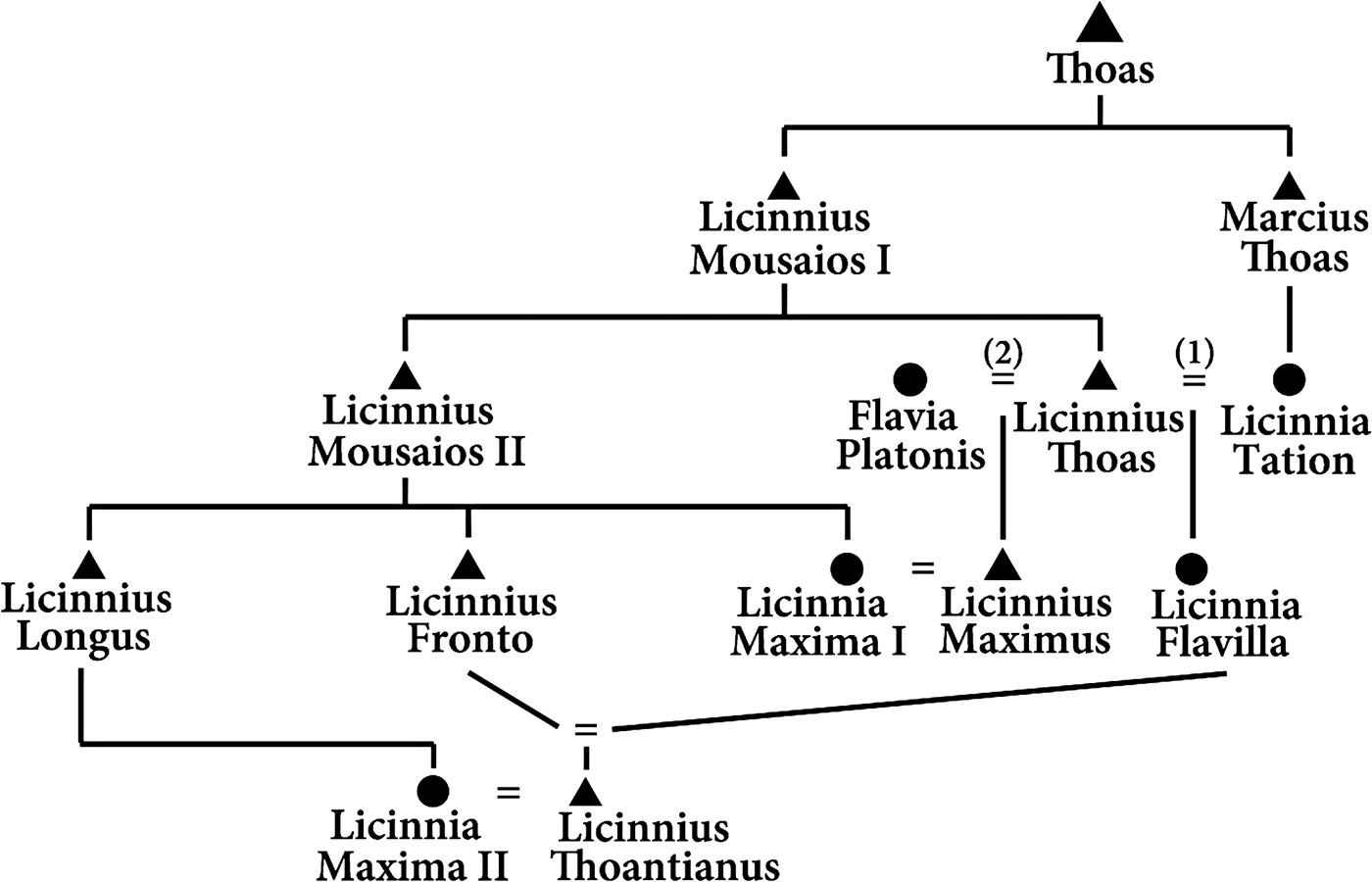
Trokondas, third of that name, had a son Thoas. The sons of Thoas were Mousaios and Thoas, of whom one was known as Licinnius Mousaios, the other as Marcius Thoas, and both served as Lykiarchs. Mousaios and Ammia, daughter of Kroisos, had two sons, Licinnius Thoas and Licinnius Mousaios, homonymous with his father, as well as a daughter Tation. Marcius Thoas and Marcia Ge, daughter of Marcius Molebes Loubasis,Footnote 11 had a son Marcius Flavianus Thoas and a daughter Tation. The son of Marcius Thoas, Flavianus Thoas, died childless, but his daughter Tation married Licinnius Thoas, the son of Licinnius Mousaios, and they had a son Licinnius Maximus. The second Licinnius Mousaios married Licinnia Kneila[…]ra, the daughter of Licinnius Alexippos of Choma, and their children were Licinnius Longus the Lykiarch and Licinnia Maxima and Licinnius Fronto. The children of Licinnius Thoas and his second wife Flavia Platonis, daughter of Flavius Aristokles of Kibyra, were Mucianus and Flavianus and Flavilla. The daughter of the second Licinnius Mousaios, Licinnia Maxima, married her cousin Maximus, the son of Licinnius Thoas and Tation.Footnote 12
Thanks to this vast, obsessive genealogy, we probably know more about the marital choices of this one extended elite family at Oinoanda than about any other family in the entire Roman world, with the single exception of the Julio-Claudian imperial house. The first thing to strike a reader of the text is the very large number of marriages between close family members. Flavilla herself was married to her mother's stepbrother; her father and mother, Licinnius Thoantianus and Licinnia Maxima, were first cousins, the children of two brothers; her paternal grandfather and great-aunt had each married their own first cousins; and so on. In total, of the thirty marriages directly recorded in Flavilla's genealogy, at least eight were marriages between close kin.Footnote 13 In fact, the sum total of close-kin marriages in this particular family was probably much larger: several more unions between close relatives can be plausibly inferred on the basis of their personal names.Footnote 14
Closer attention reveals that marriages between kin are not evenly distributed across all the various branches of the Licinnian family tree, but seem to have been concentrated in particular branches of the family at particular periods. For example, in the mid-first century AD, as described in the extract quoted above, a certain Licinnius Thoas married his father's brother's daughter (Fig. 1). Of Thoas' own four children, Licinnius Maximus married his father's brother's daughter, and Licinnia Flavilla (grandmother of the builder of the mausoleum) married her father's brother's son: in effect a case of ‘daughter-swapping’ between two brothers. The next generation down, the son of one of these couples went on to marry his own father's brother's daughter. Across three generations, we find four examples of exactly the same type of marriage, between a man and his father's brother's daughter – a type known to the anthropologists as patrilateral parallel-cousin marriage, or FBD (father's brother's daughter) marriage. This recurring pattern can hardly be a coincidence. In the first century AD, the Oinoandan Licinnii seem to have gone through a phase of favouring a particular kind of close-kin marriage for their sons and daughters (‘in this family, we marry our cousins’).
Some close-kin marriages among the Oinoandan Licinnii.

That is not to say that cousin marriage was the only possible option for family-members in this period. Some time after his original marriage to his cousin, Licinnius Thoas went on to marry a second wife from a different city altogether, Flavia Platonis, who belonged to one of the richest families of nearby Kibyra. Licinnius Thoas' brother, Licinnius Mousaios, married a woman from the Lykian city of Choma, and his niece and daughter-in-law, Licinnia Maxima (also originally married to her cousin), took as her second husband a certain Iulius Antoninus, a member of the most prominent elite family of Oinoanda.Footnote 15 It is tempting to think of the Oinoandan Licinnii as oscillating opportunistically between endogamy and exogamy. The two acceptable faces of Licinnian matrimony were marriage to a first cousin and marriage to a rich neighbour; certain family members even experienced both.Footnote 16
The sheer length of Flavilla's genealogical inscription – unparalleled anywhere in the Roman world – is an indication of how seriously this family took its marital choices. One of the main purposes of the inscription is to commemorate a long history of ‘good’ marriages, both to close family members and to members of other local elite households.Footnote 17 For the Licinnii of Oinoanda, endogamy was not just one among several possible marital strategies. First-cousin marriage was a normative good which, when achieved, was celebrated with particular pride and pleasure. This norm did not exclude out-marriage, since successful exogamy (to a member of another local elite family) was pursued and celebrated with just as much enthusiasm. The point is that we are not dealing with a spectrum of different marital options, but with a dyad: marriage in, or marriage out.
Representing close-kin marriage in Roman Asia Minor
The Licinnii of Oinoanda were, without doubt, profoundly unusual in the obsessive detail in which they chose to advertise their family tree.Footnote 18 What is harder to establish is whether they were also peculiar in their marital strategies. From this single monument alone, we cannot tell whether a preference for close-kin marriage on this scale was distinctive to (a) the Licinnii, (b) the inhabitants of Oinoanda, (c) the inhabitants of Roman Lykia, (d) the civic elites of Roman Lykia, (e) the inhabitants of Roman Asia Minor, or any number of other cross-cutting categories.
In fact, epigraphic evidence strongly suggests that marriage between close kin was very widespread among the civic elites of southern Asia Minor (Lykia, Pamphylia, Pisidia), usually between first cousins, but also between uncles and nieces and other relatives.Footnote 19 ‘Very widespread’ is probably as close as we can get to quantifying the phenomenon, since for the overwhelming majority of attested marriages, in southern Asia Minor and elsewhere, we have no means of telling whether the couple were close kin or not. The sheer volume of evidence for close-kin marriage does at least indicate that it was an entirely normal feature of elite society in the cities of Lykia and neighbouring regions. Nonetheless, as we shall see, southern Asia Minor is not typical of the peninsula as a whole: the evidence for close-kin marriage in western, northern and central Anatolia (Ionia, Lydia, Bithynia, Phrygia) is very scanty by comparison. This need not mean that close-kin marriage was actually more common in Lykia than elsewhere in Asia Minor, only that close-kin marriage is (for several overlapping reasons) more visible in our Lykian evidence than it is elsewhere.
As we would expect, most of our evidence derives from epitaphs, along with a handful of honorific inscriptions. Rather than organising the material geographically or by type of marriage, I have chosen to present it under three broad headings, reflecting the manner in which close-kin marriages are commemorated in our surviving documents. The first category consists of epitaphs and honorific inscriptions which explicitly advertise the close kinship of married couples through phrases such as ‘my wife and cousin’. Documents of this type leave no room for doubt about the close-kin status of married couples; I shall call this ‘marked’ consanguinity. The second category consists of inscriptions which indicate blood connections between husbands and wives only indirectly, usually by giving the couple's lineages to the third or fourth generation. In such cases, the close-kin status of married couples can be inferred with reasonable certainty, but is not explicitly ‘marked’; I will refer to these as cases of ‘unmarked’ consanguinity. The third category is made up of inscriptions which do not indicate a kin-relationship between the married couple at all, but where the couple's joint family tree can be reconstructed with the aid of other documents. I will refer to such cases as instances of ‘concealed’ consanguinity.
We begin with cases where families, such as the Oinoandan Licinnii, advertised their consanguineous unions with pride. At Arykanda in eastern Lykia, a lavish funerary monument of the mid-second century AD was erected by a certain ‘Killortes, son of Pigres, grandson of Killortes, for Aristainete, daughter of Krateros, granddaughter of Killortes, his sweetest wife and cousin (gynē kai exadelphos)’ (Fig. 2).Footnote 20 Had he wished to, Killortes could very easily have concealed his blood relationship with his wife: if his tomb-inscription had read simply ‘Killortes, son of Pigres, for Aristainete, daughter of Krateros, his sweetest wife’, we would never have guessed that the two were related. Instead, Killortes chose to highlight his twofold relationship with Aristainete in two different ways, both by giving their shared papponym (‘grandson/granddaughter of Killortes’) and by calling her his ‘wife and cousin’. Similarly, a third-century sarcophagus from Sidyma in western Lykia was set up by a certain M. Aur. Ptolemaios and M. Aur. Demetria, ‘the wife and cousin (synbios kai exadelphos) of Ptolemaios'. Had the words ‘and cousin’ been omitted from the epitaph, we would never have suspected that the couple were connected by blood.Footnote 21 At Olympos in eastern Lykia, around the turn of the third century, Hoplon, son of Hoplon, grandson of Diotimos, erected a tomb for himself, his parents and ‘Melitine, also known as Aristonoe, daughter of Archepolis, granddaughter of Eukles, his cousin and wife (exadelphos kai gynē)’; since Hoplon and Melitine's paternal grandfathers had different names, Hoplon must have married the daughter of one of his mother's siblings.Footnote 22 At a somewhat higher social level, at Rhodiapolis in western Lykia, a certain M. Arruntius Demetrios Claudianus set up a posthumous honorific inscription for his wife, a former high priestess of the imperial cult, who is further described as ‘his father's cousin’ (hē tou patros autou exadelphos kai gynē), i.e. Claudianus’ first cousin once removed.Footnote 23
Funerary monument of Killortes and Aristainete of Arykanda.

Another example of ‘marked’ close-kin marriage at the very highest level of the social hierarchy comes from the city of Xanthos in western Lykia. In the early second century AD, one of the wealthiest families of Roman Lykia, the Arruntii of Xanthos, erected a huge exedra at the Xanthian Letöon, adorned with statues of numerous family members with associated honorific inscriptions. One of these inscriptions honours a certain M. Arruntius Teithonos, ‘father of Arruntia Hegetoris, the late wife and cousin (gynē kai anepsia) of Arruntius'. Thanks to other inscriptions from the Letöon exedra, the family's genealogy can be reconstructed with certainty: Arruntia Hegetoris was married to her father's brother's son, M. Arruntius Claudianus, the first Lykian senator.Footnote 24 At a slightly lower social level, in the mid-second century AD, a wealthy aristocrat from Karian Stratonikeia by the name of Myonides Damylas held several major priestly offices along with Tryphaina Damyla, ‘his cousin and wife (anepsia kai gynē)’. The couple's twin status as spouses and patrilateral parallel cousins was proudly recorded in two separate honorific texts, one in prose, the other in verse.Footnote 25
Consanguineous marriage could also be ‘marked’ in a slightly different manner, by indicating the multiple connections of an older relative to the married couple. So for instance at Apollonia by Pisidia, a member of the city's wealthiest family, Alexandros, son of Olympichos, describes his father's brother on a private honorific monument as ‘his uncle and father-in-law’, implying that Alexandros had married his patrilateral parallel cousin.Footnote 26 At a significantly more modest social level, a villager from the eastern part of the territory of Amorion, on the western fringe of the Anatolian plateau, commemorated his ‘paternal uncle (patrōs) and father-in-law’, showing that he too had married his father's brother's daughter.Footnote 27 The uncle's perspective appears in a fragmentary epitaph from Amastris in Paphlagonia, erected by a man for his ‘nephew and son-in-law’.Footnote 28 Finally, another example of cousin marriage among the civic elite of Karian Stratonikeia emerges from an honorific inscription for a priestly couple and their immediate relatives, in which a man is described as ‘uncle of the priest and priestess'.Footnote 29
A lengthy Christian verse epitaph of the early fourth century AD, from the upper Tembris valley in northern Phrygia, stands in a class of its own. The author of the epitaph, Akakios, had only a single child, a daughter Loukilla; after his wife's death, ‘he gave her to a husband (anēr), her cousin (anepsios) Trophimos, in the hope of being tended for in his old age’. In fact, Loukilla died childless within eighteen months, leaving Akakios without descendants. This is a very rare case where we are given an indication of the intended social function of a close-kin marriage: by retaining his sole daughter within his lineage, Akakios was hoping to ensure that he would be looked after in his old age. (He may also have been motivated by practical reasons of inheritance, but if so, there is no indication of it in his epitaph.)Footnote 30
‘Marked’ phrases such as ‘wife and cousin’ or ‘uncle and father-in-law’ leave no room for doubt about a couple's close-kin status. In other cases, the couple's consanguinity was left implicit (‘unmarked’), to be inferred from the names of their parents and grandparents. A telling example derives from the city of Patara in western Lykia. In the early third century AD, two siblings from the Pataran civic elite both married close relatives. M. Aur. Nemeso, who married her mother's brother, is explicitly described in an honorific inscription from Sidyma as ‘wife of her uncle (theios) M. Aur. Eukarpos, of eternal memory’. Around the same time, Nemeso's brother Alkimos also married a close relative, his father's brother's daughter M. Aur. Chrysion. However, in Alkimos and Chrysion's epitaph, the couple's close-kin status is not spelled out explicitly. Instead, the reader is left to infer it from their parentage, which is listed to the fourth generation (him: ‘Alkimos, son of Dionysos, grandson of Alkimos, second of that name’; her: ‘Marcia Aurelia Chrysion, also known as Iasonis, daughter of Alkimos, third of that name’).Footnote 31 The two couples made rather different choices about how to mark their pre-existing kinship links. Nemeso was happy to be known as ‘wife of her uncle’; Alkimos and Chrysion signalled their status as first cousins only indirectly, through their respective paternal lineages.
The epitaph of Alkimos and Chrysion thus falls into my second category, that of ‘unmarked’ consanguinity. At Kotenna in north-east Pamphylia, a woman called Kbaroues is described as ‘granddaughter on her mother's side of Stanamoas, son of Setas … granddaughter on her father's side of Neoptolemos, son of Setas'. Kbaroues was evidently the daughter of two cousins, the son and daughter of the brothers Neoptolemos and Stanamoas.Footnote 32 At Lykian Isinda and Arneai, and at Tyriaion in the Kabalis, marriages between patrilateral parallel cousins can be plausibly inferred on the basis of homonymous grandfathers in the paternal line.Footnote 33 At Olympos in eastern Lykia, a certain Aur. Phidias erected a tomb for himself and his brother Epaphrodeitos, ‘and for my wife Arete, daughter of Epaphrodeitos'; it is likely enough that Arete was Phidias' niece.Footnote 34 In a familial epitaph from Diokleia in central Phrygia, repeating patterns of personal names within the family (Eukles, Rhesimachos, Timotheos) make it clear that the children of two brothers must have married one another.Footnote 35 Onomastics also strongly suggest that a rich Aphrodisian aristocrat of the first century AD, Eusebes son of Menandros, married his brother Menandros' daughter.Footnote 36 There are several other cases in the funerary epigraphy of Asia Minor where close-kin marriage may be suspected on the basis of onomastic connections between husband and wife, but where the precise character of the relationship between the couple cannot be established with any certainty.Footnote 37
Perhaps the two most interesting examples of ‘unmarked’ consanguinity derive from the small city of Sillyon in Pamphylia and from Xanthos in Lykia. At Sillyon, several honorific inscriptions of the second century AD describe the career of a wealthy female civic benefactor called Menodora, daughter of Megakles, and her son, ‘Megakles (III), (adoptive) son of Megakles (II), natural son of Apollonios (III), grandson of Apollonios (II), great-grandson of Apollonios (I), great-great-grandson of Megakles (I)’. Apparently Menodora was the daughter (and perhaps sole child) of Megakles (II). She married her father's brother, Apollonios (III), by whom she had a son, Megakles (III); this boy was then adopted by his own paternal uncle (and maternal grandfather), Megakles (II). This adoption is best explained on the assumption that Megakles (II), like the Christian Akakios in northern Phrygia, would otherwise have been lacking a male heir. He hence married his daughter off to his own brother, and adopted the couple's son (his own grandson and nephew) as his heir.Footnote 38 The case is a beautiful illustration of some of the practical benefits of close-kin marriage and adoption in a society practising patrilineal inheritance. If a man like Megakles (II) happened to have no sons, marrying his daughter to a close kinsman allowed him to transmit his property to his descendants while also retaining it within his own lineage.Footnote 39
Interesting for different reasons is a private honorific inscription from Xanthos, dating to the early first century BC. The honorand is a certain Ptolemaios, a member of the uppermost stratum of Lykian society (he acted as ambassador to Rome on behalf of the Lykian koinon).Footnote 40 Ptolemaios was married to a woman called Arsinoe, natural daughter of Ptolemaios' brother Aichmon: Arsinoe hence married her father's brother. But, as we learn later in the text, Ptolemaios was not Arsinoe's first husband. Among the family members who joined in honouring Ptolemaios is a woman called ‘Erpidasa, daughter of E[uelth]on’, who describes Ptolemaios as her ‘stepfather’ (patrōios).Footnote 41 Arsinoe was therefore first married to a certain E[uelth]on, apparently not a kinsman; only after her first husband's death did she marry her father's brother.Footnote 42 It is possible that Ptolemaios married his brother's young widow in order to prevent her wealth from being misappropriated by some unsuitable suitor.Footnote 43
In each of these last few cases, the spouses' status as close kin is implicit and ‘unmarked’: they do not indicate their blood relationship with an explicit phrase such as ‘wife and cousin’, but leave the reader to infer it from their respective lineages. But if (say) married cousins choose not to record the relevant bits of their genealogy at all, then their kinship is completely invisible, and we can only rely on the chance survival of other evidence to prove the blood connection. At Pisidian Termessos, where the vast number of extant funerary inscriptions (more than a thousand) is a gold mine for the reconstruction of civic elite genealogies, I have found three ‘concealed’ cases of marriage between patrilateral parallel cousins, and one likely case of marriage between second cousins.Footnote 44 Similar instances of ‘concealed’ close-kin marriages – identifiable only with the help of external evidence – are known at Lykian Idebessos (cousin marriage) and Pisidian Adada (one case of cousin marriage and one uncle–niece marriage).Footnote 45
Sibling marriage in Roman Lykia
We turn, finally, to one especially problematic category of close-kin marriage in Asia Minor, namely marriage between brothers and sisters, the evidence for which is almost entirely confined to Lykia. I know of three cases of ‘marked’ brother–sister marriage in Lykia, all from Tlos or neighbouring Arsada, and all dating to the late Hellenistic or early Imperial period. So, for example, a funerary monument from Tlos was erected in memory of a certain Androbios, son of Leontiskos, by (among others) ‘Teitanis, daughter of Leontiskos, for Androbios, her brother and husband (adelphos kai anēr)’.Footnote 46 There are also a further six ‘unmarked’ cases of sibling marriage, one from Istlada near Myra, one from Bonda near Limyra, three from Olympos in eastern Lykia, and one from Pisye in south-west Karia (Rhodian Peraia); in each case, brother–sister marriage can be plausibly (if not decisively) inferred on the basis of the identical names of the husband's and the wife's fathers.Footnote 47
Ought we to take these nine cases at face value, as genuine examples of marriage between full or half-siblings?Footnote 48 Perhaps; but it has recently been suggested, with some plausibility, that many (and perhaps all) of these cases are likely to have resulted from the adoption of the husband by the wife's father, and hence were in fact marriages between non-related individuals who became adoptive siblings upon marriage. An adoption of precisely this kind is directly attested in a funerary inscription from Lydai in the far west of Lykia, set up by Menodora, daughter of Apollonides, for her husband Theugenes, son of Theramenes, adoptive son of Apollonides.Footnote 49 There is, of course, no reason to think that adoptive status was always rigorously recorded in funerary inscriptions.
This hypothesis is attractive, if difficult to prove. Much depends on what we make of the very numerous contemporary cases of sibling marriage in Roman Egypt, the interpretation of which is still very much an open question (adoption at marriage or genuine brother–sister unions?).Footnote 50 True sibling marriage may in fact have been more widely practised in the Greek-speaking world than scholars tend to assume. It is notable that we have two cases of full sibling marriage from the Macedonian colony of Dura-Europos in the mid-first century AD, sometimes supposed (for no particularly good reason) to result from Parthian influence on local marital practices.Footnote 51 Given the manifold uncertainties still surrounding sibling marriage in the Greek East, it is safest to leave this handful of Lykian and Karian sibling marriages to one side for the time being.
Conclusions
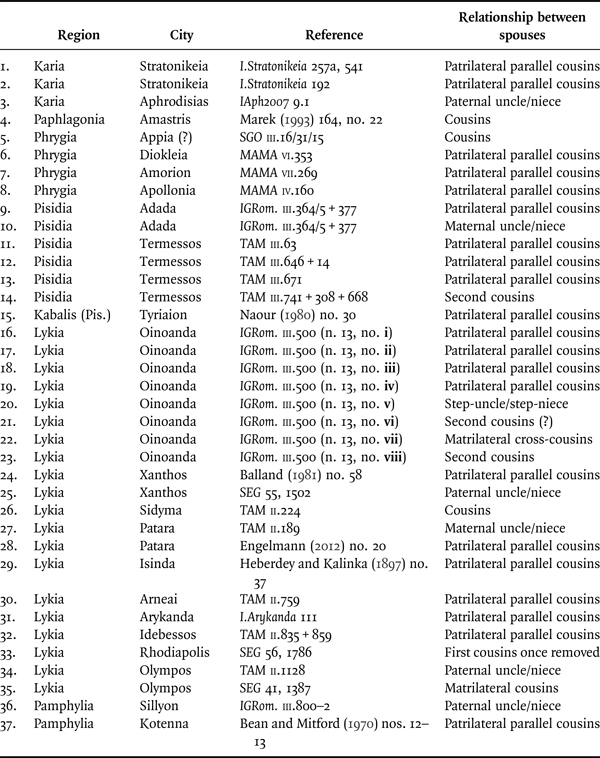
Including the eight close-kin marriages attested in the genealogy of Licinnia Flavilla, but omitting the nine Lykian and Karian cases of brother–sister marriage, we are left with a total of thirty-seven certain or highly probable cases of close-kin marriage from Roman Asia Minor, spread across the whole period from the first century BC to the fourth century AD.Footnote 52 These thirty-seven marriages are tabulated in Table 1.Footnote 53 I make no grand claims for the statistical significance of this sample. It is, of course, quite impossible to judge what proportion of the total number of marriages in Roman Asia Minor (or even of marriages among the uppermost stratum of the civic elite) were marriages between close kin. Nonetheless, compared to (say) the small total numbers of close-kin marriages attested in classical Athens or in late Republican and early imperial Rome, the sheer bulk of evidence from Roman Asia Minor is impressive.Footnote 54
Close-kin marriages in Roman Anatolia.

The data fall into some suggestive patterns. We ought first to note the highly differentiated social distribution of close-kin marriage. The overwhelming majority of the examples discussed in this paper derive from the uppermost strata of the civic élite; in only a single case, from the territory of Amorion in eastern Phrygia (no. 7 in Table 1), can we be sure that we are dealing with a sub-elite and non-urban family.Footnote 55 Of course, most of our epigraphic evidence of any genre is the product of wealthy families; absence of evidence for close-kin marriage among rural and non-elite classes is not necessarily evidence of absence. But at the very least, our evidence provides no support for the notion that close-kin marriage was more characteristic of an indigenous substrate than of the Romanised office-holding urban elite. In a society without endogamic marital rules, there is no a priori reason to expect that close-kin marriage will tend to be more prevalent at village level than in elite and urban contexts; in early modern England, the opposite seems to have been the case.Footnote 56
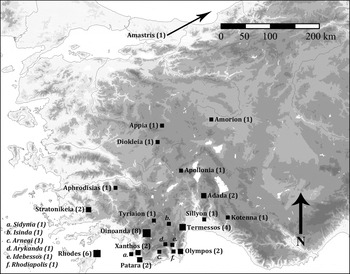
More striking still is the highly uneven geographic distribution of close-kin marriage in Asia Minor. As Figure 3 graphically illustrates, epigraphic evidence for close-kin marriage in Roman Asia Minor is heavily concentrated in the far south of the peninsula; more than three-quarters of the relevant documents derive from Lykia and the neighbouring regions of Pisidia and Pamphylia. The evidence for close-kin marriage elsewhere in Asia Minor is exiguous: a single case from Paphlagonia, four examples from widely spaced parts of Phrygia, and three cases among the civic elites of Karian Stratonikeia and Aphrodisias. I have found not a single unambiguous case of close-kin marriage in the voluminous (and discursive) funerary epigraphy of north-east Lydia;Footnote 57 nor have I located any instances in the epigraphy of the old Greek cities of western Asia Minor (Ionia, Aiolis, the Troad). No doubt I have missed some examples, but I should be surprised if the overall geographic distribution were seriously affected by this.
The geographic distribution of close-kin marriage in Roman Asia Minor.

How are we to account for this concentration of evidence for close-kin marriage among the urban elite of Lykia and adjacent regions? Was close-kin marriage actually more common in southern Anatolia than elsewhere, or are we simply dealing with a distinctively Lykian tendency towards the public commemoration of close-kin marriage?Footnote 58 I see no way of knowing for sure. It is certainly striking that the one part of the insular Aegean which offers a significant body of evidence for close-kin marriage is the island of Rhodes, which enjoyed intimate cultural contacts with coastal Lykia and Karia throughout antiquity. The abundant late Hellenistic and early imperial funerary epigraphy of Rhodes provides half a dozen instances of close-kin marriage, three of them explicitly commemorated (‘my niece and wife’).Footnote 59 Yet here too, it is impossible to say whether close-kin marriage was actually more common on Rhodes than on (say) Samos, or whether Rhodian spouses were simply more prone to commemorate their consanguinity on stone.
On the Greek mainland, marriages between close kin are occasionally attested among civic and senatorial elites during the first three centuries AD. However, unlike in Lykia, such unions are seldom commemorated explicitly; our knowledge of them largely derives from modern reconstructions of familial genealogies.Footnote 60 Even if we were to suppose, ex hypothesi, that elite close-kin marriage was widespread in all parts of the Greek East, we would still be left with a sharp regional discrepancy in commemorative practice: the civic elites of Roman Lykia and neighbouring regions were far more willing to record close-kin marriages on stone than the civic elites of Roman Sparta and Athens. It is worth emphasising that this local pattern of commemoration is an important historical phenomenon in its own right. The fact that Lykian elites commemorated their close-kin marriages, and Spartan elites did not, is important evidence for the normative desirability of close-kin marriage in southern Anatolia (I shall return to this point below).
Finally, and perhaps most interesting of all, elite Anatolian close-kin marriage falls into a very clear structural pattern. The types of close-kin marriage attested in our sources can be tabulated as follows:

Of the thirty-seven attested close-kin marriages in Roman Asia Minor (once again omitting cases of sibling marriage), a minimum of twenty-one of them (57 per cent) took the form of FBD first-cousin marriages (marriages between the children of two brothers).Footnote 61 No less striking is the near-total absence of any other varieties of first-cousin marriage in our data set, the sole exceptions being a single case of matrilateral cross-cousin marriage at Oinoanda (MBD) and a case of matrilateral cousin marriage at Olympos (MBD or MZD). We are, I suggest, entitled to speak of a preferential marriage system among the civic élites of southern Asia Minor in the early Roman Imperial period. Other things being equal, when men of this class married close kin, they strongly favoured marriage with their father's brother's daughter.
Might this apparent preference for FBD marriage (marriage between patrilateral parallel cousins) result from systematic over-representation of this particular type of marriage in our surviving evidence? It is of course true that, in cases of ‘unmarked’ and ‘concealed’ close-kin marriage, patrilateral parallel-cousin marriage will tend to be more visible than any other type of cousin marriage. To take a simple example: we are only able to identify a case of close-kin marriage at Arneai (no. 30 in Table 1) because the paternal lineages of both husband and wife are given to the third generation (Dioteimos, son of Ouassas, grandson of Dioteimos; Lalla, daughter of Teimarchos, granddaughter of Dioteimos). Had Dioteimos and Lalla been cross-cousins, or matrilateral parallel cousins, their lineages alone would not have revealed their status as cousins. It is, then, quite possible that the real proportion of close-kin marriages taking the form of FBD first-cousin marriages was somewhat lower than 57 per cent.
Nonetheless, I still see no reason to think that this figure is dramatically too high. We can test this claim, in a crude way, by limiting ourselves to cases where our knowledge of the kinship connection between husband and wife does not depend on the reconstruction of paternal lineages – that is to say, where we are offered an explicit statement of the character of the relationship between husband and wife (‘my uncle and husband’ and similar phrases). There are, by my count, thirteen such cases in Roman Asia Minor, of which at least seven (54 per cent) are cases of FBD cousin marriage.Footnote 62 In short, the preponderance of patrilateral parallel-cousin marriage among close-kin unions in Roman Asia Minor is not just an optical illusion. FBD cousin marriage was, at the very least, preferentially commemorated, and there is no good reason to doubt that this preference reflects real marital practices.
Demonstrating the existence of a preference for FBD cousin marriage among the elite families of Lykia and southern Anatolia is one thing; accounting for it is quite another. Most historians who have concerned themselves with cousin marriage in antiquity have been content with functional explanations of two broad kinds: retaining dowries within the family, or more generally consolidating a family's inheritance, particularly in the absence of male heirs;Footnote 63 and/or strengthening family ties and securing inter-generational loyalty.Footnote 64 No doubt these functional advantages helped to determine marital choices in some individual cases. As we have seen, the marriage of Menodora of Sillyon (probably an only daughter) to her paternal uncle may well have been intended, at least in part, to provide her father with a male heir, and the Christian Akakios of northern Phrygia married his only daughter to her cousin in the hope that they would care for him in his old age.
But whether functional advantages of this kind can serve as general explanations of FBD first-cousin marriage in Roman Anatolia is more doubtful.Footnote 65 First-cousin marriage is in no way restricted to families which lacked male heirs. Nor do we have any reason to think that families systematically pursued close-kin marriage to the exclusion of other marital forms; as we have seen, in the case of the Licinnii of Oinoanda, first-cousin marriage and cross-polis exogamy together made up a dyad of preferred marital strategies. What is more, these functional advantages would have applied equally well to elite families at Termessos, Ephesos and Lugdunum; they cannot help to explain the distinctiveness of close-kin marriage and its commemoration in southern Asia Minor.
Perhaps most important of all, we should be quite clear that the kinds of functionalist explanations outlined above are modern rationalisations of ancient marital behaviour. We have very little direct ancient testimony that close-kin marriage in the Greco-Roman world was favoured for reasons of inheritance, dowry-preservation or the consolidation of familial property.Footnote 66 Neither Menodora nor the voluble Licinnia Flavilla say anything of the kind; nor do the literary sources cited at the beginning of this paper (Apuleius and Dio Chrysostom) give any hint of practical considerations informing their subjects' marital choices. That is to say, we ought to be very wary of accounting for ancient marital behaviour in terms of instrumental rationality. That a particular form of marriage happens to be economically ‘rational’ does not mean that it was in fact favoured for economically rational reasons.Footnote 67
The fact that (some) families chose to commemorate their close-kin marriages prominently on their tombstones when they did not need to do so ought to be given due weight. Killortes of Arykanda and Teitanis of Tlos did not just happen to choose to marry close kin; they were sufficiently proud of having married close kin that they deliberately highlighted the character of their relationship on their funerary monuments (‘Aristainete, my sweetest wife and cousin’; ‘Androbios, her brother and husband’). Being married to your father's brother's daughter was not just practically useful (though it may well have been that too); it was also a matter of social prestige. The decision to identify one's spouse as sibling, cousin or uncle on one's tombstone should, I suggest, be seen as analogous to recording the fact that one's spouse was a Roman citizen, a city-councillor, or a faithful and devoted wife. Being a Roman citizen, or being a faithful wife, of course brought certain practical benefits to an individual and his or her family, but they were also highly desirable traits for their own sake. In parts of southern Anatolia – although not, apparently, elsewhere in the peninsula – close-kin marriage was a categorical good, quite independent of its instrumental benefits.
This normative preference for particular kinds of close-kin marriage (at least among upper social classes, and at least in Lykia) ought not to be reduced to a single functional explanation, any more than the normative preference for faithful wives can be reduced to a question of instrumental rationality. In southern Anatolia, as elsewhere in the Roman world, there were plenty of good reasons for marrying one's father's brother's daughter: private sentiment, familial solidarity, maintaining inheritance, and so forth. What we can say is that in Lykia, in contrast to other parts of the Roman world, there was an additional reason for marrying one's father's brother's daughter, namely that this was a sufficiently socially prestigious act for one to be able to boast about it to other Lykians on one's tombstone. As a result, it is possible that rates of close-kin marriage, FBD first-cousin marriage in particular, ended up being higher in coastal southern Anatolia than elsewhere in the peninsula (or indeed elsewhere in the Roman world). However, since we have no evidence of any kind about actual rates of different varieties of marriage, either in Lykia or elsewhere, this can be no more than an informed guess.
Abbreviations
Abbreviations follow those given in LSJ and/or the Oxford Classical Dictionary (third revised edition), with the following additions:
- IAph2007
-
J. Reynolds, C. Roueché and G. Bodard, Inscriptions of Aphrodisias (2007). http://insaph.kcl.ac.uk/iaph2007/
- I.Arykanda
-
S. Şahin, Die Inschriften von Arykanda. IGSK 48. Bonn, 1994.
- I.Délos
-
Inscriptions de Délos, 7 vols., Paris, 1926–72.
- I.Konya
-
B. H. McLean, RECAM iv: Greek and Latin Inscriptions in the Konya Archaeological Museum, Ankara, 2002.
- I.Lindos
-
C. Blinkenberg, Lindos. Fouilles et recherches, 1902–14. Vol. ii: Inscriptions, 2 vols., Copenhagen and Berlin, 1941.
- I.Milet
-
A. Rehm, P. Herrmann et al., Inschriften von Milet, 3 vols., Berlin, 1997–2006.
- I.Rhod.Per.
-
W. Blümel, Die Inschriften der Rhodischen Peraia. IGSK 38, Bonn, 1991.
- I.Smyrna
-
G. Petzl, Die Inschriften von Smyrna, 2 vols. in 3. IGSK 23–4, Bonn, 1982–90.
- I.Stratonikeia
-
M. Ç. Şahin, Die Inschriften von Stratonikeia/The Inscriptions of Stratonikeia, 3 vols. in 4. IGSK 21–2, 68, Bonn, 1981–2010.
- I.Sultan Dağı
-
L. Jonnes, The Inscriptions of the Sultan Dağı i. IGSK 62, Bonn, 2002.
- RECAM ii
-
S. Mitchell, Regional Epigraphic Catalogues of Asia Minor 2: The Ankara District. The Inscriptions of North Galatia, Oxford, 1982.
- SGO
-
R. Merkelbach and F. Stauber, Steinepigramme aus dem griechischen Osten, 5 vols., Munich and Leipzig, 1998–2004.