

Introduction
Whether we agree or not, with the interaction of the COVID-19 pandemic and the subsequent Russia-Ukraine war, the current world is going through a structural transformation. Furthermore, the global vision of achieving the Sustainable Development Goals has been deteriorating significantly due to emerging geopolitical rivalries, elevated inflation, and low economic growth. Apparently, the development agendas of many countries need to adjust accordingly. Apart from leaving an aggressive negative footprint over the socio-economic, environmental, and geostrategic ecosystems, this structural transformation already jeopardises the current and future workplaces of millions. In such a complex situation, what should be the role of a trade or labour union? The essence of a trade union’s Power Resources Approach (PRA) is to utilise the ability of workers to claim their demand in an organised manner (Schmalz et al Reference Schmalz, Ludwig and Webster2018), which ultimately leads towards the establishment of their rights in a strategic fashion. Nevertheless, trade unions cannot stop corporations (e.g. JC Penney, Hertz etc.) from filing for liquidation, but they may ask the performing one to act ethically. In the present labour market, retrenchment or limiting the social benefits of the workforce as an automation, survival, or cost-saving strategy is trending. In such dynamics, the scope of triggering any or all of the four power resources (e.g. structural power, associational power, institutional power, and societal power) is quite limited, and mobilisation of a PRA might prove ineffective in securing the future workplace, which is the edge of existing PRA. However, ‘ethical power’ as a supplement to PRA might help to handle such a situation optimally. How may the notion of ethics be collaborated with the job market? Reducing salaries instead of cutting the workforce might be an effective ethical strategy for the job market, as experienced during the COVID-19 pandemic, for instance. This did not push staff into uncertainty but rather enhanced company confidence towards the turnaround with full force, in parallel.
Figure 1 shows the trade union density rate from 2009 to 2020 in the top ten economies of the world. Overall, we can visualise a sluggish or declining trend, which is not a good sign for decent industrial relations (IR) and social justice in the labour market. The waning of trade unions in terms of different parameters like membership density and number of registered trade unions and the subsequent impacts on the bargaining power of trade unions are under the spotlight in contemporary literature on IR and labour economics. In the era of the digital economy, the survival of formal trade unions is a big challenge (Vandaele Reference Vandaele2018). Still, the appeal of trade or labour unions is equally important, particularly in the labour-intensive industries of emerging markets and developing economies, and in precarious employment in developed economies (Mendonca Reference Mendonca2020; Keune and Pedaci Reference Keune and Pedaci2019).
Trade union density in the top ten economies (%).

However, what is the primary role of PRA? Is it simply to protect the worker’s interest (Stritch Reference Stritch2005; McLaughlin and Bridgman Reference McLaughlin and Bridgman2017; Refslund and Arnholtz Reference Refslund and Arnholtz2022)? The current model of power resource theory is based on the four related sources of power, which are discrete in their own fashion and whose nexus might be undefined to a certain extent. Moreover, the role of certain PRAs, especially the institutional power resources, may prove ambiguous (Bieler Reference Bieler2018). Yet the issue of context-based mobilisation of those PRAs is quite popular among practitioners, scholars, academicians, regulators, and policymakers in the concerned field. Model critics of the power resources approach are mostly confined to the mobilisation of different PRAs and their context-based applications. However, the context-based adjustment of the existing PRA model is still rare in labour literature and needs to be addressed with greater importance. While exercising certain resources such as structural and associational powers might not depend on any external factors, triggering or gaining the other two resources (institutional and societal) might depend on several external factors. From those factors, ethics is the most prominent one that is treated as a supplementary power in the current PRA model. So, what is ethics, and what is ethical power? According to the Markkula Center for Applied Ethics, ‘Ethics is based on well-founded standards of right and wrong that prescribe what humans ought to do, usually in terms of rights, obligations, benefits to society, fairness, or specific virtues’ (Velasquez et al Reference Velasquez, Andre, Shanks and Meyer2010). From this we can deem ‘ethical power’ to be the power of any ethically vetted claim or movement to achieve its desired goal by supporting or igniting other power resources. In practice, the existence and influence of ethical factors are very distinguishable from real-life cases. For example, as the case studies below demonstrate, the movement of the ‘National Association of Street Vendors of India (NASVI)’ for the official recognition of street vendors as small businesses achieved great success (Kumar and Singh Reference Kumar and Singh2018), but the comparable claim of the Bangladesh Road Transport Workers Federation for revoking an amendment of the transportation law did not materialise (Shafiq et al Reference Shafiq, Dahal, Siddiquee, Dhimal and Jha2019). This raises the question of why some movements are successful and some not, though both are backed by similar forms of PRA (e.g., associational power). Here ethical confrontation made the difference, where the NASVI claims were valid from an ethical perspective, while the Bangladesh Road Transport Workers Federation claims were not. Therefore, it is clear that ethics, as a supplementary driving force of PRA, are in practice but duly unrecognised. Though the four basic PRAs are the outcome of decades of rigorous research, their functioning scope might be limited by the paradigm shift of the changing landscape of global labour markets. Certainly, the current condition is complex and survival in the market is the real success. To cope with this adverse socio-economic transition, mobilising existing PRAs might not be enough. In this context, ethical power as a supplement to PRA might work like a silver bullet for trade unions around the world, and might be their only option. From the employer’s perspective, ethical power may facilitate their encountering reverse causation, where trade unions can influence an employer’s decision. This will ultimately widen the space for policymakers to make a soft and strategic balance of association power that might come both from employers’ associations and workers’ associations.
Along with high unemployment and low real wages, the major challenges of current labour markets are the lack of access to social protection and limited fundamental rights at the workplace (International Labour Organization (ILO) 2023). To address those challenges and ensure social justice in the global labour market, trade unions have very limited choice but to trigger and build on the existing power resources. In this regard, the appeal of ethical power might be a promising one. Mobilisation of this supplementary PRA might work in favour of establishing fundamental rights at the workplace and may accelerate the process of accessing social protection. Therefore, this study introduces the idea of ‘ethical power’ as a supplementary power to the current PRA model. In the process of adding this novelty to the existing power resources theory, the coursework of ‘Trade Union in Transformation’, a massive open online course (MOOC) of the ‘Global Labour University’, focus group discussion, analysis of real-life cases, and an extensive literature review played a prominent role.
The remainder of this paper is structured as follows: Sections 2 and 3 devote themselves to the literature review and methodology, respectively. The key contributions of this paper, which are the envisioned ‘Modified Model of Trade Union’s Power Resources Approach’, are presented in Section 4. Section 5 depicts the case studies while Section 6 provides concluding remarks.
Literature review
Labour market, trade union, and power resources approach
The global labour market is passing its most challenging period ever, from unaffordable living costs to the high risk of jobs disappearing, the threats are enormous and evolving. The recent release of the International Labour Organization’s (ILO) flagship report titled World Employment and Social Outlook: Trends 2023 estimated that about 214 million workers around the world live in extreme poverty and that about 473 million people struggled in the global job gap in 2022. Along with existing concerns regarding income inequalities and the improper distribution of wealth from a social perspective, the global community is also encountering major geo-political and environmental constraints such as the Russia-Ukraine war, high inflation, the migration and humanity crisis, climate disruption, and so on. Moreover, the socio-economic recovery from the COVID-19 pandemic is not as strong as expected, and is not identical across all countries due to variations in key economic components, the shock absorption capacity of the respective economies, the pace of adaptation to lockdown and vaccination measures, demographic traits, and so on. For example, a report from the Federal Reserve Bank of St. LouisFootnote 1 documented that, in this pandemic, the gross domestic product growth rate of middle-income countries shrank by 8.7%, whereas low-income countries experienced a 5.2% decrease. The report also highlighted that average excess mortality in low-income countries was 34%, more than three times higher than in high-income countries.
This raises a further question, that given such complex dynamics, what is the role of trade unions to protect workers’ interests? This is a very timely question. Misra and Ghosh (Reference Misra and Ghosh2022) recorded a declining trend in trade union density, membership, and volume across prominent economies of the world. This trend is not a good sign for trade unionisation, as it will inevitably lead to a further decline in bargaining power. Moreover, anti-union politics is limiting the power base of trade unions (Fichter, Reference Fichter2018b). In such a context, trade unions may no longer be treated as the ‘Sword of Justice’ (Flanders Reference Flanders1961), and classical research and investigation on favourable IR management may no longer be appealing. To handle the emerging issues in labour relations, Brookes (Reference Brookes2018) stressed the distinctive role of PRA scholars, who may guide union leaders and labour activists in a prudent manner. He also highlighted the need for developing the existing PRA model to enhance its practicality. Gumbrell-McCormick and Hyman (Reference Gumbrell-McCormick and Hyman2013) argue that the revitalisation of union power may be achieved through prudent and context-based strategy formulation; they suggest that collaboration among unions may offset the emerging challenges (e.g. declining bargaining power resulting from reducing membership) of trade unionisation. Ford and Gillan (Reference Ford and Gillan2021) investigated the application of power resources beyond the national border and found that the Global Union Federation is an impactful and legitimate body with the rightful authority to mobilise different PRAs in the international arena to ensure decent global labour relations. The less coordinated unionised workers are more vulnerable, even in highly unionised economies (Lommerud et al Reference Lommerud, Meland and Straume2021). Benos and Kammas (Reference Benos and Kammas2023) investigated the effects of ethnic diversity on participation in trade unions from a European perspective and found a negative effect of ethnic diversity on trade union density. Kostøl and Svarstad (Reference Kostøl and Svarstad2023) tried to uncover the influence of trade unions on the adaptation of technological change. They found that the union could alter the labour demand as well as the wage scale of routine and non-routine workers. They also argue that routine workers are at high risk of being replaced by automation. The nexus between unionisation and technological breakthroughs is well proven, and their correlation is generally negative. From the industrial revolution to artificial intelligence (e.g. ChatGPT), the threat of technology and innovation-driven unemployment is not something new in labour literature, with JM Keynes predicting this about a century ago (Keynes Reference Keynes1931). The socio-economic implications of such incidents can be a decline in labour’s share of income as well as a surge in inequality. The production model comprising physical, digital, and biological technologies is already in practice, which is the essence of the fourth industrial revolution. Industry 4.0 will trigger social transformation (Kurt Reference Kurt2019), which has direct implications for labour relations. However, mapping the impact of the fourth industrial revolution on the labour market is a big challenge. Is it going to further widen income inequality? How should labour relations during this structural transformation of employment be handled? To cope with the pace of the fourth industrial revolution and avoid negative impacts on the labour market in advanced economies, Haipeter (Reference Haipeter2020) suggests that the trade unions should activate works councils and enhance reciprocity between unions and works councils.
Trade unions in emerging and mature markets do not possess identical power, and economies dominated by labour-intensive industries mostly encounter the challenge of labour unrest (Kai and Brown Reference Kai and Brown2013). Legislative complexity and association pressure from employers on policymakers are the key drawbacks of trade unionisation in high-growth economies (e.g. Bangladesh) and labour-intensive industries like ready-made garments (Fink Reference Fink2014). In advanced economies (e.g. the USA), automation and technological change are key challenges (Nissim and Simon Reference Nissim and Simon2021) that limit the power of trade unions. Wage discrimination between routine and non-routine workers or regular and outsourced workers is a latent driver of worker unrest or dissatisfaction among blue-collar workers (Baek et al Reference Baek, Yoon and Won2023). In this regard, retirement benefits and social benefits like festival bonuses, paid absenteeism, and so on are key differentiators. The trade union is the leading actor in addressing such issues, as the union has distinct power and interest in exerting influence. Recently, automation and digitalisation have left a negative footprint on the powers of trade unions (Fichter et al Reference Fichter, Ludwig, Schmalz, Schulz and Steinfeldt2018), especially in terms of reduced membership rates. Mobilisation of power resources has helped recovery with the intervention of institutional power, which ultimately contributed to achieving trade unions’ goals via PRA. Therefore, it is not necessary to have high membership rates to establish any claim to a trade union (Wagner and Refslund Reference Wagner and Refslund2016). Besides this, PRA might prove ineffective if the union cannot mobilise its prevailing powers in an appropriate manner (Lévesque and Murray Reference Lévesque and Murray2010) or trigger the prevailing union power for any unethical claim (please look at case 1). Utilisation of different types of PRA is subject to the pattern of the respective industry, where dynamic restructuring of industries (Fichter Reference Fichter2018a) consistently leaves challenges for trade unions. Hui (Reference Hui2022) found that the gaining or triggering of power resources depends not only on labour relations with employers but also on the pattern or involvement of other actors (e.g. the government) and the structure of trade unionisation, i.e. top-down or bottom-up. Benassi and Vlandas (Reference Benassi and Vlandas2016) identified the tangent point between institutional power and culture. They also found a negative attitude towards women, minorities, and marginalised workers among trade union leaders. Ledwith (Reference Ledwith2012) investigated the power game within trade unions from a gender and diversity perspective. Diversity within the union might be considered an active factor to justify any claim from a social as well as ethical viewpoint that might lead to strengthening institutional power. Provis (Reference Provis2012) identified that we are sacrificing moral argument and discussion in almost every sphere of life to an extent for market mechanisms and technocratic decision-making. He also argued that, in the organisational context, this emerging trend has significant implications for common-bond groups, common-identity groups, and institutionalised groups. Therefore, as a strategic actor in any society and economy, labour’s rights should be legally protected and largely respected.
Theoretical underpinning
Schmalz et al (Reference Schmalz, Ludwig and Webster2018) deeply investigated the origin and development of Power Resources Approaches (PRA) by Walter Korpi (see e.g. Korpi Reference Korpi1974, Reference Korpi1978, Reference Korpi1983), Gøsta Esping-Andersen (Esping-Andersen and Korpi Reference Esping-Andersen, Korpi and Goldthorpe1984; Esping-Andersen Reference Esping-Andersen1985), and John Stephens (Reference Stephens1979), and ended up with an expanded chart based on the study conducted by Gerst et al (2011), where the interlinkage among the four basic power resources approaches was identified. Refslund and Arnholtz (Reference Refslund and Arnholtz2022) revisited power resources theory in a comprehensive manner and denoted this as a key driver of social change, subject to their distribution and composition. However, upgrading a theory (e.g. PRA) and integrating a new concept (e.g. ethical power) requires an appropriate carrier, favourable context (Hauptmeier and Heery Reference Hauptmeier and Heery2014), constructive criticism, and proper recognition. Promoting such an idea demands collective action and adequate resources. In this particular case, the key challenge is how to prove something ethically right or wrong. Justifying the objective of a statement or claim of any movement from an ethical perspective is not plain vanilla but rather exotic, since the term ethics is somewhat abstract. For example, according to ethicist Rushworth Kidder Footnote 2 , ‘As we practice resolving dilemmas, we find ethics to be less a goal than a pathway, less a destination than a trip, less an inoculation than a process’. However, the decision criteria for ethical value vary from context to context. For Thompson and Ackroyd (Reference Thompson and Ackroyd1995), ethics is driven by ontology, while for Knights (Reference Knights1992) and Willmott (Reference Willmott1993), ethics is driven by epistemology. Moreover, it is not necessary to have empirical evidence to reach a consensus on a notion like ethics (Parker Reference Parker1999). This is quite a popular debate (Parker’s highlight of Smith and Thompson’s accusation against Knights and Willmott is no longer within the legitimate boundaries of labour process analysis) in labour process theory, where Thompson et al counterattacked Martin Parker over the criticism of their work. Thompson et al (Reference Thompson, Smith and Ackroyd2000), in their revenging statements published in Organization Studies, defined Parker’s labour process theory analysis as selectively problematic, and accused him of distorting the labour process debate. However, generalising one situation from the moral experience of other comparable situations might lead to a consensus on abstract terminology like ethics (Sayer Reference Sayer2005).
Research gap and scholarly contribution
Studies on power resources theory or the power resources approach, and their related implications in prudent industrial relationship management as well as in political science, are abundant. Among those works that were published since the beginning of the 21st century, Chun’s ‘Symbolic Power’ (Chun Reference Chun2009) appeared to be the most promising attempt to upgrade existing PRA theory. Other notable developments in labour theories and IR might be the chains of equivalence (McLaughlin and Bridgman Reference McLaughlin and Bridgman2017), the role of ideas in IR policy change or ideational power resources (Hauptmeier and Heery Reference Hauptmeier and Heery2014; McLaughlin and Wright Reference McLaughlin and Wright2018), and coalition power (Tattersall Reference Tattersall2010; Schmalz et al Reference Schmalz, Ludwig and Webster2018), where Refslund and Arnholtz (Reference Refslund and Arnholtz2022) referred to ideational and coalition power as supplements to associational and structural power resources. However, to the best of the author’s knowledge, there is no literature in the fields of labour economics and IR that coined the term ‘ethical power’ in power resources theory. In this regard, this study might prove innovative and advance the scholars’ perspective that there is enough room and need to modify the current PRA model. Therefore, the introduction of ‘ethical power’ as a supplement to the current PRA is a unique contribution of this paper. This contribution is equally valid both for the school of IR and the universe of political science. This distinctive research will stimulate policymakers and scholars of the respective domains to further ignite this idea through constructive criticism, appropriate application, and scientific addition.
Methodology
The analytical strategy of this study may be distinguished into three folds: focus group discussion, case studies, and thematic innovation.
Focus group discussion
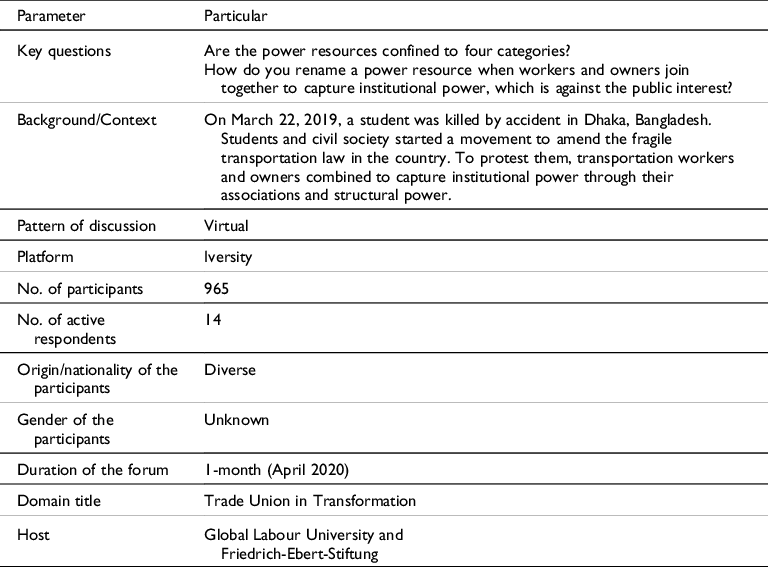
To identify the scope of upgrading existing power resources theory, justify the rationality of the study, and obtain feedback from competent peers, a focus group discussion was conducted through virtual means. Respective details are depicted in Table 1.
Focus group discussion

In parallel with the focus group discussion, an unstructured interview was conducted with a few active respondents to the forum who are veterans in this field.
Case studies
A couple of cases are investigated simultaneously in a logical manner with the intention of tracing the existence and relationship of the proposed ethical power there. The first case is about the joint movement of Bangladesh road transportation workers and owners associations to revoke the ‘Road Transportation Act 2018’. The second case is the movement of the ‘National Association of Street Vendors of India’, or NASVI, for the formal recognition of street vendors as legitimate small businesses in India.
Thematic innovation
I propose the modification of power resources theory by thematically including a new dimension with a supplementary role within the existing PRA model. A pictographic demonstration with detailed explanations of this supplementary power resource along with its application, limitations, and comparison with relative terms, follows.
Modified model of power resources approach
Philosophy
Ethical power is the power of any ethically vetted claim of a movement to achieve its desired objective(s) successfully by supporting or igniting other power resources. If the claim of a movement is not supported ethically, then it has a very rare chance of success, even if it is backed by strong power resources like associational power or structural power.
Key assumption
The precondition for utilising ethical power is that the goal or objective of the respective movement has to be very valid from an ethical perspective.
Model explanation
Until now, scholars have rightly omitted the impact of the ethical factor in PRA, despite its acute and strategic implications. Therefore, this study incorporates ‘ethics’ within the current PRA model and develops the updated version that is placed in Figure 2. This inclusion of ethics within the existing PRA model is not vague at all, due to its supplementary role in the attainment and exercise of basic power resources.
Modified PRA model. Source: Developed by the author based on the basic model from Gerst et al (Reference Gerst, Pickhaus, Wagner, Haipeter and Dörre2011).

The influence of ethics over the ‘structural power’ is secondary. As a result, for gaining and exercising structural power, trade unions do not need to depend on ethical factors. For example, the media have reported that healthcare staff demonstrated, and declared temporary layoffs in many parts of the world, including Spain and the USA, to highlight and reject inadequate and poor-quality personal protective equipment (PPE) during the COVID-19 pandemic. Therefore, the claim of healthcare staff is justifiable from an ethical viewpoint, as ethics imply right and fairness, whereas wearing standard-quality PPE is not only essential to ensure their own physical safety but also their right to avoid infection. Now, think about the strike of airline workers in the UK in September 2019. They halted the airline’s operation as this industry depends on a specialised workforce like theirs. Is it ethically justifiable? So ethical power has no influence over the gaining of structural power, but it might have some implication over the execution of such power.
‘Associational power’ also does not depend on ethical factors to gain its capacity. Nevertheless, ethical validation is somewhat relevant to exercising this power. On this occasion, the case of NASVI is remarkable. By utilising association power with strong support from society, street vendors in India obtained ‘institutional power’. The success story of NASVI is very popular among scholars and practitioners of labour studies, and it is often cited as a reference. If the claims of those vendors were not supported ethically, then achieving institutional power through mobilising associational power might not be possible. This can be distinguished easily from the comparable case of the movement of transportation unions in Bangladesh. The demand for updating the decades-old transportation act in Bangladesh received fresh impetus after the deaths of a couple of students in the streets of the capital city at the end of July 2018. Transportation unions across the country reacted aggressively with their very strong associational power to revoke the respective amendment. The union of transportation owners joined forces with transportation workers. Their combined movement was so strong that several embassies in Bangladesh, including the US Embassy, declared a countrywide ‘demonstration alert’. From such action, we can easily understand the extent of associational power that the respective unions possess. Unfortunately, the strong associational power of both the owners’ and workers’ associations failed to achieve institutional power since the claim of the unions was not right from an ethical point of view. Why was it not right? Because drivers were not afraid to break the law, as it stood at the time, as the highest penalty for accidental death was minimal, around BDT 20,000 (equivalent to approximately USD 240) and/or 3-year imprisonment. Therefore, justifying any claim from an ethical perspective is crucial before exercising associational power, which ultimately supports the existence and importance of this supplementary power resource.
The proposed supplementation of the power resources approach has greater implications for ‘societal power’. If the claim of any movement is not valid on ethical grounds, neither the attainment nor the exercise of societal power is possible. For example, the joint movement of transportation workers and transportation owners to revoke the ‘Road Transport Act 2018’ of Bangladesh was in vain due to a lack of ethical support. The claim of amending an existing act, on the other hand, is derived from strong societal power that is ethically supported. Similar characteristics appeared in the case of the movement of NASVI in India, where ethically driven associational as well as societal power established the institutional power of street vendors. Therefore, enabling societal power greatly depends on ethical support.
Trade unions might be granted ‘institutional power’ inherently by the existing labour laws of the territory or through the ILO convention, due to the ILO membership of the respective country. In fact, the union rights of labour associations or other such kinds of associations are legitimated via a legal institutional framework. For this reason, the initial gain of institutional power is not subject to ethical validation. However, amending the institution-related policy framework of trade unions is subject to ethical fairness, whether to construct new policy guidelines for them or to modify the existing laws due to the claims and movements of labour unions or other groups. Historically, trade unions exercised their associational as well as structural power to capture the institutional power that was further backed by societal power. However, such an attempt has never been successful without the ethical compliance of the respective claim. The failed movement of Bangladesh road transport workers as well as owners to revoke the amendment of the ‘Road Transportation Act 2018’ is the best example.
The existence and implication of ethical power as a supplement to PRA are quite remarkable. Even though the implication of ethics in terms of gaining or exercising societal power is very distinguishable, ethical power is definitely not a sub-form of societal power. In certain regimes (e.g. North Korea), based on the government setting, societal power is likely to be practically absent (Hinz Reference Hinz2018). Alternatively, policymakers might self-initiate several moral or ethical actions like amending the legal or institutional framework for socio-economic betterment and/or coping with contingencies, e.g. re-evaluating the minimum wage at certain intervals. Therefore, the role of ethics within the power game of the labour field is diverse. Whether to ignite societal power to influence institutional power or to justify any claim triggered through associational power for policy upgradation, the role of ethics within PRA is very valid. Nevertheless, ethics itself cannot be an isolated source of power resources, and the extent of ethical influence over the different PRAs is not identical. Hence, ethical power may be defined as supplementary to PRA.
Application of the model
The proposed modified model of PRA has greater appeal for policy advocacy. Whether to address the grievance or to offset the movement of trade unions, this supplementary PRA might work as an antitrust mechanism. Apart from the labour theory, this study might be a point of interest for political science to a different extent. However, the process of formulating or mending the institutional framework by the force of PRA is subject to ethical validation. Therefore, the use of ethical power in PRA is not something new but rather unrecognised. This addition might facilitate understanding and adapting to the changing landscape of the global labour market. It might also contribute towards the development of labour theories and the efficient governance of labour legislation.
Ethical power vs. symbolic power
Ethical power is sharply different from Jennifer Jihye Chun’s notion of symbolic power (Chun Reference Chun2009). The cases of symbolic power demonstrated how symbolic power helped institutional or structural reform. Such reforms were achieved by stimulating and engaging allies through ‘symbol’ and establishing equilibrium within the employer-employee relationship. The fundamental differences between symbolic power and ethical power are as follows:
-
In symbolic power, employer and employee are in opposition (which may be fair enough), but in ethical power, employer and employee are not necessarily in opposition and might be close allies in rare cases. Think about the joint movement of transportation workers’ and owners’ associations to revoke the amendment of the fragile transportation law of Bangladesh in 2018–2019.
-
Symbolic power mostly fosters the movements of workers, but ethical power predominantly acts for the unanimously accepted right and wrong that is beneficial to society, fairness, and good governance.
-
Symbolic power is not a power itself but rather a means of engaging like-minded peers towards a movement, whereas ethical power is an active supplementary power to PRA.
How do you assess any claim or movement in an ethical sense?
Generally, ethical validation of the claims of any labour movement is required to assess ethics in the labour market. However, before justifying the claims of any movement in ethical terms, it is necessary to understand what constitutes an ethical decision. According to Craig E Johnson, ‘Your initial reaction to an ethical dilemma, based on emotions, cultural influences, past experiences, and intuitions, can inform the conclusion’. For example, what drives one to invest in a solar company rather than a tobacco company if both yield similar returns with identical risk profiles? Certainly ethics, since a solar company produces electricity from renewable sources that are environmentally friendly, whereas a tobacco company leaves a negative footprint both on human health and the environment. However, there is no mathematical formula for ascertaining the ethical perspective of any movement. Still, we may justify the claim of any movement or issue of labour dispute in ethical terms by following four popularly vetted mechanisms (Johnson, Reference Johnson2012) of ethical decision-making:
-
James Rest’s four-component model
-
Six factors or element models by Charles Powers and David Vogel
-
Nine steps or checkpoints by ethicist Rushworth Kidder
-
Situation Definition, Analysis, and Decision formula by ethicist Louis Alvin Day
Limitations of the model
The functioning of this modified model might be limited on the grounds of governing policy, current practice, or rights of trade unionisation in the respective territory since the violation of institutional power through political interference is not rare. Even the existence of minimum wage rights depends on such a policy framework. Therefore, the pattern of a ruling government along with democracy, good governance, and transparency in the concerned jurisdiction might act as preconditions. In addition, justifying the ethical validity of an argument related to labour rights or their movement and ascertaining this from an ethical viewpoint is a big challenge. Finding appropriate means of triggering ethical power in the labour movement is also ambiguous.
Case studies
Case 1: Joint movement of Bangladesh road transport workers and owners association to revoke the amendment of the ‘Road Transport Act 2018’
Origin
On July 29, 2018, a couple of school students died on the street from a road accident in the capital city of Bangladesh, and students took to the streets to amend the fragile transportation law of the country. Why is this law treated as fragile? Until November 2019, issues related to road transportation in Bangladesh were governed by the ‘Motor Vehicles Ordinance 1983’. Within the provisions of this road safety law, the highest penalty for accidental death for a convicted driver was a fine of BDT 20,000 (equivalent to approximately USD 240) and/or three years of imprisonment. Under such provisions, drivers were indifferent to breaking the law, resulting in both an alarming death toll and rate of injury from road accidents. According to Solaiman and Algie (Reference Solaiman and Algie2022), Bangladesh has the highest number of accidental deaths in conjunction with the lowest number of vehicle users in the world. According to the 2021 report of the Independent Evaluation of the United Nations Road Safety Trust Fund Secretariat, the road accidental death rate (per 100,000) in Bangladesh is 15.3, and the country has no speed-limit law (United Nations Economic Commission for Europe (UNECE) 2021). However, by understanding the vulnerability of the respective law (Motor Vehicles Ordinance 1983), the Supreme Court of Bangladesh issued a ‘suo motu’ rule in 2007 that instructed the government to make amend, and implement the law to prevent road accidents.
Apparently nothing much has been done in order to control the speed of the vehicles within the limits spelt out in the 8th schedule. In the mean-time, hundreds and thousands of people died in the road-accidents. Recently, it has been reported in a news-paper that nearly 25 (twenty-five) thousand people died or maimed during the period of last one year. This is a staggering figure but surprisingly not a single case of punishment under Chapter X of the Ordinance has been furnished either on behalf of the BRTA or the Inspector General of Police, the respondent No. 4. [Suo Motu Rule No. 02 of 2007, p.2, High Court Division, Supreme Court of Bangladesh]Footnote 3
Thus, while the government of Bangladesh initiated and required action to amend the appropriate law, it took more than a decade to make and enforce the new law known as the ‘Road Transportation Act 2018 (RTA-2018)’. This was because of strong opposition from the association of transportation workers as well as the association of transportation owners. However, in the new Road Transport Act (enforced on November 1, 2019), the penalty reached its peak.
No matter what, if anybody gets seriously injured or killed in a motor vehicle-related accident, it would be considered as an offence under the relevant sections of the Penal Code, which are section 302 to 304B, with the maximum punishment being a death sentence. The offences that fall under section 105 of the act are not eligible for bail. [Section 105 of Chapter 11 of the Road Transportation Act of 2018]
However, the demand for passing and enforcing the RTA-2018 gained momentum after the accidental deaths of a couple of students in the streets of Dhaka at the end of July 2018. When the government was about to fulfil this demand, the Bangladesh Road Transport Workers Federation reacted very aggressively to this amendment and declared a countrywide strike for an indefinite period. The Federation of Transportation Workers Associations possessed enormous associational power, and one of the ruling ministers at that time headed the federation. Their movement was so strong that foreign consulates working in Bangladesh declared a demonstration alert. The movement further intensified with the support of the Transportation Owners Association. The joint forces, driven by strong associational power and supported by a minor structural power, claim to revoke the RTA-2018.
Ethical validation
Figure 3 depicts the ethical validation process of the joint movement of Bangladesh Road Transport Workers and Owners Associations. The goal of this movement was to revoke the execution of the ‘Road Transport Act 2018’. The movement was initiated by Bangladesh Road Transport Workers and Owners Associations, and they exerted very strong associational power to achieve their goal. The movement was supported by minor structural power. Their structural power is minor in the sense that they can only halt public transportation and road carriers like buses, trucks, etc. but cannot entirely stop the movement of the general community since other means of transportation like private motorcars, railways, seaways, and airways are not under their structural domain. However, as a rare event in the union movement, both the associations of transportation workers and owners (employers) united to achieve an identical goal and aggressively demonstrated their associational power. However, their claim was not ethically justifiable. Why not? Under the previous law, the highest penalty for accidental death to a convicted driver was a fine of about USD 240 and/or three years of imprisonment, which reached its maximum in the RTA-2018. The claim of the transportation workers and owners associations to revoke the RTA-2018 was not ethically valid because the penalty of an accidental death from a motor vehicle can’t be just USD240 or a few years of imprisonment only, and with the minimal penalty, drivers were reluctant to break the previous transportation law. Ultimately, the respective movements failed, and the Road Transport Act 2018 became effective in November 2019.
Ethical validation of the Transportation Act revoking movement in Bangladesh.

Results and evaluation
If we thoroughly examine this case under the ethical validation process, the binary rule of ethical validation posits that the claim from transportation workers not to amend the fragile law to prevent deaths from road accidents was against public and social interest. The mere attempt by two strong associations (e.g., the association of transportation workers and the association of transportation owners) to capture institutional power by exerting all possible forces was in vain. Here, the role of strategic actors like the government is parameterised by the student community and prominent arguments from civil society and social activists, like the fact that the penalty for killing by vehicle cannot be just a few years’ imprisonment. Finally, this upgrade of existing law, the RTA-2018, is for the betterment of society, to prevent the increasing death toll resulting from road accidents, and to ensure discipline on the road, which are very valid from an ethical perspective. As a result, ethical power, with the support of societal engagement, prevented strong associational power.
Case 2: The movement of the National Association of Street Vendors of India (NASVI)
Origin
Historically, the street vendors were indispensable parts of an overpopulated and developing society for supplying staple items (e.g. vegetables) and providing basic services (e.g. shoe mending) on the doorstep at a comparatively cheaper price. In modern society, where the platform economy has not flourished extensively and chain shops are not popular enough, they are still the primary source of providing daily items at an affordable rate. However, with the pace of socio-economic development and aggressive technological adaptation, this marginal group of society became a victim of rapid urbanisation in many developing countries of the world, including India. In the early 1990s, the oppression of street vendors (e.g. forcible evictions without prior notice) used to be a common phenomenon in Indian cities. Local government (e.g. municipal) and law enforcement agencies proceeded with the logic of removing pavement blockages, easing traffic jams, interrupting encroachers of public spaces in urban areas and — on the occasion of visiting cabinet members, diplomats, foreign delegates, high-ranking bureaucrats, and comparable bodies — for the sake of city beautification. The indescribable sufferings and struggles of millions of street vendors gave birth to the NASVI. According to the NASVI statistics, in 1990, there were about 3.6 million street vendors in India. Kumar and Singh (Reference Kumar and Singh2018) extensively investigated the origin, history, and series of struggles associated with the NASVI movement in India; from the 1990s rapid growth of street vendors, the 1995 Bihar state government’s brutal action against street vendors, and the remarkable initiatives of ADITHI (a Patna-based non-government organisation) for granulising and formalising an informal sector’s movement, to the 2003 NASVI as an officially registered association under the ‘Societies Registration Act of 1860’. Ultimately, the allegation against millions of street vendors as illegal encroachers of public space legitimately vanished in India when the National Policy on Urban Street Vendors was approved by the Cabinet on January 20, 2004. The case of the street vendor association in India is very popular in labour studies, as NASVI has a glorious history of protecting the rights and enhancing the dignity and social status of millions of working-class people.
This Policy would like to highlight the ruling of the Supreme Court that, if properly regulated according to the exigency of the circumstances, the small traders on the side walks can considerably add to the comfort and convenience of the general public, by making available ordinary articles of everyday use for a comparatively lesser price. An ordinary person, not very affluent, while hurrying towards his home after a day’s work can pick up these articles without going out of his way to find a regular market. The right to carry on trade or business mentioned in Article 19(1) g of the Constitution, on street pavements, if properly regulated cannot be denied on the ground that the streets are meant exclusively for passing or re-passing and no other use. [Chapter 3, Section 3.1.1, Report and Recommendation (2006), National Policy on Urban Street Vendors, Ministry of Micro, Small, and Medium Enterprises, Government of India]Footnote 4
Ethical validation
Figure 4 pictographically demonstrates the ethical validation process of the NASVI movement in India. If we closely observe this validation process, then it will appear that the goal of this movement was to formalise the recognition of street vendors as small businesses so that they wouldn’t be forced or in fear of a sudden windup of their moving business setup. This locomotive microbusiness mechanism is possibly their only means of earning their livelihood. The main driver of this movement was hard-earned associational power, since the journey of establishing NASVI as an officially registered association was not an easy one. However, the claim of millions of street vendors was duly supported by society and the movement triggered societal power as a supportive force. ‘Is the claim of street vendors ethically right?’ The key question of the ethical validation process got a positive nod. Subsequently, the binary rule (yes or no) of ethical validation propounded that the claim of NASVI was very valid from an ethical point of view. Ultimately, the movement became successful.
Ethical validation of the NASVI movement.

Results and evaluation
The growing number of incidents of street vendors’ harassment, confiscation, and sudden eviction are the main reasons for the formation of the NASVI movement (Swamy and Singh Reference Swamy and Singh2018). In response to the decade’s long oppression and discrimination against millions of informal entrepreneurs, this movement successfully sets an example of how to achieve institutional power through the justified mobilisation of associational power with the support of societal power. As an alternative, this could be regarded as a coalition of a couple of power resources (associational power and societal power) with different supportive actors like non-government organisations, civil society, and so on. This coalition strategically and positively structured the sensitive issue of millions of marginal communities to pave the way for acquiring institutional power that appeared worthy to the policymakers of the respective jurisdictions. Moreover, the claim of street vendors, that is, their recognition as small businesses, was right (justified) from an ethical perspective. If we thoroughly examine this case, then it will appear that the appeal of NASVI complied with and was based on well-founded standards of right, which are ethics. Confusion might prevail on how to decide this. Generalising the moral experience of this movement indicates that NASVI claimed their official recognition as a vendor, which is fair enough, logical, and not against public or social interest but rather essential for social fairness and justice. For this reason, not only their peers but also the general community supported them, which acts as a supportive force of societal power. As a result, NASVI’s associational power, with the support of societal and ethical powers, established the lawful dignity of millions of street vendors in India.
Concluding remarks
This study intends to incorporate ‘ethical power’ as a potential supplement to the current PRA model by demonstrating the role of ethics in different cases where PRA applies. This may not be a discovery in the sense that it wasn’t supported by rigorous empirical evidence but rather highlighted the role of ethics in PRA and pointed out the scope of modifying the current PRA model. Statements dealing with abstract terminology like ‘ethics’ often encounter disputes from empirical and theoretical perspectives. Such disputes neither prove the concept vague nor indicate the impartiality of philosophy since empirical observation is not the basis of moral consensus (Parker Reference Parker1999). Of course, empirical evidence adds value to the respective statement. However, the essence of this study lies in the role of trade unions in transformation. In the era of the digital economy, where global unrest and geo-economic power games between Western allies and the coalition of their competent opponents (e.g. Russia, and Iran) intensify uncertainty and challenges in the global labour market, how a trade union gets the most out of it for the sake of workers interests is something to look at. Securing the future workplace has been a steady concern for blue-collar jobs in the labour-intensive industries of developing countries as well as precarious employment in developed countries. Whether it is the replacement of humans by machines and robotics or the shrinking workforce due to automation and digitalisation, workers’ interests have always been preserved through the appropriate mobilisation of PRA. The inclusion of a supplementary power in existing power resources theory might demand rigorous empirical evidence, where its proper recognition in labour theories is crucial for effective policymaking. Ultimately, this study reveals that:
-
Ethical power is an active supplement to a trade union’s PRA that has greater implications for the achievement and exercise of the four vetted power resources, especially societal and institutional power.
-
This kind of power supplement might prove supportive for coping with socio-economic transition and corporate transformation and maintaining decent labour relations.
-
Power resources are always dependent on context, but the context-based adjustment model of power resources is acutely missing.
The proposed ‘Modified Model of Trade Union’s Power Resources’ might open a new avenue of deep research for scholars and practitioners in this area, where the scope of refining the proposed model can’t be omitted. Strategic recommendations on how to trigger the envisioned power resource (ethical power) require further experimentation and practical evidence, which will assist trade unions, corporations, policymakers, and other stakeholders in handling the current and comparable adverse situations and future contingencies. However, a comprehensive empirical analysis is not required by the methodology of this study. Still, the appeal of this study might be limited on the ground that there is no policy toolbox regarding the standard set of ethics that may be used for ethical validation.
Acknowledgements
I would like to thank Professor Diana Kelly (Editor-in-Chief) and Professor Anne Junor (Emerita Editor) of ELRR, anonymous reviewers, and the active participants of the focus group discussion. I would also like to express my deep gratitude to Professor Yongming Huang (CIDSP and Center for Industrial Economics, Wuhan University) and Professor Chen Hong (School of Economics & Management, Wuhan University) for their cordial supervision and consistent support of my research endeavour.
Funding statement
There are no financial or non-financial interests that are directly or indirectly related to the work submitted for publication. No funding was received to conduct this study.
Ethical standard
There is no direct involvement of humans or animals, as this study is based on secondary data. So, no harm in relevance.
Mohammad Jalal Uddin is from Chittagong, Bangladesh. He is currently pursuing his doctoral study at the School of Economics and Management, China Institute of Development Strategy and Planning, Wuhan University in China. His research interests mostly focus on the development of economic theories with practical application.