



1. Introduction
“Equality is a social impossibility” (Fried, Reference Fried1967, p.27)
“Egalitarianism is one of the most misunderstood forms of social organization” (Wiessner & Huang, Reference Wiessner and Huang2022, p.2)
Many traditional subsistence groups, including the Tanzanian Hadza, the Malay Batek, Central African BaYaka, Kalahari !Kung, Paraguayan Northern Aché, Philippine Agta, and Bolivian Tsimane, have been described as ‘egalitarian societies’ (Marlowe, Reference Marlowe2010; Endicott, Reference Endicott, Ingold, Riches and Woodburn1988; Boyette & Lew-Levy, Reference Boyette and Lew-Levy2020; Lewis, Reference Lewis and Hewlett2014; Lee, Reference Lee1979; Gurven et al., Reference Gurven, Allen-Arave, Hill and Hurtado2001; Page et al., Reference Page, Ruiz, Dyble, Major-Smith, Migliano and Myers2023; von Rueden et al., Reference von Rueden, Gurven, Kaplan and Stieglitz2014a): groups with marked “equalities of power, equalities of wealth and equalities of rank” (Woodburn, Reference Woodburn1982a). Alongside certain studies showing individuals in these societies live long lives and eat healthy diets (Pontzer, Wood, & Raichlen, Reference Pontzer, Wood and Raichlen2018; Cordain et al., Reference Cordain, Miller, Eaton, Mann, Holt and Speth2000; Kraft et al., Reference Kraft, Venkataraman, Wallace, Crittenden, Holowka, Stieglitz and Pontzer2021), have extensive leisure time (Dyble et al., Reference Dyble, Thorley, Page, Smith and Migliano2019; Sahlins, Reference Sahlins1972 though contra see Hill et al., Reference Hill, Kaplan, Hawkes and Hurtado1985), and little intergroup violence (Fry, Keith, & Söderberg, Reference Fry, Keith and Söderberg2020 though contra see Glowacki, Wilson, & Wrangham, Reference Glowacki, Wilson and Wrangham2020), this literature paints a rosy picture of life in small-scale societies as idyllic, with relatively few wants, iniquities, or conflicts (Diamond, Reference Diamond1987; Sahlins, Reference Sahlins1972; Ryan, Reference Ryan2019; Bregman, Reference Bregman2020; Lavi et al., Reference Lavi, Rudge and Warren2024).
There is also a long history in Western political thought of using small-scale traditional subsistence populations as models, or sometimes stand-ins, for the human past (reviewed Stibbard-Hawkes, in press; Marlowe, Reference Marlowe2005). Mobile hunter-gatherer lifeways, in particular, have often been taken as indicative of life during Pleistocene human evolution (Bowlby, Reference Bowlby1969; Isaac, Reference Isaac1978; Symons, Reference Symons1979; Diamond, Reference Diamond1987; Cosmides & Tooby, Reference Cosmides and Tooby1989). Observations of relative equality among contemporary foragers have bolstered arguments that egalitarianism characterized much of human evolutionary prehistory (Boehm, Reference Boehm1999; Knauft et al., Reference Knauft, Abler, Betzig, Boehm, Knox, Kiefer, Otterbein, Paddock and Rodseth1991) and is a baseline against which more recent, historical increases in inequality can be compared (Diamond, Reference Diamond1987; Anderson, 2017; Scheidel, Reference Scheidel2018; Turchin, Reference Turchin2016).
According to many accounts, our hunter-gatherer ancestors lived in a state of “primitive communism” (Morgan, Reference Morgan1877; Engels, Reference Engels1902; Lee, Reference Lee, Ingold, Riches and Woodburn1988) with both material and social equality and, often an altruistic desire to promote generalised equality, in stark contrast to the inequalities that were introduced by private property and state government (Diamond, Reference Diamond2013; Scott, Reference Scott2017; Fukuyama, Reference Fukuyama2011). Diamond (Reference Diamond1987) has called agriculture “the worst mistake in the history of the human race”, contrasting its “gross social and sexual inequality.… disease and despotism” (p.116) with hunter-gatherer societies where there are “no kings” and no “deep class divisions” (p.119). Morris (Reference Morris2015) argues that unlike farmers, foragers “tend to value equality over most kinds of hierarchy” (p. 4) and have a “strong sense that material hierarchy is morally wrong” (p.38). Sociologists Wilkinson and Pickett (Reference Wilkinson and Pickett2010) contended that “for over 90 per cent of our existence as human beings we lived, almost exclusively, in highly egalitarian societies” (p.204) and that “inequality arose and spread with the development of agriculture” (p.205). Ryan (Reference Ryan2019) writes “Until the radical transformations triggered by agriculture around ten thousand years ago, human lives were characterized by egalitarianism, mobility, obligatory sharing of minimal property, open access to the necessities of life” (p.19). Likewise, the economist Fukuyama (Reference Fukuyama2011) relates that “the hunter-gatherer societies that preceded agricultural ones… [had] relatively little differentiation between families, no permanent leadership, and no hierarchy” (p.54–55). The notion of ‘equality’ as the original human condition is so pervasive that a 2020 conference, bringing together archaeologists and hunter-gatherer experts, was titled with the question “Social Inequality Before Farming?” (Moreau, Reference Moreau2020).
Sometimes, in the tradition of Rousseau (Reference Rousseau1755/1992), discussions of contemporary hunter-gatherers are a vehicle not just for imagining the human past but determining human nature itself (Morgan, Reference Morgan1877; Engels, Reference Engels1902). Indeed, Woodburn (Reference Woodburn, Widlok and Tadesse2005) has speculated that “immediate-return” egalitarian hunter-gatherer societies may be the elementary forms of human social organisation. Economist Ernst Fehr argues that humans are characterised by strong “social preferences”: altruistic desires to “sacrifice money or other material resources… to establish fairness and justice” (Fehr & Charness, Reference Fehr and Charness2024, p.1) and that “in light of the ethnographic evidence” there was a “strong role of egalitarian ‘instincts’ in human evolutionary history” (Fehr, Bernhard, & Rockenbach, Reference Fehr, Bernhard and Rockenbach2008, p.1082). Similar claims are made in popular accounts. Hare & Woods (Reference Hare and Woods2020), pointing to widespread food-redistribution among hunter-gatherers like the Hadza, argue that throughout our evolutionary history a predisposition “to distribute food relatively equally” gave a “competitive advantage over less cooperative, more despotic humans with less reliable social insurance” (p.73). Historian Rutger Bregman (Reference Bregman2020) goes as far as saying that “Rousseau might be the true realist” (p.88) that “for most of human history… men and women were more or less equal” (p. 83), and that archaeology and hunter-gatherer ethnography give the impression “humans are noble by nature, and we were all doing fine until civilisation came along” (p.80).
Within the academy, the idea that hunter-gatherer prehistory was profoundly equal has been repeatedly contested. Multiple researchers have argued hunter-gatherers with pronounced material and social inequalities were common throughout the Holocene and late Pleistocene (Hayden, Reference Hayden2021; Rowley-Conwy, Reference Rowley-Conwy, Panter-Brick, Layton and Rowley-Conwy2001; Singh & Glowacki, Reference Singh and Glowacki2022; Wobst, Reference Wobst1978; but see Shultziner et al., Reference Shultziner, Stevens, Stevens, Stewart, Hannagan and Saltini-Semerari2010). Others have framed contemporary egalitarian subsistence populations as products of modernity, dispossessed by global capitalism or more generally forced to subsist on the less productive margins of state societies (Wilmsen et al., Reference Wilmsen, Denbow, Bicchieri, Binford, Guenther, Lee and Denbow1990; Solway, Lee, & Barnard, Reference Solway, Lee and Barnard1990; Bailey et al., Reference Bailey, Head, Jenike, Owen, Rechtman and Szechenter1989; Hart & Hart, Reference Hart and Hart1986; Singh & Glowacki, Reference Singh and Glowacki2022; and see Woodburn, Reference Woodburn, Ingold, Riches and Woodburn1988; Kelly, Reference Kelly2013; Cunningham et al., Reference Cunningham, Worthington, Venkataraman and Wrangham2019; Endicott & Bellwood, Reference Endicott and Bellwood1991; Porter & Marlowe, Reference Porter and Marlowe2007).
In response to popular portrayals of our egalitarian natures and egalitarian past, others have dismissed the notion of egalitarian societies even more forcefully. In two popular essays, anthropologist Manvir Singh (Reference Singh2021; Reference Singh2022) calls notions of an egalitarian past “a scientific origin myth” that is “widely influential and quite wrong”. He casts the idea as “seductive”; appealing but specious; a more palatable but less realistic alternative to the “idea that human nature was forged in a chaos of sundry social environments”. Graeber and Wengrow, in their 2021 book, The Dawn of Everything, go further, calling egalitarianism “a slippery term” (p.99) and a “Garden of Eden narrative” (p.102). They contend there is “simply no reason to believe that small-scale groups are especially likely to be egalitarian” (p.15), and that “it remains entirely unclear what ‘egalitarian’ even means”. They dismiss the idea as lacking “real analytical substance”. Instead, it simply refers “to that kind of protoplasmic mass of humanity one imagines as being left over when all the trappings of civilization are stripped away” (p.62).
Despite these critiques, the notion of ‘egalitarian societies’ is enduring. This is in part because, although certainly influenced by utopian political philosophers (see Graeber & Wengrow, Reference Graeber and Wengrow2021; Geroulanos, Reference Geroulanos2024) the phenomenon has a solid basis in empiricism. Ethnographic accounts of egalitarian societies are the product of careful engagement with traditional subsistence communities (Boyette & Lew-Levy, Reference Boyette and Lew-Levy2020; Endicott, Reference Endicott, Ingold, Riches and Woodburn1988; Lewis, Reference Lewis and Hewlett2014; Woodburn, Reference Woodburn1982a), and descriptions are notably consistent both within and across societies (e.g., Hawkes, Reference Hawkes and Diehl2000; Marlowe, Reference Marlowe2010; Woodburn, Reference Woodburn, Shack and Cohen1979; Endicott, Reference Endicott, Ingold, Riches and Woodburn1988; Lee, Reference Lee1979; Lewis, Reference Lewis and Hewlett2014; Woodburn, Reference Woodburn, Shack and Cohen1979; Thomson, et al, Reference Thomson, Lew-Levy, von Rueden and Stibbard-Hawkes2025). While true equality is seldom achieved, many foragers and horticulturalists exhibit markedly greater equality in political influence and in material wealth than pastoralists or agriculturalists (Borgerhoff Mulder et al., Reference Borgerhoff Mulder, Bowles, Hertz, Bell, Beise, Clark and Wiessner2009; Kaplan et al., Reference Kaplan, Hooper and Gurven2009). So, while the concept of egalitarian societies may be seductive, the phenomenon is to some degree not myth but reality.
Here, we contend that many debates concerning the validity of ‘egalitarian societies’ do not represent empirical disagreement but result from definitional ambiguity, and an emphasis of outcome over process in characterising societies. We first describe problems with outcome-based definitions of egalitarianism, particularly those emphasising equality (Section 2). To demonstrate the problems of society-level outcome-based definitions and to dispel the myth these groups are “societies of equals” (Woodburn, Reference Woodburn, Widlok and Tadesse2005, p. 21) we next show for seven overlapping domains of inequality — embodied capital, social capital, leadership, gender, age/knowledge, material capital/land tenure, and reproduction — that while often relatively equal, in no domain are “egalitarian societies” universally truly equal (Section 3). Moreover, we argue that individuals in even the most egalitarian societies, rather than having unusual nobility of purpose (see Hames, Reference Hames2007; Lee, Reference Lee and Upham1990), or atypically pronounced other-regarding preferences for equality (see Henrich et al., Reference Henrich, Ensminger, McElreath, Barr, Barrett, Bolyanatz and Ziker2010; Smith et al., Reference Smith, Stibbard-Hawkes, Diamant, Mabulla, Bicchieri and Apicella2025), are frequently concerned with securing their own resource-access, status, and autonomy (Section 4).
However, we also emphasise that the processes identified in early canonical accounts of hunter-gatherer egalitarianism (Lee, Reference Lee, Ingold, Riches and Woodburn1988; Reference Lee and Upham1990; Woodburn, Reference Woodburn1982a; Reference Woodburn, Widlok and Tadesse2005) are broadly valid — though some should be more precisely operationalised and investigated. Drawing on this discussion, we redefine egalitarian societies as those where socio-ecological circumstances enable most individuals to successfully secure their own resource access, social status, and autonomy. We argue that this individual-oriented, process-first definition has more utility in the study of human political organisation, past and present, than those definitions emphasising equality of outcome, or nobility of motive. Like some other anthropologists (Wiessner & Huang, Reference Wiessner and Huang2022; Kelly, Reference Kelly2013; Boehm, Reference Boehm1999; Leacock, Reference Leacock1978), we view those processes by which individuals stake claims on resources acquired by others and limit others’ political power as paramount to the framework. We describe these processes in detail (Section 5): demand-sharing, risk-pooling, prosocial reputation-building, status-levelling, consensus-based collective decision-making, and mobility. These processes may result in relatively low inequality (Blurton Jones, Reference Blurton Jones1984; Marlowe, Reference Marlowe2010; von Rueden et al, Reference von Rueden, Redhead, O’Gorman, Kaplan and Gurven2019; Smith et al., Reference Smith, Stibbard-Hawkes, Diamant, Mabulla, Bicchieri and Apicella2025) but equality need not be the aim nor always the outcome. In this way, we show egalitarianism does not require us to believe in an “angelic past” nor, necessarily, a greatly “prosocial human nature” (Singh, Reference Singh2022). Moreover, though strongly correlated with subsistence ecology, we argue that these processes are not unique to hunter-gatherers, and that parts of this framework are applicable across subsistence contexts. We finish by elaborating future research directions to move away from society-level taxonomies and better operationalize egalitarianism within and across a broader range of societies (Section 6).
2. Outcome versus process in definitions of egalitarianism
There are numerous definitions of egalitarianism. Perhaps the most influential comes from Woodburn (Reference Woodburn1982a) who described egalitarian societies as those where “equalities of power, equalities of wealth and equalities of rank are not merely sought but are, with certain limited exceptions, genuinely realised” (p.432). He later calls them “societies of equals: equals in wealth, equals in power and equals in status” (Woodburn, Reference Woodburn, Widlok and Tadesse2005, p.21). Lee & DeVore (Reference Lee, DeVore, Lee and DeVore1968), defined egalitarianism as a system which keeps “wealth differences between individuals to a minimum” (p.12). Lee (Reference Lee, Leacock and Lee1982) defined egalitarianism as a “positive insistence on the essential equality of all people and a refusal to bow to the authority of others” (p.53). McCall & Widerquist (Reference McCall and Widerquist2015) delineate different types of egalitarianism but, in its broadest sense, characterise it as “an absence of real political hierarchy, and limited differences between individuals in terms of rank, status, wealth, or power” (p.21). Other definitions include societies with “as many positions of prestige… as there are persons capable of filling them” where “differences among members, apart from sex and age, tend to be ephemeral” (Fried, Reference Fried1967, p.33–34) and a type of political hierarchy where “the weak combine forces to actively dominate the strong” (Boehm, Reference Boehm1999, p.3).
Though some definitions focus on material wealth, and some on power, most have one or both of two elements: a description of process (i.e. “realisation”, “positive insistence”, “weak… dominate the strong”) and a description of outcome (“equalities of power… wealth… and rank”; “societies of equals”; “equality of all people”; “inequalities are at their minimum”; “limited differences between individuals”; “differences… tend to be ephemeral”). Usually, in text, discussions emphasise process. Woodburn (Reference Woodburn1982a), for instance, highlights that equality “is not neutral, the mere absence of inequality or hierarchy, but is asserted” (p. 432).
However, though process has been central in primary accounts of egalitarianism, as we have seen, in secondary discussions, equality of outcome is often emphasised (Fukuyama, Reference Fukuyama2011; Bregman, Reference Bregman2020; Ryan, Reference Ryan2019; Fehr et al., Reference Fehr, Bernhard and Rockenbach2008). Egalitarianism is often “defined negatively: as the absence of hierarchies” where everyone agrees that valued resources should be “distributed equally” (Graeber & Wengrow, Reference Graeber and Wengrow2021, p.99). Egalitarian societies are viewed as “lacking wealth inequality” (Page et al., Reference Page, Ruiz, Dyble, Major-Smith, Migliano and Myers2023, p.157), where “all individuals… are nominally equal” (Friesen, Reference Friesen2007, p.196), with “relative equality… in access to subsistence and other resources” (Garfield & Hagen, Reference Garfield and Hagen2020, p.1), where “access to subsistence resources is equal” (Mattison et al., Reference Mattison, Smith, Shenk and Cochrane2016, p.185), and “where food is widely shared, [and the] sick and injured are cared for” (Boyd & Richerson, Reference Boyd and Richerson2022, p.190). In experimental studies, egalitarianism has been operationalised as “equitable” resource redistribution (Fehr et al, Reference Fehr, Bernhard and Rockenbach2008), where individuals are “driven by the goal of… minimizing income asymmetries among others” (Pinheiro, Reference Pinheiro2022). This is often explicitly linked to hunter-gatherer ethnography (e.g. Fehr et al., Reference Fehr, Bernhard and Rockenbach2008). Accounts of the “origins” of inequality, especially, emphasise outcome, and typically highlight the relative material and political equality of hunter-gatherers (e.g. Fukuyama, Reference Fukuyama2011; Diamond, Reference Diamond2013; Dow & Reed, Reference Dow and Reed2022; Engels, Reference Engels1902). These paint a picture of the past where “before twelve thousand years ago, humans… lived in what might be called societies of equals, with minimal political centralization and no social classes.” (Boehm, Reference Boehm1999, p.4–5)
The emphasis on equality of outcome in these definitions is ostensibly reasonable. After all, the etymological root of “egalitarianism” — the French “égal” — literally means “equal”. Moreover, beyond anthropology, equality is central to accepted vernacular definitions of egalitarianism in social psychology (Sheehy-Skeffington & Thomsen, Reference Sheehy-Skeffington and Thomsen2020), political philosophy (Hiebaum, Reference Hiebaum and Wright2015; O’Neill, Reference O’Neill2008; Scheffler, Reference Scheffler2003) and behavioural economics (Fehr & Fischbacher, Reference Fehr and Fischbacher2004). Moreover, such accounts are (often) not mischaracterizations; nominally egalitarian societies are relatively equal in important ways. However, focusing on equality in outcome causes three primary issues.
First, a focus on generalised equality serves to systematically under-represent the inequalities found in all societies. The term egalitarianism has been applied to a broad range of potentially uncorrelated aspects of life, linked only by their capacity to be unequal (e.g. resource redistribution patterns, property ownership, knowledge, skill, status, leadership, and health). This causes apparent paradoxes where nominally egalitarian societies are shown to be distinctly unequal in important regards (Flanagan, Reference Flanagan1989; McCall & Widerquist, Reference McCall and Widerquist2015).
Second, and relatedly, a focus on outcome risks obscuring the motivations that generate equality. Definitions often emphasise that equality is maintained through normative enforcement of other-regarding equality preferences; i.e. a generalised egalitarian ethos. Woodburn (Reference Woodburn, Widlok and Tadesse2005) stresses that egalitarian hunter gatherers are “active promoters of equality… in all its dimensions” (p.22), while Lee (Reference Lee, Leacock and Lee1982) highlights “a positive insistence on the essential equality of all people”. Here, however, canonical definitions don’t distinguish between four different forms of inequality aversion: second-party (self-interested), second-party (other-regarding), third-party (self-interested) and third-party (other-regarding).
This is important because theories which predict similar outcomes may make very different claims about the nature of inequality aversion. For instance, many theoretical accounts of egalitarianism (Boehm, Reference Boehm1999; Gavrilets, Reference Gavrilets2012; Wrangham, Reference Wrangham2019) emphasise third-party processes, where self-interested participation in coalitional punishment is primary. Other models stress that humans are characterised by general other-regarding third-party inequality concerns and will engage in costly third-party punishment, even where it doesn’t directly benefit the punisher (Gintis, Reference Gintis2000; Fehr & Gächter, Reference Fehr and Gächter2002; Boyd et al., Reference Boyd, Gintis, Bowles and Richerson2003; though see Henrich et al., Reference Henrich, McElreath, Barr, Ensminger, Barrett, Bolyanatz and Ziker2006; Marlowe et al., Reference Marlowe, Berbesque, Barr, Barrett, Bolyanatz, Cardenas, Ensminger, Gurven, Gwako, Henrich, Henrich, Lesorogol, McElreath and Tracer2008; Guala, Reference Guala2012). Because ethnographic research has shown third-party punishments — especially corporal punishment and ostracism but also individual fines — are less frequent in smaller-scale societies (Singh & Garfield, Reference Singh and Garfield2022; Fitouchi & Singh, Reference Fitouchi and Singh2023; Wiessner, Reference Wiessner2005, Reference Wiessner2020; Marlowe et al., Reference Marlowe, Berbesque, Barrett, Bolyanatz, Gurven and Tracer2011), other theories have stressed second-party (dyadic) enforcement. Some place second-party other-regarding equality concerns at the fore, arguing that humans are characterised by intrinsic, universal prosocial preferences (Fehr, Reference Fehr2002; Hare & Woods, Reference Hare and Woods2020). Others contend that equitable resource reallocation results primarily from self-interested second-party equality concerns, such as via demand for restitution in the case of wrong-doing (Fitouchi & Singh, Reference Fitouchi and Singh2023) or via dyadic demand-sharing from those with more resources (Blurton Jones, Reference Blurton Jones1984; Smith et al., Reference Smith, Stibbard-Hawkes, Diamant, Mabulla, Bicchieri and Apicella2026).
Focussing on process also reveals that equality often emerges not in spite of but because of status motivations. Coalitional levelling of would-be aggrandizers is frequently motivated by participants’ concerns over their own relative status (Boehm Reference Boehm1999). Sharing of knowledge, goods, or labour that equalises material inequality is often motivated by benefits to one’s reputation as a partner, ally, or leader (Gurven et al, Reference Gurven, Allen-Arave, Hill and Hurtado2000; von Rueden, et al. Reference von Rueden, Redhead, O’Gorman, Kaplan and Gurven2019), sometimes, perhaps, via signalling (see Hawkes, O’Connell, & Blurton Jones, Reference Hawkes, O’Connell and Blurton Jones1991; Bird et al, Reference Bird, Scelza, Bird and Smith2012; Bliege Bird & Power, Reference Bliege Bird and Power2015; Stibbard-Hawkes, Reference Stibbard-Hawkes2019). Those who acquiesce to demands for food may avoid reputations for stinginess, independent of marginal utility concerns (Winterhalder, Reference Winterhalder1996b). Status-seeking is not absent in more egalitarian societies but expressed via cooperation; albeit usually with subtlety and humility (Wiessner Reference Wiessner, Wissner and Schiefenhovel1996).
Third, focus on process acts as an antidote to society-level taxonomizing. For a long time in anthropology, “egalitarian societies” have been construed as a distinct type of society. The term has often been reserved for what Woodburn calls “immediate return hunter-gatherers” (Woodburn, Reference Woodburn, Widlok and Tadesse2005). This causes two difficulties. First it belies the fact that elements of “egalitarianism” appear in groups living in different ecologies, with partially or wholly different subsistence bases. These range from mobile hunter-gatherers (Boyette & Lew-Levy, Reference Boyette and Lew-Levy2020; Endicott, Reference Endicott, Ingold, Riches and Woodburn1988; Lewis, Reference Lewis and Hewlett2014; Woodburn, Reference Woodburn, Shack and Cohen1979), to more sedentary hunter-gatherer-horticulturalists (von Rueden et al., Reference von Rueden, Gurven, Kaplan and Stieglitz2014a), to many pastoralists (Salzman, Reference Salzman1999), to agricultural communes like kibbutzim (Abramitzky, Reference Abramitzky2018) or Franche-Comté farmers (Layton, Reference Layton2000). Focusing on equality of outcome at the society level obscures both the similarities and the differences in the ways by which this equality is achieved. Focusing on processes, instead, helps us identify the similarities and, by decomposing egalitarianism into different, discrete mechanisms, can dispel the enduring myth that these processes underlying egalitarianism are unique to small-scale foragers (discussed Kelly, Reference Kelly2013; Singh and Glowacki, Reference Singh and Glowacki2022). It further allows us to better understand context-bound differences in the mechanisms by which equality is achieved, both across societies and across time.
Another difficulty of a society-level approach to egalitarianism is that it does not deftly account for diversity. Under an outcome-oriented society-level typology, the most natural response to diversity has been further subtyping (e.g. Arnold, Reference Arnold1996; Hayden, Reference Hayden, Price and Feinman1995; McCall & Widerquist, Reference McCall and Widerquist2015) into e.g. “generalized versus specialized, simple versus complex, storing versus non-storing…, immediate versus delayed return” (Kelly, Reference Kelly2013, p.275), weak egalitarianism versus strong egalitarianism (McCall & Widerquist, Reference McCall and Widerquist2015), egalitarianism versus semi-egalitarianism (Begler, Reference Begler1978) or egalitarian versus transegalitarian (Hayden, Reference Hayden, Henley, Rossano and Kardas2019). Many have rightly called for fewer typological contrasts (Kelly, Reference Kelly2013; Wengrow & Graeber, Reference Wengrow and Graeber2015). Focusing on process, rather than outcome, solves this issue; it allows us to understand diversity in egalitarianism as it relates to several distinct processes, which are certainly linked to aspects of subsistence ecology but may occur separately, and may each differ in degree, rather than kind.
We return to these issues in the latter half of the article. First, however, it is important to demonstrate the key area in which outcome-oriented definitions fail: systematically under-representing the inequalities found in all human societies.
3. Inequality in egalitarian societies
A focus on outcome puts emphasis squarely on inequality sensu lato. Inequality may be defined broadly as any inter-individual or inter-group difference, or more narrowly as differences “imposed on individuals (or classes of individuals) by structural features of a social system” (Smith et al., Reference Smith, Smith and Codding2023, p.1). Much inequality research focuses on structurally-generated differences in material wealth, though this neglects other forms of wealth (Borgerhoff Mulder et al. Reference Borgerhoff Mulder, Bowles, Hertz, Bell, Beise, Clark and Wiessner2009). Structural inequality can manifest across multiple domains (Wisman, Reference Wisman2022) and its causes are manifold. In consequence, though many egalitarian societies are indeed relatively equal in several regards, they may still exhibit pronounced inequalities in other domains. Here, we explore ethnographic evidence of inequality in seven domains, which vary from less structurally imposed (inequalities of embodied capital) to more structurally imposed (age and sex). Because definitions of egalitarianism have stressed both equality in status, autonomy, and political power (Lee, Reference Lee, Leacock and Lee1982; Boehm, Reference Boehm1999 ; Woodburn, Reference Woodburn1982a; Reference Woodburn, Widlok and Tadesse2005), as well as equality in wealth, property, food and resource access (Lee & DeVore, Reference Lee, DeVore, Lee and DeVore1968; Woodburn, Reference Woodburn1982a; Reference Woodburn, Widlok and Tadesse2005), our review focuses on both types of inequalityFootnote 1. We demonstrate that ‘perfect equality doesn’t exist anywhere’ (Lee, Reference Lee and Upham1990, p.236) and nominally egalitarian societies are, in fact, notably unequal in multiple important ways.
3.1. Inequalities of embodied capital (size, skill and health)
While ‘capital’ is often framed as extrinsic — currency or material wealth — in biology and economics emphasis has also been placed on somatised, or ‘embodied’ capital (Becker, Reference Becker1985; Kaplan et al., Reference Kaplan, Gurven, Winking, Bengtson, Gans, Putney and Silverstein2007; Mincer, Reference Mincer1974). This can be straightforward stores of energy — adipose tissues, or muscle-mass — which, in many species, track measures of social status (Arnott & Elwood, Reference Arnott and Elwood2009). Even in human societies characterised by highly egalitarian politics, size and strength can be associated modestly with political influence both directly and via effects on other attributes (von Rueden et al., Reference von Rueden, Alami, Kaplan and Gurven2018, von Rueden, Lukaszewski, & Gurven, Reference von Rueden, Lukaszewski and Gurven2015).
In species inhabiting skill-intensive subsistence niches, including humans, embodied production ability is also highly variable (Kaplan, Gurven, & Winking, Reference Kaplan, Gurven, Winking, Bengtson, Gans, Putney and Silverstein2007; Kaplan, Lancaster, & Robson, Reference Kaplan, Lancaster and Robson2003; Koster et al., Reference Koster, McElreath, Hill, Yu, Shepard, Van Vliet and Ross2020). On one hand, skill differences may not always create inequalities across domains. Among the Hadza, despite mixed evidence that producers preferentially retain hunting returns (Hawkes et al., Reference Hawkes, O’Connell and Blurton Jones1991, Hawkes, O’Connell, & Blurton Jones, Reference Hawkes, O’Connell and Blurton Jones2014; Wood & Marlowe, Reference Wood and Marlowe2013; Reference Wood and Marlowe2014), there is little clear evidence that better Hadza hunters and their spouses have better nutrition, or higher child growth rates (Stibbard-Hawkes et al., Reference Stibbard-Hawkes, Attenborough, Mabulla and Marlowe2020; Blurton Jones, Reference Blurton Jones2016). On the other hand, there is extensive evidence that better hunters from a majority of nominally egalitarian societies have higher status, inter-personal influence, or age-specific fecundity (see Table 1). The Aché, who practice monogamous marriage, also practice partible paternity, the belief that multiple men can contribute to paternity (Walker, Flinn, & Hill, Reference Walker, Flinn and Hill2010); and often better hunters are named secondary fathers (Kaplan & Hill, Reference Kaplan and Hill1985). There are exceptions: a study of the Batek found no relationship between foraging success and lifetime reproductive success for either sex (Kraft et al., Reference Kraft, Venkataraman, Tacey, Kawai, Dominy and Endicott2019), yet the pattern is common.
Examples (non-exhaustive) of inequality and its effects in egalitarian societies, for different domains of inequality. Population descriptions that are not qualified by gender mean that both women and men were included across the referenced studies. The greater number of studies targeting men likely reflects differential research effort towards studies of inequality across men specifically

Table 1 Long description
A table with 10 rows and 5 columns. The columns are labeled Domain, Embodied capital, Social capital, Leadership, Gender, Age and belonging, Material capital and land tenure, and Reproduction. The rows list various studies and their findings related to inequality in egalitarian societies. Each row includes the domain of inequality, the population studied, the subdomain, and references. The table provides a detailed overview of how different factors contribute to inequality in various aspects of life within egalitarian societies.
Embodied capital also extends to health and disability. In even the most egalitarian societies, these may prompt infanticide or abandonment (see Table 1). Woodburn (Reference Woodburn, Bloch and Perry1982b) recounts that those Hadza “who cannot walk are not likely to be carried for long” (p.191) and that the infirm were often abandoned with provisions when too sick to move camp. Though care for the sick and elderly are common, attempts to equalize health disparities are neither universal nor guaranteed.
3.2. Inequalities of social capital
Where embodied capital refers to somatised ‘wealth’, social capital refers to relationships and obligations that can be leveraged for support (Lin, Reference Lin2001). These may be quantified using network analysis which has, again, revealed systematic inequalities among nominally egalitarian groups (Apicella et al., Reference Apicella, Marlowe, Fowler and Christakis2012; Migliano et al. Reference Migliano, Page, Gómez-Gardeñes, Salali, Viguier, Dyble and Vinicius2017; von Rueden et al. Reference von Rueden, Redhead, O’Gorman, Kaplan and Gurven2019).
Kin are principal sources of social capital. While most individuals in mobile hunter-gatherer residential groups aren’t close genetic kin (Hill et al., Reference Hill, Walker, Bozicević, Eder, Headland, Hewlett and Wood2011), consanguineal and affinal kinship often structures resource-sharing relations (Gurven, Reference Gurven2004b; Wood & Marlowe, Reference Wood and Marlowe2013). Kin also contribute disproportionately to coalitional support in conflicts among both foragers and egalitarian horticulturalists (Table 1), and those with more kin may more often emerge as leaders (Table 1). In many Inuit communities, kinship was defined by household membership more than genealogy or marriage, yet remained a source of systemic inequality (Guemple, Reference Guemple, Ingold, Riches and Woodburn1991; Burch, Reference Burch, Ingold, Riches and Woodburn1988).
Several studies in nominally egalitarian societies have shown that generous contribution to food-sharing or collective food production associates with inequalities in social capital (see Table 1), including aid during conflicts, times of illness or disability (Patton, Reference Patton2005, Gurven et al. Reference Gurven, Allen-Arave, Hill and Hurtado2000). Position in a community’s cooperation network also associates with variation in number of children in several egalitarian societies (Table 1). These trends are common but not universal and Hadza do not reliably distinguish each other in terms of generosity (Smith & Apicella, Reference Smith and Apicella2020), perhaps because strong demand-sharing norms render generosity less important.
3.3. Inequalities of leadership
Egalitarian societies have been characterised by ‘an absence of stratification’ (Howell, Reference Howell, Barnes, De Coppet and Parkin1985, p.170), with either ‘no leaders at all or leaders who are very elaborately constrained to prevent them from exercising authority or using their influence to acquire wealth or prestige’ (Woodburn, Reference Woodburn1982a, p.444). When considering formalised institutions of leadership, such characterizations are broadly accurate, yet obfuscate differences in informal influence in collective decision-making (i.e. leadership) which emerge even among mobile foragers (Garfield et al., Reference Garfield, von Rueden and Hagen2019a; Lewis, Reference Lewis1974).
In the context of conflict-mediation or group-wide decision-making, leadership often accrues disproportionately to particular individuals. Of the !Kung, Shostak (Reference Shostak1981) writes: “Each group has individuals whose opinions carry more weight… Despite their lack of formal authority, they function very much as group leaders” (pp. 245). Wiessner (Reference Wiessner2005) describes criticism of non-normative behaviour among the Ju/’hoansi (!Kung) as often initiated by “strong” men and women, who are “skilled in mediation and persuasion; usually good hunters, gatherers, musicians, or healers; and often have broad xaro networks.” Among the Andamanese, generosity, skill in hunting and in warfare enabled certain individuals to accrue disproportionate influence (Radcliffe-Brown, Reference Radcliffe-Brown1948).
Leadership may be transient. For instance, among the Tierra del Fuegan Ona, “one man might seem leader to-day and another man tomorrow, according to whoever was eager to embark upon some enterprise” (Bridges, Reference Bridges1988/Reference Bridges1948, pp. 216). However, where collective production is particularly skill-intensive or requires coordination, certain individuals will often emerge as regular leaders, as in Inuit whale hunts (Burch, Reference Burch, Ingold, Riches and Woodburn1988). Domain-specific leadership may even be formalised and the BaYaka recognise those with greater influence during camp discussions (kombeti); those who oversee hunting rituals and training of young boys (tuma); and traditional healers (nganga) (Hewlett, Reference Hewlett, Betzig, Borgerhoff-Mulder and Turke1988).
While leadership is central to collective decision-making even in egalitarian societies, it rarely results in greater shares of resources. Inupiaq whaling captains claimed larger shares of the hunt, but were also obligated to give most of their share away (Bodenhorn, Reference Bodenhorn, Widlok and Tadesse2007). In both experimental and naturalistic contexts, Tsimane leaders did not take or want greater shares of collective production (von Rueden et al., Reference von Rueden, Gurven, Kaplan and Stieglitz2014a). Despite this, leadership associates with inequalities of other types (Table 1). Thus, while leadership may be less formalised, coercive, or directly rewarding, differential influence in collective decision-making is found even in the most egalitarian contexts.
3.4. Gender inequalities
Alongside inequalities between individuals, egalitarian societies are often characterised by structural inequalities between categories of people. Of these, gender and age inequalities are commonplace (Flanagan, Reference Flanagan1989; McCall & Widerquist, Reference McCall and Widerquist2015). Indeed, many definitions of egalitarianism stipulate equality only within “any given age-sex grade” (Fried, Reference Fried1967, p.33), concentrating on distinctions “other than those between the sexes” (Woodburn, Reference Woodburn1982a).
This doesn’t mean that gender relations within egalitarian societies are always unequal. Of the Batek, Endicott (Reference Endicott1981) writes that “men and women are equally able to voice their opinions and exercise or resist influence as they see fit” (p.4), while of the Mbuti, Turnbull (Reference Turnbull1965) says “woman is in no way the social inferior of a man” (p.271). Likewise the Agta, BaYaka, and Hadza, have a relatively high degree of female autonomy in foraging, marriage and/or residential decisions (Goodman et al., Reference Goodman, Griffin, Estioko-Griffin and Grove1985; Marlowe, Reference Marlowe2004a; Hewlett, Reference Hewlett1991; Lewis, Reference Lewis and Hewlett2014; Dyble et al., Reference Dyble, Salali, Chaudhary, Page, Smith, Thompson and Migliano2015), and Agta and BaYaka women retain as much leisure time as men within their households (Deb et al., Reference Deb, Saunders, Major-Smith, Dyble, Page, Salali and Chaudhary2024).
However, autonomy does not necessarily result in equality where values, ambitions or incentives differ probabilistically between genders (Hawkes et al., Reference Hawkes, O’Connell and Blurton Jones2014; Leacock, Reference Leacock1978). In many ethnographic accounts of foragers, men are described as on average more prominent in campwide discussions or more likely to coordinate community meetings (Table 1). Inequalities may be reversed. In certain political domains, women in several egalitarian forager societies may situationally wield more influence than men, particularly in criticism of stinginess, bravado, or other non-normative behaviour (Table 1). Indeed, several groups ritualize women’s role in checking pride or ambition. For example, in elima pre-marital festivals, Mbuti women whip and hit young male initiates (Turnbull, Reference Turnbull, Leacock and Lee1982). During moadjo rituals, BaYaka women taunt stereotypically male behavior (Lewis, Reference Lewis and Hewlett2014).
Moreover, even the most egalitarian societies show gender-structured differences in labour specialisation (Bliege Bird, Reference Bliege Bird1999; Bliege Bird & Codding, Reference Bliege Bird, Codding, Scott and Kosslyn2015; Hawkes, Reference Hawkes, Shennan and Steele1996). Notably while women often hunt (Bliege Bird & Bird, Reference Bliege Bird and Bird2008; Goodman et al., Reference Goodman, Griffin, Estioko-Griffin and Grove1985), men do greatly more across egalitarian societies (Hoffman, Farquharson, & Venkataraman, Reference Hoffman, Farquharson and Venkataraman2023). Further, where women participate in hunting (Turnbull, Reference Turnbull1961; Wilkie & Curran, Reference Wilkie and Curran1991), they tend to specialise in different resources, which may minimise shortfall-risk relative to men’s hunting yet yield less social capital (Codding, Bliege Bird, & Bird, Reference Codding, Bliege Bird and Bird2011; Hoffman et al, Reference Hoffman, Farquharson and Venkataraman2023).
Labour divisions are not universally linked to biological sex. For instance, the Paraguayan Aché recognise a third gender, ‘panegi’ (Hill & Hurtado, Reference Hill and Hurtado1996). Though born male panegi “generally do not hunt, but instead collect plant resources and insect larvae… and spend long hours cooking, collecting fire-wood or water, and caring for children” (p.276). However, many foragers including the Ju/’hoansi, and /Xam do enforce sex-based divisions of labour, including via menstrual taboos, which explicitly prohibit women’s participation in hunting trips or handling of hunting equipment (Biesele, Reference Biesele1993; Bleek & Lloyd, Reference Bleek and Lloyd1911).
Women also conduct disproportionately more primary parenting, especially while nursing (Brown, Reference Brown1970) which, given hunter-gatherer total fertility rates of 4-8 (Page & French, Reference Page and French2020) can constitute a substantial proportion of adult life. Children accompany women’s foraging trips greatly more often than men’s hunting trips, where they may be perceived as a liability (Endicott & Endicott, Reference Endicott and Endicott2008; Kelly, Reference Kelly2013; Jang et al., Reference Jang, Janmaat, Kandza and Boyette2022; Lew-Levy et al., Reference Lew-Levy, Crittenden, Boyette, Mabulla, Hewlett and Lamb2019). Even among groups with relatively high paternal childcare including the !Kung, Hadza, Mbuti, and BaYaka, mothers provide significantly more care than fathers, pre- and post-weaning (Konner, Reference Konner, Hewlett and Lamb2017; Meehan & Crittenden, Reference Meehan and Crittenden2016). Childcare can divert women’s preferences or opportunities away from community-level politicking, and women’s political influence often peaks when they have fewer direct childcare demands (von Rueden et al., Reference von Rueden, Alami, Kaplan and Gurven2018; Brown, Reference Brown, Kerns and Brown1985). Girls and women are also more subject to intra-household violence in many nominally egalitarian societies, including infanticide and marital abuse (Table 1).
Many egalitarian societies are also characterised by ritual-based status differences between genders (Leacock, Reference Leacock1978). Among the Hadza, the organs of certain large game species are reserved exclusively for epeme men, while men are excluded from women’s maitoko initiation ritual (Marlowe, Reference Marlowe2010; Power, Reference Power2015; Woodburn, Reference Woodburn1964). However, while maitoko and epeme status involve preferential access to food and esoteric knowledge, and formalise gender distinctions, they don’t otherwise constitute “a structure for domination” (Woodburn, Reference Woodburn, Widlok and Tadesse2005, p.27).
3.5. Age and epistemic inequalities
In addition to gender-related inequalities, many nominally egalitarian societies are characterised by inequalities between ages. At one end of this spectrum are examples of the respect accorded to older individuals in societies like the Hadza and !Kung, where camps often take the name of some senior man (Lee, Reference Lee, Leacock and Lee1982; Marlowe, Reference Marlowe2010), or the Andamanese, where older individuals were accorded special modes of address (Radcliffe-Brown, Reference Radcliffe-Brown1948). At the other end are accounts of male ‘gerontocracy’ from many Australian foragers (Barnard & Woodburn, Reference Barnard, Woodburn, Ingold, Riches and Woodburn1988); Even though they could be described as ‘immediate return’ societies (sensu Woodburn, Reference Woodburn and Hann1998), with extensive food-sharing, the Kuku-Yalanji, Ngarinyin and Yolngu recognized the rights of older men to direct the labor of younger men and determine who their junior female kin would marry (Hiatt, Reference Hiatt1985; Keen, Reference Keen2006). These inequalities were rooted in the secret, ritual knowledge controlled by older men, including ancestral stories, songs, and dances (Keen, Reference Keen2006).
In general, older individuals in many egalitarian societies gain benefits from ritual status or access to restricted or specialist knowledge (Table 1). Expert storytellers in the Agta are preferred social partners (Smith et al., Reference Smith, Schlaepfer, Major, Dyble, Page, Thompson and Migliano2017), older Hadza men with epeme status get privileged food-access (Marlowe, Reference Marlowe2010), !Kung shamans make preferred marriage partners (Singh, Reference Singh2018), and some Inuit shamans leveraged their power for sexual opportunities (Hoebel, Reference Hoebel1954).
While epistemic inequalities can create inequality by conferring ritually sanctioned rights or by enhancing one’s appeal to social or marriage partners, in some contexts secret knowledge is itself inherently valuable. Among the Mbendjele BaYaka, ritual songs, healing practices and “mystical procedures” aren’t, like food, subject to demand-sharing, but may be sold and selectively traded. “Secret lore, songs, dances, drum rhythms, choreographies and costume styles… are jealously guarded” (Lewis, Reference Lewis2015, p.8). Would-be apprentices may trade goods worth over $100 to learn specific plays, in return garnering the opportunity both to generate income and social capital from performances (Lewis, Reference Lewis2015), and sell them onwards at profit. Thus, the Mbendjele, who in other regards are archetypal egalitarian societies (Lewis, Reference Lewis2008, Reference Lewis and Hewlett2014) with minimal individual claims over food, tools and territory (Lewis et al., Reference Lewis, Vinicius, Strods, Mace and Migliano2014; Peterson, Reference Peterson1993), have pronounced inequalities in intellectual property.
3.6. Inequalities in material capital and land tenure
‘Archetypal’ egalitarian societies are often characterised as having little territoriality and few inequalities in personal property, or scant property at all (Kelly, Reference Kelly2013, p.14-23). However, no society entirely lacks private property. Jealousy over possessions or punishment of theft is common in egalitarian societies, including the Aché, Ju’hoansi (!Kung), and Mbuti (Wiessner, Reference Wiessner2005; Singh, Reference Singh2022).
Many accounts highlight that egalitarian societies have ‘no private property in land’ (Lee, Reference Lee and Upham1990. p.231) and some forager groups truly recognize minimal land rights. Among the Malay Batek, for example ‘the idea of exclusive ownership of land is an absurdity’ (Endicott, Reference Endicott, Ingold, Riches and Woodburn1988, p.113). The same is true of the Mbendjele where no individual has a “greater right than any other to the forest and its resources” (Lewis, Reference Lewis2015, p.5) and the Andamanese where hunting grounds “belong to the whole group” (Radcliffe-Brown, Reference Radcliffe-Brown1948, p.41). The Tanzanian Hadza are similarly “strikingly non-territorial” (Marlowe, Reference Marlowe2010) and, though newcomers may be termed “visitors”, residential movement is otherwise free (Woodburn, Reference Woodburn1964).
However, among other egalitarian groups, there may still be informal systems of land tenure that advantage some over others (Cashdan, Reference Cashdan1983). This is certainly true of horticulturalists like the Tsimane, who have maintained relatively egalitarian politics despite recognizing individual and family-level usufruct rights to forest plots, associated with modest wealth-linked productivity differences (von Rueden, Reference von Rueden2023). Numerous coastal foragers like the Yahgan also often recognized exclusive land-rights to sections of coastline (Gusinde, Reference Gusinde1961).
More common is shared land ownership. The !Kung are regularly framed as an archetypal egalitarian society (Lee, Reference Lee and Upham1990; Lee, Reference Lee, Ingold, Riches and Woodburn1988). Despite this, Dobe !Kung sibling cousin groups controlled access to the territory surrounding water-holes, inherited through multilineal descent (Lee, Reference Lee, Leacock and Lee1982). Despite loose boundaries and food-sharing with visitors, ownership still conferred exclusionary rights. The Botswanan G//ana had even more pronounced exclusionary territory rights, and visitors had to ask permission before entering areas held by another group (Cashdan, Reference Cashdan1983).
Societies that do not recognize land rights may yet recognize rights over features of the landscape: the Andamanese respected individuals’ claims to particular trees for canoe-making (Radcliffe-Brown, Reference Radcliffe-Brown1948), and Shoshone families could own eagle nests (Steward, Reference Steward1938). In general, some form of territoriality, land tenure, or control of landscape features is common across forager societies, including many that are highly politically egalitarian (Kelly, Reference Kelly2013; Pryor, Reference Pryor2010).
3.7. Reproductive inequalities
Nominally egalitarian societies also often exhibit reproductive inequalities, which include both unequal degrees of autonomy over who people are allowed to marry and inequalities in the number of marriage/sexual partners.
Australian groups exhibited the most pronounced reproductive inequalities recorded among foragers. Among the Yolngu, certain men took upwards of 20 wives (Keen, Reference Keen2006). Among the Kûnai, Yuwaaliyaay, Pitjantjatjara and Sandbeach older men often had four wives. Given an approximately balanced sex ratio, these marriage practices may result in high reproductive skew (Henrich et al. Reference Henrich, Boyd and Richerson2012, but see Gaddy, Sear, & Fortunato, Reference Gaddy, Sear and Fortunato2025).
Some nominally egalitarian societies practice arranged marriage (Table 1). Due to the involvement of parents in marriage arrangements, Agta “orphans of marriageable age find it difficult to marry” (Headland, Reference Headland1987). Furthermore, material inequalities may be linked to reproductive ones. Bride-prices are paid by different Mbuti groups when marrying members of neighbouring villages, and Kalahari G/wi and G//ana engaged in informal gift-giving to a prospective spouse’s parents (Terashima, Reference Terashima1987; Turnbull, Reference Turnbull1961; Silberbauer, Reference Silberbauer1963). In general, marriage rules of some type, including parallel-cousin marriage, marriage proscriptions, sister exchange, and exogamy rules, are found among most ethnographically recorded hunter-gatherers (Marlowe, Reference Marlowe2010, p.52; Marshall, Reference Marshall1959; Turnbull, Reference Turnbull1961; Headland, Reference Headland1987). Although these decisions are sometimes discretionary, they are often enforced.
Nevertheless, in many forager groups both sexes are afforded complete freedom over marriage partners. Among the Batek “while parents may suggest marriage partners for their children, marriages are not arranged” (Endicott, Reference Endicott1981, p.3) and likewise among the Hadza while “parental approval is valued”, parents ultimately “have little control” (Marlowe, Reference Marlowe2010, p.170). Even among the Agta, where marriages are arranged, elopement is common and parents typically make “no overt attempts to separate the couple” (Headland, Reference Headland1987, p.270).
Due to greater female autonomy in partner-choice (Endicott, Reference Endicott1981; Headland, Reference Headland1987; Marlowe, Reference Marlowe2003), or perhaps low inequality in resource-holding (Marlowe, Reference Marlowe2003), monogamy is a general norm in foragers like the Agta, Batek, !Kung, and Hadza (Headland, Reference Headland1987; Endicott, Reference Endicott1981; Marshall, 1959; Marlowe, Reference Marlowe2003), and horticulturalists like the Tsimane (Gurven et al., 2009), where polygamy is infrequent (Marlowe, Reference Marlowe2003; Walker et al., Reference Walker, Hill, Flinn and Ellsworth2011). Hadza polygynous unions are best conceptualised as overlapping serial monogamy, and the practice is otherwise proscribed.
However, monogamous marriage and relatively low reproductive skew are not equivalent to reproductive equality, whether within or between the sexes. In Inuit populations, women tended to have autonomy in marriage decisions, but were also subject to wife-lending to cement political alliances (Hoebel, Reference Hoebel1954; Rubel, Reference Rubel1961). Inequalities also occur even alongside free partner choice. As previously described, better hunters or individuals with more social capital or special knowledge are often preferred marriage partners or have more children (Table 1). Notably, reproductive skew (Ross et al., Reference Ross, Hooper, Smith, Jaeggi, Smith, Gavrilets and Borgerhoff Mulder2023) and the association of reproduction with metrics of social status (von Rueden & Jaeggi, Reference von Rueden and Jaeggi2016) are not significantly lower in foragers in general, relative to horticulturalists, pastoralists, or small-scale agriculturalists.
4. The ‘I’ in egalitarianism: Equality without general equality preferences?
As we have shown, life among egalitarian societies can be markedly unequal across domains. Instead, then, perhaps egalitarianism should be defined not by equality itself but a general preference for equality: the belief that inequality should be remedied, and “a dynamic of unsolicited generosity and sharing” (Peterson, Reference Peterson1993). Indeed, many prototypical definitions of egalitarianism place strong emphasis on ethos, stressing the “active promotion” of equality (Woodburn, Reference Woodburn, Widlok and Tadesse2005, p.22) and “no tolerance of inequality” (Woodburn, Reference Woodburn1982a, p.434).
There is some support for this from several societies, including direct evidence of preferential giving to those in need. In a free-response study of Hadza food-sharing motivations, 26% of participants, unprompted, highlighted sharing as a personal virtue, and 12% indicated motivation to help the needy (Stibbard-Hawkes, Smith, & Apicella, Reference Stibbard-Hawkes, Smith and Apicella2022). Among larger Hiwi and Aché families, those with less capacity to produce receive more food (Gurven, Reference Gurven2004a). An experimental study among the Agta similarly revealed that food transferred towards the needy (Smith et al., Reference Smith, Dyble, Major, Page, Chaudhary, Salali and Mace2019).
However, individuals in nominally egalitarian societies may care more about fairness than ‘equality’, as elsewhere (Starmans et al., Reference Starmans, Sheskin and Bloom2017). Giving to the needy may be shaped by a “deservingness heuristic” (Petersen, Reference Petersen2012) or desire to aid those with reputations for hard work and cooperativeness. For example, low-producing Aché individuals perceived as stingy received less aid when sick than those perceived as generous (Gurven et al., Reference Gurven, Allen-Arave, Hill and Hurtado2000). In interviews, informants stated that hunters must “attempt to kill something in order for others to willingly give him a share” of daily meat (Gurven & Hill, Reference Gurven and Hill2009, p. 54). In the Inupiaq and the Mbuti, individuals who contributed to collective hunts are privileged in initial food distributions (Bodenhorn, Reference Bodenhorn, Widlok and Tadesse2007; Ichikawa, Reference Ichikawa, Widlok and Tadesse2007), and the Mbuti “refuse by the eyes” those deemed undeserving (Ichikawa, Reference Ichikawa, Widlok and Tadesse2007, p.157). These norms may be consistent with self-interested resource-access motives, by targeting aid at those more likely to reciprocate or by ensuring continued collaboration.
Moreover, sometimes individuals don’t always seek redistributive equality at all, either in second- or third-party interactions. Starkly, Marshall (Reference Marshall, Lee and DeVore1976, p.350) states she did not often witness ‘altruism, kindness, sympathy, or genuine generosity’ working with the !Kung. Though this decidedly doesn’t match other accounts (Lee, Reference Lee, Ingold, Riches and Woodburn1988, Reference Lee, Widlock and Wolde2004; Wiessner, Reference Wiessner2002), constant calls for generosity documented in egalitarian societies indicate that giving results not from strong personal generosity preferences but from others’ demands (Boehm, Reference Boehm2012; Wiessner, Reference Wiessner2005). This accords with reports of individuals hiding food (Marlowe, Reference Marlowe2010; Peterson, Reference Peterson1993) and evidence that skill contributes more than generosity to people’s reputations where sharing is heavily enforced (Smith & Apicella, Reference Smith and Apicella2020).
In addition, plentiful experimental evidence indicates that individuals in societies with high food-sharing may, counter-intuitively, exhibit relatively muted altruism or other-regarding inequality aversion. A recent experiment among the Hadza (Smith et al., Reference Smith, Stibbard-Hawkes, Diamant, Mabulla, Bicchieri and Apicella2026) presented participants with unequal distributions which either favoured them or a second party. Here individuals were intolerant of inequality primarily when it benefited others, and given personally favourable distributions, many made distributions more unequal.
A similar lack of regard for equality is seen in other giving-game experiments across egalitarian societies, including the Tsimane, Ju/’hoansi (!Kung), and Hadza who regularly share only a minority fraction of resources (Henrich et al., Reference Henrich, McElreath, Barr, Ensminger, Barrett, Bolyanatz and Ziker2006; Marlowe, Reference Marlowe, Henrich, Boyd, Bowles, Camerer, Fehr and Gintis2004b; Smith et al., Reference Smith, Mabulla and Apicella2022; Stagnaro et al., Reference Stagnaro, Stibbard-Hawkes and Apicella2022; Wiessner, Reference Wiessner2009). This is also true in third-party punishment experiments; in one cross-cultural study, the Hadza and Tsimane were the least willing to pay costs to punish stingy third parties (Henrich et al., Reference Henrich, McElreath, Barr, Ensminger, Barrett, Bolyanatz and Ziker2006; Marlowe et al., Reference Marlowe, Berbesque, Barrett, Bolyanatz, Gurven and Tracer2011).
This evidence is substantially based in redistribution experiments which are prone to various experimental artifacts, task comprehension issues, or framing effects (Bruttel & Stolley, Reference Bruttel and Stolley2018; Levitt & List, Reference Levitt and List2007; Stibbard-Hawkes et al., Reference Stibbard-Hawkes, Abarbanell, Mabulla, Endeko, Legare and Apicella2024; West, El Mouden, & Gardner, Reference West, El Mouden and Gardner2011; Zizzo, Reference Zizzo2010). Game decisions do not always match real-world behaviour (Wiessner, Reference Wiessner2009; Gurven & Winking, Reference Gurven and Winking2008). Nevertheless, evidence for strong universal equality preferences in egalitarian societies is variable at best, and certainly insufficient to be definitional.
5. Egalitarianism is NOT equality: Defining egalitarianism in terms of processes, not outcomes
The present review has demonstrated that absolute, if not relative equality across all aspects of life is a fiction. Though many foragers and horticulturalists show strikingly low inequality when compared to pastoralists, agriculturalists, and industrialised nation states (Borgerhoff Mulder et al., Reference Borgerhoff Mulder, Bowles, Hertz, Bell, Beise, Clark and Wiessner2009) there are no human societies among whom equalities of power, wealth and rank are genuinely realised (Kelly, Reference Kelly2013; Lee, Reference Lee and Upham1990; Mattison et al., Reference Mattison, Smith, Shenk and Cochrane2016). Moreover, such equalities that do exist needn’t result from other-regarding equality preferences, but may arise from self-interest in maintaining resource access (Blurton Jones, Reference Blurton Jones1984; Smith et al., Reference Smith, Stibbard-Hawkes, Diamant, Mabulla, Bicchieri and Apicella2025), preventing would-be aggrandisers from gaining influence (Boehm, Reference Boehm1999), or reputation maintenance (von Rueden, et al., Reference von Rueden, Redhead, O’Gorman, Kaplan and Gurven2019). Concentrating broadly on equality or a ‘pervasive and highly-developed ethic of generosity’ (Lee, Reference Lee, Widlock and Wolde2004) may blinker us to the actual mechanisms by which aspects of egalitarianism are maintained. Egalitarianism is not equality, whether in outcome or motivation.
This does not mean, however, that egalitarianism lacks “real analytical substance” (Graeber & Wengrow, Reference Graeber and Wengrow2021, p.62). If we concentrate instead on the processes identified in canonical accounts of egalitarian societies, we see that they are wholly consistent with “the idea that human nature was forged in a chaos of sundry social environments” (Singh, Reference Singh2022). One of the most consistent features in accounts of nominally egalitarian small-scale societies is the active assertion of personal rights and self-sovereignty: Wiessner & Huang (Reference Wiessner and Huang2022) stress that egalitarianism “is not based on sameness or lack of any differences in wealth but rather on individual autonomy” (p.2); Kelly (Reference Kelly2013) emphasises that “the key property of egalitarianism is not material equality (although that may result) but rather an ethos and practice of individual autonomy” (p.243); Boehm (Reference Boehm1999) stresses that egalitarian societies “are not intent on true and absolute equality, but on a kind of mutual respect that leaves individual autonomy intact” (p.68). Autonomy in these instances refers not just to free decision-making but also actively asserted rights of access to food, resources, land, or respect.
Like several other anthropologists (Wiessner & Huang, Reference Wiessner and Huang2022; Kelly, Reference Kelly2013; Boehm, Reference Boehm1999), we see egalitarianism based not primarily in a concern with equality but in those processes by which individuals stake claims on others’ accumulated resources or limit (or avoid) relative excesses in others’ status or political power. We identify six key processes: demand-sharing, risk-pooling, prosocial reputation-building, status-levelling, consensus-based collective decision-making, and residential mobility. These are each motivated by individuals’ concerns over their social status, resource access, and personal decision-making autonomy – not equality per se. These desires are not unique to egalitarian societies though, and as we argue, the realization of these desires is less constrained under particular socio-ecological circumstances.
Thus we define egalitarian societies as those where socio-ecological circumstances enable most individuals to successfully secure their own resource access, social status, and autonomy. Though not all of the six processes we describe are bound to a particular subsistence type, they are correlated with particular socio-ecological conditions (e.g. distribution of resources across the landscape, group size) which structure variation across societies (see Figure 1). We describe each of the six processes below, their relationship to individuals’ self-interested motives, and their socio-ecological underpinnings.
A framework for operationalizing egalitarianism: individual motives produce egalitarian processes, conditional on particular socio-ecological conditions, with consequences for equality (and inequality) in different domains. Where inequalities emerge, they may galvanize individual motivations, indicated by the dashed line. See Section 5 for detail on more specific linkages among these factors.

5.1. Demand-sharing
One mechanism by which egalitarianism is maintained is demand-sharing — frequent, vociferous demands for food or property — widely reported among forager societies (Lee, Reference Lee1979; Lewis et al., Reference Lewis, Vinicius, Strods, Mace and Migliano2014; Marlowe, Reference Marlowe, Henrich, Boyd, Bowles, Camerer, Fehr and Gintis2004b; Peterson, Reference Peterson1993; Wiessner, Reference Wiessner2005). The phenomenon has been formalised as the tolerated theft model (Blurton Jones, Reference Blurton Jones1984; Kaplan et al., Reference Kaplan, Schniter, Smith and Wilson2018; Winterhalder, Reference Winterhalder1996). Here, those in surplus acquiesce to redistributive demands of those in deficit due to the declining marginal value of maintaining possession the more one has relative to those demanding it. Additionally, food and personal property hit accumulation ceilings without effective food preservation or when residential movement prohibits storage. In result, inter-generational inheritance and its contribution to political inequality are muted (Smith et al., Reference Smith, Borgerhoff Mulder, Bowles, Gurven, Hertz and Shenk2010). This is strongly tied to socio-ecological circumstances: where surplus becomes profitable to defend, and where sedentarism promotes food-storage, the efficacy of demand-sharing may diminish.
Demand-sharing reconciles evidence of food transfers being directed to the needy, with experimentally-observed low levels of altruism (Section 4). Here, the mechanisms which maintain redistributive equality do not require other-regarding equality preferences, and can persist not in spite of, but because of self-interest.
Importantly, self-interest from those demanding food or property impacts not just immediate resource access, but diminishes long-term accumulation and “the potential for property to be used to create dependency” (Lewis, Reference Lewis and Hewlett2014). Other related processes achieve this aim too, such as gambling of material possessions (see Woodburn, Reference Woodburn1982a) or property norms that come with duties alien to Western concepts of ownership. For example, Yurok who owned canoes were obligated to ferry travellers across rivers when asked (Hoebel, Reference Hoebel1954) which, though it appears to infringe on the autonomy of the canoe owner, prevents rent relationships which might more severely threaten autonomy.
5.2. Risk-pooling
Sharing can also be self-interested where it reduces individual risk exposure. Indeed, redistributive food-sharing norms are typically associated with high spatial and temporal variability in food production (Ember et al., Reference Ember, Skoggard, Ringen and Farrer2018; Ringen, Duda, & Jaeggi, Reference Ringen, Duda and Jaeggi2019) and limited means to buffer this variability through storage or material assets (Cashdan, Reference Cashdan1980; Kaplan, Hooper, & Gurven, Reference Kaplan, Hooper and Gurven2009). Among many traditional subsistence societies, even the best producers return home empty-handed, or get sick or injured (Hill & Kintigh, Reference Hill and Kintigh2009; Sugiyama, Reference Sugiyama2003; Gurven et al., Reference Gurven, Allen-Arave, Hill and Hurtado2000). Data from foragers and forager-horticulturalists indicate that hunters tend to be successful on only a minority of days, and incapacitation occurs regularly (Hill & Hurtado, Reference Hill and Hurtado2009).
Reciprocal giving is one means of limiting individual risk over time, and food-transfers in small-scale societies, including highly egalitarian foragers, frequently reflect contingent giving within dyads or between families, independent of demand-sharing or close kinship ties (Gurven, Reference Gurven2004b; Jaeggi & Gurven, Reference Jaeggi and Gurven2013). Contingency appears as a sharing motivation in self-report data (Stibbard-Hawkes et al., Reference Stibbard-Hawkes, Smith and Apicella2022). Contingent gift exchanges also help establish longer-term relationships that provide sources of aid in times of hardship, such as Ju/’hoansi hxaro networks or Maasai osotua partnerships (Wiessner, Reference Wiessner, Leacock and Lee1982; Cronk & Aktipis, Reference Cronk and Aktipis2021).
Risk-pooling is not imposed but voluntary, and individual autonomy to make and break relationships is paramount. Accordingly, risk-pooling relationships are particularly vulnerable when everyone concurrently lacks resources to meet basic needs (Cronk & Aktipis, Reference Cronk and Aktipis2021). During scarcity and resource competition, restriction of sharing breadth to the extended family and reduced inter-family social life is common, as documented in Australian, Arctic, and California foragers, Tsimane horticulturalists and more broadly (Balikci, Reference Balikci1970; Gould Reference Gould, Williams and Hunn1982; von Rueden et al. Reference von Rueden, Redhead, O’Gorman, Kaplan and Gurven2019; Ringen et al., Reference Ringen, Duda and Jaeggi2019). However, even in good times, people may require encouragement to share via reputational mechanisms: praise of generosity, and critique of or refusal to cooperate with those perceived as stingy. Once again, this is linked to socioecological conditions. Where individuals are able to limit their own shortfall risk via storage or foreplanning, risk-pooling becomes less necessary (Ember et al, Reference Ember, Skoggard, Ringen and Farrer2018).
5.3. Prosocial reputation-building
Status-seeking and reputation maintenance are universal elements of the human condition (Boehm, Reference Boehm1999; Wiessner, Reference Wiessner, Wissner and Schiefenhovel1996; von Rueden, Reference von Rueden, Koster, Scelza and Shenk2024), even though they yield different outcomes under a range of ecological and cultural circumstances (Kelly, Reference Kelly2013; Lee, Reference Lee and Upham1990; Testart, Reference Testart1982; Keen, Reference Keen2006). Indeed, individual desires to acquire or maintain status — those same mechanisms associated with hierarchical stratification in other contexts — are often engines of egalitarianism.
Although the links between, for instance, hunting success and signalling prowess may be opaque (Stibbard-Hawkes, Attenborough, & Marlowe, Reference Stibbard-Hawkes, Attenborough and Marlowe2018), there are numerous contexts where success in production, generosity, or leadership are associated with measures of status in egalitarian societies (Section 3), including group-wide desirability as an ally, marriage or sharing partner (Garfield, von Rueden, & Hagen, Reference Garfield, von Rueden and Hagen2019a; Gurven & von Rueden, Reference Gurven and von Rueden2006; Wiessner, Reference Wiessner, Wissner and Schiefenhovel1996; von Rueden & Jaeggi, Reference von Rueden and Jaeggi2016; von Rueden, et al., Reference von Rueden, Redhead, O’Gorman, Kaplan and Gurven2019). While Hadza and Aché men, particularly those with dependents, indicate a preference to live with successful producers, a significant minority prefer living in camps where their own hunting compares favourably (Wood & Hill, Reference Wood and Hill2000; Wood, Reference Wood2006) and, in at least some cases, food-sharing may be a means of showing-off (Hawkes, Reference Hawkes1991; Bird et al, Reference Bird, Scelza, Bird and Smith2012; Stibbard-Hawkes et al, Reference Stibbard-Hawkes, Smith and Apicella2022). Importantly, skill and generosity can sow distrust and undercut status if not accompanied by humility (Lee, Reference Lee1979; Wiessner, Reference Wiessner, Wissner and Schiefenhovel1996; Bliege Bird & Power, Reference Bliege Bird and Power2015).
Where status depends heavily on prosociality, this may also restrict the formation of feedback loops in status and resource accumulation — i.e., the Matthew effect. This is true especially where status based association — i.e., homophily — is limited (David-Barrett & Dunbar, Reference David-Barrett and Dunbar2014) and where status diffuses through cooperation networks (Bothner et al., Reference Bothner, Hayes, Lee and Smith2010). Among the Tsimane, for instance, men with more informal political influence maintain cooperative partnerships with diverse community members, and men with less influence gained influence over time by cooperating with more influential men, perhaps due to resource- and information-transfer or reputational benefits from cooperating with higher-status individuals (von Rueden et al., Reference von Rueden, Redhead, O’Gorman, Kaplan and Gurven2019). These conditions resulted in status-diffusion throughout social networks, fostering rather than impeding political egalitarianism.
Selection can favor status-seeking even in contexts where status differences are small. A recent mathematical model suggested that lower levels of inequality can actually increase selection for status-seeking behaviours, “because while lower levels of inequality decrease the value of high-status positions…it can also increase the effectiveness of status-seeking behaviour… and/or the number of beneficiaries of status-seeking behaviour” (Rodrigues & Gardner, Reference Rodrigues and Gardner2023, p.8). In general, the muted hierarchies of egalitarian societies may not result from an inability to gain status through production expertise or generosity, but because socio-ecology, including resource flux, ensures that any status gained is limited, distributed, and/or transient (Hawkes, Reference Hawkes and Diehl2000).
Whereas skill and generosity typically increase status, arrogance or repeated stinginess appear universally to decrease it (Wiessner, Reference Wiessner, Wissner and Schiefenhovel1996; Gurven, Reference Gurven2004b). Across foraging societies, avoiding a reputation for stinginess may complement scrounging in motivating needs-based transfers (Gurven, Reference Gurven2004b), but neither mechanism requires equality as a primary motive.
5.4. Second- and third-party levelling of status inequality
Alongside numerous accounts of demand-sharing in egalitarian societies, there are frequent reports of both dyadic and coalitional levelling of status inequalities. Coalitional levelling, especially, is central to Boehm’s (Reference Boehm1999) thesis that the human desire to avoid tyranny is key to the origins and maintenance of egalitarianism. In nominally egalitarian societies, Boehm argues, dominance-based status is checked by group members, who aid peers against would-be despots. This needn’t be altruistic as a bully denying another’s autonomy now is liable to deny one’s own autonomy later (see Krasnow et al., Reference Krasnow, Delton, Cosmides and Tooby2016).
This idea has been formalized by Gavrilets (Reference Gavrilets2012), who showed that third-party intervention in inequitable dyadic resource transfers can be individually beneficial and will stabilise in a population when anti-bully coalition partners, by cooperating, may amplify their resistance to high-ranking bullies. Boehm (Reference Boehm1999, Reference Boehm2012) describes multiple ways in which coalition-based leveling is expressed in foraging societies, including ostracism and, rarely, execution. He argues that these more severe forms of punishment may have been critical to the evolution of human moral sentiments (Boehm, Reference Boehm2012). Wrangham (Reference Wrangham2021) further argues that the proactive, conspiratorial nature of such coalition-mediated punishment explains why egalitarianism didn’t evolve in other large-brained primates.
Though direct reparations and corporal punishment are rare and often proscribed among egalitarian societies (Bombjaková, Reference Bombjaková2018; Hewlett, Reference Hewlett1991; Marshall, Reference Marshall, Lee and DeVore1976; Roman, Reference Roman2023; Wiessner, Reference Wiessner2005; Singh & Garfield, Reference Singh and Garfield2022), less costly third-party interventions, particularly gossip and verbal punishment, are constant. For instance, among the Mbendjele BaYaka, elder women engage in a process called “moadjo” where they comically re-enact aggrandizing behaviour, highlighting the infraction, shaming the perpetrator, and reenforcing moral norms (Bombjaková, Reference Bombjaková2018; Lewis, Reference Lewis and Hewlett2014). The Mbendjele have an institution called “mosambo” where people call for camp-wide attention, then loudly articulate personal or collective grievances (Bombjaková, Reference Bombjaková2018; Lewis, Reference Lewis and Hewlett2014). A similar institution called “talk” is reported among the !Kung (Marshall, Reference Marshall, Lee and DeVore1976), for whom greediness and aggressive behaviour is often the subject of coalitional ridicule, put-downs, lampooning or straightforward criticism, much initiated by women (Wiessner, Reference Wiessner2005; Daly, Reference Daly2009; Lee, Reference Lee1979).
Though ritual knowledge provides avenues for formalising and galvanising inequalities, rituals may also act as fora for asserting autonomy (Power, Reference Power2015). Kisliuk (Reference Kisliuk1998) and Turnbull (Reference Turnbull1961) both describe how women’s challenges to men’s status may be asserted through ritually enacted metaphor among Mbuti molimo and Aka malemba rituals, where men and women literally compete for ground in dances. The Mbuti also empower unmarried young men and women during the molimo ritual to publicly criticise problematic older adult behaviour (Turnbull, Reference Turnbull, Leacock and Lee1982). In each case, autonomy is repeatedly asserted in opposition to countervailing inequalities, resulting in an unending ‘pendulum swing of power’ (Power, Reference Power2015, p.339). Here, again, egalitarianism is characterised not by the absence of inequality but assertion of personal autonomy.
Levelling mechanisms also target overt influence-seeking or conspicuous competition for prestige. If not humble and discrete, generosity can be perceived as self-aggrandizing, a means to create influence via showing-off or indebting others (Lee, Reference Lee1979; Wiessner, Reference Wiessner, Wissner and Schiefenhovel1996; Bliege Bird & Power, Reference Bliege Bird and Power2015). To avoid this problem, meat distribution practices often focus attention away from the successful hunter, distributing credit among multiple individuals, and limiting communal obligation towards productive hunters (Wiessner, Reference Wiessner, Wissner and Schiefenhovel1996). The majority of foragers, according to one survey, allocate initial ownership of meat and distribution rights not simply to the hunter most responsible, but to the whole hunting party or the owner of the weapon which made the kill (Wiessner, Reference Wiessner, Wissner and Schiefenhovel1996). Among the !Kung, hunters accused of hubris may deliberately use borrowed arrows to avoid ownership and signal humility (Wiessner, Reference Wiessner, Wissner and Schiefenhovel1996). Even hunting too much can be viewed as self-aggrandizing (Lee, Reference Lee, Leacock and Lee1982) and, in one instance, camp-members ostracised a BaYaka man for refusing to hunt less (Lewis, Reference Lewis2015).
Similarly, qualities of leaders that make them effective (e.g. competence as a speaker, confidence, expertise) can create ambivalence due to fear of exploitation and loss of personal autonomy. Thus, while !Kung leaders may vary in their more positive qualities, “what leaders have in common is an absence of certain traits. None is arrogant or overbearing, boastful or aloof” (Lee, Reference Lee, Leacock and Lee1982, p.47).
Public criticism of big-shot behaviour may on occasion require leadership and conflict-mediation by individuals with more embodied or social capital (Wiessner, Reference Wiessner2005; von Rueden et al., Reference von Rueden, Gurven, Kaplan and Stieglitz2014a; Glowacki & von Rueden, Reference Glowacki and von Rueden2015). For example, Mbendjele individuals may elect third-party specialist orators to voice grievances on their behalf, often well-respected elders (Bombjaková, Reference Bombjaková2018). Greater embodied social capital on the part of leaders may limit risk of retaliation and increase the effectiveness of intervention. That older women disproportionately initiate public criticism (Wiessner, Reference Wiessner2005; Lewis, Reference Lewis and Hewlett2014) may also contribute to lower likelihood of retaliation or conflict escalation. However, status-levelling generally requires the involvement of most community members in second- if not third-party enforcement (Bombjaková, Reference Bombjaková2018; Power, Reference Power2015; Wiessner, Reference Wiessner, Wissner and Schiefenhovel1996), which can be fractious, stressful, and tiring (Marlowe, Reference Marlowe2010; Wiessner, Reference Wiessner2005).
The depth and breadth of status-levelling within a community and, conversely, the normativity of overtly competitive status-seeking may be influenced by multiple socioecological factors (von Rueden, Reference von Rueden2020; Mattison et al., Reference Mattison, Smith, Shenk and Cochrane2016). The demand for authoritative leadership may increase alongside group size and collective action challenges (see Section 5.5). More robustly, defensible resource monopolization and geographic or social circumscription may limit emigration, while creating dependence relationships that disfavour criticism and counter-dominance (see Section 5.6). Indeed, across four African societies, Thomson et al. (Reference Thomson, Lew-Levy, von Rueden and Stibbard-Hawkes2025) identified a relative absence of morally unified levelling coalitions in the society with greater formal land tenure and reliance on monopolizable domesticates.
5.5. Consensus-based collective decision-making
In numerous egalitarian societies, collective decision-making occurs when individuals foresee decisions might affect others, when an unresolved interpersonal conflict threatens to escalate, or when groups must coordinate in production, residential movement, or defence against external aggression. Consistent with the ability of most individuals to secure their autonomy and relative status, collective decision-making tends to be consensus-based (Venkataraman & Kraft, Reference Venkataraman and Kraft2025). Among the Mbuti, Turnbull (Reference Turnbull1965) reported that even a single objection would continue group discussion until consensus was reached. Minority opinions are not necessarily discounted, in contrast with majoritarian voting systems.
However, consensus does not require unanimity of opinion. Regarding the G/wi, Silberbauer (Reference Silberbauer1982, p. 32) writes, “Consensus is reached when there remains no significant opposition to the particular proposal”, even where disagreement remains. What is important is that individuals respect the conventions of deliberation and not press minor oppositions, not that all group members agree.
Deliberative processes in small-scale, egalitarian societies are typically non-linear; they involve information-sharing among dyads or whole communities, depending on the scale of the decisions or grievances (Silberbauer, Reference Silberbauer1982; Reedy et al., Reference Reedy, Orr, Spicer, Blanchard, Hiratsuka, Ketchum and Woodbury2020; van der Does, Reference van der Does2023). Furthermore, deliberation tends to be prioritised over rushed decision-making and often “…the processes [of decision-making] themselves are important to the group.” (Biesele, Reference Biesele1978, p.942). Venkataraman & Kraft (Reference Venkataraman and Kraft2025) argue that the deliberative processes of egalitarian societies not only maintain social cohesion but also functionally leverage a greater diversity of ideas.
Several conventions are critical to effective deliberation. First is equality of access to the deliberative process, without compulsion to actively participate. In Kalahari foragers, adolescents may actively participate in band-wide meetings (Silberbauer, Reference Silberbauer1982), though adult men do relatively more talking (Lee, Reference Lee, Leacock and Lee1982). Second, discussion must be respectful and open to multiple opinions. To reinforce this, ideas are purposely divorced from personal identities; and ideas are often perceived as communal property rather than belonging to whoever first articulated them (Silberbauer, Reference Silberbauer1982; van der Does, Reference van der Does2023). Also, persistent advocacy for one’s ideas is proscribed, as is emotive speech (Boehm, Reference Boehm1999; Briggs, Reference Briggs1980). Anger especially may lead to adjournment of meetings or temporary exclusions (Silberbauer, Reference Silberbauer1982; von Rueden et al., Reference von Rueden, Gurven, Kaplan and Stieglitz2014a), as documented in the film “The Meat Fight” (Marshall, Reference Marshall1974). Third, persuasion is typically based on reason-giving, not bargaining, and discussants ensure everyone has access to necessary information (Silberbauer, Reference Silberbauer1982; van der Does, Reference van der Does2023). This does not mean that severe disagreements don’t occur or that all disputes are settled equitably (Wiessner, Reference Wiessner2005).
These deliberative conventions of egalitarian societies are generally similar to what political philosophers view as the normative obligations of good citizens in deliberative democracies (Davis, Karpowitz, & Argyle, Reference Davis, Karpowitz and Argyle2023). Importantly, such obligations can be compatible with inequality in deliberation outcomes or some mutually agreed inequalities in deliberation processes (Scheffler, Reference Scheffler, Fourie, Schuppert and Wallimann-Helmer2014). In even the most egalitarian societies, a division of responsibility often emerges in terms of deference to informal leaders — as coordinators who shepherd the deliberative process and articulate the consensus, as conflict mediators who help find common ground, or as experts with relevant knowledge or skills (Lee, Reference Lee, Leacock and Lee1982; von Rueden et al., Reference von Rueden, Gurven, Kaplan and Stieglitz2014a; Garfield, Hubbard, & Hagen, 2019a). Leaders show their commitment to individual autonomy, by articulating and respecting deviating opinions while humbly advancing their own (Ridington, Reference Ridington1988).
In many otherwise egalitarian societies, leaders may even be situationally accorded coercive authority where groups face coordination problems (Boyd & Richerson, Reference Boyd and Richerson2022). This frequently happened for war parties in North American Plains societies like the Crow, Omaha, and Comanche (Hoebel, Reference Hoebel1954; Lowie, Reference Lowie1948) and Amazonian societies like the Nambiquara and Yanomamo (Chagnon, Reference Chagnon1983; Price, Reference Price1981). Large gatherings also evoked short-term deference to authoritative leadership, such as during Yahgan whale feasts when a leader emerged who coordinated proceedings and enforced order (Gusinde, Reference Gusinde1961). Among the Cheyenne, during gatherings of bands to collectively hunt buffalo, a tribal council would assemble with authority over conflict resolution and punishment (Lowie, Reference Lowie1948). These dynamics are tied to group size, itself a product of subsistence ecology (Cunningham et al, Reference Cunningham, Worthington, Venkataraman and Wrangham2019).
In general, as groups grow larger and denser, there may be increased demand for authoritative leadership to resolve conflicts, coordination problems, and collective action problems, i.e. “managerial mutualism”. When persistent, such leadership demand can legitimize economic inequality as well (Roscoe, Reference Roscoe2009; Hooper, Kaplan, & Boone, Reference Hooper, Kaplan and Boone2010; Kohler et al., Reference Kohler, Cockburn, Hooper, Bocinsky and Kobti2012; Powers & Lehmann, Reference Powers and Lehmann2014). Larger group sizes may also make status-based homophily in productive and cooperative activities more likely, which increases inequalities in political participation and in economic opportunities (David-Barrett & Dunbar, Reference David-Barrett and Dunbar2014; von Rueden, et al., Reference von Rueden, Redhead, O’Gorman, Kaplan and Gurven2019).
5.6. Residential mobility
Often, threats to autonomy or other sources of conflict are not resolvable through the above mechanisms, and people may instead “vote with their feet” by moving to other camps or communities (Knauft et al., Reference Knauft, Abler, Betzig, Boehm, Knox, Kiefer, Otterbein, Paddock and Rodseth1991; Marlowe, Reference Marlowe2010). Residential mobility (a.k.a. ‘nomadism’) to escape interpersonal conflict is not cost-free even when commonplace (Boehm, Reference Boehm1999; Knauft et al., Reference Knauft, Abler, Betzig, Boehm, Knox, Kiefer, Otterbein, Paddock and Rodseth1991), but such costs are kept low by maintenance of kinship and friendship ties to other communities.
Residential mobility is also linked to demand-sharing, by producing both heterogeneity and flux in group composition (Dyble et al., Reference Dyble, Salali, Chaudhary, Page, Smith, Thompson and Migliano2015; Hill et al., Reference Hill, Walker, Bozicević, Eder, Headland, Hewlett and Wood2011). In groups with relatively stable compositions, reciprocal relationships may be more established (see Kaplan et al, Reference Kaplan, Schniter, Smith and Wilson2018), which can foster inequalities in social capital via individual inequalities in network centrality (Lyle & Smith, Reference Lyle and Smith2014; Apicella et al., Reference Apicella, Marlowe, Fowler and Christakis2012; Gurven et al, Reference Gurven, Allen-Arave, Hill and Hurtado2000; von Rueden et al., Reference von Rueden, Redhead, O’Gorman, Kaplan and Gurven2019). Though such inequalities are also observed to a degree in societies with high mobility (Apicella et al., Reference Apicella, Marlowe, Fowler and Christakis2012), individual- or family- level movement decreases the stability and, thus, utility of assortative partner choice (Smith & Apicella, Reference Smith and Apicella2020) and so limits the relationship between sharing and reciprocal exchange (Woodburn, Reference Woodburn and Hann1998). This, coupled with the indefensibility of foraged resources, leaves demand-sharing a principal mechanism for redistribution. Among the Agta, for example, demand-sharing is more common in camps with higher residential mobility (Smith et al., Reference Smith, Dyble, Thompson, Major, Page, Chaudhary and Mace2016). In one agent-based model, Lewis et al (Reference Lewis, Vinicius, Strods, Mace and Migliano2014) also demonstrate that mobility allows individuals to avoid free-riders (i.e., under-producers), further stabilising demand-sharing at a high frequency.
Generally, mobility limits inequality in material wealth and food consumption due to transport costs. Once stored goods — food, or other forms of capital — reach a certain weight, they cannot be carried from place to place and must be abandoned. Monopolisable production technologies and, thus, specialisation may also be curtailed by residential movement (Shott, Reference Shott1986; though see Collard et al., Reference Collard, Kemery and Banks2005). Anecdotal evidence from the Hadza shows that larger, less portable trapping technologies have appeared and spread only in the context of reduced movement (Stibbard-Hawkes & Mabulla, In Press).
Moreover, mobility equalises resource-access across communities and, in the absence of resource monopolisation, the ideal free distribution predicts that resource consumption equalises within a population as self-interested individuals migrate to avoid resource competition (Kennett et al., Reference Kennett, Anderson, Winterhalder, Kennett and Winterhalder2006; Winterhalder et al., Reference Winterhalder, Kennett, Grote and Bartruff2010). Such mobility is only possible given a resource base that will support it either because food is widely distributed, or transportable (e.g. in the form of cattle). However, when critical resources occur in clumps that vary in quality and predictability, resource monopolisation via territoriality becomes profitable, restricting mobility (Dyson-Hudson & Smith, Reference Dyson-Hudson and Smith1978). For example, territory-defense warfare occurred between foragers in Western Australia over wells and surrounding land, but ownership norms relaxed during widespread resource abundance (Tindale, Reference Tindale1974).
Furthermore, when individuals or families within communities can monopolize predictable, patchily-distributed resources, and geographic constraints or inter-group threats (i.e. circumscription) disincentivize emigration by the less wealthy, persistent institutionalized inequalities within communities tend to result (Wilson & Codding, Reference Wilson and Codding2020; Bell & Winterhalder, Reference Bell and Winterhalder2014; Perret & Currie, Reference Perret and Currie2023), particularly patron-client relationships (Boone, Reference Boone, Smith and Winterhalder1992; Mattison et al., Reference Mattison, Smith, Shenk and Cochrane2016). These processes may explain the development of social stratification in Pacific Northwest foragers (Smith & Codding, Reference Smith and Codding2021), variation in gerontocratic authority and polygyny across Australian foragers (Tonkinson, Reference Tonkinson1988; Keen, Reference Keen2006), and greater political inequalities in land-limited vs. labor-limited horticulturalists (Kaplan et al., Reference Kaplan, Hooper and Gurven2009).
6. Future research directions
Critically, while those six processes of egalitarianism identified above are found in many ethnographic accounts, their relative importance to the distribution of material resources and political power is presently under-researched. It is uncertain to what extent they are related, whether they need to co-occur, and what their independent impacts are. Moreover, some of these processes have been examined in the context of hunter-gatherer subsistence only, or lack quantitative cross-cultural comparisons. In this section, we highlight research directions which will clarify and further develop the study of egalitarianism: First, operationalizing egalitarianism through standardized measurement of preferences and behaviour in different social contexts, particularly resource sharing, status-leveling, and collective decision-making (Section 6.1). Second, underlining the need for quantitative cross-cultural research, alongside natural experiments assessing the changes brought about by shifting subsistence economies (Section 6.2). Together, these provide more robust tests of theoretical predictions than qualitative, associational methods.
6.1 . Operationalizing egalitarianism
We have argued, rather than focussing on equalities of outcome, egalitarianism is most usefully defined in terms of social processes which redistribute resources and political power. These processes may be driven by individual desires not necessarily for equality per se but rather more self-interested motives: individual access to resources, social status, and autonomy in decision-making. Our new working definition of “egalitarianism” is therefore: societies where socio-ecological circumstances enable most individuals to successfully secure their own resource access, social status, and autonomy.
This fits well within broader discussions of equality. For example, political philosophers who advocate for distributive equality do not typically view it as intrinsically valuable (Arneson, Reference Arneson2018; O’Neill, Reference O’Neill2008; Scanlon, Reference Scanlon2003). Rather, equality has instrumental value in improving people’s access to basic needs and preventing coercion (Scanlon, Reference Scanlon2003; O’Neill, Reference O’Neill2008). Within the experimental literature, furthermore, there is consistent evidence that fairness-seeking rather than equality per se motivates redistribution (Starmans, Sheskin, & Bloom, Reference Starmans, Sheskin and Bloom2017), and even the role of fairness-seeking is debated (Sznycer et al., Reference Sznycer, Lopez Seal, Sell, Lim, Porat, Shalvi and Tooby2017 but see Lin & Bates, Reference Lin and Bates2024). An overarching question to answer, then, is whether individuals in nominally egalitarian societies actually exhibit equality preferences, particularly when equality is forced to trade-off with other preferences.
To answer this question, equality preferences must be more clearly specified and operationalised. Equality preferences can be disaggregated into (1) disadvantageous inequality aversion, (2) advantageous inequality aversion, (3) third-party other-regarding inequality aversion, (4) third-party self-interested inequality aversion. Some experimental research with the Hadza suggests that other-regarding equality preferences may be subsidiary to disadvantageous inequality aversion (see discussion in Section 4). This has been borne out in at least some economic game experiments (Marlowe et al., Reference Marlowe, Berbesque, Barrett, Bolyanatz, Gurven and Tracer2011; Smith et al., Reference Smith, Stibbard-Hawkes, Diamant, Mabulla, Bicchieri and Apicella2026), though self-report data paint a different picture (Stibbard-Hawkes et al, Reference Stibbard-Hawkes, Smith and Apicella2022) and whether these findings hold outside the unnatural confines of economic experiments (see Wiessner, Reference Wiessner2009; Gurven & Winking, Reference Gurven and Winking2008) requires further investigation.
In Table 2, we summarize other gaps in our understanding of egalitarianism, in particular tests of the relative contribution of different motives to egalitarian processes. We give greater context to these research gaps below.
Knowledge gaps in our understanding of the motives and processes underlying cross-cultural variation in egalitarianism (see Section 6.1 for details)

Table 2 Long description
The table has four columns: Category, and three bullet points under each category. The categories are General, Resource-sharing, Status-leveling, and Collective decision-making. Each category lists specific research questions related to egalitarian processes and motives. For General: Are other-regarding equality preferences subsidiary to disadvantageous inequality aversion? Do genders differ in equality or autonomy preferences? To what extent must the six egalitarian processes (e.g. demand-sharing, status-leveling) co-occur to produce observed distributions of power and resources? For Resource-sharing: Do individuals privilege deservingness more than need when sharing with others? Are deservingness judgments linked to anticipation of reciprocity? How much do reputation concerns contribute to one's willingness to demand-share? For Status-leveling: To what extent is status-leveling indifferent to merit or the means by which individuals accrued their status? Is altruistic third-party status-leveling due to foreseen second-party threats to one's own autonomy, from failure to intervene in the coercion of others? Do individuals enforce autonomy to avoid others interference, more than to maintain freedom of choice per se? For Collective decision-making: When considering each other's opinions, how much do group members trade-off equality for individual differences in expertise? Is consensus always preferred over majority rule? When distributing collective production, how much do group members weight equality versus individual differences in contribution levels (i.e. equity)? When distributing collective production, are equity concerns largely a product of individuals' reputational concerns?
In the context of resource sharing, individuals in nominally egalitarian societies often appear to behave in ways consistent with other-regarding equality preferences. However, on closer inspection, sharing is often a form of reciprocal exchange (Jaeggi & Gurven, Reference Jaeggi and Gurven2013), may boost individual reputations among third-parties (Wiessner, Reference Wiessner2002; Smith et al., Reference Smith, Bliege Bird and Bird2003; Grimalda, Pondorfer, & Tracer, Reference Grimalda, Pondorfer and Tracer2016; Hawkes, O’Connell, & Blurton Jones, Reference Hawkes, O’Connell and Blurton Jones2001), or is an acquiescence to demands (Blurton Jones, Reference Blurton Jones1984). While studies of food-sharing in foragers have highlighted a preference to help the needy (Smith et al., Reference Smith, Dyble, Major, Page, Chaudhary, Salali and Mace2019; Stibbard-Hawkes et al., Reference Stibbard-Hawkes, Smith and Apicella2022), other accounts report more specific fairness (i.e. deservingness) heuristics, where assistance is preferentially given to those perceived as generous or hard-working (Gurven et al., Reference Gurven, Allen-Arave, Hill and Hurtado2000; Gurven & Hill, Reference Gurven and Hill2009). Arguably, such fairness heuristics target aid towards those people more likely to reciprocate (Petersen, Reference Petersen2012), consistent with self-interested resource-access motives. Fairness can trade off with equality, and it would be edifying to experimentally or otherwise systematically explore the extent to which those in nominally egalitarian societies prioritise deservingness over need.
In the context of status-leveling, public criticism often occurs in spite of, or even because of how hard individuals have worked to accrue material/social advantages (Lee, Reference Lee, Leacock and Lee1982; Lewis, Reference Lewis2015). The extent to which leveling is indifferent to ‘merit’ requires further investigation. As with resource-exchange, it remains unclear whether leveling requires other-regarding equality preferences. Instead, individuals may join leveling coalitions as third parties in support of reciprocity partners, or in anticipation of second-party (direct) threats to personal autonomy should aggrandizers go unchecked (Section 5.4). Furthermore, autonomy can be motivated by freedom of choice, by power over others, or avoiding others’ authority. Experiments in industrialised societies have found participants tend to value the latter the most (Neri & Rommeswinkel, Reference Neri and Rommeswinkel2017; Ertac, Gumren, & Gurdal, Reference Ertac, Gumren and Gurdal2020).
In the context of collective decision-making, deliberative conventions help equalize influence across community members (Venkataraman & Kraft, Reference Venkataraman and Kraft2025), but are such conventions (Section 5.5) sustained by third-party equality preferences or first-party efforts to ensure personal input and to defend one’s relative status? Furthermore, it is important to quantify how often equal participation is actually the norm, as in some cases the opinions of those who are older, are a certain gender, who have more coresident kin, or who have particular expertise may be informally privileged (Lee, Reference Lee, Leacock and Lee1982; von Rueden et al., Reference von Rueden, Gurven, Kaplan and Stieglitz2014a; Garfield et al., Reference Garfield, von Rueden and Hagen2019a). The value placed on expertise, especially, should also be tested, as it often trades off against equality. A recent US vignette experiment found that the relative valuation of expertise over equality differs across fora: intra-marital decision-making, community politics, and national politics (Davis & Preece, Reference Davis and Preece2022). Similar studies would be useful in egalitarian societies.
When collective decision-making concerns the distribution of collectively produced resources, individuals can employ different distribution rules, including equal distributions or equity-based (i.e. contribution-proportional) distributions. While a US student experiment found equal distributions were preferred only by low contributors (DeScioli et al., Reference DeScioli, Massenkoff, Shaw, Petersen and Kurzban2014), equal distributions of collective production may be more broadly favored in egalitarian societies (Jakiela, Reference Jakiela2015; Schafer et al., Reference Schafer, Haun and Tomasello2015; Jara-Ettinger et al., Reference Jara-Ettinger, Gibson, Kidd and Piantadosi2016; Angarita & Viciana, Reference Angarita and Viciana2022), including by high contributors. Among the Tsimane, for example, informal leaders neither took nor wanted a greater share of collective production, in large part over reputational concerns (von Rueden et al., Reference von Rueden, Gurven, Kaplan and Stieglitz2014a). Equality and equity concerns may ultimately be rooted in reputation maintenance, balancing exploitation risk against bolstering one’s desirability as a cooperative partner (Baumard, Andre, & Sperber, Reference Baumard, Andre and Sperber2013). This remains under-researched.
Particular attention should also be given to gender. Gender inequalities in egalitarian societies are often so pronounced (Section 3.4) that authors define egalitarianism within, not between genders (Garfield et al., Reference Garfield, von Rueden and Hagen2019a; Woodburn, Reference Woodburn, Widlok and Tadesse2005). More studies should quantify the frequency with which women versus men emerge as informal coordinators or mediators in mixed-gender groups (e.g. Wiessner, Reference Wiessner2005; von Rueden et al., Reference von Rueden, Alami, Kaplan and Gurven2018; Garfield & Hagen, Reference Garfield and Hagen2020) or, even less well-studied, the frequency with which gender-specific preferences shape decision-outcomes at household and community levels (especially where these conflict, see Deb et al., Reference Deb, Saunders, Major-Smith, Dyble, Page, Salali and Chaudhary2024). Moreover, resource access, autonomy, and status motives may differ by gender: studies in industrialized populations have found evidence that men more willingly pay to secure their own autonomy or to gain decision-making authority over others (Ertac et al., Reference Ertac, Gumren and Gurdal2020), and that women more often support status-leveling of higher-performing peers (Benenson & Markovits, Reference Benenson and Markovits2023) and to prefer distributive equality (Croson & Gneezy, Reference Croson and Gneezy2009), particularly when distributions are based on performance and not luck (Buser et al., Reference Buser, Grimalda, Putterman and van der Weele2020). The role of such individual preferences in structuring gender-inequality should be explored further in traditional subsistence contexts.
6.2. Disentangling the socio-ecological correlates of egalitarianism processes using cross-cultural research and natural experiments
The similarities in independent accounts of egalitarianism from unrelated smaller-scale societies, with no historical or phylogenetic link, are striking (Endicott, Reference Endicott, Gibson and Sillander2011; Hewlett et al, Reference Hewlett, Fouts, Boyette and Hewlett2011; Lee, Reference Lee and Upham1990; Woodburn, Reference Woodburn, Widlok and Tadesse2005). This is no coincidence. As we described in Section 5, the processes that underlie egalitarianism each relate to socio-ecology (Kelly, Reference Kelly2013; Lee, Reference Lee and Upham1990; Woodburn, Reference Woodburn, Widlok and Tadesse2005). There are, however, two enduring issues. First, these links have often only been established qualitatively, via post-hoc theorising and qualitative association (for exceptions, see Kameda, Takezawa, & Hastie, Reference Kameda, Takezawa and Hastie2003; Kaplan et al., Reference Kaplan, Schniter, Smith and Wilson2018; Hooper et al., Reference Hooper, Kaplan and Jaeggi2021). Second, these links have motivated the creation of society-level typologies (immediate vs delayed-return; egalitarian vs trans-egalitarian). These are coarse categories, which allow for neither continuous variation, nor for inequality across different domains. For example, societies with few differences in material wealth may tolerate inequality in ritual knowledge, marriage opportunities, or social capital (Chaudhary et al., Reference Chaudhary, Salali, Thompson, Rey, Gerbault, Geoffrey and Migliano2016; Hayden, Reference Hayden, Price and Feinman1995; Lewis, Reference Lewis2015; Keen, Reference Keen2006), while societies with moderate inequalities in material wealth may yet retain more egalitarian politics (Garfield & Hagen, Reference Garfield and Hagen2020, von Rueden, Reference von Rueden2023; von Rueden et al., Reference von Rueden, Gurven, Kaplan and Stieglitz2014a, Wiessner & Huang, Reference Wiessner and Huang2022).
Two research avenues will address these issues: (1) We need more systematic cross-cultural research, exploring the socio-ecological correlates of egalitarianism across diverse societies, and demonstrating how they interact with individual motivations (per Figure 1) to structure egalitarian processes. (2) We must leverage natural experiments to systematically explore the proposed links between process and socio-ecology.
First, cross-cultural variation in egalitarianism has been the subject of qualitative reviews (Endicott, Reference Endicott1981; Kelly, Reference Kelly2013; Mattison et al., Reference Mattison, Smith, Shenk and Cochrane2016; McCall & Widerquist, Reference McCall and Widerquist2015; Stibbard-Hawkes, Reference Stibbard-Hawkes2020; Woodburn, Reference Woodburn and Hann1998; Wiessner, Reference Wiessner, Wissner and Schiefenhovel1996; Venkataraman & Kraft, Reference Venkataraman and Kraft2025), as well as systematic quantitative studies leveraging eHRAF and Ethnographic Atlas data (Ember et al., Reference Ember, Skoggard, Ringen and Farrer2018; Garfield et al., Reference Garfield, Hubbard and Hagen2019b, Garfield, Syme, & Hagen, Reference Garfield, Syme and Hagen2020; Marlowe, Reference Marlowe2003; Ringen et al., Reference Ringen, Duda and Jaeggi2019, Thomson et al., Reference Thomson, Lew-Levy, von Rueden and Stibbard-Hawkes2025). However, there is a need for more quantitative, cross-cultural comparative research exploring autonomy, status, and distributive preferences as well as their relationship to social processes and resulting (in)equality in different domains. Extensive effort has already been made to collect and systematize analysis of individual-level food distribution (Jaeggi & Gurven, Reference Jaeggi and Gurven2013) and wealth inheritance data (Borgerhoff Mulder et al., Reference Borgerhoff Mulder, Bowles, Hertz, Bell, Beise, Clark and Wiessner2009) across multiple nominally egalitarian societies. However, cross-cultural, individual-level analyses of participation in status-levelling or in collective decision-making are lacking. Moreover, though elements of our framework have been explored in cross-cultural perspective, there is a dearth of quantitative work exploring whether the processes we have identified in Section 5 regularly co-occur or to what extent they are correlated.
Second, while early models linked subsistence ecology to egalitarianism through post-hoc theorising, findings were associational. Contemporary subsistence transitions will allow us to more securely test associations through natural experiments. Among those egalitarian societies remaining today, environments and subsistence practices are shifting (Dallos, Reference Dallos2011; von Rueden, Reference von Rueden2023). Mobility is reducing, storage increasing, and land ownership becoming more formalised. Alongside integration with cash economies, labour complexity and labour coordination are increasing. Relationships with outsiders are becoming more complex, and group sizes/density are growing alongside associated conflicts and coordination problems. Often such changes are geographically mosaic within societies, impacting certain regions more than others, which present valuable natural experiments (Cashdan, Reference Cashdan1980; Dyble et al., Reference Dyble, Thorley, Page, Smith and Migliano2019; Gurven et al., Reference Gurven, Jaeggi, von Rueden, Hooper and Kaplan2015; Page et al., Reference Page, Ruiz, Dyble, Major-Smith, Migliano and Myers2023; Smith, Mabulla, & Apicella, Reference Smith, Mabulla and Apicella2022; Stagnaro, Stibbard-Hawkes, & Apicella, Reference Stagnaro, Stibbard-Hawkes and Apicella2022; von Rueden, Reference von Rueden2023).
Research has already investigated the influence of shifting subsistence and market integration (McCall, Reference McCall2000; Wiessner & Huang, Reference Wiessner and Huang2022; von Rueden, Reference von Rueden2023) as well as integration into national culture (Smith, Mabulla, & Apicella, Reference Smith, Mabulla and Apicella2022 Reference Smith, Mabulla and Apicella), particularly on food-sharing (Yellen, Reference Yellen1990; Behrens, Reference Behrens1992; Gurven et al., Reference Gurven, Jaeggi, von Rueden, Hooper and Kaplan2015) and resource and health inequalities (Cashdan, Reference Cashdan1980; Gurven et al., Reference Gurven, Jaeggi, von Rueden, Hooper and Kaplan2015; Mattison et al., Reference Mattison, MacLaren, Sum, Mattison, Liu, Shenk and Wander2023; Page et al., Reference Page, Ruiz, Dyble, Major-Smith, Migliano and Myers2023; Jaeggi et al., Reference Jaeggi, Blackwell, von Rueden, Trumble, Garcia, Stieglitz and Gurven2021). Demand-sharing, for example, may give way to greater contingency in giving with sedentism and market participation (Smith et al. Reference Smith, Dyble, Thompson, Major, Page, Chaudhary and Mace2016; Gurven et al., Reference Gurven, Allen-Arave, Hill and Hurtado2001). This work is important and should continue.
However, we lack quantitative, individual-level studies of how subsistence change within societies influences autonomy and equality preferences. Accounts of the Baka, Batek, and Ju/’hoansi describe stability of such preferences even with increases in access to cash and market goods (Endicott, Reference Endicott, Widlok and Tadesse2005; Kohler, Reference Kohler, Widlok and Tadesse2005; Wiessner & Huang, Reference Wiessner and Huang2022). Anecdotes from the Agta (Headland, Reference Headland1986) and Hadza (Woodburn, Reference Woodburn, Bloch and Perry1982a) describe how antipathy towards those perceived as trying to enrich themselves prevented adoption of agriculture and associated wealth accumulation, though recent research indicates that tolerance of disadvantageous inequality may be increasing in those Hadza communities with greater market integration (Smith et al., Reference Smith, Stibbard-Hawkes, Diamant, Mabulla, Bicchieri and Apicella2025 ).
It would be especially pertinent to know whether those who have more to gain from private property, patronage, or deference to leadership also endorse less egalitarian ideals — perhaps an important catalyst in the cultural evolution of inequality (Singh, Wrangham, & Glowacki, Reference Singh, Wrangham and Glowacki2017). For instance, among Kenyan pastoralists, individuals with fewer cattle or greater exposure to national culture were more likely to endorse land privatization (Ensminger, Reference Ensminger1992; Lesorogol, Reference Lesorogol2003). Perhaps counter-intuitively, giving-game experiments (Stagnaro et al., Reference Stagnaro, Stibbard-Hawkes and Apicella2022; Smith et al., Reference Smith, Mabulla and Apicella2022) and food-sharing studies (Gurven et al. Reference Gurven, Jaeggi, von Rueden, Hooper and Kaplan2015) find that Hadza and Tsimane individuals who are more integrated into cash markets are sometimes more generous. Different explanations of these results should be tested, including acculturation to universalist fairness norms of market-based societies (Henrich et al., Reference Henrich, Ensminger, McElreath, Barr, Barrett, Bolyanatz and Ziker2010; Stagnaro, et al, Reference Stagnaro, Stibbard-Hawkes and Apicella2022; Enke, Reference Enke2023), management of risks associated with market activities (Gurven et al., Reference Gurven, Jaeggi, von Rueden, Hooper and Kaplan2015), and more capacity to give, i.e., “noblesse oblige” (von Rueden et al., Reference von Rueden, Redhead, O’Gorman, Kaplan and Gurven2019).
The collective decision-making which has been so often-described in hunter-gatherer societies has been viewed as a consequence of small populations lacking material inequality, and might shift as well. After Lanoh hunter-gatherer-traders re-settled in larger communities in the late 20th century, competition for leadership increased, and elders began asserting greater influence over the decisions of younger men and women, which they justified as important for maintaining community cohesion and security (Dallos, Reference Dallos2011). A Tsimane study identified associations between market integration and changing politics within Tsimane villages, including greater concentration of mediation in select individuals and increased inequality in informal political influence (von Rueden, Reference von Rueden2023). Critically, this study included both cross-sectional analyses across villages and longitudinal analyses within one village as market integration progressed. Work of this type has been so far lacking among traditionally egalitarian hunter-gatherers.
Identifying the ecological and subsistence correlates of these processes is important not only because it helps us better understand the dynamics of egalitarianism (though this itself is a worthy aim). It will also help us build a “general theory of behaviour” (O’Connell, Reference O’Connell1995; and see Wilson, Cole, & Codding, Reference Wilson, Cole and Codding2023), shedding light on the mechanisms underlying equality and inequality in diverse contexts and underlining they are not unique to hunter-gatherers (Mattison et al., Reference Mattison, Smith, Shenk and Cochrane2016; Hooper et al., Reference Hooper, Kaplan and Jaeggi2021; Reference Hooper, Reynolds, Jamsranjav, Clark, Ziker and Crabtree2023) Reference Hooper, Reynolds, Jamsranjav, Clark, Ziker and Crabtree). Rather than assuming inequality arrived with agriculture, shoring up our predictive framework will allow us to build stronger, context-specific predictions about diversity through the human past (Singh & Glowacki, Reference Singh and Glowacki2022). It will also allow us to move beyond dichotomising “simple vs complex” and “immediate-return” versus “delayed-return” (Woodburn, 2004) to a more valid model incorporating inequality in different domains (Kelly, Reference Kelly2013). Importantly it will achieve this goal without dispensing with the important lessons of seventy years of research into egalitarian societies, or dismissing the framework entirely as an analytically sterile utopian myth (Graeber & Wengrow, Reference Graeber and Wengrow2021; Singh, Reference Singh2022).
7. Conclusions
Characterisations of small-scale egalitarian societies as living in Edenic equality have a long history in Western political thought (Rousseau, Reference Rousseau1755; De Montaigne, Reference De Montaigne1879; Engels, Reference Engels1902). These notions, alongside infantilizing colonial narratives (Elkins, Reference Elkins2022), have perpetuated uncritical, ungrounded, sometimes discriminatory misapprehensions about traditional lifeways (Lavi, Rudge, & Warren, Reference Lavi, Rudge and Warren2024; Woodburn, Reference Woodburn1997; Venkataraman, Reference Venkataraman2023). More recently, arguments that egalitarian societies are both crucibles and exemplars of human-typical, other-regarding, equality preferences (Bregman, Reference Bregman2020) perpetuate the factually uninformed notion that traditional-subsistence populations are somehow more noble (Alvard, Reference Alvard1993; Hames, Reference Hames2007; Lee, Reference Lee and Upham1990). Conversely, critiques have often portrayed egalitarianism as romantic fantasy (Graeber & Wengrow, Reference Graeber and Wengrow2021; Singh, Reference Singh2022), one of many origin myths that reflect contemporary political zeitgeists more than the realities of prehistoric or smaller-scale societies (Geroulanos, Reference Geroulanos2024). We believe neither of these characterizations are wholly justified and that we should move away from equality-focused definitions, instead defining egalitarian societies as those where socio-ecological circumstances enable most individuals to successfully secure their own resource access, social status, and decision-making autonomy.
Relative equality may certainly follow, though we have argued that egalitarian societies are frequently unequal in many important regards, and individuals are certainly not universally motivated by altruistic equality concerns or other-regarding social preferences. If it has the capacity to so mislead researchers outside anthropology, the question becomes why retain the term egalitarian at all? Why not coin an alternative like ‘levelling-frameworks’, ‘autonomous societies’ or similar? Our reasons are threefold:
The first is, simply, inertia. The term ‘egalitarian societies’ is so ingrained in our conception of hunter-gatherer subsistence across so many disciplines — from psychology (Cosmides & Tooby, Reference Cosmides and Tooby1989) to anthropology (Sahlins, Reference Sahlins1972) to sociology (Wilkinson & Pickett, Reference Wilkinson and Pickett2010) to economics (Fehr et al., Reference Fehr, Bernhard and Rockenbach2008; Fukuyama, Reference Fukuyama2011) and archaeology (Moreau, Reference Moreau2020), both in scholarly and popular accounts (Diamond, Reference Diamond2013; Scott, Reference Scott2017; Bregman, Reference Bregman2020; Ryan, Reference Ryan2019) — that even were the construct completely invalid, it may be difficult to dispel. A course-correction, reframing the zeitgeist and honing existing understandings, is considerably more achievable.
The second is that the phenomenon is genuine. Egalitarianism does not lack “real analytical substance” (Graeber & Wengrow, Reference Graeber and Wengrow2021). Egalitarian societies are not a myth, nor a fiction, nor limited to Africa, nor — if we are careful — necessarily ill defined (see Singh, Reference Singh2021, Reference Singh2022; Graeber & Wengrow, Reference Graeber and Wengrow2021). While egalitarianism is not usefully defined in terms of equal outcomes, many societies are indeed characterised by relative equality in particular domains. This, of course, often results from successful defence of personal autonomy, relative status, or resource access, rather than any particular desire for widespread social harmony. But while focusing on such equality may distract us from the many inequalities that exist (e.g. between ages or genders), and from the often self-motivated status- or resource-seeking underlying processes, the construct could not have proven so enduring across the human behavioural sciences were it baseless. Societies like the Hadza, !Kung, Batek, and, indeed, the Tsimane genuinely do exhibit relative, though not absolute equality, in both wealth and politics.
Lastly, while canonical outcome-oriented definitions of egalitarianism have proven diversionary, the processes these authors identified, which distribute wealth and limit political power, have been repeatedly validated and hold broadly applicable explanatory power. We detailed six such processes, including demand-sharing, risk-pooling, prosocial reputation-building, status-levelling, consensus-based decision-making, and residential mobility. These processes re-occur in multiple unrelated societies without any links (historical or phylogenetic) except certain shared socio-ecological circumstances (Thomson et al, Reference Thomson, Lew-Levy, von Rueden and Stibbard-Hawkes2025; Deb et al., Reference Deb, Saunders, Major-Smith, Dyble, Page, Salali and Chaudhary2024; Jaeggi & Gurven, Reference Jaeggi and Gurven2013; Boehm, Reference Boehm2012; Wiessner, Reference Wiessner, Wissner and Schiefenhovel1996). Though forager lifeways in the palaeolithic were doubtless diverse (Singh & Glowacki, Reference Singh and Glowacki2022), it seems probable that the socio-ecological correlates of contemporary egalitarianism were more common in the past than now (von Rueden, Reference von Rueden2020).
Reframing egalitarianism in terms of individual resource-access, autonomy and status concerns not only dispels ‘noble savage’ stereotypes, but has three further important theoretical ramifications. First, while the assertion of individual autonomy does not preclude other-regarding fairness preferences, it allows relatively equitable distributions of both resources and political power to develop without them; through the refusal to acquiesce to arbitrary or unreasonable demands, and through insistence on shares in others’ resources (Blurton Jones, Reference Blurton Jones1984; Endicott, Reference Endicott, Ingold, Riches and Woodburn1988; Lewis et al., Reference Lewis, Vinicius, Strods, Mace and Migliano2014; Woodburn, Reference Woodburn and Hann1998). Likewise, prosocial status-seeking, rather than exacerbating status inequality, can situationally diffuse status throughout communities (von Rueden, et al., Reference von Rueden, Redhead, O’Gorman, Kaplan and Gurven2019) and, where tied to material generosity (Barker et al., Reference Barker, Power, Heap, Puurtinen and Sosis2019) limit property accumulation.
Second, while active assertion of individual rights and individual autonomy may result in equality, it need not necessitate equality where people’s goals and values diverge. This may account, partially, for the persistence of gender disparities in hunting labour and overt leadership, even among groups like the Agta and Batek where women’s hunting (Goodman et al., Reference Goodman, Griffin, Estioko-Griffin and Grove1985) and leadership (Endicott & Endicott, Reference Endicott and Endicott2008) were more commonplace.
Third, and last, focussing on the processes underlying egalitarianism finally decouples them from their hitherto concrete associations with particular subsistence types. For decades egalitarianism has been theoretically cemented to foraging (Woodburn, Reference Woodburn1982a; Lee, Reference Lee and Upham1990) despite repeat reports of similar processes in a diversity of other subsistence contexts, from sharing dynamics among French cooperative farmers (Layton, Reference Layton2000), to decision-making among many pastoralists (Salzman, Reference Salzman1999) and forager-horticulturalists (Garfield & Hagen, Reference Garfield and Hagen2020; von Rueden et al., Reference von Rueden, Gurven, Kaplan and Stieglitz2014a). Although the processes we have identified with egalitarianism are strongly correlated with subsistence categories, they are neither inherently nor inalienably tied to them. As described in Section 3, these processes can be weakened even in mobile hunter-gatherer subsistence contexts, via, for example, secret societies or other cooperative corporate groups (Singh and Glowacki, Reference Singh and Glowacki2022) or via leveraging esoteric ritual knowledge to assert control over particular resources or reproductive opportunities (Power, Reference Power2015; Lewis, Reference Lewis2015; Hayden, Reference Hayden, Henley, Rossano and Kardas2019; Barnard & Woodburn, Reference Barnard, Woodburn, Ingold, Riches and Woodburn1988, Keen, Reference Keen2006).
The more fruitful approach (per Figure 1) is analysis of how egalitarian processes respond to individual motives in interaction with more specific socio-ecological conditions (e.g. distribution of key resources across the landscape, group size and social network structure, social or geographic circumscription). A focus on process makes the study of egalitarianism not simply more operationally rigorous, but more portable and more universally applicable, across very different subsistence types and to document change within societies over time. It achieves this without need for any society-level taxonomizing or subtyping (see, Kelly, Reference Kelly2013).
The next step is leveraging this framework to systematically compare egalitarianism in cross-cultural context. Much current literature on egalitarianism emerged from participant observation, which is suboptimal for systematically comparing egalitarian processes cross-culturally or teasing apart the motives that drive them. While there is opportunity for more targeted analyses of ethnographic texts (see Thomson et al., Reference Thomson, Lew-Levy, von Rueden and Stibbard-Hawkes2025), survey, vignette, and experimental methods developed in psychology and economics have critical roles to play in operationalizing and exploring aspects of egalitarianism in contemporary societies. Cross-sectional observational methods should complement experimental or survey methods, to ensure professed preferences are consistent with real-world behavior. Here, observational measures should be better systematised, e.g. via measuring speaking time, interruptions, affirmations of others’ opinions, and nonverbal behavior during decision-making meetings (e.g. MacLaren et al., Reference MacLaren, Yammarino, Dionne, Sayama, Mumford, Connelly and Ruark2024).
Active research is still being conducted among those foragers, including the Hadza, Batek, BaYaka, and Agta, who were instrumental in developing the concept of egalitarianism. Research is ongoing in many other nominally egalitarian communities (e.g. Garfield & Hagen, Reference Garfield and Hagen2020; von Rueden et al., Reference von Rueden, Gurven, Kaplan and Stieglitz2014a). Collaboration among these research programmes, using a standardised, broadly applicable raft of measures, would determine how egalitarian societies compare in their preferences and processes and more securely establish what ‘egalitarian societies’ means in comparative context. Furthermore, life in these societies is rapidly changing as they continue to integrate with market economies (Pollom et al., Reference Pollom, Cross, Herlosky, Ford and Crittenden2021; von Rueden, Reference von Rueden2023). As people start storing resources, live in larger groups, become less dependent on stochastic resources, or less able to move locations, a coordinated research program is necessary to better operationalize the preferences and social processes underlying egalitarianism and their responsiveness to socio-ecological change.
Acknowledgements
CvR thanks Michael Gurven and Hillard Kaplan, while DSH thanks Coren Apicella and Robert Attenborough, for their support and mentorship. DSH thanks Ibrahim Mabulla, Endeko Endeko for their friendship and research support. Both CvR and DSH thank Manvir Singh, Luke Glowacki, and three anonymous reviewers for their feedback, and CVR and DSH thank the many Tsimane and Hadza communities, respectively, with whom they have worked over the years.
Financial support
CvR was supported by a research grant from the Jepson School of Leadership Studies. DSH was supported by a Leverhulme Trust Early Career Fellowship titled “Inequality on the Move: the Role of Mobility in Hunter-Gatherer Egalitarianism” (Award Number: RF170291).
Competing interests
None reported.


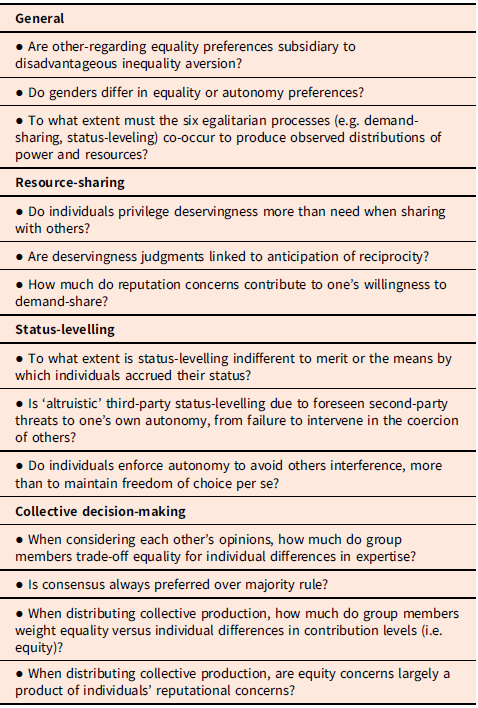



Target article
Egalitarianism is not equality: Moving from outcome to process in the study of human political organisation
Related commentaries (30)
A problem facing process-egalitarianism: Why do individuals surrender autonomy to political community?
Advantageous inequality aversion as a motivational component in egalitarian processes
Archaeology supports proposed redefinition of egalitarianism
Deliberation and egalitarianism
Egalitarian decision-making without equality: Lessons from need-based leadership and consensus in animal societies
Egalitarian for whom? Gender, dependency, and process-first egalitarianism
Egalitarian mechanisms without egalitarian societies
Egalitarianism and the social mind
Egalitarianism and women
Egalitarianism as hierarchy control: Predictive social minds and the evolution of anti-dominance institutions
Egalitarianism boosts collective intelligence
Egalitarianism is not equality: Extending process-based approaches through culture, identity, and power
Egalitarianism is not uniform: Integrating intersectionality into process-based accounts of human political organisation
Equity, equality, and egalitarianism: A context-dependent framework for resource allocation
Gender is critical to understanding how egalitarianism works
Harnessing the potential of egalitarian processes requires a psychology of inequality
Humans are not naturally egalitarian
One species, one nature, many niches
Outcomes remain crucial for identifying egalitarian systems
Patriarchy in hunter-gatherer societies
Processes versus outcomes in explaining (in)equality
Selfish reasons to be a meritocrat
Slavery as a process of maintaining extreme inequality
So there is no false consciousness in egalitarian societies?
The cultural transmission and evolution of egalitarianism
The developmental origins of egalitarianism
The problem is perfectionism: Egalitarianism is equality but not perfect equality
Understanding “societies of near-equals”
What holds the egalitarian processes together? The case for norms
When egalitarianism legitimizes inequality: Implications for gender disparities in organizations
Author response
Beyond egalitarian societies: Egalitarianism as a human universal