


7.1 Social Context: Conceptual Foundations
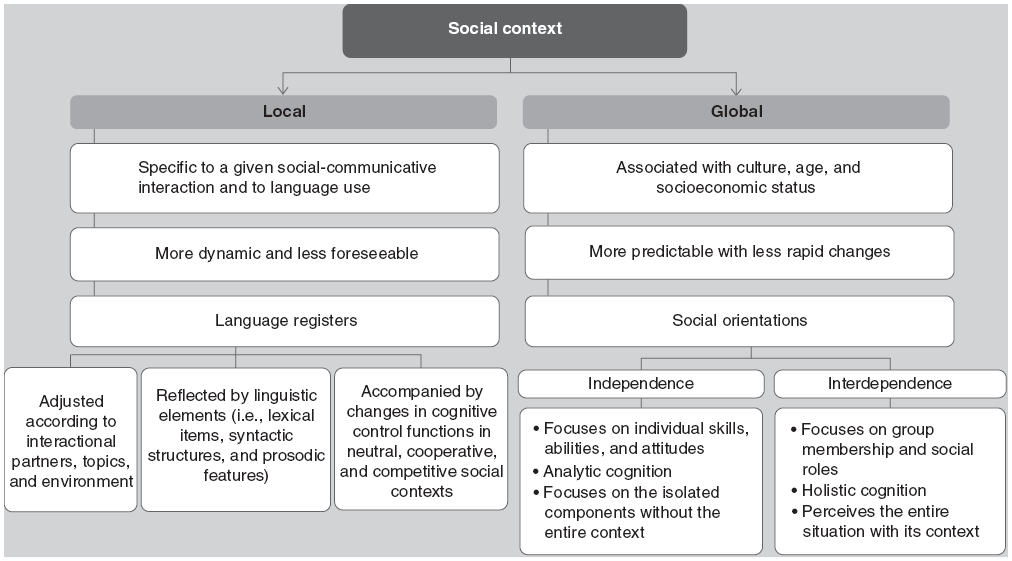
How does the social context, more specifically the presence of other people, affect children’s cognitive-linguistic control? The focus in this chapter is on the interactions between language and cognitive control across different social-communicative contexts. Used broadly in the literature, the term “social context” refers to different situations where other people are present socially and information about the social environment is processed to guide behavioral decisions (Wyer & Srull, Reference Wyer Jr and Srull2014). Typically, two levels of social context are distinguished: local and global (see Figure 7.1). The local level is specific to a given social-communicative interaction and to language use, while the global context is associated with culture, age, and socioeconomic status (Bazzanella, Reference Bazzanella2004). Although these two levels interact with each other, the local level is more dynamic and less foreseeable, whereas the global one is more predictable with less rapid changes. These differences in levels of social context have a strong effect on the development of cognitive control.
Levels of social context
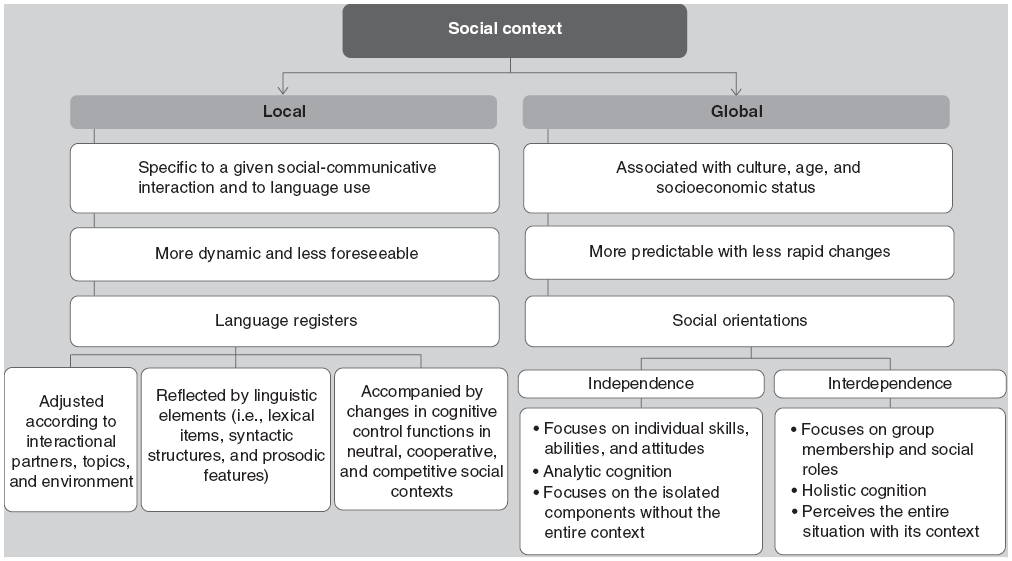
From a young age at the local level, children use different language registers across social contexts as they adjust their speech according to the various interactional partners and changing topics, as well as to the environment. Register use is reflected by a variety of linguistic elements, such as variations in lexical items, syntactic structures, and prosodic features (Wagner et al., Reference Wagner, Greene‐Havas and Gillespie2010). These variations in register use are also accompanied by changes in cognitive control functions, such as enhanced attentional focus in the presence of others (Klauer et al., Reference Klauer, Herfordt and Voss2008). The partner’s social role further influences children’s responses; they react differently in the presence of an observer compared to a competitor. These role variations across social contexts are associated with different cognitive control processes that either facilitate or inhibit certain responses (Fischer et al., Reference Fischer, Camba, Ooi and Chevalier2018). For example, children rely on different cognitive control functions in neutral, cooperative, and competitive social contexts. They adapt their cognitive system more efficiently in cooperative and competitive contexts, compared to a neutral one. This is reflected by fewer errors and faster response times. Interestingly, children’s pupil dilation, which is an indicator of engagement, also differs between the cooperative and competitive contexts as a function of age. Preschool-age children show greater pupil dilation (more engagement) during competition, whereas school-age children show greater pupil dilation in the cooperative context. Younger children enjoy more competition, whereas older children prefer cooperation with others (Fischer et al., Reference Fischer, Camba, Ooi and Chevalier2018). Moreover, these two social contexts show distinct interactions with different cognitive control functions. While cooperation has a direct facilitative effect on cognitive control, as it promotes the maintenance of socially shared goals in working memory (Qu, Reference Qu2011), competition can boost enjoyment and motivation and lead to an increase in cognitive control through positive emotions (Cagiltay et al., Reference Cagiltay, Ozcelik and Ozcelik2015; Plass et al., Reference Plass, O’Keefe, Homer, Case, Hayward, Stein and Perlin2013).
At the neurophysiological level, there are variations in prefrontal cortex activation across these social contexts – neutral, cooperative, and competitive. Contextual variations are associated with activation levels in different cortical areas. In the competitive context, activation levels are higher in the left pre-frontal cortex, whereas in cooperative and neutral contexts, activation is higher in the right pre-frontal cortex. Furthermore, this pattern is more pronounced in older (8–9-year-old) children than in younger (5–6-year-old) ones (Chevalier et al., Reference Chevalier, Jackson, Roux, Moriguchi and Auyeung2019).
These outcomes are in line with previous behavioral findings that have shown an age effect in children’s engagement of control. In response to increasing cognitive demands, older children utilize more differentiated control processes (e.g., inhibition control, working memory, monitoring, etc.) and use various strategies (e.g., verbalization and proactive strategies), compared to younger children (Camos and Barrouillet, Reference Camos and Barrouillet2011; Chatham et al., Reference Chatham, Frank and Munakata2009). These findings suggest that more flexible and more efficient cognitive control is available for use among older rather than younger children.
The results from these studies also highlight the role of motivation. Competition and motivation have been closely linked in studies with serious games, video games, and artistic creativity. In serious games, competition enhanced motivation and increased response accuracy (Cagiltay et al., Reference Cagiltay, Ozcelik and Ozcelik2015), whereas in video games, competition facilitated learning by eliciting increased interest and enjoyment that lead to a stronger goal-oriented behavior (Plass et al., Reference Plass, O’Keefe, Homer, Case, Hayward, Stein and Perlin2013). Thus, an increase in motivation exhibits a facilitative effect on cognitive control. Finally, children’s intrinsic and extrinsic motivations were also measured while performing an art project. Intrinsic motivation was positively correlated with creativity, while competition heightened intrinsic motivation as it added to the challenge of the task and to children’s level of excitement (Conti et al., Reference Conti, Collins and Picariello2001). Taking these findings together, competition increases children’s interest, excitement, enjoyment, and motivation, and these emotional factors lead to more goal-oriented behavior with enhanced cognitive control.
7.2 Social Context, Emotions, and Cognitive Control
A frequently asked question in the literature concerns the extent to which cognitive control depends on emotions in different social contexts. Social situations are typically emotionally charged, so it is essential to understand the influence of emotions and how they affect cognitive control across different social contexts. In recent years, it has been suggested that emotions play a critical role when recruiting cognitive control to perform goal-directed behavior or solve a conflict (Inzlicht et al., Reference Inzlicht, Bartholow and Hirsh2015). Behavioral regulation involves both emotional and cognitive control. For example, the control of negative emotions may lead to a limitation in expressive actions; it does not reduce unpleasant experiences, but it does decrease memory performance, and it increases the activation of the sympathetic nervous system. In contrast, cognitive control neutralizes negative emotions without impairing memory functions, although it might decrease physiological arousal (Gross, Reference Gross2002; Ochsner & Gross, Reference Ochsner and Gross2005). There is a large body of literature discussing emotion regulation and cognitive control in different social contexts in adults, while only preliminary findings have emerged in the literature on children and adolescents. Children’s emotion regulation is closely linked to their social relationships with peers and to the parent–child relationship within the family. Only a few studies have examined the links among social context, emotion regulation, and cognitive control, and most of them were focused on the effect of parental support on children’s cognitive control.
The quality of family relationships has a clear effect on children’s cognitive control abilities. This has been supported by both behavioral and neurophysiological studies. In families with negative parent–child relationships, adolescents were less able to allocate cognitive control resources efficiently, and poor cognitive control led to risk-taking behaviors (McCormick et al., Reference McCormick, Qu and Telzer2016). In contrast, higher parental control in low-chaos households predicted enhanced cognitive control in adolescents. In chaotic environments, children showed more neurocognitive vulnerability based on outcomes from a flanker task and a spatial interference task. However, in families with high-quality parent–child relationships, children performed better on the same cognitive control tasks. Hemodynamic correlates of cognitive control were assessed during task performance to support these behavioral findings at the neural level (Kim-Spoon et al., Reference Kim-Spoon, Maciejewski, Lee, Deater-Deckard and King-Casas2017).
The quality of the parent–child relationship may have a buffering effect on the interaction between socioeconomic status (SES) and cognitive control. Supportive parental behavior mitigates the negative effects of low SES on adolescents’ cognitive control skills. Lower cognitive control performance was observed in children from low-SES families only where there was a negative parent–child relationship (Li et al., Reference Li, Lindenmuth, Tarnai, Lee, KingCasas, Kim-Spoon and Deater-Deckard2022). These findings are in line with the resilience theory (e.g., Brody et al., Reference Brody, Yu, Nusslock, Barton, Miller, Chen and Sweet2019; Zimmerman et al., Reference Zimmerman, Stoddard, Eisman, Caldwell, Aiyer and Miller2013) that focuses on the positive aspects of adolescent development in negative social contexts and reveals the protective factors, such as parental warmth and support, that modify the effects of negative social contexts on cognitive and behavioral control. These outcomes already show a certain level of interaction between local and global level contexts (i.e., parent–child relationship and SES), and these results are further influenced by other global level components, such as cultural background.
7.3 Cultural Background and Cognitive Control
Changes in cognitive effort and control are also linked to global level variations in cultural background and social class (Grossmann & Varnum, Reference Grossmann and Varnum2011). Countries and cultures have been characterized by different cognitive styles, either more analytic (e.g., USA) or more holistic (e.g., Japan; Varnum et al., Reference Varnum, Grossmann, Kitayama and Nisbett2010), and these styles are associated with specific social orientations, such as independence and interdependence. In independent cultures, the self is separate from others, and the focus is on individual skills, abilities, and attitudes, whereas in interdependent cultures, the self relies more on social relationships, and the focus is on group membership and social roles (Kafetsios, Reference Kafetsios2019). Thus, independent cultures are characterized by analytic cognition and field independent attention – that is, the individual focuses more on the isolated components without the entire context – whereas interdependent cultures show more holistic cognition and field dependent attention, as they perceive the entire situation with its context. These variations are reflected in both behavioral and neurophysiological changes. For example, while watching pictures of natural scenes, the eye movements of American and Chinese students were compared in an eye-tracking study. The American students fixated sooner and longer on objects in the foreground, and they encoded more visual details than the Chinese students. In contrast, Chinese students showed more balanced fixations between the objects in the foreground and those in the background and exhibited more holistic processing of visual images. These differences in eye movements reflected differences in students’ cultural experiences and socialization. While in independent cultures, the focus was on objects, in interdependent cultures, it was on contexts (Chua et al., Reference Chua, Boland and Nisbett2005).
To further explore the relationship between cognitive control and cultural background, Canadian and Japanese children’s cognitive control skills were compared across studies. Moriguchi and colleagues (Reference Moriguchi, Evans, Hiraki, Itakura and Lee2012) examined task switching using two different versions of the Dimensional Change Card Sort task (DCCS). In the social version, a person who served as a model was introduced to a child. The model started sorting the cards according to one of the rules (i.e., either shape or color), and the child was asked to observe the model. After a certain number of trials, the model left the room, and the child was asked to sort the cards according to the other rule. In the traditional version, children were asked to sort, first according to one rule, then according to the other rule. While in the traditional version of the DCCS, Canadian and Japanese children performed similarly, in the social version of the task, the Japanese children performed more poorly than the Canadian youngsters. The Canadian children were able to follow the rules they were given, regardless of the behavior of the model, whereas the Japanese children were more highly affected by the behavior of the model, so they made more errors. The results suggest that children from cultures that are characterized by interdependence may become more attuned to the actions of others in their social environment than children who are socialized in cultures that are more independent.
Similar differences were found in a study on selective attention using variations of the flanker test with children from Canada and Japan (Senzaki et al., Reference Senzaki, Wiebe, Masuda and Shimizu2018). In the social version, children were instructed to detect the emotion (happy or sad) of the central figure that was surrounded by four other faces expressing different emotions. In the nonsocial version, children were presented with the widely used fish flanker task. In this latter task, children had to respond to the direction of the central fish, that was surrounded by flankers that either faced the same or opposing directions. In the nonsocial, fish-flanker task, all children made more errors in the incongruent conditions (i.e., where the central fish was surrounded by others facing the opposite direction) than in the congruent ones (i.e., the central fish was surrounded by others facing the same direction). Both the Canadian and the Japanese children showed an interference effect in this traditional task. In contrast to these findings, in the social, facial emotions flanker task, only the Japanese children showed an interference effect, indicating that these children were more strongly affected by the expressions of the faces that surrounded the central figure than the Canadian children were. The Canadian children were less distracted by the social context of the target. These findings provided further support for the interactions between local- and global-level components and their impact on cognitive control, including cultural differences in social orientation. It is important to note that many participants in these cultural studies spoke multiple languages. Therefore, we do not know whether the number of languages spoken affected the relationship between the social context and cognitive control.
7.4 Social Context and Cognitive Control in Children with Different Language Skills
7.4.1 Bilingual Social Contexts and Cognitive Control
Children from different cultural backgrounds often speak multiple languages; therefore, the social context is closely linked to both cognitive and language control – two systems that are interdependent. In their seminal work, Green and Abutalebi (Reference Green and Abutalebi2013) explored the cognitive-linguistic demands of three social contexts: single-language use, dual-language use, and dense code-switching. Bilingual speakers in the single-language context typically communicate with a monolingual person. Therefore, they must suppress one of their languages to prevent cross-language intrusion and maintain the current language goal. From a cognitive flexibility perspective, this context requires mostly stability, strengthening the current language representations by increasing attentional focus, monitoring, and resistance to interference. In a dual-language context, however, the bilingual speaker uses one language with one person and another language with a different person within the same social context. This situation also requires goal maintenance and monitoring but additionally, the speaker also needs to be ready to switch to the other language when addressing the other conversational partner. Thus, both languages have to be highly activated, and attention has to be focused on the conversational partners to switch from one language to the other when needed. This context requires increased stability while focusing on one partner and enhanced flexibility when switching to the other partner. Thus, this social context is highly demanding on cognitive control. Finally, dense code-switching contexts involve communicative partners that speak the same languages and are ready to switch between them frequently. A bilingual individual who is involved in a dense code-switching context must identify conversational cues and engage or disengage in one language or the other accordingly. This context requires intense monitoring, highly focused attention to the conversational cues, and a great amount of flexibility. Taken together, these three social contexts require different levels of control and flexibility to adapt the cognitive system to the changing task demands. Moreover, the same speaker may be involved in all three situations to varying extents.
To specifically target the cognitive control skills across these three bilingual social contexts, Hartanto and Yang (Reference Hartanto and Yang2020) administered nine cognitive control tasks to participants across these contexts and performed a latent variable analysis. Their data revealed that the dual-language context significantly predicted task switching, whereas the dense code-switching context predicted inhibitory control and goal maintenance. Although this latter finding was in contrast to the authors’ original hypothesis, which predicted an association between performance in task switching and the dense code-switching context, the results are in line with the predictions of various cognitive control models (e.g., Botvinick & Cohen, Reference Botvinick and Cohen2014; Cohen, Reference Cohen and Egner2017). When a certain behavior, such as switching occurs frequently, as in the dense code-switching context, less control is needed, and switching becomes more automatic than in light-switching conditions where switching occurs less frequently. However, the dense code-switching context still requires the management of coactivated language structures. Therefore, inhibitory control is still needed to ensure rule-based switching.
The adaptation of the cognitive system across these bilingual contexts may further vary, depending on whether the dominant or nondominant language is being used by the bilingual speaker (Timmer et al., Reference Timmer, Christoffels and Costa2019). Timmer and colleagues applied a common language-switching paradigm, but the frequency with which the dominant and the nondominant languages were used was manipulated. This variation in language context revealed the following pattern. When the switching task involved mainly the dominant language, a symmetric switch cost (i.e., the difference in reaction time between the stay and switch trials) and global slowing of the dominant language were observed. In contrast, when the switching task involved mainly the nondominant language, an asymmetric switching cost with larger costs for the nondominant language and no global slowing down of the dominant language were observed. These results show that the language context has a clear effect on how the cognitive system functions; it reveals that the system adapts flexibly to contextual changes. These outcomes suggest that the activation levels of the two languages are not the same and are altered by the language context.
The above findings show that the cognitive system adapts flexibly to changing conditions whether they are cultural (e.g., cultural orientation) or linguistic (e.g., dominant vs. nondominant language). To follow up on these results, Liu and colleagues (Reference Liu, Timmer, Jiao, Yuan and Wang2019) examined the combined effects of language context and social cultural identity on the control system by using a language-switching paradigm as well. The authors were particularly interested in the impact of nonlinguistic factors, such as faces, on the control system. In everyday life, faces help us to decide which language to use. For example, a Chinese-English bilingual child may choose to speak Chinese with someone who has an Asian face and English with someone who has a Caucasian face. Previous research with young adults has shown that the visual cue of a sociocultural face may stimulate language selection (Li et al., Reference Li, Yang, Suzanne Scherf and Li2013). Liu and colleagues (Reference Liu, Timmer, Jiao, Yuan and Wang2019) tested the social-cultural identity and language control across three conditions in college students. In the baseline condition, language-switching occurred with no faces; in the congruent condition, Asian faces were presented with the Chinese (dominant) language; and in the incongruent condition, Caucasian faces occurred with the Chinese (dominant) language. In contrast to the baseline condition, where a symmetric switch cost was found, there was an asymmetric switch cost, with a larger cost for the nondominant language than the dominant one in the congruent condition. The presentation of an Asian face while switching to Chinese facilitated the reactivation of the suppressed dominant language, which reduced the switch cost compared to that of the nondominant language (English). The switch cost in the incongruent condition was somewhat similar to the baseline. However, the overall response time was slower, indicating an interference effect. Thus, when the social face and language matched each other, language-switching was facilitated, whereas an interference effect (i.e., overall slowing) was observed when the face did not match the language. The cognitive system adapted to the changing conditions in both cases, but this adaptation was stimulated in the congruent context and hindered in the incongruent context.
These examples show a complex but quite consistent relationship among language control, cognitive control, and the social context in neurotypical children and young adults. A further question is whether these interactions differ in children with language impairment.
7.4.2 Social Context and Emotional and Cognitive Control in Children with Developmental Language Disorder (DLD)
While a rich social context is needed to facilitate language and cognitive development, particularly in children with DLD, it is difficult to develop and maintain appropriate social relationships without having adequate language skills (Andrés-Roqueta et al., Reference Andrés-Roqueta, Adrian, Clemente and Villanueva2016). Indeed, children with DLD exhibit a weakness in forming successful social interactions, including peer relationships (Conti-Ramsden & Botting, Reference Conti-Ramsden and Botting2004). They often perform at the extreme ends of the behavioral continuum; they are either quiet and withdrawn, they do not initiate conversations, and tend to play alone, or they are disruptive, occasionally even aggressive with others. These children more often employ nonverbal coping strategies, regardless of their appropriateness to the social situation (Marton et al., Reference Marton, Abramoff and Rosenzweig2005), and they use fewer conflict resolution and negotiation strategies than their typically developing peers (Brinton et al., Reference Brinton, Fujiki and McKee1998; Stevens & Bliss, Reference Stevens and Bliss1995). A number of these behavioral patterns indicate that in addition to language impairment, children with DLD also exhibit weaknesses in understanding why other people behave in certain ways in different social contexts. This problem is particularly relevant during the school years, when peer relationships become more complex, and children need to compete and collaborate with one another. It has been shown in the developmental literature that peer relationships play a critical role in both children’s social and emotional development (van der Wilt et al., Reference van der Wilt, van der Veen, van Kruistum and van Oers2019).
Very few sociometric studies have involved children with DLD, and the findings have been mixed (Andrés-Roqueta et al., Reference Andrés-Roqueta, Adrian, Clemente and Villanueva2016; Gertner et al., Reference Gertner, Rice and Hadley1994; McCabe & Meller, Reference McCabe and Meller2004). Nevertheless, children with DLD tend to receive more negative nominations and show lower social acceptance than their peers. The correlation between peer acceptance and children’s social cognitive skills increases with age. Rejection by peers often leads to anxiety, loneliness, and depression (Conti-Ramsden & Botting, Reference Conti-Ramsden and Botting2004; Reijntjes et al., Reference Reijntjes, Kamphuis, Prinzie and Telch2010) or to conduct problems and substance abuse in adolescents (Dodge et al., Reference Dodge, Lansford, Salzer Burks, Bates, Pettit, Fontaine and Price2003). Anxiety and depression have well-known negative effects on cognitive control, particularly on attention, memory, and processing speed. In highly demanding cognitive conditions, anxiety causes a slowdown in processing reflected by difficulties with attention shifting within and between tasks, resulting in a decrease in processing efficiency (e.g., Derakshan et al., Reference Derakshan, Smyth and Eysenck2009; Eysenck et al., Reference Eysenck, Derakshan, Santos and Calvo2007). Depression has a negative effect on cognitive control, too, but depression-related impairments are primarily linked to motivational components, in addition to attention and memory problems (e.g., Gotlib & Joormann, Reference Gotlib and Joormann2010; Grahek et al., Reference Grahek, Shenhav, Musslick, Krebs and Koster2019). These negative effects of anxiety and depression on cognitive control, however, have not been examined in children with DLD.
Given that friendships serve as protective factors for children (de Bruyn et al., Reference de Bruyn, Cillessen and Wissink2010), negative peer acceptance is often associated with bullying and victimization in adolescents. Peer victimization is more frequent in children with DLD than in their peers; these children are subjects of both physical and verbal bullying and unlike in typically developing children, friendships do not serve as buffers in children with DLD (Conti-Ramsden & Botting, Reference Conti-Ramsden and Botting2004; Redmond, Reference Redmond2011). This finding might be related to a number of factors. First, bully victimization is directly associated with weaknesses in social competence, powerlessness, low self-esteem, peer rejection, depression, and anxiety (Evans et al., Reference Evans, Smokowski and Cotter2014), which behaviors are frequently observed in children with DLD (Marton et al., Reference Marton, Abramoff and Rosenzweig2005). Second, the quality of friendships that children with DLD have is not strong enough to serve as a protective factor. Results from typically developing children indicate that friends who are rejected by their peers do not provide the same buffering effect in their friendships as children who are well accepted by others (Schwartz et al., Reference Schwartz, Gorman, Dodge, Pettit and Bates2008). Thus, children with DLD may not only have fewer friends than their peers, but their friends may be children who exhibit lower social status among their peers.
These findings show that the difficulties with peer relationships that children with DLD experience are related to multiple cognitive, linguistic, and social issues. This notion was further supported by the results from school-age children who were presented with hypothetical social scenarios to assess negotiation and conflict resolution skills, as well as to identify children’s coping strategies (Marton et al., Reference Marton, Abramoff and Rosenzweig2005). Children with DLD performed more poorly in every aspect than their peers; their social cognitive scores were significantly lower than their language scores, indicating that their social relationship problems exceeded their language difficulties. Children with DLD tended to use nonverbal means in place of speech; these reactions included physical aggressive behavior, such as pushing and shoving, and withdrawn reactions, such as relinquishing to the partner and avoiding the negotiation process. Notably, a number of these problems were associated with these children’s poor cognitive control skills. The error analysis data revealed that children with DLD exhibited difficulties with analyzing the social context and setting goals to either resolve a conflict or to initiate an interaction. They struggled with planning and monitoring the social situation to negotiate and/or collaborate with their peers. Similar to the findings of Brinton and colleagues (Reference Brinton, Fujiki and McKee1998), children’s remarks reflected their weaknesses in recognizing the perspectives and needs of their partners within the social context.
Considering previous findings in five-year-old, typically developing children who indicated a strong relationship between affective perspective taking and cognitive control, the lack of perspective taking in children with DLD might be related to their weaknesses in cognitive control. In typically developing children, affective perspective taking showed a correlation with children’s empathy. Those children who showed more empathy were able to take the cognitive and the emotional perspectives of others more efficiently. The outcomes further supported the hypothesis that cognitive control and emotion regulation are integrated systems that underlie empathic responses in children (Hinnant & O’Brien, Reference Hinnant and O’Brien2007). Thus, children with DLD show multiple handicaps in initiating and maintaining peer relationships and friendships. In addition to their language impairment, they also show difficulties in perspective taking that seem to be related to their weakness in cognitive control. These findings have significant implications for clinical intervention; it is not enough to focus on these children’s language abilities; other cognitive and social skills must be considered during intervention as well.
7.5 Conclusions
There is a close relationship among social context, emotion regulation, and cognitive control. Social context at the local level (e.g., register use) is more dynamically changing than the context at the global level (e.g., culture, SES, age), which is more predictable. Both local and global changes have significant effects on children’s cognitive control and language performance. Moreover, these contexts interact with one another, and may either facilitate or interfere with children’s cognitive-linguistic functions. These effects are reflected at both the behavioral and neural levels. The adaptation of the cognitive system in different social contexts is also influenced by the language skills of children. While typically developing bilingual children may show more flexibility across contexts than their peers, children with DLD may exhibit weaknesses in forming successful social interactions. Their language and cognitive control problems may be intensified by particular social contexts (e.g., peer interactions). Taken together, children react differently to the presence of other people in social situations, and the social context affects their cognitive linguistic performance. Children’s behavior across social situations is most strongly influenced by their age, cultural background, socioeconomic status, language skills, and emotion regulation. Research and clinical work targeting children’s cognitive-linguistic skills must consider the effects of these contextual influences.

 Open access