By associating drug consumption with emotional experience and reward, Müller & Schumann (M&S) present a specific example of the general relationship of consumer choice to reinforcement contingencies and related patterns of affect. This suggests that drug consumption, from the recreational to the addictive, can be modeled as consumer behavior.
Consumer behaviors range from routine purchasing of staples, through credit buying, environmental despoliation, and compulsive purchasing, to extreme consumption like addiction. Behaviors on this continuum (Foxall Reference Foxall2010) are influenced by similar genetic, neurobiological, economic, contextual, and cultural factors. Biosocial science seeks to unravel how these elements combine to produce consumer behaviors with such disparate outcomes, and this requires a theory of consumption that integrates the contextual with the psychobiological. Positioning a behavior on the continuum reflects the degree of impulsivity/self-control it exhibits. All consumption is a choice and exhibits matching (Herrnstein Reference Herrnstein, Rachlin and Laibson1997), which can underlie discounting; hence, behaviors at all locations on the continuum invoke temporal discounting. Occasional drug use falls within this routine category. More impulsive purchases, say of durables, lead consumers to incur expensive debt that reflects heavy discounting. Impulsivity is also apparent in environmental despoliation, whereas compulsive purchasing borders on addiction; beyond this, problem gambling, problem drinking, and overeating to the point of obesity involve delay discounting at a very high rate.
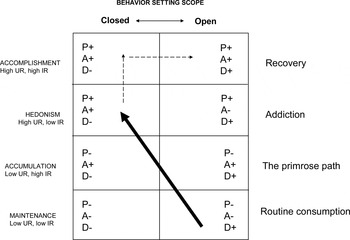
In the behavioral perspective model (BPM), consumer behaviors result from the pattern of reinforcement signaled by the consumer behavior setting (Foxall Reference Foxall2004). Two sources of reinforcement emerge, utilitarian (UR; functional) and informational (IR; symbolic/social), the combination of which provides a framework of four major classes of consumer behavior based on the pattern of reinforcement that shapes and maintains them (Fig. 1). The consumer behavior setting, primed by the consumer's learning history, predicts these outcomes contingent on the enactment of the behavior. The scope of the setting, the range of behaviors likely to be reinforced, completes the model. Closed settings like banks, dentists' offices, and gymnasia encourage a single pattern of behavior or at most a few; open settings – bars, swap meets, department stores – permit more behaviors and are thus open. Empirical studies (Foxall Reference Foxall2011) reveal these structural characteristics consistently elicit emotional responses: Utilitarian reinforcement is associated with pleasure, informational reinforcement with arousal, and setting openness with dominance (Mehrabian & Russell Reference Mehrabian and Russell1974).
Figure 1.
Dynamics of consumer choice. Continuous arrow shows route from self-control (low pleasure, low arousal, high dominance) to impulsivity (high pleasure, low arousal, low dominance). Broken arrows show possible route to recovery. P = pleasure; A = arousal; D = dominance; + = high; − = low.
Consumer behaviors that make up the continuum are defined by the pattern of reinforcement and scope of the setting maintaining them. Routine consumption corresponds to the operant class Maintenance, determined by low levels of both UR and IR. Closure is imposed by physiological limits to ingestion. Recreational drug use is another example. Maintenance in closed settings includes paying taxes and is also exemplified by medically supervised drug use.
For some consumers, there is a progression from this routine consumption, said to be under the control of executive brain functions, that entails delayed deleterious effects. These behaviors range from unplanned purchasing, which accounts for half of retail sales, to installment buying and credit card purchases, littering, and related cases of environmental spoliation, all of which can be described in terms of melioration, the choice of whatever is more immediately advantageous. This is an insidious progression. The behavior is not halted even when its deleterious effects become apparent: rather, intertemporal choice involves preference switching, from the resolve to act for one's long-term best interests to indulgence in harmful behavior, to regret for one's deviation and desire to overcome it (Ainslie Reference Ainslie1992). Patterns of reinforcement contingencies, explored in consumer psychology but not generally in drug use studies, control the progression.
The primrose path is governed by symbolic, as well as functional, results of eating and drinking, use of drugs for social leisure, and organized gambling in public places. UR is less important than the symbolic reward that inheres in IR. The primrose path begins in relatively open settings before contexts become progressively more closed as reinforcing social approval is overtaken by the addictive consequences of indulgence. Why an individual moves from routine consumption to the primrose path is apparent from embedding behavior in a network of contingencies that control the patterns of choice of which any particular response (say, drinking or abstaining from alcohol) is a part. The more long-term a pattern of behavior has become, the more costly it is to the individual to interrupt it.
The path from sobriety to addiction runs from Maintenance in open settings to Hedonism in closed settings; if recovery occurs, the sequence continues to Accomplishment in closed and then open settings (Fig. 1). Maintenance in open settings enables the behavior pattern of moderate consumption; moving from there into Accumulation involves entering the primrose path; the next stage, Hedonism in closed settings, involves gaining more pleasure from consumption and less by way of interpersonal reward: the path to lonely addiction (Rachlin Reference Rachlin2000); finally, Accomplishment in closed settings involves restoration of more moderate behavior.
In line with M&S's target article, the BPM relates emotional responses to the contingencies of reinforcement that account for the continuum of consumer behavior. We propose that this model has the capacity to complement the detailed and specific analysis of drug use proposed by M&S, not by seeking to absorb or supersede it, but by providing an integrative framework. The patterns of reinforcement it embraces can be related not only to consumption behaviors, but also to their emotional concomitants; the scope of the consumer behavior setting is closely related to the physiological role of drug ingestion and processing, and the classes of consumer behavior indicate how behaviors under the control of self-regulation, impulsiveness, and compulsion are controlled and modifiable. All in all, the conceptualization of drug use as consumer behavior provides a fruitful research program that unites economic psychology and drug studies.





By associating drug consumption with emotional experience and reward, Müller & Schumann (M&S) present a specific example of the general relationship of consumer choice to reinforcement contingencies and related patterns of affect. This suggests that drug consumption, from the recreational to the addictive, can be modeled as consumer behavior.
Consumer behaviors range from routine purchasing of staples, through credit buying, environmental despoliation, and compulsive purchasing, to extreme consumption like addiction. Behaviors on this continuum (Foxall Reference Foxall2010) are influenced by similar genetic, neurobiological, economic, contextual, and cultural factors. Biosocial science seeks to unravel how these elements combine to produce consumer behaviors with such disparate outcomes, and this requires a theory of consumption that integrates the contextual with the psychobiological. Positioning a behavior on the continuum reflects the degree of impulsivity/self-control it exhibits. All consumption is a choice and exhibits matching (Herrnstein Reference Herrnstein, Rachlin and Laibson1997), which can underlie discounting; hence, behaviors at all locations on the continuum invoke temporal discounting. Occasional drug use falls within this routine category. More impulsive purchases, say of durables, lead consumers to incur expensive debt that reflects heavy discounting. Impulsivity is also apparent in environmental despoliation, whereas compulsive purchasing borders on addiction; beyond this, problem gambling, problem drinking, and overeating to the point of obesity involve delay discounting at a very high rate.
In the behavioral perspective model (BPM), consumer behaviors result from the pattern of reinforcement signaled by the consumer behavior setting (Foxall Reference Foxall2004). Two sources of reinforcement emerge, utilitarian (UR; functional) and informational (IR; symbolic/social), the combination of which provides a framework of four major classes of consumer behavior based on the pattern of reinforcement that shapes and maintains them (Fig. 1). The consumer behavior setting, primed by the consumer's learning history, predicts these outcomes contingent on the enactment of the behavior. The scope of the setting, the range of behaviors likely to be reinforced, completes the model. Closed settings like banks, dentists' offices, and gymnasia encourage a single pattern of behavior or at most a few; open settings – bars, swap meets, department stores – permit more behaviors and are thus open. Empirical studies (Foxall Reference Foxall2011) reveal these structural characteristics consistently elicit emotional responses: Utilitarian reinforcement is associated with pleasure, informational reinforcement with arousal, and setting openness with dominance (Mehrabian & Russell Reference Mehrabian and Russell1974).
Dynamics of consumer choice. Continuous arrow shows route from self-control (low pleasure, low arousal, high dominance) to impulsivity (high pleasure, low arousal, low dominance). Broken arrows show possible route to recovery. P = pleasure; A = arousal; D = dominance; + = high; − = low.
Consumer behaviors that make up the continuum are defined by the pattern of reinforcement and scope of the setting maintaining them. Routine consumption corresponds to the operant class Maintenance, determined by low levels of both UR and IR. Closure is imposed by physiological limits to ingestion. Recreational drug use is another example. Maintenance in closed settings includes paying taxes and is also exemplified by medically supervised drug use.
For some consumers, there is a progression from this routine consumption, said to be under the control of executive brain functions, that entails delayed deleterious effects. These behaviors range from unplanned purchasing, which accounts for half of retail sales, to installment buying and credit card purchases, littering, and related cases of environmental spoliation, all of which can be described in terms of melioration, the choice of whatever is more immediately advantageous. This is an insidious progression. The behavior is not halted even when its deleterious effects become apparent: rather, intertemporal choice involves preference switching, from the resolve to act for one's long-term best interests to indulgence in harmful behavior, to regret for one's deviation and desire to overcome it (Ainslie Reference Ainslie1992). Patterns of reinforcement contingencies, explored in consumer psychology but not generally in drug use studies, control the progression.
The primrose path is governed by symbolic, as well as functional, results of eating and drinking, use of drugs for social leisure, and organized gambling in public places. UR is less important than the symbolic reward that inheres in IR. The primrose path begins in relatively open settings before contexts become progressively more closed as reinforcing social approval is overtaken by the addictive consequences of indulgence. Why an individual moves from routine consumption to the primrose path is apparent from embedding behavior in a network of contingencies that control the patterns of choice of which any particular response (say, drinking or abstaining from alcohol) is a part. The more long-term a pattern of behavior has become, the more costly it is to the individual to interrupt it.
The path from sobriety to addiction runs from Maintenance in open settings to Hedonism in closed settings; if recovery occurs, the sequence continues to Accomplishment in closed and then open settings (Fig. 1). Maintenance in open settings enables the behavior pattern of moderate consumption; moving from there into Accumulation involves entering the primrose path; the next stage, Hedonism in closed settings, involves gaining more pleasure from consumption and less by way of interpersonal reward: the path to lonely addiction (Rachlin Reference Rachlin2000); finally, Accomplishment in closed settings involves restoration of more moderate behavior.
In line with M&S's target article, the BPM relates emotional responses to the contingencies of reinforcement that account for the continuum of consumer behavior. We propose that this model has the capacity to complement the detailed and specific analysis of drug use proposed by M&S, not by seeking to absorb or supersede it, but by providing an integrative framework. The patterns of reinforcement it embraces can be related not only to consumption behaviors, but also to their emotional concomitants; the scope of the consumer behavior setting is closely related to the physiological role of drug ingestion and processing, and the classes of consumer behavior indicate how behaviors under the control of self-regulation, impulsiveness, and compulsion are controlled and modifiable. All in all, the conceptualization of drug use as consumer behavior provides a fruitful research program that unites economic psychology and drug studies.