






No CrossRef data available.
Article contents
Accuracy in social judgment does not exclude the potential for bias
Published online by Cambridge University Press: 13 May 2022
Abstract
Cesario claims that all bias research tells us is that people “end up using the information they have come to learn as being probabilistically accurate in their daily lives” (sect. 5, para. 4). We expose Cesario's flawed assumptions about the relationship between accuracy and bias. Through statistical simulations and empirical work, we show that even probabilistically accurate responses are regularly accompanied by bias.
Information
- Type
- Open Peer Commentary
- Information
- Copyright
- Copyright © The Author(s), 2022. Published by Cambridge University Press
References
Carpinella, C. M., & Johnson, K. L. (2013). Appearance-based politics: Sex-typed facial cues communicate political party affiliation. Journal of Experimental Social Psychology, 49(1), 156–160.CrossRefGoogle Scholar
Freeman, J. B., Johnson, K. L., Ambady, N., & Rule, N. O. (2010). Sexual orientation perception involves gendered facial cues. Personality and Social Psychology Bulletin, 36, 1318–1331.CrossRefGoogle ScholarPubMed
Hogarth, R. M., & Karelaia, N. (2007). Heuristic and linear models of judgment: Matching rules and environments. Psychological Review, 114(3), 733.CrossRefGoogle ScholarPubMed
Johnson, K. L., Gill, S., Reichman, V., & Tassinary, L. G. (2007). Swagger, sway, and sexuality: Judging sexual orientation from body motion and morphology. Journal of Personality and Social Psychology, 93(3), 321–334.CrossRefGoogle ScholarPubMed
Rule, N. O., Garrett, J. V., & Ambady, N. (2010). On the perception of religious group membership from faces. PLoS One, 5(12), e14241.CrossRefGoogle ScholarPubMed
Stern, C., West, T. V., Jost, J. T., & Rule, N. O. (2013). The politics of Gaydar: Ideological differences in the use of gendered cues in categorizing sexual orientation. Journal of Personality and Social Psychology, 104(3), 520.CrossRefGoogle ScholarPubMed
Tversky, A., & Kahneman, D. (1974). Judgment under uncertainty: Heuristics and biases. Science, 185(4157), 1124–1131.CrossRefGoogle ScholarPubMed
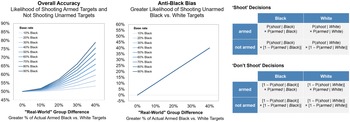
Figure 1. We varied the probability of Black people being armed, P(armed|Black), 50–90%, with P(armed|White) fixed at 50%. Given Cesario's claims about base rates in police encounters, we also varied P(Black) 10–90%. Per Cesario, we assume that participants accurately encode “real-world” statistics; thus, participants decide to shoot targets based on the likelihood that a target's racial group is armed in the environment: P(shoot|Black) = P(armed|Black) and P(shoot|White) = P(armed|White). Per Cesario, we have reproduced these conditional probabilities in the experimental context. Thus, if Black people are armed at a rate of 70% in the “real-world,” which participants encode, then 70% of Black targets in the experiment are armed. As the group difference [P(armed|Black) > P(armed|White)] grew larger, overall accuracy increased, but so did anti-Black bias. A higher base rate (proportion of Black relative to White trials in the experiment) intensified these increases in overall accuracy but did not influence anti-Black bias. Thus, with larger group differences that are accurately encoded, overall accuracy increases, but so does bias.
Target article
Related commentaries (29)
Accuracy in social judgment does not exclude the potential for bias
Beyond stereotypes: Prejudice as an important missing force explaining group disparities
Cesario's framework for understanding group disparities is radically incomplete
Experimental studies of bias: Imperfect but neither useless nor unique
External validity of social psychological experiments is a concern, but these models are useful
Missing perspective: Marginalized groups in the social psychological study of social disparities
Social bias insights concern judgments rather than real-world decisions
The only thing that can stop bad causal inference is good causal inference
We applaud Cesario's appeal to increase the realism of social psychological science and his plea for greater appreciation of effect sizes. However, Cesario's more fundamental critiques of social psychology's research on group bias hinge on misguided theoretical assumptions and fundamental errors. Cesario describes a “Standard Paradigm” in bias research that, he argues, suffers from three flaws. While we take issue with each of these arguments, we focus here on his “Flaw of Missing Forces” (sect. 3 and Table 1) – perhaps the most controversial of the three.
First, Cesario misrepresents the research he describes. Contrary to Cesario's claims, few studies explicitly explore the link between implicit bias and real-world group disparities. Instead, most bias research aims to document group-based distinctions in individuals' decisions, over and above whatever disparities exist in the real world. For example, it is valuable to know whether individuals use gender as a heuristic in science, technology, engineering, and mathematics (STEM) admissions and hiring decisions because demonstrating such a bias illuminates one factor contributing to gender-based differences in STEM representation. Cesario creates a strawman by suggesting that bias research has failed to offer single-factor explanations for complex phenomena. In our view, that is rarely, if ever, the goal of bias research.
Cesario makes a more egregious error by implying that any accuracy in decision-making obviates bias or the need to study it. He argues that bias researchers ignore “the behavior of the targets themselves and the cognitive, motivational, and behavioral differences that exist across groups” (sect. 3.2, para. 1). He concludes that bias research merely tells us that “people learn the conditional probabilities of the behavior of different groups” (sect. 5, para. 3) and what is “probabilistically accurate in their daily lives” (sect. 5, para. 4). Thus, Cesario claims that group-based distinctions in decision-making are an accurate and rational response to social reality. His analysis implies a zero-sum tradeoff between accuracy and bias. We challenge these assertions on both empirical and fundamental statistical grounds.
Existing evidence shows that accuracy is regularly accompanied by bias and, furthermore, that even “probabilistically accurate” responses allow significant opportunity for error-prone behavior. For example, although there is considerable variability in the physical attributes of gay men and lesbians, evidence shows that members of these groups, on average, appear more gender-atypical than their heterosexual counterparts. Moreover, perceivers stereotypically assume gay men and lesbians possess gender-atypical attributes and use these stereotypes to judge others' sexual orientation. Such judgments, according to Cesario, could be construed as a rational response to social reality, negating the need to identify bias in these judgments. However, research shows that using such stereotypes increases accuracy while simultaneously producing bias and overgeneralization (Freeman, Johnson, Ambady, & Rule, Reference Freeman, Johnson, Ambady and Rule2010; Johnson, Gill, Reichman, & Tassinary, Reference Johnson, Gill, Reichman and Tassinary2007; Stern, West, Jost, & Rule, Reference Stern, West, Jost and Rule2013). When judging targets who do not conform to stereotypes, participants predictably misapply these stereotypes and make erroneous judgments (Freeman et al., Reference Freeman, Johnson, Ambady and Rule2010). Similar effects have been observed in other forms of visually based social judgment (e.g., Carpinella & Johnson, Reference Carpinella and Johnson2013; Rule, Garrett, & Ambady, Reference Rule, Garrett and Ambady2010). Of course, this is hardly a new idea: Tversky and Kahneman (Reference Tversky and Kahneman1974, p. 1131) noted long ago that heuristics such as stereotypes are “highly economical and usually effective, but they lead to systematic and predictable errors.” Moreover, the existence of probabilistically accurate responses accompanied by predictable errors is reflected in classic Brunswikian theory and conventional models of human judgment (Hogarth & Karelaia, Reference Hogarth and Karelaia2007). Thus, while some stereotypes can result in more accurate responses in the aggregate, they can also increase systematic biases that warrant scrutiny.
We leveraged probability theory in the context of Cesario's centerpiece example of racial bias in the first-person-shooter-task (FPST) to illuminate these patterns. Across 45 simulated FPST experiments, we impose the controversial group differences Cesario describes: that Black people are more armed than White people in the real world (Fig. 1). Our simulations show that, while decision-makers' use of such “real-world” statistics does increase overall accuracy (i.e., likelihood of shooting only people who are armed), it also increases the rate of racial bias (i.e., greater likelihood of shooting unarmed targets when Black rather than White). Note that this general pattern would be observed even if diagnostic visual cues (e.g., weapon) were permitted to play a role as well; so long as race information is used, accuracy and bias are linked. Thus, if real-world group differences exist, encoding them can improve general accuracy, as Cesario implies, but it cannot eliminate bias. Cesario suggests that investigating bias when people are generally accurate is unnecessary. Quite the opposite, we argue that probabilistically accurate responses are regularly accompanied by predictable errors and overgeneralized stereotyping.
We varied the probability of Black people being armed, P(armed|Black), 50–90%, with P(armed|White) fixed at 50%. Given Cesario's claims about base rates in police encounters, we also varied P(Black) 10–90%. Per Cesario, we assume that participants accurately encode “real-world” statistics; thus, participants decide to shoot targets based on the likelihood that a target's racial group is armed in the environment: P(shoot|Black) = P(armed|Black) and P(shoot|White) = P(armed|White). Per Cesario, we have reproduced these conditional probabilities in the experimental context. Thus, if Black people are armed at a rate of 70% in the “real-world,” which participants encode, then 70% of Black targets in the experiment are armed. As the group difference [P(armed|Black) > P(armed|White)] grew larger, overall accuracy increased, but so did anti-Black bias. A higher base rate (proportion of Black relative to White trials in the experiment) intensified these increases in overall accuracy but did not influence anti-Black bias. Thus, with larger group differences that are accurately encoded, overall accuracy increases, but so does bias.
Cesario is incorrect in arguing that target-driven differences between groups are a “missing force” that invalidates decision-makers' bias or the need to study it. Using past empirical work and basic probability theory, we have shown that, even if group differences exist and people take note of them, that knowledge will regularly be misapplied and result in bias. Thus, understanding how flawed individual decision-making plays a role in disparate group outcomes is a worthwhile endeavor. Whatever additional forces create real-world group disparities, people have the opportunity to amplify or attenuate those disparities through their judgment and behavior.
Financial support
This work was supported by National Science Foundation grants BCS-1654731 to J.B.F. and BCS-2017245 to K.L.J.
Conflict of interest
None.